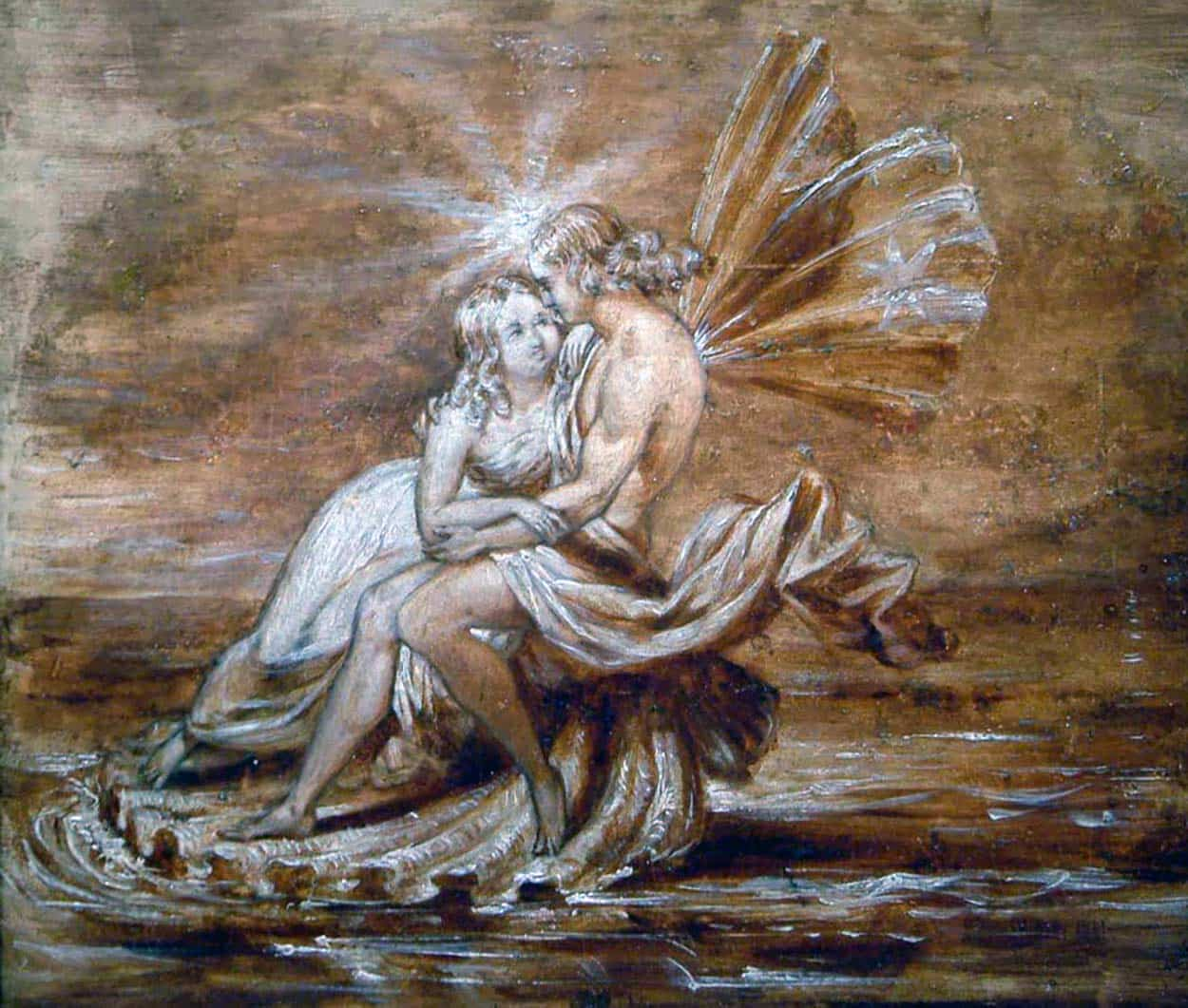
Beneath the crystal cascades of European forest waterfalls, the mossy banks of mountain streams, and the mist-shrouded reed beds of medieval lakes lived one of the most poignant and romantic beings of Western folklore: the Undine (or Ondine). Envisioned as a breathtakingly beautiful female water elemental who looked indistinguishable from a mortal noblewoman when she stepped ashore in a shimmering gown, the Undine lacked only one thing possessed by human beings—an immortal soul—which she could acquire only by leaving the waters to marry a mortal knight, at the price of a lethal curse if her human husband ever betrayed her love.
Paracelsus and the 16th-Century Book of Nymphs
Although stories of water nymphs and river maidens trace back to the ancient Greek Naiads and Nereids as well as Germanic river spirits like the Nixie, the specific name Undine was coined in the sixteenth century by the legendary Swiss Renaissance physician, alchemist, and philosopher Paracelsus (Theophrastus von Hohenheim, 1493–1541). Derived from the Latin noun unda, meaning a “wave” or “flowing water,” Paracelsus introduced the term in his posthumously published treatise Liber de Nymphis, Sylphis, Pygmaeis et Salamandris (A Book on Nymphs, Sylphs, Pygmies, and Salmanders).
In Paracelsus’s alchemical cosmology, God had populated each of the four Classical Elements with its own invisible race of elemental beings composed of pure subtle matter:
Gnomes (Pygmies): Inhabited the solid element of Earth and mountain rock.
Sylphs: Inhabited the element of Air and the winds.
Salamanders: Inhabited the element of Fire.
Undines (Nymphs): Inhabited the element of Water, and unlike the rougher Gnomes or fiery Salamanders, Undines possessed human physical proportions, melodic voices, and warm hearts that longed for union with humanity.
Gaining an Immortal Soul Through Mortal Marriage
According to the theological framework laid out by Paracelsus and absorbed into European folk ballads, when an ordinary Undine died at the end of her long elemental lifespan, she did not go to Heaven or Hell; her spirit simply dissolved back into foam on the river waves as if she had never existed. However, if an Undine fell in love with a mortal human man, married him in a Christian wedding ceremony, and bore him a child, a miracle occurred: she was instantly endowed with a permanent, immortal human soul.
Yet this marriage between human and water spirit was governed by two strict, unforgiving laws of elemental nature:
Never Scold Her Near Water: If a mortal husband ever angrily insulted, cursed, or repudiated his Undine bride while standing on a boat, on a bridge, or within sight of a river or sea, the kindred spirits of the water immediately reclaimed her—forcing the weeping Undine to plunge back beneath the waves forever.
The Kiss of Death for Unfaithfulness: Even after being driven back into the depths, the Undine could never legally remarry, and if her mortal husband broke his wedding vows by marrying another human woman on dry land, the laws of the water realm forced the reluctant Undine to rise from the family well or fountain on his wedding night, enter his bedchamber, and bestow a single, tearful kiss upon his lips that stopped his heart and drowned him from within.
From Fouqué’s 1811 Novella to Hans Christian Andersen and Medical Science
In 1811, the German Romantic writer Friedrich de la Motte Fouqué synthesized Paracelsus’s lore and the medieval French tale of Melusine into his international bestselling novella Undine—telling the story of the knight Huldebrand, who marries a foster-child of fishermen named Undine, grows frightened of her supernatural water-relatives (led by her waterfall uncle, Kühleborn), betrays her for a proud noblewoman named Bertalda, and dies in Undine’s weeping arms before she transforms into a crystal spring that wraps its two watery arms around his grave forever.
Fouqué’s masterpiece sparked an explosion of nineteenth- and twentieth-century art:
The Little Mermaid (1837): Danish author Hans Christian Andersen explicitly credited the lore of the Undine—a water spirit suffering everything to win an immortal human soul through love—as the direct inspiration for The Little Mermaid.
Opera, Piano, and Stage: E.T.A. Hoffmann and Antonín Dvořák (in his opera Rusalka) set the tale to stage, Maurice Ravel composed his notoriously difficult piano piece “Ondine” (from Gaspard de la nuit), and French playwright Jean Giraudoux wrote a famous 1939 drama Ondine in which the betrayed water-knight complains before dying that he has lost his autonomic ability to breathe unless he consciously thinks about every single breath—a play that directly inspired twentieth-century physicians to name the rare neurological disorder congenital central hypoventilation syndrome“Ondine’s Curse.”
The Vodyanoy or Vodník is a water demon from Slavic folklore that inhabits rivers, streams, lakes, and ponds. It bears resemblance to the German nixie or the Scottish kelpie. The Vodyanoy is known to both Western and Eastern Slavs, while among Southern Slavs, belief in it is limited to the Slovenes. Other South Slavs, however, knew beings called morski ljudi, creatures half-fish, half-human. Often, its companion is the water nymph or rusalka. The belief in the Vodyanoy stems from the Slavic water cult.
Etymology
The word for the water demon is simply derived from “water” in most Slavic languages, such as the Czech “vodník,” Russian “vodjanoj” (водяно́й), or Polish “wodnik.” In Czech, there is also an expression derived from the German “wasserman” meaning “water man.” Examples include names like “hastrman,” “vaserman,” “vastrman,” “bestrman” in Moravia, “hasrman” in Silesia, and “vosrmon” in Ještědsko.
Its usage dates back to the 14th century. The Lusatian Sorbian “nyks” and “nykus” are derived from the German “nixe,” meaning “water demon.” The term “šosáč,” used in the Litovel region, is derived from the widespread belief in its dripping “šos” (staff). The Polish “topielec” and “toplec” are derived from its typical activity, drowning.
A Vodyanoy statue in Germany.
Characteristics
The depictions of the Vodyanoy are fundamentally similar among Slavs. It can take the form of a small man, an adult man, or an old man, often with green hair and beard. Among Western Slavs and Slovenes, it is well-dressed, usually in green or red, matching the color of its magical wand or broom used to control water. It can transform into a human, identifiable by the dripping water from its staff. It can also change into various animals, such as fish, horses, or frogs, and even inanimate objects.
It resides in the depths of waters, especially near mills, where it has its home or a crystal palace. The Vodyanoy is particularly active at night, clapping on the surface of the water, tossing itself like a fish, or combing its hair on the mill wheel. In water, it is powerful, while on land, it is generally weak. It rules over fish, water creatures, and water birds.
The Vodyanoy is either solitary or has a wife and daughters. Its bride is either a water nymph or a girl drowned or cursed by her father or mother, usually more benevolent toward humans than her husband. When its wife gives birth, it selects godparents from among humans, rewarding them with gold. Its daughters are often very beautiful and seduce human men.
The relationship with humans is generally negative, although in folklore and popular culture, it later became a more comedic character. Sometimes its behavior is mischievous, like scaring fishermen or tearing nets, while other times it is explicitly malevolent. It is especially dangerous to millers. Western Slavic Vodyanoys store the souls of drowned people in pots or pitchers.
A benevolent Vodyanoy helps fishermen by driving fish into their nets. There is a widespread belief that it frequents markets, and its presence predicts the abundance of crops or the prices of goods.
Folklore also includes sacrifices made to secure the Vodyanoy’s favor or protect against its wrath.
The origin of Vodyanoys was sometimes linked to the faljars, the drowned army of the Pharaoh from the biblical Exodus, or fallen angels cast into the water. According to another theory, they are deceased individuals, submerged in water from a cemetery where they were buried, and the holy water from baptism washed away.
Czech Republic
The Czech Vodník takes the form of a small man with green hair, well-dressed in green or red attire, from which water drips from its staff. According to another version, it is an ugly old green man with frog-like features such as a wide mouth, webbing between fingers, or bulging eyes. Sometimes it has a red right eye, water constantly dripping from its hair, and a body as soft as mud. It speaks in a hoarse and “twisted” manner.
It primarily lures children and young girls, for example, by hanging colorful ribbons and mirrors on the shore or transforming into a child that falls into the water and drowns its rescuer.
In later folklore and popular culture, the Vodyanoy lost its malevolence and became, like the devil, a comical character.
A card featuring Vodyanoy, 1890.
The Vodyanoy can be bound with linden bark ropes, colorful ribbons, blessed clappersticks on Palm Sunday, or a whip made of nine types of wood. A brave person can also neutralize it by cutting off its wet staff, wrapping it in a rosary, and burying it in consecrated soil or at a crossroads.
The Vodyanoy then pursues the person because if it doesn’t retrieve its staff by the next sunrise, it will perish. Plants like mugwort, wormwood, tansy, fern, or comfrey also serve as protection against it.
Poland
In Poland, a specific form of the Vodyanoy is the Bagiennik, supposedly inhabiting the surroundings of the Biebrza River. It resides in shallow marshes and ponds, reaching a size of about one meter. Its nostrils are located between its eyes or on its forehead, shooting a special mud that causes burns.
However, this substance also has healing properties. Encounters with it are usually not lethal.
Lusatia
The Lusatian Sorbian Wódny muž, Nyks, or Nykus have various forms. In Upper Lusatia, it is an adult man with a red coat and cap, while his wife has red stockings. In Lower Lusatia, it takes the form of a small child, also often dressed in red. Drowned people can also become Vodyanoys.
Russia
The Russian Vodyanoy is also called Vodjanoj, Vodovik, or Vodjanik, sometimes titled Děduška. It appears as a bald old man with a potbelly, swollen face, a high net cap, and belts made of water grass. Underwater, it tends herds of cattle, horses, sheep, and pigs. It includes fish in its herds, attracting them into the water where it resides. It rides a catfish but can also saddle a horse, bull, or cow, which it rides to death. In winter, it sleeps, and upon waking in spring, it breaks the ice.
Offerings to the Vodyanoy were common, such as a horse with its mane adorned with ribbons, a black pig, a goose, the first swarm of bees in moss, or butter poured into the water. In Russia, there was a belief that a living being, an animal, or even a person had to be buried in the foundations of a mill for the miller to prosper. In Ukraine, a horse’s head was buried in the dam to prevent the Vodyanoy from tearing it apart.
An explicitly negative form of the Vodyanoy is the Bolotjanyk, inhabiting swamps, and the Očeretjanyk, dwelling in marshes and reeds.
Slovenia
The Slovenian Povodnji mož, Vodeni mož, Gestrin, or Muk appears as a handsome young man or hunter, a man with long mustaches, or an old man. It wears a green skirt and a red hat. In another version, it is fish-like or green from the waist down, with green hair and beards and is very hairy. It lures its victims, especially young girls, whom it takes as a wife. It lets her go to her parents for a while, but in that case, it ties her on a long chain.
Serbia
In Serbia, the Vodyanoy is often depicted as a figure with claws and a long tail, covered in grass or moss, or as an old man with green hair and a beard, or as a fish covered in mud. During the day, it rests in a luxurious palace underwater, emerging in the evening to attack swimmers after sunset. It harbors hostility towards humans, especially men, whom it drags into the water to marry its daughters or make them its servants. It often damages watermills, fishing nets, and bridges. To appease it, millers and fishermen offer various sacrifices, such as a rooster, chicken, or sheep. Even a sacrificed horse with a stone around its neck was thrown into the water.
Vodyanoys live in water and never leave; however, this does not apply to female water spirits, rusalkas, who are referred to as such only once a year during Rusalka Week when they emerge into this world, leading to occasional confusion with nymphs. Both Vodyanoys and Rusalkas are described as having loose, long hair, often green or reddish due to the vegetation covering them.
Near watermills and bridges, where people frequently pass, Vodyanoys lurk, enticing and luring individuals to drown them. The Vodyanoy army, consisting of precisely one hundred beings, with the leader being the hundredth or the first, is considered most dangerous during storms, likely because it is harder to notice their approach through the water at that time. They renew their ranks by drowning people, stabbing them with tridents, tangling their legs with tails, whips, or reins, and dragging them to the depths to serve the Water Spirit, the master of water. While an ordinary Vodník can be resisted, in the presence of the old one, there is no salvation for the victims.
Vodyanoys are deemed malevolent beings because they drown people. In southern Serbia, even unruly children are warned, “The Vodyanoy took you away!” However, they do not act out of malice. The Water Spirit, their master, drowns people to transform them into its servants; it cares for its subjects, who live together with it in its crystal palace deep underwater. Some even marry their daughters, the Rusalkas.
In another version, it is a cruel master, as Vodyanoys emerge only from the wicked and sinful, who, as punishment, “live” in water. Traces of belief in Vodyanoys can be observed in many world cultures. The superstition that one should not mirror oneself in a river or any other large body of water is directly connected to these mythical beings; when a person mirrors, they are close to water, and Vodyanoys or the Water Spirit personally could pull them into the water and drown them.
Although universal mythological beings, Vodyanoys are best and most vividly represented in Slavic folklore, suggesting a potential truth to the theory that posits a much older history of Slavic peoples than currently recognized by modern history. Stone fisherman weights from Lepenski Vir in Serbia, dating back seven and a half to eight and a half thousand years, shaped like heads with their upper part painted in red, were used in Danube fishing. The appearance of these weights clearly indicates that, besides being anchor-like tools, they are also cult objects, perhaps replacing a sacrifice, indicating priesthood, or simply serving to “trick” Vodyanoys. In any case, they would have allowed prehistoric fishermen not to become their victims.
Sometimes, several of them gather under the wheel. The appearance of the Vodyanoy varies from place to place. In some regions, it has a human face but with disproportionately large ears and paws instead of hands, long horns, a tail, and eyes that glow like embers. In other areas, it resembles enormous human figures covered in grass and moss. It can also be entirely black, with glaring red eyes and a long nose.
There are those who envision it as an old man with green hair and a beard, with the beard turning white as the moon waxes. Vodyanoys are immortal but rejuvenate and age with lunar phases. Since it dislikes humans, the Vodyanoy preys on the unsuspecting, luring them into the water. Drowned victims become its slaves in the depths of its kingdom, represented by a crystal palace adorned with gold and silver. During the day, the Vodyanoy remains in its palace, emerging at night to stir the water and create a loud noise. Anyone in the water after sunset becomes its prey.
Hypotheses
Psychiatrist Vladimír Vondráček considered catfish, as well as frogs and otters, as the prototype of the Vodyanoy. The idea that it drowns men swimming on horses is explained by the fact that, during the lively belief in the Vodyanoy, swimming horses were the most common way to come into contact with water. The connection between the Vodyanoy and the horse is derived from Greek mythology, where the sea god Poseidon was also the god of horses.
Cultural Representation
The Vodyanoy is a common figure in folk legends, fairy tales, and works derived from them in popular culture.
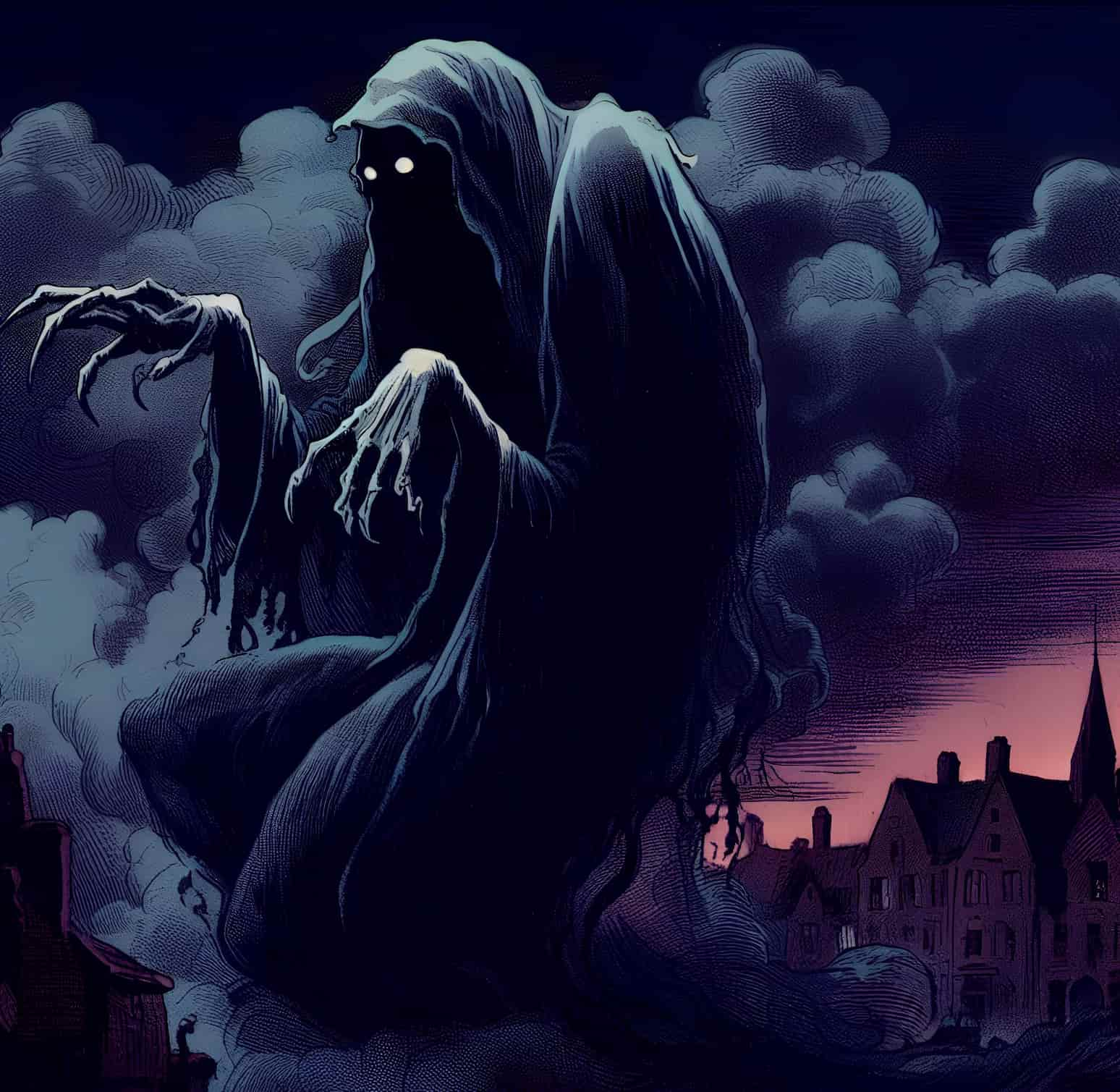
On nights when a sudden, howling gale sweeps across the dark heather moors of the Scottish Highlands, the Hebrides islands, and the western glens of Ireland, traditional Gaelic storytellers warned against stepping outside or leaving a western window unlatched. Riding inside the screaming gusts of wind was not merely a winter storm, but the Sluagh (pronounced roughly “sloo-ah”)—known in Scottish Gaelic as Sluagh na Marbh (“The Host of the Dead”). Unlike mischievous fairy folk who danced in woodland rings, the Sluagh were the terrifying aerial army of the restless, unforgiven dead, swooping down from the western sky like a flock of dark starlings to snatch living mortals up into the clouds.
Etymology of “The Host” and Excluded From Both Heaven and Hell
In both Old Irish and Scottish Gaelic, the noun sluagh translates simply as a “host, multitude, crowd, or army” (surviving in modern English inside the word slogan, which comes from the Gaelic sluagh-ghairm—”battle cry of the host”!). In folk belief documented intensively in the nineteenth century by the great Scottish folklorists Alexander Carmichael (in his Carmina Gadelica) and John Gregorson Campbell, the Sluagh represented the darkest, most dangerous category of supernatural beings in the Celtic twilight.
Who made up the ranks of the Sluagh? According to Hebridean and Irish lore, they were the souls of mortal men and women whose earthly lives had been so malicious, quarrelsome, or unrepentant that upon death:
The gates of Heaven were barred against them.
Even Hell or the peaceful Otherworld refused to take them in, and the consecrated soil of the churchyard rejected their bones.
Condemned to fly endlessly in turbulent flocks up and down the face of the Earth through eternity without a moment’s rest, the Sluagh looked down with bitter envy upon warm, happy living homes below.
Approaching From the West and Firing Poisoned “Elf-Bolts”
Unlike other Scottish fairies (the Sìthichean) who lived inside green earthen hills and mounds, the Sluagh lived exclusively in the air and were said to always approach from the West—because in ancient Celtic cosmology, the setting sun in the west marked the direction of death and the departed. Observers who claimed to see the Host passing overhead at midnight described them as a dense, swirling black cloud of shadowy figures flapping against the wind like storm-tossed crows or starlings, fighting and shrieking against one another in the clouds while dropping tiny drops of blood onto rocks and sheep’s wool below.
As the Host flew over a farmstead, they carried miniature bows and shot invisible, poisoned flint arrowheads—known to Highlanders as elf-shot or elf-bolts (actually prehistoric Neolithic flint arrowheads that farmers found lying in their plowed fields!)—down at prized dairy cows, horses, and sheep, causing sudden paralysis or death unless a healer stroked the animal with a charm stone dipped in water.
Why Dying Sickrooms Locked Their Western Windows
The greatest terror of the Sluagh was how they recruited new members into their ranks. Whenever a person lay dying in bed inside a Highland cottage, villagers believed the Sluagh gathered in the night sky outside the house, waiting to snatch the dying person’s soul away before it could depart in peace—or even kidnapping a healthy living sleeper right out of their bed, leaving an inanimate wooden log or straw effigy (a stock) lying under the blankets that looked just like a corpse while the real victim was forced to fly through the sky with the Host!
To protect a dying relative and keep oneself safe on a stormy night, Gaelic custom enforced three strict precautions:
Shutting All Western Windows and Doors: In a house where someone was seriously ill or dying, every window and door on the west side of the cottage was kept bolted and shuttered tight until the soul had safely passed, preventing the western wind of the Sluagh from blowing into the room.
Never Speaking a Dying Person’s Name to the Wind: If a traveler caught outdoors at night heard the rustling wings of the Sluagh overhead and accidentally called out the name of a friend, the Host gained the power to seize that named person.
Throwing the Left Shoe or Earth: If a lone walker felt himself being lifted off his feet into the night sky by the invisible hands of the Sluagh, his only salvation was to throw his left shoe, an iron knife, or a handful of churchyard earth over his left shoulder while calling upon the Archangel Michael to bind the Host of the Dead.