Tag: temple

  • Building the Parthenon: Athens’ Famous Temple

    Building the Parthenon: Athens’ Famous Temple

    It was under Pericles‘ impetus that the Parthenon came into existence in the 5th century BCE. The renowned Athenian strategist invited recognized artists such as Phidias or Callicrates to participate in the construction of the Parthenon. Erected on the ruins of an ancient temple destroyed by the Persians in Athens, specifically the Acropolis, the temple dedicated to Athena, the city’s protective deity, was built in record time. Indeed, it only took 15 years to complete this major monument of ancient history.

    Starting in 447, the construction of the Parthenon was interrupted by war, but it was completed in 432 BCE. It symbolizes Athenian power, democracy, and the architectural genius of ancient Greece at that time. Combining Doric classicism with unprecedented ingenuity from the architects, the Parthenon is a remarkable work, both in terms of its dimensions, its unusually fast construction, and its style.

    In What Context was the Parthenon Built?

    Between 447 and 432 BCE, builders constructed the Parthenon. It is part of the Acropolis of Athens, the current Greek capital, and one of Greece’s most iconic monuments. The Hecatompedon, a limestone temple from the 6th century BCE, served as the foundation for its construction. The Persians destroyed many monuments during the 5th century BCE (480: Greco-Persian Wars). The Parthenon is among the new constructions desired by the strategist Pericles to restore the city’s splendor. Phidias, Ictinus, and Callicrates led the construction site.

    It underwent two phases of construction, with an interruption due to the Second Persian War. Once the construction was complete, the sculptural works also concluded. They quickly erected the building, incurring significant expenses. Indeed, they had to draw funds from Delphi’s treasury, which they would later store here. It is the tallest temple in the Acropolis.

    Why Was This Temple Built?

    In this temple, the colossal statue of Phidias, the Athena Parthenos, found its home.

    buy levitra super force online http://nomaa.org/images/png/levitra-super-force.html no prescription pharmacy

    Many scholars believe that this significant project also originated from the city’s financial difficulties, plagued by regular Persian attacks. The construction site would have provided employment for many people. The functions of this temple are manifold. Despite the regular offerings at the Erechtheion, it clearly serves as a place of worship for Athena, the city’s patroness. The Panathenaic Games (festivals in honor of Athena) take place here.

    It will also become the symbol of Athenian power, according to Pericles’ wish. The impressive dimensions (nearly 70 meters long, 31 meters wide, and 14 meters high) and unprecedented architectural ingenuity showcased the greatness of Athens and its inhabitants, visible in a frieze depicting all the city’s social classes. The temple also has a political function as it houses Athenian public funds.

    How Did the Construction Work Unfold?

    The temple was built in Pentelic marble, a white stone from quarries near Athens, to the northwest. Originally, the temple consisted of a peristyle (gallery of columns) surrounded by 48 columns.

    buy provigil online http://nomaa.org/images/png/provigil.html no prescription pharmacy

    They constructed two rooms from cut stone. The 15-meter-high chryselephantine (gold and ivory) statue of Athena occupied the naos (interior of the temple). Behind this statue was a small room that housed the Athenian treasury. They built two other rooms with lateral vestibules: the opisthodomos and the pronaos. The colonnade was built simultaneously. The construction lasted about fifteen years.

    Following that, the decorations were completed. It was mainly Phidias who was in charge. His workers composed the pediments dedicated to Athena’s life. The Doric frieze, with triglyphs and metopes, mainly represents the victory of the Greeks over the Persians. The building shows a specific singularity. In Doric style, it features 8 columns instead of the usual 6. The columns’ axes, as well as the horizontal lines, are also noteworthy. The columns are slightly inclined, and the horizontals are convex to create an optical effect hitherto unseen.

    The overall proportions are enlarged. The naos thus presents a dimension never before reached: 10.6 meters wide. At the end of the construction, they added ionic columns to the opisthodomos. Under the colonnade, another frieze is present, representing the great Panathenaic Games. This encircled the sekos (the closed part of the temple, surrounded by walls). In 449, they added Propylaea and Erechtheion.

    How Did the Parthenon Evolve Over the Ages?

    This building has experienced many mishaps. It is known to have suffered a significant fire during the late antiquity period, in the 3rd century (the sack of Athens during the Chremonidean War). The fire destroyed the inner colonnade and the wooden framework. Following this event, between 361 and 363, they built a new colonnade.

    Around 590, the temple became a Christian church and took the name Mary Parthenos. This Byzantine conversion destroyed many statues. The Byzantine conversion involved moving the entrance, adding mosaics, and opening windows. It became a major Christian place of worship and was part of a great pilgrimage like that of Ephesus or Thessaloniki. The Ottomans invaded Athens in 1456 and turned the Parthenon into a mosque. The apse evolved into the mihrab. Lime completely covered the walls, hiding the decorations.

    In the 17th century, it served as a warehouse for Turkish powder barrels. The first explosion occurred in 1656, followed by a much larger one in 1687. A Venetian attack caused the barrels to explode. The Venetians destroyed the central part and the columns. The British looted the temple between 1801 and 1803, taking a large number of decorative elements that are still visible in various British museums. After proclaiming its independence, Greece began the restoration of the building in 1835. In 1894, one of the largest earthquakes Greece experienced damaged the building.

    What Were the Different Functions of the Parthenon?

    Although the Parthenon hosted the Panathenaic Games, it cannot be considered a religious building per se. Indeed, no ritual objects were found there.

    buy antabuse online http://nomaa.org/images/png/antabuse.html no prescription pharmacy

    Similarly, there is no mention of any ritual testimony on site. Only priests have access to the sanctuary’s heart. No priestess is associated with it.

    Two main functions are observable for this “temple.” The first is to house the Athena statue in the cella (or naos), the place’s sacred room. Originally an offering to the city and its inhabitants, Phidias transported this statue to Constantinople, where its trace vanished. Athena Parthenos symbolized not only the goddess but also the power of Athenian women, who, in the 5th century BCE, had an increasingly important role (the sculpted plaque on the front of the sculpture).

    The temple also served as a storage facility for the treasures won by Athens and the Delian League, some of which Pericles used to construct the building, along with the metals used for currency. These riches are obviously complemented by the statue itself, which is partly made of gold (Pericles cites it as a gold reserve, according to the author Thucydides). In cases of necessity, it was indeed possible to melt it without committing an impious act. This treasure room is synonymous with wealth and will thus become the symbol of Athenian power, both civil and political.
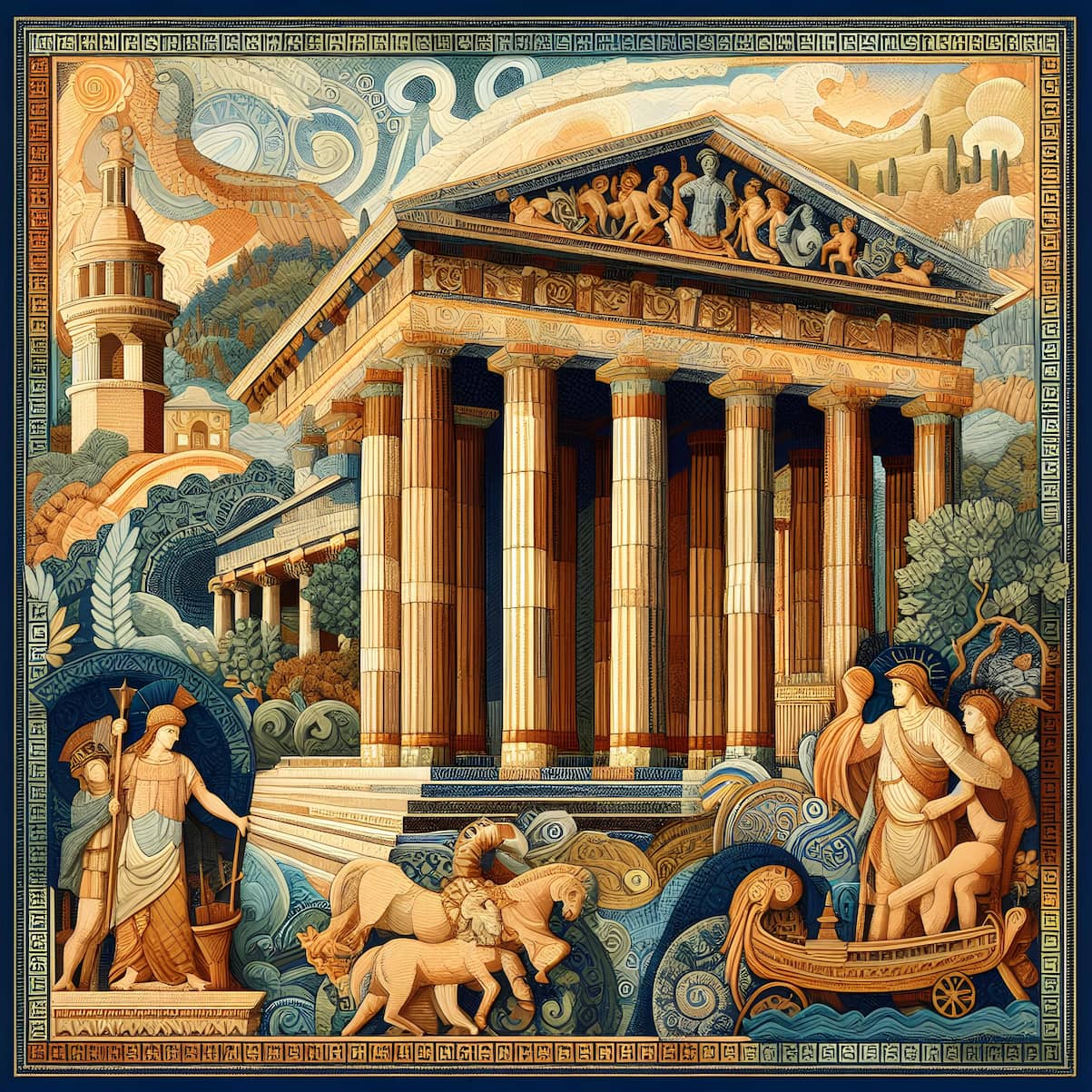
  • 10 Ancient Greek Temples You Should Know

    10 Ancient Greek Temples You Should Know

    Unlike modern churches, mosques, or synagogues, an ancient Greek temple (naos) was never designed to hold a congregation of worshippers sitting inside on pews. Instead, the Greeks conceived of the temple as the literal earthly residence—a sculptural marble or limestone jewel box—built to house the cult statue of a specific Olympian deity inside its dark inner chamber (the cella), while priests and citizens gathered outdoors in the open sunlight around the eastern altar for sacrifices and festivals. Spanning from the misty mountain gorges of the Peloponnese to the sun-bleached cliffs of Sicily and the Aegean coast, ten extraordinary surviving temples showcase the mathematical perfection of the Doric, Ionic, and Corinthian orders.

    1. The Parthenon (Athens, Greece)

    Crowning the rocky limestone plateau of the Acropolis of Athens, the Parthenon stands as the supreme masterpiece of Classical Greek architecture and the Doric order. Constructed between 447 BC and 432 BC at the height of the Athenian Golden Age under the statesman Pericles, the temple was designed by the architects Ictinus and Callicrates under the artistic direction of the master sculptor Phidias, who crafted the forty-foot gold-and-ivory statue of Athena Parthenos (“Athena the Virgin”) that once stood inside. Built from twenty thousand tons of gleaming white Pentelic marble, the Parthenon contains virtually zero straight lines: to fool the human eye into perceiving absolute geometric perfection, the architects curved the marble floor slightly upward toward the center, tilted the outer columns slightly inward, and gave every column a subtle central swelling called entasis.

    2. The Temple of Hephaestus (Athens, Greece)

    Looking down over the ancient marketplace of the Athenian Agora from the low hill of Agoraios Kolonos sits the Temple of Hephaestus (the Hephaisteion), completed around 415 BC and dedicated jointly to Hephaestus, the blacksmith god of fire and metalwork, and Athena Ergane, patroness of potters and craftsmen. While the Parthenon suffered a catastrophic Venetian gunpowder explosion in 1687, the Temple of Hephaestus was converted into the Christian Church of Saint George Akamates in the seventh century AD and left completely intact. As a result, it remains the single best-preserved ancient Greek temple on the Greek mainland today, retaining all thirty-four of its fluted Doric columns, its sculpted metopes depicting the Labors of Heracles and Theseus, and much of its original marble roof.

    3. The Erechtheion (Athens, Greece)

    Built on the uneven, sacred northern edge of the Athenian Acropolis between 421 BC and 406 BC during the Peloponnesian War, the Erechtheion is the most complex and graceful monument of the Ionic architectural order. Because the temple had to accommodate multiple ancient shrines across two different ground levels—marking the exact spot where Athena and Poseidon competed for patronage of the city, housing Athena’s sacred olive tree and the salt-water marks of Poseidon’s trident alongside the tomb of the mythical King Erechtheus—the architect Mnesicles abandoned the standard rectangular grid. On its southern porch facing the Parthenon stands the famous Porch of the Maidens, where six draped female sculptures known as Caryatids effortlessly support the heavy marble entablature atop their braided heads in place of columns.

    4. The Temple of Apollo Epicurius at Bassae (Arcadia, Greece)

    Hidden nearly four thousand feet high in the rugged, isolated mountains of Arcadia in the Peloponnese stands the Temple of Apollo Epicurius (“Apollo the Helper”), erected around 420 BC by the citizens of Phigaleia in gratitude to Apollo for sparing them from a plague—and attributed by the ancient traveler Pausanias to Ictinus, the same architect who designed the Parthenon. In 1986, Bassae became the very first site in Greece inscribed on the UNESCO World Heritage List because of its revolutionary architectural firsts: it is the only Greek temple aligned north-to-south rather than east-to-west, and it is the only ancient building that combines all three Greek architectural orders in a single structure—featuring a stern Doric exterior, an Ionic interior colonnade, and at the center of the cella, the single oldest known Corinthian capital in world history.

    5. The Temple of Poseidon at Cape Sounion (Attica, Greece)

    Perched dramatically atop a sheer two-hundred-foot crag at the southernmost tip of the Attica peninsula, surrounded on three sides by the deep blue waves of the Aegean Sea, the Temple of Poseidon at Cape Sounion served for centuries as the last sight of home for Athenian sailors heading out to sea and the first welcoming beacon upon their return. Constructed between 444 BC and 440 BC over the ruins of an older archaic temple destroyed by the Persians, the temple’s sixteen surviving Doric columns were carved from local white marble from Agrileza, which lacks trace iron and therefore remained gleaming white rather than weathering to golden rust over two millennia—even bearing the carved 1810 signature of the English Romantic poet Lord Byron on one of its pillar bases.

    6. The Temple of Apollo at Delphi (Phocis, Greece)

    Clinging to the steep, pine-scented lower slopes of Mount Parnassus above the valley of Phocis, the Temple of Apollo at Delphi was revered by the ancient Greeks as the literal center of the world, housing the conical stone known as the Omphalos (“Navel of the Earth”). Although the surviving six Doric columns standing today belong to the fourth-century BC reconstruction erected after an earthquake destroyed the earlier sixth-century temple, this exact foundation was the home of the Pythia—the Oracle of Delphi. Inside the sunken inner chamber (the adyton), the high priestess sat upon a bronze tripod inhaling vapors and chewing laurel leaves while generals, kings, and philosophers waited in the courtyard engraved with the famous Delphic maxims: “Know Thyself” and “Nothing in Excess.”

    7. The Temple of Concordia (Agrigento, Sicily, Italy)

    Because southern Italy and Sicily were colonized heavily by Greek city-states beginning in the eighth century BC—a region the Romans called Magna Graecia (“Greater Greece”)—some of the finest surviving Greek temples in the world stand today on Italian soil. Along the dramatic ridge of the Valley of the Temples in Agrigento (ancient Akragas), Sicily, stands the Temple of Concordia, constructed around 440 to 430 BC from warm, honey-colored local calcarenite limestone originally coated in brilliant white marble stucco. Converted into a Christian basilica in 597 AD by Bishop Gregory of Agrigento, the building survived earthquakes and wars virtually unscathed, keeping all thirty-four Doric columns, both triangular pediments, and its internal walls intact as a symbol so iconic that its silhouette serves today as the official logo of UNESCO.

    8. The Second Temple of Hera, “Temple of Poseidon” (Paestum, Italy)

    Just south of Naples along the Tyrrhenian coast of Campania lies the ancient Greek colony of Poseidonia, known to the Romans as Paestum, home to three monumental Doric temples standing side by side in grassy meadows. The grandest of the trio—built around 460 to 450 BC and long misidentified by eighteenth-century travelers as the Temple of Neptune/Poseidon, though modern archaeologists attribute it to Hera or Apollo—is a breathtaking powerhouse of early Classical Doric engineering. Built of golden travertine stone, it not only retains its complete outer perimeter of thirty-six thick, deeply fluted columns and full entablature, but also preserves its extremely rare two-tiered double row of smaller interior columns that supported the timber roof over the inner sanctuary.

    9. The Temple of Olympian Zeus (Athens, Greece)

    Located five hundred yards southeast of the Acropolis in central Athens, the Temple of Olympian Zeus (the Olympieion) represents the longest construction project in classical history, spanning nearly seven hundred years from its tyrannical beginnings to its Roman imperial completion. Originally started around 520 BC as a colossal Doric project by the sons of the Athenian tyrant Peisistratus, work was abandoned when the tyranny was overthrown and Athenian democracy viewed such megalomania as hubris. Re-started in 174 BC by the Hellenistic King Antiochus IV Epiphanes using the Roman architect Cossutius—who switched the design to towering fifty-six-foot Corinthian columns—it was finally finished and dedicated in 131 AD by the Philhellene Roman Emperor Hadrian. Of its original one hundred and four mammoth Corinthian columns—which made it one of the largest temples in the ancient world—fifteen still stand upright today, with a sixteenth lying in drum slices on the ground where a storm toppled it in 1852.

    10. The Temple of Apollo at Didyma (Aydin, Türkiye)

    Along the Ionian coast of Asia Minor in modern western Türkiye stood the Hellenistic world’s most ambitious architectural titans: the Temple of Artemis at Ephesus, the Temple of Artemis at Sardis, and the colossal Oracle Temple of Apollo at Didyma (Didymaion), connected to the wealthy port city of Miletus by a ten-mile Sacred Way lined with marble statues. Rebuilt starting around 300 BC after the Persians burned the archaic sanctuary, the Didymaion was so staggeringly immense—measuring three hundred and fifty-nine feet long and encircled by a double forest of one hundred and twenty Ionic columns standing sixty-four feet (nearly twenty meters) tall—that it was never given a roof. Instead, visitors walked through a dark, vaulted stone tunnel ramp only to emerge blindingly into a vast, open-air sunken marble courtyard planted with sacred laurel trees and freshwater springs, housing a full-sized smaller Ionic temple inside its heart.