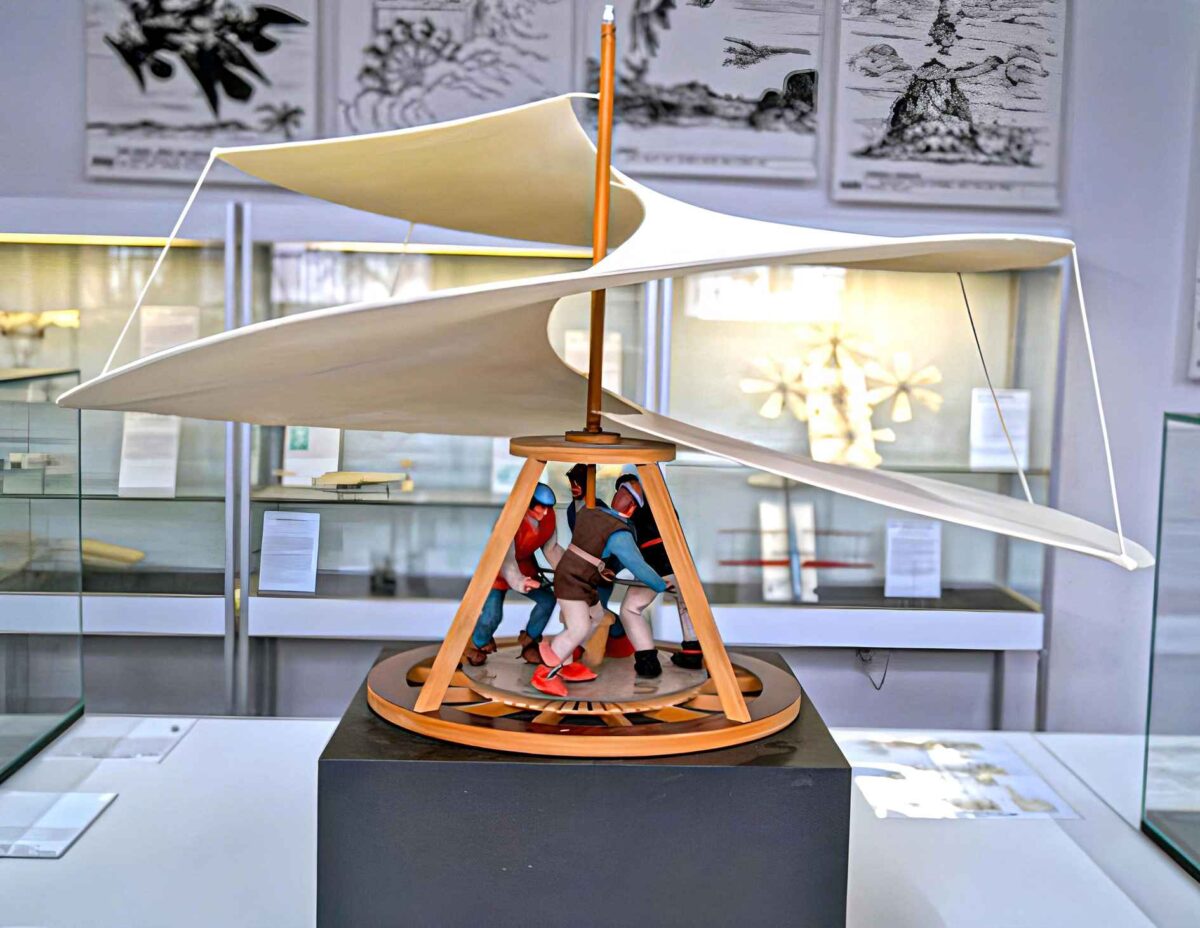
Five centuries before Igor Sikorsky piloted the first practical modern helicopter into the skies of Connecticut in 1939, the Renaissance polymath Leonardo da Vinci sat inside his workshop in Milan during the late 1480s and sketched a visionary machine designed to bore vertically straight up into the heavens. Preserved today on Folio 83v of Paris Manuscript B at the Institut de France, Leonardo’s Aerial Screw—known in Italian as the Vite Aerea—stands as one of the most iconic engineering drawings in human history, applying the mechanics of fluid hydrodynamics and the Archimedes water screw to the dream of vertical human flight.
Inspiration From Nature, Toys, and the Archimedes Screw
When Leonardo moved from Florence to Milan in 1482 to serve as court engineer and artist to Duke Ludovico Sforza, he became consumed by the problem of artificial flight. While most of his hundreds of aviation sketches focused on ornithopters—machines with flapping mechanical wings modeled directly on the anatomy of birds and bats—the Aerial Screw represented a radical departure because it relied on continuous rotary motion rather than flapping wings.
Leonardo arrived at this rotary concept by synthesizing three distinct observations. First, in the hilly landscapes of Tuscany, he had watched winged maple samara seeds spinning gently like single-bladed rotors as they fell from trees. Second, since the early fourteenth century, European children had played with “flying top” toys imported from China, which consisted of a small wooden spindle topped with angled feathers that shot into the air when spun rapidly by pulling a wound string. Third, and most importantly to Leonardo as a hydraulic engineer, he had studied the ancient water-lifting screw invented by Archimedes of Syracuse in the third century BC. Leonardo reasoned that if a solid helical screw rotating inside a cylinder could push dense liquid water upward, then a wide helical surface rotating rapidly enough inside the invisible ocean of the atmosphere should be able to screw itself upward into the air.
Materials, Dimensions, and Leonardo’s Handwritten Notes
Beside his famous pen-and-ink drawing in Manuscript B, Leonardo wrote precise construction specifications in his signature left-handed mirror script, reading from right to left. Rather than a modest tabletop model, Leonardo envisioned a colossal aerial apparatus. He specified that the helical rotor—shaped like a single continuous spiral staircase turn—should measure eight braccia in diameter, which equates to roughly sixteen feet (nearly five meters) across, supported by a central vertical wooden mast reinforced with flexible, resilient reeds and an outer perimeter ring of strong iron wire.
To construct the blade surface itself, Leonardo called for fine woven linen cloth. Crucially, he recognized that untreated fabric is porous and would allow air to leak right through its weave when pressed downward. Therefore, he instructed that the linen must have its pores completely stopped up with heavy wheat starch, turning the fabric into an airtight, taut membrane precursors to the doped linen fabrics used on early twentieth-century biplanes. In his notes, Leonardo advised builders to test the principle first by making a small paper model on a thin iron wire spring, twisting it tight, and releasing it into the air to watch the helix climb.
How It Was Supposed to Fly and Its Fatal Weight Flaw
To power the full-sized sixteen-foot machine, Leonardo had only two energy sources available in the fifteenth century: coiled metal springs or raw human muscle. At the base of the central shaft in his drawing, a circular platform rests below four horizontal wooden tiller bars. In Leonardo’s operational design, four men would stand on the lower platform, grip the horizontal bars, and run furiously in a circle around the central shaft—or alternately wind a massive cord around the drum and pull it to spin the linen screw above their heads.
Leonardo correctly grasped a foundational truth of aerodynamics that baffled many of his contemporaries: air is not an empty void, but a compressible fluid medium possessing density and resistance. As he wrote in his notebook, if this linen instrument made like a screw is well constructed and turned swiftly, the said screw will find its female thread in the air and will rise high. However, modern aeronautical analysis reveals why a full-scale human-powered Aerial Screw could never have lifted off the ground in 1489. First, human muscles can only generate roughly half a horsepower per person for brief bursts, giving a extremely unfavorable power-to-weight ratio against the heavy timber, iron wire, and four adult passengers. Second, without a tail rotor or a counter-rotating second blade to cancel out Newton’s third law of motion, the moment the blades pushed against the air, the bottom platform would simply spin in the opposite direction.
Modern University Breakthroughs and the Martian Ingenuity Connection
For centuries, aerospace engineers assumed that even if you attached a lightweight modern electric motor to Leonardo’s exact spiral screw geometry, the continuous solid helix would create too much drag and vortex turbulence to fly efficiently. In 2020 and 2022, however, a team of aerospace engineering students at the University of Maryland decided to put Leonardo’s five-hundred-year-old geometry to the test for the Vertical Flight Society’s design competition.
Using computer fluid dynamics simulations and lightweight carbon fiber, polymers, and lithium batteries, the Maryland engineers built a working quadcopter drone called “Crimson Spin” that replaced standard modern propeller blades with four small corkscrew rotors modeled directly on Leonardo da Vinci’s 1480s Aerial Screw sketch. To the astonishment of the aviation community, the machine did not merely hover; the continuous spiral edge generated a steady delta-wing leading-edge vortex that allowed the craft to lift a human passenger stably into the air while producing a noticeably lower-pitched, quieter acoustic profile than conventional helicopter blades. From drone delivery technology on Earth to NASA’s Ingenuity helicopter flying in the thin atmosphere of Mars, Leonardo’s fifteenth-century intuition that a rotating screw could climb the sky stands completely vindicated.