On September 24, 1853, under orders from Napoleon III, Rear Admiral Febvrier-Despointes officially took possession of New Caledonia for France, an island in the Pacific located 18,000 km from mainland France and 2,000 km from Australia. The capital, Port-de-France, now known as Nouméa, was founded in June 1854. This was the era when the French were rediscovering overseas territories and rebuilding a colonial empire to replace the one they had lost a century earlier, during the Treaty of Paris on February 10, 1763, where they gave up Quebec.
1864: The Beginning of Penal Colonization
The settlement of New Caledonia began in 1864 with penal colonization, with more than 20,000 convicts detained there until 1897. Among them were thousands of political prisoners deported after 1871, the year in which the Paris Commune and a Kabyle insurrection in Algeria, another former French colony, were violently suppressed.
1878: The Great Kanak Revolt
“Reserves” were established for the indigenous people, the Kanaks, who were dispossessed of their lands and subjected to forced labor. The exploitation of nickel, the economic lifeblood of the archipelago, now in crisis, triggered several waves of migration, including from Asia, Tahiti, and the Caribbean.
By 1878, a Kanak revolt erupted against the land confiscation.
Some 600 insurgents and 200 Europeans were killed, tribes were wiped out, and 1,500 Kanaks were forced into exile.
1988: The Ouvéa Cave Assault
While New Caledonia became an overseas territory (TOM) in 1946, and the Kanaks gained French citizenship and the right to vote, violence between them and the Caldoches (European settlers) occurred in the 1980s, peaking with the Ouvéa cave hostage-taking and assault in May 1988. About 19 Kanak militants and two French soldiers died. A month later, the Matignon Accords sealed reconciliation through economic rebalancing and shared political power. This was followed in 1998 by the Nouméa Accord, which granted the archipelago a unique status within the French Republic, based on progressive autonomy.
2004: The “Citizenship Day”
Declared a public holiday in 1953 by the French authorities, the date of France’s takeover of New Caledonia was renamed “Citizenship Day” in 2004 to celebrate all communities. However, it remains a day of mourning for part of the Kanak independence movement.
In 2024, a controversial electoral reform reignited the troubled history of this South Pacific archipelago. On May 13, violent riots broke out, unprecedented in scale since the “events” of the 1980s and the 1988 Ouvéa hostage crisis. The riots left 13 dead, including two gendarmes. Four months later, the situation remains unresolved. On this Tuesday, September 24, the people of New Caledonia are more divided than ever as they mark their day of celebration.
It is one of the most important archaeological discoveries in recent decades. Discovered at the site of Qumran, in Mandatory Palestine (present-day West Bank), the Dead Sea Scrolls, or Qumran Caves Scrolls, are of paramount importance, due to their content, in the field of Bible study, Judaism, and Christianity. Fascinating, intriguing, the subject of legends and heated debates among historians about their origins or interpretation, the Dead Sea Scrolls are among those masterpieces that allow us to piece together the puzzle of a part of human history. To whom do we owe the Dead Sea Scrolls? How were they discovered? What do they talk about? There are so many questions surrounding the famous Dead Sea Scrolls.
Who Wrote the Dead Sea Scrolls?
A view of part of the Temple Scroll that was found in Qumran Cave 11. Image: Israel Museum, Public Domain
This is a delicate question that many historians attempt to answer. In practice, many agree to attribute the origin of the Dead Sea Scrolls to a Jewish community, the Essenes. Settled northwest of the shores of the Dead Sea, this community allegedly took care to hide the manuscripts in caves near their territory, shortly before the arrival of the Romans and the fall of Jerusalem in the year 70. Although it is now a consensus among historians, this thesis on the origin of the Dead Sea Scrolls is still contradicted today. It remains the subject of numerous debates.
In fact, there is currently no evidence to support it. There is, however, no discussion about the composition of the manuscripts. Researchers have discovered a total of 100,000 manuscript fragments, resulting in just under 900 manuscripts.
biblical texts from the Hebrew Bible;
apocryphal books such as the Book of Enoch;
texts belonging to the Jewish community in the Qumran territory, such as the Manual of Discipline
Hebrew is the primary language of the Dead Sea Scrolls. Some are in Greek. Among the historians who devote part of their time to studying the Dead Sea Scrolls, many claim that some of these manuscripts were written on site and that another part was brought there. They date from about 250 BC for the oldest up to about 70 AD.
In the spring of 1947, a young Bedouin named Muhammed edh-Dhib Hassan was wandering around the Qumran site in search of his lost goat. As he found himself at the entrance of a difficult-to-access cave, he decided to enter it. Inside the cave, he discovered clay jars containing old documents carefully wrapped in linen cloths. Unaware that these were historical documents, the young Bedouin decided to bring them to an antique dealer in Bethlehem.
Informed of this discovery, the director of the French Biblical and Archaeological School of Jerusalem, Father Roland de Vaux, began searching for other manuscripts in 1951. Over a decade, from 1947 to 1956, several caves at the Qumran site on the shores of the Dead Sea were explored. In total, twelve of these caves contained manuscripts.
Note that most people commonly accept the “official” version of the discovery of the Dead Sea Scrolls as the truth. Historians occasionally question the elements of this version, comparing it to a beautiful legend or an oriental tale. Some doubt the accidental nature of the discovery of the first cave (it could actually have been an attempt to hide contraband goods).
The exact date of the discovery (spring 1947) is also sometimes subject to debate.
What Is the Content of the Dead Sea Scrolls?
Qumran cave 4, where ninety per cent of the scrolls were found. Image: Effi Schweizer, Public Domain
The Dead Sea Scrolls comprise a collection of nearly 900 texts providing valuable information on the roots of major religions, the history of the Jewish people, and more. The Dead Sea Scrolls allow for a more in-depth study of the Hebrew Bible with numerous theological teachings.
Among the Dead Sea Scrolls, the Great Isaiah Scroll is one of the most well-known (and best-preserved). Discovered in 1947 in Cave No. 1 of Qumran, the document contains all 66 chapters of the Book of Isaiah. Made from 17 sheets of parchment, it extends 7.34 meters long with the text distributed across 54 columns. Today preserved in the Israel Museum, the Great Isaiah Scroll has a giant reproduction within the same museum. Many present it as one of the oldest texts of the Tanakh.
Several decades after their discovery, the Dead Sea Scrolls continue to regularly reveal secrets. Advances in technology and the work of numerous specialists allow for the deciphering of manuscripts that had not been interpreted until now. Although considered quite slim, the chances of discovering new manuscripts continue to fuel on-site research. In 2017, for example, archaeologists discovered a new scroll in another cave, the twelfth one.
Why Are the Dead Sea Scrolls So Important?
A view of the Dead Sea from a cave at Qumran in which some of the Dead Sea Scrolls were discovered. Image: Eric Matson, Public Domain
Before the discovery of the Dead Sea Scrolls, the oldest biblical manuscripts dated back to the Middle Ages. From a chronological perspective, the Dead Sea Scrolls are therefore the oldest biblical manuscripts ever discovered to date. In other words, the Dead Sea Scrolls constitute the first manuscripts of the Hebrew Bible, also called the “Old Testament” by Christians. They were mostly pre-Christian and hidden less than 20 km from Jerusalem, the cradle of major monotheistic religions. In the Dead Sea Scrolls, the Jewish community of the Essenes, to whom the origin of these texts is attributed, mentions the existence of a messiah at the very time when Jesus is said to have lived.
For some historians, the Dead Sea Scrolls help highlight the Jewish origins of Christianity through the search for the historical Jesus. The writings, long sheltered in these caves, could help situate the originality of Jesus as a person, as well as his thoughts. They provide insights into the lifestyle and functioning of the Essene Jewish community. Like other elements surrounding these manuscripts, the reading and interpretation of the Dead Sea Scrolls are subjects of intense debate among historians and theologians.
After their discovery, the Dead Sea Scrolls were scattered all over the world. Different institutions, mainly museums, now possess a more or less significant part of them. The majority of the Dead Sea Scrolls are now in the Shrine of the Book in Jerusalem, within the Israel Museum. This is also where a copy of the Great Isaiah Scroll can be found. Other fragments of the Dead Sea Scrolls are preserved in Amman, Jordan. There is also a black market trade related to the Dead Sea Scrolls, driven by collectors interested in purchasing a piece of history. In Western museums, it is not uncommon to see collections of Dead Sea Scrolls presented that actually contain fakes. The Museum of the Bible in Washington experienced this bitter lesson in 2020. This environment surrounding the authenticity of the Dead Sea Scrolls is one of the elements contributing to the notoriety of these documents.
Protohistory is a pivotal period that begins at the end of Prehistory and ends at the beginning of History (with the advent of writing). It encompasses the Bronze and Iron Ages, characterized by the emergence of new tools and currencies. It is also characterized by the founding of the first cities, the emergence of a hierarchical society, and the birth of the economy.
What Is Protohistory?
The term “Protohistory” is composed of the Greek “proto” (first) and the word “history.” It first appeared in the late 19th century with a somewhat vague meaning: according to the Dictionary of the French Language (or Littré), the adjective “protohistorique” means “belonging to the beginnings of history.” Protohistory marks the transition between prehistory and history.
Over time, the definition has become more refined. Protohistory now refers to the intermediate period between Prehistory and History. By metonymy, the term Protohistory can also refer to “the science that encompasses all knowledge about peoples without writing contemporary to the first historical civilizations” (Encyclopædia Universalis). Modern researchers define it as a period of production economy without writing.
Protohistory is characterized by the progressive structuring of society, significant changes in habitat, the emergence of hierarchy and administrative power, and the birth of an advanced economy.
The development of rock art, the emergence of statuary, and most notably, the discovery of metallurgy and the emergence of currency, mark this period. The period also saw the development of early commercial exchanges.
How Does Protohistory Begin?
Protohistory corresponds to the Bronze and Iron Ages.
It begins at the end of the Neolithic, during the Copper Age (Chalcolithic). This period is mainly known for megalithic culture (4500 BCE) and its anthropomorphic steles, especially those present in the northern Mediterranean. It encompasses the Bronze Age (2100 BCE) and the Iron Age.
The beginnings of Protohistory are marked by significant innovations, such as the use of salt for food preservation. Habitats undergo a major change. Villages are structured and fortified. Soltnitsana (Bulgaria) is Europe’s first known city.
In Europe, as well as in Russia and Siberia, several cultures develop, including:
The Corded Ware culture (Northern Europe, 3000–2200 BCE)
The Catacomb culture (Ukraine, 2800–2200 BCE)
The Afanasevo culture, also known as Afanasievo, originated in southern Siberia between 3300 and 2400 BCE.
The use of copper spreads in North America, where native copper, without metallurgy, is evident in the Great Lakes region around 3000 BCE. In South America, copper metallurgy appeared in the Andes around 1300 BCE. Metallurgy appeared around 3000 BCE in Anatolia and spread to Western Europe and China around 2000 BCE, marking the end of the Neolithic in Eurasia.
What Are the Regions of Protohistory?
During Protohistory, the main regions of human occupation were:
Near East;
Mesopotamia;
Anatolia (Southeast Asia);
Balkans and Greece;
Central Europe (along the Danube);
Southern Europe;
Egypt;
Maghreb;
China;
Sub-Saharan Africa;
Mississippi Basin;
Mexico;
Andes.
The evolution of burial customs defines protohistory. In Egypt, this period corresponds notably to the construction of the Pyramids of Giza. Among the major protohistoric sites, the Great Wall of China, built in the 3rd century BCE, is also noteworthy.
The founding of Marseille in 600 BCE by Greeks from Phocaea is considered a key date of Protohistory in the Mediterranean. Southern France developed a network of settlements, most of which remained occupied until the Roman period. Among them is Lattara, located in a lagoon environment south of the current city of Montpellier.
What Are the Different Periods of Protohistory?
The Chalcolithic (3500–2100 BCE, or Copper Age) is the last period of the Neolithic. This transitional period between the end of Prehistory and the beginning of Protohistory is debated internationally, with some researchers considering it should be linked to Prehistory.
The Bronze Age (2100–860 BCE) is divided into three periods:
The Early Bronze Age took place from 2100 to 1600 BCE.
The Middle Bronze Age lasted from 1600 to 1350 BCE.
Late Bronze Age (1350–860 BCE)
The Anatolian region marks the period with the emergence of bronze metallurgy, a mixture of copper and tin. The oldest documented production in Europe comes from the Unetice culture (Czech Republic).
The Iron Age (860–52 BCE) has two distinct periods:
The First Iron Age, also known as the Hallstatt period, lasted from 860 to 475 BCE.
The Second Iron Age (475–52 BCE) is also known as the La Tène period.
The period sees the emergence of an elite that governs society, organizing the division of labor, while artisans specialize greatly. New weapons and tools appear the scythe, sickle, and harvester, as well as the folding knife and friction lighter, pliers, files, tongs, and chisels. New carpentry and wheelwright methods also emerge during this period with the appearance of wheeled vehicles.
How Does Protohistory End?
Protohistory ends at the end of the Iron Age with the emergence of writing, considered the beginning of History (between the 3rd and 1st centuries BCE). Most people agree that Antiquity marks the beginning of History, followed by the Middle Ages and Modern Times.
Protohistoric peoples like the Gauls, Ligurians, and Iberians wrote little—or not at all. Besides excavations providing numerous pieces of information, we mainly know them today through texts from Greek or Roman civilization.
The Protohistoric era is marked by a strong structuring of society, an improvement in means of production, and the significant development of exchanges as territories organized themselves. In Europe, Roman conquests, especially the Gaulish Wars (52–58 BCE), left their mark on cultures, landscapes, and languages as we know them today.
Charlemagne, son of Pepin the Short, was anointed Western Emperor by Pope Leo III in 800. It was under his rule that the Carolingian Empire flourished and expanded to include most of present-day Western and Central Europe. Charlemagne’s political legacy, however, did not survive him for long. After the death of his son Louis the Pious in 840, the empire was divided among his three grandchildren. Soon after, Lothar I, Louis II, and Charles II went to battle with one another over who would succeed as king. The fratricidal conflict between the three ended with the ratification of the Treaty of Verdun in August 843, which split the Carolingian Empire into three separate kingdoms.
Why was the Treaty of Verdun signed?
When the Western Roman Empire collapsed in 476, it was replaced by a patchwork of barbaric kingdoms. During the High Middle Ages, the Franks established the Carolingian Empire in Gaul following three centuries of territorial growth. When he was anointed emperor in 800, Charles I, commonly known as Charlemagne, expanded his kingdom’s frontiers and brought it to its zenith. However, since Clovis, it was customary for the heirs to break up the kingdoms. The Frankish Empire was split among Charlemagne’s three sons when his son, Louis the Pious, died (June 29, 840).
As a result, a bloody civil war broke out over who would succeed the king. Louis the German and Charles the Bald formed an alliance to counter their more powerful brother, Lothair I, who had become emperor. At the Battle of Fontenoy on June 25, 841, they were victorious over him and his nephew, Pepin II of Aquitaine. Lothair I accepted a compromise on February 14, 842, in the face of resolute opponents who had reinforced their alliance with the oaths of Strasbourg. With his brothers, he signed the Treaty of Verdun in August 843.
Who signed the Treaty of Verdun in 843?
Following traditional Frankish practice, Louis the Pious’ three sons split the Carolingian Empire in 840.
Lothair I, the eldest
Charles the Bald
II. Ludwig (Louis the German)
The three grandchildren of Charlemagne finally convened in August 843 to sign the Treaty of Verdun after years of civil strife. However, the exact date of the signing remains unknown to this day. In all likelihood, it must be ratified in Verdun between August 8 and 11, 843. Not only had the date been deleted, but so had the content. As a result, the contents of the Treaty of Verdun are unknown since neither an original nor a duplicate survives. Nithard, grandson of Charlemagne, provided the bulk of the document’s details via his daughter Berthe’s writings. This episode is also vaguely recounted in the Carolingian era’s Saint Bertin and Fulda chronicles.
The division of the Carolingian Empire
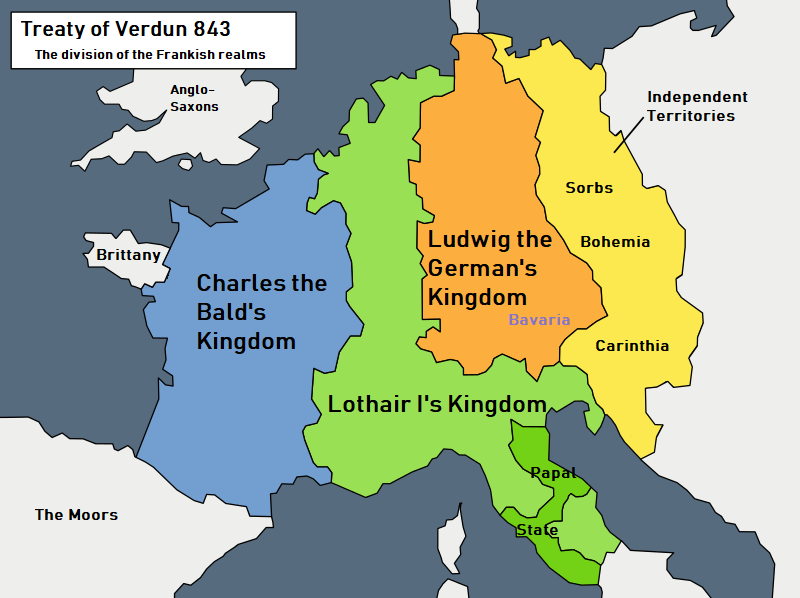
The huge areas captured by Charlemagne’s grandson were divided up at the Treaty of Verdun. This resulted in the final partition of the Carolingian Empire into three major nations.
West of the line formed by the rivers Scheldt, Meuse, Saône, and Rhone, Charles II was given the region now known as West Francia (with Paris as its capital). It included the regions formerly known as Neustria and Aquitaine, as well as the western portion of Austrasia and northern Burgundy.
Louis II made Regensburg the capital of his eastern imperial province, East Francia. Bavaria, Saxony, the Alemannic and Franconian provinces, and the eastern half of Austrasia were all included.
The oldest son, Lothair I, was given Middle Francia (also known as Lotharingia) and the imperial title. The latter reached from the North Sea province of Friesland to the Mediterranean. Part of this region was encircled by the kingdoms of his brothers; thus, it also comprised the Low Countries, the Rhineland, Burgundy, Provence, and Northern Italy. Rome, the home of the Catholic Church, was also the religious capital of the country, in addition to the political capital of Aachen.
The borders of the Treaty of Verdun evolved over time
Lands divided by the Treaty of Verdun.
At the time of the treaty of Verdun, the borders of the Carolingian Empire were set. However, they did not stay the same for very long. When Lothaire I died in 855, the Treaty of Prüm split middle Francia among his three sons. Louis II, who was the oldest and was called “the Younger,” got the southern part, which included the kingdom of Italy, and the imperial crown. Lothair II got the northern part, which became known as Lotharingia. Last, Charles, the youngest, got the center, which was made up of Provence and Cisjurane Burgundy (Lower Burgundy).
After Lothair II died in 870, a new division of middle Francia was put into place. Charles II the Bald and Louis the Germanic were his uncles. They signed the Treaty of Meerssen and split Lotharingia between them. After his nephew Louis II died in 875, Charles II became emperor of the West and took back control of the kingdom of Italy. By the Treaty of Ribemont in 880, his grandchildren gave Lotharingia to Louis the Younger, who was Louis the Germanic’s son. With this text, West Francia got back almost all of its borders from 843.
The results of the Treaty of Verdun
The hope of reuniting the empire was finally snuffed out with the Treaty of Verdun, which officially ended the Carolingian Empire. It set the stage for medieval Europe by splitting the enormous Frankish realm into three separate states. This agreement also constituted the birth of the French and German nations.
Before its eventual transformation into France in 1205, Gaul was known as “West Francia.” It was also possible to argue that Louis II was the first German king. His realm of East Francia would form the nucleus of the future Holy Roman Empire for decades.
Unfortunately, these nations’ populations were too different from one another linguistically and culturally to come together until much later. The feudal system that emerged in Europe throughout the Middle Ages can also be traced back to the Treaty of Verdun. As the number of Viking raids increased, the power of nations declined, benefiting the fiefs. Locally, the lords became de facto rulers once the monarch was deposed. From the 10th century forward, a feudal society gradually replaced the clientelism of the Merovingians and Carolingians.
MAIN DATES OF THE TREATY OF VERDUN
June 20, 840: Death of Louis the Pious
Louis I, also called “the Pious,” was born to Charlemagne and Hildegard of the Vinzgau in 814, and he eventually rose to the position of Western Emperor. During his rule, he faced several dangers, including Viking invasions and, in 830, a rebellion by his sons who wanted to succeed him. On 6/20/840, he passed away at Ingelheim, close to Mainz. After his death, his three sons, Charles, Louis, and Lothair, split up the Carolingian Empire. It didn’t take long for the fighting to start up again.
June 22, 841: The Battle of Fontenoy and the division of the Empire
Lothair I, who had been co-emperor with his father since 817, became sole emperor after his father’s death. Charles the Bald and Louis the Germanic banded together to oppose him because they both refused to acknowledge him as suzerain. At the Battle of Fontenoy in Burgundy on June 25, 841, Charlemagne’s grandsons fought over who would inherit the Carolingian throne.
It was a difficult war, but the two younger sons ultimately prevailed against their elder brother and nephew, Pepin II of Aquitaine. After signing the Treaty of Verdun in 843, the Empire was split into three separate kingdoms.
February 14, 842: Oaths of Strasbourg
Taking the vows of Strasbourg eight months after their triumph in Burgundy, Charles and Louis united to fight Lothaire. When the Carolingian Empire was split in two on February 14, 842, an oath of mutual support was signed between the two brothers. Louis made his commitment in Romance, the language from which French evolved, so that Charles’ troops would understand him. Charles repeated his phrases in Theodiscus, the proto-Germanic language. The oaths of Strasbourg, penned by their cousin Nithard, were the first official papers written in a widely spoken language other than Latin.
August 843: The Treaty of Verdun
Lothair, Charles, and Louis ended their animosity with a compromise the next year, thanks to the vows they took in Strasbourg. In August 843, the three sons of Louis the Pious signed the Treaty of Verdun, dividing the Carolingian Empire among themselves. Lothair retained the emperor title, though it was now only ceremonial and restricted to the kingdom’s core, which was medieval France.
The western part of Francia, which became known as France about the year 1200, was passed on to Charles, while Louis acquired the eastern part, which became the heart of the Holy Roman Empire and Germany.
November 22, 845: Independence of Brittany
Although the Breton duke Nominoe had declared his support for Charles II during the civil war, he eventually rebelled against his suzerain. At Ballon, close to Redon, on November 22, 845, he triumphed over the Franks. This triumph marked the beginning of the 700-year reign of Brittany as a cohesive and autonomous nation. They called Nominoe Tad ar Vro (“father of the country”) because he freed his people. When he passed away in 851, his son Erispoe became king of Brittany with the support of Charles II.
April 10, 879: Death of Louis II, the Stammerer
Louis II, often known as “the Stammerer,” became king of West Francia in 877. He was born to Charles II and Ermentrude of Orleans. In 879, on April 10th, after just 16 months in power, he passed away. He was 33 years old. His sons, Louis III of Neustria and Carloman II of Aquitaine and Burgundy, took the thrones after him.
The two brothers joined forces with their cousin Louis III, king of East Francia, to combat the Normans. At the Treaty of Ribemont’s signing in 880, they handed over Lotharingia to him. This redrawing of boundaries between the two realms would stand throughout the Middle Ages.
Bibliography:
Oebele Vries, “Friesland”, Medieval Germany: An Encyclopedia (Routledge, 2001), pp. 252–56.
Charlemagne and Anglo-Saxon England, Joanna Story, Charlemagne: Empire and Society, ed. Joanna Story, (Manchester University Press, 2005), 195.
Pompey, a prominent Roman commander and politician, was born in the Italian city of Picenum on September 27, 106 BC. He was murdered at Pelusium in Egypt on September 28th, 48 BC. With Caesar and Crassus, Pompey created the First Triumvirate, although he was ultimately destroyed by Caesar at the Battle of Pharsalus in 48 BC. Pompey or Gnaeus Pompeius Magnus born into a wealthy plebeian family, earned the moniker “the Great” due to his outstanding military achievements. However, his competition with Caesar, previously allied, would ultimately be his undoing. Pompey was a well-respected Roman commander and politician. The Civil War that broke out in 49 BC would turn him into Julius Caesar‘s biggest antagonist, despite the fact that he was married to Caesar’s daughter Julia.
Pompey was a ruthless and brazen man, typical of the world’s elite. His innate or cultivated amiability, however, won the hearts of many.
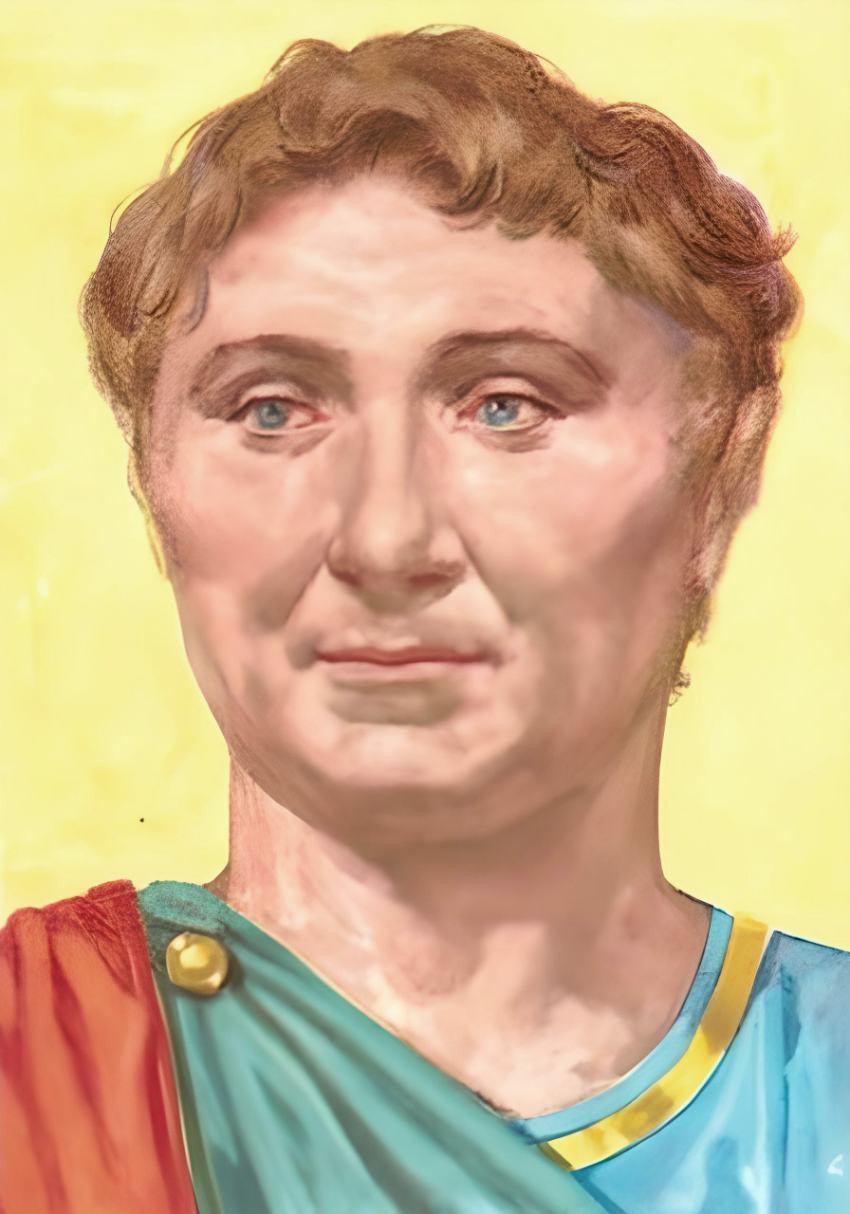
The reconstruction of Pompey the Great by Alessandro Tomasi.
Pompey’s early life
Pompey was born to a noble family and a demanding and harsh father. Pompey’s father was Cnaeus Pompeius Strabo, a substantial general in the Roman army. Pompeius Strabo stood out throughout the Social War (91-87 BC) because of his stubborn character. Thus, his funeral pyre was met with ridicule as the townsfolk despised him and burned his body.
Pompey followed his father and developed an interest in the military and strategic planning. His father’s wealth and extensive clients led Pompey to meet with Sulla. By that time, Sulla was in charge of the Optimates, the traditional political group that staunchly defended the privileges of the old nobility. While Gaius Marius, the head of the progressive Populares faction, had high hopes for the young Julius Caesar, nephew of his wife Julia, Pompey still remained a bright young guy in his eyes.
Since Pompey was trained for battle since he was young, it is only logical that he would first commit to a successful military career. Almost immediately, the politician Syula took notice of him, and he went on to battle in Africa and Sicily with successful campaigns in the Far East, Hispania, and against Mediterranean pirates.
Aeschylus’s blunt quote, “I hate the sire, but dearly love this child of his,” serves as the first line in Plutarch’s biography of Pompey the Great.
Pompey rose through the ranks of the Roman military and eventually became Emperor. With Caesar and Crassus, Pompey formed the triumvirate that ruled Rome beginning in 60 BC. Pompey married Caesar’s daughter, and the three of them ruled the whole Roman lands.
It was because of his efforts to bring back order in Rome that Pompey was named sole consul in 52 BC. But three years later, a civil war erupted, putting Pompey against Caesar. The latter was even designated an enemy of Rome by that time. After being soundly beaten by Caesar in Greece in the legendary Battle of Pharsalus, Pompey was assassinated on an Egyptian beach.
After the Pharsalus, Pompey had sought refuge with Ptolemy, King of Egypt, but Ptolemy ultimately betrayed him, killed him and gave his head to Caesar. Pompey was a military hero who also founded towns like Nicopolis and Pompeiopolis. He also created the Theatre of Pompey in Rome.
Rome during Pompey
The political systems of the city-state of Rome were in need of a revival because of the decline of the Republic in comparison to the vast geography of the Empire. The collapse of this political system paved the way for constant civil wars and provided the ideal environment for the power grabs of the ambitious. Pompey was a ruthless and brazen man, typical of the world’s elite. His innate or cultivated amiability, however, won him many friends and admirers. And he was looking good, too. His demeanor was courteous, and his eyes were a mix of softness and fervor. Pompey was quite popular with the ladies, and the stunningly beautiful famous courtesan Flora was completely smitten with him.
These deadly good looks were complemented by a rebellious strand of hair that was lifted by a spike on the forehead, giving him phony Alexander airs. After the successful campaigns he commanded in Africa in 81 BC against Marius’s supporters, his warriors took to calling him “Magnus” (Great) in honor of this trait and his military prowess in reference to Alexander the Great. This distinction was one that Pompey gladly accepted, revealing much about his aspirations.
Insolence that portends disaster
Despite the norms, Pompey still planned to ride a tank hauled by African elephants around Rome during the celebration of his victory. He was more of a strategist than a scenographer, and thus he failed to foresee that his excessively imposing chariot would prevent him from entering the city. Being ridiculed might be fatal in ancient Rome, but not to a man of his type.
In 79 BC, Pompey was just 26 years old. Despite being a member of the equestrian order (the lower Roman nobility), Pompey was so confident in his triumphs that he petitioned the Senate for the magistracy of consul, an honor normally reserved for the senatorial class. His teacher Sulla (who served as dictator in 82–79 BC) thought this request was a sign of arrogance and bad luck, so he decided to distance himself from Pompey.
When it became clear that Pompey would no longer have the backing of the optimates’ leader, he moved to support the election of Sulla’s opponent, Marcus Aemilius Lepidus. For Sulla, Aemilius Lepidus was a filthy provoker. However, this coincidental union did not survive for very long. Aemilius Lepidus revolted against the Senate and in return, Pompey suppressed this rebellion with an army raised from Picenum. After defeating Aemilius Lepidus on the battlefield, Pompey removed him from power the next year.
A path to victory
When the Spartacus revolt broke out in the city of Capua, Pompey arrested 6,000 rebels and had them crucified one every 108 feet (33 meters) along the route leading from Rome to Capua. The commander hoped to send a message to the slaves to discourage them from trying to escape.
Pompey resumed his Hispanic campaign in 77 BC. His new mission was to put down the rebellion led by another Marius admirer. Following a string of close engagements, General Pompey finally delivered a decisive defeat to Sertorius. He put up a monument to himself atop Col du Perthus (Perthus Pass) as a last act of egotism before departing the Iberian Peninsula. According to his inscription, Pompey had conquered 87 cities. Surely he totaled even the tiniest villages along his route.
Even though the Romans had been humbled by revolts for months, but the victor of Sertorius had not yet departed Spain. While trying to flee, Spartacus and his band of 100,000 slaves completely routed the army. Even a seasoned general like Crassus had run into trouble. In 73 BC, he received assistance from Pompey and Lucullus. Most of the rebels were eliminated by their forces. Capturing 6,000, Pompey then had one crucified every 108 feet (33 meters) along the route from Rome to Capua, where the uprising had begun.
The commander hoped to send a message to the slaves that would discourage them from trying to escape. In Rome, people did not question the authority of rulers. So, it was another one of Pompey’s clever “stunts” when he publicly earned credit for putting down the Spartacus rebellion.
Pompey’s hopes for absolute power were now bolstered by this fresh triumph, and he quickly took advantage of the admiration to which he was subject in Rome to make another consulate submission while failing to fulfill the requisite conditions once again. But the senate had to make an exception for Pompey because of how popular he was, and therefore, Pompey and Crassus were both chosen Roman consuls (prime ministers) in 70 BC.
Despite their election, the two men first hesitated to dismiss their troops which created fear of a new civil war. But, too much blood had already been spilled, and so the two consuls decided to simultaneously demobilize their legionaries. But this did not signify a permanent abandonment of their goals, rather, it was only a temporary pause.
Pompey’s wars against the pirates and Mithridates
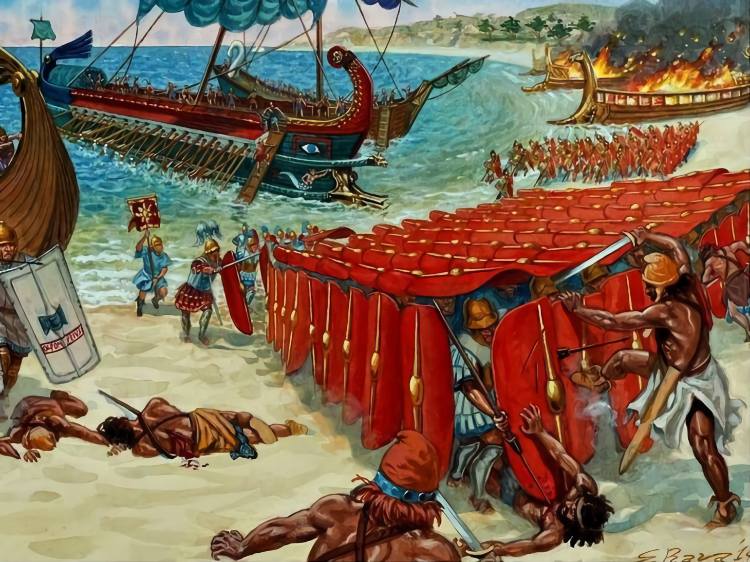
At the Battle of Korakesion, 67 BC, Pompey with 200 ships faced the pirates of the Mediterranean with 1,000 ships in modern-day Alanya, Turkey.
Pompey used his naval prowess to once again make a name for himself in 67 BC. The Gabinian Law granted Pompey extraordinary authority, the imperium. He was therefore endowed with the authority to completely wipe out the Mediterranean’s piracy problem. Their attacks hampered commerce and threatened Italy’s food supply, as much of their wheat originated in Egypt. With his fleet of 200 vessels, Pompey was able to effectively eliminate the pirate threat and square up the maritime space in just three months. Now a hero in the eyes of the Athenians, Pompey then established some of the reformed pirates in Soli, in modern-day Turkey. He planned to turn those pirates into farmers by placing them far from the sea. But the city of Soli was destroyed by Mithridates, and yet there was a request for revival by its inhabitants. So, Pompey rebuilt the city and named it “Pompeiopolis.”
The lawmaker Gaius Manilius then gave Pompey the chance to steer the war against the king of Pontus, Mithridates VI Eupator, a few months after this victory. Mithridates’ reign of terror in the East was a direct result of his refusal to abide by the terms of his treaty with Rome. Pompey was given free rein to eradicate this threat from the East and restore peace to the area.
He defeated King Mithridates’ soldiers with a daring nighttime assault in the Battle of the Lycus in 66 BC. In the East, Pompey kept pushing forward. Some, like Armenia’s King Tigran, chose to work with Pompey rather than oppose him. However, many other kinglets met their end because they were too egotistical to take the diplomatic route. The ever-victorious General Pompey brought the East to its knees and annexed the territories of Pontus and Bithynia on the southwestern bank of the Black Sea. Pompey even managed to put the King of Parthia, Phraates III, in a bind.
General who strikes fear in his subjects
However, Pompey’s progression did not end there. The Judean rulers came to him to put an end to a power conflict in 63 BC. Pompey saw his chance to crush Judea and took it for his own. On a Saturday, he led his legion into Jerusalem. Since that was a holy day, the Jewish army chose to refrain from battle. Approximately 13,000 of them were slaughtered in the temple where they took refuge. Judea was now dependent on Rome, and its new king, Hyrcanus II, was revered by Pompey and treated like a subject by the Romans.
Pompey thought about going home to Italy to revel in his victory. While returning, he followed in Alexander’s footsteps by establishing new towns as monuments to his greatness. After arriving at the city of Brindisi, he dispersed his forces to show the worried and admiring senate that he would not seize power via force. Pompey gambled on marriage ties as a means of gaining sway at the highest levels of politics. By allying himself closely with the more traditionalist Optimates, Pompey hoped to emerge as their new champion. As a result, he set his sights on tying the knot with a member of the Cato family. But the seasoned Stoic refused to give Pompey his niece in marriage.
Pompey finally realized what was going on here. His frequent victories and his will to succeed were worrying his would-be friends. He had already towered above many others and appeared menacing. Thus, he decided to look for a man who would understand him better. Similarly, Caesar also made his subjects fear him with reverence and respect. The two men agreed that it was time to join forces against the rest of Rome. In 59 BC, Pompey married his new friend Caesar’s daughter, Julia, to solidify his alliance.
In their agreement to aid each other’s rise to power, Caesar and Pompey invited Crassus to this secret pact. The First Triumvirate planned to get Pompey and Crassus elected consuls and then vote to give Caesar more time in Gaul. Everything went according to plan. However, the pact was altered following Julia’s death in 54 BC and Crassus’ death in 53 BC in the East, two years after his consulship.
Caesar vs. Pompey: a showdown between giants
As early as 51 BC, Caesar ruled all of Gaul. Getting back to Rome and taking up a new consular position was high on Caesar’s list of priorities. The two men were destined to clash, at least in Pompey’s opinion. As a strategic move, Caesar suggested that his army be disbanded if Pompey would do the same. That was the equivalent of signing a symbolic nonaggression pact. But Pompey refused and instead called Caesar, who had recently defeated the chieftain of Gaul, Vercingetorix, to return to Rome after dismissing his men.
But Caesar led his soldiers to cross the Rubicon River on January 12, 49 BC. The warning was crystal clear: The time for a titanic clash was drawing near. If there was to be a conflict, Pompey knew it would be in the city of Rome, which would not end well for him. Caesar’s army, bolstered by their Gallic successes, marched toward Pompey, while Pompey’s forces were outnumbered. It was on March 19 that Pompey departed Rome for the East, where he intended to reorganize his forces and force Caesar to meet him on neutral ground.
The two generals fought a sort of positional battle in the spring of 48 BC, near Dyrrachium in Albania. Because of supply shortages, their soldiers had to endure. But both knew that it would be risky to go on the offensive under the circumstances. Nonetheless, on July 10, both armies clashed in the Battle of Dyrrhachium which took place from April to late July and ended in a non-trivial defeat for Caesar’s army.
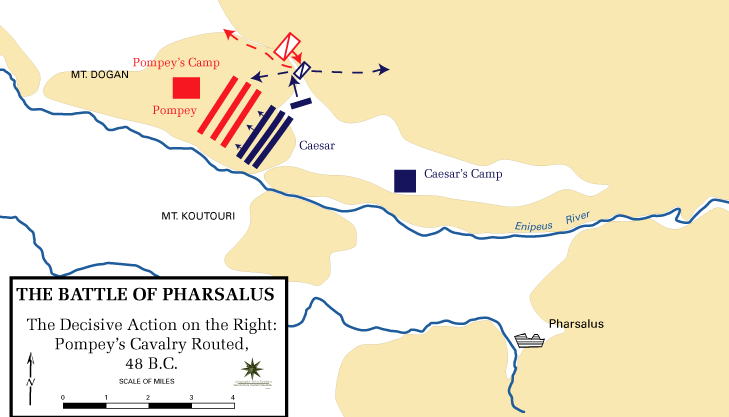
The Battle of Pharsalus, 48 BC.
But on August 9, 48 BC, near Pharsalus in central Greece, the two armies met again at the Battle of Pharsalus. Pompey lost 6,000 troops and another 24,000 captured, while Caesar only lost 1,200 men. Pompey admitted that this overwhelming defeat was the worst of his life. He escaped the camp and his soldiers while disguised as a regular civilian.
On August 9th, at Pharsalia, Pompey stated he had just faced the worst defeat of his career. 6,000 of his soldiers lay dead, while another 24,000 were captive. As for Caesar, he had only lost 1,200.
Pompey approached Ptolemy XIII, Cleopatra’s brother-husband, in a mad attempt to get revenge. He believed that hiding out in Egypt would buy him enough time to face his father-in-law, Caesar, again. On September 28th, his ship anchored off the coast of Pelusium, in the northern Nile Delta. A small group including the young pharaoh’s advisors greeted Pompey when he arrived aboard a boat. One of Pompey’s former centurions, the Roman Lucius Septimius, had been stationed in the Nile Valley for some time. While Pompey was caught off guard and trapped in the boat with no way to escape, the former legionary dealt the killing blow. Ptolemy XIII’s advisors, Pothinus and Achillas, had joined him in the assassination of Pompey as they watched Pompey die helplessly on the ship.
Pompey was assassinated and his body was dismembered to be delivered to Julius Caesar. (18th century, Gaetano Gandolfi oil painting, Musee Magnin)
Pompey had a fantastic career and deserved more than such a death. His body was cast onto the shore, pouring boiling blood, and his head was severed by Achillas. Ptolemy XIII believed he held a priceless treasure in his hands: the head of one of Rome’s best tacticians. The killers fancied themselves more cunning than Pompey and hoped that by pleasing Caesar, they might secure his support. But rather than causing an ensuing peace, the death of Pompey sparked a civil war. Caesar still had the utmost respect for Pompey. He admired Pompey’s drive and professionalism in the military. He had, no doubt, enjoyed the confrontation and was honored to see such a skilled tactician struggling. Caesar and Pompey were mirror images of one another, and thus, Pompey went down in history as Caesar’s only truly legitimate competitor.
Key dates in the history of Pompey
60 BC: The First Triumvirate
In order to become Consul of Rome, Julius Caesar created a covert alliance with Pompey and Crassus, which they called the First Triumvirate.
59 BC: Caesar, Consul of Rome
A triumvirate consisting of Pompey and Crassus and Julius Caesar allowed the latter to assume the position of Consul.
149 BC: Julius Caesar crosses the Rubicon
In order to unite Cisalpine Gaul and Italy, Julius Caesar led the 13th Legion over the Rubicon River. However, without permission from the Roman Senate, no military commander could cross this frontier.
Julius Caesar broke Roman law and declared war on the Senate by disregarding this edict. While crossing the Rubicon, he yelled “Alea iacta est,” which means “The die is cast,” in popular Latin. Nothing could stop Julius Caesar from entering Rome, removing Pompey, and eventually becoming dictator for life over the whole Roman Empire.
August 9, 48 BC: Pompey defeated by Caesar
At Pharsalia in Thessaly, Caesar pursued and decimated Pompey’s forces. Following Caesar’s crossing of the Rubicon (the river dividing Gaul from Italy), Pompey and the Senators fled Rome and headed for Greece a year earlier. After Caesar’s defeat of Pompey, the latter sought asylum in Egypt with Ptolemy XIII, but Ptolemy XIII had him murdered because he was afraid of retaliation from Caesar.
September 30, 48 BC: Assassination of Pompey
Ptolemy XIII, Cleopatra’s husband, had the Roman commander Pompey, Caesar’s adversary, killed. The Egyptian pharaoh planned this assassination in an attempt to win Caesar’s favor. But it was unlikely that the Roman Emperor would appreciate this favor. In the end, Caesar had the pharaoh deposed so that Cleopatra could rise to the throne, and then he became her lover.
47 BC: Julius Caesar meets Cleopatra
As Caesar tracked down Pompey in Egypt, Julius Caesar found out that he had been murdered. He became resentful of Ptolemy XIII, the pharaoh, who was at odds with his sister-wife Cleopatra. The Egyptian Queen had an instant and profound effect on the Roman commander. Following his successful military campaign against the monarch, Caesar handed over Egypt’s throne to Cleopatra. They were now expecting a boy.
March 15, 44 BC: Assassination of Julius Caesar
Despite being named dictator for life, Julius Caesar was killed. 50 Senators, all of whom supported the reinstatement of the oligarchic republic, piled on top of Caesar during a session of the Senate and delivered 23 sword blows. Caesar died next to a monument honoring his opponent, Pompey. Caesar had a lot of respect for Brutus, the son of his mistress, and he had a lot of respect for Cassius, a Roman commander, who were both involved in the assassination.
One of our greatest accomplishments is the development of languages, which unite and also divide us at the same time. Around 6,000 unique languages are in use on Earth right now. But UNESCO’s Atlas of the World’s Languages in Danger has more than 2,500 endangered languages, at least 600 of which are critically endangered. The question is why so many languages are disappearing.
One reason is that languages die out along with their speakers. Many native speakers of a language may perish in one mass death if their community is very tiny or if they are victims of genocide. Speakers of minority languages are much more likely to abandon their language in favor of the dominant language or a universal language.
Another indicator that a language is in danger is when it is no longer being taught to new generations. When younger generations stop using the language, it is said to have died. Most of the time, these trends progress simultaneously.
We are seeing an abandonment of languages
For instance, Latin became the dominant language in what is now France after totally replacing the Gallic language, which had been used there from around the 4th century B.C. to the third century A.D. Another example is the East Frisian and Sorbian languages, which are at risk of dying out in Central Europe.
Only around 2,000 individuals now speak Sater Frisian, the final relic of East Frisian. They are spread out throughout three different communities in the Oldenburg district of Lower Saxony in Germany.
This language was at risk of dying out since only the elderly still spoke it. To a lesser extent than before, Sater Frisian is being taught in local schools once again. Saterland could be the tiniest linguistic island in all of Europe.
The Alabama language is on the brink of extinction, with only 370 speakers left around North America. When Hernando de Soto arrived in 1540, he was the first European to hear the Alabama language. The language is related to the Muskogean languages Koasati and Apalachee.
The decline of languages persist
UNESCO found that roughly 97% of the world population speaks only 4% of the 6,000 languages around the globe. This implies that the vast majority of languages are almost abandoned by the global population. Half of all languages are now seeing a dramatic decline in speaker numbers. UNESCO predicts that by the end of the 21st century, the dominant language will have replaced more than 90% of the world’s indigenous languages.
Most language experts would agree that losing a language would be a tragedy. This is so because the loss of culture also means the loss of its traditions and values. Language is an essential part of a person’s identity, and the people who speak that language have a special connection to it. Many people who experience this change see the loss of their native language and culture as a tragic occurrence.
Efforts to preserve languages that are at risk of extinction
However, it is still possible to save an endangered language. One way that the affected language’s importance could be strengthened is through the presence of the media. Opportunities to revive and spread a language may also be found through targeted education in schools, such as in elective or special programs. Documenting and archiving an endangered language often provides the linguistic community with the urge to advocate for and strive to preserve its own language.
Alexander the Great (356-323 BC), one of history’s most successful conquerors, ruled over ancient Macedonia for 13 years. Alexander was a Greek king, explorer, and general. From the time of his first victory at the age of 18, he always moved his soldiers quickly into battle before the enemy lines were ready. He never lost a battle throughout his career. During his 13 years as King of Macedonia, Alexander the Great established an empire that stretched from Greece to what is now northwest India.
Alexander, King of Macedon
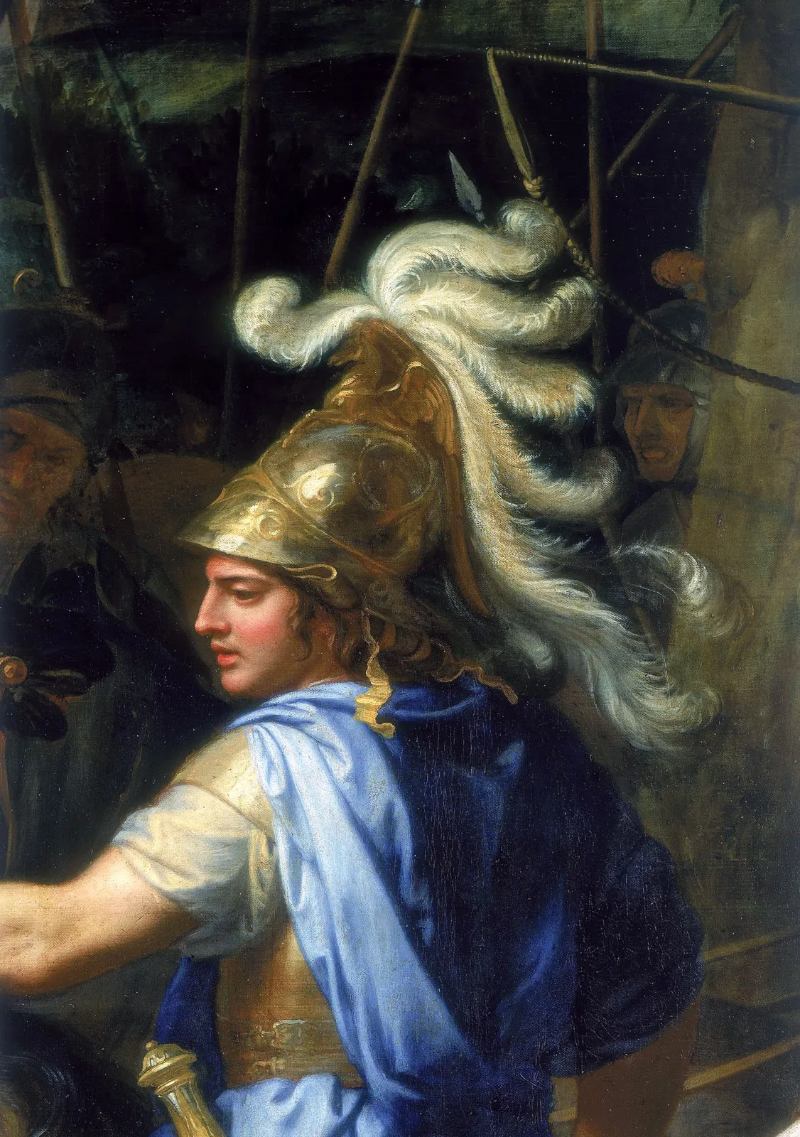
Detail of Charles Le Brun’s painting “Alexander and Porus” depicting Alexander the Great; it is located at the Louvre in Paris, France.
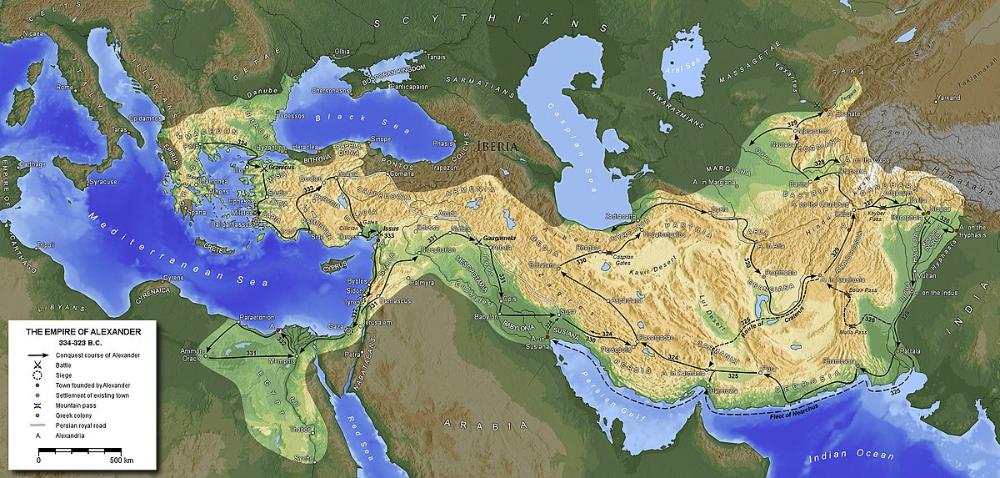
Alexander became King in 336 BC following the assassination of his father, Philip II, and was educated by the scholar Aristotle. In 336 BC, after crushing multiple uprisings, Alexander launched a massive invasion into Persian territory. Alexander started with repeated wins, eventually taking over almost the whole Persian Empire. Following his victories at Babylon, Susa, and Persepolis, Alexander set his sights on India next. He went as far as the foothills of the Himalayas, after which he returned to Babylon to rule over his conquests. The cultural legacy that his dominion spread to the East, however, did outlive him.
In general, knowledge of ancient Macedonia’s past is poor. During the Neolithic Era, several migratory peoples made their way there (c. 6200 BC). After 3000 BC, the mountainous areas between Mount Olympus and Mount Pindus were settled by people who spoke Greek. It was amid the fertile alluvial plains of Haliacmon and Axios that Perdiccas I of Macedon founded his empire in the 7th century BC. Philip II led his nation to new heights of success and growth in the 4th century BC. In 338 BC, he achieved victory against the Greeks and united Greece and Macedonia into a single kingdom.
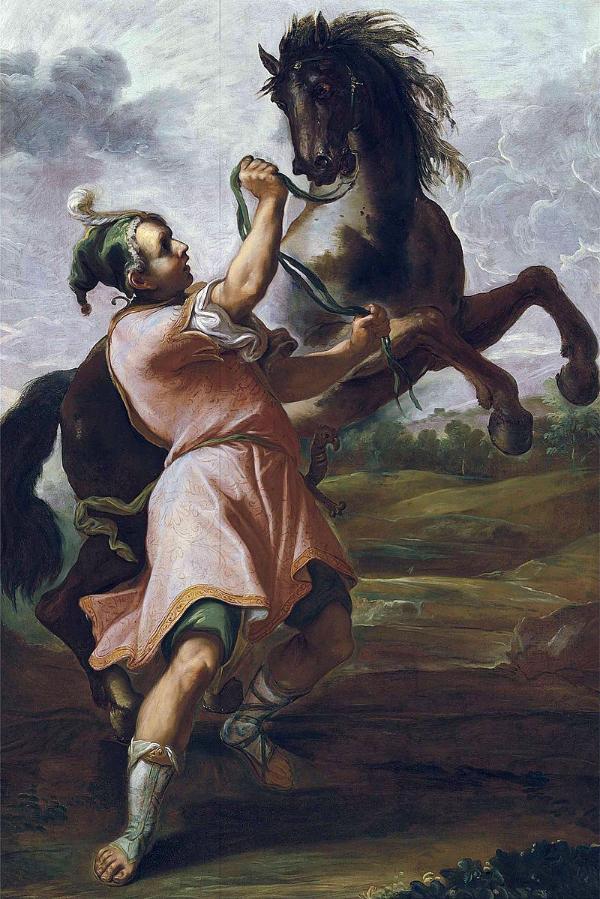
Alexander, the son of Philip II and Olympias, the Princess of Epirus, became King of Macedonia at the age of 18 (336 BC) after his father’s assassination. He was a student of Aristotle, who provided him with a rigorous education that helped cultivate his intrepidity, bravery, and innate disposition for battle. His whole upbringing had been shaken by tales of Hercules and Achilles, mythical forebears of the Macedonian throne. He had already made his mark in his father’s army as a young man, showing great skill in battle. Because of his magnetic charisma, Alexander was unrivaled in his ability to inspire his troops to victory in the face of adversity. Not only did the young prince learn to ride very well (his horse’s name was Bucephalus), but he also helped his father in the Battle of Chaeronea in 338 BC, where he gained invaluable experience in the art of combat.
Alexander the Great and his horse Bucephalus by Domenico Maria Canuti (1645-1684).
Philip II of Macedon, who had recently conquered the Greek towns, was just getting ready to attack the Persian Empire when he passed away. Although Alexander was determined to carry out his father’s plan, he postponed it while he put down a rebellion in his nation. It had been 150 years since the Persians had made another effort to conquer Greek land. Since then, the Persian Empire’s decline continued unabated. However, King Darius III was able to raise significant troops in all four corners of his immense realm, from the Mediterranean to the Indus. His riches greatly surpassed that of Alexander.
This massive size, though, may end up being a hindrance. It took weeks for the messages to travel throughout the Persian Empire and months for the warriors to assemble into their regiments. Although they outnumbered their enemies, the Persian army was so disorganized and disparate that it was difficult to keep them under control. Conversely, the legendary Macedonian phalanx, although well-equipped and over-trained, demonstrated mobility and brittleness when faced with military tactics. Unlike his contemporary Darius, who was weak and unimaginative, Alexander was a strong and inspiring leader.
At the meeting of the Greek states held in Corinth (the League of Corinth) at the end of the summer of 336 BC, Alexander established his position in Greece and obtained the leadership of the Greek armies. So the new king of Macedon handed over the regency to his mom, Olympias. In 335 BC, Alexander launched a great military effort on the outskirts of the Danube to suppress a revolt by the Thracians. Upon its return to Macedonia, he swiftly crushed the rebellious Illyrians and Dardanians at the Lake of Prespa and then made a beeline for the insurgent city of Thebes. He subjugated approximately 30,000 people to slavery and demolished the city, saving only the shrines to the gods and the house of the poet Pindar. Now that he was unburdened, Alexander was able to focus his attention eastward.
The Conquest of Persia
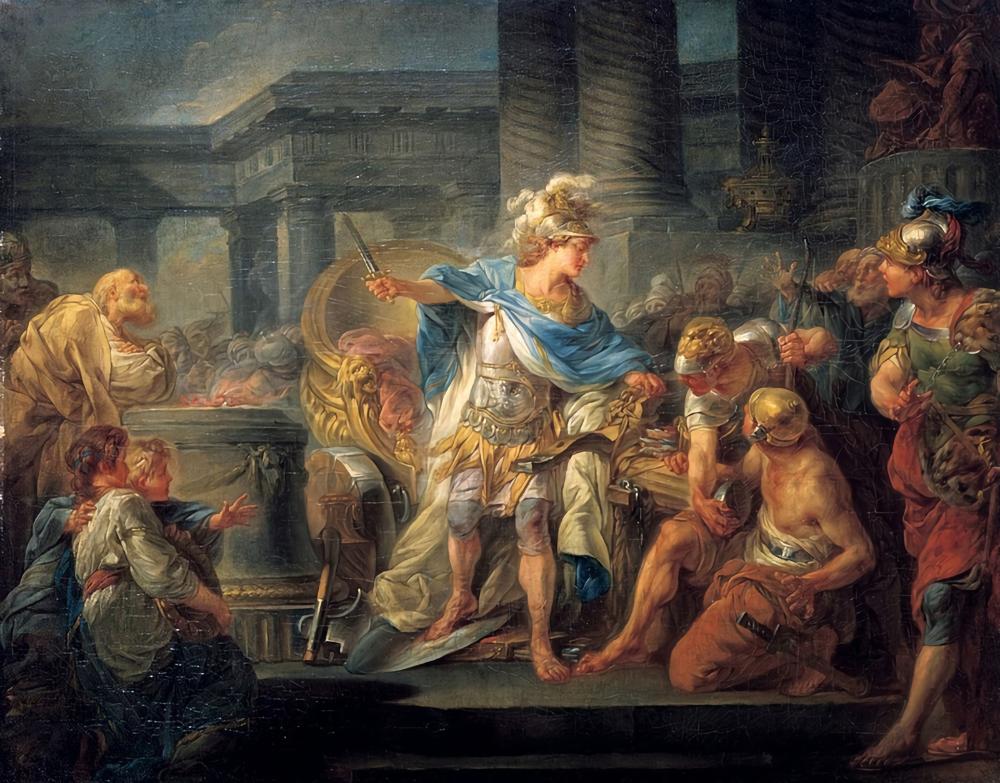
Alexander cuts the Gordian Knot, painting date 1767.
After Alexander handed over power in Macedonia to one of his generals, Antipater, in the spring of 334 BC, he embarked on a military campaign against the Persian Empire, marking the beginning of a new “Iliad,” that of an aficionado of Homer. He led 35,000 warriors over the Hellespont (the present-day Dardanelles), accompanied by his top generals, Antigonus, Ptolemy, and Seleucus. According to legend, he fought 40,000 Persians on the banks of the Granicus near ancient Troy, losing just 110 men in the process. The myth claims that at that point Alexander failed to untie the mythical Gordian Knot during his walk in Phrygia. He then sliced it with his sword. He afterwards ruled over Asian nations all the way in Afghanistan to the east.
After his first major victory at the Battle of the Granicus in 334 BC, Alexander, at the age of 22, conquered Asia Minor and freed the Greek towns on the coast from Persian rule. But his fleet didn’t let him gamble on a naval battle since the Persians could turn the tables in a maritime battle at any moment. Refusing to make a further incursion inside, Alexander instead crossed Syria and traveled down the Mediterranean Coast to Phoenicia, where the Persian fleet was based. Along the way, he defeated Darius’s Persian army in the Battle of Issus (333 BC).
After then, the Persians offered Alexander little opposition. In return for their submission, these towns and regions saw this skilled leader as kind, since he promised not to increase taxes and kept his warriors from putting them into slavery. The strategy worked, as several towns capitulated rather than suffer devastation and looting. However, some cities, like Tyre, the largest Phoenician harbor, stubbornly held out. The Greek and Macedonian forces besieged the city for eight months before finally taking it. The city’s remaining inhabitants were then forced into slavery.
With the security of this key port in his grasp, Alexander turned his attention to Egypt, which for two centuries had been under the rule of the Persians. Memphis, the ancient capital, greeted him as a liberator and anointed him king. After establishing the city of Alexandria in the Nile Delta, Alexander the Great traveled to the oasis of Siwa in the desert, where he planned to see the oracle of Amon and learn that he was indeed the son of the Greek god Zeus, not Philip. Alexander’s fame became so large that even he started to see himself as a god.
Alexander the Great in the East
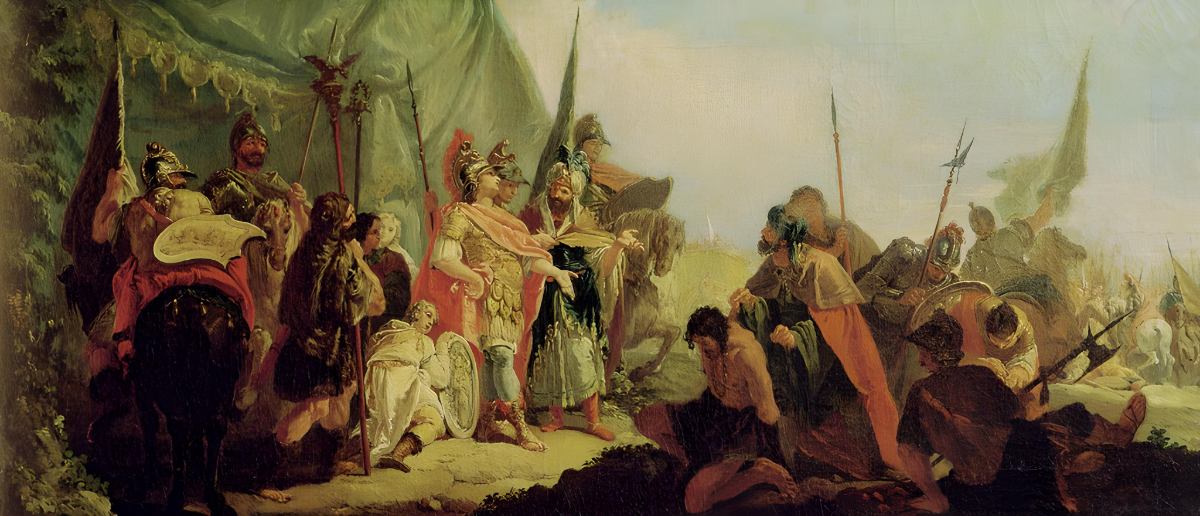
Francesco Fontebasso (1709-69), defeated Porus at the Battle of Hydaspes in 326. (Credit: Wikimedia Commons)
Alexander the Great left Egypt in October 331 BC to launch an assault on the core of the Persian Empire. Darius III suffered a second defeat at the Battle of Gaugamela, although his army outnumbered Alexander’s Macedonian army by a factor of six to one. Alexander took control of the Persian capitals of Babylon, Susa, and Persepolis, the last of which he burned as a symbol. Darius departed, having lost all hope. He died soon after being killed by relatives.
The Greek-Macedonian army continued their voyage in Central Asia for three years, finishing the conquest of the Persian Empire, which vanished forever in 327 BC. Then, Alexander headed in the direction of northern India. When Alexander reached the Himalayan foothills, he fought and won a decisive battle on the Hydaspes River (north of current Pakistan) in the Battle of the Hydaspes against the King Porus.
His weary army, on the brink of a coup, asked him to turn around. Although he would have happily pushed on to the east forever, Alexander conceded and turned back. With his army in tow, he followed the Indus to the Gulf of Oman and then began the arduous trek over the Gedrosian Desert (in Iran). In 324 BC, he was back in Babylon, his new capital.
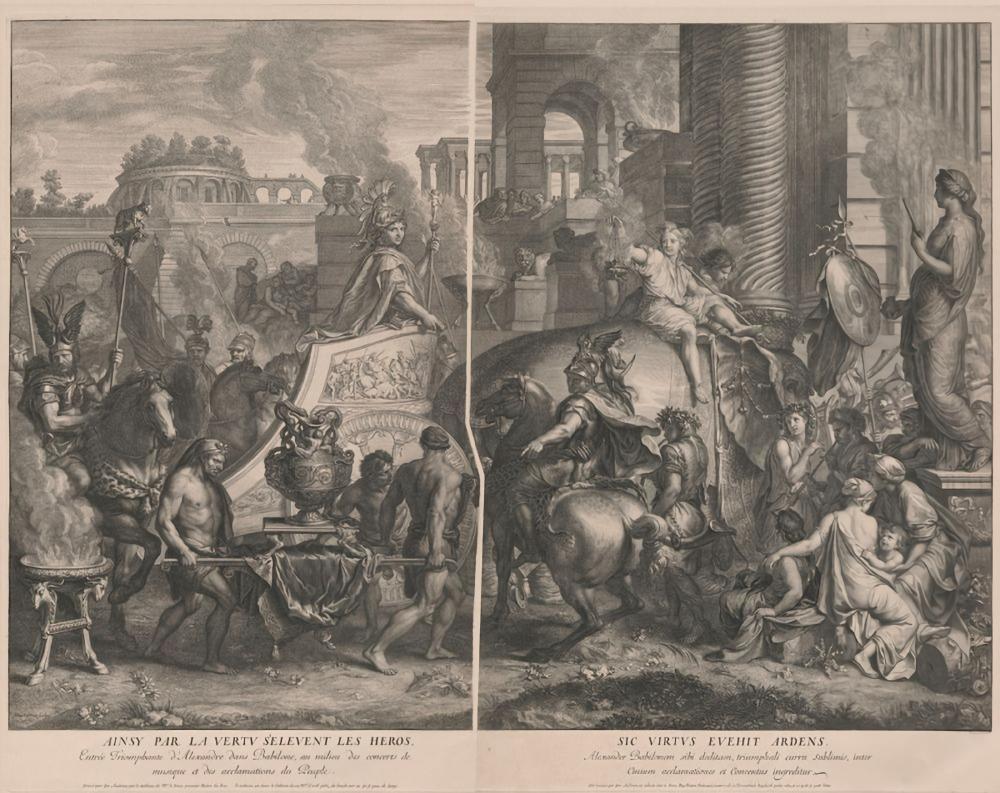
“Alexander Entering Babylon” by Gérard Audran (1640-1703).
In June 323 BC, at the young age of 32, Alexander the Great died abruptly in Babylon, most likely as a result of his alcoholism. He had been preparing for further conquests in the Persian Gulf and the East. He had become a dictator after concluding that he was a god. Due to his failure to establish a strong central administration, his kingdom soon disintegrated into chaos.
The descendants of Alexander were quickly eliminated while still infants. Alexander’s generals, to whom he had committed the administration of the conquered provinces, fought amongst themselves in a series of conflicts, eventually dividing the territory between them to form separate sovereign kingdoms. Only Ptolemy in Egypt (the Ptolemaic Kingdom, founded 305 BC) and Seleucus in Persia (the Seleucid Empire, founded 312 BC) established long-lasting dynasties.
Alexander the Great’s lasting impact
Alexander the Great had conquered much of Asia, including the Indus Valley, and brought with him the culture of the Greeks. Greeks flocked by the tens of thousands to the new towns built in the conquered lands, many of which were named after Alexander. Alexander’s conquests encouraged economic transactions and the movement of individuals and ideas, both of which contributed to the spread of Greek culture and language among the people he conquered.
This time of dominance in the Mediterranean and Near East is known as the Hellenistic period. Stunning metropolises like Alexandria, Pergamon, and Seleucia supplanted Athens as the cultural capitals of the Hellenic world. Arts and sciences thrived, and scientists, mathematicians, and astronomers like Archimedes, Euclid, and Eratosthenes helped to define the era. However, only the upper classes were exposed to Greek culture, with the masses sticking to their traditions.
Due to Rome’s rise to dominance, the Hellenic World inevitably declined. Midway through the 2nd century BC, the kingdoms of Greece and Macedonia submitted. For them, the fall of the Seleucid and Ptolemaic dynasties in 64 and 30 BC was decisive. The Greek civilization, particularly in architecture, science, literature, and mythology, was much respected by the Romans, who seamlessly assimilated the legacy of Alexander. The Bible and the Quran both refer to his deeds.
Alexander served as an example for countless conquerors throughout history. Even today, aspiring military strategists research the illustrious wars of Alexander the Great, who, with a small army of a few thousand men, successfully extended the recognized frontiers of his era.
Frequently asked questions regarding Alexander the Great
u003cstrongu003eWhich philosopher has often been credited for training Alexander the Great?u003c/strongu003e
The Greek philosopher Aristotle got young Alexander interested in science, medicine, and philosophy. He also taught him a lot about rhetoric and literature.
u003cstrongu003eu003cstrongu003eWhich empire did Alexander the Great conquer?u003c/strongu003eu003c/strongu003e
Persepolis served as the primary capital of the Persian Empire, which was established by Cyrus the Great in the 6th century BC. After Alexander the Great beat Darius III in the Battle of Issus in 330 BC, he took over the Persian Empire.
u003cstrongu003eu003cstrongu003eHow did Alexander the Great die?u003c/strongu003eu003c/strongu003e
In the spring of 323 BC, Alexander the Great returned to Babylon after a campaign that had taken him to the Indus River’s borders. The sickness he had in June ultimately proved fatal. His mysterious absence left his huge empire in shambles, with his top generals fought amongst themselves for control.
Bibliography:
Bill Yenne, (2010), Alexander the Great: Lessons from History’s Undefeated General.
David George Hogarth, (1897), Philip and Alexander of Macedon: Two Essays in Biography.
Peter Green, (2007), Alexander the Great and the Hellenistic Age.