In Greek mythology, Menoetius (Ancient Greek: Μενοίτιος Menoítios, ‘destroyed strength,’ ‘ruined fortitude’ or ‘doomed power’) was a son of the Titan Iapetus and the Oceanid Asia and brother of Atlas, Prometheus, and Epimetheus. The name Menoetius derives from the ancient Greek word μενοίτιος (menos), which means maybe power, spirit, passion, and batterage.
Menoetius
God of Fury
Native name
Μενοίτιος
Parents
Iapetus and Clymene or Asia
Sibling(s)
Atlas, Prometheus, and Epimetheus
He was a glorious warrior, but he insulted Zeus and Zeus hurled a bolt of lightning at him on Mount Triphilus (or Sipylus). According to other sources, he was merely crippled and banished to Tartaros. Perhaps he is identical with Menoites or Menoitios, the shepherd of Hades on Erytheia, who notified Geryon when Heracles stole his flock.
Hesiod mentions the “proud Menoetius” (v. 510) and reports that he is struck down by Zeus and plunged into Erebus “to punish his wickedness and boundless audacity” (v. 515). Apollodorus places the scene in the context of the Titanomachy and speaks of Tartarus rather than Erebus. Menoetius was a titan god who represented violent hatred and rash acts.
Menoitios had three siblings of the Titans: Prometheus, Atlas, and Epimetheus. He was one of the participants in the revolt of the Titans against the Olympian gods. He sided with Cronus during the Titanomachy and after attacking Olympus, Zeus knocked him down to Tartarus as punishment for his arrogance and pride.
According to the ancient author Hesiod, he sent him to Erebus, where sinful souls were also punished. No names of his wives or offspring are known. Nothing more is known of this character, and he had such a secondary character that even Hyginus omitted him from his list of Japetonids. But the same author also deviates from the common tradition and names their mother as one of the Nereids.
Other Menoetius
A less important bearer of the name Menoetius was the king of Opus, the father of Patrocles. He took part in the expedition of the Argonauts; he was a favorite of Heracles.
The third Menoetius was shepherd of the herds of Hades on the island of Erytheia. He told Geryon that Heracles had driven away his cows. When Heracles took a cow to the underworld for dead souls, Menoetius wrestled with him and his ribs were broken.
Childhood seems to be absent from representations of the Middle Ages. And yet. Medieval iconography is rich in teachings. It is almost enough to open a medieval manuscript in any region, to carefully look at a fresco, or to contemplate sculptures to realize that the child is everywhere. As a simple spectator, one also finds the child at the center of many compositions. The authors of the medieval period were aware of this.
Children in the Middle Ages
The child thus finds his place in the numerous divisions concerning the “ages of life.” Through the writings of Philip de Novara (Les Quatre Ages de l’homme, 1260) or Giles of Rome (De Regimine principum, 1280), we can distinguish a few major stages that are found in iconography, namely: early childhood, itself divided between nfantia and dentum plantatura; once this stage is passed, one enters childhood (7–14 years), then adolescence.
Beyond the correspondence between real ages and those defined by treaties, what has held our attention here concerns the different stages of life that children face. Indeed, for the medieval period, it seems more coherent to apprehend the images based on the message they want to convey rather than trying at all costs to assign an age to a particular character. In other words, one scene shows the act of learning to walk, another the act of playing, or even the apprenticeship of a trade.
Beyond these different scenes, which constitute many stages and sometimes rites of passage, we have also tried to show that the child evolves according to his environment. Indeed, there are multiple ways “to be a child in the Middle Ages.” It is this diversity that we have tried to highlight. Similarly, medieval images help reconstruct part of the material and social environment of the child, as we will see. Finally, through the three “extraordinary childhoods,” it seems obvious that the child, as such, has his rightful place in the culture, both Christian and secular, of the Middle Ages.
In the end, it is childhood, sometimes joyous, sometimes macabre, in the countryside or at the castle, playing with a spinning top or behind the master’s workbench, that we have tried to transcribe here. Through iconography, it is possible to distinguish the different stages that make up children’s lives. Based on scholarly observations while conveying stereotypes, these images are numerous and shed light on the practices and realities of the child’s condition. Thus, being born, learning, and dying are part of the realities of the time.
To Be Born
Iconoclasm as child’s play.
During the Middle Ages, the worst thing for a woman was to be sterile. Within the context of the Virgin, her role was to give as many children as possible, seen as gifts from God. In the procreation system, men still played a role, as treaties encouraged them to drink thistle juice to produce male offspring. The mother was supposed to have a “more beautiful color and lighter movement” if she bore a son.
To ensure good childbirth, one could solicit the Virgin by offering her a candle, preferably on Candlemas Day. Once consumed in the church, it could be brought home and kept close. Indeed, since the 13th century, Marian worship has gained particular importance in the West. She is then associated with both purity and fertility. As the embodiment of motherhood, she is the natural protector of all mothers.
Medical treatises also concern themselves with pregnant women. Some illuminators do not hesitate to depict uteruses in which the fetus is shown in awkward positions. Interestingly, the earliest illuminations depict “asexual” fetuses. Later additions sometimes include male genitalia. A good child is, above all, a male!
Childbirth generally takes place in the presence of midwives, who assist in delivering the newborn. The father is generally absent from the scene, sometimes even excluded from the house. As soon as the baby is born, it must cry, a sign of life. Afterward, it is rubbed with rose petals and salt, and reflexes are checked. Then, a warm water bath can begin. In any case, illuminations clearly show that the infant was eagerly awaited and received with the utmost care.
Learning
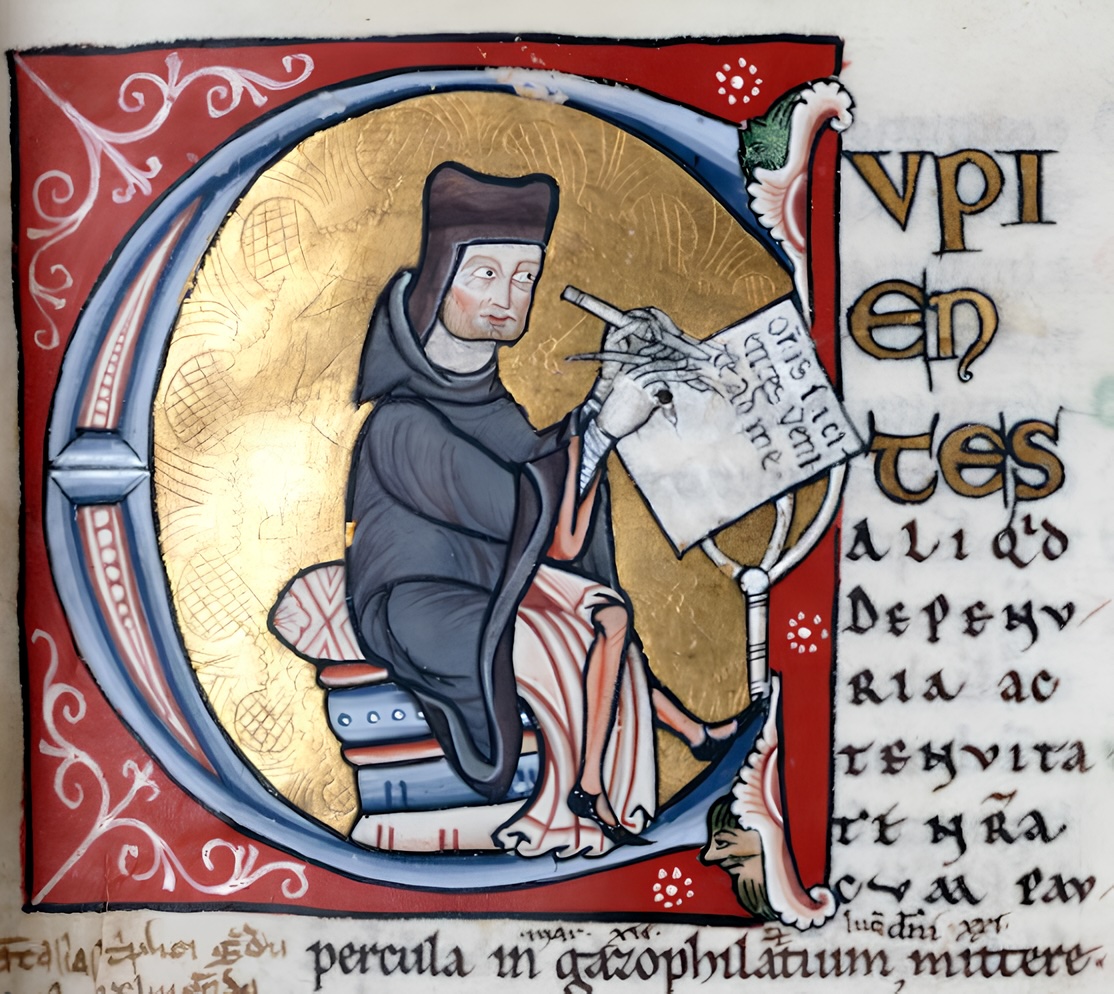
Peter Lombard at work.
After birth, the child is baptized as soon as possible, sometimes within the home itself. However, religious baptism remains mandatory and takes place shortly after childbirth, in the presence of the godfather and godmother.
This first major rite marks the integration of the newborn into the Christian community, signaling the beginning of their learning journey.
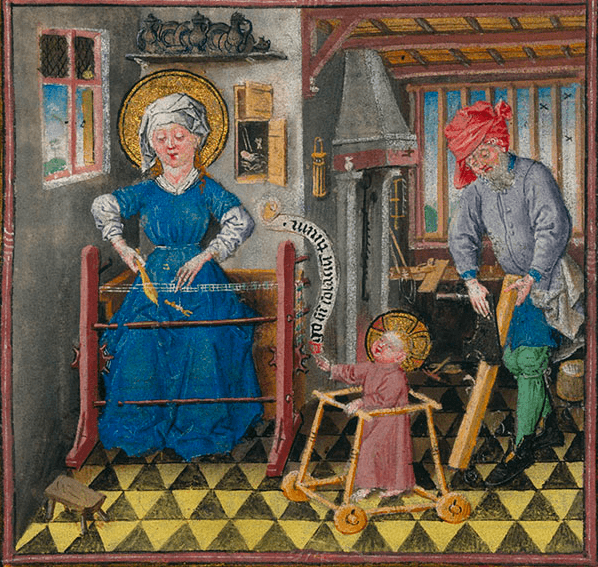
One of the first significant milestones in their lives is learning to walk. Iconography often portrays the child on all fours, although rarely, as it’s considered too reminiscent of the animal condition. The transition to standing is marked by the use of a walker or “youpala,” which can take various forms. The presence of wheels signifies mobility, albeit not without risks. Typically, speech development follows shortly after.
Another crucial moment is that of “schooling.” Illuminations reflect the reality of various educational practices. From the age of seven, children are entrusted to third parties for education, known as “fosterage” in aristocratic circles. Oblation, authorized until the 15th century, involved entrusting children to monasteries for religious education. Urban schools began to develop during the reign of Charlemagne.
Teachers provide lessons to their students. The medieval notion that school is a ladder to knowledge finds expression in iconography. Upon entering the “petite école,” children learn to read with alphabet tablets. As they progress, they ascend from floor to floor under the guidance of great masters like Peter Lombard. Childhood is indeed the age of learning, vividly represented in iconography.
Illness and Death
Infant mortality rates were very high throughout the Middle Ages. In the late Middle Ages, it was estimated that nearly one out of three children died before reaching the age of five. Death lurks at every moment. Faced with illnesses, parents can abandon everything to go on pilgrimage in hopes of a cure.
Numerous images and stories depict these miracles. For example, there is the case of a six-year-old girl who had been disabled since the age of four but regained her faculties by visiting the tomb of Saint Louis.
Beyond illness or infirmities, there are numerous other causes of death. Foremost among them is the fear of domestic accidents. Fires, for instance, both in cities and in the countryside, cause heavy damage. Wild animals are also feared. Unfortunately, caring mothers or medical remedies are not always sufficient. Iconography also attests to this.
Nevertheless, in the face of death, the reactions of parents, especially mothers, demonstrate how much childhood was valued. Everything was done to protect it.
The Child and His Environment
The child of the city is not the same as the one from the countryside, nor even that of the castle. In each place, there are different ways of representing him. At once actor and spectator, on horseback or perched in a tree, iconography does not fail to clearly distinguish social categories according to defined places. The young peasant is in the fields while the apprentice is busy in the workshop, even as the young noble learns to master his mount.
In the Country
Surprisingly, children from the peasant world are more present in miniatures than in literary texts. In this society, primarily rural—let’s not forget!—the wealth of the peasant lies in his children. Therefore, they must be taken care of closely so that they can quickly assist with agricultural work. For example, boys participate in plowing around the age of ten.
From this countryside youth, we have a witness from the 13th century in the person of the Franciscan Thomas Docking of Oxford. Thus, according to him, the country child “runs sometimes in the fields, sometimes in the garden, sometimes in the orchard, sometimes in the vineyard. He has his favorite moments in the year: in spring, he follows the plowmen and the sowers; in summer and autumn, he accompanies those who pick the grapes.
He enjoys picking unripe grapes; finding birds’ nests; bringing home sheep and poultry while jumping joyfully.” Iconography delights in depicting these children bustling happily with minor agricultural tasks and playing between two physical activities.
But rural life is also dangerous. Besides the large open hearths of the chimneys, wild animals, or even domestic ones like the sow from Falaise, agricultural infrastructures are prone to sometimes deadly accidents. Several tragic accounts mention death by drowning in the mill ponds. Thus, iconography hints at a rural world where children fully participate in agricultural work while being strongly connected to their families.
In the City
The medieval city is a place of intense and bustling activity. Generally, it is after the age of twelve that children enter into the service of an artisan. However, apprenticeship contracts show children as young as eight years old alongside a master who teaches them the basics of their future trade, building upon the mechanical arts already learned. In the margins of certain manuscripts, child cooks, carpenters, or blacksmiths are seen busy with difficult and thankless tasks.
The city is also where the hardships of the times are perhaps most keenly felt. The episode of the plague in 1348 contributed to the impoverishment of the urban world. Children suffer from epidemics, malnutrition, and even famine. In this context, begging becomes prevalent. The beggar will have a better chance of evoking sympathy from the nobles who practice charity by giving alms if they have a child with them.
But the city can also transform into a vast open-air playground. Left to their own devices, children and young adolescents watch the fish along the streams before diving in themselves to frolic in the water. As soon as they’re done, they rush straight to the nearby square to admire the spectacle of the bear showman. Taken over by the children for a game, the medieval city then takes on the appearance of a merry dance. In the end, the iconography reflects both the difficulties and dangers faced by children, as well as the playful or amusing nature of these merry groups of children who take over the places.
In the Castle
In the medieval castle, chivalrous and courteous education is imparted. Past the age of eight, boys are separated from their families to join the court of a lord of higher rank than their father. They then enter another universe, one of the cavalcades, stables, armories, hunts, ambushes, and masculine frolics. Illustrious children such as the King of Naples, Louis II of Anjou, are depicted in royal postures proportional to their size. Thus, if he rides a palfrey before the gates of Paris, the young king has a mount his size.
It is also at the castle that young nobles learn the art of hunting. This aristocratic practice is taught from the age of 7, although 12 seems more appropriate. In the wealthiest circles, children are spared so as not to hinder their development. As seen, children are generally tasked with brushing the dogs or preparing nets while observing their elders.
Still, within the castle, young pages receive education from a great lord to serve with honor. The life of a young page under Louis XII is not so rigid. We see him here and there playing with a small monkey, very much in vogue in the courts of the 14th century. The castle is also a place of pleasure where the child has his place. The education provided there aims to acquire the knowledge necessary for power under the guidance of a pedagogue, as we see here. Ultimately, the castle’s environment is not foreign to children.
On the contrary, they are integrated into aristocratic activities to acquire the codes and abilities to maintain their status.
Daily Life for Children in the Middle Ages
Among the numerous images featuring children, many of them offer glimpses into their daily lives. Sometimes at the center of the image and thus the focus of attention, other times on the margins, the place of the child within these representations is always rich in information that often coincides with contemporary textual sources. Thus, during childhood, dressing, playing, and eating are frequently staged in iconography.
Garment
Everything in a child’s attire is useful but also codified. From the “mantel” the placenta forms to the protective cradle, the goal is always to protect the child. Two types of clothing are identifiable during infancy. In early childhood, there are swaddling clothes. The attire may vary from one place to another (e.g., the mantellino with buttons in Italy) but shares common features. In Italy, spiral-striped shirts (= mummy) are notable, while elsewhere, the stripes appear looser.
The newborn’s trousseau is simple. Initially, the infant is wrapped in a linen cloth against the skin, further covered by a thicker fabric. The purpose of swaddling is to ensure proper body formation, which is deemed malleable at that stage. Ultimately, the newborn’s attire must be both comfortable and protective.
The transition from swaddling to a gown was gradual. Before the child walks, the arms are first freed in a half-swaddle. The gown, or cotte, comes into play before walking age, around one year, allowing the child time to become accustomed to their limbs. Once the child stands with the help of a walker, a long gown reaching the feet can be worn.
Between two and seven years old, the gown shortens to enable more extensive play and movement. From seven to fourteen years old, the clothing adjusts to size. Wearing a leather belt and boots generally signals the transition to a higher stage.
The color of the clothing is not arbitrary. Red and green are particularly favored. Red is believed to protect against hemorrhages, the plague, and especially measles. Moreover, aristocratic children wear a piece of red coral around their neck, possessing apotropaic value. Green is more associated with the idea of youth and the festivities of May.
Game
The game is present in all environments. Its purpose is to contribute to the strengthening of the child, their education, and their socialization. Thus, the phenomenon of the child alone with their toys is not a medieval characteristic.
Play primarily occurs in society. Many toys are handmade. Many of them are related to the commercial domain, such as the spinning top, the miniature dinner set, small merchant boats, or even the miniature plow. Others, of course, are related to war and chivalrous culture.
Several forms of amusement are distinguished, evolving according to age. Initially, the child learns to play with their body, like the infant Jesus playing with his foot or the little putti discovering their intimacy. Play quickly becomes collective and sometimes, frankly, scatological.
In a series of illuminations depicting children’s games, one can see little boys and girls playing while urinating in a pot. Others use objects that mimic nature, like the ball imitating fruit or the whistle imitating a bird. Outdoor games adapt to their environment (hopscotch, marbles, palaces, etc.). Another major game is the hobby horse. Faced off, two young boys imitate their elders, who truly joust.
All these games were to be played under the close supervision of a nurse or parents. Nevertheless, their function is primarily to promote the integration of children into society while playfully preparing them for their future activities.
Food
In addition to the mother or nurse, the father also played a role in the child’s nutrition. Similar to Joseph, fathers were responsible for preparing porridge made from flour to fortify the child’s body.
This flour paste, known as “papin,” was often supplemented with honeyed bread, goat milk (considered closest to breast milk), and a small amount of wine.
Various dishes were dedicated to this purpose, including special jars used as bottles and clay horns for breastfeeding. The horn, besides milk, could also deliver a small amount of wine, which may seem surprising today. However, it was heated beforehand to extract tannins known for treating infant diarrhea.
The weaning process was gradual, transitioning from breastfeeding to porridge consumption. By the age of two, children could consume a more regular diet, including boiled foods, eggs, cooked apples, wine, and poultry. They could even participate in banquets and receptions.
In iconography and literature, the crust of bread often symbolizes childhood.
Extraordinary Childhoods
The Infant Jesus
Throughout the Middle Ages, the representation of the Nativity underwent evolution. By the late Middle Ages, the scene typically unfolded in a stable where the ox and the donkey were included, despite their absence from the Gospels.
The shepherds and their animals congregated around the Holy Family to commemorate the Lord’s arrival, having received a warning from an angel. Subsequently, the Magi arrived to present gifts to the infant Jesus. The number of Magi depicted varied over time in iconography.
According to Jacques de Voragine, Melchior, depicted with white hair, symbolized gold and royalty; Gaspar, represented with red, offered incense from Asia; and Balthazar, with a black face, brought myrrh, symbolizing the Son’s eventual death. Similarly, various representations of the Virgin and Child existed.
The presentation of Jesus in the temple corresponds to a passage from the Old Testament indicating that “every firstborn male shall be consecrated to the Lord” [Exodus 13:2, 11–13]. An elderly man named Simeon received the infant Jesus. At the age of twelve, Jesus was discovered in the Temple conversing with the doctors. Upon being found by his mother, he responded, “Why were you searching for me? Did you not know that I must be in my father’s house?” [Luke 2:40–50].
Hence, medieval iconography depicted all episodes of the infant Jesus’ life.
Merlin: Half-man, Half-demon
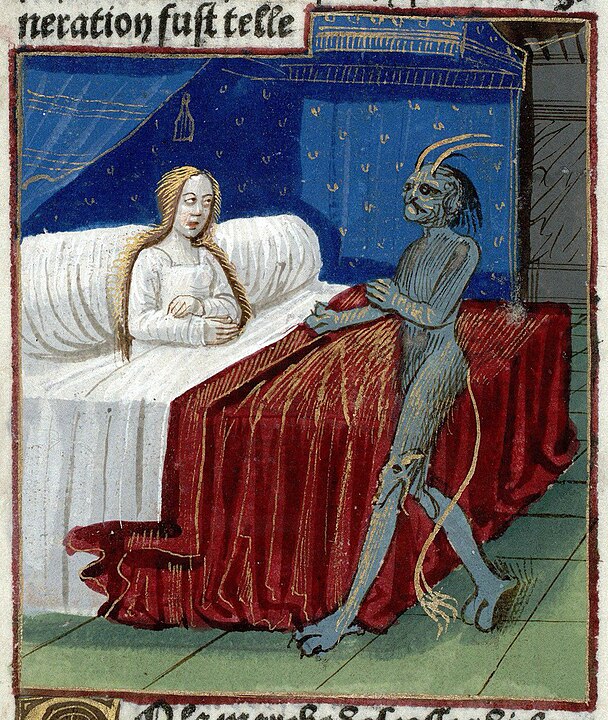
The conception of Merlin as depicted in a circa 1494 manuscript of the Prose Lancelot.
Merlin is the son of a princess impregnated during her sleep by an incubus demon. The sexual power of the demon is suggested in some illuminations by a cacophony of other demons. Merlin is, by nature, half-diabolical.
The son of a devil who deceived a virtuous woman, Merlin knows the past and the future. He reveals himself differently from birth: an astonishing newborn covered in hair, he lives secluded in a tower with two servants and his mother, who will await a witchcraft trial for two years, which could lead her to the stake.
Meanwhile, the child has been lowered into a basket to be baptized in the presence of a curious crowd that will accompany him throughout the journey. The visual procession of baptism emphasizes the integration of the devil’s son into the Christian community and thus dispels the suspicions that weigh upon him.
Two men are putting the stake together close by in a room with a low wall separating them. These preparations weigh like a threat and seem to indicate that the verdict is known in advance.
But this is without counting on the extraordinary talents that Merlin will display during the trial held at the top of the tent. Merlin, now two years old, wears an orange robe and raises his arm to defend his mother. An exceptional orator and jurist, he argues before the prosecutor and the three judges, whom he accuses in turn, revealing their secrets and denouncing their bias. He manages to have his mother’s innocence recognized.
He serves as the intermediary between the group of women and the men of law, just as he symbolized in his younger years the exchange between the top of the tower cut off from the world and the churchyard where the baptism is celebrated outdoors and in public.
The play of colors is also interesting. The orange hue of Merlin’s robe, the same color as the justice tent, highlights an essential characteristic of the character: a public figure, a man of words, Merlin saves his mother through his eloquence and upholds a higher justice.
In contrast, the yellow of the men preparing the stake symbolizes disorder in medieval times.
Lancelot: The Best Knight in the World
Lancelot is the son of King Ban of Benoic, a vassal of Arthur, and Queen Helen. He spent his early childhood surrounded by his cousins, the sons of Bohort de Gaunes. But one day, the terrible Claudas assaults his family, forcing them to flee. Upon seeing the burning castle, Ban of Benoic, his loving father, dies of grief at the thought of what will happen to his family.
In their flight, as they have just found a place to rest, Queen Helen sees the arrival of the fairy Viviane, who dangerously approaches Lancelot’s cradle. She manages to steal the young child and rushes toward a lake, where she jumps on her feet first.
From the age of three, “The Lady [of the Lake] taught him and provided him with a master who taught him how to fight and conduct himself as a nobleman.” From then on, Lancelot is not quite like his peers. At one point in his education, he argues with his tutor. Angry, the master strikes his greyhound. In response, the young and fiery knight smashes his bow over the bad master’s head. The Lady of the Lake intervenes and sides with Lancelot, who, from then on, needs no one and can judge the best and noblest behavior.
After some exploits, Lancelot goes to King Arthur’s court to receive his knighthood, a rite of passage marking entry into a higher stage. Childhood is over, making way for youth, tournaments, and chivalrous feats.
In Greek mythology, Menoetius (Μενοίτιος: Menoítios “ill-fated power”, from μένος “power” and οἶτος “ill fate”) is remembered in the Iliad as the father of Patroclus. Pindar says that among all the settlers who were invited to reside in Opuntian lands, King Opus honored Menoetius above all others.
Menoetius
Family
Spouse
Sthenele Polymele Philomela
Children
Patroklos Myrto Abderus
Parents
Actor and Aegina and Damocrateia
Siblings
Peleus
Menoetius was himself the son of Actor, the Argonaut, and Egina, but before marrying him, Egina had given Zeus a son named Aeacus, the father of Peleus and therefore the grandfather of Achilles. Thus, Menoetius and Aeacus were half-brothers, making Patroclus Achilles’ cousin-uncle (Homer, indeed, presents Patroclus as older). Eustathius has another version. He says, “It must be known that ancient historiography transmits Patroclus as a relative of Achilles; Hesiod asserts that Menoetius, the father of Patroclus, was the brother of Peleus, so in that case, the two were cousins.”
The wife of Menoetius and mother of Patroclus does not have a firmly established tradition. Apollodorus summarizes its variants: “Estenele, daughter of Acastus; or Periopis, daughter of Pheres, or according to Philecrates, of Polymela, (or Philomela), daughter of Peleus.” Others say it was Damocratea, a daughter of Zeus and Egina. It is said that Menoetius’s daughter was Myrto, and that she had a daughter, Euclea, by Heracles.
Menoetius participated in the expedition of the Argonauts. When his friend Heracles died, Menoetius instituted that sacrifices be offered to him every year in Opus and that he be honored as a hero. He lived in this city when Patroclus, still a child, accidentally killed his friend Clytonimus, son of Amphidamas, while they were playing dice. This event led both of them to flee to the court of Peleus in Phthia, where they met Achilles, and the father remained there until the end of his days. There they were found by Odysseus and Nestor when they were recruiting troops for the Trojan War. Before departing for the war, Menoetius entrusted Patroclus with the task of advising and guiding Achilles, even though he had “a superior lineage.”
Menetios is mentioned a few times in the Iliad. At the time of the Iliad, Achilles tells Patroclus that his father is still alive. It is also in the Iliad that the advice he gives to his son before leaving for Troy is recorded:
“Achilles, by lineage, is above you, my son; But he is your junior, even if he is superior to you, It’s up to you to speak to him wisely, to instruct him And to guide him: he will see what he gains from it.”
References
The less common form “Menetio” appears in Hesiod: Works and Fragments, volume 13 of the Editorial Clásica Gredos
This etymology is given by Robert Graves in the name day of The Greek Myths, adding that it could also mean “fate or defiant”.
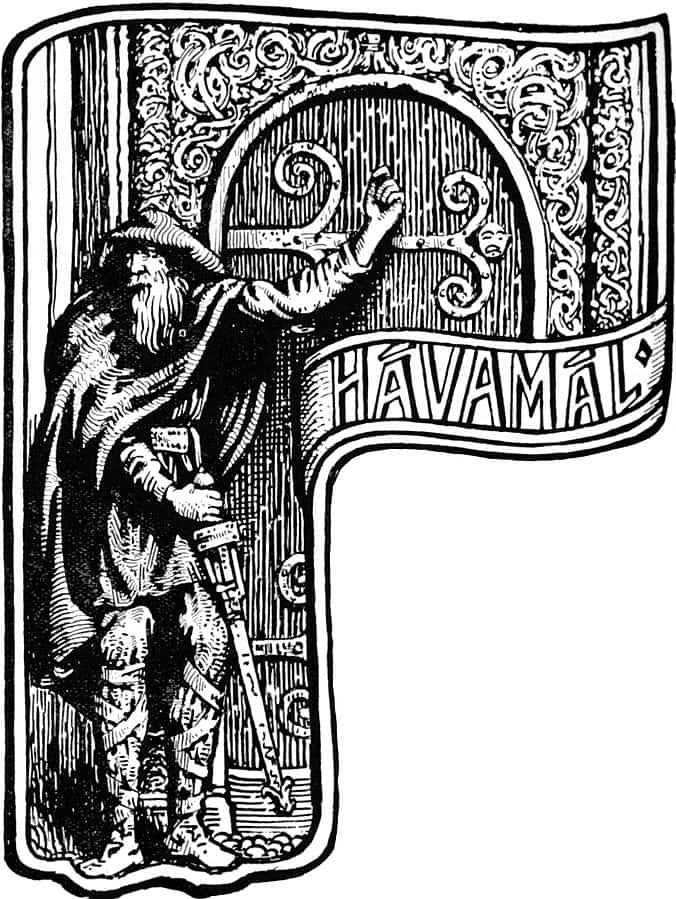
The Hávamál, the High Song or the Sayings of the High One, is a collection of a total of 164 eddic verses that are counted among the Poetic Edda. “High” in “The High Song” or “The Sayings of the High One” refers to the Norse god Odin, who in the poem gives mortal humans advice on how to lead a successful and honorable life. Hávamál, as part of the Edda, belongs to the wisdom literature and is compared to the Indian Vedas or the Homeric poems of Greece. The poem is exclusively preserved in the Codex Regius from the 13th century, which has been kept in the Arnamagnæan Collection in Reykjavík since 1971. In the Codex Regius, Hávamál is included as the second text directly after the Völuspá under the title hava mal, which indicates the high importance attributed to the poem by the compiler of the Codex Regius.
The fact that Snorri Sturluson places the first verse of Hávamál at the beginning of his mythological textbook Gylfaginning and that Eyvindr Skáldaspillir quotes verses of Hávamál at the end of his poem Hákonarmál is taken as evidence that Hávamál was already known in the 10th century. Klaus von See sees a series of dependencies on Latin poetry, especially the Disticha Catonis, whether directly or through the mediation of other Old Norse poems like the Hugvinnsmál, and also quotes other works that point to Seneca and other literature known in the Middle Ages.
Theodoricus Monachus, who wrote the Historia de antiquitate regum Norwagiensium in the 12th century, knew Plato, Chrysippus, Pliny, Lucan, Horace, Ovid, Virgil, the Church Fathers such as Origen, Eusebius, Jerome, and Augustine, and the late antique or medieval authors Boethius, Paulus Diaconus, Isidore of Seville, Bede, Remigius of Auxerre, Hugh of St. Victor, and Sigebert of Gembloux. This means that the Archbishop’s library in Nidaros was well stocked as early as the 12th century.
The earliest editions
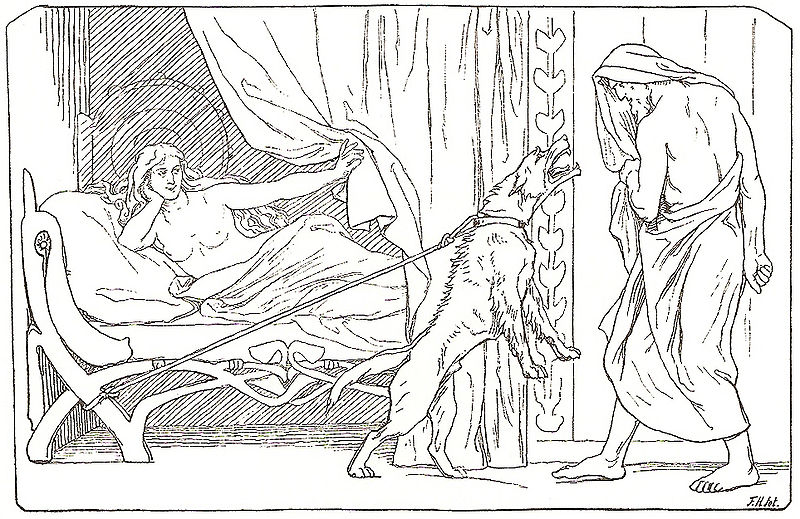
Billingr’s girl, bitch, and Odin by Frølich
In 1665, a very unreliable edition was published by Peder Hansen Resen, followed by editions in 1818 by Rasmus Christian Rask and Arvid August Afzelius, in 1828 by Finnur Magnússon, in 1843 by Franz Dietrich, and in 1847 by Peter Andreas Munch. The subsequent editions were based on Munch’s edition.
Content
Already in the 19th century, it was noted that the work was composed of several parts, with the number of parts and their boundaries being disputed. Hazelius assumed five parts, Müllenhoff apparently assumed six parts in 1883, and Finnur Jónsson in his monograph Hávamál (Copenhagen 1924) even assumed seven parts. The subheadings Ládfafnismál (“Loddfafnir’s Song”, verses 111–138), Rúnatal þáttr Óðinn (“Odin’s Rune Song”, verses 139–142), and Ljóðatal (“Magic Songs”, verses 147–165) are not found in the manuscript. Today, some scholars assume a division into three parts: Part I (verses 1–76), Part II (verses 78–110), and Part III (verses 111–165). According to this classification, the first part ends with the famous verse:
“Deyr fę, deyia frǫndr, deyr sialfr it sama; ec veit einn at aldri deýr: domr vm dꜹþan hvern.”
Cattle die, kinsmen die, all men are mortal; but words of praise will never perish nor a noble name.
Here, some have wanted to see Christian echoes, as a similar train of thought can be found in Ecclesiastes 3:19. However, not everything that is similar must depend on each other.
In terms of content, the first two (of three assumed) parts deal with wisdom for life and rules of conduct. The parts differ in that in the first part, all possible topics are addressed and consistently described in the verse form Ljóðaháttr, while the teachings of the second part focus on wealth and gender relations. Klaus von See identifies the first-person narrator, who reports on his own views and experiences in some verses, quite naturally with Odin for the entire poem. Ottar Grønvik, on the other hand, sees him as an authorial narrative poet who reports on his development and also serves as a representation of people in relation to the divine. However, at one point in the first part, it is clearly Odin. The poet critically distances himself from Odin when he reduces Snorri’s Skáldskaparmál’s celebrated acquisition of poetic mead to a simple drinking spree.
The second part differs from the first part formally in that between the verses in the verse form of Ljóðaháttr, there are also simple list verses, e.g., verses 84–86. Practical advice, such as in verses 80–82, is also missing in the first part. They could be of a later date, but verse 80 must be very old, as it advises to praise a woman only after she has been cremated. The verse probably dates from the time of cremation. The same applies to verse 70. In the second part too, there are references to Odin that portray the god in an unfavorable light. In the first, Odin recounts the embarrassing failure of a forbidden love affair (verses 95–101). This passage is probably old because in verse 96, the word “Jarl” is used as the highest social position, indicating the pre-monarchical era. The second Odin story (verses 104–110) depicts Odin as a ruthless and immoral god. The ice giants inquire about “Bölverkr” in verse 109, which means evildoer. Here, too, Odin is not portrayed as a positive hero. In the past, Odin’s denigration was seen as having Christian influence. Today, it is assumed that there were not only tensions between paganism and Christianity but also within paganism between different cults. However, the poet was not irreligious, as verse 79 shows, in which he attributes the holy runes to the gods. Due to his moral standards, which he applies to Odin’s behavior, the poet can, with some probability, be assigned to the peasant religion of Thor and Freya.
The much-discussed verse 111 introduces the teachings of Loddfafnir:
Mál er at þylja þular stóli á Urðarbrunni at, sá ek ok þagðak, sá ek ok hugðak, hlýdda ek á manna mál; of rúnar heyrða ek dæma, né of ráðum þögðu Háva höllu at, Háva höllu í, heyrða ek segja svá:
It’s time to speak from the seat of the speaker. (Þulr). At the Well of Urd I sat and was silent, sat and pondered, listened to the speech of men; about runes I heard them speak, and they did not withhold counsel in the hall of the High One; in the hall of the High One I heard such things said:
The last verse of the Hávamál picks up this formulation, so it can be assumed that originally only this part between these framing stanzas bore the name Hávamál and was an independent poem.
The discussion revolves around the person of the “Þulr” (speaker) in the second line, which is often identified with Odin. Karl Müllenhoff, however, demonstrated through usage examples also in Old English that Þulr is a human speaker in the king’s hall, a powerful man. Therefore, he changed “manna mál” in line 6 to “Háva mál”. According to his view, the first-person narrator is a human speaker on the speaker’s chair who reports to the people what he heard at Urd’s Well, where Odin himself instructed him and addressed him as “Loddfafnir.” He refers to him as a rogue because in verse 113, he pretends Odin advised him not to get up at night unless he needed to urinate or was assigned as a guard. Müllenhoff dismisses verse 112 as a later addition. He was essentially followed by Finnur Jónsson. Sophus Bugge kept the text and interpreted verses 111ff. so that Loddfafnir sits on the speaker’s chair and announces to those present the religious revelation he received from Odin and initiated men about Odin’s self-sacrifice (verse 139). According to him, Loddfafnir is not a real person but a mythical-poetic figure. Axel Olrik saw a connection between the magical framework of the sorcerers (Seiðhiall) and the chair of the Þulr and considers the chair to be a magical prop. W. H. Vogt then emphasized the relationship between Völva and Þulr. He sees the high seat of the Völva and the poet’s chair of the Þulr on the same level.
A particular difficulty is that the Þulr is said to have received his revelation both at Urd’s Well and in the hall of the High One, which is commonly equated with Valhalla. However, both places were thought of as far apart in Norse mythology: Valhalla with the gods and Urd’s Well under the world tree Yggdrasil. A newer interpretation resolves this contradiction by suggesting that the hall of the High One is not Valhalla but a cult house dedicated to Odin and Urd’s Well is one of the sacred springs in close proximity. This assumes that there was originally no internal connection between the first two parts and the concluding third part, so that the designation “the High One’s Hall” in the last Odin adventure of the second part (verse 109), which clearly refers to Valhalla, cannot be transferred to the third part. The runes that the men speak of may be certain mystical-religious chants, as they are also referred to as runes in Vafþrúðnismál verse 42.
The name “Loddfáfnir” is composed of the two word stems “Lodd” and “favne” and a suffix -nir (e.g., Vafþrúðnir, Fjósnir in verse 12 of the Rígsþula and more), which was common at the time. “Lodd” poetically stands for “woman” and “fáfnir” is traced back to “faðmr”, “to embrace”. *Faðmnir is the Embracer and Loddfáfnir “he who embraces the woman”. From the immediately following stanzas, which deal with marital fidelity, one can imagine an honest man who passes on the firm moral norms of the peasant society, which he heard in the hall. This leads to verse 139:
Veit ek, at ek hekk vindga meiði á nætr allar níu, geiri undaðr ok gefinn Óðni, sjalfr sjalfum mér, á þeim meiði, er manngi veit hvers af rótum renn.
I know that I hung on a windy tree nine long nights, wounded with a spear, dedicated to Odin, myself to myself, on that tree of which no man knows from where its roots run.
The last two lines are considered a later addition because they adopt the description of Yggdrasil under the name “Mímameiðr”, from which no one knows which root it grows from. Here, however, it is a sacred sacrificial tree on earth, to which the remark does not apply because no one knows where it is located.
The spear was Odin’s weapon and it played a special role in the sacrifice. With it, the sacrifice was wounded as a sign that it was dedicated to Odin. Adam of Bremen writes in his Gesta Hammaburgensis ecclesiae pontificum about the sacrificial ceremonies in Uppsala, stating that they lasted for nine days and that each day a man was hanged on the sacrificial tree. The ritual sacrifice described in verse 139 would have taken place at the beginning of such sacrificial ceremonies, and the first sacrifice hung on the tree for as long as the celebration lasted. However, the first two lines of the following verse indicate that the Hávamál was not an ordinary fertility sacrifice:
Við hleifi mik sældu né við hornigi; nýsta ek niðr, nam ek upp rúnar, æpandi nam, fell ek aftr þaðan.
No bread did they give me nor a drink from a horn, downwards I peered; I took up the runes, screaming I took them, then I fell back from there.
The one sacrificed was not hung by the neck to die, but by the body, so that he could peer downward, and thus he acquired the runes. Learning by loudly speaking the material was the customary method of instruction at that time. By “runes” are meant the religious secrets and magical knowledge in fixed mnemonic verses, and they contrast with the bread and livestock of the fertility sacrifice. The image of the hanged sacrifice may also be described in verse 135:
oft ór skörpum belg skilin orð koma þeim er hangir með hám ok skollir með skrám ok váfir með vílmögum.
From shriveled skin often comes wise word, (of) the one who hangs with hides and dangles among animal skins and floats alongside sons of misfortune.
In Vestfold, remnants of a tapestry were found depicting nine men hanging from a tree. It is believed that Odin is speaking here. Sophus Bugge saw Christian influence in this, assuming a parallel to the crucifixion of Christ. This view was also recently supported by Britt-Mari Näsström. However, it contradicts the fact that the Bible does not speak of a sacrifice of God to himself but of the redemptive suffering of Jesus, who is a person of God distinct from the Father. Grønvik therefore assumes that it is not Odin but the Þulr from verses 111 and 112, who is the first-person narrator, experiencing a mystical union with Odin in ecstasy, as described for mystics in many religions. This mystical union with Odin simultaneously constitutes an initiation rite for a Þulr, as has been suggested earlier. It follows the notion that Odin hung in the World Ash Yggdrasil in mythical times. Yggr is one of Odin’s many names.
Grønvik believes to have found hints on the runestones of individuals referred to as Þulr. On the Snoldelev Stone from Zealand, it says, “Gunvald’s stone, son of Roald, tul in Salhauku(m)” (= Salløv).
Ethics
The philosophy of the poem is rooted in the belief in the worth of the individual, who nonetheless is not alone in this world but connected through an inseparable bond with nature and society. The cycle of life is complete and indivisible. The animate world, in all its manifestations, forms a harmonious whole. Violations against nature have immediate repercussions on the individual themselves. Each individual is responsible for their own life, happiness or unhappiness, and creates their own life from their own resources.
References
Konstantin Reichardt: “Odin on the gallows.” Yale University, 1957, pp. 15–28.
Kalus von See: The figure of Hávamál. A Study of Eddic Saying Poetry. Athenäum Verlag 1972.
Barend Sijmons and Hugo Gering: The Songs of the Edda. Third volume: Commentary. First half: Songs of the Gods. 1927.
Kieran R. M. Tsitsiklis: The Thul in Text and Context. Þulr/Þyle in Edda and Old English Literature. Berlin/Boston 2016, ISBN 978-3-11-045730-8.
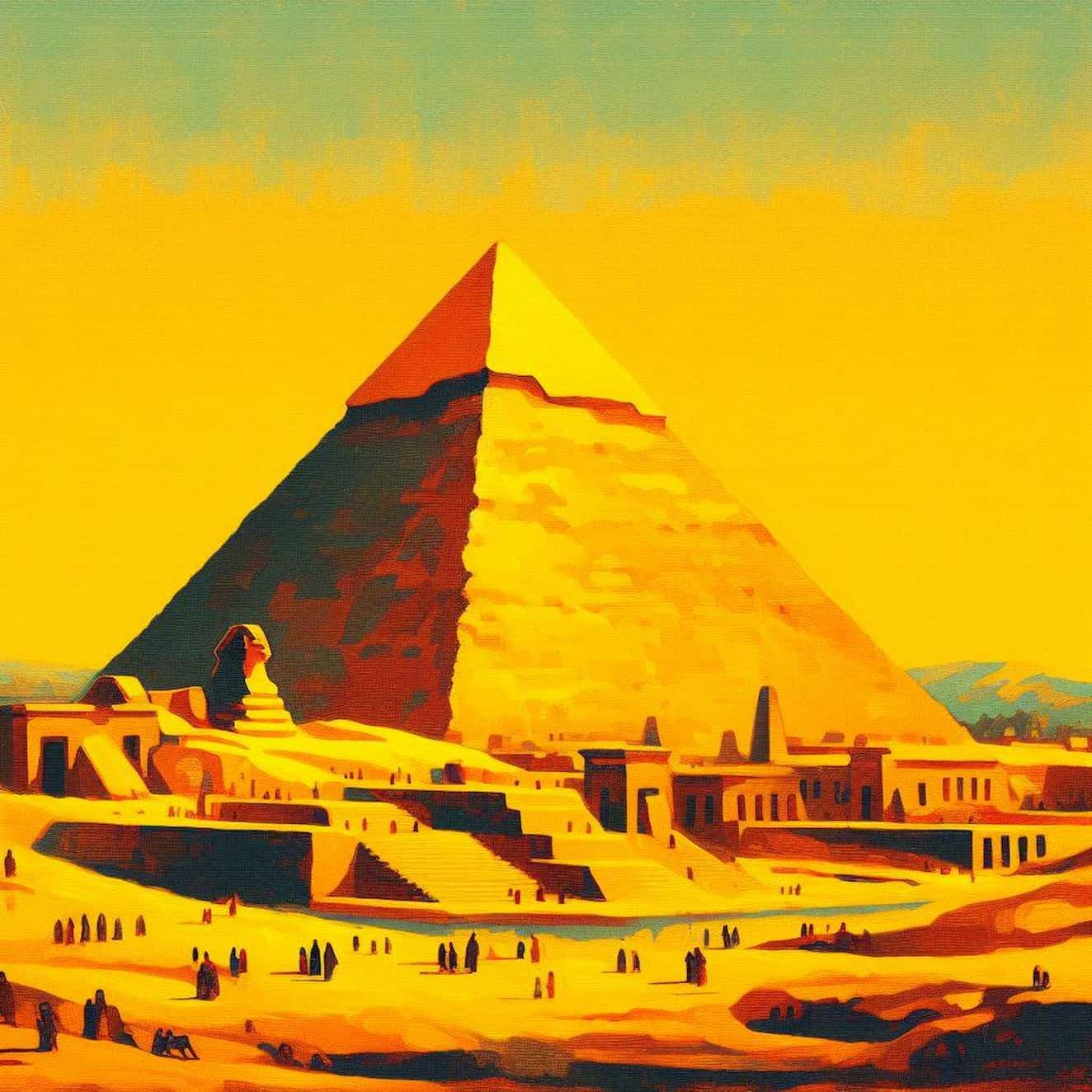
Standing on the desert plateau of Giza outside modern Cairo, the Great Pyramid of Pharaoh Khufu (completed around 2560 BC during the Fourth Dynasty) challenges the human imagination even in an era of tower cranes and laser surveyors. Constructed from roughly 2.3 million individual blocks of limestone and granite weighing an average of 2.5 tons apiece—with the heaviest granite ceiling beams inside the King’s Chamber tipping the scales at a staggering fifty to eighty metric tons each—the monument rose 146.6 meters (481 feet) into the sky with its four base sides aligned to true North, South, East, and West to within three-sixtieths of a single degree. Over the past three decades, a revolution in experimental archaeology, papyrus discoveries, and geophysical scanning has debunked myths of alien intervention and whip-lashed slave armies, revealing the brilliant real-world physics and engineering behind how the Egyptians built the pyramids.
Not Slaves: The Workers’ Village of Heit el-Ghurab and the Diary of Merer
For over two thousand years, a popular misconception originating with the fifth-century BC Greek historian Herodotus claimed that the pyramids were built by a hundred thousand starving enslaved prisoners whipped under the desert sun. Modern archaeology has completely overturned that myth:
The Excavated Workers’ Town at Giza: Beginning in the late 1980s, archaeologists led by Mark Lehner and Zahi Hawass excavated the vast pyramid-builders’ settlement of Heit el-Ghurab (“Wall of the Crow”) just south of the Sphinx. Instead of slave shackles, they unearthed industrial-scale royal bakeries, copper workshops, dormitories for rotating crews of 20,000 to 30,000 skilled Egyptian craftsmen and seasonal agricultural laborers, and hundreds of thousands of animal bones proving the workers were fed a high-protein luxury diet of prime roast beef, sheep, goat, Nile fish, garlic, bread, and beer every single day—and received orthopedic medical care when injured!
The 2013 Discovery of the Diary of Merer: In 2013, at the ancient Red Sea port of Wadi al-Jarf, French archaeologist Pierre Tallet unearthed the oldest surviving papyrus logbooks in human history: the 4,500-year-old Diary of Merer, written by an actual middle-ranking inspector (Merer) who led a two-hundred-man boat crew during the twenty-sixth year of Pharaoh Khufu’s reign! Merer’s day-by-day logbook describes his crew quarrying fine white casing limestone at Tura on the east bank of the Nile, loading the stones onto wooden barges, and rowing them across the flooded Nile inundation basin right into artificial harbor canals dug at the foot of the Giza plateau.
Quarrying Limestone and 80-Ton Aswan Granite Without Iron or Wheels
How did Fourth Dynasty stonecutters quarry millions of blocks when Egypt was still in the Copper and Bronze Age and did not yet possess hardened steel chisels or wheeled cranes?
Quarrying Soft Core Limestone Locally: Over ninety percent of the Great Pyramid’s interior core blocks were quarried right on the Giza plateau just a few hundred yards south of the pyramid! Using work-hardened arsenical copper chisels and wooden mallets, masons cut narrow grid trenches around each block in the soft nummulitic limestone bedrock and pried the bottom loose using long wooden levers and wedges soaked in water to expand.
Pounding Hard Granite With Dolerite Balls and Quartz Sand Saws: For the rock-hard red granite brought five hundred miles down the Nile from Aswan to line the burial chambers, soft copper chisels would simply bend. Instead, quarrymen pounded trenches into the granite bedrock using ten-pound spherical hammerstones of even harder greenish-black volcanic dolerite, and sawed flat precision faces through granite blocks using toothless flat copper blades fed with a wet abrasive slurry of crushed quartz sand and water—where the hard quartz crystals (Mohs hardness 7) did the actual cutting!
The Wet-Sand Sled Trick: Cutting Friction by 50 Percent!
Once a 2.5-ton or 50-ton stone block was unloaded from a Nile barge at the Giza harbor, how did crews haul it across the sand and up the pyramid without wheels? By strapping the block onto a heavy, curved-runner wooden sled (sledge) pulled with thick papyrus and hemp ropes.
For a century, modern Egyptologists looked at a famous Twelfth Dynasty wall painting inside the Tomb of Djehutihotep (showing 172 men pulling a colossal sixty-ton alabaster statue on a wooden sled while a single worker stands on the front toe of the sled pouring liquid from a jar onto the sand right ahead of the runners) and dismissed the water-pourer as performing a purely religious purification ritual. In 2014, however, physicists at the University of Amsterdam tested a scale sled in a laboratory sand tray and proved the ancient Egyptians were masters of tribology (friction physics):
If you pull a heavy wooden sled over bone-dry desert sand, a pile of loose sand heaps up in front of the runners and creates massive sliding friction.
If you pour just the right amount of water (roughly 2% to 5% moisture volume) onto the sand directly in front of the sled runners, capillary water bridges bind the sand grains together into a firm, slick surface—cutting the pulling force required to move the sled in half (by 50%)!
Stepped Ramps, Post-Hole Pulleys at Hatnub, and Water Leveling
To raise those sleds up the rising tiers of the pyramid, engineers used systems of construction ramps built of brick rubble, desert clay (tafla), and gypsum plaster:
External Straight, Wrapping, and Internal Ramps: For the lower third of the pyramid—which contains over half of the pyramid’s entire mass!—wide straight or zigzagging external ramps allowed teams to haul stones directly from the quarry onto the broad platform. For the narrower upper levels, researchers have proposed wrapping corkscrew ramps or an internal spiral tunnel ramp (investigated by architect Jean-Pierre Houdin and the ScanPyramids cosmic-ray muon tomography project, which discovered a massive thirty-meter unexplored “Big Void” above the Grand Gallery in 2017).
The 2018 Hatnub Ramp Discovery: At the ancient alabaster quarry of Hatnub dating to Pharaoh Khufu’s exact reign, archaeologists uncovered a remarkably steep twenty-percent-grade rock-cut ramp flanked on both sides by two staircases and dozens of deep vertical post-holes—proving that Khufu’s engineers wrapped ropes around stout wooden posts like primitive pulleys to multiply human hauling power and drag multi-ton blocks up steep slopes!
Leveling the Base With Water Trenches and Stars: Finally, to make the thirteen-acre rock base of the Great Pyramid flat and level to within **just two centimeters (less than an inch!) across 230 meters**, engineers cut a grid of shallow mud-walled trenches around the perimeter, filled them with water (which always forms a 100% level horizontal plane by gravity), marked the exact water line on every wall, and chiseled the rock down to the marks—before laying the outer white Tura limestone casing stones from the top down and polishing the seams so tightly that not even a human hair or a razor blade can slip between the blocks four and a half millennia later.
Pyramidion is the term used in archaeology to refer to the pyramid-shaped top, last, or final stone of a pyramid—called benbenet in Ancient Egyptian, associated with the so-called Benben—as well as the pyramid-shaped tip of an obelisk. Pyramidia from pyramid structures have nearly the same proportions as these structures and represent them in a reduced or condensed form. In the Old Kingdom, this form was carved out of a block of diorite, granite, or limestone. Often, the sides are inscribed and coated with electrum.
Discoveries
Reconstructed pyramidion in front of the Red Pyramid of Snofru in Dahshur (4th Dynasty, Old Kingdom).
Not many pyramid tops from Egyptian pyramids have been found so far. For some of the findings, also due to the state of preservation, it is not certain whether they actually sat atop a pyramid and, if so, which one. Some may have also belonged to an obelisk.
From the Old Kingdom come the earliest ones. The limestone fragments of the pyramidion, now restored and standing in front of the Red Pyramid of Sneferu in Dahshur, which are about 5 feet high (see top illustration), are dated as the oldest to the time before 2620 BCE. Also belonging to the 4th Dynasty is the pyramidion of the cult pyramid (G I-d) of Khufu at the southeast corner of the Great Pyramid of Giza, and also the square base of a pyramidion of a subsidiary pyramid (G III-a) of Menkaure south of the Pyramid of Mykerinos, both in Giza and made of limestone.
Dating to the 5th Dynasty is a pyramidion fragment from the pyramid of Khentkaus II made of dark granite, which had a metal coating, and one near the Lepsius XXIV pyramid, both in Abusir. For the 6th Dynasty, several pyramidia are known, four alone from the complex of the Teti Pyramid in Saqqara, two of them with a rectangular base and each about 1.65 feet high.
Reconstruction with pyramidion of the cult pyramid (G I-d) southeast of the Great Pyramid of Cheops (4th dynasty).
From the Middle Kingdom and attributed to the 12th Dynasty are fragments of pyramidia made of red granite near two queen’s tombs of the pyramid complex of Senusret I in el-Lisht, inscribed fragments of the pyramidion of the pyramid of Senusret II in el-Lahun, as well as the inscribed one made of black granite from the pyramid of Amenemhat III in Dahshur (see illustration below).
Two uninscribed pyramidia made of black granite from the Second Intermediate Period, both at the entrance of a begun tomb construction (the South Pyramid), also in South Saqqara, and several fragments of the inscribed pyramidion from the pyramid of Khendjer, as well as, according to its inscription, that of the (so far unlocated) tomb of Aya I, all from the 13th Dynasty, also from the 17th Dynasty, that of the mudbrick pyramid of Nubkheperre Intef in Dra’ Abu el-Naga.
Place de la Concorde – The golden top of the obelisk.
From the New Kingdom, numerous pyramidia are decorated according to a fixed image schema, from officials’ tombs, whose superstructure could be built as a brick pyramid at that time. This includes the 1.65 feet high pyramidion of Mose or Mes, a scribe of the 19th Dynasty during the time of Ramesses II, which was made of limestone in the 13th century BCE and is now housed in the Hildesheim Roemer and Pelizaeus Museum.
Geometric Proportions
The found pyramidia correspond in their shape to the idealized geometric body of a straight pyramid based on a square. Some have a rectangular base, most have a square base; differences exist in the dimensions of the base and the height, or in the size of the base and the slope of the sides. For a regular straight pyramid on a square base, the angle of inclination α of the four sides of the lateral surface results from the respective ratio of height h to base b (tan α = 2•h / b). For example, for a pyramidion on a square base with four exactly equilateral triangles as lateral surfaces, where all 8 edges are of equal length, an inclination angle of 54° 44′ (rounded height to base length ratio) results here.
Approximately that inclination angle was realized around 2650 BCE in the Old Kingdom during Pharaoh Sneferu’s first attempt to build a large unstepped pyramid in the 2nd construction phase of the Bent Pyramid on a square base of about 620 feet (190 m) in base length; however, due to the technical difficulty of stabilizing the enormous load of the structure, its upper part was then executed in the final 3rd construction phase with a shallower slope at an angle of about 44°. With this inclination angle, subsequently, 1.2 miles north on a larger base (base measurement about 720 feet), the first unstepped and un-bent large pyramid was erected, the roughly equally high Red Pyramid of Sneferu on the plateau of Dahshur.
Details of the Pyramidion of Amenemhet III.
The pyramidion of the structure also known as the Black Pyramid, which Pharaoh Amenemhet III of the 12th Dynasty in the Middle Kingdom had erected in Dahshur at the beginning of his reign, still before 1800 BCE, was found there in the rubble at the east base in the year 1900 CE. The pyramid-shaped capstone measures about 6 feet as the base length of the square base and about 4.6 feet in height; it is made of black granite and inscribed all around. Possibly, the stone, like the tips of some obelisks, was previously covered with electrum, a metallic alloy of gold and silver. The slightly worn smooth surface, however, also suggests that this pyramidion was never placed atop a pyramid.
During the construction of the Black Pyramid in Dahshur, subsidence and cracks in the structure, which was too heavy for its foundation, became apparent.
At an assumed slope angle of around 57°, it would have become or was the highest pyramid built in the Middle Kingdom, reaching over 262 feet. Soon after this first one, Amenemhet III began the construction of a second one, the Hawara Pyramid with the same base (side length about 345 feet), but with a lower inclination angle (around 49°) and in a different location, near the pyramid of Senusret II in the Fayyum Basin.
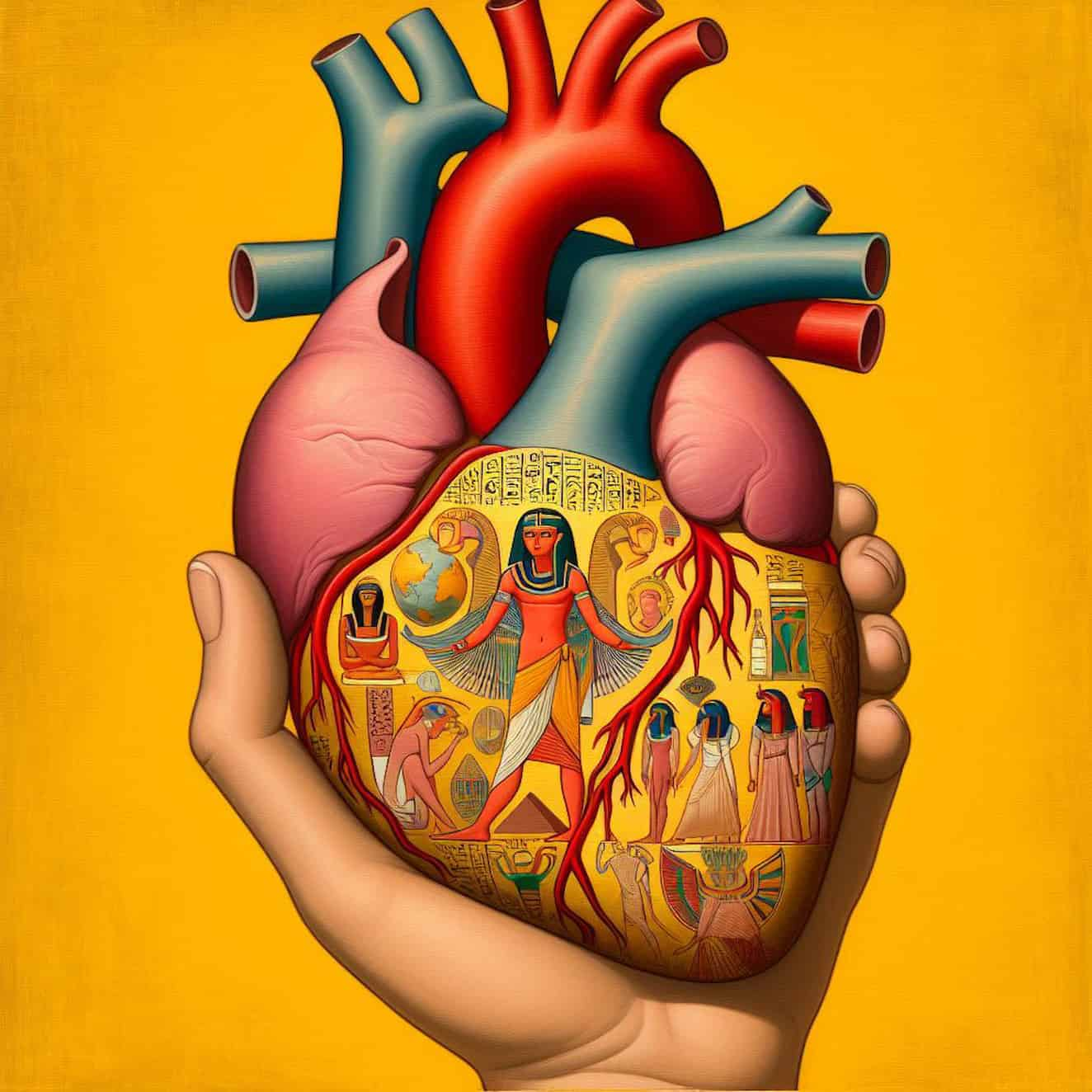
When ancient Egyptian embalmers spent seventy days preparing a pharaoh’s body for eternity, they took a sharp bronze hook, inserted it up through the left nostril, smashed the ethmoid bone, and liquefied and drained the human brain onto the floor to be thrown away as useless stuffing. Yet when those exact same priests opened the abdomen to remove the internal organs into canopic jars, they obeyed one absolute, inviolable command: the heart—known in ancient Egyptian as the ib or haty—had to remain untouched and sewn securely in its natural place inside the chest cavity. To the physicians, philosophers, and priests of the Nile, the heart was not merely a muscular pump; it was the physical throne of intelligence, emotion, memory, and the literal moral witness that decided whether a soul lived forever or ceased to exist.
The Ebers Papyrus and the Channels of the Metu
From a purely anatomical and clinical standpoint, ancient Egyptian doctors understood the mechanics of the cardiovascular system centuries before any other civilization on Earth. In the famous Ebers Papyrus (written around 1550 BC, copying much older Old Kingdom medical treatises) and the Edwin Smith Surgical Papyrus, an entire section known as the Treatise on the Heart lays out an empirical observation of the pulse that astonished later Greek visitors.
The Egyptian medical writer opens by stating that the secret of the physician is the knowledge of the heart’s movement. When a doctor places his fingers on the crown of the head, on the back of the neck, on the wrists, on the arms, or on the legs, he is measuring the heart directly, because “the heart speaks out of every vessel of every member.” Egyptian anatomists called this network of radiating tubes the metu—a term that grouped together arteries, veins, tendons, and hollow ducts extending from the heart to every organ in the body. Just as the Nile River branched into irrigation canals to carry life-giving water and silt to every field in Egypt, the heart pumped blood, air, water, and vital energy through the metu to nourish the limbs, while diseases were diagnosed as “floods,” blockages, or sluggishness within the vessels descending from the heart.
Ib vs. Haty: The Seat of Mind, Will, and Creative Thought
While modern Western culture separates the “logical brain” from the “emotional heart,” ancient Egyptian psychology located every single cognitive, intellectual, and emotional faculty inside the heart itself. Interestingly, the Egyptian language used two distinct words for the organ: haty (written with the hieroglyph of a physical animal heart with its attached aorta and pulmonary vessels) referred primarily to the physical muscular organ beating in the chest, whereas ib referred to the metaphysical heart as the seat of consciousness, memory, courage, wisdom, and moral character.
Everyday Egyptian idioms reflected this cardiocentric worldview: a brave man was called “broad of heart,” an impatient or angry man was “short of heart,” a joyful person was “long of heart,” and to forget something was literally to “eat one’s heart.” Even the creation of the universe itself was attributed to the heart in the Memphite Theology inscribed on the Shabaka Stone: the creator god Ptah first conceived the design of every god, human, and object inside his heart (mind) through rational thought, and then spoke their names aloud with his tongue to bring them into physical existence.
The Weighing of the Heart and the Heart Scarab
Because the heart recorded every single thought, word, and action a person committed from birth to death like an incorruptible black box flight recorder, keeping the physical heart inside the mummy was essential for surviving the ultimate trial of the afterlife: the Weighing of the Heart (Psychostasia), detailed in Chapter 125 of the Book of the Dead. Guided by the jackal headed god Anubis into the Hall of Two Truths before Osiris and forty two divine judges, the deceased watched as Anubis placed their heart (ib) on one side of a golden balance scale and placed the ostrich feather of Maat—representing cosmic truth, justice, and harmony—on the opposite pan.
If the deceased had lived a virtuous life, the heart balanced perfectly with the feather—being literally “light hearted”—and the soul was welcomed into the eternal Field of Reeds (Aaru). However, if the heart was heavy with greed, cruelty, and lies, the scale tipped downward, and the terrifying composite monster crouching beside the scale—Ammit, the “Devourer of the Dead,” possessing the jaws of a crocodile, the forequarters of a lion, and the hindquarters of a hippopotamus—leaped forward and swallowed the heart on the spot, causing the person’s soul to suffer the “second death” and vanish into nonexistence forever. Just in case a person’s own honest heart tried to blurt out embarrassing sins committed on earth during the trial, wealthy Egyptians had a heavy green jasper or basalt stone carved into the shape of a dung beetle—the Heart Scarab—placed directly over the mummy’s chest and inscribed with Spell 30B of the Book of the Dead, begging their own organ: “O my heart which I had from my mother! Do not stand up as a witness against me, do not oppose me in the tribunal, and do not tip the scales against me in the presence of the Keeper of the Balance!”
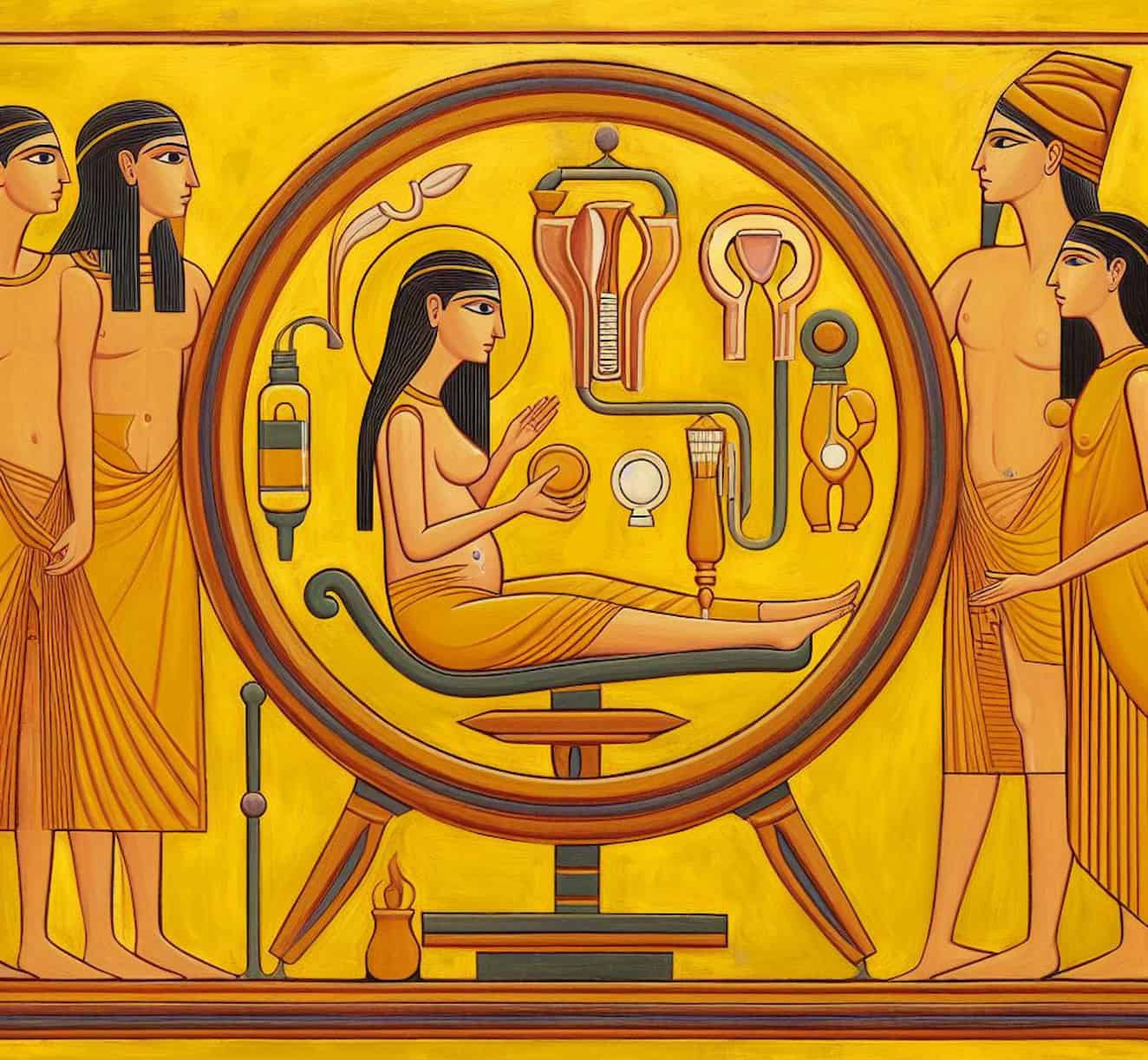
Although families in ancient Egypt cherished children as both a divine blessing from the gods Hathor and Bes and an essential source of care for parents in old age, the women of the Nile Valley enjoyed a level of legal, financial, and bodily autonomy unmatched anywhere else in the ancient Mediterranean world. Preserved on surviving medical papyri dating back nearly four thousand years to the Middle and New Kingdoms, Egyptian physicians and midwives documented an extensive, surprisingly clinical array of contraceptive prescriptions and early pregnancy tests—combining bizarre animal ingredients with genuine plant biochemistry that anticipated twentieth-century spermicides by millennia.
The Kahun, Ebers, and Ramesseum Medical Papyri
Our knowledge of ancient Egyptian family planning comes not from rumor, but from the oldest surviving gynecological textbooks in human history, unearthed from dry desert towns and tombs:
The Kahun Gynecological Papyrus (circa 1825 BC): Discovered by Flinders Petrie in 1889 at the pyramid-builders’ town of Lahun during the Twelfth Dynasty, this Middle Kingdom scroll contains the earliest written contraceptive recipes on Earth.
The Ebers Papyrus (circa 1550 BC): Purchased at Luxor in 1873, this massive sixty-eight-foot medical scroll includes a dedicated gynecological section detailing barrier pessaries and medicated tampons designed to prevent conception for one, two, or three years.
The Ramesseum, Berlin, and Carlsberg Papyri: Provide additional formulas alongside diagnostic tests for fertility and fetal sex determination.
Acacia Gum and Lactic Acid: The Spermicide That Actually Worked
By far the most scientifically remarkable contraceptive formula in all of antiquity appears in Ebers Papyrus Prescription 783. To prevent a woman from conceiving for one, two, or three years, the physician instructed her to grind together equal parts of tips of the Acacia shrub (Acacia nilotica), ripe dates, and colocynth (bitter desert gourd), blend the paste with raw honey, soak a wad of fibrous plant wool (lint) in the mixture, and insert it deep into the vaginal canal as a medicated tampon.
When twentieth-century biochemists and pharmacologists tested this thirty-five-hundred-year-old Egyptian recipe in the laboratory, they were astonished to discover that it wasn’t mere folk magic—it was a two-pronged chemical and physical spermicide:
Lactic Acid Production: When fermented acacia tree gum (gum arabic) breaks down in moisture, it produces lactic acid anhydride, which turns directly into lactic acid—an active chemical ingredient that immobilizes and kills human spermatozoa on contact, and the exact same spermicidal compound used in modern twentieth- and twenty-first-century contraceptive jellies!
The Honey and Date Barrier: Raw honey and mashed date paste possess high viscosity and osmotic density, forming a thick, sticky physical barrier plug over the cervix that physically blocks sperm from swimming upward while simultaneously inhibiting bacterial growth.
Crocodile Dung Pessaries and Prolonged Breastfeeding
Alongside the genuinely effective acacia-and-honey tampon, the older Kahun Papyrus (circa 1825 BC) recorded several barrier pessaries mixed from ingredients that sound far less appealing to modern ears: specifically, mixing dried, pulverized crocodile dung with fermented sour milk or mucilage paste, or mixing honey with natural natron salt (sodium carbonate harvested from dry desert lakebeds) to pack against the cervix.
Why on earth would an Egyptian woman use crocodile dung? Religiously, the crocodile was sacred to the powerful god Sobek; practically, dried herbivorous/carnivorous reptile dung mixed with thick sour milk or honey formed a dense, sponge-like physical barrier, and modern researchers note that while natron salt acts as a desiccant and changes local pH levels, fermented sour milk provides another dose of sperm-inhibiting lactic acid. Furthermore, on an everyday demographic level, Egyptian mothers naturally spaced their pregnancies three to four years apart by practicing extended breastfeeding for up to three full years—utilizing natural lactational amenorrhea to suppress ovulation.
The Barley and Emmer Wheat Pregnancy Test
Equally famous in the Berlin and Carlsberg Medical Papyri (circa 1350 BC) was the world’s first home pregnancy test—a diagnostic technique so famous that it was copied centuries later by Hippocrates in Greece and persisted in European medical folklore all the way until the seventeenth century. To find out if a woman was pregnant, she was instructed to urinate every morning for several days onto two small cloth bags filled with seeds: one containing barley and the other containing emmer wheat, mixed with dates and sand.
According to the papyrus, if neither grain sprouted, the woman was not pregnant; if the barley sprouted first, she would give birth to a boy; and if the emmer wheat sprouted first, she would give birth to a girl. In 1963, endocrinologists at a laboratory tested this ancient Egyptian method using real urine samples from pregnant and non-pregnant women—and discovered that while the test could not predict the baby’s sex, pregnant women’s urine caused the grain seeds to sprout seventy percent of the time, whereas urine from non-pregnant women and men never stimulated growth, because elevated levels of estrogens in pregnant urine actively accelerate seed germination!
Each physician in ancient Egypt had a specialty. The Greek historian Herodotus reported from a trip to Egypt:
“Each physician treats one disease, not several; some are physicians for the eyes, others for the head, for teeth, for the abdominal region, for gynecology, or for diseases of uncertain localization.”
Origin of Obstetrics
Min is the god of fertility. Tauret, a goddess with a hybrid body—part hippopotamus, part crocodile—with lion’s paws, protects the mother and child during childbirth. She is supposed to scare away spirits that could harm the child. She is often accompanied by the dwarf god Bes, who has the same function.
The goddess Hathor, the goddess of maternity and fertility, was called upon to assist the child and the mother, through incantations:
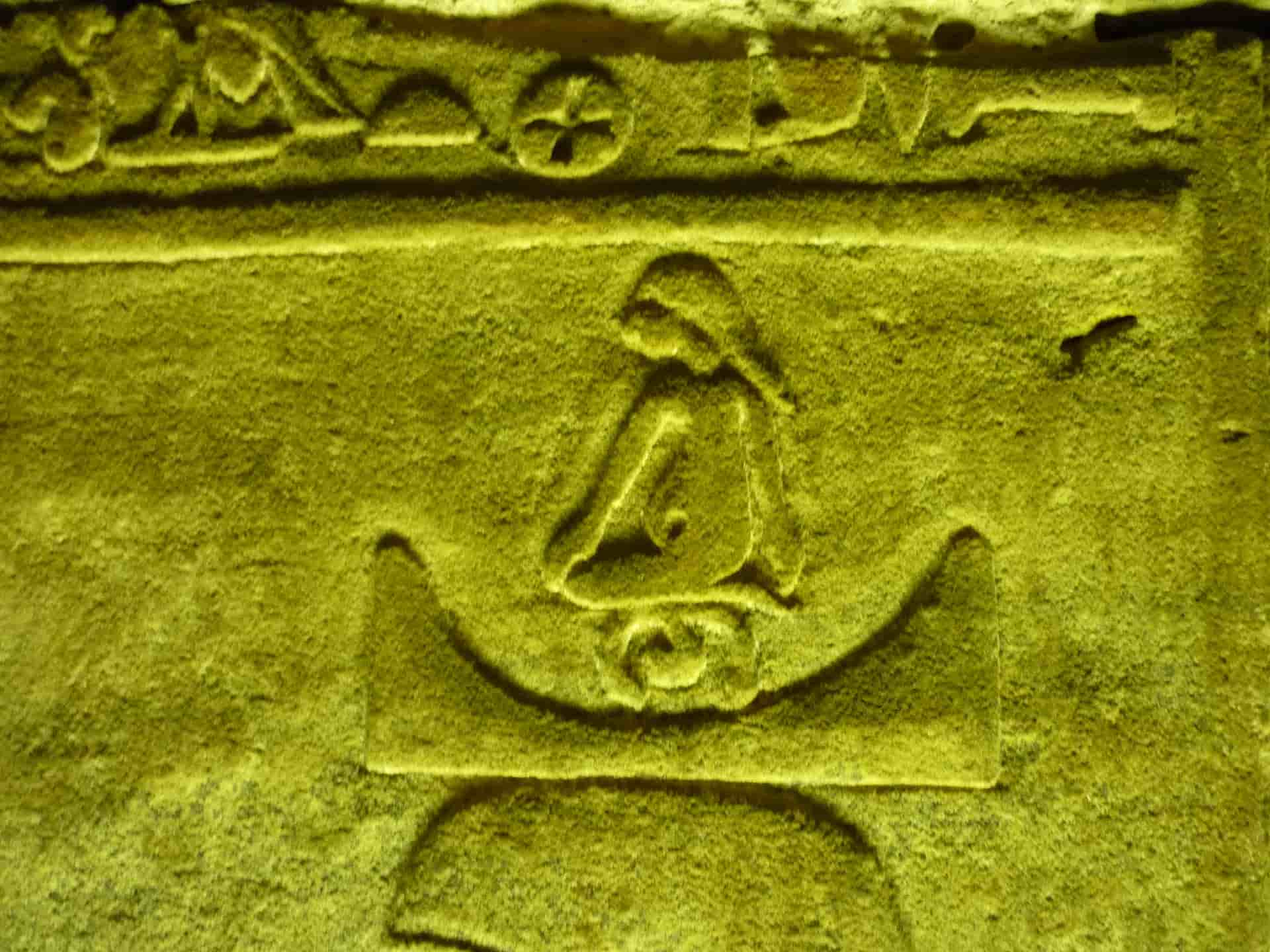
Bas-relief of childbirth in Ancient Egypt.
“Place barley and wheat in two linen bags with sand and dates; urinate on them every day; if the barley and wheat germinate, she will give birth; if the barley germinates first, it will be a boy; if the wheat germinates first, it will be a girl; if they do not germinate, she will not give birth.
But for medical reasoning to be developed, physicians had to get rid of the idea that pregnancy is due to the intervention of supernatural powers, gods, or demons.
In Egyptian papyri, amid conjuring formulas, mythical conceptions, and superstitions, there is an attempt at rationalization:
one of the Kahun papyri, dating back to the XII dynasty, is a gynecology manual and mentions a disease that devours tissues (cancer);
Egyptian physicians had noticed the beneficial action of honey in gynecology;
in the 14th century, condoms were made with animal bladders as a means of birth control.
To give birth, women squat on four ritual bricks, the Meskhenet, and let midwives proceed with childbirth. The placenta is preserved to make medicinal remedies. Women are then secluded for fourteen days to purify themselves, as they are contaminated with their blood and therefore impure. They will then return to see their child.
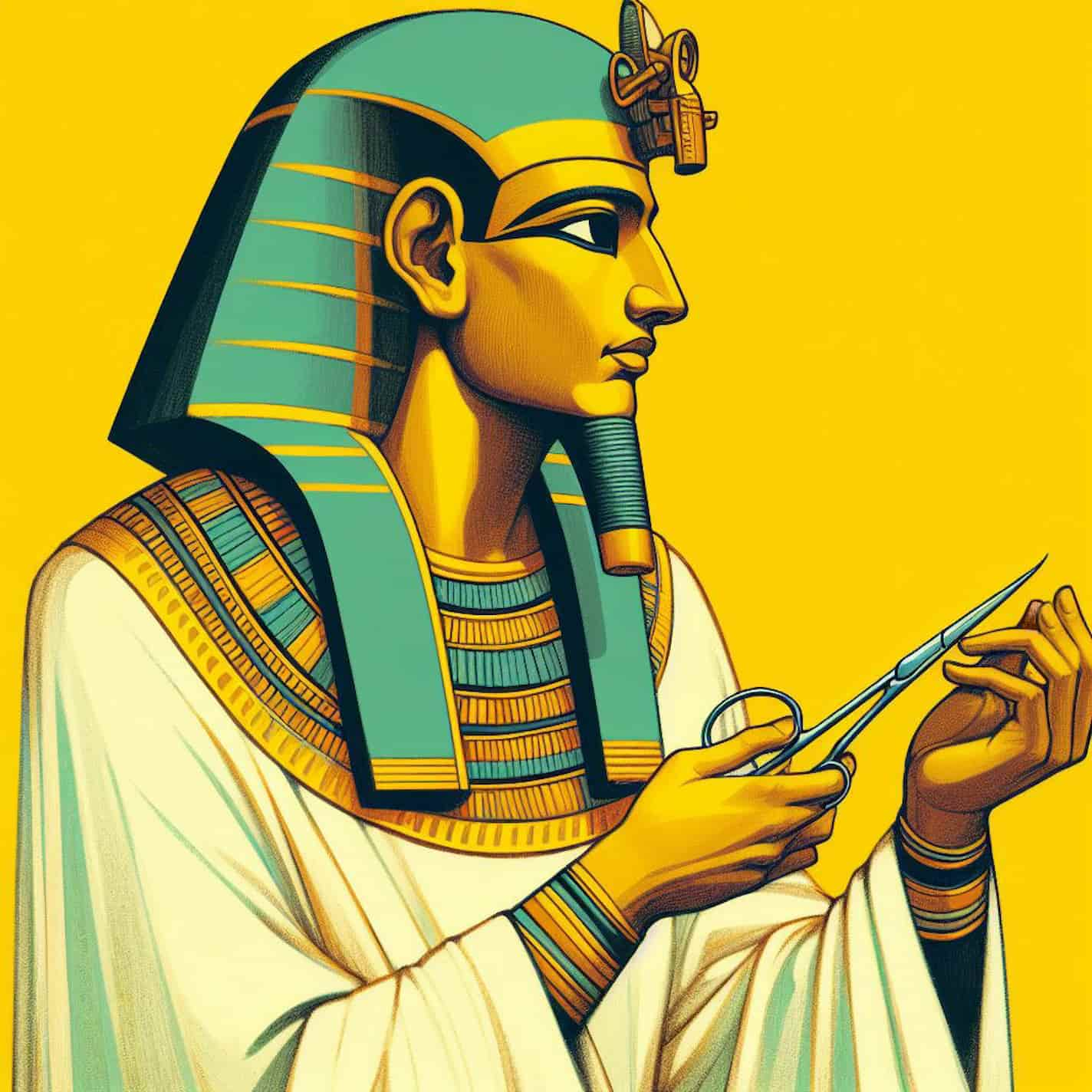
While popular movies depict ancient Egyptian healers as mystical priests chanting spells inside dark temples, the archaeological and textual record of the Nile Valley reveals a remarkably empirical, scientific tradition of clinical trauma care. Practicing alongside religious rituals for over two millennia, ancient Egyptian surgeons—known as the swnw (pronounced “sou-nou”)—sutured gaping flesh wounds with linen thread, cauterized bleeding arteries, reduced dislocated shoulders using techniques identical to modern orthopedics, and compiled the oldest rational surgical textbook in human history.
The Edwin Smith Papyrus: The World’s First Trauma Textbook
The single greatest monument to ancient Egyptian surgery is the Edwin Smith Surgical Papyrus, a fifteen-foot-long scroll written around 1600 BC that linguistic analysis indicates was copied from an even older Old Kingdom original dating back to the pyramid-building era of 2600 BC (often attributed by historians to the circle of the polymath architect and physician Imhotep). Unlike other medical papyri that mix herbal remedies with magic spells, the forty-eight trauma cases in the Edwin Smith Papyrus are almost 100% rational, anatomical, and clinical—containing only a single incantation among four dozen surgical injuries.
Organized logically from the top of the skull down through the face, throat, collarbone, chest, and spine, each of the forty-eight cases follows the exact four-step protocol of modern emergency medicine:
Title and Examination: Direct physical palpation of the wound, checking the patient’s pulse, asking the patient to move their neck or limbs, and observing neurological signs (remarkably providing the first description in human history of the cerebral cortex, the meninges membranes, cerebrospinal fluid, and how a crushed skull on one side paralyzes the opposite side of the body).
Diagnosis and the Three Verdicts: After examining the injury, the Egyptian surgeon was required to pronounce one of three honest clinical verdicts to the patient:
“An ailment which I will treat” (a curable injury with a favorable prognosis).
“An ailment with which I will contend” (an uncertain, serious injury where the surgeon will fight to save the patient).
“An ailment not to be treated” (a hopeless, fatal injury—such as a crushed cervical vertebra with spinal cord severance—where only palliative comfort could be offered).
Treatment: Mechanical reduction of fractures, stitching, splinting, and wound dressings.
The Wall Relief of Kom Ombo and Bronze Surgical Instruments
Carved onto an interior stone enclosure wall at the Ptolemaic Temple of Kom Ombo in Upper Egypt—and corroborated by real bronze and copper tool kits unearthed inside the tombs of Sixth Dynasty physicians like Qar at Saqqara—is a detailed visual inventory of approximately forty surgical instruments used in antiquity:
Scalpels and Knives: Razor-sharp blades crafted first from freshly knapped obsidian and flint (which actually hold a sharper microscopic edge than steel) as well as hardened copper and bronze scalpels.
Forceps, Tweezers, and Bone Saws: Pincers for extracting arrowheads and bone splinters from deep wounds, hooked retractors to hold open incisions, metallic probes, cupping vessels, dental pliers, and fine-toothed bronze saws.
Sutures and Adhesive Linen Tape: The Edwin Smith Papyrus contains the earliest reference in world history to closing a gaping wound with surgical stitches (sutures) using bone or bronze needles and linen thread, alongside an ingenious non-invasive alternative for facial cuts so they wouldn’t leave ugly scars: drawing the edges of a split eyebrow or nose together using strips of linen tape coated in sticky acacia gum resin!
Fire Drills for Cauterization: To stop severe hemorrhaging when excising surface cysts or tumors, surgeons heated bronze blades or rotated wooden fire-drills directly against the bleeding vessels to cauterize the tissue.
Raw Meat, Honey Antiseptics, and Skull Trepanation
Once a surgical wound was stitched or set inside rigid splints made of padded bark, wood, or cartonnage linen stiffened with plaster, Egyptian post-operative care prevented deadly bacterial infection through a two-day dressing regimen that modern microbiologists praise. On the very first day of a fresh wound, the surgeon bound a slice of fresh raw meat over the cut—providing natural clotting enzymes (thromboplastin) that stopped bleeding quickly.
From the second day onward, the wound was dressed daily with a salve of raw honey and animal fat (lint). Because pure honey is hyperosmolar (sucking moisture out of bacterial cells by osmosis), acidic, and naturally generates trace amounts of hydrogen peroxide when diluted with body fluids, no common bacteria could survive inside the bandage. Bioarchaeologists examining thousands of ancient Egyptian mummies and skeletons have confirmed how often patients survived major interventions: showing cleanly healed amputations of forearms and toes fitted with functional wooden prosthetics, skillfully set femur fractures, and even rare cases of trepanation—drilling or scraping a circular hole into the living skull to relieve fatal intracranial pressure after a battlefield mace blow, with smooth bone regrowth around the edges proving the patient lived for years after leaving the surgeon’s table.
More than three thousand five hundred years ago, when a sick citizen of Thebes or Memphis visited a physician (swnw), they did not walk away with vague folkloric advice; they received a meticulously measured prescription written down on papyrus, specifying the exact plant, mineral, or animal ingredients, the method of compounding, and the route of administration. Preserved across a dozen major medical scrolls—led by the monumental Ebers Papyrus (circa 1550 BC), which contains over 877 distinct drug prescriptions using more than seven hundred raw ingredients—the pharmacopoeia of ancient Egypt was the most advanced pharmaceutical archive of the Bronze Age world, directly inspiring the later medical traditions of Hippocrates, Dioscorides, and Galen.
Precision Compounding: Liquid Vehicles and Dosage Forms
Unlike casual folk herbalism where a patient simplemente chews a handful of leaves, ancient Egyptian pharmacists—who worked inside specialized temple laboratories called the Per-Ankh (“House of Life”)—understood that the chemical solubility and bodily absorption of an active drug depend entirely on the liquid vehicle used to extract it.
Every Egyptian prescription Carefully matched its active botanical or mineral powder with a specific carrier base according to whether the compound was water-soluble, fat-soluble, or alcohol-soluble:
Water, Milk, and Sweet Beer: Fermented barley beer—particularly a high-alcohol variety called “sweet beer”—was used across hundreds of prescriptions both to extract alcohol-soluble plant alkaloids and to mask the bitter taste of medicines for children.
Wine and Vinegar: Used for astringent washes and dissolving resins like frankincense and myrrh.
Fats, Oils, and Raw Honey: Goose fat, ox tallow, hippopotamus fat, castor oil, and pure Nile bee honey served as the base for topical ointments, burn salves, eye drops, and swallowable pills.
Furthermore, the Egyptians invented virtually every modern pharmaceutical delivery method: oral potions, molded honey-paste pills, gargles, therapeutic inhalations (throwing herbal resins onto red-hot stones and breathing the steam through a hollow reed tube!), eye drops applied with smooth wooden or hematite rods, skin poultices, vaginal pessaries, and medicated rectal suppositories and enemas.
Key Botanical Drugs Validated by Modern Pharmacology
While Egyptian papyri included sympathetic magic ingredients like lizard blood or fly specks alongside prayers to Isis and Thoth, modern pharmacognosists testing the core botanical staples of the Egyptian pharmacopoeia have confirmed that a remarkable percentage of their plants contained potent, clinically active molecules:
Willow Bark and Leaves (Salix): Prescribed in the Ebers and Edwin Smith papyri as an anti-inflammatory poultice for aching joints and infected wounds. Willow bark is rich in salicin, which the human body metabolizes into salicylic acid—the direct natural chemical ancestor of modern aspirin!
Pomegranate Root Bark (Punica granatum): Steeped in water and drunk by patients suffering from intestinal tapeworms. Modern chemistry confirmed that pomegranate bark contains high concentrations of the alkaloid pelletierine, which paralyzes the muscular suckers of tapeworms so they detach from the intestinal wall and are expelled.
Senna Pods, Castor Oil, and Aloe Vera: Because Egyptian medical theory believed that internal diseases were caused by putrefying food residue (wekhedu) trapped in the lower bowel, physicians prescribed senna pods (containing sennosides, still sold in every modern pharmacy on Earth as a laxative) and pressed castor bean oil, while applying fresh Aloe vera gel to soothe skin burns and ulcers.
Khella (Ammi visnaga) and Blue Lotus: Seeds of the Nile tooth-pick plant (Ammi visnaga) were brewed to relax painful kidney-stone spasms and asthma—leading twentieth-century pharmacologists in Cairo to isolate the active compound khellin, which served as the chemical blueprint for modern asthma inhalers (sodium cromoglycate) and the heart-rhythm drug amiodarone!
Coriander, Cumin, Garlic, and Juniper Berries: Cloves of raw garlic (found preserved inside the tomb of Tutankhamun) were given daily to pyramid laborers to boost stamina and fight respiratory infections via antimicrobial allicin, while juniper berries and coriander calmed digestive gas and acted as diuretics.
Mineral Chemistry: Malachite Eye Paint That Prevented Blindness
Nowhere was Egyptian pharmaceutical chemistry more brilliant than in their signature green and black cosmetic eye paints (kohl and udju), worn by every man, woman, and child along the Nile. For centuries, historians assumed the heavy black galena (lead sulfide) and green malachite (copper carbonate) eyeliner was purely aesthetic or used to reduce sun glare.
In 2010, however, French analytical chemists at the Louvre Museum and CNRS analyzed residue inside fifty-two ancient Egyptian cosmetic pots and discovered that Egyptian pharmacists spent thirty days synthesizing rare lead-chloride compounds (laurionite and phosgenite) that do not even occur naturally in Egypt. When a tiny trace of these lead and copper salts touched the tear film of the human eye, it stimulated the eye’s immune cells to produce a 240-percent surge in nitric oxide—turbocharging the immune response to kill the bacteria carried by Nile floodwaters that caused blinding trachoma and conjunctivitis, turning everyday Egyptian makeup into a preventative public-health triumph.
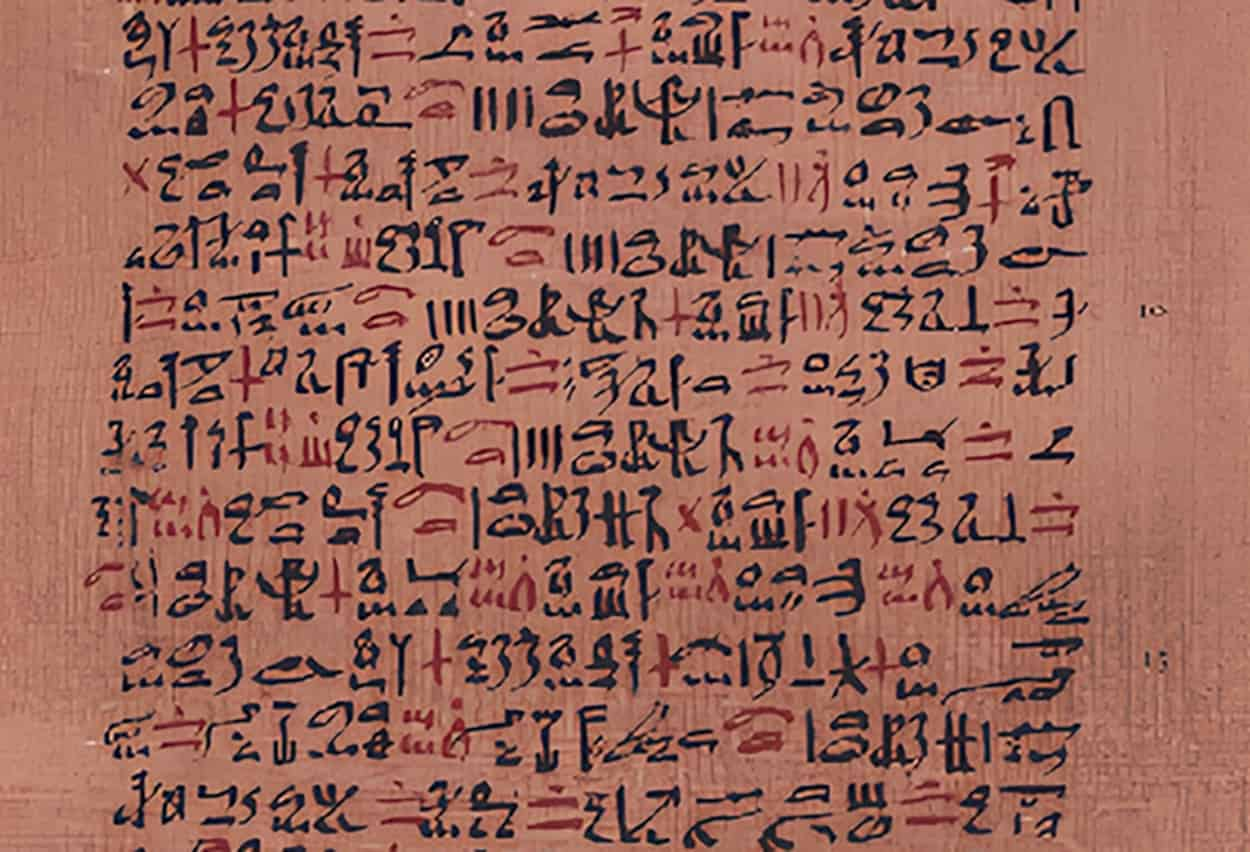
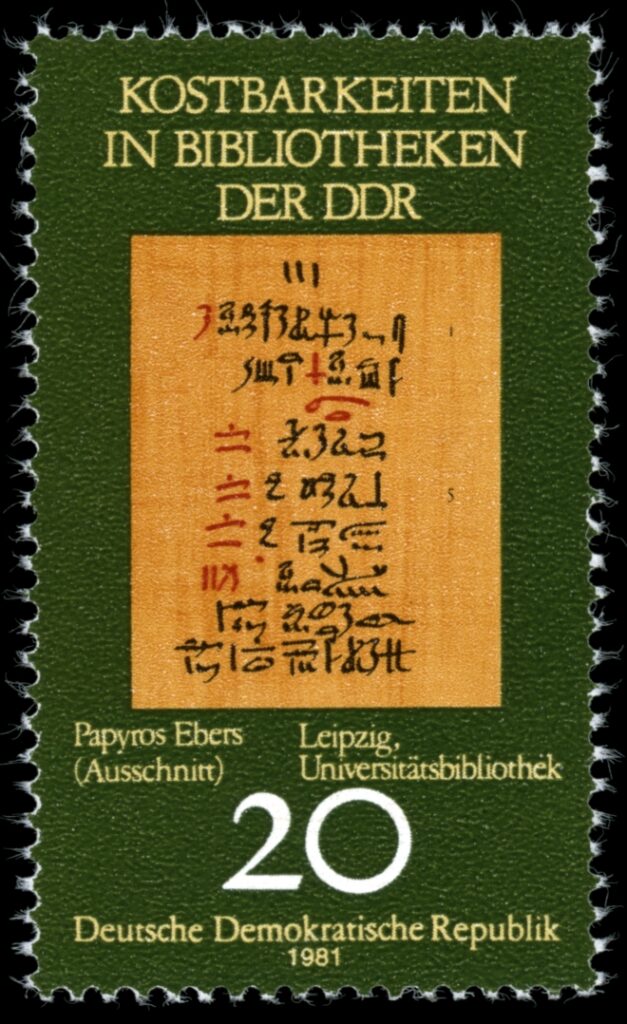
The Ebers Papyrus is one of the oldest known medical treatises; it dates back to the 16th century BCE, during the reign of Amenhotep I. It’s the most important text for understanding ancient Egyptian medicine. It appears as a list of remedy recipes with a brief indication of the ailment to be treated. It’s difficult to interpret because some medical terms remain mysterious and most substances have not been identified. It’s often regarded as the emergence of medical and pharmacological thought in a religious or magical universe.
Discovery, Translations, and Preservation
Ebers Papyrus
The Ebers Papyrus was part of a clandestine find under poorly known circumstances. It was likely a chest or a small library from the Ramesseum, also containing the Edwin Smith Papyrus and the Rhind Mathematical Papyrus.
In 1862, in Luxor, the lot came into the possession of Edwin Smith, who kept the Smith papyrus for himself and sold the other two. The Ebers Papyrus was purchased by the German Egyptologist Georg Moritz Ebers on behalf of the University of Leipzig library.
It was Ebers who named and published the papyrus in 1875. It’s a facsimile reproduction. Ebers didn’t attempt a translation, but provided an introduction with comments and an Egyptian-Latin glossary.
Early Translations
In 1890, Heinrich Joachim, a physician from Berlin, provided a rather controversial German translation: Papyros Ebers. Das älteste Buch über Heilkunde.
In 1937, Bendix Ebbell published a new translation, aiming to give precise identifications to the names of diseases, plants, and minerals used.
The first photograph of the Ramesseum, by Francis Frith, circa 1857.
From 1954 to 1963, under the direction of Hermann Grapow, the Ebers Papyrus was part of the large German edition of Egyptian medical texts in eight volumes, the Grundrisse der Medizin der alten Ägypter (often abbreviated in French as Grundriss).
The first French translation (partial translation) was by Gustave Lefebvre, who provided excerpts in his Essay on Egyptian Medicine in the Pharaonic Period (1956).
In 1987, Paul Ghalioungui published a new English translation.
Preservation
In Leipzig, in the 19th century, the Ebers manuscript was cut into twenty-nine pieces to be placed under glass. A transcription from hieratic to hieroglyphs was published in 1913 by Walter Wreszinski, which divided the one hundred and ten pages of the original manuscript into 877 numbered sections.
The Ebers Papyrus. Postage stamp of the GDR.
The original manuscript is complete, in perfect condition, written in exceptional hieratic quality, and easily readable from beginning to end.
During World War II, the manuscript was protected in the Deutsche Bank vault in Leipzig, then moved and safely housed at Rochlitz Castle (Rochlitz, sixty kilometers southeast of Leipzig). According to an anonymous testimony published in 1951, when the manuscript was found in 1945, it was not inside the castle but hidden in the kennel under a pile of rubbish. Seventeen pages out of one hundred and ten were lost and four were damaged (due to the broken glass protection).
The Ebers Papyrus is still preserved in the University Library of Leipzig. Like all papyri, the greatest threats are excessive light and humidity.
It’s one of the longest written documents found in ancient Egypt. The scroll consists of one hundred and ten pages (columns); it’s about twenty meters long by thirty centimeters wide, in forty-eight sheets of about forty centimeters long, glued in such a way that the right edge of one sheet covers the left edge of the other, with the text read from right to left.
Titles and quantities are written in red ink, the rest in black. The author is unknown, but the text appears to have been written by a single highly skilled scribe. There are no spaces between words (usual practice), a few mistakes, and some missing words (omitted) have been added in the margin; their placement in the text is indicated by a red X.
It’s the most important medical work from ancient Egypt because it’s a guide presenting the entirety of pathology for a physician in their daily practice, with corresponding prescriptions. “Nowhere else will you find as much information to define the medical thought of the time.”
Dating
The Ebers Papyrus gathers texts from different dates and origins, which can be divided into groups bringing together several successive paragraphs. It appears as a compilation of older texts to which “new recipes” are added. This represents a long tradition of empirical knowledge and observations.
It was mainly written in the 16th century, around 1550 BC, or during the reign of Amenhotep I. Some Egyptologists give more recent dates and cite instead the reign of Amenhotep III in the 14th or 15th century (variable date according to Egyptologists).
Furthermore, the Ebers Papyrus contains information on the date of Ramses II’s succession to the throne of Egypt. Ramses II succeeded his father around 1304 or 1279 – 1278. The date varies depending on how the Sothic date of this papyrus is interpreted.
The most recent dating is based on the style of writing, comparison with other similar manuscripts, and the presence of a calendar on the back mentioning the ninth year of the reign of Amenhotep I (late 16th century BCE). A carbon-14 dating, conducted in 2014, confirms these data (around 1500 BCE).
Contents
The Ebers Papyrus contains exactly 877 formulas (recipes organized into paragraphs from Eb.1 to Eb. 877). It doesn’t present itself as a modern treaty but rather as a formulary (a list of prescriptions) where diseases are most often named or described concisely rather than diagnosed.
It includes a prologue (Eb.1 to Eb.3) of magical protection formulas aimed at protecting the physician from the demons that cause diseases.
From Eb.4, the actual medical compendium begins, which can be divided into thirty-three groups, each consisting of a list of recipes for the same ailment or type of ailment. In the following presentation, the term “large group” can mean both the length of the text and its importance for understanding Egyptian medicine.
Large Group 1 (Eb.4 to 187) deals with diseases inside the body, naming the main causes and corresponding recipes. It includes diarrhea, intestinal worms, and pains and burns during defecation.
Large Group 2 (Eb. 188 to Eb. 220) is devoted to diseases of the “entrance/opening of the inside-ib,” meaning the exits of all the body’s ducts connecting the organs (such as the aerodigestive entrances).
Group 3 (Eb. 221 to Eb. 241) deals with diseases associated with the heart-haty; Group 4 (Eb.242 to Eb. 260) with protective ointments and diseases of the head; Group 5 (Eb. 261 to Eb. 283) with urinary conditions; Group 6 (Eb. 284 to Eb. 293) concerns nutrition.
Group 7 (Eb. 294 to Eb. 304) is intended to combat setet (pathogenic beings circulating in the body’s ducts); Group 8 (Eb. 305 to Eb. 325) against the secretion-seryt causing cough; and Group 9 (Eb. 326 to Eb. 335) against parasites-gehou responsible for wheezing.
Large Group 10 (Eb. 336 to Eb. 431) deals with eye diseases.
Group 11 (Eb. 432 to Eb. 436) deals with bites; Group 12 (Eb. 437 to Eb. 476) with hair care; Group 13 (Eb. 477 to Eb. 481) with liver diseases; Group 14 (Eb. 482 to Eb. 514) with burns, blows, and scars; and Group 15 (Eb. 515 to Eb. 542) with wounds and hemorrhages.
Group 16 (Eb. 543 to Eb. 550) deals with pathological formations and secretions; Group 17 (Eb.551 to Eb. 555) with abscesses-benout; Group 18 (Eb.556 to Eb. 591) with swellings-chefout; and Group 19 (Eb. 592 to Eb. 602) with blood that eats and substances that corrode.
Group 20 (Eb. 603 to Eb. 615) is dedicated to leg conditions; Group 21 (Eb. 616 to Eb. 626) to fingers and toes.
Large Group 22 (Eb. 627 to Eb. 696) concerns the ducts-met.
Group 23 (Eb. 697 to Eb. 704) deals with tongue conditions; Group 24 (Eb. 705 to Eb. 738) with skin and body surface; Group 25 (Eb. 739 to Eb. 749) with teeth.
Group 26 (Eb. 750 to Eb. 756) deals with pestilential diseases and demons; Group 27 (Eb. 757 to Eb. 760) with the impact of the right side by the substance-rouyt; Group 28 (Eb. 761 to Eb. 763) impacts by the exudate-rech.
Group 29 (Eb. 764 to Eb. 782) deals with ear conditions.
Group 30 (Eb. 783 to Eb. 839) is devoted to remedies for women.
Group 31 (Eb. 840 to Eb. 853) concerns remedies for the household (protecting against undesirable animals).
Large Group 32 (Eb. 854 to Eb. 856) consists of the “Treatise on the Heart” and the treatise on oukhedou (circulating pathogenic substances).
Large Group 33 (Eb. 857 to Eb. 877) represents the “Treatise on Tumors.”
Magical Protections
The prologue of the Ebers Papyrus includes several protection rituals. These are invocations or prayers to be recited before touching the patient, applying medication, a bandage, or removing such a bandage.
These texts are written in the first person; they have been interpreted as being spoken by the patient or by the physician on behalf of the patient. However, according to Bardinet, they were pronounced by the physician for his own protection.
The physician invokes protective gods, mainly Ra, Isis, and Horus, against malevolent (demonic) or opposing forces (the god Seth). According to Bardinet, the physician seeks to magically identify with Horus in his mythical struggle against Seth by directly addressing Isis, Horus’s protective mother. “Daily medical activity will ultimately reproduce the constantly renewed conflict between Horus and Seth, between the organized world and the disorganized and wild world.”
The patient is also assimilated to Horus, but to Horus as a child incapable of defending himself, while the physician is the adult and active Horus. Thus, the physician and his patient are close and fight together. According to the Grundriss, the physician is the magical substitute for the patient; Bardinet disagrees with this interpretation, as “the physician never takes on the patient’s illness himself.”
Magical rituals are found in other parts of the papyrus, particularly in difficult or dangerous situations. These prayers refer to mythical battles, repeated daily, such as those of the crew of the solar barge. The physician can also be aggressive, casting curses against demons and malevolent beings to disrupt their harmful world.
Medical Knowledge
Diverse Approaches
The various translations of the Ebers Papyrus imply diverse interpretations, particularly regarding anatomical and pathological denominations, names of animals, plants, and minerals. Not all Egyptian terms have corresponding modern terms. Early versions, like Ebbell’s 1937 version, which claim to provide precise identifications for each Egyptian term, are considered outdated by modern Egyptologists. These older versions are still quite often referenced.
Conversely, and for the same reason, authors like Gustave Lefebvre considered Egyptian knowledge to be imprecise or undeveloped. According to Bardinet, this knowledge is simply different and must be studied differently depending on its context. Bardinet gives an example, concerning anatomy, of the current technical vocabulary of butchery (such as beef cutting), which indeed represents precise knowledge adapted to practical use.
Another approach is to seek analogies between Egyptian and Greek medicine, with the idea of an influence of the former on the latter, which remains hypothetical. Greek concepts (such as phlegm, miasma, etc.) are then used to approach Egyptian terms. According to Bardinet, the flaws are the same as those of modern identifications: Egyptian medical thought is diluted in a context that is not its own, appearing as approximate or even childish.
The medical interpretations of the Ebers Papyrus are made for two different purposes: “understanding from the outside,” approaching the pathological reality of ancient Egypt (by comparing the text with other historical data and current knowledge), and “understanding from the inside,” approaching Egyptian medical thought (in this case, exact modern diagnosis is less important).
According to Bardinet, one must not confuse the fact that a situation may, more or less plausibly, correspond to a modern diagnosis (such as leprosy, cancer, myocardial infarction, etc.) with the false idea that Egyptian physicians already had modern ideas. Here, the search for and statement of a precise retrospective diagnosis introduce foreign ideas into Egyptian medicine.
Anatomical and Physiological Representations
The constituent elements of the body are not considered to have intrinsic properties; they are subject to higher forces of divine origin. The elements of the body (substances, liquids, breath, etc.) come from a primordial liquid universe, the Noun. All gods and beings of creation originate from it, through processes of generation, life, and death. These are processes of binding, nurturing, and generating (nourishing blood, milk, semen, etc.), opposed to processes of dilution, blocking, or destruction (blood that eats, corrosive substances, etc.). These processes themselves are considered to be living beings.
In the Ebers Papyrus, the main concepts concerning the structure and functioning of the body are the heart-haty (the heart organ and its major vessels, which are central and anterior) and the interior-ib (which fills the shet, the body cavity corresponding to the thoracic and abdominal cavities, and extends into the limbs). The heart-haty is the seat of consciousness, of the will that carries out desires, closely related to the interior-ib, the seat of sensations and emotions.
The entrance/opening of the ib, or ro-ib, represents the stomach, the upper digestive tract. At is called any part of the body that has a name. According to Grapow and Lefebvre, embalmers and physicians had about a hundred words to designate the different parts of the body.
The body is traversed by ducts-met with their own walls through which bodily fluids, nourishing substances, and vital breath circulate. In ancient Egypt, the human body “is an animated body and not an incarnated soul.”
Main Pathogenic Entities
Disease is linked to direct divine interventions. It most often comes from the outside, in the form of a demon, a dead person (deceased), a harmful breath, or “animated substance-beings” that enter the body, particularly through its orifices.
Disease manifests as displacements and false paths, various obstacles to the natural circulation of bodily fluids and secretions. Disease is a struggle between the animating breaths of binding and formation and the disruptive breaths of dissolution and disorganization. This struggle often takes place in the ducts-met, which can be too rigid, blocked, worn, or distended.
According to Bardinet, this divine or magical context did not prevent the emergence of medical reflection, based on daily observation of repetitive phenomena, in search of a “logic” that combines facts (pathological reality) with medical speculation, to build a practice. “We have here writings composed by physicians, for the use of other physicians.”
The Ebers Papyrus mentions four major circulating pathogenic factors:
The âaâ is a bodily fluid that seems to refer to the water of the Nile; like it, it is a fertilizing liquid, a seed. In pathological cases, âaâ is a fluid emitted by the bodies of demons, capable of transforming into other “parasitic” substances (living pathogenic substances).
Setet are living decomposition substances that are evacuated through the lower abdomen but can cause pain, vomiting, and discharge from the orifices of the head by their death or blockage.
The oukhedou would be the pathogenic emanation of the vital force of excrement. It is a bodily substance that opposes nourishing blood and can associate with it, to reverse it into eating blood or blood that eats. Oukhedou are the origin of pus formation and putrid phenomena.
The ouhaou are believed to originate from the oukhedou, coming from the inside they manifest on the outside of the body, notably through skin inflammation.
The Treatise of the Heart
Egyptian heart-shaped amulets, XVIIIth or XIXth dynasty. Metropolitan Museum of Art.
The papyrus contains a “treatise of the heart” represented by the passage Eb. 854 to Eb. 856. It begins with three successive titles: “The Physician’s Secret. Knowing the Movements of the Heart-haty. Knowing the Heart-haty.”
Interpretations differ among authors. For some ancient authors, it would be a treatise dealing with anatomy (knowing the heart) and physiology (knowing the movements and functioning of the heart). These authors note that the heart is the center of blood irrigation, with vessels attached to all parts of the body, and that the Egyptian physician palpates the body parts and ducts-met to examine the beats, take the pulse, or even count them.
For other authors (modern ones), it is not only about the heart organ in the modern sense, but about an Egyptian heart-haty capable of moving (changing position). It would then be a treatise on medical diagnosis aimed at establishing the position and involvement of the heart-haty. Pulse-taking is also recognized, but it is not about counting it but about “taking a measure” (evaluating) a diseased state. Palpation is part of a qualitative overall assessment aimed at assessing the nature and extent of the ailment throughout the body.
The heart is described in its relationships with the interior-ib. In its normal state, it is in a perfect and stable position on its fixed support (the meket); in its diseased state, it can start dancing, fluttering its wings, banging against the walls, or falling by sinking into the depth. The heart-haty “speaks in front of each conduit-met of every part of the body.”
This treatise lists ducts-met that start from the head orifices to reach the heart-haty. From there, they go towards the inside (interior-ib) and the four limbs, to gather at the anus. The “treatise of the heart” would not really be a “cardiology book” but rather a “book of paths” of pathogenic entities.
The Treatise of Tumors
This treatise is represented by the passages Eb. 857 to Eb. 877. “It is one of the greatest texts of Egyptian medicine and also one of the most difficult texts to interpret.” It establishes a kind of differential diagnosis between different types of abscesses and tumors based on their content: those filled with pus and those filled with something else. Tumors are distinguished by their color, firmness (hard, soft…), mobility or fluctuation (literally “rolling under the fingers”), heat, and presence of pain.
Depending on the cases, the treatment consists of ointment, surgery (“treatment with a knife”), or therapeutic abstention (“prepare nothing against it”).
Swellings and tumors filled with pus are called henhenet swellings. Pus is produced internally by a corrosive substance called oukhedou that gathers externally in a “pouch” (âat). The pus derives from an upward secretion from digestion (what was intended for the formation of flesh has been transformed into pus).
Other tumors are said to be filled with “fat,” “superficial flesh,” “like something swollen with air,” liquid, or various substances. For example, tumors filled with oukhedou manifest at the extremities of the body, those of substance-sefet refer to a tar of vegetable origin, evoking necrosis or gangrene.
The most feared tumors are “those formed by the god Khonsou.” The text indicates “it is something bewitched that is before your face,” presenting itself in multiple pouches and producing secretions—shepaou—against which nothing can be done. The papyrus ends on the size-ânout “formed by the massacres of the god Khonsou.” When it is multiple and hot, nothing can be done; otherwise, it can be cured.
Pathological Interpretations
The Ebers Papyrus mainly consists of a list of formulas, and most of the time, the conciseness of the text mentioning ailments hardly allows for retrospective diagnoses. Most interpretations are based on those of Ebbell in 1937, but several are no longer accepted or considered barely plausible. As a general rule, hypotheses are accepted when they are compatible with other historical data, such as the paleopathology of Egyptian mummies.
Digestive and Thoracic Ailments
The medical compilation of the Ebers papyrus begins with what appears to be digestive pathology: diarrhea, including bloody diarrhea, constipation, and various obstructions… A large place is given to ano-rectal diseases. The mention of what could be stomach cancer is doubtful, while the pictures of cholecystitis, intestinal obstructions, and digestive hemorrhages appear plausible. Several recipes “to treat the liver” are listed, but without any corresponding clinical description.
This digestive pathology can be associated with a thoracic pathology represented by “forgetfulness, fleeing, or stabbing of the heart,” which would represent palpitations and precordial pain. A passage (Eb. 191) has been interpreted as angina pectoris, a manifestation of myocardial infarction.
“If you proceed to examine a man afflicted at the entrance of the interior-ib; and he is affected in the arm, chest, and (on) one side of the entrance of the interior-ib; and people say about it; ‘it’s the (disease) green!’ (= popular diagnosis) You shall say about it: ‘It is (something) that has entered the mouth, it is a dead person who travels through it.’”
According to Bardinet, the description may correspond, but the Egyptian author has no idea of a heart disease: it is a problem of a conduit traversed by a dead person. The recipe given aims to strengthen the patient and evacuate this pain through the anus.
Urinary and Parasitic Afflictions
Urinary pathology is represented by the substance-chepen which causes pus in the urine. Other disorders appear to be urinary retention, enuresis, and cystitis. Passages concerning “an overflow of urine that escapes” have raised the possibility of polyuria due to diabetes mellitus.
The disease by âaâ with red urine would be bilharzia. The importance of the condition is indicated by the number of recipes (about twenty). The presence of the disease in ancient Egypt is certain and extremely widespread; it was detected in nearly half of the tested mummies, but it is difficult to know what the Egyptians knew about it. According to Bardinet, the frequency of parasitic hematuria indicated less of a disease than a particular human type, those inhabited by or in relation to a god, here the god Seth, a reference to the color red.
Several intestinal worms are mentioned, including the ver-hefat, the ver-pened… Their exact identification remains debated, but given other historical data, they could represent the hookworm, the roundworm, or the Taenia saginata.
Furthermore, the mention of dracunculiasis is possible, by combining two passages (Eb.617 and Eb. 876), but more by its demonstrated existence in ancient Egypt than by the clarity of the text. According to Bardinet, Eb. 617 would be a myiasis problem, and the “7 knots” of Eb. 876 a magical conjuration, rather than an allusion to traditional treatment (see section examples of recipes).
Ocular and ENT Afflictions
Egyptian harpist, interpreted as blind. Tomb of Nakht, Thebes, c. 1422-1411 BC J.C.
An important passage is dedicated to eye diseases: about a hundred recipes are presented as intended to combat the agents of these diseases. According to Bardinet, it is always difficult to match Egyptian words with ophthalmological reality (modern terms), but the Egyptians took note of what they could observe in the eyes (water, pus, blood, harmful substances, harmful beings…). Commentators have recognized conjunctivitis, blepharitis, styes, ectropion, chalazion, corneal opacity, etc.
Cataracts would be referred to as “water rising in the eyes”, on the grounds that the Latins used the term suffusio to designate it, but cataract surgery is not mentioned (it was introduced in Egypt in the Hellenistic period).
A passage indicating “uterine secretions in the eyes” has been interpreted as a gonococcal infection (gonococcal iritis), which has been contested by others, with historians disagreeing on the presence of this condition in antiquity.
On the other hand, manifestations indicating trachoma appear plausible, as its historical character and widespread occurrence in pharaonic Egypt are widely accepted, notably as a leading cause of blindness. There are many Egyptian representations of blind musicians, especially harpists, whose eye is depicted by a line or whose eyeball lacks an iris.
The fact that recipes may contain beef liver (vitamin A) would indicate a treatment for night blindness.
Afflictions by exudate-rech would represent ENT conditions, as it makes the “seven holes of the head” (mouth, nostrils, eyes, and ears) painful, which suggests sinusitis, rhinitis, otitis, etc. Deafness is attributed to a cutting demon or heseq, that interrupts the hearing conduits.
Passages dedicated to mouth and dental conditions do not propose an ordered classification of lesions, but they are varied enough to see a set of periodontal diseases (dental caries and wear, abscesses and oral infections, gingivitis…) sometimes related to a “corrosive substance”.
In such a context, the Ebers Papyrus has the reputation of being one of the first texts in history to describe scurvy. However, this diagnosis remains improbable, as it is not confirmed by paleopathology data. Periodontal diseases found (Egyptian mummies) are common but attributed to an alteration of oral flora or to the poor quality of antiquity flours that contained mineral particles from millstones or stone mortars (sometimes the addition was deliberate to obtain a finer flour). Consumers of these flours were exposed to premature tooth wear.
Gynaecological Conditions
The Ebers Papyrus gives considerable attention to menstrual disorders: amenorrhea and dysmenorrhea. Uterine prolapse is mentioned. Recipes are provided for inflammatory conditions of the vulva, vaginitis, and endometritis. Burning sensations or odor perception have been subjected to microbiological interpretations. Commentators have noted the possibility of uterine cancer, which is likely but difficult to confirm. The same applies to breast cancer, for which there is no clear mention.
A contraceptive recipe in the form of a pessary is given “to not have a child for one, two, or three years” (Eb. 783).
Around twenty other preparations (vaginal preparations, suppositories, fumigations, etc.) are intended to facilitate childbirth and placental expulsion. Egyptian women gave birth on a “birthing brick.” Recipe Eb. 789 specifies that the medication should impregnate “the brick lined with fabric.” According to Bardinet, “this little text teaches us in passing that they had thought to stuff it.”
Other recipes address breast conditions and breastfeeding problems. A magical formula, called the “conjuration of the breast,” is provided (Eb. 811): “This is the breast where Isis was affected in the marsh of Chemmis when she gave birth to Shou and Tefnout. What she did was conjure the breasts with the iar plant, with a pod of the seneb plant, with the bekat part of the reed—all this to drive away the action of a dead man, a dead woman, and so on. This will be prepared in the form of a band turned to the left, which will be placed where the action of the dead man or woman is (with the following words): Do not cause evacuation! Do not produce substances that corrode! Do not produce blood! Be careful that darkness does not develop against humans! Words are to be said about [each of the ingredients already mentioned] and about the band turned to the left, to which seven knots are made.”
Children are rarely mentioned. There are predictions about the fate of the newborn such as “If one hears its plaintive voice, it means that it will die. If it places its face toward the ground, it also means that it will die” (Eb. 839). A recipe is given against incessant crying and screaming (Eb. 782).
There is also a recipe for bleeding after circumcision (see the recipe example section). The mummy of Prince Sipaari or Ahmose-Pairy (New Kingdom) at the age of five or six, bore traces of circumcision.
Tumors and Swellings
The treatise on tumors has been widely interpreted. Tumors related to the conduits-met would be aneurysms. The authors propose diagnoses for each paragraph: scrofula, inguinal hernia, varicose veins, cystic tumor, polypoid tumor, etc. The presence of cancer or neoplastic tumors can be indirectly deduced, but there is no clear indication of malignancy, except for the tumors of the god Khonsou.
States of liquid swelling, more or less generalized, have been interpreted as equivalents to the historical diagnosis of dropsy (obsolete medical term) corresponding to edemas or effusions (for example, ascites) related to states of heart, liver, or kidney failure, or parasitic or malnutrition-related conditions.
The swelling-ânout by “massacre of the god Khonsou” would be a mention of leprosy; this diagnosis, proposed by Ebbell in 1937, is no longer accepted by more modern authors by comparison with other historical data, particularly paleopathology.
Pestilential and Other Afflictions
The pestilences occurring at certain times are attributed to demons-nesyt or “a morbid breath that passes.” The Ebers Papyrus offers protection recipes, such as this one (Eb. 756): “Other (remedy): testicles of a newborn donkey. It will be finely ground, put in wine, and drunk by the man. Then he (the demon-nesyt) must immediately flee.” Here, the donkey would be a Sethian animal, whose testicles represent the formidable seed of the god who drives away demons.
Several inflammatory skin conditions are mentioned under the term, among others, kakaout. This term has persisted in Coptic to mean “pustule, blister.” Some authors relate it to the Arabic kalkal, “to swell, to fill with air.”
These conditions have been interpreted as erysipelas (streptococcal infection) and anthrax (staphylococcal infection). Others have also seen herpes, shingles, smallpox, etc. All of these diagnoses are considered “provisional suggestions.”
Furthermore, protective ointments to cure headaches and prevent relapses suggest the existence of migraines. Tremors are attributed to substances-setet or substances-daout that block the conduits-met. A recipe for finger tremor aims to “drive away (the substances that cause) the tremor found in the fingers”.
Mental Afflictions
Mental disorders are mentioned in the “Book of Hearts,” such as deafness and pathological anger due to “sagging of the conduits-met,” or wear of these conduits with age, which has been interpreted as depression, dementia, or Ménière’s disease. These mentions suggest that the Egyptians did not make a fundamental distinction between mental and physical illnesses.
Pharmacopoeia
Difficulties
The Ebers Papyrus mentions several hundred substances, but for modern Egyptologists, 70 to 80% of these ingredients have not been identified. Therefore, reproducing the prescriptions is very difficult. Similarly, this lack of exact determination hardly allows for deducing the presumed mode of action (pharmacological reality in the modern sense).
The Egyptian pharmacopoeia of the time used mineral, plant, and animal substances, whose denominations do not necessarily correspond to a modern equivalent. For example, for plant substances, the Egyptians did not have the modern notion of species. A plant recognized by the Egyptians is a plant integrated into a “phytosociological unit” corresponding to a particular use, or to a different knowledge (plant categories, or elements of plants, specific to the Egyptians). In the case of gum and resin names, modern Egyptologists have abandoned the idea that an Egyptian name designates a single substance and its producer. The Egyptians were not seeking a “botanical origin” but “qualities” corresponding to their “phytoreligious” beliefs.
Substances more or less identified
Among the identified substances, the most frequently mentioned minerals are clay, copper, galena, malachite, natron, ochers, and salt (terrestrial and marine).
The most commonly identified plants are: acacia, wheat, spelt, barley, fava bean, juniper berries, frankincense, barley, pyrethrum, castor oil plant, reed, willow, sycamore, valerian… There are also vegetables (garlic, celery, peas, edible tuber, lotus…), fruits (date, fig, jujube, grape…), and spices (coriander, cumin…). The Ebers Papyrus mentions many derivative products (beers, wine, lees, oils, flours and breads, gums and resins, mucilages…).
Expressions such as “snake wood,” “image of Horus,” “image of Seth,” “baboon hair,” “mouse tail”… are names of unidentified plants (the text mentioning leaf or root).
Animal substances are represented by products such as bone marrow or teeth; fat, liver, or testicle; blood, urine, semen, or milk; bile and excrement, etc. They come from mammals, the most frequently mentioned being the donkey, cat, goat, deer, gazelle, hippopotamus, pig, mouse, and bull; for birds, it is the ostrich, swallow, and vulture; snakes, lizards, crocodiles, and turtles are mentioned, as well as fish and frogs. The Egyptians also used flies, beetles, and scorpions. Honey occupies a very important place.
Logic of use
The first commentators distinguished in the Egyptian pharmacopoeia what was “demonic” or “excremental,” belonging to a “barbaric imagination” of magicians, and active plant substances belonging to medical knowledge. Their association would be explained thus: “Respect for tradition, customer habits are partially the cause.” According to Gustave Lefebvre, “The doctors, moreover, must have given preference to the remedies of their own composition, which had at least the merit of not being repugnant or ludicrous.”
According to Bardinet, Egyptian recipes must be approached as a whole. Far from being absurd or contradictory, they present internal coherence—a logic based on presumed causes. It becomes possible to speak of medical reasoning based on “physiological considerations” (the traditional conception of the body and the world in ancient Egypt).
For example, the Egyptians believed that human generation (formation of the fetus and development of the infant) was the result of divine forces acting through paternal bone-seed, and maternal blood-milk. The same divine forces act for each particular animal (animal related to a god, see List of Egyptian deities by animal). This idea helps to understand the presence of semen, bone marrow, blood, or milk… of human or animal origin, in Egyptian recipes.
These recipes aim to capture divine forces for the benefit of the patient, such as the “blood of the horn of a black bull” (Eb. 454) used to treat scalp diseases. This blood, taken near the horn, is supposed to be of superior virtue, since it produces a black coat by nourishing the horn. Another recipe combines “boiled donkey hoof” and “bitch vulva blood” (Eb. 460), aiming to bring together the two forces of generation, bone-seed, and blood-flesh according to the invoked gods.
Excremental ingredients (sometimes called “coprotherapy”) are also considered to have autonomous vital force. They are intended to directly oppose demons or other harmful entities. It is then a repulsive action, to evacuate, chase away, or kill them as the case may be. This type of recipe “aims both to heal the patient and to protect the physician.”
Other products and means act by “mechanical” virtues: it is a matter of cooling what is too hot, softening or toning, emptying or filling, unblocking and circulating, etc.
Examples of Recipes
The catfish skull ointment for migraine (Eb. 250), here interpreted as the bandage on the head of a crocodile made of clay with medicinal plants in its mouth.
Examples from the Ebers Papyrus (translated by Thierry Bardinet):
To cleanse the inside of the body: 1 cow’s milk, 1 incised fruit of the sycamore, 1 honey. It will be finely ground, cooked, and ingested for four consecutive days (Eb. 18).
To expel the alterations found in a man’s body: castor seeds. It will be chewed and swallowed with beer until everything inside his body comes out. (Eb. 25).
To drive away all the ailments found in one side of the inside of the body: 1 sweet clover, 1 date wine. It will be cooked in fat/oil. Dress with it (Eb. 40).
To expel the burning substances found at the anus: 1 broad bean flour, 1 plant-djaret powder, 1 frankincense, 1 resin-ihemet, 1 galena. It will be shaped into a suppository and inserted into the anus (Eb. 155).
The ointment with catfish skull against migraine (Eb. 250), here interpreted as the bandage on the head of a crocodile in clay with medicinal plants in its mouth. For migraine (literally: the pains that are on one side of the head): catfish skull, fried in fat/oil. Rub the head with it, for four consecutive days (Eb. 250).
To drive away the seryt secretion that causes coughing: 1 realgar, 1 men resin, plant-ââam. It will be finely ground. (to be told to the patient) You must take seven stones and heat them in the fire. One stone will be coated with the medicine and placed in a new pot with the bottom pierced. You must insert a reed stem into the hole, and place your mouth to inhale the vapor. Do the same with each stone (Eb. 325).
Another makeup, to open the view: 2 galena, 2 goose fat, 4 water. It will be placed in the eyes (Eb 401).
For a burned spot on the first day: 1 peret-cheny fruit, 1 edible tuber rhizome, 1 cat’s dung. It will be mixed into a homogeneous mass with gum water and applied to it (Eb 498).
To drive away the benout abscesses found in the teeth and make (re)grow the superficial flesh (=gum): 1 besbes plant, 1 incised fruit of the sycamore, 1 ineset plant, 1 honey, 1 terebinth resin, 1 water. It will be left at rest overnight in the dew and chewed (Eb 554).
To extract a thorn when it is in the superficial flesh: donkey dung. It will be mixed with mucilage and placed on the orifice (entry point of the thorn) (Eb. 728).
Remedy for an abnormal ear that concentrates pus: 1 moringa oil, 1 terebinth resin, 1 sekhepet liquid. It will be poured into the ear (Eb. 768).
Home remedies, to prevent mosquitoes from biting (against stings): fresh moringa oil, smear with that (Eb. 846), to prevent mice from reaching something: cat fat, it will be placed on all things (Eb. 847).
To make a woman cease to be pregnant for one year, two years, or three years: acacia part-qaa, plant-djaret, date. It will be finely ground with a vase-hénou of honey. Impregnate a plant tampon with it which will be placed in her vagina (Eb 783).
For a painful breast: 1 calamine, 1 bull bile, 1 fly dung, 1 ochre. It will be prepared into a homogeneous mass. Rub the breast for four consecutive days (Eb. 810).
Some old translations or interpretations considered questionable:
Dracunculiasis (Guinea worm): “wrap the emerging end of the worm around a stick and slowly extract it” (3,500 years later, this remains the standard treatment). This is a passage from recipe Eb. 876, whose translation by Bardinet is: “If you find that the affected area is red, round, like (after) a stick blow, (this) being caused by the ‘blow’ struck at all things that are in any part of the body, and for which seven knots are made (magical conjuration). You must say it is the sefet substance of a conduit-met, it is a ‘blow’ struck to a conduit-met that causes this.”
A circumcision? : “Remedy for a foreskin (?) that is cut (circumcised) and from which blood comes out: drst, honey, cuttlefish bone, sycamore, dsjs fruit, it will be mixed and applied to it” (Eb. 732). Bardinet’s translation is “Remedy for an acacia thorn where when extracted, blood comes out: 1 plant-djaret, 1 honey, 1 nes-che, 1 sycamore, seeds of the djas plant. It will be prepared into a homogeneous mass and applied to it.”
The recipe for continuous crying of the child (Eb. 782): “poppy capsules, wasp droppings found on walls. Mix into a mass, filter and take (by the patient) for four days. (The cries) cease immediately” (translation Lefebvre). Bardinet’s translation is: “parts-chepennou of the chepen plant, fly droppings on the wall. It will be prepared into a homogeneous mass, filtered, then absorbed for four consecutive days. (This) will stop perfectly.”
Modern translations are more cautious and do not attempt to guess precise identifications based on presumed contexts.
Birth of Pharmacognosy
The Ebers Papyrus would indicate the emergence of medical thought (observation, diagnosis, and prognosis) in a religious or magical context, but also the appearance of pharmacognosy which seeks to organize knowledge about therapeutic substances.
The structure of the recipes is a prototype of modern prescription comprising: the indication of an ailment, the naming of substances, their quantity or proportion, the type of preparation (grinding, filtering, cooking…), the vehicle or excipient (beer, water, honey, lees…), the dosage form (decoction, powder, pill, suppository, ovule…), the route of administration (oral, topical, rectal, vaginal, inhalation, fumigation…). Most recipes mention an evolutionary stage of the ailment, the time of prescription during the day, as well as the duration of treatment. Some mention the season or the age of the patient.
In 1876, after the publication of the Ebers Papyrus, Gaston Maspero formulated the following judgment: “With the little that the Egyptians knew, there may have been some merit in finding it nearly thirty centuries before our era.” Many mineral and plant substances mentioned in the papyrus retained medicinal use until the 20th century.
Several authors have sought a pharmacological interpretation supporting the presumed real effectiveness of certain ingredients. The most often cited is that of vitamin A contained in the fat and liver of animals. According to Gustave Lefebvre (with J.F. Porge), “Every bile contains cholic acid, and it is from this acid that our chemists synthetically prepare cortisone.”
Some authors believe that the infectious risk of excrements would be offset by a high immune resistance. Similarly, for the contraceptive recipe in the Ebers Papyrus, fermenting acacia gum produces lactic acid with proven spermicidal power, dates contain phytoestrogens, and honey has antiseptic properties.
Publius Cornelius Scipio Aemilianus Africanus (185/184—129 BCE) was a Roman military commander and political figure from the patrician Cornelii Scipiones family, consul in 147 and 134 BCE. He was the son of Lucius Aemilius Paullus Macedonicus and, through adoption, became part of the Scipiones family, becoming the adopted grandson of Publius Cornelius Scipio Africanus. He participated in the Third Macedonian War. In the subsequent years (167—152 BCE), he became one of the most prominent representatives of the aristocratic youth of Rome and the leader of an intellectual circle known as the “Scipionic circle.” This circle included Polybius, Gaius Laelius Sapiens, Lucius Furius Philus, and other politicians and intellectuals.
Lucius Aemilius Paulus of Macedon (by blood), Publius Cornelius Scipio (by adoption)
Mother
Papiria (by blood)
Wife
Sempronia
Awards
Triumph (end of 146 BC)
Title
legate
Publius Cornelius began his career in 151 BCE with military service in Hispania Ulterior under the command of Lucius Licinius Lucullus. He quickly earned a reputation as a brave and capable officer. From 149 BCE, Scipio Aemilianus participated in the siege of Carthage during the Third Punic War. The military actions were generally unsuccessful, and in many cases, it was only Publius Cornelius who saved the Roman army from significant defeats. Therefore, he was prematurely elected consul in 147 BCE and led the African army. After fierce battles, Carthage was captured and destroyed in 146 BCE. Scipio was honored with a triumph and the honorary title “Africanus.” In the following years, he was one of the most influential politicians of the Roman Republic: he held the position of censor in 142 BCE, and several members of his circle obtained the consulship. However, Scipio led a generally unsuccessful struggle against the “faction” of the Caecilii Servilii. A plan for reforms in favor of the plebs was developed in his “circle,” but Scipio abandoned the implementation of this plan due to possible resistance in society.
Publius Cornelius Scipio Africanus
In 134 BCE, Publius Cornelius obtained his second consulship and command in the war against the Spanish city of Numantia, near the walls of which the Romans had already suffered shameful defeats. Scipio managed to discipline the besieging army and take Numantia after seven months of fighting. During the intense internal political struggle in Rome that began at this time (in 133 BCE) between the Senate and the plebeian tribune Tiberius Sempronius Gracchus, he sided with the Senate, although Gracchus was his close relative, and approved the tribune’s assassination. Later, Scipio led the conservative “party,” opposing reformers such as Gaius Sempronius Gracchus, Marcus Fulvius Flaccus, and Gaius Papirius Carbo. He managed to effectively halt the redistribution of land in Italy and thwart the initiative to allow plebeian tribunes to be re-elected, but in doing so, he lost the support of the people. In the midst of this struggle, in 129 BCE, Publius Cornelius died. Since his death was sudden, his opponents were suspected of involvement in his assassination.
Biography
Origin
By birth, Publius Cornelius belonged to the distinguished patrician family of the Emilii, which ancient authors considered one of the oldest families in Rome. One of the eighteen oldest tribes was named in honor of this family. Their genealogy was traced back either to Pythagoras or to the second king of Rome, Numa Pompilius, and one version of the tradition, cited by Plutarch, calls Emilii the daughter of Aeneas and Lavinia, who gave birth to Romulus by Mars—the legendary founder of Rome. According to Plutarch, representatives of this family were distinguished by “high moral qualities, in which they constantly perfected themselves.” In the 3rd century BCE, the Emilii regularly held the consulship, and in historiography, they are referred to as the nucleus of one of the “political cliques seeking to seize all power entirely.” Their political allies included the Livii, Servilii, Papirii, Cornelii Scipiones, Veturii, and Licinii.
The cognomen Paulus means “small” or “humble.” Publius’s great-grandfather was Marcus Aemilius Paullus, consul in 255 BCE, who fought against the Carthaginians at sea during the First Punic War; his grandfather was Lucius Aemilius Paullus, consul in 219 and 216 BCE, who commanded in the Second Illyrian War and perished in the Battle of Cannae. The daughter of this nobleman, and thus Publius’s aunt, Aemilia Tertia, became the wife of Publius Cornelius Scipio Africanus.
Carl Vernet. The Triumph of Aemilius Paulus (fragment) (1789)
Publius’s father was the twice-consul (in 182 and 168 BCE) Lucius Aemilius Paullus, who received the agnomen Macedonicus for his victory over King Perseus in 168 BCE. Publius’s mother, Papiria, belonged to the patrician Papirii family. Her father, Gaius Papirius Maso, was consul in 231 BCE and, after defeating the Corsicans, became the first of the Roman commanders to celebrate a triumph against the will of the Senate.
Papiria bore Paulus two sons, the second of whom was the future Publius Cornelius. Soon after their birth, Lucius Aemilius divorced his wife for unknown reasons and remarried. In his second marriage, he fathered two more sons, and he gave his eldest sons up for adoption to other patrician families: the first to Quintus Fabius Maximus (presumably the grandson of Cunctator), and the second to Publius Cornelius Scipio. From that moment on, the young Emilius bore the name Publius Cornelius Scipio Aemilianus.
As an adopted son, Publius was a blood cousin to Scipio’s two sons, Scipio Aemilianus and Maximus Aemilianus, who, due to poor health, refrained from pursuing a career but nevertheless held a high position in society due to their lineage. In addition to the two blood brothers, Scipio Aemilianus and Maximus Aemilianus, Scipio’s daughters later appeared. Emilia later became the wife of Marcus Porcius Cato Licinianus (son of Cato the Censor), and the other became the wife of Quintus Aelius Tubero, a representative of an ancient but very poor patrician family.
Early years
The future Scipio Aemilianus was born in late 185 or early 184 BCE. Researchers cannot determine a more precise date because the sources are contradictory. On the one hand, Titus Livius and Diodorus Siculus report that on the day of the Battle of Pydna (June 22, 168 BCE), Publius Cornelius was seventeen years old. On the other hand, Polybius, recounting his first meeting with Scipio Aemilianus, which could not have taken place before the beginning of 166 BCE, says that he was “not more than eighteen years old” at that time. And Diodorus confirms that Scipio was indeed this age when he made Polybius his mentor.
Publius Cornelius passed away, according to some sources, shortly before his 56th birthday. This occurred immediately after the completion of Marcus Tullius Cicero’s treatise “On the State,” shortly after the Latin Games of 129 BC. These games took place in April or May, indicating 185 BC as the year of birth. Apparently, in antiquity, there was no consensus on when Scipio Aemilianus was born; this may be indicated by the message of Gaius Velleius Paterculus: “He died at almost 56. If anyone doubts this, let him refer to his first consulship, to which he was elected at the age of thirty-six, and doubts will disappear.”
Plutarch writes that Scipio Aemilianus lived for 54 years, but there may have been a simple confusion here: the Greek writer may have mistaken the Roman numeral VI for IV.
After formally joining the Cornelius Scipio family, Publius continued to live in the house of his biological father, as did his elder brother, named Quintus Fabius Maximus Aemilianus. According to Plutarch, Lucius Aemilius loved his sons more than any other Roman; the Aemilian brothers received an excellent education, blending ancient Roman traditions with Greek ones. One of Publius Cornelius’s mentors was Marcus Porcius Cato the Censor. According to Cicero, both the youth’s biological and adoptive fathers decided that Publius should dedicate all his free time to Cato, taking lessons in practical wisdom from him.
In 168 BC, Scipio Aemilianus and Maxim Aemilianus accompanied their father, who commanded in the Third Macedonian War, to the Balkans. Publius Cornelius participated in the victorious battle of Pydna for Rome and became so engrossed in pursuing the enemy that he returned to the camp only at night. By that time, his father had already suspected that Publius had perished, “getting entangled through inexperience in the very midst of the enemy,” and the soldiers, who loved Scipio Aemilianus, searched for his body among the fallen.
The victory at Pydna meant the end of the war, but the Roman army remained in Macedonia for over a year. During this time, Lucius Aemilius Paullus granted Publius the right to hunt in the royal forests, and as a result, he became a passionate hunter for life. Additionally, Paullus presented the sons with the library of King Perseus, which was later taken to Rome. In the autumn of 168 BC, Paullus took his son on a journey through Greece. Through Thessaly, the Romans reached Delphi, then visited Euboea, Athens, Corinth, Sicyon, and the cities of Argolis, Sparta, and Olympia. It was Publius who later told Polybius about the immense impression made on his father by the statue of Zeus made by Phidias.
Upon returning to Rome the following year, Scipio Aemilianus, like Maxim Aemilianus, took part in his father’s triumph. Both of them followed the triumphator’s chariot. In those same days, Publius Cornelius lost both of his blood brothers, who suddenly died one after another (one was 14 years old, the other 12).
Youth
In the years following the Macedonian War, Scipio Aemilianus was only engaged in hunting and books, showing no interest in public affairs. Contrary to the custom at the time, he did not attend the forum and did not attempt to bring a lawsuit against any prominent nobles for the sake of fame. Therefore, he was considered a man devoid of ambition, lazy, and lethargic, whose behavior did not correspond to his distinguished lineage.
The decisive turning point in Scipio Aemilianus’s life was his acquaintance with one of the hostages provided to Rome by the Achaean League, the son of the strategos Lycurgus, Polybius. This Achaean first came to the house of Lucius Aemilius Paullus on some business related to books, and thus began a great friendship, the fame of which, according to Polybius himself, “spread throughout Italy and Greece.” The Aemilian brothers managed to persuade Polybius to remain in Rome unlike the other hostages sent to Italian municipalities. Shortly thereafter, a fateful conversation took place for Publius Cornelius, the story of which is preserved in Polybius’s “Universal History.”
Scipio Aemilianus asked his Greek friend, Publius, why he constantly conversed only with his brother Quintus, seemingly neglecting him, Publius:
“Perhaps you think of me as my fellow citizens do, about whom I have to hear. Everyone considers me a man of immobility and lethargy — these are their words, and since I do not engage in conducting cases in court, then completely devoid of the qualities of a Roman with an active character. Not such qualities, but directly opposite, they say, should distinguish a representative of the house to which I belong. This saddens me more than anything.”
— Polybius. Universal History, XXXII, 9, 9—12
Polybius, astonished by these words, explained to Scipio that he does not neglect him and that Publius’s feelings “reveal a noble soul.” He offered to teach his friend to speak and act as befits a person of his lineage, and this proposal was warmly received:
Polybius had not yet finished when Publius grabbed his right hand with both hands and, squeezing it with feeling, said: “If I live to the day when you leave all other matters, devote your energies to me, and live with me. Then, perhaps, I myself would soon find myself worthy of both our house and our ancestors.”
— Polybius. Universal History, XXXII, 10, 9—10
From that moment on, Polybius became Scipio’s constant companion. The latter began to deliberately cultivate strength of character, gave up any excesses, and physically toughened himself (thanks to this circumstance, he later emerged victorious from a series of military contests). Publius continued to be passionate about hunting, but alongside this, he began to attend the forum and sought not to return home without acquiring at least one new friend. Within five years of the memorable conversation with Polybius, he acquired an excellent reputation and became widely known in Rome.
Publius Cornelius was particularly renowned for his generosity toward his closest relatives. After the early death of his adoptive father and the passing of his mother, Emilia Tertia (162 BC), Publius found himself the sole inheritor of Scipio Africanus’ estate. Since his biological mother, Papiria, lived modestly after their divorce and was forced to forego participation in public processions, Scipio Aemilianus gifted her all of Emilia Tertia’s adornments, her sacrificial vessels, horses, and chariots that accompanied her during ceremonial appearances of slaves and handmaidens. Such a display of filial piety added to Publius’s popularity. However, when Papiria passed away (approximately in 159 BC), Scipio distributed all her inheritance, including what once belonged to Emilia, among his sisters, although by law they had no rights to the property.
As the head of the Scipio family, Scipio had to pay the remaining half of his aunts’ dowries (the daughters of Scipio Africanus) to their husbands, Publius Cornelius Scipio Nasica Corculum and Tiberius Sempronius Gracchus, twenty-five talents each. In Rome, it was customary in such situations to pay in equal installments over three years, but Gracchus and Nasica, who came for the first installment, unexpectedly received the full amount. They were about to inform Scipio Aemilianus of their mistake when he responded that he did not approve of calculating matters with relatives.
In 160 BC, Publius’s biological father passed away. In the absence of other heirs, he bequeathed his estate to the Aemilii, although they had joined other families. Scipio renounced his share, amounting to sixty talents, in favor of his elder brother, so that he could equal him in wealth. Additionally, he covered half the expenses of the funeral games, although they were given on behalf of Quintus Fabius. All these examples of selflessness glorified Publius Cornelius even before the start of his political career.
In the 150s BC (exact dates are unknown), Scipio Aemilianus entered the Senate and married Sempronia — his cousin by blood and his adoptive sister; presumably, this marriage was purely political. During this period of Publius’s life, he undertook a significant journey through Italy and Transalpine Gaul for educational purposes. It is known that Polybius accompanied Scipio, and Publius Cornelius inquired about Britain from the residents of Narbo, Massilia, and Corbilo, albeit without much success.
“The Scipionic Circle”
Publius Terentius Afr. Miniature of the IX century
In the 160s BC, around Publius Cornelius, a circle of friends and like-minded individuals began to form, distinguished from other members of the Roman nobility by their sympathies towards Greek culture and their disdain for vulgar entertainment. Many of them were connected by blood or old family ties. Researchers attribute to the “Scipionic Circle,” which lasted for over 30 years, senior contemporaries of Publius such as Gaius Laelius the Wise and Manius Manilius, his peers Spurius Mummius, Lucius Furius Philus, Publius Rupilius, and Quintus Pompeius (Cicero reports on this friendship circle of peers). It also includes Polybius, the philosopher Panaetius, Publius’s nephew Quintus Aelius Tubero; A. Bernstein associates Publius Mucius Scaevola (consul in 133 BC) with the “Scipionic Circle,” A. Astin includes Lucius Postumius Albinus (consul in 154 BC), Marcus Aemilius Lepidus Porcina, Publius Licinius Crassus Mucianus, Lucius Calpurnius Piso Frugi, Marcus Fulvius Flaccus (consul in 125 BC), the poet Gaius Lucilius, and the playwright Publius Terentius Afer. Y. Zaborovsky, basing his argument on Cicero’s treatise “On the State,” suggests that the circle also included Gaius Laelius’s sons-in-law Quintus Mucius Scaevola Augur and Gaius Fannius, as well as Publius Rutilius Rufus and the poet Marcus Pacuvius. According to A. Gruen, most of the prominent political figures of Rome in the 140s BC belonged to this “circle.”
Scipio Aemilianus’s closest friend became Gaius Laelius, the son of a “new man” who had been the best friend of Scipio Africanus. Perhaps Publius and Gaius met at a very young age; in any case, by the 160s BC, they were already as close friends as their grandfathers and fathers respectively. Until Scipio Aemilianus’s death, Laelius was his constant companion and like-minded friend. Cicero puts the following words into the mouth of Gaius Laelius:
There is no treasure that I could compare with the friendship of Scipio. In it, I found agreement on state affairs, advice on personal matters, and relaxation filled with joy. I have never offended him, as far as I know, not even with some trivial matter, and I have never heard anything unpleasant from him. We shared one house and one meal at the same table. Not only outings but also journeys and life in the countryside were shared by us. Do I need to speak about our constant efforts to learn and study something when we, far from the eyes of the people, have devoted our leisure time to this?
— Cicero. On Friendship, 103–104.
Together with their friends, Scipio Aemilianus supported talented writers who did not enjoy success among the general public due to their coarse taste. Thus, from 165 to 160 BC, he maintained close friendly relations with Publius Terentius, in whose comedies, according to rumors, both Publius Cornelius and Laelius inserted fragments written by themselves. There was even an opinion that Scipio and Laelius staged their own plays, using another person’s name as a cover, and Terence did not refute such rumors, but rather supported them. For example, in the prologue to the comedy “The Brothers,” he writes that such rumors are pleasant to him, as they indicate that his plays are liked by the most popular people in Rome. According to Suetonius, the playwright acted on the assumption that these rumors were pleasing to his patrons.
Sources do not report any attempts by Scipio and Laelius to clarify this issue. Cicero and Quintilian provide information about the possible authorship of the two friends as something that could be true but is unproven; the grammarian of the 1st century BC, Santra, argues that Laelius and Scipio could not have written the plays attributed to Terence due to their young age. Some researchers suggest that Scipio and Laelius could indeed be the true authors of his plays; others dispute this opinion, not denying that Terence could receive advice and agree to “something like editing.”
There were also rumors that Terence was involved in a romantic relationship with his patrons and that’s why he went to Greece after his separation and perished there, without receiving help and in complete poverty (160 BC). But Suetonius treats this version with skepticism, saying, among other things, that after Terence, there remained a garden of 20 jugers along the Appian Way, and his daughter became the wife of a Roman knight. The surviving epigram by Porcius Licinus about the “debauched nobility” and Terence is clearly defamatory.
In 155 BC, three Athenian philosophers visited Rome — the Academic Carneades, the Peripatetic Critolaus, and the Stoic Diogenes. Scipio Aemilianus, together with Gaius Laelius and Lucius Furius Philus, became their regular listener. Later, the outstanding Stoic Panaetius settled in the house of Publius Cornelius. Later, after 146 BC, when Publius Cornelius returned from Africa, he became close to the poet Gaius Lucilius, who became an important member of the “Scipionic Circle”:
…When Scipio or Laelius, serene sage, Retired from the crowd and from the concerns to peace, He often loved to joke and converse with them simply, While they prepared vegetables for their meal.
In Laelius’s house, with Scipio’s participation, readings of Lucilius’s “Satires” were organized.
It was precisely in the “Scipionic Circle” in the 150s BC that the concept of the “mixed constitution” emerged, as outlined in the sixth book of Polybius’s “Histories.” Cicero names Publius Cornelius as its author. According to this concept, the political structure of the Roman Republic successfully combined elements of the three main forms of government as per Plato and Aristotle — democracy, monarchy, and aristocracy. The first of these forms found its embodiment in the popular assembly, the second in the institution of the consulate, and the third in the Senate. As a result, the Greek classification was filled with concrete Roman content.
Beginning of Military Career
Scipio Aemilianus began his career in 151 BC, when he was 33 or 34 years old. At this time, the incumbent consuls, Lucius Licinius Lucullus and Aulus Postumius Albinus, attempted to recruit armies to continue the war in the Spanish provinces, but encountered serious difficulties. The Romans, frightened by reports of constant uprisings on the Iberian Peninsula and the defeats suffered by provincial troops, tried in every way to avoid conscription. Particularly dramatic was the absence of young aristocrats who would want to go to Spain as military tribunes (usually there were several contenders for each such position).
In this situation, Publius Cornelius announced his readiness to go to the Pyrenees with any of the consuls. At that time, he was called by the Macedonians to settle internal disputes, and this mission promised to be quite comfortable and safe, but Scipio decided that Rome needed him more in the West. His statement was a complete surprise and had an effect: the consuls were finally able to recruit people and set off to their provinces. However, some historians argue that Polybius and Appian, who sympathized with Publius Cornelius, somewhat distorted the facts; they could exaggerate the situation, portraying Scipio’s importance for the successful outcome of the matter.
Publius Cornelius found himself in Lucullus’s army, which was tasked with governing Near Spain. According to the epitomator Livy, Scipio was a military tribune; according to Appian, Lucius Ampelius, and Pseudo-Aurelius Victor, he was a legate. Polybius limits himself to a neutral formulation (“in the rank of either a tribune or a legate”). The author of the classical reference book R. Broughton considers the first option more likely, while the German researcher G. Simon favors the second.
The campaign of 151 BC turned out to be extremely scandalous. Lucullus’s predecessor had managed to conclude an honorary peace with the enemy, but the new governor, eager for glory and plunder, started a war with the friendly tribe of Vaccaei. Thanks to a treacherous stratagem, he managed to take the city of Caucia, whose population he massacred, but after a series of battles, he made an agreement with the inhabitants of Intercatia and was forced to retreat from Palantia with losses.
Scipio Aemilianus is only mentioned in connection with the siege of Intercatia. A Vaccaean horseman came out of the city every day to challenge one of the Romans to combat; finally, Publius Cornelius, after much deliberation, accepted the challenge. In a horseback duel, he “happily overcame this huge man,” and this victory lifted the spirits of the Roman army, while it had the opposite effect on the opponent. Soon, the besiegers breached the wall and broke into the city; Scipio Aemilianus was the first to enter, earning a “wall” crown (corona muralis) for this feat. However, the Romans were immediately pushed into some artificial reservoir for water and mostly slaughtered there, but Publius Cornelius managed to break through to his own. It was during this battle that he might have saved the life of a certain Marcus Aelius Pelignus, shielding him with his shield, and then killing his opponent (this episode is mentioned by Cicero in his “Tusculan Disputations”).
During the prolonged siege, both sides suffered serious difficulties due to a lack of food. Eventually, an agreement was reached, and Scipio signed it on behalf of Rome: presumably, the Vaccaei trusted him as a brave warrior or remembered his father’s governorship in Near Spain from 191 to 189 BC. Lucullus’s army received 10,000 cloaks, some cattle, and 50 hostages.
Scipio, who sought to establish a reputation as a valiant warrior during this campaign, clearly disapproved of Lucullus’s treacherous behavior. However, due to circumstances related to military recruitment, Publius may have had more influence in the consular army than a regular legate or military tribune. Presumably, this is why Lucullus decided to send Scipio to the allied Numidia for elephants and cavalry. This trip could have taken place either before the siege of Intercatia (G. Simon even suggests that Publius Cornelius went to Africa directly from Rome) or after it.
Scipio Aemilianus at the deathbed of Massinissa
At that time, the Numidian king Masinissa was at war with Carthage. Publius Cornelius arrived at the king’s camp on the eve of a major battle, observing it “from a height, as if in a theater.”
And often later he said that, participating in all kinds of battles, he had never enjoyed it so much: because, he said, for this one battle, where 110,000 men clashed in battle, he watched carefree. And, using a somewhat elevated tone, he said that only two before him had seen such a spectacle during the Trojan War. Zeus from Mount Ida and Poseidon from Samothrace.
— Appian. The Punic Wars, 71
The battle ended in a victory for the Numidians. Learning that the grandson of Scipio Africanus was in the enemy army’s camp, the Carthaginians asked him to mediate in concluding peace. Publius Cornelius almost succeeded in this mission: Carthage agreed to cede disputed territory around the city of Emporia to Masinissa and pay a tribute (200 talents of silver immediately and another 800 later), but rejected the demand to surrender hostages. As a result, peace was not concluded. Historiography notes that Publius Cornelius’s attempt to settle the conflict ran counter to the basic principles of Roman policy in Africa: the Romans consistently sought to escalate the situation in this region, pushing the Numidians to new territorial seizures.
Masinissa provided Publius Cornelius with the best reception, as it was to the Scipio family that the king owed his throne. Publius received both elephants and auxiliary troops, which he brought to Lucullus. Later, the governor sent “his best commanders” to repel the Lusitanian raid, among whom Scipio could have been.
By the end of the summer of 150 BC, Scipio was already in Rome. It is known that he persuaded Cato to speak in the Senate in favor of allowing the Achaean hostages to return home “for the sake of Polybius.” At that time, Marcus Porcius said, “— As if not knowing what to do, we sit all day and discuss whether our undertakers or the Achaeans will bury Greek elders.” As a result, the hostages were able to return home.
In 149 BC, Rome, using the pretext of another clash between Numidia and Carthage, declared war on the latter. Publius Cornelius secured his election as a military tribune. Since Africa was considered a sort of “hereditary province” of the Scipios, his cousins Publius Cornelius Scipio Nasica Serapio and Gnaeus Cornelius Scipio Hispanus were with him as part of the army, which was to take and destroy Carthage. This army, under the command of the consuls Manius Manilius and Lucius Marcius Censorinus, landed in Utica and began the siege of Carthage; the Senate issued a secret order not to end the war until the city was destroyed.
The enemy unexpectedly offered vigorous resistance and repelled the attempts of the Romans to take Carthage by storm. A protracted war began, in which the besieging Roman army had to act against both Carthage and the enemy’s field forces. Manilius and Censorinus were not very competent commanders; in this situation, Scipio Emiliano’s successful actions became the focus of attention. Publius Cornelius first made himself heard after the Romans’ attempt to break into the city through a breach in the wall in the autumn of 149 BC. From the beginning, he did not believe in success, so he positioned his unit near the breach from the outside. The assault unit was repelled by the enemy, and it was only thanks to Scipio Emiliano’s covering action that they were not completely wiped out. According to Appian, on that day Scipio “showed himself to be more far-sighted and cautious than the consul.”
Soon one of the consuls, Censorinus, left for Rome, and the Carthaginians became even more energetic. During a nighttime attack on Manilius’ camp, they crossed the ditch and began to destroy the rampart, causing panic among the Romans. Publius Cornelius once again saved the situation: he led the cavalry out through the gates far from the site of the attack and struck the enemy in the rear, forcing them to retreat.
After these events, Manius Manilius expanded his operations into the interior of the country. His army plundered enemy lands, gathering food, forage, and building materials. Meanwhile, the enemy’s light cavalry under the command of Himilco Phameas constantly attacked the Romans, inflicting significant losses. The foraging detachments, which were alternately commanded by military tribunes, suffered the most from these attacks. But Scipio Emiliano raised discipline in his units to such a level and organized foraging so skillfully that Phameas did not dare to attack him. Because of this, Publius Cornelius’s colleagues began to spread rumors out of envy that there were friendly relations between him and Phameas.
Unlike other tribunes, Publius Cornelius, when accepting the surrender of local residents, always kept his word and even escorted the surrendering parties to fortified cities; therefore, from a certain moment, the Libyans agreed to surrender only to him. Immediately upon returning to the camp near Carthage, Scipio again distinguished himself: the besieged attacked the fortification near the harbor at night, and Publius led 640 horsemen out of the camp with torches and organized such a convincing demonstration that the enemy retreated, fearing encirclement.
Later, Manius Manilius decided to move on to Nepheris, against the Carthaginian commander Hasdrubal Boethar. Scipio expressed his opposition to this campaign, citing the uneven terrain and the fact that all the heights were occupied by the enemy, but he was not listened to. Before the battle, a sharp debate broke out in the commander’s headquarters: Publius Cornelius opposed the proposal to cross the river and ascend to the opposite steep bank, where the enemy stood. He suggested at least building a camp on this bank, where defensive positions could be taken in case of failure, but he was accused by the other tribunes of cowardice. One of his opponents “even threatened to throw down his sword if Manilius, not Scipio, commanded.”
The subsequent course of events confirmed Publius Cornelius’s fears: after crossing the river, the Romans were forced to retreat again, as Hasdrubal took up impregnable positions; the enemy counterattacked, and as a result, Manilius’s army suffered serious losses (including the deaths of three tribunes). The consequences could have been much worse if Scipio had not covered the retreat with his cavalry. However, several cohorts, losing contact with the rest of the forces, failed to cross the river and took up a circular defense on one of the hills. Livy’s epitomator writes about two cohorts, the author of the eulogy of Scipio and Pliny the Elder about three, Appian about four, and Pseudo-Aurelius Victor about eight. Some officers believed that this detachment should be left to the mercy of fate, but Publius Cornelius had a different opinion. With his cavalry, he crossed the river again, occupied one of the heights, and forced the enemy to retreat, after which he returned to his own with the lagging cohorts. For this feat, Scipio received a special military award “for saving the Roman army” — corona obsidionalis, or corona obsidionalis graminea, or corona obsidionalis aurea.
Shortly after the army’s return from the campaign to Nepheris, a Senate commission from Rome arrived at the camp. It heard praises for Publius Cornelius from the commander, the other tribunes, and the rank and file, so that “after returning, the envoys spread everywhere the fame of Scipio’s skill and luck and the attachment of the army to him.”
At this time (148 BC), dying Masinissa was summoned by Publius Cornelius, who wanted to consult with the grandson of his patron Scipio Africanus on the division of inheritance among his sons. Publius did not meet the king alive. But the latter, before his death, bequeathed to his numerous descendants to submit to the decision of the problem proposed by the Roman. Scipio Emiliano used this unique situation to weaken Numidia to the maximum: having distributed valuable gifts to all the illegitimate children of the deceased, he divided power among the three legitimate sons. The eldest, Micipsa, received the capital Cirta and, presumably, formal supreme power; the second, Gulussa, received control over foreign policy, and the third, Mastanabal, judicial authority.
Gulussa immediately joined the Roman army with the squadrons of the renowned Numidian cavalry. This had an impact on the course of the war: the commander of the Carthaginian cavalry, Himilco Phameas, realized the futility of further struggle and switched sides to Rome. According to Appian, there was initially a personal meeting between Phameas and Scipio Aemilianus, during which the latter guaranteed the Carthaginian’s personal safety and “gratitude.” Later, when Manius Manilius set out for Nepheris for the second time, Phameas came to him and brought with him 2200 horsemen. This became the main positive result of the campaign; it is known that Scipio again assisted his army by organizing a cavalry raid and providing soldiers with provisions. As a result, according to Appian, the Romans already began to pray for the appointment of Publius Cornelius as commander: they were confident that only this commander could take Carthage.
Manius Manilius was replaced as the head of the army by Lucius Calpurnius Piso Caesoninus. Before his departure for Rome, Manilius sent Phameas and Scipio there. The latter was greeted with enthusiasm; it is known that the elderly Cato characterized him using a verse from the “Odyssey”: “He alone is wise; all others float about like senseless shadows.”
Third Punic War: Commander
Ruins of the Phoenician Quarter on the Hill of Byrsa
Scipio Aemilianus planned to obtain the first of the civil curule magistracies, the aedileship, in 147 BC. But news of constant defeats was coming from Africa; outraged by this, the Roman plebs became increasingly convinced that only one person could save the situation—Publius Cornelius. Therefore, when the latter appeared at the popular assembly to officially nominate himself for the aedileship, he unexpectedly found himself elected consul. The chairman of the assembly pointed out to the voters the violation of the law of Villius, according to which the candidate must be at least 42 years old (Scipio was 36 or 37), but “they insisted and demanded and shouted that by the laws of Tullius and Romulus the people are fully empowered in the elections of authorities and in recognizing or invalidating any of the laws regarding them, as they wish.” One of the plebeian tribunes threatened to stop the elections if the will of the plebs was not followed; after this, the Senate had to suspend the lex Villia for a year.
Scipio’s colleague in the consulship was the plebeian Gaius Livius Drusus, whose father was also of patrician blood, an Aemilian; according to one hypothesis, the consuls were cousins. Despite this hypothetical relationship, Drusus demanded the division of provinces by lot—apparently, he was aiming for command in Africa. But one of the plebeian tribunes achieved division through voting, and the people unanimously gave Africa to Scipio; according to another version, this decision was made by the Senate.
The new commander, in the spring of 147 BC, crossed to Utica with reinforcements for the army. He was accompanied by his cousin and brother-in-law Tiberius Sempronius Gracchus, Gaius Fannius, and Polybius. In Utica, Scipio learned that the detachment of Lucius Hostilius Mancinus, which had broken through to the streets of Carthage from the sea side, was pushed back to the wall and was about to be destroyed; the next morning, Scipio set off by ships to help, arrived at a critical moment, and evacuated Mancinus’s warriors.
Upon taking command, Publius Cornelius began with strengthening discipline: he did not hope to “ever defeat enemies if he does not defeat his own warriors,” accustomed under the command of Piso to “laziness, greed, and plunder.” Scipio expelled the camp followers and other merchants from the camp, made the soldiers get rid of unnecessary luxury items, forbade them from unauthorized absences and forays for loot, instilled in subordinates “a saving fear.” Unlike his predecessors, he concentrated all his forces against Carthage, without being distracted by other cities in Africa.
The first test of strength was the night attack on Megara, the northeastern suburb of Carthage. The Romans were repelled from the walls but managed to occupy a nearby tower belonging to a private individual, and from there, they crossed over to the city fortifications via a constructed bridge. A four-thousand-strong detachment burst into Megara, and panic broke out in the city: defenders fled to Birsa. But Scipio did not pursue further success. Fearing that his legions would suffer unreasonably high losses in battles in this part of the city, cut up by hedges and canals, he ordered a retreat.
After these events, the enemy army under the command of Hasdrubal took refuge in the city. Publius Cornelius occupied and burned the enemy’s outer camp and dug a passage connecting Carthage with the mainland with two ditches, each 25 stadia long. These ditches were connected by two transverse ditches, forming a quadrangle with the Roman camp in the center. As a result, the besieged could no longer receive help and supplies from the land side; famine began in the city. To block Carthage from the sea as well, the Romans built a dam closing the harbor. But the defenders of the city managed to dig a new exit from the harbor and through it launched a whole fleet consisting of 50 ships. This came as a complete surprise to Scipio. Nevertheless, in a fierce naval battle, the Romans emerged victorious, and afterwards, they managed to occupy the mole near the entrance to the harbor. The Carthaginians recaptured the mole the same night, and full-fledged panic broke out in the ranks of the Roman army, so Publius Cornelius, who personally participated in repelling the attack, had to order the killing of fleeing soldiers. In the end, the Romans won the battles for the mole, building a brick wall here and organizing continuous shelling of the city. After that, there was a lull in active operations under Carthage, lasting from the summer of 147 to the spring of 146 BC.
At the end of 147 BC, Scipio concentrated his efforts on the last centers of resistance outside Carthage. First, Nepheris and the nearby army camp commanded by Diogenes were attacked. The assault on the camp was led by the consul himself. A complete victory was won here, and according to Appian, 70 thousand Carthaginians perished, and another 10 thousand were captured. After this, the Romans took Nepheris; the remaining cities of Libya surrendered, leaving Carthage alone.
Presumably, it was at this stage of the war that Hasdrubal offered the Romans the capitulation of Carthage in exchange for mercy for the citizens. Scipio listened to this offer, relayed to him through Gulus, with laughter, but since his consulship was ending, and his successor could claim all the glory of victory, he sought to seize the only chance: he offered Hasdrubal personal safety and the opportunity to take 10 talents of silver with him in exchange for surrendering the city unconditionally. Hasdrubal refused.
The Storming of Carthage (19th century drawing)
Scipio’s successor was not sent to him: the assembly prolonged his powers for the next year, 146 BC. In the spring, decisive battles for Carthage began. The Romans managed to capture the harbor of Cothon and the adjacent area; then they began a systematic advance along three narrow streets leading from this square to Byrsa. These streets were lined with six-story houses. The Romans moved both along the streets and from house to house, throwing beams and planks between windows and roofs. “There was a chorus of groans, cries, shouts, and all kinds of sufferings, as some were killed in hand-to-hand combat, others, still alive, were thrown down from the roofs to the ground, and some fell directly onto raised spears, all sorts of pikes, or swords.” Arriving at the scene of this battle and assessing the situation, Scipio Aemilianus ordered the houses to be set on fire and the path to be cleared following the fire.
And here was presented a spectacle of other horrors, as the fire burned everything and spread from house to house, and the warriors gradually demolished the houses, but, piling with all their might, they brought them down whole. This caused even greater turmoil, and along with the stones, the dead and the living fell into the middle of the street, mostly the elderly, children, and women who hid in the secret places of the houses; some of them, wounded, others half-burnt, emitted desperate cries. Others, thrown and falling from such a height along with the stones and burning beams, broke their arms and legs and were dashed to death. But this was not the end of their torment; the soldiers, clearing the streets of stones, with axes, hatchets, and hooks removed the fallen and cleared the way for passing troops; some of them with axes and hatchets, others with the points of hooks threw both the dead and the still living into pits, dragging them like logs and stones, or overturning them with iron tools: the human body was trash, filling the trenches. Some of those dragged fell headlong and their limbs, protruding from the ground, writhed in convulsions for a long time; others fell feet first, and their heads protruded above the ground, so that the horses, passing by, crushed their faces and skulls, not because the riders wanted it, but because of the hurry, as even the stone clearers did this not of their own free will; but the difficulty of the war and the anticipation of imminent victory, the haste in the movement of troops, the cries of the heralds, the noise from the trumpet signals, the tribunes and centurions with their detachments, replacing each other and passing by quickly, all this, due to haste, made everyone insane and indifferent to what they saw.
— Appian. Roman History, Punic Wars, 128.
This lasted for seven days. Roman units constantly relieved each other, and Publius Cornelius remained on the battlefield without sleep or rest. Finally, on the seventh day, the priests of the temple of Eschmoun came to him with a request to grant life to all who wanted to leave Byrsa. Scipio agreed. According to Appian, 50 thousand people took advantage of this, according to Orosius, 55 thousand (30 thousand men and 25 thousand women), according to Florus — 36 thousand warriors. Only 900 Roman deserters remained in the temple of Eschmoun, standing on a sheer cliff, and with them — Hasdrubal, his wife, and two children. The defenders of the temple could not hold out for long because they had no food. They left the outer fence and moved into the building, and Hasdrubal, abandoning his family, came to the Romans. Scipio seated him at his feet; the deserters, seeing this, showered Hasdrubal “with all sorts of abuse and reproaches” and set fire to the temple. Their death in the fire meant the fall of Carthage.
The city burned for 17 days. Polybius reports that Scipio Aemilianus, who watched the grand fire, wept with pity for the doomed city. The proconsul quoted the Iliad:
One day it will perish, the holy Troy will perish, With it will perish Priam and the people of spear-wielding Priam.
— Polybius. Universal History, XXXIX, 5, 1.
To Polybius, Publius Cornelius said, “I am tormented by fear at the thought that someday someone else will bring such news about my homeland.”
In Rome, Scipio Aemilianus’s laconic message about the long-awaited victory (“Carthage is taken, awaiting your orders”) caused general rejoicing. A special senate commission was sent, which together with the proconsul organized a new Roman province — Africa. The place where Carthage stood was cursed, plowed, and sown with salt, and settling on it was prohibited; other cities that fought against Rome were also destroyed, and their lands were distributed among Roman allies. In honor of his victory, Scipio offered sacrifices to Mars and Minerva and organized games, during which he handed over deserters and deserters to be torn apart by wild beasts.
Scipio Aemilianus and Polybius on the ruins of Carthage (engraving 1797)
Upon returning to Rome at the end of 146 BC, Publius Cornelius celebrated a splendid triumph, almost coinciding in time with the triumph of Quintus Caecilius Metellus over the Macedonians and Lucius Mummius over the Achaeans. According to Appian, this was “the most brilliant of all triumphs ever with a large amount of gold, statues, and temple offerings, which the Carthaginians brought from all over the world to Libya over a long period and with constant victories.” The honorary title African was now added to Scipio’s name, which his grandfather once bore.
Peak of Career
After the capture of Carthage, Publius Cornelius became one of the most authoritative politicians in Rome. He enjoyed the love of the people, was popular among the knights; around him formed an influential senatorial “faction”, to which belonged, in particular, three consuls out of ten for the first post-war five-year period. However, Scipio Aemilianus did not become the most powerful man in the republic, as was the case with his adoptive grandfather in the 190s BCE: his military glory was not as unique, and in the Senate, there was a party hostile to him, led by the brothers Cepiones (Quintus and Gnaeus), Quintus Caecilius Metellus Macedonicus, Appius Claudius Pulcher. Therefore, even one of the consuls in 145 BCE, immediately after the triumph, was elected Lucius Hostilius Mancinus, who challenged Scipio’s fame as the conqueror of Carthage.
Publius Cornelius’s enemy until his death was Metellus Macedonicus, although sources emphasize the purely political nature of the disagreements between these two nobles. According to Valerius Maximus, “their disagreements, stemming from rivalry in achievements, led to a serious feud, widely known”.
This enmity found its expression, in particular, in two episodes related to Lucius Aurelius Cotta, consul in 144 BCE and a political ally of Metellus. During the consulship, both Cotta and his colleague Servius Sulpicius Galba claimed command in Farther Spain in the war against Viriathus. Opinions in the Senate on this issue were divided, and then they turned to Scipio Aemilianus, who stated: “I think it is not worth sending either of them there, because the former has nothing, and the latter will not be satisfied with anything”. As a result, the powers of the current proconsul – Quintus Fabius Maximus Aemilianus, brother of Scipio – were extended. Later, Publius Cornelius brought Lucius Aurelius to trial on charges of extortion; Metellus Macedonicus defended Cotta and secured his acquittal. For their part, Quintus Caecilius, Lucius Caecilius Metellus Calvus, and the two Cepiones united against Quintus Pompeius, who was once part of Scipio Aemilianus’s circle, and accused him of bribery. Pompeius was also acquitted; in both cases, sources cite the reason for such a decision by the judges as their desire to show that the authority of the accuser cannot influence the outcome of the trial. It is also known that Metellus Macedonicus was a “zealous enemy” of Lucius Furius Philus, Publius Cornelius’s closest friend.
In 142 BCE, Scipio Aemilianus nominated himself for the position of censor. His competitor was Appius Claudius Pulcher. Publius Cornelius won thanks to his popularity among the people, although he refused traditional campaign methods; in particular, he did not greet voters by name, as was customary. Scipio’s colleague in the censorship was another recent triumphator, Lucius Mummius Achaicus, and such a choice of colleagues all sources call extremely unsuccessful. Mummius and Cornelius were very different people with different political interests; the former was inclined to compromise, especially in relations with the nobility, while the latter, an implacable enemy of the aristocratic “party” of the Claudii, intended to fight against the “vices” in the manner of Cato the Censor. Scipio Aemilianus’s attitude towards Lucius Mummius is characterized by his phrase, spoken either in the Senate or at a popular assembly: “What my colleague has or has not given me is indifferent!”
Several examples of “moral judgment” by Publius Cornelius as censor are preserved in the sources. Scipio enrolled Tiberius Claudius Asellus in the aerarium (the lowest class) for insubordination; deprived a young knight of his horse for mocking military valor (during the Third Punic War, he organized a feast at which a honey cake called “Carthage” was served); censured Publius Sulpicius Gallus for frivolous clothing (he wore a tunic with sleeves). Publius Cornelius caught Gaius Licinius Sacerdos in perjury, but did not punish him, as he found no other witnesses. There were other numerous reprimands. Lucius Mummius repealed some of his colleague’s orders – in particular, sanctions against Asellus, and this, according to the prevailing opinion at the time, brought the wrath of the gods upon the Republic. Scipio Aemilianus did not hide his contemptuous attitude towards Mummius. This was manifested, in particular, in the fact that the latter was not invited to the celebratory dinner in honor of the consecration of the temple of Hercules; contemporaries condemned Scipio for such open disregard for his colleague.
Together with Mummius, Publius Cornelius built a bridge across the Tiber (Pons Aemilius), continued to adorn the Capitol temples. During the census conducted by the censors, 328,442 citizens were counted. Concluding the lustrum (solemn sacrifice), Scipio Aemilianus pronounced a new prayer, created by him: he did not ask the gods to increase the wealth of the Roman people but wished to preserve what already exists. This text, fixing Scipio’s uncertainty about Rome’s happy future, was used by all subsequent censors.
Immediately after the censorship, Publius Cornelius was brought to trial by Azellus, who held the position of plebeian tribune (140 BCE). The content of the lawsuit is unknown; the trial lasted for at least five sessions and ended in Scipio’s acquittal. To subsequent times belongs Publius Cornelius’s participation in a diplomatic mission to the Eastern Mediterranean. Together with Lucius Caecilius Metellus Calvus and Spurius Mummius, he visited Egypt, Syria, Asia, Cyprus, and Greece, in all these regions restoring old connections and strengthening alliances. Contemporaries noted the envoys’ simple manners and friendliness. There are no exact dates in the sources, but since in Pergamon the envoys were received by King Attalus II, who died in 138 BCE, this date is the latest possible.
In his domestic political activity, Publius Cornelius stood on moderately conservative positions: for example, it is known that in 145 BC, a member of his “circle,” Gaius Lelius, failed a democratic bill on the replenishment of priestly colleges through popular vote. On the other hand, on behalf of the same Lelius, the “circle” planned to put forward legislative initiatives to improve the situation of small landowners in Italy. Only one mention of these initiatives has been preserved by Plutarch without specifying their content. There are no exact dates here: it could be during Lelius’s tribunate (151 BC), his praetorship (145 BC), or consulate (140 BC), and researchers do not have substantial evidence in favor of any of the options. Rumors of impending reforms spread widely and sparked opposition from the nobility. “Encountering fierce resistance from powerful citizens and fearing disorders,” the members of “Scipio’s circle” ceased their activity in this direction.
Upon his return from the East in 137 BC, Publius Cornelius actively participated in the development of the Cassian Law, which introduced secret voting in the centuriate assemblies, which considered major criminal cases. The adoption of this law was a serious blow to the dominance of the nobility, and therefore reformers faced strong resistance. When the plebeian tribune Antius Brizon vetoed the bill, Scipio Aemilianus persuaded him to withdraw it, and thanks to this, the law was passed. In the following several years (137-135), Publius Cornelius’s influence reached its peak; and during this period, the Numantine problem reached its utmost sharpness.
Numantine War
Starting from 143 BC, Roman governors of Hispania Citerior regularly besieged the city of the Arevaci Numantia and could not take it. In 139 BC, Quintus Pompey, by that time at odds with Scipio Aemilianus, was forced to conclude a favorable peace with the Numantines, and in 137 BC, Gaius Hostilius Mancinus, also besieging the city, was himself surrounded by the enemy and capitulated. His army left all weapons and property to the Numantines. Upon learning of this, the Senate summoned the consul to Rome to investigate all the circumstances of the case; an animated and protracted discussion ensued about what to do with Mancinus’s treaty and, in case of refusal to ratify it, what to do with the people who concluded it. Scipio Aemilianus, along with his cousin Scipio Nasica Serapion, led in the Senate the faction that advocated the annulment of the agreement and the extradition of Mancinus, his quaestor, and military tribunes to the enemy. Publius Cornelius was not even stopped by the fact that another of his first cousins and his wife’s brother-in-law, Tiberius Sempronius Gracchus, was the quaestor who sealed the treaty with his signature.
Researchers associate Scipio’s position with both his principled rejection of compromises in relations with still undefeated enemies and his hostility towards the Gostilii family—Gaius Mancinus was the first cousin of Lucius Mancinus, who claimed the status of the conqueror of Carthage. The consuls of 136 BC, Lucius Furius Philus and Sextus Atilius Serranus (both belonging to “Scipio’s circle”), proposed to the Senate to annul Mancinus’s treaty and hand over to the Numantines the people who signed it. Senators who sided with the two Scipios supported this initiative and turned to the people with a corresponding recommendation; the people agreed to hand over Gaius Hostilius, while Gracchus and the military tribunes were exempted from responsibility. As a result of these events, Tiberius Sempronius became an enemy of Scipio.
In the next two campaigns, the Romans continued to suffer defeats under Numantia. As a result, there was a widespread belief that only one person could end this war with victory—Scipio Aemilianus. He himself did not seek command, but the people nevertheless elected him consul in 134 BC. According to Valerius Maximus, the election took place unexpectedly for Publius Cornelius when he appeared on the Field of Mars to support his nephew, who was running for quaestorship. The Senate, faced with the fact, legalized this election retrospectively and without drawing lots granted Scipio Hispania Citerior as his province.
Subsequent events showed that the senators, among whom at that time political opponents of Scipio Aemilianus dominated, were not inclined to cooperate with the new consul. They did not allow Publius Cornelius to recruit a new army, citing the fact that there were enough troops in Hispania Citerior and that there were also wars in other provinces; moreover, the Senate refused to give Scipio money. Therefore, Publius Cornelius had to use his own means and money received from friends for the needs of the war. He set off for the Pyrenees accompanied by 4,000 volunteers, including an elite detachment of 500 people, whom Scipio called his “friends.” It is known that among the commanders were his brother Quintus Fabius Maximus Aemilianus (legate), the son of the latter Quintus Fabius Maximus, who subsequently received the agnomen Allobrogicus (quaestor), military tribunes Publius Rutilius Rufus, Sempronius Azellio, and (presumably) Gaius Sempronius Gracchus (cousin and brother-in-law of the commander), cavalryman from Arpinum Gaius Marius, Polybius, Gaius Lucilius. Auxiliary squads were provided by Rome’s vassals—King Micipsa of Numidia (this detachment was commanded by his son Jugurtha), Aetolians, Attalus III of Pergamon, Antiochus VII Sidetes.
Presumably, in April 134 BC, Publius Cornelius assumed command of the provincial army. By that time, it had been suffering defeats for several years in a row; military morale and discipline were at a very low level. According to Appian, the soldiers led “a life of idleness, full of mutinies and revelry.” The consul took measures to quickly rectify the situation: he expelled all merchants, soothsayers, prostitutes from the camp, ordered the soldiers to get rid of wagons, draft animals, and all unnecessary baggage, prohibited the use of soft bedding, and sitting on mules during marches. Sources report Scipio’s harsh criticism of the officers accustomed to useless luxury. For example, to Gaius Memmius, who brought “cooling cups adorned with stones, the work of Phyrichus” to the war, Publius Cornelius declared: “For me, you are unfit temporarily, for yourself and the state — always” (some researchers with greater or lesser confidence identify this Memmius with the plebeian tribune of 111 BC, but according to other opinions, there is no basis for this). To Gaius Caecilius Metellus (later Caprarius), the fourth son of Metellus Macedonicus, Scipio said: “If your mother bears a fifth time, she will bear a donkey!”
At the time of the consul’s arrival, his army numbered about 24,000 soldiers. With the help of Spaniards, Publius Cornelius increased its strength to 60,000 people. Initially, the commander limited himself to training his men: his goal was to accustom the soldiers to long marches and earthworks. Succeeding in this, Scipio began actions against the Vaccii, being extremely cautious at first due to the army’s low combat readiness; there are no reliable reports of any major clashes at this stage of the war in the sources. In the autumn of 134 BC, the Romans finally approached Numantia. Their goal, apparently, was initially to take the city by siege.
The Romans built two camps (in one of them, Maxim Aemilianus was the commander), a circumvallation around Numantia, and dug a moat. The defenders of the city (there were only about 4,000 of them) repeatedly tried to destroy the wall during construction, but the besiegers, thanks to their numerical superiority, repelled all such attempts. At the same time, the Numantines constantly provoked the Romans to a major battle, but Publius Cornelius ignored these provocations. This siege continued throughout the winter. Numantine Rector managed to get out and appealed for help to other cities of the Arevaci; he found sympathy only in one city, Lutia, but Scipio instantly responded to this: he ordered the hands to be cut off to 400 young people who expressed willingness to help Numantia.
The failure of Rector’s mission meant that Numantia was doomed. By summer, the city ran out of food, and hunger drove the besieged to cannibalism. In July, Numantine envoys attempted to negotiate surrender on moderate terms with Scipio, but he demanded unconditional surrender. Presumably, after this, the defenders of the city made a final sortie to die in battle; then Numantia surrendered. Many townspeople used the one-day respite granted by the Romans to commit suicide, and all others were sold into slavery. Publius Cornelius left only 50 people for his triumph. Numantia was destroyed, and its lands were divided among neighboring communities. Publius Cornelius did not wait for the Senate commission, which was supposed to establish order in the conquered territories with his assistance: after the war ended, he sailed to Italy.
Struggle with the “reform party”
While Publius Cornelius was subduing Numantia, the political struggle in Rome reached unprecedented sharpness. Scipio Aemilianus’s opponents became active immediately after his departure to Spain: Publius Mucius Scaevola became consul, Tiberius Sempronius Gracchus succeeded in his election as plebeian tribune and, relying on the support of his father-in-law Appius Claudius Pulcher (the latter was the princeps of the Senate), put forward a project of agrarian reform. He proposed to limit the lease of ager publicus to 500 jugera of land or a thousand jugera with two or more adult sons. Surpluses were subject to confiscation and distribution among the poor citizens in the form of inalienable allotments, the maximum area of which could be 30 jugera. This project became law; to implement the reform, a special commission of three people (triumviri agris iudicandis assignandis) with very broad powers was created, which included Tiberius himself, Pulcher, and Gaius Gracchus, who was with Scipio’s army.
Enemies of the reforms led by another cousin of Scipio Aemilianus, Scipio Nasica Serapio, soon organized a crackdown on Tiberius Gracchus and a number of his less prominent supporters. Theoretically, Publius Cornelius and his circle could sympathize with the idea of the reform itself, but they could not approve of Tiberius Sempronius’s radical methods of political struggle; in particular, the latter deposed his colleague who vetoed his bill. Therefore, Scipio Aemilianus, upon learning of Gracchus’s death during the siege of Numantia, expressed his approval with a quote from Homer: “Thus let anyone perish who commits such a deed.”
It is unknown exactly when Publius Cornelius returned to Rome from Spain. According to G. Simon, he must have been in a hurry, knowing that the “reform party” was not defeated and that, in particular, the agrarian commission continued its work. Therefore, by November 133 BC, by the time of the consular elections, Scipio was already in Rome and ensured the election of his friend, the “new man” Publius Rupilius, as consul. According to another version, he returned only in spring or summer 132 BC.
The Senate granted Scipio the right to a triumph and another honorary title — Numantine (Numantinus). The triumph turned out to be quite modest since there was no rich booty captured in the war; Publius Cornelius’ soldiers received only 7 denarii each, about 4 times less than usual in such cases. Soon after, the first confrontation between Scipio and the reformers occurred. Either Gaius Sempronius Gracchus and Marcus Fulvius Flaccus or Gaius Papirius Carbo asked the recent triumphator in the popular assembly what he thought about the death of Tiberius Gracchus. The purpose of the question, according to historians, was to “drive a wedge between the people and their beloved hero,” that is, Publius Cornelius. The latter replied that “if Gracchus intended to seize the state, then he was rightfully killed.” Upon hearing this, the people shouted in outrage; then Scipio Aemilianus declared, “I was not frightened by the cry of armed enemies, should I be frightened by you, to whom Italy is a stepmother?”
As a result of these events, Publius Cornelius lost his popularity among the plebeians. This became evident in 131 BCE when a commander was needed for the Pergamene War; Scipio’s candidacy, put forward as an alternative to the consuls of that year, received votes from only two tribunes, and Publius Licinius Crassus Mucianus, the father-in-law of Gaius Gracchus, was sent to war. Nevertheless, Scipio retained some influence over the people: when Carbo proposed a bill allowing the re-election of tribunes of the plebs (in 131 or 130 BCE), Publius Cornelius opposed this initiative, supported by Gaius Gracchus, and his opinion prevailed.
Plutarch on the enmity between Scipio Aemilianus and Gaius Gracchus:
“The followers of Gaius cried out: ‘Death to the tyrant!’ Scipio said: ‘It is right that whoever wages war on his country should want my death, for as long as Scipio stands, Rome shall not fall, nor shall Scipio live when Rome falls.’”
With this victory, a new phase of political struggle began for Scipio, in which his main opponent became Gaius Gracchus. All the enemies of reform among the senators and wealthy landowners rallied around Publius Cornelius. The agrarian commission began to confiscate excess public lands from the allies, and numerous complaints from Italian landowners began to reach the senate and Scipio personally. The latter used this to convince the senate to curtail the powers of the commission. From now on, the triumvirs could not adjudicate disputed issues, deciding which land was private property and which belonged to ager publicus. This became the prerogative of the consuls, who in turn effectively distanced themselves from the problem. As a result, in 129 BCE, the agrarian reform was effectively rolled back.
Publius Cornelius planned to continue his fight against the reformers. Rumors circulated in Rome about his imminent appointment as dictator, and Scipio’s enemies used this to claim that he intended to annul Gracchus’ law and “start an armed slaughter.” Publius Cornelius, in response, said there was a danger to his life.
Death
Gaius Lelius the Wise on the death of Scipio Aemilianus:
“…His life was such that there was nothing to add to it — neither in terms of luck nor in terms of glory — and it was freed from the sense of impending death by its suddenness. It is difficult to speak of this kind of death; what people suspect, you know. Nevertheless, it is permissible to say with confidence one thing: of all the days crowned with glory and bringing him joy that he experienced in life, the brightest was the one when, after the senate meeting, fathers of the senate, the Roman people, allies, and Latins accompanied him home in the evening; on the eve of his departure from life: from such a high degree of honor, it seemed as if he moved to the gods, not to the underworld.”
In April or May of 129 BCE, on the morning of the day when Publius Cornelius was supposed to deliver another speech in the popular assembly, he was found dead in his bed. The day before, he was healthy; next to the body lay a wax tablet on which the outline of the speech was to appear. The suddenness of this death led to rumors of murder; it was said that traces of strangulation remained on the deceased’s neck, and Gaius Gracchus, Flaccus, Carbo, and even Scipio’s wife and mother-in-law were accused of poisoning him. According to Valerius Maximus, Metellus Macedonicus was sure that Publius Cornelius had been killed; ten years later, Lucius Licinius Crassus named Carbo as a participant in this crime, who had to take his own life.
According to another version, Scipio committed suicide, “feeling that he would not be able to keep his promises.” Finally, some claimed that he was strangled by some foreigners who broke into the house at night. However, no investigation was conducted, and Gaius Lelius insisted that the death was natural. A century and a half later, Gaius Velleius Paterculus wrote that the death of Scipio Aemilianus was considered violent only by “some.”
Despite his merits, Publius Cornelius was not honored with a state funeral. Nevertheless, the funeral took place amidst universal mourning; all four sons of Metellus Macedonicus — Quintus (later Balearicus), Lucius Diadumenus, Marcus, and Gaius, who participated in the Numantine War, took part in the procession carrying the body. They were directed to the funeral by their father, who forgot about his former enmity with the deceased. The traditional eulogy was delivered by Scipio’s closest relative — his nephew Quintus Fabius Maximus (Maximus Aemilianus was already deceased by then); the orator thanked the gods that Publius Cornelius was born in Rome. However, Cicero reports that the speech written by Gaius Lelius was delivered by another nephew of the deceased, Quintus Aelius Tubero, but historians believe that Cicero was mistaken in this case. It fell to Tubero to organize a feast for the people; being a fervent adherent of Stoic philosophy, he tried to arrange a feast in the spirit of “ancient simplicity.” According to Cicero, “this most learned man and a Stoic laid out some goat skins on wretched Punic couches and set out Samian pottery, as if the Cynic Diogenes had died, and not a celebration was held in memory of the divine Publius Africanus.” This cost Tubero his career: later, the people, outraged by the dissonance between the greatness of the deceased Scipio and the poverty of the memorial service, refused Quintus Aelius the praetorship.
Publius Cornelius’ body was buried not in the Scipio family tomb near the Capene Gate but somewhere else — possibly, near the body of Paulus Macedonicus.
Scipio Aemilianus as an Orator
Cicero considers Publius Cornelius one of the two best orators of his time, alongside Gaius Laelius. “However, Laelius’ oratorical fame was brighter.” At the same time, according to Cicero, both had a “old-fashioned and unpolished” style. According to Aulus Gellius, Scipio “spoke the most purely of all his contemporaries.”
Sources mention “numerous speeches” by Scipio Aemilianus. There is mention of a speech against Gaius Papirius Carbo, issued after it was delivered; Cicero in his treatise “On Friendship” speaks of this speech, saying that it was “in everyone’s hands.” A fragment of the speech “Against the Judicial Law of Tiberius Sempronius Gracchus” has been preserved in Macrobius’ “Saturnalia,” in which the orator speaks out against the widespread fascination of aristocratic youth with dances. Aulus Gellius quotes the fifth speech of Scipio against Tiberius Azellus, another speech against this tribune without indicating the ordinal number, and a speech “On Morals,” delivered during the censorship.
Personality
Publius Cornelius was of short stature. T. Bobrovnikova suggests that he had a fragile build, but this was combined with iron health, endurance, and energy. He shaved his beard constantly until at least the age of 40; according to Pliny the Elder, it was Scipio Aemilianus who popularized daily shaving. At the same time, he condemned men’s excessive attention to their appearance, so shaving was a manifestation of his strict self-discipline. Scipio was characterized by modesty, respect for those below him in rank and origin, and a clear understanding of subordination. His ambition “from the first steps of his career took the form of zealous duty fulfillment.” As an officer, he demonstrated foresight, the ability to act according to a preconceived plan; but if the situation got out of control, he could instantly assess the situation and take desperate measures that invariably led to success.
Publius Cornelius was characterized by integrity and keeping his word, even if that word was given to an enemy. He always remained in control of himself, not giving in to anger or other emotional outbursts. For all these virtues, he enjoyed the love and respect of soldiers and the people.
As a military leader, Scipio Aemilianus relied on the experience of his native father. In particular, according to Sempronius Azellio, Publius “heard his father Lucius Aemilius Paullus say that a good commander will not engage in open battle unless extreme necessity arises or a very convenient opportunity presents itself.” Other authors attribute this maxim to Scipio Aemilianus himself.
Ancient authors emphasize the selflessness of Publius Cornelius: having taken Carthage and given his soldiers the richest booty, he took nothing for himself and even forbade his slaves and freedmen from taking or buying anything. According to Plutarch, Scipio throughout his life “bought nothing, sold nothing, and accumulated nothing in the house; and after him, there remained only 33 pounds of silver and 2 pounds of gold.” In addition to generosity in the division of inheritance among relatives, Publius was characterized by generosity in everyday life. This is confirmed by the story told by Macrobius: once receiving a rare red fish as a gift, Scipio Aemilianus began to invite people to dinner who had come to greet him that day; eventually, his friend Pontius felt compelled to whisper in his ear: “Think, Scipio, about what you’re doing. Such red fish is rare for few people.”
Assessments
In sources
Scipio Aemilianus received the highest praise in the works of ancient authors. According to N. Trukhina, “we only hear insignificant reproaches in irony, ambition, proud treatment of Lucius Mummius.” Already friends of Publius Cornelius considered him “the ideal of a man and a citizen.” Gaius Lucilius in one of his poems calls him “the Great Scipiade,” Gaius Fannius in Cicero’s treatise “On Friendship” says that “there was no better, no more famous man than Publius Africanus,” Gaius Laelius notes that “the greatest hopes” that his fellow citizens associated with Scipio, were fully realized.
Marcus Tullius Cicero, born 23 years after the death of Publius Cornelius, admired him and many people from his environment. The middle of the 2nd century BC appeared to Cicero as the “golden age” of the Roman Republic, when the first genuine orators lived (and among them was Scipio Aemilianus), when the influence of philosophy on Roman society was spreading. Since Marcus Tullius held conservative views from a certain point, he approvingly spoke of Scipio’s struggle against the Gracchans; he also highly appreciated the activities of the “Scipio circle” in the cultural field. Cicero received information about Publius Cornelius from eyewitnesses — Laelia Major and Publius Rutilius Rufus; besides, he had close relations with the philosopher Posidonius, a disciple of Panaetius.
Scipio Aemilianus acts or is often mentioned in a number of Cicero’s treatises. The action of the dialogue “On Friendship” takes place in 129 BC, a few days after the death of Publius Cornelius. In it, Gaius Laelius speaks with his sons-in-law, Gaius Fannius and Quintus Mucius Scaevola Augur, and one of the important topics is the relationship between Laelius and the deceased Scipio. In the treatise “On Old Age,” Publius Cornelius and Laelius speak with Cato the Censor, who explains to them why he reconciles so easily with his advanced age. In the dialogue “On the State,” Scipio Aemilianus is the main character: shortly before his death, he talks with friends about various types of government. This treatise concludes with a kind of apotheosis “The Dream of Scipio,” in which Publius Cornelius sees his adoptive grandfather in a dream. He predicts a great future for his grandson.
Ancient historians of subsequent epochs spoke of Scipio Aemilianus with great respect. Thus, Gaius Velleius Paterculus calls him “thanks to his talent and education the most outstanding man of his century in matters of war and peace, not having done anything in his life that would not be worthy of praise — neither in words, nor in deeds, nor in thoughts.” For Diodorus Siculus, he is “the greatest man of his time.” Plutarch wrote a biography of Publius Cornelius paired with the biography of Epaminondas, but both texts have not survived; according to Plutarch, Scipio “far surpassed all his contemporary Romans in valor and power without exception.”
Nevertheless, some ancient authors consider Scipio’s capture of Carthage as the end of the “golden age” of the Roman Republic: in their view, Carthage was a kind of “whetstone” that gave shine and sharpness to the Roman sword. Only fear of the old enemy prevented the Romans from “transitioning from virtues to vices” until the 140s BC.
In historiography
The fragmentary nature of the sources does not allow historians to come to a consensus on the political activities of Scipio Aemilianus. There are polarized assessments: Publius Cornelius is described as a military man uninterested in politics or as an ambitious individual who stopped at nothing to expand his influence within the state. According to researcher A. Estin, Publius Cornelius represented a new type of populare: leading one of the senatorial factions fighting for positions and honors, he actively used the popular assembly in this struggle, involving it in high politics and “corrupting” it. At the same time, Scipio had no original political course.
According to T. Mommsen, Publius Cornelius, more than anyone else of his contemporaries, was suited to the role of reformer in conditions when Rome urgently needed transformations. “But he was convinced that the country could only be saved at the cost of… revolution… He thought that such a remedy was worse than the disease itself.” Therefore, Scipio did not join either the conservatives or the Gracchans and remained alone, but after his death, both “parties” claimed him as “theirs.”
Some researchers place the agrarian reform plan developed by the “Scipio circle” on a par with the reforms of Tiberius Gracchus, since the goal in both cases was the revival of small peasantry and the preservation of Rome’s polis structure; accordingly, it was a conservative program. H. Scullard even suggests that it was Publius Cornelius who created the political program that Gracchus later attempted to implement. In the context of this hypothesis, the “Scipio circle” is attributed to the camp of moderate reformers; its initial conservatism could have been strengthened by the radical methods of Tiberius Gracchus. Guided by the ancient system of values and the idea of the inherent superiority of the nobility, Scipio was able to reject a series of laws proposed by the populares, which threatened the penetration of the plebs into the priestly colleges and the strengthening of the power of plebeian magistrates, and succeeded in reversing the Gracchan reforms, which was in the interests not only of large but also of medium land ownership.
In 2001, the only biography of Scipio Aemilianus in Russian was published, written by T. Bobrovnikova. According to A. Korolenkov, it “is not devoid of elements of fictionalization and is extremely tendentious.”
In culture
Scipio Aemilianus is one of the characters in Miguel de Cervantes’ play “Numancia,” Milija Ezersky’s novel “Gracchus.” He appears in the film by director Luigi Magni “Scipione detto anche l’africano” (1971, Italy) and is a character in the series Ancient Rome: The Rise and Fall of an Empire (episode “Revolution”), where he is played by Greg Hicks.
One of the novels by British writer Ian Pears is called “The Dream of Scipio”; it refers not to the last book of Cicero’s treatise “On the State,” but to the work of the novel’s hero, Manlius Hippoman, who lives in Gaul in the 5th century.
Cicero, De oratore I-III, Bloomsbury 3PL; new edition, 2013; ISBN 978-1853996313
Florus Epitome of Roman History, CreateSpace Independent Publishing Platform, 2015; ISBN 978-1519684851
Plutarch, Tiberius Gracchus, Caius Gracchus, Romulus, in Plutarch’s Lives (two volumes), Modern Library, 2001; Vol. 1 ISBN 978-0375756764; Vol 2 ISBN 978-0375756771
Astin, A. E., Scipio Aemilianus, Oxford University Press, 1967; ISBN 978-0198142577
Warmington, B.H. Carthage, A History, Barnes & Noble, New edition, 1994;ISBN 978-1566192101
Ward, A. M., Heichelheim, F. M., and Yeo, C. A., A History of the Roman People, Pearson; 3 edition, 1998. 158.ISBN 978-0138965983
Worthington, I, The Death of Scipio Africanus, Hermes, Vol. 117, No. 2 (1989), pp. 253–256 ( JSTOR reference)
The account of the Ten Plagues of Egypt, recorded in the Book of Exodus, represents one of the most dramatic confrontations in ancient religious history. Within the narrative of Exodus 7 through 12, these ten escalating calamities serve a dual purpose: to compel Pharaoh to release the enslaved Israelites from bondage and to demonstrate the supremacy of the God of Israel over the entire pantheon of Egyptian deities. As stated explicitly in Exodus 12:12, the judgments were directed not merely against the political state of Egypt, but against all the gods of Egypt, systematically dismantling the religious and economic pillars of the Nile Valley.
Blood in the Nile and the Invasion of Frogs
The first plague struck at the very lifeblood of Egyptian civilization. In Exodus 7:19, Aaron stretched out his staff over the waters of Egypt, turning the Nile River, its canals, and its reservoirs into blood. The fish died, the river smelled foul, and the Egyptians had to dig along the riverbanks for drinkable water. Theologically, this targeted Hapi, the deity of the annual Nile inundation, and Khnum, the guardian of the river’s source. By rendering the sacred river undrinkable and lethal to aquatic life, the plague turned Egypt’s primary source of agricultural prosperity into a symbol of death.
Seven days later, the second plague emerged directly from the compromised river. In Exodus 8:2 through 6, millions of frogs swarmed out of the Nile, filling royal palaces, bedrooms, kneading bowls, and bread ovens. In Egyptian religion, the frog was sacred to Heqet, the frog headed goddess of fertility, childbirth, and regeneration. Because frogs were revered and could not be killed by pious Egyptians, the population was forced to watch helplessly as the symbol of life overran their homes and rotted in heaps across the land after dying off.
Gnats, Flies, and the Distinction of Goshen
The third plague began without prior warning to Pharaoh. As recorded in Exodus 8:16, Aaron struck the dust of the earth, and all the dust throughout the land of Egypt became gnats or lice, afflicting both humans and animals. This strike humiliated Geb, the Egyptian god of the earth, whose very soil turned hostile. Even Pharaoh’s court magicians, who had attempted to replicate the first two signs through secret arts, admitted defeat in Exodus 8:19, declaring to Pharaoh that this was the finger of God.
With the fourth plague, a crucial geographical division appeared. In Exodus 8:22, God declared that the land of Goshen, where the Israelites resided, would be spared from the incoming swarms of biting flies so that Pharaoh would know the Lord was in the midst of the land. Dense clouds of insects, often associated with the sacred scarab beetle of the solar deity Khepri, ruined the Egyptian provinces while leaving Goshen untouched, proving that the calamities were targeted judgments rather than random natural disasters.
Pestilence of Livestock and Painful Boils
The fifth plague targeted the economic and religious wealth of the Egyptian pastures. In Exodus 9:3, a severe pestilence struck the horses, donkeys, camels, herds, and flocks belonging to the Egyptians, while not a single animal belonging to the Israelites perished. In a culture that worshiped the Apis bull as the living manifestation of Ptah and revered Hathor in the form of a cow, the sudden death of cattle represented both an agricultural collapse and a visible failure of the animal deities to protect their earthly forms.
Immediately following the livestock plague, Moses took handfuls of soot from a kiln and tossed it into the air before Pharaoh in Exodus 9:8. The fine ash spread across the land, causing festering boils to break out on people and animals alike. This sixth plague directly challenged Imhotep and Sekhmet, the Egyptian deities associated with medicine, healing, and protection from epidemic disease. The affliction was so severe that the court magicians could not even stand before Moses because of the sores covering their bodies.
Fiery Hail, Locusts, and Palpable Darkness
The seventh plague brought an unprecedented meteorological assault upon the sky. In Exodus 9:23, thunder, hail, and fire ran down to the ground, shattering trees, striking down livestock left in the fields, and ruining the ripening barley and flax crops. In the Egyptian worldview, Nut was the sky goddess who arched over the earth to protect it, while Shu ruled the atmosphere and Seth commanded storms. None of these celestial powers could halt the ice and fire that devastated the country’s food supply.
What little vegetation survived the hail—specifically the late blooming wheat and spelt—was entirely consumed by the eighth plague. Driven by a relentless east wind in Exodus 10:13, a swarm of locusts covered the face of the whole land until the ground was dark, stripping every green leaf and fruit from the trees. This annihilated the domain of Osiris and Renenutet, the deities of grain and the harvest, leaving Egypt facing imminent famine.
The ninth plague struck at the supreme pinnacle of the Egyptian state religion: the sun god Ra, of whom Pharaoh himself was considered the living son and earthly embodiment. In Exodus 10:21, Moses stretched his hand toward the sky, and a thick, palpable darkness descended over Egypt for three full days. People could not see one another or rise from their places, yet all the Israelites had light where they lived. For three days, the daily solar cycle that defined Egyptian cosmic order was extinguished.
The Death of the Firstborn and the Institution of Passover
After nine plagues failed to break Pharaoh’s hardened resolve, the tenth and final judgment struck the royal succession and every Egyptian household. As foretold in Exodus 11:5, at midnight every firstborn son in Egypt died, from the firstborn of Pharaoh who sat on the throne to the firstborn of the captive in the dungeon, along with the firstborn of the cattle. Since Pharaoh’s firstborn son was considered a divine heir destined to maintain cosmic order, this final blow shattered the theology of divine kingship.
For the Israelites, survival during this final night centered on the institution of the Passover in Exodus 12:7, where families applied the blood of an unblemished lamb to the doorposts and lintels of their homes. When the Lord passed through the land to strike Egypt, He passed over the marked houses. By dawn, broken by grief, Pharaoh summoned Moses and Aaron and urged the Israelites to depart immediately, ending four centuries of servitude and initiating the journey toward Mount Sinai.
Hippias of Elis (circa 470 BCE, Elis in the Peloponnese — after 399 BCE) was an ancient Greek philosopher-sophist and mathematician, a contemporary of Socrates. He was distinguished by the encyclopedic nature of his knowledge and the breadth of his interests. In addition to philosophical treatises, he wrote literary works in epic, lyrical, and tragic genres. He is the author of the world’s first history of philosophy. In his homeland, the philosopher was often entrusted with diplomatic missions.
Hippias
Ancient Greek: Ἱππίας
Date of birth
circa 470 B.C.E.
Place of birth
Alida
Date of death
after 399 B.C.E.
Country
Ancient Athens
Language(s) of the works
Ancient Greek
School/Tradition
sophistry
Main Interests
Philosophy, Geometry
Hippias’s philosophical ideas laid the foundation for the emergence and further development of egalitarianism and cosmopolitanism. Hippias is classified among the “older sophists,” whose names are associated with the emergence of the philosophical direction of sophistry. Hippias is also known for his achievements in mathematics. His name is linked to the description of the quadratrix and the solution to the angle trisection problem.
Hippias is a character in several Socratic dialogues by Plato and Xenophon. These dialogues depict philosophical disputes between Hippias and Socrates. Considering that the works were written by Socrates’s students, Hippias may be portrayed in a somewhat distorted manner.
Biography
Hippias was born in Elis, a region in northwest Peloponnese, around 470 BCE. In the 10th-century encyclopedia “Suda,” Hippias’s father is named Diopithes.
Biographical information about Hippias is scarce. He gained fame due to his extensive knowledge in many fields of study. In antiquity, he was nicknamed “the polymath” (Greek: Πολυΐστωρ, Polyistor). Even among other sophists who possessed encyclopedic knowledge, Hippias stood out for the breadth of his interests. In addition to philosophical treatises, he created literary works in various genres (epic, lyrical, and tragic). He is credited with compiling a list of Olympic victors, which was of great significance for dating various events in Greek history. Hippias authored the book “Collection” (Greek: Συναγωγή), which, according to one version, was the first history of philosophy. His approach to its creation was revolutionary. While Hippias’s predecessors may have referred to various philosophers only to criticize their assertions, he aimed to show that the teachings of predecessors and contemporaries depended on the “opinions of the ancients.” According to a more widespread version, the “Collection” was a compendium of information on natural philosophy and genealogy. In this book, Hippias attempted to find the origins of philosophy in mythology. For example, in the teaching of Thales of Miletus that “water is the principle of all things,” Hippias saw a connection with the myth of the primordial god Oceanus.
In Elis, Hippias was entrusted with diplomatic missions, most often to Sparta. Hippias also visited Athens, where he had the opportunity to debate with Socrates and other famous philosophers of the time.
Hippias possessed numerous practical skills. At Olympia, he demonstrated the ability to be self-sufficient, using only items he had handmade — shoes, a cloak, a chiton, a belt, a ring, and items necessary for ablutions.
As a teacher of wisdom, Hippias charged his students large sums of money. In addition to philosophy, he taught astronomy, music, geometry, phonetics, mnemonics, and meteorology. Hippias was distinguished by excellent oratory skills and an extraordinary memory. He became famous for his ability to deliver a speech on any topic without prior preparation.
The late antique author Tertullian claimed that Hippias was “killed because he was plotting against his city.” According to historian S. Dushanich, this event could have occurred around 385 BCE. Possibly, Tertullian identifies Hippias the philosopher with his namesake — the tyrant of Athens, who, after being exiled, began to serve the Persians and participated on their side in the Battle of Marathon. Historians usually date Hippias’s death as “after 399 BCE.” It is associated with Socrates’s mention of Hippias in his defense speech at the trial in 399 BCE.
Philosophical Teaching
Hippias is classified among the elder group of sophists, whose names are associated with the emergence of this direction in philosophy. He believed that in life, one should be guided primarily by the laws of nature, rather than human decrees. Nature unites people, while law separates them. If the law is opposed to nature, it will bring suffering. Hippias laid the foundation for the desacralization of human laws, subjecting their very existence to criticism. However, his conclusions were not destructive in nature. Based on natural law, there should be no division among citizens of different city-states, nor should they be discriminated against based on their origins. Moreover, in this concept, slavery is considered unnatural, as it arose not “from nature” but “from transient social relations.” Hippias’s ideas laid the groundwork for the emergence and further development of egalitarianism and cosmopolitanism.
Hippias is credited with authorship of one of the earliest contractual theories of the origin of the state and law. The philosopher’s line of reasoning can, with certain allowances, be reproduced as follows. There are “written” and “unwritten” laws. Unwritten laws are observed in all countries. They could not have been created by people, as they are physically incapable of gathering together and determining what can and cannot be done. Thus, unwritten laws are natural. Written laws are created by the citizens of each specific city-state and country. Accordingly, written laws differ. Hippias did not deny their necessity, but he noted that law does not always bring good. Moreover, a bad law, which does not ensure the “natural” rights inherent to all people, is harmful. The need for periodic changes in legislation indicates its imperfection. Thus, Hippias explained the existence of numerous independent state entities. Perhaps he also advocated for the existence of some kind of analogue of international law common to all states.
It is not impossible to exclude the authenticity of Hippias’s statement in “Protagoras” that intellectuals are kin and citizens “by nature,” although not so by law. It can be considered an attempt to find justification for the solidarity of the scholarly community against the backdrop of external conflicts between their native city-states.
The assertion that Hippias considered self-sufficiency or autarky as the goal of life is an anachronism. It is based on a fragment in which Hippias is depicted as a “jack of all trades,” capable of making everything necessary by himself. Information from ancient texts may only indicate that Hippias, based on his own example, considered autarky achievable.
Mathematical Achievements
Quadratrix (red); snapshot of E and F having completed 60% of their motions.
Hippias is associated with the discovery of the quadratrix, which he used to solve the angle trisection problem. In scientific literature, there is an opinion that the quadratrix was described by a certain Hippias the mathematician, namesake of the philosopher. Hippias’s discoveries in the field of curves prompted the famous politician, philosopher, and mathematician Archytas of Tarentum to conduct research. Proclus Diadochus, in one of his comments on Euclid’s works, wrote: “Thus, Apollonius derived the main characteristic for each of the conic sections, Nicomedes for the conchoid, Hippias for the quadratrix, and Perseus for the spirals.” The transcendent curve of Hippias received the name quadratrix later, when Dinostratus was able to solve the problem of squaring the circle with its help. Therefore, it may also be called “Dinostratus’s quadratrix.”
Hippias’s merit in this case lies in the continuous correlation of two uniform motions — circular and rectilinear. Another ancient mathematician, Sporus, opposed such an approach: “Indeed, how can one make two points move from B in uniform motion so that one point comes to A along a straight line and the other point comes along the arc to D, if we do not know from the very beginning how the lengths of this straight line and arc relate to each other? After all, it is precisely in this respect that the speeds of both movements should be.” However, despite the fact that solving the problem using the quadratrix cannot be considered truly geometric, the quadratrix itself is used to solve various mathematical problems.
Hippias in Plato’s and Xenophon’s Socratic Dialogues
Plato. “Hippias Major.” 283 a
You, Hippias, present a splendid and important proof of wisdom, both your own and that of people in general, — how much they differ from the ancients! According to you, the ignorance of people who lived before was great. It is said that the opposite happened to Anaxagoras compared to what happens to you: he inherited a large fortune, but due to recklessness, he lost everything — what an imprudent sage he was! Similar things were said about others who lived in ancient times. So, it seems to me, you present a splendid proof of the wisdom of present-day people compared to the past. Many agree that a wise person should first and foremost be wise for themselves. This is defined as follows: wise is the one who has earned more money. But enough about that. Tell me this: …
Hippias is portrayed as an active participant in three Socratic dialogues by Plato — “Protagoras,” “Hippias Major,” and “Hippias Minor,” and also mentioned in “Apology” and “Phaedrus.” The dialogue between Hippias and Socrates is the subject of Chapter IV of Book IV of Xenophon’s “Memorabilia of Socrates.” These works describe philosophical disputes between Hippias and Socrates. Plato and Xenophon were disciples of the latter. Hippias represented the opposite direction to the “Socratic” philosophy — sophistry. These sources are very important in describing the details of Hippias’s biography but may present the philosopher in a somewhat distorted light. Diogenes Laërtius (2nd–3rd century) also emphasized that “Even speaking in the voice of Socrates and Timaeus, Plato presents his own doctrines. And he refutes false opinions by introducing such characters as … Hippias … and others like them.”
Plato ridicules Hippias’s numerous knowledge, considering them superficial. At the same time, he portrays the philosopher as a foolish and boastful person with a lack of self-criticism. Hippias’s main motive is presented as a passion for gain. Greed is alien to Hippias. Money is not an end in itself for him but a measure of success. The opinions he expresses with great confidence turn out to be incorrect. In dialogues with Socrates, he suffers a complete defeat.
In “Hippias Major,” despite his knowledge, the character is portrayed as a foolish person. He cannot understand the difference between the particular and the general, between essence and appearance. When asked “What is beauty?” — Hippias answers: “A beautiful girl.” Socrates is interested in “beauty in itself, thanks to which everything else is adorned and appears beautiful — as soon as this idea attaches itself to something, it becomes a beautiful girl, mare, or lyre?” The dialogue formulates the idea that the definition of a concept is the definition of its essence, which should be understood as the unity in the diversity of its manifestations. Towards the end of the conversation, even Hippias, despite his foolishness, begins to guess what Socrates wants from him.
In the works of Plato and Xenophon, Hippias becomes the object of Socrates’s irony, which causes his indignation. So, to the question: “Your discovery is a great boon to humanity: … I, of course, will not leave you until I hear your account of the discovery of such a great blessing” — Hippias, to avoid getting into a comical situation, avoids answering: “you will not hear this, … enough of you mocking others — asking everyone questions and refuting them, while not wanting to give an account yourself and not wanting to express your opinion on anything.”
References
Diogenes Laertius. On the Life, Teachings and Sayings of Famous Philosophers.