The principle of double effect is a principle applied in bioethics to assess the moral dimension of an action with dual (positive and negative) effects.
General Characteristics
This principle is associated with the teachings of the Catholic Church, which profess moral absolutism, forbidding the commission of evil regardless of how much good the evil act might bring. Sometimes, however, an action produces both a good effect, intended by the actor, and an evil effect that is not desired.
Beauchamp and Childress, in their Principles of Biomedical Ethics, formulate the following conditions for the permissibility of the analyzed action:
The action in question must be inherently good (Tadeusz Biesaga formulates this differently, stating that an action can be undertaken if its natural consequence is good, but it cannot be undertaken if it is bad).
The intention of the actor committing the act must also be good; thus, the actor must directly desire the good outcome of the action, while he may only indirectly allow and tolerate the bad outcome, but he cannot intend to commit it.
The bad effect cannot be the means of achieving the good.
The good effect must at least outweigh the bad, or even surpass it; that is, the good and bad effects caused by the action must be proportional.
There is still one more condition:
There are no other ways to achieve the good effect.
Biesaga also notes that according to this principle, the actor committing the act is responsible for its natural consequences, if known. However, regarding a consequence that was not known at the time of performing the action but was discovered by science later, the responsibility for its occurrence does not lie with the actor.
Abortion
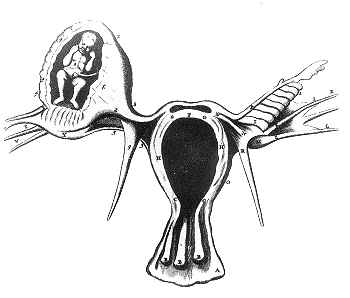
The principle of double effect justifies certain methods of treatment of ectopic pregnancy, depicted in the above figure from Graaf’s work of 1669
An example of applying moral absolutism to the issue of the permissibility of abortion is provided by Father Jacek Woroniecki. He writes in his Catholic Educational Ethics that in a situation where the life of a pregnant woman can only be saved by sacrificing the life of the fetus, it is not permissible to do so, even if the fetus is destined to die shortly afterward. In such a situation, both should be allowed to die.
On the other hand, the application of the principle of double effect allows for the termination of pregnancy under certain conditions. For example, it justifies a salpingectomy along with an ectopic pregnancy if the termination of the pregnancy is only a foreseeable but not desired outcome of the surgery. A debatable case is when, instead of salpingectomy, a small resection of the fallopian tube is performed, involving only the site of implantation, or when the embryo itself is removed (salpingostomy or salpingotomy). Here, the death of the embryo becomes, according to some, a means to achieve the desired outcome, while for others, it is an unavoidable but incidental effect of its removal. The proportionality of such actions and their necessity are also questioned, especially if a larger resection can be performed. A similar issue arises with the pharmacotherapy of ectopic pregnancy using methotrexate, often negatively evaluated from the perspective of the principle of double effect, although it is also subject to debate.
Another example of a situation where the unintended consequence of an action aimed at saving the mother’s life is the death of the child is the treatment of cancer with chemotherapy. Although such chemotherapy leads to the death of the fetus, its aim is to combat the tumor. Therefore, it is a permissible method of treating a pregnant woman with cancer. Some ethicists also accept the induction of labor at an early stage when the fetus cannot survive outside the mother’s body.
Analgesia
The relief of pain accompanying illness is approved by both medical and church authorities. It is the duty of medical personnel, and a patient can only waive this right through an informed decision. Typically, a pain ladder is used to combat pain, starting with non-steroidal anti-inflammatory drugs and ending with strong opioids if necessary. However, sometimes, especially in the case of terminally ill cancer patients, even the usually administered doses of strong opioids prove insufficient because the patient becomes accustomed to the medication, which gradually loses its effectiveness. As a result, pain relief is achieved only by administering lethal doses, i.e., doses that cause death in some patients and may also cause death in the patient.
Administering a lethal dose carries the risk of being accused of euthanasia, which is illegal in many countries. This accusation is refuted using the principle of double effect. The administration of a lethal dose of an analgesic allows for the fulfillment of the following conditions:
Alleviating the patient’s suffering is inherently good and demonstrates concern for the patient. Refusing analgesia would result in immense suffering for the dying patient.
The intention of administering the medication must be good – the person must intend to alleviate the patient’s suffering. They cannot desire the death of the patient, although they should be aware of the possibility.
However, death cannot be the means. This means that actions aiming to eliminate pain by killing the patient (as in euthanasia) are not acceptable. Death cannot serve the desired outcome; it cannot lead to it.
It can only be an unintended but tolerated or foreseeable consequence.
The desired effect, in the form of pain relief, must be proportional to the threat posed to the patient. In cancer, severe, all-encompassing pain often occurs, affecting not only physical but also spiritual and psychological suffering. Such pain has no moral value in itself and does not fulfill its biological function. Alleviating the patient’s suffering in such cases is considered a proportionate effect compared to the threat associated with their relief.
Such high doses of strong opioids are only used when weaker analgesics and smaller doses are ineffective.
This reasoning is subject to criticism. Firstly, it is difficult to distinguish between intended and foreseeable consequences.
However, in ethics, there is usually no certainty. Critics of the above argument point out that there is no moral difference between gradually increasing opioid doses to meet the last of the aforementioned conditions (ineffectiveness of smaller doses) and administering a one-time lethal dose, which is not approved by the principle of double effect.
Others argue that previous attempts to use smaller doses increase the patient’s suffering and that their treatment should immediately begin with effective opioid doses. However, a positive aspect of applying this principle to the analgesia of terminally ill patients is reducing the fear of medical personnel of being accused of euthanasia, which often leads to their administration of too small, ineffective opioid doses.
However, there are doubts about various laws. Some lawyers regard actions consistent with the principle of double effect as acts prohibited with eventual intent. Thus, the Penal Code of many countries would reject the principle of double effect. For instance, however, the Medical Code of Ethics, in Article 29, mandates the alleviation of a patient’s suffering until the end of their life in Poland. There is also a view that, in a situation of uncertainty regarding the threat to life, a doctor is exempt from liability for administering opioids, unlike the administration of a dose that will certainly cause the patient’s death. However, this view is based on erroneous premises, assuming that properly conducted analgesia does not include the administration of lethal doses. Such views reinforce, within the medical community, the fear of criminal liability for conducting effective analgesia and for inappropriate therapy of dying patients – with doses that do not affect them. Administering effective doses is defended here, invoking a state of higher necessity, the concept of primary legality of actions, and counter-type (in this case, extra-legal, but resulting from the Medical Code of Ethics, the Act on Healthcare Facilities, and the Act on the Profession of Physician and Dentist).
Transplantology
The principle of double effect is also sought to be applied in transplantology. The issue revolves around maintaining the dead donor rule in the case of donors with non-beating hearts.
Consequently, allowing such donors, motivated by the shortage of organs for transplantation, may lead to transforming the doctor-patient relationship into a doctor-source of organs relationship.
Veatch repels such a threat precisely through the principle of double effect. However, Szewczyk criticizes this approach, considering the last of the aforementioned criteria of the principle of double effect unmet, citing living donors and donors diagnosed with brain death.
However, even the retrieval of organs from a living donor, which indeed worsens their physical health, is justified by the principle of double effect, although the principle of totality is also applied here. The physical suffering of the donor caused by the procedure is offset by a spiritual benefit. Such an approach was supported by Pope Pius XII during his speech at the International Neuro-Pharmacological Colloquium.
The lesser evil, or the lesser of two evils, is an ethical principle that justifies choosing one evil in order to avoid a greater evil. The condition of the principle is that of a strictly binary dilemma, meaning that there is no possibility of a third option (tertium non datur); for example, the option offered may be between the action that implies one evil and the omission that implies another different evil (which requires evaluating which of the two evils is lesser).
The impossibility of choosing between two equally attractive options is the paradox called “Buridan’s ass” (which would die of hunger and thirst if placed equidistant from food and water, unable to move in any direction). Examples of ethical dilemmas are Carneades’ table (where a castaway saves himself at the expense of causing another to drown) and the trolley problem (where one must choose to save a greater number of people at the cost of the lives of a smaller number, or vice versa).
The myth of Scylla and Charybdis presents the choice between two evils that Ulysses had to face; by choosing to approach Scylla, he lost six companions, but if he had sailed alongside Charybdis, they all would have perished.
Therein dwells Scylla, yelping terribly. Her voice is indeed but as the voice of a new-born whelp, but she herself is an evil monster, nor would anyone be glad at sight of her, no, not though it were a god that met her. Verily she has twelve feet, all misshapen, and six necks, exceeding long, and on each one an awful head, and therein three rows of teeth, thick and close, and full of black death. Up to her middle she is hidden in the hollow cave, but she holds her head out beyond the dread chasm, and fishes there, eagerly searching around the rock for dolphins and sea-dogs and whatever greater beast she may haply catch, such creatures as deep-moaning Amphitrite rears in multitudes past counting. By her no sailors yet may boast that they have fled unscathed in their ship, for with each head she carries off a man, snatching him from the dark-prowed ship. “‘But the other cliff, thou wilt note, Odysseus, is lower—they are close to each other; thou couldst even shoot an arrow across—and on it is a great fig tree with rich foliage, but beneath this divine Charybdis sucks down the black water. Thrice a day she belches it forth, and thrice she sucks it down terribly. Mayest thou not be there when she sucks it down, for no one could save thee from ruin, no, not the Earth-shaker. Nay, draw very close to Scylla’s cliff, and drive thy ship past quickly; for it is better far to mourn six comrades in thy ship than all together.’
The Latin phrase incidit in Scyllam cupiens vitare Charybdim (fell into Scylla while wanting to avoid Charybdis) became proverbial, with a similar meaning to expressions like “out of the frying pan into the fire,” “escape the fire only to fall into the coals,” or “between a rock and a hard place.” Erasmus includes it as an ancient proverb in Adages, although its earliest appearance is in Alexandreis, a 12th-century Latin epic poem by Gautier de Châtillon.
History of philosophy and law
The principle of lesser evil apparently contradicts other ethical principles that would seem to indicate that it is never permissible to commit any evil, such as those posed about injustice (αδικία adikía) by Plato, in the mouth of Socrates, in the dialogues Gorgias (it is preferable to suffer injustice than to commit it), and Crito (injustice should not be committed even to avoid a greater injustice). In contrast, the principle is clearly defended by Aristotle in Book II of his Ethics, whose Latin version spread in the 13th century in Western Europe and was also adopted by Thomas à Kempis: De duobus malis, minor est semper eligendum (of two evils, the lesser must always be chosen).
Aristotle defined virtue as a mean between two vices; proposing that it is advisable to fall into the less erroneous vice rather than the more erroneous one when one cannot hit the virtue (ta elachista lepteon ton kakon -“one must take the lesser of two evils”-). Cicero, in De officiis, gives as an example of choosing the lesser evil (minima de malis) not an easy way out but an example of heroism: the physical suffering that Marcus Atilius Regulus chose to endure in order to avoid breaking his oath.
In the Middle Ages, the principle is reflected in Ivo of Chartres and in the Decree of Gratian, which is supported by texts such as this one from the Eighth Council of Toledo: si periculi necessitas unum ex his temperare compulerit, id debemus resoluere quod minori nexu noscitur obligari (“if an inexcusable danger compels us to perpetrate one of two evils, we must choose the one that makes us less guilty”); with that wording, it is evident that, although there is a moral obligation to inflict the lesser evil, the fact that there is an obligation to do so does not exempt from guilt or responsibility, since it is still an evil. As for the way to distinguish which of the two evils is lesser, there is an inconsistency among the manuscripts that contain the text of the Council: in one it says purae rationis acumene (“by the sharpness [clearness] of pure reason”) and in another orationis acumene (“by the sharpness [clearness] of prayer”).
Electoral systems and psychological techniques
In political elections, especially in two-party systems, the options offered to the voter can both be seen as bad, so casting a vote usually does not mean identifying with a candidate considered optimal, but rather avoiding the candidate considered worse. In such contexts, expressions like “strategic voting” or “holding one’s nose while voting” are used.
There are theories and psychological techniques used in marketing and political campaigns (decision theory, neuroeconomics, and neuropolitics) that seek to guide consumer or voter preference by presenting comparative advantages or disadvantages. When not only the possibility of choosing between two options is posed, presenting a third instrumental option, closer to one option than to another, ensures that the preference leans in the desired direction.
Bioethics and medical ethics
The amputation of a foot to avoid greater harm (losing the entire leg or life) is a lesser evil assumed in medical practice, which is even expressed in a topic applicable to any other circumstance: “cutting out the unhealthy part.” An important question is the possibility of applying the principle or criterion of the lesser evil in bioethical decision-making and medical ethics.
To admit techniques like amputation, even for those who refuse to justify the principle of the lesser evil, a resort is made to differentiate between “physical evils” and “moral evils.” According to moral rigorists, only physical evils could be subjected to a weighing of which evil is lesser, something impossible between two moral evils (absolute evils), while between a physical evil and a moral evil, the physical evil should always be preferred.
Justification of War as the Lesser Evil
While some aspects of ancient civilizations manifest a consideration of war as a good in itself or an honorable activity, others show it as an evil to be avoided as much as possible, but one must be aware that it cannot always be avoided (si vis pacem, para bellum). This is the case in the Greco-Roman world: according to Titus Livius, the Roman king Tullus Hostilius, despite his warlike nature, “calls the gods to witness that the calamities of this conflict [against the Albanians] will fall upon the people who first refused to listen to the demands of the ambassadors.” Cicero condemned the formalism that the rules of the ius fetiale imposed regarding the justification of the causes of war, proposing defense and revenge as the only just causes; although in some cases, he also proposes that war can be undertaken to “enlarge the boundaries of peace, order, and justice.”
Illa injusta bella sunt quae sunt sine causa suscepta, nam extra ulciscendi aut propulsandorum hostium causam bellum geri justum nullum potest (“wars undertaken without reason are unjust, for no war can be waged justly unless for the purpose of repelling or avenging an enemy”).
… if the iniquity of the opposing party is what leads the wise to uphold a just war, this iniquity should cause regret, since it is characteristic of human hearts to sympathize… So anyone who considers with pain these calamities so great, so horrendous, so inhuman, must confess to misery; and whoever suffers them, or considers them without feeling in his soul, is erroneously and miserably deemed blessed, for he has erased from his heart all human sentiment.
Augustine of Hippo, City of God, XIX.
Christianity went from proposing radical pacifism in the time of persecutions to justifying wars when the Roman Empire was Christianized in the 4th century. From then on, the causes of just war (bellum iustum) were theorized, always to restore peace and repair the injustice received: thus in Augustine of Hippo (just wars avenge injustices) or Isidore of Seville (“to recover lost goods or repel and punish enemies for the unjust war initiated by madness or without legitimate cause”), whose ideas were collected in the Decree of Gratian. Other medieval authors who theorized about just war were Acursius, the decretists and decretalists, and Thomas Aquinas. For the latter, three requirements are necessary: legitimate authority (auctoritas principes), just cause, and right intention (intentio recta) to promote good and avoid evil. Thomism developed in a new context (that of humanism and the nation-states of the Modern Age) notably with the School of Salamanca (Francisco de Vitoria). With these Catholic thinkers, and with Protestants like Hugo Grotius and Alberico Gentili, the ius ad bellum (to wage war, there must be a just cause) was added to the ius in bello (in war, damage should be limited only to combatants, and there should be proportionality between the lives destroyed and those saved).
President Harry Truman justified the use of atomic bombs on Japan based on a calculation of lives, according to which they saved more lives than they cost, assuming that any other option to end the war would have meant a greater number of casualties on both sides, although such calculations and motivations are disputed.
… the truth is very simple: to survive, we often must fight, and to do so, we must get our hands dirty. War is evil, and sometimes it is the lesser evil.
George Orwell, Homage to Catalonia.
How can you say that a good cause sanctifies even a war? I tell you: the good war sanctifies every cause!
Friedrich Nietzsche, Thus Spoke Zarathustra, 1883-1885.
Collaborationism as the Lesser Evil
Those who denounce the moral fallacy of this argument are generally accused of aseptic moralism unrelated to political circumstances, of not wanting to dirty their hands; and it must be admitted that it is not so much political or moral philosophy (with the sole exception of Kant, who is usually accused of moral rigorism), but religious thought that has most unequivocally rejected all compromises with lesser evils. Thus, for example, the Talmud argues…: If they ask you to sacrifice a man for the security of the whole community, do not give him up; if they ask you to let a woman be raped for the sake of all women, do not let her be raped. … John XXIII … “never to act in collusion with evil in the hope that, by so doing, they can be of use to anyone.”
Politically speaking, the weakness of the argument has always been that those who choose the lesser evil quickly forget that they are choosing evil. … the extermination of the Jews was preceded by a very gradual series of anti-Jewish measures, each of which was accepted with the argument that refusing to cooperate would make things worse, until a stage was reached where nothing worse could have happened.
Hannah Arendt, Personal Responsibility Under Dictatorship (1967).
Tolerance as the Lesser Evil
For those who conceive of political power as a means to achieve the “maximum moral, both from religious perspectives (“to ordain good and forbid evil,” “heresy must be punished) and from secular totalitarianism, tolerance is a concession to evil since it allows its existence. In the context of the religious wars of 16th-century France, the politiques saw tolerance as the only way to achieve social peace, and Henry of Navarre agreed to convert to Catholicism to reign over a united country (“Paris is well worth a mass”), granting with the Edict of Nantes spaces of security for the Protestants. In the field of international relations, from the Peace of Westphalia (1648) onwards, the imposition of religion ceased to be a priority for European states as it had been in the previous century.
Realism in international politics requires tolerating moral differences with allies and enemies. The “balance of terror” of the mid-20th-century Cold War implied avoiding direct confrontations between superpowers if one wanted to avoid “mutual assured destruction,” forcing a peaceful coexistence with so-called realpolitik (renouncing the imposition of one’s own principles to achieve an understanding with the adversary). Even game theory was developed to weigh the logical consequences of the confrontation between adversaries with opposing interests (in the “prisoner’s dilemma,” the possibility of voluntarily assuming a punishment to avoid a greater one by collaborating with an adversary facing the same perspective).
United with the principle of lesser evil, and as a consequence of it, we can state the principle of tolerance. This has great relevance due to the pluralistic environment of our society. In a certain sense, we can understand it as “not preventing an evil, although capable of doing so, but without expressly approving it.” Consequently, regarding truth and opinion, the stance is one of respect, while in the face of evil and error, tolerance is appropriate. We can distinguish two types of tolerance: one is dogmatic, which permits everything, as for it, everything is equal. This position cannot be sustained… [but] it continues to be supported by many thinkers, for whom the relativistic view of tolerance (the dogmatic one), often presented as ethical pluralism or the neutrality of the State, is the condition for the possibility of peaceful democratic coexistence. The other type of tolerance is practical, allowing error without approving it. That is, it focuses on fundamental ethical values for coexistence: peace, freedom, and justice to legally guarantee the demands of human dignity. This second type, with some nuances, can be admitted. It is what has been called “negative permission of evil.” Tolerance, in the strict sense, that is, as a moral principle, can be defined as follows: “in some circumstances, it is morally permissible not to prevent an evil – although capable of preventing it – in consideration of a higher good or to avoid more serious disorders.”
Traditionally, the argument of the lesser evil has been applied in social ethics within the framework of the permission by public authorities of certain evils to avoid worse evils [But when one must choose between two dangers, in each of which there is an imminent peril, it is better to choose that one from which less evil follows. Thomas Aquinas, On Kingship, I, 6]. From the 16th century onwards, this notion has been extended to the distinction between the sphere of personal ethics and the sphere of legal order and governmental action. It is then when the contemporary concept of “tolerance” arises, understood as the attitude of States accepting the primacy of individual decisions over public authorities, in less relevant aspects of the common good, gradually opening a more marked dissociation between individual morality and public order, as in John Locke in his Letter Concerning Toleration (1689), or in Voltaire with his Treatise on Tolerance (1763). However, this gradual process has not ceased to reveal its contradictions. The sophistical uses of the argument of the lesser evil, and its use in a context unrelated to the perception of the absolute ethical demands of truth about the human person and their dignity, have been denounced by contemporary thought, especially since the Second World War. Hannah Arendt has made a sharp critique of the aberrant and ideological uses of the argument of the lesser evil in an attempt to numb moral consciousness during the National Socialist period in her book Personal Responsibility Under Dictatorship (1964): “The acceptance of the lesser evil was consciously used to accustom officials and the population to generally accept evil itself.”
Justification of Torture as the Lesser Evil
Since at least Jeremy Bentham, the use of torture has been purportedly justified as a lesser evil, with the so-called “ticking time bomb scenario” (TBS): authorities have caught a terrorist who has just placed a bomb, and he refuses to provide information about its location, so there is no way to prevent the death of many people unless he is forced to do so. Alan Dershowitz argues that both evils must be analyzed, and one must be willing to accept the consequences of the choice, concluding that torturing the detainee is the lesser evil. Michael Ignatieff agrees with the approach, warning that it could only be applied as a last resort if it were impossible to resolve the emergency with other methods; but he insists on pointing out the danger of turning it into a greater evil if it is disconnected from the assumptions of the scenario (real and immediate threat) and becomes a systematic recourse (applied to suspects or for potential events), as would have happened after the attacks of September 11, 2001.
References
de Spinoza, Benedict (2017) [1677]. “Of Human Bondage or of the Strength of the Affects”. Ethics. Translated by White, W.H. New York: Penguin Classics. p. 424. ASIN B00DO8NRDC.
“Jill Stein cost Hillary dearly in 2016. Democrats are still writing off her successor”. Politico.
“Chirac’s new challenge”. The Economist. 2002-05-06. Retrieved 2011-04-15.
Schneider, William (18 September 1988). “THE EVIL OF TWO LESSERS”. Los Angeles Times. Retrieved 12 September 2020.
Keinon, Herb (6 November 2016). “Clinton vs. Trump: ‘The evil of two lessers’”. Jerusalem Post. Retrieved 12 September 2020.
Noted by Edward Charles Harington in Notes and Queries 5th Series, 8 (7 July 1877:14).
A Morton’s Fork is a type of false dilemma where contradictory observations lead to the same conclusion. It’s said to have originated with tax collection by John Morton. The first known use of the term dates back to the mid-19th century, and the only earlier known mention is a claim by Francis Bacon about an existing tradition.
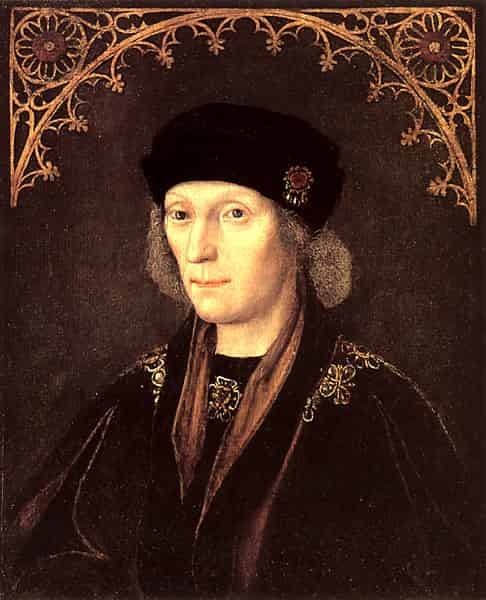
Under Henry VII, John Morton was appointed Archbishop of Canterbury in 1486 and Lord Chancellor in 1487. He raised tax funds for his king by arguing that someone living modestly must be saving money and therefore could afford to pay taxes, while someone living extravagantly obviously was wealthy and thus could also pay taxes. The Morton’s Fork might have been invented by another of Henry’s supporters, Richard Foxe.
Henry VII
In some cases, like Morton’s original use of the fallacy, one of the two observations may be likely valid, but the other is purely sophistic.
In other cases, it may be that neither observation can be trusted to properly support the conclusion.
For instance, asserting that a person suspected of a crime, if acting nervously, must have something to feel guilty about, while a person acting calmly and confidently must be either practical or skilled at hiding guilt. Thus, either observation has little or no probative value, as each could be evidence for the opposite conclusion.
A Morton’s Fork can lead a person not to make a choice at all, possibly with undesirable consequences. A more thorough consideration of the alternatives may sometimes reveal an additional option or show that one of the available options does produce a less unfavorable result than the other. Sometimes a Morton’s Fork can also be solved by finding an exception to the rule.
Other similar concepts to Morton’s Fork are between hammer and anvil or between Scylla and Charybdis; namely a choice between two or more equally undesirable alternatives. Morton’s Fork is the logical counterpart of Buridan’s Donkey (Buridan’s Ass).
Examples
The “Morton’s Fork coup” is a maneuver in the game of contract bridge that uses the principle of Morton’s Fork.
An episode of the television series Fargo is titled “Morton’s Fork,” referencing the dilemma.
Charybdis (in ancient Greek Χάρυϐδις / Khárubdis, pron.: [kaʀibd] “karybde”) and Scylla are two sea monsters from Greek mythology, located on either side of a strait traditionally identified as the Strait of Messina. The legend is the origin of the expression “between Scylla and Charybdis,” which means “to go from bad to worse.” Charybdis in ancient Greek epic poetry is the personification of the all-devouring sea whirlpool (etymologically, Charybdis derives from the word meaning “whirlpool”). In the Odyssey, Charybdis is depicted as a sea deity (Ancient Greek: δία Χάρυβδις), dwelling in the strait beneath a rock within an arrow’s flight from another rock, which served as Scylla’s lair.
Greek mythology
Charybdis was the daughter of Poseidon and Gaia. She was perpetually hungry. When she devoured the cattle of Heracles, the son of Zeus, he punished her by sending her to the bottom of a strait “formed by a sea arm that separates Rhegium from Messene.”
Not far away lived Scylla. Originally, she was a nymph whom Glaucus was madly in love with. As this love was not reciprocated, Glaucus went to the sorceress Circe for a love potion, but she, deeply in love with Glaucus and jealous of Scylla, took the opportunity to transform the nymph into a terrifying monster.
James Gillray, Britannia between Scylla and Charybdis (1793)
In the Odyssey, Circe describes to Odysseus the route he must follow in these terms: “The route leads you between the Two Rocks. One thrusts its pointed peak up to the vast sky; a dark blue cloud surrounds it. No mortal could climb or stand there, […] for the rock is smooth and seems polished all around. In the middle of this rock, there is a dark cave facing northwest towards Erebus. Straight toward it, you shall steer your hollow ship, O noble Odysseus! With an arrow, a strong man drawing from a hollow ship could not touch the bottom of this cave. Scylla, with her resounding cry, resides there.”
Scylla is portrayed as a monstrous creature whose resounding cry is a bark echoing on the cave walls; Circe describes her as “eternal evil, a terrible scourge, a wild reality that cannot be fought.” Despite Circe’s recommendations, Odysseus equips himself with two long spears to confront the monster, but in vain; he loses six of his sailors and orders them to quickly steer away from the rock. As for Charybdis, “it swallows the black water; three times a day it spits it out; three times it swallows it again.” This whirlpool is so powerful that even Poseidon himself would be unable to save anyone caught in its vortex.
Interpretations
Since Homer, Charybdis and Scylla have been two associated terms, both opposed and complementary. Scylla is a high fixed rock that rises to the sky; Charybdis lies in the depths of the sea, like a liquid mass descending and rising in spiral movements. These two dangers that threatened sailors were identified since antiquity by Thucydides as “the formidable passage, given its narrowness and currents,” which we now call the Strait of Messina. This whirlpool and reef are indicated on our sea charts and defined by Nautical Instructions: “The meeting of two opposing currents produces, in various places in the strait, whirlpools and large swirls called garofali. The main garofali are on the coast of Sicily, between Cape Faro and Punta Sottile, with the ebb tide, and in front of the tower of Palazzo, with the flood tide; this latter garofalo is very strong: it is the Charybdis of the Ancients.”
Following Circe’s instructions, Odysseus bypassed the sirens, whom experienced navigators recognize as the Galli, and headed for Scylla, a rock that appears on the port side before the narrow gate giving access to the south. It is also indicated in our modern Nautical Instructions: “The city of Scilla is built in an amphitheater on the steep cliffs of a prominent point to the north.” On this high and rocky promontory, the Greeks imagined the monster Scylla in its lair. Midway up, there is indeed a cave and the cliff resounds with the blows dealt by the surging waves.
Also noteworthy are the numerous philosophical interpretations, sometimes alchemical, both pagan and Christian, that Scylla and Charybdis have been the subject of since antiquity, notably by Heraclides Ponticus, Eustathius, and Christopher Contoleon.
In the twentieth century, the philosopher Emmanuel d’Hooghvorst also commented on them in this sense: “In Greek oneiromancy, teeth signify bones. In each of its mouths, this monster [Scylla] has three rows of teeth; it is the triple series of human vertebrae, two of which are mobile and one fixed. ‘In these nineteen mobile vertebrae, I spend my life in the vanity of this century. Such is the danger, such is the trap of souls.’”
Doxography
In the earliest mythological accounts, Charybdis hardly played any role; later she was named the daughter of Poseidon and Gaia.
In various mythographic sources, Scylla is considered:
the daughter of Phorcys and Hecate;
or the daughter of Phorbas and Hecate;
the daughter of Triton and Lamia (according to Stesichorus, daughter of Lamia);
the daughter of Typhon and Echidna;
the daughter of Poseidon (Deima) and Crataeis;
the daughter of Triton;
or the daughter of Poseidon or Gaia.
the daughter of the river Crataeis and Trienus (or Phorcus); Homer calls her the mother nymph Crataeis, daughter of Hecate and Triton.
According to Acusilaus and Apollonius, the daughter of Phorcus and Hecate, named Crataeis;
According to another version, the daughter of Tyrrhenus;
In Vergil’s works, the monster Scylla is identified with the daughter of Nisus.
In some tales, Scylla is sometimes portrayed as a beautiful maiden: Glaukos sought her love, but the sorceress Circe herself fell in love with Glaukos. Scylla used to bathe, and Circe, out of jealousy, poisoned the water with potions, turning Scylla into a fierce beast. Her beautiful body was disfigured, with its lower part turning into a row of dog heads.
According to another tale, this transformation was performed by Amphitrite, who, upon learning that Scylla had become Poseidon’s beloved, decided to get rid of the dangerous rival by this means (poisoning the water).
According to the “Epic Cycle” by Dionysius of Samos, for the abduction of one of the cattle of Geryon, Scylla was killed by him but was revived again by her father Phorcys, who burned her body.
Description by Homer
The rock of Scylla rose high with a sharp peak to the sky and was perpetually covered with dark clouds and twilight; access to it was impossible due to its smooth surface and steepness. In the middle of it, at a height unreachable even for an arrow, there was a cave with a dark entrance facing west. In this cave dwelled the fearsome Scylla. Without ceasing to bark (Σκύλλα”barking”), the monster echoed the surroundings with piercing cries. In front of Scylla, there were twelve legs moving, six long flexible necks rising from shaggy shoulders, and on each neck there was a head protruding; in her mouth, there were frequent, sharp teeth arranged in three rows. By backing her hindquarters into the depths of the cave and sticking out her chest, she hunted prey with all her heads, groping around the rock with her paws and catching dolphins, seals, and other sea creatures. When a ship passed by the cave, Scylla, opening all her mouths wide, would snatch six men from the ship at once. This is how Homer outlines Scylla.
Charybdis, on the other hand, lacks individuality in Homer’s description: it is simply a sea whirlpool, agitated by an unseen water goddess, which three times a day swallows and as many times spews out seawater beneath the second of the mentioned rocks.
When Odysseus with his companions passed through the narrow strait between Scylla and Charybdis, the latter eagerly swallowed the salty water. Calculating that death from Charybdis threatened inevitably to all, whereas Scylla could snatch only six men with her paws, Odysseus, losing six of his comrades, who were devoured by Scylla, avoids the dreadful strait.
Later, as punishment for sacrilegiously striking the cattle of Hyperion, Zeus ordered a storm that wrecked Odysseus’ ship and scattered his companions’ bodies in the sea. Odysseus himself, having managed to cling to the mast and keel, was again carried by the wind towards Charybdis. Seeing the inevitable death, at the moment when the wreckage of the ship fell into the whirlpool, he grabbed the branches of a fig tree, which descended to the water, and hung in that position until Charybdis threw back the “desired logs.” Then he, spreading his arms and legs, fell with all his weight on the thrown remnants of the ship and, straddling them, escaped from the whirlpool.
According to Gaius Julius Hyginus, below she is a dog, and above she is a woman. She had six dogs born to her, and she devoured six of Odysseus’ companions.
Like Odysseus, Jason and his companions safely passed by Charybdis, thanks to the help of Thetis; Aeneas, who also had to pass between Scylla and Charybdis, preferred to circumvent the dangerous place.
In Vergil’s works, there are several Scyllas, who, among other monsters, inhabit the vestibule of Tartarus.
Geography
Geographically, the whereabouts of Scylla and Charybdis were associated by the ancients with the Strait of Messina between Sicily and Calabria, with Charybdis being located in the Sicilian part of the strait under Cape Pelorus, and Scylla on the opposite cape (in Bruttium, near Rhegium), which bore her name in historical times (Latin Scyllaeum promontorium, Ancient Greek: Σκύλλαιον). It is noteworthy that the fantastic description of the mythical dangerous strait by Homer does not match the actual nature of the Strait of Messina, which is not so dangerous for sailors. It is known that parts of the rocks collapsed during the strongest earthquake on February 5, 1783, in this region. In reality, Scylla is a sharp-pointed rock, and Charybdis is a large whirlpool.
In addition to the Messina Charybdis, in antiquity, under the name Charybdis, there was a chasm where the flow of the river Orontes disappeared for a certain distance in Syria, between Antioch and Apamea, and a whirlpool near Gades in Spain.
Evocations
Antiquity
In the story of the Argonauts, they cross the strait without difficulty thanks to divine interventions, going from Sardinia to the Ionian Sea, on their return from Colchis.
In the Odyssey, Odysseus is called to cross the strait with his ship, then is confronted with Charybdis a second time after a shipwreck.
In Virgil’s Aeneid, the hero must cross the strait on his way to Latium.
In Culture
Literature
1831: in Victor Hugo’s Notre-Dame de Paris, the first chapter of the second book is titled From Charybdis to Scylla.
1937: in J.R.R. Tolkien’s The Hobbit, the sixth chapter is titled From Charybdis to Scylla [source insufficient].
2006: in James Joyce’s Ulysses, the entire ninth episode references this myth.
2006: in book 2, The Sea of Monsters, of Rick Riordan’s Percy Jackson series.
Comics
In issue number 102 published in 1967 of the Blek le Roc albums, Professor Occultis uses this expression to show that he, Blek, and Roddy were caught between an Indian tribe and the Red Lobsters.
In the manga Saint Seiya, during the attack on Poseidon’s underwater sanctuary, the Andromeda knight battles General Io of Scylla, whose armor and powers refer to the mythological monster.
In Mark Waid’s comic Irredeemable, Charybdis and Scylla are twin superheroes.
Film and Animation
In episode 11 of Ulysses 31, Charybdis and Scylla are represented as two monstrous planets located in a vortex that, seen from above, resembles the symbol ∞. The first is of fire, and the second of ice.
In the second episode of the animated series The Odyssey, Charybdis and Scylla are presented as a loving couple, victims of a curse by Circe. Charybdis has become a cave sheltering a whirlpool that swallows everything and Scylla has become a three-headed monster, with the two lovers unable to reunite. At the end of the episode, the two are reunited thanks to Ulysses and regain their original appearance.
In season 4 of the series Prison Break, Michael Scofield and his team must obtain a memory card named “Scylla” which is accessed through six electronic keys (referring to the six heads of Scylla in Homer’s tale). The titles of the first two episodes of this final season also refer to this myth, as they are respectively titled From Charybdis… (# 4.01) and …To Scylla (# 4.02).
Episodes 20 and 21 of the series Alias are titled respectively From Charybdis… (# 4.20) …to Scylla (# 4.21).
In the film The Hobbit: An Unexpected Journey, the expression “to fall from Charybdis to Scylla” is spoken by the wizard Gandalf.
In the film Percy Jackson: Sea of Monsters, directed by Thor Freudenthal in 2013.
Music
A song by the band Trivium on the album Shogun is also called Torn Between Scylla & Charybdis which means Torn between Scylla and Charybdis.
A song by The Police discusses the bonds of marriage (Wrapped Around Your Finger) where Sting does not want to be caught between “the Scylla and Charibdes.”
Video Games
In Halo 3, the Arbiter mentions this expression when, after killing the High Prophet of Truth and defeating the Covenant, the Master Chief and the Arbiter find themselves confronted with the Parasite.
In God of War: Ghost of Sparta, Scylla is the very first boss of the game in Atlantis.
In the video game Smite from Hi-Rez Studios, Charybdis and Scylla are part of the pantheon of gods accessible to players.
One of the achievements in the video game Call of Duty: Modern Warfare 2 is called From Charybdis to Scylla and is obtained by completing the level The Enemy of My Enemy…
Origin of the phrase
Ancient sailors having to take this passage were faced with an alternative: to pass by Charybdis or to pass by Scylla, and thus “to choose between Charybdis and Scylla.”
The well-known phrase “to fall from Charybdis to Scylla” seems to have been anchored in the language by Jean de La Fontaine with his fable The Old Woman and Her Two Servants, where the establishment of the expression may be more about the harmony of the verse. However, he was preceded by Gautier de Châtillon in his Latin novel the Alexandrian, with the mention: “…incidit in Scyllam cupiens vitare Charybdim…” (he falls on Scylla wanting to avoid Charybdis).
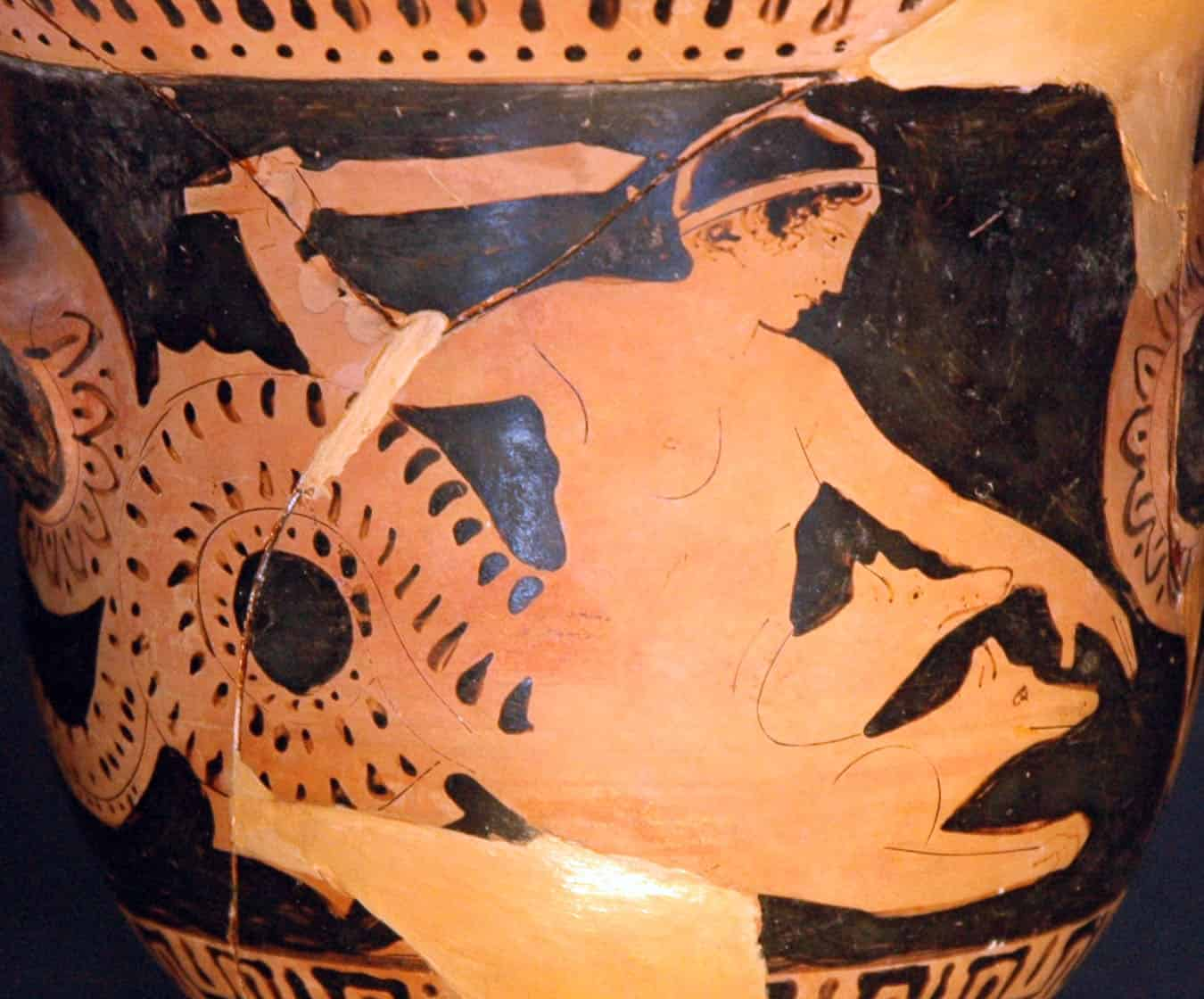
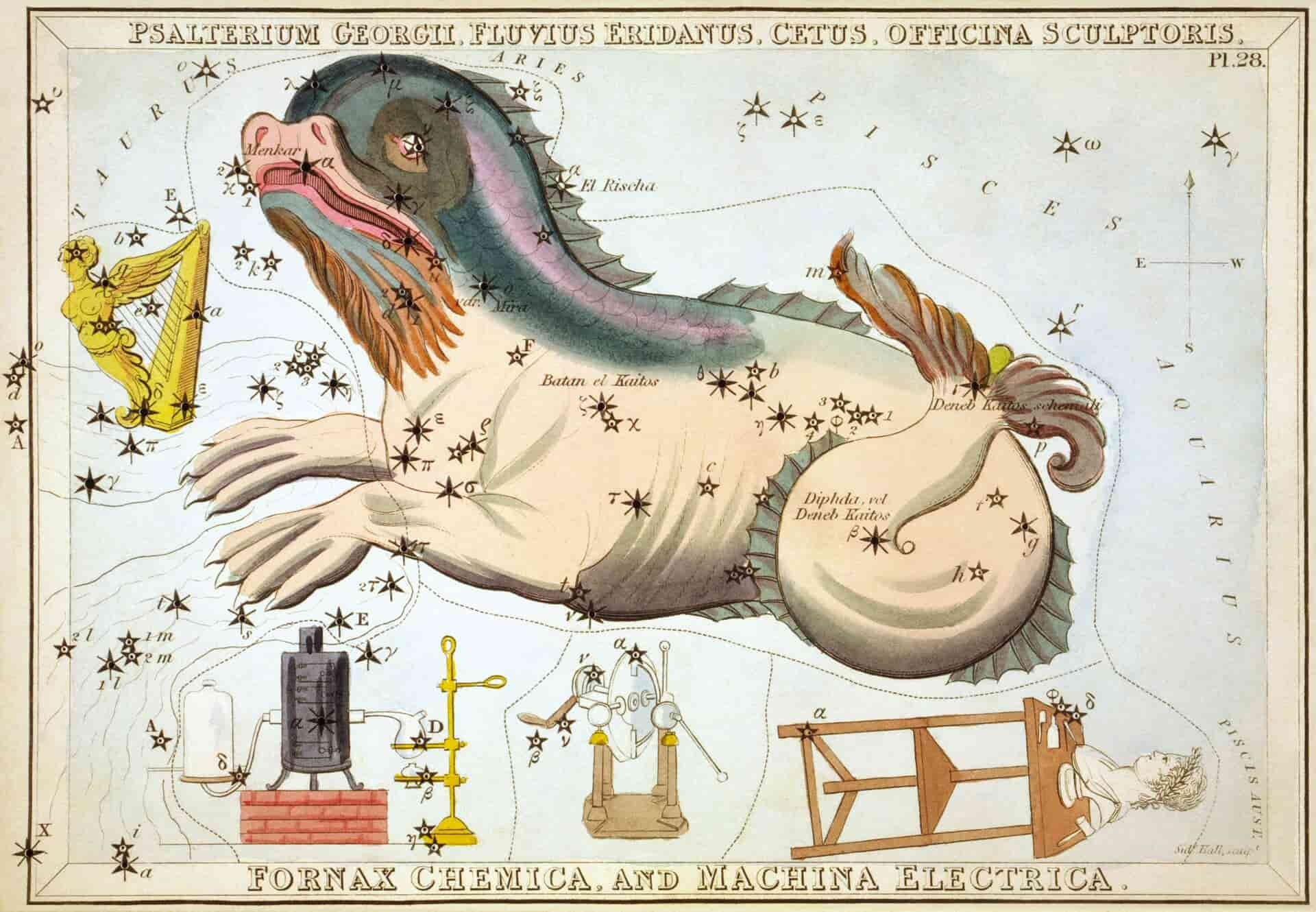
In the maritime imagination of ancient Greece and Rome, the deep blue waters beyond the sight of land were the domain of the Ketos—latinized as Cetus—a colossal, terrifying sea monster dispatched by the gods to punish royal hubris and devastate coastal kingdoms. Depicted on hundreds of ancient vase paintings, mosaics, and marble sarcophagi, the Cetus was neither a simple whale nor an ordinary fish; it was a hybrid leviathan whose mythological confrontations with the heroes Perseus and Heracles earned it a permanent place among the stars as the fourth largest constellation in the night sky.
Anatomy of the Ketos in Ancient Art and Natural History
In the everyday Greek language of Homer and Aristotle, the word ketos (plural ketea) was used broadly to describe any enormous marine animal, including great baleen whales, sperm whales, giant sharks, and massive Mediterranean monk seals—giving rise to the modern biological order name Cetacea for whales, dolphins, and porpoises. When sailors spotted fifty-foot whale carcasses washing ashore or saw spouts rising on the horizon, storytellers fused those real marine giants with nightmare predators.
In Greek and Roman visual art, the mythological Cetus had a specific, unmistakable hybrid anatomy:
The Head and Jaws: A long, flat, canine or boar-like snout lined with rows of razor-sharp carnivore teeth, often sporting upright dog ears and a flaring beard or spiny crest beneath the chin.
The Forequarters: Two powerful, clawed terrestrial front legs or webbed flippers capable of hauling the beast partially onto rocky shores.
The Serpentine Body: A massive, looping, hundred-foot sea-serpent torso covered in glittering scales and undulating vertical coils, terminating in a forked fish or dolphin tail fluke.
The Ethiopian Cetus: Andromeda and Perseus
The most famous Cetus in classical mythology terrorized the coast of Aethiopia (often associated in ancient geography with the Levantine port of Joppa, modern Jaffa). The disaster began when Queen Cassiopeia, the vain wife of King Cepheus, boasted aloud that she and her daughter, Princess Andromeda, were more beautiful than the Nereids—the fifty sea nymphs who attended Poseidon. Outraged by the insult to his nymphs, Poseidon unleashed a devastating coastal flood alongside a ravenous Cetus that devoured fishermen, cattle, and merchant ships.
When King Cepheus consulted the Oracle of Ammon, he learned that the monster would never leave until he chained his innocent daughter Andromeda naked to a sea cliff as a human sacrifice. Just as the Cetus surged out of the foaming surf with jaws gaping to swallow the princess, the hero Perseus happened to be flying home overhead wearing the winged sandals of Hermes and carrying the severed head of the Gorgon Medusa in his pouch. Swooping down from the sky, Perseus either drove his curved harpe sword into the monster’s neck and shoulder or pulled Medusa’s head from his bag—instantly petrifying the colossal Cetus into a jagged coastal crag of solid stone, rescuing Andromeda as his bride while the gods placed the entire cast of characters, including the monster Cetus itself, into the autumn night sky.
The Trojan Cetus: Heracles and King Laomedon’s Horses
Interestingly, Greek mythology featured a second, equally destructive Cetus sent by Poseidon just generations before the Trojan War. After Poseidon and Apollo spent a year building the indestructible stone walls of Troy for King Laomedon, the greedy king refused to pay the gods their agreed-upon wages. In fury, Apollo sent a plague while Poseidon sent a massive Cetus that rode high tides onto the Trojan plain to snatch farmers from their fields.
Forced by an oracle to chain his own royal daughter, Princess Hesione, to the seaside rocks for the monster, Laomedon offered his divine, immortal snow-white horses—originally a gift from Zeus—to any hero who could slay the beast. Arriving at Troy, Heracles (Hercules) accepted the challenge. In one dramatic version preserved by Hellenistic poets, when the Cetus opened its cavernous jaws, Heracles leaped straight down the monster’s throat in full armor, spent three days hacking through its internal organs and belly from the inside out, and emerged victorious onto the beach—having lost all the hair on his head from the heat of the monster’s stomach acid.
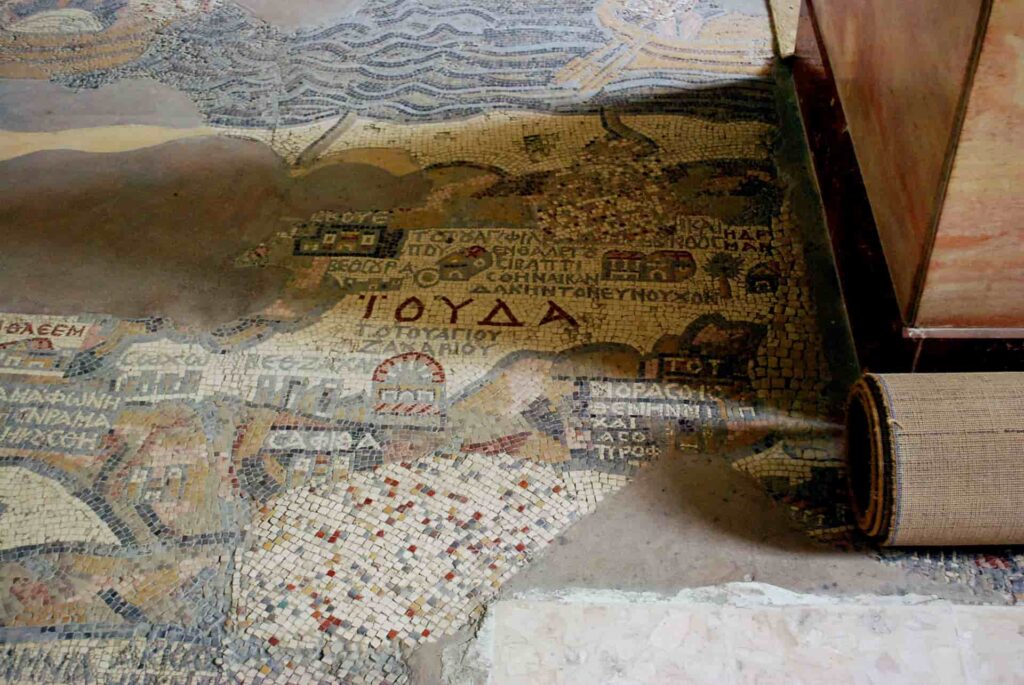
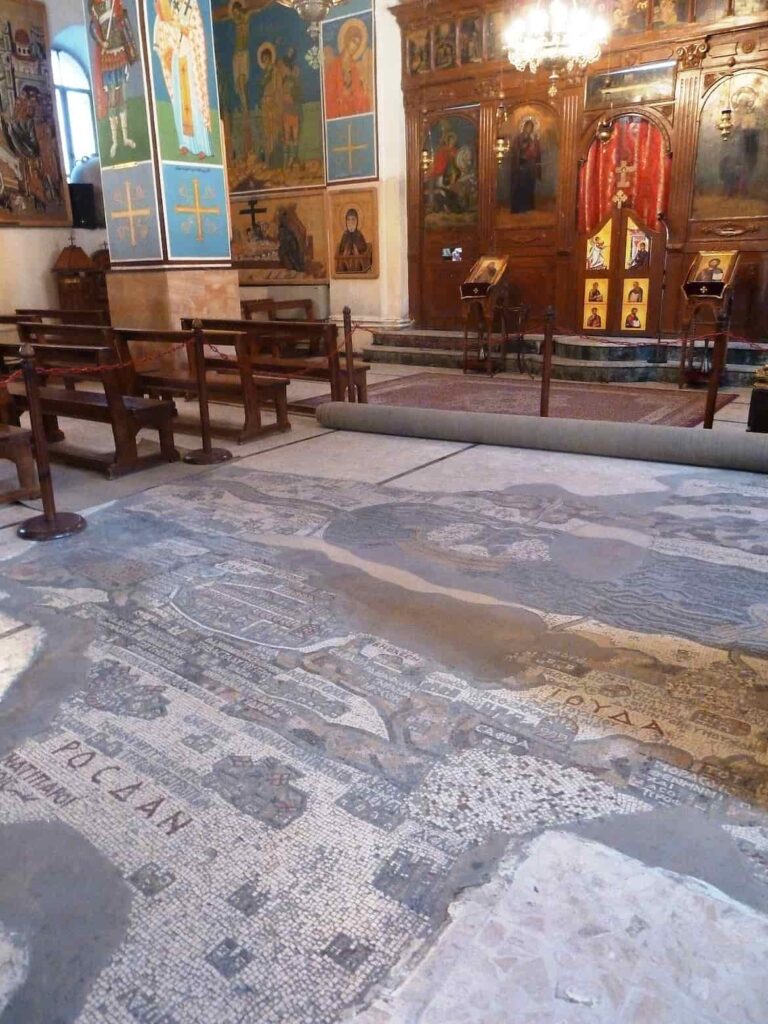
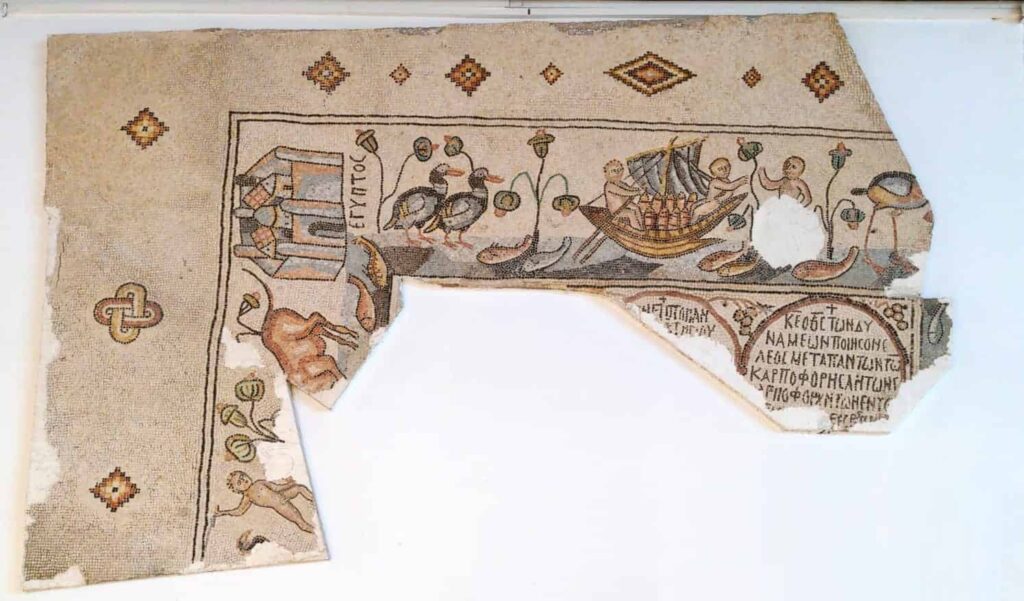
The Mosaic Map of Madaba (also known as the Madaba Mosaic or Madaba Map) is a fragmentarily preserved late antique to early Byzantine floor mosaic located in the modern Greek Orthodox Church of St. George in Madaba, Jordan. The Madaba Mosaic is the oldest surviving original cartographic depiction of Palestine on both sides of the Jordan River and Lower Egypt. It was created after 542, possibly during the reign of Emperor Justinian († 565).
The Madaba Map is renowned for its detailed representation of the city of Jerusalem, including walls, gates, main streets, and churches. Other cities, such as Ashkelon and Gaza, are similarly depicted in detail. The Madaba Map also contains some information about economic life: dates and balsam are cultivated in the Jericho area, and transport ships ply the waters of the Dead Sea. Pilgrimage tourism to Palestine was a significant economic factor in the 6th century, with the map featuring mostly biblical pilgrimage sites, supplemented by the stations of the overland roads that connected them.
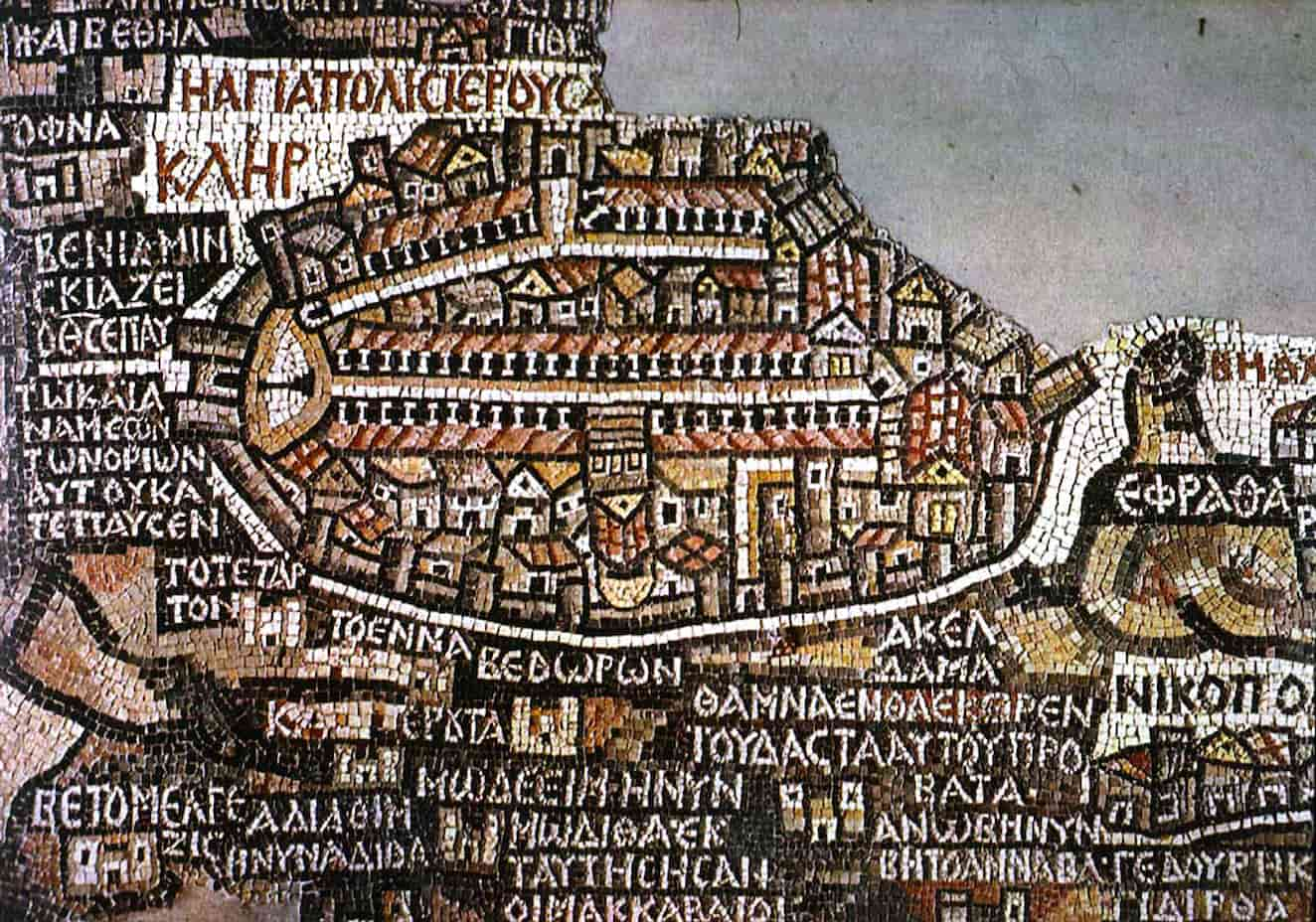
The map of Palestine, 6th century mosaic in St. George’s Church in Madaba (Jordan): details of Judea. (Wikimedia Commons)
A faithful stone copy of the Madaba Map is housed in the casting collection of the University of Göttingen. This article presents the details of the Madaba mosaic based on photos of this copy.
Discovery and Publication
Orthodox Arab Christians from al-Karak left their hometown in the 1880s due to a local conflict. They petitioned the Ottoman government in Istanbul to settle on the large tell of the Byzantine city of Madaba. The Ottoman authorities stipulated that churches could only be built where churches had stood centuries ago. Consequently, the late antique and Byzantine city of Madaba was specifically searched for the foundations of churches.
Madaba map mosaic, Jordan Abstract/medium: G. Eric and Edith Matson Photograph Collection.
In 1884, the Greek Orthodox Patriarch of Jerusalem, Nikodemos I, was informed about the discovery of the mosaic floor during the construction of the Church of St. George; reactions are not documented. In 1897, Cleopas M. Koikylides, the librarian of this patriarchate, saw the mosaic in the now completed church in Madaba and recognized its significance. His publication drew the attention of the academic world to the mosaic map. Koikylides published a schematic drawing of the mosaic map. Later visitors did the same. In 1901, the German Association for the Exploration of Palestine commissioned the Jerusalem architect Paul Palmer to make an accurate reproduction. Palmer completed the colored drawing in 1902, and the association’s chairman, Hermann Guthe, published it as a colored plate in 1906. This set a new standard of quality. Palmer’s drawing served as the basis for literature on the Madaba Map for decades. Even Michael Avi-Yonah relied on it for his 1954 publication on the Madaba Map.
After the restoration of the Madaba Map in 1965, Herbert Donner and Heinz Cüppers published a volume in 1977 documenting the mosaic map with photos. This included the peripheral areas that were covered with cement during Palmer’s time and therefore were not drawn by him. There is no photographic panoramic view of the mosaic instead of Palmer’s drawing. Whichever angle one chooses, parts of the mosaic are always hidden by modern pillars.
Description
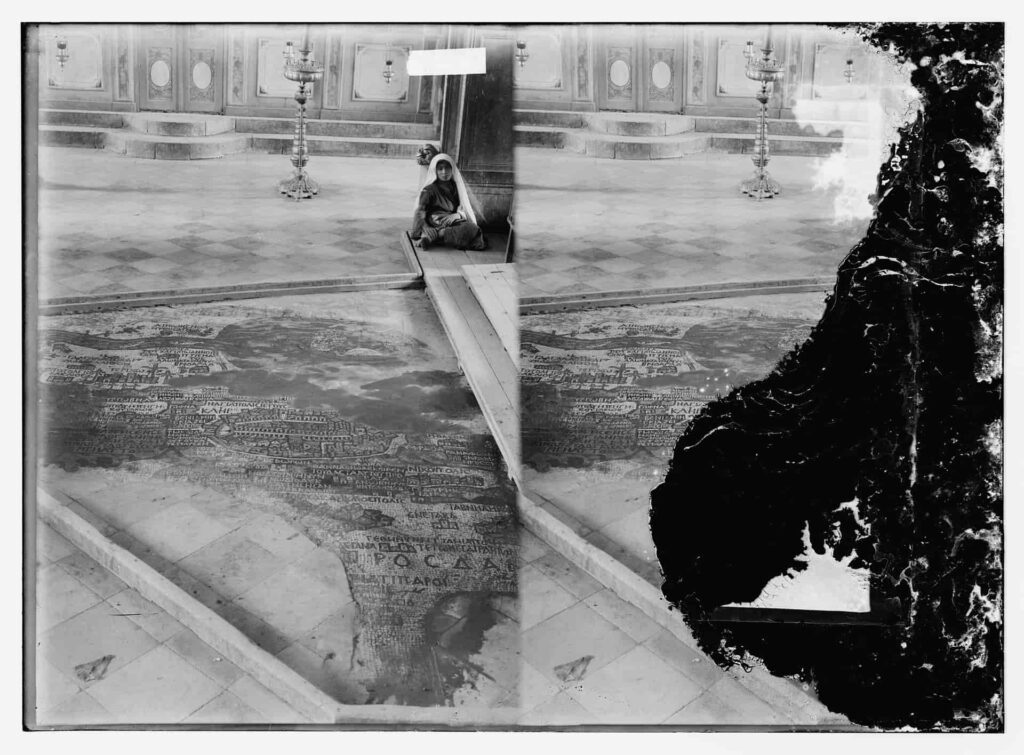
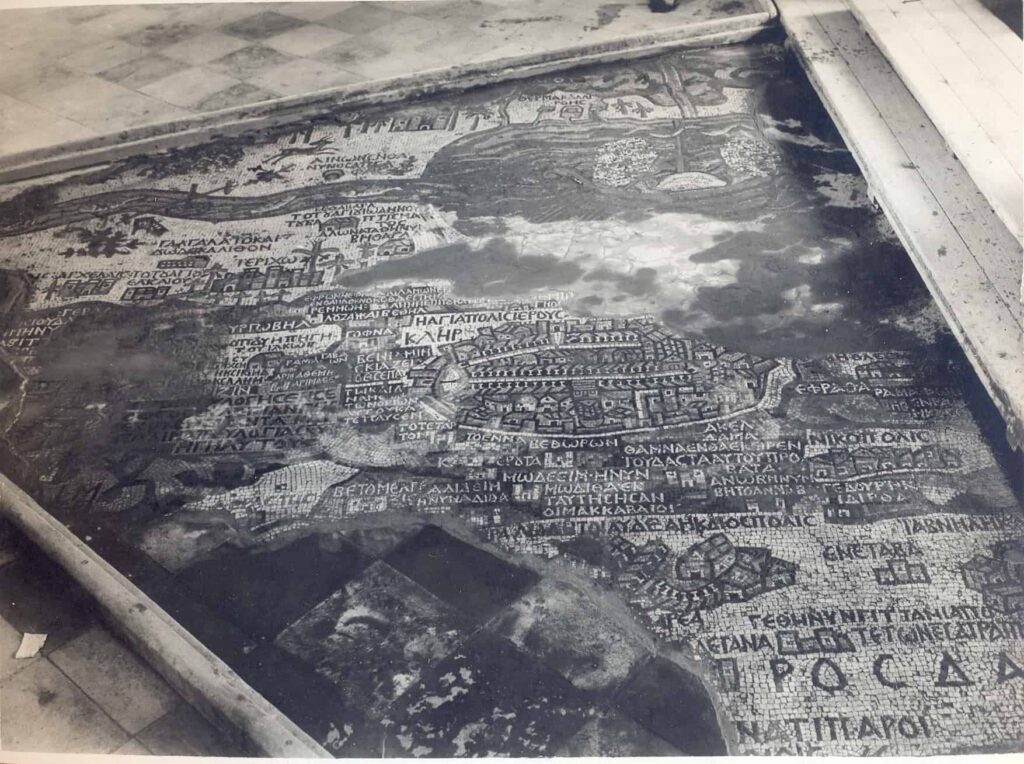
Madaba Mosaic in Wooden Frame (1917)
The Greek Orthodox Church of St. George in Madaba, completed in 1896, was built on the foundations of an early Byzantine predecessor church. The current spatial arrangement largely corresponds, except for the pillar placement, to the predecessor church, which was, however, larger. The mosaic was a rectangular picture field in front of the sanctuary. It originally measured about 24 m × 6 m and spanned the entire width of the church nave.
The Madaba Map originally depicted an area from Lebanon in the north to the Nile Delta in the south and from the Mediterranean in the west to the Arabian Desert in the east. The viewer looks eastward, from an imaginary location high above the Mediterranean, over Jerusalem and the Jordan, towards the east bank where Madaba is located. The mosaic map is not oriented to the north but to the east, aligning with the orientation of the church space.
The macro-topography, which is not easily discernible in the current fragmentary state, likely adhered to late antique table work conventions: mountain ranges depicted in brown hues, along with rivers, lakes, and coastlines (blue), structured the landscape. Numerous individual pieces of information were inserted into this basic structure. All natural geographic units are labeled in Greek script, mostly referring to the Old Testament.
Byzantine floor mosaic map at St. George Church, Madaba, Jordan. (Wikimedia Commons)
In a combination of oblique perspective and bird’s-eye view, approximately 150 cities and villages are depicted and named on the mosaic map. The topography became quite busy due to this wealth of detail. A number of large city vignettes counteract this and facilitate orientation, especially in Jerusalem, but also in Neapolis, Pelusium, Charachmoba, Ashkelon, and Gaza, which are highlighted as centers of urban life. The tradition of city vignettes originates from late-antique city boards (compare the depiction in the Notitia dignitatum). With few exceptions, churches are marked with red roofs, palaces and residential buildings have yellowish-gray roofs, and squares are recognizable by their brown color.
A contiguous fragment of approximately 15.70 m × 5.60 m is preserved; this corresponds to about 25 percent of the original map. In addition, there are two fragments in the northern side aisle:
Fragment A shows a location with a church, likely identifiable with ʿAkbara in Upper Galilee, attested to by the inscription ΑΓΒΑΡѠ[Ν] Agbarō[n].
Fragment B, measuring approximately 1.25 m × 0.5 m, was first described by Eugène Germer-Durand in 1897. At his time, a part of the Mediterranean with a ship was still visible. In 1965, the fragment was smaller, showing only mountain ranges, two unidentifiable incomplete place names, and the blessing over the tribe of Zebulun (Gen 49:13 in the Septuagint version). While historically, this tribal territory is to be sought in Lower Galilee, the Byzantine mosaicist extended it to modern-day Lebanon.
The following division of the mosaic map into ten panels is based on the approach taken by Paul Palmer.
Top row:
Panel I: Jordan
Panel II: Confluence of the Jordan into the Dead Sea
Panel III: Central Dead Sea and East Jordanian Highlands with Charachmoba (al-Karak)
Panel IV: Southern end of the Dead Sea
Panel V: (only parts of inscriptions)
Bottom row:
Panel VI: Neapolis (Nablus) and surroundings
Panel VII: Jerusalem and surroundings
Panel VIII: Judean Desert with Philippus, Zacharias, and Abraham sanctuaries; Ashkelon
Panel IX: Gaza and surroundings
Panel X: Lower Egypt
Jerusalem and Surroundings (Panel VII)
The largest and most detailed element of the topographic depiction is “the holy city of Jerusalem” (ancient Greek Η ΑΓΙΑ ΠΟΛΙϹ ΙΕΡΟΥϹΑ[ΛΗΜ] hē hagía pólis Ierousa[lḗm]) at the center of the map. The city vignette of Jerusalem lay on the axis of the church. The site of Madaba, not preserved on the fragment, lay on the extension of this axis and directly in front of the bema. Jerusalem, as the center of the world, is also the focal point of the Madaba Map. In Jerusalem, it was not the Church of the Holy Sepulchre but the base of the column at the Damascus Gate that was chosen as the central point of the map.
Walls and Gates
Jerusalem is depicted within its city walls as an oval. From a fictional location high in the west, the viewer looks “perspectivally” down on Jerusalem; he sees the western wall from the outside and the eastern wall from the inside. The late antique Byzantine city wall of Jerusalem is depicted. According to widespread dating, it was completed in the 440s under Empress Aelia Eudocia. In contrast to the present-day city wall of Jerusalem, built in 1517 under Sultan Suleiman I, the Byzantine city wall also enclosed the southwest hill (Mount Zion) and the southeast hill (with the Pool of Siloam at its foot). However, it is also held that Jerusalem remained an open city in late antiquity. In this case, the Jerusalem vignette provides a terminus ante quem for the construction of the Byzantine city wall, as this wall is depicted on the mosaic.
Within the city walls of Jerusalem, there are 19 towers and several city gates. According to ancient and medieval tradition, the northern city gate is particularly emphasized. The northern gate, today’s Damascus Gate, was called the Gate of Stephen in Byzantine times. On the city side of the gate square stood a column, probably dating from the time of Emperor Hadrian, which is now interpreted as the “symbol of the center of the world” and therefore forms the geographic reference point of the Madaba Map. Continuing clockwise from the Damascus Gate, two smaller gates can be seen in the city wall: the Lion’s Gate (in Byzantine times: Eastern Gate) and the Golden Gate. The southern part of the city wall is no longer included in the mosaic fragment. On the western side of Jerusalem, i.e., seen from the nave of the church, there is an inconspicuous gate that corresponds to the present-day Jaffa Gate and was called the Gate of David in Byzantine times.
Streets
The main streets of Byzantine Jerusalem are highlighted in white. The oval of the city is horizontally divided by the late antique Cardo Maximus (= Suq Chan ez-Zeit) with covered colonnades on both sides of the street. The stairs of the Constantinian Church of the Holy Sepulchre interrupt the colonnades on the west side.
From the column square at the Damascus Gate, the Cardo secundus (= Tariq al-Wad) branches off, running through the inner-city valley in the east of Jerusalem. It also has covered colonnades, but they are only depicted on the eastern (rear) side of the street. The street from the Cardo secundus to the Lion’s Gate is now known as the beginning of the Via Dolorosa, an inner-city pilgrimage route that did not exist in early Byzantine times.
The late antique Decumanus is depicted without colonnades. It starts from the Jaffa Gate and appears to end at the intersection with the Cardo Maximus on the Madaba Map, which does not correspond to reality and is probably due to the mosaicist’s lack of space.
Churches and Pilgrimage Sites
In the center of the city is the Church of the Holy Sepulchre, which is seen from the nave of the church upside down. This resulted from the mosaicist wanting to depict the Cardo Maximus in all its splendor, and therefore with colonnades on both sides. The main street was, so to speak, “unfolded,” and the western colonnades are upside down. The staircase leading to the propylaeum of the Church of the Holy Sepulchre interrupts the western colonnades; therefore, the church is also upside down.
The most significant church in Christendom is depicted in detail. It features the characteristic arrangement of surrounding and overarching rooms typical of Constantinian church architecture. From the Cardo, the visitor entered the basilica through the propylaeum and atrium, depicted on the map with a roof and gable, and reached the Holy Sepulchre shrine in the center of the Constantinian Anastasis rotunda, depicted on the map with a yellow (gilded) dome.
On the southern side of the Church of the Holy Sepulchre was a subsidiary building, poorly known from sources, interpreted as a baptistery. On the mosaic map, it appears as a house with a flat roof, two doors, and a window. West of it is a diamond-shaped square, perhaps the forum of the late antique city. North of the Church of the Holy Sepulchre, three residential buildings near the Cardo Maximus are tentatively identified as the palace of the Jerusalem Patriarch, the house of the clerics, and the guesthouse of the Patriarchate.
Of the numerous churches and pilgrimage sites in Jerusalem, only the major and securely identified ones are mentioned below. They are located in the southern part of the city:
The large basilica in the southeast, adjacent to the Cardo Maximus with its gable wall, is the Nea Theotokos Church, built under Emperor Justinian. It is distinguished by a yellow (gilded) double portal.
The slightly smaller church next to it on the right, with a yellow (gilded) gable, is the Pilgrimage Church, which commemorated the healing of the man born blind by Jesus. In the courtyard in front of its entrance, the Pool of Siloam is depicted as a black, white-framed square. Along the long side of this pilgrimage church, the Pool of Siloam is followed by an outdoor facility. Max Küchler characterizes the entire complex in the 6th century as a “religious-secular healing spa.”
The dominant church in the southwest of Jerusalem is the Basilica on Mount Zion. It bore the honorary title “Mother of all Churches” and, after the Church of the Holy Sepulchre, had the second-highest rank. This was because the upper room was located here, where, according to the Acts of the Apostles, the Pentecost event took place. On the Madaba Map, this large church is depicted with a yellow (gilded) double portal and gable field; to the south, it is followed (with a red roof) by the diaconicon, whose connection to the current pilgrimage sites of David’s Tomb and the Cenacle is unclear.
The Temple Mount in the southeast is depicted as disproportionately smaller, reflecting its lesser importance in the Byzantine city. A rectangle divided into three stripes at the southern end of the Cardo secundus on the Madaba Map is suggested by Herbert Donner as the great staircase that led from the south to the esplanade of the Temple Mount. Michael Avi-Yonah, on the other hand, considers this structure to be “the earliest preserved representation of the Western or Wailing Wall.”
Before the Gates of Jerusalem
Above the Jerusalem vignette, the Christian pilgrimage site of Gethsemane (ΓΗΘϹ[ΙΜΑΝΗ] Gēths[imanē]) is depicted as a small church building.
To the left of the Jerusalem vignette, the blessing over the tribe of Benjamin in Deuteronomy 33:12 is written in the Septuagint version. The Septuagint translator had not realized that “shoulders” in the Hebrew text was a poetic term for mountain slopes; the Madaba Map corrected the Septuagint to read: “Benjamin, God protects him, and he dwells between his mountains.”
As the only overland road, the road leading from the Damascus Gate to Neapolis (Nablus) is marked by white tesserae. Another road is recognizable by its milestones: Below (that is, west of) Jerusalem, the “fourth milestone” (ΤΟ ΤΕΤΑΡΤΟΝ tó tétarton) and the “ninth milestone” (ΤΟ ΕΝΝΑ tó enná) are listed, two stations (mansiones, mutationes) on the road from Jerusalem to Nikopolis and Diospolis (Lydda). Further south, also on this road, is the location of Bethoron (ΒΕΘѠΡΟΝ) with the “Ascent of Bethoron” mentioned multiple times in the Bible; this is perhaps indicated by the black tesserae beneath the place name.
East of Bethoron is “Modeïm (ΜѠΔΕΕΙΜ), now Moditha (ΜѠΔΙΘΑ), from where the Maccabees originated.” The formulation almost completely matches that of Eusebius of Caesarea’s Onomasticon. Then follows “Thamna (ΘΑΜΝΑ), where Judah sheared his sheep” (Genesis 38:12-13), and Akeldama (ΑΚΕΛΔΑΜΑ), the cemetery land purchased with the thirty pieces of silver by Judas Iscariot (Matthew 27:6-8), which, according to the Onomasticon of Eusebius, is located near Mount Zion.
Neapolis (Nablus) and Surroundings (Panel VI)
Between Jerusalem and Neapolis, there is a text field with red letters on a brown background as a montage of two blessings over the tribe of Joseph in the wording of the Septuagint:
Genesis 49:25 (Jacob’s blessing): “Joseph, God has blessed you with the blessing of the earth, with the choicest gifts of the ancient mountains.”
Deuteronomy 33:13 (Moses’ blessing): “And of Joseph he said: Blessed of the Lord is his land, with the precious things of heaven.”
Neapolis (ΝΕΑΠΟΛΙϹ) was marked by a large city vignette. It is damaged and discolored black from a fire. A segment of the city wall with several towers is preserved. From the East Gate, a colonnaded street leads to the West Gate and crosses the north-south road. To the left of the intersection of these two main axes stands a small building with an entrance flanked by columns, possibly a thermal bath, located roughly where the an-Naṣr Mosque stands today. An conspicuous semi-circular structure at the southern edge of the city was perhaps a nymphaeum. This interpretation is supported by the findings of modern excavations at ʿAin Qaryun. A large basilica may be the main church of the city, which was damaged in 484 during an attack by Samaritans.
The mountains of Gerizim and Ebal are depicted twice on the Madaba Map due to conflicting Jewish and Samaritan traditions. Eusebius followed the Jewish tradition in his Onomasticon and localized the two mountains east of Nablus, in the mountainous region northwest of Jericho. In the Madaba Map, they are entered as “Garizeim” (ΓΑΡΙΖΕΙΜ) and “Gebal” (ΓΕΒΑΛ). The mosaicist also considered the Samaritan local tradition: To the right of the city vignette of Neapolis is the “Mount Gobel” (ΤΟΥΡ ΓѠΒΗΛ tour Gōbēl) with Jacob’s Well at its foot, and the “Mount Garizin” (ΤΟΥΡ ΓΑΡΙΖΙΝ tour Garizin) a bit further west.
Jericho and the Jordan Valley (Panels I, II, VI)
A particularly well-preserved segment of the Madaba Map shows the lower Jordan Valley with the large oasis of Jericho (ΙΕΡΙΧϹ Ierichō) and several Christian pilgrimage sites. The depiction is interspersed with depictions of animals and plants. For example, on the eastern bank, there is a Nubian ibex being chased by a (made unrecognizable by iconoclasts) big cat, probably a leopard. Fish are swimming in the Jordan, one of which is swimming against the current to avoid entering the Dead Sea, where no fish can live due to the salt content.
Around Jericho, and occasionally at other locations, several date palms are depicted. On both sides of the Jordan, the mosaicist has depicted shrubs that, due to their egg-shaped leaflets, are tentatively identified as balsam (Commiphora gileadensis). Since ancient times, the production of dates and balsam has been the source of wealth in this region; balsam cultivation ended due to the decline of plantation agriculture in early Islamic times.
Jericho is not distinguished by a city vignette but is stylized as a medium-sized city with walls, five towers, and two gates; the roofs of three churches in the city center cannot be assigned to specific church buildings.
North of Jericho is a sanctuary of the Old Testament prophet Elisha (ΤΟ ΤΟΥ ΑΓΙΟΥ ΕΛΙϹΑΙΟΥ to tou hagiou Elisaiou). The Elisha Memorial Church is depicted as a dome-shaped building flanked by two towers.
In the northeast of Jericho, a biblical site is listed, which Eusebius’ Onomasticon designates as a pilgrimage site: “Gilgal (ΓΑΛΓΑΛΑ Galgala), also called Twelve Stones.” As known from the Onomasticon and pilgrimage reports, the twelve stones shown there were the ones set up by the Israelites according to the biblical account (Joshua 4:20) after crossing the Jordan; they are also included on the Madaba Map “in the form of a two-layered wall” in front of the basilica.
For easier crossing of the Jordan, a ferry service was established in the 6th century. On the Madaba Map, posts are driven into both banks and the middle of the river, connected by a rope. The small oarless boat is pulled across the Jordan by the ferryman on the rope. On the west bank, a military post on a watchtower with a ladder controls the ferry traffic.
At the confluence of the Jordan into the Dead Sea, since the beginning of pilgrimages in the 4th century, the site of the baptism of Jesus was located. Here, a baptism site on the east bank competed with one more conveniently accessible from Jerusalem and Bethlehem on the west bank. The Madaba Map shows that by the 6th century, the west bank tradition had largely prevailed. There, a church with red lettering is highlighted: “Bethabara (ΒΕΘΑΒΑΡΑ Bethabara), the (church) of the baptism of Saint John”. On the east bank, the mosaic indicates a cave or spring and the place Ainon (ΑΙΝѠΝ Ainōn) with the explanation “now there is the sycamore tree (Ο ϹΑΠϹΑΦΑϹ ho sapsaphãs).” This is an allusion to the Sapsas Monastery in the Wadi el-Ḥarrar, which preserved the memory of John the Baptist and the prophet Elijah. Monastic complexes are not depicted on the mosaic map.
Dead Sea (Panels II, III, IV)
For comparison: Correct boat depiction without damage from iconoclasts (Haditha)
On the preserved fragment of the Madaba Map, the Dead Sea vies with Jerusalem for prominence due to its size and central location. Its significance arises from the destruction of Sodom and Gomorrah, which were localized here, and its proximity to the baptism site of Jesus. Its label is found on the eastern shore between the two “foot-like” gaps; it is entirely taken from Eusebius’ Onomasticon and reads: “Salt or Asphalt Sea, also Dead Sea.”
The Lisan Peninsula is not depicted on the Madaba Map, which is usually explained as an inaccuracy of the mosaicist. However, it is also possible that the shallow southern part of the Dead Sea dried up during a pronounced dry period in the 560s and the Lisan Peninsula became the southern shore of the inland sea.
The Madaba Map attests to shipping on the Dead Sea, which was also known from antiquity. Two boats equipped with oars and sails are depicted. The two crew members of each boat have been made unrecognizable by iconoclasts. Below the mast, the cargo being transported is visible; it is interpreted as salt or grain. However, in one of the boats, the sail is wrapped around the yardarm. This is an absurd depiction, as the sail would have become non-functional. The mosaicist’s ignorance is remarkable because boat depictions were part of the common visual repertoire. How the boat representation could have appeared without damage from the iconoclasts is shown by the mosaic from Haditha, which is approximately contemporary.
Charachmoba (al-Karak) and the Eastern Jordan Land (Panel III)
The Madaba Map (photo) shows on the eastern shore of the Dead Sea the “hot springs of Callirhoe (ΘΕΡΜΑ ΚΑΛΛΙΡΟΕϹ therma Kallirhoes),” a bathing resort known to Flavius Josephus. By the 6th century, there was certainly no longer any luxury from the Hellenistic and early Roman periods. The mosaicist depicted architecturally framed springs and streams under palm trees. Since archaeological findings do not confirm this facility, it is also possible that it is not an early Byzantine bathing resort but only a reminiscence of the once-famous hot springs.
At the southern end of the Dead Sea, the medium-sized city of Zoora (ΖΟΟΡΑ), a Byzantine administrative center and bishopric, is visible. In the mountainous region behind it, the Madaba Map records a memorial church of Saint Lot (ΤΟ ΤΟΥ ΑΓΙΟΥ ΛѠΤ to tou hagiou Lōt), which is not mentioned in other sources.
At the top of the preserved map fragment is the city vignette of Charachmoba ([ΧΑΡ]ΑΧΜѠΒ[Α] [Char]achmōb[a]), “Palisade of Moab.” This is the Byzantine name for al-Karak. The Madaba Map is the only source for the Byzantine city, which was also a bishopric. The mosaicist had local knowledge. He depicted Charachmoba as a heavily fortified city with walls and towers. In the south, there is a city gate flanked by two towers, and to the east of it, there is a church recognizable by its red roof. Two colonnaded main streets running north–south are visible. One of them leads to a large church, probably the cathedral.
Below, to the west of al-Karak, the Madaba Map shows a triple-dome structure with the inscription “Cult House, or also Maioumas (ΒΕΤΟΜΑΡϹΕΑ Η Κ(ΑΙ) ΜΑΙΟΥΜΑϹ Betomarsea hē k(aì) Maioumas).” The inclusion of such a pagan establishment, which could only have a niche existence in the Byzantine Empire, on the Madaba Map is subject to controversy.
Bethlehem and the Judean Highlands (Panels VII and VIII)
Next to Jerusalem, Bethlehem (ΒΗΘΛΕΕΜ Bēthleem) was the second most important Christian pilgrimage site, conveniently accessible from Jerusalem. Reflecting its importance, the place name appears in red. However, the depiction of the Nativity Church is not particularly prominent. After the Constantinian basilica possibly burned down following the earthquake of 510, the present-day representative church was built during the reign of Justinian. Perhaps the Madaba Map depicts the state before the completion of the Justinianic construction.
South of Bethlehem lies the place Socho (ϹѠΧѠ Sōchō), followed by Bethzachar (ΒΕΘΖΑΧΑΡ) with the striking memorial church of Saint Zacharias: “A red-covered narthex or portico is attached to a basilica with three windows or gates in the front, and to this, a semicircular courtyard surrounded by a colonnaded hall,” the actual memorial building. Various biblical traditions about Zacharias have merged in the saint venerated here: the author of the Book of Zechariah, the high priest Zechariah killed by King Joash (2 Chronicles 24:20-22), and Zacharias, the father of John the Baptist.
Above the Zacharias sanctuary, the large inscription ΙΟΥΔΑ marks the region as the territory of the tribe of Judah. A little further east, one of the few New Testament memorial sites is entered on the Madaba Map. Symbols for a basilica and a well are visible with the explanation: “the (place) of Saint Philip, where, as they say, the eunuch of Candace was baptized.” As in other Byzantine sources, the high court official of Queen Candace, whom Philip baptized (Acts 8:26-40), became a eunuch named Candaces. The mosaic map is the only source for this basilica. In 1918, Andreas Evaristus Mader described the ruin of a mosque built on Byzantine foundations at ʿēn eḏ-ḏirwe, which he identified with the Philippus Church of the Madaba Map.
South of the Philippus sanctuary, the Madaba Map records an Abraham’s Church and next to it the sacred grove of Mamre; this tree is referred to in the caption as both a terebinth and an oak. In Late Antiquity, Mamre (Ramet el-Chalil) was a holy site visited by Jews, Christians, and pagans. Emperor Constantine claimed Mamre exclusively for Christian worship with his (rather modest in size) church building, which can be seen on the map. Nevertheless, the multi-religious practice there continued unabated.
The building to the right of the Mamre sacred grove already belongs to the city of Hebron, whose name as well as other structures on the mosaic map have not been preserved.
Cities on the Mediterranean Coast (Panels VIII and IX)
The lower border of the mosaic map is the Mediterranean Sea; however, it is only recognizable in small fragments. From north to south, the following coastal cities are visible on the map: the port of Ashdod, Ashkelon, and Gaza.
The fragment of the port of Ashdod (“Ashdod by the Sea, ΑΖѠΤΟϹ ΠΑΡΑΛΟ[Ϲ] Azōtos paralo[s]”) on the Madaba Map does not reveal the significant harbor facility and only allows the observation that there were several churches here.
Ashkelon
The city vignette of Ashkelon (ΑϹΚΑΛѠ[Ν] Askalō[n]), on the other hand, stands out for its richness of detail. The city was walled; the eastern gate is two stories high and flanked by towers. In front of it is a city-side square from which two colonnaded streets extend as the east-west axes of the city. Where the left of these two main streets intersects with the similarly colonnaded north-south street, there is an arched structure laid with yellowish tesserae, which is more aptly referred to as a tetrapylon than a triumphal arch. The structures in the angle between the major east-west streets are not clearly identifiable; Donner suggests that they could be fountain installations for which Byzantine Ashkelon was famous. There is a continuity in the city layout of Ashkelon from Late Antiquity to the Crusader-period city, in which the prominent eastern gate bore the name Jerusalem Gate.
Gaza
Gaza ([Γ]ΑΖΑ [G]aza) was a bishopric and a significant urban center in Byzantine times. “The mosaicist has taken into account the city’s reputation on our map and accordingly indicated the architectural splendor of the city in its vignette.” Only the southern half of the city vignette is preserved; its interpretation is complicated by the fact that the Byzantine city of Gaza has been modernized and there are hardly any archaeological investigations. Like Jerusalem, Gaza is depicted as a walled oval. The colonnaded Cardo runs east-west and corresponds approximately to the modern as-Suq al-kabīr street. At the intersection of the Cardo and Decumanus is a large open square in the city center, which is presumed to be in the area of modern Ḫān az-Zēt.
In the southwestern part of Gaza, the mosaicist depicted two large churches. The rhetorician Chorikios of Gaza wrote detailed descriptions in the 6th century of the Church of St. Sergius and the Church of St. Stephen in his hometown. However, since the city vignette is only partially preserved, the identification of the two church buildings as the Sergius and Stephen churches remains uncertain.
In the southeastern area of the city, a theater stands out. Zeev Weiss suggests construction in the Roman imperial period, while it was later incorporated into the city wall. He interprets the yellowish semicircle in the middle as the orchestra, the white and pale red semicircles surrounding it as the divided cavea, and the dark red stripes dividing the outer cavea into segments as stairs (scalariae).
Surroundings of Gaza
Northwest of Gaza is the city’s port with the partially preserved inscription “Maioumas, also Neapolis (called)” ([ΜΑΙΟΥΜΑϹ Η] ΚΑΙ ΝΕΑ[ΠΟ]ΛΙϹ [Maioumas he] kaì Neápolis). Southwest of Gaza, the mosaicist depicted a Church of Saint Victor (<Τ>Ο ΤΟΥ ΑΓΙΟΥ ΒΙΚΤΟΡΟϹ ò toũ hagíou Viktoros) with a red-roofed portico. According to the Pilgrim of Piacenza, the tomb of Saint Victor was located within Maioumas and not, as on the Madaba Map, between Maioumas and Gaza. South of Gaza, a group of villages is recorded, some of whose names are only attested by the Madaba Map. Here, the mosaicist likely had personal knowledge of the locations.
All stations of the coastal road connecting Palestine with Egypt are recorded on the Madaba Map from Gaza: Thauatha, Raphia, Betylion, “the border between Egypt and Palestine,” Rhinokorura, Ostrakine, Kasin, Pentaschoinon, Aphnaion, and Pelusium. From Betylion onwards, one station follows another along the Mediterranean coast.
Lower Egypt (Panel X)
Pelusium (ΤΟ ΠΗΛΟΥϹΙΝ Tò Pēlousin) is designated with a city vignette according to its importance as the “Gateway of Egypt.” Within the city walls, three colonnaded streets running east-west and three churches are visible. Among the other buildings, one has a yellow (= gilded) gable. The depiction of Pelusium cannot be related to the sparse archaeological findings and “remains a mystery.”
The representation of Lower Egypt differs from the rest of the Madaba Map. The places in the Nile Delta do not receive biblical references, although these could easily have been added using the source commonly used elsewhere, Eusebius’ Onomastikon. While the mosaicist otherwise made only isolated geographical and topographical errors, they are found here in abundance. One major error stands out: While the real coastline south of Gaza turns westward, on the mosaic map, it turns eastward, and therefore, the Nile does not flow from south to north but from east to west. This may have practical reasons: The elongated rectangular shape of the map should not be departed from. A theological reason is also possible: The Nile is one of the four rivers of paradise; paradise was presumed to be in the east; therefore, the Nile had to have its source in the east as well. Herbert Donner suggests that the mosaicist did not use Eusebius’ Onomastikon for the representation of the Nile Delta nor did they use a late Roman-Byzantine road map. Instead, they apparently relied on Herodotus’ description of the Delta region and combined it with a contemporary itinerary similar to the Itinerarium Antonini. Without personal knowledge of the locations, they created a map of Lower Egypt based on this, which, despite numerous errors, exceeded the accuracy of later maps until the beginning of modern cartography.
According to Donner, the Madaba mosaic is an accurate rendition of the description that Herodotus (Histories 17.2.3–6) gives of the Nile Delta’s distributaries. According to him, the Nile divides into three main branches in the Delta region: the Pelusiac, the Canopic, and in between, the Sebennytic branch. From the latter, two secondary branches diverge: the Saitic and the Mendesian branches. Additionally, Herodotus mentions two canals: the Bolbitine and the Bucolic canal. The Mendesian branch is missing on the preserved fragment of the Madaba Map. The two canals were treated by the mosaicist as branches of the Nile, and instead of Bolbitine, they wrote Bulbytine. Like the Jordan, the Nile is teeming with fish. A ship sails on the middle Nile branch. During restoration work in 1965, a crocodile laid with dark green glass tesserae was uncovered in the Nile at the upper edge of the map fragment.
Creation of the Mosaic
The city vignette of Jerusalem shows the Nea Theotokos Church, consecrated on November 20, 542. This provides a terminus post quem for the mosaic map. The absence of certain structures known from pilgrim reports of the 7th century could have various reasons, such as a lack of space. Therefore, Herbert Donner does not commit to the latest possible date. Michael Avi-Yonah suggests a creation date between the consecration of the Nea Theotokos Church and the death of Justinian in 565.
The patron of the Madaba mosaic is unknown, probably a learned monk or bishop. Peter Thomsen speculated in 1929 that the mosaicist was a certain Salamanios, who was named on a mosaic of the Apostles’ Church of Madaba along with the three donors. The fact that he was able to mention his name here shows that he was a famous artist. However, this theory did not find agreement. Martin Noth deemed it pointless to attribute further mosaics to Salamanios. There were apparently other mosaicists in Madaba and its surroundings.
Herbert Donner estimates that three workers, under the direction of the mosaicist, would have taken about half a year to create the mosaic. Over a million tesserae made of stone and glass were laid in a bed of solid lime mortar. The tesserae, available in a wide range of colors, were not cubic but rod-shaped; with a maximum surface area of two square centimeters, they were about 6 centimeters long. Smaller tesserae were used for humans, animals, plants, and intra-urban buildings. It is assumed that the lead mosaicist incised a preliminary drawing, and then structural lines were laid first, such as the Mediterranean coast, the shores of the Dead Sea, the Jordan River, the Nile with its branches, and the mountain ranges. Then the city vignettes and the longer inscriptions were laid, followed by the small towns with their inscriptions.
Sources of the Mosaicist
Among the written sources of the mosaicist, the Greek Bible takes first place. Old Testament quotations therefore follow the Septuagint. In addition, the Onomastikon of biblical place names by Eusebius of Caesarea was extensively used: of a total of 149 inscriptions on the preserved mosaic fragment, 61 inscriptions quote Eusebius more or less verbatim. Other literary sources, such as the works of Flavius Josephus or the Church Fathers, are not securely traceable. Contemporary maps and itineraries were certainly used. Finally, the mosaicist could draw on their own local knowledge to some extent. Yoram Tsafrir assumes that Byzantine pilgrimage literature was also equipped with parchment maps, which depicted the most important places in Palestine, the pilgrimage sites, and the connecting routes: “Such a map could well have been the primary source for the mosaicists and provided them with the majority of the information,” as some places were apparently only recorded because they were located on an important overland route.
Interpretations of the Mosaic
When the mosaic was completed, no pillars obstructed the viewer; it was visible from all sides. Herbert Donner assumes that there was a certain benefit for the residents of Madaba and its surroundings in that they could inform themselves in advance about pilgrimage destinations in the Holy Land that they might want to visit. However, the main purpose of the mosaic was to depict the Christian concept of salvation history in the form of a map. With Jerusalem as the center, numerous locations from the Old and New Testaments are represented. This corresponds to the liturgy, which is full of biblical references and also addresses salvation history in other ways. Worshipers could walk barefoot on the mosaic and thus move through the Holy Land.
Rainer Warland sees the Madaba mosaic map as a “testimony of a pilgrimage topography,” but one that is embedded in a broader overall concept. The centrally positioned blessing of Joseph points to the abundant fertility of the earth, a theme that can be found alongside river landscapes in other Byzantine churches (for example, in Tabgha). Because the flooding of the Nile was for antiquity the “embodiment of the life-giving principle.” Warland also ultimately sees liturgy as the frame of reference for such earthly images depicted on mosaic floors in churches.
Francesco Prontera, who treats the Madaba map in the context of ancient cartography, sees the captions to the place names, the numerous biblical quotations, and the special status of Jerusalem as indications of a “didactic objective of this chorography in the Ptolemaic sense of the word.”
It can be excluded that the Madaba map was intended to prepare long-distance pilgrims for visiting the Holy Land. Because if at all, they only came to the Transjordan at the end of their journey through Palestine. After the site of Jesus’ baptism had been moved from the east to the west bank of the Jordan, there was one less reason for them to cross the Jordan at all.
Damages and Conservation Measures
The preserved fragment of the mosaic map shows traces of damage and repair work. At an unknown time, the representations of people and animals as well as some inscriptions were made unrecognizable, but the areas were patched with the original tesserae. This may be related to the Iconoclasm during the reign of Yazid II (720–724), assuming that the church was used by the Christian community until the early Islamic period. Later, possibly in the context of the abandonment of Madaba in the mid-8th century, the church burned down, and the wooden roof collapsed. The tesserae of the mosaic map are therefore particularly discolored black in the area of Neapolis. Large gaps in the area of the Dead Sea and the loss of marginal areas may also be consequences of this church fire.
In the following centuries, the mosaic map suffered further losses. When graves, presumably children’s burials, were dug, the mosaic and its substrate were pierced. This created the “foot-like” gaps in the representation of the Dead Sea. Moles also caused damage. In an effort to secure the mosaic, the edges of the fragment were enclosed in dark cement during church construction work in the 1880s, and three larger gaps were filled with the same cement. In some cases, the cement covered several centimeters of the mosaic.
The fact that Madaba became a tourist destination led to additional damage to the mosaic map over the course of the 20th century. The floor mosaic had been covered with heavy wooden planks for protection, which rested on a wooden frame. For the tourists, these planks were then uncovered and re-laid each time. Over the years, the planks struck directly at the mosaic with their weight and destroyed many tesserae. For the sake of the tourists, the mosaic was sprinkled with water because it made the colors appear more vivid. Cooling and evaporation put the mosaic under tension, and because lateral expansion was not possible due to the enclosure with cement, the mosaic rippled, detached from the substrate, and threatened to crack.
In December 1964, the Volkswagen Foundation, at the initiative of the German Society for the Exploration of Palestine, finally provided 90,000 DM for the rescue of the mosaic. Under the direction of Heinz Cüppers, later director of the Rheinisches Landesmuseum Trier, and the Old Testament scholar Herbert Donner, urgently needed work to restore and conserve the remaining parts of the mosaic map was carried out from September 1965 to November 1965. The restorers removed the cement from the edges and gaps. It turned out that in the gap to the right above the city vignette of Jerusalem, the fine lime slurry in which the tesserae were embedded had been preserved; a negative impression of the lost tesserae could be taken with rubber.
Scientific Significance
The Madaba mosaic map is the oldest known geographical floor mosaic to date. It shows which Christian pilgrimage sites had been established in Palestine in the 6th century, thereby supplementing contemporary pilgrimage reports. Eusebius of Caesarea’s Onomasticon, which locates numerous biblical places, was known to the mosaicist; developments can be observed compared to this source from the 4th century. For example, the Madaba map shows that in the 6th century, the tradition of the site of Jesus’ baptism had shifted from the east to the west bank of the Jordan.
Time and again, the Madaba map proves useful in identifying late antique and early Byzantine buildings and roads. For example, in 1967, excavations in the Jewish Quarter of Jerusalem uncovered the remains of a monumental basilica that could be identified as the Nea-Theotokos Church with the help of the Madaba map. However, the example of Kallirhoë on the east bank of the Dead Sea shows that the representation on the Madaba map does not always harmonize with the archaeological evidence.
Göttingen Copy of the Madaba Map
A true-to-life copy of the Madaba mosaic map has been on permanent loan from the Seminar for Christian Archaeology and Byzantine Art History since 1977 in the casting collection of the Archaeological Institute of the University of Göttingen. This cast made of colored polyester resin was made by the restorers of the Rheinisches Landesmuseum Trier during the restoration work in Madaba in 1965. “The Göttingen cast is the only copy of the mosaic worldwide. … Due to the vertical installation, the mosaic in Göttingen can be viewed more comfortably than in Madaba itself, where it still adorns the floor of the church.”
References
Donner, 1992, p.11
Donner, Herbert (1992). The Mosaic Map of Madaba: An Introductory Guide. Kampen: Pharos. p. 12. ISBN 9789039000113. Retrieved 21 February 2022.
Ute Friederich: Antike Kartographie
Kallai-Kleinmann, Z. (1958). “The Town Lists of Judah, Simeon, Benjamin and Dan”. Vetus Testamentum. Leiden: Brill. 8 (2): 155. doi:10.2307/1516086. JSTOR 1516086.
Dalman, Gustaf (2013). Work and Customs in Palestine. Vol. I/1. Translated by Nadia Abdulhadi Sukhtian. Ramallah: Dar Al Nasher. p. 65 (note 4). ISBN 9789950385-00-9. OCLC 1040774903.
“Dig uncovers ancient Jerusalem street depicted on Byzantine map”.
In Greek mythology, Iasion (in Ancient Greek Ἰασίων / Iasíôn, meaning “the sower” or “the bindweed”) or Iasos (in Ancient Greek Ἴασος / Íasos) is a character associated with the agricultural cults of Demeter. When he died, Iasion was placed in the stars, forming with Triptolemus the constellation Gemini, although the most widespread version says that it was formed by the brothers Castor and Pollux.
Iasion is the son of Zeus and the Pleiad Electra, and the brother of Dardanus (ancestor of the royal lineage of Troy) linked to the cult of the mysteries of Samothrace, where he is honored under the name “Eetion.” He is sometimes associated (along with Triptolemus, another hero involved in agricultural myths) with the constellation Gemini.
Iasion is best known for being the lover of the goddess Demeter. In the version recounted by Homer and Hesiod, they unite in Crete in a field plowed three times. From this union is born Ploutos, a deity personifying wealth. In Homer’s account, however, Iasion is struck down by Zeus, who seeks to punish the hubris that led him to unite with a goddess. While Hesiod does not mention this, the striking down is also reported by Pseudo-Apollodorus with a slightly different motif, as in his version Iasion attempts to violate Demeter.
Hyginus relates a Cretan legend where Jason and Demeter have a son named Philomelos, with Ploutos being said in this version to be the son of Demeter and Thuscus.
Furthermore, a more complete late tradition reported by Diodorus Siculus diverges quite notably from the archaic tradition. In Diodorus Siculus, Iasion and Dardanus have a sister named Harmonia. Zeus, wishing to honor his son, teaches him the sacred mysteries, which Iasion extends and is the first to admit strangers to. He then marries Cybele, with whom he has a son, Corybas. The union with Demeter is only reported by Diodorus as allegorical:
“The true meaning is that the wheat [of Demeter], given to Iasion at the wedding of Harmonia, is the source of the riches represented by [Ploutos].”
Samothracian Mysteries
In Hesiod’s writings, his name is written as Eetion, but elsewhere he is referred to as Iasion. Myths about him connect him with Samothrace or Crete. Beloved by Demeter, she shared her bed with him in a field plowed three times on Crete, and for this, Zeus struck him with lightning. The triple plowing of the field is mentioned in the Eleusinian Hymn. Demeter, grieving for the death of Iasion, refused to give a harvest. Then the gods allowed Iasion to leave Hades annually and return to Demeter on Earth, symbolizing the changing of the seasons.
He established the Samothracian mysteries. According to other sources, Zeus entrusted him with the mystery rites. Demeter loved him and gave him a harvest of wheat. Then Iasion married Cybele and became the father of Corybantes. Alternatively, he fell in love with Demeter and wanted to dishonor her but was killed by lightning on an island. According to Hyginus, he was destroyed by his team. Or he was killed by his brother Dardanus.
According to one myth, Iasion and his brother were born in Crete and then migrated to the island of Samothrace. There Zeus initiated them into the mysteries of Demeter. Zeus commanded them to spread the Samothracian mysteries throughout the land, so the brothers traveled extensively.
Another version of the myth: Iasion was the brother of Harmonia, the wife of Cadmus. At their wedding, he met Demeter. According to Virgil, Iasius is an ancestor of the Trojans, born in Italy, like Dardanus.
According to Petelidou from Crete, Iasion and Demeter had two children, Philomel and Plutus. Plutus (the god of wealth and abundance) personifies the fertility of the earth. From Demeter, Iasion received as a gift wheat grains and taught people agriculture. Iasion is the protagonist of the play “Iasion” by Antiphanes. In modern science, he is considered an ancient Cretan deity of agriculture.
Interpretation
The story of Iasion is an allegory of fertility. Iasion and Demeter represent the male and female principles, as well as the human and divine/natural aspects. As for their son Ploutos, he illustrates the epithet of ploutodeiria (“she who gives wealth”) often attributed to Demeter. As for Zeus’s divine punishment, it is to be understood in the same sense as that inflicted on Prometheus. Iasion, symbolizing the sower, the farmer, steals and violates divine power. He “alters” the natural order of things and cycles. Through his mastery of natural productions, he frees himself from divine/natural vicissitudes. Like Prometheus, Iasion must be punished for this theft. This must be linked to the fairly widespread idea in various cultures, sometimes very distant from each other, that agriculture is a violence, a wound inflicted on Mother Earth. It must be “forced” by plowing to obtain the harvest and “wealth.”
References
Diodorus Siculus. Historical Library V 48, 4; 49, 2
Pseudo-Apollodorus. Mythological Library III 12, 1; Dionysius of Halicarnassus. Roman Antiquities I 61, 4; Strabo. Geography VII, fragment 49
In the mythology and daily religious life of ancient Greece, wealth was originally inseparable from the fertility of the soil and the abundance of the grain harvest. The divine personification of this material prosperity was Plutus, known in Greek as Ploutos, whose name gave modern languages words such as plutocracy. Born in a thrice plowed field and linked intimately to the mysteries of the earth, Plutus evolved over centuries from an agricultural spirit of overflowing granaries into a satirical figure of gold, silver, and the blind distribution of human riches.
Birth in the Thrice-Plowed Field and the Eleusinian Mysteries
According to Hesiod’s Theogony, Plutus was the son of Demeter, the Olympian goddess of grain and agriculture, and the mortal Cretan hero Iasion. During the wedding celebration of Cadmus and Harmonia, Demeter fell in love with Iasion and lay with him in a fertile field that had been plowed three times on the island of Crete. From their union was born Plutus, a benevolent deity who traveled across land and the broad back of the sea, bestowing rich agricultural fortune and overflowing barns upon whomever met him and took him into their hands.
Because his mother was Demeter, Plutus became a central figure in the Eleusinian Mysteries, the most sacred religious initiation rites of the ancient Greek world held annually at Eleusis near Athens. When Persephone was abducted into the Underworld by Hades—who was himself frequently called Plouton, the Rich One, because both mineral ores and seeds lay beneath the soil—the return of Persephone each spring brought the birth of Plutus, symbolizing that agricultural wealth emerges directly from the union of the subterranean underworld and the sunlit earth.
Artistic Depictions with Eirene and Tyche
In Classical Greek art and civic sculpture, Plutus was rarely depicted as a bearded monarch; instead, artists portrayed him as a radiant infant or a young boy holding a cornucopia—the horn of plenty overflowing with pomegranates, figs, wheat cakes, and grapes. His most famous visual representation in antiquity was a bronze statue group sculpted around 370 BC by Cephisodotus the Elder, the father or uncle of Praxiteles, which stood in the Athenian Agora and survives today through Roman marble copies.
Created to celebrate the peace treaty following Athens’ naval victory over Sparta, the sculpture depicted Eirene, the serene goddess of peace, holding the infant Plutus affectionately in her left arm while the child reached up to touch her chin. The political allegory was unmistakable to every citizen walking through the marketplace: true economic prosperity and material wealth can only grow and be nurtured under the protection of civic peace. In later Hellenistic sanctuaries, similar statues showed the infant Plutus cradled in the arms of Tyche, the goddess of fortune, or Athena Ergane, patroness of craftsmen.
Why Plutus Is Blind in Aristophanes’ Comedy
As Athens transitioned from a purely agrarian economy to a maritime commercial empire powered by the silver mines of Laurion and silver owl coinage, philosophers and playwrights began questioning why honest, hard-working citizens often lived in poverty while corrupt politicians, informers, and swindlers grew fabulously rich. In 388 BC, the master comic playwright Aristophanes answered this question in his final surviving comedy, titled Wealth (Ploutos).
In the play, an honest but poor elderly Athenian farmer named Chremylus consults the Oracle of Delphi and is instructed to follow the first man he sees upon leaving the temple. That man turns out to be a ragged, filthy, blind beggar who reveals himself as the god Plutus. When Chremylus asks how the god of wealth came to be blind, Plutus explains that in his youth he had threatened to visit only the homes of righteous, wise, and virtuous people. Hearing this, Zeus grew jealous of good mortals and struck Plutus blind so that he could no longer distinguish the wicked from the noble, forcing him to wander randomly into whatever household happened to cross his path.
The Healing of Plutus and Philosophical Allegory
The plot of Aristophanes’ comedy follows Chremylus as he brings the blind Plutus to the sanctuary of Asclepius, the god of medicine, where sacred temple serpents lick the god’s eyelids and restore his eyesight. Immediately, the social order of Athens is turned upside down: honest farmers become wealthy overnight, corrupt sycophants lose their ill-gotten fortunes, and even Hermes complains that no one is offering sacrifices to the Olympian gods anymore because good people now automatically receive the wealth they deserve. Midway through the play, Chremylus must also debate Penia, the fierce goddess of poverty, who argues persuasively that if everyone were rich, no one would ever farm the land, forge iron tools, build ships, or practice science, because necessity is the true mother of human industry.
In later Greek and Roman literature, writers such as Lucian of Samosata expanded upon the physical allegory of Plutus. Not only was the god of wealth blind, Lucian observed, but he was also lame and slow-footed when approaching a mortal’s house, yet possessed swift wings when departing—explaining why fortunes take decades of grueling labor to accumulate through honest work, yet can vanish in a single afternoon of extravagance.
Nicolas Flamel (circa 1330 or 1340, possibly in Pontoise – in Paris) was a Parisian bourgeois of the 14th century, a public writer, copyist, and sworn book merchant. His successful career, marriage to Pernelle, a wealthy widow, and real estate speculations ensured him a comfortable fortune, which he dedicated, towards the end of his life, to pious foundations and constructions. This fortune, amplified by rumors, is the origin of the myth that made him an alchemist who succeeded in the quest for the philosopher’s stone, capable of transmuting metals into gold.
Because of this reputation, several alchemical treatises were attributed to him, from the late 15th century to the 17th century, the most famous being “The Book of Hieroglyphic Figures” published in 1612. Thus, “the most popular of French alchemists never practiced alchemy.”
Biography
For a character of the time not belonging to the nobility, there is relatively extensive documentation on Nicolas Flamel: the records of the parish of Saint-Jacques-la-Boucherie, compiled in the 18th century, various personal documents of him and his wife including his will, as well as descriptions and illustrations, posthumous to his death, of the buildings and religious monuments he had built.
Flamel, Public Writer, and Sworn Book Merchant
The two faces of Nicolas Flamel: as a pious donor as he had been depicted in 1402 on the portal of Sainte-Geneviève-des-Ardents (engraving of the Critical History of Nicolas Flamel and Pernelle his wife by Abbé Villain in 1761), and as an alchemist in the romantic portrait in the Historical Gallery of Popular Celebrities (1840)
Nicolas Flamel was born around 1340 (rather than around 1330 as often indicated), perhaps in “Pontoise, seven leagues from Paris.” He escaped the Black Death of 1348 in his youth, which claimed between a third and half of the European population. His life unfolded in Paris during the Hundred Years’ War, from the Battle of Crécy in 1346 to that of Agincourt in 1415. In 1389, he had to attend, with all the Parisian bourgeois dressed in red and green, the entry into Paris of Queen Isabeau of Bavaria, and he lived just before his death in 1418, the Parisian disturbances of the civil war between Armagnacs and Burgundians and the revolt of the Cabochiens (1413). From the 13th century, the foundation of universities but also the development of secular literature and reading in the nobility and the upper bourgeoisie led to the establishment of lay workshops for copying and illuminating, which until then had been the prerogative of monasteries. They were established in major cities, especially in Paris.
He began a career as a copyist and public writer in Paris, in a small shop next to the church of Saint-Jacques-la-Boucherie, on the Rue des Écrivains. He may have been the elder brother or a relative of Jean Flamel, secretary and librarian to the great bibliophile Jean I de Berry (the one from the “Très Riches Heures du Duc de Berry”). He later bought a house opposite the shop, at the corner of Rue des Écrivains and Rue de Marivaux (renamed Rue Nicolas-Flamel in 1851), where he lived and set up his workshop, under the sign of La Fleur de Lys. This house, decorated with engravings and religious inscriptions, and with the motto “Let everyone be content with what they have, He who lacks sufficiency has nothing,” attests to the wealth Flamel acquired, although, compared to other much more luxurious bourgeois residences of the time, it does not seem to have been exceptional. Rue de Rivoli, much wider, now covers Rue des Écrivains, the location of Flamel’s house, and most of the church, of which only the Saint-Jacques Tower remains (built at the beginning of the 16th century, a century after Flamel’s death).
Probably after 1368, he became a sworn book merchant (sworn because he had to swear an oath to the University of Paris), a member of the privileged category of “booksellers, parchment makers, illuminators, writers, and bookbinders, all people belonging to various sciences and known in the Middle Ages under the generic term of clerics. They depended on the University and not on the jurisdiction of the provost of Paris, like other merchants.” They were notably exempt in principle from taxes (direct taxes). Flamel also tried in 1415 to invoke this privilege to avoid paying a tax.
Nicolas Flamel’s Paris, from his house at the corner of rue de Marivaux and rue des Écrivains to the cemetery of the Innocents – Plan by Truschet and Hoyau (1552) known as the “Plan of Basel”.
Nicolas and Pernelle
Around 1370, he married a woman twice widowed, Pernelle, and in 1372, they made a mutual bequest of their property before a notary, a donation that was renewed several times and excluded from Pernelle’s inheritance her sister and her children. Childless themselves, the Flamel couple began to finance pious works and constructions.
In order to empty the pits of the Cemetery of the Innocents, the bourgeois of Paris had charnel houses built all around it, in the 14th and 15th centuries, where the exhumed bones were piled up and left to dry, high up, above arcades. In 1389, Nicolas Flamel had one of these arcades built and decorated, on the Rue de la Lingerie side, where there were also public writer’s shops. Carved on it, around a black figure representing death, were Nicolas Flamel’s initials in Gothic letters, a poem, and religious inscriptions, “writings to stir people to devotion” according to Guillebert de Mets in his Description de Paris (1434). The same year, he financed the renovation of the portal of Saint-Jacques-la-Boucherie, where he was depicted in prayer with his wife, at the foot of the Virgin Mary, Saint James, and Saint John.
Pernelle died in 1397. Just before her death, her family tried to annul the mutual bequest between the spouses. This led to a lawsuit between the heirs of Pernelle’s sister and Nicolas Flamel, which he eventually won. After his wife’s death, he continued to finance pious constructions and engaged in real estate investments in Paris and the surrounding areas.
In 1402, he rebuilt the portal of the church of Sainte-Geneviève-la-Petite, which was located on the Île de la Cité, along Rue Neuve-Notre-Dame, on the site of the current “parvis Notre-Dame – place Jean-Paul-II”. It was called Sainte-Geneviève-des-Ardents from the beginning of the 16th century and destroyed in 1747. His statue, dressed in a long hooded robe, and with a writing tablet, symbol of his profession, was placed in a niche next to the portal. In 1411, he financed a new chapel of the hospital of Saint-Gervais (which was opposite the church of Saint-Gervais), and seems to have contributed to the renovations of the churches of Saint-Côme and Saint-Martin-des-Champs. In 1407, he had a tomb built for Pernelle in the Cemetery of the Innocents, on which he had an epitaph engraved in verse.
That same year, he had several houses built to accommodate the poor, on which were seen “many figures engraved in the stones with an N and a Gothic F on each side.” The best-known, and the only one still existing today, is the house of Nicolas Flamel, also called “with the large gable,” on Rue de Montmorency (now at No. 51). In addition to Flamel’s initials and various figures including musical angels, it bears the inscription: “We men and women laborers residing in the porch of this house which was built in the year of grace one thousand four hundred and seven are each bound to say every day a Pater Noster and an Ave Maria praying to God that his grace may grant pardon to the poor sinners deceased Amen.” Today baptized “Nicolas Flamel’s house,” although nothing indicates that he ever lived there, it is reputed to be one of the oldest dwellings in Paris.
Flamel also owned a number of houses in Paris and the surrounding villages, some of which brought in rents, but others were abandoned and in ruins. With the success of his activity as a copyist and bookseller, and the contribution of his wife Pernelle, twice widowed before marrying him, these real estate investments, made in the context of the economic depression of the Hundred Years’ War, probably contributed to his fortune.
Gravestone and Will
He died on [date], and was buried in the church of Saint-Jacques-la-Boucherie where his gravestone was installed on a pillar below an image of the Virgin. The church was destroyed at the end of the revolutionary period, around 1797. The gravestone, however, was preserved and bought by an antique dealer from a fruit and vegetable seller on Rue Saint-Jacques-la-Boucherie, who used it as a stall for her spinach. Bought back in 1839 by the Paris City Hall, it is currently located in the Cluny Museum: “The late Nicolas Flamel, formerly a writer, left by his will to the work of this church certain rents and houses, which he had acquired and bought during his lifetime, to perform certain divine services and distribute money each year through alms touching the Quinze Vingt, the Hôtel Dieu, and other churches and hospitals in Paris. Pray here for the deceased.” His remains, as well as those of his wife Pernelle buried with him, are then transferred to the catacombs of Paris.
The number and ostentatious nature of his pious foundations, in fact relatively modest, and the accumulation in his will (now kept at the National Library) of bequests of small amounts probably contributed to amplifying the importance of his fortune in the memory of the time. Shortly after his death, Guillebert de Mets in his Description de la ville de Paris (1434) speaks of Flamel as the “scribe who made so many alms and hospitalities and built several houses where craftsmen lived below and from the rent they paid, poor laborers were supported above.” And as early as 1463, during a lawsuit concerning his succession, a witness already said that “[Flamel] was reputed to be half richer than he was.” It was in this context that the rumor arose that he owed his wealth to the discovery of the alchemists’ philosopher’s stone, capable of transforming metals into gold.
The Legend of the Alchemist
How One Becomes an Alchemist
The myth of Nicolas Flamel the alchemist is the result of several phenomena of alchemical tradition. First of all, from the 15th century, the belief in the alchemical origin of certain bourgeois fortunes of the Middle Ages: besides Flamel (the most famous), this was the case of Jacques Cœur (c. 1400-1456), Nicolas le Valois (c. 1495-c.1542) (the richest man in Caen and founder of the Hôtel d’Escoville), or the German merchant Sigmund Wann (c. 1395-1469). Then there was the pseudepigraphy, by which alchemical treatises were attributed to ancient (Aristotle, Hermes Trismegistus, etc.) or medieval (Albert the Great, Thomas Aquinas, Raymond Lulle, Arnaud de Villeneuve…) authorities, to compensate for “the marginality of a discipline that was never really integrated into university knowledge.” Finally, with the Renaissance, “the use of allegorical language and pictorial symbolism became systematic” in alchemical texts; this led, from the mid-16th century onwards, to an “alchemical exegesis” that sought a hidden meaning in both biblical texts and the stories of Greco-Roman mythology (especially the legend of the Golden Fleece), and finally in the symbolic decorations of medieval architecture.
The oldest trace of this legend is a text from the late 15th century, Le Livre Flamel, which is actually the French translation of a 14th-century Latin treatise, the Flos florum (The Flower of Flowers), then attributed to Arnaud de Villeneuve. This text gained some circulation, and a shortened version of it was translated into English in the mid-16th century. Other treatises were attributed to Flamel during the 16th century. This is notably the case of the Livre des laveures, which is actually the French translation of the Rosarius, a Latin treatise from the 14th century by the English alchemist John Dastin: on a 15th-century manuscript, the name of the owner was scratched out and replaced by that of Flamel.
At the same time, the idea arose that an alchemical meaning was hidden in the religious allegorical figures adorning the arcades of the cemetery of the innocents. The first trace is found in the book De antiquitate et veritate artis chemicæ (On the antiquity and truth of the chemical art) (1561) by the alchemist Robert Duval (a treatise that will be placed at the beginning of the first volume of the great alchemical anthology Theatrum Chemicum in 1602): “To this category of fictions belongs the enigma of Nicolas Flamel, who shows two serpents or dragons, one winged, the other not, and a winged lion, etc.” This idea is also found in prose commentaries from the second half of the 16th century on the poem Le Grand Olympe (which makes an alchemical interpretation of Ovid’s Metamorphoses). Still in 1561, Robert Duval, in his collection of alchemical poems De la Transformation métallique: Trois anciens traités en rithme françois, attributed to Flamel the Sommaire philosophique, probably because it also presented the motif of the two dragons (the dragon being one of the main alchemical symbols). The poem, which addresses “Who wants to have knowledge / Of metals & true science / How to transform / And from one to the other change,” takes up the classical alchemical theory that all metals are composed of two “seeds”: sulfur, fixed and masculine, and mercury (quicksilver), volatile and feminine.
The legend was taken up several times from 1567 to 1575 by the influential Paracelsian physician Jacques Gohory. At that time, one of the most hackneyed topoi of alchemical literature since the Emerald Tablet appeared, and it suited the bookseller Flamel well: the discovery of an ancient book containing the secret of the philosopher’s stone. It was first introduced by Noël du Fail in 1578, who, in support of Paracelsus’ miraculous healings, cited the most famous alchemists including “Nicolas Flamel, Parisian, who from a poor writer he was, & having found in an old book a metallic recipe that he tried, became one of the richest men of his time, as evidenced by the splendid buildings he built in the cemetery S. Innocents, at Saincte Genevieve des ardens, at S. Jaques la Boucherie, where he is in half relief, with his writing desk on the side, & the hood on the shoulder estimated rich he and his Perronelle (it was his wife) of fifteen hundred thousand ecus, in addition to the immense alms & endowments he made.” The idea gained ground, as it is found in 1592 in a note at the end of a manuscript of an alchemical text La Lettre d’Almasatus.
The legend became so popular that it was mocked in 1585 by Noël du Fail (who had apparently changed his position) in his Tales and Discourses of Eutrapel (1585), while Flamel appeared as an alchemist and author of the Philosophical Summary in the notices of the French Libraries by La Croix du Maine (1584) and Antoine du Verdier (1585). La Croix du Maine also reports rumors that were circulating at the time, according to which Flamel’s wealth did not come from his alchemical talents, but from the fact that he would have appropriated the claims of the Jews, then expelled from Paris (Charles VI had signed an expulsion edict in 1394). It was to conceal this fact that he would have made people believe that he had discovered the philosopher’s stone and would have financed pious foundations.
It crossed borders in 1583, when the Belgian Paracelsian Gérard Dorn translated into Latin passages from the Philosophical Summary, and it is found in Germany in 1605 and in England in 1610. All the ingredients were there for the appearance in 1612 of the most famous work attributed to Flamel: The Book of Hieroglyphic Figures.
The Book of Hieroglyphic Figures
In 1612, in Paris, Three Treatises of Natural Philosophy Not Yet Printed are published, by Pierre Arnauld, lord of La Chevallerie, a native of Poitou. In addition to two treatises in Latin and French versions by Artephius and Synesius, there is a text in French: “The hieroglyphic figures of Nicolas Flamel, as he placed them in the fourth arch he built at the Cemetery of the Innocents in Paris, entering through the main gate of Rue S. Denys, and taking the right hand; with their explanation by Flamel himself.”
The work presents itself as the translation from Latin of a text by Flamel written between 1399 and 1413. Following the trope of alchemical literature about the discovery of an ancient book, Flamel recounts that he acquired for two florins a mysterious and ancient book in Latin, made of “three times seven sheets” of bark bound in a copper cover “all engraved with letters and figures.” On the first sheet, one finds the title “The book of Abraham the Jew, prince, Levite priest, astrologer and philosopher, to the people of the Jews by the wrath of God, scattered in Gaul, greetings. D. I.”. This book, written by a “very learned man,” explains that, “to help his captive nation pay tributes to the Roman emperors, and to do other things, which I will not say, he taught them the metallic transmutation in common words […] except for the first agent of which he said nothing, but […] he painted it, and depicted it with very great artifice.” The text of the book of Abraham the Jew thus explains the process of the Great Work (which Flamel does not repeat) without specifying the initial ingredient, the prima materia (the alchemists’ raw material), which is only given through mysterious illuminations, which are described but not reproduced in the Book of Hieroglyphic Figures.
Despite the help of his wife Pernelle, Nicolas Flamel fails at the Great Work for twenty-one years (the same number of years as the book’s sheets) for not understanding the illuminations. He then goes on a pilgrimage to Saint-Jacques-de-Compostelle, where he meets an old converted Jewish doctor, who finally explains the illustrations to him.
Back in Paris, he finally succeeds in transmuting mercury into silver, then into gold, on [date]: “I projected it with red stone onto a similar quantity of mercury […] which I truly transmuted into almost as much pure gold, certainly better than common gold, softer and more pliable.”
With the fortune thus acquired, Flamel and his wife “founded and endowed fourteen hospitals in this city of Paris, built completely anew three chapels, decorated seven churches with great gifts and good incomes, with several repairs in their cemeteries, besides what we had done in Boulogne, which is hardly less than what we have done here” (much more than the donations and works of the historical Flamel). And Flamel had “hieroglyphic figures” painted on an arcade of the cemetery of the innocents, which have both a theological interpretation and a “philosophical interpretation according to the magisterium of Hermes.” He first briefly gives the theological explanation; thus “the two dragons united […] are the sins which are naturally intertwined [chained to each other]; for one at its birth from the other: some of them can be easily chased away, as they come easily, for they fly at all times towards us. And those who have no wings cannot be chased away, such as the sin against the Holy Spirit.” He then gives, in a significantly more extensive manner, the explanation of the alchemical sense, an explanation in which the symbolism of colors takes a prominent place: “these are the two principles of philosophy that the wise men dared not show to their own children. The one which is below without wings, it is the fixed, or the male; the one which is above, it is the volatile, or the black and obscure female […] The first is called sulfur, or warmth and dryness, and the latter quicksilver, or coldness and humidity. These are the sun and the moon of mercurial source…”
Dating and Attribution
No medieval original of either the Book of Hieroglyphic Figures or the Book of Abraham the Jew has been found. Two Latin manuscripts of the Book of Figures have recently come to light, but they turn out to be “Latin translations” of the French text from 1612 made in the early 17th century.
In fact, everything indicates that this is a text written between the end of the 16th century and the beginning of the 17th century: the vocabulary (starting with the word Hieroglyph), the anachronisms (the text mentions the name of the alchemist Lambsprinck, mentioned for the first time by Nicolas Barnaud in 1599). The true source is a famous collection of medieval alchemical treatises, the Artis auriferae, published in 1572 (In The Hieroglyphic Figures, alchemical theories are often presented in the same order, but sometimes in reverse).
According to Claude Gagnon, P. Arnaud de la Chevallerie would be the pseudonym of Béroalde de Verville (1556-1626) (in the form of the imperfect anagram “Arnauld de Cabalerie”), a writer interested in alchemy and cabala, and best known today for his satire Le Moyen de Parvenir (1617). In support of this thesis, Gagnon found in a note by a 17th-century bibliographer on a copy of La Croix du Maine’s Bibliothèque françoise, the title of a work by Béroalde: Les aventures d’Ali el Moselan surnommé dans ses conquêtes Slomnal Calife, Paris 1582, translated from Arabic by Rabi el Ulloe de Deon. “Slomnal Calife” being the anagram of “Nicolas Flamel,” and “Rabi el Ulloe de Deon” that of “Béroalde de Verville.” Another element is that Béroalde de Verville published, in the same year and with the same publisher as The Hieroglyphic Figures, the Palais des curieux in which he warns his alchemist readers against “those who deceive you, and who under the beautiful tales of Flammel & others spy on your souls, to ruin them.”
However, this attribution did not convince some specialists of Béroalde de Verville. On the other hand, Bruno Roy takes up Gagnon’s hypothesis about the author of the Hieroglyphic Figures: “In the end, Béroalde’s Flamel is much more attractive to us than the real bourgeois bigot, megalomaniac, and litigious who lived in the 14th century.” Another possibility is the discovery by François Secret in early 17th-century alchemical manuscripts of the name of a “Sieur de la Chevalerie de Chartres” (therefore from Beauce rather than Poitou), but about whom nothing more is known.
Fortune of the Myth
This text was immediately successful and widely popularized the myth of Flamel, who became the quintessential French alchemist. In addition to the fact that his supposed fabulous fortune, traces of which are still visible in Paris, testified to his success in the search for the philosopher’s stone, this success may be partly due to the fact that during the Counter-Reformation, Flamel offered an alchemist figure revering the Virgin and the Saints, while the discipline was dominated by the reformed alchemists of the “Paracelsian revival,” within which other alchemical literary mystifications were born, promising success as well: Solomon Trismosin (appeared in 1598), the alleged master of Paracelsus (1493/4-1541), Basil Valentine (1600), who would have been a Benedictine monk of the 15th century, as well as the Rosicrucian manifestos (1614-1615) and The Chymical Wedding of Christian Rosenkreutz (1616).
The Book of Hieroglyphic Figures had many reprints and translations. As already indicated, pseudo-Latin originals were forged. The figures from the Book of Abraham the Jew, which are merely described in the 1612 edition, were quickly represented in manuscripts and in subsequent editions. This tradition continued until the 18th century, when in German in Erfurt in an Uraltes chymisches Werck (1735): “A very ancient alchemical work by Rabbi Abraham Eleazar, which the author wrote partly in Latin and Arabic, partly in Chaldean and Syriac, and which was then translated into our German language by an anonymous author,” and which contains a new version of the figures from the Book of Abraham.
“A cross where a serpent was crucified.”
“Deserts, amidst which flowed several beautiful fountains, from which emerged several serpents, running here and there.”
“A young man with wings on his heels, holding a caduceus in his hand, entwined with two serpents, with which he struck a helmet covering his head, […], against him came running and flying with open wings, an old man, who on his head had a clock attached, and in his hands a scythe like death, from which, terrible and furious, he wanted to cut off Mercury’s feet.”
“A beautiful flower at the top of a very high mountain, which the north wind shook very roughly, it had a blue stem, white and red flowers, leaves shining like fine gold, around which northern dragons and griffins made their nest and dwelling.”
“A beautiful rose bush blooming in the middle of a beautiful garden, climbing against a hollow oak, at the feet of which bubbled a fountain of very white water, which was going to precipitate into the abysses, nevertheless passing, first, between the hands of endless peoples who dug in the earth, seeking it: but because they were blind, no one knew it, except someone, considering the weight.”
“A king with a large knife, who had soldiers kill in his presence a great multitude of small children, whose mothers wept at the feet of the pitiless soldiers, the blood of whom little children was then collected by other soldiers, and put into a large vessel, in which the sun and the moon came to bathe.”
Other texts were attributed to Flamel. In 1619 appeared, along with the Treatise on Sulphur by the Pole Michael Sendivogius, a Treasury of Philosophy or Original of the Desired Desire of Nicolas Flamel, which is nothing other than a French version of the Thesaurus philosophiae by Efferarius Monachius (14th century). The attribution is probably related to the Book of Washings which begins with “The desired desire, and the price that no one can appraise.” The same goes for The Great Enlightenment of the Philosopher’s Stone for the transmutation of all metals (1628), a French translation of the Italian treatise Apertorio alfabetale (1466 or 1476) by Cristoforo Parigino (Christophe de Paris).
In 1655, Pierre Borel, Louis XIV’s personal physician and the first bibliographer of alchemy, reported in his Treasure of Gaulish and French research and antiquities a number of rumors and rumors that were circulating at the time about Flamel: King Charles VI would have sent, to inquire about his wealth, his master of requests Mr. de Cramoisy, whose silence Flamel would have bought with a matras (vessel) full of projection powder (one of the forms of the philosopher’s stone); Flamel’s house would have been searched for the Book of Abraham the Jew, which would have been eventually found by Cardinal Richelieu shortly before his death in 1642. It was also said that Richelieu had executed an alchemist named Dubois who claimed to be the heir to Flamel’s secret.
At the same time, the historian of Paris Henri Sauval (1623-1676) was more doubtful: “The hermetics who seek everywhere the Philosopher’s Stone without being able to find it, have meditated so much on some portals of our Churches, that in the end they found what they pretend. […] They distill the spirit to quintessentialize Gothic worms & figures, some of them in the round, others scratched, as they say, on the stones of the house on the corner of Rue Marivaux, as well as of the two Hospitals which he [Flamel] had made on Rue de Montmorenci.”
Flamel in the Age of Enlightenment
Alchemy did not disappear with the 18th century and the Enlightenment. But while it retained a certain scientific credibility (Newton, during his alchemical studies, was interested in the “hieroglyphs” of the Book of Figures and the Book of Abraham the Jew), because it did not seem possible to demonstrate the theoretical impossibility of transmutation, the failure of its practical realization gradually accentuated its moral and social discredit throughout the century. It was increasingly perceived as a ruinous chimera, as with Fontenelle (History of the Academy of Sciences 1722) and with Montesquieu in one of his Persian Letters (1721): Rica recounts that he met a man ruining himself because he believes he has achieved the great work, and who affirms to him: “This secret, which Nicolas Flamel found, but which Raymond Lulle and a million others always sought, has come to me, and I find myself today a happy adept.”
Along with the transmutation of metals, the prolongation of life was the other goal of alchemy, in the form of the elixir of long life (sometimes also called drinkable gold). At the time of the Count of Saint-Germain, who pretended to be immortal, the belief arose that Nicolas Flamel and his wife Pernelle were still alive. In 1712, Paul Lucas, the king’s antiquarian and great traveler, reported without too much belief in his Voyage of Mr. Paul Lucas, made by order of the king in Greece, Asia Minor, Macedonia, and Africa: Containing the description of Natolia, Caramania, & Macedonia, that a dervish he met in Turkey told him that the philosopher’s stone prolongs life by a thousand years, with as proof that he would have met Nicolas Flamel in the Indies three years earlier. His wife Pernelle would not have died either in 1397 but would have settled in Switzerland, joined in 1418 by her husband. The legend continued and it was said that Flamel had met Count Desalleurs, ambassador of France in Turkey from 1747 until his death in 1754, and in 1761, with his wife and their son, he had been seen at the opera.
In 1758, Father Étienne-François Villain published a detailed study on the history of his parish of Saint-Jacques la Boucherie, in which he rejected the legend of Flamel the alchemist, first asserting that Flamel’s wealth was far from being as considerable as what was said, for example by Nicolas Lenglet Du Fresnoy in his History of Hermetic Philosophy (1742) who claimed that Flamel’s pious foundations were “more considerable than those made by Kings & Princes themselves”. Secondly, Villain emphasized that the Book of Hieroglyphic Figures was an apocryphal work due to its alleged translator, Pierre Arnauld de la Chevallerie. He was vigorously attacked by Antoine-Joseph Pernety, known as Dom Pernety, a former Benedictine with a passion for hermeticism, relayed by Fréron in his journal The Literary Year, while Villain, supported by the Jesuits of the Journal de Trévoux, published in 1761 a more complete study:
Critical History of Nicolas Flamel and Pernelle his wife; collected from ancient deeds which justify the origin and mediocrity of their fortune against the imputations of alchemists. Pernéty criticized Villain’s historical method in particular: “Can one reasonably imagine that a Hermetic Philosopher should advertise himself as such? And Mr. Abbé V… did he think to find Flamel the Philosopher in the rent contracts, the receipts, etc. of Flamel the private man? […] Was it necessary to employ more than 400 pages to overwhelm us with the minute details of these rents, these receipts, etc. of Flamel conducting himself like a good Christian Bourgeois? Mr. Abbé V… to convince himself that Flamel deserves the name of Philosopher, would he want him to sign, in the contracts he made, in the receipts he received or given, Nicolas Flamel, Hermetic Philosopher?” Pernéty argues that there exists a Breviary of Flamel, dated 1414. This Breviary, found in two illustrated manuscripts from the 18th century, which uses vocabulary and syntax unknown in the 15th century and which quotes The Book of Hieroglyphic Figures, is also a later apocryphal work.
Excerpts from Flamel’s Alchemy, by Chevalier Denys Molinier – 18th-century manuscript.
The conclusions of Abbé Villain were vigorously attacked by the Ardennes alchemist Onésime Henri de Loos (1725-1785) in his work “Flamel avenged, his adaption defended, and tradition restored in its vigor against the attacks, insults of ignorance, against the fictions and impostures of criticism.” He concludes: “The commentary on the hieroglyphs is not and could not have been the work of a speculative philosopher, who only combines ideas, gropes for principles, and tries skillfully to draw conclusions from them. It is, on the contrary, the masterpiece of a man skilled in practice, a collection of the finest and most delicate observations of a master accustomed to seeing and seeing well; and who, by the force of a genius aided by habit, guesses everything, explains everything, and goes back to the secret causes of nature’s crises. No book is as filled with these traits that characterize an eyewitness: no book is less suitable for a beginner, it is only made for adepts. By this, undoubtedly, it is more precious and more estimable. No one will reproach Flamel for leading him into a labyrinth, since he declares at first that he closes the door to it, and that it will never be opened, unless one has found the key elsewhere. All this, well considered, and referring to the other reasons I have mentioned, excludes Mr. de la Chevallerie and Gohorry.”
Flamel in the Contemporary Era
With the advent of modern chemistry in the late 18th century, alchemy lost all its scientific credibility and experienced a considerable decline as a discipline. But “romanticism invents the image of a cursed, misunderstood, heroic and persecuted alchemical science.” Flamel becomes the quintessential figure, especially in France. In 1828, the young Gérard de Nerval made a play about him (Nicolas Flamel), as did Alexandre Dumas in 1856 (La Tour Saint Jacques). Frollo, the alchemist archdeacon of Notre-Dame de Paris (1831) by Victor Hugo, goes to contemplate the hieroglyphic figures in the cemetery of the Innocents. In 1842, he is the hero of Le Souffleur, a fantastic tale by Amans-Alexis Monteil in his Histoire de Français des divers états, aux cinq derniers siècles.
The founder of occultism, Éliphas Lévi, assures in his History of Magic: “Popular tradition asserts that Flamel did not die and that he buried a treasure under the Tour Saint-Jacques-la-Boucherie. This treasure contained in a cedar chest covered with blades of the seven metals, would be nothing else, say the enlightened adepts, than the original copy of the famous book of Abraham the Jew, with its explanations written by Flamel’s hand, and samples of projection powder sufficient to turn the Ocean into gold if the Ocean were Mercury.”
The occultists and hermeticists, Albert Poisson, Fulcanelli, Eugène Canseliet, and Serge Hutin, rejected the conclusions of Abbé Villain and continued to affirm that Flamel had been an alchemist. He naturally finds his place in the long succession of the great masters of the Priory of Sion, between 1398 and 1418, in the Secret Files of Henri Lobineau of the hoaxer Pierre Plantard (and is thus found as such in Dan Brown’s The Da Vinci Code).
In 1929, Nicolas Flamel simultaneously inspired André Breton in the Second Manifesto of Surrealism and Robert Desnos in an article “The Mystery of Abraham the Jew” for the magazine Documents. Breton establishes an “analogy of purpose” between alchemical and surrealist research and, taking up the idea of Flamel as an alchemist, compares what “Abraham the Jew” and “Hermes” have been for him to what Rimbaud and Lautréamont represent for the surrealists, both precursors and initiators. However, by “reducing the ‘philosophical stone’ to being the symbol of the triumph of imagination, Breton does not act at all as an adept [but] diverts alchemical tradition and empties it of its metaphysical significance for the benefit of its poetic value.”
On the side of academic historians, as early as 1941, the medievalist Lynn Thorndike completely rejected the myth of Flamel the alchemist, confirmed by the work of Claude Gagnon, Robert Halleux, and Didier Kahn.
The view of alchemy today remains largely dependent on the antagonistic and complementary viewpoints of 19th-century positivism and occultism, and Flamel is, along with his contemporary Paracelsus, the figure referred to by Zénon, the physician, astrologer, and alchemist of the 16th century in “The Abyss” (1968) by Marguerite Yourcenar, which was based on “three major modern [at the time] works on alchemy: Marcellin Berthelot, La Chimie au Moyen Âge, 1893; C.G. Jung, Psychologie und Alchemie, 1944; J. Evola, La Tradizione ermetica, 1948.”
The character of Flamel the alchemist still appears today in esoteric literature, but also in popular literature, comics, and even video games.
“Honor and Posterity”
Rue Nicolas-Flamel and Rue Pernelle in the 4th arrondissement of Paris.
The Nicolas Flamel College in Pontoise.
The Nicolas-Flamel high school of the BOULLE school, which hosts the Jewellery and Jewel Arts workshop.
Nicolas Flamel in Fiction
Movies
Nicolas Flamel is mentioned and appears in J. K. Rowling’s Wizarding World franchise: in Chris Columbus’ Harry Potter and the Sorcerer’s Stone, historical moments in Nicolas Flamel’s life are evoked (cf. the eponymous novel), while the character appears on screen in the spin-off Fantastic Beasts and Where to Find Them: The Crimes of Grindelwald (set in 1927) to fight Gellert Grindelwald alongside the heroes. He is portrayed by Brontis Jodorowsky.
In John Erick Dowdle’s film Catacombs, released on August 20, 2014, the philosopher’s stone is hidden in Paris by Nicolas Flamel.
In Alexandre Castagnetti’s film Le Grimoire d’Arkandias, Nicolas Flamel is evoked as a magician who was a precursor of modern chemistry.
Television
In the television series Les Compagnons d’Eleusis (1975), Nicolas Flamel and Dame Pernelle are often mentioned.
Theater and Opera
Gérard de Nerval, Nicolas Flamel, 1828.
Alexandre Dumas, La Tour Saint-Jacques, 1856.
Georges Bizet, Nicolas Flamel, 1865 (unfinished and never performed opera).
Novels
Martine Basso and Jean-Jacques Lujan, The Testament of Nicolas Flamel, C.R.S editions coll. LiberFaber, 2015 (ISBN ). This novel sets its story in 1916, during the battle of Verdun: a mysterious case is unearthed. In 1968, Antoine, a young student, receives this object. He is eager to shed light on this gift in order to discover who Nicolas Flamel is…
Michael Scott, in a series of 6 books titled The Secrets of the Immortal Nicolas Flamel: The Alchemist, 2008; The Magician, early 2009; The Sorceress, late 2009; The Necromancer, 2010; The Traitor in 2012; The Enchantress in 2013, Pocket Jeunesse.
Léo Larguier, The Gold Maker Nicolas Flamel, 1936, J’ai lu, The Mysterious Adventure n° A220.
Évelyne Brisou-Pellen, The Sorcerers’ Claw, 1996, Rageot Editions: appearance of Nicolas Flamel and Pernelle.
Marie Desplechin, Verte, 1996, L’École des loisirs: the team against which Soufi plays football, when he is rendered invisible, comes from Nicolas Flamel College.
J.K. Rowling, Harry Potter and the Philosopher’s Stone, 1997: mentioned character but never encountered, Flamel is the creator of the Philosopher’s Stone, at the heart of the plot, thanks to which his wife, Pernelle, and he are still alive; they ultimately agree to die after the stone is destroyed. This is a historical nod from the novelist.
Éric Boisset, The Arkandias Trilogy (book 1): he is mentioned.
Éric Giacometti, Jacques Ravenne, The Blood Brother, 2007: Masonic thriller in which Flamel is one of the characters.
Corinne De Vailly, The Gold Pieces of Nicolas Flamel, coll. “Phoenix: Time Detective”.
Janine Durrens, Pernelle and Nicolas Flamel: novel, Calviac-en-Périgord, Ed. du Pierregord, coll. “Pierrefeu”, 2008, 477 p. (ISBN , OCLC , BNF ).
Matthieu Dhennin, Saltarello, Actes Sud, 2009.
Henri Loevenbruck, The Cathedrals of the Void, 2009, Flammarion, Nicolas Flamel in the context of a testament letter from which extracts are distilled throughout the novel tells us his true story, reminds us that he was not an alchemist at all, and reveals that he nevertheless discovered a secret.
Patrick Mc Spare, The Heirs of Dawn, vol. 1: The Seventh Sense, Paris, Scrineo, 2013 (ISBN)
Dan Brown, The Da Vinci Code, 2003: Mentioned as the navigator of the Priory of Sion, from 1398 to 1418
Pierre Pevel in The Paris of Wonders: the enchantments of Ambremer
Victor Hugo in Notre-Dame de Paris
Karim Berrouka in The Thing That Resembles a Machine
Comics and Cartoons
The Gold Maker, 1977, 20th album of the Adventures of Spirou and Fantasio: he is the inventor of a gold-making machine.
The Genie Wars, 1983, in the series Leonard: he appears during disputes between Leonard and Albert.
The Secret of Nicolas Flamel, 1989, short story created by Bom and Seron in the tribute album to Gil Jourdan and Maurice Tilleux Les Enquêtes de leurs amis.
Willy Vassaux, The Philosophers by Fire / Nicolas Flamel, 1990: main character
The Alchemist’s Testament (1st and 2nd part) of the television series Blake and Mortimer, 1997.
Belphégor, “The Secret of Master Flamel”.
Fullmetal Alchemist: Brotherhood (season 1, episode 7): Edward Elric mentions the “Flamel codex” which speaks of the Philosopher’s Stone, 2005.
The Blood Brother, 2016, 3 albums about alchemy and Nicolas Flamel
Video Games and Board Games
Assassin’s Creed Unity, 2014, a series of three missions entitled The Secret of Flamel aims to find Nicolas Flamel’s laboratory in Paris and seize his Elixir of Life before members of a monastic cult.
Artus and the Secret Grimoire, 2004.
The School of Nicolas Flamel, 2021, by Lalex Andrea, published by Jyde Games.
In the history of Western theater, few playwrights have exerted as profound an influence on modern dramatic structure as the Athenian poet Menander. Born around 342 BC into a prosperous family in Athens, Menander stood at the forefront of Greek New Comedy, a theatrical movement that abandoned the wild political satire, mythological burlesque, and bawdy chorus routines of Aristophanes in favor of realistic domestic situations, romantic misunderstandings, and nuanced psychological character studies. Nearly every romantic comedy, situation comedy, and drawing-room farce written over the past two thousand years traces its narrative DNA directly back to Menander’s stage.
Athens in Transition and Intellectual Influences
To understand why Menander revolutionized Greek comedy, one must look at the political transformation of Athens in the late fourth century BC. During the Golden Age of the fifth century, playwrights like Aristophanes wrote Old Comedy for a sovereign democratic assembly, mercilessly mocking living generals, demagogues, and foreign policies by name. However, following the conquest of Greece by Philip II of Macedon and his son Alexander the Great, Athens lost its status as an independent imperial superpower. With political sovereignty curtailed under Macedonian regents, the Athenian theater turned its gaze inward, shifting from the public assembly to the private courtyard of the family home.
Menander was uniquely equipped to chronicle this private human world. As the nephew of the comic poet Alexis, he grew up immersed in stagecraft. Even more significantly, he studied philosophy at the Lyceum under Theophrastus, the successor to Aristotle and the author of the famous work Characters, which catalogued thirty distinct personality types observable in daily Athenian life. Alongside his lifelong friendship with the philosopher Epicurus, with whom he completed his compulsory military training as an ephebe around 322 BC, Menander absorbed a deep philosophical fascination with human temperament, chance, and moral responsibility.
The Architecture of Greek New Comedy
Menander transformed both the physical staging and the plot mechanics of Greek drama. In earlier plays, the chorus was an active participant that debated the actors and addressed the audience directly in political interludes. In Menander’s plays, the chorus was reduced to a musical interlude—often depicted as a band of drunken revelers entering between the five distinct acts—establishing the five-act dramatic structure that Roman playwrights and later William Shakespeare adopted as standard practice.
On stage, Menander replaced grotesque caricatures with relatable human beings navigating universal dilemmas: stern fathers clashing with love-struck sons, clever household slaves outsmarting arrogant soldiers, misunderstood courtesans with hearts of gold, and long-lost children reunited with their birth parents through tokens left in infancy. Writing in fluid, natural iambic trimeter that mirrored everyday educated Athenian speech, Menander prompted the famous Hellenistic critic Aristophanes of Byzantium to ask in admiration: O Menander and Life, which of you imitated the other?
Why His Plays Vanished and the Twentieth-Century Papyrus Miracle
Although Menander wrote over one hundred plays during his thirty-year career—strangely winning first prize at the Lenaia and City Dionysia festivals only eight times during his lifetime—his posthumous fame across the Greco-Roman world was unmatched, rivaled only by Homer in school curricula. Paradoxically, by the Middle Ages, not a single complete play by Menander had survived inside monastery libraries. Because later Byzantine scholars prioritized the archaic fifth-century Attic dialect of Aristophanes and Sophocles over Menander’s gentler fourth-century Greek, scribes stopped copying his manuscripts. For centuries, the modern world knew Menander only through brief isolated quotes and through the Latin adaptations of the Roman playwrights Plautus and Terence.
That literary tragedy was reversed in the twentieth century beneath the dry sands of Egypt. In 1905, the French archaeologist Gustave Lefebvre uncovered the Cairo Codex inside a ceramic jar in ancient Aphroditopolis, preserving large portions of plays such as Epitrepontes (The Arbitration) and Samia (The Girl from Samos). An even greater breakthrough occurred in 1957 with the acquisition of the Bodmer Papyrus, which contained the virtually complete third-century AD text of Dyskolos (The Grouch or The Curmudgeon), the play that won Menander his very first dramatic victory in 316 BC.
Dyskolos and the Enduring Legacy of Character
The rediscovery of Dyskolos allowed modern audiences to experience Menander’s brilliance firsthand. The plot centers on Knemon, a bitter, misanthropic old farmer who despises human company and refuses to let anyone approach his daughter, until an accidental fall down his own deep well forces him to realize that no human being is entirely self-sufficient. Rather than treating Knemon as a one-dimensional villain to be mocked, Menander grants the old man a poignant fourth-act speech explaining how human greed and hypocrisy drove him into isolation, blending genuine sympathy with warm humor.
When Menander died prematurely around 291 BC at the age of fifty-two—reportedly drowning while swimming in the harbor of Piraeus—he left behind a theatrical blueprint that conquered Rome and shaped European literature. Through Terence and Plautus, Menander’s plots, five-act pacing, and empathetic observation of ordinary people passed directly to Moliere, Carlo Goldoni, Oscar Wilde, and the writers of modern television, proving his own famous line preserved from antiquity: How charming a thing is a human being, when he is truly human.
Throughout the history of Western alchemy, natural philosophy, and Hermetic thought, no concept commanded greater reverence or sparked more intense laboratory experimentation than the prima materia, translating from Latin as the first matter. To the alchemists of Hellenistic Alexandria, the Islamic Golden Age, and Renaissance Europe, all physical substances in the cosmos were merely differentiated expressions of a single, formless, primordial substrate. Understanding and isolating this foundational matter was considered the essential prerequisite for creating the Philosopher’s Stone, accomplishing the transmutation of base metals into gold, and unlocking the universal elixir of life.
Aristotelian Roots and the Four Classical Elements
Although alchemists wrapped the prima materia in rich allegorical imagery, its theoretical framework originated directly in classical Greek metaphysics. In the sixth and fifth centuries BC, Pre Socratic thinkers such as Thales, Anaximander, and Empedocles sought to identify the arche, the single underlying substance from which all phenomena arise. It was Aristotle, however, in his Physics and Metaphysics, who provided the exact philosophical blueprint that alchemists later adopted into laboratory practice.
Aristotle proposed the doctrine of hylomorphism, arguing that every physical object in the world is a compound of two principles: hyle, which is pure, passive, undifferentiated matter, and morphe, the active substantial form or quality impressed upon that matter. In the terrestrial sphere, this prime matter never exists in a naked, isolated state; instead, it is immediately clothed in two pairs of primary qualities: hot or cold, and wet or dry. By combining these qualities upon the blank canvas of prime matter, nature produces the four classical elements of fire, air, water, and earth. Crucially for future alchemists, Aristotle taught that if you strip away the specific qualities of lead or copper and reduce the metal back to its underlying prime matter, you can impress the form and qualities of gold onto that exact same substrate.
Graeco Egyptian Alchemy and the Ouroboros
When Aristotelian natural philosophy merged with Egyptian metallurgy, goldsmithing, and Gnostic mysticism in Alexandria between the first and fourth centuries AD, theoretical metaphysics became practical alchemy. Early practitioners such as Zosimos of Panopolis and Maria the Jewess viewed the laboratory alembic and furnace as a microcosm of creation. Their guiding maxim was En to Pan, meaning One is the All, famously illustrated in ancient manuscripts like the Chrysopoeia of Cleopatra by the Ouroboros, a serpent devouring its own tail in an eternal cycle of dissolution and regeneration.
To obtain the prima materia in the vessel, alchemists believed a substance had to undergo a process of death and putrefaction known as nigredo, or blackening. By calcining, dissolving, and fermenting metals with corrosive acids, sulfur, and mercury, the practitioner destroyed the outward form of the vulgar metal until it turned into a uniform, pitch black mass called the massa confusa or the Raven’s Head. Only when matter was reduced to this chaotic, featureless blackness could it be washed, purified into albedo, and finally exalted into the red perfection of rubedo.
The Sulfur Mercury Theory and Secret Code Names
During the eighth through thirteenth centuries, scholars writing in Arabic, most notably Jabir ibn Hayyan and Muhammad ibn Zakariya al Razi, refined the quest for the first matter by introducing the sulfur mercury theory of metals. According to Jabir, all metals are formed deep within the womb of the Earth through the union of two primordial exhalations: philosophical Sulfur, representing the fiery, active, combustible principle, and philosophical Mercury, representing the volatile, metallic, fluid principle. To the medieval alchemist, philosophical Mercury was frequently identified as the closest physical manifestation of the prima materia itself.
Because alchemists guarded their laboratory processes from the uninitiated and feared persecution for counterfeiting currency, they masked the identity of their starting material behind hundreds of paradoxical decknamen, or code names. Across seventeenth century treatises such as the Theatrum Chemicum, the prima materia is variously called the Virgin’s Milk, the Green Lion, the Philosophical Egg, the Dew of May, the Blood of the Red Dragon, and the Stone that is not a stone. Alchemical texts delighted in telling readers that the prima materia was simultaneously the most precious substance on earth and the most vile, stepped on daily by beggars in the street, prized by kings, found everywhere, yet recognized by almost no one.
Carl Jung and the Psychological Projection of the Unconscious
As the Scientific Revolution of the seventeenth and eighteenth centuries replaced Aristotelian elements with Robert Boyle’s corpuscular chemistry and Antoine Lavoisier’s table of atomic elements, the physical search for a chemical prima materia gave way to modern physics, which eventually discovered its own fundamental building blocks in subatomic quarks, leptons, and the primordial quark gluon plasma of the Big Bang. Yet in the twentieth century, the Swiss psychiatrist Carl Gustav Jung revealed why alchemical descriptions of the prima materia varied so wildly from one author to another.
Analyzing hundreds of medieval Latin and Greek treatises in his landmark work Psychology and Alchemy, Jung demonstrated that as alchemists stared into their dark distillation flasks, they were projecting the contents of their own collective unconscious onto unknown chemical reactions. In Jungian analytical psychology, the chaotic, dark prima materia represents the unintegrated human psyche at the beginning of therapy: a turbulent mixture of repressed shadow traits, raw instincts, and unrealized potential. By confronting this inner darkness rather than fleeing from it, the individual undergoes psychological individuation, transforming the raw lead of unconscious turmoil into the integrated gold of the mature Self.
In the turbulent world of ancient Greece, where rival city states waged near constant seasonal campaigns against one another and citizens lived under the ever present threat of siege and enslavement, peace was not merely the passive absence of conflict; it was revered as an active, life sustaining divine power. Personified as the goddess Eirene—whose Greek name gave rise to the English word irenic and the personal name Irene—she presided over civic harmony, the blossoming of spring, and the agricultural prosperity that could only flourish when spears and shields were laid aside.
Lineage Among the Horae in Hesiod’s Theogony
According to the earliest genealogical account in Hesiod’s eighth century BC poem Theogony, Eirene was born from the second sacred marriage of Zeus, king of the gods, to the wise Titaness Themis, the embodiment of divine law and ancient custom. Through this union, Eirene and her two sisters—Eunomia and Dike—formed the triad of the second generation Horae, the goddesses who governed both the natural progression of the agricultural seasons and the moral foundations of human civilization.
The pairing of the three sisters represented a profound political truth to the ancient Greeks. Peace (Eirene) could never exist in a vacuum; she was biologically and philosophically inseparable from her sisters Eunomia (Good Order and Lawful Governance) and Dike (Moral Justice). If a city abandoned justice or fell into lawlessness, Eirene inevitably vanished from its streets. Simultaneously, in her role as a seasonal goddess, Eirene specifically embodied the gentle warmth of spring, the exact season when winter storms subsided, wildflowers bloomed across the meadows, and Greek festivals filled the sanctuaries with choral song.
The Athenian Cult and the Statue of Cephisodotus
Although Eirene was praised by lyric poets like Pindar and Bacchylides as the nurse of youth and giver of wealth, she gained her most prominent official state cult in Athens during the fourth century BC. Following decades of exhaustion from the Peloponnesian War and subsequent conflicts against Sparta, Athens won a decisive naval victory at the Battle of Alyzia in 375 BC, forcing Sparta to sign the Common Peace of 375 and later 371 BC. To celebrate this diplomatic triumph, the Athenians erected a formal state altar to Eirene in the Agora and instituted an annual public sacrifice in her honor held on the sixteenth day of the summer month of Hekatombaion—remarkably, a bloodless sacrifice or one carefully staged so that no weapons or iron spilled blood upon the altar of Peace herself.
To commemorate the newly established cult, the city commissioned the master sculptor Cephisodotus the Elder to cast a monumental bronze statue of the goddess for the Athenian marketplace. Preserved for the modern world through exquisite Roman marble copies such as the one housed in the Glyptothek in Munich, the sculpture depicted Eirene as a serene, dignified matron draped in a flowing peplos, gazing tenderly down at the infant Plutus—the god of agricultural and material wealth—whom she cradled in her left arm while holding a royal scepter and cornucopia. The visual message was immediate and unforgettable: Peace is the literal mother and guardian of Wealth.
Aristophanes’ Comedy and the Rescue of Peace
Four decades before her formal statue stood in the Agora, Eirene served as the silent, triumphant heroine of Aristophanes’ famous comedy Peace (Eirene), performed at the City Dionysia in 421 BC just days before Athens and Sparta signed the Peace of Nicias. In the play, an ordinary Athenian vineyard farmer named Trygaeus, exhausted by years of Spartan armies burning his fig trees and olive groves, fattens up a giant dung beetle and rides it like Pegasus straight up to Mount Olympus to ask Zeus why he is destroying Greece.
Upon reaching heaven, Trygaeus learns that the Olympian gods have moved away in disgust at Greek warmongering, leaving the palace in the hands of Polemos, the brutal daemon of War, who has thrown the goddess Eirene into a deep pit heaped over with heavy boulders while preparing to grind the cities of Greece to paste inside a giant mortar. Summoning farmers, merchants, and craftsmen from across all Greek city states to pull on ropes together, Trygaeus hauls the colossal statue of Eirene out of the pit into the sunlight, along with her joyful attendants Opora (Harvest) and Theoria (Festival), restoring laughter, weddings, and overflowing wine jars to the Greek countryside.
Transformation Into the Roman Goddess Pax
When Rome absorbed the cultural heritage of the Hellenistic world, Eirene was adopted directly into the Roman pantheon under the Latin name Pax. However, while Greek Eirene emphasized mutual diplomatic truces and agricultural relief from war, Roman Pax took on a distinctly imperial dimension under the first Roman Emperor, Augustus. Following a century of devastating Roman civil wars that ended with the defeat of Mark Antony and Cleopatra, Augustus proclaimed the Pax Augusta—later known as the Pax Romana—teaching that peace was the gift bestowed upon the world through the unchallenged strength of Roman arms and law.
Between 13 BC and 9 BC, the Roman Senate consecrated the Ara Pacis Augustae (Altar of Augustan Peace) on the Campus Martius in Rome, featuring the famous Tellus or Pax relief showing the goddess seated amidst blooming poppies, grain, and contented livestock while holding two thriving infants. Later in 75 AD, following the suppression of the Jewish Revolt, Emperor Vespasian constructed the monumental Templum Pacis (Temple of Peace) adjacent to the Roman Forum, housing the greatest masterpieces of Greek art and literature within gardens dedicated to the enduring spirit of Eirene and Pax.
Popol Vuh (K’iche’: Popol Wu’uj) is a historical-mythological text of the K’iche’ (in the old spelling: Quiché), a Maya people from Guatemala, which was transcribed into European script shortly after the Spanish conquest (mid-16th century). The document was presumably composed by members of the K’iche’ nobility to legitimize their own position in the emerging colonial society.
The first part of the Popul Vuh recounts the creation of the earth and humans. The creation of humans did not succeed at first: the first attempt resulted in the creation of animals; the first human made of clay was too weak; the second made of wood lacked intelligence and walked on all fours; only the human made of corn was perfect. He was too perfect, and his sight had to be clouded so that his wisdom was limited. He was not meant to be like the gods. During his sleep, his wife was created. Four pairs of humans, created from corn, were the ancestors of the K’iche’ Maya.
First Page of the Popol Vuh Manuscript, Kept in the Newberry Library, Chicago, Ayer Collection.
Before their history is further recounted, the myths surrounding the divine twins Hunahpu and Ixbalanqué are discussed: their victory over the proud Seven Macaw and his sons, their birth from the spit of Hun Hunahpu (One Hunter) and the disobedient maiden Ixquic. She desired to taste the forbidden fruits of the calabash tree. This tree bloomed after Hun Hunahpu’s body was placed within it. He had been defeated by the Lords of the Underworld, Xibalba. Hun Hunahpu already had two sons, who were turned into monkeys by the divine twins and driven into the forests. The twins returned to Xibalba and defeated the Lords of Death. Afterward, the brothers ascended as the sun and moon.
The migrations of the Maya tribes, described in the second part, led eastward from Tula (Tollan) to Santa Cruz del Quiché, while the book repeatedly states that the Maya originally came from the east, migrated to Tula, and that even Tula lay in the east. A catastrophe must have occurred as the Maya left their homeland and traversed the darkness, dressed only in hides, in the cold, and without food. They had to wade through the sea and wait for dawn until the sun finally dried the earth’s surface.
Three sons of the maize ancestors traveled ‘to the other side of the sea’ in the direction ‘where the sun is made [the east]: from there came our fathers.’ They received from King Nacxit (Topiltzin Ce Acatl Quetzalcoatl), ‘the lord of the sunrise,’ the signs of kingship and ‘the writing from Tula,’ in which their history was recorded, and returned home with it.
Manuscripts and Editions
The original manuscript of the Popol Vuh has been lost: all editions are based on a copy from the early 18th century, the Chichicastenango manuscript (Chuilá in K’iche’). This 112-page copy was made by the parish priest of Chuilá, the Dominican Francisco Ximénez (1666-1729), and presents the Mayan text and the Spanish translation in two columns. The modern editorial history of the Popol Vuh begins in 1861 with the publication of the original and its French translation by Brasseur de Bourbourg; since then, numerous new, annotated translations have appeared as research into traditional Mayan culture has progressed (with Schultze Jena, Recinos, Edmonson, Tedlock, and Christenson being the most prominent).
Father Ximénez’s manuscript contains the oldest known text of the Popol Vuh. It is written in parallel in K’iche’ and Spanish, as seen in the recto and verso of the first folio.
Content
Popol Vuh literally means ‘Book (vuh) of the Mat (popol)’, to be understood as ‘Book of the Council Meeting’. It is essentially a history of the origin of the K’iche’ kingdom of Q’umarkaj that reaches back into the distant mythological past. The structure of the text somewhat resembles that of the Bible (from Genesis to Kings and Chronicles). However, although Christianization was already underway, its influence on the text itself is minimal.
First Part
Creation
The narrative begins with the creation of the earth and the first, yet unsuccessful attempts to create humans. Especially in this section are the oldest prayer texts known from the Maya.
‘Once there was the resting universe. Not a sigh. Not a sound. The world is motionless and silent. And the space of the heavens was empty.’ Thus begins the story of creation. ‘In the water, illuminated by light’ were ‘Tzakól, the creator; Bitól, the shaper; the victor Tepëu and the green-feathered snake Gucumátz; Alóm also; and Caholóm, the progenitors.’ And there was Huracán, ‘the Heart of the sky called Cabavil, he-who-sees-in-the-dark. (..) His first appearance is the lightning, Cakulhá. His second, the thunder, was Chipi Cakulhá. His third is the lightning bolt, Raxa Cakulhá. These three form the heart of the sky.’ Tepëu and Gucumátz came together and discussed the ‘creation of man.’ They created the earth. The earth was formed by ‘the heart of the sky’ and ‘the heart of the earth’, which ‘first impregnated her’. Then the animals were created, ‘our first works, our first beings,’ but the progenitors Tzakól and Bitól were dissatisfied because the animals could not speak, praise, or worship the gods. ‘Therefore, we shall create others who are willing.’
A new attempt was made to create man. ‘From clay they made the flesh of man, but ‘it was too soft, it was without motion and without strength (..) it had no understanding’. It could not walk or multiply and was destroyed. The progenitors decided: ‘Let us say to Ixpiyacóc [Grandfather Daykeeper], Ixmucané [Grandmother Duskkeeper], to Hunahpú-Vuch and Hunahpú-Utiú: Try it again.’
Ixpiyacóc ‘cast lots’ with tsité beans and ‘people of wood’ were created. ‘From tsité was the flesh of man made, but the flesh of the woman (..) from reeds. ‘The wooden people ‘had no soul, no understanding (..) they walked on all fours. (..) Those were the first people; numerous of them lived on the face of the earth. ‘They too were destroyed, beaten with sticks and stones, pots and pans, torn apart by dogs, drowned in a flood. ‘And it is said that their descendants are the monkeys that now live in the forests. In the monkeys, one can recognize those from whom the creator and shaper made the flesh of wood. That is why the monkey resembles man, as a reminder of a creation of humans, of humans who were nothing but wooden dolls.’
The Divine Twins
Next, the deeds of the sons of Ixquic, the Heroic Twins Hunahpu and Ixbalanqué, are described: their neutralizing of the proud Seven Macaw, a bird demon, and his two sons, Zipacná (the Strong) and Cabracán (the Shaker, Two-Legged). Zipacná had killed ‘400 youths,’ who had first attempted to bury Zipacná in a pit with an enormous log. Zipacná is slain by the heroic twins through trickery. They made a crab and placed it in the water at the foot of a mountain. When Zipacná dove for it, the mountain slid onto his chest. Cabracán was incapacitated by feeding him a bird covered in white lime, causing him to lose all his strength and be buried in chains.
Only after the deaths of Seven Macaw and his sons is it told how the heroic twins were born. The brothers Hun Hunahpu and Vucub Hunahpu (One Hunter and Seven Hunter) lost their lives in the Underworld in battle with One Death and Seven Death, and the body of Hun Hunahpu was hung in a calabash tree, which then began to bloom beautifully. Ixquic, the daughter of one of the Lords of Xibalba, the Underworld, desired to taste the calabashes, spoke with the head of Hun Hunahpu, and received his saliva on her hand. After that, she became pregnant and was driven away by the Lords of Xibalba. She went to the house of Ixmucané, the mother of Hun Hunahpu and Vucub Hunahpu. Ixmucané cared for the two sons of Hun Hunahpu’s previous wife. Ixquic must prove that she truly carries the sons of Hun Hunahpu. The heroic twins are born.
Then follows the banishment of One Monkey and One Artisan, two jealous older brothers, to the forests, and especially the avenging of the father through the subjugation of the underworld, an adventure in which the Mesoamerican ballgame plays a significant role. Hunahpu and Ixbalanqué transform into the sun and the moon, respectively.
Completion of Creation
Finally comes the ‘completion of creation’: ‘They must appear, those who sustain us and feed us, the radiant sons of light.’ The’stuff of life’ was found: ‘from Pan Paxil and Pan Cayalá [a wonderfully beautiful land full of pleasant things] came the yellow and white corn cobs.’ There were four animals that brought the yellow and white corn: the wildcat, the coyote, the parrot, and the raven. Ixmucané ground the corn cobs and made nine drinks, which gave ‘strength and abundance’, from which ‘the strength and the power of man’ were created. From corn dough, the four ancestors of the K’iché were created: the Forest Jaguar, the Night Jaguar, the Lord of the Night, and the Moon Jaguar. They were created and formed; they were not born of a woman. ‘Only by a miracle, by sorcery, were they created and formed by Tzakól, Bitól, Alóm, Caholóm, Tepëu, and Gucumátz. (..) A reason was given to them. They looked inward and also looked into the distance; they came so far that they saw everything, knew everything that exists in the world (..) Their wisdom was great. (..) And whatever is great or small in the sky or on the earth, we see it. (..) Soon they knew everything.’ But the creator and shaper were not satisfied and said, ‘Should they also be gods? (..) Should they eventually be like us, who created them and can see very far, know everything, and see everything?’ Then Huracán ‘cast a veil over their eyes. And they became clouded: they could only see what was nearby. Thus, the wisdom and all knowledge of the four people of the origin and the beginning were destroyed.’
Then the spouses were created; they appeared ‘during sleep’: Skywater was the wife of the Forest Jaguar, Springwater of the Night Jaguar, Hummingbirdwater of the Lord of the Night, and Parrotwater of the Moon Jaguar. ‘They begot the people, the small and the large tribes. And they were the origin of us, of the K’iché tribe. (..) There were more than four, but four were the progenitors of our K’iché tribe. Different were the names of all when they multiplied there in the east, and numerous were the names of the tribes: Tepëu [Tepëu-Yaqui], Olomán [Olmecs], Cohá, Quenéch, and Aháu. Thus the tribes called themselves when they multiplied there in the east. Also, the origin of the Tamúb tribe and of the Ilocáb tribe is known; they came together from the east. Balam-Quitzé, Forest Jaguar, was the grandfather and father of the nine great Cavéc families. The Night Jaguar, Balám-Acáb, was the grandfather and father of the nine great Nimhaib families. Mahucutáh [Lord of the Night] is the grandfather and father of the four great Ahau-Quiché families. There were three family groups, but they did not forget the names of their grandfather and father, not those who spread and multiplied in the east. Also, the Tamub and Ilocáb arrived [in Tula], and thirteen subtribes, the thirteen of Tecpán [Pocomanes and Pocomchis]. And the Rabinals, the Cakchiquels, those of Tzikinahá, and those of Zacahá and Lamák, Cumatz, Tulhalhá, Uchabahá, those of Chumilahá, those of Quibahá, those of Batenabá, Acul-Uinák, Balamihá, the Canchahéles, and the Balám-Colób. (..) They multiplied there [in the darkness] in the east as well. (..) They all lived together and roamed in the east. (..) There were many dark and light-skinned people. (..) They had a single language.’ They observed the morning star Venus and awaited the (new) sun.
Second part
With the ‘creation of man from corn,’ the mythological primordial time transitions into a more legendary account of the deeds of the first ancestors, their wanderings, and wars, leading to the foundation and further fortunes of the K’iché kingdom.
Tula
The four patriarchs, Balam-Quitzé, Seawater was his wife, Balam-Acab, Springwater was his wife, Mahucutáh, Hummingbirdwater was his wife, and Ixqui-Balám, Parrotwater was his wife, of the ‘Ahau Quiché’s’ had heard about a city, Tula(n), Seven Caves (the Aztec Chicomoztoc, ‘seven caves’), Seven Gorge, where they journeyed through the ‘darkness of the night’ on a long wander. They desired the great star, the ‘sun bearer’, ‘sun bringer’, (Venus the Morning Star), the ‘birth of the sun’, to see. The Tamub and Ilocáb also went there. There they received their gods: Tohil (Quetzalcoatl), Avalix, Hacavitz, and Nicahtacáh. The three K’iché tribes united under their common god Tohil. Different tribes gathered in Tula: the Rabinal, Cakchiquels, those of Tzikinahá, and Yaqui. In Tula, their languages changed, so they could no longer understand each other because, in Tula, the tribes separated. The people were poor, wore only animal skins, had little food, and had no fire. Tohil gave them fire. Due to heavy rain and a hailstorm, the fire went out again, and the tribes asked the K’iché’s, who alone received fire for the second time from Tohil, for fire. ‘Are we not from one root, were we not created and formed on the same mountains?’ Tohil stipulated that the other tribes also united with him. The tribes were sacrificed, humiliated, and subjected to the K’iché’s. Then the K’iché’s ‘left the east behind,’ they ‘set out [from] the east.’
Hacavitz
The Quiché or Kʼicheʼ people gathered on the mountain ‘Place of the council’ and went through ‘the parting sea’. They called the place ‘Quicksand’. They sought out forests to hide the god statues of Tohil, Avilix, and Hacavitz, which they had been carrying in ‘nets of lianas’ since they had departed from the Tulan cave, there in the east. Hacavitz disappeared ‘into a naked mountain,’ and there they awaited the sunrise. Then ‘they brought out the incense that they had brought from the east for this moment.’ The sun appeared. ‘And immediately the sun dried the face of the earth. (..) immediately the earth’s surface dried.’ The god statues turned into stone. On Mount Hacavitz, ‘they thought with sorrow of the east, from where they had come. They had been their hills, from where they had departed (..) There were also fishermen there in the east, the victorious Olmecs, we did not stay with them.’
The gods appeared as ‘youths’ when incense was offered to them, ‘as nagual they emerged from the rock.’ The four patriarchs, the offering priests, disappeared into the forest, terrorized the tribes, tore people apart, and wanted to sacrifice tribes to the gods. They received from the gods Patzilib, a blood-soaked skin, a sign from Tula. The human hunt began, and tribes were slaughtered. The gods bathed as youths in the ‘Bathing place of Tohil,’ and the tribes wanted to seduce them with three girls: Ixtáh, Ixpúch, and Quibatzunáh. But the gods gave the girls gifts, supposedly as proof that they had given themselves to the gods: three mantles, with the jaguar, the eagle, and bees and wasps painted on them. The prince of the tribes put on the mantles, ‘paraded with his naked genitals before all eyes,’ and was then stung by bees and wasps from the third mantle. Thus, Tohil triumphed over the tribes. The tribes (‘more than 20,000 warriors’) rebelled and wanted to destroy the patriarchs, who had entrenched themselves with their families on the top of Mount Hacavitz. They wanted to worship Tohil but first ‘seize him.’ The attackers were first put to sleep, their weapons and jewelry were stolen from them, their eyebrows and beards were cut off. Then they marched to the top of the mountain. The patriarchs placed ‘insect hives’ in four large gourds at the corners of the palisade around their settlement, behind which wooden armed dolls were arranged. The warriors were defeated by the insects when the lids of the gourds were lifted, and slaughtered. All the tribes submitted. Hacavitz was the first settlement.
Balam-Quitzé had two sons: Co Caib and Co Cavib. Balam-Acab had two sons: Co Acul and Co Acuték. Mahucutáh had a son: Co Ahau and Iqui-Balám had no sons, ‘he was a true offering priest.’ The patriarchs left and left behind a ‘sign of the covenant,’ Pisom K’ak’al, a seamless scroll consisting of many cloths. ‘So the people descended from these lords. (..) the first people who came across the sea from the sunrise.’ Now, it was decided by Co Caib (of the Cavéc house), Co Acuték (of the Nihaib house), and Co Ahau (of the Ahau Quiché house) to journey to the east, ‘to the other side of the sea’. The three sons went to Nacxit (Topiltzin Ce Acatl Quetzalcoatl), the ‘lord of the sunrise.’ They received from him the signs of royal power and ‘they brought across the sea the scripture from Tula. They called it the Scripture, in which their history was recorded.’ The three sons returned, and after the four wives of the patriarchs had died, other mountains were sought to settle.
Santa Cruz
Chiquix became the new city, and on four hills, cities with the same name appeared. Then came the cities of Chiquix, Chicác, Humetahá, Kulbá, and Cavinál. The sons of the patriarchs died. The ‘elders and the fathers’ united in the hilly city of Chi Izmachi. There were three great families, from the Cavéc, Nihaib, and Ahau Quiché houses. The Ilocáb rebelled but were captured by King Co Tuhá. During that time, the custom of sacrificing people for the god statues began. Three generations ruled over the city of Izmachi. Then came the city of Cumarcaáh (the Aztec Utatlan, Santa Cruz del Quiché) under the kings Co Tuhá and Gucumátz, where the three houses were divided into nine families and the empire was divided into twenty-four subdivisions (and twenty-four ruling houses). Then Chichicastenango emerged. Driehert and Negenhond, the twelfth royal lineage of the Cavéc house, ruled when the Spanish conqueror Pedro de Alvarado arrived. They were hanged by the Spaniards. Don Christóbal was the ruler of the Nihaib house at the time of the Spaniards.
The end of the Popol Vuh reads: ‘There is nothing more to see. The old wisdom of the kings has been lost. Thus everything comes to an end in Quiché, which is called Santa Cruz.’
Background
The mythological part of the Popol Vuh has a great depth of time. Main characters such as the Heroic Twins, Howler Monkey gods, and underworld gods were already significant in the Classic Maya civilization (up to 900 AD) and were frequently depicted on painted pottery. One of the heroic twins, Hunahpu, had a direct connection with the then-kingship (see Ahau). The extent to which the adventures of the classic heroic twins coincided with those of the Quichean is a contentious issue.
Impact in the present
Charles Étienne Brasseur de Bourbourg already labeled the Popol Vuh as ‘the holy book’ in 1861. This implicit comparison with the holy books of Jews and Christians is not entirely accurate. First of all, the Popol Vuh as a whole does not have a universal edifying purpose, and secondly, the mythological part of the Popol Vuh, as far as is known, was not an inviolable, essentially unchangeable text like the Bible. However, in the struggle for their own cultural identity, the text has indeed become a kind of holy book for many modern Maya and a new, pan-Mayan life has begun. Translations into other Mayan languages than just K’iche’ have contributed to this. Although the Popol Vuh is considered national heritage by all Guatemalans, for these Maya and their organizations, it represents their quintessentially own.
History
The Popol Vuh, also known as the Book of the Council, is a book that treasures much of the wisdom and many of the traditions of Mayan culture, primarily established in what is now Guatemala. It is a comprehensive compendium of aspects of great importance such as religion, astrology, mythology, customs, history, and legends that recount the origin of the world and civilization, as well as the many phenomena that occur in nature.
The text of the Popol Vuh is preserved in a bilingual manuscript written by Friar Francisco Ximénez, who identifies himself as the transcriber (of the version in Quiché Maya) and translator of an ancient “book.” Based on this, the existence of a work written around the year 1550 by an indigenous person who, after learning to write with Latin characters, captured and wrote down the oral recitation of an elder, has been postulated. However, this hypothetical author “never reveals the source of his written work and instead invites the reader to believe whatever they want from the first recto folio,” where he affirms that the original book “is no longer seen” and uses the expression “painted” to describe it. If such a document existed, it would have remained hidden until the period 1701-1703, when Ximénez became the doctrinal curate of Santo Tomás Chichicastenango (Chuilá).
Friar Francisco Ximénez transcribed and translated the text into parallel columns of K’iche’ and Spanish. Later, he elaborated a prose version that occupies the first forty chapters of the first volume of his History of the Province of Santo Vicente de Chiapa and Guatemala, which he began writing in 1715.
Ximénez’s works remained archived in the Convent of Santo Domingo until 1830 when they were transferred to the Academy of Sciences of Guatemala. In 1854, they were found by the Austrian Karl Scherzer, who in 1857 published Ximénez’s first carving in Vienna under the original title The Stories of the Origin of the Indians of this Province of Guatemala.
Abbot Charles Étienne Brasseur de Bourbourg stole the original manuscript from the university, took it to Europe, and translated it into French. In 1861, he published a volume under the title Popol Vuh, le livre sacré et les mythes de l’antiquité américaine. It was he, therefore, who coined the name Popol Vuh.
Brasseur died in 1874 and left his collection to Alphonse Pinar. He showed little interest in the Central American area and sold the collection in 1883 to raise funds for other studies. The original manuscript by Ximénez was purchased by collector and businessman Edward E. Ayer, who resided in Chicago, United States. As a member of the board of directors of a private library in Chicago, he decided to donate his collection of seventeen thousand pieces to the Newberry Library, a process that lasted from 1897 to 1911. Three decades later, Guatemalan ambassador Adrián Recinos located the manuscript in the library and published the first modern edition in 1947. Today, a facsimile of the manuscript is available online thanks to a collaboration between the Newberry and the Library of Ohio State University, under the direction of Professor Carlos M. López.
The town of Santa Cruz del Quiché was founded by the Spanish to replace Q’umar Ka’aj, the ancient capital of the K’iche’ kingdom. Juan de Rojas and Juan Cortés are cited in the book as the last members of the generation of K’iche’ kings.
Origin of the Narratives
The first researchers assumed that the Popol Vuh had been written in the Mayan language with Latin characters, thus collecting the existing oral tradition in the 16th and 17th centuries. The mention in the genealogies of characters from the post-conquest period undoubtedly indicates that the work as it exists today is also posterior to the Hispanic presence in the area.
René Acuña, like other scholars, doubted that the content reflected in the Popol Vuh was truly Mayan because he points out that “the Popol Vuh is a book designed and executed with Western concepts. Its compositional unity is such that it allows us to postulate a single collector of the narratives, it does not seem that this was a spontaneous native autodidact who wrote down the memories of his nation.” This theory is based on certain transcription errors that Ximénez commits when translating the text, revealing his unfamiliarity with the K’iche’ language. For example, the analogies with the biblical book of Genesis, although mixed with purely Mesoamerican concepts, have raised suspicions both of clerical intervention in its composition and of the result of a process of acculturation.
Regarding this, Acuña points out: “If the fidelity with which Ximénez copied and translated the K’iche’ text were the criterion for establishing the authenticity of the Popol Vuh, it would immediately have to be declared false […] Enumerating in detail all the inaccuracies that Ximénez introduced could justify a work of pages whose number cannot be quantified […] Faced with the impossibility of carrying out here a detailed examination of the translations that Ximénez made of the Popol Vuh, I will have to limit myself to saying that they are unequal and very unfaithful and that the friar omitted translating a high percentage of the text. My assessment is based on the meticulous comparative analysis I have carried out of the first 1,180 lines of the Popol Vuh with Fray Francisco’s two Spanish versions. But my intention is not aimed at discrediting the linguistic competence of this religious, but rather at highlighting that, with the scarce knowledge of the K’iche’ language that he possessed, it is natural that he would have disfigured the work when copying it.”
By questioning Ximénez’s ability to handle the Mayan language, a logical doubt arises as to whether the Popol Vuh is an original Mayan text, since only the version of said religious text is currently available. In this same line of thought, John Woodruff, another critic, has come to the conclusion that “the extent of the interaction that Ximénez has with the text is not sufficiently established […] and without discussing what could constitute an authentic indigenous discourse, at least some of the ideas contained in the first recto folio can be identified as not entirely indigenous.” On his part, Canto López comments that it is possible to question the existence of an original book of pre-Hispanic origin, which would lead to the logical conclusion that it was written with the support of oral tradition.
However, some archaeologists have endeavored to find evidence of the narratives of the Popol Vuh in the Mayan hieroglyphs of the pre-Hispanic period.
Popol Vuh is a bilingual compilation of mythical, legendary, and historical narratives of the Maya K’iche’ or Quiché people, the indigenous people of present-day Guatemala with the largest population. This book, of great historical and spiritual value, has been called the Sacred Book of the Maya. In contemporary K’iche’ orthography, the book is called Popol Wuj, following the norms of the Academy of Mayan Languages of Guatemala.
Discovery of Popol Vuh Mural in El Mirador
During investigations carried out in the city of El Mirador, a team of archaeologists led by Richard D. Hansen from Idaho State University discovered a panel with one of the oldest representations of the creation beliefs according to the Mayans: the Popol Vuh. The sculpture dates back to approximately 200 BCE and depicts the mythical twin heroes Hunahpú and Ixbalanqué, swimming in the underworld to retrieve the decapitated head of their father. The sculpture dates from the same period as some of the oldest works related to the Popol Vuh: the murals in San Bartolo and the Nakbe stela, two nearby cities. Archaeologists installed a climate-controlled shed over the newly discovered area to prevent the structure from being damaged.
The sculpture adorns the wall of a canal intended to channel rainwater through the administrative area of the city; moreover, every roof and plaza in the city were designed to direct rainwater towards collection centers. This water collection system would have been one of the reasons why El Mirador became the first powerful Mayan kingdom and would represent one of the oldest examples of the myths described in the Popol Vuh.
Synopsis
The Popol Vuh encompasses a variety of themes including creation, ancestry, history, and cosmology. There are no content divisions in the Newberry Library’s holograph, but generally popular editions have adopted the organization introduced by Brasseur de Bourbourg in 1861 in order to facilitate comparative studies. Guatemalan writer Adrián Recinos explains that: “The original manuscript is not divided into parts or chapters, the text runs without interruption from beginning to end. In this translation, I have followed Brasseur de Bourbourg’s division into four parts and each part into chapters, because the arrangement seems logical and in accordance with the subject matter and meaning of the work. Since the version by the French abbot is the most well-known, this will facilitate the work of those readers who wish to make a comparative study of the different translations of the Popol Vuh.”
Creation
The gods create the world.
The gods create the animals, but since they do not praise them, they condemn them to eat each other.
The gods create beings from clay, which are fragile and unstable and fail to praise them.
The gods created the first humans from wood, these are imperfect and lacking in feelings.
The first humans, who become monkeys, are destroyed.
The twin heroes Hunahpú and Ixbalanqué try to kill the arrogant god Vucub Caquix, but fail.
Hunahpú and Ixbalanqué kill Vucub Caquix.
Stories of Hunahpú and Ixbalanqué
Ixpiyacoc and Ixmukané engender two dwarfs.
Hun Hunahpú and Ixbakiyalo engender the twins Hunbatz and Hunchouén.
The Lords of Xibalbá kill the brothers Hun Hunahpú and Vucub Hunahpú, hanging the head of the former (Hun Hunahpú) on a tree.
Hun Hunahpú and Ixquic engender the twin heroes Hunahpú and Ixbalanqué.
The twin heroes are born and live with their mother and paternal grandmother Ixmukané, competing with their half-brothers Hunbatz and Hunchouén.
Hunbatz and Hunchouen turn into monkeys.
Hunahpú and Ixbalanqué use magic to cut down trees.
A rat speaks to Hunahpú and Ixbalanqué and tells them the story of their ancestors.
The Lords of Xibalbá call Hunahpú and Ixbalanqué to the underworld.
Hunahpú and Ixbalanqué survive the tests of the underworld.
Hunahpú is killed by bats, but his brother resurrects him.
The twin heroes commit suicide in the flames and their bones are left abandoned in a river.
Hunahpú and Ixbalanqué come back to life and murder the Lords of the Underworld.
Hun Hunahpú returns to life through his son.
Creation of the Corn Men
The first four real men are created: Balam Quitzé, the second Balam Akab, the third Mahucutah, and the fourth Iqui Balam. They are made of corn.
The first four women are created.
They began to have children and raise their generation.
Waiting for Dawn and Stay in Hacauitz
Venus rises, followed by the birth of the sun, causing great joy.
The deities turn to stone (only the elf Zaquicoxol escapes).
The four K’iche’ men remain hidden in the mountain.
By order of Tohil, the patron god of the K’iche’, the kidnappings of other tribes begin to carry out human sacrifices to this deity.
The other tribes, desperate due to the kidnappings, send four beautiful girls to seduce the men and achieve their defeat, but they are deceived by four magic mantles.
The other tribes send an army to defeat the K’iche’ men hiding in the mountain, but before reaching it, they fall asleep induced by Tohil, and the four K’iche’ men steal their war instruments.
Death and advice of Balam Quitze, Balam Akab, Mahucutah, Iqui Balam.
Balam Quitze leaves his descendants, the K’iche’, the “Pizom Kakal,” or “Sacred Wrapper,” which will serve as a symbol of their power.
Migration Stories
The children of the first K’iche’ parents return to Tula, where they receive the symbols of power from Nacxit. Upon their return to Mount Hacauitz, they are received with signs of joy.
They embark on a migration in search of the mountain where they will finally settle and find a city. In Chi Quix, some groups split. They pass through Chi Chak, Humeta Ya, Qulba, Cauinal, and Chi Ixmachi.
In Chi Ixmachi, the first war erupts, motivated by the deception of the Ilocab group to Istayul. Finally, the Ilocab are reduced to slavery.
The power of the K’iche’ grows, causing fear among other peoples.
The three main tinamit of the K’iche’ Confederation are formed: Cauiquib, Nihaib, and Ahau Quiché.
Foundation of Gumarcah and List of Generations
They found the city of Gumarcah, near present-day Santa Cruz del Quiché, in the Quiché department.
The 24 “Great Houses” are founded, becoming important units of sociopolitical organization.
The conquests made by Quikab and Gukumatz, of prodigious nature, are narrated.
The K’iche’ caueques expand their territory, conquering neighboring and distant peoples, who become tributaries.
The different chinamit and “Great Houses,” as well as their main rulers until Juan de Rojas, who lived under Spanish rule, are named.
Main Characters
Tepeu-Gucumatz
Also called Tz’aqol-B’itol; Alom-K’ajolooom; Junajpu Wuch’-Junajpu Utiw; Saqinim Aq-Sis; Uk’ux Cho-Uk’ux Palo; Ajraxa Laq-Ajraxa Tzel. He is buried under quetzal feathers when Uk’ux Kaj comes to speak to him. He is what is before anything, amidst the darkness, pulsating. From him emerges the creative force, the first deity that then becomes increasingly distant. Seeks advice from other deities: Uk’ux Kaj and Xmukane, when it comes to creation, as he does not know how to do it. The creative impulse arises from this deity, which later in the narrative falls into oblivion.
Uk’ux Kaj-Uk’ux Ulew
Also represented as Jun Raqan; Kaqulja Jun Raqan; Ch’ipi Kaqulja; Raxa Kaqulja (and Nik’aj Taq’aj). In this sense, it is a triad, as the text says “It was of three essences, that of Uk’ux Kaj”. This deity is not present from the beginning, but “comes” to talk with Tepeu-Gucumatz, so it can be considered that it is posterior to Tepeu. Creation arises from the dialogue between the two. It remains active for a longer time than Tepeu, as later in the narrative it assists Junajpu and Ixb’alamke.
Xpiyakok, Xmukane
Also called Grandmother of the Day, Grandmother of Clarity, Rati’t q’ij, rati’t saq. According to Sam Colop, they were ajq’ijab’ (Mayan spiritual guides). They give advice on the creation of the stick men (the second failed creation). Later in the narrative, they are the grandparents of Jun Junajpu and Wuqub’ Junajpu. Although not mentioned directly, Xpiyakok contributes with Xmukane to the deception of Wuqub’ Kak’ix, saying they are doctors. They are wise but also naive. Their grandchildren deceive them to obtain the ball implements or when they turn their brothers into monkeys, for example. They do not show signs of being prodigious; rather, they are religious specialists who divine and burn incense when appropriate.
Wuqub’ Kak’ix-Chimalmat
Literally “Seven Macaw”. He became grand before creation. He claimed to be the sun and the moon, but it was not true; only his wealth shone: his silver eyes, his precious stones, the green gems of his feathers. It is not clear if he was a macaw or a man; he may have had characteristics of both, as he has a jaw, but at the same time, it is indicated that he “perches” (taqalik in the K’iche’ language) to eat the nances in the tree when he is shot down (like a bird) by the blowpipe of the boys. He behaved like a great lord, but only his riches gave him power, since when he is deceived, and these are taken from him, he dies. He could be a metaphor for those who are grand solely because of their material possessions, but he can also be (like his children) a representative of the error of pride alone.
Zipaqna
First son of Buqub’ Kak’ix, Zipaqna created mountains and volcanoes in one night. The text says that he literally played ball with the hills. He was a diviner, for he knew that the 400 boys wanted to kill him, whom he later murdered. He is defeated by Junajpu and Ixb’alamke, who bury him under what was his pride: a mountain.
Kabraqan
Literally “two feet” or “earthquake”, Kab’raqan knocked down mountains; with his feet, he made the earth tremble. He is deceived by the brothers Junajpu and Ixb’alamke with the promise of a mountain taller than all, which continues to grow. They give him a bird smeared with tizate (white earth), which weakens him, and so he is buried under the earth, under that which gave him pride.
Jun Junajpu, Wuqub’ Junajpu
The sons of Xmukane and Xpiyakok were apparently twins, although this is not explicitly mentioned in the text. Perhaps they were prodigious, but this is not clear since they do not perform any prodigy (except for the flowering of the morro tree in Xib’alb’a) and are easily deceived by those of Xib’alb’a. Jun Junajpu fathered two sons with Ixb’aqiyalo. Apparently, their only occupation was to play dice and ball. They held the title of rajpop achij. They were defeated in Xib’alb’a, in the House of Darkness, and their bodies were sacrificed and buried under the ballgame, except for Jun Junajpu’s head, which was placed on a tree that later sprouted and turned into a morro.
Jun B’atz, Jun Chowen
Sons of Jun Junajpu and Ixb’aqiyalo. They were flutists, artists, scribes, wise men, connoisseurs, blowgunners, sculptors, and goldsmiths. They were envious and mistreated their brothers Junajpu and Ixb’alamke, so they were deceived by them and turned into monkeys. In the narrative, it is mentioned that they were invoked by artists later as patron or protective deities.
Ixkik’
Daughter of Kuchuma Kik’, a lord of Xib’alb’a, she is a curious and impulsive maiden who approaches the forbidden tree by the lords of Xib’alb’a and speaks with the fruit-head of Jun Junajpu. She is also ingenious and brave when she finds a way to cheat her own death and ascends to the earth in search of her mother-in-law. There, she proves to be a good daughter-in-law, as she performs the impossible tasks her mother-in-law requests. Xkik’ and the prodigious pregnancy Xkik’ heard the tale of the tree fruit when it was told by her father Kuchumalkik’, the fruit of which was actually tasty, the one she heard about, so she walked alone and arrived at the foot of the tree planted in the ball court, Ixki’k wondered about the fruit, whether it was sweet, she thought she was not going to die or get lost, then she thought about cutting one. And then suddenly a skull among the branches of the tree spoke to her, it was the head of Jun Junajpu speaking to Xkik’, and asked her, don’t you want it? The head inquired, but the girl said she wanted it, the head asked her to extend her right hand so I can see it, said the head. Xkik’, convinced, extended her hand in front of the skull, so it squeezed and a bone saliva came out and went directly into the girl’s hand, and when she opened her hand there was no
bone saliva. The saliva carries her descent from Junajpu as a thinker, speaker, artist, ballplayer. When Xkik’ returned home, she carried Junajpu and Xb’alanke in her womb.
Junajpu, Xb’alamke
Sons of Jun Junajpu and Wuqub’ Junajpu, they are the main characters in the mythological section of the Popol Wuj. Their main characteristic is cunning and humility, for although they perform great feats, they never boast of them; on the contrary, they often perform them under the guise of simple blowgunners, poor people, or beggars. They carry out the wishes of Uk’ux Kaj, with whom they have constant communication. They are vengeful, as seen when they ceaselessly strive to defeat those from Xib’alb’a until they dismember them. They are prodigies by nature.
Jun Kame, Wuqub’ Kame
The two main lords of Xib’alb’a are wicked and deceitful. They and their kingdom are full of deception for anyone who descends into it, even if invited. They seek the destruction of Junajpu and Ixb’alamke, as they disturbed their rest with their ballgame. Apparently, they ruled over a large number of people, who were not necessarily dead, just as they themselves seemed to be alive, despite their macabre titles. This is proven when they are killed by the twins. They are proud and arrogant, which ultimately causes their downfall.
The first created men set out for the mythical city of Tula, where they were given their respective deities. Except for Ik’i B’alam, they are the grandparents of the three great divisions, or amaq’, of the K’iche’: Kaweq, Nija’ib’, and Nima K’iche’. They are humble and obedient to the mandates of their respective deity, although often it is Tojil, the deity of the Kaweq, who speaks for all. They ensure the submission of other people by offering fire in exchange for their hearts. For this reason, they later kidnap the inhabitants of other villages to sacrifice them to their deities. Finally, they die leaving behind the Sacred Bundle to their descendants. They are faithful in fulfilling the wishes of their deities and ultimately die peacefully.
Tojil, Awilix, Jaqawitz, Nik’aj Taq’aj
Tojil is the tutelary deity who was given to B’alam Ki’tze’, the Ilokab’, Tamub’, and Rab’inaleb’ (under the name Jun Toj) in Tula. Awilix is the deity of B’alam Aq’ab’; Jaqawitz of Majuk’utaj; and Nik’aj Taq’aj of Ik’i B’alam. Nik’aj Taq’aj, like Ik’i B’alam, lacks protagonism and disappears in the later narrative. As for Awilix and Jaqawitz, although they are present throughout the story, they are often not mentioned, their names being replaced only by Tojil. They are vengeful deities, demanding the blood of people as tribute, and with it, they become more powerful and youthful. They guide the pilgrimage of the K’iche’ and direct them in their wars against other peoples.
As for their nature, perhaps they were animate beings before dawn, as with the rays of the sun, they became stone statues. If compared with Saqik’oxol, a similar deity who escaped petrification, it becomes clear that they were supernatural beings similar to those known as elves, with a physical presence but also immaterial, like the so-called owners of the current hills. In their stone state, however, these deities also manifested themselves as human beings. This is evident because it is mentioned that they went to bathe in the river, where they were seen by the villages, who tried to lose them through fornication, implying that they also had a physical nature.
K’oka’ib’, K’o’akutek, K’o’ajaw
Sons of the three first fathers, they set out eastward where Nacxit gives them the emblems of power and authority. They are the ones who move to and reign justly in Chi K’ik.
Q’ukumatz-K’otuja
Q’ukumatz was a character who reigned alongside K’otuja. According to the text, he belonged to the fourth generation of another character also known as Q’ukumatz. He is a portentous being, taking the form of a serpent, eagle, jaguar, and resting blood. He initiated a period of greatness for the K’iche’.
K’ikab’, Kawisamaj
They extended K’iche’s dominance by conquering the Kaqchikel and the Rab’inaleb’. They extended their domains to Mam territory as well, in Xe’laju and Saqulew. They made tributaries of the conquered peoples, brutally repressing those who refused their expansion. They razed cities and wiped out entire lineages. They also secured the villages they were conquering so that they could not be taken back. They were great warriors and consolidated the expansion and image of the K’iche’.
Fragments
Creation of the World and the First Attempts to Create Men
The Popol Vuh recounts the nonexistence of the world until the creator and former decided to generate life. The intention was for his own creations to be able to speak to him and thank him for life. First, the Earth was created, then the animals, and finally, men. These were initially made of clay, but as the attempt failed, the great creator and former decided to fashion them from wood. Once several families were established, the creator and former, fearing that his creatures might be tempted to supplant him in wisdom, diminished the sight and intelligence of the eight gods
The Creation
This is the account of how all was in suspense, all calm, silent; all still, silent, and the expanse of the sky empty.
This is the first relation, the first speech. There was not yet a man, bird, fish, crab, tree, stone, cave, cliff, herb, or forest: only the sky existed.
The face of the earth was not yet manifest. Only the sea was calm and the sky in all its extent. Nothing was together, making noise, or moving, or stirring in the sky. Nothing stood upright; only the water at rest, the calm sea, alone and tranquil. Nothing was endowed with existence.
There was only stillness and silence in the darkness, in the night. Only the Creator, the Former, Tepeu, Gucumatz, and the Progenitors were in the water surrounded by brightness. They were hidden under green and blue feathers.
Here then came the word, Tepeu and Gugumatz came together, in the darkness, in the night, and spoke to each other Tepeu and Gugumatz. They spoke, therefore, consulting with each other and meditating; they agreed, they joined their words and thoughts. Then it was clearly manifested, while they meditated, that when dawn came, man should appear. Then the creation and growth of the trees and vines and the birth of life and the clarity in action of man were arranged. Thus it was arranged in the darkness and in the night by the Heart of
the Sky, which is called Hurricane.
The first is called Caculhá Hurricane. The second is Chipi-Caculhá. The third is Raxa-Caculhá. And these three are the Heart of the Sky.
Then Tepeu and Gugumatz came together; then they conferred about life and clarity, how it will be done so that it clears and dawns, who will be the one who produces food and sustenance.
“Let it be so! Let the void be filled! Let this water retreat and clear the space, let the earth emerge and firm up! So they said. Let it clear, let it dawn in the sky and on earth! There will be no glory or greatness in our creation and formation until there exists the human creature, the formed man.” So they said.
Then the earth was created by them. Thus it truly was how the creation of the earth was done:
“Earth!” they said, and instantly it was made.
Like the mist, like the cloud, and like a dust cloud was the creation, when the mountains emerged from the water; and instantly the mountains grew.
Only by a miracle, only by magical art was the formation of the mountains and valleys accomplished; and instantly the cypress and pine forests sprang up on the surface.
And thus Gugumatz was filled with joy, saying:
“Good has been your coming, Heart of the Sky; you, Hurricane, and you, Chípi-Caculhá, Raxa-Caculhá!”
“Our work, our creation shall be completed,” they replied.
First, the earth, the mountains, and the valleys were formed; the waterways were divided, the streams flowed freely among the hills, and the waters were separated when the high mountains appeared.
Such was the creation of the earth, when it was formed by the Heart of the Sky, the Heart of the Earth, which are thus called those who first made it fertile, when the sky was in suspense and the earth was submerged within the water.
Thus the work was perfected when they executed it after thinking and meditating on its happy completion.
Then they made the small animals of the forest, the guardians of all the woods, the mountain geniuses, the deer, the birds, lions, tigers, snakes, serpents, and rattlesnakes (vipers), guardians of the vines.
And the Progenitors said:
“Shall there be only silence and stillness under the trees and vines? Henceforth, there should be those who guard them.”
Thus they spoke when they meditated and immediately spoke. At once, the deer and birds were created. Then the deer and birds were assigned their abodes:
“You, deer, will sleep in the meadows by the rivers and in the ravines. Here you will be among the underbrush, among the grasses; in the forest, you will multiply, on four legs you will walk and have yourselves. And as it was said, so it was done.”
Then they also designated their abode to the small birds and the larger birds:
“You, birds, will dwell on the trees and vines, there you will make your nests, there you will multiply, there you will shake yourselves on the branches of the trees and vines.” Thus it was told to the deer and birds so that they would do what they were supposed to do, and all took their dwellings and nests.
Thus the Progenitors gave their dwellings to the animals of the earth.
And when the creation of all the quadrupeds and birds was completed, they were told by the Creator and Former and the Progenitors:
“Speak, cry out, chirp, call, speak each one according to your species, according to the variety of each one.” Thus it was told to the deer, the birds, lions, tigers, and serpents.
“Say, then, our names, praise us, your mother, your father. Invoke, therefore, Hurricane, Chípi-Caculhá, Raxa-Caculhá, the Heart of the Sky, the Heart of the Earth, the Creator, the Former, the Progenitors; speak, invoke us, worship us!” they said to them.
But they could not be made to speak like men; they only squealed, clucked, and squawked; the form of their language was not manifested, and each one shouted differently.
When the Creator and the Former saw that it was not possible for them to speak, they said to each other:
“It has not been possible for them to say our name, the name of us, their creators and formers. This is not right,” the Progenitors said to each other. Then they said to them:
“You will be changed because it has not been achieved that you speak. We have changed our minds: your food, your pasture, your dwelling, and your nests you will have, they will be the ravines and the forests, because it has not been possible to achieve that you worship us or invoke us. There are still those who worship us, we will make other beings that are obedient. You, accept your fate: your flesh will be ground up. So it will be. This will be your fate.” Thus they said when they made known their will to the small and large animals that are on the face of the earth.
Thus, a new attempt had to be made to create and form man by the Creator, the Former, and the Progenitors.
“Let’s try again! Dawn and the dawn are approaching; let’s make the one who will sustain and feed us! How will we be invoked to be remembered on earth? We have already tried with our first works, our first creatures; but it was not possible to achieve that we were praised and venerated by them. Let’s try now to make beings obedient, respectful, who will sustain and feed us.” Thus they made the human beings who exist on earth.
The Twin Gods: Hunahpú and Ixbalanqué
The Popol Vuh also recounts the exploits of the twin gods: Hunahpú and Ixbalanqué, who descended to Xib’alb’a (underworld) and defeated the Ajawab, and became the Sun and the Moon. Here is a fragment of the story of their birth:
When the day of their birth arrived, the young woman named Ixquic gave birth; but the grandmother did not see them when they were born. In an instant, the two boys named Hunahpú and Ixbalanqué were born. There, on the mountain, they were born.
Then they arrived at the house, but they could not fall asleep.
“Go throw them out!” said the old woman, because truly they cry a lot. And immediately they were placed on an anthill. There they slept peacefully. Then they were removed from that place and placed on thorns.
Now, what Hunbatz and Hunchouén wanted was for them to die right there on the anthill, or to die on the thorns. They desired this because of the hatred and envy they felt for Hunbatz and Hunchouén.
At first, they refused to receive their younger brothers into the house; they did not know them and so they were raised in the field. Hunbatz and Hunchouén were great musicians and singers; they had grown up amidst much toil and need and had gone through many hardships, but they became very wise. They were at once flute players, singers, painters, and carvers; they knew how to do everything.
They knew about their birth and also knew that they were the successors of their parents, those who went to Xibalbá and died there. Great sages they were, for Hunbatz and Hunchouén knew everything about the birth of their younger brothers. However, they did not demonstrate their wisdom, because of the envy they felt for them, for their hearts were filled with ill will towards them, although Hunahpú and Ixbalanqué had not offended them in anything.
The latter only occupied themselves with blowing darts every day; they were not loved by the grandmother or by Hun
batz or Hunchouén. They were not given food; only when the meal was finished and Hunbatz and Hunchouén had eaten, then they arrived. But they did not get angry or enraged, and suffered silently, because they knew their condition and understood everything clearly. They brought their birds when they came every day, and Hunbatz and Hunchouén ate them, without giving anything to either of the two, Hunahpú and Ixbalanqué.
The only occupation of Hunbatz and Hunchouén was to play the flute and sing.
References
Akkeren, Ruud van (2003). Authors of the Popol Vuh (14). Ancient Mesoamerica. pp. 237-256. ISSN 0956-5361.
Edmonson, Munro S. (1971). “The Book of Counsel: The Popol-Vuh of the Quiche Maya of Guatemala.” Middle American Research Institute (New Orleans, Louisiana: Tulane University) (35).
Goetz, Delia; Morley, Sylvanus Griswold (1950). Popol Vuh: The Sacred Book of the Ancient Quiché Maya By Adrián Recinos. Norman: University of Oklahoma Press.
López, Carlos M. (2007). “The Popol Wuj in Ayer MS 1515 Is a Holograph by Father Ximénez”. Latin American Indian Literatures 23 (2). pp. 112-41.
Quiroa, Néstor Ivan (2002). “Francisco Ximénez and the Popol Vuh: Text, Structure, and Ideology in the Prologue to the Second Treatise”. Colonial Latin American Historical Review 11 (3): 279-300.
Quiroa, Néstor Ivan (2001). The “Popol Vuh” and the Dominican Friar Francisco Ximénez: The Maya-Quiché Narrative As a Product of Religious Extirpation in Colonial Highland Guatemala. Illinois, USA: University of Illinois at Urbana-Champaign.
Tedlock, Dennis (1996). Popol Vuh: The Definitive Edition of the Mayan Book of the Dawn of Life and the Glories of Gods and Kings. Touchstone Books. ISBN 0-684-81845-0.
Woodruff, John M. (2011). “Ma(r)king Popol Vuh”. Romance Notes 51 (1): 97-106.
Woodruff, John M. (2009). The “most futile and vain” Work of Father Francisco Ximénez: Rethinking the Context of Popol Vuh. Alabama, USA: The University of Alabama.
Zorich, Zach (2010). “Popol Vuh Relief – El Mirador, Guatemala”. Archaeology Magazine (Archaeological Institute of America) 63 (1). Archived from the original on 1 March 2013.
Xibalba (freely translated as “Place of Fear”) – the underworld in Mayan mythology, ruled by spirits of diseases and death. Traditionally, the entrance to Xibalba was located in a cave near Cobán in Guatemala. According to some K’iche’, who are descendants of the Maya, this region is still associated with death. Another place that is sometimes given as an entrance to the underworld is the cave system in Belize. Yet another physical entrance to Xibalba is, according to the K’iche’, a dark crevice visible in the Milky Way.
Inhabitants
Xibalba is described in the Popol Vuh as a place located beneath the surface of the Earth. It is unclear whether its inhabitants are the souls of ancestors or a separate kind of beings who worship death. They were superhuman entities, but without the status of gods. Like humans, they felt pain and thirst, joy and sadness; they lived and worked like humans. They also made sacrifices by decapitating or tearing out hearts. They differed from humans only in their zoomorphic appearance, especially their faces, which inspired terror. They incited evil, sin, and discord. The elite of Xibalba consisted of twelve superhuman beings paired up. Their names expressed the roles they played in the underworld.
Ah Pus, one of the rulers of Xibalba
They were:
Hun-Came (“One-Death”) and Vucub-Came (“Seven-Death”) – the most important judges of the realm;
Xiquiripat (“Blood Gatherer”) and Cuchumaquic (“Gatherer of Souls”) – made blood flow from people;
Ahalpuh (“Pus Maker”) and Ahalgana (“Bile Producer”) – caused swelling and pus in people, turning their faces yellow;
Chamiabac (“Leg Breaker”) and Chamiaholom (“Skull Breaker”) – acted as guards in Xibalba, holding wooden clubs; they caused people to become emaciated until only skeletons and naked skulls remained, and then took their victims to starve to death;
Ahalmez (“Maker of Filth”) and Ahaltocob (“Causer of Suffering”, “Pus Maker”, “Bringer of Misery”) – brought misfortune to people returning home or near their homes. These people were found wounded or dead, lying on the ground with their faces turned upward;
Xic (“Vulture”) and Patan – responsible for the sudden death of travelers. They would pounce on travelers, squeezing their throats and chests so that blood would rise to the victim’s mouth, causing people to die on the roads while traveling, vomiting blood.
Court of Xibalba
The lords of Xibalba were served by four gods – messengers in the form of owls generally called Ahpop Achich. These were Caquix-Tucur (“Owl Parrot”), Chabi-Tucur (“Arrow Owl”), Holom-Tucur (“Head Owl”), and Huracan-Tucur (“One-Legged Owl”). In addition to them, there were two other owls serving as guardians of flower gardens, sitting on tree branches – Ixpurpuvec and Puhuyu. According to legend, once they failed to fulfill their assigned task – they did not guard the flowers, for which they were punished: their mouths were torn, so owls today have broken noses.
Other figures of the underworld included: the zoomorphic figure – Camazotz (“Bat-Death”), two seers – Xulu (“Seer”) and Pacam (“Dignified”), and Ixguc (“Blood Woman”). These inhabitants often visited the Earth. The underworld was also visited by humans, but such expeditions usually ended unfavorably for them.
Structure
Xibalba was a vast realm or a huge city with many buildings of various purposes. The most important of them were: the rulers’ residence, five or six houses used for tests, and a ball court. Also mentioned were the rulers’ houses of Xibalba, gardens, and other facilities.
In the realm (or on its outskirts) there were rivers, gorges, cliffs, trees, and other plants, animals, roads, houses, temples, and even a pelota court. Flowers of yellow, red, blue, and white colors grew in the gardens (this referred to the colors of the four cardinal directions). Xibalba was of considerable size, and a certain number of its individual structures and locations were described or at least mentioned in the Popol Vuh.
The entrance to Xibalba was near a pelota court called Nim-Xob Carchah. This road led down steep steps to a river flowing in gorges called Nu Zivan Cul (“Tight Gorge”) and Cuzivan (“Narrow and Steep Gorge”). Upon arriving at this place, one crossed a river (another version speaks of passing between birds called Molay), a river of pus secretion (decay), and a river of blood. The deceased had to pass through them without drinking a drop or touching their waters if they did not want to succumb to the lords of Xibalba. At the end, there was a crossroads – red, black, white, and yellow (sometimes green). The black road leading westward directed travelers to their destination. In Xibalba, the newcomer reported to the Hall of Ceremonies, where the gods’ meetings took place. Here, he was subjected to cunning tests, e.g., he greeted wooden effigies imitating Hun-Came and Vucub-Came, becoming an object of ridicule, or sat on a bench, which was actually a hot stone. The lords of Xibalba played with human suffering in this way before sending the person to one of the tests.
Xibalba had many chambers where deceased souls were tortured, including:
Quequma-ha (“Dark House”), where there was nothing but darkness,
Xuxulim-ha (“House Where Everyone Trembled”), filled with hail and where a freezing wind blew,
Balami-ha (“Jaguar House”), where enclosed jaguars dwelled,
Zotzi-ha (“Bat House”), full of squeaking and flapping bats,
Chayim-ha (“Blade House”), where sharp blades clashed.
The purpose of all these tests was both to kill and to humiliate the person beforehand. All the rooms were associated with the directions of the world.
Xibalba was the place where there was a court, on which the mythical Twins – heroes of the Popol Vuh – fell into the trap of participating in a deadly game, in which they avenged their parents (also a pair of twins), outsmarted the inhabitants of Xibalba, and brought about its downfall.
According to the Popol Vuh, the rulers of Xibalba enjoyed the reverence given to them on the surface of the Earth, a cult that involved human sacrifices to the gods of death. However, during the time period described in the Popol Vuh, the rulers of Xibalba were deceived by feigned sacrifices and suffered, receiving too few of them. Anthropologist Dennis Tedlock speculated that this may be only a slander of the Maya by the K’iche.
The role of Xibalba and its rulers after the great defeat at the hands of the heroic twins remains unclear, but it seems that it continued to fulfill its previous functions for a long time.
Xibalba in Myths
The underworld of Xibalba was associated with several Mayan myths. It was there that the game for life was played by two twins, Hun-Hunahpu and Vucub-Hunaphu. They lost this game on the first attempt, which resulted in their being sacrificed and buried at the ball court. The head of Hun-Hunahpu was hung on a nearby barren tree, which immediately bore fruit for the first time, in reality skulls; one of the twin’s heads became one of them.
Calendar and the God of Death Xibalba
In the Mayan calendar, in the 260-day ritual cycle Tzolkin (twenty days by thirteen months), the third day called Akbal, was dedicated to the world of darkness and referred to the times when death demons and the underworld ruled the world. The old god of death Xibalba presided over this day. In the Haab solar calendar, the sixth month Xul was dedicated to him among others.
Contemporary References in Culture
Representations in Culture
Literature
Xibalba is mentioned in the title of the novel “El tiempo principia en Xibalbá” (1985) written by the Guatemalan author Luis de Lion. The underworld is more specifically described in the novel “Gods of Jade and Shadow” (2019) by the Canadian-Mexican author Silvia Moreno-Garcia. “Siesta in Xbalba and Return to the States” is the title of a poem by the American author Allen Ginsberg.
Video Games
Xibalba is featured in the “Southern Mexico” or “Mexico” level in the video game Tomb Raider: Underworld.
Xibalba appears in the adventure video game Atlantis II by Cryo Interactive. Players will encounter Quetzalcoatl and Tezcatlipoca on their stelae.
Xibalba plays a major role in the latter part of the video game Persona 2: Innocent Sin.
Xibalba is a playable nation in the games Dominions 4 and Dominions 5.
In Wizard101, Xibalba is the comet that destroys the world of Azteca, and is also the final dungeon of the latter.
In Shadow Gambit: The Cursed Crew, by Mimimi Games, one of the hidden objectives in a mission in Iron Bay is titled “To Xibalba!”. Note that this is also the phrase uttered in the animated film The Road to El Dorado to request throwing offerings into the chasm.
Films and TV Series
The first part of the film The Fountain, directed by Darren Aronofsky, mentions Xibalba.
Xibalbla is mentioned in the animated film The Road to El Dorado (Dreamworks) by the inhabitants of El Dorado as the spiritual world.
Xibalba appears in the animated film The Book of Life (20th Century Fox Animation).
Xibalba is mentioned in the third season of From Dusk Till Dawn: The Series. It is the place where the demons encountered by the heroes come from.
Xibalba is mentioned by Marcus Alvarez in episode 5 of season 4 of Mayans MC.
The 9th episode of season 3 of Falling Skies is titled “Journey to Xibalba”.
Music
In Fall Out Boy’s Youngblood Chronicles, a demon named Xibalbla appears at the end emerging from the briefcase.
Xibalba is an American heavy metal band formed in 2007.
The song “In Yumen / Xibalba” by the Greek metal band Rotting Christ.
The song “Xibalba” by the Guatemalan rock band Bohemia Suburbana.
Comics
In the comic book “Long John Silver,” written by Xavier Dorison and illustrated by Mathieu Lauffray, Xibalba is the lair of the god of the inhabitants of Guyanacapac.
In the comic book “Nameless,” written by Grant Morrison and illustrated by Chris Burnham, Xibalba is the mythology used in the plot to name the meteorite heading towards Earth.
Xibalba is a comic book by Simon Roussin published in 2018.
Coiled silently at the freezing, lightless bottom of the world’s oceans in Norse mythology lies a leviathan of such unimaginable length that its scaly body wraps completely around the circumference of planet Earth, allowing its jaws to clamp down onto the tip of its own tail. Known in Old Norse as Jörmungandr (“Huge Monster” or “Vast Wandering Staff”) or the Midgard Serpent (Miðgarðsormr), this venomous offspring of the trickster god Loki serves simultaneously as the physical belt holding the mortal oceans together and the sworn eternal nemesis of the thunder god, Thor.
Born in Jotunheim and Cast Into the Sea by Odin
According to Snorri Sturluson’s Gylfaginning in the thirteenth-century Prose Edda, Jörmungandr was the middle child of a terrifying trio of monsters born in Jotunheim from the union of the trickster god Loki and the fierce giantess Angrboda (“She Who Brings Grief”). Jörmungandr’s older brother was the monstrous wolf Fenrir, and his younger sister was Hel, the half-living, half-corpse ruler of the underworld.
When the gods of Asgard learned through prophecies that these three siblings were being raised in the giant-realm and were destined to bring ruin upon the cosmos, the Allfather Odin sent the gods to seize the three children and bring them before his throne:
Odin cast Hel down into Niflheim to rule over those who died of sickness and old age, and bound Fenrir with the magical ribbon Gleipnir.
Looking at the young serpent Jörmungandr, Odin picked the snake up and hurled it down into the deep ocean that encircles all the lands of humanity (Midgard).
Instead of drowning or staying small, however, the serpent grew to such titanic proportions on the ocean floor that its body encircled the entire landmass of the Earth and bit its own tail—becoming the Norse archetype of the Ouroboros (the world-encircling tail-biting serpent).
Three Encounters With His Arch-Enemy, Thor
In the Norse pantheon, no rivalry was as personal or explosive as the blood-feud between Jörmungandr and Thor, the red-bearded protector of Midgard and Asgard. Prior to the end of the world, the god of thunder and the great serpent came face-to-face twice in unforgettable comic and heroic adventures:
Lifting the “Cat” in the Hall of Útgarða-Loki: When Thor and Loki visited the giant fortress of Útgarða-Loki, the giant king mocked Thor’s strength by challenging him to simply lift his pet grey housecat off the stone floor. Straining with every ounce of divine muscle he possessed, Thor only managed to lift a single paw of the cat off the ground! The next morning, Útgarða-Loki confessed the terrified truth: he had used optical magic (sjónhverfing) to disguise the Midgard Serpent as a cat—and when Thor stretched the “cat’s” back up to the ceiling and lifted one paw off the floor, the giants had nearly fainted in terror seeing the world-serpent pulled out of the ocean toward the sky.
Hymir’s Fishing Trip (Hymiskviða): Determined to settle the score, Thor disguised himself as a young boy and rowed far out past the normal fishing grounds in a small boat with the giant Hymir. Tearing the head off Hymir’s largest black prize bull (named Himinhrjótr, “Heaven-Bellower”) and impaling the whole ox-head onto a massive iron fishing hook attached to a thick anchor line, Thor dropped the bait to the bottom of the abyss. When Jörmungandr swallowed the ox-head and the iron hook pierced the roof of its mouth, the serpent thrashed with such violence that Thor’s fists slammed against the gunwale and **Thor’s both feet punched clean through the wooden bottom of the boat**, bracing himself directly on the granite seabed as he hauled the venom-spitting head of the monster above the waves! Just as Thor raised his hammer Mjolnir to smash the serpent’s skull once and for all, the terrified giant Hymir panicked at the sight of the sinking boat, pulled out his bait-knife, and sliced Thor’s fishing line in half—letting the wounded serpent sink back into the deep.
Nine Fatal Paces at Ragnarok
The final chapter of their rivalry is foretold in the Völuspá. When the cosmic winter arrives and Ragnarok begins, Jörmungandr will finally release its tail from its jaws and thrash in giant fury (jörmungandr snýst í jötunmóð)—causing the world’s oceans to surge over the continents in a planetary tsunami that shakes loose the ship of the dead, Naglfar, while the serpent crawls ashore onto the plain of Vigrid blowing clouds of black poison across sky and sea.
Meeting his ancient foe one last time, Thor will battle the Midgard Serpent in a titanic duel and finally succeed in crushing the monster’s skull with Mjolnir. Yet in the moment of his greatest victory, Thor will stagger backward just nine paces from the serpent’s corpse before falling dead to the earth—drowned and consumed by the torrents of lethal venom that the dying Jörmungandr spat upon him.