We all sometimes say things like “you scared me to death!” But can intense fear actually lead to death?
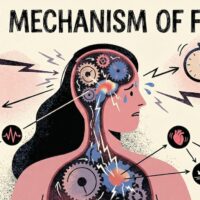
Humans, like all other animals, have an evolutionarily developed protective mechanism of “fight or flight” that our bodies activate automatically during intense stress. This was described by Dr. Walter Cannon, a professor in the Department of Physiology at Harvard University, in 1915.
When we face danger, the autonomic (involuntary) nervous system responds. At its command, the adrenal glands release adrenaline, which rapidly spreads throughout the entire body.
This hormone causes the opening of calcium channels in the membranes of heart muscle cells. Calcium ions make the heart contract faster. Blood flow to the muscles increases, pupils dilate, and the digestive process slows down. The body prepares for a fight or quick escape to protect itself.
This helped our primitive ancestors better cope with dangers like a jaguar suddenly jumping out of the bushes.
However, releases of adrenaline, despite their usefulness in moments of danger, lead to risky consequences. An overload of cells with this hormone can lead to a situation where the heart muscle simply cannot relax, which leads to arrhythmia and ventricular fibrillation. From truly intense terror, the heart can literally stop. Moreover, this happens even to completely healthy people.
Not only fear but also other excessively strong emotions can lead to death. High levels of adrenaline can also kill during sexual intercourse, religious ecstasy, or excessive enthusiasm among sports fans. The number of heart attacks increases during tsunamis, hurricanes, earthquakes, and other natural disasters.
And even if fear, stress, and anxiety don’t kill immediately, they contribute to the development of heart disease later on. For example, military conflicts become the cause of heart attacks and cardiac ischemia even years after the restoration of peaceful conditions.
Japanese doctors in 1990 described the so-called takotsubo stress cardiomyopathy, when due to the strong impact of adrenaline and noradrenaline, myocardial contractility decreases. The disease is also called “broken heart syndrome,” as its trigger is intense emotional stress—the loss of a loved one, a job, means of subsistence, and so on.
Perhaps the reason for the deadliness of fear is that modern people fight their terrors without resorting to a physical reaction.
We stopped “fighting or fleeing” because stresses are now less material than predators or natural cataclysms.
Surges of adrenaline, noradrenaline, and cortisol in our bodies don’t serve real needs—to become faster, stronger, more aggressive—but burden the body’s systems in vain.
So fear can indeed literally lead to a heart attack. But fortunately, the probability that a person will simply up and die from terror is very, very small. To cope with this feeling in critical moments, simply breathe deeply. This helps normalize your pulse.
And dedicate time to sports and aerobic exercises, because the cardiovascular system of trained people best handles surges of adrenaline.