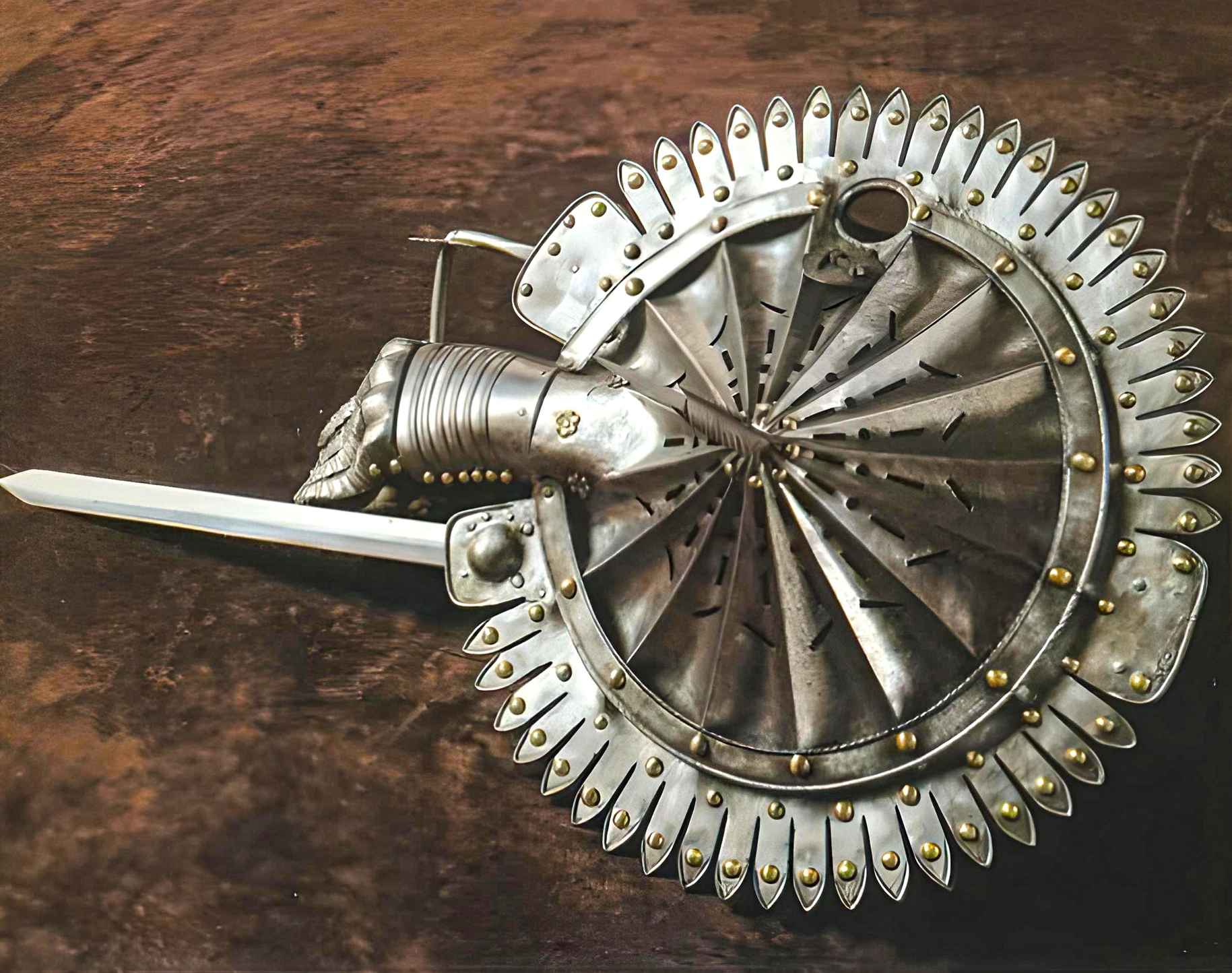
Walk through the royal armories of Vienna, Madrid, or Turin, and one piece of Renaissance defensive equipment looks less like a historical tool of war and more like an eccentric contraption pulled straight from a modern fantasy novel: the sixteenth century Italian lantern shield. Combining a small round steel buckler, an articulated armored gauntlet, curved sword-catching spikes, a projecting offensive dagger blade, and a built-in hinged oil lamp designed to blind opponents in the dark, this multifunctional Swiss Army knife of personal combat was engineered for the shadowy, dangerous world of nocturnal street duels in Renaissance Italy.
Nighttime Duels in Sixteenth Century Italian Cities
To understand why a Renaissance nobleman or bodyguard would strap five different weapons and a lamp onto his left forearm simultaneously, one must picture the streets of Milan, Venice, Rome, and Bologna during the mid fifteen hundreds. Before the invention of municipal gas or electric streetlamps, sixteenth century cities plunged into absolute pitch blackness the moment the sun set. Narrow cobblestone alleys flanked by overhanging stone palazzi became prime hunting grounds for hired bravos, rival family factions settling blood feuds, and nocturnal thieves.
In many Italian city states, local laws strictly required citizens walking abroad after curfew to carry a lit lantern so they could be identified by the night watch, while simultaneously regulating the carrying of long two handed battlefield weapons. Carrying a rapier in one hand and a heavy oil lantern in the other left a gentleman completely unable to hold a parrying dagger or a buckler shield if ambushed in the dark. The lantern shield solved both the legal requirement and the tactical dilemma in a single stroke of workshops engineering.
Anatomy of a Renaissance Combat Contraption
Surviving examples, most notably the famous specimen housed in the Kunsthistorisches Museum in Vienna dated to around 1540, showcase extraordinary blacksmithing complexity. The base of the weapon is a circular, convex steel buckler shield measuring roughly twelve to sixteen inches in diameter. Instead of being held by a simple central handle like an ordinary buckler, the back of the shield is riveted directly onto a heavy leather and steel gauntlet that straps securely over the wearer’s left hand and forearm, leaving the right hand completely free to wield a long thrusting rapier.
Projecting straight forward from the bottom rim or the central boss of the round shield is a rigid, twelve inch double edged steel sword blade or armor piercing spike, turning every defensive punch with the left arm into a lethal thrust. Welded around the outer circumference or protruding from the face of the shield are jagged iron hooks, serrated rings, and upward curving prongs called sword breakers. If an enemy lunged forward in the dark with a rapier, the defender could catch the sliding blade inside these iron teeth and twist his left wrist sharply, either wrenching the sword right out of the attacker’s grip or snapping the brittle high carbon blade in half.
Tactical Blindness and the Hinged Peephole Flap
The defining feature that gave the weapon its name sits tucked inside the upper quadrant of the shield behind a circular cutout in the steel plate: a small gimbaled or fixed metal oil lamp fueled by olive oil or tallow. To prevent the wearer from giving away his position while walking down a dark alley or being blinded by his own glare, the circular window in the front of the shield was fitted with a hinged, spring loaded or latched steel cover flap.
During a nocturnal encounter, the swordsman kept the metal shutter closed until the exact instant his opponent prepared to lunge. With a flick of a finger or thumb lever from behind the shield, the duelist snapped the shutter open, unleashing a sudden beam of bright yellow flame straight into the dilated pupils of his adversary’s night adjusted eyes. Momentarily blinded by the flash and unable to judge the distance of the rapier and shield spikes lunging out of the glare, the attacker was left completely defenseless, while the man behind the shield remained safely in the shadow of the steel disk, peeking at his target through a tiny grilled vision slit pierced near the top rim.
Fencing Manuals vs. Aristocratic Curiosities
While none of the heaviest, most baroque museum lantern shields show deep battle scars from actual street brawls—leading arms curators like Ewart Oakeshott to note that the most elaborate surviving gilded pieces were probably expensive conversation pieces crafted by master Milanese armorers for wealthy princely armories—the tactical concept of fighting with a shield and lantern was entirely real. Several sixteenth and seventeenth century German and Italian fencing treatises, including works by Paulus Hector Mair, explicitly illustrate techniques for fighting at night with a sword and a lantern tucked behind a small buckler, proving that the impulse to weaponize light in close quarters combat is at least five hundred years old.