
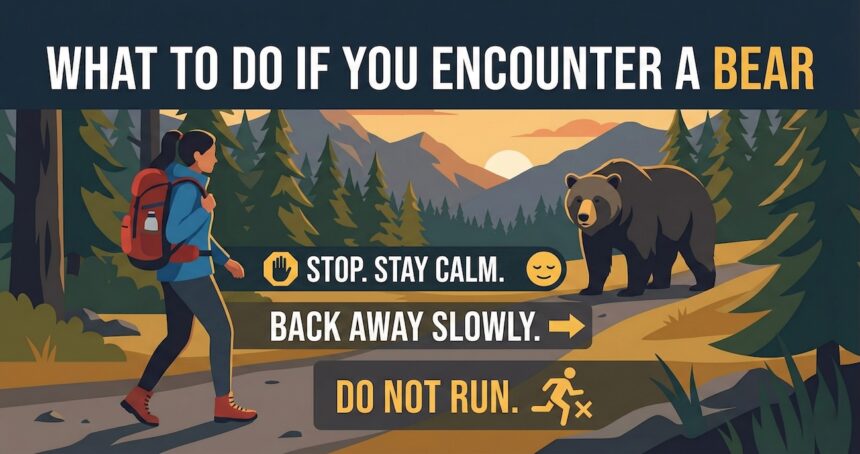
How to Avoid Encountering a Bear in the Forest
Brown bears rarely attack humans. Typically, they are quite cautious and try to avoid encounters with people. If an animal knows in advance about an approaching human, or especially a group, it will try not to show itself and will likely move away on its own.
However, if a wandering bear that was forced to leave its den early or a wounded animal is roaming the forest, an encounter can be extremely dangerous.
To reduce the risk of encountering an animal in the forest, follow several rules:
1. Don’t wander through dense thickets. Avoid areas overgrown with bushes. Stay away from fallen trees. It’s better to move through open areas and use established trails.
2. Never walk on a bear trail. By doing so, you risk meeting its owner, who may decide you’ve invaded their territory.
A bear trail is easy to distinguish from a regular one. It looks like two chains of indented tracks. They are located about 20 centimeters apart from each other.
Generally, don’t follow a trail if it seems a wild animal has left tracks on it. It’s better to find another path through the forest. This rule is especially important in winter or early spring. If you see tracks in the snow that might resemble bear tracks, immediately move away and try to stay in open areas.
3. Make noise. This is one of the main rules for those who don’t want to meet a bear. So talk, sing, laugh, stomp loudly. If you’re traveling alone, you can attach a bell to your backpack. A healthy adult bear doesn’t want an encounter any more than you do. So let it know in advance that there are people in the forest—it will try not to meet you.
4. Don’t take decorative dogs or other small animals into the forest. A large hunting or guard dog can help you and drive away a brown bear. But if a small house dog runs off and encounters a shaggy predator, it will get scared, run back, and lead the bear to you. It’s better to avoid such an encounter.
5. Don’t leave food waste in the forest. As well as food packaging and tin cans. You especially shouldn’t create large dumps. Even if you buried the waste in the ground, a bear can find it by smell. This will make the campsite dangerous for the next groups. Take the waste with you, or if that’s impossible, burn it.
6. Never approach animal remains. Or piles of fish lying on the shore. A bear may consider all of this its prey. Then it will defend its property.
7. Don’t move along riverbanks after sunset and before sunrise. During this time, bears catch fish and definitely won’t be happy if they’re disturbed.
What to Do If You See a Bear
A common situation: you’ve spotted a bear, but it hasn’t noticed you yet. For example, it’s busy fishing or eating berries. The distance between you is more than 10 meters, and the sound of water prevents the animal from hearing your footsteps. Or you accidentally saw a bear that fell asleep in the forest.
In such cases, leave immediately. Don’t try to photograph the bear, even if it’s not looking in your direction at all. You don’t know when it will turn toward you. Or wake up, if it’s sleeping. Remember: the animal really doesn’t like being caught by surprise.
So try to leave in the direction you just came from, or bypass the dangerous zone in a wide arc. Don’t let the bear out of your sight and don’t turn your back to it.
Important: never approach bear cubs. Upon seeing them, leave immediately. A mother bear may be nearby. If she sees you, she may attack instantly because she’ll perceive you as a threat to her cubs.
What to Do If the Bear Sees You
The first and most difficult thing is not to panic. Remember that a healthy bear in its natural habitat extremely rarely attacks humans. And try to maintain confidence and composure.
A bear tries not to conflict with large creatures, so try to appear bigger. For example, raise your backpack above your head. Or open your cloak or jacket, spread your arms to the sides. If you’re traveling in a group, gather together—the animal may see a massive silhouette and decide it’s better to get out of the way.
If a bear rises on its hind legs, it’s usually not dangerous. The bear simply wants to get a better look at who’s in front of it.
To break off contact, back away diagonally. At the same time, say something aloud in a loud, confident voice, make noise, stomp your feet.
But don’t scream like an animal, don’t squeal, don’t bare your teeth. And definitely don’t growl. You absolutely don’t need to resemble an aggressive animal. Or a weak creature that could become prey, either.
You can bang a spoon on a pot, fire a flare gun. If you have a weapon, it’s also worth firing a shot upward to make noise and scare the bear. But under no circumstances aim at it! If you’re not an experienced hunter and haven’t encountered an animal one-on-one before, you might wound the predator. In this case, it will almost certainly charge at you, and you won’t be able to avoid a fight.
For the same reason, don’t try to use a knife or axe for self-defense. You’ll only wound the animal and turn it into an extremely dangerous opponent.
If the bear continues moving and has already approached you, stop. Continue talking loudly, bang on trees. But don’t make aggressive lunges and movements, and don’t look the animal straight in the eyes: for it, this is a signal of readiness to attack.
If the bear stops, you can slowly move backward again.
But under no circumstances should you turn your back to the animal and run!
This is how prey behaves, and the hunting instinct may push the bear to pursue. You still won’t be able to get away from the animal: it’s capable of moving at speeds up to 60 kilometers per hour.
The only reliable means of defense is pepper spray. But be careful: an ordinary canister that can stop a human won’t affect a brown predator at all. Only take special means with red pepper extract designed for bears into the forest, and keep them at hand. They work at a distance of 5–6 meters.
Be careful: if the wind is blowing in your direction, the spray may harm you rather than the bear.
What to Do If You Encounter a Group of Bears
This encounter is much more dangerous. Brown bears can travel in groups during mating season. Young males during this period behave aggressively and may charge at any large moving object.
Bear mating season lasts from spring to mid-July, so in the first half of summer you need to be especially careful. It’s better not to go alone to places where bears live.
Young individuals that stay together for some time are also dangerous. They’re not yet familiar with humans, and the feeling that they’re not alone can make them more active. Such pairs or groups may try to ransack a camp at a rest stop and steal food supplies. They need to be driven away—with shouts, noise, banging, shots fired upward. And don’t approach them if you see them in the forest.
Let’s repeat once more: never, under any circumstances, approach bear cubs or a mother bear with cubs!
Such encounters can end in tragedy—a mother bear will stop at nothing to protect her young.
What to Do If a Bear Attacks You
If an attack does occur, the main thing is not to try to run and not to scream.
Drop to the ground immediately. Lie on your stomach, but better—curl up in a ball and clasp your fingers in a lock on the back of your neck. Your task is to be motionless and protect your stomach, neck, and face.
If the bear tries to turn you onto your back, slowly and smoothly roll back to hide your face. But do it naturally, as if by inertia. Don’t make sudden movements.
Usually, a bear loses interest in a fight if it sees that the opponent is no longer dangerous. It has fulfilled its task: defended its prey or territory. Therefore, it will most likely leave. But if it sees or hears you moving, it may linger or return.
A bear attack always ends abruptly. Your task is to wait until it moves a sufficient distance away. And then immediately leave the dangerous territory.