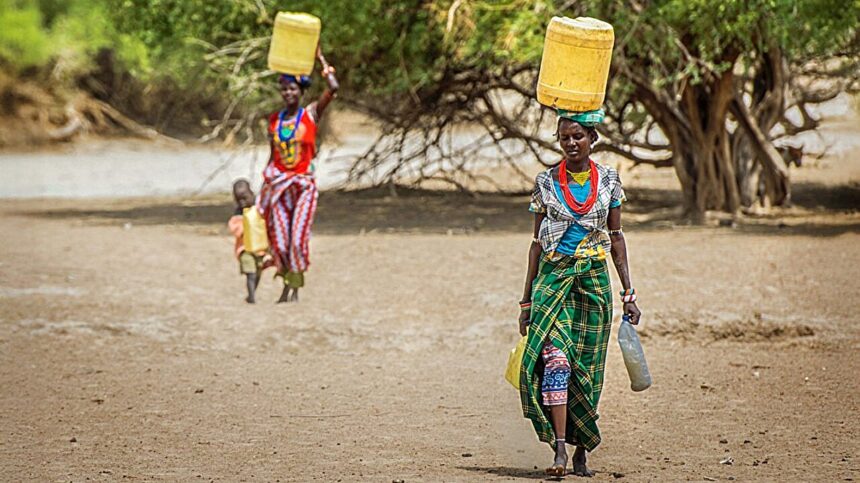
As the human species spread to the four corners of the world, it adapted to a wide range of different environments, some with very harsh conditions. In Tibet and in the Andes mountain range, for example, humans became accustomed to the lower oxygen levels typical of high altitudes. Elsewhere, pastoral populations, whose diet depends mainly on the animals they raise, are able to digest milk well, even in adulthood. But the natural selection processes that enable these adaptations come with trade-offs. Recently, the team of Julien Ayroles, from the University of California at Berkeley, examined another human population living in extreme conditions: the Turkana. They mainly inhabit a very arid region in northwestern Kenya, where access to water is severely limited. The researchers analyzed the genomes of numerous individuals from this population and discovered regions that had undergone recent positive natural selection, particularly near genes involved in the response to dehydration.
To fully understand the Turkana’s adaptations, the medical implications, and the impact in terms of lifestyle, the researchers employed a multifaceted approach. They studied the genomes of 367 individuals from East African populations, analyzed urine samples and interview reports, and conducted experiments on mouse models.
The genomic analysis revealed that the genetic region near the STC1 gene had recently undergone positive selection—meaning that one version of the gene, or allele, was more favored than others by natural selection—among the Turkana, but also in neighboring communities like the Dassanetch. The variants identified in this region are associated with increased urinary concentrations of urea, which is a biomarker of kidney function. These elevated urea concentrations indicate that these individuals retain more water in their bodies. They thus avoid becoming dehydrated too quickly despite the arid conditions of their environment.
At the molecular level, in mouse models, the researchers observed an increase in the production of proteins linked to the STC1 gene when the rodents had very limited access to water. They therefore concluded that STC1 was activated in response to dehydration and indeed played a key role in water retention.
In recent years, the advent of genomic databases has made it possible, as in this case, to identify the genes involved in these remarkable adaptations. At first glance, these appear to be precisely forged by evolution in response to environmental pressures. But genomic data also reveal that the emergence of such adaptations comes at a cost, and that the natural selection mechanisms underlying them are profoundly complex. Among the Turkana, adaptation to the arid environment is not limited to the STC1 gene; it is accompanied by hundreds of genetic changes that globally affect their metabolism.
For 5,000 to 8,000 years, the Turkana have practiced nomadic pastoralism; their way of life relies largely on the herds they raise and the pastures in which they move. They therefore primarily use animal products (milk, red meat, and animal blood) to meet their daily nutritional needs. But some communities are gradually transitioning to a “modern” urban lifestyle, where they consume more industrial products than products from traditional pastoralism.
Studies have already identified an increased risk of cardiovascular disease among Turkana undergoing this transition. Through this study, Julien Ayroles and his colleagues found that the genes implicated, whose expression differs between nomadic and urbanized populations, are among those that have undergone positive selection, like STC1. The identification of these risk factors will enable better care for people affected by this lifestyle change.