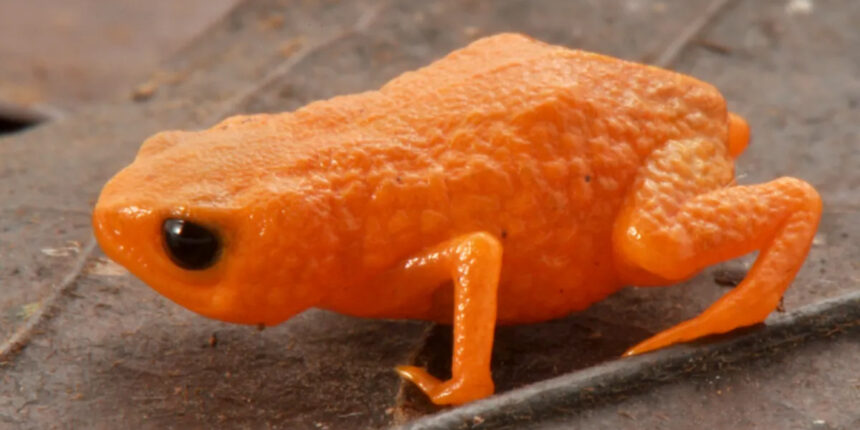
In Brazil’s Atlantic Forest, scientists have identified a new species of miniature orange frogs belonging to the genus Brachycephalus. These tiny amphibians live among the forest floor litter and are notable for their loud calls—despite remaining nearly invisible to the human eye.
The newly discovered species was found in the Serra do Quiriri mountainous region. Researchers confirmed the discovery through a combination of genetic analysis, distinct physical characteristics, and unique mating calls used to attract partners. With this addition, the Brachycephalus genus now includes 43 known species—35 of which have been described since the year 2000 alone.
The frog stands out with its bright orange skin and has been named Brachycephalus lulai in honor of Brazilian President Luiz Inácio Lula da Silva. The researchers explain that this naming aims to draw attention to the conservation of the Atlantic Forest and its unique miniature amphibians.
To study the species, scientists collected several specimens in the field and conducted detailed laboratory analyses, including DNA sequencing. The frog is distinguished by its rounded snout, compact body, lack of a fifth toe, and black eyes. Its vivid orange body is occasionally marked with small green or brown spots. Female Brachycephalus lulai are noticeably larger than males.
The frog’s size is remarkable: adults measure only about 14 millimeters in length. They inhabit high-altitude meadows and misty forests, with a known distribution covering just eight square kilometers. Despite this limited range, researchers believe the species qualifies as “Least Concern” on the IUCN Red List.
This isn’t the only exciting discovery of 2025. Earlier this year, in March, scientists revealed a new species of giant tree capable of living up to 3,000 years. Additionally, researchers uncovered a previously unknown species of ancient shark dating back 340 million years.