1. Jealousy Doesn’t Necessarily Harm Relationships
There are two primary types of this emotion:
- Reactive jealousy arises in response to real threats—for example, if your partner is genuinely flirting with someone else. This is a normal emotional reaction.
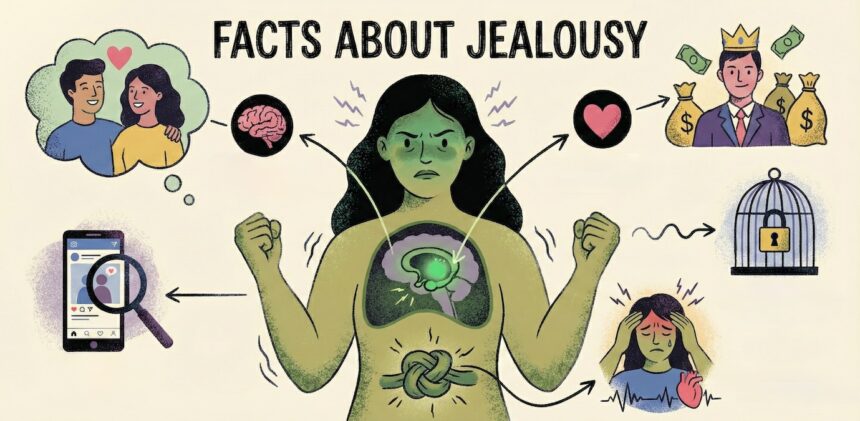
- Suspicious jealousy appears without objective grounds and is usually linked to low self-esteem. It can damage relationships through excessive control, pressure, and distrust. It also negatively affects mental and physical health, potentially causing headaches, stomach pain, blood pressure fluctuations, sleep disturbances, and even a weakened immune system. Over time, suspicious jealousy can develop into a chronic condition associated with anxiety disorders, depression, or obsessive-compulsive behaviors.
While suspicious jealousy is toxic, reactive jealousy—in moderate doses—can actually be beneficial. It often signals the importance of a relationship and may prompt partners to clarify boundaries, thereby strengthening trust. People who experience reactive jealousy typically feel a strong emotional attachment and strive to maintain closeness. In such cases, jealousy isn’t a sign of weakness or dysfunction but a natural part of emotional connection. The key is to channel it constructively: replace accusations with openness, and restrictions with shared plans.
2. Men Tend to Be More Upset by Sexual Infidelity, While Women Are More Distressed by Emotional Infidelity
A team of researchers from Sweden’s Karolinska Institute investigated whether men and women truly react differently to different kinds of infidelity. Over 3,000 participants were asked to imagine two scenarios: In the first, their partner had a brief sexual encounter while on vacation. In the second, their partner fell in love with someone else—but, as in the first scenario, would never see that person again.
Participants rated how upset they’d feel in each situation on a scale from 1 to 10.
The results showed that men generally felt more distressed by sexual infidelity, while women were more troubled by emotional attachment. Interestingly, both groups still rated sexual infidelity as more painful overall.
These findings support the evolutionary theory that different forms of jealousy developed as adaptive responses: for men, avoiding investment in offspring that weren’t genetically theirs was crucial, whereas for women, maintaining stable relationships that ensured safety and resources was key. Although scientists emphasize the need for further research, this study helps explain why men and women may still view fidelity differently—even after thousands of years of evolution.
3. Jealousy Can Drive Women Toward Risky Appearance Changes
Jealousy can be a powerful motivator for unexpected actions. A 2019 study involving 189 female university students in Canada (average age around 20) explored this link. Participants completed questionnaires assessing their levels of jealousy and envy, along with their attitudes toward various appearance-enhancement strategies. The results were striking: the more intensely a woman felt jealous of her partner, the more willing she was to take extreme measures.
Jealousy correlated strongly with a positive attitude toward plastic surgery and dangerous diets with serious side effects. Some women were prepared to spend up to 25% of their income on cosmetics and beauty treatments. Notably, everyday practices like regular makeup use weren’t linked to jealousy—likely because they’re seen as routine rather than drastic.
Interestingly, jealous participants didn’t show greater interest in other risky behaviors overall; their choices appeared specifically aimed at retaining their partner’s attention rather than stemming from a general love of risk-taking.
Researchers caution that the study focused only on young women in Western cultures, so results may differ in other groups. Also, it remains unclear how effective these appearance changes really are—whether they truly help save relationships or merely create an illusion of control.
4. Dogs Can Show Signs of Jealousy
Jealousy was long considered a uniquely human emotion, but it turns out that animals may experience something similar. Studies have shown that dogs display clear signs of jealousy when their owner gives attention to others—whether it’s another dog, a toy, or even a robot.
For example, in a 2024 study, dogs watched as their owner petted another dog, interacted with a mechanical device, or read a magazine. When the owner engaged with the other dog, the test subjects were more likely to bark, insert themselves between the owner and the “rival,” or even snap. No such reaction occurred with the magazine, while the response to the robot was intermediate: less aggressive but still attentive.
Scientists link this behavior to evolutionary mechanisms for protecting social bonds. For dogs, their owner is a key figure providing safety and comfort. In this context, jealousy acts like an alarm: “Our bond is under threat—time to act!”
Moreover, even when the interaction between the owner and the “rival” happened behind a screen, dogs still reacted as if they sensed the threat—suggesting they could mentally imagine the situation.
Experts note that this isn’t identical to human jealousy but rather a simplified mechanism for safeguarding important relationships. Still, it reveals that animals’ inner worlds are more complex than they appear—and sometimes include a struggle for their favorite human’s attention.
5. Dark Chocolate May Help Ease Jealousy Episodes
It turns out you might ease a bout of jealousy not only in a therapist’s office—but also at a confectionery shop, as long as you choose dark chocolate with high cocoa content.
The reason lies in flavonoids—compounds that can lower cortisol levels in the body. Cortisol is the stress hormone responsible for raising blood pressure and blood sugar. Jealousy can spike cortisol, intensifying anxiety, aggression, and obsessive thoughts.
In one study, participants consumed 25 grams (note: likely a typo in original—should be grams, not milligrams) of high-flavonoid dark chocolate daily for four weeks. By the end, their salivary cortisol levels had significantly decreased.
Essentially, cocoa beans may act as a natural calming treat—though they won’t necessarily stop you from snooping through your partner’s phone messages.
Dr. Ji-Yu Chuang, a psychiatrist at Columbia University, became interested in this connection while working with people struggling with romantic emotions. She suggests that regularly eating dark chocolate might soften the sharp edges of jealousy, since flavonoids not only reduce cortisol but also improve mood—particularly helpful for those prone to perceiving threats in even harmless social media chats.
However, she cautions that this remains a hypothesis, not a treatment protocol. Chocolate isn’t a cure-all, and overindulgence can lead to acne, migraines, or weight gain. But if jealousy creeps up with your morning coffee—a small piece of dark chocolate might just help.