
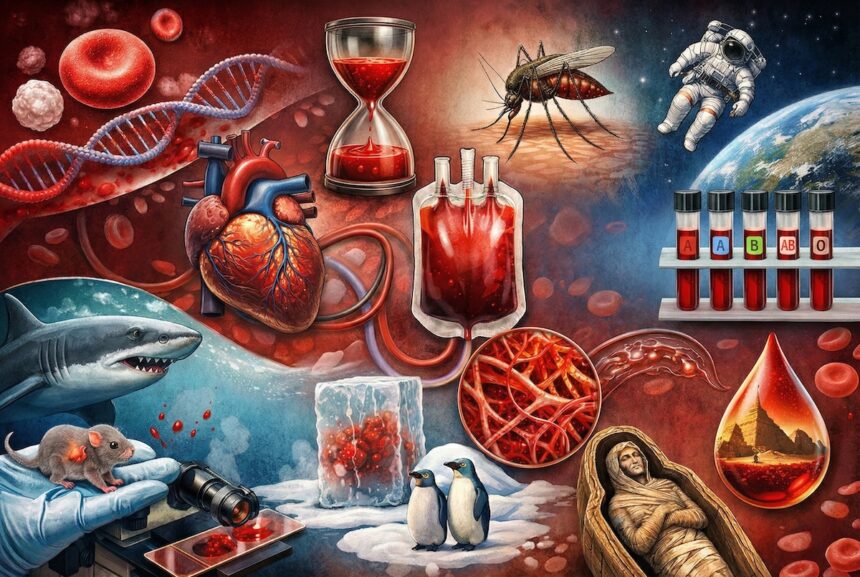
Blood Was an Ingredient in the First Plastic
In 1856, François Charles Lepage patented one of the early prototypes of plastic in France, which he called bois durci. In 1877, William Dibble created its American analogue called hematite in the United States.
To produce the material, animal blood from slaughterhouses was mixed with wood sawdust, particularly from poplar trees, and dyes were added to create a resemblance to natural wood. The mixture was then heated, stirred to the right consistency, and placed into a mold. Under heat and pressure, the albumin in the blood coagulated and the mass transformed into a dense, smooth material resembling wood with similar properties.
About 130 milliliters of blood were needed to produce 1 kilogram of bois durci.
Hematite was often used to imitate jet, a variety of coal from which various crafts were made, such as inkwells, tablets, decorative bas-reliefs, door handles, picture frames, and even furniture pieces. They were durable and pleasant to the touch.
Later, with the spread of synthetic plastics, this blood-based “wood” became unnecessary and was forgotten. Unfortunately, because the material was more environmentally friendly than modern plastics and allowed for the recycling of waste from both food and woodworking industries.
Blood Can Be Used in Construction
It’s hard to argue that the ancient Romans knew how to build: their aqueducts and amphitheaters still stand today. This may be related to the fact that they added livestock blood, most often from bulls, to their famous Roman concrete.
This technology probably originated from religious rituals, when building construction was accompanied by sacrifices to the glory of the gods. Then ancient architects noticed that blood made concrete stronger. Its proteins react with air bubbles inside the mixture, and the material becomes more resistant to cold and moisture.
Rome eventually fell, but its achievements were not forgotten. In 1805, Scottish engineer Thomas Telford built the navigable Pontcysyllte Aqueduct in northeast Wales, United Kingdom. And what do you think? Two centuries after opening, the aqueduct is still in use and is one of the busiest sections of the British canal network, passing about 15,000 boats per year.
Thomas Telford prepared the lime mortar for the aqueduct according to an ancient Roman recipe, with the addition of bull’s blood.
Not only in Britain, but also in the USA, bull’s blood was added to building materials. In 1911, a certain Conrad Steinbo patented a corresponding mixture to use it in creating tiles for paving sidewalks.
Even in our time, ideas periodically surface to build something interesting from blood. For example, British architect Jack Munro developed a material for making bricks that consists of blood, an antibacterial agent, an anticoagulant, sand, and water. The result is a crimson-colored brick. And it’s no worse than an ordinary sun-dried brick. Munro points out that his building material is cheaper and more environmentally friendly, plus it requires less water for production, which is important for poor and developing countries.
Blood Isn’t Always Red
We humans have red blood because our red blood cells are filled with hemoglobin, an iron-containing protein that transports oxygen. Other mammals, as well as most amphibians and reptiles, also have red blood, which is again related to hemoglobin.
But certain marine animals, such as squids, octopuses, and some marine worms, have blue blood because oxygen is transported by hemocyanin. This protein, unlike hemoglobin, contains copper rather than iron. Spiders, slugs, and snails can have the same blue blood.
And in the veins of some species of frogs from Cambodia and lizards from New Guinea flows green blood. This is related to the presence of the bile pigment biliverdin.
Hemerythrin is another pigment that contains iron and transports oxygen. It gives a purplish-pink color to the blood of some mollusks, such as lamp shells and sea squirts.
Some species of fish, like the Antarctic icefish, have no blood pigment at all. A genetic mutation removed hemoglobin from their bodies, so their blood is now transparent and doesn’t transport oxygen. The fish breathes directly through its skin.
What’s more, even in humans blood isn’t always red. True, only with rare and dangerous diseases.
For example, in 2019, doctors in Germany encountered a unique case. In a 39-year-old male patient, they discovered blood resembling milk due to an extremely high level of triglycerides (that is, fats). Attempts to pump out and purify the blood failed because it was thick and simply clogged the medical equipment. This unusual phenomenon was caused by a combination of genetic factors, obesity, and irregular intake of diabetes medication. To save the patient’s life, doctors had to resort to the good old medieval bloodletting.
Type O Blood Attracts Mosquitoes Most Strongly
Have you ever noticed that mosquitoes bite you as if you had personally offended them, while your roommate is bypassed? Perhaps it’s all because you have type O positive blood.
Such a suggestion was made by specialists from the Japanese Institute of Pest Control Technology. Under the supervision of scientists, volunteers with different blood types immersed their hands in a specially prepared aquarium with mosquitoes. The results showed that the most insects landed on those with type O positive blood.
Researchers claim that we humans secrete substances from our skin that can reveal our blood type. Bloodsuckers apparently sense such substances by smell, and this determines their taste preferences.
The insects, by the way, had their proboscises amputated beforehand so they couldn’t bite the participants. So no one was harmed during the experiment. Except the mosquitoes.
There’s a Place in Your Body Without Blood
It would seem that blood is everywhere in the human body. Even bones, which seem like a bloodless thing, contain red bone marrow that produces red blood cells and are permeated with tiny vessels.
But there is a place in our body devoid of blood vessels and amazingly capable of performing its functions. This is the cornea, the convex transparent membrane that covers the front part of the eye and protects it from external influences, such as dust, microbes, and injuries. In addition, it plays an important role in focusing light on the retina, which allows us to see the world around us.
Blood vessels would reduce the transparency of the cornea and negatively affect the quality of our vision. Therefore, it contains no vessels, and receives oxygen and nutrients directly from the internal fluid of the eye, as well as from tears that moisten its surface.