For centuries, plague swept through European cities like a grim reaper with a schedule, claiming millions of lives. Where did this nightmare of the early modern era originate? How did people fight it? How did societies hold together when death became inevitable? And what finally tipped the scales in our favor?
Among the countless infectious diseases that have haunted humanity across the millennia, plague has always occupied a category of its own. Its sheer lethality captured the imagination, and people saw it as divine punishment—the wrath of gods or God made flesh. For Europeans living between the 14th and 18th centuries, recurring outbreaks weren’t abstract historical events; they were a terrifying fact of life. You simply cannot understand the story of the Old World without reckoning with this unwelcome guest.
Plague wasn’t, of course, history’s only mass killer. Over thousands years of urban civilization, humanity has faced wave after wave of epidemics: smallpox, measles, syphilis, cholera, typhus, influenza (including the infamous “Spanish Flu”)… Some of these diseases emptied entire regions, toppled states, or erased ethnic groups from the map. When Captain James Cook “discovered” the Hawaiian Islands in 1778, the archipelago was home to roughly half a million people. Seventy years after European contact, that number had plummeted to around 80,000.
Then there are the ghosts of epidemics past—diseases that preferred to remain anonymous. Descriptions in oral traditions, chronicles, and medieval medical treatises are often too vague or symbolic for modern historians and epidemiologists to pin down with certainty. Was the “English sweat” (sudor anglicus), which struck the British Isles repeatedly between the late 1400s and mid-1500s, a form of influenza? Hantavirus? Something else entirely? In many cases, we can only guess.
Yet even in this grim lineup, plague stood apart. It was perceived as the absolute disease—the very embodiment of pestilence. Its Latin name, pestis, meant “scourge,” “calamity,” “ruin”—a word so potent it was sometimes applied to epidemics caused by entirely different pathogens. The English word plague shares this heritage, deriving from Latin plaga: “blow,” “wound,” “disaster.” These names aren’t accidental. They echo the primal terror people felt toward a scourge from which there seemed no escape.
Three Great Waves
Pathogens thrive on the infrastructure of civilization. Most major epidemics require dense populations to spread—and they tend to emerge alongside cities and the movement of people.
Thanks to trade routes that, since the days of the Roman Empire, linked the Far East to the Mediterranean, plague traveled from Central Asia across Eurasia at least three times in recorded history, claiming millions of lives. Though none of these waves engulfed the entire global population, historians still classify them as pandemics (from Greek pandēmia: “of all the people”).
🌊 The First Wave: Justinian’s Plague (6th–8th centuries)
The first pandemic began in Central Asia around the mid-6th century, during the reign of Emperor Justinian I. It reached Constantinople, capital of the Byzantine Empire, then radiated outward across the Mediterranean, North Africa, and beyond. Outbreaks continued intermittently until the mid-700s. Historians estimate the death toll of Justinian’s Plague at 30–50 million people—but it’s crucial to remember that statistics from such distant eras are necessarily approximate and often speculative.
🌊 The Second Wave: The Black Death (14th–18th centuries)
After centuries of relative quiet, plague struck again in the mid-1300s. This second pandemic—later dubbed the “Black Death”—likely began in China in the 1330s. Traveling the Silk Road, the bacillus reached the Genoese port of Caffa in Crimea, then hitched a ride on merchant ships to Sicily in 1347.
From southern Italy, the disease raced across Europe between 1348 and 1352, reaching as far as England, Scandinavia, and the distant principalities of Rus’. Historians estimate it killed roughly one-third of Europe’s population. In some regions, the toll was lower; in others, entire towns were emptied. England’s population may have been halved—and it took 250 years to recover to pre-1348 levels. Global estimates range wildly, from 50 to 200 million dead.
The Florentine merchant and chronicler Giovanni Villani (c. 1276–1348) was writing his Nuova Cronica when the plague hit his city. Unsure when—or if—it would end, he left a blank in his manuscript: “The plague lasted until…” He never filled in the date. The plague claimed Villani himself, along with tens of thousands of his fellow Florentines.
The Black Death didn’t just strike and vanish. It became a recurring visitor to Europe, returning in waves for centuries. Seville lost roughly half its 120,000 residents in 1649–1650; Naples lost more than half of its 400,000–450,000 inhabitants in 1656. Western Europe’s last major outbreak struck Marseille in 1720, brought by a ship from Syria. By 1722, the disease had spread across southern France and killed over 140,000 people. Moscow suffered a devastating outbreak in 1771; Constantinople in 1778. In the Ottoman Empire, flare-ups continued into the late 1800s.
🌊 The Third Wave: The Modern Pandemic (mid-19th–early 20th century)
The third pandemic began in China in the mid-1800s and didn’t fully subside until the 1920s. From Asia, plague traveled aboard ships infested with rats, reaching India, then ports across the Americas, Africa’s coasts, and much of Southeast Asia. Total deaths are estimated at around 12 million. For perspective: the 1918–1920 influenza pandemic (“Spanish Flu”) killed roughly 50 million worldwide.
Causes and Scapegoats
Plague terrified people in part because of its ruthless egalitarianism. It struck young and old, rich and poor, unraveling the social hierarchies that gave life structure. And it always left two urgent questions unanswered: What causes this? And how do we stop it?
During the late Middle Ages and early modern period—when plague returned to Europe again and again—doctors, clergy, and ordinary people relied on a handful of dominant theories. These explanations weren’t mutually exclusive; they often blended seamlessly.
⚡ Divine Punishment
For millennia, people interpreted epidemics as expressions of divine wrath. The Church taught that the Black Death and its successors were punishments sent by God for the sins of entire cities or kingdoms. Plague, like a hailstorm of invisible arrows, struck sinner and saint alike—because it was collective retribution. To halt God’s anger, medicines, doctors, and human cleverness were useless. Clergy insisted that only spiritual remedies would work: mass repentance, public prayers, processions, and the intercession of saints.
In Catholic lands, two saints became the go-to protectors against plague: Saint Sebastian and Saint Roch.
Saint Sebastian, an early Christian martyr from the 3rd century, was reportedly sentenced to death by archers under Emperor Diocletian. Countless paintings show him bound to a tree or column, pierced by a storm of arrows—yet he survived, only to be martyred later. In both Greco-Roman and Jewish texts, plague and other diseases were often described metaphorically as arrows raining down from the heavens. Perhaps for that reason, Sebastian—the man who endured the arrow-storm—became, in the Middle Ages, a heavenly shield against this very scourge.
Saint Roch, by contrast, had a more direct connection to plague. Legend holds he was born in Montpellier in the late 1200s. While on pilgrimage to Rome, he contracted plague and retreated to a forest hut. A local lord’s hunting dog began bringing him food from the master’s table. Roch recovered, returned to France, but his own family failed to recognize him. Accused of espionage, he was imprisoned and died in captivity. As a sign of his sanctity, his cell was said to have filled with light, and an angel inscribed beside his body in Latin: “Eris in peste patronus”—”You shall be a protector against plague.” In most depictions, Roch points to a bubo (a swollen, inflamed lymph node) on his leg—a visual cue to his specialized intercessory role.
💨 Poisoned Air
From the 14th to the 18th century, physicians most commonly argued that plague was caused by corrupted air—made lethal either by malignant influences of stars and comets, or by poisonous miasmas rising from the earth: from unburied corpses, rotting waste, or stagnant water. Protection, therefore, meant purifying the atmosphere or deploying strong scents capable of overpowering the plague’s poison.
Giovanni Boccaccio, describing Florentines during the 1348 outbreak in The Decameron, notes that some citizens walked the streets “holding in their hands flowers, or fragrant herbs, or some sweet-smelling substance, which they frequently brought to their noses, believing it an excellent preservative to fortify the brain with such aromas—since the air seemed infected and tainted by the stench of corpses, of the sick, and of medicines.”
By the 17th–18th centuries, one of plague’s most enduring symbols had emerged: the plague doctor. Physicians in bizarre beaked masks patrolled the streets of infected cities. This iconic costume was designed in 1619 by French physician Charles de Lorme. It included a waxed leather or fabric coat, a cane for examining patients without touching them, and—most famously—a mask with glass eyeholes and a long, bird-like beak. Think of it as an early respirator: the beak was stuffed with aromatic substances, dried flowers, and pungent herbs, intended to filter out the plague’s toxic vapors.
Naturally, scientific and medical theories about plague coexisted easily with theological ones. One could argue, for instance, that an angry God (the ultimate cause) employed the influence of celestial bodies poisoning the air (secondary causes) as instruments of divine justice.
☠️ The Poisoners
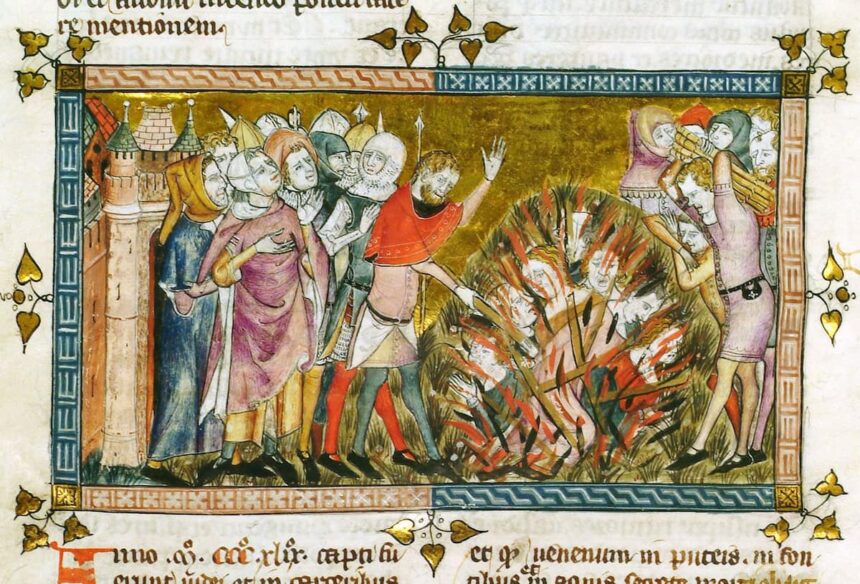
Fear demands a target. Periodically, rumors spread that plague was being deliberately spread by Jews, lepers, witches, vagrants, beggars, foreigners, or other “dangerous elements” who needed to be hunted down and neutralized. Despite repeated warnings from church authorities, in many places the arrival of the Black Death triggered frenzied accusations that Jews were poisoning wells—and pogroms erupted.
But scapegoats weren’t always outsiders or religious minorities. In 1530 Geneva, authorities “uncovered” a conspiracy involving the head of the plague hospital, his wife, a local surgeon, and even a chaplain. Under torture, they confessed to having sold their souls to the Devil, who taught them to brew a deadly potion. Fifteen years later, Geneva executed 39 more alleged poisoners on similar charges. During Milan’s 1630 outbreak, women accused barber-surgeon Gian Giacomo Mora and public health commissioner Guglielmo Piazza of deliberately spreading plague by smearing infected ointments on house walls. Both were executed.
The Bacterium That Changed the World
The true culprit behind plague is a rod-shaped bacterium: Yersinia pestis. Humans are merely accidental casualties in an ancient evolutionary arms race. In certain natural reservoirs, the bacterium lies dormant among its primary hosts—rodents—and only occasionally spills over into human populations.
Even the ancient Romans suspected that plague spread via invisible “creatures.” In his 1546 treatise On Contagion, Italian physician Girolamo Fracastoro proposed that infectious diseases might be transmitted by tiny “seeds.” But without microscopes and the tools of modern science, proof remained out of reach.
The plague bacterium was finally identified in 1894 during an outbreak in Hong Kong. Swiss-French bacteriologist Alexandre Yersin and Japanese physician Kitasato Shibasaburō independently isolated the pathogen from victims’ tissues. By 1897, bacteriologist and epidemiologist Waldemar Haffkine—a native of Odessa who had emigrated to Europe as a young man—had developed the first anti-plague vaccine while working during an epidemic in British India.
In nature, Y. pestis circulates primarily among rodents: marmots, ground squirrels, mice, rats… Only occasionally—via flea bites (though other routes exist)—does it jump to humans. In medieval Europe, the black rat (Rattus rattus) was plague’s chief vector. Wild rodents often show mild symptoms; domestic mice and rats are far more vulnerable; humans, tragically, are nearly defenseless.
The infection mechanism is brutally elegant:
- A flea bites an infected animal and ingests plague bacteria.
- The bacteria multiply rapidly in the flea’s gut, eventually forming a blockage between its esophagus and stomach.
- Blood the flea ingests can no longer reach its stomach. It remains perpetually hungry.
- Desperate to feed, the flea attacks new hosts.
- When it bites, it regurgitates a clot of bacteria into the wound—injecting a lethal army of Yersinia directly into the bloodstream.
Plague Victims — Miniature from the Toggenburg Bible, 1411
Kupferstichkabinett, Berlin
Depending on the route of infection and disease progression, the same bacterium can cause several distinct forms of plague:
🔹 Bubonic plague (most common): Bacteria enter the bloodstream, travel to lymph nodes, and multiply explosively. Nodes swell into painful, hardened lumps—buboes. The infection then spreads systemically. Without modern treatment, death from septic shock is highly likely.
“At the onset of the illness, both men and women developed swellings in the groin or under the arms, some as large as a common apple or egg… the common people called them gavoccioli [plague buboes]; before long, this mortal swelling would spread indifferently from those initial sites to other parts of the body. Soon after, the sign of the disease changed to black or livid spots appearing on the arms, thighs, and elsewhere—large and sparse in some, small and numerous in others. And just as the initial swelling was, and remained, the surest sign of approaching death, so too were these spots. It seemed that neither medical advice nor the power of any medicine availed against these illnesses… only a few recovered, and nearly all died within three days of the first symptoms—some sooner, some later.”
— Giovanni Boccaccio, The Decameron
🔹 Pneumonic plague: Bacteria reach the lungs. When the infected person coughs, microscopic droplets spray countless bacteria into the air. Transmission becomes nearly unavoidable. Pneumonic plague could devastate medieval cities, leaving almost no survivors. Before antibiotics, bubonic plague killed 60–70% of those infected; pneumonic plague was virtually 100% fatal.
The City Under Siege
A plague-stricken city quickly becomes a fortress under siege—not just from without, but from within. Its enemy is contagion. And for everyone still healthy, every infected person becomes a potential threat. Neighborhoods, streets, households, individuals: the city fractures into countless miniature fortresses, each fighting for survival. Epidemics—where death sweeps away all conventions—reveal just how fragile social bonds truly are.
Sometimes, denial feels like the safest strategy. In many cities, when the first cases appeared, residents refused to believe plague had returned. Authorities delayed imposing quarantines or other restrictions, fearing panic, supply-chain collapse, or economic ruin. What if it’s not really plague? What if the doctors are mistaken—or exaggerating to profit from the crisis? What if it passes us by?
In 1599, as plague raged across northern Spain, physicians in Burgos and Valladolid, reluctant to acknowledge the obvious, issued evasive diagnoses: “This isn’t quite plague,” or “We’re dealing with a tertiary and double fever, diphtheria, ague, pleurisy, catarrh, gout, and similar afflictions… Some patients have buboes, but they’re easily treatable.” Tragically, many buboes did not heal—and both cities were devastated.
Epidemics are almost always “foreign.” They arrive from distant lands—or so the story goes. In Lorraine in 1627, people called it the “Hungarian plague”; in 1636, the “Swedish plague”; in Toulouse in 1630, the “Milanese plague.”
Saint Macarius of Ghent Administering Communion During the Plague — Jacob van Oost the Younger, 1673
The Louvre
Plague was doubly destructive: it consumed not only the body’s cells, but society’s very fabric. When collective prayers and processions failed to appease an angry God, religious fervor gave way to fragmentation. The stranger praying beside you might unknowingly become your executioner. Witnesses to epidemics in Florence (1348), Braunschweig (1509), London (1664–1665), and Marseille (1720) described, almost verbatim, how parents abandoned sick children, children fled their parents, husbands deserted wives, and wives forgot their vows. During Milan’s 1630 outbreak, some citizens took to the streets armed with pistols, daring anyone to approach.
Plague shattered daily life and civic order. Rumors abounded: plague inspectors looting homes; gravediggers, eager to avoid return trips, burying people still alive.
“This calamity bred such terror in the hearts of men and women that brother abandoned brother, uncle his nephew, sister her brother—and often, wife her husband. More astonishing still: fathers and mothers avoided visiting or caring for their own children, as though they were not their own. Consequently, the countless men and women who fell ill had no help but the charity of friends (few indeed) or the greed of servants, lured by extravagant wages; and even these were scarce, and often coarse, unaccustomed to such care, able to do little beyond fetching what was asked and watching for the end. In performing such duties, they often lost their own lives along with their earnings.”
— Giovanni Boccaccio, The Decameron
In some cities, priests and doctors—whose calling was to comfort the despairing and care for the incurable—abandoned churches and hospitals. In others, they stayed, fulfilling their duty and dying alongside their patients. In Perpignan in 1348, six of eight physicians perished; in Florence, 78 of 150 Franciscan friars. In Milan during the 1575 epidemic, Archbishop Carlo Borromeo remained in the city, visiting lazarettos to comfort the sick. Fifty-five years later, his nephew Federico—also an archbishop—did the same. Yet many church leaders fled, leaving their flocks behind.
Confronting mortality often pushed people to psychological extremes: despair gave way to reckless revelry; mourning to indulgence. If the end is near, why not seize life’s pleasures? Moralists condemned contemporaries who gambled and caroused amid scenes of death. Yet in Paris in 1401, the Dukes of Burgundy and Bourbon founded a cour amoureuse—a “court of love.” Think of it as a salon or chivalric society dedicated to feasting and literary exercises in honor of ladies. Its stated purpose: to “pass the time with grace and discover new joy in life” during “these grievous days of pestilence.”
Even earthly pleasures could be justified scientifically. Many 16th–17th century physicians argued that apathy and fear dramatically increased infection risk—and prescribed moderate amusements, music, and pleasant reading as preventive medicine. Sometimes, city authorities organized public festivities mid-epidemic to stave off despair. When plague finally receded, many cities experienced a wedding boom: survivors, having lost families, rushed to remarry and rebuild. In Cologne, shortly after the 1451 outbreak that killed over 20,000, records suggest roughly 4,000 marriages were contracted.
“Some believed that a moderate life and abstinence from all excess greatly aided the fight against evil; gathering in small groups, they lived apart from others, shutting themselves in houses free of the sick… passing their time with music and whatever pleasures they could afford. Others, drawn to the opposite view, maintained that drinking and reveling, wandering with songs and jests, indulging every desire as far as possible, laughing and mocking at all that befell—this was the surest medicine against the malady. And as they spoke, so they acted, day and night roaming from tavern to tavern, drinking without measure or restraint, often arranging these gatherings in others’ homes, provided they heard there was something to their taste and pleasure.”
— Giovanni Boccaccio, The Decameron
London: From Plague to Fire
London’s experience offers a vivid case study of how a major European city navigated catastrophe. In the winter of 1664–1665, plague arrived—later remembered as the Great Plague. The first cases appeared in the impoverished port districts and the parish of St. Giles. Today, the British Museum stands nearby; then, it was a distant suburb. Cold weather initially kept the disease dormant. But as temperatures rose, plague exploded—and any hope it might pass unnoticed evaporated.
Plague was a regular visitor to London. Every generation in the 1600s remembered one or more outbreaks: 30,000 dead in 1603; 35,000 in 1625; 10,000 in 1636. But the Great Plague of 1664–1666 dwarfed them all: 70,000–100,000 Londoners dead—roughly 20% of the city’s population.
Plague typically entered England via continental ports, then spread along trade routes and rivers. Infected rats or fleas, hidden among cargo or in the folds of clothing, traveled inland aboard ships or in merchants’ wagons.
Contemporaries were convinced the Great Plague had been imported from the Netherlands, where it had lingered for years: Leiden and Amsterdam had lost tens of thousands in the mid-1660s. Some even alleged the Dutch—then at war with England—had deliberately sent the disease across the Channel.
When plague returned to London in 1664, authorities began implementing measures to slow its spread. Special inspectors canvassed neighborhoods searching for the sick. Houses with infected residents were ordered sealed to isolate the contagious and prevent further transmission. But deaths mounted rapidly. In early 1665, King Charles II and his court fled to Oxford. Many wealthy citizens followed: merchants, lawyers, professors, clergy, physicians, apothecaries. Ordinary people fled too—some to distant estates, others to relatives, others simply anywhere but the infected city. Yet Lord Mayor Sir John Lawrence and the city’s aldermen stayed at their posts.
Flee or stay? This question confronted countless Londoners—and victims of epidemics everywhere, across centuries. As early as the 1300s, the University of Paris advised: cito, longe, tarde—”flee quickly, go far, return late.” But neighboring villages and towns weren’t always eager to shelter dangerous refugees. Often, barriers were erected; lone travelers were met with clubs or musket fire.
Lose everything but save yourself? Flee immediately, or wait and hope the epidemic wanes? Among those who chose to stay were Samuel Pepys, the naval administrator whose famous diary chronicles the era, and Henry Foe—a cordwainer (shoemaker) and uncle of writer Daniel Defoe, future author of Robinson Crusoe. In 1722, Defoe published A Journal of the Plague Year, a documentary novel styled as the diary of a Londoner identified only as “H.F.” (perhaps Henry Foe?), who survived the 1664–1666 outbreak. Defoe may have drawn on his uncle’s recollections—or perhaps, like Pepys, Foe kept a plague diary of his own.
“I began now seriously to consider my condition, and what I ought to do; that is, whether I should stay in London, or shut up my house and flee, as many of my neighbors did. <…>
I had two weighty considerations to balance: on one hand, I had to continue my business and trade, which was considerable—for my entire fortune was invested in it; on the other, I had to think of preserving my life in the face of this great calamity, which, as I understood, was evidently advancing upon the whole city, and, however great my fears and those of my neighbors, might prove more terrible than any expectation.
<…>
And one morning, as I was again reflecting on all this, a perfectly clear thought struck me: if what befalls us happens only by the will of God, then surely all my troubles are not without purpose; and I ought to consider whether this might not be a sign from above, plainly indicating that Heaven intended me to stay. And immediately following that, I understood that if God truly willed me to remain, it was within His power to preserve me amid the dangers and death raging all around…”
— Daniel Defoe, A Journal of the Plague Year
By summer 1665, the epidemic peaked. Newspapers published weekly Bills of Mortality—and the numbers climbed alarmingly: one thousand dead, then two, then seven thousand per week by September. Churchyards overflowed; victims were hastily dumped into mass graves.
Attempting to halt the spread, the Lord Mayor ordered the killing of dogs and cats, believed to carry contagion. The measure backfired spectacularly: cats controlled the rat populations that harbored infected fleas.
If contagion traveled through air, logic suggested shielding oneself with strong scents and perfumes. Bonfires were lit at street corners. Wealthy Londoners burned sulfur, frankincense, hops. The poor burned old shoes. Authorities recommended—and in some places mandated—tobacco smoking.
But the only truly effective measure was isolation: of the sick, or self-isolation by the healthy. Since antiquity, cities had closed their gates during epidemics, posting guards against outsiders. In 1377, the Adriatic port of Ragusa (modern Dubrovnik) introduced measures to protect against plague: all ships arriving from infected or suspect regions had to wait thirty days before crew could disembark. This isolation period was called trentina (from Italian trenta: “thirty”). For overland arrivals, the period was forty (quaranta) days—giving us the word quarantine. Such measures later spread to other ports. In 1423, Venice established a dedicated quarantine station on a nearby island: a hospital-isolator for suspect arrivals and plague patients. Because the island long housed the Church of Saint Mary of Nazareth, and Saint Lazarus was considered a protector of the plague-stricken, the site became known as Lazzaretto—origin of the word lazaretto.
Within cities, authorities isolated individual houses, streets, or entire neighborhoods. In London, homes with plague victims were sealed and boarded from the outside. Guards were posted to prevent the infected from escaping and spreading disease—but residents regularly tried to outwit them.
“Today, with great sadness, I found in Drury Lane two or three houses marked with a red cross and the words ‘Lord have mercy upon us’—a sight most grievous to me, for I do not recall ever seeing the like before. I immediately began to examine myself and was forced to buy tobacco, which I sniffed and chewed until the ill omen passed.”
— Samuel Pepys, Diary, June 7, 1665“Went out briefly for a walk—to show off my new waistcoat, truth be told—and on the way back noticed that the door of poor Dr. Burnett’s house has been boarded up. I heard he won the respect of his neighbors by discovering his own illness and voluntarily locking himself in, performing a most admirable act.”
— Samuel Pepys, Diary, June 11, 1665“Today ends this sad month—sad, for plague has now spread through almost the entire kingdom. Each day brings grimmer news. In the City this week, 7,496 died, of whom 6,102 from plague. Yet I fear the true death toll approaches 10,000—partly because the poor die in such numbers they cannot be counted, and partly because Quakers and others refuse to have bells tolled for their dead.”
— Samuel Pepys, Diary, August 31, 1665
(Quakers, members of the Religious Society of Friends, rejected traditional church rituals, including funeral bells.)
Desperation made people clutch at straws. Londoners rushed to buy plague amulets. Charlatans multiplied, peddling miracle cures: “infallible plague-preventing pills,” “the finest preservative against unwholesome air,” “the unparalleled plague mixture, never before applied,” “the only effectual healing water,” “the royal antidote for all diseases.”
“Rose and put on my colored silk waistcoat—a fine thing—and my new curled wig. I bought it some time ago but dared not wear it, for when I purchased it, plague was raging in Westminster. Curious to see what the fashion for wigs will be when the plague ends, for now no one buys them for fear of infection: rumors circulate that wigs are made from the hair of plague victims.”
— Samuel Pepys, Diary, September 3, 1665“Lord, how deserted and dismal the streets are! How many wretched, afflicted people everywhere—covered in sores; what sad stories I heard along the way—talk of nothing but: this one died, that one is sick, so many dead here, so many there. They say not a single physician remains in Westminster, and only one apothecary—all have perished. Yet there is hope the disease may abate this week. God grant it.”
— Samuel Pepys, Diary, October 16, 1665
By late autumn 1665, the epidemic began to recede. In February 1666, King Charles II returned to London. But the city faced another blow: the Great Fire. On September 2, a blaze ignited in baker Thomas Farriner’s shop on Pudding Lane. It spread rapidly, consuming the City of London: over 13,000 homes, 87 churches, and St. Paul’s Cathedral. In the reconstruction that followed, streets were widened—partly to hinder plague’s spread in future outbreaks.
“I, with Lord Brouncker and Mrs. Williams, in a coach drawn by four horses—to London, to my master’s house in Covent Garden. Lord, what a stir our coach caused entering the city! Porters bow low, beggars gather from all sides. What joy to see the streets full of people again, shops beginning to reopen—though in seven or eight places all remains boarded—and yet the city feels alive compared to what it was…”
— Samuel Pepys, Diary, January 5, 1666
Epilogue: Pathogens and Progress
There’s a famous aphorism attributed to Napoleon: every French soldier carries a marshal’s baton in his knapsack. But that same knapsack often harbored dangerous microbes, which traveled colossal distances alongside armies and their supply trains. Until World War II, the deadliest killers in armed conflict weren’t arrows, bullets, or cannonballs—but microbes. War’s eternal companions—famine and plague—followed in its wake. Roads filled with soldiers, refugees, and traders, who spread disease like postal carriers delivering letters. In 1627–1628, during a campaign to suppress French Protestants, an 8,000-strong royal army crossed France from La Rochelle on the Atlantic coast to Montferrat, near the modern Swiss-Italian border. Plague bacilli traveled with them. Over the next few years, according to French historian Emmanuel Le Roy Ladurie, the country lost over a million subjects.
Epidemics exploit the infrastructure we build to connect the world: roads, bridges, ships, trains, airplanes. Cholera offers a striking example.
Long endemic to India, cholera lingered there even after Portuguese colonization in the 1500s—but it took centuries to reach Europe. Only in the first half of the 1800s did outbreaks erupt in Russia, France, England, and even the Americas. The likely culprit? Speed and intensity of global connections. Cholera outbreaks typically burn out within weeks once the bacterium exhausts susceptible hosts. Old sailing ships moved too slowly for the pathogen to survive the voyage. But faster 19th-century vessels—and later, steamships and the opening of the Suez Canal, linking the Indian Ocean to the Mediterranean—allowed cholera to travel in comfort.
Progress, it turns out, comes with a price tag.