When people think of Athens, they think of democracy. It is often imagined as the product of philosophical ideals, civic virtue, and a gradual march toward political enlightenment. In reality, Athenian democracy emerged from something far less idealistic: a severe debt crisis that threatened to tear society apart.
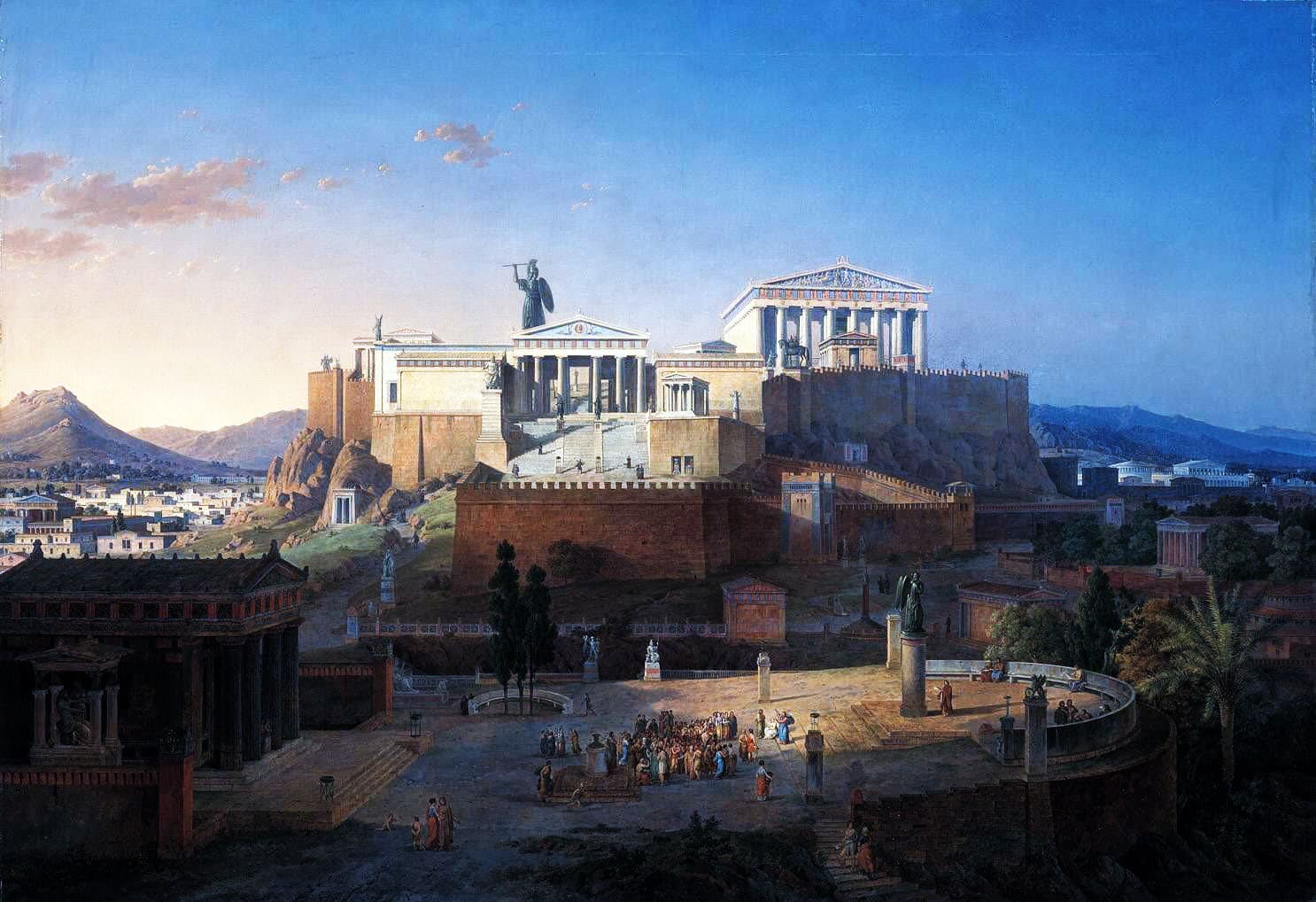
By the 7th century BCE, Athens was not a democracy but an oligarchy. Political power was concentrated in the hands of elite magistrates known as archons and the Areopagus Council, a body composed of former archons who held lifetime authority. For most Athenians, political participation was not an option. Power was inherited, concentrated, and largely unaccountable.
At the same time, the Athenian economy was overwhelmingly agricultural. Wealth depended almost entirely on land ownership and productivity. Unlike later economies with diversified income sources, there were few alternative paths to financial stability. As the population grew rapidly between 700 and 500 BCE, land became increasingly scarce. Smaller plots, declining soil quality, and unpredictable harvests placed enormous pressure on ordinary farmers.
A System Designed to Fail
As agricultural conditions worsened, many small farmers found themselves unable to sustain production. When harvests failed, they had little choice but to borrow money from wealthier landowners. These loans were not abstract financial instruments. They were secured against the only asset most people possessed: their land.
The consequences were devastating.
If a borrower failed to repay, the land passed into the hands of the creditor. Former landowners were often forced to remain on that same land as tenant farmers, producing just enough to survive but unable to generate surplus income. In many cases, the situation deteriorated further. Those who could not meet their obligations risked falling into debt bondage, losing not only their property but their personal freedom.
Over time, land ownership became increasingly concentrated in the hands of a small elite. As Aristotle later observed, “all the land was in the hands of a few, and if the poor failed to pay their rents, they and their children were liable to enslavement.” This was not a series of isolated misfortunes. It was a systemic trap.
Even members of the elite began to recognize the danger. A society in which large portions of the population were reduced to debt slavery was not stable. The crisis was no longer merely economic. It had become political.
Solon and the Politics of Survival
In response, the Athenians turned to Solon, appointing him as archon in 594 BCE with extraordinary powers to reform the system. Solon was not a revolutionary in the modern sense. He did not seek to overturn the social order entirely. Instead, he aimed to stabilize it.
His most famous reform addressed the core of the crisis: debt. In a sweeping measure later known as Seisachtheia, or the “shaking off of burdens,” Solon canceled existing debts and abolished debt slavery. Those who had been enslaved due to unpaid obligations were freed, and Athenians were no longer permitted to use their own bodies as collateral for loans.
This was a radical intervention, but it was also carefully calibrated. Solon did not attempt to redistribute land, a move that would have directly threatened elite interests. Instead, he sought to remove the most destructive features of the system while preserving its basic structure.
Redefining Status and Participation
Solon also introduced a new way of organizing society. Rather than defining status purely by birth, he established a classification system based on wealth. Citizens were divided into four groups according to their agricultural output, from the wealthiest landowners to the poorest laborers.
This shift was subtle but significant. It did not eliminate inequality, but it redefined it in more flexible terms. In principle, status could now change over time, depending on economic success rather than lineage alone.
More importantly, Solon expanded political participation. He created institutions that allowed broader segments of the population to take part in governance. The Assembly, known as the Ekklesia, was opened to all male citizens, including the poorest class. A new council, the Boule, was tasked with preparing legislation.
Yet these reforms had limits. The highest offices remained restricted to the wealthiest citizens, and elite influence did not disappear. Solon was walking a narrow line, attempting to reduce social tension without provoking outright resistance from those who held power.
Law, Justice, and the End of Arbitrary Punishment
Before Solon, Athens had been governed by the harsh legal code of Draco, whose laws were infamous for their severity. Even minor offenses could carry the death penalty. Justice was rigid, disproportionate, and often brutal.
Solon replaced this system with a more structured legal framework. Citizens gained the right to bring cases before courts, and decisions were made through juries rather than unilateral authority. This marked a crucial shift. Justice was no longer simply imposed from above. It became, at least in part, a collective process.
An Incomplete Transformation
Despite their significance, Solon’s reforms did not resolve all underlying tensions. Land remained concentrated, and political power was still unevenly distributed. The system was more stable than before, but not yet fully democratic.
It would take further changes to move Athens closer to what we now recognize as democracy.
Cleisthenes and the Reorganization of Power
Several decades later, Cleisthenes introduced reforms that fundamentally reshaped the political structure. He reorganized the population into new tribes based on geography rather than kinship, weakening traditional aristocratic networks.
Each tribe contributed representatives to a council of 500, creating a more balanced and distributed system of governance. This reorganization reduced factionalism and strengthened the idea that political identity should be tied to shared civic participation rather than family lineage.
With these reforms, the institutional foundations of Athenian democracy were firmly established.
Who Was Left Out
Even at its height, Athenian democracy was far from inclusive. Political participation was limited to adult male citizens. Women, enslaved individuals, and resident foreigners were excluded entirely. What emerged in Athens was not universal democracy, but a highly restricted form of it.
This limitation is essential to understanding the system. It was innovative, but it was not egalitarian in the modern sense.
Democracy as a Response to Crisis
Athenian democracy did not arise from abstract ideals alone. It was the product of necessity. Faced with economic collapse, social unrest, and the risk of widespread enslavement, the Athenians were forced to rethink how their society functioned.
The result was not a perfect system, but a durable one. By addressing the most destructive aspects of the debt crisis and gradually expanding political participation, Athens created a model that would influence political thought for centuries.
In this sense, democracy was not the starting point of Athenian history. It was the solution to one of its deepest crises.