At the height of his power, Napoleon Bonaparte ruled over a vast empire stretching from Portugal to Poland. His dominance was not simply the result of battlefield brilliance. It rested on something more fundamental: the construction of an army uniquely suited to a new way of war.
- Revolution and the Transformation of the Army
- Napoleon as Commander and Architect of Perception
- Organizational Innovation: The Corps System
- Speed, Concentration, and Decisive Battle
- Merit, Loyalty, and the Marshalate
- The Soldier’s Experience: Endurance and Motivation
- Conscription and Its Limits
- Overextension and Collapse
- Legacy
What historians call “Napoleonic warfare” was not invented from nothing. It emerged from the upheavals of the French Revolution, which transformed how armies were raised, organized, and deployed. Napoleon’s achievement was to take these innovations and turn them into a coherent, highly effective system. At the same time, some of the very features that made his army powerful would later contribute to its collapse.
Revolution and the Transformation of the Army
Before the Revolution, France already possessed one of Europe’s largest and most professional armies. However, military setbacks in conflicts such as the Seven Years’ War, combined with financial strain, weakened the state. When the French Revolution began in 1789, it did more than reshape politics. It shattered the structure of the army itself.
Many aristocratic officers resigned or fled the country, leaving a vacuum in command. Initially, this disrupted military effectiveness. Yet it also created an unexpected opportunity. Promotion was no longer tied exclusively to birth. Talented individuals from modest backgrounds could rise through the ranks.
Napoleon was one of them.
At the same time, revolutionary France introduced one of the most significant military innovations of the era: mass conscription. Beginning with the levée en masse in 1793, the state mobilized society on an unprecedented scale. War was no longer the business of small professional armies. It became a national effort.
French military thinkers, including figures such as Lazare Carnot and Antoine-Henri Jomini, contributed ideas about organization, strategy, and logistics. Advances in artillery, particularly under the Gribeauval system, improved mobility and firepower. Napoleon, trained as an artillery officer, absorbed these developments early in his career.
Napoleon as Commander and Architect of Perception
Napoleon’s success cannot be explained by structure alone. His personal style of command played a decisive role.
He favored constant offensive action. Rather than waiting for the enemy, he sought to seize the initiative and dictate the pace of battle. According to historians, defensive engagements were rare in his career until its final years. His campaigns depended on speed, surprise, and the ability to win what are sometimes called “encounter battles,” where opposing forces collided with incomplete information.
In such moments, Napoleon thrived on chaos.
Equally important was his mastery of propaganda. Napoleon did not merely win battles; he shaped how those battles were perceived. During the Italian campaigns of 1796–1797, he oversaw the publication of reports and newspapers that celebrated his victories and reinforced morale. Later, as emperor, he continued this practice through official bulletins.
He exaggerated successes and minimized losses, but the effect was powerful. His army believed in him, and the French public saw him as a near-mythical figure.
Organizational Innovation: The Corps System
The most important structural innovation of Napoleon’s army was the permanent corps system.
Before this period, armies were often organized into large, centralized formations. Napoleon divided his forces into semi-independent corps, each capable of operating as a miniature army. A corps typically included infantry, cavalry, and artillery, allowing it to fight independently if necessary.
This system provided several advantages:
- Mobility: Corps could march along separate routes, avoiding congestion.
- Flexibility: Units could concentrate rapidly at decisive points.
- Sustainability: Each corps could draw supplies from designated areas, reducing strain on logistics.
The system was supported by an efficient staff structure, in which figures like Louis-Alexandre Berthier played a crucial role. Berthier translated Napoleon’s broad strategic vision into precise operational orders.
The result was an army capable of moving faster and striking harder than its opponents.
Speed, Concentration, and Decisive Battle
Napoleonic warfare was built on a simple but demanding principle: concentrate superior force at the decisive moment.
Napoleon aimed to move quickly, divide enemy forces, and defeat them in detail before they could unite. This approach is clearly visible in his early Italian campaigns, where he separated Austrian and Piedmontese forces and defeated them individually.
It reached its most famous expression in the 1805 Ulm–Austerlitz campaign. Austrian commanders believed Napoleon’s army would take months to reach them. Instead, his forces covered roughly 480 kilometers in less than two weeks. The result was the encirclement and surrender of an entire Austrian army at Ulm, followed by a decisive victory at Austerlitz.
Speed was not simply an advantage. It was the foundation of his entire system.
Merit, Loyalty, and the Marshalate
Napoleon’s army also reflected a unique blend of old and new social principles.
On one hand, the Revolution had promoted ideals of equality and merit. On the other, Napoleon reintroduced elements of hierarchy and prestige. Institutions such as the Legion of Honour rewarded service and achievement, effectively creating a new form of elite status based on merit rather than birth.
This synthesis was most visible in the rank of marshal. Napoleon appointed a group of senior commanders who combined talent, loyalty, and political usefulness. Some, like Davout, rose through ability. Others, like Bessières, combined noble background with personal loyalty. Still others, including Lannes and Masséna, came from modest origins.
The message was clear: advancement was possible, but loyalty to Napoleon remained essential.
The Soldier’s Experience: Endurance and Motivation
For ordinary soldiers, service in the Grande Armée was demanding.
Marches of 30 kilometers per day were common, and longer distances were not unusual when required by strategy. Soldiers often lived off the land, especially during rapid campaigns. This approach worked during early victories but became increasingly problematic as campaigns extended into regions with poor infrastructure.
Despite these hardships, morale was often high. Napoleon cultivated a powerful sense of identity within his army. A popular saying captured this idea: every soldier carried a marshal’s baton in his knapsack. The implication was that promotion, even to the highest ranks, was within reach.
Napoleon reinforced this belief through recognition, storytelling, and the cultivation of regimental pride. Soldiers did not simply fight for France. They fought for advancement, honor, and the legend of their emperor.
Conscription and Its Limits
The scale of Napoleon’s wars required enormous manpower. Much of this came from conscription rather than voluntary enlistment.
Laws such as the Jourdan Law of 1798 made military service obligatory for young men. As the wars continued, the system expanded, drawing in younger and less experienced recruits. By the later years of the empire, many soldiers lacked the training and resilience of earlier generations.
Conscription also generated resistance, particularly in territories under French control. In regions such as Tyrol, opposition to taxation and forced service contributed to uprisings, including the revolt led by Andreas Hofer.
What had once been a source of strength began to reveal its limits.
Overextension and Collapse
The same factors that enabled Napoleon’s success eventually contributed to his downfall.
His armies grew larger, his campaigns longer, and his logistical systems increasingly strained. The strategy of living off the land became unsustainable in regions with poor infrastructure or hostile populations.
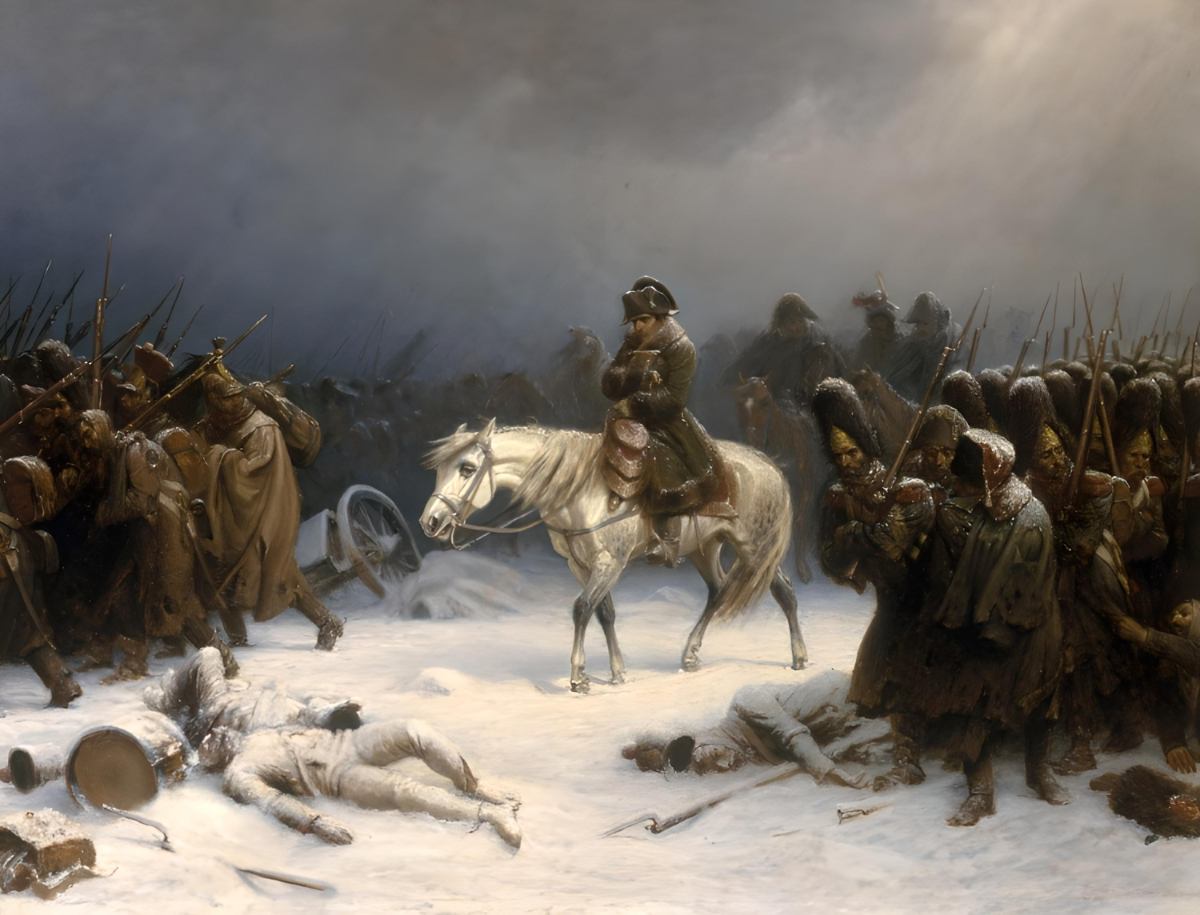
The 1812 invasion of Russia exposed these weaknesses dramatically. Of the hundreds of thousands of troops in the Grande Armée, a significant portion were not French but drawn from across the empire. This reflected both Napoleon’s reach and his growing reliance on non-French manpower.
At the same time, his enemies adapted. Coalition powers such as Austria, Prussia, Russia, and Britain learned from his methods and coordinated their efforts more effectively. Once they were able to concentrate their forces, Napoleon’s advantages diminished.
Defeat followed in a series of campaigns between 1813 and 1815.
Legacy
Despite its eventual collapse, Napoleon’s army left a lasting mark on military history.
The corps system remains a foundational principle of modern military organization. The emphasis on mobility, concentration, and decisive engagement continues to shape strategic thinking. His campaigns are still studied in military academies around the world.
Napoleon did not invent modern warfare, but he brought together its key elements and demonstrated their potential on an unprecedented scale. His army was not simply large. It was structured, motivated, and deployed in ways that defined an era.
In the end, the Grande Armée was both a product of revolution and a force that reshaped Europe. Its rise and fall illustrate a broader truth: the systems that create power can also, under pressure, lead to its limits.