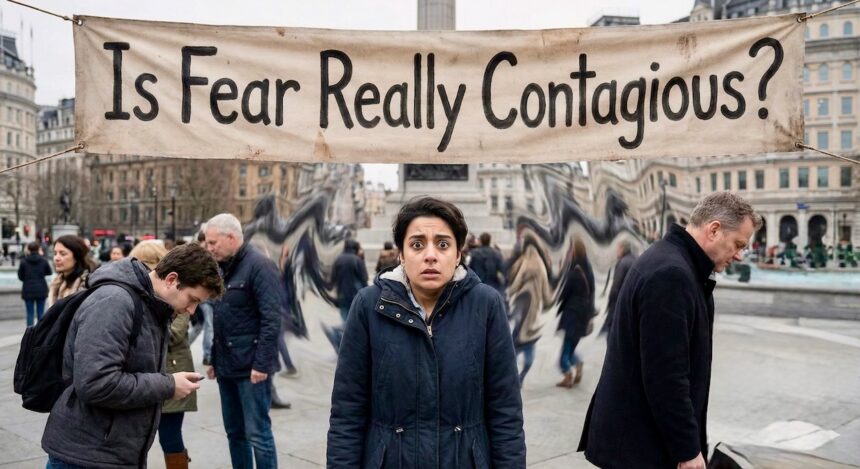
Rapid heartbeat, sweaty palms, stomach cramps, trembling knees—the iron grip of fear is unmistakable. It’s one of the least controllable emotions, making it very difficult to suppress or hide. But can you catch fear if someone near you is frightened? The answer to this question lies in the nature of the phenomenon.
What Function Does Fear Serve?
The ancient mechanism of fear is activated mainly in the face of physical threats. If one person fears a predator, others notice and react, even if they don’t see the danger directly. By learning from others what to fear, people survive.
In theory, fear should be contagious.
When a person senses someone else’s fear, the amygdala activates—a brain region that plays a key role in forming emotions and responding to threats. A signal is then transmitted to the hippocampus to mobilize the nervous system. The body releases adrenaline, which speeds up the heartbeat and breathing. This is all part of the “fight or flight” response, which provides the strength and energy to confront threats or escape from them.
How We Copy Fear
People naturally mimic each other, and many emotions are inherently social. We not only experience them but also share them. Copying emotions, including fear, is a fundamental element of our mutual understanding.
Research shows that we can feel fear simply by observing those who are afraid of something. Even if frightened faces flash before our eyes too quickly for us to consciously perceive them, the amygdala in our brain can still activate.
This suggests that fear can spread subconsciously.
In other words, research data indicates that we can copy fear from those around us, even if we haven’t been in the same dangerous situation or aren’t aware of what’s happening.
Animals, such as certain rodents, also pick up fear from each other. When rats hear distress signals from other rats experiencing pain, they freeze in terror.
Overall, fear can be transmitted through various pathways. Humans rely heavily on sight and hearing, while animals depend more on smell and hearing.
Can We Smell Fear?
Animals react acutely to odors. Many creatures—from zebrafish to ants—release pheromones when frightened or injured. These olfactory alarm signals warn of potential danger and trigger fear in other members of the same species.
For years, scientists doubted that we could smell fear. After all, we don’t have an organ that detects pheromones. However, recent research provides grounds to suppose that humans can still sense the smell of fear through chemical signals produced by the brain that activate the amygdala.
In a series of experiments, scientists collected sweat from those preparing to parachute jump and from those exercising on a treadmill. Participants were then given cotton pads with sweat samples to smell while undergoing brain scans. Test subjects who inhaled the sweat from parachutists showed increased amygdala activity. That is, they could likely pick up the parachutists’ emotions on a subconscious level.
What Determines Our Reaction to Others’ Fear?
All people share a common brain structure that makes fear contagious, but not everyone reacts to it the same way.
Genetics, past experience, and level of empathy can influence this.
People who aren’t particularly empathetic may experience less intense fear themselves when in the presence of someone gripped by terror. More empathetic individuals, conversely, will be affected more in such situations.
When everyone around is panicking, those with relevant knowledge and experience are also likely to be less frightened. For example, if a wild snake escapes from a terrarium at the zoo, the crowd’s fear won’t affect an experienced zoologist who knows the reptile isn’t actually dangerous.
Some people are biologically more inclined to pick up fear emotions from others. This may be connected to changes at the genetic level found in children whose parents survived catastrophes or wars. For instance, descendants of Holocaust victims possess heightened sensitivity to danger and therefore may not only experience fear more frequently themselves but also be more susceptible to others’ anxiety.
So, fear is indeed contagious. First and foremost, this increases our chances of avoiding physical danger. But in everyday life, we also fear situations that don’t actually contain real threats, such as public speaking or job interviews, and other people can catch and pass on our panic moods further. Therefore, it’s worth remembering that fear is contagious.