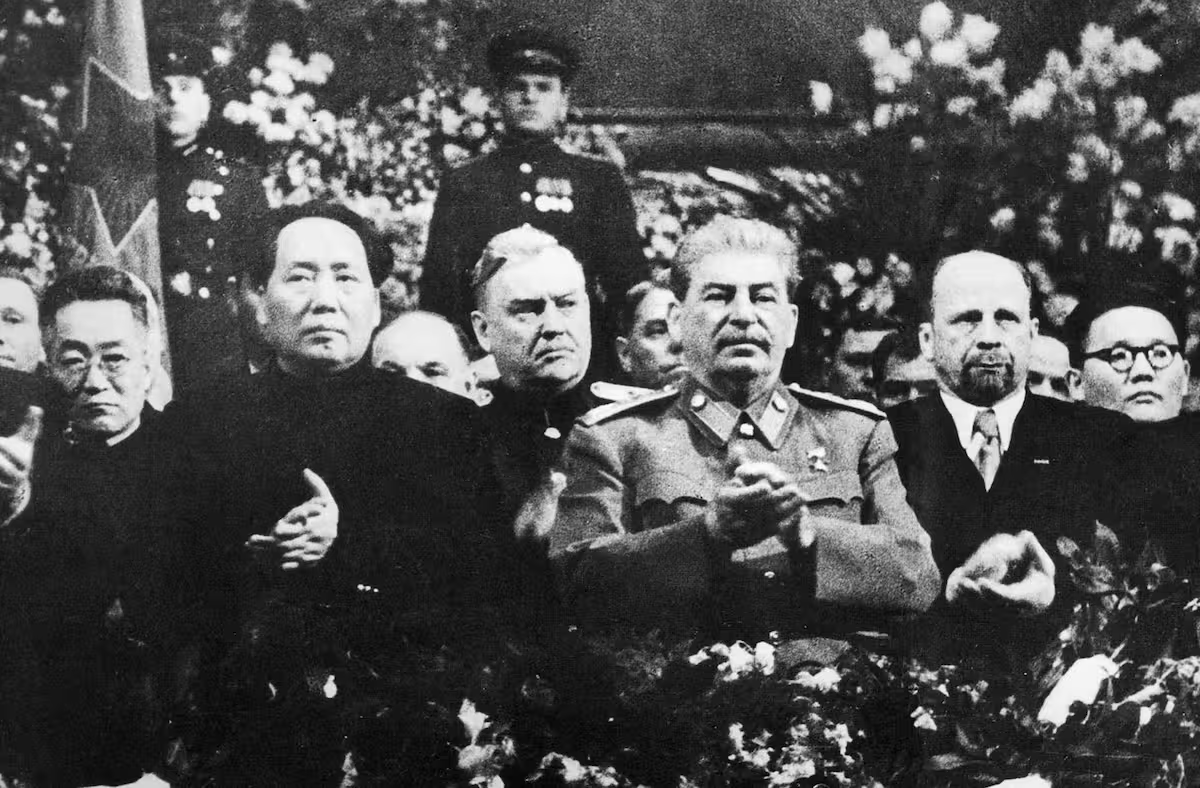
Stretching across forty-six years from the ashes of the Second World War in 1945 to the lowering of the red hammer-and-sickle flag over the Moscow Kremlin on Christmas Night in 1991, the Cold War was an ideological, geopolitical, and technological struggle for global supremacy between two nuclear-armed superpowers: the capitalist, democratic United States and its NATO allies, and the communist, one-party Soviet Union (USSR) and its Warsaw Pact bloc. It was called a “cold” war because the two superpowers never declared direct all-out shooting war on each other—knowing that a direct clash meant thermonuclear extinction under the doctrine of Mutually Assured Destruction (MAD)—instead waging proxy wars, espionage battles, and a race to the Moon across ten pivotal turning points.
1. February 4–11, 1945 & March 5, 1946: Yalta and the “Iron Curtain”
Even before Nazi Germany surrendered in May 1945, the wartime alliance between U.S. President Franklin D. Roosevelt, British Prime Minister Winston Churchill, and Soviet Premier Joseph Stalin began fracturing at the Yalta Conference (February 1945) over the fate of postwar Eastern Europe. As Stalin kept Red Army occupation forces stationed across Poland, Hungary, Romania, Bulgaria, Czechoslovakia, and East Germany to install Moscow-controlled communist regimes as a buffer zone, Winston Churchill traveled to Fulton, Missouri, on March fifth, 1946, and delivered his famous warning: “From Stettin in the Baltic to Trieste in the Adriatic, an iron curtain has descended across the Continent.”
2. June 24, 1948 – May 12, 1949: The Berlin Blockade and Airlift
When the United States, Britain, and France introduced a new stable currency (the Deutsche Mark) into their western occupation zones of Germany following the launch of the $13 billion Marshall Plan, Joseph Stalin retaliated on June 24, 1948, by cutting off all road, rail, and canal access to Allied-controlled West Berlin—which sat isolated 100 miles deep inside Soviet-occupied East Germany—hoping to starve two million West Berliners into submission.
Refusing either to abandon the city or start World War III by ramming an armored train through Soviet lines, President Harry S. Truman launched the Berlin Airlift: for eleven straight months, American and British cargo planes landed at West Berlin’s Tempelhof Airport **once every forty-five seconds day and night**, delivering 2.3 million tons of coal, flour, and medicine (plus tiny handkerchief parachutes of chocolate dropped for children by “Candy Bomber” pilots!) until Stalin admitted defeat and lifted the blockade in May 1949—the exact spring the Western allies founded NATO.
3. August 29, 1949 & June 25, 1950: The Soviet A-Bomb and the Korean War
In late 1949, two shocks ended America’s sense of untouchable security within weeks of each other: on August 29, 1949, four years earlier than Western intelligence predicted (thanks to stolen Manhattan Project blueprints), the Soviet Union detonated its first atomic bomb (RDS-1, “First Lightning”) in Kazakhstan, ending the U.S. nuclear monopoly; five weeks later, on October 1, 1949, Mao Zedong proclaimed the communist People’s Republic of China.
Nine months later, on June 25, 1950, the Cold War turned bloodily hot in Asia when communist North Korea—armed by Stalin and later backed by hundreds of thousands of Chinese troops—invaded South Korea, triggering the three-year Korean War (1950–1953) that cost over three million lives before freezing the peninsula along the 38th Parallel DMZ.
4. October 4, 1957: Sputnik 1 Launches the Space Race
Following Stalin’s death in 1953, the formation of the Soviet-led Warsaw Pact (1955), and the brutal Soviet tank crushing of the Hungarian Revolution (November 1956), the Cold War leaped into the heavens on October 4, 1957. Using an R-7 intercontinental ballistic missile rocket, the Soviet Union launched Sputnik 1—a polished 184-pound aluminum sphere the size of a beach ball that orbited the Earth every ninety-six minutes emitting a radio beep-beep-beep heard around the globe. Terrified that a rocket capable of putting a satellite over American heads could also drop a thermonuclear warhead on New York in thirty minutes, the U.S. established NASA in 1958, kicking off the twelve-year Space Race that saw Soviet cosmonaut Yuri Gagarin become the first human in space (April 1961) and American astronauts Neil Armstrong and Buzz Aldrin walk on the Moon aboard Apollo 11 (July 20, 1969).
5. August 13, 1961: Construction of the Berlin Wall
Between 1949 and 1961, more than 3.5 million East Germans—especially young doctors, engineers, and teachers—voted with their feet against communism simply by taking a subway train from East Berlin into prosperous West Berlin and flying out to West Germany. In the predawn darkness of Sunday, August 13, 1961, East German soldiers unrolled miles of barbed wire across the heart of Berlin, quickly replacing it with the twelve-foot concrete barriers, guard towers, dog runs, and “death strip” of the Berlin Wall—the ultimate physical symbol of the Cold War divide.
6. October 16–28, 1962: The Cuban Missile Crisis (13 Days at the Brink)
The closest humanity has ever come to thermonuclear extinction occurred over thirteen terrifying days in October 1962, after an American U-2 spy plane photographed Soviet technicians secretly constructing medium-range nuclear missile launch sites on the island of Fidel Castro’s Cuba—just ninety miles off the coast of Florida. Ordering a naval “quarantine” blockade around Cuba while nuclear bombers flew airborne on hair-trigger alert—and surviving a single hair-raising moment on October twenty-seventh when Soviet submarine officer Vasili Arkhipov refused to give the third vote needed to launch a nuclear torpedo at U.S. Navy ships!—President John F. Kennedy and Soviet Premier Nikita Khrushchev struck a secret compromise on October twenty-eighth: Khrushchev dismantled and removed all nuclear missiles from Cuba in exchange for Kennedy’s public pledge never to invade Cuba and a secret promise to remove older U.S. Jupiter missiles from Türkiye.
7. 1965–1975 & 1979: The Vietnam War, Détente, and Afghanistan
Guided by the “Domino Theory,” the United States deployed over half a million combat troops to South Vietnam starting in 1965, fighting a devastating decade-long conflict against communist North Vietnam and the Viet Cong that ended with the U.S. withdrawal in 1973 and the fall of Saigon on April 30, 1975. Meanwhile, President Richard Nixon executed a brilliant geopolitical pivot in 1972—visiting Mao Zedong in Beijing to open relations with China and signing the SALT I nuclear arms-limitation treaty in Moscow during a thaw known as Détente. That thaw froze solid again on December 24, 1979, when the Soviet Union invaded Afghanistan to prop up a communist government—getting trapped in a bleeding ten-year guerrilla war against U.S.-armed Mujahideen fighters.
8. March 11, 1985: Mikhail Gorbachev, Glasnost, and Perestroika
By the mid-1980s, facing President Ronald Reagan’s massive U.S. defense buildup, plunging world oil prices, and a stagnant Soviet command economy where citizens stood in line for hours for shoes and meat, the aging Soviet Politburo selected a fifty-four-year-old reformer as General Secretary on March 11, 1985: Mikhail Gorbachev.
To save the Soviet system from within, Gorbachev introduced two revolutionary policies: Perestroika (“Restructuring” the economy) and Glasnost (“Openness” and freedom of speech/press), while meeting Reagan at summits in Geneva and Reykjavik to sign the landmark 1987 INF Treaty eliminating an entire class of nuclear missiles—and crucially announcing the “Sinatra Doctrine”: that Moscow would no longer send Soviet tanks to crush Eastern European countries that chose to go their own way.
9. November 9, 1989 & December 25, 1991: The Fall of the Wall and the End of the USSR
Once people in Eastern Europe realized Soviet tanks would stay in their barracks, a peaceful democratic revolution swept the bloc in 1989: Poland’s Solidarity movement won free elections in June, Hungary opened its border fence with Austria, Czechoslovakia staged the Velvet Revolution, and on the night of November 9, 1989, after a confused East German press conference announced that citizens could cross the border “immediately,” hundreds of thousands of euphoric East and West Berliners climbed atop the Berlin Wall with sledgehammers and champagne, tearing down the barrier after twenty-eight years. Two years later, following a failed hardline coup in Moscow and the independence declarations of Ukraine and the other Soviet republics, Mikhail Gorbachev resigned on television on December 25, 1991—and as the Soviet flag was lowered from the Kremlin flagpole at 7:32 PM, the Cold War passed into history.