When British settlers arrived in Tasmania in 1803, they encountered not an empty land, but a complex and long-established Aboriginal society. Estimates suggest that between 6,000 and 8,000 Aboriginal people lived on the island, organized into dozens of clans and several distinct nations. Exact numbers remain uncertain, but what is clear is that Tasmania offers one of the most revealing case studies for understanding the impact of settler colonialism on Indigenous populations.
As historian Lyndall Ryan has argued, Tasmania provides one of the clearest examples of how colonial expansion reshaped, displaced, and devastated Aboriginal societies in Australia.
Aboriginal Tasmania Before British Settlement
Long before European arrival, Aboriginal people had lived in Tasmania for at least 40,000 years. The island was once connected to mainland Australia by a land bridge, which disappeared as sea levels rose thousands of years ago. Over time, Aboriginal communities adapted to the island’s diverse environments, developing social, ecological, and cultural systems deeply tied to the land.
These communities were organized into nations and clans, each with its own territory, language, and seasonal patterns of movement. Rivers, coastlines, and inland lake regions formed the basis of their subsistence and cultural life.
Daily life reflected a sophisticated relationship with the environment. Women gathered plant foods, roots, and shellfish, and hunted small animals. Men hunted larger game such as kangaroos and wallabies, as well as fish and marine animals. Fire was used strategically to manage landscapes and improve hunting conditions. Resources were used efficiently, and cultural practices, including the use of ochre in ceremonies and burials, reinforced connections between land, identity, and community.
This was not a marginal or fragile society. It was a resilient and highly adapted one.
First Contact and Early Violence
The first years after British arrival were marked by a mix of cautious interaction and growing tension. Encounters between settlers, Aboriginal groups, and escaped convicts were often shaped by misunderstanding, but also by clear imbalances of power.
Certain patterns quickly emerged. Settlers took Aboriginal children. Sealers and others abducted Aboriginal women. Aboriginal groups, in turn, responded to encroachments and violence in ways that settlers often interpreted as hostility. These interactions were not isolated incidents but early signs of a deeper structural conflict.
A key turning point came in 1804 at Risdon Cove. There, British soldiers opened fire on a group of Aboriginal people who were unarmed and engaged in seasonal movement. This event is widely regarded as the first large-scale massacre in Tasmania and set a precedent for the violence that followed.
Expansion and the Pastoral Invasion
After 1807, the scale and intensity of settlement increased dramatically. Hundreds of settlers and their families arrived, establishing farms along key river systems and fertile plains. Within a few years, large portions of Aboriginal land were occupied.
This was not simply settlement. It was a process of dispossession.
As farms expanded, so did the infrastructure that made permanent occupation possible: fences, huts, and roads. By the 1820s, vast areas of land had been formally granted to settlers, and the colony was rapidly transforming into a pastoral economy based on sheep farming.
For Aboriginal communities, the consequences were immediate and severe. Access to hunting grounds and food sources was restricted or eliminated. Traditional movement patterns were disrupted. Starvation became a real threat.
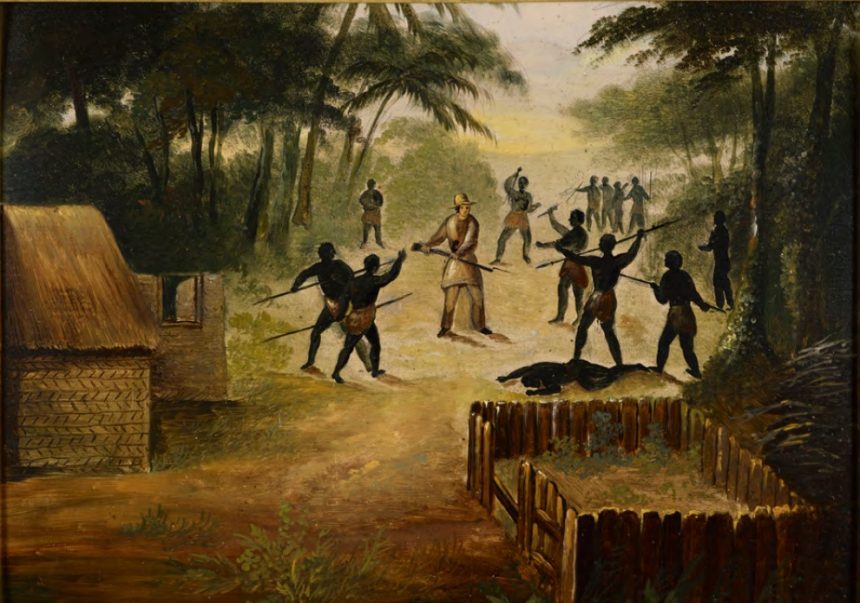
At the same time, violence intensified. Settlers carried out attacks on Aboriginal groups, often at night. Aboriginal groups responded with raids on farms and livestock. What followed was not random conflict, but a frontier war shaped by competing claims to land and survival.
Governor Arthur and the Legalization of Violence
In 1824, George Arthur was appointed governor of the colony. Arthur believed that Aboriginal people could be “civilized” and incorporated into colonial society, but only under strict conditions: conversion to Christianity and surrender of their land.
His policies reflected a fundamental contradiction. While presenting himself as a protector, he oversaw the expansion of a system that enabled widespread violence.
In 1826 and again in 1828, Arthur issued proclamations that effectively legalized the killing of Aboriginal people within designated “settled districts.” Martial law followed, formally declaring Aboriginal groups as enemies of the state.
Violence was no longer incidental. It was sanctioned.
The Black War and the Black Line
The period that followed is often referred to as the Black War. It was characterized by escalating cycles of violence between settlers and Aboriginal groups, but the balance of power remained overwhelmingly in favor of the colonists.
Military patrols were established to hunt down Aboriginal people. Settlers, convicts, and soldiers participated in coordinated campaigns. Aboriginal resistance continued, but it was increasingly constrained by loss of land, resources, and population.
In 1830, the colonial government launched one of the most ambitious operations of the conflict: the Black Line. Thousands of men formed a human chain across the island, attempting to drive Aboriginal people out of settled areas and into a confined region.
The operation largely failed in its immediate objective. Few Aboriginal people were captured. However, it demonstrated the extent to which the colonial state was willing to mobilize resources to control and remove the Indigenous population.
Removal and the Mission System
Following the failure of direct military strategies, colonial authorities turned to a different approach: removal under the guise of protection.
George Augustus Robinson played a central role in this process. He traveled across Tasmania, negotiating with Aboriginal groups and persuading them to relocate to designated areas, promising safety and support.
These relocations were not voluntary in any meaningful sense. They were shaped by exhaustion, coercion, and the absence of viable alternatives.
Initial attempts, such as the settlement on Gun Carriage Island, quickly failed due to disease and lack of resources. Survivors were moved to Flinders Island, where the Wybalenna establishment was created as a controlled settlement for displaced Aboriginal people.
Life there was harsh. Disease spread rapidly. Food was inadequate. Cultural practices were disrupted. Mortality rates were high.
Wybalenna, Oyster Cove, and Survival
By the early 1830s, most surviving Aboriginal people had been removed from mainland Tasmania and concentrated in settlements like Wybalenna. Later, in 1847, many were relocated again to Oyster Cove.
Conditions remained poor. Families were separated. Children were removed. Many individuals suffered from illness, depression, and alcohol dependency. Yet despite these conditions, Aboriginal people continued to adapt, resist, and maintain aspects of their identity.
Figures such as Walter Arthur emerged as leaders within these communities. Alongside others, he advocated for rights, fair treatment, and self-governance. In 1846, a group of Aboriginal men petitioned Queen Victoria, asserting their autonomy and protesting the conditions imposed upon them.
This was not passive survival. It was political action.
The Myth of Extinction
For many years, colonial narratives claimed that Tasmanian Aboriginal people had disappeared. This idea was reinforced by the death of Truganini in 1876, who was often incorrectly described as the “last” Tasmanian Aboriginal person.
This claim is false.
Aboriginal communities persisted, particularly in the Bass Strait islands and northern Tasmania. Individuals such as Fanny Cochrane Smith and others maintained cultural practices and passed them on to future generations.
The history of Tasmania is not one of complete erasure. It is one of survival under extreme pressure.
The colonization of Tasmania was not a simple story of settlement. It was a process of dispossession, violence, and forced removal, supported by legal and administrative systems.
At the same time, it was also a story of endurance. Aboriginal people resisted, adapted, and asserted their identity even in the most difficult conditions.
Tasmania stands as one of the clearest examples of settler colonialism in practice. It shows how land, power, and ideology can reshape entire societies—and how those societies, despite everything, can endure.