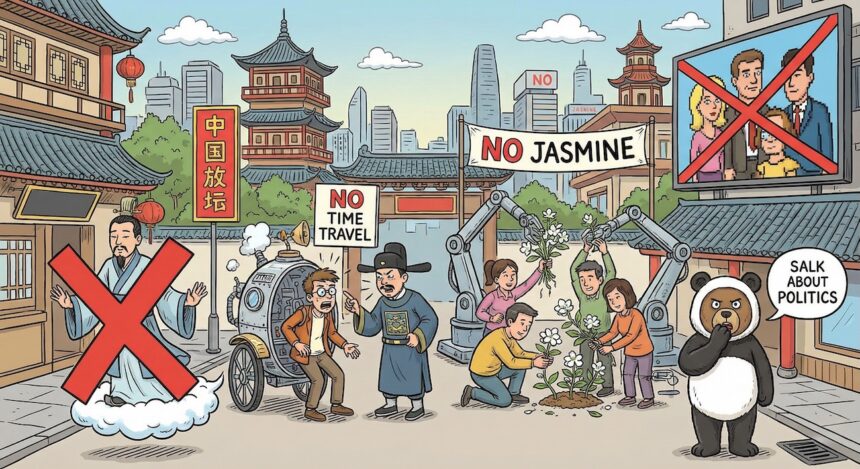
1. Movies About Time Travel and Ghosts
Since 2011, China has had a ban on the screening of movies and TV shows about time travel. The country’s leadership explained this unusual decision as necessary to prevent historical distortions and insults to Chinese culture.
The issue was that at the time, films featuring characters who moved from modern China to ancient times were attracting increasingly large audiences. The government worried that such films could alter ordinary Chinese people’s perception of the past and negatively influence the nation’s collective consciousness.
No more time travelers appearing in the party apparatus of comrade Mao or at the court of Emperor Qin Shi Huang.
However, the ban on showing films isn’t limited only to time travelers’ adventures. The restrictions also affected cinema with elements of feudalism, superstitions and reincarnation, as well as content containing “horror, ghosts and the supernatural.” For example, China banned the showing of films like “Pirates of the Caribbean: Dead Man’s Chest,” “Crimson Peak,” and “Ghostbusters.”
The Communist Party of China (CPC) explained this by stating that “such films could undermine the party’s stability and authority and raise doubts about the power and legitimacy of its regime.” The Chinese authorities didn’t specify exactly how films about walking skeletons and time travelers could shake the foundations of society, but as they say, better safe than sorry.
2. Peppa Pig
It would seem that the cartoon about Peppa Pig is quite harmless, but it’s banned in China. You see, the country has a kind of “gangster” youth subculture called “shehuiren” (translated as “people of society”), sort of like “guys from the neighborhood.”
These hooligans chose Peppa as their symbol, making all sorts of outrageous memes with her and even getting tattoos of her.
Chinese media wrote that fans of the “Peppa Pig” cartoon don’t share the values that dominate the country, usually have poor education and no stable work: “They are dishonest idlers, vagrants and the complete opposite of the young generation that the Communist Party is trying to raise.”
In short, the authorities decided that if they couldn’t deal with the hooligans, they could at least get rid of their symbols. So they cleaned out more than 30,000 Peppa cartoons from their video-sharing platforms and banned the hashtag #PeppaPig on their social networks.
3. The Big Bang Theory
“The Big Bang Theory” became one of the most popular American comedies in China. But in 2014, the State Administration of Press, Publication, Radio, Film and Television (SARFT) banned the show. It was removed from the country’s largest streaming service Sohu, where the sitcom had garnered more than 1.3 billion views by that point.
You see, China also has something like a subculture called “diaosi,” which can be translated as “pubic hair.”
This is a derogatory slang term for a stereotypical loser—a poor guy without work, a girlfriend, or any clear plans for the future.
There are significantly more men than women in China, due to the “one family, one child” policy conducted in the past. Most parents chose abortion when they found out they would have a girl, because having a son was considered more advantageous and prestigious than a daughter. As a result, Chinese society developed a considerable number of unattached guys suffering from loneliness and lack of social and economic prospects. In 2013, for example, according to Sohu service data, more than 80% of respondents aged 30-39 identified themselves as “diaosi.”
Meanwhile, the Chinese government considers them unreliable comrades. Instead of building careers, starting families and boosting the communist economy with demographics, these wimps play their games and watch Western cartoons.
And “The Big Bang Theory” shows these losers Sheldon Cooper and other timid but smart nerds, creating among “diaosi” the impression that being like this is normal and nothing to be ashamed of. So censors from SARFT decided to reduce the corrupting influence of the West on Chinese society through the popular series.
However, in 2015, under pressure from a dissatisfied public, the ban was lifted, and the eighth season of the sitcom was released in China—after censors approved all 24 episodes.
4. Adult Films
This is one of the oldest bans operating in the country. Pornography has been prohibited in the People’s Republic of China since the founding of the socialist state in 1949. Anyone who produces, distributes or acquires indecent magazines, books and videos can be punished.
Usually they only punish with a fine and warning.
But not always. In 2005, the creator of the country’s largest porn site was sentenced to life imprisonment.
At the same time, it’s not entirely clear what exactly Chinese authorities mean by pornography. The law is unclear on this issue: officials can ban anything that “violates public morals and harms the physical and mental health of youth.” Most often these are adult images and videos, but sometimes fragments of books with frivolous content fall under the ban, and occasionally works of art featuring nudity.
The Chinese government diligently filters porn on the internet, so DVD movies with pornographic films and books with erotic scenes are still in demand on street markets in the country. For example, the classic 17th-century Chinese literature work “The Golden Lotus,” which fell into the list of banned items due to its openly sexual nature.
5. Erotic Banana Eating
Not only the display of sex poses a danger to Chinese public morality. In 2016, Beijing television channel CCTV reported that authorities banned live streaming platforms from showing videos in which young female hosts seductively eat bananas. This ban became part of the fight against vulgar, violent and sexual content on the Chinese internet.
Now Chinese streaming platforms such as DouYu, Panda.tv and YY are obliged to constantly monitor that girls creating video content don’t eat oblong-shaped fruits on camera. They were also banned from wearing mini-skirts and revealing tops. No corrupting communist society.
6. Puns About Alpacas
China has also banned puns. Not all of them, of course—just some.
In 2009, the Chinese government tried to fight foul language on the internet by including filters against profane words on popular sites. In response, Chinese users continued to swear, but euphemistically—using puns.
Soon on the Baidu Baike website, China’s equivalent of Wikipedia, a humorous article appeared with various puns. Due to the complexity of the Chinese language, many generally harmless words with the slightest change in writing or pronunciation can be transformed into quite indecent ones, and this feature of speech serves as a basis for countless jokes among the Chinese themselves.
The article described imaginary animals whose names could sound ambiguous. One such indecent phrase—”dirty grass horse”—was represented as an alpaca. This sounds like “caonima” and is similar to “cao ni ma,” which in Mandarin means “your mother!” Alpacas eat “fertile grass” “wo cao,” which also means “to copulate.” And they live in the desert “male gebi,” which, very mildly put, can sound like “vagina.”
The article, teaching users to swear and bypass internet filters, caused a sensation on the Chinese internet.
Memes, music videos and cartoons about the “dirty grass horse” began to appear, collecting millions of views. In addition, some Chinese manufacturers began producing plush alpaca toys and other souvenirs.
But after some time, jokes about alpacas were also banned on the Chinese internet, because the puns started being used to mock the CPC. Party members were called river crabs “hexie,” which also means “hooligan, brawler, getting his way with fists.” And alpacas supposedly don’t like crabs and fight them.
In short, in 2009, the State Administration of Radio, Film and Television of China issued a directive banning online content that could “incite ethnic discrimination or undermine social stability.” The list of censored information also included jokes about alpacas.
7. Unauthorized Reincarnation
Yes, China has such a ban at the legislative level. If you joke about being a pharaoh or some other interesting person in your past life, the Chinese government may have serious questions for you.
Anyone who claims to have reincarnated from a past life or wishes to reincarnate in the next one must obtain permission from the state and follow the rules established by Order No. 5 of the State Bureau for Religious Affairs of China.
The ban on unauthorized reincarnation is essentially directed at one single person—the current Dalai Lama, the spiritual mentor of Tibetan Buddhists. He fell into disgrace with the Chinese government and has already stated that he will not be reborn on Chinese territory out of principle.
It’s important to the PRC that the next Dalai Lama be a Chinese citizen, so the party decided to prohibit anyone from being reborn in the wrong place.
If Tenzin Gyatso—the current Dalai Lama—dies, Buddhist monks will begin searching for the infant into whom he reincarnated, and that person will become the new leader. But the CPC may not recognize him and appoint its own Dalai Lama. Perhaps in the future, Tibetan Buddhists will have two mentors, one of whom is approved by China.
This has happened before in world history—with Roman popes, when from 1378 to 1417, three pontiffs simultaneously claimed the Vatican throne: Pope Urban VI, antipope Clement VII and antipope Alexander V. And the Dalai Lama will probably somehow figure out for himself where to reincarnate.