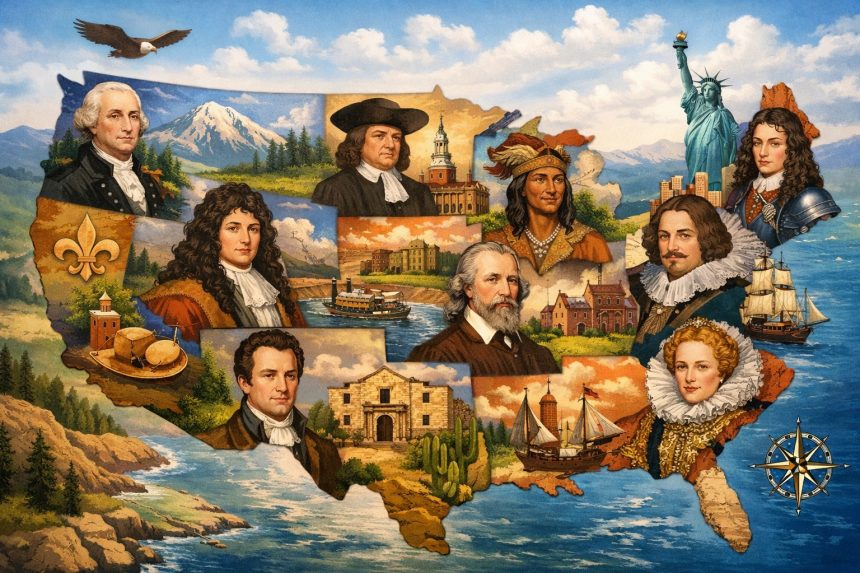
A surprisingly large number of U.S. states are named after real historical figures. Some of these names belong to well-known monarchs and political leaders, while others trace back to lesser-known individuals whose influence was tied to exploration, colonization, or imperial politics. From queens and kings to naval commanders and a founding president, these names are embedded in the American map. Behind them, however, lie deeper stories of power, ambition, and the cultural values of their time.
Virginia: Elizabeth I
Virginia, the first enduring English foothold in North America, takes its name from Queen Elizabeth I. Known as the “Virgin Queen” for her refusal to marry, Elizabeth carefully cultivated an image of purity and devotion to the state. Naming a colony in her honor reinforced both her symbolic authority and England’s imperial aspirations.
The name “Virginia” entered European maps in 1584 through the efforts of Sir Walter Raleigh, one of Elizabeth’s favored courtiers and explorers. Raleigh proposed the name as a gesture of loyalty and gratitude, even though he himself never established a permanent settlement there.
Before this, early English encounters with the region had produced the name “Wingandacon,” likely the result of a misunderstanding with Indigenous peoples. This name was eventually replaced, and by the late 16th century, “Virginia” had become standard in official English usage. The adoption of the name reflected not only royal patronage but also the broader process of imposing European identity onto newly claimed lands.
The symbolic reach of the name extended further. Virginia Dare, the first English child born in the Americas, carried the colony’s name, linking identity, territory, and imperial ambition in a single narrative.
North and South Carolina: Charles I
Like Virginia, the Carolinas were named in honor of a monarch, King Charles I. The name derives from the Latin form “Carolus,” later adapted into “Carolina.” It first appeared in a 1629 charter granted to Sir Robert Heath, though that early attempt at colonization failed due to financial and political obstacles.
The idea was revived after the restoration of the monarchy under Charles II. In 1663, the king granted the territory to a group of aristocrats known as the Lords Proprietors. These men envisioned a structured, hierarchical society influenced in part by the ideas of philosopher John Locke.
In practice, geography and economics shaped the colonies more than theory. North Carolina developed slowly, characterized by smaller farms and dispersed settlements. South Carolina, by contrast, grew rapidly after the founding of Charleston in 1670, becoming one of the wealthiest colonies through plantation agriculture based on rice, indigo, and enslaved labor.
Although the colonies were formally divided in 1712, they remained under shared governance until 1729, when they became separate royal colonies. The name “Carolina” endured as a lasting symbol of monarchical authority and colonial expansion.
Georgia: George II
Georgia, the last of the original British colonies, was named after King George II. Unlike many earlier colonies, it was conceived not primarily as a commercial venture but as a social experiment.
The driving force behind its creation was James Oglethorpe, a former military officer and member of Parliament. He envisioned Georgia as a refuge for the “worthy poor,” particularly debtors imprisoned in England’s overcrowded prisons. With royal approval, Oglethorpe and a group of trustees established the colony in 1733, founding the city of Savannah.
The original design of Georgia reflected a mix of idealism and strategic calculation. It was intended to serve as a buffer zone between British territories and Spanish Florida, while also fostering a society of small, independent farmers. To support this vision, early regulations prohibited slavery, large landholdings, and even the importation of rum.
These restrictions did not last. Economic realities, especially the profitability of plantation agriculture in the region’s climate, led settlers to push for change. By 1752, the trustees relinquished control, and Georgia transitioned into a more conventional colony driven by market forces rather than social reform.
Louisiana: Louis XIV
Louisiana takes its name from King Louis XIV of France, one of the most powerful monarchs in European history. The region was claimed for France in 1682 by the explorer René-Robert Cavelier, Sieur de La Salle, who reached the mouth of the Mississippi River and declared the vast surrounding territory in the king’s name.
The claim was expansive, stretching from the Great Lakes to the Gulf of Mexico and encompassing a significant portion of what is now the United States. Known as La Louisiane, or “the land of Louis,” the territory was intended to link France’s northern and southern holdings in North America.
In practice, Louisiana remained sparsely populated and loosely governed, relying on a network of forts and missions. Following France’s defeat in the Seven Years’ War, the territory was transferred to Spain in 1763 to prevent it from falling into British hands. It later returned to French control before being sold to the United States in 1803, a transaction that dramatically expanded the young republic.
Washington: George Washington
Washington stands apart from other states named after individuals. When it achieved statehood in 1889, more than a century had passed since George Washington had led the American Revolution and served as the nation’s first president. By then, his name had become synonymous with republican virtue and national unity.
The territory was carved from the northern portion of the Oregon Territory, where settlers felt politically and economically marginalized by distant centers of power. Naming the region after Washington served as both a tribute and a unifying symbol during a period of growing national tension.
There were concerns about confusion with Washington, D.C., but the symbolic value of the name prevailed. Unlike earlier state names tied to monarchy or aristocracy, Washington represented a different ideal: leadership based on merit, civic responsibility, and national identity.
Lesser-Known Figures in the Mid-Atlantic
Not all state names are linked to reigning monarchs. Some reflect more indirect forms of influence.
Maryland, for example, was named after Henrietta Maria, the wife of Charles I. Unlike other royal names, hers came from a queen consort rather than a ruling monarch. The name, originally Terra Mariae, appeared in the colony’s founding charter and carried both political and religious significance, as the colony was intended in part as a refuge for English Catholics.
Delaware derives its name from Thomas West, 3rd Baron De La Warr. Although he never set foot in the region, his leadership during a critical period in the Virginia colony earned him recognition. Explorers named the nearby river and bay in his honor, and the name eventually extended to the surrounding territory.
Pennsylvania reflects a different kind of legacy. In 1681, King Charles II granted a vast tract of land to William Penn to settle a debt owed to his father, Admiral Sir William Penn. The name, meaning “Penn’s Woods,” honored both the family and the individual who would go on to establish a colony grounded in religious tolerance and self-governance.
Names as Historical Markers
The names of U.S. states are more than geographic labels. They are remnants of historical relationships shaped by empire, authority, and identity. Monarchs used naming as a tool of legitimacy. Explorers used it to claim and define territory. Later generations used it to express national ideals.
What appears on a map as a simple name often reflects a deeper story. Each one marks a moment when power, culture, and ambition intersected, leaving a lasting imprint on the landscape.