In the pantheon of nineteenth-century nation-builders, if Count Camillo di Cavour served as the calculating diplomatic brain of Italian unification and Giuseppe Mazzini acted as its idealistic prophetic soul, then Giuseppe Garibaldi was indisputably its fearless, indispensable sword. Born a sailor in Nice, condemned to death in his twenties as a revolutionary rebel, hardened by twelve years of guerrilla warfare in South America, and adored across the globe in his signature red flannel shirt and poncho, Garibaldi accomplished military feats during the Risorgimento—the “Resurgence” or unification of Italy—that transformed a geographic collection of divided monarchies into a single unified Kingdom of Italy in 1861.
From Merchant Sailor to the Hero of Two Worlds
Giuseppe Garibaldi was born on July fourth, 1807, in the coastal city of Nice (Nizza), which had recently been annexed by Napoleonic France and was soon returned to the Italian Kingdom of Piedmont-Sardinia. Growing up on the Mediterranean docks, he became a merchant sea captain in his twenties. During a voyage to the Black Sea in 1833, Garibaldi met followers of the exiled nationalist thinker Giuseppe Mazzini and joined Young Italy (La Giovine Italia), a secret movement dedicated to driving Austrian Habsburg rule out of the Italian peninsula and establishing a unified democratic Italian republic.
After participating in a failed republican sailors’ mutiny in Genoa in February 1834, the twenty-six-year-old Garibaldi saw his name printed in a newspaper notice sentencing him to death by firing squad in absentia. Fleeing in disguise across the Atlantic Ocean to South America, Garibaldi spent the next twelve years fighting for independence and republican causes—first for the breakaway Rio Grande do Sul Republic in southern Brazil, where he met his fearless comrade and future wife, Anita Ribeiro da Silva, and then commanding the Italian Legion in the defense of Montevideo during the Uruguayan Civil War. It was in Uruguay in 1843 that Garibaldi acquired a shipment of cheap red woolen tunics originally manufactured for workers in Buenos Aires slaughterhouses; worn to mask bloodstains and identify his volunteers in gunsmoke, the Red Shirt (Camicia Rossa) and South American gaucho poncho became Garibaldi’s lifelong uniform and earned him international fame as the “Hero of Two Worlds.”
The Defense of the Roman Republic in 1849
When the Revolutions of 1848 swept across Europe and Milan and Venice rose up against Austrian rule, Garibaldi sailed back to Italy with sixty of his veteran Red Shirts to offer his sword to the cause of national liberation. In the spring of 1849, after Pope Pius IX fled a popular uprising in Rome, Mazzini and Roman democrats proclaimed the short-lived Roman Republic, entrusting the military defense of the Eternal City to Garibaldi.
When French President Louis-Napoleon Bonaparte dispatched a professional French expeditionary army under General Oudinot to crush the republic and restore the Pope, Garibaldi led a heroic, outnumbered defense atop the Janiculum Hill from April to July 1849, routing the initial French assault at the Porta San Pancrazio before weeks of heavy French siege artillery breached the ancient walls. Refusing to surrender personally, Garibaldi led four thousand volunteers—accompanied by his pregnant wife Anita mounted on horseback—in a legendary mid-summer retreat across the Apennine mountains while hunted by French, Austrian, Spanish, and Neapolitan armies. Although Anita died tragically of malaria in his arms inside a farmhouse near Ravenna while Garibaldi barely escaped back into exile—spending time working quietly as a candle maker on Staten Island, New York, and captaining ships in the Pacific—his defense of Rome made him a living legend to every patriot in Italy.
The Pragmatic Alliance With Cavour and King Victor Emmanuel II
Returning to Italy in 1854 to purchase a rugged granite farm on the Sardinian island of Caprera, the maturing Garibaldi made a momentous political decision that broke the hearts of strict republicans like Mazzini: recognizing that only the regular army and diplomatic alliances of the Kingdom of Piedmont-Sardinia had the realistic strength to expel the Austrian Empire from northern Italy, Garibaldi set aside his republican idealism and pledged his loyalty to King Victor Emmanuel II and his brilliant Prime Minister, Count Cavour.
During the Second Italian War of Independence in 1859, while Franco-Piedmontese forces fought the Austrians at Magenta and Solferino, Garibaldi commanded a volunteer mountain corps called the Hunters of the Alps (Cacciatori delle Alpi), winning dazzling victories over Austrian forces at Varese and San Fermo to liberate northern Lombardy. Yet his relationship with Cavour soured into bitter fury in early 1860 when, in exchange for French military help and annexation of central Italy, Cavour ceded Garibaldi’s beloved hometown of Nice to Emperor Napoleon III of France—turning Garibaldi into the eloquent Italian parliamentarian noted wryly that Cavour had made him a foreigner in his own homeland.
The Expedition of the Thousand (1860): Conquering a Kingdom
Just weeks after losing Nice, in May 1860, Garibaldi launched the most audacious military campaign of the nineteenth century: the Expedition of the Thousand (Spedizione dei Mille). Learning of an armed revolt in Sicily against the tyrannical rule of the Bourbon King Francis II of the Kingdom of the Two Sicilies—who commanded a well-equipped regular army of over one hundred thousand soldiers and a powerful navy—Garibaldi crowded exactly one thousand and eighty-nine volunteers, mostly students, professionals, and artisans wearing red shirts and armed with rusty antique smoothbore muskets lacking bayonets, aboard two hijacked paddle steamers, the Piemonte and the Lombardo, sailing out of Quarto near Genoa on the night of May fifth, 1860.
Landing at Marsala on the western tip of Sicily on May eleventh under the indirect presence of British Royal Navy warships, Garibaldi declared himself Dictator of Sicily in the name of Victor Emmanuel II, King of Italy. Only four days later, at the terraced hill of Calatafimi, when his outnumbered volunteers came under heavy rifle fire and his lieutenant Nino Bixio suggested retreating, Garibaldi uttered his immortal reply: “Here we make Italy, or we die!” Charging uphill with the bayonet, the Thousand routed the Bourbon troops.Joined by thousands of Sicilian peasant insurgents (picciotti), Garibaldi executed a brilliant feint through the mountains to storm the capital city of Palermo, won a fierce pitched battle at Milazzo, crossed the Strait of Messina onto the Italian mainland in August, entered Naples in an open carriage to the thunderous cheers of the populace without firing a shot on September seventh, and defeated thirty-five thousand Bourbon regulars at the Battle of the Volturno on October first. In under five months, a thousand poorly armed volunteers had toppled an eight-hundred-year-old kingdom of nine million people.
The Handshake at Teano and Legacy
As Garibaldi stood victorious in Naples preparing to march north to liberate papal-held Rome—a move that would have triggered an immediate war with the French garrison protecting the Pope—Count Cavour hastily marched the royal Piedmontese army south through the eastern Papal States to intercept him. The climax of the Risorgimento occurred on the morning of October twenty-sixth, 1860, at a rustic crossroads bridge near Teano, north of Naples.
Riding forward in his poncho and cap to meet King Victor Emmanuel II at the head of the royal army, Garibaldi—who held absolute dictatorial command over all of southern Italy and could have easily carved out his own personal realm—reined in his horse, removed his hat, and shouted aloud: “I salute the first King of Italy!” Having handed half of the Italian peninsula over to the King, Garibaldi asked solely for the recognition of his volunteer officers and a year’s supply of seed grain for his farm; when offered royal titles, dukedoms, castles, and fortunes by the grateful monarch, he refused every single coin and sailed quietly back to his rocky island of Caprera carrying only a sack of dried beans, a bag of seed corn, and a barrel of salted cod. Although he spent his later years campaigning tirelessly to add Venice (achieved in 1866) and Rome (achieved in 1870) to the new nation before passing away on Caprera in June 1882, that selfless handshake at Teano secured Garibaldi’s place as the incorruptible father of modern Italy.
For more than a century after the discovery of the painted caves of Altamira in Spain and Lascaux and Chauvet in France, archaeology textbooks taught a Eurocentric story about the birth of human creativity: that representational figurative art and visual storytelling erupted first in Ice Age Europe between thirty thousand and forty thousand years ago. Over the past decade, however, a series of breathtaking discoveries inside the tropical limestone karst caves of Sulawesi, Indonesia, has shattered that timeline completely—culminating in the 2024 dating of a dynamic hunting narrative painted on a cave ceiling at least 51,200 years ago, making it the oldest known figurative cave art and visual story in human history.
Leang Karampuang and Leang Bulu’ Sipong 4 in Sulawesi
The breakthrough discoveries took place inside the Maros-Pangkep limestone karst region of South Sulawesi—an otherworldly landscape of steep, jungle-covered limestone towers riddled with hundreds of prehistoric rock shelters and high cliff caves. Conducted by a joint team of Indonesian and Australian scientists led by Maxime Aubert, Adam Brumm, and Adhi Agus Oktaviana from Griffith University, Southern Cross University, and Indonesia’s National Research and Innovation Agency (BRIN), the research focused first on the cave of Leang Tedongnge (where a lifelike painting of a warty pig was dated to 45,500 years ago) and then on the ceiling of Leang Karampuang.
Painted high up on the limestone ceiling of Leang Karampuang in dark red ochre mineral pigment is a striking, action-packed narrative scene:
The Giant Sulawesi Warty Pig: Dominating the panel is a large, anatomically vivid painting of a wild Sulawesi warty pig (Sus celebensis) measuring nearly three feet across, standing upright on its four legs watching the figures around it.
Three Therianthropic (Human-Animal Hybrid) Figures: Surrounding the pig are three smaller human-like figures painted in dynamic, interacting poses—one appearing to hold a rod or object right up against the throat of the pig, while another figure stands upside down directly above the pig’s head with legs splayed out. Crucially, these figures display therianthropic traits (part-human, part-animal features, such as bird-like beaks or animal tails), proving that more than fifty-one millennia ago, early humans were not merely copying real animals they saw in the woods, but painting mythical beings and spiritual stories from their imagination!
Laser-Ablation Uranium-Series Dating: How Scientists Proved the Age
Why couldn’t archaeologists date Indonesian cave paintings decades ago? Unlike charcoal drawings in French caves that contain organic carbon suitable for radiocarbon (C-14) dating—which hits an absolute ceiling around 45,000 to 50,000 years anyway—the Indonesian murals were painted using inorganic iron-oxide red clay (ochre), which contains zero carbon to date.
To solve this problem without damaging the priceless artwork, the research team used a revolutionary technique published in Nature in July 2024 called laser-ablation uranium-series (LA-U-series) imaging:
Over thousands of years as rainwater seeped through the porous limestone roof of the cave, microscopic layers of translucent calcium carbonate mineral crust—nicknamed “cave popcorn”—slowly grew right on top of the painted red pig.
Because water carries trace amounts of natural radioactive uranium (which slowly decays at a fixed, known constant rate into the element thorium), measuring the exact ratio of uranium to thorium inside the mineral layer sitting directly *on top* of the paint gives a guaranteed minimum age for the painting underneath!
By using a microscopic laser beam less than the width of a human hair to vaporize and map tiny layers of the calcium carbonate closest to the pigment surface, the team proved that the mineral crust covering the Leang Karampuang scene formed at least 51,200 years ago—while also updating the age of a nearby hunting scene at Leang Bulu’ Sipong 4 to at least 48,000 years old.
Rewriting the Journey of Modern Humans
Pushing the dawn of figurative storytelling back past fifty-one thousand years in Southeast Asia forces a profound reassessment of cognitive evolution. Because the first Homo sapiens crossed the ocean straits through the Indonesian islands of Wallacea to reach Australia by roughly 60,000 to 65,000 years ago, the sophistication of the Sulawesi cave art strongly suggests that modern humans did not suddenly invent representational art after arriving in Europe or Asia—instead, our ancestors likely carried a rich tradition of symbolic painting and mythical storytelling out of Africa with them from the very beginning of our species’ global journey.
The Chipko movement began in the early 1970s in Uttarakhand, India, as a people’s movement for the protection of forests. The word “Chipko” means “embrace” or “stick to” in Hindi, referring to the characteristic of tree-huggers who would hug trees and not let them be cut down. The environmental impact of this movement and the involvement of Indian rural communities, especially women, are salient features.
The genesis of the Chipko movement can be traced back to the 18th century, when a group led by Amrita Devi tried to stop the cutting of khejri trees in one village in the state of Rajasthan. The modern version of the Chipko movement started in Uttarakhand state, specifically, the Garhwal Himalayas area, during the early 1970s.
Key events and development
1964: Chandi Prasad Bhatt founded the Dasholi Gram Swarajya Sangh (DGSS) in Gopeshwar, with local development and resource use as its focus.
March 26, 1974: In this area, known as Mandal village in the Chamoli district, a group of village women emerged and hugged trees to avoid having them cut down.
1975-76 The agitation later spread to other parts of the region, including Reni and Gopeshwar.
1977: The movement raised a national concern as reports abounded about women embracing trees to save them from being felled.
1980: The government of India declared a 15-year ban on the commercial felling of trees in the Uttarakhand Himalayas—a massive victory for the movement.
Human Faces
Sunderlal Bahuguna: He was among the key activists in the Chipko movement. Also noted are his hunger fasts and padayatras for the cause of preserving forests.
Chandi Prasad Bhatt: Founder of the Dasholi Gram Swarajya Sangh, which went on to play a major role in the Chipko movement.
Gaura Devi: Led the women of Reni village in 1974 to protect their forest from logging contractors.
Other activists associated with the Chipko movement and having played an important role are Dhoom Singh Negi, Bachni Devi, and Sudesha Devi.
Techniques and Tactics
Tree Hugging: The primary strategy required villagers to hug trees with their bodies, mainly carried out by women who hindered the cutting down of a tree.
Non-violent Protest: The movement was based on the principles of non-violent resistance that were propagated.
Folk Songs and Slogans: There were also locally developed folk songs and slogans utilized as a medium to popularize the message of the activists and keep the people motivated.
Education and Awareness: Workshops and meetings of the leaders of this movement were conducted to educate villagers on the importance of forests.
Reforestation: In the process, there were also campaigns of replenishing trees in areas that had already been degraded.
Impact and Significance
Environmental Conservation: The movement was a step ahead in bringing about policy change that resulted in the outlawing of tree felling in the Himalayan regions.
Women’s Involvement: One of the Chipko movement’s characteristics is that women played a dominant role, demonstrating women’s participation in environmental conservation and community leadership.
Sustainable Development: emphasized sustainable use of forest resources and the rights of local communities.
Social Influence: The Chipko movement created global awareness about environmental concerns.
Recognition: In 1987, the Chipko movement was also bestowed with the Right Livelihood Award, popularly referred to as the “Alternative Nobel Prize.
Limited Vision: Critics accused the ethos that prevailed in the movement—of tree-hugging—of having too narrow a vision on broad issues.
Human Disagreements: There were sporadic disagreements between leaders regarding the direction of the movement and tactics.
Government Intervention: A section of activists also saw government recognition and support as an aspect that diluted the movement. Legacy and Current Status Although the active phase of the Chipko movement is over, its influence continues in other environmental and social movements in India and worldwide. The principles of the Chipko movement often find their references in new efforts against deforestation and for the rights of forest-dwelling communities.
Conclusion
Chipko stands as an example of local environmental activism, sometimes translating into a potent force for conservation effected by the community and more so by women. This model—the way it integrated environmental conservation with social justice and sustainable development—has persisted in influencing activists and policy matters.
Every day around the world, thousands of police officers, firefighters, soldiers, and astronauts bet their lives on a lightweight golden synthetic fiber that is five times stronger than steel on an equal-weight basis: Kevlar. Since its commercial introduction in the 1970s, Kevlar body armor and helmets have saved the lives of more than three thousand documented law enforcement officers and countless military personnel from ballistic trauma. Behind this material revolution stood Stephanie Louise Kwolek, a four-foot-eleven American polymer chemist at DuPont whose refusal to throw away a cloudy, watery laboratory batch in 1965 forever changed modern materials science.
From Aspiring Physician to DuPont’s Buffalo Lab
Born on July thirty-first, 1923, in the industrial town of New Kensington, Pennsylvania, to Polish immigrant parents, Stephanie Kwolek inherited two lifelong passions that shaped her career: a deep love of natural science from her father, John (who died when she was just ten years old after spending weekends walking the woods with her), and an intricate understanding of fabrics, sewing, and textiles from her mother, Nellie.
Graduating from Margaret Morrison Carnegie College (now part of Carnegie Mellon University) in 1946 with a degree in chemistry, the twenty-three-year-old Kwolek dreamed of attending medical school to become a doctor, but lacked the tuition money. Planning to work for just a couple of years to save up for medical school, she interviewed at the DuPont chemical company in Buffalo, New York. Because many male chemists were still returning from World War II and Kwolek confidently insisted that DuPont offer her a job decision on the spot before she accepted another offer, research director W. Hale Charch hired her immediately. Within months of synthesizing new polymers in the lab—including her famous 1959 classroom demonstration known as the “Nylon Rope Trick,” still performed in high school chemistry labs worldwide—she fell so deeply in love with polymer research that she abandoned medical school altogether and moved to DuPont’s elite Pioneering Research Laboratory in Wilmington, Delaware.
1964: The Quest for a Lighter Tire Cord and the Cloudy Liquid
In 1964, anticipating a future gasoline shortage, DuPont tasked Kwolek’s group with finding an ultra-lightweight, rock-strong synthetic fiber that could replace the heavy steel wires used to reinforce radial automobile tires—a breakthrough that would dramatically reduce tire weight and improve fuel economy.
Working with rigid-rod aromatic polyamides (later named aramids), Kwolek faced a frustrating chemical wall: these stiff polymers refused to melt at reasonable temperatures and were nearly impossible to dissolve into a liquid that could be forced through the microscopic holes of a spinneret machine to make fibers. Normally, when chemists succeeded in dissolving polymers into a liquid solution, the liquid looked thick, viscous, and crystal-clear like dark corn syrup or molasses.
One day in 1965, after dissolving poly-para-phenylene terephthalamide in a specialized solvent at low temperatures, Kwolek looked into her beaker and saw something bizarre:
Instead of being thick and clear like molasses, the liquid was thin, watery, opalescent, and cloudy like buttermilk.
Any ordinary chemist would have poured the batch down the drain, assuming it was contaminated with undissolved particles that would clog and ruin the expensive spinneret machine.
Instead, Kwolek realized she had created a liquid crystalline polymer solution: when stirred, the stiff rod-like molecules lined up completely parallel to one another like logs floating down a narrow river, reflecting light to look cloudy while sliding past one another with zero friction.
Convincing the Spinner and Discovering 5x Steel Strength
When Kwolek carried her cloudy, watery beaker over to Charles Smullen, the technician who ran the spinning machine, he initially refused to pour it in, convinced the particulate matter would plug the tiny platinum spinneret holes. Kwolek persisted, filtering the solution repeatedly and persuading him to run a test. To their astonishment, the watery liquid spun into silky, unbroken golden threads without breaking a single time.
When Kwolek sent the new fibers down to the physical testing laboratory to measure their tensile stiffness and breaking strength, the numbers came back so astronomically high that she thought the testing machine was broken. Running the test again and again before telling her lab director, she confirmed the impossible: the aligned crystalline molecules had produced a lightweight organic fiber five times stronger than steel by weight, flame-resistant, and virtually immune to stretching or tearing. Introduced commercially in 1971 as Kevlar, Kwolek’s discovery went far beyond car tires—reinforcing everything from bulletproof vests, combat helmets, and fireproof boots to suspension bridge cables, fiber-optic sheathing, tennis rackets, and the Mars Pathfinder landing airbags. Awarded the National Medal of Technology and inducted into the National Inventors Hall of Fame before her passing in June 2014 at age ninety, Kwolek took her greatest pride in a simple human fact: that a curious chemist’s cloudy beaker had allowed thousands of men and women to return home safely to their families.
After the purchase of Louisiana from France, the conquest of the West began in the early 19th century under Thomas Jefferson’s presidency. Following the Lewis and Clark expedition of 1804, it aimed to colonize the territories beyond the Mississippi River. This historical period in the United States also marks the beginning of the Indian Wars and the deportation of native peoples, starting in the 1830s after the adoption of the Indian Removal Act. The conquest of the West is also known for its numerous migratory movements, notably the gold rush and the race for land. The latter is the subject of a specific law: the Homestead Acts. Gradually, American settlers established themselves in the western states. The conquest of the West ended around 1890, by which time the United States had become a major industrial power on a global scale.
When and How Did the West’s Conquest Begin?
The conquest of the West occurred during a period of profound transformation for the United States. In addition to land purchases in Louisiana in 1803, the Lewis and Clark expedition of 1804 was one of the first notable explorations of the territories west of the Mississippi. Long before the gold rush of 1848, many explorers and adventurers ventured into the fur trade in these wild regions. Between 1846 and 1848, the United States acquired California and Oregon on the west coast. The American government then justified the colonization process with the concept of “manifest destiny,” the divine will to “civilize” the western territories.
Which Territories Are Considered the American West?
The American West is a general term that has evolved over the years according to historical events, conflicts, and political decisions. Notable acquisitions include Louisiana in 1803, Texas’ independence in 1845, and the war with Mexico in 1846. All states west of the Mississippi River are considered part of the American West, including the West Coast territories and the Louisiana territory ceded by France. These include California, and Oregon, the territories of Washington, New Mexico, and Utah.
Who Were the Protagonists of the Conquest of the West?
Throughout the 19th century, the conquest of the West involved many protagonists. The United States gradually colonized the territories of Native American peoples and various European immigrants. This westward expansion also involved certain religious groups seeking to escape persecution, such as the Mormons. During the gold rush, migratory flows were significant, including those from Asia. Many Chinese attempted the journey to seek fortune, participating in commercial activities dedicated to pioneers and gold prospectors. Slaves also likely participated in this event, as slavery was definitively abolished in the United States in 1865 after the Civil War (1861-1865).
How Did Native Americans Experience the Conquest of the West?
The conquest of the West led to numerous conflicts between Native Americans and the United States. The appropriation of territories, buffalo hunting, and massacres of local populations heightened tensions. This period saw numerous confrontations, including the Seminole Wars, Black Hawk War, Navajo War, and Apache Wars. Many Native Americans tried to resist the conquest of their territories, such as Black Hawk, Sitting Bull, Crazy Horse, and Geronimo. From the 1820s, the federal government addressed the “Indian question,” including creating the Bureau of Indian Affairs. In 1837, the implementation of the Indian Removal Act led to the deportation of Native Americans to “reservations,” often worthless lands where these semi-nomadic peoples were forced to stay confined. Under President Andrew Jackson, this forced migration became known as the “Trail of Tears,” causing thousands of deaths.
How Did Settlers Live in the American West?
At the end of the 18th century, there were barely more than 100,000 Americans in the western states. By 1840, various migrations contributed to a population explosion, with nearly 7 million inhabitants. The development of the railroad and the establishment of the Pony Express (the postal service of the time) enabled many families to settle. Immigrant populations retained their European roots, particularly in education, religion, and lifestyle. Economic activities flourished, notably cattle ranching. This period also saw the emergence of new criminality. Notable bandits of the time include the Dalton brothers, Jesse James, Butch Cassidy, and Sam Bass.
How Were Lands Distributed During the Conquest of the West?
To avoid conflicts in land distribution, Abraham Lincoln’s government implemented the Homestead Act. Effective May 20, 1862, it allowed any person or family to claim ownership of a plot of up to 160 acres. They had to justify occupying the land for at least five years. While the conquest of the West recalls the gold rush, it also evokes the “land runs” organized by some states to colonize certain territories more quickly. These were real races, where the first to arrive claimed a ready-to-allocate plot.
What Were the Roles of Cowboys During the Conquest of the West?
Cowboys worked on ranches or cattle farms. Frequently, he was a farm boy or an agricultural laborer assigned to subordinate tasks. His main role was to ensure the supply of beef to meet an exponential demand. The collective imagination often associates the cowboy with a symbol of independence and freedom. However, the reality involved a precarious, often dangerous, daily life with low pay.
When and How Did the West End Conquest Take Place?
The conquest of the West ended around 1890 when authorities no longer distinguished borders within the United States. In 1896, pioneers and adventurers turned to the Klondike, opening the episode of the Alaska gold rush. Buffalo Bill, a bison hunter, created the “Buffalo Bill’s Wild West Show” in 1882, continuing to fascinate audiences with cowboy history. Some historians suggest the end of the conquest of the West was rather in the 1910s, with conflicts between Americans and Mexicans.
What Films, Series, or Books Address the Conquest of the West?
In popular culture, countless stories depict the conquest of the West. In cinema and television, the Western genre is very popular. Notable series include “Little House on the Prairie,” “The Wild Wild West,” “Deadwood,” and “Hell on Wheels.” On the big screen, there are numerous iconic Western films such as “How the West Was Won” (1962), “Far Horizons,” “Once Upon a Time in the West,” and “Dances with Wolves.” In literature, notable works include “The Hanging Tree,” “3:10 to Yuma,” and “Little Big Man.”
Key Dates in the Conquest of the West
May 14, 1804: The Departure of the Lewis and Clark Expedition
In 1804, President Thomas Jefferson ordered the Lewis and Clark Expedition with a total budget of $2,500. The mission aimed to explore the territories west of the Mississippi River.
1817: The Seminole War Against the Americans
The Seminole Indians took up arms when Andrew Jackson invaded Florida with his army. This expedition was purportedly in retaliation for the thefts committed by the Seminoles on Georgia plantations and the assistance they provided to runaway slaves. The Seminoles could not compete. In 1819, a Spanish territory, Florida, was transferred to the United States. Early in the 1830s, the Seminoles signed a treaty to relocate west of the Mississippi. However, some revolted, leading to another war.
May 28, 1830: The Indian Removal Act
Under President Andrew Jackson, the United States enacted a law ordering the deportation of all Indian populations east of the Mississippi. Among these were the Cherokees and Seminoles, who categorically refused to part with their lands. However, the new law left them no choice. The following years, the American army gathered tens of thousands of Indians to lead them beyond the river.
October 1838: The Cherokees on the Trail of Tears
The United States forced thousands of Cherokees to abandon their territory east of the Mississippi and relocate to northeastern Oklahoma. On December 29, 1835, a minority of them signed the Treaty of New Echota with the United States, ceding these gold-rich lands to the country for $5 million. When the treaty expired, the American army evacuated the territory. A long and exhausting journey awaited them, and over 4,000 died en route from cold, fatigue, or disease.
December 29, 1845: The Mexican-American War Begins
Sam Houston, President of the Republic of Texas, requested to join the United States. The annexation was thus voted on by the American Congress in December 1845, and Texas became the twenty-eighth state. The United States also wanted to annex Mexican California, which displeased Mexico. Having lost Texas, Mexico declared war on the United States, beginning the Mexican-American War, which ended in 1848.
January 5, 1846: Annexation of Oregon by the United States
On January 5, 1846, the United States Congress voted to stop sharing the lands in the Oregon region with the United Kingdom. The Convention established between the two countries in 1818 had set the border at the 49th parallel from the Lake of the Woods to the Rockies. Thanks to this vote, the United States annexed Oregon. The Oregon Treaty slightly modified the boundary.
February 26, 1846: Birth of Buffalo Bill
Buffalo Bill, born William Frederick Cody, was a legendary figure in the West’s conquest. He fought in the Indian Wars and was also a bison hunter. In 1882, he led a theater troupe and organized shows dedicated to the Wild West. He died on January 10, 1917, at the age of 70.
January 24, 1848: Mexico Cedes California
The signing of the Treaty of Guadalupe Hidalgo marked the end of the Mexican-American War (1846–1848) between Mexicans and Americans. The Mexicans, defeated, had to cede Texas, California, and New Mexico. The United States acquired half of Mexico’s territory.
January 24, 1848: Start of the Gold Rush and the Conquest of the West
The discovery of a gold nugget in a Coloma sawmill triggered the “gold rush.” The rumor of gold at Sutter’s Mill spread quickly, and thousands of American settlers and European newcomers headed to California to become gold miners. Simultaneously, the conquest of the western territories of the United States began, leading to numerous conflicts and wars over the years.
February 2, 1848: Treaty of Guadalupe Hidalgo
On February 2, 1848, the Mexican-American War came to an end with the signing of the Treaty of Guadalupe Hidalgo. Mexico ceded California, Nevada, Utah, and parts of Arizona, Colorado, New Mexico, and Wyoming to the United States. The United States paid $15 million for these territories. Mexico also had to recognize the annexation of the Republic of Texas by the United States and cede lands east of the Rio Grande.
May 29, 1848: Wisconsin Becomes the Thirtieth American State
The Frenchman Jean Nicolet discovered the territory of Wisconsin. On these lands, he founded the colony of Green Bay. Many Europeans from Germany, Scandinavia, and Switzerland then settled in the region. In 1763, Wisconsin became the United Kingdom’s property. After the American Revolution, the United States took possession of the territory managed by the British until 1812. In 1848, Congress accepted Wisconsin’s entry into the Union.
December 1857: Start of the War Between Native Americans and Settlers in Minnesota
Minnesota became the 32nd state of the American Union in February. During the procedures, the 6,500 Santee and Lakota Sioux, nearly a third of the total population, lost the vast majority of their territory to live on a strip of land in the southwest of the state. Tension escalated, and various incidents sparked a war between Native Americans and settlers, which ended in 1862 after a long series of trials.
April 3, 1860: Creation of the Pony Express
William H. Russell, Alexander Majors, and William B. Waddell founded the Pony Express rapid mail delivery service in the 19th century. It relied on the performance of isolated riders instead of stagecoaches, connecting the Atlantic coast of the United States to the Pacific coast (St. Joseph, Missouri, to Sacramento, California) in ten days instead of 26. Due to a lack of profitability, this service ceased ten months after its creation.
December 20, 1860: South Carolina Secedes
Against the abolition of slavery, South Carolina withdrew from the Union and opposed Abraham Lincoln’s government. Along with Alabama, Florida, Georgia, Louisiana, Mississippi, and Texas, they formed the secessionist movement.
February 8, 1861: Formation of the Confederate States of America
The secessionist movement led to the creation of the Confederate States. This involved the promulgation of a new constitution and the appointment of a president: Jefferson Davis. This opposition with the Northern States marked the beginning of the Civil War.
September 18, 1862: The Sioux Lay Down Their Arms
General Sibley defeated the Santee Sioux at Wood Lake. Since summer, the Minnesota Santee Sioux have launched a relentless war against the Americans. Under the command of Chief Little Crow, they perpetrated numerous massacres of soldiers and civilians. In total, several hundred of them, including women and children, perished under Sioux weapons.
November 29, 1864: Sand Creek Massacre
The Colorado Territory militia attacked a village inhabited by the Cheyennes and Arapahos east of the Rockies during the Indian Wars. Over two days, Colonel John Chivington’s forces killed nearly 270 Indians, including men, women, and children. This episode sparked controversy, leading to questions about the policy of exterminating Native Americans.
April 9, 1865: Defeat of the Southerners at Appomattox
After General Robert E. Lee’s defeat at Appomattox, the Southern troops gradually ceased hostilities in May. This marked the restoration of the Union and the abolition of slavery.
March 1, 1867: Nebraska Joins the American Union
After siding with the Northern camp during the Civil War (1861-5), Nebraska became the 37th state to join the Union. Native American tribes such as the Sioux, Cheyennes, and Pawnees originally populated this wild region in the central United States. The Spanish and then the French successively colonized it, exploring and delineating its first borders before ceding it, along with French Louisiana, to the Americans in 1803. Nebraska became a territory in 1854.
November 27, 1868: Custer and the Washita River
American Lieutenant Colonel George Armstrong Custer, leading the 7th Cavalry with 800 men, attacked Black Kettle’s Cheyenne camp of 51 tipis in the Battle of the Washita River (Oklahoma Plains). They killed 123 Indian warriors and civilians, including their chief and his wife. The initial assault concluded in less than 20 minutes, but the fighting persisted for several hours. The exact role of Custer and the actual course of events—was it a massacre?—remain subjects of controversy and discussion among historians and specialists.
November 29, 1872: Start of the Modoc Indian War
Under pressure from settlers, the American army intervened in the Modoc camp. The influx of emigrants to the fertile lands of Oregon and California (late 1840s) prompted the administration to expel the Modoc Indians and regroup them on the neighboring Klamath reservation, which they refused. After seven months of fierce resistance, the “Modoc War” ended with the hanging of its leaders, including their chief Kienptoos, Captain Jack, and the rest of the tribe being “directed” to Oklahoma reserves.
June 27, 1874: Beginnings of the “Red River War”
The second Battle of the Adobe Walls (Texas) marked a new phase in the Indian wars. According to legend, after being attacked by 300 Indian warriors, including Comanches, Kiowas, Cheyennes, and Arapahos, led by Quanah Parker, twenty-eight hunters took refuge in a trading post run by James C. Hanrahan. The American army subsequently intervened, sending five regiments against the rebellious tribes. The American army drove these out of the Southern Plains to the Oklahoma reserves, thereby ending Indian resistance.
June 25, 1876: The Little Bighorn Massacre
The Cheyenne, Sioux, and Arapaho killed a detachment of the 7th Cavalry, led by Lieutenant Colonel George Armstrong Custer, during the Battle of Little Bighorn (Montana). Against 3,500 Indian warriors led by Sitting Bull and Crazy Horse, the general and his 275 soldiers couldn’t hold out for long.
October 1877: Chief Joseph Surrenders
After leading his Nez Perce tribe on a 2,000-kilometer escape route through the Rocky Mountains, Chief Joseph surrendered to the American army in Montana. While his attempt to avoid internment on the Idaho reservation initially succeeded, he eventually fell into the hands of the cavalry of General Nelson Miles. General Nelson Miles imprisoned him in Fort Leavenworth for eight months before transferring him to the Indian Territory.
October 6, 1879: Anglo-American “Pacific War”
The War of the Pacific pitted Chile against Peru and Bolivia. The cause: the Bolivian nitrate tax imposed on the Chilean company “Compañía de Salitres y Ferrocarril de Antofagasta” in Antofagasta (formerly a part of Bolivia). Bolivia’s breach of the free-trade treaty led Chile to occupy the city in February 1879, prompting Bolivia to declare war in March, followed by Peru, honoring its military alliance. The Chileans emerged victorious in 1884, annexing Atacama, Antofagasta, and part of Peru (Tarapacá and Arica).
May 2, 1885: The “Red River War” Ends
Ending on June 6, 1877, the so-called “Red River War” was a series of military campaigns by the United States Army against the Southern Plains Indians (Comanche, Kiowa, Southern Cheyenne, and Arapaho) in Texas. General Philip Sheridan dispatched five regiments against the rebellious tribes, ultimately subduing them to the Oklahoma reserves.
April 22, 1889: Land Rush in Oklahoma
On April 22, 1889, the American government officially opened Oklahoma Territory to settlers through the Land Rush. About 50,000 settlers (“Boomers”) participated, competing to claim the best lands.
December 29, 1890: Wounded Knee Massacre
The last confrontation of the Indian Wars took place in Wounded Knee (South Dakota). The American army attacked a Sioux camp, resulting in the deaths of 153 Indians, including women and children. This massacre marked the definitive end of the Indian resistance and symbolized the conquest of the West.
July 7, 1898: Annexation of Hawaii
In the late 19th century, the Kingdom of Hawaii found itself increasingly under American influence due to the economic importance of its sugar plantations. In 1893, a group of American settlers and businessmen orchestrated a coup against Queen Lili’uokalani, leading to the establishment of a provisional government. Following the coup, the United States initially hesitated to annex Hawaii, but with the outbreak of the Spanish-American War in 1898, the strategic value of the islands became clear. On July 7, 1898, the United States officially annexed Hawaii through the Newlands Resolution, and it became a U.S. territory in 1900. This event marked a significant expansion of American influence in the Pacific.
These events outline the relentless expansion of the United States across the continent, often at the expense of Native American populations, through wars, treaties, and migrations. Violence, displacement, and significant changes in the American landscape and society marked the conquest of the West.
On the sunny autumn morning of October eleventh, 1962, more than two thousand five hundred Roman Catholic bishops, cardinals, and patriarchs dressed in flowing white mitres and damask copes processed across St. Peter’s Square in Rome to inaugurate the Second Vatican Council—universally known as Vatican II. Summoned to the shock of the world by an elderly, smiling eighty-year-old pontiff whom cardinals had elected expecting a quiet “caretaker” reign—Pope John XXIII—this four-year ecumenical assembly (1962–1965) became the most transformative religious event of the twentieth century, bringing the ancient Catholic Church out of its defensive post-Reformation fortress and into direct, vernacular dialogue with the modern world.
Aggiornamento: “Throwing Open the Windows of the Church”
Prior to 1962, there had been only twenty ecumenical councils in two thousand years of Church history, and almost every single one of them—from Nicaea in 325 AD to the Council of Trent (1545–1563) and the First Vatican Council (1869–1870)—had been called in response to a specific crisis or heresy, issuing stern dogmas and condemning theological enemies with anathemas. Since losing the Papal States in 1870, the Vatican had adopted a posture of rigid suspicion toward modern science, secular democracy, and other religions, while every Catholic Mass from Tokyo to Boston was celebrated exclusively in Latin by a priest standing with his back to the congregation (ad orientem).
Just ninety days after his election, Pope John XXIII announced on January twenty-fifth, 1959, that he was calling a new global council—not to condemn a single new heresy or issue a single anathema, but to achieve what he called in Italian aggiornamento (“bringing up to date”) paired with the French theological concept of ressourcement (“returning to the ancient early-Christian sources”). When asked why the Church needed such a massive meeting, John XXIII walked over to a window in his Vatican study, threw it wide open, and declared that he wanted to let some fresh air into the Church.
Four Autumn Sessions Under Two Popes (1962–1965)
Meeting inside the vast nave of St. Peter’s Basilica converted into a tiered parliamentary stadium, the council Fathers—advised by brilliant young theological experts (periti) including Joseph Ratzinger (later Pope Benedict XVI), Hans Küng, Karl Rahner, and Yves Congar, alongside invited Protestant and Eastern Orthodox observers—gathered for four autumn sessions across four years. When Pope John XXIII died of stomach cancer after the first session in June 1963, his successor, Pope Paul VI, immediately reconvened the council and guided it to its solemn conclusion on December eighth, 1965, promulgating sixteen landmark documents anchored by four great Constitutions.
5 Revolutionary Changes That Reshaped Everyday Catholic Life
When ordinary Catholics walked into their local parish churches in the late 1960s, the reforms of Vatican II touched every sensory and spiritual aspect of their faith:
Mass in the Vernacular Language (Sacrosanctum Concilium, 1963): Ending over a millennium of mandatory Latin liturgy in the West, the council permitted the Mass and sacraments to be celebrated in the local spoken language of the people—English, Spanish, French, Swahili, or Korean—so that every worshipper could actively understand and respond to the prayers. Simultaneously, altars were moved forward so the priest faced the congregation, laypeople were permitted to read Scripture from the pulpit and receive Communion in the hand or under both forms of bread and wine, and local musical styles joined Gregorian chant.
The Church as the “People of God” (Lumen Gentium, 1964): Instead of viewing the Church solely as a top-down clerical pyramid of Pope, bishops, and silent lay obedience, Vatican II emphasized the “universal call to holiness,” defining the entire community of baptized believers—laity and clergy alike—as the shared People of God, while affirming the collegiality of the world’s bishops alongside the Pope.
Interfaith Reconciliation and Rejecting Antisemitism (Nostra Aetate, 1965): Perhaps the shortest yet most historically revolutionary document of the council was Nostra Aetate (“In Our Time”). For the first time, the Catholic Church recognized the spiritual truths present in Hinduism, Buddhism, and Islam, and—in its landmark Fourth Chapter following the horrors of the Holocaust—officially repudiated the ancient charge of collective Jewish guilt (“deicide”) for the death of Jesus, condemning all antisemitism and affirming God’s unbroken covenant with the Jewish people.
Christian Unity and Ecumenism (Unitatis Redintegratio, 1964): Rather than labeling Protestants and Eastern Orthodox believers as “heretics and schismatics” outside the ark of salvation, Vatican II embraced them warmly as “separated brethren” sharing a valid Christian baptism, launching decades of formal theological dialogue—highlighted in 1965 when Pope Paul VI and Ecumenical Patriarch Athenagoras I of Constantinople mutually lifted the 911-year-old excommunications of the Great Schism of 1054!
Religious Freedom as a Fundamental Human Right (Dignitatis Humanae and Gaudium et Spes, 1965): Abandoning the medieval ideal of state-enforced religious coercion (“error has no rights”), the Church declared that every human being possesses an inviolable, God-given right to religious freedom grounded in the dignity of the human person, and pledged the Church’s active solidarity with the joys, hopes, griefs, and anxieties of the modern human family.
On the rainy, dusk-lit evening of August twenty-second, 1962, as French President Charles de Gaulle and his wife Yvonne sped through the southwestern Paris suburb of Petit-Clamart toward Villacoublay military airfield to catch a flight home, their unarmored black Citroen DS 19 sedan drove straight into a military crossfire. Twelve heavily armed gunmen belonging to the Secret Army Organization (OAS) opened fire with submachine guns and light machine guns, riddling the presidential car with fourteen bullet holes at close range, shattering the rear window inches from De Gaulle’s head, and blowing out two tires on the wet cobblestone street. That the sixty-one-year-old hero of Free France walked away without a single scratch was a miracle owed entirely to the nerves of his chauffeur, the obsessive accuracy of a thirty-one-year-old military engineer, and the revolutionary hydro-pneumatic suspension of a French automobile.
The Algerian War and the Treason of the OAS
To understand why elite officers of the French military tried to murder their own president on the streets of Paris, one must look at the bitter climax of the Algerian War (1954 to 1962). When Charles de Gaulle returned to power in 1958 during the collapse of the Fourth Republic, French settlers in Algeria—known as the pieds-noirs—and right-wing French army commanders assumed the general would keep Algeria permanently integrated as part of France. Instead, recognizing that colonial rule was no longer sustainable after years of brutal counter-insurgency warfare, De Gaulle opened negotiations with the Algerian National Liberation Front (FLN) and signed the Evian Accords in March 1962, granting Algeria full independence.
Viewing the abandonment of French Algeria as high treason, a group of rogue French generals, Foreign Legion veterans, and paratroopers formed the Organisation Armee Secrete (OAS). Operating under the motto “Algeria is French and will remain so,” the OAS launched a campaign of bombings and assassinations across both Algeria and mainland France, placing President de Gaulle at the very top of their death list.
Lieutenant-Colonel Jean-Marie Bastien-Thiry’s Operation Charlotte Corday
The mastermind behind the August twenty-second ambush—codenamed Operation Charlotte Corday after the young woman who assassinated the French revolutionary Jean-Paul Marat in 1793—was not a hardened street mercenary, but a brilliant, devoutly Catholic thirty-four-year-old French Air Force weapons engineer named Lieutenant-Colonel Jean-Marie Bastien-Thiry. A graduate of the prestigious Ecole Polytechnique and the chief designer of the SS.10 and SS.11 wire-guided anti-tank missiles, Bastien-Thiry convinced himself through medieval theological arguments on tyrannicide that assassinating De Gaulle was a moral duty to save Christian Europe and the French Empire.
Earlier in September 1961 at Pont-sur-Seine, Bastien-Thiry had orchestrated a roadside bomb attack against De Gaulle’s car that failed when damp explosives only partially detonated. For his second attempt in August 1962, he assembled a twelve-man commando unit positioned along the Avenue de la Liberation in Petit-Clamart. Waiting in two parked ambush vehicles—a yellow Renault Estafette van and a Simca sedan—with lookouts stationed near the Elysee Palace communicating via walkie-talkies and flashed headlights, the squad waited as De Gaulle’s two-car motorcade, escorted by just two motorcycle policemen, approached the intersection at seventy miles per hour around eight-twenty in the evening.
187 Bullets in the Rain and the Miracle of the Citroen DS
Because twilight had fallen twenty minutes earlier than in previous weeks, the lookout signaled the ambush team just seconds before De Gaulle’s black Citroen DS 19 reached the kill zone. As the first wave of submachine-gun fire from the yellow van shattered the front left and rear right tires of the presidential car, a lesser automobile would have immediately spun out of control on the wet slick cobblestones and crashed straight into the gunmen’s waiting crossfire.
Instead, two factors saved the President of the Republic. First, seated in the back seat alongside his wife Yvonne, while his son-in-law Colonel Alain de Boissieu sat in the front passenger seat, De Gaulle bent forward when Boissieu shouted at him to get down just as a second gunner named Lazlo Varga leaned out of a pulling-alongside vehicle and emptied an automatic magazine through the rear window. Second, the 1962 Citroen DS 19 was equipped with a revolutionary self-leveling hydro-pneumatic suspension system—powered by pressurized nitrogen spheres and hydraulic fluid—that automatically compensated for the two blown-out tires, keeping the car’s chassis level and steering straight on three rims while police chauffeur Francis Marroux stomped the accelerator to the floor, fishtailing out of the ambush through a hail of one hundred and eighty-seven bullets.
“They Shoot Like Pigs” and the Final Firing Squad in France
Moments later, when the bullet-riddled Citroen screeched to a halt on the tarmac at Villacoublay airfield, Charles de Gaulle stepped calmly out of the car, brushed shards of safety glass from his coat while checking on his unflappable wife Yvonne, and remarked with icy aristocratic disdain that the assassins shot like pigs. Within two weeks, a massive nationwide police dragnet captured nearly every member of the Petit-Clamart commando squad, including Lieutenant-Colonel Bastien-Thiry, who was arrested upon returning from a technical mission to Britain.
The assassination attempt had two profound consequences for modern France. Politically, public outrage over the near-murder of the president allowed De Gaulle to hold an immediate national referendum in October 1962 amending the constitution so that the President of France would henceforth be elected directly by universal popular vote rather than by an electoral college—creating the powerful modern French presidency. Judicially, following a dramatic military trial at the Fort de Vincennes in early 1963, De Gaulle commuted the death sentences of the trigger men who had obeyed orders, but refused clemency to the organizer who had put his wife Yvonne in the line of fire. At dawn on March eleventh, 1963, at the Fort d’Ivry, Jean-Marie Bastien-Thiry clutched a rosary and became the very last person in French history ever to be executed by a firing squad—an event later immortalized as the opening chapter of Frederick Forsyth’s 1971 thriller novel, The Day of the Jackal.
The Berlin Blockade and Airlift (1948–1949), one of the first major crises of the Cold War, set the stage for the long geopolitical struggle between the United States and the Soviet Union. This pivotal event reinforced the division of Europe and demonstrated the Western Allies’ determination and ability to counter Soviet expansionism.
Post-War Europe and Escalating Tensions
The United States, the Soviet Union, the United Kingdom, and France divided Germany into four occupation zones at the end of World War II. Berlin, situated deep within the Soviet zone, also saw its division into four sectors. Despite wartime cooperation between the Allied powers, deep ideological differences soon emerged and competing visions for post-war Europe emerged.
The ideological clash between capitalism and communism, along with mutual suspicions, fueled the emerging Cold War. While the United States sought to rebuild Europe along democratic and capitalist lines through initiatives such as the Marshall Plan, the Soviet Union sought to expand its influence by establishing communist regimes in Eastern Europe. Berlin became a theater of conflict and the symbolic heart of a divided Germany.
The Berlin Blockade: Soviet Strategy and Western Response
Stalin’s Blockade
In June 1948, Soviet Premier Joseph Stalin launched the Berlin Blockade, cutting off all land and water routes between West Berlin and West Germany. With this blockade, Stalin aimed to force the Western Allies to withdraw from Berlin or negotiate on Soviet terms, which would give the Soviet Union control of the city.
The Western Allies’ Dilemma
Faced with the blockade, the Western Allies’ options were limited. Direct military intervention risked triggering a new war, while withdrawal from Berlin would weaken their position in Europe and give the Soviets a major propaganda victory. Instead, the Allies developed a bold plan to airlift the city.
Berlin Airlift: A Logistical Victory
Operation Vittles
The Berlin Airlift, called “Operation Vittles” by the Americans and “Operation Plainfare” by the British, began in June 1948. It aimed to provide food, fuel, and other essentials to two million West Berliners entirely by air. This unique logistical operation required meticulous planning and coordination.
For the next 15 months, Allied cargo planes worked around the clock, moving up to 8,000 tons of supplies daily. The operation faced many challenges, including bad weather, mechanical breakdowns, and the constant threat of Soviet intervention. But the airlift’s success demonstrated Allied determination and ingenuity.
Impact: Political and Humanitarian Consequences
Symbol of Stability
The Berlin Airlift became a powerful symbol of the Western Allies’ determination to counter Soviet aggression without direct military confrontation. It sent the message that the Allies would not abandon Berlin, and therefore would not abandon their commitment to prevent communism in Europe.
The airlift also revealed the human dimension of the Cold War. The constant effort to feed and support the people of Berlin placed West Berlin at the forefront of the ideological battle and won many hearts.
The End of the Blockade and Aftermath
Lifting the Blockade
Realizing the futility of the blockade and the propaganda defeat it represented, Stalin lifted it on May 12, 1949. The Western Allies continued air resupply until September to ensure that West Berlin had sufficient stocks.
The Creation of NATO and the Formation of the German States
The Berlin Blockade and Airlift accelerated the division of Germany into two states: The Federal Republic of Germany (West Germany) and the German Democratic Republic (East Germany). It also triggered the creation of the North Atlantic Treaty Organization (NATO), a military alliance against Soviet expansionism.
Conclusion
The Berlin Blockade and Airlift were two of the events that ignited the Cold War, setting the stage for a long struggle between the superpowers. The crisis demonstrated the ideological divide in Europe and the determination of the Western Allies to defend democracy and freedom. Beyond providing a lifeline to the people of Berlin, the airlift emphasized the importance of unity and resilience and proved that victory was possible in the face of adversity.
During the time of Bartolomeu Dias, in the latter part of the 15th century, Europeans believed the earth to be flat, with the universe revolving around it. Navigating the high seas was considered foolish, and they had not yet conceived of any maritime route to the Indies. Thus, the adventurers of Portugal, a small nation of one million inhabitants, undertook a significant intellectual, technical, and human achievement by rounding the Cape of Good Hope, the southern tip of Africa. Step by step, over four generations, the Portuguese followed the African coast to reach the Indian Ocean, far from imagining the long voyage that would take them to the Indies.
The Portuguese Dream of New Conquests
Infante Henry the Navigator, son of King John I of Portugal, initiated the Lusitanian expansion. The prince aimed to explore new territories for religious and economic reasons, such as the spice trade, while disengaging from the Ottoman Turks’ control over European commerce. Despite the passing of Henry the Navigator before Bartolomeu Dias’ first mission, the Infante’s exploration of the globe directly benefited the latter. In 1415, Henry the Navigator led his first campaign. He crossed the Strait of Gibraltar and conquered Ceuta, a Spanish enclave in Morocco. Another feat was the crossing of Cape Bojador in 1434. Located 300 km south of the Canaries, this place was the limit of the known world. The Portuguese regarded it as the site of terrifying legends, in which monsters lurking in the deep sea emerged.
To improve navigation, Infante Henry established an academy that brought together astrologers, cartographers, and navigators from across Europe. Together, they invented celestial navigation, oceanic maps, and a lighter ship: the caravel. The coastal ships of the Algarve served as inspiration for the design of this vessel. Dias’s caravel had multiple masts and up to five sails, maneuvered by a crew of 25 men. Importantly, it could sail against the wind, an undeniable advantage for covering long distances.
All these significant efforts paved the way for the conquest of the oceans. To finance these innovations, the Infante, appointed governor of the Order of Christ, received spiritual rights over the African coastline from Pope Calixtus III. Thus, the Order sponsored the voyages of the caravels, whose sails bore their red cross. In 1454, the prince also obtained the pope’s approval to trade Africans as slaves. One last obstacle remained: the Equator, which inspired frightening myths. The navigators feared that their ships would burn up, they would scald, or their skin would turn black. They crossed it in 1474, and exploration continued.
Bartolomeu Dias de Novaes: A Short Biography
A replica of Bartolomeu Dias ship displayed in the Bartolomeu Dias Museum Complex. Image: CC BY-SA 4.0
Bartolomeu Dias was the first explorer to link the Atlantic Ocean and the Indian Ocean via waterways, accomplishing this four years before Christopher Columbus discovered the New World, a revelation that overshadowed the success of Portuguese navigators. Born in Algarve in 1450, Bartolomeu Dias learned navigation from the German geographer and cosmographer Martin Behaim. At the age of 16, he embarked on his first expedition, but it wasn’t until 37 that his efforts yielded a remarkable success: the discovery of the Cape of Good Hope, the southern tip of the African continent. He drowned in a shipwreck in May 1500, during a subsequent expedition.
The Expedition to the Cape of Good Hope in 1488
The discovery of the Cape of Good Hope was crucial for the upcoming voyages of Portuguese and Spanish explorers. It provided evidence of a maritime route to the Indies and that the African continent indeed had an end. For the first time, cartographers conceived of the oceans as interconnected spaces. The world’s horizon expanded. Under the leadership of Bartolomeu Dias, two caravels and a ship dedicated to carrying supplies carried out this exploration along the African coast. The crew faced a shift in dominant winds between the northern and southern hemispheres. The slow-moving ship hindered their progress. They left it behind with nine guards.
A storm caught the caravels near the southern tip of the African continent, bringing them to the coast near the Bay of St. Blaise (now called Mossel Bay), 370 km east of the southern tip of South Africa. They anchored there on February 3, 1488, realizing they had reached the Indian Ocean and had rounded, without seeing it, the Cape of Good Hope. Bartolomeu Dias wanted to continue the exploration, but his exhausted crew rebelled. Turning back, he identified the point and named it the Cape of Storms. The king would later rename the Cape of Good Hope, seeing it as proof that this maritime route would lead Portuguese explorers to the Indies. Nine months after leaving it, he reunited with the ship with three survivors aboard. One of them, sick, died “of joy” upon seeing them return.
In late 1488, after 16 months of travel, the Portuguese made a triumphant return to Lisbon. Among the crowd welcoming them was a then-unknown Genoese, Christopher Columbus, who came to offer his services to the King of Portugal. In light of Bartolomeu Dias’s success, the king wished to exploit this route that bypassed Muslim lands. He rejected Christopher Columbus’s expedition, which sought to find a passage to the Indies from the West.
All Bartolomeu Dias Expeditions
DestinatIon
Departure
Participants
Sovereign
Southern Congo
in 1466
Pedrarias Davila, accompanied by Bartolomeu Dias, only 16 years old
Alphonse V
Ghana
in 1481
Bartolomeu Dias
John II
Cape of Good Hope
in August 1487
Bartolomeu Dias is 37 years old
John II
Calicut, India
July 8, 1497
Vasco de Gama, accompanied by Bartolomeu Dias
Manuel I
Brazil, then Calicut, India
March 9, 1500
Pedro Alvarez Cabral, accompanied by Bartolomeu Dias
On April 16, 1746, on the moor of Culloden in Scotland, the British government army clashed with Jacobite forces. The Jacobites, led by the claimant to the throne, Charles Edward Stuart, fought to restore the Stuart dynasty to power in Britain. The better-equipped and organized Hanoverian government troops defeated them despite their courage. The Battle of Culloden ended the Jacobite rebellions in Scotland. Pursued, Charles Stuart went into hiding before exiling himself to France, while repression struck the surviving Jacobites.
What Were the Causes of the Battle of Culloden?
From 1688 to 1689, the Second English Revolution, also known as the “Glorious Revolution,” took place. Following this revolution, King James II overthrew the Stuart dynasty. The English Parliament entrusted the crown to James II’s daughter, Mary II, who ruled with her husband, William of Orange-Nassau. They were considered usurpers by supporters of James II, who had taken refuge in France. The Latin name Jacobus gave James II’s supporters the nickname Jacobites.
Primarily from Ireland and Scotland, the Jacobites aimed to restore the Stuart dynasty, of Scottish origin, and return the crown to James II. A rebellion broke out in Scotland in 1689, pitting Jacobite forces against the Orangists, resulting in a defeat for the Jacobites. James Francis Stuart, the son of James II, led the Jacobites after his death. They continued the fight and attempted to land in Scotland in 1708 and again in 1715, all of which ended in failure.
In 1744, a war broke out between France and England. Jacobite refugees in France, led by Charles Edward Stuart (son of the previous claimant), sought to take advantage of this to invade England. The country was under the control of the House of Hanover, with George II at its head. Despite the lack of an invasion, the House of Hanover launched the second Jacobite rebellion. Charles landed in Scotland in July 1745 and managed to assemble a powerful army. His troops won the battles of Prestonpans (September 1745) and Falkirk (January 1746). Ready to invade England, Charles did not receive the expected aid from France and had to remain in Scotland. In April 1746, the Jacobites took Inverness and Fort Augustus. The Hanoverian forces joined them on Culloden’s moor to confront them.
How Did the Battle of Culloden Unfold?
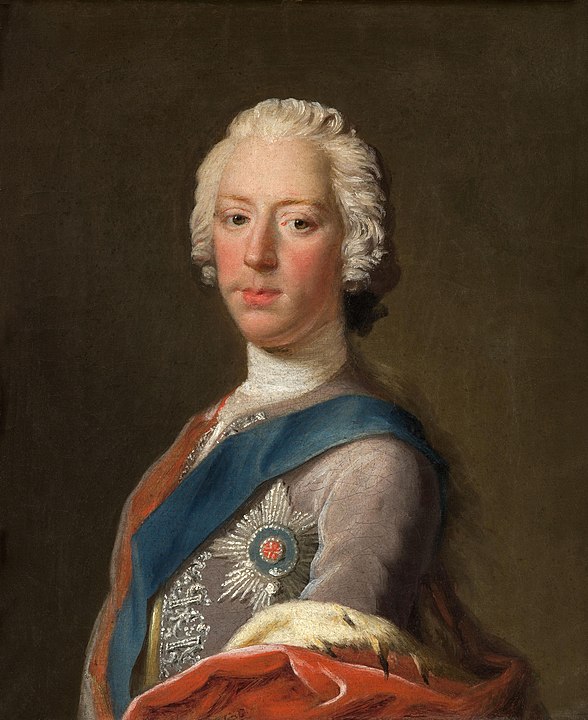
Charles Edward Stuart, painted late 1745 (original now lost)
The Battle of Culloden took place on April 16, 1746. The two armies met on the moor of Culloden, located between Inverness and Nairn in Scotland. When the Hanoverian army arrived in Nairn, the Jacobite troops were at Drummossie, near Inverness. Since early April, Charles Edward Stuart’s supporters have had control of the city, as well as Fort Augustus, a fortified stronghold at the western end of Loch Ness. The weather conditions were poor due to rain, making the terrain marshy. Scottish General George Murray advised Charles against fighting in this location, where his soldiers would be too exposed to enemy fire, but the young claimant did not listen.
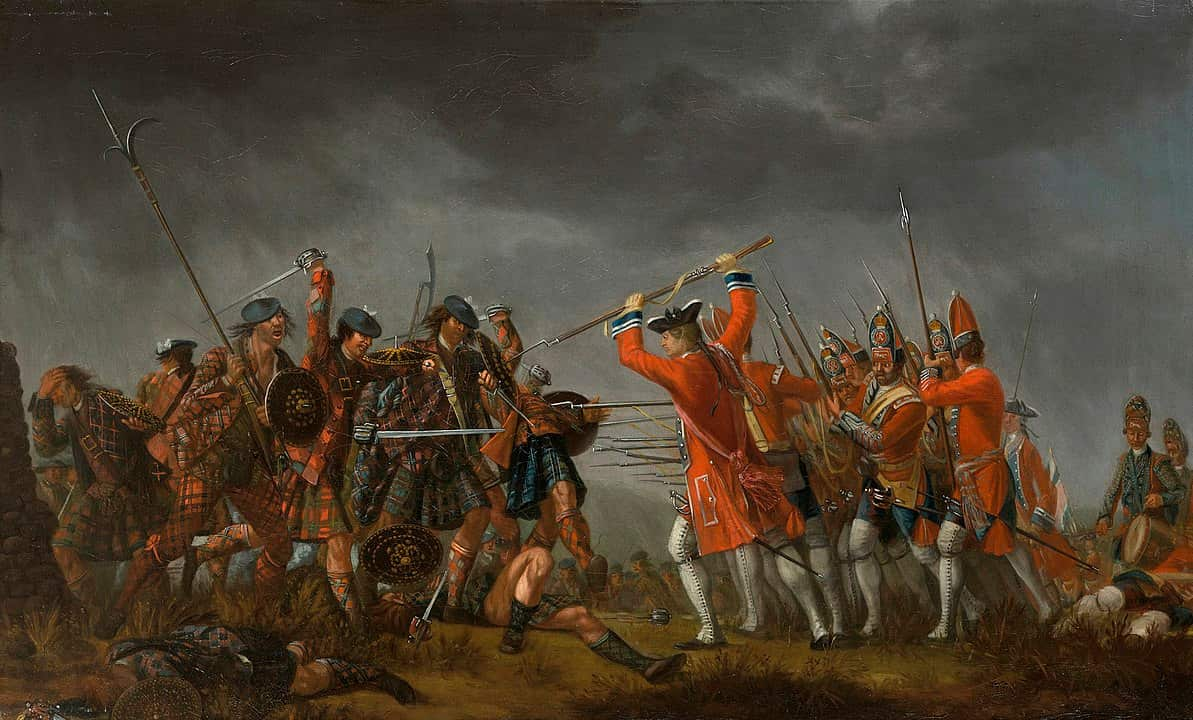
To win the battle, the Jacobites relied on the courage of the Highland warriors, armed with broadswords and axes. They planned to lure the enemy into taunting them, then defeat them with deadly charges. In contrast, the Hanoverian forces were better disciplined and equipped with powerful artillery and bayonet rifles. They used a new technique to break the momentum of the Highlanders’ charges: to render the Scottish shields ineffective, soldiers aimed their bayonets at the enemy coming from the right rather than targeting those coming directly in front.
Who Won the Battle of Culloden?
The government army, commanded by the Duke of Cumberland, won the Battle of Culloden. Better organized, the Hanoverians pounded the Jacobites with their cannons and mowed down enemy charges with shrapnel and grenades. In less than an hour, they managed to rout the Jacobite army. General Cumberland commanded the execution of the wounded and low-ranking prisoners. He also hunted down Jacobite survivors in the surrounding villages, searching barns and setting fire to houses near the battlefield.
The repression resulted in tens of thousands of casualties, earning Cumberland the nickname “Butcher of Culloden.” High-ranking Jacobite prisoners faced imprisonment and trials. High treason led to the trial and execution of some officers. The government offered Charles Edward Stuart’s head as a reward. To escape his pursuers, the Jacobite leader disguised himself as a woman and hid in the western Highlands. In September 1746, he managed to board a ship that took him back to France.
Who Were the Combatants in the Battle of Culloden?
The Battle of Culloden pitted the Hanoverians against the Jacobites. The Hanoverian government army, consisting of 8,000 men, fought for King George II, the King of Great Britain. Prince William Augustus, Duke of Cumberland, one of King George II’s sons, commanded it. Its ranks included Englishmen, as well as Germans and Lowland Scots, close to England. The Jacobites, numbering 7,000, were under the command of Charles Edward Stuart and General George Murray. Charles Stuart, nicknamed “Bonnie Prince Charlie,” led the second Jacobite rebellion.
The son of James Francis Stuart and the grandson of James II, he aimed to reconquer the throne of Great Britain and restore the Stuart dynasty. The Jacobite army mainly consisted of Scottish Highlanders, Irishmen, and a few English loyal to the Stuarts, but also Scottish and Irish soldiers from the French army (the Irish Brigade). Indeed, King Louis XV of France was at war with Great Britain and unofficially supported his cousin Charles.
How Many Deaths Were There in the Battle of Culloden?
The Hanoverian camp reported only 300 deaths and wounded from the Battle of Culloden. Among the Jacobites, the toll is heavier: between 1,500 and 2,000 dead and wounded. The Hanoverians capture 3,800 Jacobite soldiers and 200 soldiers from France.
What Were the Consequences of the Battle of Culloden?
The Battle of Culloden marks the end of the Jacobite rebellions. The British government handsomely rewarded the Scottish lords who remained loyal to it. On the other hand, the Jacobite-supporting nobles lost their lands. As part of a policy to integrate Scotland into the rest of Great Britain, the government drafts laws abolishing the hereditary rights of lords and clan chiefs in the Highlands. This weakens the identity of the Highlanders and, more broadly, Gaelic culture.
In 1746, the Dress Act declared the wearing of tartan and kilt, the main elements of traditional Scottish costume, illegal. Loyal subjects of Scottish origin received the confiscated lands from the Jacobites. These individuals create large pastures for sheep farming and expel the peasants present on their lands. Many Highlanders emigrate to the Lowlands or settle in North America. We refer to these massive population movements as the “Highland Clearances.”
Charles Edward Stuart, on the other hand, takes refuge in France and converts to Protestantism, hoping one day to reign over England and Scotland. Expelled from France in 1748, he stayed in Avignon, in papal territory. In 1759, he failed to convince the French to invade Great Britain, which definitively ended his project to ascend to the throne. He settled in Italy and died in Rome in 1788, without any legitimate descendants.
By the autumn of 1799, ten years after the storming of the Bastille, the French First Republic was exhausted, bankrupt, and cynical. Governed since 1795 by the corrupt five-man executive committee known as the Directory, France faced runaway inflation, highway banditry across the provinces, royalist uprisings in the west, and a resurgent coalition of British, Austrian, and Russian armies threatening its borders. Then, in October 1799, thirty-year-old General Napoleon Bonaparte landed back in southern France from his Egyptian campaign to wild cheering crowds. Within four weeks, he overthrew the Directory in the Coup of 18 Brumaire and established a four-and-a-half-year regime known as The Consulate (1799–1804)—arguably the most productive, brilliant period of institutional reform in modern European history, during which Napoleon built the legal, financial, and educational foundations of modern France before placing an imperial crown upon his own head.
18–19 Brumaire (November 9–10, 1799): The Coup That Almost Failed
Ironically, the man who organized the coup that brought Napoleon to power never intended for Napoleon to be in charge! Emmanuel-Joseph Sieyès—the famous political theorist of 1789 and a member of the Directory—wanted to replace the weak constitution with a strong executive, and went looking for what he called “a sword” (a popular, tame army general who would intimidate the parliament on the day of the coup and then politely step aside so Sieyès could run the country). Sieyès thought young General Bonaparte was his useful pawn.
Launched on 18 Brumaire, Year VIII (November ninth, 1799), under the fake pretext of a Jacobin terrorist plot in Paris so the two legislative councils (the Council of Ancients and the Council of Five Hundred, chaired conveniently by Napoleon’s quick-thinking twenty-four-year-old younger brother, Lucien Bonaparte) could be moved outside the city to the isolated Château de Saint-Cloud surrounded by troops, the coup nearly turned into a humiliating disaster on day two (19 Brumaire / November 10):
Napoleon Faints Under Heckling: Impatient with the slow legal speeches inside Saint-Cloud, Napoleon marched uninvited into the Orangerie hall of the Council of Five Hundred surrounded by four tall grenadiers. Instantly, furious Jacobin deputies leaped from their benches, screamed “Down with the dictator! Outlaw him (Hors la loi)!”—the exact legal death sentence that had killed Robespierre!—and grabbed the five-foot-six general by the collar, shaking him until a dizzy, overwhelmed Napoleon stumbled out of the room with his face scratched and bleeding.
Lucien Bonaparte Saves His Brother: Outside in the courtyard, the soldiers hesitated to march against their own elected parliament—until brother Lucien Bonaparte ripped off his official parliamentary robes, jumped onto a horse, drew a sword, and pointed it Dramaticly at Napoleon’s own chest, swearing to the troops that he would stab his own brother through the heart if Napoleon ever harmed French liberty, and telling the gullible soldiers a brilliant lie: that crazy deputies armed with British-paid daggers were trying to murder their general inside! Beating their drums, Murat’s grenadiers marched in with fixed bayonets as deputies jumped out the ground-floor windows into the garden bushes in their togas, ending the French Revolution’s parliamentary era in two minutes.
Outsmarting Sieyès: The Three Consuls and First Consul Bonaparte
Borrowing the reassuring classical Roman Republican title of Consuls so the public wouldn’t think a king had returned, the plotters drafted the Constitution of the Year VIII. When Sieyès proposed a complicated pyramid where a figurehead “Grand Elector” sat at the top doing nothing while two consuls did the work, Napoleon laughed in his face, asking how any man of talent could agree to act like “a fatted pig put out to pasture on a few million livres!”
Instead, Napoleon dictated a three-man executive—the Consulate—where all real power belonged strictly to the First Consul (Napoleon Bonaparte), who appointed ministers, generals, and judges, while the Second and Third Consuls (Jean-Jacques-Régis de Cambacérès and Charles-François Lebrun) held only advisory voices. Proclaiming to the nation on December fifteenth, 1799, “Citizens, the Revolution is fixed to the principles that began it: it is finished!”, Napoleon submitted his constitution to a nationwide plebiscite (public referendum).
The Four Pillar Reforms of the Consulate (1800–1804)
Moving into the Tuileries Palace in February 1800 and crossing the snow-covered Great St. Bernard Pass in the Alps four months later to defeat the Austrians at the dramatic Battle of Marengo (June 1800)—followed by the Treaty of Lunéville (1801) and the Treaty of Amiens with Great Britain (1802), which gave France complete peace across Europe for the first time in ten years!—First Consul Bonaparte spent four sleepless years personally chairing council sessions until two in the morning to build the “granite blocks” (masses de granit) that still govern France two centuries later:
The Bank of France and the Franc Germinal (1800–1803): Ending a decade of worthless paper money, Napoleon founded the Banque de France in January 1800, centralized tax collection, and minted the silver-and-gold Franc de Germinal (1803)—a currency so rock-solid it kept its exact metal value without devaluation for the next 125 years, until 1928!
The Prefect System and the Lycées (1800–1802): He placed a centrally appointed Prefect at the head of every French department (an office that still exists today), founded the elite state secondary schools called Lycées with scholarships for talented boys regardless of birth, and in 1802 created the Legion of Honour (Légion d’honneur) to reward civilian and military merit alike.
The Concordat of 1801 With Pope Pius VII: Healing the bitter religious wound of the Revolution that had driven millions of Catholic peasants into rebellion, Napoleon signed the Concordat of 1801 with the Pope—reopening France’s churches and recognizing Catholicism as “the religion of the great majority of French citizens” while keeping the clergy on state salaries and letting buyers of confiscated Church lands keep their farms.
The Napoleonic Code (Code Civil, March 1804): Personally attending thirty-six of the eighty-four drafting
Summary of Operation Fortitude – In 1944, during World War II, the Allies were preparing to land their military forces in Europe. This plan was no secret to the Germans, who reinforced their defenses along the Atlantic Wall. Operation Fortitude, launched by the British and Americans, aimed to create widespread disinformation regarding the landing (locations and dates). The goal was to deceive the Germans and make them believe that attacks might occur in Norway or in the Pas-de-Calais region of France.
Operation Fortitude would involve the use of a wide variety of means to carry out these deceptions: false information delivered through double agents, rumors spread through diplomatic channels, fictitious units created from scratch in Scotland and southern England, and intensive bombing of the supposed landing zones… The success of Operation Fortitude and this large-scale deception would contribute significantly to the success of the invasion of France and the advance of Allied troops in Normandy.
In what context was Operation Fortitude launched?
Operation Fortitude took place during World War II (1939–1945). The Germans considered an American and British landing in northwestern Europe to be highly likely. They had observed a massive concentration of troops in England since late 1943. In fact, the Allies’ objective was to land in occupied France and breach the Atlantic Wall, which the Germans had successfully held since the start of the conflict. Landing on French beaches was no easy task, given the large number of German troops assigned to coastal defense.
It therefore became necessary for the Allies to employ disinformation tactics. A comprehensive plan of action was put in place to deceive the Germans, particularly regarding the landing site of the Anglo-American troops. This was Operation Fortitude, comprising several distinct operations: concealing the landing site, setting up decoys, and making the Germans believe that the Normandy landing was merely a diversion. All these missions were planned by Colonel John Henry Bevan of the London Controlling Section.
What was the goal of Operation Fortitude?
Operation Fortitude was led by the Allied High Command, SHAEF (Supreme Headquarters Allied Expeditionary Force). Colonel John Bevan, who organized this plan, was a British intelligence officer descended from a line of earls and bankers. Calm and confident in appearance, Bevan was in reality nervous, devious, and at times ruthless. He decides to keep things simple by throwing the Germans off the scent regarding the landing site and making them believe that the June 6 landing in Normandy is a precursor to a much larger operation in the Pas-de-Calais. While these objectives are clear, the methods used to deceive the Germans are more complex and involve the use of double agents and the creation of phantom units.
Operation Fortitude consists of a plan to mislead the Germans. It is part of a broader set of deception operations, named Bodyguard, aimed at concealing all Allied landings in Europe—including in the Mediterranean—from the Germans. Operation Fortitude involves creating a diversion regarding the landing site. The Fortitude North plan thus aimed to create the impression of a landing in Norway, a scenario supported by Hitler. Operation Skye involved concentrating British forces in Scotland and generating intense radio activity. At the same time, Operation Fortitude South, or Operation Quicksilver, aimed to create the illusion of a landing in the Pas-de-Calais, an ideal location for a rapid crossing of the English Channel. Forces were deployed as a decoy in southeastern England, and a fictitious American unit was created from scratch.
What resources were used to launch Operation Fortitude?
Every means was employed to deceive the enemy. Disinformation was spread through the use of double agents. German spies were arrested and turned by the British counterintelligence service, MI5. They successfully passed false information to the Germans. This strategy employed by the secret services was supported by diplomatic leaks directed toward Sweden. The British, in fact, requested aerial reconnaissance permits from that country, which suggested a likely landing from the north. As for the French Resistance, in addition to providing useful intelligence, they contributed to this disinformation campaign through controlled information leaks.
Another tactic involved creating phantom units as part of Operations Skye and Quicksilver. The British deployed part of their Fourth Army, supported by fictitious units, which they stationed in Scotland. Numerous radio messages helped reinforce the theory of a landing in Norway. Meanwhile, a fictitious American group was created in southeastern England: the FUSAG (First United States Army Group). This fictitious force was commanded by the famous General George S. Patton.
Fake infrastructure was constructed, including inflatable tanks. These decoys would fool German pilots responsible for aerial photography. Intense radio activity accompanied the Anglo-American strategy. Heavy bombing took place in the supposed landing zones. Bombs rained down on the Pas-de-Calais, destroying the French villages of Portel and Equihen-Plage (killing several hundred civilians).
Was Operation Fortitude a success?
Hitler had long believed that the Allies would land in Norway. Operation Fortitude helped maintain this misconception. At the time of the Normandy landings, some sources claim that the Führer was in his bedroom, and that no one dared disturb him. Yet 100,000 soldiers had already landed on the beaches of Normandy. Despite everything, convinced that the Americans would attack further north, Hitler refused to move the German reserve troops. He had no confidence in his generals, which contributed to a certain amount of confusion surrounding the landing.
Among the German forces stationed along the French coast, there was a firm belief that a landing would take place in the Pas-de-Calais. The very intensive bombing of the area and the intelligence available to the Germans contributed to the belief in the veracity of this hypothesis. The British, having succeeded in decrypting the Enigma machine used to encode German messages, realized that the German high command had fallen into the trap.
Rommel, the renowned German commander who had managed to reinvigorate his troops, was absent on D-Day. He never imagined that a landing could take place that day and had gone to celebrate his wife’s birthday. His absence contributed to the indecision among German military leaders during the Normandy landings.
The very poor weather forecasts also misled the Germans, but the weather cleared up, allowing Allied troops to land under favorable conditions. Until September 1944, however, the Germans believed that a larger-scale landing would take place in the Pas-de-Calais. German troops remained stationed in the region, allowing for the consolidation of Allied positions in Normandy. Operation Fortitude was a resounding success, combining decoys and information manipulation. It became the greatest deception in history!
What were the consequences of Operation Fortitude?
The success of Operation Fortitude paved the way for the Allied landing in Normandy, also known as Operation Overlord. After postponing the landing by one day due to terrible weather, the Allies finally set foot on the French beaches. The British were slowed in their advance eastward. After a bloody battle during the landing, the Americans launched Operation Cobra. This took place in late July 1944 and aimed to break through the German lines in the Cotentin Peninsula, heading toward the road to Brittany.
The U.S. Army made slow progress through the Normandy bocage, but the tide of battle turned in its favor with the support of intense Allied bombing. The success of Operation Cobra was followed by the Avranches breakthrough and the encirclement of German lines, which secured victory for the Americans in Normandy. Operation Fortitude played a major role, helping to support the assumption of a larger-scale landing in the Pas-de-Calais. The Germans thus kept troops in reserve, while the Allies advanced in France during the Battle of Normandy.
When twenty-six-year-old General Napoleon Bonaparte arrived in Nice in late March 1796 to assume command of the French Republic’s Army of Italy, the seasoned divisional generals waiting for him—hardened veterans like Masséna and Augereau—sneered behind his back at the short, gaunt Corsican artillery officer with long unkempt hair whom they dismissed as a political appointee and a “street general.” His thirty-seven thousand soldiers were starving, unpaid, dressed in rags, and missing boots. Yet within twelve months of lightning marches, audacious river crossings, and sixty-seven battles across northern Italy, Napoleon destroyed four separate Austrian armies, knocked the Kingdom of Sardinia-Piedmont out of the war, forced the Pope and the Habsburgs to sue for peace, and emerged as the most famous military genius in Europe.
The Central Position Strategy: Splitting Piedmont From Austria
For four years prior to 1796, the Italian front had been considered a secondary sideshow by the French Directory in Paris, which viewed the Rhine River in Germany as the main theater of the War of the First Coalition. Guarding the mountain passes into northern Italy stood two allied forces totaling over fifty-two thousand men: the army of King Victor Amadeus III of Sardinia-Piedmont on the west, and the Imperial Austrian army under the seventy-one-year-old General Beaulieu on the east.
Instead of attacking both enemies along a wide front, Napoleon applied his signature operational masterpiece: the Strategy of the Central Position (interior lines). Marching rapidly through the Cadibona Pass where the Alps meet the Apennines in April 1796, Napoleon drove a wedge straight into the hinge separating the Piedmontese from the Austrians. Concentrating his superior numbers against the isolated Piedmontese first at Montenotte, Millesimo, and Mondovì while holding the Austrians off with a thin screen, Napoleon marched toward Turin and forced King Victor Amadeus III to sign the Armistice of Cherasco on April twenty-eighth—knocking Piedmont completely out of the war in just sixteen days and seizing their artillery and food depots to feed his ragged troops.
The Bridge of Lodi and the Birth of “The Little Corporal”
With Piedmont defeated, Napoleon immediately wheeled eastward to chase Beaulieu’s retreating Austrians across the Po River down into Lombardy. On May tenth, 1796, at the town of Lodi on the Adda River, Napoleon caught the Austrian rear guard defending a narrow, two-hundred-yard wooden bridge swept from end to end by fourteen Austrian cannons.
Rather than waiting days to find a boat crossing, Napoleon personally stepped down into the mud under heavy enemy grapeshot to aim the French artillery guns himself—a hands-on task normally done by lowly corporals—before sending a dense column of French grenadiers charging across the narrow timber planks while General Masséna and Lannes waded into the foaming river to support them. Storming the bridge and capturing Milan five days later, Napoleon’s veteran soldiers affectionately christened their fearless young commander Le Petit Caporal (“The Little Corporal”). Even more importantly, as Napoleon later confessed in exile on Saint Helena, it was on the evening of Lodi that he first realized he was no longer merely an ambitious general, but a man capable of altering the destiny of the world.
Defeating Four Austrian Relief Armies Around Mantua
By June 1796, the Austrians held only one major fortress left in northern Italy: the island-like citadel of Mantua, surrounded by malarial lakes and swamps. Over the next eight months, Emperor Francis II in Vienna dispatched four successive, massive relief armies down from the Alpine valleys of the Tyrol to rescue Mantua and crush Bonaparte’s outnumbered forty thousand men:
Battle of Castiglione (August 1796): When Austrian Field Marshal Dagobert von Wurmser marched fifty thousand men down both sides of Lake Garda to trap the French, Napoleon boldly abandoned his siege guns at Mantua, marched his men day and night to smash the smaller western Austrian column at Lonato first, and then turned around to crush Wurmser’s main body at Castiglione.
Battle of Arcole (November 1796): Facing a fresh Austrian army of nearly fifty thousand under József Alvinczi across the marshes of Verona, Napoleon led a desperate three-day battle across the narrow causeways and wooden bridge of Arcole—famously grabbing a tricolor flag in his own hands and charging onto the bridge under withering musket fire until his aide-de-camp Muiron threw his own body in front of Napoleon to take a fatal bullet.
Battle of Rivoli (January 1797): When Alvinczi launched one final winter offensive down the Adige Valley, Napoleon correctly deduced which of six Austrian columns was the main strike force. Fighting on the icy plateau of Rivoli on January fourteenth, 1797, as Masséna’s troops marched all night to arrive just in time, Napoleon shattered the Austrian offensive so completely that the starving thirty-thousand-man garrison inside Mantua finally surrendered on February second, 1797.
Marching Toward Vienna and the Treaty of Campo Formio
With Mantua in French hands and Pope Pius VI forced to sign the Treaty of Tolentino handing over thirty million livres in gold along with priceless ancient statues like the Laocoön and the Apollo Belvedere for the Louvre in Paris, Napoleon didn’t wait for permission from the politicians in Paris. In March 1797, he marched his army straight northeast over the Julian Alps into Austria itself, advancing within seventy-five miles of Vienna.
Terrified as French bayonets approached the imperial capital, the Habsburgs agreed to the Preliminary Peace of Leoben and signed the landmark Treaty of Campo Formio on October seventeenth, 1797—negotiated personally by Napoleon without waiting for French diplomats. In a single year, the twenty-eight-year-old general had ended the War of the First Coalition on the continent, secured Belgium and the Rhine frontier for France, reorganized northern Italy into the Cisalpine Republic, extinguished the thousand-year-old Republic of Venice, and laid the direct political stepping stone to his seizure of power two years later.
In the single calendar year of 1848, more than fifty countries and principalities across continental Europe erupted almost simultaneously in armed popular revolution. Known romantically to history as the Springtime of the Peoples (Völkerfrühling) or the March Revolution, this unprecedented political tidal wave swept from Palermo and Paris to Vienna, Berlin, Milan, Budapest, and Prague in a matter of weeks—without any central international conspiracy directing it. Driven by a shared hunger for written constitutions, freedom of the press, national unification, and relief from famine, the revolutions of March 1848 shook the absolute monarchies of Europe to their knees before conservative armies staged a counter-revolution that delayed liberal democracy for generations.
The Twin Triggers: Potato Blight, Hunger, and the Vienna System
Why did the entire continent explode at the exact same moment in the early spring of 1848? For thirty-three years since the defeat of Napoleon at Waterloo in 1815, continental Europe had been policed under the ultra-conservative Congress of Vienna system engineered by Austrian Chancellor Prince Klemens von Metternich. Across Germany, Italy, and the Austrian Empire, kings and emperors ruled without elected parliaments, secret police censored newspapers and university professors, and Italy and Germany remained artificially divided into dozens of petty states to stifle nationalism.
Beneath this political lid, a devastating economic pressure cooker boiled over between 1845 and 1847:
The Hungry Forties: The exact same potato blight that caused the Great Famine in Ireland ruined potato harvests across northern and central Europe in 1845 and 1846, followed immediately by terrible wheat and rye harvests that doubled the price of a loaf of bread and triggered thousands of food riots.
Early Industrial Unemployment: As mechanized factories undercut traditional handloom weavers and urban artisans while a banking crisis in 1847 halted railway construction, millions of desperate, literate young workers and university students crowded into capital cities with nothing left to lose.
The Domino Effect: From Paris to Vienna, Budapest, and Berlin
After an initial January uprising in Sicily against the Bourbon King in Naples, the continental explosion was detonated in Paris between February 22 and 24, 1848, when street barricades overthrew King Louis-Philippe and proclaimed the French Second Republic. As news of the Paris revolution traveled at lightning speed across Europe via the newly built railway and telegraph lines, the dominoes fell in rapid succession throughout March 1848 (“the March Days”):
Vienna and the Fall of Metternich (March 13, 1848): When students and workers marched on the diet in Vienna demanding a constitution, clashes with troops prompted the frightened Habsburg imperial court to fire the seventy-four-year-old symbol of European absolutism, Prince Metternich, who had to flee Vienna in disguise inside a laundry cart for London while the Emperor promised a constitution and abolished peasant serfdom.
Budapest and the Hungarian Revolution (March 15, 1848): Inspired by the fiery speeches of Lajos Kossuth and the young poet Sándor Petőfi reciting the National Song on the steps of the National Museum in Pest, Hungarians enacted the “April Laws,” turning Hungary into an autonomous parliamentary democracy with its own ministry and army.
Milan and Venice (March 17–22, 1848): In the famous “Five Days of Milan,” ordinary citizens built 1,700 barricades out of pianos, carriages, and cobblestones to drive Field Marshal Radetzky’s Austrian garrison out of the city, while Daniele Manin proclaimed the Republic of San Marco in Venice and King Charles Albert of Piedmont-Sardinia declared the First War of Italian Independence.
Berlin and the Frankfurt Parliament (March 18, 1848): After bloody street fighting around the Royal Palace in Berlin left nearly three hundred civilians dead, a shaken King Frederick William IV of Prussia ordered his army out of the capital, stood on his balcony taking off his helmet to bow before the coffins of the dead revolutionaries, and rode through Berlin wearing the black-red-gold sash of German unity, while liberal professors and lawyers from across all German states convened in May at St. Paul’s Church in Frankfurt—the Frankfurt Parliament—to write a democratic constitution for a united Germany.
Why the Revolutions Collapsed: Class Splits and Competing Nationalisms
In March 1848, the monarchs had surrendered almost without a fight because they were terrified. By the summer and autumn of 1848, however, the revolutionary coalitions began fracturing from within along two fatal fault lines:
Middle-Class Liberals vs. Working-Class Radicals: Educated middle-class business owners, lawyers, and professors wanted a polite constitutional monarchy with property-restricted voting and sacred private property rights; poor urban workers wanted socialist labor guarantees, universal suffrage, and wealth redistribution. Terrified by worker uprisings like the bloody “June Days” in Paris, middle-class liberals ran straight back into the arms of the Kings and their armies to protect their property from the mob.
Nationalism vs. Nationalism: Within the multi-ethnic Austrian Empire and German lands, the newly liberated nationalities immediately started oppressing and fighting each other instead of uniting against the Emperor! German deputies in Frankfurt supported crushing Polish nationalists in Posen and Czechs in Prague; meanwhile, when Lajos Kossuth’s Hungarian government refused to grant equal linguistic rights to Croats, Serbs, Slovaks, and Romanians living inside Hungary, the clever Habsburg dynasty armed the Croatian commander Josip Jelačić to fight the Hungarians—playing one ethnic group against another to recapture Vienna in October 1848.
The Turning Point That Failed to Turn (and What Actually Survived)
By 1849, the old monarchs had regained their nerve. In April 1849, when the Frankfurt Parliament finally finished drafting its constitution and offered the crown of a united democratic Germany to King Frederick William IV of Prussia, the King contemptuously refused to pick up what he called “a crown from the gutter” offered by commoners. Austrian armies crushed the Italians at Novara and Venice, French troops destroyed Mazzini and Garibaldi’s Roman Republic, and when Lajos Kossuth’s gallant Hungarian army proved too strong for Austria alone, Tsar Nicholas I of Russia marched 200,000 Russian soldiers across the Carpathian Mountains in August 1849 to crush Hungarian independence at Világos.
The British historian A.J.P. Taylor famously wrote that in 1848, “German history reached its turning point and failed to turn.” Tens of thousands of defeated “Forty-Eighter” democrats emigrated to the United States (where many later fought as Union generals against slavery in the American Civil War). Yet the People’s Spring was not entirely in vain: feudal serfdom remained permanently abolished across Austria, Hungary, and Central Europe; even Prussia and Piedmont kept written constitutions; and the exact dreams of Italian and German unification born on the barricades of March 1848 were ultimately fulfilled just twenty years later—not by liberal poets, but by the “blood and iron” realpolitik of Cavour and Bismarck.
It was under Pericles‘ impetus that the Parthenon came into existence in the 5th century BCE. The renowned Athenian strategist invited recognized artists such as Phidias or Callicrates to participate in the construction of the Parthenon. Erected on the ruins of an ancient temple destroyed by the Persians in Athens, specifically the Acropolis, the temple dedicated to Athena, the city’s protective deity, was built in record time. Indeed, it only took 15 years to complete this major monument of ancient history.
Starting in 447, the construction of the Parthenon was interrupted by war, but it was completed in 432 BCE. It symbolizes Athenian power, democracy, and the architectural genius of ancient Greece at that time. Combining Doric classicism with unprecedented ingenuity from the architects, the Parthenon is a remarkable work, both in terms of its dimensions, its unusually fast construction, and its style.
In What Context was the Parthenon Built?
Between 447 and 432 BCE, builders constructed the Parthenon. It is part of the Acropolis of Athens, the current Greek capital, and one of Greece’s most iconic monuments. The Hecatompedon, a limestone temple from the 6th century BCE, served as the foundation for its construction. The Persians destroyed many monuments during the 5th century BCE (480: Greco-Persian Wars). The Parthenon is among the new constructions desired by the strategist Pericles to restore the city’s splendor. Phidias, Ictinus, and Callicrates led the construction site.
It underwent two phases of construction, with an interruption due to the Second Persian War. Once the construction was complete, the sculptural works also concluded. They quickly erected the building, incurring significant expenses. Indeed, they had to draw funds from Delphi’s treasury, which they would later store here. It is the tallest temple in the Acropolis.
Why Was This Temple Built?
In this temple, the colossal statue of Phidias, the Athena Parthenos, found its home.
Many scholars believe that this significant project also originated from the city’s financial difficulties, plagued by regular Persian attacks. The construction site would have provided employment for many people. The functions of this temple are manifold. Despite the regular offerings at the Erechtheion, it clearly serves as a place of worship for Athena, the city’s patroness. The Panathenaic Games (festivals in honor of Athena) take place here.
It will also become the symbol of Athenian power, according to Pericles’ wish. The impressive dimensions (nearly 70 meters long, 31 meters wide, and 14 meters high) and unprecedented architectural ingenuity showcased the greatness of Athens and its inhabitants, visible in a frieze depicting all the city’s social classes. The temple also has a political function as it houses Athenian public funds.
How Did the Construction Work Unfold?
The temple was built in Pentelic marble, a white stone from quarries near Athens, to the northwest. Originally, the temple consisted of a peristyle (gallery of columns) surrounded by 48 columns.
They constructed two rooms from cut stone. The 15-meter-high chryselephantine (gold and ivory) statue of Athena occupied the naos (interior of the temple). Behind this statue was a small room that housed the Athenian treasury. They built two other rooms with lateral vestibules: the opisthodomos and the pronaos. The colonnade was built simultaneously. The construction lasted about fifteen years.
Following that, the decorations were completed. It was mainly Phidias who was in charge. His workers composed the pediments dedicated to Athena’s life. The Doric frieze, with triglyphs and metopes, mainly represents the victory of the Greeks over the Persians. The building shows a specific singularity. In Doric style, it features 8 columns instead of the usual 6. The columns’ axes, as well as the horizontal lines, are also noteworthy. The columns are slightly inclined, and the horizontals are convex to create an optical effect hitherto unseen.
The overall proportions are enlarged. The naos thus presents a dimension never before reached: 10.6 meters wide. At the end of the construction, they added ionic columns to the opisthodomos. Under the colonnade, another frieze is present, representing the great Panathenaic Games. This encircled the sekos (the closed part of the temple, surrounded by walls). In 449, they added Propylaea and Erechtheion.
How Did the Parthenon Evolve Over the Ages?
This building has experienced many mishaps. It is known to have suffered a significant fire during the late antiquity period, in the 3rd century (the sack of Athens during the Chremonidean War). The fire destroyed the inner colonnade and the wooden framework. Following this event, between 361 and 363, they built a new colonnade.
Around 590, the temple became a Christian church and took the name Mary Parthenos. This Byzantine conversion destroyed many statues. The Byzantine conversion involved moving the entrance, adding mosaics, and opening windows. It became a major Christian place of worship and was part of a great pilgrimage like that of Ephesus or Thessaloniki. The Ottomans invaded Athens in 1456 and turned the Parthenon into a mosque. The apse evolved into the mihrab. Lime completely covered the walls, hiding the decorations.
In the 17th century, it served as a warehouse for Turkish powder barrels. The first explosion occurred in 1656, followed by a much larger one in 1687. A Venetian attack caused the barrels to explode. The Venetians destroyed the central part and the columns. The British looted the temple between 1801 and 1803, taking a large number of decorative elements that are still visible in various British museums. After proclaiming its independence, Greece began the restoration of the building in 1835. In 1894, one of the largest earthquakes Greece experienced damaged the building.
What Were the Different Functions of the Parthenon?
Although the Parthenon hosted the Panathenaic Games, it cannot be considered a religious building per se. Indeed, no ritual objects were found there.
Similarly, there is no mention of any ritual testimony on site. Only priests have access to the sanctuary’s heart. No priestess is associated with it.
Two main functions are observable for this “temple.” The first is to house the Athena statue in the cella (or naos), the place’s sacred room. Originally an offering to the city and its inhabitants, Phidias transported this statue to Constantinople, where its trace vanished. Athena Parthenos symbolized not only the goddess but also the power of Athenian women, who, in the 5th century BCE, had an increasingly important role (the sculpted plaque on the front of the sculpture).
The temple also served as a storage facility for the treasures won by Athens and the Delian League, some of which Pericles used to construct the building, along with the metals used for currency. These riches are obviously complemented by the statue itself, which is partly made of gold (Pericles cites it as a gold reserve, according to the author Thucydides). In cases of necessity, it was indeed possible to melt it without committing an impious act. This treasure room is synonymous with wealth and will thus become the symbol of Athenian power, both civil and political.