In the 19th century, shopping was almost the only available physical activity for women, and they threw themselves into it passionately in the department stores and arcades that filled European and North American cities.
Sports had obvious masculine connotations, and gender roles were clearly defined: what was allowed for men was not always permitted for women. Engaging in sports was considered contrary to feminine nature. For example, in 1797, Scottish doctor and moralist John Gregory wrote in “A Father’s Legacy to His Daughters“:
But though good health be one of the greatest blessings of life, never make a boast of it, but enjoy it in grateful silence. We so naturally associate the idea of female softness and delicacy with a correspondent delicacy of constitution, that when a woman speaks of her great strength, her extraordinary appetite, her ability to bear excessive fatigue, we recoil at the description in a way she is little aware of.
A Father’s Legacy to his Daughters, by John Gregory
Good health was seen as something vulgar and unworthy of a refined feminine nature, reducing a young woman’s chances of marriage—particularly in the bourgeoisie, even more so than in the aristocracy, as the bourgeoisie adhered even more strongly to the fashion of frailty and delicacy associated with high status.
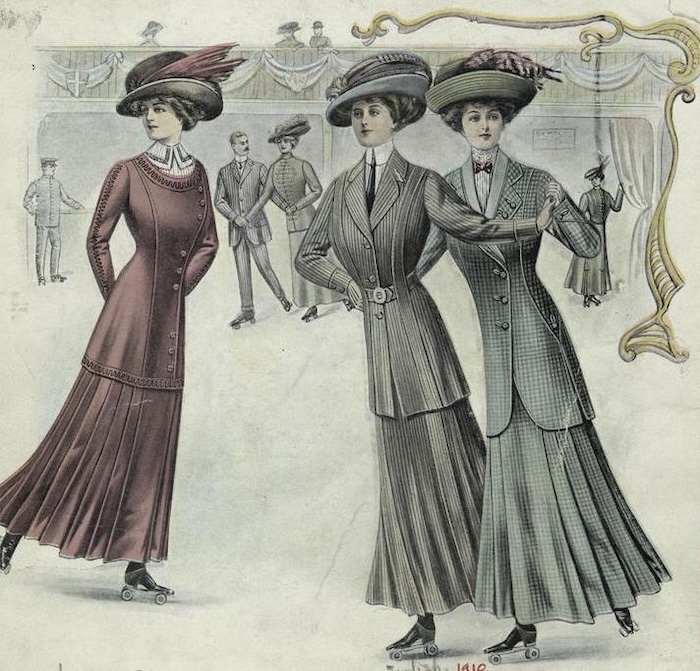
By the 1860s, women began playing croquet alongside men. This is particularly noteworthy because the sport allowed young ladies and their potential suitors to meet and socialize not only in churches, ballrooms, and theaters. Croquet was followed by ice skating—ladies in hats and long skirts performed incredible maneuvers on the ice rinks.
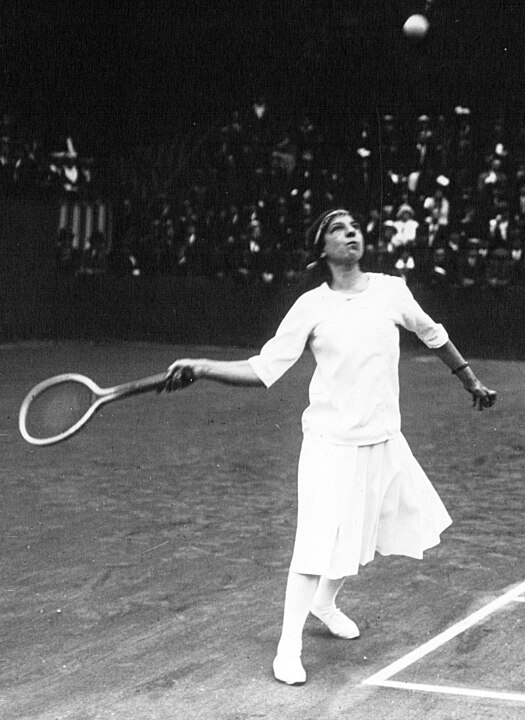
Suzanne Lenglen at the 1914 World Hard Court Championships
In the 1870s, after croquet and skating, tennis became popular. Historian Eduard Fuchs wrote: “If mothers once took their daughters to balls, now they sent them to play tennis or ski. Winter resorts began to function as international marriage markets, while in summer, this role was taken over by all the parks and courts of major cities where tennis was played.”
Around the same time as tennis, women began to engage in team sports like football and hockey, leading to debates about appropriate sportswear for women. Men did not have these issues: their everyday attire was practical and quite suitable for sports activities.
The debates were heated; supporters of clothing reform even began suggesting that women should adopt trousers—the foundation of men’s wardrobes and a symbol of masculinity.
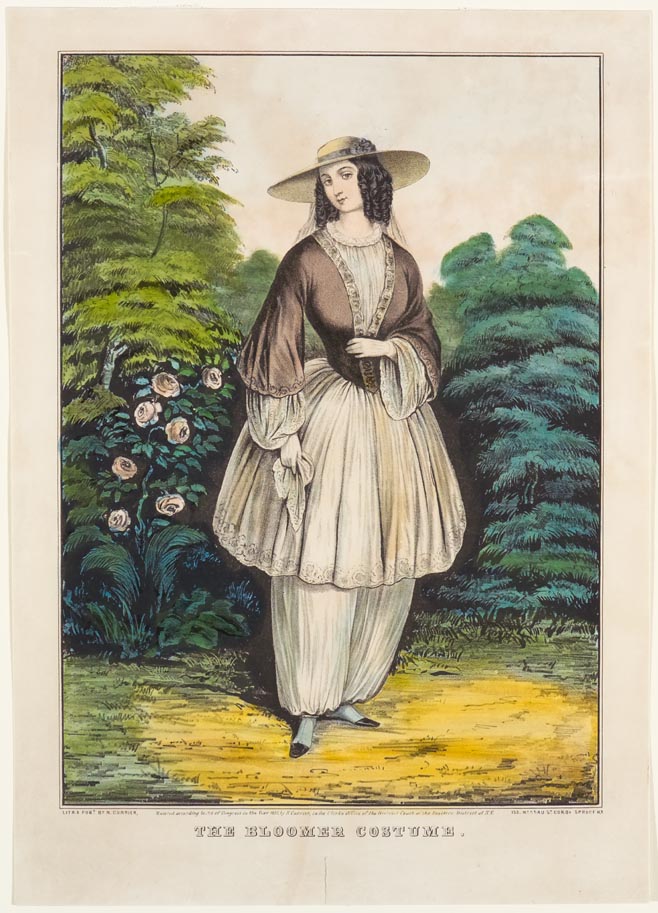
Several reform proposals for women’s clothing were made. For example, American suffragist Amelia Bloomer, editor of the feminist newspaper “The Lily,” invented “bloomers” in the early 1850s—a costume consisting of Turkish-style pantaloons worn with a shortened dress. Naturally, such experiments provoked sharp criticism from conservatives.
Debates about appropriate clothing for women became even more intense after the introduction of the so-called “safety bicycle” in the 1880s. The bicycle brought revolutionary changes to the lives of both men and women. Unlike other sports that women adopted after men, cycling was a fundamentally new activity for both sexes. Bicycle rides made women much more visible participants in the public life of the city. Many, like the protagonist of Chekhov’s “The Man in a Case” (1898), were horrified by these newfangled iron machines, which women rode astride—a sight deemed highly improper: “I was horrified yesterday! When I saw your sister everything seemed dancing before my eyes. A lady or a young girl on a bicycle — it’s awful!
” But the new mode of transportation also had many supporters:
“The dawn has come… thanks to the bicycle, the hour of women’s liberation has struck. Discovering a wonderful world… turning the wheels of her bicycle, the independent girl of our time strengthens her health and develops her mind… How limited life seems before the arrival of the bicycle!”
— Louis Jay, from an article for “The Lady Cyclist,” 1895
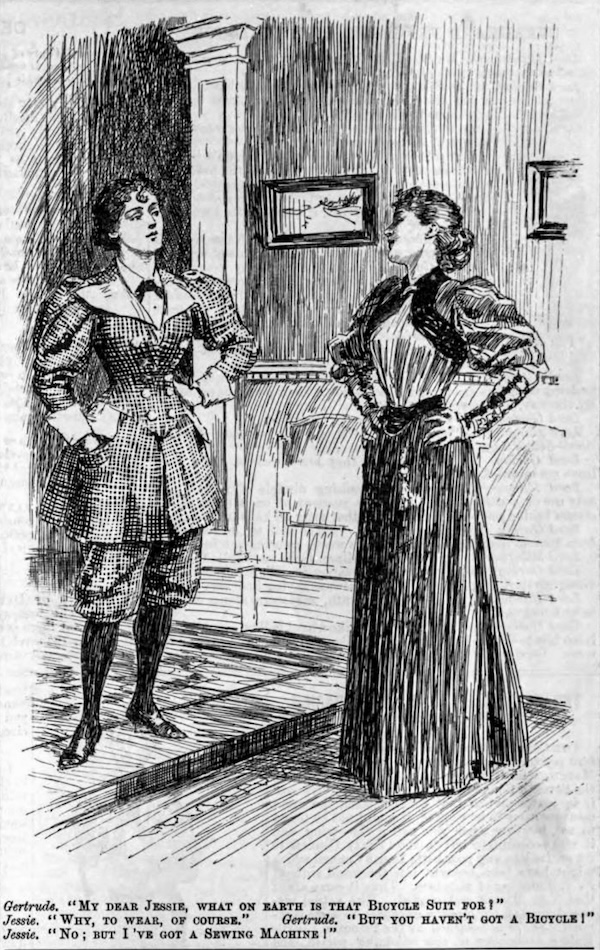
Victorian Women’s fashion and emancipation cartoons from Punch magazine. Image: Wikimedia Commons
One of the British cyclists and active participants in the movement for dress reform (or the rational dress movement), Lady Florence Harberton, proposed a special women’s cycling costume with breeches in 1881. In the magazine “Punch,” which consistently mocked the rational attire of contemporary women, a 1895 cartoon showed two ladies, one wearing a cycling costume and the other a traditional dress. Their conversation went like this:
“Gertrude: ‘Jessie, darling, why are you wearing a cycling costume?’ Jessie: ‘To wear it, of course.’ Gertrude: ‘But you don’t have a bicycle!’ Jessie: ‘But I have a sewing machine!’”
Most female cyclists preferred traditional ladies’ attire, which caused them quite a bit of trouble while riding. Female athletes chose to injure their bodies with corsets, get entangled in ankle-length skirts while playing, and suffocate in long-sleeved blouses while holding their mandatory hats, unwilling to change into more comfortable sportswear that might include Turkish pantaloons or culottes.
The need for special sports clothing for women became apparent only a couple of decades later when sports, initially unfashionable and unladylike, suddenly began to influence the development of everyday fashion, which increasingly focused on practicality, functionality, and comfort.
Designers like Jean Patou, Elsa Schiaparelli, and Gabrielle “Coco” Chanel became trendsetters in the 1920s by launching their sports lines.
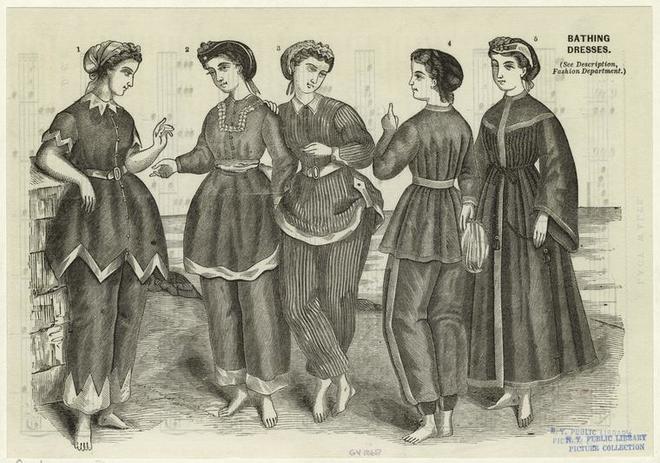
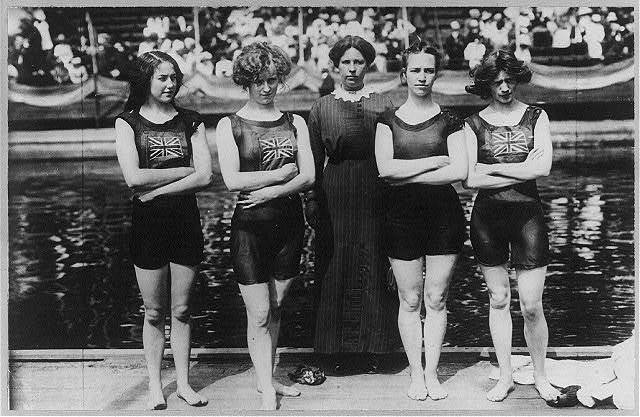
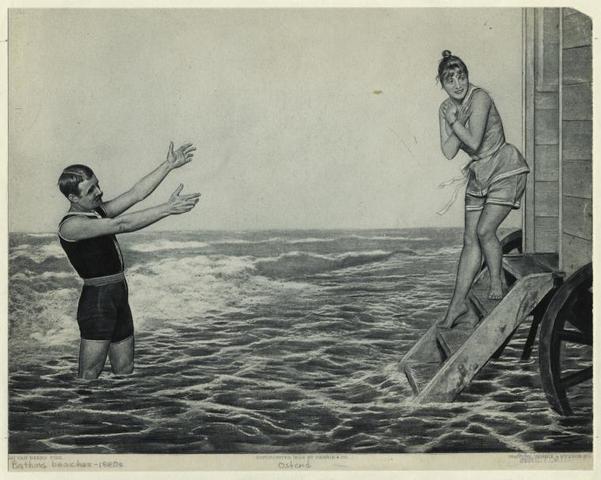
Swimwear, 1868. Image: New York Public LibraryBritish swimming team at the 1912 Olympics. Image: Library of CongressA girl leaving a swimming cabin in Ostend, Belgium. XIX century. Image: New York Public Library
Even swimwear, which resisted any innovations the longest, underwent changes only at the beginning of the 20th century—with a shift in attitudes toward bathing and tanning. Now, having a tan was perceived as a sign that a person had the time (and money) to sunbathe, and open swimsuits became fashionable. Before that, swimwear was a complex construction that completely covered the body—with a corset, pantaloons, blouse, cap or hat, and swimming shoes.
When a modern audience settles into the velvet seats of a London West End playhouse or the open-air wooden gallery of Shakespeare’s Globe on the South Bank of the Thames, they are participating in a continuous dramatic tradition that transformed the English language itself. Yet in the year 1570, London did not possess a single permanent public theater building; traveling actors were legally classified alongside vagabonds and bear-baiters, performing on temporary wooden planks set up inside muddy coaching-inn courtyards. Then, between 1576 and 1642, a remarkable generation of entrepreneurial carpenters, rebel university graduates, larger-than-life lead actors, and a glover’s son from Stratford-upon-Avon invented modern British Theatre from scratch.
1. James Burbage and “The Theatre” (1576): Building the First Playhouse
Before great plays could be written, someone first had to invent the business model of a permanent, purpose-built commercial playhouse where thousands of ordinary citizens could pay a single copper penny to stand in the yard. That pioneer was James Burbage (circa 1531–1597)—a joiner and master carpenter by trade who had become an actor and leader of the Earl of Leicester’s Men.
In 1576, borrowing money from his brother-in-law, Burbage leased a plot of land in Shoreditch just north of the jurisdiction of the puritanical City of London mayors, and built a polygonal, open-air timber amphitheater that he boldly named The Theatre—the first permanent public playhouse erected in Britain since the fall of the Roman Empire! Twenty-two years later, on the freezing night of December twenty-eighth, 1598, when a greedy landlord tried to confiscate the building after the lease expired, James Burbage’s two sons—Cuthbert and Richard Burbage—alongside a partner named William Shakespeare hired master carpenter Peter Street and a crew of armed men with axes to **dismantle The Theatre timber by timber in the middle of the night**, haul the oak beams across the Thames to Southwark, and use the exact same wood to build the legendary Globe Theatre in 1599!
2. The “University Wits” and Christopher Marlowe’s Mighty Line
To fill these new 3,000-seat wooden amphitheaters (The Theatre, The Curtain, and Philip Henslowe’s The Rose), playhouse managers needed thrilling new scripts every week. In the 1580s, a group of brilliant, bohemian, often impoverished young graduates of Oxford and Cambridge—known to literary history as the “University Wits” (including Thomas Kyd, who invented the smash-hit Elizabethan revenge tragedy with The Spanish Tragedy; John Lyly; Robert Greene; and Thomas Nashe)—abandoned careers in the Church to write for the popular stage.
Towering above all the University Wits was a shoemaker’s son from Canterbury with a Cambridge scholarship and a shadowy second career as an espionage agent for Queen Elizabeth’s spymaster Sir Francis Walsingham: Christopher Marlowe (1564–1593). Before being fatally stabbed above the eye in a Deptford rooming house at the age of twenty-nine over a tavern bill (“the reckoning”), Marlowe revolutionized English drama with Tamburlaine the Great, Doctor Faustus, and The Jew of Malta—throwing out clunky rhyming couplets and perfecting unrhymed iambic pentameter (blank verse, what Ben Jonson called “Marlowe’s mighty line”) as the electric, musical heartbeat of the British stage.
3. William Shakespeare, Ben Jonson, and the Leading Tragedians
Into the vibrant theater world created by Burbage and Marlowe stepped William Shakespeare (1564–1616). Unlike rival playwrights who sold their scripts for a flat fee of six pounds and stayed poor, Shakespeare was a uniquely shrewd theatrical businessman: becoming a one-tenth shareholder (“housekeeper”) in both his acting company (the Lord Chamberlain’s Men, later the King’s Men) and the physical real estate of the Globe and indoor Blackfriars theatres.
Writing thirty-eight plays that fused the highest philosophical poetry with low-brow tavern comedy—and pushed every year by his brilliant friend and friendly rival, the bricklayer-turned-classical-satirist Ben Jonson (author of Volpone and The Alchemist, who in 1616 became the first English playwright brave enough to publish his stage plays in a grand folio book titled Works, inspiring the 1623 First Folio of Shakespeare!)—Shakespeare wrote his greatest roles specifically for the physical voices of two legendary lead actors who were the true first superstars of British acting:
Edward Alleyn (1566–1626): The six-foot-plus, booming-voiced star of the rival Admiral’s Men, who originated Marlowe’s Tamburlaine and Faustus and became so fabulously wealthy from theater ownership that he founded Dulwich College and bought a manor house for £10,000.
Richard Burbage (1567–1619): James Burbage’s younger son and Shakespeare’s closest stage collaborator—a naturalistic, chameleon-like actor who was the very first human being on Earth to walk onto a stage and speak the words of Hamlet, Othello, King Lear, Macbeth, and Richard III.
4. Aphra Behn and the Restoration Pioneers (1660s)
When the English Civil War erupted in 1642, Oliver Cromwell’s Puritan Parliament shut down every playhouse in Britain for eighteen years and demolished the Globe. Yet the moment King Charles II was restored to the throne in 1660, British theatre roared back to life inside enclosed, candlelit proscenium-arch theaters at Drury Lane and Covent Garden with two revolutionary breakthroughs: first, Charles II issued a royal warrant decreeing that female roles would no longer be played by teenage boy apprentices, welcoming professional actresses (such as Margaret Hughes and Nell Gwyn) onto the British stage for the first time; and second, in the 1670s, a former royal spy in Surinam named Aphra Behn (1640–1689, author of the hit comedy The Rover) shattered the glass ceiling to become the first professional female playwright in the English language—completing the foundation of the modern theatre world.
Europeans did not immediately realize that the lands across the Atlantic, where they found themselves, were not Asia, but a new, unknown part of the world. However, this does not mean that by the time Columbus’s expedition was planned, Europeans had no concept of lands lying west of Europe, in the “Sea of Darkness.” On 13th to 15th-century maps, various islands were marked—some well-known, others mythical, like the Island of Saint Brendan, Antillia, and Brazil. The belief in their existence influenced Columbus’s decision to venture across the open ocean. But these were thought to be islands; it was only some time after Columbus returned from his first voyage that people began to talk about a new part of the world beyond the ocean.
Columbus himself likely believed until his death that he had not discovered a new part of the world, but rather a new route to the countries of the East. During his last voyage (1502–1504), he sincerely believed that the distance from where he was (near the Isthmus of Panama) to the Ganges in India was only two weeks. But not everyone agreed with him. In 1499–1500, Spanish and Portuguese sailors like Alonso de Ojeda, Vicente Yáñez Pinzón, Pedro Álvares Cabral, and others discovered a continuous line of the eastern coast of South America—from the Isthmus of Panama almost to the Tropic of Capricorn. It was becoming increasingly clear that this land was not Asia, as it was known that all of Asia lay in the Northern Hemisphere.
The first to declare the discovery of a new part of the world was the Italian Amerigo Vespucci (1454–1512), who participated in Spanish and Portuguese expeditions to the coasts of South America. Vespucci personally traced thousands of kilometers of the coastline. In 1503–1504, he described his voyages in two letters that gained enormous popularity and were reprinted many times. In these letters, he emphasized that he was speaking of a previously unknown part of the world—a “New World.”
Vespucci may have only voiced the idea of a new part of the world; others may have surmised it earlier. For instance, such an idea could have easily occurred to the sailor and cartographer Juan de la Cosa, who participated in several voyages to the Americas. In 1500, by royal commission, he created a map that reflected the latest Spanish and Portuguese discoveries. This map aimed to define the boundaries of these countries’ territories under the Treaty of Tordesillas. It was the first to accurately depict the Greater and Lesser Antilles and a significant part of the western coastline of South, Central, and North America—contradicting contemporary understandings of Asia’s eastern coastline. De la Cosa likely realized this represented the outlines of a previously unknown part of the world, resonating with Vespucci’s letters. Thus, the idea that America existed—or more accurately, that newly discovered lands were a new, previously unknown part of the world—emerged around 1500–1503.
In 1507, the cartographer Martin Waldseemüller from Lorraine suggested in his book “Introduction to Cosmography” that the new continent be named “America” in Vespucci’s honor. The name “America” first appeared on Waldseemüller’s map that same year, located in the southern part of South America. Gradually, it became established on maps of North America as well. Neither Vespucci nor Waldseemüller intended to deprive Columbus of his laurels as the discoverer. Initially, it was understood that Columbus and Vespucci had discovered lands in different locations and that the name “America” referred only to the lands Vespucci had discovered. It was later applied to the entire continent discovered by Columbus—without Vespucci’s knowledge and against Waldseemüller’s wishes.
Who Discovered America and When?
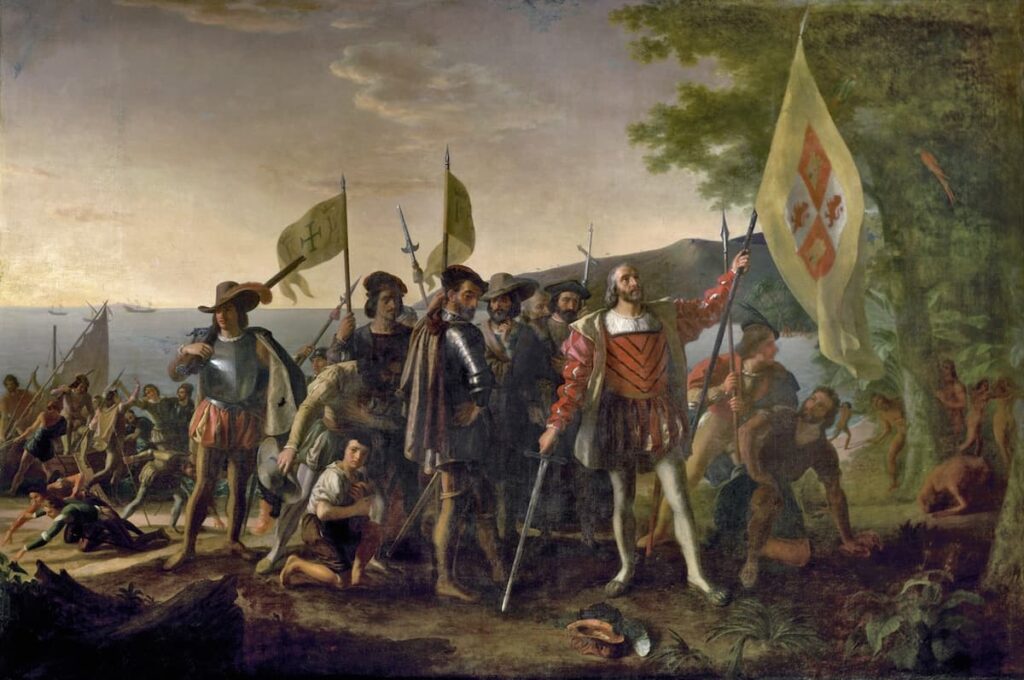
Landing of Columbus in America. Painting by John Vanderlin, 1846. Image: Architect of the Capitol
Often, discovery is attributed to the first European visit to new lands, denying that status to those who arrived earlier, such as people from Asia who came to America via the Bering Strait. However, the situation with Europeans is not straightforward either. It is known that around the 10th–11th centuries, Vikings sailed to America, establishing settlements in Newfoundland and Greenland. However, they did not perceive the discovery of America as fundamentally different from discovering Iceland or the Faroe Islands.
It did not have a significant impact on either the Native Americans or the Vikings themselves. Moreover, this information, apparently, did not extend beyond the Scandinavian world and was forgotten by the end of the 15th century. For historians, unlike geographers, what matters is not so much the first visitation to a territory, but the establishment of contacts—regular and significant for both parties—between the “discoverers” and the “discovered.”
The discovery made by Columbus on October 12, 1492, quickly became a sensation across Europe, igniting a race for discoveries along the American coastlines. In the decade following Columbus’s return from his first voyage, at least twelve expeditions were undertaken by Spain, Portugal, and England. This event profoundly altered European life within a few decades. Thus, Columbus made the “true” discovery of America. However, he merely initiated the lengthy process of discovering and exploring various parts of America, involving hundreds of expeditions from many European countries.
Were North and South America Discovered at Different Times?
Yes, but there are nuances. First, the geographical distinction: unlike America as a continent, North and South America are separate landmasses, and Columbus’s discovery began with the Bahamas in the Caribbean, which does not belong to either North or South America. If we talk about the discovery of mainland territory, North America was discovered slightly earlier: an English expedition led by John Cabot, with his son Sebastian, seeking a northwest passage to the East, reached North America’s northeast coast in late May or early summer of 1498. During his third voyage, Columbus reached the mouth of the Orinoco River and discovered South America only in early August of that year.
Second, we cannot be certain that modern researchers know about all the voyages of that time. It is possible (though unlikely) that information, even indirect, might emerge regarding the discovery of the mainland parts of North or South America before the summer of 1498. For example, there are theories that the Portuguese knew about Brazil even before Columbus’s first voyage and that is why they insisted on moving the demarcation line further west during the Treaty of Tordesillas negotiations. However, there is no documentary evidence to support this.
What Were the First Colonists Like?
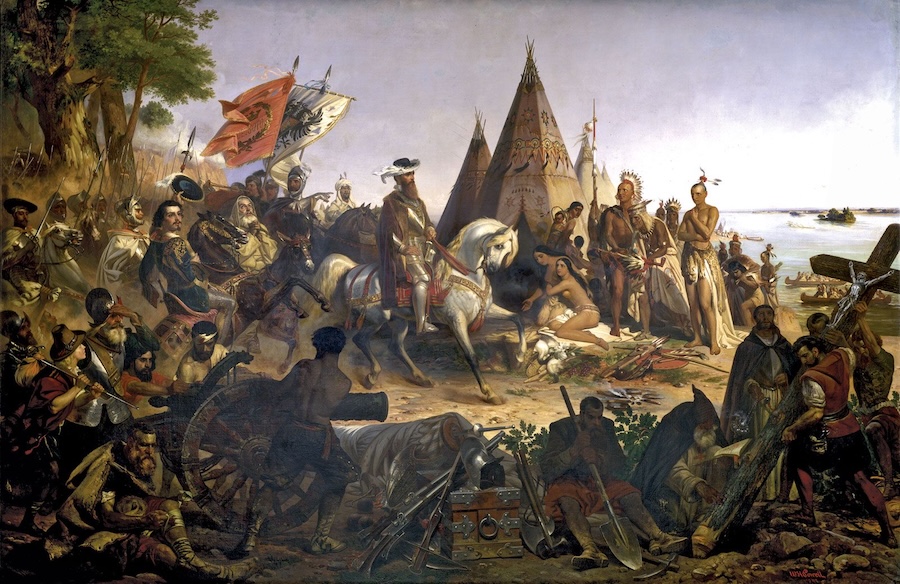
Discovery of the Mississippi River by conquistador Hernando de Soto in 1541. Painting by William Henry Powell, 1853. Image: Architect of the Capitol
To better understand what the first colonists were like, it is important to consider, first, the differences between colonists from different countries. For example, settlers from Spain were quite different from the Portuguese, and even more so from the English or the French. Secondly, one must consider the conditions and circumstances they encountered in various parts of the New World. Emigration to Spanish and Portuguese colonies was strictly controlled by the authorities. For instance, for most of the three-century colonial period, one could only depart from Seville to the New World from Spain, and each colonist had to obtain an individual permit, with their name entered into a special list. However, it was very difficult to organize such control, and occasionally it was circumvented. The authorities were also very careful to ensure that only Catholics and subjects of the Spanish monarchs were allowed to settle in the colonies. Attempts by colonists from other countries to establish settlements in territories considered Spanish met with strong resistance.
Once rumors of the riches of America were confirmed by the successes of the conquistadors in Mexico and Peru, the flow of settlers increased. Until about the mid-16th century, most of the emigrants were potential conquistadors—those who relied on their swords rather than on the plow (although farmers and artisans were also among the first colonists). Most of them were poor natives of the southwestern regions of Spain, Extremadura and Andalusia, who were migrating not out of prosperity. They were characterized by energy and persistence—others simply could not survive there. At the same time, their pragmatism was astonishingly combined with a naïve belief in miracles: they were convinced of the existence of giants and Amazons, golden cities, and a fountain of youth in the vastness of America.
Few were lucky enough to participate in one of the few truly successful expeditions that enriched all survivors (such as the people of Francisco Pizarro, who captured the Sapa Inca Atahualpa and received a fantastic ransom for him). Even fewer among them were those who returned to Spain and lived luxuriously in palaces built from the captured treasures. The rest either quickly squandered their share or failed to amass a fortune and depended on the favors of the central government, including the grant of lands that were transferred along with the indigenous people living on them, known as encomiendas. Formally, the owners of encomiendas (encomenderos) were supposed to care for them, but in practice, they lived off the labor of the local population.
Around the mid-16th century, when the Conquista was coming to an end, the richest silver deposits were discovered in the territory of present-day Mexico and Bolivia. From then on, their exploitation became the main goal of the Spanish crown, and agricultural development of the conquered lands receded into the background for a long time. It was at this time that the main characteristics of Spanish colonization and the Spanish colonist were finally formed: he lives near enormous riches and is significantly involved in their exploitation—organizing it, ensuring its protection, and what we would now call infrastructure; he is very dependent on the metropolis, under its constant control; survival is generally not an issue for him, and he is not always willing to earn a living through his own labor. This was also influenced by the widespread view in 16th-century Spain that manual labor was an unworthy and even despised occupation.
Portuguese colonists were also seeking quick enrichment, but unlike the Spaniards, they did not find such deposits of silver in their territories. Later, they discovered gold and diamonds, but this occurred only at the end of the 17th and the first third of the 18th century. In the 16th century, their sources of wealth were the harvesting of valuable redwood, which was in demand in Europe, and the organization of the still technically imperfect but already profitable production of sugar from cane brought to Brazil from the Canary Islands. The idea that manual labor was ignoble also manifested itself here: the workforce in the artisanal industries, called engenhos, were dependent indigenous people and African slaves. The beginning of the mass importation of African slaves to Brazil is connected precisely with the expansion of plantation agriculture and sugar cane production, while the owners were referred to as “senhores” or “lords” of the engenhos.
If the Spanish and Portuguese territories were an integral part of the Iberian monarchies and were all in the same legal standing relative to the metropolis, the British colonies were different from the very beginning. There were three types of colonies. Royal colonies belonged directly to the crown and were governed by officials appointed from London. In corporate colonies, the crown (or the parliament in 1649–1660) endowed a special joint-stock company with the right to govern. In proprietary colonies, these rights were given to a particular individual.
Joint-stock companies or private individuals who received rights from the authorities to develop North American lands often concealed their real intentions on paper. For example, the Massachusetts Bay Company was founded in 1628. Its goal was to create an ideal world of Christian life in the New World in a Protestant-Calvinist interpretation (Calvinists in England were called Puritans)—a “City upon a Hill” from the Sermon on the Mount, as John Winthrop (1588–1649), the founder of Massachusetts, told the settlers before the ship departed. Six New England states in the northeastern United States emerged from Puritan colonization. The Pennsylvania colony was founded by William Penn (1644–1718) primarily for fellow Quakers, although the colony’s fundamental laws, drafted by him, stated that all settlers who believed in a single God were welcome in the new lands.
The royal colonies were mainly populated by the poor who hoped for a better life and their own land allotment in the New World. Most of them could not pay for the trip themselves and then worked off this “loan” for 4–7 years. Therefore, they were called indentured servants. Upon completion, they received land, sometimes with agricultural tools for its cultivation. Of the roughly 75,000 people who moved to Virginia and Maryland between 1630 and 1680, two-thirds arrived as indentured servants.
The first British settlers in North America found themselves in a completely different position compared to the Spaniards in Central and South America. Firstly, there was no gold, silver, or other wealth that attracted people with the temptation of easy profit. Although theoretical justifications for colonization soon appeared, emphasizing that the English could earn as much in these places from fishing and logging as the Spaniards did from gold and silver.
Secondly, the natural and climatic conditions were harsh for Europeans, and aid from the metropolis was minimal. Survival was only possible through daily hard work and strict discipline. In the very first permanent colony (Jamestown, Virginia), founded in 1607, only a few dozen of the 150 colonists survived the winter and spring of 1608, and such numbers were not uncommon.
Thirdly, relations with the Native Americans were different, and the Native Americans themselves were different. There were no highly developed civilizations here that had accumulated reserves of precious metals, as in Mexico or Peru, and there was nothing for the Europeans to take from the Native Americans except land. In the early years, contacts between colonists and Native Americans varied: from frequent bloody clashes (in the spring of 1622, Algonquin Indians killed 347 colonists—at least a quarter of Virginia’s population) to mutual assistance.
For example, in New Plymouth in New England, the Wampanoag Indians helped the colonists survive the first winter, and in gratitude, the colonists celebrated the first harvest together with the Native Americans. This is how Thanksgiving Day came about. At the same time, the density of the Native American population in the territory of the United States and Canada was much lower than in the Aztec or Inca states, and the Native Americans quickly retreated from the coastal areas where the colonists settled.
The first British colonists were generally hardworking and persistent, decisive, and able to stand up for themselves, deeply religious, and intolerant of religious dissent. Necessity taught them discipline. Compared to settlers from the Iberian countries, they were relatively less dependent on the metropolis and were used to relying on their own strength in everything.
What Did They Eat and How Did They Survive?
Hunger was a common companion for nearly all early settlers, especially in the first years. The colonists anticipated rapid wealth accumulation and support from their mother countries; plowing the land and raising livestock were often not part of their plans. Moreover, native food could be perceived as unworthy or weakening for the body. The settlers faced the dual challenge of a lack of familiar foods and an abundance of unknown ones. The diet was significantly different: while Europeans were accustomed to meat and dairy products, the indigenous people of South America (despite the variety of climate zones and economic systems in the region) relied primarily on plant-based foods, with protein coming not only from wild game and fish but also from insects. Furthermore, dairy products were unknown to the Indigenous peoples.
Another major difference in attitudes toward food was the consumption of raw, uncooked foods. For those from the Old World, this was seen as savage and barbaric; they believed that only animals ate raw food. In addition to this, a major psychological barrier for Europeans was the absence in the New World of two crucial crops: wheat and grapevines. Since Christian worship required wheat bread and wine, local substitutes (such as corn, manioc, and fermented beverages made from them) were considered inadequate replacements.
Initial attempts to practice European-style agriculture in the New World encountered serious difficulties: different levels of humidity and sunlight, different soil chemistry, a lack of natural pollinators, and opposite seasons in the Northern and Southern Hemispheres. There was also a shortage of labor: as mentioned earlier, Spanish and Portuguese colonists brought with them the notion that manual labor was not a noble activity, and the recruitment (often forced) of Indigenous people did not always meet all their needs.
Moreover, the Indigenous people of tropical regions, who survived through hunting, fishing, and gathering, had a completely different attitude toward work for sustenance. They did not have the drive to collect (catch or hunt) more than they would eat or to work day after day to create reserves. At the same time, colonists in both Spanish and Portuguese America wanted to extract more and more products from them. Reports sent to the Portuguese crown in the first half of the 16th century contained numerous accounts of hunger among settlers. This was due to the organization of food supply and a prejudiced attitude toward local products, not a lack of resources.
Nevertheless, crops such as manioc, corn, and potatoes did eventually make their way into the settlers’ diets, although they were initially intended for the Indigenous peoples. In some regions of Spanish America, these products were used as a form of tax collected from the local population. Later, they continued to be consumed alongside imported wheat, rice, and certain types of legumes. As for wine, it was imported for a long time and became a luxury item. By regulating its supply, the mother countries aimed to increase the colonies’ dependence and tie them more closely to the metropolis. However, by the second half of the 16th century, grapevines began to be cultivated in Spanish territories in what is now Peru, followed by Paraguay, Argentina, and Chile. The inhabitants of Portuguese America, with its specific climate conditions, relied more on imported wine, and large-scale production began only in the 19th century.
The first agricultural animals brought by the Spanish were pigs and cattle. These were not only kept near settlements but were also deliberately released on uninhabited Caribbean islands as a backup food source for sailors who might go off course or be shipwrecked. After being introduced to the Antilles, they were also brought to other regions of Spanish America. European pigs quickly adapted to the new environment and began feeding on tropical vegetation. Pietro Martire d’Anghiera and Gonzalo Fernández de Oviedo y Valdés noted with satisfaction how the new diet improved the taste of these pigs’ meat.
Globally, the new food base for pigs and cattle allowed them to reproduce quickly, and due to the lack of natural predators, they significantly altered the ecological balance of certain regions (such as the Caribbean islands). However, European colonizers did not think in these terms: they sought to provide familiar meat-based food for themselves, the fleets arriving from the mother countries, and the conquest expeditions of Hernán Cortés, Francisco Pizarro, Hernando de Soto, and others. In addition, cattle were needed by the colonists as draft animals on plantations and in mines.
Where Did Native Americans Come From — Have They Always Been in America or Did They Arrive from Somewhere Else?
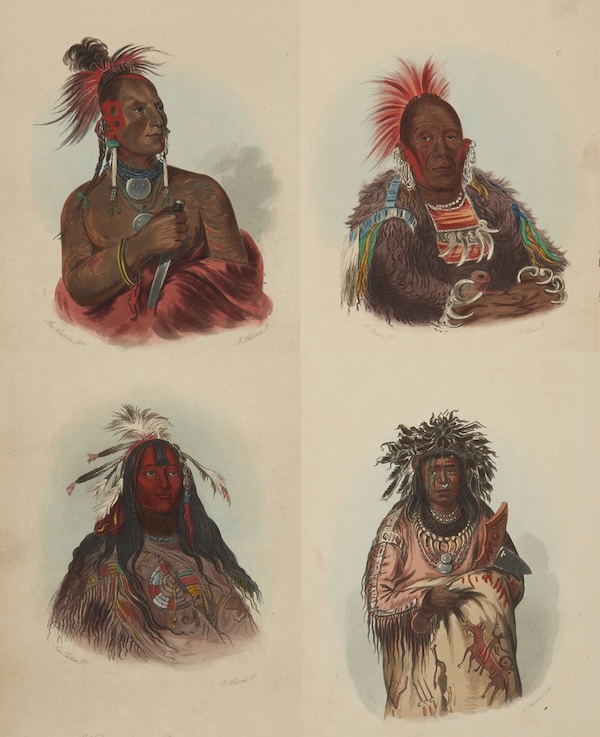
Four colorized engravings of Indians of various tribes from James Coles Pritchard’s book The natural history of man : comprising inquiries into the modifying influence of physical and moral agencies on the different tribes of the human family. London, 1845. Image: Heritage Auctions
North and South America were settled relatively late in human history. At the end of the Ice Age, Upper Paleolithic Siberian tribes crossed into America via the Bering land bridge (now the Bering Strait) and spread throughout both continents in about 1,000 years. Genetic analysis has shown that all Native Americans — from Aleuts and Eskimos to various tribes of Tierra del Fuego — are closely related. For a long time, the oldest archaeological culture in the New World was considered to be the Clovis culture, discovered in the 1920s and 1930s, in what is now New Mexico.
This culture emerged around 15,000 years ago. Over the past two to three decades, the discovery of several pre-Clovis sites (most notably the Monte Verde culture in southern modern-day Chile) has shifted the date of settlement of the New World back by 2,000–3,000 years — it is now believed to have occurred around 15,000–16,000 years ago. Earlier datings (up to 31,000–26,000 BC) are disputed and, although not yet rejected by the scientific community, are not widely accepted by most researchers.
How Many Were There, How Did Different Tribes Live, and What Do We Know About Them?
European conquerors encountered a variety of complex societies in the New World, ranging from semi-nomadic tribes of hunters, fishers, and gatherers to powerful state entities like the Aztec and Inca empires. Over a thousand Native American languages are known, forming hundreds of diverse language families. Attempts to reconstruct a Proto-Indian language, spoken by the first settlers who crossed the Bering Strait, have not been successful so far.
Native Americans were unable to put up significant resistance to Europeans. Despite their remarkable achievements in certain areas (such as astronomy), even the most advanced societies did not have knowledge of the wheel, gunpowder, or iron (occasional iron finds do not change the overall picture). Native Americans used bronze for making ornaments and ceremonial objects but not for weapons. This imbalance in technological development is due to the isolation of the New World from the rest of the world.
The question of the native population’s size at the time of America’s discovery is highly ideological and tied to debates about genocide. Estimates vary widely, ranging from 8 million to more than 100 million people. Venezuelan researcher Ángel Rosenblat (1902–1984) estimated the indigenous population of the New World at the time of conquest to be around 13.3 million, and by 1650, around 10 million. In textbooks, you may often see the figure of 55 million; this data is provided by North American geographer William Denevan. In his later works from the early 1990s, he refined this estimate to 53.9 million ± 20%.
How Did the Genocide of Indigenous Peoples Occur and Why?
South America
To address this complex issue, it’s essential to start with definitions. The 1948 UN Convention defines genocide as acts committed with the intent to destroy, in whole or in part, a national, ethnic, racial, or religious group. Clearly, this definition was shaped by the tragic events of the 20th century and cannot be automatically applied to earlier historical periods. At first glance, there seem to be numerous grounds for discussing the genocide of the Indigenous populations of Latin America: the fall of pre-Columbian civilizations after encountering the conquistadors; the complete disappearance of the native population in Cuba and almost complete disappearance in Argentina and Uruguay; significant losses among Indigenous peoples in the tropical and coastal zones of South America; and the massive mortality caused by diseases introduced by Europeans and by forced labor in mines and plantations.
On the other hand, European contacts with Indigenous peoples were varied, the policies of colonial authorities were inconsistent and often contradictory, and there were significant discrepancies between laws imposed from Europe and the local conditions. This diversity prevents us from reducing the entire picture to systematic and methodical genocide. However, the tradition of attributing solely atrocities and bloodshed to the Spanish is not new and has persisted for several centuries. This is also influenced by the so-called “Black Legend”—a strongly anti-Spanish narrative spread by opponents of the Habsburg dynasty in Europe as the Spanish Empire conquered more and more territories.
However, from a historical perspective, when the scale of the loss among the Indigenous population became apparent, one cannot help but think about the destruction of Indigenous peoples—even if it was involuntary and collateral, rather than conscious and intentional (for example, when the pretext was a war against pagans, idolaters, or those practicing human sacrifice). To call it genocide, it must be proven that the colonizers consciously intended to wipe out the Indigenous peoples rather than subjugate, pacify, or conduct a demonstrative act of intimidation, and so forth. There were instances when subjects of the Spanish king pursued policies that led to the destruction of Indigenous peoples, while the king himself condemned these “excesses” and declared that such actions contradicted service to him and God.
Modern historians disagree on whether the term “genocide” applies to the events of the Conquista. Some remind us of a range of aggravating circumstances beyond direct massacres: the removal of leaders as a blow to communities and entire tribal alliances; the relocation of enslaved Indigenous peoples from “useless” areas to regions where labor was needed, resulting in enormous losses; ecocide, or the destruction of ecosystems in which traditional pre-state societies had been integrated for centuries; and sexual violence against women. Opponents of equating the Conquista with genocide argue that the Spaniards’ brutality was driven by the desire to subjugate and later exploit the Indigenous peoples, not to annihilate them entirely. Others emphasize that in the demographic catastrophe that befell the Indigenous population of Latin America, European-introduced infections were more to blame than the extermination by conquistadors. Finally, some point out that alongside the military actions of the conquistadors on the ground, extensive legislation was developed in Spain throughout the 16th century, declaring the protection of Indigenous peoples. Although the practice of the Conquista often involved the voluntary or involuntary extermination of Indigenous peoples, theoretically, something entirely different was proclaimed.
Beyond the question of genocide during the Conquista, researchers address related issues: ecocide and ethnocide. The previously mentioned ecocide refers to the predatory exploitation of natural resources by Europeans in the pursuit of profit and the destruction of ecosystems in which the lives of hunter-gatherers in the Caribbean and continental tropical zones were embedded. It includes the colonization of the Caribbean islands, which led to the rapid (within a few decades) disappearance of the Taíno tribe and several others, as well as the significant reduction of Atlantic coastal forests in Brazil due to the cutting down of valuable redwood. A key element in the modern struggle for the rights of the Amazonian Indigenous peoples is the preservation of the natural environment in which they live.
As for ethnocide, it is understood as the destruction of an ethnic group through the eradication of its culture and the prevention of the use, development, and transmission of its language and culture to subsequent generations (including religious beliefs). Indeed, it is undeniable that the Spaniards and Portuguese sought to convert the Indigenous populations of Latin America to their religion and impose a Christian way of life. None of the defenders of the Indigenous peoples in the 16th–17th centuries—be it Padre Bartolomé de las Casas or the Portuguese and Spanish Jesuits who saved the Tupi-Guarani from brutal slave hunters—questioned the superiority of Christianity over paganism and the impossibility of preserving the old rituals and way of life. They were driven by a sincere belief in the only possible salvation of the soul through the acceptance of the Catholic faith. The realities of the Conquista showed that the slogans of spreading Christianity for the good of the Indigenous peoples too often masked looting and ruthless exploitation. Nevertheless, contemporaries objected only to the methods of conversion, not to its overarching goals.
Thus, based on the 1948 UN Convention, the actions of Europeans in South America during the Conquista and colonization were not genocide. The most comprehensive general formulation, which seems acceptable to both opponents and supporters of the idea of genocide, is as follows: a violent alteration of the destinies of peoples after the Old World discovered the New and subjugated it.
North America
In North America, the population density of both Indigenous and non-Indigenous peoples during the colonial era was significantly lower. Nevertheless, European colonization also led to wars and the gradual displacement of Indigenous peoples deeper into the continent. The first encounters between Indigenous peoples and the Spanish and French in North America date back to the 16th century. Wars between white settlers and Algonquin Indigenous peoples began in Virginia (1622) and New England (1637, 1675–1676). Then came wars with the Iroquois, Muscogee, and Sioux (from 1675 onward). However, there were cases when European powers, on the contrary, sought to enlist the military support of the Indigenous peoples. For example, the Seven Years’ War (1754–1763) in British North America became known as the “French and Indian War.”
In 1763, British authorities prohibited settlers from moving west of the Allegheny Mountains, explaining their decision as being in the interest of Indigenous peoples. However, this decision ultimately was not implemented—independence movements soon began.
The true catastrophe for the Indigenous populations of the United States was linked to the rapid agricultural development of vast areas of the continent in the 19th century. In 1830, the U.S. Congress passed the “Indian Removal Act,” forcibly relocating Indigenous peoples from the Atlantic coast to lands west of the Mississippi River. A series of wars did not halt the federal government’s decision. In 1831, the U.S. Supreme Court recognized Indigenous tribes as “domestic dependent nations,” for which the U.S. government essentially bore guardianship responsibilities. Although the Supreme Court restored the tribes’ sovereignty in 1832, their relocation did not stop. The Cherokee, Creek, Seminole, Chickasaw, and Choctaw were sent along the “Trail of Tears” to what is now Oklahoma.
The Dawes Act (1887) destroyed the rights of Indigenous communities—tribal self-government and their collective land ownership—leaving almost all of them, beyond the borders of the so-called Indian Territory, with individual plots of 160 acres (64.8 hectares), the same amount an ordinary settler could receive under the Homestead Act. This was a very large allotment for irrigated farming but did not allow for the continuation of traditional economies. Senator Henry Dawes (1816–1903) believed that his law would speed up the transformation of Indigenous hunters into progressive, prosperous farmers.
The outcome was different. During the years the law was in effect (until 1934), Indigenous peoples lost nearly two-thirds of their lands. On December 28–29, 1890, U.S. troops crushed the Sioux uprising at Wounded Knee in South Dakota. This last armed conflict with the Indigenous population of the U.S. coincided with the end of the “moving frontier” era—the completion of the country’s internal rural colonization: vast expanses, where only recently one could encounter only Indigenous peoples, were plowed in just a few decades. If in 1800 the total Indigenous population in the U.S. was about 600,000, by 1900 it had reached the lowest point in North American statistical history—fewer than 240,000.
The governments of not only the U.S. but also other New World countries sought to break up Indigenous communities and replace communal land ownership with private property. Their goal was to create a unified land market and eliminate “feudal remnants.” These measures were most consistently implemented in Mexico. The Lerdo Law (1856) prohibited corporate (i.e., non-individual) land ownership, which immediately dealt a powerful blow to Indigenous peoples who could not keep up with the re-registration of their land rights (another victim of the law was the Catholic Church). The Law on Colonization of “Vacant Lands” (1883), in particular, led to the direct seizure of Indigenous lands in Sonora and Yucatán. As a result, if in 1821 communal land ownership accounted for 40% of agricultural land, by 1910 it was no more than 5%. The situation of the Indigenous peoples became dire in Argentina, where, as in the U.S. and Canada, a powerful settler movement and effective market agriculture emerged in the last third of the 19th century.
How Did Mexico, the USA, and Canada Come to Be?
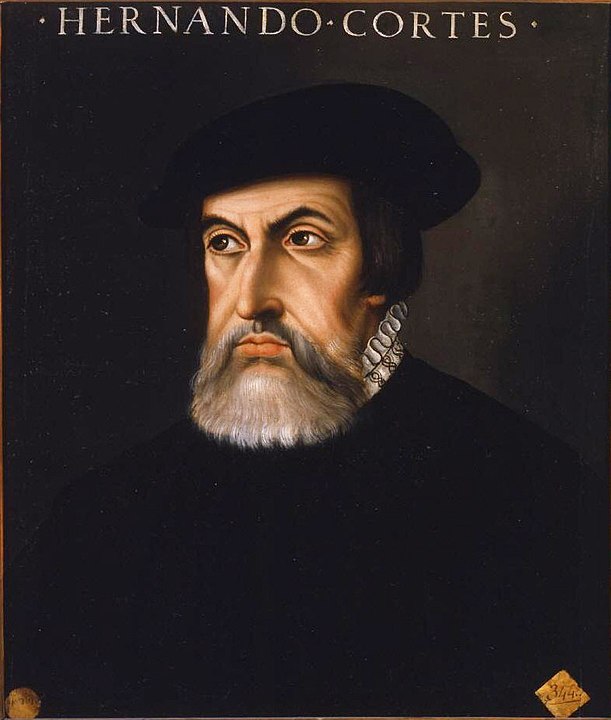
Hernán Cortés, Conquistador of the Aztec Empire
Mexico
All these modern countries are geographically part of North America, but historically and culturally they represent different regions. Mexico is part of Latin America; after the discovery of the New World, it became part of Spain’s colonial possessions. The USA emerged from British colonies, though some of its modern territories were once Spanish and even French colonies. Modern Canada includes lands that belonged to both the French and British crowns.
Of all these countries, Mexico experienced the earliest systematic European colonization. As early as 1519–1521, the Spanish conquistador Hernán Cortés (1485–1547) conquered the Aztec Empire, and in the 1540s, the Spanish subdued the Maya states. Gradually, a system of governance for Spanish America developed, and in 1535, the Viceroyalty of New Spain was established. It became the first of the viceroyalties into which Spanish possessions in America were divided. The significance of New Spain, which was one of the most densely populated and economically developed regions of the New World even before the conquest, increased with the discovery of silver mines in the 1540s.
Like the other viceroyalties, New Spain lasted until the early 19th century. After Napoleon Bonaparte increasingly subjugated the Spanish monarchy, forcing King Charles IV of Bourbon and his heir to abdicate in favor of Napoleon’s brother Joseph in May 1808, juntas (representative bodies) began to emerge in Spain and its overseas territories. These initially ruled in the name of the rightful king, Ferdinand VII, son of Charles IV. In Mexico City, the capital of New Spain, such a junta appeared in August 1808. Unlike the viceroyalties of New Granada and Rio de la Plata, where the struggle for independence was initiated by the Creole elite—descendants of Spaniards who felt more American than European—in New Spain, the independence movement developed from below. On September 16, 1810, the priest Miguel Hidalgo from the village of Dolores in Guanajuato (central Mexico) called for a fight for freedom—known as the “Cry of Dolores.” This sparked a struggle for Mexican independence that divided the country.
On February 24, 1821, the commander of Spanish forces in southern Mexico, Agustín de Iturbide, issued the “Plan of Iguala” (named after a town in southwestern Mexico) under the slogan “Religion, Unity, Independence.” It declared Mexico a constitutional monarchy, guaranteed the preservation of the Catholic Church’s privileges, and proclaimed equality for all Mexicans, regardless of race or origin. The “Plan of Iguala” became the historical compromise that united the forces of radicals and conservatives in the struggle against the authority of the metropole.
On September 28, 1821, the Act of Independence of the Mexican Empire was proclaimed, but by March 1823, the republicans had overthrown Emperor Agustín I Iturbide. On October 4, 1824, the republican constitution of the United Mexican States was published.
USA and Canada
The first permanent British colony in the New World, Virginia, was founded in 1607. The War of Independence began in 1775 in 13 British colonies in North America—excluding Canada, which was incorporated into the British Empire only after the Seven Years’ War (1756–1763), and the island possessions in the Caribbean. The struggle concluded in 1783 with the signing of the Treaty of Paris, under which London recognized the independence of the new state—the United States of America.
The exploration of Canada began with the Italian John Cabot (Giovanni Caboto), who landed on the coast of Newfoundland in 1497, serving the English crown. He was followed in the early 16th century by French expeditions led by the Florentine Giovanni da Verrazzano and Jacques Cartier, whom the Indigenous people guided to Canada (meaning “village” in the Iroquois language). The actual colonization of Canada by the French began with Samuel de Champlain’s establishment of Quebec City in 1608. Following the Treaty of Utrecht, which ended the War of Spanish Succession in 1713, France lost Acadia, and by the Treaty of Paris in 1763, the British Empire acquired Quebec, bringing Canada entirely under its control.
During the Revolutionary War -or American War of Independence- (1775–1783), both new British settlers and the French in Canada remained loyal to London. It was during this time, in 1774, that the Quebec Act was passed, securing the rights of French Catholics. In 1841, the English-speaking Upper Canada and the French-speaking Lower Canada, created in 1791, were unified. In 1867, the British North America Act created the Dominion of Canada, a self-governing possession of the British Empire. The legal concept of a “Dominion,” which existed until 1949, was initially developed for Canada and later extended to Australia, New Zealand, South Africa, Ireland, and Newfoundland, which was incorporated into Canada only in 1949. Canada became fully independent in 1982 with the passage of the Canada Act, despite retaining membership in the British Commonwealth.
What is the Oldest City in America?
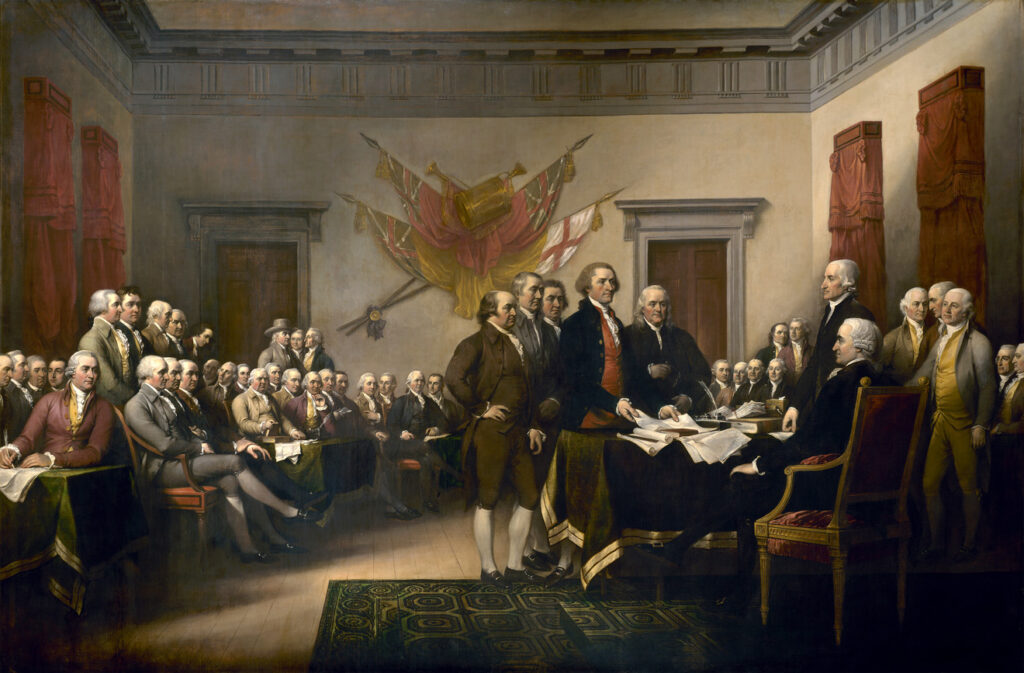
Declaration of Independence. Painting by John Trumbull. 1819 year. Image: Architect of the Capitol
To answer this question, we must make some clarifications. Firstly, it’s essential to distinguish between cities founded by Europeans and those of ancient American civilizations, the oldest of which likely date back to the 1st millennium BCE. These did not survive the era of the Conquest in their original form, although some cities of Spanish colonists emerged on their ruins. The most prominent example is Mexico City on the ruins of Tenochtitlan.
If we talk about cities founded in the New World by Europeans, the undisputed primacy belongs to Santo Domingo on the island of Hispaniola. It was established in 1496 by Bartolomeo Columbus, the brother of Christopher Columbus. If we look at the mainland, the uncontested oldest city in Central America is Nombre de Dios in Panama, founded by Diego de Nicuesa in 1510. In South America, the oldest existing city (again, with the caveat that we do not consider pre-Columbian cities) appears to be Santa Marta on the current territory of Colombia, founded by Rodrigo de Bastidas in 1525.
Finally, in North America (excluding Central America, meaning in the territories of the USA and Canada), the oldest city is St. Augustine (Spanish name San Agustín), located in what is now the state of Florida, USA. In 1564, a French fort named Fort Caroline was established there, but the following year, the Spanish admiral Pedro Menéndez de Avilés destroyed the French colony and established Fort San Agustín in its place.
How the Discovery of America Affected the European Economy
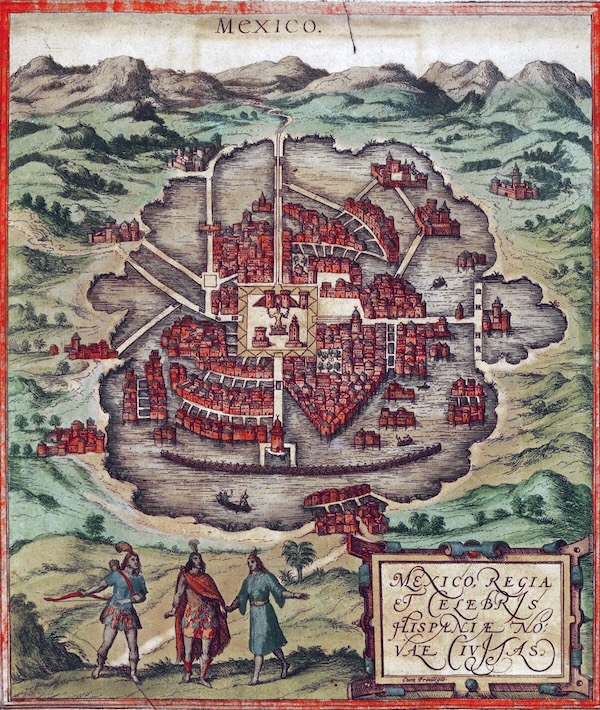
View of Mexico City (formerly Tenochtitlan). Colorized engraving by Franz Hogenberg. 1564. Image: Hebrew University of Jerusalem
The discovery of America had a profound impact on the socio-economic development of Europe. As major trade routes shifted from the Mediterranean to the Atlantic, some regions lost their former prominence (Italy, Southern Germany), while others gained significantly in strength (Spain and Portugal, later England and the Netherlands). The large-scale importation of American precious metals doubled the amount of gold and tripled the amount of silver circulating in Europe, contributing to a rapid increase in prices for essential goods (the so-called “Price Revolution”) across Europe
A significant portion of the precious metals arriving in Europe was immediately exported to Asia, where they were used to purchase expensive Eastern goods. However, some silver remained in Europe. The increase in the money supply, along with the potential of colonies as sources of raw materials and markets for European goods, contributed to the development of the European economy. At the same time, the causes of the “Price Revolution” and other new socio-economic processes required explanation and stimulated the development of economic thought, particularly in Spain.
As a result of the discovery of America, not only did trade contacts with Europe rapidly expand, but systemic connections also developed between Asia and America (embodied in the Manila galleons—huge ships that sailed between Manila in the Philippines and Acapulco in Mexico), as well as between America and Africa. In the Atlantic in the 16th and 17th centuries, a triangular trade route developed: ships carried European goods to Africa, transported enslaved people to the New World, and returned to Europe with cargoes of tobacco, sugar, and other goods. All of this indicated the formation of a global market.
Paradoxically, the economies of the Iberian countries, which were the first to establish colonies in America, ultimately found themselves at a disadvantage. First, emigration to the colonies created huge demographic problems for Spain and especially for Portugal. Second, their economies could not meet the needs of their overseas possessions, forcing authorities to open the way to America for merchants from more developed countries, who in turn began to dominate the economies of the metropolises to some extent. “These kingdoms are becoming poorer every day and are turning into Indies for foreigners,” complained deputies of the Castilian Cortes in the mid-16th century.
Along with the economy, politics also expanded onto the vast oceans. Competition for control over trade routes, the desire of European powers to acquire their own colonies, and the struggle for their redistribution became an integral part of international relations. Thanks to the wealth of the colonies, the metropolises significantly strengthened their positions in Europe.
How Did It Change European Culture?
The scientific revolution of the 16th and 17th centuries became possible in large part because the discovery of America, as a key component of the Age of Discovery, led to a dramatic expansion of Europeans’ understanding of the world. In America, new extensive materials were collected for the natural sciences, ethnography, history, and linguistics. Contacts with indigenous tribes, who had different social structures, stimulated the development of social thought. By gaining experience in interacting with bearers of different cultures and religions, Europeans became more aware of their own cultural and historical unity.
At the same time, the most critically-minded among them realized that the world is diverse, that foreign cultures and religions may be no worse than their own, and that Europeans could learn much from the inhabitants of distant lands. It is no coincidence that the famous French humanist Michel de Montaigne (1533–1592) emphasized that in terms of morality, Native Americans were in no way inferior to Europeans, and Thomas More placed his ideal island of Utopia near the shores of South America. Alonso de Ercilla, in his epic poem “La Araucana,” describing the wars of the Spaniards with the Araucanian Indians, does not question Spain’s right to subdue them but effectively presents them in a heroic light as fighters for freedom, whose truth is equated with that of the Spaniards. Spanish humanists and clergy (Bartolomé de las Casas, Vasco de Quiroga, and others) attempted to implement utopian ideas in the New World that were born in Europe. Reflections on the Golden Age and the unspoiled faith of the inhabitants of America were organically woven into the intellectual world of the Renaissance and the Reformation.
The discovery of America and the subsequent Conquista inspired literary works of various genres: Hernán Cortés’s “Letters,” Álvar Núñez Cabeza de Vaca’s “Shipwrecked Survivor’s Report,” and others. Innovative compilations appeared that contained information about the geography and nature of the new lands, as well as the customs and history of their peoples: “Decades of the New World” by Pietro Martire d’Anghiera, “History of the Indies” by Las Casas, “General History of the Things of New Spain” by Bernardino de Sahagún, and others. Images of America from the Age of Discovery and Conquista can also be traced in European literature and art, particularly in the works of Shakespeare and Calderón.
And the Food?
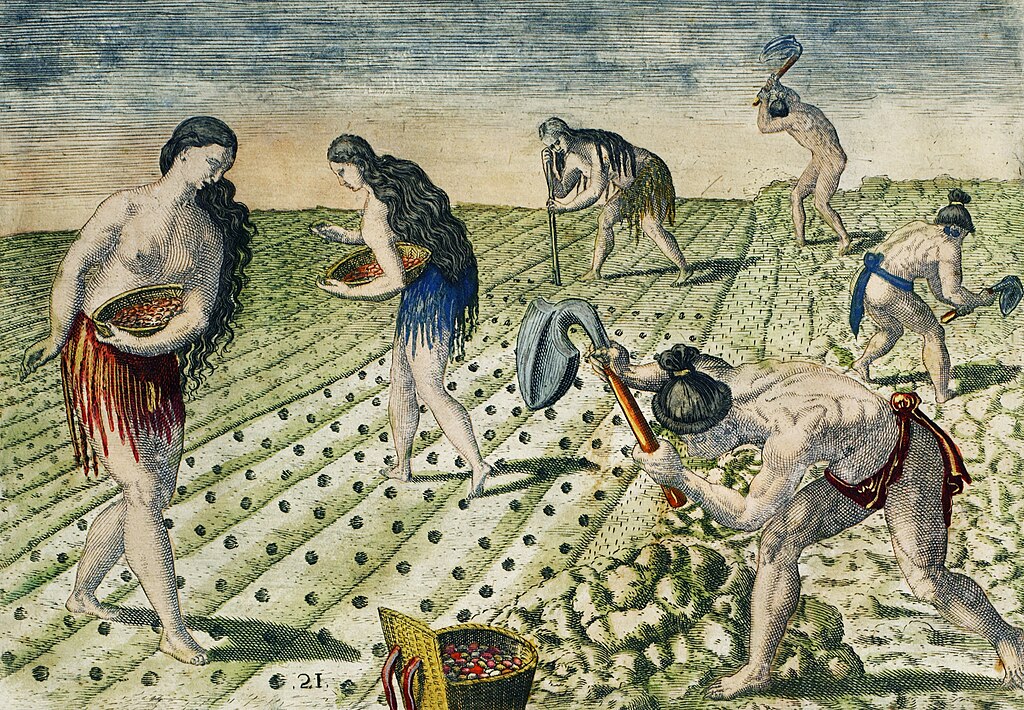
Florida Indians sowing corn. Illustration for a story by Jacques Lemoine from the second volume of Theodor de Bry’s Grand Voyages. First edition 1591. Image: Jacksonville Public Library Florida Collection
Europeans were introduced to new types of poultry (turkeys), agricultural crops (potatoes, corn, tomatoes, beans, red chili peppers, pumpkins, cocoa), and fruits (pineapple, avocado). Although the introduction of new products was delayed due to the conservative mindset of most colonists, over time, they significantly changed the diet of Europeans, causing a sort of “food revolution.” Particularly important were potatoes and corn, which significantly reduced the threat of famine. The influence of crops brought to America by Europeans and actively cultivated there for export to the Old World (coffee, sugarcane, from which not only sugar but also rum was made) was also substantial.
Tobacco deserves special mention: it is not an edible crop, but was initially valued by Europeans as a remedy for hunger; it was also used as medicine (recall that later Robinson Crusoe used tobacco tincture for treatment on his deserted island). Eventually, chewing, sniffing, and smoking tobacco became popular in the Old World for pleasure. Tobacco became the main crop in British Virginia and Maryland in the 17th and 18th centuries.
The Spanish also introduced bananas to the island of Haiti, which are now considered an integral part of American flora. There are hypotheses that bananas were known in South America even before the arrival of Europeans; in any case, it was the Spanish who spread them widely throughout their territories.
European colonists also contributed to the spread of American species of cultivated plants and domesticated animals beyond their original habitats. For example, they brought the Mexican-origin turkey to Peru. Over time, the mixing of indigenous and European food products and methods of preparation led to the creation of a unique cuisine on both sides of the Atlantic. Some dishes that became traditional on both sides of the Atlantic include imported ingredients, but their American or European origins have been forgotten (for example, the Spanish potato tortilla—not to be confused with the Mexican corn tortilla—or dishes based on rice and milk from Argentina).
The “War of Currents” refers to the late 19th-century rivalry between two inventors: Thomas Edison and Nikola Tesla, who was supported by the prominent American industrialist and engineer George Westinghouse. Edison advocated for direct current (DC), while Tesla championed alternating current (AC). Both types of current can power electrical appliances and communication devices, but they behave differently when transmitted over distances.
Historically, DC generators appeared first. They had low voltage and could power electric light bulbs and provide signal transmission, but only over short distances of up to 1-2 km. Over longer distances, voltage dropped and network resistance increased.
AC is transmitted at higher voltages, allowing for more efficient energy transmission over long distances. Its energy can be used not only to supply low-power lighting devices but also, for example, in industrial enterprises with heavy machinery. AC machines received a boost in development in the 1870s with Pavel Yablochkov’s creation of an arc lamp powered by alternating current (see question 8), but the “War of Currents” truly began in the 1880s when Nikola Tesla started working for Edison’s company and demonstrated his AC motor designs based on a rotating magnetic field.
Who Were Edison and Tesla?
Thomas Edison. Circa 1906. Image: Library of Congress
Thomas Edison (1847-1931) was an American inventor and entrepreneur. In his youth, he worked as a telegraph operator, was interested in electrical engineering, and enthusiastically repaired and improved devices. Around 1869, Edison sold his first patent for an improved stock ticker — a system for telegraphing stock market data. In 1873, he visited England, where he became familiar with the complex laboratory machinery used by telegraph engineers for communication. After returning to the USA, he organized a laboratory and later a whole “invention factory”: in 1875-1876 in Menlo Park, and in 1887 in West Orange. He became famous after inventing the phonograph in 1877.
After establishing the production of dynamos, cables, and light bulbs, Edison launched DC power stations in London and New York in 1882. In 1889, the Edison General Electric Company was formed through the merger of three of Edison’s manufacturing companies that had been operating since the early 1880s and his patent company, founded in 1878. He was 42 years old at the time.
Nikola Tesla (1856-1943) was an engineer and inventor of Serbian origin. He became famous for developing AC motors and the idea that electricity and messages could be transmitted wirelessly. He went down in history as an extravagant and even odious figure, with his biography shrouded in mysteries and myths. In 1882, while pondering a problem he had formulated in 1878 while studying in Graz, the 26-year-old Tesla came up with a way to use the phenomenon of a rotating magnetic field, which would allow the construction of an AC electric motor.
What Did They Disagree About?
In the same year, 1882, Tesla arrived at the Paris office of Continental Edison Company, where he proposed the idea of a new motor. Instead of considering the proposal, Tesla was sent to build a problematic power station for the Strasbourg railway station. Tesla helped launch it, but when he returned to Paris for the promised fee, the company refused to pay.
Not abandoning his ideas in electrical engineering, Tesla went to the USA and got a job as a repair engineer for DC generators at Edison Machine Works. The company offered Tesla to improve DC machines and promised a substantial bonus — reportedly $50,000. Tesla soon presented 24 variants of new generators. Edison approved the work but refused to pay, joking that the Serbian immigrant didn’t understand American humor well. According to another version of this event, Tesla himself offered to sell his patent to the company for $50,000, but the company just laughed. Either way, from that moment on, Edison became Tesla’s lifelong enemy.
Tesla left Edison’s company, but George Westinghouse, who was well-versed in the industry and knew the weaknesses of DC power stations, saw potential in his developments. He wanted to use Tesla’s ideas to overcome these shortcomings.
What Was Westinghouse’s Interest?
Illustration from Westinghouse Electric Company catalog. 1888. Image: Wikimedia Commons
Westinghouse’s AC stations and devices began to compete with Edison’s almost established monopoly from the mid-1880s. Moreover, Westinghouse began using transformers that allowed high AC voltage to be lowered so it could be used for home lighting as well. If before the advent of transformers, Edison and Westinghouse could have occupied separate niches (Edison in lighting and communication, Westinghouse in long-distance power transmission and industry with powerful installations), current transformation allowed Westinghouse to compete with Edison in his field – lighting.
What Role Did the Simple Electric Meter Play in the “War of Currents”?
Edison developed an electricity meter in his laboratory and received a patent for it in 1881. There were several such patents afterward. Electric measuring devices existed before this; scientists actively began inventing and manufacturing them from the early 19th century when the first electric batteries appeared and electricity research began to shift from recording qualitative characteristics of the phenomenon to quantitative ones.
Edison’s development is important because the new meter became an element of a centralized energy supply and lighting system, turning electricity into a commercial commodity. It was a kind of final touch, making the whole system complete: power plant, wires, lamps, and a meter recording the relationship between the company and the consumer.
Electricity supply according to this system was organized by Edison’s company in New York in 1882. According to the scientist’s plan, the device for measuring electrical energy should have worked on the same principle as the gas meter familiar to consumers. However, unlike gas, electricity has no weight or smell, so it had to be measured by indirect signs. Edison’s meter was based on Faraday’s law of electrolysis, according to which the mass of substance deposited on an electrode is directly proportional to the amount of electricity transferred to that electrode.
The specificity of such a meter design was that users could not independently take measurements. Company employees would disconnect the meters once a month, remove the electrodes, take them to the laboratory, where electricity consumption was calculated based on weighing data, and then a bill was sent by mail. This method was inconvenient and non-transparent for consumers. Moreover, the electrolytic principle was suitable for a DC system but not for an AC system.
In the context of the “War of Currents,” the invention of the meter was important in the sense that it secured the status of electricity as a mass measurable commodity, allowing the construction of an electricity market. The introduction of AC generators implied a redistribution of this market.
Is It True That Everyone Was Afraid of Alternating Current?
The myriad of telephone, telegraph, and power lines over the streets of New York City in a photo of the Great Blizzard of 1888. An AC line that fell during the storm led to the electrocution of a boy that spring. Image: Public Domain, Wikimedia
Electricity was a trendy topic in American press and public discourse of the 1880s. Electricity was associated with hopes for progress, described as a revolutionary technology capable of illuminating, moving, and even healing. However, there was also fear. In addition to Edison’s company, several other companies in New York offered lighting and telegraph communication. According to journalists’ remarks, they literally enveloped the city with a huge number of wires that covered the sky. Not all wires were maintained in good condition; there were exposed sections.
The number of accidents related to electricity was growing. From May 1887 to September 1889, seventeen New York residents died from electric shock. The fear of electricity intensified and was used in the “War of Currents.” One could say that Edison tried to play on the increasing fear and indignation of New Yorkers. The New York press immediately switched from stories about the comparative merits of gas and electric lighting to reports of “deaths by wire,” and each such report further fueled public fear of high-voltage alternating current.
What Does the Electric Chair Have to Do With This?
Execution by electricity. Illustration from Scientific American. 1888
The history of introducing execution by electricity can be viewed as a story of public confrontation between Edison’s and Westinghouse’s companies. The cunning PR pursued economic interests but relied on the idea of the humanism of technological progress.
Since the 1860s, debates about humanizing the death penalty resumed in the USA — the punishment of the condemned was to be death without physical suffering. In 1885 (according to other data, in 1887), a commission was created in New York State, which for several years consulted with doctors, engineers, and lawyers regarding the most humane and technological methods of execution. In the commission’s report, electricity was given priority, as this method was described as painless, reliable, and fast, that is, as civilized as possible. The guillotine and shooting, according to the report, were also considered reliable and fast methods, but they left visible damage to the body. Execution by electricity was legalized in 1888.
One of the leading figures in the technical implementation of the execution law was Harold P. Brown. In the late 1870s, he was responsible for designing and installing arc lamps in Chicago and consulted in the field of electrical engineering, and from 1887, after moving from Chicago to New York, he began collaborating with Thomas Edison. First, experiments were conducted on animals. Thomas Edison’s laboratory in West Orange provided technical assistance in conducting them. Brown used alternating current. For example, a horse and several calves were killed. Thanks to Edison’s lobbying efforts, it was alternating current that was chosen as the deadly weapon against criminals. Due to the public campaign launched by Edison, alternating current gained a reputation as a more powerful and excessively dangerous technology, unsuitable for everyday use.
The first person sentenced to death in the electric chair was the murderer William Kemmler. Westinghouse felt that his business interests were under threat, so he hired the best lawyers for Kemmler. They built the defense on the fact that the use of electricity for execution was unconstitutional and that its lethal force was not proven. The public condemned the defendant’s defenders for merely defending the company’s economic interests. The execution took place in 1890; it was long and painful. Nevertheless, the first experience of such an execution was recognized as successful and paved the way for the subsequent development of this technology.
In 1901, Edison’s film company shot a series of films about the activities of US President William McKinley. One of the episodes was dedicated to the execution of his killer — the anarchist Leon Czolgosz. For this, the process of carrying out the sentence was reconstructed in Auburn Prison (New York State). The film showed technological details, and the execution was presented in a neutral scientific and medical manner without emotions and suffering.
Who Actually Invented the Light Bulb?
It’s difficult to name a single creator of the light bulb. Many inventors contributed to it.
The use of electricity to create an artificial light source was discussed from the beginning of the 19th century. In 1802, Vasily Petrov, a corresponding member of the St. Petersburg Academy of Sciences, discovered the phenomenon of the electric arc, that is, the occurrence of an electric discharge in gas. Inventors experimented with different power source designs and electrode materials. For example, during the coronation of Alexander II in 1856, illumination was organized using arc lamps made by inventor Alexander Shpakovsky.
In 1873, electrical engineer Alexander Lodygin, having pumped air out of the bulb, created incandescent electric lamps capable of burning for more than 700 hours. He received patents for his invention in Russia and several European countries.
One example of successful technology based on the phenomenon of the electric arc and subsequently widely used was the carbon lamp created by Pavel Yablochkov, the so-called “electric candle.” In 1875, Yablochkov went to Paris, where he constructed an industrial sample of an electric lamp. And in 1878, Yablochkov’s lighting system “Russian light” was demonstrated at the World Exhibition in Paris. At the same time, English engineer Joseph Swan proposed a lamp with a carbon rod in the form of a filament.
In turn, Thomas Edison created a lamp that surpassed others in reliability and became commercially successful. Most likely, he was familiar with Yablochkov’s “candle” and Lodygin’s incandescent lamp with tungsten filaments, but he improved the lamp’s design. He experimented with various heating element materials, tried platinum, boron, chromium, in 1879 received a patent confirming the invention of an incandescent lamp with a platinum filament, and in 1880 — a patent for an incandescent lamp with a carbon filament. Trying to improve the filament, he also experimented with high-quality Bristol cardboard and natural plant fibers — botanists collected samples in South America, Cuba, Australia on his instructions. Bamboo turned out to be the most suitable.
On January 1, 1880, a large-scale demonstration of the new lighting system took place at Edison’s laboratory in Menlo Park, which was attended by more than 3,000 people. After the successful presentation, Edison received many requests for lighting installation. Mass distribution of his lamps began. By the beginning of the “War of Currents,” Edison’s invention was an integral part of the electricity market.
When and How Did the “War of Currents” End?
The final chord of the confrontation between Edison and Tesla was the World’s Fair in Chicago in 1893. Westinghouse, together with Tesla, won the tender for illuminating the event and installed 200,000 lamps powered by alternating current. And in 1894, Westinghouse built a large hydroelectric power station at Niagara Falls, operating on a three-phase AC generator. It transmitted energy over long distances at high voltage. This was a triumph for alternating current and a defeat for direct current.
However, the history of the rivalry between direct and alternating current did not end there. An example can be given from Soviet electrification. Soviet engineers and economists in the early 1930s returned to the question of choosing a current system for creating a unified centralized network of high-voltage transmissions. The historical victory of alternating current was obvious, but in the USSR, this technology seemed unsatisfactory and short-sighted. The fact is that when transmitting energy over distances of more than 250-300 km, a limitation of the three-phase AC system was discovered – reactive resistance, leading to large energy losses. Direct current was transmitted without losses, and the infrastructure allowed saving on compensating equipment and maintaining high voltage.
Under these conditions, direct current became the embodiment of the idea of scaling electrification. The longer the power transmission line and the greater the transmitted power, the higher (not lower!) the throughput and economic benefit became. Then, in the 1930s, engineers associated the possibility of transferring millions of kilowatts over thousands of kilometers, ensuring the country’s technological and material abundance, precisely with direct current.
Looking ahead, we note that DC lines did not become the only or universal ones in the Soviet system, but they did indeed show their effectiveness and are still used in Russia and the world to this day.
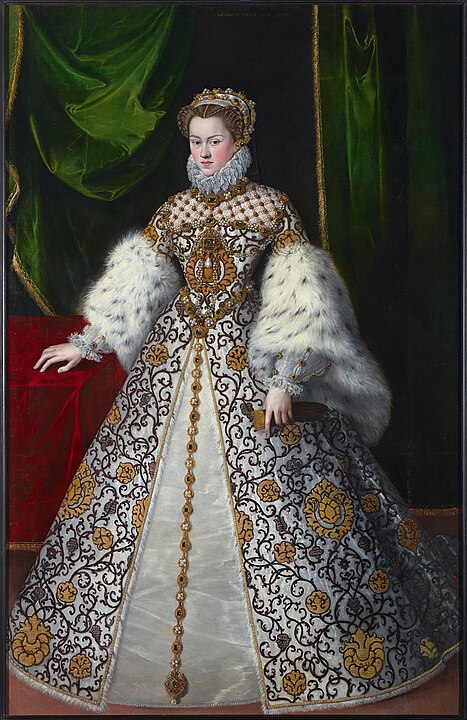
Eleanor of Austria (1498-1558), widow of the King of Portugal, became the second wife of Francis I in 1530. An instrument of negotiation for her brother Charles V and of revenge for the King of France, she would struggle to find her place at the court of her tempestuous husband. During the seventeen years of her life as a French wife and queen, this sister of the enemy would feel the animosity of the king and his sons.
Rejected for being a foreigner, Eleanor of Austria would return to her country upon her husband’s death and would be “erased” from French memory, not even being admitted to the Basilica of Saint-Denis!
Youth of Eleanor of Austria
Eleanor of Austria, the first child of Philip the Handsome and Joanna the Mad, was born on November 15, 1498, in Louvain, obtaining her patronym from her grandfather Maximilian of Austria, with Margaret of York, the widow of Charles the Bold, as her godmother. Eighteen months later, her brother Charles of Ghent, the future Charles V, was born, and upon their parents’ death, they were entrusted to their aunt Margaret of Austria.
A smiling, cheerful young girl, skilled in horseback riding and hunting, she learned music, painting, and letters. Her simple tastes, modesty, and feelings made her “a fool without ambition.” At eighteen, she fell in love with a penniless younger son, the Palatine Prince Frederick, son of Philip of Bavaria; Charles V disapproved and sought a “proper” suitor, at least a king… of France, England, or Poland, thus ruling out the Duke of Lorraine, the King of Denmark, and the King of Navarre.
Queen of Portugal
He finally opted for the King of Portugal, Manuel I, born in 1469, ugly, old, hunchbacked, and widowed for the second time. Eleanor of Austria was offered to him in 1517, and in September, she left Flanders accompanied by her brother for a long journey fraught with obstacles: burning ships, storms, crossing the Asturias towards Madrid, which was an arid and desolate country. On July 13, 1518, considered “a masterpiece, so wise, joyful, honest, and gentle in all things,” she married by proxy Emmanuel the Fortunate, becoming Queen of Portugal for three years, and would have a boy who died young and a little girl named Maria whom the Portuguese would want to marry off as they saw fit.
Upon the king’s death in 1521, she left Portugal to join Charles V in Spain. Promised to Charles de Bourbon, on the condition that he manage to recover Provence or part of Italy, Charles V still hesitated. Bourbon was a traitor since he had entered the service of Spain. It’s not exactly clear what the young woman thought of this, but it’s certain that she wasn’t in favor of it.
Eleanor of Austria, Queen of France
In 1525, Francis I was imprisoned in Spain and signed a pact to be released: among other things, he would marry Eleanor (snatching her from Bourbon!). Charles V accepted (better to hold than to chase), but his sister would remain in Spain with the royal children until all the terms of the agreement were fulfilled, including the donation of French provinces. Eleanor and Francis I got to know each other during his illness, and she was even happy to hear that the Treaty of Madrid “gave her” to the King of France.
A marriage promise was thus signed on January 19, 1526; the future spouses were allowed to correspond and met for the celebrations given in their honor, but everyone remained on guard. Eleanor was sincere, devoted real affection to the King of France, but was torn between the two men: she took care of the future Philip II (her brother’s child) and tried to soften the conditions of captivity for Francis I’s children.
After the Ladies’ Peace signed in 1529, Eleanor became the new queen but found herself in a strange situation: sister of the enemy, a pledge of not-so-honest friendship, a sort of instrument for her brother. She finally joined her husband in 1530, accompanying the young hostages, but it was Cardinal de Tournon who welcomed her on July 1… the king waiting in Bordeaux, only coming to meet her on July 4.
Testimonies in favor of Eleanor are numerous: “she was the most joyful lady ever seen.” Pretty, she was blonde with dark eyes, still fresh despite her thirty-two years, dressed in dark velvet, she adopted a white dress and a triple necklace of pearls, rubies, and diamonds around her neck. Nevertheless, she had the too-strong lower lip of the Habsburgs, and Brantôme added, “under a giant’s body, sloping downwards, she appeared a dwarf, so short were her thighs and legs”! Finally, on July 6, the king could embrace his children, greet the queen, and go to bed, for the next day was the wedding and the exchange of consents.
A Neglected Foreigner
They set out to travel up to Saint-Denis for the queen’s coronation on March 5. Arriving fifteen days late, she received as a gift from the city a pair of candlesticks topped with a phoenix with her motto “unica semper avis,” a bird that is reborn from its ashes, a symbol of her double royalty and her faithful love. She triumphed… but would quickly be sidelined, as her aunt Margaret of Austria had warned her: “it is necessary that she conduct herself according to the King’s will, that she act according to his desire… she will gain more through gentleness than by pressing too much.
She thus expected consideration from the king… but she was quickly disappointed, even hurt: Francis I displayed his official mistress, which he had not done with Claude. He showed her no marks of affection, was not ready to give her a child (he already had some and did not want a half-brother for his sons). This marriage was part of the treaty that had to be obtained, the king harbored a great grudge against Charles V, and could not forgive: Eleanor was the sister of his enemy!
Moreover, she was shy, reserved, and the king preferred strong-willed women. A maternity would have given her a place beside the king, but he didn’t want it, she wouldn’t have it. She turned to her “stepchildren” but received a very cold welcome: Henry still had not forgiven either. Only Francis showed her a little kindness: Eleanor was a foreigner!
Louise of Savoy was already dead, there remained Margaret her sister-in-law, with whom she had formed a bit of friendship in Spain during Francis I’s detention. But Margaret had just married Henry of Navarre in 1527 and had returned to Navarre. Of superior intelligence to Eleanor, they did not have the same culture, nor the same ambitions: there was a gulf between the two ladies.
An Instrument of Parade
At court, clans formed around the royal mistress, but not around the queen! She thus confined herself to her role of parade, following the king on his travels without difficulty, being in good health, holding her place in ceremonies, not always as Queen of France, but: as sister of Charles V!
She would not succeed, however, in reconciling these two sovereigns! It was not for lack of trying in 1532 when she appealed to her sister Mary, widow of the King of Hungary, or again in 1535 during the talks at Cambrai. And when war resumed in 1536, Eleanor took it as a personal failure, especially as on this occasion the Dauphin Francis caught cold and died: Charles V was accused of assassination. She resumed her role as intermediary in 1538-1539 for negotiations between the two sovereigns and Pope Paul III to stop the wars in Italy… to no avail! These two men would never manage to reconcile, it was mission impossible!
Her services were still needed in 1544 after the signing of the Treaty of Crépy to lead an important delegation (the young Duke of Orléans, the Duchess of Étampes) to the festivities in the Netherlands.
Eleanor of Austria After the Death of Francis I
Then came the coup de théâtre: Francis I died in March 1547. Informed two days later, Eleanor sincerely mourned him, even if some ambassadors took her tears for “propriety.” Good and pious, she had been his wife for seventeen years! With no one loving her, rejected, she could no longer stay in France. She returned the crown jewels (as was customary), Henry II offered her financial compensation (as was also customary), but there were no ceremonies, no farewells, no escort to leave the country for Brussels where she arrived in December 1548.
She ended her life as a dowager, among her own (her sister, her nephew Philip, Maximilian II). In 1556, when Charles V abdicated and ceded the throne to his son, Eleanor and her sister accompanied him and settled near his retreat at the monastery of Yuste, in Spain. It was on her return from meeting her daughter Maria at the Portuguese border that she was struck by a violent asthma attack, so much so that she died in mid-February 1558, shortly before her brother, who would have a funerary monument erected for her at the Escorial.
Eleanor of Austria never felt at home in France, as Anne of Austria would experience a few years later… except that Anne would have children! She did not have this chance! Worse: she would not be installed at Saint-Denis beside Francis I! Eleanor is truly a rejected queen, almost “erased” from French memory!
Eleanor of Aquitaine, also known as Eleanor of Guyenne, was Queen of France from 1137 to 1152 after her marriage to Louis VII, then Queen of England from 1154 to 1204 after marrying Henry II Plantagenet in her second marriage. As a “lively” young woman, and later mother of three kings, she challenged the masculine tradition of power by administering her lands and playing a preeminent role in public affairs. A seductress, she is credited with originating courtly love; intelligent and cultured, she protected troubadours, novelists, and poets. Her effigy is located in the Abbey Church of Fontevraud, where she took the veil at the end of her life and where she passed away on March 31, 1204.
Eleanor of Aquitaine: A Coveted Princess
Daughter of William X, Eleanor of Aquitaine was born around 1123 near Bordeaux. Through her father, she would inherit an immense domain covering the entire southwest of France: Gascony, Guyenne, Périgord, Limousin, Poitou…. Her grandfather, the Duke of Poitiers, William IX, was perhaps the most illustrious of the princes of Aquitaine, also known for his talents as a troubadour. Initiator of a cultural movement that flourished in the 12th century, William enabled the emergence of literature in the Occitan language alongside the expansion of lyric poetry.
Beautiful and alluring, with a charming smile, a gentle gaze, noble manners, a quick and cultivated mind, Eleanor loved parties and flowers. She was only fifteen when her father proposed her in marriage to the son of King Louis VI the Fat, the future Louis VII: the king, ill, could die in peace. She welcomed her future husband, accompanied by five hundred gentlemen, in Bordeaux, where the marriage was celebrated on July 25, 1137, with Louis VII becoming king in August of the same year. The new Queen Eleanor proved perfect: present at jousts and tournaments, she received the nobility, welcomed and listened to troubadours… while single-handedly managing the Duchy of Aquitaine. But she was ambitious and desired power.
Queen of France
Louis VII the Young was a weak, very devout king. Little respected by his vassals, whose possessions were often more important than the royal domain, he withdrew from everything, no longer participating in anything, partly entrusting the government to Abbot Suger. Eleanor said, “he is more monk than king,” but their first daughter Marie of France was born in 1145 (she married Count Henry I of Champagne and died in 1198). The king’s only salvation lay in the crusade requested by Pope Eugene III in March 1146. Convinced by the words of Saint Bernard, Louis VII set out for the Holy Land, followed by his court and a “light and dissipated” Eleanor occupied with amusing herself. From Constantinople to Asia Minor, Eleanor discovered magnificent landscapes but… was caught in an ambush by the Saracens near Iconium. Thanks to the knights, she escaped, yet the bulk of the army was defeated.
King Louis of France, arriving shortly after, was involved in the battle for four hours and fortunately found Eleanor in Antioch, where they were royally received by the queen’s uncle: Raymond of Poitiers, Duke of Antioch. The festivities had a particular character due to the customs and practices of Asia, Eleanor gave herself up gaily to the pleasure of these festivities, and the king held it against her. He found the relationship between Eleanor and her uncle dubious, he was indignant and decided to leave the place.
The queen refused to leave and spoke of separation, the situation deteriorated… but she had to obey nonetheless. The rumor was launched about the queen’s extramarital adventures… with her uncle. The king embarked for Europe thanks to the vessels of the King of Sicily. Stopping later in Rome, he confided in the Pope about Eleanor: he wanted to repudiate her…
Failure of the Marriage With Louis VII
Queen Eleanor (Frederick Sandys, 1858)
Returning to France after four years of absence, Louis VII found his friend Abbot Suger who calmed him, helped him with his worries and explained that he was strongly against this repudiation. The royal couple reconciled and a second daughter was born in 1150: Alix, who would marry Count Thibault the Good of Blois and who would die in 1195. But Suger died in January 1152, the king lost a wise friend and the situation worsened again in the couple. Finally, at Easter 1152, he presented his request before an assembly of prelates: a request for the annulment of the marriage.
The chancellor had this speech: “It is unnecessary,” he said, “to insist on the king’s sorrows, and on what happened in Palestine; there is no one who does not know the rumors that have circulated, and the king, who wants to respect the honor of this great princess, must not delve into the truth of the facts whose certainty would oblige him to deploy all his severity. He relies on the queen herself. When she wanted to separate from the king her husband in Antioch, she invoked kinship as evidence of the nullity of her marriage; this is what the king submits to the judgment of the Assembly. If kinship is proven, Louis’s union with Eleanor will be annulled.”
The Archbishop of Bordeaux then admitted that kinship indeed existed to the fourth degree through the women of Burgundy. The nullity was immediately pronounced during this council of Beaugency. At the announcement of this news, Eleanor fainted, then recovering herself, she was surprised by the king’s decision: “Ah! Gentlemen, what have I done to the king that he wants to abandon me? How have I offended him? What fault has he found in my person? I am young enough for him, I am not barren… I am rich enough; I have always obeyed him…“
Quickly regaining her senses, at the head of Poitou and all of Aquitaine, she felt threatened with abduction (the Count of Anjou, Geoffrey Plantagenet wanted to stop her in order to marry her), fled Blois, passed through Tours and took refuge in Poitiers, hoping to marry Henry Plantagenet, Duke of Normandy, Geoffrey’s brother. Their first meeting had taken place in 1151 and had been very successful. He had everything to please the rich heiress: a bearing announcing his high birth, golden blond hair, a gentle gaze, an adroitness for all bodily exercises, at ease at court, he was twenty years old. Six weeks after the repudiation, Henry asked for her hand in marriage.
Queen of England
Although Louis VII did everything to prevent this union, Eleanor married Henry in May 1152; the latter became King of England and took the name Henry II. Eleanor, Duchess of Normandy, Queen of England did not find happiness, her husband being unfaithful and moreover, he had no intention of letting her have power! She just had the right to take care of the eight children who would be born: William (1153-1156); Henry the Young (1155-1183); Matilda (1156-1189) wife of Henry the Good, mother of Emperor Otto IV; Richard the Lionheart (1157-1199) King of England; Geoffrey (1158-1186) father of Arthur; Eleanor (1161-1214) wife of the King of Castile, mother of Blanche of Castile; Joan (1165-1199) wife of William II King of Sicily, then Raymond V Count of Toulouse, became abbess of Fontevraud; John Lackland (1166-1216) King of England to the detriment of Arthur.
Furious, Eleanor made scenes to her husband, going from anger to tenderness, even turning the children against their father, providing them with weapons, pushing them to ally with Scotland against him. She left England and retired to Poitiers, in the midst of her court of poets. Henry II, suspecting Eleanor of being behind the death of his former mistress Rosamund and at the end of his patience, imprisoned her for sixteen years, in Chinon, and in various castles in England.
She only came out when her eldest son Richard the Lionheart, once on the throne after the death of Henry II in July 1189, freed her. From that day, still governing Aquitaine and Poitou, she visited her lands and decided to open all the prisons.
While Richard the Lionheart was on crusade, she ensured the Regency and received a more than warm welcome at each of her passages in the various regions.
But out of jealousy and need for power, she evicted Richard’s young fiancée, sister of Philip Augustus: she wanted no one but herself on the throne! She eventually accepted and negotiated the marriage of Berengaria of Aragon and Richard.
A little later, she struggled and devoted herself body and soul to free Richard who had just been captured and delivered to Emperor Henry VI, on his return from the crusade. She spared no effort to gather the enormous ransom demanded. Richard was freed in February 1194, but a few years later, he was wounded and died in Limousin in 1199.
Rather than see another lineage accede to power, she pushed John Lackland, her last son, to ascend the throne. She went to fetch her granddaughter Blanche from Castile and participated in negotiating the marriage with the son of Philip Augustus, the future Louis VIII.
End of Eleanor of Aquitaine’s Life at Fontevraud
Having reached the end of her life, she left her inheritance to her grandson Henry III, then retired definitively to the Abbey of Fontevraud in Maine. She took the veil there while making donations and alms to the poor. After a very eventful life, “the most beautiful and richest flower of Aquitaine, the incomparable pearl of the South” died in March 1204 at the age of 82. She rests at Fontevraud, first alongside her husband, then her son Richard and her daughter-in-law Isabella of Angoulême (wife of John Lackland). Today, one can see their four polychrome effigies facing the high altar of the abbey church.
Considered for a time by historians as the cause, by her conduct, her divorce and her remarriage, of three centuries of conflicts with England, this famous figure is perceived differently today. Eleanor of Aquitaine embodies the liberated woman of the 13th century, symbol of an enlightened and pleasant Middle Ages; however, some would like to present her as the archetype of the medieval princess, more to be pitied than admired. If Eleanor continues to provoke such strong positions, it is because she remains above all a central female figure in our history.
Elizabeth Charlotte of Bavaria (1652-1722), known as the Princess Palatine, was the second wife of Monsieur Philippe d’Orléans, brother of Louis XIV. A renowned letter writer, she was also nicknamed Madame Europe or the “Gossip of the Grand Siècle”.
Elizabeth Charlotte of Bavaria: A Coveted Match
Born in May 1652, Elizabeth Charlotte of Bavaria was nicknamed the Princess Palatine because she was the daughter of Charles Louis, Elector Palatine of the Rhine. She was also the ancestor of most Catholic princes and of Marie Louise (2nd wife of Napoleon Bonaparte), great-grandmother of Marie Antoinette and the emperors Joseph II and Leopold II, great-granddaughter of a King of Bohemia as well as a King of England and Scotland. Skinny at birth, she became plump at six, played with her brother’s swords and guns, walked in her native Palatinate picking grapes, spoke dialect, and listened to folk tales. Torn between estranged parents, her aunt Sophie of Hanover took her under her wing for five years, teaching her languages, dance, music, and writing (she would keep fond memories of Christmas, Carnival, and Pentecost celebrations).
When her parents spoke to her about marriage, she was eighteen (several suitors such as William of Orange Nassau, the Prince of Denmark, the King of Sweden, the Electoral Prince of Brandenburg, the heir to the Polish Duchy of Courland), but she wished for a true love marriage. Thanks to the Palatine Princess Anne of Gonzaga, Elisabeth Charlotte converted to the Roman religion, then was married by proxy in November 1671 to the Duke of Orléans (a contract where Philippe received all his wife’s assets!). She arrived in France completely abandoned by her family, crying incessantly during the nine-day journey. Her trousseau consisted of “a blue taffeta dress, a sable scarf, six night shirts and as many day shirts”.
Madame was surprised at the sight of Philippe, of modest height, perched on high heels and adorned with rings, bracelets, and jewels: “without looking ignoble, Monsieur was short and plump, with very black hair and eyebrows, large dark eyes, a long thin face, a large nose and a too-small mouth with ugly teeth. However, the clothes are magnificent“. As for Monsieur, he could only say: “how could I sleep with her?“. She was not a beauty, but not ugly either. Blonde, fresh, massive, with rosy cheeks, blue eyes, fair complexion. She lacked the grace, seduction, and charm of the Court. She formed, with Philippe, a couple with reversed roles: he effeminate, small, precious, coquettish; she masculine, robust, simple, natural. The ten-day honeymoon at Villers-Cotterêts was up to Philippe’s sumptuous standards. The king was quickly won over by Madame, who spoke fluent French. He even pitied her, knowing his brother and his attractions.
Princess Palatine: Wife of Philippe, the King’s Brother
Princess Elizabeth Charlotte of the Palatinate
The couple got along well at first. Elisabeth Charlotte discovered Saint Cloud “the most beautiful place in the world“, the Palais Royal and Paris (which she would hate for life, due to the noise and smells), the ovations of the people who would always love her… and the minions whom she distrusted. She did not meddle in Philippe d’Orléans’ affairs, but the most disturbing thing was that he used Elisabeth Charlotte’s assets to offer gifts to the minions!
Not having had a boy yet, Philippe did his duty: Alexandre-Louis was born in June 1673 but would only live for three years, then Philippe Duke of Chartres future regent in August 1674, Mlle de Chartres in September 1676. From this date on, they slept in separate rooms. Elisabeth Charlotte would later write: “I was quite pleased, for I never liked the business of making children. When His Highness made this proposal to me, I answered yes, gladly, Monsieur, I will be very content provided you do not hate me and continue to have some kindness for me…“. Especially since Philippe had transmitted to her “a beautiful disease“! She quickly replaced his presence in her bed… with 6 spaniels!
The following ten years (the golden age of music, letters, theater) were the best for Elisabeth Charlotte: she discovered Versailles, enjoyed walks in the gardens, was highly appreciated by the king for her frankness, uprightness, spontaneity, especially her lack of hypocrisy. Having common tastes, he invited her to hunt, to the theater, to the opera, to evening gatherings. Louis XIV, won over by her humor and common sense, offered her his friendship.
From 1680, “the wind turned”. Elisabeth Charlotte lost her father and Anne of Gonzaga, faced a plot organized by the minions to oust her, destroying the good understanding between the two spouses, Philippe’s double tertian fever, the king destroyed the Palatinate, Philippe suppressed positions in his wife’s household, imposed Effiat as their son’s tutor… Madame rebelled, the king reprimanded her and added: “if you were not my sister-in-law, I would have dismissed you from the court“. He turned away from her… the king began the 2nd part of his life: more serious, more pious, Elisabeth Charlotte’s frankness almost offended him. She lost all credibility and did not realize the rising favor of Mme de Maintenon.
The worst was reached when the king married the Duke of Chartres (in order to channel him as he was too gifted in war) to Mlle de Blois, his illegitimate daughter. Elisabeth Charlotte left the salons of Versailles Castle, in the midst of courtiers “like a lioness from whom one tears away her cubs”. She felt increasingly alone and lost. Philippe no longer taking care of her, she wished to enter a convent. She complained to the king who replied: “as long as I live, I will not consent to it. You are Madame, and obliged to hold this post, you are my brother’s wife, so I will not allow you to make such a scene… I do not want to deceive you, in all the quarrels you may have with my brother: if it’s from him to you, I will be for him; but also if it’s from other people to you I will be for him“. Only her aunt Sophie of Hanover was there for her. Elisabeth Charlotte’s only consolation was her mail, she wrote freely, recounted her misfortunes, depicted the Court’s antics, without forgetting anyone. Her letters were opened and shown to the king…
“Gossip of the Grand Siècle”
Elisabeth Charlotte and Philippe, neglected by the king, grew closer. She took on worrying proportions, he was worn out, tired by his excesses. Wanting to defend his son, Monsieur got so angry and upset with the king that he had an apoplectic fit. On June 9, 1701, Elisabeth Charlotte was alone, threatened with spending the rest of her life in a convent. Following the advice of her entourage, she made peace with Madame de Maintenon on June 11… everyone embraced but the atmosphere remained tense.
Having neither the Palais Royal nor the domain of Saint Cloud left, she was left with the old castle of Montargis and the king’s goodwill! She settled definitively at Versailles, became philosophical and aspired “only to spend her life peacefully”. Serene, no longer under the pressure and sarcasm of the minions, in good friendship with the king and Mme de Maintenon, the rest of her life alternated between joy and sorrow: the happiness of having a new grandson on her daughter’s side neutralized the grief caused by the death of her favorite dog, the birth of the new Duke of Chartres had no effect on her, her aunt Sophie of Hanover’s daughter died of a throat tumor. Elisabeth Charlotte fell seriously ill by twisting her foot and knee, and deprived of “Marly”, hunts and walks, she wrote: “one changes nature as one ages“. She went through the very harsh winter of 1709 with its numerous deaths, and noticed in July 1710 that her treasurer had subtracted 100,000 écus from her…
She spent more and more time in her study, playing the guitar, enlarging her collection of beautiful books (3000 volumes) and antique medals (964). She navigated between Virgil, Honoré d’Urfé, Saint Evremond and the Bible. Interested in medicine and sciences, she spent moments studying insects and other things through the three microscopes she owned. Her twenty-page letters did not serve History, they were a testimony of her time, “these little nothings” of everyday life that one tells, a bit like nowadays. In our time, we would say “she chatters”.
Between Melancholy and Lucidity
Elisabeth Charlotte was infinitely sad at the death of her aunt Sophie in 1714 and no longer had a taste for life. At the king’s death, she fainted, so real and deep was her grief. Among her occupations, she laid the first stone of the church of the Abbey-aux-Bois, rue de Sèvres, she supported her son during the Cellamare conspiracy. Finally, in 1719, Mme de Maintenon passed away at St Cyr! She exclaimed: “the old Maintenon has croaked. It would have been a great happiness if this could have happened some thirty years ago“. Another contentment: the death of the Marquis d’Effiat. She reconciled with doctors and accepted certain prescriptions, but she was wearing out, tiring very quickly.
No longer able to walk, but still of sound mind, she was perplexed by this new Parisian wealth produced by the Law system. She still had time to attend the coronation of Louis XV before dying. Courageous to the end, she passed away on December 8, 1722, at the same time as a solar eclipse.
Mathieu Marais would say: “we lose a good princess, and that is a rare thing“. A princess of the old times, preserving and applying the principles of propriety, always ready to serve the people of her household, having had difficulty understanding the evolution of mores during the Regency.
Louise of Lorraine-Vaudémont was the last Queen of France from 1575 to 1589, during the Valois era, without offspring. Her marriage to Henry III was the only one not arranged for political reasons, but inspired by a “true and sincere inclination.” Gentle, beautiful, unpretentious, without fortune, and an ally of Catherine de’ Medici, she was an ideal queen with a sovereign’s behavior. She is the only queen to actually rest in the tomb bearing her name at Saint-Denis!
Louise of Lorraine: A Wife for Henry III
Upon the death of Marie of Cleves, Henry’s youthful love, the young king was prostrate, exhibiting macabre behavior (his clothes bore skull emblems), experiencing mystical crises, and following penitent processions. Catherine de’ Medici urgently needed to marry him off and proposed several candidates: Doña Juana, Philip II’s sister; Mary Stuart, widow of Francis II; his sister-in-law Elizabeth, widow of Charles IX; and the Queen of England, of whom Henry had a strong opinion: “she’s an old creature with a bad leg.”
To cut short other proposals (a Swedish or Danish princess), the king declared his choice was made: it would be Louise of Vaudémont!
A Discreet Lady
Born in April 1553 to Nicolas of Mercœur, Count of Vaudémont, belonging to the cadet branch of the House of Lorraine, Louise, cousin of the Guises, was the eldest of fourteen children and only a year old when her mother, Margaret of Egmont, died. Nicolas of Mercœur’s second wife, Jeanne of Savoy-Nemours, was affectionate and introduced her to the court of Nancy when Louise was ten.
Catherine of Aumale, her father’s third wife, was harsh and jealous, but Louise could count on the friendship of Claude, Catherine de’ Medici and Henry II’s second daughter.
Tall, blonde, of delicate beauty, and discreet, Henry had met her in Lorraine when he was leaving for Krakow. She had moved him with her modesty and gentleness. She may have been a young woman without rank, fortune, or pretensions, but “he wanted to take a wife of his nation who was beautiful and agreeable, saying he desired one to love well and have children with, without going to seek others from afar, as his predecessors had done.” Catherine de’ Medici loved her son so much that she approved!
She was won over by “the gentle and devout spirit of this princess whom she judged more suited and inclined to pray to God than to meddle in affairs.”
As for Louise, she renounced two suitors (François of Luxembourg and the Count of Salm), and the king offered one of them his current mistress, the lady of Châteauneuf!
A Non-Political Marriage…
Portrait of Louise de Lorraine (1553-1601) Portrait of Louise of Lorraine (1553-1601), Queen of Henry III of France
Louise’s father gave his consent very quickly, and in a month, “everything was settled”: the king arrived in Reims on February 11, was crowned on the 13th, and the wedding took place on February 15, 1575! Louise was radiant with joy, the king’s heart melted with tenderness. They entered the capital, and she was Queen of France!
From that day on, Louise never changed her attitude and remained dazzled and amazed. Her love for her husband would withstand time, trials, infidelities, and death! Occupying little space, she blended into the king’s entourage, always by his side at all ceremonies, all festivals, all feasts. She was associated with the creation of the Order of the Holy Spirit (the insignia bore their initials). Etiquette required the king to pay her a daily visit, but he did more: they went for walks in Paris, visited monasteries, discovered the sea in Normandy, the port of Dieppe, and stayed on the land of Ollainville (a castle the king gave her and had renovated).
All these attentions lasted well beyond the honeymoon: in 1581, she was seen sitting on the king’s lap; in 1587, he “spent almost the whole day with her and tried with words full of affection to exhort her to keep courage” when she was seized with a tertian fever; like Francis I, the king did not officially introduce a royal mistress, as Louise meant a lot to him.
Yet not everything was “rosy.” The king had a mistress, a lady advised Louise to take a lover: she was chased away! A conspiracy was led by one of the king’s favorites who entered the queen’s chamber, the favorite became Henry’s nemesis, and the affair turned into a matter of state! But this strengthened the bonds between the king and queen, as Louise had the qualities of a queen of the time: piety, discretion, obedience, love for the monarch…
Brantôme recounted, “One can and must praise this princess for much; for in her marriage, she behaved with the king her husband as wisely, chastely, and loyally as the knot by which she was bound in conjunction with him always remained so firm and indissoluble that it was never found undone or untied, even though the king her husband loved and sometimes went to change”; “She devoted herself to nothing else but serving God, going to devotions, continually visiting hospitals, tending to the sick, burying the dead.”
…But No Children
She participated in a procession in penitent costume, hoping for a child! For from the beginning of their union, she wished to offer a dauphin to the king. Unfortunately, the couple was and remained childless, many thinking it was due to the king’s sterility (because of his inclinations). They had themselves examined, called upon potion “makers,” went to thermal cures, the king engaged in prayers and devotional gestures, he undertook pilgrimages from 1580 to 1586, she did not adhere to her husband’s mystical sessions, she tried to understand him, to help him, but did not approve.
An irreproachable Catholic, she devoted herself to the poor, orphans, and prisoners. She patronized a Charity House in the Mouffetard district. She is also credited with bringing light to crossroads, thanks to statues of the Madonna illuminated by a lamp. Her popularity increased when in 1586 she allocated an annuity to two students so that “they ensure the preaching on Sundays and annual feasts in the prisons of the Conciergerie, the grand and petit Châtelet of Paris.”
During the troubles of the League, she supported her husband against her Lorraine family: it was an act of honor. She even went so far as to reproach him for rebelling! When the king decided to arrest the Duke of Guise, she approved; during the days of the barricades, cloistered in Paris, she faced the Duke of Guise alone; she supported her husband when he decided on the death of his enemy; she was still by his side for the meeting at Plessis-lès-Tours.
But on August 4, 1589, she received a last letter: the king had just been the victim of an attack, and wanted to reassure her “My love, I hope I will be very well; pray to God for me and do not move from there.”
She Mourned But Did Not Forgive!
Louise took on white mourning, settled in Chenonceau in a room facing the river, and organized her life: walks, embroidery, reading of the Lives of Saints, Sunday service in the small church of Francueil. In her room, there were mementos of her husband everywhere: a portrait on the fireplace with the motto “saevi monumenta doloris,” flaming torches, widow’s cords, all on a black velvet background.
She did not forgive those who had killed her husband and “desires no more life than to see punishment done to those who make it so miserable for her.” Only half satisfied when the prior of the convent to which Jacques Clément belonged was sentenced to death, and because the Guises were responsible, she appealed to Henry IV: he evaded the question and absolved the Duke of Mayenne and the Lorraine princesses in 1596!
She would never forgive! She begged the pope for the Church to make amends for all that had been done against the king, and many years later, finally, the pope annulled the excommunication and proclaimed Henry III dead in peace with the Church.
But Louise was tired and worn out by this struggle. She received a final blow: she had to leave Chenonceau! Catherine de’ Medici’s will presenting more liabilities than assets, Louise would have to pay her share of her mother-in-law’s debts if she wanted to keep the castle, which was impossible!
The estate was sold at auction in December 1593; Louise’s half-brother, a Mercœur, bought back Chenonceau, left it to Louise, but charged her with donating it to the young future spouses: Mercœur’s only daughter and little César (who had just been born), son of Henry IV and Gabrielle d’Estrées. She had the usufruct, but preferred to leave these places of sorrow and settled in the Duchy of Bourbonnais, in Moulins. She died at the end of January 1601, after catching a cold in a church during a sermon the previous December.
She is the only queen to actually rest in the tomb bearing her name at Saint-Denis: she was first installed in the Capuchin convent in the Faubourg Saint-Honoré, then in the new Capuchin church near Place Vendôme, was transported to Père Lachaise during the Revolution, and accessed Saint-Denis in 1817. While all the kings’ tombs had been violated and the remains thrown into the common grave!
Anne of France, also known as Anne of Beaujeu, was regent of France until Charles VIII came of age. She governed firmly, convened the Estates General of 1484, and defeated the feudal revolt led by the Duke of Orléans, the future Louis XII, during the “Mad War” (1485-88). Consolidating royal power, she completed the territorial unification accomplished by Louis XI by preparing the annexation of the Duchy of Brittany to the Crown of France.
Anne of France and the Mad War
The eldest daughter of Louis XI and Charlotte of Savoy, and elder sister of Charles VIII, she was married at the age of twelve to Pierre II, Lord of Beaujeu and Duke of Bourbon. For her strength of character, she was designated by her father, the King of France, to exercise the regency during the minority of her brother Charles VIII from 1483 to 1491.
After the disappearance of the last Count of Maine and the last Duke of Anjou, the French crown acquired, by right of return, the provinces of Maine (1481), Provence (1481), and Anjou (1482), thus considerably increasing the territory under monarchical control. Powerful and authoritarian, Louis XI, father of Charles VIII, had managed to subdue the pretensions of the great political bodies, princes, and keep the clergy in check.
Saint-Pol and Nemours were executed for their treasons, and Balue was punished for eleven years for his intrigues with the enemy.
Thus, when Louis XI died on August 30, 1483, leaving his thirteen-year-old son Charles as heir, everything suggested that France would once again be plunged into civil war. During the Estates General of 1484, Anne of France intrigued to exclude Louis of Orléans, the future Louis XII, from the regency. The latter formed, the following year, with Francis II of Brittany, Maximilian of Austria, and Richard III of England, a contestatory league. Disagreements of interests among the leaguers allowed the regent to establish her authority, while working on the annexation of the Duchy of Brittany, although insurgent, to the royal domain.
Anne of Beaujeu: Duchess of Bourbon
Work: Moulins Triptych, right panel: Portrait of Anne de Beaujeu with Daughter Suzanne and Patron Saint
The revolt nevertheless continued for three years, until the defeat of Louis of Orléans at the Battle of Saint-Aubin-du-Cormier (1488). The Duke of Orléans was taken prisoner; the Duke of Brittany, Francis II, had to sign the Treaty of Sablé, which consecrated the primacy of royal power. Upon his death in 1491, Anne of Beaujeu had the Breton cities seized and arranged the marriage of Charles VIII to Duchess Anne of Brittany, who had been promised by her father to Maximilian of Austria.
After this alliance, celebrated in 1491, Anne of Beaujeu handed over power to Charles VIII.
The now Duchess of Bourbon henceforth devoted herself to the administration of the immense possessions of the House of Bourbon, her husband – who had become Duke of Bourbon in 1488 – having died in 1503. Mother of Suzanne of Bourbon, married to Charles of Bourbon, she supported, until her death on November 14, 1522, her son-in-law against the territorial claims of Francis I.
Blanche of Castile (1188-1252) was Queen of France through her marriage to Louis VIII and regent of the kingdom during the minority of her son, Louis IX (1226-1244). Of Spanish and English origin, Blanche of Castile married Prince Louis, son of King Philip II of France, as part of a peace treaty between France and England. She became widowed when the heir to the throne, the future Saint Louis, was only twelve years old. For nearly ten years, the queen would serve as regent and spare no effort to preserve the integrity and stability of the kingdom, governing with authority and suppressing several revolts. The regency of Blanche of Castile saved the Capetian legacy in many areas.
Blanche: Princess of Castile and England
Born in Palencia, Spain, Blanche was the third daughter of King Alfonso VIII of Castile and, through her mother, granddaughter of Henry II of England and Eleanor of Aquitaine. She was married to the future Louis VIII of France following the Treaty of Le Goulet signed between her maternal uncle John Lackland and King Philip II (May 22, 1200).
Blanche of Castile brought as dowry a large part of Berry, mainly the lordships of Issoudun, Graçay, and Châteauroux.
The marriage was celebrated in Normandy on May 23, 1200.
Blanche of Castile quickly proved to be a courageous wife and actively supported her husband when he attempted, albeit in vain, to establish himself in England (1216). She would be crowned Queen of France in Reims at the same time as her husband on August 6, 1223.
Regent of France
Blanche of Castile. Contemporary depiction from the Bible of St Louis, c. 1230
At the death of her husband in November 1226, her son, Louis IX, was only twelve years old. She became regent of the kingdom (1226/34). The Queen of France, complying with the last wishes of the deceased, who had appreciated her energy and dedication, thus resumed the government of the kingdom until the king’s majority. She acted immediately with great skill by having her son crowned without delay in Reims (the cathedral was then under construction). Most of the great vassals of the crown attended the ceremony. On this occasion, the Count of Flanders, Ferrand, one of the defeated at Bouvines, was even released from the royal prisons on January 6, 1227.
Shortly after, Blanche of Castile concluded with the Count of Toulouse the Treaty of Meaux (1229), very advantageous for the Capetian dynasty. The Count ceded to the crown the eastern part of Languedoc (Beaucaire, Nîmes, Béziers, Carcassonne) and married his daughter and sole heiress to Saint Louis’s younger brother, Alphonse of Poitiers, stipulating that if the latter had no children (which happened), the rest of Languedoc would revert to the king. These acquisitions already allowed, for the first time, the Capetian dynasty to establish itself on the Mediterranean.
The Guardian of the Kingdom
Blanche then quelled a revolt of lords possessing lands around the royal domain, who were seeking in the sovereign’s minority an opportunity for disorder to regain some of their lost independence. At the head of the rebellion was Count Thibaut IV of Champagne, an agitated and inconsistent character, a talented poet but poor politician, and, moreover, more or less in love with the queen. Blanche had little trouble defeating him and making him an ally rather than an enemy. To the west, the task was more difficult against Pierre of Dreux, called Mauclerc, widower of Countess Alix of Brittany, a feudal constantly in a state of revolt, and against the Count of La Marche, Hugh of Lusignan. Both benefited from the diplomatic support of King Henry III of England.
The latter even landed at Saint-Malo on May 3, 1230, to reconquer his heritage. Pierre Mauclerc did not hesitate to transfer his homage to him. Here again, Blanche overcame several uprisings. As early as October 1230, Henry III had to return to England, and his new vassal had to negotiate in Paris in November 1234 with the queen mother, who allowed him to keep the government of Brittany until the majority of his son, Count John the Red, in 1237. Thus the regency, contrary to those France experienced in later centuries, contributed to strengthening the crown instead of weakening it.
Blanche of Castile: Mother of the Future Saint Louis
Very pious, Blanche of Castile watched over the education of her children, particularly that of the future Louis IX of France; she is even attributed excessive educational statements: indeed, she allegedly told her son that she would prefer to see him dead rather than sullied by a mortal sin. In 1234, she negotiated the marriage of the young king to Margaret of Provence, daughter of Raymond Berengar V of Provence, to extend French influence in the Rhône Valley.
This alliance was reinforced in 1246 by the union of her youngest son, Charles I of Anjou, with Beatrice of Provence, heiress to the county.
Very authoritarian, the queen mother gave Saint Louis a strict Christian education and always maintained a political influence and great ascendancy over the king. The latter would not govern alone until 1244. When he left for the 7th Crusade, she resumed the regency again (1249-1252) and had to face the revolt of the Pastoureaux, bands of young people who had taken the cross only to eventually engage in pillaging along their way. She passed away on November 27, 1252, and was buried in Maubuisson Abbey, leaving her son a pacified kingdom.
Elisabeth of Austria (1554-1592), the penultimate queen of the Valois dynasty and wife of Charles IX, was a gentle and kind spouse, dominated by Catherine de’ Medici, and as unassuming as Claude and Eleanor had been; a discreet queen who is not much talked about; a queen as they were liked at that time, a queen who especially did not meddle in politics!
Elisabeth of Austria: A Younger Daughter of the Family
Charles IX came to power by officially reaching majority on August 17, 1563. Very young, malleable, and especially dominated by his mother Catherine de’ Medici, he was not well-versed in politics and governance of a kingdom.
The regent wanted peace and national independence. To achieve this, she considered an alliance with the House of Austria and opted for Anne, the eldest daughter of Maximilian II, granddaughter of Charles V.
Marshal de Vieilleville, on a mission to Vienna in 1562, found the younger Elisabeth, born in July 1554, “very pretty” and addressed the Emperor saying, “Sacred Majesty, here is the Queen of France,” and the young lady conveyed through him to the King of France “her very humble and very affectionate service”! Catherine de’ Medici received this news very coolly: Elisabeth was only a younger daughter, but an archduchess nonetheless. A Catholic marriage was still useful, and Albert de Gondi took charge of the negotiations.
The contract was signed in January 1570, and the marriage by proxy took place in October.
The young girl was sixteen and had learned to live at court, unlike all the Spanish infantas; but no one had prepared her to leave her country and especially not to learn French, as in Austria she spoke German or Spanish.
Queen of France
Portrait of Elizabeth of Austria (1554-1592), Queen consort of Charles IX of France
When she arrived in France, she was welcomed in a princely manner. Like all young future spouses, Charles IX hid in the crowd to look at her, and while waiting for her in Mézières, he “rejoiced to have found a wife to his contentment.” What did she look like? Fortunately, François Clouet made her portrait: a beautiful young girl with a triangular face, golden hair held back by a pearl headband, and a frank, direct gaze.
The official introductions took place on November 26, 1570, followed by ceremonial festivities. Elisabeth was dressed in a silver gown covered with pearls and a large purple mantle sown with golden fleurs-de-lis. She wore “an imperial crown adorned with large diamonds, rubies, and emeralds.” The festivities lasted two days, treaties were ratified, and Elisabeth became Queen of France.
The festivities in the capital took place in the spring of 1571, with triumphal arches, processions, cavalcades, fireworks, and balls. Crowned at Saint-Denis on March 25, she was “paraded” dripping with gold and pearls, in a silver cloth litter, entered Paris on the 29th, and the festivities ended on March 30, 1571, with a huge banquet and a ball offered by the City of Paris.
Of course, the Protestants were not happy to see so much money spent…
Representation and Procreation
Everything went well at the beginning of the couple’s life together: Charles IX showed her affection when she was bedridden with a bad bronchitis in January 1571; he spent time with her, brought a troupe of jugglers to entertain her, and even took her to the Saint Germain fair when she felt better. During the Carnival period, they disguised themselves and walked around Paris. But she did not have the same playful temperament as him and especially did not speak the same language: there was a total misunderstanding! When someone addressed her, they had to go through the Countess of Arenberg, a lady in her retinue who acted as a translator. After a year of marriage, she was pregnant… and despite Marie Touchet (the king’s mistress), Elisabeth “never showed him a worse face, nor said a worse word to him, patiently enduring her little jealousy and the theft he was making from her.”
Raised in virtue and religion, she supported her husband during the dark hours of St. Bartholomew’s Day. Locked alone in her apartments, almost alone sleeping in the Louvre, when the tocsin began to ring, and her women warned her to tell her that her husband was responsible, she began to pray for him and ask God to forgive him!
On October 27, 1572, a little Marie-Elisabeth was born, carried by the godmother, the Queen of England, during the baptism.
Elisabeth is mentioned once again during the visit of the Polish ambassadors in 1573: she only makes an appearance. During the three and a half years of reign, she is sidelined by her husband, who prefers hunting, and her mother-in-law, who prefers power. However, when her husband is ill, she stays by his side, sitting in silence, crying while hiding her pain, praying a lot, even at night so as not to be seen.
Elisabeth of Austria’s Return to Vienna
After her husband’s death in 1574, “not being recognized or rewarded as she deserved,” she was resolved to return to Austria, unable to stay in France because she had no son. In Amboise, she went to embrace her little daughter, whom she would never see again and who would die in April 1578, then left Paris in early December 1575. She settled again in Vienna; she was only twenty-one years old! She remained on good terms with her sister-in-law Marguerite (Queen Margot), to whom she would pay half of her dowry when she learned that the Queen of Navarre no longer had “a penny to her name.”
Henry III was considered as her new husband: she refused; Philip II of Spain had just lost Anne (the eldest of the archduchesses), Elisabeth was proposed to him: she refused again, in memory of her husband Charles.
Wishing to enter a convent, she founded a monastery of Poor Clares near Vienna. There she led the life of nuns “in vigils, fasts, and continuous prayers for Peace among Christian princes.” She created the Church of All Saints in Prague and may be the origin of two works “on the Word of God” and “on the considerable events that occurred in France in her time.”
She died in January 1592, and L’Etoile wrote, “she had been greatly loved and honored by the French.”
Before the mid-fifteenth century, the mistresses of French kings remained discreetly in the shadows of palace corridors, unnamed in official chronicles and devoid of political standing. That royal taboo was shattered forever in 1444 by a twenty-two-year-old noblewoman named Agnès Sorel, universally celebrated in her own lifetime as the Dame de Beauté (“Lady of Beauty”). As the first officially recognized royal mistress (maîtresse-en-titre) in French history, Sorel transformed the depressed, indecisive King Charles VII into the victorious monarch who drove the English out of Normandy, revolutionized European court fashion with daring décolletage, and died so suddenly at age twenty-eight that it took twenty-first-century forensic toxicologists five hundred and fifty years to prove she had been murdered.
Awakening King Charles VII and the title “Dame de Beauté”
Born around 1422 in the Touraine village of Fromenteau into the minor gentry as the daughter of the soldier Jean Soreau, young Agnès received a refined education before entering the household of Isabelle, Duchess of Lorraine (wife of René of Anjou, King of Naples), as a lady-in-waiting. When the forty-one-year-old King Charles VII of France met the blonde, blue-eyed Agnès around 1443 or 1444, she was widely hailed by chroniclers across Europe—including Pope Pius II—as the most striking woman in the world, famous for her wit, infectious laughter, and milky complexion.
Up to that moment, despite Joan of Arc having saved his crown fifteen years earlier, Charles VII had remained a gloomy, lethargic ruler beset by phobias and dominated by corrupt older counselors while the English still occupied Normandy and Gascony. Agnès Sorel worked a psychological miracle on the King. Refusing to flatter him passively, she reportedly told Charles VII to his face that an astrologer had predicted when she was a child that she would be loved by one of the bravest and most valiant kings in Christendom—so if Charles kept sitting idly in his castles while the King of England held half his kingdom, she would have to pack her bags and move to England because she clearly had the wrong king. Stung into action and surrounded by the energetic young reformist ministers Sorel promoted (such as the financier Jacques Coeur and the Bureau brothers), Charles VII modernized the French artillery and marched out to reconquer Normandy.
To keep Agnès permanently by his side in public with her own apartments positioned right beside the royal chambers—and with the quiet, dignified acceptance of his long-suffering wife, Queen Marie of Anjou—Charles VII gifted Agnès the picturesque royal castle of Beauté-sur-Marne near Vincennes, granting her the double-entendre official title Dame de Beauté.
Scandalizing the Church With Diamonds and Bared Shoulders
At the royal castles of Loches and Chinon in the Loire Valley, Agnès Sorel used her influence to invent a provocative new court aesthetic that scandalized medieval bishops and chroniclers like Jean Juvénal des Ursins:
Diamonds for Commoners: Prior to Sorel, an old thirteenth-century sumptuary law passed by King Louis IX decreed that uncut diamonds could be worn only by crowned kings, princes, and consecrated religious statues. Agnès became the very first uncrowned woman in Europe to wear sparkling, faceted diamonds set in gold necklaces against her skin, single-handedly launching the modern European diamond jewelry industry.
Towering Hennins and Plunging Necklines: She wore twenty-foot-long fur-lined silk trains, towering cone-shaped headdresses (hennins), plucked her hairline high on her forehead for an elongated oval brow, and wore bodices cut so daringly low that they intentionally left one entire breast bare in public—a look immortalized around 1452 by the great painter Jean Fouquet in the Melun Diptych, where Sorel posed as a porcelain-skinned Virgin Mary nursing the Christ Child with one perfect spherical breast exposed.
Sudden Death at Jumièges and the 2005 Mercury Discovery
Nobody hated Agnès Sorel more fiercely than the King’s estranged, rebellious eldest son and heir, the future King Louis XI, who once became so enraged at her influence over his father that he chased Agnès through the palace corridors at Chinon with a drawn sword and slapped her across the face. In the freezing winter of January 1450, despite being eight months pregnant with her fourth daughter by the King, the twenty-eight-year-old Agnès traveled northward through the snow to the Abbey of Jumièges in Normandy to be with Charles VII during the siege of Rouen and warn him of a suspected conspiracy against his life.
Shortly after arriving at the manor of Mesnil near Jumièges and giving birth prematurely, Agnès was struck down by violent stomach pains and died on February ninth, 1450, within hours of dictating her will, initially diagnosed by royal doctors as having succumbed to “dysentery” or a “flux of the belly.” For five and a half centuries, historians debated whether the Dauphin Louis or the financier Jacques Coeur had secretly poisoned her.
In 2004 and 2005, while restoring Agnès Sorel’s alabaster tomb at the Collegiate Church of Saint-Ours in Loches, French forensic pathologist Dr. Philippe Charlier and a team of nineteen scientists opened her funerary urn and examined her preserved skull fragments, hair, and digestive tract residue under a scanning electron microscope. The toxicological results were explosive: while her hair did contain parasite eggs showing she had taken fern root to treat roundworms, her internal tissues and hair roots contained a lethal concentration of mercury between ten thousand and one hundred thousand times higher than normal medical therapy—a single massive oral dose of mercury salts ingested less than three days before her death, scientifically proving five hundred and fifty-five years later that the first royal favorite of France died of acute mercury poisoning.
In the rigid, blood-obsessed caste system of eighteenth-century Versailles, the coveted position of official royal mistress (maîtresse-en-titre) to the King of France was supposed to belong exclusively to daughters of the ancient sword nobility. Yet in 1745, a twenty-three-year-old Parisian woman born into the middle-class bourgeoisie—Jeanne-Antoinette Poisson, immortalized as the Marquise de Pompadour—shattered centuries of aristocratic snobbery to capture the heart of King Louis XV. For nineteen years until her death in 1764, long after her physical romance with the King had evolved into a platonic soul-mate partnership, Madame de Pompadour reigned as the unofficial Prime Minister and Cultural Minister of France: appointing generals, forging European alliances, protecting the writers of the Enlightenment, and founding the world-renowned porcelain and architecture of the Rococo age.
“Reinette”: The Bourgeois Girl Raised to Catch a King
Born in Paris on December twenty-ninth, 1721, Jeanne-Antoinette carried an unfortunate last name that aristocratic enemies at Versailles never let her forget: Poisson, which translates literally in French to “Fish.” (Her official father, François Poisson, was a financier forced to flee France temporarily during a black-market debt scandal, while her biological father was widely believed to be the wealthy tax-farmer Charles François Paul Le Normant de Tournehem.)
According to family legend, when Jeanne-Antoinette was just nine years old, her mother took the little girl to a famous Parisian fortune-teller named Madame de Lebon, who peered into her palm and declared that the child would one day rule the heart of a King! Delighted, her mother immediately nicknamed the girl “Reinette” (“Little Queen”), and her wealthy guardian Tournehem paid for an education fit for a princess: hiring the finest actors of the Comédie-Française to teach her elocution and theater, opera stars to train her singing voice, harpsichord masters, painters, and botanists.
Married at age nineteen to Tournehem’s nephew, Charles-Guillaume Le Normant d’Étiolles, the dazzling young bride quickly became the toast of the Paris Enlightenment salons, hosting Voltaire and Montesquieu—while intentionally driving her pink-and-blue phaeton carriage across the royal forest paths of Sénart dressed in striking pastel gowns right whenever King Louis XV was hunting nearby so the bored monarch would notice her.
The 1745 Masked Ball of the Yew Trees and Move Into Versailles
Her moment arrived on the night of February twenty-fifth, 1745, inside the Hall of Mirrors at Versailles during the legendary Bal des Ifs (“Ball of the Yew Trees”) celebrating the wedding of the King’s son. To remain incognito in the crowd of fifteen hundred masked guests, King Louis XV and seven courtiers dressed in identical, head-to-toe costumes shaped like clipped conical yew-tree bushes from the palace gardens, while Jeanne-Antoinette arrived dressed as Diana, the Roman goddess of the hunt, complete with a bow and quiver of arrows.
Cornering one of the walking yew trees who turned out to be the King himself, she charmed Louis XV with her wit before dropping her lace handkerchief on the floor; when the King bent down to pick it up and tossed it back to her politely, the entire ballroom gasped at the royal signal: “The handkerchief has been thrown!”
Within months, Louis XV arranged her legal separation from her husband, purchased the extinct noble estate of Pompadour in Limousin to grant her the noble title and coat of arms of Marquise de Pompadour, and installed her in an apartment directly above his own private chambers at Versailles, connected by a hidden spiral staircase.
Surviving as Unofficial Prime Minister After 1750
Every courtier at Versailles assumed that once the King’s initial physical passion cooled, the bourgeois “Poisson” woman would be packed into a carriage and sent back to Paris. Indeed, around 1750—plagued by chronic poor health, miscarriages, and exhaustion—Pompadour and Louis XV quietly ended their physical sexual relationship, and she moved down to a grand ground-floor apartment at Versailles usually reserved for princes of the blood.
Instead of losing her power after 1750, her political dominance doubled! Knowing the melancholic, easily bored Louis XV better than any living human being, Pompadour made herself completely indispensable:
Entertainment and the Little Theater: She built a miniature private theater inside Versailles where she sang lead opera roles for an audience of twelve people, cooked delicate late-night suppers for the King with her own hands inside private hermitage pavilions, and discreetly tolerated the King’s brief physical dalliances at the Parc-aux-Cerfs because she knew no younger girl could ever rival her intellect.
The Diplomatic Revolution of 1756: Acting as gatekeeper between the King and his cabinet, she elevated the reformist Duke of Choiseul, dismissed ministers who crossed her, and personally negotiated the historic 1756 Treaty of Versailles with Empress Maria Theresa’s envoy, uniting France and Austria after centuries of war (though she bore the brunt of public blame when French generals lost the subsequent Seven Years’ War).
Sèvres Porcelain, the Petit Trianon, and Protecting the Encyclopédie
While her foreign policy adventures proved costly, Madame de Pompadour’s legacy as a patron of the arts, science, and architecture is unmatched by any royal consort in French history:
Rescuing Diderot’s Encyclopédie: When conservative churchmen tried to ban and burn Denis Diderot and d’Alembert’s monumental 28-volume Encyclopédie—the engine of the French Enlightenment—Pompadour and her brother, the Marquis de Marigny (Director of Royal Buildings), protected the writers behind the scenes, and she proudly posed with volumes of the Encyclopédie and Montesquieu’s Spirit of the Laws sitting right on her desk in Maurice Quentin de La Tour’s famous portrait of her in the Louvre.
Founding Sèvres Porcelain: To stop French gold from flowing into Saxony to buy German Meissen porcelain, she persuaded the King to move a small porcelain workshop to Sèvres near her château at Bellevue in 1756—hiring top chemists to invent dazzling new colors like Rose Pompadour and turning Sèvres into the most prestigious porcelain manufactory on Earth.
The École Militaire, Place de la Concorde, and the Petit Trianon: Working with architect Ange-Jacques Gabriel, she urged the founding of the École Militaire in Paris to educate impoverished noble officer cadets (where a penniless Corsican boy named Napoleon Bonaparte later studied on scholarship!), backed the creation of Place Louis XV (now Place de la Concorde), purchased the Élysée Palace in Paris (which serves today as the official residence of the President of the French Republic), and commissioned the neoclassical jewel box of the Petit Trianon in the gardens of Versailles.
When Madame de Pompadour finally succumbed to pulmonary tuberculosis and heart congestion on April fifteenth, 1764, at the age of forty-two, King Louis XV granted her an honor strictly forbidden by centuries of Versailles protocol—which dictated that no non-royal subject was ever allowed to die inside the King’s palace. Refusing to move her from her Versailles apartment, the heartbroken King stood alone on the palace balcony in driving wind and pouring rain without a coat or hat, weeping silently as her funeral cortege rolled down the avenue toward Paris and murmuring: “That is the only tribute I can pay her now… A friend of twenty years!”
Scottish physician and microbiologist Sir Alexander Fleming is known for being the author of one of the greatest – if not the greatest – discoveries in medicine: penicillin, the first antibiotic in history. For this feat, he won a Nobel Prize in Medicine and the title of Knight of the British Crown, among other honors. He is also considered one of the greatest scientists of all time.
Born on August 6, 1881, on a farm in Ayrshire county, Scotland, Fleming began his academic career in 1903 at the medical school of St. Mary’s Hospital in London. He graduated as a doctor, surgeon, and bacteriologist.
He served as a doctor in World War I, where he saw the destructive action of infections caused by bullet wounds in soldiers – which would inspire him to seek a way to kill bacteria. He died on March 11, 1955, in London, victim of a heart attack.
Here are five facts about Alexander Fleming’s career and discoveries:
A Scientist at War
Graduated since 1908 as a doctor, surgeon, and bacteriologist, Fleming made his first major discovery during World War I. In a field hospital on the Western Front in France, he observed that many shot soldiers died of septicemia. And worse: the antiseptics used on wounds seemed to worsen the situation.
In an article published in The Lancet in 1917, while the war was still ongoing, he described the reason for this effect: the antiseptics had a good bactericidal action on the wound surface but removed the body’s defenses against germs. As a result, the deeper bacteria gained space to infect the severely wounded areas.
First Major Discovery
After the war, Fleming persevered in the search for a medication that would alleviate the agony of infection victims. In the laboratory, he was known for being a scientist careless with hygiene, to the point that his Petri dishes frequently suffered from unexpected growth of bacterial colonies.
One day in 1921, he decided to apply nasal mucus to one of these plates contaminated by airborne bacteria. And he noticed that the secretion killed the microorganisms. This casual revelation led to the subsequent discovery of lysozyme, an enzyme with antimicrobial action present in secretions such as mucus, tears, and saliva.
The Mold That Saved Lives
Fleming’s ability to observe and intuit accidental discoveries led him to be the author of what many consider the greatest revolution in medicine. In 1928, his research focused on staphylococcus bacteria, grown in Petri dishes.
On September 3, upon returning to work after spending a holiday with his family, he noticed that the culture was contaminated by mold – and that the colonies that were close to the fungi were dead, unlike those more distant.
Later he identified the fungus as Penicillium rubens, which would lead to the creation of penicillin, the first antibiotic in history.
Joint Nobel Prize
Announced by Fleming on February 13, 1929, penicillin did not impress the scientific community of the time. In fact, the discovery went more than a decade without receiving the recognition it deserved. The reason was that no practical application of the substance was seen, as no way to isolate it and produce it as a medication had been presented.
This only happened in 1940, when biochemists Ernst Boris Chain, Howard Florey, and Norman Heatley published a study presenting the structure of penicillin and developed a method to purify and stabilize the component, enabling mass production. In 1945, Fleming, Chain, and Florey were awarded the Nobel Prize in Medicine.
At the Center of Two Fake News Stories
Two British urban legends involve the names of Alexander Fleming and Winston Churchill, Prime Minister of England between 1940 and 1945 and from 1951 to 1955. The first is that Fleming’s studies were sponsored by Churchill’s father because Alexander’s father had saved young Winston from drowning in a swamp.
The other, published by newspapers of the time, claimed that Fleming saved Churchill with penicillin when the Prime Minister contracted an infection in Tunisia in 1943. In fact, the premier was treated by the official doctor, Lord Moran, who applied a sulfonamide-based medicine, another recently discovered antibiotic substance at the time.
The construction of an airport runway near the historic city of Chichen Itza, Mexico, in 1967, led to a surprising discovery: two chambers connected to the pyramids contained bones of more than 100 children, likely sacrificed in religious rituals. These remains have now been the subject of studies using cutting-edge microscopy technologies. The analyses revealed clues about the identity of these sacrificed children and the reasons for their deaths.
In an article published in the journal Nature, Mexican, European, and American researchers collected DNA data from 64 children and showed that the vast majority were male. Their dentition suggests they were between 3 and 4 years old. It was also possible to conclude that about a quarter of the children were related to each other. The samples even revealed that there were identical twins buried side by side.
Sacrifice for Corn?
At the time of the chambers’ discovery, there weren’t advanced genetic analysis techniques sufficient to provide this information, given the state of preservation of the bones. The bones were in a small space of only 3 square meters, and many were deteriorated by time, as well as showing cracks due to internal collapses. The fact that they were children made the identification process even more difficult, as biological sex only becomes evident in skeletal markers during puberty.
Years later, scientists were able to collect and analyze genetic material from a specific part of the skulls, called the petrosa, known to accumulate DNA. This way, it was possible to refute an old hypothesis that the skeletons belonged to girls, as well as determine the degrees of kinship among the sacrificed. According to the researchers, the pattern found can be linked to an important Mayan cultural myth.
“Very few things in archaeology have such a clear pattern. The selection of close relatives and twins pointed to the Hero Twins,” said Christina Warinner, co-author of the article and paleogeneticist at Harvard University, to Science magazine. The tale of the Hero Twins, linked to agriculture, narrates the story of brothers Hunahpu and Xbalanque, who travel to the underworld, where they are sacrificed and resurrected repeatedly, returning to life in the spring as corn stalks.
This possible association provides clues that help explain the sacrifice rituals. This information is supported by the discovery that the children maintained similar diets throughout their short lives. This suggests that they were raised in the same families—or even prepared specifically for sacrifice.
Although the motivations cannot be stated with certainty, the authors highlight that such practices were common in Mayan culture. According to traditions and ceremonies described in the book of Popol Vuh, a documentary record produced in the 16th century itself, human sacrifice may have been considered a privilege or even an honor, being an essential part of maintaining the balance of the cosmos in the Mayan view.
Impact of Colonization
The study was constructed with the help of a genetic database from an indigenous Mayan community in the city of Tixcacaltuyub, which had already donated DNA for research on metabolism and diabetes. By comparing samples from the two groups, scientists found a genetic proximity more than a thousand years apart, thus tracing similarities and differences.
The few disparities found brought a new insight into the impact of Spanish colonization, which began in 1511 in the region. The current inhabitants of Tixcacaltuyub possess genes that confer resistance to Salmonella bacteria, while the bones of the sacrificed boys do not. The difference may indicate that Europeans likely introduced Salmonella, which may have stimulated the evolution of resistance among those who survived.
“For the people who live in this area, it’s very valuable to know and be sure of their roots,” says Ermila Moo Mezeta, an indigenous Mayan researcher and co-author of the study, to Science. “The reward is powerful, reaffirming and giving a name to how we are connected to the past.”