Author: Hrothsige Frithowulf

  • Protohistory: The Transition from Prehistory to History

    Protohistory: The Transition from Prehistory to History

    Protohistory is a pivotal period that begins at the end of Prehistory and ends at the beginning of History (with the advent of writing). It encompasses the Bronze and Iron Ages, characterized by the emergence of new tools and currencies. It is also characterized by the founding of the first cities, the emergence of a hierarchical society, and the birth of the economy.

    What Is Protohistory?

    The term “Protohistory” is composed of the Greek “proto” (first) and the word “history.” It first appeared in the late 19th century with a somewhat vague meaning: according to the Dictionary of the French Language (or Littré), the adjective “protohistorique” means “belonging to the beginnings of history.” Protohistory marks the transition between prehistory and history.

    Over time, the definition has become more refined. Protohistory now refers to the intermediate period between Prehistory and History. By metonymy, the term Protohistory can also refer to “the science that encompasses all knowledge about peoples without writing contemporary to the first historical civilizations” (Encyclopædia Universalis). Modern researchers define it as a period of production economy without writing.

    Protohistory is characterized by the progressive structuring of society, significant changes in habitat, the emergence of hierarchy and administrative power, and the birth of an advanced economy.

    buy flagyl online https://jayhawkfoot.com/wp-content/uploads/2025/03/jpg/flagyl.html no prescription pharmacy

    The development of rock art, the emergence of statuary, and most notably, the discovery of metallurgy and the emergence of currency, mark this period. The period also saw the development of early commercial exchanges.

    How Does Protohistory Begin?

    Protohistory corresponds to the Bronze and Iron Ages.

    buy synthroid online https://jayhawkfoot.com/wp-content/uploads/2025/03/jpg/synthroid.html no prescription pharmacy

    It begins at the end of the Neolithic, during the Copper Age (Chalcolithic). This period is mainly known for megalithic culture (4500 BCE) and its anthropomorphic steles, especially those present in the northern Mediterranean. It encompasses the Bronze Age (2100 BCE) and the Iron Age.

    The beginnings of Protohistory are marked by significant innovations, such as the use of salt for food preservation. Habitats undergo a major change. Villages are structured and fortified. Soltnitsana (Bulgaria) is Europe’s first known city.

    In Europe, as well as in Russia and Siberia, several cultures develop, including:

    • The Corded Ware culture (Northern Europe, 3000–2200 BCE)
    • The Catacomb culture (Ukraine, 2800–2200 BCE)

    The Afanasevo culture, also known as Afanasievo, originated in southern Siberia between 3300 and 2400 BCE.

    The use of copper spreads in North America, where native copper, without metallurgy, is evident in the Great Lakes region around 3000 BCE. In South America, copper metallurgy appeared in the Andes around 1300 BCE. Metallurgy appeared around 3000 BCE in Anatolia and spread to Western Europe and China around 2000 BCE, marking the end of the Neolithic in Eurasia.

    What Are the Regions of Protohistory?

    During Protohistory, the main regions of human occupation were:

    • Near East;
    • Mesopotamia;
    • Anatolia (Southeast Asia);
    • Balkans and Greece;
    • Central Europe (along the Danube);
    • Southern Europe;
    • Egypt;
    • Maghreb;
    • China;
    • Sub-Saharan Africa;
    • Mississippi Basin;
    • Mexico;
    • Andes.

    The evolution of burial customs defines protohistory. In Egypt, this period corresponds notably to the construction of the Pyramids of Giza. Among the major protohistoric sites, the Great Wall of China, built in the 3rd century BCE, is also noteworthy.

    The founding of Marseille in 600 BCE by Greeks from Phocaea is considered a key date of Protohistory in the Mediterranean. Southern France developed a network of settlements, most of which remained occupied until the Roman period. Among them is Lattara, located in a lagoon environment south of the current city of Montpellier.

    What Are the Different Periods of Protohistory?

    The Chalcolithic (3500–2100 BCE, or Copper Age) is the last period of the Neolithic. This transitional period between the end of Prehistory and the beginning of Protohistory is debated internationally, with some researchers considering it should be linked to Prehistory.

    The Bronze Age (2100–860 BCE) is divided into three periods:

    • The Early Bronze Age took place from 2100 to 1600 BCE.
    • The Middle Bronze Age lasted from 1600 to 1350 BCE.
    • Late Bronze Age (1350–860 BCE)

    The Anatolian region marks the period with the emergence of bronze metallurgy, a mixture of copper and tin. The oldest documented production in Europe comes from the Unetice culture (Czech Republic).

    The Iron Age (860–52 BCE) has two distinct periods:

    The period sees the emergence of an elite that governs society, organizing the division of labor, while artisans specialize greatly. New weapons and tools appear the scythe, sickle, and harvester, as well as the folding knife and friction lighter, pliers, files, tongs, and chisels. New carpentry and wheelwright methods also emerge during this period with the appearance of wheeled vehicles.

    How Does Protohistory End?

    Protohistory ends at the end of the Iron Age with the emergence of writing, considered the beginning of History (between the 3rd and 1st centuries BCE). Most people agree that Antiquity marks the beginning of History, followed by the Middle Ages and Modern Times.

    Protohistoric peoples like the Gauls, Ligurians, and Iberians wrote little—or not at all. Besides excavations providing numerous pieces of information, we mainly know them today through texts from Greek or Roman civilization.

    The Protohistoric era is marked by a strong structuring of society, an improvement in means of production, and the significant development of exchanges as territories organized themselves. In Europe, Roman conquests, especially the Gaulish Wars (52–58 BCE), left their mark on cultures, landscapes, and languages as we know them today.

  • 1982 Chez Jo Goldenberg Restaurant Attack

    1982 Chez Jo Goldenberg Restaurant Attack

    In the tense climate of the Israeli-Palestinian conflicts in Lebanon, this massacre occurred. The terrorists targeted the Jewish quarter of the Marais and, more specifically, a kosher restaurant, the Jo Goldenberg, located on Rue des Rosiers in Paris. They attacked on August 9, 1982, in the early afternoon, armed with grenades and submachine guns. They killed six people and wounded 22 others. Law enforcement failed to intercept the assailants as they fled. This attack fueled tensions and increased French distrust toward President François Mitterrand, who was criticized for a pro-Palestinian policy. He promised to combat terrorism, and an investigation began. As some witnesses contradicted each other and the attack was successively attributed to various groups, the investigation stalled. In 2020, after forty years of judicial wandering, Palestinian Abou Zayed, the main suspect in this case of anti-Semitic attack, was incarcerated pending his trial.

    What Were the Reasons for the Attack on Rue Des Rosiers?

    The Israeli-Palestinian conflict, which has torn the Middle East apart since the 1920s, has repercussions even in Europe. Indeed, tensions run high between the two communities. The Palestinian national sentiment grew even stronger following the crushing defeat of the Six-Day War in 1967; this sense of injustice breeds a desire for revenge and motivates some to commit anti-Semitic attacks. A bomb attack targeted the Copernic Street synagogue in Paris on October 3, 1980, a day of celebration for Jews. The bomb attack left four people dead and 46 injured. This is the first anti-Semitic attack in France since the end of the war. In 1982, the Israeli-Palestinian conflict took a new turn as Israel invaded Lebanon. The goal was to push back the PLO (Palestine Liberation Organization) forces that were bombarding Galilee from the south of the country. Despite the United States securing a ceasefire, tensions intensified, leading to the alleged attack on Rue des Rosiers in August by members of the Fatah-Revolutionary Council.

    How Did the Attack on Rue des Rosiers Unfold?

    On August 9, 1982, a small group of terrorists attacked the kosher restaurant “Jo Goldenberg” at the corner of Rue des Rosiers and Rue Ferdinand Duval. This restaurant, named after its owner, is located in the Jewish quarter of the Marais in Paris. It is the specific target of this anti-Semitic attack without a clear motive. The tragedy occurred at 1:15 PM, with about fifty customers seated. The assailants (either 2 or 5 according to witnesses) burst in, dressed in gray suits and armed with black bags concealing their weapons. They start by throwing a first grenade into the restaurant, opening fire with submachine guns, throwing a second grenade, and then fleeing while continuing to shoot at the crowd somewhat randomly. A plainclothes policeman present in the restaurant tries to retaliate, but Marco Goldenberg, the son of the restaurant owner, thinking he is one of the terrorists, shoots him and seriously wounds him.

    Who Are the Victims of the Attack on Rue des Rosiers?

    Despite the attack lasting only three minutes, it claimed the lives of six people (three men and three women) and injured 22 others. They are the restaurant’s primary customers and employees. The terrorists continued to shoot as they fled, striking a few passersby with machine gun fire. As previously mentioned, Marco Goldenberg also inflicted injuries on a plainclothes policeman. Among the victims are two American citizens.

    How Was the Investigation Into the Attack on Rue des Rosiers Conducted?

    Jean-Louis Bruguière, the anti-terrorism judge, is leading the investigation into this attack. It is particularly laborious. Witnesses diverge, making it impossible to pinpoint the precise number of attackers. Moreover, the attack is initially claimed on behalf of an anarchist-communist organization called Action Directe. They deny it, and suspicions then turn to a dissident Palestinian group led by Abu Nidal: the FCR (Fatah-Revolutionary Council). Since they, contrary to their usual practice, do not claim the attack on Rue des Rosiers and no suspects are arrested, doubt remains. A neo-Nazi lead is even mentioned before being abandoned. In 2007, Judge Marc Trévidic took over the investigation and decided to conduct interrogations anonymously. These incriminate the FCR. In 2015, France issued international arrest warrants against three main suspects: Mouhamad Souhair Al-Abassi, Mahmoud Khader Abed Adra, and Abou Zayed. Only the latter was extradited from Norway in 2020 and placed in detention. As of 2023, he is still awaiting trial.

    What’s the Secret Pact for the Attack on Rue des Rosiers?

    Le Parisien published an article on August 8, 2019, detailing revelations made by Yves Bonnet, the former head of the Directorate of Territorial Surveillance (DST). He confesses before the court the existence of a secret agreement between France and the terrorist group Abu Nidal, potentially linked to the attack on Rue des Rosiers in 1982. This oral pact would have allowed members of Abu Nidal, who were refugees abroad, to come to France without the risk of prosecution in exchange for their commitment not to commit violent actions. The perpetrators of the attack on the Jewish restaurant were potentially associated with the group.

    What Are the Consequences of the Attack On Rue des Rosiers?

    François Mitterrand, heavily criticized for his policy deemed pro-Palestinian, is greeted with cries of “Mitterrand assassin! Mitterrand accomplice!” as he moves to pay tribute to the victims. To appease tensions and demonstrate that he acknowledges the seriousness of the events, he announces his intention to fight terrorism more effectively and create a State Secretariat for Public Security. They classify the facade of the Jo Goldenberg restaurant as a historical monument and affix a commemorative plaque there. The enactment of a law against terrorism and attacks against state security occurred in September 1986. It provides a clear definition of the concept of terrorism and outlines the procedure by which suspects in such cases will be treated (extended detention to 4 days, lawyer intervention delayed to 72 hours after the start of detention, facilitated searches, etc.).

  • Travelling to the Time of the First Crusade

    Imagine stepping out of the twenty-first century and arriving in the sun-baked, dust-choked landscape of the Mediterranean world between the autumn of 1095 and the summer of 1099. To travel back to the time of the First Crusade is to witness one of the most improbable, chaotic, and fanatical mass migrations in human history: a three-thousand-mile trek on foot and horseback by nearly one hundred thousand Western Europeans who sold everything they owned, sewed strips of red cloth onto their tunics, and marched into an unfamiliar Eastern world that was far wealthier, cleaner, and more scientifically advanced than the feudal villages they had left behind.

    November 27, 1095: The Field Outside Clermont

    Your journey begins on a chilly Tuesday afternoon in November 1095 in an open pasture outside the eastern gate of Clermont in central France, because the cathedral inside the walls is too small to hold the crowd of three hundred bishops, abbots, and French noblemen. Standing on a raised wooden platform in his papal tiara is Pope Urban II, who has received an urgent letter from the Byzantine Emperor Alexios I Komnenos in Constantinople asking for a few hundred Western mercenary knights to help push the Seljuk Turks back from Anatolia.

    Instead of asking for a small mercenary detachment, Urban II preaches an electrifying sermon that changes world history. Calling upon the violent feudal knights of France and Normandy to stop slaughtering their Christian neighbors in private castle feuds, the Pope urges them to march two thousand miles east to liberate the Holy Sepulchre in Jerusalem—promising a revolutionary spiritual reward: anyone who dies on the march or in battle will receive immediate remission of all confessed sins. As the crowd roars back in unison in Latin and Old French, “Deus le volt!” (“God wills it!”), men rip strips of red wool and linen to sew cross badges onto their right shoulders, taking the pilgrim’s vow that will soon give birth to the word Crusader.

    Two Worlds Collide at the Walls of Constantinople (1096–1097)

    Fast-forward a year to the spring of 1097 outside the colossal triple Theodosian Walls of Constantinople. Having survived the disastrous prelude of the “People’s Crusade”—where a ragged mob of forty thousand peasants led by the barefoot monk Peter the Hermit marched ahead without supplies and was annihilated by Seljuk archers in Asia Minor—the four main baronial armies of the Princes’ Crusade have finally converged on the Bosporus, led by rivals who barely trust one another: Godfrey of Bouillon, his brother Baldwin of Boulogne, Count Raymond IV of Toulouse, and the towering six-foot-plus Norman warlord Bohemond of Taranto.

    To a Western knight arriving from a dark, smoky, mud-floored stone keep in Picardy or Flanders—where few nobles can read their own name and towns rarely exceed five thousand people—Constantinople looks like another planet. Housing half a million citizens, paved avenues, running water aqueducts, public hospitals with trained physicians, silk workshops, and the soaring dome of the Hagia Sophia glittering with gold mosaics, the Byzantine Greeks look down from their battlements at the unwashed, mail-clad “Franks” with a mixture of awe at their ferocious height and horror at their lack of manners—prompting Emperor Alexios’s brilliant historian daughter, Princess Anna Komnene, to write down her impressions of the boastful Western barbarians before her father hurriedly ferries them across the water into Asia Minor.

    Starvation at Antioch and the Scorching March Across Anatolia

    Once your boots hit the dry central plateau of Anatolia in the summer of 1097, the romantic dream of a swift pilgrimage turns into a two-year nightmare of thirst, heatstroke, and starvation. Wearing forty pounds of iron chainmail hauberks over padded wool gambesons under a forty-degree-Celsius July sun, knights watch their prized warhorses die by the thousands from lack of water after routing the Seljuk Sultan Kilij Arslan I at Dorylaeum—forcing proud French barons to ride into Syria sitting on the backs of pack oxen, mules, and goats while their hunting dogs pull baggage carts.

    By the winter of 1097–1098, you are trapped in the mud outside the four-hundred-tower walls of Antioch during a grueling eight-month siege. Food runs out so completely that a single dried bean sells for a silver penny, knights boil the leather soles of their own boots and the thongs of their shields to eat, and one in every five people in the camp starves to death. Only after Bohemond bribes an Armenian tower guard named Firouz to let fifty knights climb a rope ladder over the wall on the night of June second, 1098—hours before a massive Muslim relief army under Kerbogha of Mosul arrives to besiege the starving Crusaders inside the city—does the discovery of a rusty iron spearhead buried beneath the floor of Saint Peter’s Cathedral (proclaimed by a visionary peasant to be the Holy Lance that pierced Christ’s side) whip the skeletal Crusaders into a fanatical frenzy, charging out of the city gates on June twenty-eighth to rout Kerbogha’s superior army.

    July 15, 1099: The Final Assault on Jerusalem

    Of the sixty thousand to one hundred thousand men, women, and children who left Europe three years earlier, barely twelve thousand fighting men and fifteen hundred knights survive to stagger up the rocky Judean hills and behold the golden Dome of the Rock and the walls of Fatimid-held Jerusalem on June seventh, 1099, falling to their knees and weeping in the dust.

    After a desperate barefoot penitential procession around the city walls while defenders mock them from the ramparts, and after dismantling Genoese ships at Jaffa to haul heavy timber across the hills to build three fifty-foot rolling wooden siege towers wheeled right up against the stone walls, the climax arrives at noon on Friday, July fifteenth, 1099. As Godfrey of Bouillon’s wooden tower drops its drawbridge onto the northern wall and knights pour into the city, the triumph descends into an infamous three-day massacre of Jerusalem’s Muslim and Jewish defenders and inhabitants inside the Al-Aqsa compound and synagogues, before the blood-soaked Crusaders wash their hands and walk weeping in joy to pray at the tomb of the Holy Sepulchre—establishing four fragile Crusader states that will lock East and West in two hundred years of conflict and cultural exchange.

  • Renaissance Kings in France

    Renaissance Kings in France

    At the close of the fifteenth century, France was still a land of medieval stone fortresses: thick walls, narrow arrow-slit windows, dark tapestries, and scholastic Latin universities that viewed the artistic explosion underway in Florence, Milan, and Rome from afar. Then, between 1494 and 1589, a succession of French monarchs crossed the Alps into Italy to wage the Italian Wars—and fell so completely under the spell of Italian art, architecture, humanism, and courtly elegance that they imported the Renaissance wholesale back to the banks of the Loire and the Seine. Across five pivotal reigns of the House of Valois, the Renaissance Kings of France transformed castles into fairy-tale palaces, standardized the modern French language, and navigated the fiery crucible of the Wars of Religion.

    1. Charles VIII (1483–1498) and Louis XII (1498–1515): Crossing the Alps

    The French Renaissance began with a military invasion. In 1494, twenty-four-year-old King Charles VIII marched an army of twenty-five thousand men and bronze siege cannons down the length of the Italian peninsula to claim the throne of Naples. Although the military campaign was brief, Charles VIII was dazzled by the classical gardens, marble sculptures, and villas of Italy. When he marched back to his boyhood home at the Château d’Amboise on the Loire River in 1495, he brought twenty-two Italian master artisans, architects, furniture makers, and the brilliant landscape gardener Pacello da Mercogliano (who created the first Renaissance geometric gardens in France at Amboise and Blois) right back with him in his baggage train.

    His cousin and successor, King Louis XII (“Father of the People,” reigned 1498–1515), conquered the Duchy of Milan—coming face-to-face with Leonardo da Vinci’s The Last Supper, which Louis XII admired so intensely he actually asked his engineers if they could saw the entire brick wall out of the Milan monastery and carry it across the Alps to France! Building the transitional Louis XII Wing at the Château de Blois, he blended French Gothic flamboyance with Italian classical columns.

    2. Francis I (1515–1547): The True Father of the French Renaissance

    The undisputed titan of the French Renaissance was the six-foot-six, athletic, art-obsessed King Francis I (François Ier), who ascended the throne at age twenty in 1515 and immediately won the famous victory of Marignano in Italy. Determined to make the French court outshine both Rome and his lifelong Habsburg rival, Emperor Charles V, Francis I launched a cultural revolution that reshaped France forever:

    • Bringing Leonardo da Vinci and the Mona Lisa to France (1516): In 1516, Francis I persuaded the sixty-four-year-old Leonardo da Vinci to move permanently to France as “Premier Painter and Engineer and Architect to the King,” gifting him a handsome manor house—the Château du Clos Lucé—connected by an underground tunnel directly to the King’s castle at Amboise so Francis could walk over every evening to talk philosophy and science. Traveling across the Alps on a mule in Leonardo’s leather saddlebags was a poplar-wood portrait that Francis I purchased for four thousand gold ecus—keeping the Mona Lisa in France forever!
    • Chambord and Fontainebleau: Replacing gloomy defense keeps with pleasure palaces of white tufa stone and vast windows, Francis built the breathtaking 440-room hunting palace of Château de Chambord—featuring a famous central double-helix spiral staircase inspired by Leonardo da Vinci where two people can walk up and down simultaneously without ever meeting—and transformed the Palace of Fontainebleau with Italian masters Rosso Fiorentino and Primaticcio, founding the influential School of Fontainebleau.
    • The Ordinance of Villers-Cotterêts (1539) and the Collège de France: He founded the Royal Library (ancestor of the Bibliothèque nationale de France), established the Collège Royal (now the Collège de France) to teach Greek, Hebrew, and mathematics free of charge outside church censorship, sent Jacques Cartier to explore Canada, and signed the landmark 1539 Ordinance of Villers-Cotterêts—decreeing that all laws, courts, and contracts in the kingdom must henceforth be written in French rather than Latin!

    3. Henry II (1547–1559) and the Fatal Tournament Lance

    Succeeding his father in 1547, the athletic King Henry II—married to the formidable Italian Medici heiress Catherine de’ Medici, yet devoted all his life to his brilliant older mistress, Diane de Poitiers (for whom he built the iconic bridge gallery spanning the River Cher at the Château de Chenonceau)—presided over the high classical noon of the French Renaissance. Under Henry II, French architect Pierre Lescot began replacing the medieval Louvre fortress in Paris with the classical Renaissance courtyard of the Palais du Louvre, while the poets of La Pléiade (led by Pierre de Ronsard and Joachim du Bellay) elevated French poetry to rival Petrarch and Virgil.

    Tragically, on June thirtieth, 1559, during a grand jousting tournament held in Paris to celebrate the Peace of Cateau-Cambrésis, the forty-year-old Henry II insisted on riding one final tilt wearing the black-and-white colors of Diane de Poitiers against the young captain of his Scottish Guard, Gabriel de Montgomery. When Montgomery’s wooden lance shattered against the King’s breastplate, a jagged wooden splinter flipped up the golden visor of Henry’s helmet and drove straight through the King’s right eye into his brain—killing Henry II after ten days of agony and plunging France into thirty years of religious civil war under his three young sons: Francis II, Charles IX, and Henry III, before the Protestant-turned-Catholic Renaissance warrior King Henry IV finally healed the kingdom in the 1590s as the first monarch of the House of Bourbon.

  • The Fronde: From the Parliamentary Revolt to the Revolt of the Princes

    The Fronde: From the Parliamentary Revolt to the Revolt of the Princes

    Revolts undermined the French royal power for four years, from 1648 to 1652. Originating from the Parliament initially, they extended to the princes of the kingdom. Stemming from excessive taxation imposed by Minister Mazarin, this movement known as the Fronde deeply impacted the young Louis XIV. Upon ascending the throne, he spared no effort to ensure that such a crisis would never occur again.

    What Are the Causes of the Fronde?

    The Fronde movement was born in a particular context. Since 1643, the kingdom of France has been governed by Anne of Austria, wife of the late King Louis XIII and mother of Louis XIV. As the latter is still too young, she assumes the regency of the country, accompanied by her principal minister, Jules Mazarin, a trusted man who has already distinguished himself under Richelieu. But the minority of a king always weakens a kingdom, which can see discontented people take advantage of the sovereign’s inexperience to revolt at any moment.

    Despite this situation, Mazarin’s acceptance among the subjects is far from universal. An outsider, as most consider him, pulling the strings of the country alongside the queen mother, is hardly acceptable. And when this same outsider decides to increase taxes to cover the cost of the Thirty Years’ War, it is entirely unacceptable.

    What Is the Parliamentary Fronde?

    To collect the taxes in question, Mazarin resorts to intendants, who wield significant power. Therefore, the Parliament and the nobility fear that this system will further threaten their situation. On May 13, 1648, the Parliament of Paris, the Cour des aides, and the Chambre des comptes issued the Union decree. Defying the royal prohibition, they decided to assemble to consider state reform. The aim of the movement was to reduce the absolute power of the king and to regain certain prerogatives abolished by Richelieu.

    Thus, during the summer, the representatives submit to the queen mother a program of twenty-seven articles, demanding, among other things, the abolition of the intendants and the principle of not levying any new tax without parliamentary consent. Anne of Austria agrees but does not sign the document. Offended by the deputies’ behavior, she waits for the ideal moment to put an end to this charade. In August 1648, she was surprised by the arrest of one of the main counselors of the Parliament, Pierre Broussel. Immediately, the Parisian population revolts (Broussel is a highly esteemed figure), to the point that the Court is forced to flee the Capital. Filled with resentment, the regent has no choice but to confirm the reform program of the parliamentarians.

    The royal family has already lost some of its prestige, and it takes little to arouse the anger of the people and the nobility. The nobles, the princes, and the population all wish for one thing: the departure of Mazarin, which is still far from being considered by the authorities. Therefore, it became imperative to act, especially as the end of the Thirty Years’ War allowed France to recover its troops. The dangerous Capital is once again abandoned by the royal family, which this time goes to Saint-Germain (January 1549).

    Once safe, the regent’s task is now to reaffirm her authority over Paris. To begin with, the regent tries to install parliaments in the provinces to distance them. But to no avail, as they, supported by the bourgeoisie, raised an army led by nobles (Prince Conti, Duke of Longueville, etc.). Meanwhile, Mazarin places the royal troops under the command of the Prince of Condé, who agrees to besiege Paris. Disorganized, the Parisian revolt lost steam, and the Parliament eventually accepted the peace of Rueil in March 1649 before signing the peace of Saint-Germain on April 1, 1649.

    How Was the Fronde Des Princes Organized?

    After the agreements, the kingdom’s elites are rather satisfied, unlike the people, who are still bending under the weight of taxes while Mazarin retains his functions. However, the Prince de Condé, expecting more privileges from the royal family, is very disappointed and makes it known. Mazarin then seeks the help of Prince de Gondi, willing to betray Condé for a few promises. Thus, on January 18, 1650, the Princes de Condé, de Conti, and the Duke of Longueville were arrested and imprisoned at Vincennes. The shadow of a new Fronde becomes increasingly oppressive, especially since Mazarin did not keep his promises to Gondi.

    The latter demands the immediate release of the princes, but Anne of Austria opposes it. The supporters of the princes take up arms throughout France; the country is on the brink of civil war. When the Parisian population discovers, in February 1651, that the royal family is attempting to flee the capital again, it revolts, invades the palace, and blocks the city. Once again, the queen has no choice; she capitulates and releases the princes. Immediately upon his release, Condé begins to plot his revenge. Mazarin, meanwhile, goes into exile in the Rhineland to calm spirits.

    How Did Le Grand Condé Deal with His Own Fronde?

    Soon, Louis XIV reached the age of majority and, distrusting the Grand Condé, raised troops with his mother to quell the insurrection. Condé had indeed joined the rebellion of the Ormée, going as far as to ally with Spain. Cardinal Mazarin emerged from exile to support the young king in Poitiers, even as the despised minister faced a bounty on his head. France became the scene of multiple devastations, with the countryside pillaged and the poorest dying of hunger.

    Under the command of Turenne, who had once again allied with the king, the royal army marched against Condé to put an end to the prolonged horror. Several battles ensued until the fateful day of July 2, 1652, when Condé and Turenne clashed on the outskirts of Paris. However, on the brink of defeat, Condé received assistance from the king’s cousin, known as the Grand Mademoiselle. She ordered the Saint-Antoine gate to be opened, allowing her troops to enter, and directed cannon fire against the royal forces.

    Condé was thus able to seize Paris, a city descending irreversibly into anarchy. Eventually, the Parisians overthrew Condé and initiated negotiations with the royal power. Among the conditions negotiated was the departure of Mazarin from the country, enabling the king to reclaim his authority over Paris. Consequently, the advisor went into exile in Belgium.

    What Were the Consequences of the Fronde?

    On October 21, 1652, Louis XIV made his entrance into the capital. Mazarin was finally recalled in February 1653, and the last insurrection was suppressed in Bordeaux in August 1653. The Prince de Condé was sentenced to death. Nevertheless, he continued his vengeance by fighting against France and Spain. He was pardoned in 1659 by the Treaty of the Pyrenees. After four years of civil unrest organized by parliamentarians, princes, and the population, France regained some stability. However, its sovereign, the young Louis XIV, remained deeply affected by these events, which nearly cost the country dearly.

    Determined to prevent them from happening again, he tirelessly strengthened his absolute power: he had no prime minister, deprived the parliament of power, and surrounded himself at Versailles (far from Paris and its revolts) with the grandees of the kingdom to keep them under surveillance. Thus, these few years of the Fronde were more than enough to dictate the entire policy of a personal reign lasting 54 years.

  • Fall of the Western Roman Empire in 476: History, Causes and Consequences

    Fall of the Western Roman Empire in 476: History, Causes and Consequences

    In the late summer of 476 AD, inside the marsh encircled imperial capital of Ravenna in northern Italy, a Germanic military commander named Odoacer marched his troops into the palace, executed the regent Orestes, and deposed the teenage Western Roman Emperor, a boy whose name carried biting historical irony: Romulus Augustulus, combining the names of Rome’s legendary founder Romulus and its first emperor Augustus. Rather than murdering the boy, Odoacer granted him a generous annual pension of six thousand gold solidi, sent him to live comfortably at a seaside villa near Naples, and packed up the imperial purple robes and diadem, shipping them east to Emperor Zeno in Constantinople with a polite message stating that the West no longer needed an emperor of its own.

    Why 476 AD Was the End of a Century-Long Process

    Although textbooks universally mark September fourth, 476 AD, as the official fall of the Western Roman Empire and the boundary between Classical Antiquity and the Middle Ages, people living in Italy that autumn barely noticed a sudden rupture. The Senate continued to meet in the Roman Forum, consuls were still appointed every January, Latin remained the language of administration, and Odoacer governed Italy nominally as a patrician viceroy of the Eastern Emperor in Constantinople. The reason 476 AD felt anticlimactic at the time is that the actual military and financial power of the Western Empire had been eroding for nearly a century.

    Since Emperor Constantine and later Emperor Theodosius I permanently divided the administration of the Roman world into Western and Eastern halves in 395 AD, the two realms faced starkly unequal fortunes. The Eastern Roman Empire—centered on Constantinople and encompassing the rich urban provinces of Egypt, Syria, Asia Minor, and Greece—possessed a massive tax base, dense populations, and short land borders that allowed it to survive for another thousand years as the Byzantine Empire. The Western Empire, by contrast, had to defend thousands of miles of exposed river frontiers along the Rhine and Danube while relying on a far more rural, war ravaged agrarian economy governed by powerful senatorial landlords who routinely evaded imperial taxes.

    Barbarian Migrations, Civil Wars, and the Loss of Africa

    The structural unraveling of the West accelerated dramatically in 376 AD when the Huns swept off the Eurasian steppes, driving gothic tribes across the Danube into Roman territory and culminating in the disastrous Battle of Adrianople in 378 AD. Over the next three decades, the cash strapped Western government stopped recruiting and training native Italian and Gallic citizen legions, relying instead on entire allied Germanic tribes—known as foederati—who fought under their own tribal kings in exchange for Roman gold and land grants inside the empire. When the Rhine River froze solid on New Year’s Eve in 406 AD, waves of Vandals, Suebi, and Alans poured across the ice into Gaul and Spain, while in August 410 AD, the Visigothic King Alaric—himself a former Roman military commander demanding unpaid wages and grain for his people—sacked the city of Rome for the first time in eight hundred years.

    Even after the sack of 410 AD, the Western Empire might have recovered had it not suffered its single greatest economic catastrophe in the 430s: the conquest of Roman North Africa (modern Tunisia and Algeria) by the Vandals under King Gaiseric. North Africa was the peaceful, wealthy breadbasket of the Western Mediterranean, supplying the grain that fed the city of Rome and the tax revenues that paid the Western army. Once Gaiseric seized Carthage in 439 AD, built a Vandal fleet that cut off Mediterranean shipping, and sacked Rome a second time in 455 AD, the Western imperial treasury went permanently bankrupt. Deprived of tax revenue, the final generation of Western emperors became helpless puppets propped up and murdered at will by powerful Germanic commanders in chief like Ricimer, before Odoacer finally pulled the plug on the facade in 476 AD.

    The Rise of Post-Roman Successor Kingdoms

    The consequences of the Western Empire’s collapse reshaped the political, economic, and cultural landscape of Europe forever. Where a single unified legal system, currency, and standing army had once stretched from Hadrian’s Wall in Scotland to the Atlas Mountains of Morocco, Western Europe fractured into a mosaic of competing Germanic successor kingdoms: Odoacer’s and later Theodoric the Great’s Ostrogothic Kingdom in Italy, the Visigothic Kingdom in Spain, the Vandal Kingdom in North Africa, the Burgundian Kingdom in the Rhone Valley, the Anglo Saxon petty kingdoms in Britain, and most enduringly, the Frankish Kingdom established by Clovis in Gaul.

    Economically, the end of the imperial tax and trade network triggered a sharp contraction in urban life and long distance commerce. Without imperial subsidies to maintain aqueducts, paved highways, and Mediterranean grain fleets, the population of the city of Rome plummeted from nearly one million inhabitants at its peak down to fewer than fifty thousand people clustering along the banks of the Tiber amidst overgrown marble ruins. Across Gaul and Britain, mass produced industrial pottery, brickmaking, and literacy declined outside of aristocratic courts. Yet out of this political fragmentation stepped the Christian Church and the Bishop of Rome—the Pope—alongside networks of rural Benedictine monasteries, which preserved Latin literacy, classical manuscripts, and Roman administrative memory, serving as the cultural bridge that carried the legacy of Rome into the medieval world.

  • Vase of Soissons: Legendary Relic of French History

    Vase of Soissons: Legendary Relic of French History

    In 481 AD, Clovis inherited the kingdom of his father, Childeric I. After unifying the Frankish peoples, the Merovingian monarch launched into the conquest of Gaul. In 486, he defeated the Gallo-Roman leader, Syagrius, at the Battle of Soissons. Following their victory, the Franks plundered the churches in the region and took away many valuable objects. Shortly after, the bishop of Reims asked Clovis to return a vase. The latter agreed, thereby transgressing Frankish traditions. One of his men challenged him by striking the vessel, but the monarch swallowed his anger.

    A year later, Clovis recognized the warrior and shattered his skull with his Francisca (a favored short war axe of the Franks). He then uttered these famous words: “Just as you did to the vase of Soissons!” These words have stood the test of time and notably echoed under the Third Republic. Nearly a century after Gregory of Tours first reported it, the story of the Soissons vase continues to generate discussion. However, it carries strong symbolism: the connection between the Catholic Church and Clovis, who asserted his authority over the Frankish chiefs.

    Note

    The Vase of Soissons is significant in Frankish history as it is part of the legendary narrative surrounding Clovis I’s rise to power and his conversion to Christianity. The story illustrates aspects of Clovis’s character and leadership, as well as his relationship with his soldiers.

    What Was the Historical Context of the Vase of Soissons?

    Clovis and the Soissons vase Vase of Soissons
    Clovis and the Soissons vase, Grandes Chroniques de France, 14th century

    In 476 AD, the Western Roman Empire vanished, yielding a patchwork of barbarian kingdoms. Around 481, upon his father’s demise, Clovis assumed leadership of the Salian Franks. Having consolidated his authority, he initiated the conquest of Gaul. In 486, scarcely 20 years old, the Frankish king vanquished the Gallo-Roman leader Syagrius in the Battle of Soissons. This event marked the demise of the final remnants of Roman authority in Gaul.

    The account of the Soissons vase comes to us from Gregory of Tours, who, a century later, chronicled it in his work, “The History of the Franks.” The bishop and historian situate this incident in 486, directly following the Battle of Soissons. Clovis subsequently selected the captured city as the new stronghold of his realm. Following their triumph over the Roman army, the Frankish forces pillaged the religious edifices within Syagrius’s territory, seizing numerous precious artifacts and liturgical decorations, including a splendid vase of unparalleled beauty.

    What Is the History of the Vase of Soissons?

    After the plundering, the Bishop of Reims, Saint Remi, requests that Clovis return the liturgical vessel to him. Eager to please Saint Remi, the young Frankish king, as documented by Gregory of Tours, accedes to his request. Confronted with the gathered booty, Clovis seeks permission from his warriors to retrieve the object for its return to the bishop. This action deviates from Frankish custom, which typically mandates the distribution of wealth through drawing lots.

    Nonetheless, his men willingly acquiesced to their monarch’s request. Only one warrior dissents, striking the vessel with his Francisca, a prized short war axe of the Franks. Clovis tolerates the insult and surrenders the dented vase to Saint Remi. 

    A year later, while inspecting his troops during the March field, Clovis identifies the dissenting warrior. Intent on retribution for the earlier challenge, he chastises the warrior for his negligent appearance. Subsequently, Clovis confiscates the warrior’s weapons and hurls them to the ground. The Frankish soldier stoops to retrieve them, at which point Clovis fatally strikes him with a blow from his Francisca, splitting his skull.

    Why Do We Say “Remember the Vase of Soissons”?

    At the Champ de Mars, Clovis delivers what could be considered a funeral oration for the warrior: “Just as you did to the vase of Soissons!” These words of the Merovingian king have remained famous throughout history, especially during the 19th and 20th centuries. During the Third Republic, school textbooks reported the most famous formulation: “Remember the vase of Soissons!” At that time, the national narrative, the story that valorizes the construction of the nation, becomes of great importance. Clovis, the first Frankish king converted to Christianity and grandson of the legendary Merovech occupies a central place.

    It was during his reign that the borders of the Frankish kingdom were extended to most of Gaul. He is also credited with choosing Paris as the capital, and his victories are commemorated, notably at the Battle of Tolbiac. Baptized on December 25, between 496 and 511, he is honored as the founder of the Christian monarchy. Finally, the anecdote of the vase of Soissons, the first act of his reign, is remembered.

    Did the Event of the Vase of Soissons Really Happen?

    The episode of the Vase of Soissons remains a subject of debate among historians today. It is very difficult to separate fact from fiction due to the lack of detailed information about the Merovingian era. The writings of Gregory of Tours, who was not contemporary with Clovis, are the only source from this period. Therefore, it is impossible to confirm with absolute certainty the events the bishop described in the “History of the Franks,” written a century later.

    They could have been distorted or twisted to serve the author’s ideas and used for political purposes. Nevertheless, the story of the vase of Soissons has a strong symbolic significance. Clovis departs from Frankish customs, centralizes power, and asserts his superiority over his warriors. He also demonstrates, through delayed violence, that one does not flout the king’s authority with impunity.

    By returning the liturgical vase to Remigius, Clovis shows his respect for the bishops and aligns himself with the Catholic Church. With his baptism in Reims, he definitively rejects his pagan beliefs and ensures the support of the Gallo-Roman elites!

  • Jean Jaurès: Socialist Icon of France

    Jean Jaurès: Socialist Icon of France

    Founder of the newspaper L’Humanité in 1904 and of the Socialist Party (SFIO) a year later, Jean Jaurès embodied peaceful socialism until his assassination on the eve of World War I. Criticizing the Marxist conception of seizing power, he opposed violence throughout his life, whether in the social domain or in foreign policy. A great moral figure of the left, adorned with the ideal of humanistic socialism, he became, along with Léon Blum and Pierre Mendès-France, a source of inspiration for several generations of politicians. Upon becoming president, François Mitterrand paid homage to his tomb and inaugurated the Jean Jaurès Museum in Castres.

    Note

    Jean Jaurès was a key figure in French politics, serving as a member of the French Chamber of Deputies and as leader of the French Socialist Party. He was known for his impassioned speeches and efforts to promote social reform and progressive policies.

    Jean Jaurès’ Political Beginnings

    Born in Castres in 1859 and from a bourgeois family, Jean Jaurès achieved brilliant academic success, which led him to join the École Normale Supérieure in Paris. Subsequently, he taught as a philosophy professor at Albi High School before being appointed lecturer at the Faculty of Arts in Toulouse in 1883.

    His political career began in Tarn, where he was elected as a deputy in 1885. Initially a Republican, he converted to socialism around 1892, under the influence of Lucien Herr and following the Carmaux miners’ strike. As an independent socialist deputy, he quickly made a name for himself through the warmth of his rhetoric and his exceptional erudition.

    When the Dreyfus Affair erupted, he initially believed in Alfred Dreyfus’s guilt and denounced the leniency of the verdict.

    buy xenical online https://onlineandnewblo.com/buy-xenical.html no prescription pharmacy

    Shortly after the publication of Zola’s “J’accuse” and the revelation of forgeries produced by the captain’s superior, Jaurès passionately engaged in the defense of Alfred Dreyfus, in the name of humanism and against the arbitrariness of institutions such as the army. He gained national prominence as a result.

    The Rise of French Socialism

    Following the bloody strikes during which the government intervened against the workers, the socialist movement split into two factions: the French Socialist Party of Jean Jaurès and the Socialist Party of France of Jules Guesde. Jaurès emerged victorious in the legislative elections of 1902 against the Guesdists.

    Re-elected in 1906, 1910, and 1914, he dominated the left throughout this period. For the unification of the Socialist Party, mandated by the Second International (1904), he had to accept condemning any collaboration with the bourgeoisie, which blocked any governmental participation.

    In 1908, the new Socialist Party (French Section of the Workers’ International or SFIO) entrusted him with the effective leadership of the party. As the founder of the newspaper L’Humanité, he sought to establish the human and cosmopolitan truth of rational order. A synthetic genius, he sought to reconcile idealism with materialism, individualism with collectivism, democracy with class struggle, and the nation with the international. Under his strong leadership, the Socialist Party made rapid progress.

    Jaurès: A Figure of Peace

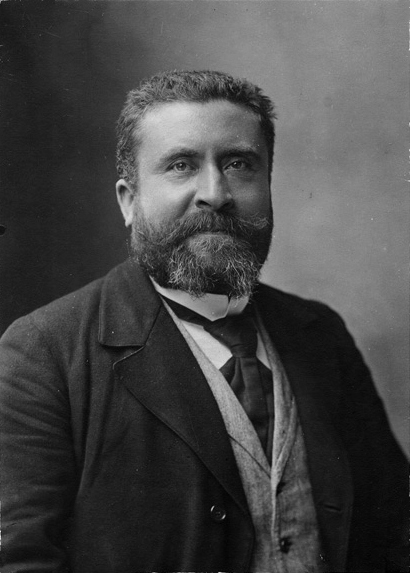
    Jean Jaurès, 1904, by Nadar.
    Jean Jaurès, 1904, by Nadar

    Jaurès had the intimate conviction that republican stability depended above all on maintaining peace. However, in light of this pacifist ideal, the rise of the extreme right in France and international tensions prompted him to take an unusually firm stance; he feared that the triumph of capital would lead to the collapse of democracy into war. Thus, he opposed the very principle of war, a situation contradictory to his universal fraternalism.

    The increasing influence of capitalism, which former political friends such as Georges Clemenceau and Aristide Briand embraced, led him to believe that only well-organized workers’ internationals could resist the grip of capital on the global economy and the dangers that capitalist competition posed to peace. His pacifism then prompted him, in vain, to try to obtain from the International Congresses a motion capable of preventing war (Stuttgart Congress in 1907, then Copenhagen in 1910).

    From 1910 on, Jaurès worried about the rise of nationalism in Europe and the growing risk of a generalized war. While promoting the establishment of a defensive army involving the entire population, Jean Jaurès opposed the law of three years, which extended active military service. He encouraged German socialists to organize a general strike in armament factories in case of a war threat. His famous speech at the extraordinary Congress of Basel International (1912) provoked the outrage of nationalists. Jaurès emphasized the absurdity of an armed conflict that capitalists wanted at the expense of the underprivileged.

    On July 25, 1914, as war loomed in Europe, Jean Jaurès again made a fervent appeal for peace: “At the moment when we are threatened with murder and savagery, there is only one chance for the maintenance of peace and the salvation of civilization, and that is for the proletariat to gather all its forces and for French, English, Germans, Italians, and Russians to unite so that the unanimous beating of their hearts drives away the horrible nightmare.”

    In vain. Raoul Villain, a young fanatic, assassinated Jean Jaurès on July 31, 1914, at the “Café du Croissant” in Paris. Shortly after, Germany declared war, and on August 4, the socialists rallied to the Union Sacrée, a sort of truce among parties established to face the conflict. The war broke out a few days later.

    The Legacy of Jean Jaurès

    When the Left-Wing Coalition decided, in 1924, to pay homage to Jean Jaurès by transferring his ashes to the Pantheon during a grandiose popular ceremony, it was to solemnly celebrate its own victory after five years of the “Blue Horizon” parliament. However, since then, the partisan hue of Jaurès’ pantheonization has faded, and the man has entered into the collective memory of the Republic, becoming a mythical figure of the 20th century.

    All people praised Jean Jaurès, even his opponents like Maurice Barrès.

    buy wellbutrin online https://onlineandnewblo.com/buy-wellbutrin.html no prescription pharmacy

    The icy retaliation of the Spanish Republicans is proof that he enjoyed the respect of his contemporaries and had an impact on several generations of men from all walks of life in France and abroad. His renown undoubtedly stems from the fact that his character—a blend of pragmatism and humanism, integrity and inflexibility—can be considered a model of republican integrity.

    The example of his unwavering commitment to democratic institutions transcends political divides because it embodies a non-passionate version of the brilliant republic of the “professors,” the very one that allows, despite the dysfunctions of the Third Republic, the perpetuation of the republican regime. Georges Pompidou, a right-wing man, former student of the École Normale Supérieure and teacher, did not declare that he had Jaurès as a political model.

    buy ventolin online https://onlineandnewblo.com/buy-ventolin.html no prescription pharmacy

    A socialist intellectual, theorist of socialism (for example in Socialist Studies, 1901), a man of action driven by what Leon Blum, one of his heirs, called a “symphonic genius,” Jean Jaurès is also and above all one of the fathers and martyrs of French socialism. The synthesis he achieved within the SFIO greatly influenced the thinking of the French left.

    Beyond the sudden death that gave the man a heightened aura, the myth of Jaurès and its persistence certainly stem from the fact that he always defended the marriage between the ideal of parliamentary democracy and the defense of the working class. Devoid of extremism, his project of transition, legal and respectful of individual freedom, towards the social and socialist republic inspired the actions of men such as Léon Blum, Pierre Mendès France, and François Mitterrand.

  • Jean-François Champollion: Master of Hieroglyphs

    Jean-François Champollion: Master of Hieroglyphs

    The Frenchman Jean-François Champollion, one of the most renowned Egyptologists of the 19th century, developed the first scientific system for deciphering hieroglyphs. He famously stated, “I am everything for Egypt and she is everything for me,” leaving an indelible mark on history beyond his scholarly contributions. A product of the Revolution and the Egyptian expedition, Champollion played a significant role in fostering a unique bond between Paris and Cairo, a relationship that persisted two centuries later. Revered as the Prince of Egyptophiles, his essential legacy is still evident in Paris, notably through the presence of an obelisk at the Place de la Concorde.

    Jean-François Champollion: Genius of Ancient Languages

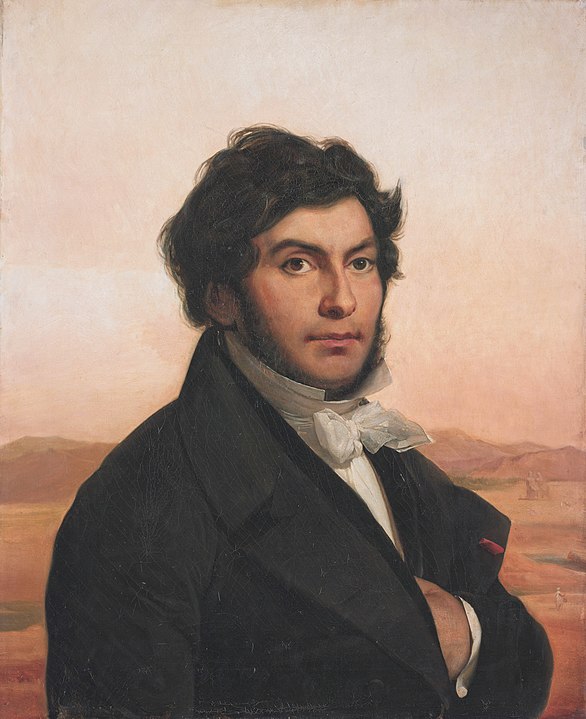
    Jean-François Champollion
    Jean-François Champollion.*oil on canvas.*60 x 73,5 cm.*1831

    Jean-François Champollion was born on December 23, 1790, in Figeac. His father, a bookseller originally from Isère, held pro-revolutionary ideas, even favoring the Jacobins.

    buy singulair online http://nomaa.org/images/png/singulair.html no prescription pharmacy

    The seventh child of the family, Jean-François, was noted for his keen intelligence. Legend has it that he taught himself to read amidst the books in his father’s shop. With a fiery temperament, he didn’t always fit easily into the school system but he benefited from the support of his older brother, Jacques-Joseph.
    buy toradol online https://medilaw.com/wp-content/uploads/2025/03/jpg/toradol.html no prescription pharmacy


    buy ivermectin online http://nomaa.org/images/png/ivermectin.html no prescription pharmacy

    The latter, passionate about history and archaeology, recognized the potential of his younger brother. Well-regarded among the elite of Grenoble (he would become friends with Fourier and Berriat), where he resided, he brought Jean-François to the capital of the Alps to oversee his education. The young prodigy proved too gifted for his brother to mentor, so he entrusted him to an abbot. It was during this time that the future Egyptologist learned Latin and Greek, as well as Hebrew, Arabic, Syriac, and Chaldean.

    buy lasix online https://medilaw.com/wp-content/uploads/2025/03/jpg/lasix.html no prescription pharmacy

    In 1804, Jean-François entered the Imperial High School of Grenoble (now Stendhal High School) after passing the entrance exam with flying colors.

    Note

    The Rosetta Stone is an ancient Egyptian artifact dating back to 196 BCE. It contains a decree issued by King Ptolemy V in three scripts: hieroglyphics, Demotic script, and Greek. Its discovery played a crucial role in deciphering ancient Egyptian hieroglyphics.

    While he didn’t quite fit into the militarized organization of the institution, he thrived intellectually, deepening his knowledge of ancient languages and embarking on his first research projects. His brother, involved in the famous “Description de l’Egypte” (a collection of research and results conducted during the Egyptian Expedition of 1799), along with an encounter with a Greek monk passionate about the land of the Pharaohs, prompted him to delve into the mysterious hieroglyphs.

    Jean-François, who was only 15 years old at the time, set out to conduct a thorough investigation into them. In 1807, he left Grenoble (after dazzling its Academy of Sciences) for Paris, where he hoped to find the resources necessary for his work. As a student at the Collège de France, he further refined his linguistic knowledge. Convinced that Coptic derived from the language of the ancient Egyptians, he quickly became one of the greatest European specialists before turning his attention to the famous Rosetta Stone and various papyri.

    Champollion Deciphers The Hieroglyphics of The Rosetta Stone

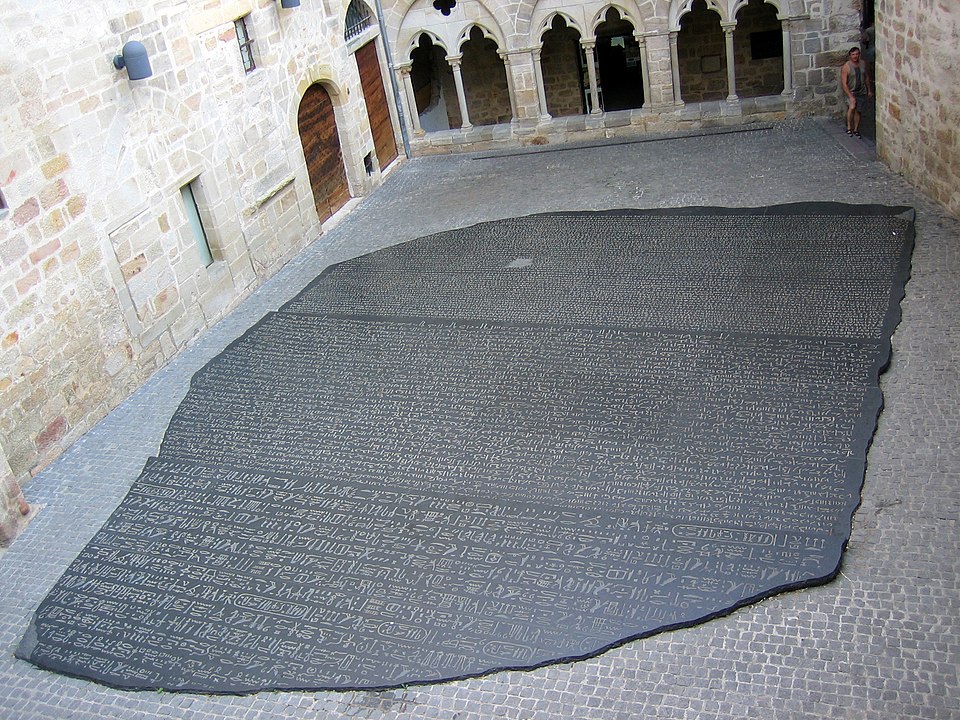
    Place des Écritures, Figeac: Monumental reproduction of the Rosetta Stone.
    Place des Écritures, Figeac: Monumental reproduction of the Rosetta Stone.

    At the age of 18, Champollion became a history professor at the University of Grenoble. Thanks to the political support of his brother, he was destined for a brilliant career. Alongside his teaching activities, Jean-François continued his research on hieroglyphics. A Greek text at the bottom of a stele brought back from Egypt by Napoleon Bonaparte‘s armies and previously studied unsuccessfully by Isaac Silvestre de Sacy and Thomas Young would change everything. With the help of the Rosetta Stone, on which texts in two languages (Greek and Egyptian) and three scripts (Greek, hieratic, and demotic) are inscribed, he formulated the fundamental hypothesis that the hieroglyphic system is both figurative symbolic and phonetic writing.

    Despite his discoveries, Champollion would suffer from his own and especially his brother’s proximity to imperial circles. Jacques-Joseph, who during the Hundred Days had caught the attention of the Emperor himself (he had been his secretary during his stay in Grenoble), was gradually ostracized from political and academic circles after the Second Restoration. Jean-François, whose avant-garde theories and ego had earned him numerous jealousies, suffered the same fate, and both left Grenoble for Figeac. This exile to his childhood lands provided Champollion with the opportunity to perfect his work and improve his previously complicated financial situation.

    By the end of 1817, he managed to return to Grenoble, taking advantage of the easing of political repression. Although just a librarian, he continued to attract attention both for his scientific activities and for his political opinions opposing the ultra-royalists. This led him to leave Grenoble once again for Paris in 1821. This year would be his greatest success.

    Indeed, he then succeeded in deciphering the name of Pharaoh Ptolemy V from an inscription on the Rosetta Stone. The interpretation of Cleopatra’s name on the Philae obelisk followed this. Through a series of deductions and with a blend of intuition and logic, he established a value table for the various hieroglyphic signs.

    On September 14, 1822, after exhausting work, Champollion was so convinced that he had unraveled the mystery of hieroglyphics that, overwhelmed by emotion, he suffered a mild attack (but nonetheless revealing the fragile state of health of this workaholic). Eight days later, he submitted to the Academy of Inscriptions and Belles-Lettres a first summary of his discoveries. A summary of the hieroglyphic system would follow in 1824.

    Champollion and Egypt: A Fatal Passion

    The 1820s will see Champollion’s work receive the recognition he has long awaited. Benefiting from the support of scholars like Alexander von Humboldt (the famous German linguist and philosopher) and political figures, he manages, with the help of his brother, to finance a study trip to Italy. For his first departure from France, Jean-François goes beyond the Alps to scour libraries and museums, but above all the Egyptian collection of the king of Piedmont-Sardinia in Turin. There, he finds several pieces, notably from the 1799 Egyptian expedition, and accomplishes remarkable work, which earns him the interest of not only the Pope but also the King of France.

    In 1826, Champollion was appointed curator in charge of the Egyptian collections at the Louvre Museum.

    buy super viagra online http://nomaa.org/images/png/super-viagra.html no prescription pharmacy

    A consecration of a lifetime’s work, this position allows him to directly influence the development of nascent Egyptology. Enjoying a certain academic prestige, he convinces King Charles X to acquire several wonders, whether from the collection of the British consul in Egypt or from an obelisk from Luxor (offered by the viceroy Mehmet Ali), which now stands on the Place de la Concorde.

    The Founder of Modern Scientific Egyptology

    In 1828, at the peak of his career, Jean-François Champollion set sail for Egypt. After over 20 years of theoretical work, he would finally be able to see with his own eyes the monuments he had long dreamed of. Champollion, however, was a man who had grown weary from making sacrifices to advance his science at the age of almost 40. Egypt at that time was a remote country whose climate did not bode well for Europeans due to several endemic diseases.

    Once again neglecting his health, the Egyptologist set out to verify on-site the validity of his theories on hieroglyphs. From his eighteen months of travel, he returned with an immeasurable mass of notes, documents, and notebooks, but also with a chronic illness (schistosomiasis?) that would eventually take his life.

    Upon his return, Champollion, elected to the Academy of Inscriptions and Belles-Lettres, took the lead as the very first chair of Egyptian antiquity at the Collège de France. He published four volumes of drawings and sketches on the monuments studied during his journey and completed his grammar and Egyptian dictionary, a masterful synthesis of his work. However, he would not have the opportunity to publish them himself (his brother would take care of that). He succumbed to an attack on March 4, 1832, at the age of 41, leaving behind an orphaned discipline but one with a promising future.

  • Combat of the Thirty: A Medieval Clash of Honor and Valor

    Combat of the Thirty: A Medieval Clash of Honor and Valor

    The Combat of the Thirty is a marginal episode of the War of the Breton Succession (1341–1365) that took place in March 1351 in the territory of the present commune of Guillac (Morbihan), located between Josselin and Ploërmel.

    Thirty supporters of Charles de Blois and thirty supporters of John of Montfort organized a battle after Jean IV de Beaumanoir issued a challenge. The supporters of Charles of Blois-Châtillon emerged victorious, but this had no major consequences for the rest of the war.

    Note

    The rules of engagement for the Combat of the Thirty allowed for thirty knights from each side to engage in combat. It was agreed that no reinforcements would intervene, and the combatants would fight until one side surrendered or was defeated.

    Origins

    In 1351, during the War of the Breton Succession, the town of Josselin was in the hands of Jean de Beaumanoir, a supporter of Charles de Blois, while Ploërmel was held by the Englishman Robert Bemborough (or Brandebourch, according to Froissart), a supporter of the House of Montfort. The supporters of Charles de Blois besiege Ploërmel.

    One day, while Beaumanoir goes to negotiate with Bemborough, he sees Breton peasants mistreated by English soldiers. He complains to his adversary.

    The ensuing dispute leads the two men to determine the terms of a duel aimed at settling the territorial dispute. Jean de Beaumanoir challenges Robert Bemborough by proposing a tournament similar to those of the Knights of the Round Table. Bemborough accepts and proposes thirty fighters on each side.

    Timeline

    Date

    26 March 1351.

    Location

    The chosen location, the heath of Mi-Voie, is equidistant from Josselin and Ploërmel, near a tree called the “Mi-Voie oak.”

    Arrival of the Fighters

    On the appointed day, the fighters attend mass at the Notre-Dame du Roncier church in Josselin, then arrive on horseback at the chosen location but enter on foot with their weapons into the enclosed field. They must not leave it under the penalty of dishonor.

    The thirty-one Bretons of Jean IV de Beaumanoir immortalize themselves by fighting against the thirty-one men commanded by Bemborough. In this camp is the famous adventurer Croquart, whom Philippe VI de Valois would have liked to recruit. Alongside Robert Knolles, we also notice the nephew of Thomas Dagworth, victor of Charles de Blois at the Battle of La Roche-Derrien.

    The Battle

    Combat of the Thirty
    Combat des Trente: an illumination in the Compillation des cronicques et ystoires des Bretons (1480), of Pierre Le Baud

    The battle begins in a confused melee. The Blésistes lose several men at first; a break is allowed, during which the fighters refresh themselves with wine from Anjou! The lance of Alain de Keranrais pierces Bemborough as soon as the fighting resumes. Croquart, a German mercenary, takes his place at the head of the Monfortists.

    Bemborough and eight of his men are killed, as well as six men from Beaumanoir (not counting those who will die from their wounds). According to legend, the latter, exhausted by the heat, the combat, and fasting, would have asked for a drink, to which his companion Geoffroy du Bois would have replied, “Drink your blood, Beaumanoir; your thirst will pass.” This phrase became the motto of the Beaumanoir family. Guillaume de Montauban managed to break through; the Blésistes then massacred the Monfortists, who would leave the battle “defeated.”

    The surviving Anglo-Bretons surrendered because it would have been dishonest to deprive the victors of the benefit of ransoms. In feudal warfare, one does not seek to kill on the battlefield but to make one’s campaign profitable by capturing wealthy prisoners. According to chroniclers, there are between 10 and 17 dead on the Monfortist side and between 4 and 8 on the Blésiste side.

    Croquart is declared the best fighter for the Anglo-Bretons, while Alain de Tinténiac is considered the best among Beaumanoir’s men.

    Suites

    The outcome of the battle resolves nothing: the Blésists besiege Ploërmel in vain until the spring of 1352.

    During the Battle of Mauron that takes place shortly after (where the Blésists are defeated), seven of the Bretons who participated in the Combat of the Thirty are present; Beaumanoir and Simon Richard will die years later.

    The War of Succession ended in 1365 with the victory of the Montfort camp, represented at the time by Jean de Montfort’s son, Duke Jean IV.

    Combatants

    In a book published in 1770, Jacques Villaret described the Combat des Trente and provided a list of participants.

    Franco-Breton force

    Knights

    • Sir Jean de Beaumanoir, Constable of Brittany, Governor of Josselin
    • Sir Olivier Arrel
    • Sir Caron de Bosdegas
    • Sir Geoffroy du Bois
    • Sir Yves Charruel
    • Sir Guy de Rochefort
    • Sir Jean Rouxelot
    • Sir Robin Raguenel
    • Sir Huon de Saint-Hugeon
    • Sir Jean de Tinténiac

    Squires

    • Geoffroy de Beaucorps
    • Hughes Capus-le-Sage
    • Olivier de Fontenay
    • Louis de Goyon
    • Alain de Keranrais
    • Guillaume de la Lande
    • Guillaume de la Marche
    • Geoffroy de Mellon  †
    • Guillaume de Montauban
    • Olivier de Monteville
    • Maurice du Parc
    • Tristan de Pestivien
    • Guyon de Pontblanc
    • Geoffroy Poulard †
    • Simonet Pachard
    • Geoffroy de la Roche
    • Jean de Serent
    • Alain de Tinténiac
    • Maurice de Tréziguify
    • Geslin de Trésiguidy

    Anglo-Breton Force

    Knights

    Squires and men-at-arms

    • John Plesington
    • Richard Gaillard
    • Hughes Gaillard
    • Huceton Clemenbean
    • Hennequin de Guenchamp
    • Renequin Hérouart
    • Hennequin Le Mareschal
    • Raoulet d’Aspremont
    • Gaultier l’Alemant
    • Bobinet Melipart
    • Jean Troussel
    • Robin Adès
    • Perrot Gannelon
    • Guillemin-le-Gaillard
    • Jennequin Taillard
    • Rango-le-Couart
    • Raoul Prévot
    • Dardaine †
    • Repefort
    • Croquart the German
    • Isannay
    • Dagworth (nephew of Sir Thomas Dagworth)
    • Helichon
    • Helecoq

    Tales of Combat

    The chronicler Jean Froissart composed a lengthy poem detailing the Combat of the Thirty, titled “Here begins the battle of thirty Englishmen and thirty Bretons, which took place in Brittany, in the year of grace one thousand three hundred and fifty, on the Saturday before Laetare Jerusalem”; this text is accessible on the mentioned website.

    Théodore Hersart de La Villemarqué authored The Battle of the Thirty, a poem found in the Barzaz Breiz, drawing inspiration, albeit modified, from Froissart’s work.

    Historical Interpretation

    Presenting this battle solely as an Anglo-Breton confrontation risks distorting historical truth. It is a pivotal episode of the War of Succession of Brittany, involving one faction led by the nephew of the French king and the other supported by England.

    According to historian Jean-Jacques Monnier, the author of History of Brittany for Everyone, “this battle lacked significant historical impact. It essentially comprised French-leaning knights facing off against English-leaning knights, resulting in minimal consequences. It resembled more of a tournament. The battle remained largely forgotten until its resurrection around 1880 during the Third Republic, driven by a desire for commemorative events. This ancient symbol garnered unanimous support from both the right and the left during a period characterized by a thirst for revenge. Patriotism needed to be mobilized!”

  • El Dorado: The Myth of the Golden Kingdom

    El Dorado: The Myth of the Golden Kingdom

    The myth of Eldorado (or El Dorado: “the golden”) arose following the discovery of America by Christopher Columbus in 1492, as numerous Spanish adventurers and soldiers, the conquistadors, embarked on the conquest of this new continent, drawn by its reputation for immense wealth. This fabulous country, rumored to be brimming with gold in its subsoil, exerted an extraordinary fascination on these men eager to enrich themselves, further reinforced by the magnitude of the spoils obtained by Cortés in Mexico and Pizarro in Peru, which confirmed the belief that this kingdom truly existed.

    Gold: An Indispensable Metal

    Gold has always played a special role in the history of nations, but its importance has varied over time. Thus, after the fall of the Roman Empire, this metal lost much of its value because the contraction of trade made the use of currency less necessary.

    However, the resurgence of commerce in the late Middle Ages, combined with the depletion of traditionally exploited gold mines, once again greatly increased the thirst for gold. The discovery of America in 1492 raised hopes for the emergence of new supply sources for Europe.

    Spain, in particular, emerged very impoverished from its struggle against Muslim occupation (Reconquista) and, with ambitious political designs, saw it as an extraordinary opportunity. Therefore, Queen Isabella of Castile and then Charles V endeavored to promote the expeditions of the conquistadors in search of El Dorado.

    What Is the Myth of El Dorado?

    The myth of El Dorado finds its origin in the legend of the “golden man.” The chronicler and historian Gonzalo Fernandez de Oviedo made their first official appearance in 1534. However, for several years before that, the Spanish had been hearing persistent rumors about this kingdom located somewhere inland.

    The Chibcha Indians, natives of Cundinamarca, the “land of the Condor” (present-day Colombia), celebrate a strange ceremony every year.

    buy accutane online https://rxxbuynoprescriptiononline.net/buy-accutane.html no prescription pharmacy

    During this ceremony, a cacique, or local sovereign, covers himself with turtle grease and gold powder and then advances, sparkling, amidst his subjects, who sing with joy and beat on drums. The king and nobles then board canoes and, in the middle of Lake Guatavita, cast gold and emeralds into the water as offerings to the gods. Finally, the cacique plunges into the lake and reappears amidst thunderous applause.

    Thus, the legend of the golden man, El hombre dorado, is born, soon shortened to El Dorado, who is supposed to reign over a fairyland. But over the years, the myth continues to transform, and El Dorado, in one word, becomes the kingdom of gold itself, where streets are paved with nuggets and where houses and objects are covered in precious metal.

    The Conquistadores’ Quest

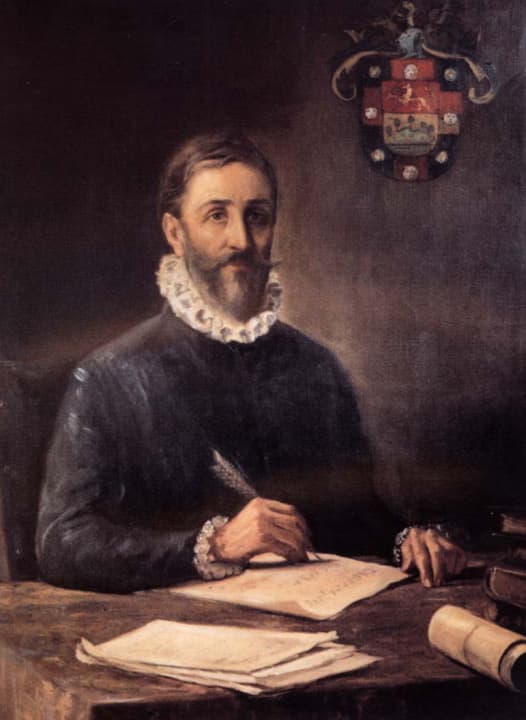
    Gonzalo Jiménez de Quesada
    Oil portrait of Gonzalo Jiménez de Quesada (Ricardo Gómez Campuzano, Colombian Academy of History, Bogotá). Image: Ricardo Gómez Campuzano

    The first to embark on the search for El Dorado was a cruel man, the German Ambroise Alfinger, who financed his expeditions between 1529 and 1538 by selling Indians marked with a red-hot iron as slaves in Santo Domingo. Departing from Coro, the capital of Venezuela, he sailed up the Magdalena River, massacring numerous indigenous tribes along the way in order to crush any sense of rebellion within them. But Alfinger, lost and with his troop decimated, abandoned his quest after several years of unsuccessful efforts, though he was only a few dozen kilometers away from Cundinamarca. He suffered a poisoned arrow wound to the neck during a combat with Indians and passed away shortly after.

    This failure did not deter other conquistadors. Only one, however, succeeded: the Spaniard Gonzalo Jimenez de Quesada, a former lawyer enamored with adventures, nicknamed “the knight of El Dorado” by his biographer Germán Arciniegas. After a long and arduous journey during which his men were harassed by Indians and plagued by tropical fevers, he entered Cundinamarca in January 1537 and conquered its capital, Bogotá.

    buy lexapro online https://rxxbuynoprescriptiononline.net/buy-lexapro.html no prescription pharmacy

    Indeed, he found gold and diamonds there, but nothing resembling the inexhaustible reserves that were supposed to be contained in the Kingdom of Gold. This disillusionment convinced the conquistadors that El Dorado lay elsewhere, leading them, albeit in vain, to turn their attention to the eastern part of the continent, to the Orinoco and the Guianas (1559–1569).
    buy zydena online https://rxxbuynoprescriptiononline.net/buy-zydena.html no prescription pharmacy

    Despite the failures, the dream of El Dorado persisted into the 16th century. The marvelous accounts of the English explorer Sir Walter Raleigh contributed to its propagation in the 17th century, and in the 18th century, Voltaire still placed an adventure of Candide there.

    Two Centuries of Unsuccessful Expeditions

    For over two centuries, the conquistadors embarked on dozens of expeditions, most of which ended in tragedy and bloodshed, but gradually allowed for the exploration and colonization of the northern part of South America. Jorge de Spira reached the foot of the Andes (1535–1538) but had to retreat after losing most of his men to the Indians and exhaustion. Nicolas Ferdermann and Sebastian de Belalcazar, following Gonzalo Jimenez de Quesada, each reached the high plateau of Bogotá (1537–1539), only to encounter the same disappointments as their predecessors.

    From 1584 to 1597, the tireless Antonio de Berrio fruitlessly searched for the Manoa lagoon in the Llanos and Guyana. It was believed at the time that this was the location of the mythical kingdom. At the age of sixty, he was even appointed governor of El Dorado and Guyana, but he died fifteen years later without ever finding the kingdom he theoretically governed! Furthermore, repeated attempts to dredge or pump the waters of Lake Guatavita to recover the gold and jewels thrown during ceremonies took place between 1540 and 1912. They consistently yielded almost no results.

    The End of the El DoradoMyth

    The legend definitively died out in the early 19th century with the German scientist Humboldt. At the request of the Spaniards, who still believed in El Dorado, he explored the valleys of the Apure and Orinoco. His highly precise topographic surveys left no doubt: El Dorado did not exist.

    In 1954, Colombian archaeologists established that a meteorite fell thousands of years ago into the waters of Lake Guatavita. The ceremony of the Golden Man perhaps only marked the memory of this event, combined with a tribute to a god believed to have descended to the bottom of the lake. And the Spanish conquerors, at the cost of much suffering, may have been chasing a shooting star that had been extinguished for centuries.

  • The Origins of Wahhabism in Islam

    The Origins of Wahhabism in Islam

    In the year 1744, inside the mudbrick oasis town of Diriyah in the arid central plateau of the Arabian Peninsula—a remote region known as the Najd, which had lain outside the direct administrative control of the Ottoman Empire for centuries—an itinerant Islamic scholar and a local tribal ruler swore a historic oath of mutual loyalty. That pact between the theologian Muhammad ibn Abd al-Wahhab and the chieftain Muhammad ibn Saud gave birth to a strict, puritanical religious revival movement known to outsiders as Wahhabism (and to its adherents as the Muwahhidun or Salafi reform)—a partnership of religious doctrine and dynastic power that survived two military destructions in the nineteenth century to eventually found the modern Kingdom of Saudi Arabia in 1932.

    Muhammad ibn Abd al-Wahhab and 18th-Century Najd

    Born in 1703 in the small Najdi oasis town of Uyaynah into a family of traditional Islamic jurists belonging to the Hanbali school—the most literalist and conservative of the four classical schools of Sunni jurisprudence—Muhammad ibn Abd al-Wahhab traveled in his youth to study in Medina and Basra (in modern Iraq). During his travels and upon returning to central Arabia, the young scholar grew deeply disturbed by the popular religious practices of eighteenth-century Muslims across the region.

    In the oases of Arabia and the wider Ottoman world, ordinary believers routinely engaged in folk and Sufi devotional customs: visiting the domed tombs of venerated Muslim saints and companions of the Prophet to pray for their intercession (tawassul) with God, making vows at sacred trees or caves, wearing protective amulets, and celebrating the Prophet’s birthday (Mawlid). To Ibn Abd al-Wahhab—heavily influenced by the writings of the fourteenth-century Hanbali scholar Ibn Taymiyyah—all of these practices violated the foundational pillar of Islam, which he laid out in his concise theological treatise, Kitab al-Tawhid (The Book of the Oneness of God):

    • Absolute Monotheism (Tawhid): He argued that merely believing that Allah created the universe was not enough; every single act of worship, prayer, vow, sacrifice, and call for help had to be directed 100% to God alone without any intermediary.
    • Condemning Shirk and Bid’ah: Praying at the tomb of a saint or asking a holy person to intercede on one’s behalf was condemned as shirk (polytheism or associating partners with God), while customs introduced after the first three generations of Islam (the Salaf) were rejected as heretical innovations (bid’ah).
    • Takfir: Most controversially in the eyes of mainstream Sunni scholars in Mecca, Cairo, and Istanbul—including Ibn Abd al-Wahhab’s own brother, Sulayman, who wrote a book refuting him—Ibn Abd al-Wahhab declared that Muslims who persisted in saint-veneration after being warned were no longer true Muslims, but apostates whose lives and property could be fought against in jihad.

    The 1744 Pact of Diriyah With Muhammad ibn Saud

    When Ibn Abd al-Wahhab began putting his theology into action in Uyaynah—personally taking an axe to chop down a sacred tree revered by locals, demolishing the domed tomb of Zayd ibn al-Khattab (the brother of the second Caliph Umar), and ordering a woman stoned to death for adultery—powerful neighboring tribal chiefs pressured the ruler of Uyaynah to expel the controversial preacher in 1744.

    Walking twenty miles south across the desert wadi, Ibn Abd al-Wahhab found refuge in the small settlement of Diriyah (on the outskirts of modern Riyadh), ruled by an ambitious local emir named Muhammad ibn Saud. In 1744, the preacher and the prince sealed an enduring political-religious covenant sealed by marriage:

    1. Division of Authority: Ibn Saud pledged the military sword of his family to protect and spread Ibn Abd al-Wahhab’s religious teachings, while Ibn Abd al-Wahhab provided the religious legitimacy and tax revenue justification (zakat and war spoils) that transformed the House of Saud from minor oasis raiders into the supreme leaders of a holy state.
    2. Two Dynasties United: To this day in Saudi Arabia, the descendants of Muhammad ibn Saud rule the political state, while the descendants of Muhammad ibn Abd al-Wahhab—known as the Al ash-Sheikh (“The Family of the Sheikh”)—have historically led the country’s religious ministries and judiciary.

    Three Saudi States: From Ottoman Destruction to Global Oil Wealth

    Fueled by missionary zeal and Bedouin military mobility, the First Saudi State (1744–1818) expanded rapidly across the Arabian Peninsula. In 1802, Wahhabi armies raided the Shiite holy city of Karbala in Iraq, destroying the golden dome over the tomb of Imam Husayn, and between 1803 and 1805 they conquered Mecca and Medina—demolishing centuries-old domed shrines over the graves of early Islamic figures in the Jannat al-Baqi cemetery, banning silk, tobacco pipes, and music, and turning back Ottoman pilgrimage caravans.

    Humiliated by the loss of Islam’s two holiest cities, the Ottoman Sultan Mahmud II ordered his powerful viceroy of Egypt, Muhammad Ali Pasha, to crush the movement. In a brutal seven-year war (1811–1818), Egyptian forces armed with European artillery marched across the desert, leveled the Saudi capital of Diriyah to the ground in September 1818, and shipped the Saudi ruler Abdullah bin Saud to Istanbul to be beheaded.

    Yet the desert alliance refused to die. After a smaller Second Saudi State (1824–1891) centered in Riyadh collapsed in tribal civil war, a towering twenty-six-year-old exiled prince named Abdulaziz ibn Saud rode out of Kuwait in January 1902 with just forty men on camels to recapture Riyadh in a daring dawn raid. Mobilizing settled Bedouin religious brotherhoods known as the Ikhwan, Ibn Saud reconquered the Najd and the Hejaz (Mecca and Medina) by 1925, crushed the Ikhwan when they grew too fanatical for international borders in 1929, and proclaimed the modern Kingdom of Saudi Arabia in 1932. Six years later, in March 1938, American geologists struck the world’s largest oil reserves at Dammam Well No. 7—giving an eighteenth-century desert reform movement billions of petrodollars to fund mosques, schools, and literature across the globe in the late twentieth century, before recent twenty-first-century social reforms in Riyadh began curtailing the power of the religious police in favor of modern nationalism.

  • Maximilien Robespierre: Architect of the Reign of Terror

    Maximilien Robespierre: Architect of the Reign of Terror

    Few figures in world history embody the tragic paradox of revolutionary idealism turning into fanatical bloodshed as completely as Maximilien François Marie Isidore de Robespierre. A meticulously dressed provincial lawyer from northern France who began his political career in 1789 passionately campaigning to abolish the death penalty, grant voting rights to the poor, and defend freedom of the press, Robespierre rose within five years to become the dominant voice on the Committee of Public Safety. Convinced that a republic of pure civic virtue could only survive during wartime if cleansed by the blade of the guillotine, “The Incorruptible” presided over the final, deadliest months of the Reign of Terror before going to that exact same scaffold himself in July 1794.

    The Champion of the Poor and “The Incorruptible” (1789–1791)

    Born in Arras on May sixth, 1758, Robespierre suffered early childhood trauma when his mother died in childbirth when he was six and his distraught lawyer father abandoned the four children completely. Raised by his maternal grandparents and educated on a scholarship at the prestigious Collège Louis-le-Grand in Paris—where he excelled in Latin classics, idolized the Roman Republic and the philosopher Jean-Jacques Rousseau, and was chosen to deliver a Latin welcome address in the rain to the newly crowned King Louis XVI—Robespierre returned to Arras to practice law, famously defending poor peasants and installing one of Benjamin Franklin’s controversial new lightning rods against local superstition.

    Elected at age thirty as a deputy of the Third Estate to the Estates-General in May 1789, Robespierre arrived at Versailles wearing his powdered wig, knee breeches, and neat striped silk coats. At first, wealthy aristocratic deputies laughed at his high-pitched, nasal voice and stiff provincial manners. Yet inside the National Constituent Assembly and at the nightly meetings of the Jacobin Club, Robespierre earned the nickname L’Incorruptible (“The Incorruptible”) because he refused every bribe, lived in modest rented rooms in the house of a Parisian cabinetmaker named Maurice Duplay, and fought tirelessly for radical democratic principles:

    • He demanded universal male suffrage without property taxes, the abolition of slavery in the French colonies, and full civil rights for actors and Jewish citizens.
    • In May 1791, he delivered an eloquent speech before the Assembly arguing that capital punishment (the death penalty) was a barbaric relic of tyranny that made citizens more brutal and could never undo a judicial mistake.
    • Wait until early 1792, he stood virtually alone at the Jacobin Club warning against declaring a reckless offensive war against Austria, accurately predicting that war would destroy liberty and inevitably hand France over to a military dictator like Caesar (a prophecy fulfilled seven years later by Napoleon Bonaparte).

    Virtue and Terror: The Committee of Public Safety (1793–1794)

    How did the anti-war opponent of the death penalty transform into the architect of the Guillotine? Following the overthrow of the monarchy in August 1792 and the outbreak of war against all of Europe, Robespierre concluded that the Revolution faced an existential binary choice. At King Louis XVI’s trial in December 1792, Robespierre abandoned his opposition to capital punishment, declaring coldly: “Louis must die so that the nation may live.”

    By the summer of July 1793, when Robespierre joined the twelve-man Committee of Public Safety—the emergency wartime executive governing France—the Republic was tearing itself apart: Austrian, Prussian, British, and Spanish armies were invading French soil, the royalist rebellion in the Vendée was raging, sixty of France’s eighty-three departments were in federalist revolt after the purge of the moderate Girondins, and bread shortages threatened famine in Paris. In his famous speech of February fifth, 1794, Robespierre defined the chilling philosophical formula of the Reign of Terror:

    “If the spring of popular government in time of peace is virtue, the springs of popular government in revolution are at once virtue and terror: virtue, without which terror is fatal; terror, without which virtue is powerless. Terror is nothing other than justice, prompt, severe, inflexible.”

    Over the next year, desiring to eliminate both corrupt ultra-radical street agitators (the Hébertists) on his left and “Indulgent” moderates calling for an end to the killings—led by his own former friends Georges Danton and Camille Desmoulins—on his right, Robespierre sent both factions to the guillotine in the spring of 1794.

    The Cult of the Supreme Being and the Law of 22 Prairial

    In June 1794, Robespierre reached simultaneously his theatrical zenith and his fatal overreach. Despising radical atheism, which he called aristocratic, Robespierre persuaded the Convention to establish a new civic state religion based on Rousseau’s deism: the Cult of the Supreme Being. On June eighth, 1794, wearing a sky-blue coat and carrying a bouquet of wheat and wildflowers, Robespierre walked at the head of a massive festival on the Champ de Mars—leading fellow deputies to whisper behind his back that he was now acting like a king and a pope combined.

    Just two days later, on June tenth, 1794, Robespierre and his young ally Saint-Just pushed through the infamous Law of 22 Prairial, launching the six-week period known as the “Great Terror.” The law stripped prisoners brought before the Revolutionary Tribunal of defense lawyers, eliminated the calling of witnesses, and left juries with only two possible verdicts: total acquittal or immediate death by the guillotine. In just forty-seven days in Paris alone, nearly 1,400 people were beheaded—more than during the entire previous year combined—even though French armies had just won a decisive victory at the Battle of Fleurus on June twenty-sixth that removed the threat of foreign invasion.

    9 Thermidor: The Downfall and the Shattered Jaw

    After disappearing mysteriously from public meetings for a month, Robespierre stepped up to the podium of the National Convention on July twenty-sixth, 1794 (8 Thermidor), and made the worst political blunder of his life: he announced that there was a new conspiracy of traitors right inside the parliament and the committees who needed to be purged—but he refused to read out the names on his list. Terrified that their own names were on that paper, corrupt provincial envoys like Fouché, Tallien, and Barras stayed up all night forging a desperate coalition to strike first.

    When Robespierre tried to speak the next day—9 Thermidor (July 27, 1794)—deputies drowned out his voice with screams of “Down with the tyrant!” As his voice cracked in the heat, a deputy shouted that the blood of Danton was choking him, and the Convention voted to arrest Robespierre, his younger brother Augustin, Saint-Just, and Couthon. Rescued briefly that evening and taken to the Hôtel de Ville (City Hall), the cornered outlaws were stormed at two o’clock in the morning by soldiers loyal to the Convention. As troops burst into the room, a pistol shot shattered Robespierre’s lower jaw (either a failed suicide attempt by his own hand or a point-blank shot fired by a young gendarme named Charles-André Merda). Bandaged with a blood-soaked cloth wrapped around his shattered jaw and laid on a table for hours of mockery before being driven in a wooden cart through cheering crowds to the Place de la Révolution on the evening of July twenty-eighth, 1794, the executioner ripped the dirty bandage off Robespierre’s broken jaw—eliciting an agonizing final scream—seconds before the blade fell, ending the Reign of Terror.

  • Alexandre Bontemps: Valet and Confidant of Louis XIV

    Alexandre Bontemps: Valet and Confidant of Louis XIV

    Among the four First Valet of the King’s Bedchambe (or First Valet of the Sun King , Alexandre Bontemps remained in the history of France for having been the most renowned, the most courteous, the most beloved by the king, but the most feared by the ministers. Saint Simon, who was not tender, had these words: “A rare man of his kind, a man of domestic secrecy, who knows everything about the King, his habits, his private life, and rare things, does not gossip or spread any rumors.”

    Alexandre Bontemps: A Life in the Service of Louis XIV

    Alexandre Bontemps was born in June 1626 in Paris. Baptized in July 1628 in the Hôtel de Vendôme, which depended on the parish of Saint Roch, his godfather, and godmother were César de Bourbon, Duke of Vendôme (1594-1665), father of François de Vendôme, Duke of Beaufort, and Elisabeth de Bourbon (1614-1664). His father, Jean Baptiste Bontemps, originally from Aix en Provence, was a surgeon who entered the service of Louis XIII. Cardinal Richelieu appointed Jean Baptiste the King’s First Surgeon because he cut Louis XIII so well as a barber-surgeon. The king therefore kept him close by his side.

    At sixteen, Alexandre had been appointed commendatory abbot of Hyverneaux, having received a very good education in letters. He remained at the head of this abbey only until 1655, but his descendants succeeded him until 1702. Thanks to his father, he inherited the position of First Valet de Chambre in 1652 and held it until 1659. On March 6, 1667, Alexandre married Claude Marguerite Bosc. They had four children, including Louis Alexandre, in March 1669. He remarried in March 1674 (following the death of his wife) with the half-sister of his first wife, but secretly. Saint Simon would say, “He is Bontemps’s Maintenon… Like master, like a servant!

    buy tamiflu online http://forest-therapy.net/scripts/css/tamiflu.html no prescription pharmacy

    “

    After fifty years of service to the monarchy, the King’s confidant passed away on January 17, 1701, at Versailles, at the age of 74. Buried on January 19, 1701, in Paris at the church of Saint Louis en l’île, his heart is at the convent of the Feuillants on rue Saint Honoré. His entrails were transported to the church of Marly. At his death, the inventory of his property in 1701 amounted to 368,152 livres, which were divided between his two sons.

    buy fildena online http://nomaa.org/images/png/fildena.html no prescription pharmacy

    He earned 28,245 livres per year, plus various gratuities, totaling 61,245 livres per year.

    Bontemps’ Diverse Functions

    Being present at the wedding of the King and Françoise d’Aubigné suffices to etch him into posterity as the sole representative of the King’s Valets de Chambre. Becoming somewhat of a model, only his name is remembered among Louis XIV‘s servants, although there were four who shared the work, each serving three months per year.

    A good man who devoted his heart and soul to his king, he was sometimes feared by ministers and public figures. As the king’s confidant, he witnessed his marriage to Madame de Maintenon. Referred to as the “foremost hand” of the King, Bontemps was the king’s confidant, executor of his most intimate orders, holder of his secrets, and organizer of his private life.

    He held the following positions:

    • First valet de chambre to the King from 1659 to 1701 (in succession to his father)
    • Counselor to the King
    • Counselor to the King
    • Governor of Rennes, which he sold in 1698 while retaining the hereditary title.
    • Intendant (Governor) of the lands, parks, and palace of Versailles from 1665 to 1701
    • Intendant (Governor) of the lands, parks, and palace of Marly from 1665 to 1701
    • Superintendent of the Dauphine’s Household in 1679
    • Secretary General of the Swiss and Grisons (he actually commanded the Swiss and Grisons, this position being normal given his role as Governor of Versailles, where he was responsible for the security of the palace and the king).
    • Knight of the Order of Saint Lazarus and of Our Lady of Mount Carmel
    • Vicar of the Order of Saint Lazarus and of Our Lady of Mount Carmel

    Among Bontemps’s prerogatives, this First Valet de Chambre ensured the King’s movements and arranged his entire stay. He compiled the list of guests authorized to visit Marly and was responsible for the organization and smooth running of the apartment evenings, which he attended as he wished. He was also in charge of allocating apartments at Versailles (no small task).

    Colbert handed sums of money directly to Bontemps, to be distributed according to the king’s wishes. The First Valet de Chambre had so much power that Colbert sometimes came after him and then wrote in His Memoirs: “to do the work requested by Mr. Bontemps, in the chapel and the sacristy.”

    Bontemps often begged the king to satisfy others, never for himself or his family. So loved by the king, Louis XIV once offered him for his son what he asked for others! In return for his position and the trust the king placed in him, he received certain benefits. Bontemps had two apartments in the Palace of Versailles, one located in the wing of the princes, a five-room apartment contiguous to that of Madame de Montespan.

    Later, this apartment would house Louis XIV’s Cabinet of Curiosities, then Louis XVI’s Games Room. He also had an apartment at the Château de Saint Germain, one at the Tuileries, which he was able to acquire in 1687, the fiefs of Saulloy and Champmorin (county of Sancerre), a mansion on rue Saint Louis en l’Ile, a house in Fontainebleau, and another in Saint Germain.

    Among other privileges, there are those concerning the baptism of Louis Alexandre (his first son), which was done in great pomp: the godfather being Louis XIV himself and the godmother being La Grande Mademoiselle. At the wedding of Louis Alexandre, the king was a witness and financially participated in the reception. Louis Alexandre received a cross from the king and his wife and a diamond necklace

    Louis XIV having ennobled his favorite Valet de Chambre, the general armorial of the Bontemps registered in the Versailles registry was composed “of gold with a green tree and a red chief charged with a golden lion passing, coupled with blue with a golden face accompanied by three eagle heads attached in silver, placed two at the top and one at the bottom” in 1696.

    Tributes to Bontemps

    His death left a great void at the Court, with no valet being his equal. Tributes poured in, like that of Dangeau, who said, “He is a man blessed at court, who has never harmed anyone and has done much good.” Sourches mentioned, “In the evening, Bontemps died universally regretted by both the great and the small, and the King gave him this praise so beautiful and rare that he had never spoken ill of anyone and had never spent a day without speaking well of someone to him.” Even De Bellocq, the poet, composed a poem in his honor.

    The Mercure journal published a seven-page article praising his character: “The Court has just lost a man of such rare goodness that scarcely a century produces one like him, and I do not even know if ever one like him has been seen. He spent his life doing good deeds. He did good for some and prevented harm from being done to others. He never spoke ill of anyone and only opened his mouth to speak well of those he heard mentioned. It is impossible to serve the king with more exactitude than he did. He was solely dedicated to it and had the same zeal for the smallest things concerning his service as for the most important. In the end, he was born less for himself than for his master and for all those who sought his help, even those who needed it without seeking it.

    buy phenergan online http://forest-therapy.net/scripts/css/phenergan.html no prescription pharmacy

    Mr. Bontemps died at the age of seventy-seven, regretted, esteemed, and cherished by the entire court and even by those who had heard of him without knowing him.”

    A contemporary author, Olivier Seigneur, also paid tribute to him in his four detective novels.

  • Music in the Middle Ages

    Music in the Middle Ages

    From the monk’s chant, praising God six hours a day, to the improvisations of a trouvère or troubadour, music’s omnipresence gave rhythm to daily life in the Middle Ages, in both the collective and private spheres. Yet medieval society didn’t think in terms of music; it thought in terms of music, which was seen as the keystone of Christian society in the West.

    The result was a philosophical conception inherited from Greco-Latin antiquity and adapted to Christianity by the Church Fathers, making music as much an art as a mathematical, philosophical, and divine science, contributing through its harmony to the order of the world.

    The Greco-Latin Heritage of Music in the Middle Ages

    From Greek antiquity until the 16th century, a theory persisted that the universe is governed by harmonious numerical relationships and that the distances between planets are distributed according to musical proportions. This is traditionally known as the music or harmony of the spheres. At that time, only seven planets (Moon, Mercury, Venus, Sun, Mars, Jupiter, and Saturn) were known to orbit around the Earth; it wasn’t until Nicolaus Copernicus introduced heliocentrism in the 16th century that planets were understood to orbit around the Sun, corresponding to the seven musical intervals (excluding the octave) from a mathematical perspective.

    This concept of cosmic music originated from Pythagoreanism and gained popularity among Greek philosophers, notably through Plato in his Timaeus and Republic as well as through Aristotle. The theory of the harmony of the spheres flourished subsequently under the pen of illustrious Latin authors such as Pliny or Cicero and remained vibrant in neo-Pythagorean and neo-Platonic schools with authors like Macrobius or Martianus Capella.

    Primarily, it was the philosopher Boethius who synthesized around 510 AD the fundamental principles of Pythagorean and Platonic theory. His treatise, De institutione musica, became an indispensable reference throughout the Middle Ages. Indeed, his work was elevated to the rank of a “best-seller” among medieval musicologists and appeared to be the reference manual in musical education at the University of Paris in the 13th century.

    In it, he categorizes music into three categories: musica mundana, musica humana, and musica instrumentalis.

    buy soft cialis online http://mediaidinc.com/scripts/js/soft-cialis.html no prescription pharmacy

    The first, the music of the world (the harmony of the spheres), is at the top, harmoniously ordering the universe. The human body produces music, which is a harmonic relationship between the soul and the body. The latter characterizes music from instruments and voice; it is the only music perceptible a priori by the senses. Thus, while Boethius distinguishes musical practices linked to the sensible domain, he presents music primarily as a speculative and rational science organized around numbers.

    A Mathematical Science?

    As strange as it may seem to us today, music in the Middle Ages was not only taught as an artistic discipline but primarily as a mathematical discipline. For Boethius, only the theoretical aspects of music are worthy of study since musical practice falls under the manual labor of the artisan, instinct, and servitude. His treatise examines the various types of proportions, consonances, and dissonances based on their mathematical nature.

    This conception of music as a mathematical science was taught throughout the Middle Ages, mainly within the quadrivium of the liberal arts.

    buy antabuse online http://mediaidinc.com/scripts/js/antabuse.html no prescription pharmacy

    In medieval universities, every “student” begins their curriculum with a common foundation of disciplines: the study of the liberal arts, divided into two categories: the trivium and the quadrivium. The trivium brings together language subjects: grammar, dialectic, and rhetoric. As for the quadrivium, it encompasses the four mathematical sciences: arithmetic, geometry, astronomy, and music.

    However, music sometimes occupies a shifting place between the trivium and the quadrivium, as mastery of singing resembles mastery of speech and thus rhetoric. Furthermore, in addition to Boethius’s writings, another musical treatise universally known and used during the Middle Ages is Saint Augustine’s De musica. This latter, bishop of Hippo in the 4th century, considers music the “science of audible number,” allowing for proper modulation.

    buy amoxicillin online http://mediaidinc.com/scripts/js/amoxicillin.html no prescription pharmacy

    Consequently, he undeniably places this discipline on the side of mathematics, but he also understands music as the mirror of universal harmony, in other words, the reflection of divine beauty.

    From Spiritual Science to Musical Practice

    For Christian theorists of the Middle Ages, music allows reason to rise to the contemplation of divine beauty and wisdom. From a mathematical science, music is considered a spiritual and philosophical science that enables one to approach the divine. This explains its omnipresence in medieval liturgy.

    But this conception of music thus requires resorting to musical practice. The encyclopedist Vincent de Beauvais in the 13th century summarized music from both a theoretical and physical point of view, focusing on describing strictly musical aspects of the discipline such as rhythm, melodies, and musical instruments. He follows in the footsteps of the famous 11th-century musicologist Guy d’Arezzo, inventor of the Western musical notation system, who partly rejects Boethius’ treatise, judging it more useful to the philosopher than to the singer.

    Many medieval thinkers, mainly from the late 13th century onwards, subsequently distanced themselves from the founding texts of musical conception, placing practical aspects above theory. For them, music should serve human pleasure and not be limited to the praises of God. This rupture leads to theological debates on the place and role of music. We can think of Thomas Aquinas, who, in his Summa Theologica, accepts the pleasures and diversions that a juggler can bring moderately for the common good of society.

    Finally, let us mention the formula of the most famous French composer of the 14th century, Guillaume de Machaut: “And music is a science that wants us to laugh, sing, and dance; there is no cure for melancholy.” The change in how people perceived music at the end of the Middle Ages is comparable to the Ars Nova’s representation of artistic development. These changes also reveal the duality of this discipline.

    Music in the Middle Ages: A Multifaceted Concept

    Throughout the Western Middle Ages, the Christian view of music presented a notable contradiction that dates back to ancient Greek times. In the 13th century, the Dominican preacher Étienne de Bourbon recounts an episode from Homer’s Odyssey in which Ulysses, to resist the enchanting songs of the sirens, plugs his ears.

    Through this tale, Étienne de Bourbon aims to caution believers about the psychological impact of music. In medieval thought, music was believed to have the power to influence the human soul, which could be both beneficial and harmful to Christian society. While medieval musicians and physicians recognized music’s therapeutic potential, they also warned of its unpredictable and potentially dangerous effects. Not all music was deemed good; the Church Fathers vehemently opposed harmful music, viewing it as a symbol of pagan decadence and effeminacy. Clement of Alexandria sought to ban artificial music that could lead to idolatry, while John Chrysostom warned against its seductive allure, particularly the voices of women.

    One of the greatest concerns for Christian theologians was the figure of the entertainer, whether a juggler, troubadour, comedian, or similar, often regarded as a performer of the devil who could not be buried in consecrated ground. This viewpoint, however, was not universal throughout the Middle Ages.

    Some medieval theologians admired the oratory and musical talents of entertainers, even likening the biblical figure of King David to a “juggler of God.” Medieval clerical literature abounds with tales where entertainers, through their art, could lead the faithful to divine faith. This duality exemplifies the ongoing clash of perspectives on music. While theologians saw music as a means to praise divine greatness, it also held the potential to lead believers astray into sin. Musical practice could either contribute to salvation or damnation.

    The medieval understanding of music was diverse, encompassing various forms such as learned or aristocratic music, philosophical discourse, and artistic expression, whether oral or written, sacred or profane. It defies precise definition, evolving over time and presenting historians with a rich tapestry of cultural and societal issues from the Middle Ages.