Author: Hrothsige Frithowulf

  • Why Is the Marathon 42195 Meters Long?

    Why Is the Marathon 42195 Meters Long?

    The first Olympic marathon runners covered the distance between Athens and the city of Marathon, after which the race is named. However, it wasn’t until the Paris Olympics in 1924 that the distance became what it is today.

    Fast-forward to the end of the 19th century. In 1894, French historian Pierre de Coubertin founded the International Olympic Committee (IOC), which inaugurated the Modern Era Olympic Games. A friend of Coubertin, Michel Bréal, suggested that the marathon be included in the Games. Naturally, the distance could only be the same as the one that the long-distance runner Pheidippides covered in the legend.

    And so it was. In the first Olympics, held in Athens in 1896, the marathon course covered the exact distance between Marathon and the host city. However, since there wasn’t an established rule, the route in the 1900 Olympics increased to 40.26 km. In St. Louis, USA, in 1904, it reverted to 40 km. Then in 1908, in London, the distance became 42.195 km. Why this specific number? The reason is simple.

    The Olympic Committee only stipulated that the marathon needed to be between 38 and 41 km.

    buy mebendazole online https://nsstulsa.com/mt-content/uploads/2021/08/png/mebendazole.html no prescription pharmacy

    The British used this flexibility to start the race from inside Windsor Castle, the royal residence—a way to keep the common public away and avoid crowds. The finish line was at the White City stadium, in front of the British royal family. The course was exactly 42.195 km.

    In the following Games, the distance underwent new variations.

    buy symbicort inhaler online https://nsstulsa.com/mt-content/uploads/2021/08/png/symbicort-inhaler.html no prescription pharmacy

    To avoid further changes, it was established at the Paris Olympics in 1924 that the 42.
    buy strattera online http://rxdc.com/images/html/strattera.html no prescription pharmacy

    195 km route would be the standard. The marathon distance has remained the same since then and was repeated exactly a century later at the Paris 2024 Games.

  • How Did the Vikings Calculate Fines?

    How Did the Vikings Calculate Fines?

    Popular television dramas often portray Viking Age Scandinavia (circa 793–1066 AD) as a lawless free-for-all where every minor insult in a mead hall was settled on the spot by splitting a neighbor’s skull with a battle-axe. In historical reality, the Norse peoples of Norway, Iceland, Denmark, and Sweden were obsessive, hair-splitting **legal formalists**. Indeed, our modern English word “law” itself is not Latin or Anglo-Saxon—it comes directly from the Old Norse word lagu (“that which is laid down”)! To prevent blood-feuds from wiping out entire farming valleys, Viking legal assemblies—the Things (Þing)—enforced a remarkably detailed, mathematical schedule of silver fines known as wergild (“man-price”), which priced out everything from killing a free farmer down to slicing off a specific finger or composing an insulting poem.

    Why Silver Replaced Blood: Stopping the Endless Feud

    In early Germanic and Norse society, if a man from Family A killed or maimed a man from Family B, Family B had the traditional honor obligation to take blood-revenge by killing a member of Family A—which then forced Family A to kill someone back in an endless cycle of vendetta that could last for three generations (vividly depicted in Iceland’s Njáls Saga).

    To offer an honorable off-ramp that satisfied a victim’s wounded pride without shedding more blood, the regional assemblies—such as the Althing in Iceland (founded in 930 AD, the oldest surviving parliament in the world), the Gulating and Frostating in Norway, and the Danish and Swedish provincial laws—established that almost any violent act committed openly and declared honestly within twenty-four hours (víg, manslaughter, as opposed to cowardly secret murder in the dark, morð) could be settled by paying a standardized fine in weighed silver, cattle, or homespun woolen cloth (vaðmál).

    Anatomical Price Lists: How Much Each Body Part Cost

    Surviving early medieval Norse law codes—such as the Icelandic Grágás (“Grey Goose Laws”) and the Norwegian Gulathing Law—read like a modern insurance company’s actuarial injury chart. First, the baseline price for killing a whole human being (the wergild, or manngjöld) was scaled strictly according to the victim’s social rank (a nobleman or royal retainer cost far more than a standard free farmer, or bóndi, who in turn cost far more than a freedman or an enslaved thrall).

    Once the baseline “whole-man price” (for example, 120 ounces of pure silver, or roughly fifteen to forty dairy cows for a free man) was set, every individual limb and organ on the body was assigned an exact mathematical fraction of that total:

    • Half a Man’s Full Life Price (50% Wergild): If you did not kill a man, but chopped off one hand, one foot, or blinded one of his eyes, you owed him exactly half of a full homicide wergild—because a one-handed or one-eyed farmer had lost half his ability to plow and defend himself! Cutting off a man’s nose, ears, or castrating him carried even higher penalties.
    • Pricing Individual Fingers and Toes: The laws priced each of the five fingers on a hand according to its usefulness in gripping a sword hilt or an axe handle:
      1. The Thumb: Worth one-quarter (25%) of a full man-price (or half the value of the entire hand!), because without an opposable thumb a warrior cannot hold a weapon.
      2. The Index (“Shooting”) Finger: Next most expensive, required for drawing a bowstring and pointing.
      3. The Middle Finger, Ring Finger (“Gold Finger”), and Little Finger: Scaled down in exact ounces of silver, with the ring finger costing extra if the injury prevented the victim from wearing a gold ring.
    • Visible Scars vs. Clothes-Covered Scars: If you slashed a man across his chest or thigh where his woolen tunic hid the scar from public view, the fine was modest; if you slashed his face or forehead where the scar was visible to everyone in the marketplace and couldn’t be hidden beneath his hat or hair, the fine doubled for the public humiliation!

    The “Ringing Bone” Test: Throwing Bones Into a Bronze Shield!

    Perhaps the most colorful forensic rule in all of Viking law was how the court calculated the fine when a blow to the head fractured a man’s skull and knocked loose small splinters of bone. Instead of arguing over whether a bone splinter was “big” or “tiny,” the Norwegian and Germanic law codes used an acoustic test:

    During the outdoor court session at the Thing, a hollow bronze shield (or metal basin) was placed on the ground twelve paces away. The lawman took each bone splinter extracted from the victim’s head wound and tossed the bone fragment onto the metal shield! For every single bone splinter heavy enough to make an audible metallic “clink” (a “ringing bone,” skjaldbein) that the judges could hear from twelve steps away, the attacker had to pay an extra silver fine of one øre (ounce of silver) per ringing bone!

    Baugatal (The Ring-List) and When Fines Failed: Outlawry

    Crucially, under the Icelandic system known as Baugatal (“The Counting of Rings”), a killer did not pay the massive silver wergild out of his own pocket alone, nor did the victim’s widow keep it all alone. Instead, the law required the killer’s entire extended male family—brothers, uncles, first cousins, and second cousins—to chip in specific, mathematically decreasing silver rings according to how closely related they were to the killer, and distributed those rings in the exact same fractions to the victim’s extended relatives. Why? Because if a hot-headed cousin knew that picking a fight at the tavern would force *his own uncles and cousins* to pay away their silver and cattle, his own family policed his temper before he ever drew his sword!

    And what if a convicted Viking refused to pay his silver fine or committed a crime too heinous for silver (such as burning a family inside their house at night, or composing a defamatory níð poem accusing another man of cowardice)? Then the Thing pronounced the ultimate penalty: full outlawry (skóggangr, “forest-going”)—confiscating all his property, forbidding anyone in the country from giving him a crust of bread or a boat passage, and declaring him a “wolf in the woods” (vargr) whom any citizen could legally hunt down and kill on sight with zero fine owed at all.

  • Operation Overlord: What Really Happened During the Battle of Normandy

    Operation Overlord: What Really Happened During the Battle of Normandy

    Operation Overlord began on June 6, 1944, with the Normandy landings. It represents one of the decisive battles of World War II in Europe and is also known as the Battle of Normandy. After several months of organization in London, the Allies launched an offensive aimed at liberating France, which had been occupied by the Germans since 1940.

    The operation began with the parachuting of the first combatants into the French hinterland, followed by the maritime landing of liberation forces on the beaches of Normandy, particularly on the coasts of Calvados and Cotentin. Operation Overlord ended more than two and a half months later, around August 30, 1944, by which time the territories between the Loire and the Seine had been reconquered. It allowed for the liberation of Paris on August 25, as well as that of Le Havre two weeks later. This operation ultimately led to the defeat of Nazi Germany, caught in a pincer movement by the USSR in the east and the Americans in the west.

    Why Was Operation Overlord Implemented?

    World War II began in 1939. On June 4, 1940, the Germans took possession of Paris, and France was occupied, forced to sign an armistice with Adolf Hitler. Since 1941 and the breaking of the German-Soviet pact, Germany had been weakened by the Eastern Front. It lost the support of its Italian ally at the end of 1943 after the Allied invasion of Italy. Stalin called on British, Canadian, and American forces to catch the Axis in a pincer movement by creating a third front from the west. With the Atlantic Wall weakened by German indecision, the Americans proposed to the Allies to land in France in 1944 to create a new opening in Europe and work towards the liberation of the country. The operation was named “Overlord,” which means “suzerain,” a term chosen to show the importance of this operation for the Allies.

    What Were the Objectives of Operation Overlord in 1944?

    The main objective of Operation Overlord was to create a new combat front by breaking through the German defenses in the west. The plan was to penetrate the Atlantic Wall and force the Germans to retreat. It was necessary to seize a port like Cherbourg and a larger territory to create a bridgehead. The goal was to facilitate the movement of the Allies and to hold Germany in a vice between the Eastern and Western fronts.

    The operation aimed to liberate northwestern France, starting with Normandy and then Brittany, to facilitate the transport and installation of Allied forces. This operation was part of a larger reconquest movement, with the landing in Provence and also Operation Bagration led by the Soviets in the east to push back the German forces installed in Poland and Eastern European countries.

    Where and When Did Operation Overlord Take Place?

    Operation Overlord began on the night of June 5-6, 1944, in Normandy. D-Day is the English name given to this day when airborne divisions were parachuted behind the Atlantic Wall to sow disorder in the German lines and force them to fight on two fronts. Operation Neptune, originally scheduled for June 5 and postponed due to bad weather, allowed for the landing of Allied troops on the beaches of Normandy. It concentrated its action on the coasts of Calvados and Cotentin.

    American troops landed at Utah Beach and Omaha Beach, while Canadian troops landed at Gold Beach, Juno Beach, and Sword Beach. The objective was to break the Atlantic Wall; the German coastal fortifications were finally dismantled, and the troops continued their progression until August 30, 1944.


    By this date, the territories between the Loire and the Seine were conquered, with a few exceptions.

    Who Directed D-Day and the Battle of Normandy?

    D-Day (the landing) and the Battle of Normandy were directed by various Allied generals and leaders.


    The British forces followed Churchill’s orders, with command delegated to Marshal Bernard Montgomery. The British were in charge of parachuting into Norman lands. On the American side, President Franklin D. Roosevelt delegated the beach landing operation to General Dwight Eisenhower and his deputies George S. Patton and Omar Bradley. Although the organization of these operations was overseen by the Americans and British, other countries took part in the Battle of Normandy, notably the Canadians and the Free French Forces (FFL) under General de Gaulle.

    How Did the Battle of Normandy Unfold?

    The Normandy landings followed Operation Fortitude, during which the Allies launched false information to make the Germans believe that the landing would take place in Nord-Pas-de-Calais. D-Day began on the night of June 5-6 with the parachuting of several airborne divisions around Norman villages to surprise and disperse the attention of the Germans, whose weak contingents were concentrated along the Norman coasts.

    Even though the divisions were severely weakened by aerial bombardments and ground resistance, the paratroopers distinguished themselves in various battles, such as at Cotentin-Cherbourg, which allowed for the liberation of Cherbourg on July 1. On June 6, the Normandy landings were launched, and nearly 150,000 Allied soldiers poured onto the Norman coasts in one day. They distinguished themselves in the Battle of Caen. On June 13, they continued the liberation of Norman territory with the Battle of the Hedgerows.

    Gradually, the Allies regained ground until July with Operation Cobra, which aimed to organize a breakthrough at Avranches. Once German resistance was annihilated, a crossing of the Seine was established after the victory of the Falaise Pocket. The liberation of Paris took place on August 25, 1944, and that of Rouen on August 30, the final step that closed the Battle of Normandy. In detail, numerous battles took place simultaneously:

    • Normandy landings, June 6, 1944
    • Battle of Carentan, June 6-13, 1944
    • Battle of Cherbourg, June 6 to July 1, 1944
    • Battle of Caen, June 6 to August 13, 1944
    • Battle of the Hedgerows, June 13 to July 24, 1944
    • Liberation of Saint-Lô, July 9-24, 1944
    • Liberation of Avranches (Operation Cobra), which opened the way to Brittany, July 25-31, 1944
    • Liberation of Rennes, August 4, 1944
    • German counterattack at Mortain, August 7-13, 1944
    • Liberation of Nantes, August 12, 1944
    • Falaise Pocket, August 12-21, 1944
    • Liberation of Paris, August 19-25, 1944
    • Liberation of Rouen, August 30, 1944

    How Were the Logistics of Operation Overlord Organized?

    Operation Overlord required particularly advanced logistics to ensure its success. First, an efficient strategy was needed to allow a large number of men, namely several hundred thousand soldiers, to cross the English Channel. This required building tens of thousands of ships, resulting in a particularly high material cost. This problem could only be solved by the contribution of raw materials and human resources from all Allied countries. Subsequently, it was necessary to ensure the continuous delivery of thousands of soldiers as well as heavy military equipment, vehicles, and materials for several weeks. Indeed, the German counterattack following the landing required a continuous influx of soldiers and vehicles to resist enemy offensives and organize the breakthrough. To address this, the Allies established artificial ports such as Mulberry Harbor (Arromanches), while the fighters recaptured the port city of Cherbourg. It was also necessary to ensure the supply of fuel to power the approximately 20,000 deployed vehicles. The Allies had to transport nearly 15,000 tons of gasoline, initially dropped by air and introduced through artificial ports, and later shipped through the recaptured port of Cherbourg.

    How Many Deaths Were there During Operation Overlord?

    The Battle of Normandy resulted in nearly 130,000 deaths on both sides during Operation Overlord, including civilian casualties. Estimates suggest around 50,000 soldiers were killed on each side and 30,000 civilians lost their lives. The number of wounded in combat is estimated at about 160,000 among the Allies. Many soldiers were disfigured, maimed, and disabled for life.

    buy soft cialis online https://therehabcentres.com/wp-content/uploads/2025/03/jpg/soft-cialis.html no prescription pharmacy

    Similarly, Normandy was ravaged by bombings and clashes, with many buildings destroyed and villagesrazed.

    What Were the Consequences of the Battle of Normandy?

    The Battle of Normandy significantly weakened German forces. It allowed for the liberation of the Northwest, from Le Havre to Nantes, passing through Paris. In parallel, the Germans entrenched themselves in Brest, Lorient, Saint-Nazaire, and La Rochelle. While other Allied contingents landed in Provence and ensured the liberation of Southern France without significant German opposition. Nevertheless, from September 1944 to March 1945, the Lorraine Campaign took place, opposing the Americans and French to the Germans.

    Well-established Allied troops could organize the offensive in Europe from the west. Other German pockets were created in Colmar or Dunkirk, but the Allies had to advance eastward. Paris was liberated in barely three months. Pushed back towards Berlin, the Axis forces would soon be neutralized, cornered in the west by the Americans and in the east by the Soviets. The war was coming to an end in Europe.

  • Was the French Language Born in the Middle Ages?

    Was the French Language Born in the Middle Ages?

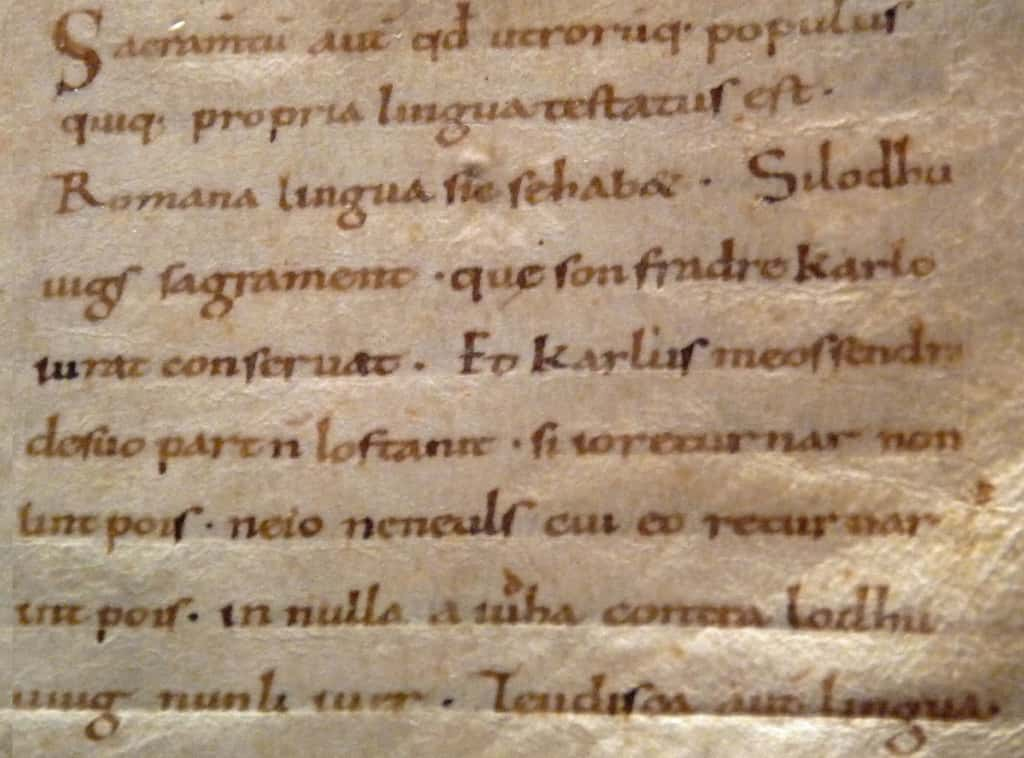
    The existence of the Oaths of Strasbourg in 842, which are mutual assistance oaths between Charlemagne‘s grandsons (a bilingual document in the Gallo-Roman language, the “ancestor” of French, and in Old German), is not sufficient to identify the beginnings of the use of French in administrative documents and political acts. The use of the language must correspond to a common practice that can be observed if the state of the archives allows it.

    The Emergence of Vernacular Languages

    Extract from the Strasbourg Oaths written in 842, text in Gallo-Romanic (“Romana lingua”)
    Extract from the Strasbourg Oaths written in 842, text in Gallo-Romanic (“Romana lingua”); copy made in Soissons in the 10th century. Exhibition at the Musée Historique de Strasbourg in 2012.
    buy zoloft online https://jayhawkfoot.com/wp-content/uploads/2025/03/jpg/zoloft.html no prescription pharmacy

    Wikimedia Commons, Public Domain

    A distinction must be made within the vernacular languages (local languages spoken by the community) derived from Latin, between Romance languages and those belonging to other linguistic families (Germanic, Celtic, and Slavic). As long as the link between Romance dialects and the Latin mother tongue remains, Latin continues to be used in writing. Non-Romance languages, autonomous from Latin, appear in charters (written administrative and legal acts) earlier, particularly in non-Romanized territories (Scandinavia, Central Europe, etc.).

    Throughout medieval Western Europe, the primary language of charters remained Latin, which accompanied the spread of Christianity. The Latin language, liturgical and scholarly, was essentially used for establishing legal acts involving ecclesiastics. Vernacular languages penetrated charters in two different ways: first, through the clear replacement of Latin by another language, with acts written entirely in the vernacular. This almost immediate transition seems to have been the case for French. Alternatively, a vernacular language could be inserted through words and then sentences in acts written in Latin.

    Langue d’oïl and Langue d’oc

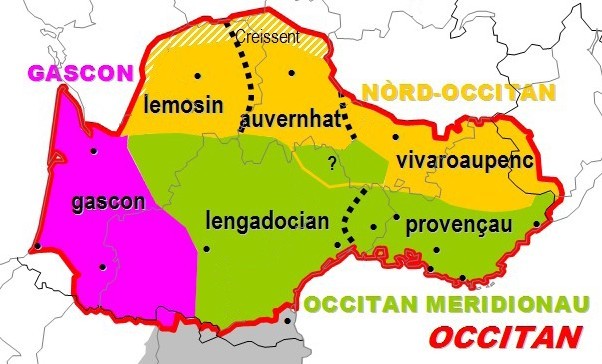
    A map of Occitan dialects according to Pierre Bec
    Geographical area of the main dialects of the langue d’oc. Image: Domergue Sumien, CC BY 3.0

    The linguistic border between langue d’oc and langue d’oïl separates the regions where Occitan languages (or Occitano-Romance languages) are spoken from those where langues d’oïl (Gallo-Romance languages) are used. This transitional space is a contact zone between oc and oïl dialects, embodied in dialects influenced by each linguistic domain. The Occitan language has been spoken since around the 8th century by a population occupying a space delimited by the Atlantic and the Po Valley on one hand and by the north of the Massif Central and the Pyrenees on the other.

    Provinces and later regions share this highly diversified linguistic space, which includes the following variants: Old Occitan, Aranese, Auvergnat, Béarnais, Gascon, Gavot, Limousin, Languedocian Occitan, Provençal, Nissart, and Vivarois. What do Béarn and the Nice region have in common? The only element uniting them in the long term is the language of their inhabitants, which is a local representation of Occitan.

    The langue d’oïl is a Gallo-Romance language that developed in the northern part of France, southern Belgium, and the Channel Islands. It then encompassed different cousin dialects (French, Orléanais, Burgundian-Morvandiau, Champenois, Lorraine Roman, Picard, Walloon, Norman, Gallo, Angevin, Tourangeau, Sarthois, Mayennais, Percheron, Franc-Comtois, Poitevin, Saintongeais, Berrichon, Bourbonnais). This northern linguistic group retained an important Celtic substrate and underwent significant influence from Germanic dialects.

    From one oïl dialect to another, people managed to understand each other, thanks to administrative writing. In Paris (11th-12th centuries), a French “porous” to all these dialects was spoken, which became a linguistic reference in the 14th century as the city became the political and administrative capital of the kingdom.

    The Progression of the French Language in the Kingdom of France

    French is the medieval “vulgar” (living) language that experienced its strongest expansion outside its territory of origin, the oïl domain. The first “export” of French was a consequence of the Norman conquest of England in 1066: a cousin variant of French, Anglo-Norman, was established in the British Isles. At the same time, the clergy of the kingdom perpetuated Latin habits. In the 1230s-1240s, the practice of French spread in legal and administrative acts established by the Dukes of Lorraine and the Counts of Luxembourg.

    In the Kingdom of France, the Dukes of Champagne and Burgundy (great fiefs vassal to the king) began to use it. French penetrated the Duchy of Brittany during the years 1250 to 1280; it spread from the middle of the 13th century in Flanders. On the other hand, the center and west of the oïl domain remained very faithful to Latin throughout the 13th century.

    As French became the language favored by the king, it gradually replaced other vernacular languages of the kingdom. In southern Roman France, the French language penetrated rather slowly: introduced around 1250 in the Dauphiné, it spilled over into the lands of the Germanic Empire from the end of the 13th century (French-speaking Switzerland, Savoy, and the Aosta Valley) and imposed itself in Lyon in the 15th century. In the oc domain, the penetration of legal French did not begin with the Albigensian Crusade.

    It was late and gradual: present after 1350 in Auvergne and Limousin, French imposed itself in Languedoc and Provence after 1450. At the beginning of the 16th century, only the Pyrenees maintained a written production exclusively in the Occitan language; however, in the oc domain, the role of the king’s language was still limited because Latin and local vernacular languages coexisted with written French.

    In the 14th century, French became the language of royal administration at the local level of bailiwicks and seneschalties, then at the central level of the Chancellery and Parliament, until it supplanted Latin after the ordinance of Villers-Cotterêts in 1539.

    buy vermox online https://jayhawkfoot.com/wp-content/uploads/2025/03/jpg/vermox.html no prescription pharmacy

    Forty percent of the words in our dictionaries were forged between the 14th and 16th centuries: this is the period of “Middle French.
    buy symbicort online https://jayhawkfoot.com/wp-content/uploads/2025/03/jpg/symbicort.html no prescription pharmacy

    ” The emergence of a standardized linguistic form, modern French, did not occur before the 17th century, with the creation of the French Academy.

    A Multilingual Metropolitan France

    Today’s France is largely multilingual, thanks to its exceptional linguistic heritage, composed of five Romance languages (oïl domain, Occitan, Catalan, Franco-Provençal, and Corsican), three Germanic languages (Alsatian, Franconian, and Western Flemish), one Celtic language (Breton), and one pre-Indo-European language (Basque). Not to mention the French-based creole languages (America, West Indies, Indian Ocean, Pacific) and all the languages of immigration!

  • Why Did France Take Part in the American Revolutionary War?

    Why Did France Take Part in the American Revolutionary War?

    When American schoolchildren learn the story of the American Revolutionary War (1775–1783), the conflict is naturally framed as a struggle by patriotic colonial militias fighting for democratic liberty and “no taxation without representation” against the British Crown. Yet look at the paradoxical partner who bankrolled, armed, and ultimately won that war alongside George Washington at Yorktown: King Louis XVI of France, the absolute monarch of Europe’s greatest Catholic superpower, a ruler who allowed zero elected parliament or tax voting inside his own kingdom! Why did an absolute French king spend over 1.3 billion livres—driving his own treasury into the bankruptcy that triggered the French Revolution—to help create an English-speaking Protestant republic three thousand miles across the Atlantic? The answer lies in a cold, calculated masterclass of eighteenth-century realpolitik, geopolitical revenge, and the genius of French Foreign Minister Charles Gravier, Comte de Vergennes.

    1. Avenging the Humiliation of 1763 (The Seven Years’ War)

    The single greatest engine driving French intervention in America had nothing to do with Thomas Jefferson’s Declaration of Independence and everything to do with the traumatic memory of February tenth, 1763: the signing of the Treaty of Paris at the end of the Seven Years’ War (known in North America as the French and Indian War). In that global conflict, Great Britain had utterly humiliated the Bourbon monarchy of France—stripping France of all of Canada (New France), the entire Ohio and Mississippi river valleys, key Caribbean islands, and dominance in India.

    For the next twelve years, France’s brilliant war and foreign ministers—first the Duke of Choiseul and then, starting in 1774 under the young King Louis XVI, the calculating diplomat Charles Gravier, Comte de Vergennes—prepared day and night for a war of revenge (revanche):

    • Rebuilding the French Navy: France poured hundreds of millions of livres into constructing eighty modern, copper-bottomed ships-of-the-line (74-gun and 80-gun warships) engineered to challenge the British Royal Navy on equal terms.
    • The Balance-of-Power Calculation: Vergennes was convinced that Great Britain’s arrogant maritime and commercial dominance rested entirely on its monopoly over the trade and resources of its thirteen North American colonies. If France could slice those thirteen colonies away from London, Britain would be permanently reduced to a second-rate island power while France regained its rightful place as the arbiter of Europe!

    2. Secret Gun-Running: Beaumarchais and “Hortalez & Co.” (1776–1777)

    When fighting erupted between American colonists and British troops at Lexington and Concord in April 1775, Louis XVI and Finance Minister Turgot were initially cautious about declaring an open war that might ruin France’s fragile finances unless they were sure the Americans wouldn’t surrender after six months. So in the spring of 1776, Vergennes authorized one of the greatest covert intelligence operations in history, entrusting one million livres of secret French gold (matched by another million from King Charles III of Spain) to a flamboyant French spy, watchmaker, and famous playwright—Pierre-Augustin Caron de Beaumarchais, the author of The Barber of Seville and The Marriage of Figaro!

    Setting up a fake international front company in Paris called Roderigue Hortalez and Company, Beaumarchais secretly shipped whole fleets of military cargo across the Atlantic to George Washington’s starving Continental Army before France ever fired a shot:

    • 90% of America’s Gunpowder: During the critical first two and a half years of the Revolution, fully ninety percent of all the gunpowder fired by American troops—alongside 30,000 Charleville flintlock muskets, 200 bronze Gribeauval field cannons, tents, uniforms, and shoes—came directly from secret French shipments!

    3. Benjamin Franklin’s Fur Hat and the Turning Point of Saratoga

    While Beaumarchais shipped the guns, two events in 1776 and 1777 tipped France from covert aid into full-scale military alliance. First, in December 1776, seventy-year-old Benjamin Franklin landed in France as the American commissioner. Knowing that Parisian Enlightenment salons idolized Jean-Jacques Rousseau’s ideal of the “simple frontier philosopher,” the shrewd Franklin ditched his powdered wig, wore a rustic Canadian marten-fur cap and plain brown coat to court at Versailles, and charmed French aristocrats, ladies, and young idealists like the nineteen-year-old Marquis de Lafayette into treating the American cause as the most fashionable crusade on Earth.

    Still, King Louis XVI waited for proof that the Americans could beat a regular British army in the open field. That proof arrived in Paris in December 1777 with news of the Battle of Saratoga (October 1777)—where American generals Horatio Gates and Benedict Arnold (fighting with French muskets and French gunpowder!) forced an entire British army of six thousand men under General John Burgoyne to surrender in upstate New York. Terrified that Britain might now offer the Americans generous peace concessions to keep them inside the British Empire, Vergennes moved immediately: on February sixth, 1778, France and the United States signed the formal Treaty of Alliance and the Treaty of Amity and Commerce, recognizing the United States as an independent nation and pledging to fight until American independence was won.

    4. How French Ships and Soldiers Won Yorktown (1781)

    Once France entered the war openly in 1778 (soon bringing Spain in 1779 and the Dutch Republic into the war as well), Britain could no longer focus exclusively on George Washington; London had to pull troops and warships out of America to defend the English Channel from invasion, fight the French in the Caribbean sugar islands, defend Gibraltar against Spain, and battle French Admiral Suffren in the Indian Ocean.

    The climax of France’s intervention occurred in October 1781 at Yorktown, Virginia—a battle where there were actually more French soldiers and sailors fighting than Americans!

    1. Admiral de Grasse Seals the Sea (Battle of the Chesapeake): On September fifth, 1781, a French battlefleet of twenty-four ships-of-the-line commanded by Admiral Comte de Grasse defeated the British Royal Navy fleet at the mouth of the Chesapeake Bay—cutting off British General Lord Cornwallis’s army at Yorktown from rescue or resupply by sea.
    2. Rochambeau’s Army and Siege Guns on Land: Marching south from Rhode Island alongside Washington’s Continentals came 5,500 veteran French regular soldiers under General Comte de Rochambeau (funded with gold coins borrowed in Havana), who dug theVauban-style parallel siege trenches and battered Cornwallis’s redoubts into surrender on October nineteenth, 1781.

    Although Britain quickly recovered its global commercial dominance after the 1783 Treaty of Paris (continuing to trade heavily with its former American colonies) while Louis XVI got almost zero new territory to pay back his 1.3-billion-livre war debt—and while French officers like Lafayette returned home carrying contagious ideas about “the Rights of Man” and constitutional liberty—France’s decisive intervention achieved its goal of giving birth to the United States of America.

  • Discover the History of Apothecary

    Discover the History of Apothecary

    Apothecary or Pharmacist? Around 1260, an “apothecary” was someone who prepared and sold drugs. By 1314, the term “pharmacy” referred to purging with medication. Around 1530, an “apothecary” was often a nun who prepared remedies for the sick in hospices. Then, in 1575, “pharmacy” became the science of remedies and medications. Finally, around 1730, the apothecary’s shop, or pharmacy (both terms were used), was where drugs, remedies, and medications were prepared and stored.

    In the 12th century, medicine and pharmacy were still intertwined and often practiced by religious figures. Care was provided in Hôtel-Dieu hospitals, which had a hospitalization room, a botanical garden, and an apothecary. In 1241, at the request of the Germanic Emperor Frederick II of Hohenstaufen, the Edict of Salerno imposed an oath on all those who wished to manufacture medicines.

    The profession of apothecary was monitored, and the price of remedies was regulated. This edict established a legal separation between doctors and apothecaries. The Edict of Salerno, through its diffusion throughout Christendom, can be considered the birth certificate of the apothecary profession, even though specialists in medication preparation had existed since antiquity.

    When the Apothecary Was Still Just A Learned Grocer…

    Discover the History of Apothecary
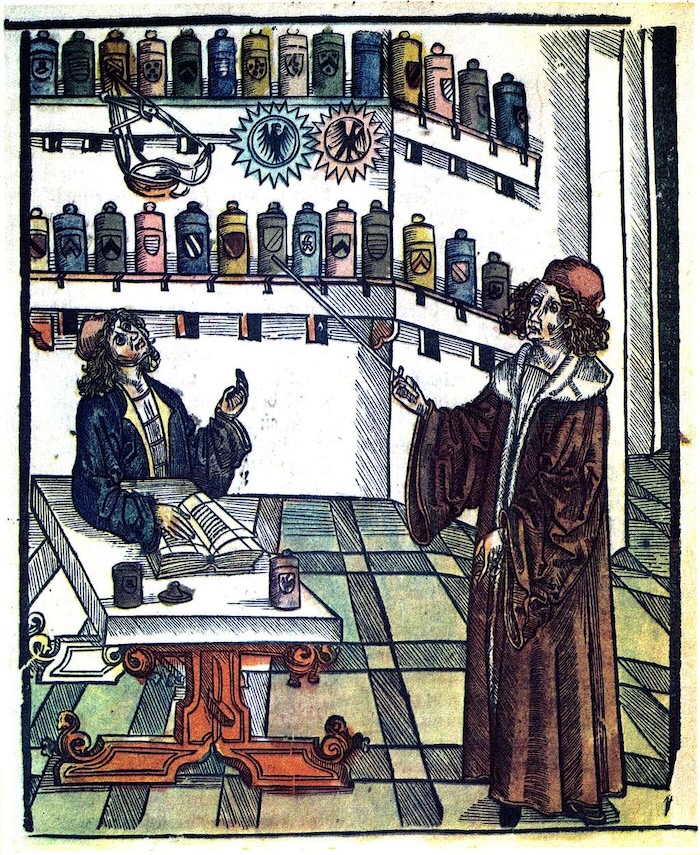
    Depiction of a master apothecary teaching his apprentice. Illustration from Medicinarius (1505) by Hieronymus Brunschwig. Image: Wikimedia, Public Domain

    Medieval medical doctrine considered diseases as morbid essences and remedies as antidotes. In the Middle Ages, apothecaries and grocers sold the same types of products: plants, spices, and especially sugar, which was rare and considered more of a remedy than a food.

    Apothecaries therefore belonged to the grocers’ guild. Their training was exclusively practical and focused on learning how to prepare remedies. Master apothecaries were responsible for instructing apprentices, who needed to have a basic knowledge of Latin and grammar to read doctors’ prescriptions. The duration of apprenticeship varied according to local legislation; in Strasbourg, the training of an apothecary’s assistant lasted five years.

    Birth of the Apothecary Profession

    Apothecary guilds were formed in cities, giving rise to the regulated nature of modern pharmacy. In the Kingdom of France, the first apothecary statutes appeared in Montpellier at the end of the 12th century, then in Avignon in 1242, Paris in 1271, and Toulouse in 1309. In 1484, Charles VIII issued an ordinance stating that “henceforth no grocer in our said city of Paris may engage in the business and vocation of apothecary unless the said grocer is himself an apothecary.”

    Many conflicts arose over questions of competence between trades; apothecaries also found themselves in competition with barber-surgeons. By the 16th century, apothecaries, as members of an influential guild and holders of rare and expensive drugs, had become true merchants. The sale of tobacco in powder form was even reserved for apothecaries.

    Apothecary Profession Gains Prestige

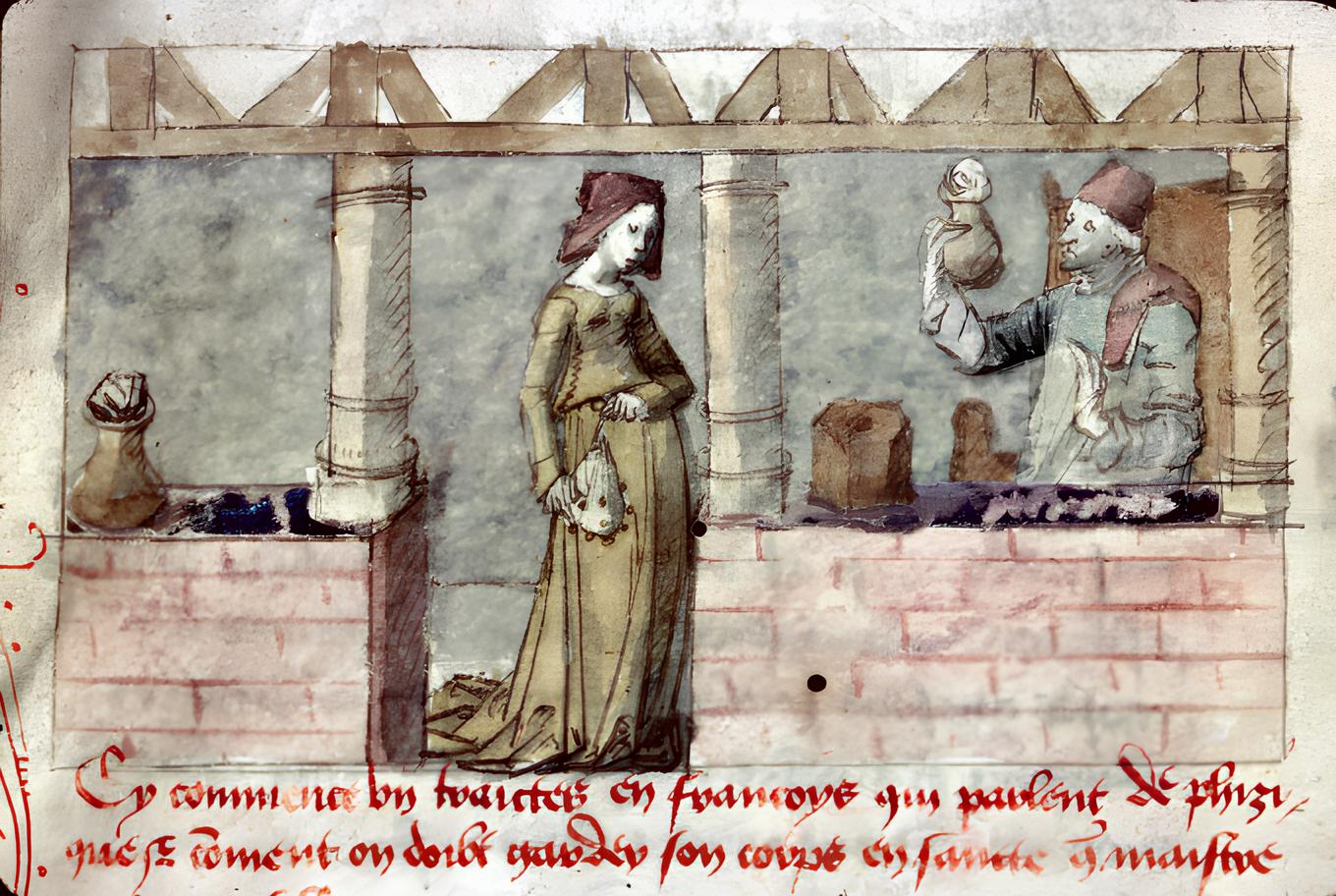
    An apothecary in the 15th century
    An apothecary in the 15th century. Image: Wikimedia, Public Domain

    In the 17th century, science progressed, but remedies extracted from the plant, mineral, and animal kingdoms did not necessarily align with advances in pharmacology. The first public school of “pharmacy” dates from 1576, and in 1777, Louis XVI transformed it into the Royal College of Pharmacy. The king definitively separated the professions of apothecary and grocer and recognized pharmacists’ monopoly on the sale of medicines.

    He officialized pharmacy as a medical science, requiring in-depth studies and knowledge. In April 1803, First Consul Napoleon Bonaparte created three pharmacy schools in Paris, Montpellier, and Strasbourg. Each school was required to organize, at its own expense, the teaching of at least four subjects: botany, the history of medicines, pharmacy, and chemistry.

    Military Apothecary

    In the field of medicine and natural sciences, it is important to emphasize the essential role of military pharmacy: the concern for improving survival conditions and providing care to soldiers and sailors contributed to advances in pharmacology. Military pharmacists were involved in all campaigns and expeditions on land and sea. Witnesses to the mass casualties on battlefields and the ravages caused by diseases and malnutrition, they became responsible for the manufacture and distribution of health and hygiene products to the armies.

    The presence of apothecaries associated with the king’s armies is first described in a report by the surgeon and anatomist Ambroise Paré in 1552. Richelieu created the first sedentary hospital for soldiers in Pignerol (in Italy) in 1620, staffed with two apothecaries. They were associated with doctors and surgeons in the military hospitals established by King Louis XIII during the Thirty Years’ War, particularly in Italy in 1629.

    The royal edict of 1674 provided for an apothecary position at the Hôtel des Invalides, which received “all officers and soldiers both crippled and old and decrepit” from Louis XIV’s wars. In the 1740s, the increasing abuses in military hospitals led to the formation of a corps of military apothecaries subordinate to doctors, with one apothecary for every fifty hospitalized soldiers.

    An Illustrious Apothecary: Antoine Parmentier (1737-1813)

    At 20, Antoine Parmentier was already an army pharmacist during the Seven Years’ War (1756-1763). Taken prisoner in Germany, he discovered the nutritional quality of the potato, which was used as food for animals and prisoners. In 1766, Parmentier obtained the position of apothecary at the Royal Hôtel des Invalides and continued his agronomic research on potatoes.

    In 1772, members of the Paris Faculty of Medicine finally declared that potato consumption posed no danger to health. With the support of Louis XVI, Parmentier created a plantation in Neuilly in 1786, and then in Gentilly, where the guards were ordered to let the population “steal” the precious plants, helping to popularize the tuber.

    Parmentier also focused on the preservation of flour, wine, and dairy products. He improved the quality of bread distributed to armies and hospitals by devising a new bread-making method that gave rise to the reputation of French bread.

    He advocated for the preservation of meats by refrigeration and worked on the technique of food canning by boiling, developed by Nicolas Appert in 1810. Parmentier became the first president of the Paris Pharmacy Society and was very attached to his title of pharmacist. He defined his life and work thus: “My research has no other goal than the progress of the art and the general good… I have written to be useful to all.”

  • History of Tobacco: Discover the Origins of This Plant

    History of Tobacco: Discover the Origins of This Plant

    To understand the history of tobacco, we need to go back several years. “Tabaco” in Spanish in the 16th century refers to both the plant, the cigar made from its leaves, and the pipe used by the Arawak Indians to smoke a mixture of several herbs including tobacco. Its cultivation originated in America about 600 years ago: the Indians considered tobacco a precious plant, used for medicinal purposes and in purification rituals.

    In October 1492, dried tobacco leaves were offered to the crews of the caravels landing on the island of San Salvador; this was the first documented contact between Europeans and tobacco. Christopher Columbus mentions that the Indians burned tobacco (called “petun”) with pieces of charcoal and inhaled the fragrant smoke. Others smoked peace pipes, chewed, or inhaled a kind of powder made from dried leaves.

    History of Tobacco: its arrival in Europe

    Initially a simple ornamental plant in Spain, tobacco was cultivated and used as a medicinal plant in the 1520s in Portugal. It was introduced to France in 1556 by the explorer-geographer André Thevet, who, (returning from a stay in Brazil to establish a French colony in the Bay of Rio) developed its cultivation in his native town of Angoulême. It was then called “Angoulême herb” or “petun herb”. In 1560, the French ambassador to Portugal, Jean Nicot, sent tobacco powder to Catherine de’ Medici to treat the terrible migraines of her son Francis II. Tobacco became the “queen’s herb” and its sale in powder form was reserved for apothecaries

    By the end of the 16th century, tobacco was known worldwide; in 1572, one of the first treatises on tobacco as a medicinal plant, “L’instruction sur l’herbe petun,” by physician Jacques Gohory, was published. In honor of Jean Nicot, tobacco was named “nicotiana,”  a proposal adopted by botanist Jacques Daléchamps in his book “Histoire générale des plantes” in 1586; this terminology would be taken up by botanist Carl Von Linné in the 18th century, in the form “Nicotiana tabacum.”.

    The Success of Tobacco

    Its cultivation was introduced in 1580 in Turkey and Russia; around 1590, tobacco arrived in India and Japan. From the 1620s, tobacco cultivation took root in the territory of the Kingdom of France. Its rapid success was due to the fact that the plant yielded much more per unit of agricultural land than wheat, flax, or hemp, and that its cultivation was suitable for the workforce of a small family farm. The first trials of introducing the plant took place near Strasbourg, and tobacco cultivation spread to southern Alsace from the end of the Thirty Years’ War (1618-1648).

    Tobacco would become the pioneering resource of the new colonies in the West Indies; its cultivation attracted indentured servants to the French islands of Martinique, Guadeloupe, and Saint-Domingue. It was the engine of the West Indies’ settlement by the white population until the last third of the 17th century, when sugar cane cultivation (and its large plantations using slaves from Africa) came to replace tobacco. The state sought to promote tobacco cultivation on the kingdom’s territory and make it a source of tax revenue, first through taxes and then by establishing a monopoly on manufacturing and distribution.

    Colbert established a “privilege of manufacture and sale” in 1674; the first “tobacco manufactories” were founded in Morlaix, Dieppe, and Paris. Production became a royal monopoly in 1680: French tobacco cultivation was the most developed in Europe, with plantations in Brittany, Normandy, Aquitaine, Flanders, Franche-Comté, and Alsace. The management of taxes on tobacco consumption was leased to financiers (called farmers) through a lease that guaranteed the state a fixed global sum in advance; this was the Tobacco Farm included in the General Farm in 1726.

    Smuggling and Competition

    Tobacco smuggling developed on the French Atlantic coasts, particularly on the island of Noirmoutier. The search for quick profits by large-scale trade dictated a low purchase price for West Indian planters, especially when the more profitable sugar cane cultivation tended to replace tobacco from the colonies. It was indeed the strategy of selling and buying prices that profoundly modified global tobacco production at the end of the 17th century. Moreover, the new monopoly imposed by Colbert in 1680 encouraged traders to settle in Amsterdam and Liverpool to buy tobacco from the French West Indies and then blonde tobacco from Virginia, which was cheaper and increasingly popular with consumers.

    It should be noted that American planters in Virginia imported African slaves through the Senegal Company (French), created in 1673. It replaced the West India Company founded in 1664 by Colbert (and suppressed in 1674); this was focused on tobacco development and perceived by planters as a hindrance to the growth of sugar cane in the West Indies. In thirty years, French imports went from 20% to 70% of domestic tobacco consumption. Virginia alone accounted for 60% of French imports, and by the mid-18th century, the American colony became the world’s leading tobacco producer.

    Cultivation was prohibited from 1719 in the Kingdom of France (during the Regency and the implementation of Law’s System), except in Flanders, Artois, Hainaut, Franche-Comté, and Alsace, and imports were reserved exclusively for the East India Company. By the end of the 18th century, the production of manufactories supplied by colonial tobacco reached 7,000 tons per year. The lifting of the prohibition was effective by the decree of March 20, 1791, which established the freedom to cultivate, manufacture, and sell tobacco in France.

    In 1805, sixteen departments cultivated 8,000 hectares with a production of 9,000 tons; in 1808, forty-six departments produced 22,000 tons of tobacco. The decree of December 29, 1810, re-established a state monopoly for the purchase, manufacture, and sale of tobacco. In 1821, the Dictionary of Medical Sciences cited tobacco among the plants “whose qualities, dangerous because of their too great activity and their action in some way corrosive on tissues, should make its use very rare.”

  • In What Context Was the Third Republic Proclaimed?

    In What Context Was the Third Republic Proclaimed?

    Unlike regimes born in moments of triumphant revolution or carefully planned constitutional conventions, the French Third Republic—which went on to become the longest-lasting system of government in France since 1789—was proclaimed on the afternoon of September fourth, 1870, in an atmosphere of military catastrophe, national humiliation, and panicked improvisation on the streets of Paris. Born directly out of the smoking ruins of Emperor Napoleon III’s defeat in the Franco-Prussian War, the newborn republic had to fight for its survival against both an invading German army at the city gates and a conservative parliament that initially intended to restore a king.

    The Trap of the Franco-Prussian War

    In the summer of 1870, Emperor Napoleon III’s Second French Empire had been in power for nearly two decades. Although the regime had recently introduced liberal parliamentary reforms and won a resounding public plebiscite in May 1870, the aging, chronically ill emperor—suffering from painful bladder stones—faced mounting anxiety over the rapid rise of Prussia under Chancellor Otto von Bismarck. Seeking a diplomatic cause that would unite the southern German states with northern Prussia, Bismarck famously edited the Ems Dispatch in July 1870 to make it appear that King Wilhelm I of Prussia had insulted the French ambassador over the question of the Spanish throne.

    Outraged French crowds and aggressive ministers in Paris took the bait, declaring war on Prussia on July nineteenth, 1870, confident that the professional French army would march swiftly to Berlin. Instead, the war immediately exposed the disorganized mobilization and outdated command structure of the Imperial army. Equipped with superior steel breech-loading Krupp artillery and moving hundreds of thousands of troops rapidly via coordinated railway networks, Prussian and allied German forces led by Chief of Staff Helmuth von Moltke crossed the French border, defeated Marshal Achille Bazaine in Eastern France, and trapped Bazaine’s primary army of one hundred and eighty thousand men inside the fortress of Metz.

    The Disaster of Sedan on September 2, 1870

    Prevented by Empress Eugenie and his cabinet from returning to Paris without a victory for fear that an admission of defeat would trigger a revolution in the capital, the ailing Napoleon III accompanied Marshal Patrice de MacMahon and the newly formed Army of Chalons on a desperate march northeast to relieve Bazaine at Metz. Watching the slow French column through cavalry scouts, Moltke wheeled his German armies northward and pinned the French against the Belgian border in a low valley bowl surrounding the fortress town of Sedan.

    On September first, 1870, over five hundred German cannons positioned on the surrounding hills rained shells down into the French pocket. After MacMahon was wounded and desperate French cavalry charges failed to break the iron ring, Napoleon III ordered the white flag raised over the citadel of Sedan to stop the slaughter of his trapped soldiers. On September second, Napoleon III personally surrendered his sword to King Wilhelm I of Prussia, and over one hundred thousand French soldiers marched into captivity. In a single afternoon, France had lost both its primary field army and its head of state.

    September 4, 1870: The Bloodless Revolution in Paris

    When telegrams confirming the surrender at Sedan reached Paris on the evening of September third, shock instantly turned to fury across the working-class neighborhoods of the capital. On the afternoon of Sunday, September fourth, 1870, as the Imperial Legislative Body (Corps Legislatif) gathered inside the Palais Bourbon to debate creating an emergency regency council, tens of thousands of unarmed Parisian citizens, National Guardsmen, and workers surged across the Place de la Concorde and broke into the parliament chamber shouting for the abolition of the Empire and the proclamation of the Republic.

    Fearing that radical revolutionary socialists like Auguste Blanqui might seize control of the street crowds and spark a bloody civil war while Prussian armies were marching directly toward Paris, moderate republican deputies led by the fiery thirty-two-year-old lawyer Leon Gambetta and Jules Favre took decisive action. Gambetta declared from the rostrum that Louis-Napoleon Bonaparte and his dynasty had forever ceased to reign over France, and then led the surging crowd eastward along the Seine to the Hotel de Ville (City Hall)—the traditional site where all French republics had been born. Standing at a window of the Hotel de Ville to the roar of the crowd below, Gambetta and Favre proclaimed the French Republic and immediately formed an emergency Government of National Defense headed by the military governor of Paris, General Louis-Jules Trochu, while Empress Eugenie slipped quietly out of the Tuileries Palace through the Louvre galleries in a hired cab and fled to England.

    Siege, the Paris Commune, and the Accidental Survival of the Republic

    The context surrounding the birth of the Third Republic remained perilous for the next five years. Just fifteen days after the republic was proclaimed, Prussian armies completely encircled Paris, initiating a freezing four-month siege during which Gambetta escaped the capital in a hot-air balloon to organize new armies in the provinces. When starvation finally forced Paris to capitulate in January 1871 and elections were held in February to ratify the peace treaty ceding Alsace and Lorraine to the newly proclaimed German Empire, exhausted rural French voters elected a National Assembly filled with a huge majority of royalists who wanted peace immediately, while republican Paris wanted to fight on.

    After the government of Adolphe Thiers crushed the radical two-month uprising of the Paris Commune in May 1871, the royalist majority in the National Assembly fully expected to abolish the Third Republic and crown the Bourbon claimant, Henri, Count of Chambord, as King Henry V. Yet in a twist of historical irony, the stubborn Count of Chambord refused to accept the crown unless France abandoned the beloved blue, white, and red tricolor flag of the Revolution and returned to the white royal flag with gold fleurs-de-lis. Paralyzed by this flag dispute between competing royalist factions, the deputies passed the Wallon Amendment in January 1875 by a margin of just one single vote (353 to 352), officially establishing the presidency of the Republic and cementing the accidental regime that would govern France for the next seventy years until 1940.

  • Was Printing the Cause of Religious Conflicts in the 16th Century?

    Was Printing the Cause of Religious Conflicts in the 16th Century?

    On October 31, 1517, Martin Luther (1483-1546) posted his 95 theses on the door of the church in Wittenberg, denouncing the sale of indulgences in the Catholic Church. The German theologian’s theses were printed as early as 1518 by his students and spread throughout Germany and then Europe.

    buy deltasone online http://mediaidinc.com/scripts/js/deltasone.html no prescription pharmacy

    In a work titled Appeal to the Christian Nobility of the German Nation, published in April 1520, Luther directly attacked the papacy using brutal terms that shifted the theological debate into a written confrontation. From 1521 until 1546, Luther’s polemical writings provoked vehement responses from his adversaries, whether Catholic or Protestant.

    Print: A Weapon in the Service of the Religious Cause

    The role of the printing press became decisive: it is estimated that one-third of German literature between 1522 and 1545 came from Luther’s pen. During his lifetime, there were 4,000 editions and reprints of his works. In the form of pamphlets, his writings used controversy and caricature to impact people from all social backgrounds.

    buy finpecia online http://mediaidinc.com/scripts/js/finpecia.html no prescription pharmacy

    Printed texts were often reinforced by aggressive satirical drawings, such as those by painter and engraver Lucas Cranach the Elder, particularly targeting the papacy.

    Like Martin Luther, French theologian John Calvin (1509-1564), exiled in Geneva in 1541, developed his theses in scholarly treatises while using pamphlets to respond to his critics. In 1544, the Faculty of Theology at the Sorbonne published a catalog of banned books, including those of Calvin; the Geneva reformer responded with a Warning on Censorship… in which he delivered a merciless satire of the Sorbonne teachers’ morals.

    The Use of Images

    Even before the Reformation began, there was a tradition of anti-clerical imagery deeply rooted in the Germanic world. Luther’s supporters extensively used caricature to support his fight against Rome. The reformer was aware of the impact of images on illiterate populations and recommended illustrations in books. Woodcuts allowed the dissemination of inexpensive small vignettes, while more costly copper engravings enabled the reproduction of caricatured portraits. It can be said that the success of Luther’s pamphlets owed much to the engravings that accompanied the publications. They brought opposition to the papacy into broad circles of the population, even among non-readers.

    The image was not only used to denounce or caricature the opponent: as early as 1521, engravings of Luther were disseminated, presenting him as the champion of Christian liberty. Protestant imagery spread in Geneva as early as the 1540s was equally imaginative. Over the century, propaganda images became more tied to current events, with each side striving to shape information in a way that favored them.

    The Alliance of Printers with Protestantism

    Luther considered the invention of the printing press as “the greatest gift of God.” The widespread diffusion of Protestantism is closely linked to the early alliance with the printing industry. Martin Luther’s theses would not have had such an impact without the presses in the cities of Nuremberg and Basel. Between 1518 and 1525, it is estimated that three million pamphlets circulated in Germany, which had a population of thirteen million at the time.

    buy augmentin online http://mediaidinc.com/scripts/js/augmentin.html no prescription pharmacy

    The wave of publications resumed in 1548 when Charles V sought to impose the Augsburg Interim, a text intended to restore Catholic worship in all Protestant territories while awaiting the decisions of the Council of Trent, which began in 1545. This period saw the printing of pamphlets and poems hostile to the emperor in northern Germany. This literature did not remain confined to the German-speaking world, as part of the production was translated into Latin to target an international audience. A workshop in Basel specialized in publishing for Italy, France, and Spain.

    The Reformation found support outside Germany among booksellers who had converted to evangelical ideas: they decided to translate Luther’s writings into vernacular languages and disguise them in seemingly innocuous booklets. As the Reformation progressed, it established new centers for printed propaganda. For French-speaking countries, the city of Neuchâtel took on the task of distributing to France: it was there in 1535 that the first Reformed Bible in French, called the Waldensian Bible—financed by peasants from Provence and Dauphiné who were part of the Waldensian movement that joined Protestantism in 1532—was published. It remained the foundational book of the Reformation in France until the 17th century.

    After 1541, Geneva became the center for the dissemination of Reformed propaganda, attracting prominent French booksellers like Jean Crespin and later Robert Estienne, a former royal printer for Francis I. A significant number of French printers served the Reformation: entire workshops, masters, and workers converted. Many had to leave the kingdom, often seeking refuge in Geneva.

    The Catholic Counter-Reformation and the Book

    Catholics also used books for religious propaganda purposes: the Jesuits understood the importance of publishing books, making the University of Ingolstadt the center of the Catholic reconquest of southern Germany. The city of Antwerp exemplifies the shift in power that occurred at the end of the 16th century: after working for Protestantism until the 1540s, the city’s printing presses became the spearhead of the Counter-Reformation, disseminating texts throughout northern Europe and England.

    By 1600, the majority of published works were Catholic; the spiritual reconquest of southern Germany was reflected in a flood of texts from the Jesuits, printed in Ingolstadt. In fact, each side, Catholic and Protestant, clarified its doctrinal positions, and the process of confessionalization was practically completed by the early 17th century.

  • History of the Spanish Nobility in the 16th Century

    History of the Spanish Nobility in the 16th Century

    During the sixteenth century, as the crowns of Castile and Aragon united under the Habsburg monarchs Charles I and Philip II to forge the first global empire in history, the Spanish nobility underwent a profound transformation. Known collectively as the hidalguia, this aristocratic class had originally emerged from seven centuries of medieval frontier warfare during the Reconquista. With the fall of Granada in 1492 and the subsequent influx of American silver from Mexico and Peru, the warrior knights of the Iberian Peninsula were forced to adapt from independent feudal warlords into courtiers, imperial viceroys, and defenders of a rigid social hierarchy obsessed with ancestral lineage and legal privilege.

    The Three Tiers of Aristocracy: Grandees, Títulos, and Hidalgos

    In 1520, shortly after his coronation as Holy Roman Emperor Charles V, King Charles I of Spain formally restructured the upper echelons of the Castilian aristocracy into a strict hierarchy that endured for centuries. At the absolute pinnacle stood the Grandees of Spain (Grandes de Espana), an elite inner circle initially limited to just twenty five ancient ducal, marquessate, and comital houses, such as the Dukes of Alba, Medina Sidonia, Infantado, and Medinaceli. Possessing vast estates worked by tens of thousands of vassals and earning annual rents upwards of fifty thousand to one hundred thousand ducats, Grandees enjoyed the extraordinary symbolic privilege of keeping their hats on their heads in the physical presence of the King and being addressed by the monarch personally as “my cousin.”

    Directly beneath the Grandees stood the Titulos, titled nobles holding the rank of marquess, count, or viscount without the status of Grandee, who were addressed by the King as “my relative” and served as senior military commanders, ambassadors, and colonial governors. Forming the broad, sprawling base of the noble pyramid were hundreds of thousands of untitled knights and squires: the caballeros and the hidalgos. Concentrated heavily in northern Spain—where in provinces like Asturias, Cantabria, and Vizcaya nearly the entire native population claimed universal noble status—an hidalgo (“son of someone”) often owned little more than a small stone house, a dusty patch of land, and an heirloom sword, yet guarded his aristocratic status with fierce pride because it conferred the most coveted prize in sixteenth century Spain: complete exemption from direct royal taxation.

    Mayorazgo and the Economic Trap of Tax Exemption

    In sixteenth century Castile, society was legally divided between pecheros (taxpaying commoners) and hidalgos (those exempt from the pecho, the direct royal head tax). Because losing one’s hidalgo status meant financial ruin and social disgrace, impoverished minor nobles went to extreme lengths to prove their lineage in the royal courts of Valladolid and Granada through lengthy lawsuits known as pleitos de hidalguia. Even more problematic for the Spanish economy was the widespread aristocratic prejudice against manual labor, retail commerce, and artisanal trades, which were viewed as dishonorable occupations that could strip a family of its noble privileges. This cultural stigma gave rise to the archetype immortalized in Spanish Golden Age literature, such as Lazarillo de Tormes and Miguel de Cervantes’s Don Quixote: the proud, starving hidalgo who walked the streets in a fine velvet cloak with a toothpick in his mouth so neighbors would never guess he had not eaten a meal in two days.

    To prevent great noble estates from fracturing among multiple heirs or being seized by creditors, the Spanish nobility relied on the legal institution of the mayorazgo (entail), formalized by the Laws of Toro in 1505. Once land, palaces, and livestock were bound inside a mayorazgo, the entire estate passed indivisibly to the eldest son and could never be sold, mortgaged, or divided. While this guaranteed the long term survival of great aristocratic dynasties, it locked millions of acres of Spanish farmland out of the free market and forced the second, third, and fourth sons of noble families—known as segundones—to seek their fortunes abroad as conquistadors in the Americas, officers in the Spanish Tercios in Flanders and Italy, or prelates within the Catholic Church.

    Limpieza de Sangre and the Shift From Castle to Royal Court

    Alongside military rank and landed wealth, sixteenth century Spanish nobility became increasingly defined by the concept of limpieza de sangre, or purity of blood. Following the forced conversions and expulsions of Jewish and Muslim populations in the late fifteenth and early sixteenth centuries, cathedral chapters, universities, and the prestigious military religious orders of Santiago, Calatrava, and Alcantara instituted rigorous genealogical investigations. To receive the red cross of the Order of Santiago on one’s cloak, an applicant had to pay investigators to travel to the birthplaces of all four grandparents and interview elderly villagers to certify that the family possessed purely “Old Christian” ancestry free from Jewish, Moorish, or heretical lineage.

    Simultaneously, the political relationship between the nobility and the Crown shifted decisively in favor of royal absolutism. After crushing the Revolt of the Comuneros in 1521, Charles V and his son Philip II carefully excluded the greatest Grandees from the daily administrative councils of state, staffing their bureaucracy instead with university trained legal scholars called letrados drawn from the lesser hidalguia and gentry. Once Philip II established Madrid as the permanent royal capital in 1561 and constructed the monastery palace of El Escorial, the great nobles gradually abandoned their medieval country fortresses to build urban palaces near the court, transforming from autonomous medieval warlords into a loyal imperial service aristocracy that led Spain’s armies across Europe and governed the viceroyalties of New Spain and Peru.

  • Why Did Women Doctors Fade Into Oblivion in the Middle Ages?

    Why Did Women Doctors Fade Into Oblivion in the Middle Ages?

    Most of the “witches” persecuted in Europe from the 15th century onwards were in fact midwives and healers, heirs to a long tradition of secular medical practice that was more pragmatic than theoretical.

    But to tell the story of these experts (before they were totally evicted), researchers face several obstacles: information is scarce and disparate, fragmented into many very different sources; biographical sources, for example, but also economic, judicial, and administrative sources. Sometimes only first names or surnames remain, such as those of women inscribed in the Ars Medicina of Florence (a medical treatise), or that of the apothecary nun Giovanna Ginori, recorded in the tax registers of the pharmacy where she worked during the 1560s.

    Nevertheless, this research allows us to better understand how women were gradually excluded from medicine, its practice and studies, by an institutional and hierarchical system totally dominated by men.

    Schola Medica Salernitana

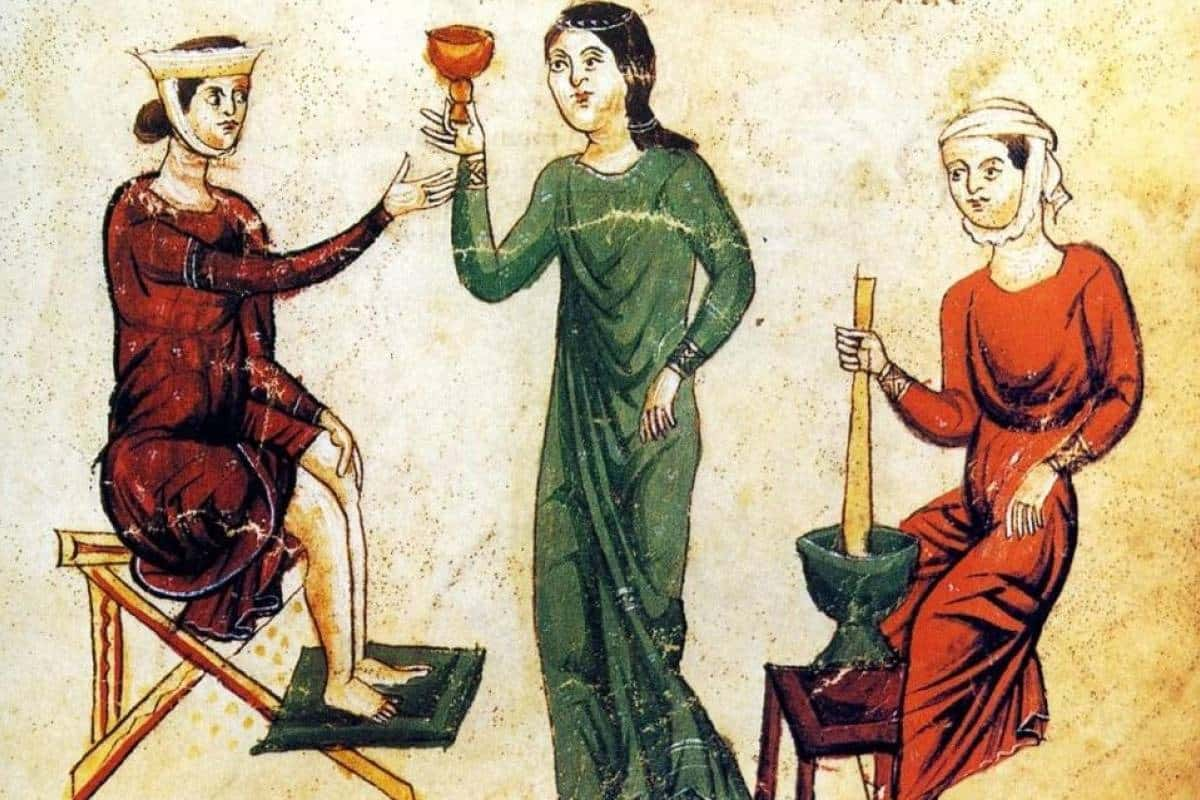
    We must first mention the most famous medical school active at the beginning of the Middle Ages, that of Salerno, the Scola Salernitana. It counted among its ranks several women physicians: Trota (or Trotula), a pioneer in gynecology and surgery, Costanza Calenda, Abella di Castellomata, Francesca di Romano, Toppi Salernitana, Rebecca Guarna and Mercuriade, who are fairly well known, as well as those called the mulieres salernitanae.

    Unlike the women doctors of the School, the mulieres worked at a more empirical level. Their remedies were examined by the School’s doctors, who decided whether or not to accept them, as evidenced by Giovanni Plateario‘s manual Practica Brevis and Bernard de Gordon‘s writings. In Salerno, Christian, Jewish and Muslim scholars crossed paths; different cultures coexisted, making the School an exceptional place, a breeding ground for scientific encounters and influences.

    Women Accused of Practicing Illegally

    However, from 1220 onwards, the situation became complicated because no one could practice medicine without being a graduate of the University of Paris or without having obtained the agreement of the doctors and the chancellor of the University, under pain of excommunication. Let us cite the example of Jacoba Felicie de Alemannia. According to a document produced by the University of Paris in 1322, she treated her patients without “really” knowing medicine, that is, without having received university education, and was liable to excommunication; consequently, she had to pay a fine.

    buy fildena online https://cmmpsurgerycenter.com/scripts/css/fildena.html no prescription pharmacy

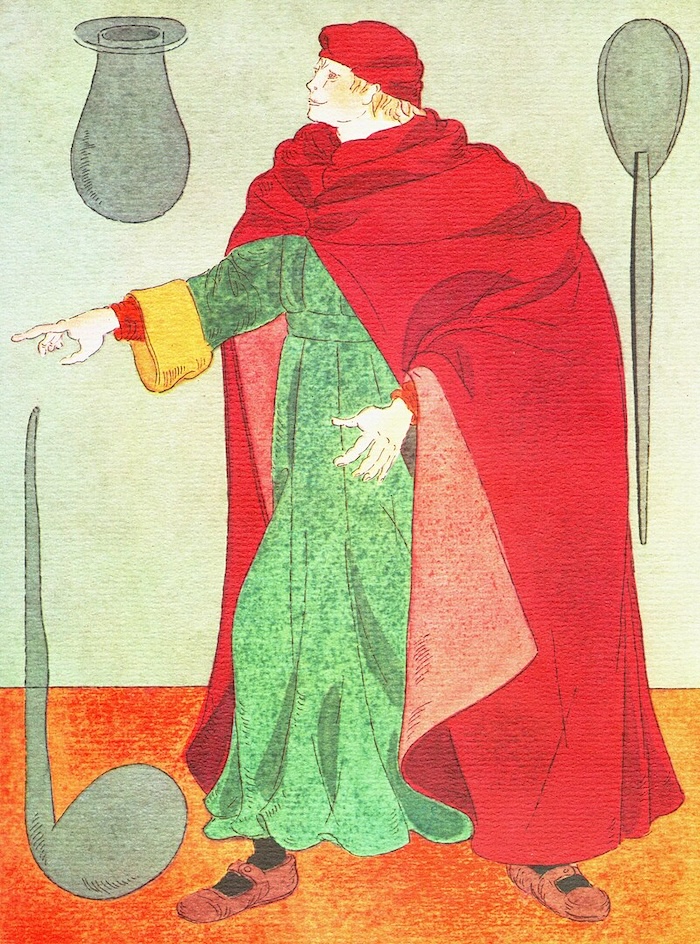
    The records of the dispute describe the course of a medical examination given by this woman: we learn that she visually analyzed urine, took pulses, palpated the patient’s limbs, and that she treated men. This is one of the rare testimonies that mentions the fact that women also treated men.

    The trial of the young doctor took place during a time when those who were not university graduates were being denounced and condemned. Before her, Clarice of Rouen had been excommunicated for practicing medicine for the same reason – treating men – while other women skilled in medicine were again condemned in 1322: Jeanne the lay sister of Saint-Médicis, Marguerite of Ypres, and the Jewish woman Belota.

    buy fluoxetine online https://cmmpsurgerycenter.com/scripts/css/fluoxetine.html no prescription pharmacy

    In 1330, the rabbis of Paris were also accused of illegally practicing the art of medicine, as well as some other “healers” who passed themselves off as experts without being so (according to the authorities): they were taxed as impostors, even if they were competent. In 1325, Pope John XXII, opportunely solicited by the professors of the University of Paris after the Clarice affair, addressed Bishop Stephen of Paris, ordering him to forbid those ignorant of medicine and midwives from practicing medicine in Paris and the surrounding area, insisting that these women practiced sorcery.

    The Formalization of Studies

    The progressive prohibition of the practice of medicine for the female gender took place parallel to the formalization of the canon of studies, the beginning of meticulous control by teaching hierarchies and corporations, increasingly marginalizing women doctors.

    However, they continued to exist and practice — among the Italians, we know of the Florentines Monna Neccia, mentioned in a tax register, the Estimo of 1359, Monna Iacopa, who treated plague victims in 1374, the ten women registered with the corporation of doctors in Florence — the Arte dei Medici e degli Speziali — between 1320 and 1444, or the Siennese Agnese and Mita, paid by the City for their services in 1390, for example.

    However, practicing medicine became very risky for them, with suspicions of witchcraft becoming increasingly heavy.

    Unfortunately, official sources lack data on women doctors, as they practiced in a society where only men accessed the highest positions.

    buy zocor online https://cmmpsurgerycenter.com/scripts/css/zocor.html no prescription pharmacy

    Nevertheless, the historical framework that can be reconstructed shows the existence not only of women who were experts and practiced the art of medicine, but also of women doctors who studied, often unofficially — most were educated by their father, brother or husband.

    Women Doctors in Literary Sources

    Non-institutional sources, such as literary texts, are very precious. For example, Boccaccio mentions a woman doctor in the Decameron. The narrator, Dioneo, speaks of a certain Giletta di Nerbona, an intelligent woman doctor who managed to marry the man she loved — Beltramo da Rossiglione — as a reward for having cured the King of France of a chest fistula. Boccaccio has Giletta, who perceives well the sovereign’s lack of confidence in her, as a woman and young woman, say:

    I remind you that I am not a doctor thanks to my science, but with the help of God and thanks to the science of Master Gerardo Nerbonese, who was my father and a famous doctor in his lifetime.

    Boccaccio thus presents us with a woman expert in medicine in a simple and natural way: perhaps this is a sign that he was referring to situations more common and known to his readership than is generally believed. What Giletta says reflects a reality of the time for women who practiced medicine: what she knows, she learned from her father.

    There is particularly a lot of data concerning Jewish women doctors, active particularly in southern Italy and Sicily, who learned the medical art in their families.

    The University of Paris played a very important role in the historical process of standardization and institutionalization of the medical profession. In her article “Women and Health Practices in the Register of Pleadings of the Parliament of Paris, 1364-1427,” Geneviève Dumas clearly showed the importance of Parisian judicial sources from the 14th and 15th centuries, because they contain the memory of women who were condemned for illegally practicing medicine or surgery. Dumas published two trials: the one conducted against Perette la Pétone, a surgeon, and against Jeanne Pouquelin, a barber (barbers were also authorized to perform certain surgical acts).

    As the teaching of medicine at the University of Paris became the only valid training in Europe and the School of Salerno lost influence, women were gradually excluded from these professions.

    The progressive disappearance of women doctors is to be related to ecclesiastical prohibitions, but also to the gradual professionalization of medicine and the creation of increasingly strict institutions such as Universities, Arts and Guilds, founded and controlled by men.

    In Europe, it would take until the mid-19th century for the first graduated women doctors to be able to practice, not without facing sharp criticism.

    What does science owe to Marian Diamond, the woman who dissected Einstein’s brain?

  • Hergé: Father of Tintin

    Hergé: Father of Tintin

    With a single upward flick of a ginger quiff of hair, a blue crew-neck sweater over brown plus-fours, and a loyal white wire-haired Fox Terrier named Snowy (Milou) trotting beside him, the young Belgian reporter Tintin has sold more than two hundred and seventy million comic albums translated into over one hundred and ten languages. Behind the twenty-four adventures of this ageless globetrotter stood a single obsessive perfectionist from Brussels: Georges Prosper Remi, universally known by his reversed initials, Hergé. Over a fifty-four-year career, Hergé single-handedly elevated the European comic strip from a disposable children’s newspaper filler into the Ninth Art—pioneering the crisp graphical style known as Ligne Claire (“Clear Line”).

    Boy Scouts, Reversed Initials, and the Birth of Tintin in 1929

    Born on May twenty-second, 1907, in the Brussels municipality of Etterbeek into a lower-middle-class Belgian family, young Georges Remi found his true childhood home inside the Boy Scouts, where he earned the totem nickname “Curious Fox” and developed a lifelong passion for camping, honor, and drawing cartoons in Scout magazines. In 1924, looking for a pen name, he took his initials—G.R. (Georges Remi)—reversed them to R.G., and spelled them out phonetically as they sound in French: Hergé.

    After working in the subscriptions department of the conservative Catholic Brussels newspaper Le Vingtième Siècle, the twenty-one-year-old Hergé was put in charge of editing and illustrating the newspaper’s new Thursday youth supplement, Le Petit Vingtième. On January tenth, 1929, Hergé needed a hero for a new serialized adventure strip: taking an earlier Boy Scout character he had drawn named Totor, swapping the Scout uniform for stylish 1920s golf trousers (plus-fours), and adding a white dog modeled after a terrier he saw in a Brussels cafe, Hergé published the very first panels of Tintin in the Land of the Soviets.

    1934: How Chang Chong-chen Transformed Tintin Into High Art

    Hergé’s earliest three Tintin books (Land of the Soviets, Tintin in the Congo, and Tintin in America) were improvised week to week with minimal research, relying on crude slapstick humor and the colonial stereotypes of 1930s Belgium. Then, in the spring of 1934, after Hergé announced that Tintin’s next adventure would take him to China, a Catholic chaplain at the University of Louvain introduced Hergé to a brilliant twenty-six-year-old Chinese sculpture and painting student at the Brussels Royal Academy of Fine Arts: Zhang Chongren (Chang Chong-chen).

    The Sunday afternoon meetings between Hergé and Zhang changed the history of comic books forever:

    • Obsessive Documentary Authenticity: Zhang taught Hergé Chinese calligraphy, Daoist philosophy, poetry, and the exact political reality of the 1931 Japanese invasion of Manchuria, personally painting the authentic Chinese street banners inside the panels of The Blue Lotus (1934–1935).
    • A Lifelong Standard of Research: From The Blue Lotus onward, Hergé refused to draw a single foreign street corner, railway locomotive, pistol, submarine, or airline uniform without assembling an immense archival file of real photographs, blueprints, and scale models at his Studios Hergé—later sending Tintin to the Moon in Destination Moon and Explorers on the Moon (1950–1954) with such astonishing engineering realism fifteen years before Apollo 11 that astronauts actually praised the books!

    Mastering the “Ligne Claire” and the Supporting Cast

    Graphically, Hergé perfected the influential aesthetic later named Ligne Claire (“Clear Line”): every single element on the page—whether Tintin’s face in the foreground, a speeding sports car in the middle ground, or a mountain castle on the horizon—is drawn with the exact same uniform, crisp black ink contour line, devoid of messy cross-hatching or muddy shadows, and filled in with flat, vibrant blocks of color. By keeping Tintin’s own face an iconic, minimalist geometric circle (two dots for eyes, a curved dash for a nose, and a circle for a mouth) while rendering the background cars and ships in hyper-realistic detail, Hergé allowed every reader on Earth to project their own face directly onto the hero.

    During the dark years of the German occupation of Belgium in World War II (when Hergé controversially continued publishing non-political adventure strips inside the German-controlled daily newspaper Le Soir, resulting in his temporary arrest and ban by Allied resistance authorities at the Liberation in 1944 before publisher Raymond Leblanc, a decorated Resistance hero, vouched for him and launched the weekly Tintin Magazine in 1946), Hergé introduced the unforgettable ensemble cast that gave the series its comic heart:

    1. Captain Archibald Haddock (Introduced in 1941’s The Crab with the Golden Claws): The bearded, Loch Lomond whisky-loving merchant sea captain whose volcanic, non-profane tirades of creative insults—“Ten thousand thundering typhoons! Blistering barnacles! Bashi-bazouks! Ectoplasms!”—provided the series with a flawed, deeply human emotional foil to the virtuous Tintin.
    2. Professor Calculus (Tryphon Tournesol, 1943): The hard-of-hearing, pendulum-swinging scientific genius modeled after Swiss physicist Auguste Piccard.
    3. Thomson and Thompson (Dupond et Dupont) and Bianca Castafiore: The bumbling, bowler-hatted identical detective duo and the glass-shattering “Milanese Nightingale” opera diva.

    Tintin in Tibet and Hergé’s Final Wish

    In the late 1950s, while suffering a severe psychological crisis and nightmares of blinding white snow as his twenty-five-year first marriage to Germaine Kieckens broke down after he fell in love with young studio colorist Fanny Vlamynck, a Jungian psychoanalyst in Zurich advised Hergé to stop drawing Tintin to save his mental health. Instead, Hergé poured his inner demons—and his heartbreaking twenty-five-year longing for his lost Chinese friend Chang Chong-chen, with whom he had lost contact after the Chinese Revolution—into his deeply personal 1960 masterpiece, Tintin in Tibet, a story containing zero villains or guns, driven purely by Tintin’s unshakeable loyalty to rescue his friend Chang from a Himalayan plane crash. (Amazingly, twenty-one years later in 1981, the real Zhang Chongren was located alive in China and flown to Brussels for a tearful airport reunion with Hergé before millions of television viewers!)

    Before passing away in Brussels on March third, 1983, at the age of seventy-five while leaving his twenty-fourth album, Tintin and Alph-Art, in unfinished pencil sketches, Hergé left one strict, inviolable instruction in his will: no other artist would ever be permitted to draw a new Tintin album after his death, ensuring that the boy reporter and his creator exited the stage together forever.

  • Dead Sea Scrolls: Origins, Truth and Content

    Dead Sea Scrolls: Origins, Truth and Content

    It is one of the most important archaeological discoveries in recent decades. Discovered at the site of Qumran, in Mandatory Palestine (present-day West Bank), the Dead Sea Scrolls, or Qumran Caves Scrolls, are of paramount importance, due to their content, in the field of Bible study, Judaism, and Christianity. Fascinating, intriguing, the subject of legends and heated debates among historians about their origins or interpretation, the Dead Sea Scrolls are among those masterpieces that allow us to piece together the puzzle of a part of human history. To whom do we owe the Dead Sea Scrolls? How were they discovered? What do they talk about? There are so many questions surrounding the famous Dead Sea Scrolls.

    Who Wrote the Dead Sea Scrolls?

    656px Temple Scroll
    A view of part of the Temple Scroll that was found in Qumran Cave 11. Image: Israel Museum, Public Domain

    This is a delicate question that many historians attempt to answer. In practice, many agree to attribute the origin of the Dead Sea Scrolls to a Jewish community, the Essenes. Settled northwest of the shores of the Dead Sea, this community allegedly took care to hide the manuscripts in caves near their territory, shortly before the arrival of the Romans and the fall of Jerusalem in the year 70. Although it is now a consensus among historians, this thesis on the origin of the Dead Sea Scrolls is still contradicted today. It remains the subject of numerous debates.

    buy soft cialis online https://resmedfoundation.org/documents/pdf/soft-cialis.html no prescription pharmacy

    In fact, there is currently no evidence to support it. There is, however, no discussion about the composition of the manuscripts. Researchers have discovered a total of 100,000 manuscript fragments, resulting in just under 900 manuscripts.

    • biblical texts from the Hebrew Bible;
    • apocryphal books such as the Book of Enoch;
    • texts belonging to the Jewish community in the Qumran territory, such as the Manual of Discipline

    Hebrew is the primary language of the Dead Sea Scrolls. Some are in Greek. Among the historians who devote part of their time to studying the Dead Sea Scrolls, many claim that some of these manuscripts were written on site and that another part was brought there. They date from about 250 BC for the oldest up to about 70 AD.

    buy cialis black online https://resmedfoundation.org/documents/pdf/cialis-black.html no prescription pharmacy

    How Were the Dead Sea Scrolls Discovered?

    Caves at Qumran
    Caves at Qumran. Image: Tamarah, CC BY-SA 2.5

    In the spring of 1947, a young Bedouin named Muhammed edh-Dhib Hassan was wandering around the Qumran site in search of his lost goat. As he found himself at the entrance of a difficult-to-access cave, he decided to enter it. Inside the cave, he discovered clay jars containing old documents carefully wrapped in linen cloths. Unaware that these were historical documents, the young Bedouin decided to bring them to an antique dealer in Bethlehem.

    Informed of this discovery, the director of the French Biblical and Archaeological School of Jerusalem, Father Roland de Vaux, began searching for other manuscripts in 1951. Over a decade, from 1947 to 1956, several caves at the Qumran site on the shores of the Dead Sea were explored. In total, twelve of these caves contained manuscripts.

    Note that most people commonly accept the “official” version of the discovery of the Dead Sea Scrolls as the truth. Historians occasionally question the elements of this version, comparing it to a beautiful legend or an oriental tale. Some doubt the accidental nature of the discovery of the first cave (it could actually have been an attempt to hide contraband goods).

    buy cymbalta online https://resmedfoundation.org/documents/pdf/cymbalta.html no prescription pharmacy

    The exact date of the discovery (spring 1947) is also sometimes subject to debate.

    What Is the Content of the Dead Sea Scrolls?

    Qumran cave 4, where ninety per cent of the scrolls were found
    Qumran cave 4, where ninety per cent of the scrolls were found. Image: Effi Schweizer, Public Domain

    The Dead Sea Scrolls comprise a collection of nearly 900 texts providing valuable information on the roots of major religions, the history of the Jewish people, and more. The Dead Sea Scrolls allow for a more in-depth study of the Hebrew Bible with numerous theological teachings.

    Among the Dead Sea Scrolls, the Great Isaiah Scroll is one of the most well-known (and best-preserved). Discovered in 1947 in Cave No. 1 of Qumran, the document contains all 66 chapters of the Book of Isaiah. Made from 17 sheets of parchment, it extends 7.34 meters long with the text distributed across 54 columns. Today preserved in the Israel Museum, the Great Isaiah Scroll has a giant reproduction within the same museum. Many present it as one of the oldest texts of the Tanakh.

    Several decades after their discovery, the Dead Sea Scrolls continue to regularly reveal secrets. Advances in technology and the work of numerous specialists allow for the deciphering of manuscripts that had not been interpreted until now. Although considered quite slim, the chances of discovering new manuscripts continue to fuel on-site research. In 2017, for example, archaeologists discovered a new scroll in another cave, the twelfth one.

    Why Are the Dead Sea Scrolls So Important?

    A view of the Dead Sea from a cave at Qumran in which some of the Dead Sea Scrolls were discovered
    A view of the Dead Sea from a cave at Qumran in which some of the Dead Sea Scrolls were discovered. Image: Eric Matson, Public Domain

    Before the discovery of the Dead Sea Scrolls, the oldest biblical manuscripts dated back to the Middle Ages. From a chronological perspective, the Dead Sea Scrolls are therefore the oldest biblical manuscripts ever discovered to date. In other words, the Dead Sea Scrolls constitute the first manuscripts of the Hebrew Bible, also called the “Old Testament” by Christians. They were mostly pre-Christian and hidden less than 20 km from Jerusalem, the cradle of major monotheistic religions. In the Dead Sea Scrolls, the Jewish community of the Essenes, to whom the origin of these texts is attributed, mentions the existence of a messiah at the very time when Jesus is said to have lived.

    For some historians, the Dead Sea Scrolls help highlight the Jewish origins of Christianity through the search for the historical Jesus. The writings, long sheltered in these caves, could help situate the originality of Jesus as a person, as well as his thoughts. They provide insights into the lifestyle and functioning of the Essene Jewish community. Like other elements surrounding these manuscripts, the reading and interpretation of the Dead Sea Scrolls are subjects of intense debate among historians and theologians.

    Where Are the Dead Sea Scrolls Preserved Today?

    627px Dear Sea Scrolls at the Jordan Museum in Amman
    Dead Sea Scrolls at the Jordan Museum in Amman. Image: Osama Shukir Muhammed Amin FRCP(Glasg), CC BY-SA 4.0

    After their discovery, the Dead Sea Scrolls were scattered all over the world. Different institutions, mainly museums, now possess a more or less significant part of them. The majority of the Dead Sea Scrolls are now in the Shrine of the Book in Jerusalem, within the Israel Museum. This is also where a copy of the Great Isaiah Scroll can be found. Other fragments of the Dead Sea Scrolls are preserved in Amman, Jordan. There is also a black market trade related to the Dead Sea Scrolls, driven by collectors interested in purchasing a piece of history. In Western museums, it is not uncommon to see collections of Dead Sea Scrolls presented that actually contain fakes. The Museum of the Bible in Washington experienced this bitter lesson in 2020. This environment surrounding the authenticity of the Dead Sea Scrolls is one of the elements contributing to the notoriety of these documents.

  • Contaminated Haemophilia Blood Products

    Contaminated Haemophilia Blood Products

    This is one of the greatest health scandals France has experienced in its history. The contaminated blood affair, which affects several countries but particularly France, contains all the elements to be a major event in our country’s history. Indeed, political and financial scandals are added to the health scandal (the transfusion of blood contaminated with the AIDS virus). This is a mixture whose impact is still felt today.

    buy keflex online https://drweitz.com/wp-content/uploads/2015/06/png/keflex.html no prescription pharmacy

    Here is a summary of the contaminated blood affair. Transmitted diseases, the role of journalists and politicians, figures, convictions, number of victims, consequences for society: discover how the contaminated blood affair has changed the French medical, political, and legal landscape.

    How did the contaminated blood scandal break out in France?

    The contaminated blood scandal officially broke out in 1991 through the initiative of a journalist, Anne-Marie Casteret, who unveiled a disastrous health practice. However, the scandal actually began much earlier. The world quickly raised suspicions about blood transmission of the disease after discovering the first cases of AIDS in the early 1980s. As early as 1983, several health professionals recommended heating blood at high temperatures before transfusing it to hemophiliacs. This required treatment capabilities that were insufficient in France at the time. Between 1984 and 1985, the National Blood Transfusion Center ignored these recommendations and continued distributing contaminated blood products to hemophiliacs. While some pointed out negligence in explaining this situation, others quickly mentioned the related financial stakes.

    Which diseases did contaminated transfusions transmit?

    While AIDS is better understood today, this wasn’t the case during the contaminated blood transfusions.

    buy furosemide online https://drweitz.com/wp-content/uploads/2015/06/png/furosemide.html no prescription pharmacy

    In the 1980s, research on AIDS (HIV) was still in its early stages.
    buy flexeril online https://drweitz.com/wp-content/uploads/2015/06/png/flexeril.html no prescription pharmacy

    People often underestimated the disease’s danger and failed to fully identify at-risk populations and modes of transmission. However, it didn’t take long to discover the mode of AIDS transmission and realize that the virus posed a significant danger to blood transfusions. Hemophiliacs often associate the contaminated blood scandal with AIDS transmission, but these transfusions also spread other diseases like hepatitis.

    Who revealed the contaminated blood scandal?

    Journalist Anne-Marie Casteret deserves credit for uncovering the contaminated blood scandal. On April 25, 1991, the French journalist, who was trained as a doctor, revealed a confidential report of a meeting held a few years earlier at the National Blood Transfusion Center (CNTS) in the weekly magazine “l’Evénement du Jeudi.” The public then became aware of this affair and discovered the main aspects of the medical scandal. Very quickly, several journalists began investigating. The health scandal was followed by a financial scandal, then a political scandal. The main political leaders of the time were attacked for their contradictory decisions and called upon to explain themselves.

    Who was the Minister of Health during the contaminated blood scandal?

    The contaminated blood scandal primarily targets Laurent Fabius, who held positions as Minister of Budget under François Mitterrand from 1981 to 1983, Minister of Industry and Research from 1983 to 1984, and Prime Minister from 1984 to 1986. His name is often associated with Edmond Hervé, Minister of Health from 1983 to 1985, and Georgina Dufoix. This affair also implicated the French politician, who served as Minister of Social Affairs and National Solidarity from 1984 to 1986. Georgina Dufoix declared in November 1991, just a few months after the scandal’s revelation, that she felt deeply responsible but not guilty, a statement that became famous as “responsible but not guilty.”

    What are the figures for the contaminated blood scandal?

    Hemophiliacs, who needed blood transfusions in the early 1980s, were the main victims. During the same period, the number of hospitalized patients also increased. In total, several thousand people received potentially contaminated blood transfusions. In its confidential report, the CNTS acknowledged that one in two people who received a blood transfusion was infected, or nearly 2,000 people, including children. More than 1,000 HIV-positive and sick people, 66 widows, and 77 orphans had already received initial compensation when the scandal broke in 1991.

    Victims’ associations gradually emerged to demand truth, justice, and compensation. By the end of 1991, 4,000 people were able to prove they had received a contaminated transfusion, and those who were HIV-positive received compensation. The disease affected more than 4,400 hemophiliacs in 1999. 2,000 of them had developed the disease. 40% had died.

    Who was convicted in the contaminated blood trial?

    In 1992, a long judicial procedure began against those responsible for the contaminated blood affair, supported by victims’ associations. During the first trial in criminal court in 1992, the administration and the CNTS (National Blood Transfusion Center) were sanctioned. A year later, the verdict was confirmed on appeal, and the state’s fault was recognized. Michel Garretta, former director of the CNTS, and Jean-Pierre Allain, former head of the CNTS research department, were sentenced to four years in prison, including two years of non-suspended sentences. In 1994, the Cassation Court intervened in the procedure.

    The Court of Justice of the Republic opened the trial of former political leaders implicated in the contaminated blood scandal in 1999, trying them for “involuntary manslaughter.” The Court of Justice of the Republic acquitted Laurent Fabius, just as it did Georgina Dufoix. The Republic Court of Justice found only Edmond Hervé guilty of involuntary manslaughter, but exempted him from punishment.

    Were the victims of the contaminated blood compensated?

    Hemophiliacs and hospitalized patients who received contaminated blood transfusions received compensation thanks to the work of victims’ associations. The estimated total compensation for victims and their families in 1996 was 17 billion francs. The state itself financed a significant portion of these 17 billion francs, while insurers contributed another part.

    What consequences did the contaminated blood scandal have?

    The contaminated blood scandal had significant consequences due to its scale and severity.

    Political level: The state failed in its protective role and as a guarantor of public health. A sense of distrust towards the state developed in public opinion. The responsibility of political decision-makers was also questioned.

    Medical level: The contaminated blood scandal created a rift in the medical world between doctors and their leaders capable of concealing information. Here too, mistrust developed between different links in the medical chain, including between patients and healthcare professionals. Many doctors, for example, found themselves confronted with patients infected by blood transfusions that they themselves had prescribed.

    Legal level: In the aftermath of the health scandal, a constitutional crisis occurred. It led to the creation of the Court of Justice of the Republic.

  • Rif War: The Beginnings of Decolonization, 1921-1926

    Rif War: The Beginnings of Decolonization, 1921-1926

    The Rif War between 1921 and 1926 was a succession of armed conflicts. It pitted the Spanish and then French colonial powers against the Riffian Republic, led by Abdelkrim el-Khattabi. The Rif War was known to be particularly violent, marking the history of anti-colonialism and the construction of Morocco as a nation. This conflict, considered a transition between World War I and World War II, resulted in tens of thousands of casualties, both on the Spanish and French sides, as well as on the side of the Rif Republic, a coalition of Berber tribes.

    What Are the Causes of the Rif War?

    We must trace the origins of the Rif War back to the 19th century, when the French and Spanish conquered the territory. On March 30, 1912, the Treaty of Fez established the French protectorate over Moroccan territory. France and Spain concluded the Madrid Convention in November of the same year. The Madrid Convention established three Spanish zones of influence: Tangier and the Rif, Ifni, and the Tarfaya region.

    While France and Spain exploited their territories, the Riffian tribes carried out demonstrations of force and tried to preserve their culture. Isolated conflicts arose, evolving into confrontations and ultimately into guerrilla warfare. The war started in the Rif region of the Spanish protectorate’s northern zone. This territory corresponds to the Mediterranean border, in the northern part of the country.

    How Did the Rif War Unfold?

    The Rif War took place from 1921 to 1926, with Spanish participation from 1921 to 1925 and French participation from 1925 to 1926, in the Rif region of Morocco. In 1921, Mohamed Abdelkrim el-Khattabi (known as Abd el-Krim) wanted to unify the Riffian tribes to organize the Rif liberation army and emancipate themselves from Spain and France. The Battle of Annual marks the beginning of the Rif War; it took place during the summer of that same year. On the Spanish side, Manuel Fernandez Silvestre had 60,000 soldiers. He was preparing to face the Beni Ouriaghel tribe and its allies.

    After suffering a defeat and losing 12,000 men, the Spanish general committed suicide.

    buy arimidex online https://buynoprescriptiononlinerxx.com/buy-arimidex.html no prescription pharmacy

    Abd el-Krim founded the Republic of the Rif. Abd el-Krim established the Rif Republic’s government and outlawed tribal conflicts. In total, 20,000 to 30,000 men joined the military formations. In 1924, Spanish troops had to withdraw along the coast. In 1925, Abd el-Krim launched a surprise attack on the French zone.
    buy prelone online https://buynoprescriptiononlinerxx.com/buy-prelone.html no prescription pharmacy

    As the French and British feared for their colonial project, they intervened alongside Spain. The Rhine Army sent troops, tanks, planes, and heavy artillery. In September 1925, the Spanish landing at Al Hoceima took place, the first amphibious air-naval operation in history. They pushed back the Riffian tribes and defeated Abd el-Krim. His surrender took place on May 30, 1926.

    Why Did the French and British Intervene?

    The French and British decided to fight alongside Spain in 1925. Marshal Lyautey had first provoked the hostility of local tribes by peacefully occupying the Rif Valley. He refused to negotiate an agreement with the Riffians, believing that only the Sultan of Morocco was sovereign.

    buy deltasone online https://buynoprescriptiononlinerxx.com/buy-deltasone.html no prescription pharmacy

    Abd el-Krim feels betrayed, and Lyautey, acting on behalf of the Sultan, wants to preserve the French colonial empire’s integrity. Abd el-Krim launches an offensive on April 13, 1925. French posts are surrounded one after another. Paris strongly questions Lyautey’s strategy, while Riffian troops fail during an offensive near Fez in the spring of 1925.

    Who Are the Protagonists of the Rif War?

    Units of the Army of Africa initially led the French troops. Metropolitan reinforcements then arrived on site: in August and September 1925, more than 150,000 French soldiers were distributed among the various sectors of the Rif. Among the best-known generals were Pruneau (western sector), Marty (central sector), and Boichut (eastern sector). Marshal Lyautey, who resided in Rabat, resigned in September 1925; he was replaced by Marshal Pétain at the head of French troops. General Primo de Rivera commanded the Spanish troops. What about the Riffian tribes? Their leader was Abdelkrim el-Khattabi, known for his fight against the colonizers of Morocco. In 1919, he had begun to unite the Rif tribes in an independent republic. The whole point was to overcome enmities and create a powerful tribe capable of repelling French and Moroccan colonial troops.

    Were Chemical Weapons Used During the Rif War?

    On the Spanish side, Hidalgo de Cisneros, an aviation general, dropped a 100-kg mustard gas bomb from his Farman F60 Goliath during the summer of 1924. This chemical weapon had been manufactured in Madrid by Hugo Stoltzenberg, a German chemist. This dropping took place a year before the signing of the Geneva Protocol, which aims to prohibit the use of “asphyxiating, poisonous, or similar gases and bacteriological means.” The Spanish army had kept these bombings hidden. However, several witnesses mentioned using these toxic gases in their autobiographies. In 1990, two German journalists and investigators managed to prove the veracity of the chemical attacks using scientific methods. The objective was to target heavily populated territories to cause maximum damage. The Treaty of Versailles in 1919 had forbidden Stoltzenberg from producing mustard gas.

    How Many Deaths Were There During the Rif War?

    More than 27,000 casualties were recorded among Spanish troops (dead and wounded) and more than 18,500 among French troops (2,500 soldiers died in combat, 7,500 died of disease, and 8,500 were wounded). As for the Riffians, more than 10,000 men perished on the battlefield. The number of casualties is also high among Riffian civilians due to the use of chemical weapons. Estimates place the Rif War’s death toll between 45,000 and 70,000.

    What Are the Consequences of the Rif War?

    French troops supported Spanish troops to preserve the Moroccan protectorate and subject local tribes to the authority of Moulay Youssef. The latter reigned over Morocco from 1912 to 1927 as Sultan. The Rif War marked the end of the Republic of the Rif and the exile of Abdelkrim el-Khattabi. The former leader of the Riffian tribes complained about the use of mustard gas to the League of Nations. Another consequence of the Rif War was the emergence of aviation.

    Among the many reinforcements arriving from the mainland were French military pilots, who managed to play a key role in operations, particularly reconnaissance. They supported the army until the Riffian tribes were defeated. The Battle of Ouergha, a confrontation that took place between April and July 1925, marked the end of Marshal Lyautey’s sovereignty over Morocco. While the French army had sufficient means to win, it lost this battle. Marshal Pétain replaced Hubert Lyautey.

    The latter led a victorious campaign in the Rif region. Francisco Franco was another general who emerged during the Rif War. The Spanish military and statemen showed leadership and tactical qualities during the war. He trained the newly created units of the Spanish Foreign Legion. France and Spain dissolved the Republic of the Rif, but the Moroccan protectorate persisted until 1956.