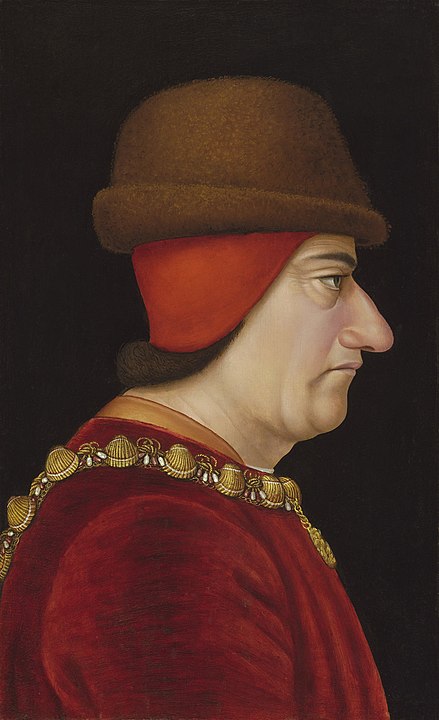
Better known as Saint Louis, Louis IX was a king of France from the Capetian dynasty who reigned from 1226 to 1270. This sovereign is a legendary figure in the history of France and Christendom. A model prince, knight, and crusader, he ruled at the height of the French Middle Ages. Thanks to the writings of Jean de Joinville, we know a great deal about his long reign, which spanned the 13th century. Concerned with order and justice, this great Capetian king implemented numerous reforms. Deeply pious, Louis IX participated in two crusades. The failure of his ventures in the Holy Land and his death in Tunis secured his place in history and led to his rapid canonization.
Louis IX: Heir to a Dynasty at its Peak
Despite the brevity of his reign (three years), the father of the future Saint Louis, Louis VIII, secured the future of the dynasty. From his wife, Blanche of Castile, he had no fewer than eight sons. The eldest, Philippe, died in 1218, and the second, Louis, was destined for the crown, leaving the others to be provided for. In a will drafted in June 1225, Louis VIII decided that three of his sons would be granted fiefs that had been incorporated into the royal domain by Philip II Augustus. The third, Robert, received Artois, the fifth, Alphonse, received Poitou and Auvergne, and the eighth, Charles, received Anjou and Maine, in place of the fourth son, Jean, who had died prematurely in 1226, and the sixth and seventh, who had also died young.
The creation of these territorial principalities for the “princes of the fleurs-de-lis” could facilitate the spread of Capetian customs and mindsets in territories that had retained their local identity and traditions due to a long period of autonomy. Additionally, the clause stating that these territories would revert to the crown in the absence of a male heir would help reincorporate them into the royal domain. Nevertheless, this decision reduced the domain’s size by a third.
There was a considerable risk that this could lead to the rise of a new feudal aristocracy of powerful barons who, despite their close kinship, could pose an obstacle to the strengthening of the sovereign’s authority. For the moment, the royal house was wealthier, more powerful, and more prestigious than all the other great feudal families. It was obeyed, respected, and even admired from the English Channel to the Rhône and from the Rhône to the Pyrenees. Thus, the reign of Louis IX began under favorable conditions.
The Regency of Blanche of Castile
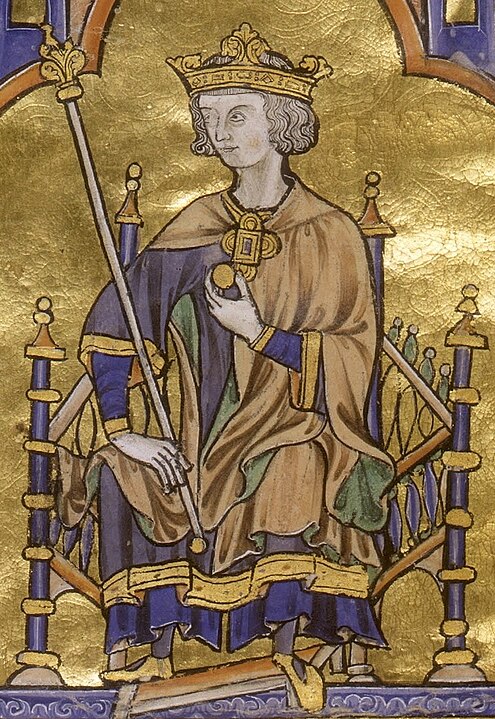
Contemporary depiction from the Bible of St Louis, c. 1230
Born in 1214 (the year of the Battle of Bouvines), Louis IX was too young to rule upon his father’s death in 1226. His mother, Blanche of Castile, assumed the regency. She fought against a coalition of nobles led by the Count of Brittany, emerging victorious in 1234. Blanche also ended the crusade against the Albigensians in 1229 (Treaty of Meaux) and united the County of Toulouse with the crown.
As soon as he ascended the throne, the young king faced a new feudal rebellion, led by Hugh X of Lusignan, which was swiftly crushed. King Henry III of England took advantage of the situation to invade France in 1242, but he was defeated by Louis IX at Taillebourg and Saintes. By 1243, a five-year truce had been agreed with Henry III, which was confirmed by the Treaty of Paris in 1258, where both sovereigns ceded territories to each other.
In the same spirit, Louis signed a treaty with King James I of Aragon, with the former renouncing French claims on Roussillon and Catalonia, and the latter relinquishing his suzerainty over Provence and Languedoc. Louis also intervened in the ongoing conflict between the Empire and the Pope, positioning himself as a mediator. Saint Louis was determined to stabilize the situation in Europe and with its neighbors so that he could focus on what he saw as his Christian duty: the Crusade.
Saint Louis: The Most Christian King
Louis IX was deeply marked by his intense faith, strongly influenced by his mother, Blanche of Castile. He aspired to make France the preeminent Christian nation. In this spirit, he had the Sainte-Chapelle built in 1248 to house relics such as the Crown of Thorns and a fragment of the True Cross. He also supported the Cistercians by establishing them at Royaumont in 1236.
Concerned with maintaining order and justice, he banned familial vendettas. In the same vein, Saint Louis sought to regulate private violence (issuing the 1258 ordinance on judicial duels), outlawed blasphemy, and persecuted Jews. He even went so far as to ban gambling. Haunted by the concept of sin, Saint Louis embodied the archetype of the Christian knight, generous toward the poor. His faith deeply impressed his contemporaries as he adopted an increasingly monastic lifestyle. Nevertheless, he was not without fanaticism, showing no mercy toward heretics. He supported the Inquisition in Languedoc against the Cathars (Montségur fell in 1244) and required Jews to wear the scarlet badge.
Popular imagery depicts the king as a man of fervent faith, rendering justice under the oak tree of Vincennes. Of all the duties required of him as king, those of a judge were Saint Louis’ favorite. Throughout his life, he was a just king. Joinville was the first to describe the king sitting after Mass under an oak tree, receiving all who wished to plead their cases “without obstruction from ushers.” He gave alms to the poor, healed the blind and lepers by touch, and preferred the company of mendicant friars to that of princes. Joinville reports one of his mottos: “Beware of doing or saying anything that, if the whole world knew of it, you would be unable to acknowledge, ‘I did this; I said this.’”
Louis IX Departs On Crusade
In 1244, Saint Louis was struck by illness and vowed to go on a crusade if he survived. He kept his promise and had the port of Aigues-Mortes built specifically for this purpose. After meeting Pope Innocent IV in Lyon in 1245, he left for the Holy Land, choosing Egypt as his target. The crusaders easily captured Damietta in June 1249 but delayed advancing toward Cairo. They were hindered by the flooding of the Nile and had to fight in poor conditions at Mansourah in February 1250. The king’s favorite brother, Robert of Artois, driven by reckless bravery, was killed at the vanguard along with many knights. The army was forced to retreat in desperate conditions, as a terrible epidemic decimated much of the troops.
On April 5th, the king, now sick, was captured and taken to Mansourah. Fallen into the hands of the Mamluks (who had just overthrown the Sultan), Saint Louis was in great danger, but he displayed admirable courage and even impressed his enemies during adversity. After difficult and painful negotiations, the Mamluks released him in exchange for the return of Damietta and a massive ransom of 400,000 livres. The depleted Christian army was allowed to leave Egypt, and the king made it a point of honor to scrupulously fulfill the terms he had sworn for his release.
The king did not leave the East immediately and spent the following years in the Latin states, trying to address the internal problems tearing them apart. In his fervor for the crusade, the king seemed to forget his own kingdom. However, it was facing challenges. Besides the constant threat of aggression from the King of England, France was plagued by new and peculiar troubles. A wave of mystical madness swept through the northern provinces and seemed to spread across the entire country. Shepherds, called “pastoureaux,” rose up in Flanders and Picardy, following the call of a mysterious figure known as the “Master of Hungary.” They claimed they would save the king, betrayed by his knights.
Outcasts, vagrants, and bandits joined them from all sides. Soon, they became an army of one hundred thousand men, a mob of peasants declaring war on the nobles, priests, and Jews. In Paris, Orléans, and Bourges, conflicts between the pastoureaux and the population were bloody. The regent, initially surprised by the scale and mystical nature of the movement, regained control and ordered royal officials to organize a crackdown on the pastoureaux everywhere. They were then pursued, driven toward the South, and eventually annihilated.
This was the last service rendered to the kingdom by the regent. Saint Louis received the news of her death at the beginning of 1253. However, he lingered in the Holy Land for another year, unable to tear himself away. It was only in the summer of 1254 that he finally returned to his kingdom.
Louis IX: A Reforming King
The France of Louis IX experienced significant institutional reforms. The first phase took place between 1226 and 1248: the king played the feudal card fully, winning the loyalty of the nobility while also regulating private warfare.
The second phase of his reforms occurred after his return from the crusade, partly in response to this inquiry. Deeply changed by his experience as a crusader, the king sought peace with his neighbors, Henry III of England and James I of Aragon. He then embarked on significant reforms, recruiting competent men like Gui Foulquoy.
The Curia regis was restructured in its functioning, with the king at the center, surrounded by his close advisors. From 1250, part of this court specialized in justice, laying the foundations for the 14th-century parliament. The administration was refined, tasked with relaying the numerous ordinances decided by the king. Saint Louis thus became the Capetian monarch who legislated the most.
The Last Crusade and the King’s Death
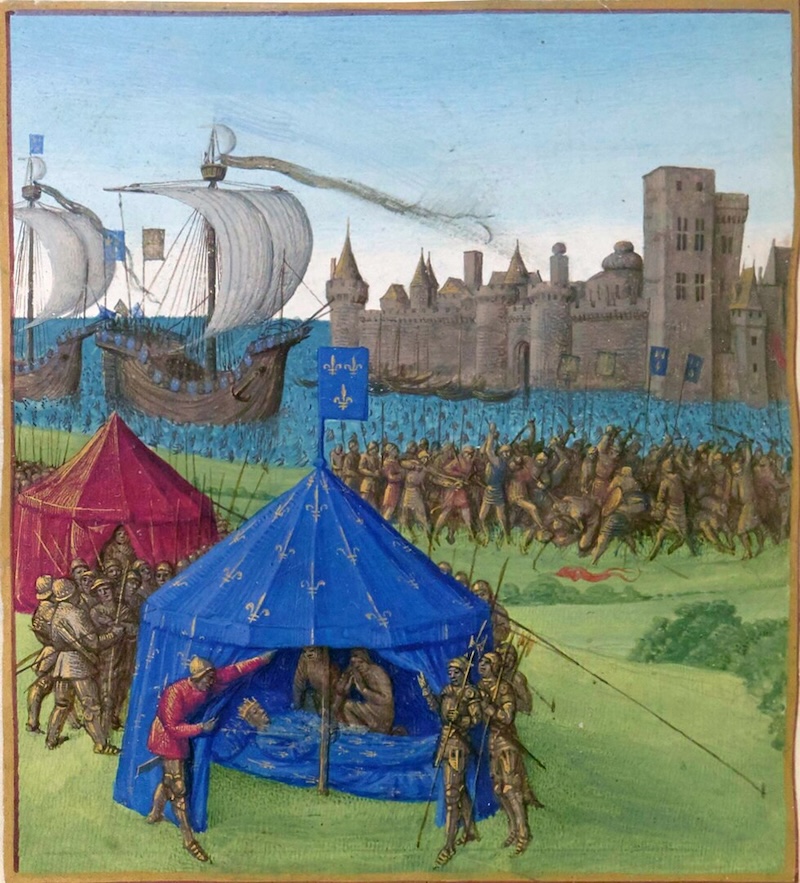
Death of Saint Louis: On 25 August 1270. Illuminated by Jean Fouquet, Grandes Chroniques de France (1455–1460
After his return, despite the numerous tasks he accomplished, the king’s daily thoughts were focused on taking up the cross again. In 1266, he finally shared his desire with Pope Clement IV, who was less than enthusiastic. In fact, Saint Louis had little understanding of Eastern affairs and even less of Muslim politics. Wounded by his previous failure, but also aware of the dangers facing the Latin presence in the Holy Land, Saint Louis once again took the cross in 1267, despite the exhaustion of the barons. Likely influenced by his brother, Charles of Anjou, who had become very ambitious since conquering Sicily, the king decided to lead the crusade against Tunis.
The army set sail imprudently, in the height of summer, on July 1st, 1270, from Aigues-Mortes, after waiting for a long time for the Genoese ships that were to transport the crusaders to Africa. A month later, the army was on the ruins of ancient Carthage, suffering under a scorching sun, with no drinking water and only the shade of scraggly olive trees.
The Saracens, with their war machines, sent clouds of burning sand into the French camp. Dysentery and the plague caused considerable devastation. Saint Louis’ beloved son, Jean Tristan, died at the age of twenty. The king tended to the sick until the day he himself was struck by the plague. He died on August 25th, 1270. Paradoxically, this new failure marked his glory: the Christian king died on a crusade, paving the way for his sainthood.
The Legacy of Saint Louis
The reign of Saint Louis was ultimately a period of moral, intellectual, and artistic flourishing for France across Europe, especially since it benefited from a favorable situation, without famine or epidemics. The king’s personality, his reforms, his faith, and his actions as a crusader explain why he is regarded as one of the most important kings of France, far beyond mere folklore. He was canonized by Pope Boniface VIII in 1297, just twenty-seven years after his death. His son Philip, the future Philip III the Bold, succeeded him.
For the first century of the Crusading movement, Christian armies marched exclusively outward toward Jerusalem, Egypt, or the Iberian frontier to fight non-Christian powers. In the summer of 1209, however, Pope Innocent III redirected the full spiritual and military machinery of a Crusade straight into the sunlit heart of Western Europe itself. Known to history as the Albigensian Crusade (1209–1229), this twenty-year war pitted northern French barons and the Crown of France against the wealthy, cultured lords and cities of Languedoc (Occitania) in southern France—wiping out the dualist religious movement known as Catharism, giving birth to the medieval Papal Inquisition, and permanently annexing the Mediterranean south into the Kingdom of France.
Who Were the Cathars (the “Good Men and Good Women”)?
In the twelfth century, the region of Languedoc—stretching from Toulouse and Carcassonne to Béziers and Albi (which gave the movement the name Albigensians)—was culturally, linguistically, and politically distinct from northern France. Speaking Langue d’Oc (Occitan) rather than the French of Paris, governed by tolerant counts like Raymond VI of Toulouse, and celebrated for the romantic courtly poetry of the troubadours, southern society had grown deeply disillusioned with the worldly wealth and corruption of the local Roman Catholic clergy.
Into that spiritual vacuum stepped the Cathars—who never called themselves Cathars, preferring the simple titles Bons Hommes and Bonnes Femmes (“Good Men and Good Women”) or “Good Christians.” Influenced by Eastern European Bogomil dualism, Cathar theology taught a radical, uncompromising worldview:
Two Competing Gods: Cathars believed the universe was divided between two realms. The invisible realm of the human spirit and light was created by the true, benevolent God of the New Testament; the physical, material world of flesh, gold, war, and decay—along with the wrathful deity of the Old Testament—was created by an evil cosmic demiurge or Satan (Rex Mundi, King of the World).
The Consolamentum and the Perfecti: Because human souls were trapped angels imprisoned inside physical bodies through reincarnation, the Cathar leadership elite—known as the Perfecti (Perfect Ones), which included both men and women preaching as equals—received a single spiritual baptism of the laying on of hands called the Consolamentum. Once ordained, a Perfect lived a life of absolute apostolic poverty: owning nothing, never lying or swearing oaths, abstaining completely from sex, war, and killing, and following a strict vegan-pescatarian diet that forbade eating any meat, eggs, cheese, or milk produced through sexual reproduction.
1208: The Murder of the Papal Legate and the Massacre of Béziers
For decades, Pope Innocent III sent Cistercian monks and the Spanish preacher Dominic de Guzmán (founder of the Dominican Order) to debate the Cathars peacefully, with minimal success because the local nobility protected the beloved Perfecti. The breaking point arrived on January fourteenth, 1208: following a heated argument in which the papal legate Pierre de Castelnau excommunicated Count Raymond VI of Toulouse for refusing to persecute his own Cathar subjects, a squire loyal to the Count rode up beside Castelnau at a crossing of the Rhône River and ran him through with a lance.
Outraged at the murder of his ambassador, Pope Innocent III proclaimed a formal Crusade against Languedoc—offering any northern French knight who fought for forty days against the southern heretics the exact same plenary indulgence of sins as a Crusader going to Jerusalem, plus the legal right to confiscate and keep the castles and lands of southern nobles. In July 1209, a massive northern army marched south and surrounded the walled city of Béziers, where Catholic citizens refused to hand over their two hundred Cathar neighbors.
On July twenty-second, 1209, when the Crusaders stormed the gates of Béziers and soldiers reportedly asked the Cistercian papal legate, Arnaud Amalric, how they could tell the few hundred Cathar heretics apart from the thousands of orthodox Catholic citizens inside the city, the chronicler Caesarius of Heisterbach recorded the legate’s chilling reply: “Caedite eos. Novit enim Dominus qui sunt eius”—”Kill them all; for the Lord knows those that are His.” In a single afternoon, up to fifteen thousand to twenty thousand men, women, and children were slaughtered inside the churches and streets of Béziers, and the city was burned to the ground.
Simon de Montfort, King Peter II at Muret, and the Royal Takeover
Following the fall of Carcassonne weeks later, leadership of the Crusader army fell to a relentless, fanatically pious minor baron from the Île-de-France: Simon de Montfort. For nine years (1209–1218), Montfort waged a brutal war of castle sieges across Languedoc—burning captured Cathar Perfecti alive on giant communal pyres at Minerve (140 burned in 1210) and Lavaur (400 burned in 1211) when they refused to renounce their faith.
In September 1213, when the heroic Catholic King Peter II of Aragon crossed the Pyrenees with a massive army to rescue his brother-in-law Count Raymond VI of Toulouse from Montfort’s depredations, the outnumbered Simon de Montfort launched a daring cavalry charge at the Battle of Muret that killed King Peter II on the field and shattered the Aragonese-Occitan coalition. Even after a stone hurled from a women-operated mangonel catapult smashed Simon de Montfort’s skull during the siege of Toulouse in 1218 and the southern lords temporarily reconquered their lands, the French Crown itself stepped in: King Louis VIII marched south with a royal army in 1226, forcing the exhausted Count Raymond VII to sign the Treaty of Paris (1229), which ceded the Mediterranean coast to France and arranged for Toulouse to pass by marriage directly to the French royal family.
The Inquisition and the Final Pyre of Montségur (1244)
To root out the surviving Cathars who went underground in mountain villages, Pope Gregory IX established the Papal Inquisition in 1233, entrusting Dominican friars with interrogation registers that tracked down clandestine believers across generations.
The tragic final act of the movement unfolded during the freezing winter of 1243–1244 high atop the sheer, 3,900-foot limestone crag of Château de Montségur in the Pyrenees foothills, where two hundred Cathar Perfecti and a small garrison of knights held out for nine months against a royal French army of ten thousand men. After royal engineers scaled a sheer cliff at night to set up a trebuchet that battered the castle walls, the defenders negotiated a surrender in March 1244. Given two weeks to prepare, the French offered a simple deal: any Cathar who walked down the mountain and renounced their heresy before the inquisitors would walk away completely free; anyone who refused would be burned. On March sixteenth, 1244, not a single Perfect recanted—in fact, twenty ordinary soldiers and lay defenders inside the castle voluntarily asked to receive the Cathar Consolamentum on the final night so they could share the fate of the Good Men and Women, walking calmly down the mountain together into a giant stockade of blazing wood at the foot of the cliff known ever since as the Prat dels Cremats (“Field of the Burned”).
After the fall of Napoleon Bonaparte in June 1815, a new White Terror was carried out by the ultra-royalists, who enjoyed the support of rural France and the clergy. This “counter-revolution” set out to remove former revolutionaries and Bonapartists from all organs of power and administration, and to eradicate from the country all the political and ideological legacy of that period. The suppression of individual freedoms, summary justice, and massacres followed one another for a year, until Louis XVIII dissolved the Chamber dominated by the ultras.
After Waterloo and Napoleon’s second abdication, while in Paris it was enough to wear a bouquet of violets to be assaulted, new massacres were perpetrated in southern France. On June 25, serious incidents opposed royalists and soldiers in Marseille; the latter, who had been ordered not to respond to provocations in order to avoid civil war, lost 145 infantrymen and 18 cavalrymen, killed by royalist volunteers on the road to Toulon.
In the Phocaean city left to itself, it was carnage; retired soldiers, peaceful shopkeepers, former Mamluks brought back from Egypt by Bonaparte fifteen years earlier (13 Mamluk corpses were identified, but there were others), gendarmes, were mercilessly massacred, sometimes with refinement, while the crowd celebrated the French defeat in Belgium. The exact number of victims of this frenzy, which posterity remembered as the “Day of the Farce,” is unknown; estimates range from 45 to 250. The surviving suspects were imprisoned for their safety in the Château d’If; they were almost all released by the king’s prefect, Mr. de Vaublanc.
The Assassination of Marshal Brune
Soon, in many places, rioters bearing the colors of the Count of Artois pursued and killed Protestants and former Jacobins. In Avignon, under the leadership of a man named Pointu and a self-styled Major Lambot, Bonapartist houses were ransacked, dozens of people killed, perhaps even hundreds; among them a disabled man and a baker who was scalded in his kneading trough. Debtors freed themselves from their debts by throwing their creditors into the river. It was in this overheated atmosphere that Marshal Guillaume Marie Anne Brune, who had nevertheless submitted to the king, was assassinated by fanatics. Brune, a genuine republican rather than a Bonapartist, was falsely accused of having carried the head of the Princess of Lamballe on a pike. The constituted authorities, including the newly appointed royal prefect, Mr. de Saint Chamans, tried in vain to save him. Fearing Paris’s disapproval, the murder was disguised as a suicide.
The rioters did not omit to plunder the marshal’s baggage. Brune’s body was thrown into the Rhône, where it floated and was riddled with gunfire; retrieved downstream and buried by pious hands, it was later exhumed and buried again in the ditches of a castle, where it remained for two years before being returned to his widow in a soap box so as to pass unnoticed. For a few months, the Austrian occupation calmed the unrest; an Austrian officer even declared that, all things considered, he preferred Napoleon’s officers to the French nobles brought back in the baggage trains of his army. Like the September massacres, these atrocities were not committed solely by the dregs of the populace, but also by respectable bourgeois and aristocrats, among whom women were not absent. And it all ended in a festive atmosphere reminiscent of a rustic sabbath (carimantran).
The second White Terror was certainly more terrible than the first. In Montpellier, where the announcement of the Emperor’s abdication led to a bloody clash between royalists and the still Bonapartist garrison, more than a hundred people perished in the bloody orgies that followed. In Uzès, about a dozen.
In Nîmes, the change of regime, initially poorly accepted by part of the army, set it against the royalists, before the evacuation of the town by the disarmed troops, who were mercilessly massacred (more than thirty dead). Religious antagonisms reappeared; Protestants, about a third of the population of the Gard, had welcomed the return of the Emperor with joy and were once again targeted by the Catholic majority. It is true that during the Hundred Days they had committed acts of violence against the miquelets of the Duke of Angoulême, notably at Arpaillargues (2 dead). Villages remained divided, and travelers were wise to carry a set of cockades to change quickly before entering, depending on whether they were Bonapartist or royalist.
The royalist army of Beaucaire, a mob dressed in mismatched uniforms stolen from dead soldiers, looted and murdered indiscriminately, even killing royalists, and punished Calvinist women by lifting their skirts and flogging them with paddles adorned with fleur-de-lis (incidents minimized by royalists).
At this time, Trestaillons distinguished himself, whose real name was Jacques Dupont; it is said he owed his nickname to his claim that he would cut Bonapartists into three pieces, though others say it came from the three plots of vineyard he owned. This porter, at the head of armed bands, had many Protestants assassinated; many others were persecuted and several thousand fled. Paradoxically, the only relatively safe refuges were prisons; however, these too were emptied and their occupants exterminated. Trestaillons was assisted by two accomplices, Truphémy and Servan; these men varied their amusements by setting fires and dancing around the blaze, looting, cutting ears, or killing, sometimes burning their victims alive. After expelling Bonapartist Protestants from their homes, they installed their own families there. They even went so far as to exhume the ancestors of “wrong-thinkers” to auction off their remains. Foreign troops had to be called in to restore order; the Austrians shot about twenty rioters, though not the leaders.
Trestaillons was nevertheless surpassed in cruelty by Quatretaillons of Uzès, a certain Graffand, a former soldier, later a rural guard and a miquelet of the Duke of Angoulême in 1815. Like Trestaillons, he surrounded himself with a band of bloodthirsty fanatics ready to commit any crime. In the name of popular justice, he shot prisoners, both Catholic and Protestant; he spread terror in the villages and indulged in vile mockery of the corpses of those he had just murdered. Granted a pardon once, he was later pursued again by justice for a common-law offense committed in 1819 and was sentenced to death in absentia by the court of Riom in 1821. Fifteen murders were certainly attributed to him, not counting others. The whole of southern France was shaken by the storm, and apart from a few pockets such as Montauban, where the prefect, Mr. de Rambuteau, showed firmness and courage, the authorities were almost everywhere overwhelmed.
The Assassination of General Ramel
In Toulouse, during the return of the Usurper, Vitrolles, a trusted man of the Count of Artois, armed a cohort of “verdets,” so called because their white cockade was trimmed with green. The population was openly royalist. After Napoleon’s second abdication, bloody clashes opposed the army to supporters of the Restoration; the army was forced to leave the city, which was handed over to the verdets. The most fervent among them dreamed of creating a Kingdom of Aquitaine whose monarch would be the Count of Artois, supported by the troops of Ferdinand VII. The presence of the Duke of Angoulême nevertheless kept the monarchists in line until mid-August. After that, secret societies took control, while the verdets, no longer paid, began to grow impatient. The appointments of Mr. de Rémusat as prefect, General Jean-Pierre Ramel as deputy to Marshal Pérignon responsible for maintaining order, and Mr. de Castellane at the head of the National Guard were received as provocations. Secret societies refused to obey Paris, and the verdets demanded pay; to obtain it, they saw only one solution: to instill fear.
The mayor Malaret, threatened, preferred to yield his position to Mr. de Villèle, the future minister. Rémusat did not allow himself to be intimidated, nor did Ramel, who had moreover received the order to disband the verdets.
On August 15, after a well-watered dinner, the conspirators went beneath Ramel’s windows, where they intoxicated the soldiers on guard. The general, who had been absent, warned of the events being prepared, returned home amid insults and threats. The soldier guarding his door was killed with a bayonet thrust, while a pistol shot struck Ramel in the lower abdomen. The wounded man was carried to his apartment by the few people accompanying him. The rioters demanded that he be thrown out of the window to be finished off. As the door was about to be broken down, the two or three individuals present fled and hid. Ramel dragged himself as best he could to a neighbor’s house; the neighbor refused to receive him. Outside, the verdets incited the crowd by claiming that the general had ordered fire on the people, whereas they themselves were the only ones to have used weapons.
Meanwhile, Colonel Ricard, a surgeon, and a police commissioner arrived and, following the trail of blood, found the general in an attic. The surgeon dressed his wounds while National Guards and gendarmes arrived on the square; this force did nothing to prevent the rioters from breaking through the barriers set up to separate them from their prey. The fanatics threw themselves upon the wounded general, tore out one of his eyes, struck him with several blows of bladed weapons, taking care not to kill him in order to prolong the pleasure. Nothing was spared: his uniform, lying on a chair, was slashed with sabers. Ramel died only the next day, horribly mutilated, in dreadful suffering. He had nevertheless been deported to Guyana during the coup of Fructidor because of his royalist opinions and did not hide his support for Louis XVIII; his only fault was having obeyed the king’s orders by refusing to pay the verdets.
Louis XVIII, whose authority had been flouted in this affair, demanded in vain the punishment of an attack that threatened the unity of the kingdom. In 1816, the apartment of the magistrate in charge of the investigation, Mr. de Caumont, was searched, six hundred francs were stolen, and many documents useful to the inquiry were taken; the investigation came to nothing. In 1817, three of Ramel’s murderers were indeed brought before the provost court, an exceptional tribunal used against Bonapartists, but despite a severe indictment by the king’s prosecutor, who was for the occasion called a Jacobin by the audience, the accused were sentenced, almost reluctantly, only to minimal penalties. Pérignon, Ramel’s superior, not only failed to appear on the day of the drama, but the following day wrote to Paris that he was obliged to replace his sick deputy; the timidity of the old marshal was rewarded as it deserved, with exile to his estates. And, to add hypocrisy to horror, solemn funeral honors were given to the martyred general, at which some of his executioners dared to attend. This affair remained emblematic of the prevailing mindset.
It should nevertheless be noted that in the Vendée, where a royal army had opposed imperial troops during the Hundred Days, from the moment of Napoleon’s abdication, the royalists offered to unite with their former enemies to defend France against invaders. A fine display of civic spirit at a time when, further south, people were thinking of carving up the kingdom. In the west, it was mainly in Nantes that the Viscount of Cardaillac earned the nickname of “White Carrier,” rather unfairly, since although he persecuted, he did not kill. In Normandy, the prefect was briefly threatened by a band of fanatics who tore up orders from Paris, but Caen was close to the capital, news spread quickly, and order was rapidly restored. In central France, the “brigands of the Loire,” as survivors of the imperial army were called, were often threatened, especially when returning home alone; but when they traveled in groups, it was enough for them to adopt a firm attitude for their opponents to scatter like a flock of sparrows.
The Institutional Second White Terror: The Provost Courts
If, as we have seen, a perverted and disorderly justice characterized the White Terror, its second phase was different from the first. This second phase also took on an institutional and regular character, with prison sentences or death sentences imposed on several senior officers (19 generals), some of whom managed to escape while others suffered the penalty. Exceptional tribunals, the provost courts, were established, in a way mirroring revolutionary tribunals. The press demanded, without nuance, the punishment of the guilty, condemning some to death and others to deportation to Siberia. Some even attacked the king, deemed too lenient for having promised pardon upon his return to Cambrai, a promise he could not keep. Legal terror was encouraged by foreign powers, who wished both to teach the French a lesson and to strip them of part of the artworks they possessed, which had not always been acquired honestly.
It was in this atmosphere of vengeance that Joseph Fouché, former regicide and at that time minister, prepared the lists of proscription, in which he forgot none of his former friends, perhaps not suspecting that he would join them later. Faithful to the policy of Jacobin terror, Fouché tried to appease public opinion by bringing the most guilty to justice in order to put an end to the disturbances that bloodied southern France and to calm the fury of the reaction. The arbitrariness in selecting those who would pay for all undoubtedly contributed to discrediting the monarchy and preparing the events of 1830. Many excused the revolutionaries for their cruelty because of their lack of education; such an excuse no longer held when well-born individuals behaved in the same way. Hypocrisy was added to cruelty; as a dark joke of the time put it, an amnesty was proclaimed from which everyone was excluded. The legal sophistry of notables had simply replaced the revolutionary fury of the people. And the “unfindable chamber,” composed largely of fanatics, prolonged a situation that only the initial moment might have excused.
Death Sentences of Military Figures
Let us turn to the executions. The brothers Constantin and César de Faucher, natives of La Réole, twin brothers, more moderate republicans than Bonapartists, were judicially murdered in Bordeaux, where the population, inspired by the courage shown by the Duchess of Angoulême during the return of the Usurper, was royalist without descending into excesses beyond words. The dramatic and absurd arrest of the two brothers, for trivial offenses, took place in a climate of civil war reminiscent of Toulouse; the brothers, accused only of their opinions, found no lawyer willing to defend them, not even among their friends, and even a defense witness was imprisoned. At the appeal stage, their court-appointed lawyer, instead of defending them, apologized to the court for having been assigned to the case. On the day of the execution, the condemned were forced to walk for an hour to the place of execution, instead of being transported, to satisfy the ultras; but while their execution briefly excited their frenzy, their composure and dignity moved many spectators and soon inspired contempt among honest people.
Colonel Charles de La Bédoyère, an impetuous Bonapartist who had brought his regiment to Napoleon in the Alps, was executed in Paris despite the pleas of his royalist family. Warned of his fate, he could have fled but ultimately refused to abandon his wife and child. Decazes used his arrest to plot against Fouché, whose position he coveted; he failed at that time, but it was only a matter of time before the regicide minister was forced into exile. La Bédoyère’s widow was ordered to pay the bonus granted to the soldiers who executed her husband. The ultras rejoiced, and even François-René de Chateaubriand urged the king to firmness.
Marshal Michel Ney was arrested in the Cantal, where he had taken refuge after unsuccessfully attempting to be killed at Waterloo. His arrest troubled Louis XVIII, who foresaw that Ney’s inevitable execution would deal a severe blow to the monarchy. The Chamber of Peers condemned him to death. He was officially shot discreetly near the Observatory, though some believe he later lived in the United States.
Marshal Bon-Adrien Jeannot de Moncey refused to preside over Ney’s trial and was punished for it.
Mouton-Duvernet was executed in Lyon; the city’s elite celebrated by dancing at the execution site. Chartran was executed in Lille. General Travot was sentenced to death for having shown moderation; his sentence was commuted to prison, where he lost his sanity. Several other generals were condemned or imprisoned.
Drouot surrendered himself and was acquitted. Cambronne was also acquitted after a passionate defense. Marshal Davout was stripped of income and exiled internally. Masséna was publicly insulted. Soult fled in disguise.
Persecution of Civilians and Soldiers
Alongside the military, civilians were also persecuted and executed. Lavalette, a former minister, escaped thanks to his wife, who took his place in prison and later went mad. In various regions, people were executed for minor or fabricated offenses.
By the end of 1815, nearly 3,000 political prisoners were held in French jails. Around 9,000 political sentences were handed down. Thousands were purged across all social levels. Many fled abroad, to Europe and America, where some joined independence movements. Figures such as Joseph Bonaparte and Marshal Grouchy went into exile in the United States, along with many others.
Aftermath of the Second White Terror
Louis XVIII, who did not approve of the excesses, quickly dismissed the ultra-dominated chamber. In 1816, the royal power dissolved associations formed in its name but engaged in extortion. Foreign occupying armies, responsible for maintaining order, intervened only sporadically.
Rather than consolidating peace, the White Terror deepened divisions between royalist and revolutionary France. In 1816, the Didier conspiracy in Grenoble further destabilized the situation, leading to executions and repression.
In Lyon in 1817, General Canuel manipulated unrest to provoke a Bonapartist uprising and demonstrate his loyalty. Arrests and executions followed, though the plot was later exposed.
Many other conspiracies followed. Ultimately, the events contributed to the downfall of the Bourbon Restoration. The July Revolution finally drove Charles X into exile.
One observation remains: it is far easier to enter a period of bloody turmoil than to emerge from it. The events of 1830 once again proved that one does not create martyrs without consequence.
The First White Terror during the French Revolution was a violent anti-Jacobin reaction during the Thermidorian Reaction (1794–1795). After Robespierre’s fall on 9 Thermidor Year II (27 July 1794) and especially after the failure of the revolutionary attempts on 12 Germinal (1 April 1795) and 1 Prairial (20 May 1795), the royalists, or “whites,” led a violent repression against the Jacobin sans-culottes. This White Terror, the counterpart to the “red” Terror of the sans-culottes during the “Robespierrist” regime, persisted intermittently throughout the Directory.
A Divided Revolutionary France
Although the White Terrors were less deadly than the revolutionary terror, the excesses committed after Robespierre’s hasty execution without trial and after Napoleon’s second abdication were far from insignificant, even if they occupy only a modest place in official history. The most terrible inclinations of humanity were on display, mirroring the fall of the monarchy, showing not only the extremes of political passions but also personal vendettas exploiting the disorganization of the State to act freely without constraint.
To understand the White Terrors, one must return to the beginnings of the Revolution. The oppositions were not only political but also religious. Protestants, still numerous, especially in the Cévennes and southern France, were generally in favor of regime change (Rabaut Saint-Etienne was a Protestant pastor from Nîmes), whereas Catholics often leaned toward the Ancien Régime. Among Catholics, the Jansenists were more inclined toward the new order than the Jesuits, meaning religious disputes reinforced political conflicts.
In several southern cities, bloody clashes broke out between the two sides. This was particularly true in Nîmes, which had a significant Protestant community supported by their co-religionists in the Cévennes. Through somewhat dishonest maneuvers, Catholics managed to take control of the National Guard and appoint an aristocrat as mayor. The supporters of the Ancien Régime armed themselves with axes and pitchforks to hunt down Protestants, known as “black clothes.” They hoped for the support of the Guyenne regiment stationed in the city, but it remained loyal to the constitution.
Fights broke out between soldiers and the National Guardsmen, the former wearing the tricolor cockade, the latter the white cockade. A royalist armed insurrection erupted but was crushed by the army, which assaulted a tower where the rebels had barricaded themselves with a small cannon. Contrary to their expectations, the Catholics of Nîmes received no help from other southern cities; on the contrary, they antagonized the Protestant Cévennes, whose National Guardsmen camped on the outskirts of the city. These events in June 1790 led to massacres, interpreted differently depending on the side. The Catholic movement failed but left lasting scars on the collective memory.
Two early attempts to unite anti-Revolutionary forces connected to émigrés occurred in July 1790 and February 1791 in Vivarais (Jalès camp). In July 1792, an even more openly monarchist conspiracy formed around one of the authors of the previous attempts. The goal was to organize an uprising of southern Catholics, fueled by hatred of Protestants. The conspirators seem to have overestimated the strength of the antagonisms. In any case, their gathering was dispersed by the army, and many of the fugitives went underground, where they engaged in banditry.
Later, the nascent Republic faced a royalist insurrection in the West (Vendée, Brittany, Pays de la Loire, Normandy). These uprisings, motivated primarily by religious reasons (rejection of the constitutional clergy), secondarily by opposition to conscription, and finally by the abolition of communal lands (sold as national property, depriving the poorest rural inhabitants of their main resources), were much bloodier than the White Terrors.
In addition to these uprisings, starting in June 1793, after the fall of the Girondins, the Committee of Public Safety also had to contend with federalist revolts in Normandy (Caen), Bordeaux, Lyon, and the south, where the port of Toulon was handed over to the English. These revolts brought Girondins and royalists closer together, at least in Lyon and Toulon, united by their common hatred of the Jacobin Montagnards in power in Paris. It is important to note that not all southern inhabitants were pro-monarchy. The role of the Marseille volunteers in the fall of the monarchy in August 1792 and the popularization of the song that would become the French national anthem are significant reminders of this.
The intensity of opposing passions in the south partially explains the events of the White Terrors. While the Marseillais played a significant role in the storming of the Tuileries, and the young revolutionary hero Agricole Viala was killed by royalists in 1793 on the Rhône near Avignon, Marseille remained in the hands of moderates, who imprisoned and guillotined republicans even before the Girondins were overthrown. Later, the bloody repression of royalist and federalist uprisings sowed the seeds of future vengeance.
The period following Robespierre’s fall saw not only the rehabilitation of the surviving supporters of Danton, Hébert, and the Girondins but also the return from exile of some royalists who continued to hide while benefiting from relaxed surveillance to resume their old plots. This was particularly the case with Imbert-Colomès in Lyon; compromised in the bloody suppression of a food riot in 1789–1790, he had to flee after his house in Lyon was destroyed by a popular uprising. Far from being a time of calm, this period was one of heightened tensions. None of the involved parties, whether the remaining Montagnards or their rehabilitated adversaries, interpreted the fall of the “tyrant” the same way.
The Thermidorian Reaction
The Thermidorian Reaction was characterized by the abandonment of policies favoring the popular classes (such as the law of the maximum) and a relaxation of revolutionary discipline. However, those who brought down MaximilienRobespierre, out of fear of the guillotine, often due to their own excesses and plundering, had no intention of ending the Terror. They were carried further by events than they initially intended. Evidence of this is that the most fervent extremists of the Committees remained in place, at least for a time. Therefore, portraying the movement against “The Incorruptible” (Robespierre) as a movement against the Terror is, in part, a historical falsification; most serious historians of the Revolution have already corrected this biased view.
In the factional struggles that resurfaced, those currently holding power, often newly wealthy and free from fear, seized every opportunity. They thought their time might be limited, as the revolutionary spirit was far from subdued, as demonstrated by the events of Germinal and Prairial. During these days, riots twice invaded the Convention; a deputy (Féraud) was assassinated, and his head was presented on a pike to President Boissy d’Anglas.
Féraud, however, was a victim of mistaken identity—he had been taken for Fréron, the leader of the gilded youth! This helps explain the moral decline and the hatred the new elite felt toward the republicans. These “muscadins,” as they were called, wielded leaded clubs disguised as canes to beat anyone they suspected of being part of what they called the “tail of Robespierre.” It was in this context that the first “White Terror” began.
The press, having regained some freedom, fanned the flames. Moderate and royalist newspapers launched attacks on the terrorists, as did the Hébertist pamphleteers (like Gracchus Babeuf), at least until mid-November 1794, when the Babouvists reallied with the Jacobins. Louis Fréron, who had represented the Convention in the South alongside Barras in 1793, had distinguished himself there by his violence and thefts.
From September 11, 1794, he resumed publishing L’Orateur du Peuple, a reactionary propaganda outlet, in which he displayed a virulent anti-Jacobinism—entirely opposite to the ferocity he had previously directed at royalists. Fréron no doubt hoped to make people forget that, in the same newspaper in 1791, he had loudly dreamed of storming the Tuileries, toppling the monarchy, and wished for Marie-Antoinette to be tied by her hair to a horse’s tail, to suffer the fate of Frédégonde.
He also likely wanted to make people forget that he had boasted in his letters about having massacred dozens of counter-revolutionaries without trial in Marseille and Toulon, and that his role in the events of 9 Thermidor was primarily to avoid punishment for his crimes. Alongside this fanatic, now claiming he would burn down the Saint-Antoine district, royalist Méhée de Latouche published the pamphlet La Queue de Robespierre, and Ange Pitou spread royalist songs in the streets. These examples are just a small reflection of the many counter-revolutionary publications that appeared at the time (Le Messager du soir, Le Postillon des armées, L’Éclair, L’Historien, Les Nouvelles politiques, Le Véridique, Le Rôdeur, Le Précurseur, La Feuille du jour, Le Courrier républicain (poorly named), Le Gardien de la constitution (a constitution they dreamed of overthrowing), La Quotidienne…).
Verbal and physical violence against anyone even remotely resembling a Jacobin increased. In Paris, Tallien and Fréron organized gangs of muscadins. Two to three thousand of these dandies, made up of suspects released from prison after Thermidor, deserters, draft dodgers, journalists, artists, clerks, brokers, and small tradesmen, mostly living on the right bank and nicknamed “Collets Noirs” (Black Collars) due to their attire—a tight coat with a black velvet collar (mourning the death of Louis XVI), with 17 pearl buttons (in honor of Louis XVII), tails cut like a cod’s tail, breeches tight at the knee, and braided hair tied back by hairpins—paraded their rejection of the revolutionary order by waving their leaded clubs.
Gathered around singers and composers like Pierre Garat, François Elleviou, and Ange Pitou, dramatist Alphonse Martainville, and publicist Isidore Langlois, and led by adventurer the Marquis de Saint-Hurugue, they became increasingly openly anti-republican. They stirred up loud disturbances in the Palais Royal neighborhood, making noise in the streets while singing Le Réveil du Peuple, a counter-revolutionary song.
They met in royalist cafés, read the aforementioned newspapers, disrupted theater performances by heckling actors considered terrorists, imposing readings or songs, and attacking anyone whose readings, words, or appearance remotely resembled that of the Jacobins. They also hunted down busts of revolutionary figures, forcing the Convention to remove Marat from the Panthéon and throw him into a sewer on February 8, 1795. Finally, they multiplied clashes, some of which escalated into brawls, murders, and rapes of Jacobin women.
Fights between the gilded youth and republicans, Jacobin or otherwise, multiplied, particularly with soldiers on leave or at the Hôtel des Invalides. One notable incident took place on September 19, 1794, at the Palais-Égalité (Palais-Royal). Using these violent incidents as a pretext, the authorities closed the Jacobin Club in November 1794. Even Girondin Louvet de Couvray, who denounced both royalists and Jacobins in his newspaper La Sentinelle, was attacked by young royalists in his bookstore-printing shop at the Palais-Royal in October 1795.
The Jacobins, facing hostility from both moderate republicans and royalists, and the people of Paris, suffering from famine during the harsh winter of 1794-1795, partly due to the Convention’s liberal policy of ending the price cap on grain, responded by revolting. However, the insurrections of 12 Germinal and 1 Prairial Year III (1795) failed. The authorities ordered the disarmament of the terrorists, confining them to their homes; 1,200 Jacobins and sans-culottes were arrested. These were the last popular uprisings in Paris until the Revolution of 1830. Rather than be guillotined, the last Montagnards in prison committed suicide with a single knife, which they passed from one to another. Meanwhile, the Committees were purged of the remaining terrorists.
The Revenge of the Royalists
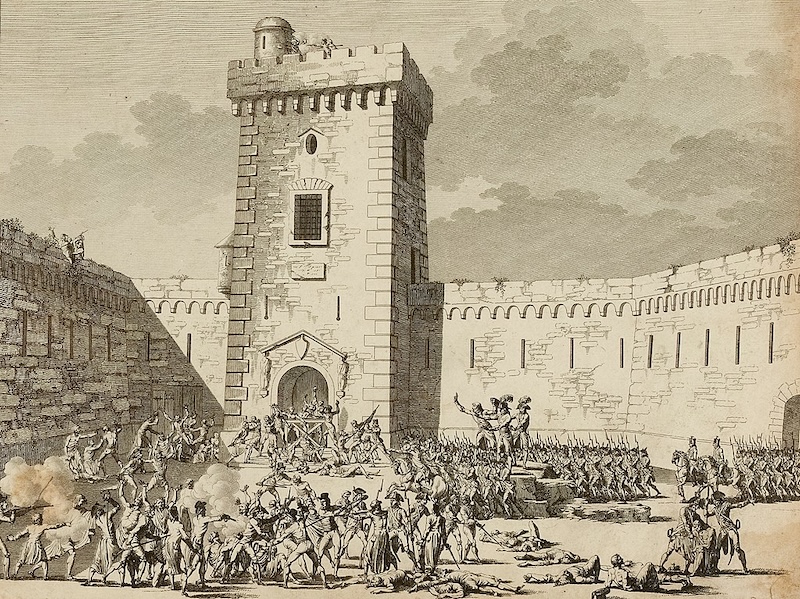
Massacres in Fort Saint-Jean, Marseilles, 17 Prairial, Year 3 of the Republic. Credit: Paris Musees Collections
Taking advantage of the Thermidorian reaction, with the return of refractory clergy and the influx of émigrés, for whom new legislative measures cautiously opened the door, spontaneous vengeance movements by royalists, families of victims of the Jacobin terror, and fanatical Catholics developed in 1795, particularly in the southeast of France, especially in the Rhône Valley. These movements targeted former Jacobins, sans-culotte militants (called “terrorists” or “mathevons” in Lyon), as well as Protestants. The recall of former Girondins led to the return of those who had handed Toulon over to the English.
Many individuals who had left well before the May-June 1793 crisis, true émigrés disguised as Girondins, took advantage of the opportunity to return, threatening purchasers of nationalized property and stripping them of the fruits of their labor. Delegates from the new Committee of General Security of Marseille even went aboard the British fleet to negotiate the restoration of the monarchy in exchange for the disarmament of French fleets and arsenals, a blatant act of treason. The Convention was soon forced to exclude émigrés and traitors to their country from benefiting from return laws.
Exploiting peasant reactions, popular revenge, and counter-revolutionary actions that created a climate of violence, monarchist leaders rallied around them discontented young men, former federalists, deserters, and criminals. The English agent Wickham, based in Switzerland, established a propaganda agency in Lyon that recruited counter-revolutionaries, such as Imbert-Colomès, and prepared a new insurrection with Précy, who had already commanded the federalist uprising in Lyon in 1793. They facilitated desertion and encouraged refusal to conscription to weaken the republican armies. Republican generals were imprisoned, others were dismissed or demoted, as was the case with Bonaparte, while armed bands liberated arrested émigrés.
The Companies of Jehu (or of Jesus) and of the Sun hunted down and massacred anyone who fell into their hands: Jacobins, republicans, former administrators, soldiers idling in the streets, relatives of soldiers at the front, without distinction of age or gender, constitutional priests, and Protestants (for socio-economic and political reasons as much as religious ones). Victims were sometimes attacked in their homes, in front of their families, or in the streets, or even in prisons.
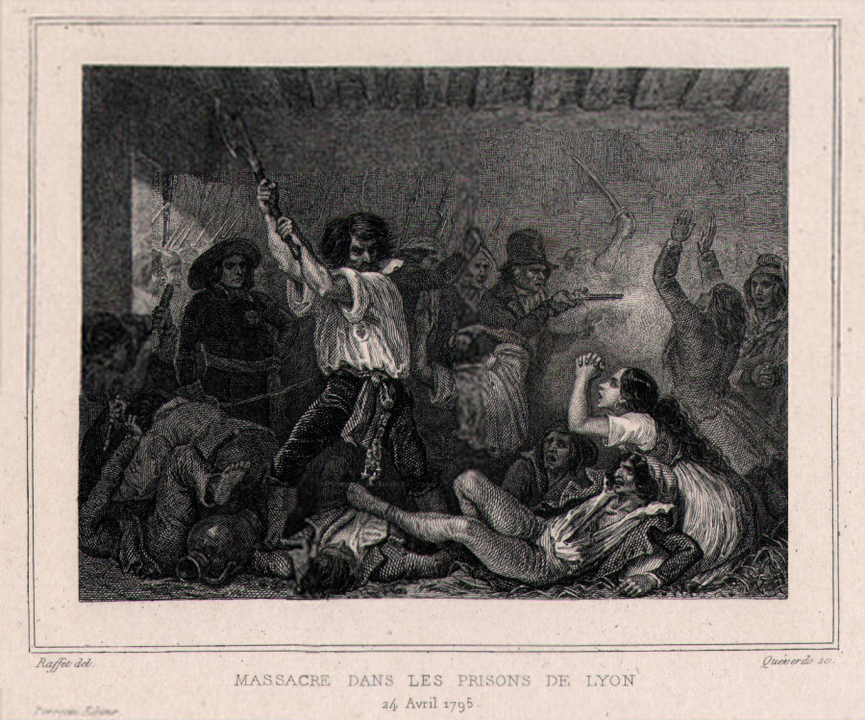
In Lons-le-Saunier, Bourg, Lyon (where around a hundred suspects were reportedly slaughtered in the city’s jails), Roanne, Saint-Étienne, Aix, Marseille, Toulon, Arles (where both sides accused each other of atrocities), Eyragues, Montélimar, Beaucaire (where large amounts of sulfur were thrown into dungeons to try to burn prisoners alive), Tarascon, l’Isle, and Salon (where locals intervened to prevent an attempt on the prison), the violence was brutal and unchecked.
Municipal and departmental authorities, infiltrated by former émigrés, often acted as accomplices to these actions, as did representatives on mission (such as Chambon, who ordered the arrest of all suspects, hypocritically placing them under the protection of the law, then released arrested murderers and armed members of the Company of the Sun). No longer content with merely sawing down Liberty Trees, most victims bore the marks of multiple wounds from firearms, blades, or clubs, showing the determination of their killers.
Other bands were denounced, including the “Triqueurs,” the “Vibou,” or a group of Chouan national guardsmen in the Gard, who united noble émigrés and popular elements. Using denunciation lists, these groups attacked former administrative agents and correspondents of popular societies. The coordination center for these bands was in Lyon.
Considering that prosecutions against the perpetrators of massacres were nearly nonexistent and that identifying victims was difficult, it is estimated that 3% of the perpetrators were nobles, 14% were notables and village mayors, 12% were merchants and members of liberal professions, and 44% were artisans and shopkeepers. Peasants played an important role in the atrocities committed along the roads, with some transforming into highway robbers under the guise of political unrest.
On the other hand, the victims mainly came from the popular classes—artisans and laborers in Tarascon, sans-culottes from Marseille, and workers from the Toulon arsenal, who paid the price for their revolutionary engagement. 42% of the victims were soldiers, gendarmes, volunteers, or conscripts, 34% were former administrators and Jacobin officials, and 12% were constitutional priests, such as the parish priest of Barbentane, who was thrown into the Durance River, bound hand and foot.
It is important to emphasize that this white terror, unlike the Jacobin terror, was not institutionalized. It operated outside any legal framework, without recourse to a tribunal, without the apparatus of justice, and outside the law. Those who claimed to be restoring order began by taking justice into their own hands, thus disregarding any authority, even though they claimed to be fighting for legitimate authority—a frequent contradiction in troubled times. Finally, justice was powerless to punish the guilty because witnesses were either complicit or paralyzed by fear and claimed they had seen or heard nothing.
Although this First White Terror primarily raged in the Rhône Valley and southern France, this was no coincidence. In addition to social antagonisms (the struggle of the canuts against the silk merchants in Lyon), religious quarrels fueled political opposition. The memory of the repression of royalist and federalist uprisings and the proximity of the border, which facilitated infiltrations, also explain the concentration of this disordered outbreak of violence.
The collapse of the Jacobin power structures and the weakness of the Thermidorian authorities left ample room for the Revolution’s most determined opponents. Alongside local supporters of the royalist cause—muscadins, refractory clergy, and relatives of those executed since 1793—the bulk of the royalist forces in Lyon consisted of nobles, priests, or adventurers from outside the city, refugees or clandestine arrivals from abroad. Most notably, the insurrectionary days in Paris during Germinal and Prairial had sparked fears of a Jacobin resurgence.
When the sans-culottes of Toulon revolted at the end of Floréal, perhaps manipulated by royalist provocateurs, and marched on Marseille to free detained patriots, fear gripped the moderates, who feared a repeat of the September 1792 massacres. They organized a preventive counter-revolution. Unable to calm the tensions, the people’s representative in Toulon, Brunet, shot himself, while in Aix, another representative, Isnard, a former Girondin orator, urged his audience to dig up their fathers’ bones to use as clubs to strike down the Jacobins. Isnard even authorized the creation of a Company of the Sun in Brignoles!
The First White Terror in Provence
In Beausset, the disarmed sans-culottes from Toulon were attacked, slashed, and gunned down by Isnard’s soldiers. The prisoners, taken to Marseille, were exterminated—either after being sentenced or spontaneously by a furious crowd storming Fort Saint-Jean, which served as a prison. Some prisoners, already starving, were reportedly killed by the fumes of burning sulfur and straw lit outside their windows. Cannon blasts broke down the cell doors, and others were set on fire where prisoners had barricaded themselves. To complete their horrific task, the executioners did not hesitate to rob these unfortunate souls of their belongings, both before and after killing them, with the active complicity of the fort’s commander, named Pagez!
The number of victims of these counter-revolutionary orgies, in which watchmakers and jewelers drunk on brandy participated under the leadership of the son of a tavern owner named Robin (a sort of reverse “September Massacres”), is estimated at 200, possibly even 600, including several women. The report noted that most of the dead were so disfigured they were impossible to identify! Several military depositions condemned the behavior of the people’s representative, Cadroy (from Le Véridique newspaper), who not only protected the assassins but even encouraged them. Graves with quicklime had been prepared at Marseille’s lazaret to bury the bodies several days before the massacre, and no food was prepared for the prisoners the next day, proving the massacre was premeditated.
Marseille was, unfortunately, not the only place where prisons were stormed. In Aix, on 23 Floréal, Year III (May 12, 1795), according to the municipality, around thirty prisoners perished under the attackers’ blades. In Tarascon, on 6 Prairial (May 25, 1795), 24 prisoners, mostly artisans and a former canon, met the same fate, reportedly thrown from the castle towers into the Rhône River or onto the rocks that shredded them.
Again in Tarascon, on 2 Messidor (June 20, 1795), the agitated crowd repeated their actions: 23 more individuals, including two women, were thrown out of windows at around 3 a.m. On the night of 2 to 3 Messidor, the fort of Eyragues also received grim visitors, leaving behind an unknown number of corpses. In Roanne, 94 prisoners, including three women, were massacred by about twenty men, likely from Lyon. As the prisoners defended themselves and even killed some of their assailants, the attackers set fire to the prison.
Armed insurrections, following the spirit of the Paris sections’ uprising on 13 Vendémiaire, supported these chaotic crowd movements. One such uprising occurred in the Drôme, led by a certain Job Aimé and the Marquis de Lestang. Their army failed to capture Avignon’s castle, where they allegedly intended to slaughter prisoners, and also failed at Montélimar. Eventually, troops recalled from the Italian army dispersed them. However, similar movements were stirring nearby regions, notably in Ardèche, Gard, and Lozère. An assault was even attempted on the Saint-Etienne arms factory. The suppression of the Parisian sections’ uprising calmed these military uprisings but did not stop the atrocities.
Aside from political crimes, many of the massacres were also driven by greed, revenge against members of certain communities, or old regional rivalries, often targeting Protestants or those who had acquired national property. Authorities, threatened by the violent fervor of opposing religious groups, sometimes redirected the violence onto former terrorists. These acts ranged from threats and insults to arbitrary arrests without warrants, murders of prisoners, personal attacks, looting, imprisonments, and individual executions (notably by stoning).
It’s difficult to ascertain the exact number of victims; not all were detained, and the number of prison murders was likely downplayed by administrators fearing Paris’s disapproval. Depending on the sources, Aix saw around sixty killed, Tarascon between 47 and 60, and between Orange and Pont-Saint-Esprit, during a prisoner transfer, 55 (or 14). The total number of lives lost during these days is estimated to be in the thousands, possibly ranging from 2,000 to 30,000!
These barbaric acts were witnessed by numerous spectators, much like the guillotine executions, following the long tradition of public shaming rituals like charivaris or farandoles. In Vaucluse, a convict exposed in the pillory was reportedly torn apart by the crowd, while another was allegedly buried alive. In Sisteron, Breyssand, a district administrator wrongly arrested and freed by the Committee of General Security, was re-arrested while hiding with his parents to escape his enemies’ wrath. He was assaulted with stones and sabers, left for dead, revived by his former constituents, only to be killed on his hospital bed, dragged through the streets, and dismembered on the banks of the Durance!
Of the 415 murders committed between Year III and Year V (1795-1797) in the Bouches-du-Rhône, Vaucluse, Var, and Basses-Alpes, 66% occurred in just three months, from Floréal to Messidor, Year III (April-June 1795). After the Jacobin uprising in Toulon on 28 Floréal and the Parisian insurrection on 1 Prairial, the killings reached their peak in Prairial, with 50% of the massacres taking place in Provence. From Haute-Loire to Bouches-du-Rhône, the killers hunted down Republicans, often identified by a justice of the peace or an innkeeper. Every day and night, Jacobins were assaulted, injured, and thrown into the Rhône.
Massacre of Jacobin prisoners in Lyon in 1795. Credit: Public Domain
In Lyon, the White Terror continued with a wave of violence, collective assassinations of former revolutionary leaders from Lyon, and the elimination of informers following the publication of the General List of Informers and the Denounced in February 1795. This lasted until the city was placed under siege in February 1798. In Saint-Étienne, after the release of numerous suspects, including local notables, and successive purges of the town hall and the departmental directory—which saw the arrival, between December 1794 and January 1796, of individuals compromised in royalist subversion—a hunt for Jacobins began in March 1795.
On March 12 and 13, 1797, muscadins (royalist supporters) armed to the teeth, spread terror through the streets of the city. They forcefully entered the Verrier tavern, a gathering place for Jacobins, killed three people, fatally wounded a municipal officer, Mory, and nearly killed another. On January 1, 1798 (12 Nivôse Year VI), the mayor, Jean-Baptiste Bonnaud, was struck in the head by two individuals at around 8 p.m., two days after sending the police to search the house of a businessman, Jovin, where a refractory priest had set up a clandestine chapel. The government eventually placed the city under siege on March 28, 1798, until April 22, 1800.
To end the abuses, the Convention sent Fréron back to the south. He returned with an anti-royalist report, which was published but should be read with caution, especially since he was suspected of embezzling public funds for personal gain, and his drastic shifts in allegiance left many perplexed. His opponents, including Isnard, accused him of resurrecting the Jacobin terror against federalists and royalists.
The Convention, in its final days, hardened its stance.
Several Jacobin generals who had been sidelined were recalled, including Rossignol and especially Bonaparte. Before dissolving to make way for the Directory, the revolutionary assembly had to overcome a royalist insurrection by several Parisian sections. Barras, who commanded the republican forces, relied on Bonaparte, who fired cannons—brought from the Sablons camp—on the insurgents on the steps of the Saint-Roch church in Vendémiaire Year III (October 1795). Afterward, the Directory was marked by a series of coups, with power, fragile and constantly under threat, alternating between striking the right and the left, targeting royalists first and then Jacobins.
During the Fructidor coup, the Directory triumphed once again thanks to Bonaparte’s intervention. He sent General Augereau to rid them of the royalists, who were deported to Guyana. However, the Directory eventually fell on 18 Brumaire (November 1799) under the blows of the same Bonaparte. Bonaparte finally pacified France, putting an end to the unrest that had continued to plague the country, which had mostly descended into mere banditry. Upon his return from Egypt, a few probable heirs of the First White Terror robbed the Mamluk Roustan, who believed he had been attacked by French Arabs. But the final embers of this turmoil were soon extinguished by the firm hand of the First Consul…
Henry II, King of France from 1547 to 1559, is best known for his tragic death following an eye injury sustained during a tournament. The son of King Francis I and Claude of France, he married Catherine de’ Medici, a wealthy Florentine aristocrat. Shortly after their marriage, he took Diane de Poitiers as his mistress, a woman who would significantly influence the king’s policies after his accession to the throne in 1547. Henry II continued the war waged by his father against Charles V, the Holy Roman Emperor, but with no greater success. He also attempted to eradicate the Protestants.
Born in Saint-Germain-en-Laye in 1519, Henry II was the second son of Francis I and Claude of France. Francis I hardly prepared his son to rule, preferring his younger brother, Charles of Orléans, who died of the plague in 1545. However, from a young age, Henry faced the harsh reality of being a prince. The Treaty of Madrid (1526) included the taking of Francis I’s two eldest sons as hostages.
Thus, Henry, at the age of seven, was forced to live for four years in detention in Villalba and then in Villalpando, Spain. This experience, endured in dreadful conditions, permanently shaped his austere and reserved character.
Upon his return to France, Henry’s education was entrusted to Diane de Poitiers by Francis I. The young woman won the affection of the prince, and even after his marriage to Catherine de’ Medici in 1533, Diane’s influence over Henry continued, eventually becoming his mistress. In 1536, the death of his elder brother Francis made Henry the dauphin of France. He ascended the throne after his father’s death on March 31, 1547.
A Young King Under Influence
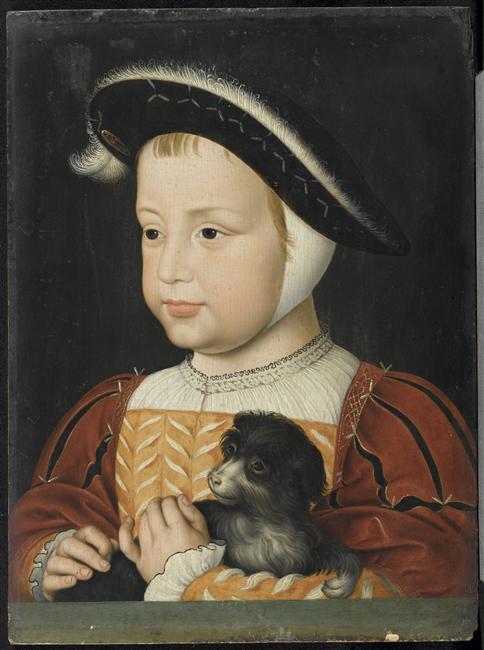
Henry as a child
Before his coronation at Reims on July 26, 1547, Henry II had already taken control of the government. He began by reforming courtly behavior, and in 1548 organized an expedition to Scotland to rescue the young Mary, Queen of Scots, from Protestant clutches. Henry II arranged for the young queen to be betrothed to his eldest son.
He also sent his favorite, Charles de Brissac, to gauge the intentions of Charles V. As strong in appearance as he was weak in character, the young king was influenced by several conflicting forces: Diane de Poitiers, Catherine de’ Medici, the Guise family, and the constable of Montmorency.
Henry II enlisted the service of Anne de Montmorency, who had fallen out of favor during the previous reign but was now rehabilitated as the king’s chief advisor. This arrogant, jealous, and staunch advocate of peace frequently clashed with the war-ready Guise family, the Cardinal of Lorraine, and the Calvinists. Throughout his reign, Henry II was caught between the intrigues of the Guise and Montmorency, and the counsel of his beloved mistress, Diane de Poitiers, satisfying his taste for controversies.
Domestic Reforms
Internally, Henry II established four State Secretariats to manage the geographical division of France. These officials handled military, financial, and judicial matters within their districts. In 1551, under the guise of relieving the parliaments, but with the true aim of fiscal management, Henry II created the présidiaux, courts that held judicial authority over bailiffs and seneschals.
This increase in judicial institutions encouraged litigation, already widespread, but did nothing to address the sluggishness of the justice system. Fiscal revolts, which were frequent, were harshly suppressed. By the end of Henry II’s reign, public debt had already reached 43 million livres tournois.
Henry II Against the Empire
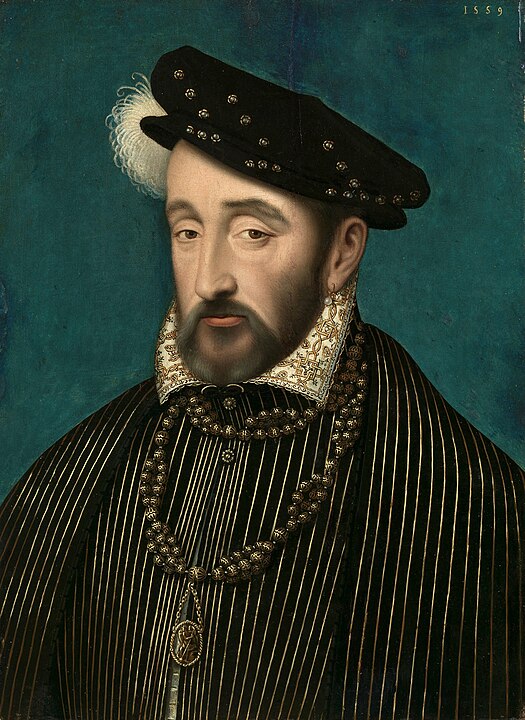
Henry II of France, 1559
In foreign policy, Henry II naturally focused more on France’s northern and eastern borders than on Italy. Humiliated during his childhood imprisonment by Charles V during the Italian Wars, he sought revenge upon becoming king.
He fought against the German princes of the Schmalkaldic League and, by allying with the Protestant German princes rebelling against Charles V through the Treaty of Chambord (January-February 1552), managed to capture the Three Bishoprics: Metz, Toul, and Verdun (1552), French-speaking territories. François de Guise, besieged at Metz (October 1552), brilliantly organized the defense and emerged victorious. However, though triumphant at Renty on August 13, 1554, the imperial forces were victorious in Italy the following year.
Exhausted by the war, the aging Charles V granted Henry II a five-year truce, the Truce of Vaucelles (February 1556), and soon after abdicated (September 1556). Besides retaining the Three Bishoprics, France was allowed to keep Piedmont. The truce, however, was short-lived, and war resumed in 1556, first at sea and then in Italy, where the French suffered a series of defeats.
Boulogne was nevertheless retaken by the French in 1556. The Duke of Savoy, Emmanuel-Philibert, a general in the service of the Empire, marched on Saint-Quentin. Montmorency was captured (August 1557), but Coligny cleverly took control of the city, holding the siege and stopping the Duke’s advance on Paris.
Henry II was defeated at Saint-Quentin (1557) by King Philip II of Spain. However, with the determination of François de Guise, who had just returned from Italy, Henry managed to recapture Calais (1558), which had been under English control for two centuries. Faced with financial difficulties and the Protestant issue, Henry II decided to end the Italian wars by signing the Peace of Cateau-Cambrésis (1559).
Through this treaty, France ceded Savoy, Bugey, Bresse, and Milan, but retained Pinerolo, the Marquisate of Saluzzo, Metz, Toul, Verdun, and Calais. Additionally, the treaty arranged the marriage of Henry II’s sister to the Duke of Savoy, and that of his daughter, Elizabeth, to Philip II, recently widowed of Mary Tudor.
The king then had a free hand to combat the Protestants. A devout and uncompromising Catholic, Henry II had pursued them from the beginning of his reign. In December, the king decided that all books printed in France or abroad had to be submitted for approval by the faculty of theology. Protestants caught in the clandestine practice of their worship faced the death penalty. Despite this strictness, Calvinism spread across France, and many nobles converted. In June 1559, the Edict of Ecouen urged the courts to punish Protestants who appeared before them with death. The Wars of Religion would begin a year later.
Henry II was the last French monarch to participate in jousting tournaments. During the celebrations held for the marriage of his daughter, Elisabeth, the king was mortally wounded in a tournament organized near the Tournelles on June 30, 1559, after being struck in the eye by a lance blow delivered by Montgomery, captain of his Scottish guard.
After a long and painful agony, he died on July 10, 1559. Having had ten children with Catherine de’ Medici, he left the throne to his fifteen-year-old son, François II.
Two of his other sons would reign under the names of Charles IX and Henry III.
Like his father, Henry II was a fervent patron of the arts, and his court was one of the most splendid in Europe. Ronsard and the Pléiade celebrated his triumphs. His tomb, along with that of his wife, can be found today in Saint-Denis.
King of Navarre and leader of the Huguenots during the Wars of Religion, Henry IV became King of France in 1589. The first sovereign of the Bourbon dynasty, he worked to pacify the kingdom (Edict of Nantes) and restore the authority of the monarchy, which had been weakened by civil war. Surrounded by capable ministers like Sully, Henry IV reorganized the Kingdom of France: the economy, finances, agriculture, and commerce were revived.
Everything was undertaken to make France a prosperous kingdom, reconnecting with artistic, cultural, and urban development. It was also during his reign that exploration and colonization of Quebec were reignited, with Samuel Champlain’s expeditions along the Saint Lawrence River. His assassination by Ravaillac on May 14, 1610, forged the legend of the “king with the white plume” and established him in popular imagery as one of the just and good monarchs.
Summary of Key Achievements
Ended the French Wars of Religion by defeating the Catholic League and securing the throne.
Issued the Edict of Nantes (1598), granting religious tolerance to Huguenots and ending decades of civil war.
Rebuilt France’s economy through effective financial reforms led by Sully, fostering agricultural growth and improving infrastructure.
Promoted urban development in Paris and cultural renewal, setting the stage for France’s later prominence in the arts and architecture.
Established the Bourbon dynasty, ensuring a lasting legacy for the French monarchy.
Henry: Child King of Navarre
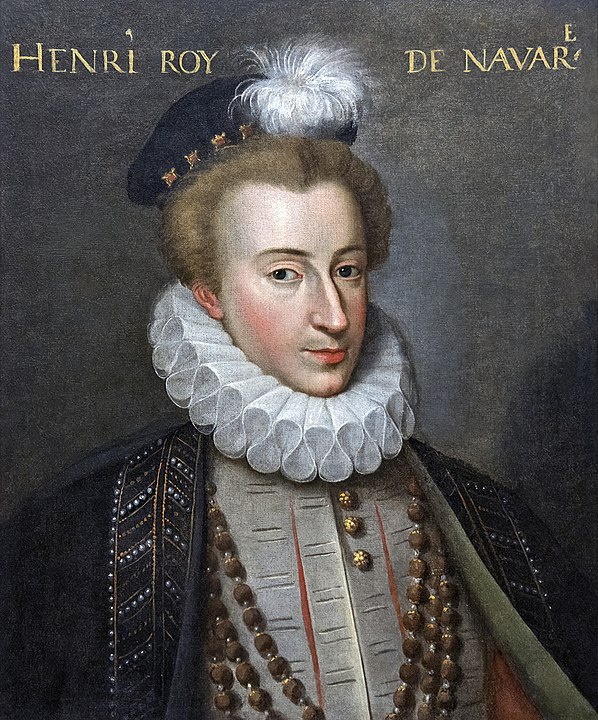
Portrait of Henry III of Navarre (future Henry IV of France), c. 1575. Credit: Public Domain
Born on December 13, 1553, Henry of Navarre was, in a way, an upstart, a “peasant from the Pyrenees,” a “Béarnais”—a king of operetta, caught between Spain and France. Yet, he was also the first prince of the blood, directly in line for the French throne as he was a descendant of Saint Louis through his father Antoine de Bourbon. From his childhood, after being raised in the fresh air of Béarn by his mother Jeanne d’Albret, he became a political pawn and was sent to the French Valois Court. He became a political hostage, a guarantee of alliance between the two kingdoms.
At the end of the 16th century, no one would have bet on the extinction of the ruling Valois line. Henry II, the son of Francis I, had numerous offspring with his wife, Catherine de’ Medici. However, this new generation would disappear, throwing the crown into a dark dynastic battle from which France would emerge exhausted.
The Rival of the Valois
At first, nothing foretold the future destiny of Henry IV. A scion of two illustrious families that had embraced the Reformation, this prince of the blood initially appeared, in the France of the Wars of Religion, as the natural leader of the Protestant party. A leader whose influence also rested on vast personal domains: those of the Albret family in the southwest, with the royal title of Navarre in Béarn, and those of Bourbon-Vendôme in the Loire Valley. His youth was marked by the political confusion that prevailed during the early wars.
Raised at the French court alongside his royal cousins, he nevertheless took part in Protestant military campaigns in 1567 and 1569. Three years later, as the newly married King of Navarre to the dazzling Marguerite de Valois, he escaped the St. Bartholomew’s Day massacre by renouncing Protestantism. In 1576, at the age of 23, he fled from Paris, where he had been held semi-captive as a political hostage, to regain his Reformed faith and contest with Condé, his relative, for leadership of the Huguenot party.
Allied with the king’s intriguing brother and his discontented Catholic friends, he appeared at that time as a great feudal lord, taking advantage of the circumstances to expand his personal authority. It was only after the death of Monsieur (the king’s brother) in 1584, which designated him as the future King of France, that events gradually revealed his statesmanship. In the War of the Three Henrys, the Béarnais fought to assert his rights but always strove, even against King Henry III, to appear as a defender of the public good rather than a party leader, at the risk of displeasing some of his fellow Protestants.
As leader of the Huguenots from 1569, during the La Rochelle assembly, he waged open war against the King of France. However, lacking heirs and threatened by the rising power of the House of Lorraine and the Guises, Henry III sought rapprochement with Henry of Navarre.
Henry III barely had time to have the Duke of Guise assassinated before he fell to the dagger of the monk Jacques Clément. As the designated heir, Henry IV would need to be patient to reconquer the throne of France starting in 1589. Cunning and strategic, these qualities made him a feared and respected war leader. Only Paris proved a real challenge, as the city, fanatical under the influence of monks and the Catholic League, only surrendered when he converted to Catholicism and was recognized as king in 1594.
His religious versatility could be seen as political opportunism. As a child, his mother Jeanne d’Albret initiated him into Calvinism. However, Henry IV was never to be Saint Louis and held a certain detachment towards religion that allowed him great tolerance. His numerous conversions and switches between Catholicism and Protestantism are well-documented. His Protestant supporters were quite displeased with his conversion in pursuit of the French crown. Nevertheless, he issued the Edict of Nantes on April 13, 1598, converted to Catholicism, and thus managed to temporarily resolve the issue of the Wars of Religion.
This versatility extended to his relationships with women. Politically married to Marguerite de Valois, Henry IV was a prisoner of his passions and could not help but make promises, including marriage, to various lovers—such as Gabrielle d’Estrées. However, Henry was already married and embarked on a long process of separation from Margot. Imprisoned and in exile, the Valois heiress refused to cede her place to scheming adventurers, doing everything possible to delay the process. She ultimately agreed to step aside for Marie de’ Medici, the “banker’s daughter.”
France in 1598
After forty years of crisis and civil war, France found itself in deep material and moral disorder. The demographic bloodletting was particularly serious because it was accompanied by economic ruin. The constant movement of soldiers ravaged the countryside. In certain provinces, farms and villages were half-deserted, fields left untended, livestock destroyed, and famine loomed. Cities were overcrowded with refugees, unemployed people, the sick, and the roads were filled with vagabonds, beggars, and soldiers turned bandits.
While the common people suffered greatly and the lesser nobility likely lost more than they gained from the turmoil, the high aristocracy benefited significantly, and the financiers made handsome profits. However, the biggest winner was the legal bourgeoisie: as the main support of the third party, which ultimately imposed a compromise solution in the name of public good, they gained a sense of class consciousness and an enhancement of their social prestige.
The monarchy as an institution emerged significantly weakened from the crisis. The kingdom was fractured. Cities, divided between factions, had grown accustomed to and enjoyed self-administration. Entire provinces, in the hands of governors who had become all-powerful during the troubles, escaped the king’s authority. Financially, the monarchy was in dire straits. Under Henry III, taxes had risen considerably, but they were not being collected, either because people refused to pay or because the money, intercepted in the general anarchy, never reached the treasury. Officials, feeling they had a greater sense of public duty than the monarchy, were tempted to increase their role in the state, and parliaments sought to control the functioning of institutions.
A clear sign of the weakening royal power was the need to convene the Estates General on four occasions (1560, 1576, 1588, and 1593) after not having been called since 1484. A theoretical challenge to absolutism emerged. Protestants, as early as 1573, had proclaimed the right of subjects to rise against a tyrannical sovereign. Among the ranks of the Catholic League, there were theorists of tyrannicide who legitimized the murder of a king when he failed to uphold his coronation oath to defend the Catholic faith.
The Work of Henry IV
Upon taking power, Henry IV first decided to reunite Navarre with France, a union that would be formalized during the Revolution. However, his most urgent task was to reassure his former Huguenot coreligionists and establish peaceful coexistence between the two faiths. The Edict of Nantes (1598) granted Protestants civil equality, full freedom of conscience, regulated their worship, and provided significant political privileges, including mixed chambers of justice and about a hundred fortified towns as “places of safety.”
This solution made Protestantism just another particularism among many in the vast mosaic of particularisms and privileges that constituted Ancien Régime society. The Huguenots gained a legal status, but Protestantism risked losing its soul: confined in a legal framework, it became demobilized and dormant just as the fruits of the Counter-Reformation were giving rise to a renewed, dynamic, and militant Catholicism.
With peace restored among the French, Henry IV turned to rebuilding the kingdom. Through a skillful mix of firmness and leniency, he restored royal authority over the feudal lords, provincial estates, and urban communities. Marshal Biron, a former companion-in-arms who conspired with Spain, was executed in 1602, and the ever-conspiring Duke of Bouillon was forced to submit in 1606. But until the end of his reign, the king continued to battle the legalism of the magistrates, seeking to curtail the powers of parliaments and other sovereign courts. Prudent financial management and indirect taxation, under the supervision of Sully, allowed for a moderation of the taille (direct tax) and the accumulation of a significant royal treasure at the Bastille. However, Sully’s economic achievements were likely overestimated.
As a country gentleman, Sully primarily promoted agriculture and, as a grand surveyor, sponsored large public works projects (roads, bridges, canals, etc.). Meanwhile, Barthélémy de Laffemas laid the groundwork for industrial and commercial mercantilism, which, systematized by Antoine de Montchrestien in 1615, would inspire the economic thought and actions of Richelieu and later Colbert. In Paris, significant urban planning projects were undertaken, such as the development of the Marais district, the Place Royale (now Place des Vosges), the Pont-Neuf, and the Place Dauphine. Architectural achievements continued the Valois tradition at the Louvre, the Tuileries, Fontainebleau, and Saint-Germain.
Externally, the Béarnais king continued the anti-Habsburg policy of his predecessors. In 1601, he forced Savoy, Spain’s traditional ally, to cede Bresse and the Pays de Gex. Although he was unable to prevent the United Provinces from signing the Twelve Years’ Truce with Spain in 1609, he took advantage of every incident in the Empire to strengthen his alliance with Protestant princes. He was likely on the verge of resuming the war against the Habsburgs when he was assassinated by Ravaillac.
The Legend of “Good King Henry”
On May 14, 1610, in Rue de la Ferronnerie in Paris, Henry IV met his fate with legend. François Ravaillac committed the ultimate crime by assassinating a king consecrated and anointed by God. Although his punishment was widely discussed, Henry IV’s death was met with relative calm in France. By 1610, many French citizens had complaints about the king. The proverbial “chicken in the pot” was not in their dishes every Sunday, and despite his common sense and simplicity, Henry IV was far from being a unifying and beloved figure. Peasant unrest, opposition from both extreme Catholics and Protestants, and other discontent explain the tragic end of the “Green Gallant.”
To be sure, he was appreciated for restoring peace, and his personal qualities made him likable. A fine horseman, bold soldier, and cheerful companion, Henry, like a true gentleman of his time, enjoyed the countryside, hunting, and rural life.
His sturdy rusticity contrasted pleasantly with the refined, somewhat morbid elegance of the last Valois kings. Jealous of his authority, but charming and persuasive, he preferred seduction to coercion. But he had flaws: sometimes careless, often forgetful (of friends and foes alike), and above all, an incorrigible lover. Before and after his remarriage to Marie de’ Medici in 1600, he had countless mistresses, occasionally sacrificing state matters for their sake.
The public criticized the king’s behavior, but they had other grievances as well. The nobility, although beneficiaries of his reign, felt too tightly controlled. Magistrates complained of his authoritarianism, and parliaments, traditional defenders of Gallican Church liberties, hesitated to register both the Edict of Nantes and the concessions made to the Pope and the Jesuits. The common people, who rejoiced at the end of the civil wars in 1598, found by 1610 that taxes were too high, the “chicken in the pot” too rare, and the rumors of war very alarming.
While Protestants accused the king of betraying his faith, many Catholics doubted the sincerity of his conversion. As for the League’s nostalgics, they saw his plans against Spain as a betrayal of Catholicism and glorified tyrannicide. The surest proof of the persistent hostility toward the Béarnais king was the number of plots and assassination attempts he survived before succumbing to Ravaillac’s dagger. But his death, by conferring upon him the aura of a martyr, restored the love of his people and secured his place in legend.
Henry III, King of France from 1574 to 1589, was the last ruler of the Valois dynasty. The fourth son of Henry II and Catherine de’ Medici, he was not initially destined to reign.
A skilled legislator, he exhibited a strong desire for national unity in a France then torn apart by the French Wars of Religion. Intelligent and cultured, this monarch left behind a mixed legacy, at times overshadowed by a “black legend” that includes homophobia and accusations of inconsistency, even tyranny. Beyond these perceptions, his political actions allowed his successor, Henry of Navarre, to end the civil war. Henry III was assassinated on August 1, 1589, by the fanatical Dominican monk Jacques Clément.
Key Achievements and Events
Last Valois King: Henry III was the last monarch of the Valois dynasty, which had ruled France for over two centuries.
Religious Conflict: His reign was dominated by the French Wars of Religion, which saw ongoing conflict between Catholics and Protestants.
The War of the Three Henrys: A complex three-way power struggle between Henry III, Henry of Navarre, and Henry, Duke of Guise.
Assassination of the Duke of Guise: In 1588, Henry III ordered the assassination of his rival, Henry of Guise, leading to his excommunication and alienation from Catholic factions.
Alliance with Henry of Navarre: His alliance with Henry of Navarre marked a pragmatic, albeit controversial, attempt to restore order to France.
Assassination in 1589: Henry III was assassinated by a Catholic fanatic, marking the end of the Valois dynasty.
The Duke of Anjou: The Future Henry III
Born on September 19, 1551, Henry of France was the fourth son of King Henry II and Catherine de’ Medici. Initially, he was baptized with the name Alexandre-Édouard. The choice of the name Édouard was no accident and encapsulated the political and religious contradictions that troubled France at the time. He received the title of Duke of Anjou.
Édouard, an unusual name among the Valois, was a tribute to the child’s godfather, the adolescent King Edward VI of England, a country leaning towards Calvinist reform. Although King Henry II was at the forefront of Protestant repression, he still maintained a strong sense of political pragmatism. England could be a valuable ally in the struggle against the Habsburgs, and this gesture might also appeal to the increasingly influential Huguenot nobility.
Alexandre-Édouard, who became Henry in 1565, spent his childhood, like his siblings, away from his parents in Blois. Nevertheless, his mother, Catherine de’ Medici, a true Florentine, ensured that her son received a refined education typical of the Renaissance. His tutor (also the tutor of his elder brother, the future Charles IX) was Jacques Amyot. A true fountain of knowledge, Amyot, a Plutarch specialist, recognized in the young Valois the qualities that would make him a cultured and eloquent ruler: “one of the best speakers of his century.”
The young prince was quickly involved in royal power, attending his first Estates General at the age of seven (in 1560). As Catherine’s favorite child, an accomplished swordsman, and endowed with a striking presence, it was only natural that he was appointed Lieutenant General of the kingdom at the age of sixteen, thus beginning his political career.
In the Turmoil of the Wars of Religion
Henry III in preparation to besiege Paris in 1589. Credit: HAL, Public Domain
As the second most powerful military leader in France after his brother, King Charles IX, Henry made an enemy of the leader of the Protestant party, the formidable Prince of Condé, who coveted the same position. Their rift led to Condé’s departure from court and the start of the second war of religion in 1567.
Concerned with protecting royal authority, Henry proved himself a competent general, notably winning the Battle of Jarnac, which resulted in the tragic death of Prince of Condé. His rising influence began to overshadow King Charles IX, leading to discord between the brothers and pushing Henry towards the camp of the Duke of Guise (a family of Lorraine origin that was then essential), the champion of ultra-Catholicism.
While Charles advocated for reconciliation with the reformers (likely due to the influence of his Protestant friend Admiral de Coligny), Henry favored a firmer stance. In his mind, it was already clear that royal authority could not tolerate any dissidence, whether religious or otherwise.
Henry’s involvement in the St. Bartholomew’s Day Massacre (the last days of August 1572) remains controversial. Caught between the extremism of the Catholic League and the Guise supporters, and his duty to maintain order (in a rebellious Paris overwhelmed by religious fanaticism), he was also preoccupied with more distant events. Henry was no longer content to be second in the kingdom, and a crown now seemed within his reach.
On July 7, 1572, Sigismund Augustus Jagiellon, King of Poland-Lithuania, died. The state he governed was quite unique within Christendom. This nobility-led republic, ethnically and religiously diverse, elected its kings. A significant portion of the Polish nobility was Protestant, and Henry sought to secure their support in the upcoming election.
Thus, it seems unlikely that he would have incited the populace to massacre the reformers on August 24, 1572. After further battles against the Protestant party (as the Wars of Religion resumed their bloody course), including a failed siege of La Rochelle, the prince, while in the midst of a romance with Marie de Clèves, was elected King of Poland. On August 19, 1573, a Polish delegation came to meet the future king and present him with the laws of his future realm.
Henry, who, like all Valois, was in favor of strong royal authority, had to adjust to the realities of the Polish-Lithuanian Commonwealth. The new king was thus forced to sign the Henrician Articles, a set of laws that required him to cease persecuting Protestants in France and to respect religious tolerance. Aware that his royal powers would be severely limited, Henry took his time departing for Krakow, only arriving in February 1574…
From King of Poland to King of France
Escape of Henry III from Poland, by Artur Grottger, 1860. Credit: Wikimedia
The young king, well aware of the necessity of religious tolerance within his new states, could not tolerate the independence of the Diet and the nobility. He tried by all means to strengthen his authority, without fully succeeding, despite his deep involvement in his new duties. Henry had to admit that he “reigned but did not govern.”
On June 14, 1574, he learned of the death of his brother, Charles IX, of whom he was the heir. On the 18th, he secretly left Poland for the kingdom of France, where he intended to rule in the manner of his model: Francis I. After a dramatic escape (which would earn him a dark legend in Poland) and a journey filled with celebrations fit for his status, Henry arrived in France in September 1574.
He was crowned king on February 13, 1575, marrying two days later Louise de Vaudémont-Nomény, a beautiful princess from Lorraine, but most importantly, close to the Guise faction. Henry III knew the magnitude of the task ahead: restoring peace and harmony within the kingdom, a necessary prerequisite for consolidating royal power, meant he had to win the favor of both the ultra-Catholics and their Huguenot enemies.
Unfortunately for the king, his younger brother, the Duke of Alençon, tipped the balance in favor of the Protestant party when he allied with Henry of Navarre (the future Henry IV), who had entered armed rebellion. The resulting war turned into a disaster for the king, and he was forced by the Edict of Beaulieu (May 1576) to grant a very favorable peace to the Protestants. In response, the ultra-Catholic League emerged as a militant force.
With the Peace of Beaulieu, the king seemed worn out before he had even begun to reign. His brother, the guarantor of the alliance between moderate Catholics and Protestants, became the strongman of the kingdom, and the treasury was nearly empty. Nevertheless, Henry was not without options.
Capitalizing on the humiliation of the Catholics, the king positioned himself as their defender and protector, which allowed him to once again align with the Guises.
To obtain the financial means for his revenge, Henry convened the Estates General at Blois (1577), where he displayed great tactical skill. Faced with deputies who were already considering reforming the kingdom in a parliamentary direction, “When the Estates write, it is France itself that writes,” he exploited divisions and rivalries to bury any constitutional ambitions and reaffirmed himself as the undisputed leader of the Catholics. Despite his tenacity, he did not secure the financial resources he sought, a lesson his successors would remember in their relations with the parliamentarians.
Nevertheless, the war resumed shortly afterward (the sixth religious war, 1577), leading to a modest but real victory for the royal camp. The monarch had received support from his brother, who had temporarily shelved his ambitions.
With the Edict of Poitiers (1577), which ended the conflict, the Protestant camp was forced to make various concessions. It was time for Henry to consolidate his position through diplomacy. With the mediation of his ever-present mother Catherine, he initiated a rapprochement with Henry of Navarre while supporting his brother’s efforts in the Netherlands. These efforts had the advantage of uniting Catholics and Protestants in a common struggle against their hereditary enemy: the Habsburgs, something Henry IV would remember!
The War of the Three Henrys
1584: seven years of relative peace, seven years of consolidating royal authority, seven years of intense legislative work, and yet Henry knew his throne was in danger. After almost ten years of marriage to Louise of Lorraine, he still had no heir, and his brother, who had presented himself as a valuable successor, had died of tuberculosis.
The Valois dynasty seemed destined to extinguish. According to Salic Law, the crown would pass upon Henry III’s death to Henry of Navarre, the leader of the Protestant party. This was, of course, unacceptable to Catholic opinion, which exerted constant pressure on the king to appoint a Catholic successor. The city of Paris, entirely in the hands of the League, was dangerously restless.
The hour had come for the triumph of Duke Henry of Guise. Ultra-Catholic passions condemned Henry III to another war, as confirmed by the Treaty of Nemours (July 1585), where he committed to “driving the heretics out of the kingdom.”
This War of the Three Henrys (Henry III of Valois, Henry of Guise, and Henry of Navarre) involved three camps, not two. Although seemingly aligned with the ultra-Catholics, Henry III did not sever all ties with the Protestants. The king, eager to maintain the independence of his states, knew that the Duke of Guise was strongly supported by the Habsburgs. On the other hand, a total defeat of Navarre would overly benefit the ambitious Duke of Lorraine, whom the king did not like. Thus, Henry waged war with allies he despised (the Leaguers) against an enemy (Henry of Navarre) whom he respected.
The result was a confusing situation, with the king attempting to maintain a precarious balance between the belligerents. Any misstep could prove fatal.
Henry’s maneuvers eventually exasperated the Duke of Guise, who in May 1588 defied the king’s authority by entering Paris, where he was hailed by the Leaguers. Fearing a coup, the king sent his troops to Paris, sparking an insurrection, the famous Day of the Barricades on May 13, 1588.
Although he bought time by initiating negotiations with the Leaguers, the last of the Valois had made his decision. Henry of Guise had to disappear. Overwhelmed by the excesses of the Parisian Leaguers (whose practices and demands echoed those of Étienne Marcel’s supporters two centuries earlier), the duke posed a great danger to royal authority. Henry III feared above all that a victory for the League would bring an end to the centralizing efforts of France’s kings.
In 1588, Henry of Guise’s position weakened. With the reduction of generous Spanish subsidies (following, among other things, the defeat of the Invincible Armada), the duke lost his prestige. Fearing that the king might make peace with his rival, the King of Navarre, he resigned himself to negotiating with Henry III at the Estates General of Blois.
On December 23, 1588, during a royal council, the king ordered the assassination of the Duke of Guise by the “Forty-five,” his personal guard. This assassination ended the ambiguity of the royal position but also provoked the uprising of the League’s France. The king was condemned by the ultra-Catholics, who now called for the murder of the man they considered a “tyrant.”
Logically, Henry III saw no hope except in a complete reconciliation with Henry of Navarre, who emerged as his successor (under the tacit condition that he once again renounce Protestantism). The two Henrys would go on to besiege Paris together, which was controlled by the Leaguers, whose militias were equipped with Habsburg funds.
The king, stationed in Saint-Cloud, would not live to see the destruction of the League. On August 1, 1589, a fanatical monk named Jacques Clément, an agent of the Leaguers, assassinated Henry III with a knife. Thus ended the Valois dynasty…
Henry III: The Last of the Valois
As evidenced by his actions, Henry III always aimed to maintain and strengthen royal authority, despite an extremely unfavorable context. His complex personality and his shifts in stance (often dictated by circumstances) earned him an unenviable reputation. However, much of this reputation stems from the hateful propaganda spread during his time by his enemies.
He was said to be weak. He did, indeed, yield many times to pressures from the nobles, but he never failed to regain control afterward. He was said to be cowardly and effeminate. Fond of beauty, often surrounded by elegant young men (the famous “mignons”), he was certainly not a rugged medieval sovereign thirsty for glory. Yet, this is to forget too quickly his warrior youth and personal courage, amply demonstrated at Jarnac and Moncontour. As for the rumors about his sexuality (the notorious “pink legend”), they hardly hold up in light of his numerous female conquests.
He was said to be frivolous and immoral. While he certainly never denied his extravagant taste for festivities and the arts, he was also a devout king, concerned for the salvation of his soul, with remarkable displays of faith.
King Henry III, despite the challenges he faced, managed to govern and left behind a significant legislative legacy (the Code Henri III). He had a lofty view of royal authority and a modern conception of the state. He avoided the collapse of the French monarchy, leaving it to his successors to once again elevate it to a great power.
Agrippa d’Aubigné summarized the feelings of many French people of the time regarding the king: “Thus ends Henry the Third, a prince of pleasant conversation with his own, a lover of letters, more generous than any king, courageous in youth and then desired by all; in old age loved by few, who had many qualities of a king, wished for the throne before he had it, and worthy of the kingdom if only he had not reigned…“
Crowned at the age of five after a wave of illness wiped out three generations of his immediate family, King Louis XV of France ruled for fifty-nine years (1715–1774)—the second-longest reign in French history behind only his great-grandfather, Louis XIV. Celebrated in his youth as Louis le Bien-Aimé (“Louis the Well-Beloved”) when the entire country prayed at his sickbed in 1744, the monarch gradually squandered that popular affection through disastrous global wars, fiscal paralysis, and court scandals at Versailles. By the time he died of smallpox in 1774, his half-century on the throne had hollowed out the prestige of the absolute monarchy and set the stage for the French Revolution fifteen years later.
The Orphan Boy-King and the Golden Peace of Cardinal Fleury
Born at Versailles on February fifteenth, 1710, the young Duke of Anjou was never expected to wear the crown; three older males stood directly ahead of him in the line of succession. In a single tragic week in February and March 1712, however, a virulent measles epidemic killed both his mother, his father (the Duke of Burgundy), and his five-year-old older brother. Two-year-old Louis only survived because his devoted royal governess, the Duchess of Ventadour, literally locked the boy inside a bedroom and refused to let the royal physicians bleed him to death as they had his brother.
When the seventy-six-year-old Sun King died in September 1715, the five-year-old boy became King Louis XV under the Regency of his libertine cousin, Philippe, Duke of Orléans (1715–1723). After coming of age, the shy, intelligent young monarch made the wisest decision of his life: he entrusted the day-to-day governance of France for seventeen years (1726–1743) to his beloved childhood tutor, the septuagenarian Cardinal André-Hercule de Fleury:
Economic Stabilization: Following the collapse of John Law’s paper-money bubble in 1720, Fleury stabilized the gold and silver value of the French livre in 1726—giving France six decades of stable currency that fueled booming Atlantic port trade in Bordeaux and Nantes.
Paving the Royal Highways: Fleury and Controller-General Orry expanded the network of paved royal highways across France, initiated the peaceful diplomatic acquisition of the Duchy of Lorraine (which formally joined France in 1766), and kept taxes relatively stable until Fleury died at age eighty-nine in 1743.
1744: How “The Well-Beloved” Earned and Lost His Title
After Cardinal Fleury’s death, thirty-three-year-old Louis XV announced that just like Louis XIV, he would henceforth govern without a chief minister. During the War of the Austrian Succession (1740–1748), the King rode personally to the eastern front in August 1744—only to collapse in the city of Metz with a raging, life-threatening fever. As rumors spread that the young king was dying, thousands of ordinary Parisians wept in the streets and paid for six thousand Masses at Notre-Dame Cathedral for his recovery, spontaneous devotion that earned him the official title Louis le Bien-Aimé (“the Well-Beloved”). Months later, in May 1745, Louis XV and his thirteen-year-old son stood under cannon fire alongside Marshal Maurice de Saxe at the Battle of Fontenoy, winning the greatest French battlefield victory of the eighteenth century and conquering the entirety of the Austrian Netherlands (modern Belgium).
Then, at the Treaty of Aix-la-Chapelle (1748), Louis XV stunned his own subjects: desiring to act like a chivalrous Christian prince rather than a greedy merchant, he handed every single conquered Belgian city right back to Austria in exchange for almost nothing. Outraged Parisians who had paid heavy wartime taxes coined a biting street proverb that remained in the French language forever: “Bête comme la paix” (“As stupid as the peace”).
The Secret du Roi and the Disaster of the Seven Years’ War
Despite possessing a sharp, analytical mind and a passion for science, cartography, botany, and architecture, Louis XV suffered from crippling self-doubt and conflict avoidance in face-to-face cabinet meetings. Rather than firing ministers whose foreign policies he disagreed with, the King did something bizarre: beginning in the 1740s, he ran his own parallel, clandestine spy and diplomatic network behind the backs of his own official Foreign Ministers, known as the Secret du Roi (“The King’s Secret”)—often leading to comic chaos where an official French ambassador in Warsaw or Stockholm pushed one policy while the King’s secret agent in the exact same room pushed the exact opposite!
Guided by his brilliant official mistress, Madame de Pompadour, and Minister Choiseul, Louis XV executed the “Diplomatic Revolution” of 1756, abandoning France’s two-hundred-year hatred of the Austrian Habsburgs to ally with Vienna against Frederick the Great’s Prussia and Great Britain. The resulting Seven Years’ War (1756–1763) was an unmitigated geopolitical catastrophe for France:
Routed on land in Germany at the Battle of Rossbach (1757) and swept off the seas by the Royal Navy, France signed the humiliating Treaty of Paris (1763).
In a single stroke of the pen, Louis XV lost New France (Canada), all French territory east of the Mississippi River, and French political dominance in India to Great Britain, while ceding Louisiana west of the Mississippi to Spain—though Minister Choiseul did manage to rebuild the French Navy afterward and purchase the island of Corsica from Genoa in 1768 (just fifteen months before a boy named Napoleon Bonaparte was born there as a French subject!).
The Damiens Knife Attack, the Parlements, and “After Me, the Deluge”
At home, the final twenty years of Louis XV’s reign were consumed by a bitter constitutional war against the aristocratic high law courts, the Parlements, which repeatedly refused to register new royal tax decrees that would force wealthy nobles and clergy to pay their fair share of France’s crushing war debts. In January 1757, as the King walked to his carriage at Versailles, a mentally disturbed servant named Robert-François Damiens stepped out of the dark and stabbed Louis XV in the ribs with a small penknife. Although the thick winter coats saved the King from a serious wound, Damiens was subjected to a gruesome four-hour public execution by drawing and quartering at the Place de Grève that horrified Enlightenment writers like Voltaire.
In 1771, Louis XV and his tough Chancellor, René Nicolas de Maupeou, finally launched a bold royal coup against the noble judges—abolishing the obstructionist Parlements and replacing them with salaried courts so the Crown could reform taxes. Had that reform survived, the French monarchy might have avoided bankruptcy. However, when the sixty-four-year-old King contracted fatal smallpox at the Petit Trianon and died in agony on May tenth, 1774—so unpopular in death that his decaying coffin had to be driven at a fast trot through the dark night to the Abbey of Saint-Denis to avoid jeering crowds—his inexperienced nineteen-year-old grandson, Louis XVI, immediately made the fatal mistake of firing Maupeou and restoring the obstructive noble judges, fulfilling the famous fatalistic warning attributed to Louis XV and Pompadour: “Après moi, le déluge” (“After me, the flood”).
Elected King of Poland, Stanislas I Leszczyński was forced to give up his throne in 1709 but regained it after the death of Augustus II (1733). While he was supported by France, Spain, Sardinia, and Bavaria, his rival Augustus III (the deceased king’s son) received backing from Russia, Austria, and Saxony. This rivalry led to the War of the Polish Succession (1733-1735), at the end of which Stanislas renounced the Polish throne.
As compensation, he was granted the duchies of Lorraine and Bar. Constantly forced to flee, he was a philosopher, always in good spirits, and knew how to enjoy life, saying, “He who possesses much is not the happiest: it is he who desires little and knows how to enjoy what he has.” He was also the great-grandfather of three Kings of France: Louis XVI, Louis XVIII, and Charles X.
Summary of Key Achievements
King of Poland (1704–1709 and 1733–1736), though both reigns were marked by political conflict and eventual exile.
Duke of Lorraine (1737–1766), where he ruled with great success, promoting education, culture, and social welfare.
Cultural contributions, including the construction of the Place Stanislas in Nancy, which remains a symbol of his legacy.
His daughter, Marie Leszczynska, became the Queen of France through her marriage to Louis XV, linking Stanislas to one of Europe’s most powerful royal families.
Early Steps in Politics
King Stanisław I Leszczyński of Poland (1677-1766). Credit: Wikimedia, Public Domain
Stanislas Leszczyński was born on October 20, 1677, into an influential family belonging to the Polish nobility since the 16th century. His father was the Palatine of Poznań and the Grand Treasurer of the Crown, while his mother was the daughter of a renowned general who had defeated the Swedes and Cossacks. He studied in Leszno, Greater Poland, learning sciences, mathematics, and literature, and he spoke Latin, German, Italian, and French fluently. At 18, his educational journey took him to Vienna, Venice, Rome, Florence, and Paris, but he had to cut it short in 1696 due to the death of King John Sobieski.
Holding the title of Count of Leszno and acting as the governor of Poznań, he made his first political moves and sat in the senate. Stanislas was elected to the diet preparing for the final election of a new king. Facing two tough competitors (the Prince of Conti and the previous king’s son), he withdrew from the final vote and left the throne to the King of Saxony, Frederick Augustus, who was crowned in Krakow in September 1697 as Augustus II. Stanislas had the honor of offering the assembly’s condolences to the widow of King John Sobieski, impressing everyone with his oratory skills.
At 21, in May 1698, Stanislas married the daughter of a Polish magnate, Catherine Opalińska, who gave him two daughters: Anna in May 1699, and Maria in June 1703. Her dowry included sixty towns and one hundred fifty villages, giving him control of a vast estate when his father, Raphael III, died in 1703.
Stanislas Leszczyński: The Short-Lived King of Poland
Charles XII of Sweden refused to accept the alliance that Augustus II had signed with Russia and Denmark against him. Impressed by Stanislas’s good nature, Charles maneuvered to demonstrate Augustus II’s incapacity to rule and install Stanislas on the throne. This was accomplished on October 4, 1705, in Warsaw, but not without difficulty, as Augustus II attempted to kidnap Stanislas! The new King of Poland could rely on his “protector” until 1709, when Charles XII suffered a major defeat in Russia and fled to the Turks. With Russian and Saxon armies advancing on Warsaw, Stanislas had no choice but to abdicate.
While informing Charles XII, Stanislas took refuge in Stettin and later Stockholm. Unlike the optimistic and victorious Swedish king, Stanislas knew that Poland would suffer more if he persisted. He had lost all his possessions and was now living as a refugee abroad. Meanwhile, Augustus II reclaimed Poland. Despite Charles XII’s insistence to hold on at any cost, Stanislas decided to join him in Turkey during the winter of 1712, disguised as a French officer.
After a complicated journey, including an arrest upon arrival and a quick release, Stanislas convinced the Swedish king to accept his abdication. In a moment of understanding, Charles XII offered him the Duchy of Zweibrücken in Germany as he waited to reclaim his Polish kingdom.
Stanislas traveled back through Vienna and Lorraine. In Lunéville, in need, he pawned his jewels. Despite using the alias “Count of Cronstein,” he was recognized by Mr. de Beauvau, loyal to the Duke of Lorraine, who allowed him to keep his jewels and lent him the estimated amount.
By early July 1714, Stanislas arrived in Zweibrücken and found an old castle. The income was 70,000 écus, but 400 Swedish troops in the garrison consumed much of it. Always good-natured, Stanislas adapted to this situation, and three months later, he brought over his wife and two daughters. He embraced this new peaceful life, despite the premature death of his eldest daughter in June 1717.
In Poland, Charles XII continued to push for Stanislas to reclaim the throne, although Augustus II attempted to capture him again in August 1717. After Charles XII’s death in late 1718, Stanislas was forced to relocate, first near Landau, then to Wissembourg in 1719, thanks to Regent Philippe d’Orléans, who granted him a pension of 4,000 livres a month. The Duke of Lorraine lent him an additional 30,000 livres
Lacking the funds to settle, Stanislas pawned his jewels again and proposed to Augustus II: he was ready to give up his crown if he could recover his property. He needed to marry off his second daughter, who had just turned 18. Suitors were scarce due to the family’s poverty, but Stanislas made peace with the situation, enjoying a happy affair with a French officer’s wife, philosophizing, hunting, and savoring the simple pleasures of life.
Father-in-Law to Louis XV
In France, after the departure of the Spanish Infanta, who was too young, seventeen candidates remained for Louis XV’s marriage, from an initial ninety-seven. Either they were not Catholic or, like Stanislas’s daughter, were too poor. The Duke of Bourbon, serving as regent after the death of Philippe d’Orléans, offered to marry Marie, and Stanislas was pleased with the outcome. In February 1725, a portrait painter for the royal court arrived and left with Marie’s portrait.
In early April, the Duke of Bourbon asked for her hand… on behalf of the King of France!
As Stanislas fainted, France was taken aback, but Louis XV was pleased with the portrait: “neither beautiful nor pretty, but with a fresh complexion, lively eyes, cultured, gentle in character, and kind-hearted like her father.” When Stanislas recovered, he reclaimed his pawned jewels with the help of a 13,000 livres loan from the Strasbourg government.
The marriage took place by proxy on August 15. Stanislas received good news in early September, thinking, “I lost the Polish throne, but my future grandson will ascend the throne of France,” and radiated with happiness. In 1729, Louis XV settled his in-laws at Chambord with a modest pension, but the castle was empty. Accustomed to having little, Stanislas managed his funds wisely, leaving much of the castle unfurnished. Life unfolded quietly between his devout wife, his mother indulging herself, his forest walks, and his readings. “We live in great tranquility, which makes my life sweet,” he said, having long given up on the Polish throne, as no one in France would act while Augustus II was still alive.
Stanislas Leszczynski Regains His Throne of Poland…
August II died in February 1733, and several candidates for the Polish throne emerged, including his son August III and Stanislas Poniatowski, a former loyal supporter of Stanislas Leszczynski. The Marquis de Monti, French ambassador to Poland, made every effort to help Stanislas reclaim his throne despite his exile. With the support of sympathizers, Monti spared no expense, explaining that Stanislas had the backing of the King of France, who would never invade Poland even though neighboring countries (Austria, Prussia, Russia) were threatening. He even assured that France was ready to defend Poland in case of an invasion by any member of the Treaty of the Three Black Eagles (Germany, Russia, and Prussia, who sought to prevent any Polish claimant from ascending the throne).
By March 1733, Monti requested that France send Stanislas to Poland, but he hesitated. While confident about reclaiming his throne, Stanislas was unsure of the reception he would receive from the Polish people. Brave and clear-sighted, he realized he didn’t have the support of the French Prime Minister; if war broke out, he couldn’t count on France’s aid. In August 1733, Stanislas set sail from Brest but was stopped in Copenhagen by the Tsarina, who blocked the roads.
Eventually, he disguised himself as a German merchant’s clerk and traveled by postal carriage. He arrived on September 8, just days before the election on September 11, which Monti had masterfully organized. On September 10, Stanislas was recognized leaving the embassy, and the public was ecstatic—no one had expected his presence! The next day, he was unanimously elected, with only three abstentions. Meanwhile, 5,000 Polish soldiers deserted!
A Master of Escapes
Barely elected and knowing the Russian army was advancing, Stanislas engaged in two glorious battles. But faced with the overwhelming number of attackers and lacking a regular army, he left Warsaw on September 22, heading to Danzig, where he awaited help from France.
That help would never arrive. Louis XV had decided to declare war on Emperor Charles VI (an ally of the Russians invading Poland), stationing his troops on the German-Italian border. Thus began the “War of the Polish Succession.” On October 5, 1733, August III was crowned with the support of 40,000 Russians, 20,000 Saxons ravaging the country, and 36,000 soldiers advancing on Danzig!
Finally, reinforcements arrived in April 1734—but with only 1,950 men, each with 20 bullets!
They quickly retreated, showing “good sense” in the face of the overwhelming enemy forces. As the Russians issued an ultimatum—”For the freedom of Danzig, hand over the King of Poland or let him flee”—the city continued to fight despite the soldiers’ exhaustion. In late June, the ambassador organized an evacuation plan: slipping past enemy posts, crossing the Vistula River, and reaching Prussia.
Furious that Cardinal Fleury had refused to send more help, Stanislas fled once again, maintaining his good humor. Assisted by a Swedish general, both disguised as peasants, he undertook a perilous journey. Along the way, the Polish king, who was also the French king’s father-in-law, was reprimanded by his guides. This was no time for royal airs—it was no longer about keeping the throne but saving his life, as enemies were everywhere, and a hefty reward had been offered for his capture, “dead or alive.”
The escape took over a week, traversing canals and moving from farm to farm, hidden in carts covered with goods. Eventually, he reached safety and was welcomed by the King of Prussia in Königsberg in early July. Frederick William I offered him an honor guard and a respectable pension. A few days later, Danzig capitulated, and Stanislas’ small band of loyalists was imprisoned in a castle near Marienburg by the Russian army.
In Versailles, no one dared tell the Queen of France the full story, to the point where pamphlets were printed in support of Stanislas! Meanwhile, the King of France signed a famous treaty known as the Pragmatic Sanction: Francis III, Duke of Lorraine, married Maria Theresa of Habsburg, ending the War of Polish Succession. France acquired the duchies of Bar and Lorraine, intending to install Stanislas there!
Stanislas Leszczynski Rules Over the Duchies of Bar and Lorraine
After two years of negotiations, Stanislas Leszczynski signed his abdication to the Polish throne on January 27, 1736, pressured and forced by Versailles. Even his daughter urged him to accept, explaining that Lorraine was close by, and though it wasn’t Poland, it was still a duchy where he wouldn’t be a king without a throne. Forced to sign the “secret declaration of Meudon” in early June, which stated, “His Polish Majesty, not wishing to burden himself with the administration of the finances and revenues of the duchies of Bar and Lorraine, leaves that responsibility to the King of France, from now and forever,” Stanislas was granted an annual income of 2,000,000 livres, a chancellor to manage affairs, and the honorary title of King of Poland. Stanislas would reign without ruling! As was his nature, he accepted this with philosophical grace.
Antoine Chaumont de la Galaizière, urged by Cardinal Fleury, took control of the duchies in February and March 1737, wielding full power. Stanislas made his official entrance into Lunéville on April 3 before a reluctant populace but reunited with an old acquaintance, Mr. de Beauvau, who had crossed his path 23 years earlier and set him up in his private mansion. Stanislas was happy and busied himself with restoring Lunéville Castle, which was uninhabitable, and furnishing the Bar Castle. Who would have thought he would reign over his duchies for 29 years and be beloved?
Stanislas “the Benevolent”
From the moment he arrived, though unwelcome, Stanislas Leszczynski got to work, establishing his Council of State, Finance, and Commerce. He spent his money on charitable works, fought against famine, created a form of social security to cope with unforeseen events like accidents, illness, or disability, and set up free legal consultations for the poor. In 1748, he founded an order of the Brothers of Schools and contributed to school maintenance, ensuring free education for several schools in Nancy. This kind man “smoothed the rough edges” when his chancellor imposed French laws.
Everything went smoothly until 1740 when the War of Austrian Succession began. Three years later, despite French armies stationed in Strasbourg, Stanislas fled Lunéville as the Germans advanced, seeking refuge in Metz. In 1746, he returned to Lorraine and took care of his castle, which had burned down in 1744. Queen Catherine died in March 1747, and the Marquise de Boufflers, nicknamed “the Lady of Pleasure,” became his mistress. Stanislas enjoyed life and, thanks to his passion for desserts, invented the “baba”: finding the kouglof too dry, he soaked it in rum. He was reunited with old escape companions: Thyange, the Chevalier de Solignac, Tercier, and he welcomed Montesquieu in 1747 and Voltaire in 1748-1749. His court was “more breathable” than Versailles, a haven of peace with a love for intellectual pursuits!
Architect of Lunéville and Nancy
Major works were undertaken at the Château de Lunéville, where he even created a throne room. He redesigned the gardens, installed a Turkish-inspired kiosk, a pavilion in the Chinese style, and in 1742, added a series of 88 automatons at the “Rock.” He also had the “Chartreuses” built for his favorite courtiers so they could host salons. Visitors came from far away to admire these wonders of Lunéville. All of this was gradually destroyed by Louis XV after the death of Stanislas, as the king wanted to transform the château into a military barracks!
In Nancy, he built the Church of Notre Dame de Bonsecours in 1738, unified the medieval Old Town and the New Town, and used his own funds to develop the Royal Square (future Place Stanislas), which was inaugurated in 1755. He also created a large public library, a Royal Society of Sciences and Fine Letters in 1750, and the Royal College of Medicine in 1752.
A Fatal Day for Lorraine
On February 5, 1766, Stanislas Leszczynski got too close to the fireplace, and the fur robe (a gift from his daughter) he was wearing caught fire. He tried to extinguish the flames but fell into the blaze.
By the time the guard managed to enter the room, it was too late: one side of Stanislas’s body was burned, and one of his hands was charred.
Stanislas died seventeen days later, on February 23, 1766, at the age of 88. His remains rest in the crypt of the Church of Notre Dame de Bonsecours, alongside his wife, Catherine Opalinska.
Following the agreements made with Louis XV, Nancy became part of France, and in 1831, the population installed a statue in his honor at the center of the Royal Square, with the inscription: “To Stanislas the Benefactor, from grateful Lorraine.”
While King Louis XIV shone at the center of the Palace of Versailles as the Sun King, the immense financial, industrial, and naval machinery that paid for those gilded halls and sustained France as the superpower of seventeenth-century Europe was built and operated by a tireless, black-clad workaholic sitting at a desk piled with ledgers: Jean-Baptiste Colbert. Serving as Controller-General of Finances, Secretary of State for the Navy, and Superintendent of Royal Buildings from the 1660s until his death in 1683, Colbert rescued the French monarchy from the brink of bankruptcy, laid the foundations of the modern French luxury economy, and codified the economic doctrine known to history as Colbertism.
Rise Under Mazarin and the Downfall of Nicolas Fouquet
Born in Reims in August 1619 into a family of prosperous wool and cloth merchants rather than the ancient sword nobility, Colbert possessed an unmatched genius for accounting, double-entry bookkeeping, and administrative detail. Entering the service of Cardinal Jules Mazarin—the chief minister who governed France during the minority of Louis XIV—Colbert managed the Cardinal’s vast personal fortune so brilliantly that on his deathbed in March 1661, Mazarin uttered a famous parting line to the twenty-two-year-old King: “Sire, I owe you everything, but I believe I acquit myself of some of that debt by giving you Colbert.”
Colbert’s first major strike on the King’s behalf occurred just five months later in August 1661. For years, the flamboyant Superintendent of Finances, Nicolas Fouquet, had enriched himself by skimming millions of livres from royal tax loans, using the fortune to build the magnificent Chateau de Vaux-le-Vicomte. Working in total secrecy with Louis XIV, Colbert combed through Fouquet’s hidden accounting registers and exposed the massive embezzlement. Weeks after Fouquet made the fatal mistake of hosting a lavish party at Vaux-le-Vicomte that outshone the King’s own palaces, Louis XIV had D’Artagnan, captain of the Musketeers, arrest Fouquet in Nantes, abolishing the corrupt office of Superintendent and placing the entire fiscal state in the incorruptible hands of Colbert, whom Madame de Sevigne nicknamed “Le Nord” (The North) for his icy, unyielding demeanor.
Colbertism: Mercantilism and the Luxury Industry Monopoly
Working sixteen hours a day starting at five-thirty every morning, Colbert operated under a strict mercantilist philosophy that became known across Europe as Colbertism. In Colbert’s worldview, the total amount of gold and silver bullion in the world was fixed; therefore, for France to grow powerful and wealthy, it had to maximize exports of high-value finished goods to foreign buyers while reducing imports of foreign luxury items to near zero, keeping every gold coin inside French borders.
At the time in the 1660s, French aristocrats spent millions of livres buying fine lace and mirrors from Venice, tapestries from Flanders, woolen broadcloth from England, and steel from Germany. Determined to make France completely self-sufficient and turn Paris into the undisputed capital of European taste, Colbert established hundreds of Royal Manufactories (Manufactures Royales), granting state subsidies, tax exemptions, and monopolies to skilled workshops. He consolidated the Gobelins tapestry works in Paris, established silk looms in Lyon, and even sent French industrial spies to the island of Murano in Venice to bribe master Italian glassmakers into sneaking away to France—founding the Royal Mirror Glass Manufactory of Saint-Gobain (which still exists today as a global industrial giant) and producing the three hundred and fifty-seven revolutionary glass mirrors that lined the Hall of Mirrors at Versailles. To guarantee world-class reputation, Colbert issued over one hundred and fifty strict quality-control decrees, ordering that any bolt of French cloth found with a weaving flaw be tied to a public post with the careless merchant’s name attached.
Building the French Navy, Canals, and Global Infrastructure
Recognizing that international trade required maritime power and efficient transport routes inside France, Colbert transformed the country’s physical infrastructure. He abolished dozens of internal medieval river tolls, paved royal highways, planted vast royal oak forests (such as the Tronçais forest, whose trees are still harvested for French cathedrals and wine barrels three centuries later) to guarantee future timber for warship hulls, and enthusiastically backed Pierre-Paul Riquet’s monumental construction of the Canal du Midi—a two-hundred-and-forty-kilometer waterway featuring over sixty locks that connected the Atlantic Ocean directly to the Mediterranean Sea across southern France without ships having to sail around hostile Spain.
When Colbert became Secretary of State for the Navy in 1669, France possessed fewer than twenty rotting, seaworthy warships while the Dutch and English ruled the waves. Within a decade, Colbert constructed modern naval arsenals and drydocks at Brest, Toulon, and Rochefort, founded schools of hydrography and naval gunnery, replaced chaotic impressment with a regulated maritime conscription system (the Inscription Maritime) that provided pensions for wounded sailors, and launched a battle fleet of nearly two hundred warships and galleys that challenged the combined fleets of England and the Netherlands.
Science, Culture, and the Exhausting Shadow of War
Beyond finance and ships, Colbert understood that cultural and scientific prestige was an instrument of state power. He founded the French Academy of Sciences (1666), the Paris Observatory, the Academy of Inscriptions and Belles-Lettres, the Academy of Architecture, and the French Academy in Rome, placing foreign geniuses like the Italian astronomer Giovanni Domenico Cassini and the Dutch physicist Christiaan Huygens on the French royal payroll. Simultaneously, as Minister of the Colonies, he chartered the French East and West India Companies, expanded New France in Canada down the Mississippi River—which explorers initially named the “Colbert River”—and drafted the infamous Code Noir regulating the French Caribbean colonies.
Despite raising royal revenues nearly threefold without raising the crushing peasant land tax (the taille) during his early years, Colbert’s final decade was a tragedy of frustration. Every million livres Colbert painstakingly saved through trade and accounting reform was immediately spent twice over by Louis XIV and Colbert’s bitter rival at court, the War Minister Louvois, on endless European wars and the bottomless construction expenses of Versailles. Worn out by kidney stones, overwork, and royal ingratitude, the sixty-four-year-old Colbert died on September sixth, 1683, reportedly murmuring on his deathbed that if he had done for God what he had done for that man (the King), he would have been saved twice over, whereas now he did not know what would become of him.
If King Louis XIV envisioned the French state as a grand theatrical stage of absolute royal power, the man who physically built that stage in limestone, marble, and gold leaf was his First Architect, Jules Hardouin-Mansart. Ruling over the royal building administration for the final three decades of the seventeenth century, Hardouin-Mansart transformed a modest hunting chateau at Versailles into the largest palace in Europe, crowned the skyline of Paris with the soaring golden Dome of Les Invalides, and designed the aristocratic urban geometry of the Place Vendôme and Place des Victoires—defining the stately, monumental architectural style known to the world as French Classicism.
Inheriting a Great Name and Winning the Sun King’s Eye
Born Jules Hardouin in Paris in April 1646 as the son of a royal court painter, the young boy received the ultimate architectural education from his famous great-uncle: François Mansart, the pioneer of French Baroque classicism who popularized the steep, double-pitched “mansard roof.” When the childless François Mansart died in 1666, he left his vast collection of architectural blueprints, drawings, and clients to his twenty-year-old great-nephew, who shrewdly added his great-uncle’s prestigious surname to his own in 1668 to become Jules Hardouin-Mansart.
Unlike his famously stubborn great-uncle François—who had lost royal commissions because he refused to stick to a budget and constantly tore down walls he had just built to fix minor proportions—young Jules Hardouin-Mansart was a charming courtier, a lightning-fast draftsman, and a master project manager. After designing the enchanting miniature Chateau de Clagny in 1674 for Louis XIV’s favorite mistress, Madame de Montespan, the twenty-nine-year-old architect won the complete trust of the Sun King, who appointed him chief architect of the Palace of Versailles in 1678 and later elevated him to Count of Sagonne and Superintendent of the King’s Buildings (Surintendant des Bâtiments).
Expanding Versailles: The Hall of Mirrors and the Grand Trianon
When Louis XIV decided in 1678 to move the entire French royal court and government permanently from Paris out to Versailles—requiring living and office quarters for over five thousand courtiers, ministers, and servants—it was Hardouin-Mansart who engineered the colossal expansion that quadrupled the size of Louis Le Vau’s earlier palace:
The Hall of Mirrors (Galerie des Glaces): Filling in an open central terrace overlooking the western gardens between 1678 and 1684, Hardouin-Mansart created a seventy-three-meter-long vaulted ceremonial gallery lit by seventeen tall arched windows on one side, matched on the opposite interior wall by seventeen arches holding 357 Venetian-style mirrors manufactured in France, all beneath ceiling frescoes painted by Charles Le Brun.
The North and South Wings and the Orangerie: He stretched the garden facade of the palace to an astonishing length of over four hundred meters by adding the vast North and South Wings, constructed the sunken vaulted masonry of the Royal Orangerie to shelter twelve hundred orange and palm trees in winter, and built the horseshoe-shaped Royal Stables facing the Place d’Armes.
The Grand Trianon and the Royal Chapel: When the King craved a quiet family retreat away from the exhausting etiquette of the main palace, Hardouin-Mansart built the single-story pink Languedoc-marble palace of the Grand Trianon (1687), and ended his career designing the soaring, white-and-gold two-story Royal Chapel of Versailles (completed in 1710, two years after his death).
Shaping Paris: The Dome of Les Invalides and Place Vendôme
While transforming Versailles, Hardouin-Mansart simultaneously left an indelible mark on the urban fabric of Paris. Commissioned by Louis XIV to add a royal monumental church to the southern end of the Hôtel des Invalides (the home and hospital for wounded war veterans), Hardouin-Mansart designed the Dome des Invalides (1679–1706). Inspired by St. Peter’s Basilica in Rome yet rising with distinctly French vertical elegance upon a Greek-cross floorplan, its gilded ribbed dome soared 107 meters (351 feet) into the Paris sky—serving originally as Louis XIV’s private royal chapel and becoming, in the nineteenth century, the monumental final resting place of Emperor Napoleon Bonaparte.
In the heart of the city, Hardouin-Mansart also pioneered modern urban square planning by designing two grand royal plazas centered around equestrian statues of Louis XIV: the circular Place des Victoires (1685) and the octagonal Place Vendôme (begun in 1699, originally called Place Louis-le-Grand), where he built the uniform, rhythmic stone facades with Corinthian pilasters and mansard roofs first, and then sold the lots behind the facades to wealthy financiers to build their mansions inside—creating a harmonious urban symmetry that still defines luxury Paris more than three centuries later.
Throughout the seventy-two-year reign of the Sun King, Louis XIV, as France waged war against nearly every major power in Europe simultaneously, the survival and expansion of the kingdom rested upon the geometric genius of one tireless soldier-scholar: Sebastien Le Prestre de Vauban. Rising from impoverished provincial nobility in Burgundy to become a Marshal of France, Vauban personally directed over forty major military sieges without a single failure while designing or upgrading more than one hundred and sixty fortresses around the perimeter of France. Yet beyond his mastery of stone bastions and gunpowder trenches, Vauban stood as one of the earliest Enlightenment humanitarians, econometrists, and brave truth-tellers at Versailles, famously risking royal disgrace at the end of his life to defend religious minorities and overtaxed peasants.
From Rebel Soldier to the King’s Chief Engineer
Born in May 1633 in the tiny village of Saint-Leger-de-Foucheret in the rugged Morvan hills of Burgundy, Vauban grew up in such genteel poverty that he walked barefoot with village peasant boys and educated himself in mathematics and geometry under the local parish priest. At the age of seventeen, during the civil war of the Fronde, he enlisted as a cadet in the rebellious regiment of the Prince of Conde, fighting against the royal army until he was captured in 1653. Recognizing the young Burgundian’s extraordinary talent for reading terrain and building earthworks, Cardinal Mazarin personally persuaded the twenty-year-old Vauban to switch sides and enter the service of the young King Louis XIV.
Over the next five decades, Vauban lived almost continuously on horseback and inside muddy siege trenches, traveling thousands of miles each year from the North Sea to the Pyrenees and the Rhine. His scarred face bore literal witness to his hands-on courage: during the 1667 siege of Douai, a Spanish musket ball tore across his left cheek, leaving a permanent scar that appears in all his portraits, and he was wounded seven more times throughout his career because he insisted on personally crawling out into no-man’s-land at night to inspect enemy moat defenses before sending a single French soldier forward.
Revolutionizing the Attack: Parallel Trenches and Ricochet Fire
Paradoxically, the man most famous for building unbreakable fortresses earned his initial fame by figuring out how to crack any fortress open with mathematical certainty and minimal loss of French blood. Before Vauban, seventeenth-century sieges were chaotic, bloody affairs in which infantry charged across open ground from narrow zig-zag trenches and suffered devastating casualties from defender counterattacks. At the famous Siege of Maastricht in 1673, Vauban unveiled his revolutionary system of the Three Parallels.
Instead of pushing narrow trenches straight forward alone, Vauban ordered thousands of sappers to dig three wide, concentric trench lines running completely parallel to the enemy fortress walls—the first at roughly six hundred yards out of musket range, the second at three hundred yards for heavy artillery batteries, and the third right at the foot of the enemy’s sloped glacis. Connected by zig-zag communication trenches that prevented enemy cannons from firing straight down them, these parallel lines allowed whole infantry battalions to sit safely underground right in front of the walls. Later, at the sieges of Philippsburg (1688) and Ath (1697), Vauban invented “ricochet fire”: loading cannons with precisely reduced gunpowder charges and elevating the barrels slightly so the iron cannonball barely cleared the top of an enemy bastion wall, bounced downward along the length of the hidden rampart walkway like a stone skipping across water, and smashed five or six enemy cannons and gun crews in a single shot. As a popular French military saying of the era put it: “A town besieged by Vauban is a town taken; a town defended by Vauban is an impregnable town.”
The Pre Carre and the Three Systems of Fortification
Whenever Vauban captured a border city, he immediately turned around and rebuilt its defenses to protect France against counter-invasion. Appalled by the chaotic, jagged northern border where French and Spanish-held towns were tangled together, Vauban wrote to War Minister Louvois in 1673 proposing the strategic doctrine of the Pre Carre—the “Square Field” or dueling meadow. Under Vauban’s plan, France gave up indefensible forward outposts and instead constructed a double line of interlocking, star-shaped fortresses stretching from Dunkirk on the English Channel to Sedan and down the Rhine through Strasbourg to Briancon in the Alps.
Refining the Italian trace italienne bastion style across three progressive engineering phases, Vauban abandoned tall, flat medieval stone walls that shattered easily under cannon fire. Instead, he sank his fortresses low into the earth so only a gently sloping grass mound called the glacis was visible to an approaching army. Behind that earthen slope lay a deep ditch, detached triangular islands of masonry called ravelins and half-moons, and five-sided projecting bastions engineered so that every single square inch of the moat was covered by interlocking crossfire from neighboring walls, leaving zero blind spots (“dead ground”) for an attacker to hide. In his masterpiece at Neuf-Brisach in Alsace—built using his “Third System”—he added multi-story vaulted stone artillery towers (tours bastionnees) recessed behind massive outer ramparts. Simultaneously, in 1687, Vauban transformed infantry warfare forever by inventing the socket bayonet: replacing the clumsy plug bayonet that jammed inside the musket barrel with a hollow iron collar that slipped around the outside of the muzzle, allowing a soldier to load and fire his musket even while his bayonet was fixed, permanently eliminating the pike from European armies.
The Royal Tithe and Courageous Dissent at Versailles
Because Vauban spent forty years crisscrossing rural France to hire tens of thousands of local masons, diggers, and carters for his fortresses, he knew the true economic misery of the ordinary French peasant far better than any silk-clad courtier sitting in the Hall of Mirrors at Versailles. Shocked by the famines of the 1690s, Vauban pioneered the science of modern statistics and national census-taking, designing pre-printed demographic forms and calculating how much grain France could produce per square league.
In 1689, four years after Louis XIV revoked the Edict of Nantes and outlawed Protestantism, Vauban courageously wrote a secret memoir to Louvois begging the King to restore religious freedom immediately, pointing out that persecuting the Huguenots had driven one hundred thousand skilled craftsmen, thirty million livres in coin, nine thousand of France’s best sailors, and six hundred veteran army officers straight into the armies and fleets of France’s enemies, while declaring boldly that the conversion of the human heart belongs to God alone. Finally, in early 1707, the seventy-three-year-old Marshal privately printed three hundred copies of his economic treatise La Dime Royale (The Royal Tithe). In it, Vauban exposed how the corrupt French tax system crushed starving peasants while the wealthiest nobles and clergy paid almost nothing, proposing to abolish all tax exemptions and replace them with a single, fair, flat income tax of five to ten percent paid equally by every subject in France—from the peasant to the dukes and princes of the blood. Outraged that anyone dared question the divine social order, the aging Louis XIV ordered the Royal Police to seize and pulp every copy of Vauban’s book on February fourteenth, 1707. Heartbroken by the royal condemnation of his life’s work to save France from bankruptcy, Vauban died in Paris just six weeks later on March thirtieth, 1707—though a century later Napoleon Bonaparte personally ordered Vauban’s heart enshrined beneath the dome of Les Invalides, and twelve of his surviving star fortresses stand today as a collective UNESCO World Heritage site.
Louis XIII (1601-1643) was a King of France from the Bourbon dynasty, nicknamed “the Just.” He reigned from 1610 to 1643. The eldest son of Henry IV, Louis XIII succeeded his father at the age of nine. His mother, Marie de’ Medici, served as regent. In 1624, he appointed Cardinal Richelieu as his principal minister.
From that point, the kingdom’s policies took a new direction: together, the king and the cardinal fought against the influence of the Habsburgs in Europe and limited the power of the nobility within the kingdom. They reduced the privileges enjoyed by Protestants since the issuance of the Edict of Nantes, which reignited the war between Catholics and Protestants. Louis XIII’s reign is marked by the establishment of a strong, centralized state, ushering in France’s “Grand Siècle.”
The Dauphin: Future Louis XIII
Louis was the son of Henry IV, King of France and Navarre, and Marie de’ Medici. He was not the first-born of the “Vert-Galant” (Henry IV), known for his numerous illegitimate offspring. The marriage between Henry IV and the Florentine princess was driven by diplomatic (preserving French influence in Italy), dynastic (providing the Bourbon lineage with an heir), and financial (canceling the kingdom’s debt to Florentine bankers) reasons. Personal feelings were secondary to these calculations, and Henry IV remained infatuated with his various mistresses.
The young Queen, who came from Florence with an extensive entourage (including her confidante and lady-in-waiting, the famous Leonora Dori, wife of Concino Concini, who will be discussed later), nevertheless fulfilled the dynastic hopes of the king. She bore him six children, of whom two sons reached adulthood: Louis and Gaston (the Duke of Orléans, known as Monsieur).
Louis’ childhood is well documented in the journal left by his doctor and friend, Jean Héroard. Raised at the Château of Saint-Germain-en-Laye, Louis shared his daily life with his siblings, both legitimate and illegitimate. The child had a keen interest in outdoor activities, hunting, and the arts, particularly dance and drawing.
The young Louis greatly admired his father, who was known for his love of children. However, the relationship between mother and son was much more distant. Marie, fond of pleasures and frivolity, made little effort to adapt to France and remained under the influence of her Italian favorites, the Concini couple. Additionally, she preferred her younger son Gaston, whom she considered more graceful and intelligent than Louis, whom she found unattractive and slow-witted.
Fascinated by military life, Louis was not the most diligent student but demonstrated a certain intelligence. Despite his speech impediment (he was a stutterer) and shyness, he was aware of his status and demanded respect. There is no doubt that the example of his father, an authoritative king, greatly influenced him.
May 1610: The Assassination of Henry IV
France was on the brink of war. For both diplomatic reasons (the succession of Cleves and Jülich) and domestic concerns (the flight of the Prince of Condé to Brussels), Henry IV planned to confront the Habsburgs once again. However, he never fulfilled his plan as he was assassinated on May 14, 1610, by Ravaillac, a disturbed fanatic who may have been manipulated by the ultra-Catholic faction opposed to the war.
Louis, still a child, experienced a trauma that would haunt him for the rest of his life. His mother, who had been officially crowned the day before, became the regent of the kingdom.
The Regency of Marie de Medici and Concini
Louis XIII. Image: Portrait by Philippe de Champaigne, c. 1635
Previously uninterested in governance, Marie de’ Medici quickly developed a taste for power. Favoring the pro-Spanish and ultra-Catholic faction, the regent pursued a policy of appeasement on the international stage. She successfully arranged the marriage of the Spanish Infanta, the beautiful Anne of Austria, to her son Louis, securing peace between the Bourbons and Habsburgs. However, Marie was ill-prepared to manage a kingdom still divided.
While the Protestant-Catholic conflict persisted, the main threat to the kingdom’s stability was the Grands—representatives of the most powerful aristocratic families, such as the Condé, Guise, Nevers, and Montmorency. In times of regency, when royal authority was perceived as weak, their influence grew. Furthermore, the Grands sought to take revenge on a monarchy that relied on the nobility of the robe (the administrative class) and the rising bourgeoisie.
Portrait by Philippe de Champaigne, c. 1635
This burgeoning bourgeoisie, with its growing wealth, increasingly accessed high offices, which at the time were purchasable. This system of venality of office was used by Henry IV to fill the state’s coffers. In response, the aristocracy maintained its dominance by deliberately fostering instability in the provinces, even to the point of rebellion. Faced with this challenge, Marie de’ Medici was forced to buy peace through generous pensions.
Additionally, the kingdom’s financial situation suffered from the regent’s extravagant spending on entertainment and the greed of the Concini couple, who became highly unpopular. Concino Concini, a minor Italian noble, displayed excessive ambition, acquiring prestigious titles and honors through his wife’s influence over the queen. He soon became the Marquis of Ancre and a Marshal of France, amassing immense wealth and controlling ministerial careers.
Despite his unpopularity, Concini remained a royal favorite, enjoying both the queen’s affection and trust. He was a key instrument of the monarchy’s absolutist tendencies, which did not go unnoticed by the Grands. They soon denounced Concini’s influence over the queen and retreated to their provinces, sowing the seeds of rebellion.
The Grands found an unexpected ally in the young king. Although, like his father, Louis was attached to the prestige of the monarchy and disliked the nobility’s pretensions, he harbored a fierce hatred for Concini. The Italian favorite openly scorned the king and wounded his adolescent pride. When Louis appealed to his mother, he found only further humiliation. This was a dark time for the young king, who began to suffer from the illness that would plague him throughout his life—likely Crohn’s disease, a severe intestinal condition.
Despite the often unbearable pain, Louis was determined to assert himself as king. In secret, this shy and brooding fifteen-year-old prepared Concini’s downfall. He could count on the help of several supporters, notably Charles d’Albert, the future Duke of Luynes. A minor noble and France’s Grand Falconer, he had become Louis’ best friend, sharing a passion for hunting. This relationship reflects Louis’ tendency to form close bonds with male friends and father figures.
On April 24, 1617, Concini was arrested at the Louvre and assassinated by conspirators on the pretext that he had resisted. Louis, who had not opposed the physical elimination of his favorite, simply declared, “At this hour, I am king.”
From Luynes to Richelieu
This coup d’état, or “majestic coup” as it was referred to at the time, reveals the strength of character of the man taking control of France’s destiny. Louis XIII intended to be a king who ruled without sharing power. Nonetheless, with the elimination of Concini, it marked the triumph of Luynes. This new favorite, though lacking great talent, was charismatic and the primary beneficiary of the downfall of the Italian couple, taking advantage of the young king’s inexperience.
Blinded by his friendship with the grand falconer, Louis soon made Luynes a duke and peer, then a marshal (despite Luynes being a poor military leader). Such rapid success naturally led to jealousy and discontent among the nobility, as well as Queen Mother Marie de’ Medici, who saw Concini’s elimination, and especially that of his wife, as a personal affront. She held the belief that the king could not govern France without her “good counsel” and was resentful of her marginalization in Blois.
She soon took the lead of the discontented faction, gathering behind her the very nobles who had caused her so much trouble during her regency. After escaping Blois, Marie de’ Medici triggered two short civil wars, both of which she eventually lost.
At the heart of the negotiations that ended these “wars of mother and son” (from 1619 to 1620), one figure stood out: Armand du Plessis, Bishop of Luçon, the future Cardinal Richelieu. Originally one of Marie de’ Medici’s secretaries of state, the ambitious cleric skillfully maneuvered to bring peace back to the kingdom. Though Louis XIII was wary of him, he recognized that Richelieu shared his vision of royal authority and was equally hostile to religious or noble dissent. Louis would remember this…
From 1620 to 1621, the young king, having proven himself a capable captain during his recent campaigns, asserted his character and gained popularity with his people. He ended religious exceptionalism in Béarn (a Protestant state at the time) and turned his provincial travels into effective political communications. His entrances into towns were occasions to present himself as a sovereign who was both warrior and peacemaker, but above all, as a dispenser of justice—a role he cherished. He never missed an opportunity to position himself as the defender of the people against the greed of the nobility.
Louis’ authority grew even more during this period, especially after the death of his favorite, the Duke of Luynes, in 1621. With Luynes gone, Louis was freed from this cumbersome friendship, a vestige of his adolescence. However, the situation remained difficult for Henri IV’s son. Despite some affection for Anne of Austria, Louis had a distant relationship with her. He showed little interest in physical pleasures, likely unsettled by their unremarkable wedding night.
As a result, the king still had no heir, leaving the door open to various conspiracies. Meanwhile, the Protestants had risen in rebellion, supported by high-ranking aristocrats and foreign powers, notably England. Given this domestic unrest, the king could not take advantage of the Thirty Years’ War that had broken out within the Holy Roman Empire. His efforts were hampered by the hesitant leadership of his key ministers, whose incompetence paved the way for Cardinal Richelieu, who had patiently positioned himself and developed a coherent political program.
Louis XIII and Richelieu: Absolutism in Action
Cardinal Richelieu joined Louis XIII’s council in April 1624. Like the king, he advocated firmness towards both the nobility and the Protestants. Both men shared a vision of a regenerated Catholicism, shaped by the Counter-Reformation, characterized by deep spirituality and aligned with strong royal authority.
Jealous of their kingdom’s independence, the king and cardinal believed they should not be overly dependent on Rome and aimed to rival the Habsburgs. In this respect, they followed in the footsteps of the last Valois monarchs and Henri IV. Realizing this agenda would not be without challenges. The internal war against the Protestants was fueled by both the rebellion of certain nobles and the support they received from England. It wasn’t until 1628 that the citadel of La Rochelle surrendered.
The resulting peace treaty (the Peace of Alès in 1629), while confirming freedom of worship, abolished Protestant strongholds, a legacy of the Wars of Religion. This marked the first step in dismantling the Edict of Nantes, which would gradually lose its substance. It also affirmed royal power, which sought to assert control over military infrastructures.
The Era of Conspiracies
Marie de’ Medici confronts Cardinal Richelieu before Louis XIII. Image: Richelieu, Collection d’albums historiques, Paris: Boivin & Cie., p. 55 OCLC: 1012269.
Alongside their struggle against the Protestants, Louis XIII and Richelieu faced numerous noble conspiracies and revolts. At the center of many of these was the king’s younger brother, Gaston d’Orléans, known as “Monsieur,” and the Duchess of Chevreuse. Monsieur took every opportunity to trouble his brother in hopes of advancing his claim as the presumed heir to the throne, as seen in the Chalais conspiracy.
The stunning Duchess of Chevreuse, first married to Luynes and later to a Lorraine duke, managed to turn Anne of Austria against the king. Relations between the royal couple had soured. Louis struggled to show affection for his wife, while Anne opposed his anti-Spanish policies, even leaking military secrets to the Spanish court.
One of the most significant events of Louis XIII’s reign was the famous “Day of the Dupes” on November 10-11, 1630. On this occasion, Marie de Medici tried to turn her son away from Richelieu’s influence. At first, the king seemed to yield to her. Richelieu believed he was condemned to exile, while the queen mother and the nobility savored what they thought was their victory. But in the end, Louis XIII renewed his trust in Richelieu, appointing him as his principal minister and elevating his lands to a duchy-peerage. It was Marie de Medici who was forced to flee, and her supporters were imprisoned.
From 1626 to 1638 (the year of the birth of the heir to the throne, the future Louis XIV), there were at least half a dozen major plots, often leading to armed revolts. These revealed the tense context, driven by the assertion of royal authority. During this twelve-year period, France underwent numerous reforms. The king and cardinal rationalized and strengthened administration, ended certain feudal practices (such as dueling), developed the navy, commerce, and colonies, and oversaw cultural advancements. This period laid the groundwork for the reign of Louis XIV and the emergence of a modern state.
Struggle Against the Habsburgs and the Death of Louis XIII
In governing, the king and cardinal proved to be complementary. Where the king displayed audacity and firmness, the cardinal acted with caution and flexibility. Richelieu excelled at executing the king’s will, giving it the substance and pragmatism needed for success. The two men respected and valued each other, though a certain distance remained between them due to their differing personalities. Nevertheless, their partnership was a success, as demonstrated by France’s resurgence on the European stage. A warrior king, Louis XIII could not remain on the sidelines of the conflict ravaging the Holy Roman Empire. The Thirty Years’ War offered France an opportunity to weaken the Habsburgs that encircled it. Initially, France merely supported the enemies of Vienna and Madrid, particularly Sweden.
In 1635, this “cold war” ended when France declared war on Spain. It was a cruel and costly conflict. Due to their holdings in Franche-Comté, Milan, and the Netherlands (modern Belgium and part of northern France), the Spanish were able to strike at all French borders. Habsburg troops could rely on numerous allies and betrayals. The early years were tough for French forces. The king, commanding in person, did not spare himself and worsened his already fragile health.
It was during this difficult time that Louis became a father. The birth of Louis Dieudonné (a revealing name) was seen as a miracle. In a great act of piety, so characteristic of his fervent faith, Louis even consecrated his kingdom to the Virgin Mary. The following years saw the tide of the war turn in France’s favor, but neither Richelieu nor the king would live to see its end. Armand du Plessis died in December 1642, having ensured his succession through another cardinal: Mazarin. As for Louis XIII, exhausted by war and overwhelmed by illness, he died on May 14, 1643, exactly 33 years after the death of his father.
The Reign of Louis XIII: What is the Legacy?
France in 1643 is heavily burdened by the king’s ambitious policies. The countryside, the cities, commerce, and productive activities have all suffered from continuous wars and revolts. The tax system struggles to bear the military expenses as well as those of an administration that is still in its infancy. And yet, France in 1643 is on the verge of becoming the leading European power of the Grand Siècle. The kingdom has managed to preserve its independence against the Habsburgs and even break free from the encirclement they had imposed. Spain and Austria are exhausted, in decline… Strategic territories (Artois, Roussillon, part of Alsace) have been conquered by French troops.
Domestically, royal authority has progressively asserted itself against the nobles, the Protestants, and various troublemakers. The kingdom’s unity has never been so strong. Key infrastructures and administrative systems crucial for development have been reinforced. Ultimately, a modern monarchical state emerges under Louis XIII. It is true that this king, with his somber appearance, few words, and brooding nature, never garnered the affection his father did, nor did he shine as much as his son Louis XIV. Yet, he was the last French king to be mourned by his people, who considered him worthy of his title: “the Just.”
Charles VII (1403-1461), known as “the Victorious”, was a king of France from the Valois dynasty. His reign, which lasted nearly forty years (1422-1461), is inseparable from the end of the Hundred Years’ War. It covers one of the richest periods of events in French history and could also be seen as a time when the Capetian dynasty appeared on the brink of disappearing. The epic of Joan of Arc allowed the “King of Bourges” to regain his throne and legitimacy, initiating the reconquest of his kingdom from the English.
Having become Charles VII the Victorious, he would long remain in the shadow of the glory of the Maid of Orléans. This once-overlooked sovereign, now rehabilitated, restored the authority of the monarchy in France, reforming and modernizing finances and the military.
Charles VII: The “Little King of Bourges”
The son of Charles VI the Mad and Isabeau of Bavaria, Charles became dauphin in 1417 after the suspicious deaths of his two elder brothers. He appeared frail and ill-equipped to bear the heavy responsibility of restoring the name and prestige of a faltering monarchy. Expelled from Paris during the struggle between the Armagnacs and the Burgundians, he took refuge in Bourges, where he maintained a small court with his last loyal followers. Meanwhile, the King of England seized Normandy, and John the Fearless, Duke of Burgundy, took control of the government by allying with his mother, Isabeau of Bavaria, who had declared Charles a “bastard.”
John the Fearless attempted to secure an alliance with the dauphin to control him. However, their meeting at Montereau degenerated into an altercation, and John the Fearless was killed. The vengeance of the new Duke of Burgundy, Philip the Good, and Isabeau of Bavaria fell upon Charles. He was disinherited in favor of the King of England, Henry V, through the Treaty of Troyes (1420), signed by Isabeau and Charles VI, who was no longer in full possession of his faculties.
Henry V claimed the crown of France while preserving its institutions. Isabeau of Bavaria resisted in vain. The premature death of Henry V on August 31, 1422, followed by the death of Charles VI on October 21, did nothing to change the dual Lancastrian monarchy, which passed to Henry VI, with the Duke of Bedford acting as regent. However, the dauphin now claimed the throne as Charles VII, and the war for the crown began.
Yolande of Aragon and the Victory at La Brossinière
Charles VII of France. Image: Wikimedia, Public Domains
Charles, with a rather lackluster character, was poorly surrounded and placed too much blind trust in unreliable advisors who cast no shadow over him, unlike the flamboyant lords of the time. The young Charles found providential support in Yolande of Aragon, the wife of the Duke of Anjou, who happened to be his mother-in-law. Through patient effort, Yolande forged alliances and reconciliations to present a united front against the invader.
In 1423, the Battle of La Brossinière marked the first significant victory for the French armies. After a raid led by the Duke of Suffolk, Lord William Pole, across Maine and Anjou, Queen Yolande of Aragon convinced several supporters of her son-in-law, the King of France, to intervene militarily to avenge the damage done. Ambroise de Loré, along with John VIII of Harcourt, Count of Aumale and Mortain, among others, gathered their troops and prepared an ambush on the return path of the English.
After a brief skirmish between scouts, the French knights charged in battle formation, forcing the English to dismount. Despite solid resistance, the English troops were decimated, and few soldiers escaped French reprisals. This victory marked the starting point for a gradual reconquest of French lands.
Joan of Arc and Charles the Victorious
Joan of Arc at the coronation of Charles VII with her white flag. Image: Wikimedia, Public Domains
Militarily, the situation remained precarious despite the success at La Brossinière. The English won several victories near Crevant (1423) and Verneuil (1424). Most notably, they laid siege to Orléans. If the city fell, the English would gain access to the south of the Loire and reach Charles in his last refuge. It was at this moment that a young shepherdess from Lorraine, Joan of Arc, intervened providentially.
Charles regained his legitimacy only after being recognized by Joan of Arc, who liberated Orléans (1429) and had him crowned at Reims on July 17, 1429. Together with Joan, he undertook the reconquest of the kingdom, partly occupied by the English and their Burgundian allies. While they succeeded in reclaiming parts of the regions north of the Loire, Joan of Arc was captured and burned in Rouen (May 30, 1431). Charles VII made little effort to save her, and this is often referred to as a “cowardly abandonment.”
To detach the Burgundians from the King of England, Charles VII made significant concessions to Duke Philip III the Good of Burgundy in the Treaty of Arras (1435). The Anglo-Burgundian alliance was broken. Paris was reconquered, and the king made a triumphant entry into the city in 1437 but stayed only briefly, preferring his castles in Berry and Touraine. Normandy and then Guyenne (1450-1453) were retaken thanks to remarkable military leaders.
Rouen rose up and opened its gates to Charles VII, who made a triumphant entry alongside Jacques Cœur (1449). The English retaliated by sending an army, which landed in Cherbourg and marched toward Caen, only to be defeated by the French near Formigny (1450 / Battle of Formigny). In Guyenne, victory at the Battle of Castillon (1453) drove the English out. Soon, the English retained only Calais in France. With the Hundred Years’ War over (although no formal treaty was signed), Charles VII focused on reorganizing his kingdom.
The Reforms of Charles VII
He fought against the Écorcheurs (mercenaries who terrorized the countryside) by maintaining permanent troops tasked with restoring security and summoned the Estates General at Orléans. Some lords, unhappy with the progress of royal authority and encouraged by the Dauphin Louis (the future King Louis XI), rebelled. Charles triumphed over these revolts, known as the “Pragueries,” named after the disturbances in Bohemia. Between 1445 and 1448, he established a permanent army, consisting of a cavalry of compagnies d’ordonnance, recruited from the nobility, and an infantry of francs-archers, composed of commoners exempted from the taille tax (hence their name).
Currency was stabilized, regular taxes were levied, making it unnecessary to convene the Estates General, and France experienced a commercial revival, thanks to Jacques Cœur, the king’s chief financial officer. Charles signed the great ordinance of Saumur in the autumn of 1443, while various measures were taken to stimulate commerce in a country slowed by war. Privileges were granted to the major fairs of Lyon and Champagne, and silk weaving workshops were created. Demonstrating his ingratitude once again, Charles VII sacrificed Jacques Cœur to the jealousy of courtiers in 1453, and the great financier ended his days ruined and exiled.
Charles also addressed church matters at a national council held in Bourges in 1438. A “pragmatic sanction” gave French churches more autonomy and reduced the tributes that the pope collected on ecclesiastical benefices, such as annates, reserves, and expectations.
He ordered the various customary laws of the country to be written down, signaling the future unification of legal codes.
He created two new parliaments: one in Toulouse (1447) and another in Grenoble (1453). The end of his reign was marked by a commercial resurgence and the strengthening of royal authority. Ultimately, only one threat remained: the power of the Duchy of Burgundy.
A Favorite and a Rebellious Son
An innovation with a long-lasting legacy, the reign of Charles VII witnessed the public emergence of a royal mistress in the charming figure of Agnès Sorel. Around 1443, she became the king’s mistress, possibly following the manipulations of Pierre de Brézé, who then held significant sway over royal policy.
The king showered her with gifts, making her the lady of Loches, the lady of Beauté-sur-Marne (hence her nickname “Lady of Beauty”), and the countess of Penthièvre. He legitimized the three daughters she bore him in the early years of their relationship.
Her presence at court overshadowed that of Queen Marie of Anjou, as she enjoyed baring her shoulders and sporting extravagant dresses and hairstyles. She obtained her fashion items from the businessman Jacques Cœur, with whom she likely had an affair. Agnès Sorel exerted significant influence (though often exaggerated) over royal governance, often linked to the influence of the Brézé family.
King Charles VII married Marie of Anjou, having been raised at the court of Anjou, which explains the influence of Marie’s mother, Yolande of Aragon, on him. The royal couple had twelve children, five of whom survived. Among them was the Dauphin Louis, the future Louis XI. Estranged from his father, Louis troubled the court with his conspiracies, to the point that the king exiled him in 1447. Charles VII never saw his son again before his death in Mehun-sur-Yèvre on July 22, 1461.
King of France from 1461 to 1483, Louis XI, nicknamed “the universal spider,” had the heavy responsibility of restoring France’s prosperity, which had been lost during the Hundred Years’ War. A turbulent son of Charles VII, he earned a reputation as a harsh ruler, sometimes considered a tyrant. Nonetheless, his reign was crucial, not only because of his mortal struggle against Charles the Bold, Duke of Burgundy, but also due to the increasing centralization of power around the king. As France experienced renewed economic growth, Louis XI’s authoritarian reign paved the way for the Renaissance kings and, with them, France’s emergence as the leading European power.
Louis XI: The Turbulent Son of Charles VII
Born in 1423, at a time when France was in a dire position against the English (the Treaty of Troyes was signed in 1420), Louis was the son of Charles VII (not yet king) and Marie of Anjou. He received a high-quality education, particularly in law and theology. However, after becoming Dauphin, he was also a political tool for his father, who married him in 1436 to Margaret of Scotland, who apparently retained a very poor memory of him (she died at just 21).
As Charles VII entrusted him with increasingly important responsibilities, Louis asserted his independence. Along with Jean II of Alençon, he joined the revolt known as the Praguerie at just sixteen years old! This revolt by the princes was crushed by Charles VII, who sent his son to Dauphiné. There, Louis managed his principality autonomously, establishing a parliament in Grenoble in 1451 and marrying Charlotte of Savoy against his father’s wishes. Throughout the 1440s, Louis continually opposed his father, both directly and indirectly, while also building a solid network of supporters.
By 1456, Charles VII directly threatened Dauphiné, and Louis took refuge at the court of Duke Philip the Good of Burgundy. He remained in the Netherlands until his father’s death in 1461, returning to France to be crowned in Reims.
“The Universal Spider”
Louis XI wearing his Collar of the Order of Saint Michael, c. 1469
Louis XI’s political skill, which would later define his reputation, was not yet fully evident at the start of his reign. In his desire to break with his father’s rule, he alienated many competent officials, driving them into the arms of his enemies. Nevertheless, he began to engage in foreign politics, intervening in the affairs of Aragon. His financial support of John II of Aragon against the Catalonian cities’ revolt allowed him to acquire Roussillon and Cerdagne (although his son Charles VIII would later return them to Aragon to secure his position in Italy). He had to subdue Perpignan in 1463 to achieve this. That same year, Louis XI negotiated with Duke Philip the Good of Burgundy to purchase the cities along the Somme, thereby contributing to France’s territorial expansion.
To control a nation increasingly unsettled by the chaos caused by his father’s dismissed officials, Louis XI embarked on a journey to connect with his people, even making symbolic appearances riding a donkey, evoking a direct reference to Christ. These grand journeys became a distinctive feature of his reign.
It was by gradually regaining control of the kingdom that Louis XI earned his famous nickname, “the universal spider,” coined by Philippe de Commynes (1447-1511). The king wove his web, often plotting, while slowly becoming paranoid. This reassertion of control was slow and challenging, involving not only intrigue but also warfare.
The War of the Public Weal
Louis XI’s authoritarian policies and the kingdom’s disarray in the early 1460s encouraged the great lords to rebel against the king. Nearly all of them were involved, including the Count of Charolais (Charles, son of the Duke of Burgundy, and the future “Charles the Bold”) and, most notably, Louis XI’s brother, Charles of France. The rebellious princes gained the support of the Duke of Brittany, claiming to act “for the public good” by proposing reforms to restore the kingdom’s stability, which had been undermined by the king’s policies.
The Battle of Montlhéry (July 16, 1465) did not resolve the situation, and Louis XI began to cultivate a reputation as a skilled negotiator.
Through targeted concessions (some of which he did not always honor, such as when he seized Normandy), he managed to divide the coalition. He was also supported by the cities.
However, the war led by the League of the Public Weal gradually shifted toward a direct confrontation with Burgundy when Charles, Count of Charolais, succeeded his father Philip the Good as Duke of Burgundy. By 1467, the ten-year conflict between Louis XI and Charles the Bold had begun.
Louis XI Against Charles the Bold
The King and the Duke of Burgundy met in 1468 in Péronne. At the same time, Louis XI encouraged the revolt of the Liégeois against Charles. However, it failed, and Louis had to retreat and negotiate, though he still managed to gain the support of Philippe de Commynes. The Duke of Burgundy, on the other hand, benefited from the backing of Edward IV of England through marriage to his daughter. Thus, Louis XI appeared relatively weaker compared to his rival.
However, the 1470s turned in favor of the King of France, despite some early successes by Charles the Bold at the onset of renewed conflict. The Duke of Burgundy was defeated in 1472 at Beauvais, and he then temporarily shifted his ambitions away from France, focusing on the Empire. This only earned him new enemies, including the cities of Alsace, supported by the Swiss. In his attempt to regain control, Charles the Bold eventually failed before the walls of Nancy, where he was found dead in January 1477.
Thus, Louis XI was rid of a formidable adversary, and he was long suspected of having orchestrated the Alsatian revolts, although his role is now considered less significant. However, he faced greater challenges in seizing the possessions of the Duke of Burgundy. The Duke’s daughter, Marie of Burgundy, married Maximilian of Habsburg, and the conflict did not conclude until the Treaty of Arras in 1482. While Louis XI gained Picardy, the Duchy of Burgundy, and Franche-Comté, the Netherlands passed to Philip the Handsome. This had significant consequences, as Philip was the father of Charles V, who would later claim Burgundy during his conflict with Francis I.
Louis XI Beheads the Nobles
Both literally and figuratively, Louis XI took advantage of his power in the 1470s to eliminate some of his remaining rivals. The death of his brother Charles of France confirmed the succession for Louis’ son, born in 1470. Jean d’Armagnac was assassinated in 1473, while the Constable of Saint-Pol and Jacques d’Armagnac were executed in 1475 and 1477, respectively. A conspiracy involving Burgundy, Brittany, and England erupted in 1475, but failed to gain support among the cautious French nobility. The king even secured peace with England through the Treaty of Picquigny (August 29, 1475).
The last obstacle to Louis XI’s dominance over the kingdom was the powerful René of Anjou, his cousin. However, once again, fate favored the French king when René died in 1480, followed shortly by his son. Thus, all Anjou’s possessions reverted to the French crown! Louis XI’s son, Charles VIII, would use this to claim the Kingdom of Naples in 1494, marking the beginning of the Italian Wars.
A Wise Administrator
Throughout his reign, Louis XI focused on promoting France’s economic development and revitalizing agriculture in regions still suffering from the effects of the Hundred Years’ War. He granted tax exemptions, direct subsidies, and invited populations from Spain and Italy to stimulate the cultivation of abandoned lands.
Relying on the urban bourgeoisie — to whom he granted many privileges, fostering industrial and commercial expansion — Louis XI encouraged luxury industries (notably by establishing silk workshops in Lyon and Tours), regulated the cloth and mining industries, expanded printing, and developed major fairs (such as the one in Lyon, surpassing its rival in Geneva). He also improved the road network, waterways, and ports.
In the military realm, Louis XI continued his father’s work, increasing the number of ordinance companies and free-archer corps, while also instituting a mounted courier service, a precursor to a genuine postal system (1464). The return of prosperity allowed him to levy heavy taxes, which made him increasingly unpopular.
While Louis XI is not usually associated with the arts, he was nonetheless a shrewd and sometimes tyrannical political figure. Though often seen as lacking the refinement of Italian patrons or even Charles V (1364-1380), recent scholarship suggests that Louis XI did take an interest in the arts, albeit for political reasons rather than personal taste.
Louis XI and Art as a Political Tool
Louis XI had a reputation for sobriety and simplicity, often avoiding ostentation and luxury, which is reflected in most portrayals of him. This extended to his court and residences, making him stand apart from contemporaries like Borso d’Este, Lorenzo the Magnificent, and Federico da Montefeltro, as well as his rivals, the Dukes of Burgundy, who were great patrons of the arts and lovers of opulence.
Despite this, Louis XI’s court was not devoid of grandeur, with over 200 individuals reportedly present at the Hôtel du Roi. The King, always mindful of expenses, nonetheless possessed significant wealth (France was the richest monarchy in the West at the time), and he did not hesitate to display it during official receptions for foreign dignitaries, ambassadors, or sovereigns. For instance, during the reception of the Earl of Warwick in 1468 and the Queen of England three years later, elaborate ceremonies were organized.
Louis XI also used the arts as a tool against his enemies. For example, after the death of Charles the Bold in 1477, the king ordered the removal of the Duke’s arms and their replacement with his own. He even resorted to defamatory paintings, such as one depicting the Prince of Orange hanging upside down, which was displayed in Dijon in 1477. He promoted pamphlets against the English and the Burgundians and used jesters in public squares to spread positive messages about himself.
Much like the Italians of that time, and foreshadowing the early modern period, Louis XI understood the importance of maintaining a visible image of his person throughout the kingdom. He became one of the most frequently depicted French kings through statues, stained glass, paintings, and medals, such as those created by Francesco Laurana. These depictions particularly emphasized recently acquired territories, such as Anjou after the death of King René.
Louis XI and Artists
Louis XI’s approach to the arts influenced his patronage and choice of artists. He followed the tradition of his predecessors, such as his father Charles VII, by bringing Jean Fouquet to his court. Following the example of René of Anjou, he surrounded himself with renowned artists like musician Jean Ockeghem and painters Colin d’Amiens and Coppin Delf. Louis XI attracted both national artists, like Fouquet and Bourdichon, and foreigners like Francesco Laurana and Georges Hermonyme. He also stood out by recruiting local artists and craftsmen, even for major works (such as the Notre-Dame de la Salvation in Compiègne in 1468).
His interest in the arts extended beyond painting, architecture, and goldsmithing; he also supported humanist literature, engaging figures like François Filelfe, Robert Gaguin, and Francesco Gaddi.
Louis XI rigorously managed the recruitment of his artists, testing them, creating competition, and assigning them different ranks. For example, Jean Galant was appointed royal goldsmith, Jean Fouquet royal painter, and Jean Ockeghem master of the royal chapel choir. These artists were rewarded with both financial compensation and honorary titles. However, Louis XI did not form close relationships with them, though he trusted Ockeghem enough to send him on a diplomatic mission to Spain.
Louis XI’s Artistic Taste
Louis XI had the reputation of being devout, and this was reflected in his artistic preferences. His primary focus was religion, and he made numerous donations to churches, which even his advisor Philippe de Commynes considered excessive. His goldsmithing was mostly religious in nature, such as the arm reliquary of Charlemagne offered to Aachen in 1481. Louis XI expressed his piety through art and patronage, glorifying God, Mary, and various saints, such as Saint Martin of Tours and Saint Michael, after whom he named his chivalric order, established in 1469.
This religious devotion extended to his early desire to have a unique funerary monument, initially commissioned from Fouquet and Michel Colombe in 1471, then later from Colin d’Amiens in 1481 after being disappointed with the initial work. He had specific requirements, including being depicted kneeling rather than recumbent like previous sovereigns. The monument was placed in the Basilica of Notre-Dame de Cléry, where Louis XI refused to be buried at Saint-Denis.
For secular arts, Louis XI favored architecture that reflected his personality. His palaces, like the Château of Plessis (purchased in 1463 and regularly improved), emphasized comfort over luxury. Few of his paintings survive, but it is known that he greatly enjoyed illuminated manuscripts (such as those by Jean Colombe) that adorned his library. He is also recognized as a learned and erudite king, especially interested in political works. Sculpture, tapestry, and music were appreciated by the monarch, though seemingly to a lesser extent, as few traces remain.
While Louis XI did not ignore the arts, he understood their political importance and used them accordingly. The arts he promoted were simple and deeply religious, reflecting his personality. As historian Sophie Cassagnes-Brouquet notes, the king practiced “a tempered and interested patronage with political aims.”
A Difficult End of Reign
Over the course of his reign, Louis XI managed to find a certain balance between authoritarianism and negotiations, particularly with the lower nobility, who, unlike the higher nobility, never really revolted against him. For a time, he benefited from the economic prosperity and population growth observed at the end of Charles VII’s reign, and he initiated reforms that demonstrated a certain unity within the kingdom (such as the creation of the royal postal service in 1477).
However, the early 1480s proved to be more challenging, and Louis XI had to impose a fiscal policy that sparked new tensions, especially with the cities, which had until then been important supporters of the king.
Increasingly devout and had a fragile health condition that had persisted for a long time, Louis XI died on August 30, 1483. Unlike other French monarchs, he was not buried at Saint-Denis but in the Basilica of Notre-Dame de Cléry, where he had commissioned a funerary monument from several prominent artists of his time as early as the late 1460s, showing an appreciation for the arts that historians had long denied him.
His son, Charles VIII, still a minor, succeeded him after the regency of Anne of France and Pierre de Bourbon-Beaujeu. France then fully entered the Renaissance.