Charles X (1757–1836) was the last King of France from the House of Bourbon (1824–1830). Opposed to any attempts at reform during the Estates-General of 1789, he fled France after the storming of the Bastille, later living in Italy, Prussia, and Austria. As the leader of the Ultra-royalist party during the reign of Louis XVIII, he became king upon Louis XVIII’s death.
His reign was marked by the authoritarian and reactionary policies of his minister Villèle, which made him unpopular despite the victory at Navarino and the appointment of the more liberal Martignac ministry in 1828. The ordinances of July 25, 1830, which dissolved the yet-to-convene Chamber, altered the Charter, and suppressed freedom of the press, triggered the July Revolution of 1830 and Charles X’s abdication on August 2. He died in exile.
Tumultuous Youth of Charles X
Born on October 9, 1757, in Versailles, Charles-Philippe of France was the youngest son of Louis, Dauphin of France, and Maria Josepha of Saxony. Titled the Count of Artois, he was the grandson of Louis XV and the younger brother of Louis XVI and Louis XVIII. Married at the age of sixteen to Maria Theresa of Savoy, while leading a somewhat libertine lifestyle, he had two daughters who died in infancy and two sons, the Duke of Angoulême, who became Dauphin, and the Duke of Berry, assassinated in 1820. With a haughty demeanor and undeniable charm, he won the favor of the court, especially with the women.
His frivolous life, marked by numerous conquests, including the famous Madame de Polastron, reflected his lack of interest in studies and political debate. The scandals of his marital life and his excessive debts due to gambling and extravagant living were quietly handled by his brother, Louis XVI.
An Anti-Revolutionary Past
As early as 1787, the Count of Artois became notable for his conservative positions, opposing, for example, the convening of the Estates-General. During the 1789 French Revolution, advised by the king himself, he fled the country and, as an emigrant, rallied the nostalgic supporters of the Ancien Régime. After an unsuccessful attempt to land on the island of Yeu, he lost the leadership of the monarchist refugees following the exile of the Count of Provence (the future Louis XVIII). He had to wait until 1814 to return to the kingdom, where he was appointed lieutenant general by the king.
During the Second Restoration, his political influence grew considerably, especially after the assassination of his son, the Duke of Berry. He led the conservative opposition and, as the king weakened, gradually took control of the government, particularly since he was the heir to the throne.
Coronation of Charles X in Reims and Popular Enthusiasm
When Louis XVIII died from gangrene in both feet, the Count of Artois ascended the throne. A grandson of Louis XV and brother of two kings, Charles X was crowned in Reims on May 29, 1825, following the traditional ceremony. This old-fashioned coronation, full of piety and archaic symbols, sparked reactions from moderate political leaders, who feared a return to the values and customs of the Ancien Régime.
Nevertheless, upon his accession, the king enjoyed considerable monarchist enthusiasm and extraordinary popularity. Despite his age, he retained a certain charm. However, his days of romantic conquests were over, and the ostentatiously pious monarch only charmed for a brief time. His shallow education made him more focused on protecting his privileges than addressing popular demands.
A Conservative Reign
Invasion of Algiers, Attaque d’Alger par la mer 29 Juin 1830, Théodore Gudin. Image: Public Domain
In foreign policy, the French government struggled to reclaim distant territories that treaties had ultimately granted it. Despite efforts, the island of Saint-Domingue definitively gained independence in 1825. Slowly, ties between the French navy and the colonies were rebuilt, thanks to the Ministry of the Navy. However, attempts to annex Senegal, Madagascar, and French Guiana were unsuccessful. Military intervention thus refocused on Algeria (Invasion of Algiers, 1830) and Greece (Battle of Navarino, 1827).
Domestically, although Charles X initially promised to respect the 1814 Constitutional Charter, by 1825, he had implemented a number of conservative measures that quickly became unpopular. The Chateaubriand and Villèle government, in place since 1821, marked the end of moderate aspirations. Intellectuals like Thiers, Michelet, and Mignet harshly criticized the regime in their works.
Despite the short-lived liberal ministry of the Viscount of Martignac (1828–1829), the Ultra-royalists eventually prevailed. From 1829, the cabinet led by Prince de Polignac, who became president of the council, systematically undermined key principles of the Constitutional Charter. In response, the Chamber was dissolved twice, and the most moderate ministers resigned. The conflict between Charles X’s government and the deputies plunged France into a severe political crisis.
Ordinances of Saint-Cloud and Charles X’s Abdication
On July 25, 1830, facing political opposition, Charles X initiated a veritable coup d’état. He issued four ordinances, including suspending freedom of the press, dismissing the deputies, calling for new elections, and modifying the electoral system.
The Parisian uprising, fueled by politicians advocating a republican state, led to the revolt of the “Three Glorious Days” or the July Revolution. Unable to respond to popular demands, the king was eventually forced to abdicate, not in favor of his son, the Duke of Angoulême (who briefly became Louis XIX), but in favor of his grandson, the Duke of Bordeaux, later known as the Count of Chambord, or Henry V.
In the meantime, the Duke of Orléans, the king’s cousin, was initially appointed regent against his will by Charles X but was pressured by the deputies to accept the lieutenancy general of the kingdom. At the end of the July Revolution, he took power as Louis-Philippe I. Forced into exile, Charles X, titled Duke of Ponthieu, first sought refuge in Great Britain, Austria, and Prague before spending his final days in 1836 at a monastery in Gorizia, Slovenia. The brief reign of Louis XIX, Count of Marne, claimed the title of head of the House of France, but no Bourbon would ever return to the French throne.
At the end of the 13th century, the Crusader States were in their death throes; the West had lost interest, and the last expeditions to save them had failed. Meanwhile, the Muslims had resisted the Mongol fury thanks to the Mamluks. It was these Mamluks who would finish off the Frankish states and mark what is considered the end of the Crusades, symbolized by the fall of Acre in 1291.
Divisions in the Latin Camp
The problems seen during Frederick II’s crusade, or even earlier (since the fall of Jerusalem in 1187), continued to worsen in what remained of the Latin States after Louis IX‘s departure in 1254. In this near-civil war, the Italian cities and military orders played a central role: the rivalry between Genoa and Venice and between the Hospitallers and Templars likely contributed to the weakening of the last Frankish states. This period is referred to as the War of Saint Sabas (a monastery in Acre), where the Genoese, allied with Philip of Montfort and the Hospitallers, clashed with the Venetians, supported by the Templars.
The war was mainly naval between 1256 and 1258, with one side attacking Acre and the other Tyre. Peace only came in 1270 through Louis IX’s political intervention.
However, this did not resolve the dynastic conflicts in the Kingdom of Jerusalem, which continued after Conrad III’s death in 1268. The Angevin house took control of the crown until the death of Charles (Louis IX’s brother) in 1285, after which the King of Cyprus reclaimed it. By then, it was too late; the Mamluks had long since launched their jihad against the Crusader States.
Fall of Acre
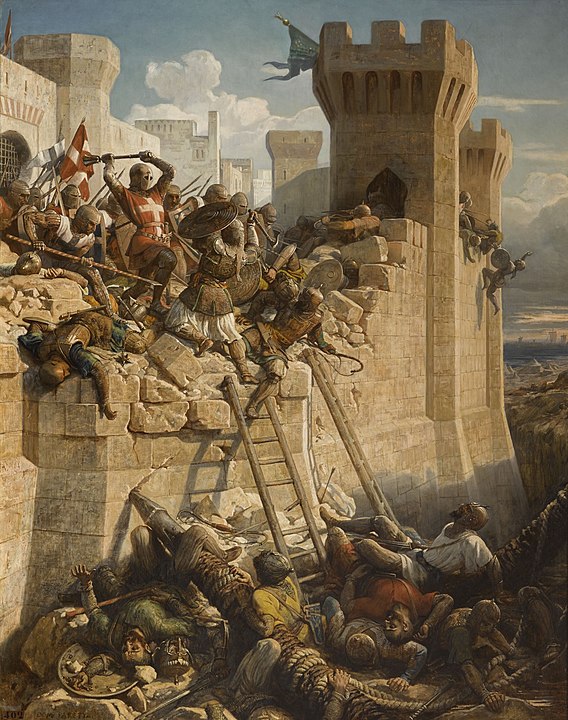
Matthieu de Clermont défend Ptolémaïs en 1291, by Dominique Papety (1815–49) at Salles des Croisades in Versailles
The primary architect of the Latin States’ downfall was Baybars, who had played a key role during Louis IX’s first crusade, defeating Robert of Artois at the Battle of Mansurah. Baybars was also instrumental in the 1260 Battle of Ain Jalut against the Mongols, and, feeling unrewarded, he killed the sultan and took his place! He first directed his jihad against the Mongols from 1260 to 1263, then turned to the weakened Latin States.
In just two years, he captured Caesarea and Arsuf, then Safed in 1266, and most notably Antioch in 1268, and the Krak des Chevaliers in 1271. Most of the major Crusader strongholds fell to the Mamluks within a decade. In 1272, Edward of England’s crusade (which was initially meant to join Louis IX in Tunis) slowed Baybars’ advances a bit, and Pope Gregory X tried to revive support for the Holy Land States, but to no avail.
Fortunately for the Crusaders, Baybars’ death in 1277, the succession disputes that followed, and a new Mongol invasion in 1280 provided them with a short reprieve. Their neutrality in the Mongol-Mamluk war allowed them to secure a ten-year truce with the latter. The Sicilian Vespers in 1282 weakened Angevin power, and Italian cities resumed fighting in Acre and Tripoli by 1285.
Taking advantage of this, Sultan Qalawun captured Tripoli in 1289 and aimed to finish off the Franks by turning his sights on Acre. His death gave the Latins a brief respite, but his son al-Ashraf Khalil laid siege to Acre in 1291. The city fell five weeks later, followed by the last remaining Frankish strongholds; it was the end of the Latin States in the Holy Land.
The End of the Crusades?
With the fall of Acre, the Crusader barons retained only Cyprus in the region, which would hold out until… 1571! Generally, 1291 is considered the end of the Crusades, at least the “official” ones—the eight well-known campaigns from historical accounts. Indeed, the concept of the Crusade as it had been conceived throughout the 12th and 13th centuries was no longer relevant, and for a long time, the Western kingdoms (except for Saint Louis) had lost interest in the fate of the Crusader States. On-site, it was the Italian cities and the Angevin house that acted, but with a more political and economic focus than ideological or religious: the reconquest of the Holy Sepulchre was far from their priority.
However, the idea of the Crusade, though it evolved, resurfaced in the following centuries.
It took new forms, targeted other geographical areas (the Teutonic Knights come to mind), and even led to new conquests, like that of Rhodes in 1310! The idea of the Crusade was rethought within a broader framework, with reforms (such as the merging of military orders, responsible for much division) or new alliances (for example, with the Mongols).
Throughout the 14th and 15th centuries, several military expeditions, particularly against the Turks, were considered Crusades (often led by leagues).
It must be made clear from the outset that it is impossible to provide an exhaustive assessment of the Crusades or the Latin presence in the Holy Land. The religious, political, economic, and even cultural stakes are so varied, and the historiographical interpretations are so often contradictory, that attempting such a review is too risky. For that, the selected bibliography below is recommended. However, it is worth focusing on whether the Crusades were the first colonial ventures and their importance in the economic boom and maritime dominance of the Italian cities.
In the summer of 1270, twenty years after his disastrous capture in the Nile Delta during the Seventh Crusade, the fifty-six-year-old King of France—Louis IX, the only French monarch ever canonized as a saint by the Catholic Church—took up the pilgrim’s cross one final time. Known to history as the Eighth Crusade, this brief, tragic expedition never even came within a thousand miles of Jerusalem. Diverted by geopolitical calculations to the sun-baked coast of Tunisia in North Africa, the campaign was crippled within weeks not by enemy scimitars, but by contaminated water wells and camp dysentery, claiming the life of the Crusader King on a bed of ashes among the ruins of ancient Carthage.
The Threat of Sultan Baibars and the Second Vow of Louis IX
Throughout the 1260s, the fragile surviving Crusader strongholds along the coast of Syria and Palestine faced systematic destruction at the hands of one of the most brilliant military commanders of the Middle Ages: the Mamluk Sultan of Egypt and Syria, Baibars. Having already helped shatter the Mongol army at Ain Jalut in 1260, Baibars captured Caesarea and Arsuf in 1265, took Safed in 1266, and in May 1268 stormed and sacked the great Crusader principality of Antioch—leaving only a narrow strip of coastal towns around Acre and Tripoli in Christian hands.
Haunted for two decades by the failure of his earlier 1248–1254 Crusade in Egypt, King Louis IX summoned his barons to the Louvre in Paris on March twenty-fourth, 1267, and announced that despite his failing health—so frail that he could barely ride a horse or wear full iron armor for long—he was sailing back across the Mediterranean to rescue the Outremer. Even the King’s most loyal friend and biographer, Jean de Joinville, who had fought beside Louis in Egypt, refused to join this second expedition, arguing bluntly that the King was needed at home in France and that anyone who advised the frail monarch to go on another Crusade was committing a mortal sin.
Why Did the Fleet Sail to Tunis Instead of the Holy Land?
When Louis IX’s fleet of Genoese and French ships finally weighed anchor from Aigues-Mortes in July 1270 and regrouped at Cagliari in Sardinia, the ordinary knights aboard assumed they were sailing east to Cyprus, Acre, or Alexandria. Instead, the royal council announced a shocking destination: the fleet was sailing due south across the central Mediterranean to attack Tunis, the capital of the Hafsid Caliphate in modern Tunisia.
Historians point to two interlocking reasons for this bizarre geographical detour:
The Ambitions of Charles of Anjou: Louis IX’s ruthless, ambitious younger brother, Charles of Anjou, had recently been crowned King of Sicily (which sat just a hundred miles across the water from Tunisia). The Hafsid ruler of Tunis, Caliph Muhammad I al-Mustansir, had stopped paying the traditional annual gold tribute to the Sicilian crown and was sheltering political refugees who opposed Charles.
The Illusion of a Royal Conversion: Knowing his pious brother Louis would never divert a holy Crusade purely for Sicilian tribute gold, Charles of Anjou helped convince Louis IX that Caliph al-Mustansir was secretly sympathetic to Christianity and would gladly convert to the Catholic faith—and cut off North African supplies to Mamluk Egypt—if only a powerful Christian army appeared outside Tunis to give him political cover against his own subjects!
Landing at Carthage and the Siege by Disease
Landing unopposed on the sandy peninsula near the ancient Roman and Punic ruins of Carthage on July eighteenth, 1270, the French quickly realized that the rumor of the Caliph’s desire to baptize himself was a complete fantasy. Instead of welcoming the Crusaders, al-Mustansir fortified the walls of Tunis, called for Muslim volunteers from across the interior, and sent fast Berber light cavalry to harass the French camp day and night under the blistering forty-degree July and August African sun.
Refusing to launch a full-scale assault on the city walls until his brother Charles of Anjou arrived with the Sicilian fleet and army, Louis IX kept his ten thousand troops pinned inside a crowded, dusty fortified camp on the plain of Carthage. Within days, catastrophe struck from the ground beneath their feet:
Contaminated Brackish Wells and Dysentery: With scant fresh water and poor sanitation in the summer heat, a virulent outbreak of bacillary dysentery (compounded by typhus or scurvy, which medieval chroniclers called “the camp plague”) tore through the tents.
Death of Prince John Tristan: On August third, 1270, the King’s beloved twenty-year-old son, John Tristan, Count of Valois—who had ironically been born in Damietta during the dark days of the Seventh Crusade—died in agony in the camp, just as King Louis himself and his eldest son and heir, Philip, collapsed with raging fevers.
“Jerusalem! Jerusalem!” and the Treaty of Tunis
By late August, the French camp was a vast open-air hospital where bodies were thrown into trenches by the hundreds. Sensing that his final hour had arrived on August twenty-fifth, 1270, King Louis IX asked his attendants to lift him from his royal bed and lay him flat upon a bed of ashes spread in the shape of a cross on the tent floor in an act of ultimate Christian humility. Whispering softly on his back, “Jerusalem! Jerusalem! We will go to Jerusalem,” the King crossed his arms over his chest and breathed his last at three o’clock in the afternoon.
In one of the most dramatic coincidences in medieval history, the exact moment Louis IX died, trumpet blasts echoed from the harbor: the sails of Charles of Anjou’s Sicilian fleet had finally arrived, dropping anchor to find a silent, weeping camp. Taking immediate command alongside the recovering new king, Philip III (“the Bold”), Charles of Anjou defeated the Hafsid sorties enough to bring Caliph al-Mustansir to the negotiating table.
On October thirtieth, 1270, without a single Crusader setting foot inside Tunis, the two sides signed the Treaty of Tunis: in exchange for the Crusader army packing up and sailing home immediately, the Caliph agreed to pay a massive war indemnity of 210,000 ounces of gold, resume paying double tribute to Charles of Anjou’s Kingdom of Sicily, grant free trade to Christian merchants, and allow Christian monks and priests to live and preach inside Tunisia. Just days after the ink dried, England’s tall Crown Prince Edward (the future King Edward I, “Longshanks”) arrived off Tunis with an English Crusader fleet—too late for the fighting, prompting Edward to sail onward alone to Acre for the brief Ninth Crusade, while the French fleet carried the boiled white bones of Saint Louis back to the Abbey of Saint-Denis, closing the era of major royal French Crusades forever.
If Pope Innocent III was very active in calling for the Crusades, his record proves to be more than mixed, whether it was with the one diverted to Constantinople or the Fifth Crusade, which failed in Egypt, partly due to the pope’s legate. Innocent III himself died before the crusaders set out. It was time for Western rulers to take the lead, with one of the most significant among them, Frederick II Hohenstaufen. The German emperor was already a living legend, and it is impossible to summarize his character in a few lines. Therefore, we will focus on the political situation following the Fifth Crusade and Frederick II’s image at that moment, particularly regarding the papacy.
Context of the Sixth Crusade
Despite the rivalry between the Empire and the Church, it was Pope Innocent III who facilitated the election of the young Frederick. At the time, he was still young (born in 1194), living in Sicily when the pope decided to “abandon” the then Emperor Otto IV (excommunicated), making the Hohenstaufen the King of Germany. However, Frederick had to wait until Otto IV’s defeat at Battle of Bouvines (1214) for the imperial throne to effectively return to him.
He was elected emperor in 1215; then he took the cross, but, as we have seen, did not honor his promise, being too preoccupied with internal issues within the Empire and, it seems, not very motivated by the idea of a crusade. Even though he seemed to have been “made” by the pope, he did not wish to remain politically dependent on him.
However, Frederick quickly understood that leading such an expedition could allow him to present himself as the leader of the West, in opposition to the pope but also other rulers like Philip II of France (Philip Augustus). He renewed his promise in 1220 when Honorius III crowned him in Rome, but it was not until 1223 that Frederick II’s crusade began to take shape.
The pope still played a central role: first, he pushed the emperor to renew his promise, then he arranged his remarriage (he was widowed) to the daughter of the King of Jerusalem. This was concluded in 1223, at the same time as the crusade oath was renewed, with the departure scheduled for June 1225.
Nevertheless, Frederick II intended to decide the course himself and preferred to resolve his problems in Sicily rather than prepare for the crusade; as a result, he risked excommunication! He agreed to renew his vow, and the crusade was postponed to 1227. Frederick II bought time, using it to seize control of the Kingdom of Jerusalem (without yet setting foot there), forcing his father-in-law John of Brienne to take refuge in Rome!
However, the pope’s reasons seemed more complex, as his attention was focused both on the Kingdom of Sicily and that of Jerusalem.
Frederick II Finally on Crusade?
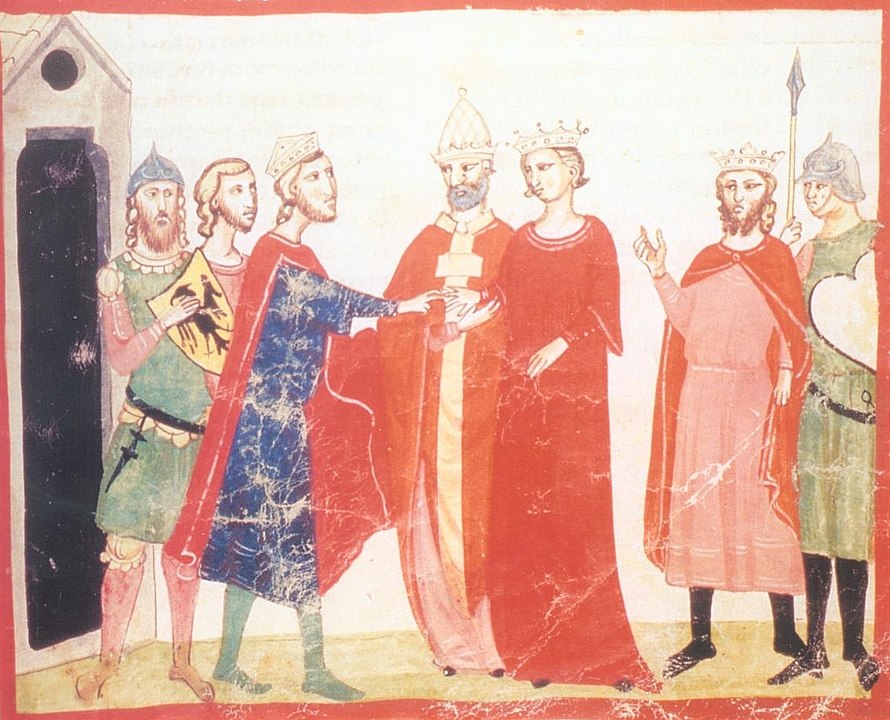
Frederick II marries Queen Yolande
Despite his excommunication, the emperor finally decided to leave for the Holy Land at the end of 1228, accompanied by 500 knights. He first traveled to Cyprus, where John of Ibelin was serving as regent, and asserted his dominance by claiming that the island’s rulers were his vassals since it was his father, Henry VI, who had granted it to the Lusignans! The Ibelin family thus became fierce enemies of Frederick, but war was avoided thanks to the intervention of the Military Orders. He then proceeded to Acre, but there, the Templars and Hospitallers opposed him due to his excommunication!
However, he had the support of the Teutonic Knights. The emperor’s goal was twofold: to reclaim Jerusalem and to establish his authority as a ruler. The crusade was, therefore, not his only priority.
Treaty of Jaffa
Frederick II decided to pressure the sultan by fortifying the strategic city of Jaffa. Success came quickly, as without a battle, he obtained the treaty bearing his name in the same city on February 18, 1229! He took advantage of a civil war among the Ayyubids.
This treaty restored the Holy City to the Latins (except for the Temple Mount), as well as several other places like Sidon, and regions that allowed for the partial reconstruction of the Kingdom of Jerusalem around it (and no longer around Acre), along with a ten-year truce. The unexpected success was significant, and Frederick II celebrated by traveling to Jerusalem himself in March 1229, where he was officially crowned and fulfilled his duty as a pilgrim.
However, the context was not in Frederick’s favor: he was still excommunicated, and his methods in Cyprus and Acre had earned him much hostility, particularly from the Templars (who had not regained their Temple, located on the esplanade still guarded by the Muslims). Moreover, his tolerance toward the Infidels (following his attitude in Sicily) was even less well-received, and he was criticized for his appreciation of Eastern customs, the Arabic language, and Muslim art, as well as dining with the sultan’s envoys and even the leader of the Assassins! He quickly left the Holy City, then the Holy Land, after a brief stay in Acre, where he was met with mockery and jeers…
Consequences of the Treaty of Jaffa
Frederick II’s crusade was much more successful than the previous ones (except for the First, of course), but the treaty and the circumstances under which it was signed diminished its significance. Firstly, the Latins of the East greatly resented the “imperial tyranny.” Secondly, the ten-year peace agreement prevented them from taking advantage of the internal conflicts still active among the Ayyubids. Finally, among the Muslims, this return of Jerusalem to the crusaders was deeply resented, and the Ayyubids were further weakened.
Jerusalem was eventually recaptured by force in 1244 by the Khwarezmians (fleeing from the Mongols), despite earlier attempts to strengthen the city’s protection. Indeed, in 1239, Pope Gregory IX had called for a new crusade, led by Thibaut IV, Count of Champagne, to protect Jerusalem. Despite some victories and the fortification of several strongholds, this effort ended in 1240 without consolidating the kingdom, although a new treaty was signed with Sultan Ayyub.
Frederick II left the Kingdom of Jerusalem in a deplorable state. His son Conrad was supposed to assume his role as sovereign, but Frederick first clashed with Patriarch Géraud upon his return to Acre. He was ready to storm his palace and confront the Templars but had to retreat to Sicily, where John of Brienne had launched a counterattack! Later, Frederick refused to send Conrad to the Holy Land, leaving the kingdom to struggle with internal conflicts. He also lost the support of Cyprus, which was retaken by the Ibelins in 1232. Fortunately, the pope decided to support the emperor, and the situation seemed to stabilize in the following years, despite the hostility of the Templars. However, this peace would not last long…
After the shameful diversion of the Fourth Crusade in 1204—in which Western Crusaders never reached the Holy Land at all, instead sacking Christian Constantinople—Pope Innocent III spent the final years of his life organizing a massive, disciplined expedition designed to redeem the Crusader movement: the Fifth Crusade (1217–1221). Targeting the wealthy Nile Delta port of Damietta to strike at the economic heart of the Ayyubid Empire in Egypt, the Crusaders actually won their primary objective and were offered the peaceful return of Jerusalem itself on a silver platter by the Sultan of Egypt—only for the obstinate arrogance of a Papal Legate and a catastrophic miscalculation of the annual Nile flood to turn total victory into unconditional surrender.
Strategy: Why Attack Egypt to Liberate Jerusalem?
Planned at the Fourth Lateran Council in 1215 and launched in 1217 under Pope Innocent III’s successor, Pope Honorius III, the Fifth Crusade began with preliminary campaigns in Palestine by King Andrew II of Hungary and Duke Leopold VI of Austria before adopting the grand strategic doctrine first proposed by King Richard the Lionheart: the road to Jerusalem runs through Cairo.
Why sail to Egypt to recover a city in Judea? Because the Ayyubid dynasty founded by Saladin relied entirely on the agricultural tax wealth, grain, and maritime trade of the Nile Valley to fund its armies in Syria and Palestine. If a Crusader fleet captured the fortified gateway port of Damietta on the eastern branch of the Nile Delta and marched up the river to Cairo, Egypt could either be conquered outright or traded back to the Sultan in exchange for the entire Kingdom of Jerusalem.
The Chain Tower of Damietta and Sultan al-Kamil’s Peace Offer (1218–1219)
In May 1218, a fleet of Frisian, German, and Italian ships carrying King John of Brienne (nominal King of Jerusalem) and Duke Leopold VI of Austria landed before Damietta. Guarding the harbor stood a formidable engineering obstacle: a massive stone fortress built on an island right in the middle of the Nile—the Chain Tower—from which giant iron chains were stretched across the water to the city walls to block any ship from sailing upstream.
Using the ingenuity of a German priest and chronicler named Oliver of Paderborn, Frisian carpenters lashed two wooden cog ships together side-by-side across four masts and built a floating, revolving wooden siege tower and drawbridge on top, storming and capturing the Chain Tower on August twenty-fourth, 1218—a shock so severe that the elderly Ayyubid Sultan al-Adil (Saladin’s brother) reportedly died of a heart attack upon hearing the news, handing the Egyptian throne to his pragmatic son, Sultan al-Kamil.
As the grueling eighteen-month siege of Damietta dragged on and internal plots threatened Sultan al-Kamil’s rule, two extraordinary historical events unfolded outside the walls in the autumn of 1219:
1. Saint Francis of Assisi Walks Into the Sultan’s Tent: Appalled by the bloodshed in both camps, the barefoot Italian friar Francis of Assisi (founder of the Franciscan Order) and Brother Illuminatus walked unarmed across no-man’s-land directly into the Muslim camp! Instead of executing him, the cultured Sultan al-Kamil welcomed Francis warmly into his royal tent for several days of deep theological conversation, offering Francis lavish gifts (which the saint politely declined because of his vow of poverty) and escorting him safely back to the Christian lines with deep mutual respect.
2. The Sultan Offers to Give Back Jerusalem for Free! Desperate to save Damietta before its starving garrison collapsed, Sultan al-Kamil sent envoys to the Crusader camp with a stunning peace offer: if the Crusaders simply packed up and left Egypt, al-Kamil would immediately hand back the city of Jerusalem, Bethlehem, Nazareth, the True Cross, all of central Palestine, and thirty years of tribute money to pay for rebuilding Jerusalem’s walls!
Cardinal Pelagius’s Refusal and the Nile Flood Trap at Mansurah (1221)
King John of Brienne and the French, English, and German secular knights were thrilled: they begged to accept the Sultan’s offer immediately, pointing out that liberating Jerusalem was the entire reason they had left Europe! However, leadership of the Crusade had been usurped by the imperious Spanish Papal Legate, Cardinal Pelagius of Albano, backed by the Knights Templar and Hospitaller and the Italian merchant fleets who wanted to keep Damietta’s lucrative trade docks.
After the Crusaders stormed the disease-ravaged city of Damietta on November fifth, 1219, Cardinal Pelagius **flatly rejected Sultan al-Kamil’s peace offer twice**—convinced that the German Emperor Frederick II (who had promised to come on the Crusade, but stayed home in Sicily) was about to arrive with a giant army, and equally convinced by an Arabic prophecy scroll that a mysterious Christian king from the East (“King David,” actually distorted rumors of the pagan Mongol conqueror **Genghis Khan**, who was currently obliterating Persia!) was marching to help them conquer all of Egypt.
In July 1221, ignoring the urgent warnings of King John of Brienne, Cardinal Pelagius ordered the Crusader army to march south from Damietta up the Nile toward Cairo—at the exact worst possible week of the calendar year, right as the annual summer inundation (flood) of the Nile River was rising to its crest:
Advancing into the wedge of low-lying land at the fork of the Nile opposite Sultan al-Kamil’s new fortress camp of al-Mansurah (“The Victorious”), Pelagius forgot to guard the canal behind him.
Egyptian ships sailed through a side canal into the Nile behind the Crusaders, cutting off their supply boats from Damietta, and then Sultan al-Kamil gave a simple order: his engineers **broke open the dikes and sluice gates of the Nile canals**!
Overnight, the entire plain turned into a waist-deep sea of sticky black mud and rushing water. Trapped on a shrinking strip of mud with their mules, tents, and gunpowder/food supplies washed away, the starving Crusader army was completely surrounded without a single battle needing to be fought.
On August thirtieth, 1221, to save his drowning army from annihilation, Cardinal Pelagius signed an eight-year truce handing Damietta right back to Sultan al-Kamil in exchange for nothing more than safe passage home and a bowl of bread and soup for the starving Christian soldiers—ending the Crusade that had held Jerusalem in its palm and thrown it into the waters of the Nile.
Pope Innocent III, in 1198, disregarded the agreements between Richard the Lionheart and Saladin and called for a Fourth Crusade to retake Jerusalem. However, this time, he was not supported by the major European monarchs, and it was the barons who responded to the call and sought help from the powerful Venice. The consequences were not suffered by the infidels but by the “Second Rome”: Constantinople!
Byzantium and the Latins
Tensions between the Byzantines and the Crusaders had hardly ceased since the First Crusade, and various Byzantine emperors always sought to maintain influence over events in the Holy Land, at times acting against the Latins. But the Empire had been in crisis since the 1180s, following the death of Manuel Komnenos. In 1182, a coup brought Andronikos Komnenos to power at the expense of Alexios II, the legitimate heir; at that time, the people of Constantinople, galvanized by Andronikos’ men, massacred the Latins in the city!
The antagonism between Greeks and Latins was twofold: religious since the Schism of 1054, and economic with the rise of Italian cities threatening Byzantium’s hegemony in the eastern Mediterranean. There was also a political dispute, heightened in the following years by the passage of Frederick Barbarossa during the Third Crusade, which directly confronted Byzantine armies, as Isaac II had allied with Saladin.
The Byzantine Empire was under internal strain, but also external threats, with an ever-present Bulgarian menace, not to mention the Turks. This benefited Alexios III, who overthrew Isaac II. On the eve of the Fourth Crusade, imperial power was still far from stabilized.
Venice at the End of the 12th Century
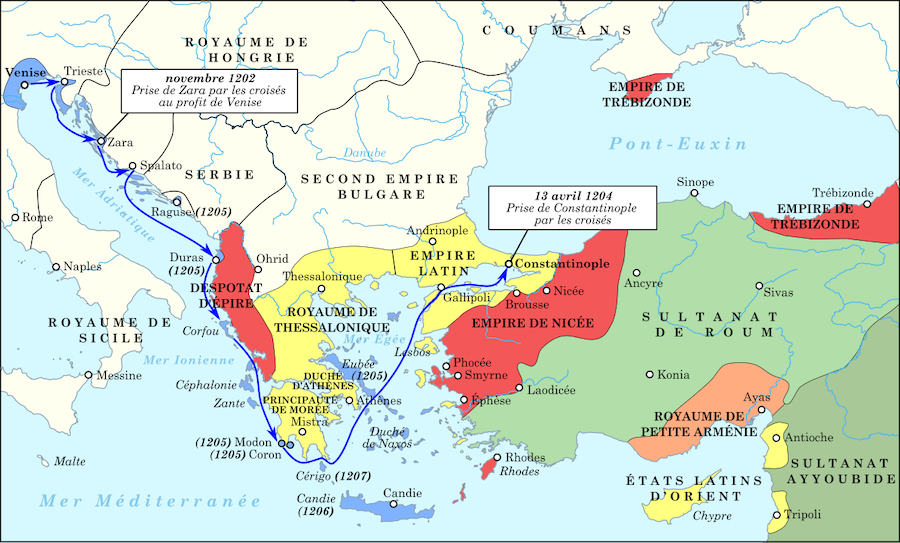
Itinerary of the Fourth Crusade (1202-1204) and foundation of the Latin Empire of the East (1204).
The rise of the famous Italian city occurred in the context of wars with the Holy Roman Empire under Frederick I and the creation of the commune system. Venice had maintained privileged relations with Constantinople since agreements dating back to the late 11th century, allowing it to surpass its Italian competitors in the eastern Mediterranean.
In 1183, the Peace of Constance temporarily settled the conflict between the German Emperor and the Italian cities, giving Venice (and its rivals) the freedom to continue their economic development independently. The death of Frederick I, and soon after that of Henry VI, did not change the situation as their successor, Frederick II, focused on southern Italy and Sicily.
Venice was thus in a strong position when the Crusaders sought a fleet to transport them to the Holy Land.
Departure of the Fourth Crusade
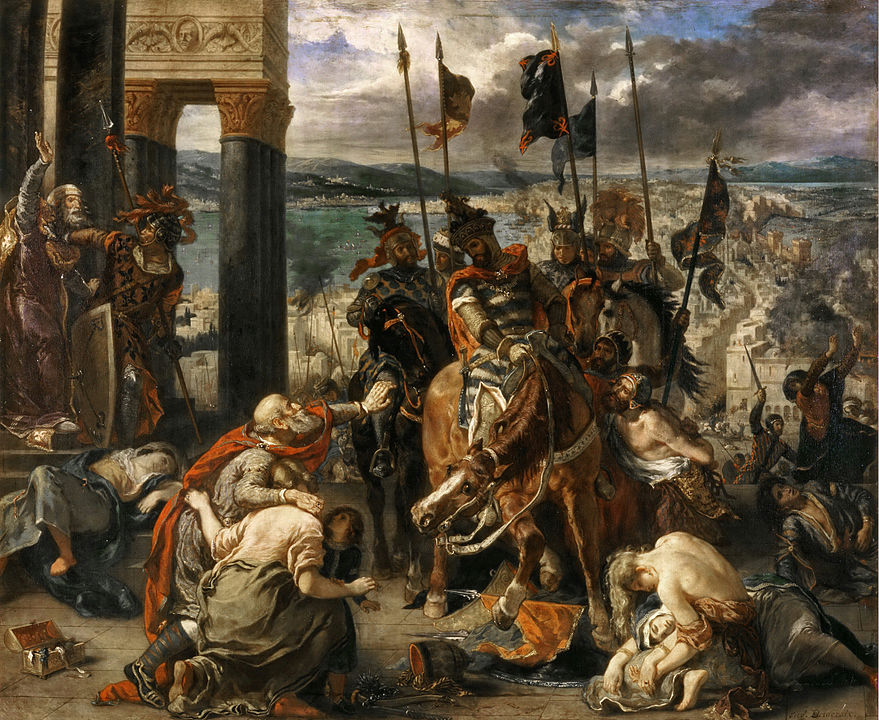
The Entry of the Crusaders into Constantinople, oil by Eugène Delacroix (1840). Image: Public Domain
The pope, like his predecessors, sought to use the Crusade to unite powers under his authority amidst the ongoing Franco-English war, not to mention the more immediate dangers in the Italian peninsula. However, he could only recruit barons, despite his attempt to mediate between Philip Augustus and Richard the Lionheart through the legate Pietro Capuano.
Fulk of Neuilly was tasked with preaching the Crusade from late 1198, but it wasn’t until the end of 1199, at the tournament of Écry, that the Crusade truly took shape. It was to be led by the Count of Champagne, Thibaut (who died in 1201 and was replaced by Boniface of Montferrat), and the elite knights from northern France, including Louis of Blois and Simon de Montfort. The Crusaders then asked the Italian cities to transport them, but Genoa and Pisa refused, leaving only Venice. Agreements were made for transportation and the sharing of any conquests.
It was decided to gather in 1202 in Venice and then head directly to Egypt. The situation with Byzantium had become more strained than ever, making the usual route through Constantinople less safe.
Diverted Crusade: The Siege of Zara
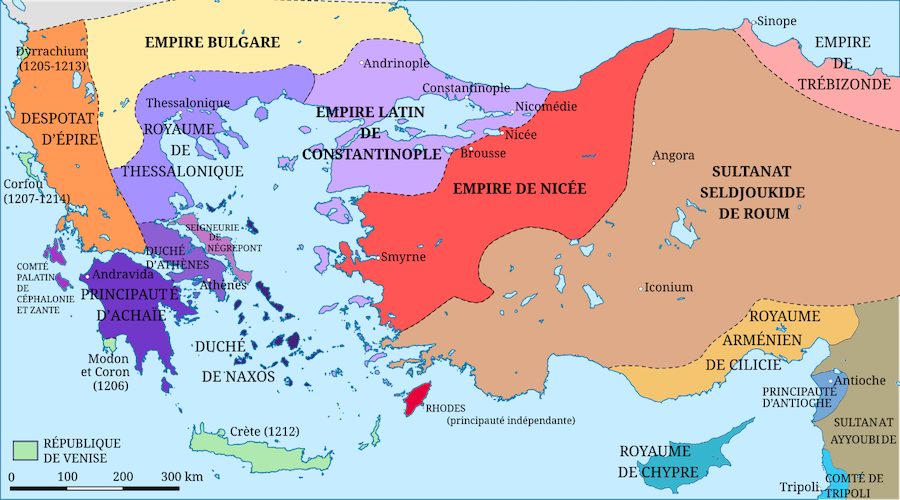
Fragmentation of the Byzantine Empire after 1204. Image: Public Domain
The Crusader army assembled in Venice was smaller than expected. The problem was that the Venetians had prepared to transport 30,000 men and were determined to be paid for that. Eventually, 34,000 marks were missing from the 85,000 demanded by Venice. Doge Enrico Dandolo then offered the Crusaders a moratorium on their debt if they helped him capture Zara, in Dalmatia. The issue was that the city, although rebellious, was Christian, and the pope immediately warned that he would not tolerate a Christian city being attacked by soldiers of Christ!
The Venetians and Crusaders ignored this warning, and Zara was besieged in November 1202. Its inhabitants hung crosses on the walls to signify they were Catholics, tried negotiations, and tensions grew among the Crusaders. But under the insistence of the Doge, the assault was launched on November 24! The city was pillaged, the Crusaders settled there, but Innocent III only excommunicated the Venetians…
Crusaders “Liberate” Constantinople!
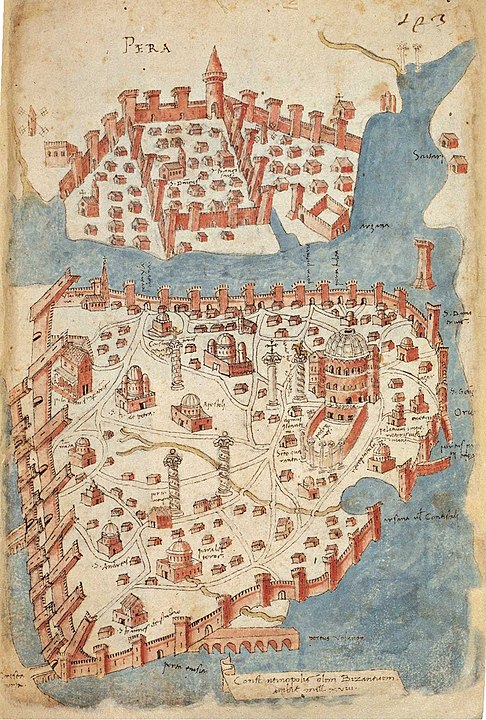
Map of Constantinople around 1420, after Cristoforo Buxondelmonti. Image: Public Domain
Indeed, during the siege, negotiations brought in other key players. It seems that Philip of Swabia, contacted by Crusader Boniface, reached out to his brother-in-law, Alexios, the son of Byzantine Emperor Isaac II, who had been deposed and blinded by Alexios III in 1195. The young man had escaped from prison and, through Philip’s intervention, met with Boniface in Zara, asking for help against the usurper Alexios III.
The terms of the agreement included the promise of uniting the two Churches, but in Rome, Innocent III did not seem to approve of this deal. Negotiations continued, and Philip of Swabia managed to secure the Crusaders’ support by promising large sums of money from Alexios IV. Despite disagreements among the barons, the agreement was approved, even by the Venetian Doge, and the young Byzantine prince joined the Crusaders in Corfu in April 1203. The pope did not intervene, not wanting to break the momentum of the Crusade.
The Crusaders did not forget to destroy Zara before leaving, and then set out for Constantinople, which they reached a month later. However, contrary to what Alexios IV had promised, the Byzantines did not welcome them as liberators from Alexios III’s yoke! A siege became necessary. On July 6, the capture of Galata allowed the Crusader fleet to advance into the gulf, but it wasn’t until July 17 that the usurper fled the city, defeated. The legitimate emperor, Isaac II, was restored but was forced to ratify his son’s promises, with Alexios IV crowned co-emperor on August 1.
Crime Against Constantinople
Soon after, difficulties arose. The Empire was no longer what it once was, and the emperors proved unable to fulfill their promises, financially or religiously. The Crusaders also distrusted Isaac II, who had once allied with Saladin, and relations between Greeks and Latins in the city were atrocious. An “anti-Latin” party emerged in Constantinople, led by Alexios Murzuphlos (also known as Alexios Doukas), the son-in-law of Alexios III. On January 29, 1204, he imprisoned and strangled Alexios IV, which Isaac II did not survive for long! Alexios Doukas crowned himself emperor as Alexios V.
Naturally, the Crusaders viewed the rise of someone who roused the populace against them with suspicion, especially as he likely had no intention of repaying the debts of his predecessors.
Additionally, they were still indebted to Venice, which was growing impatient, and the Crusade was stalling. The barons and the Doge signed new agreements to share the spoils after the capture of the city, which took place on April 13, 1204, after several days of fierce fighting.
The city was mercilessly pillaged for three days, even within the walls of Hagia Sophia, where precious stones were torn from the altar. The patriarch’s throne was desecrated by a prostitute, as were the tombs of the emperors, which were opened and their bodies stripped! The rest of the city was also devastated, and the Venetians even took the quadriga statue, now on the façade of St. Mark’s Basilica.
Division of the Empire and the End of the Fourth Crusade
One might remark that this was a curious way to lead a crusade, but it is difficult to easily designate the culprits. The chain of circumstances was fatal, but we can also point to the ambitions of certain individuals, such as Boniface of Montferrat, or the diplomatic maneuvers of the Hohenstaufen, through Philip of Swabia, to weaken the Empire and thus facilitate their projects in the Central and Eastern Mediterranean.
Finally, of course, the ambitions of Venice cannot be overlooked. However, it seems that the majority of the crusaders were against diverting the crusade, whether towards Zara or Constantinople (it is even said that some of them went to Palestine before heading to Venice!). Then, the need for unity within the crusader army and the actual chain of events, such as the crimes of Alexios V, could hardly lead anywhere other than disaster. But this mainly confirms the difficulties seen since the First Crusade between the Byzantines and Latins, and the inevitable competition for hegemony in the region. Beyond that, the rivalry between the two Churches did not help, and, of course, the capture of Constantinople definitively shattered any hope of reconciliation, as the resentments still linger to this day.
With the capital under Latin control, the empire itself was divided among the victors: this is the “Partitio Romaniae.” A Latin Empire of the East emerged from the ashes of Constantinople, and Baldwin VI of Hainaut was installed as emperor by the Venetians, to the detriment of Boniface of Montferrat, who would go on to found the Kingdom of Thessalonica. Venice seized most of the islands, and one of its own, Marco Sanudo, founded the Duchy of Naxos.
However, the Byzantines were not completely defeated: several princes established other kingdoms, the most notable being the Empire of Trebizond, ruled by the Komnenos family (which would last until 1461), and especially the Empire of Nicaea, ruled by Theodore I Laskaris. It was one of his successors, Michael Palaiologos, who managed in 1261 to retake Constantinople and restore the Byzantine Empire with the support of Genoa.
The Latin clergy took advantage of their “opportunity” to seize the numerous relics that were kept in Constantinople and brought them back to the West. It seems that this was enough, as there was no further mention of the crusade ordered by Innocent III. Subsequently, it was primarily monarchs who took the initiative for crusades, including Saint Louis but first Frederick II, despite a final attempt by Innocent III.
It has been almost a century since Urban II launched the Crusade to liberate Jerusalem, when the city was reconquered by Saladin in 1187. The Latin states were weakened, the county of Edessa had even been destroyed, and a previous crusade, led by two major Western sovereigns, had miserably failed. The situation was thus critical when a new crusade was proclaimed by Pope Gregory VIII; thus began the Third Crusade, perhaps the most famous, as it pitted great Western kings, including Richard the Lionheart, against the already legendary Saladin.
Why is the Third Crusade sometimes called the “Kings’ Crusade”?
The Third Crusade is often referred to as the “Kings’ Crusade” because it was led by three of the most powerful European monarchs of the time: Richard I of England, Philip II of France, and Frederick I Barbarossa of the Holy Roman Empire. Their involvement highlighted the importance and scale of this crusade compared to previous ones.
The Crusade for Peace in the West?
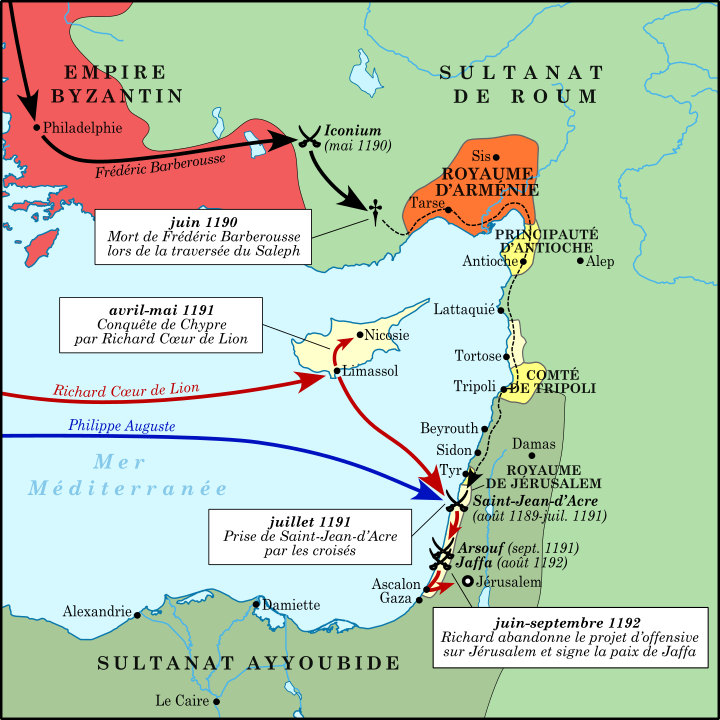
Map of the Third Crusade
The situation was actually much more complex, and the papal decision to call for a crusade was probably not solely due to the fall of Jerusalem and the main Latin strongholds in the Holy Land. Indeed, the West was embroiled in a war between the Capetians and the Plantagenets! For the former, Philip II of France (Philip Augustus) had consolidated his power in the Kingdom of France and could now turn against the already hereditary enemy, who held significant possessions on the continent, such as Anjou and Normandy.
The Plantagenets, led by Henry II, were experiencing serious problems with his sons, particularly Richard and John. The King of France did not hesitate to support them during the years 1186–88, and a weakened Henry II had to give in, despite a temporary reconciliation with Richard.
As early as 1187, however, Henry II had promised to respond to the call for a crusade from Gregory VIII (renewed by his successor Clement III); Richard was to take up the mantle. This did not bother him at all, as he was not very interested in the Kingdom of England and instead wanted to make a name for himself through his military exploits; he too had promised to take up the Cross at the end of 1187. This did not prevent him from persuading Philip II of France to accompany him, probably to avoid his French rival attacking him from behind once he had left for the Holy Land. Louis VII’s son could hardly refuse to undertake this pilgrimage.
The two sovereigns prepared to depart around 1190. In England, Richard managed to impose the “Saladin tithe” to fund his crusade, but Philip II of France had to do without it, which would later cause considerable problems for royal finances. The two kings met in early 1190 to sign a non-aggression pact, which did not prevent new tensions and a postponement of their departure; however, they finally set off on July 4, 1190, from Vézelay, where Philip II of France and Richard the Lionheart began their journey to the Holy Land.
The Other Great Sovereign: Frederick Barbarossa
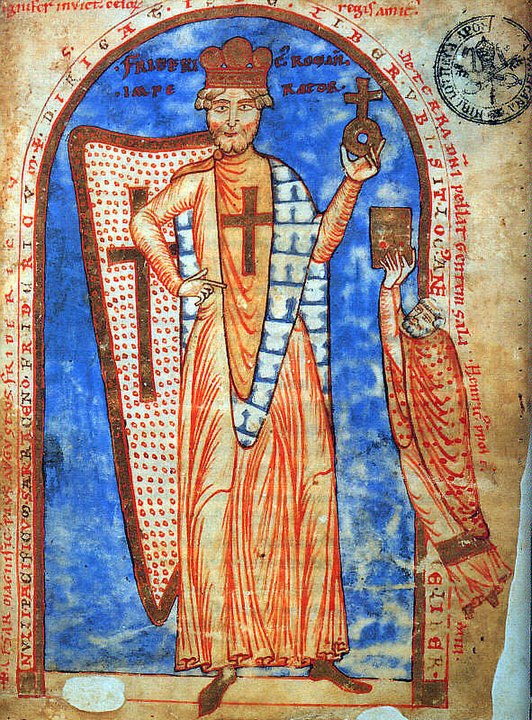
Frederick Barbarossa. Image: Wikimedia, Public Domain
It would take too long to explain the circumstances of Frederick Barbarossa’s rise to the imperial throne, but it should be remembered that this followed the Investiture Controversy. Barbarossa had been in conflict with the papacy since the 1150s, and this continued into the 1180s, primarily due to the rivalries in Italy between the Hohenstaufens and the Guelfs, not to mention the Normans in southern Italy and Sicily! He had also been involved in the struggles between the Plantagenets and Capetians, often supporting Henry II.
In the early 1180s, the emperor had settled his affairs with the Lombard League at the Peace of Constance (1183) and definitively pacified rivalries within the Empire at Pentecost in 1184, where his power was recognized by most of the nobles. He decided to take the Cross at the Diet of Mainz in 1188.
The imperial army was by far the most impressive of the three royal armies heading for the Holy Land, with estimates of 100,000 men, including 20,000 knights! Frederick Barbarossa did not hesitate to challenge Saladin to a duel, and he marched decisively toward Jerusalem, without waiting for Richard and Philip. However, problems quickly arose due to the unwillingness of the other emperor, Isaac II Angelos of Constantinople, who had allegedly made deals with Saladin and imprisoned a German embassy.
Barbarossa then decided to ravage Thrace and force his eastern rival into cooperation; the Byzantine emperor had to relent and helped him cross the Dardanelles in March 1190. After a difficult journey through Asia Minor and two victories over Muslim armies, the emperor drowned while crossing the Saleph River! The great imperial army vanished with him, except for a few contingents that managed to reach Antioch.
Richard and Philip in Sicily
The English army reportedly numbered 850 knights, and the French army slightly more than 600. Although the two rival kings departed together from Vézelay, they then took different routes: Philip II of France sailed from Genoa, while Richard chose Marseille. The King of France arrived in Messina on September 16, 1190, and stayed in the royal palace; Richard made a grand entrance six days later, and the rivalry between the two men immediately resurfaced. Nevertheless, they remained in Sicily for six months! Tensions arose between the two armies, as well as with the local population, but in any case, it was the King of England who benefited; it was during these events that he was reportedly nicknamed “the Lion,” and Philip “the Lamb.
It also seems that a romantic issue arose, with Richard’s sister Joan, whom Philip had fallen for, as the central figure, and the main issue being the succession in Sicily. Tancred, cousin of the late William the Good and then ruler of the island, took advantage of the situation to strengthen his position by setting the two kings against each other. This led to the sack of Messina by the English army in October 1190, and Philip was deeply offended when he saw his vassal’s banners flying over the city walls; it is said that this is when he decided to seize Normandy later.
Despite attempts at compromise, tensions continued into the first half of 1191, exemplified by the case of Guillaume des Barres, a knight who managed to defeat Richard in a joust, provoking the latter’s fury and forcing Philip to dismiss him! Everything finally ended when Richard was allowed to break his promise to marry Philip’s sister, Alys, in order to marry Berengaria of Navarre, who arrived on the island accompanied by Richard’s mother, Eleanor of Aquitaine. It seems that an agreement was reached, and the two kings reconciled before continuing their journey.
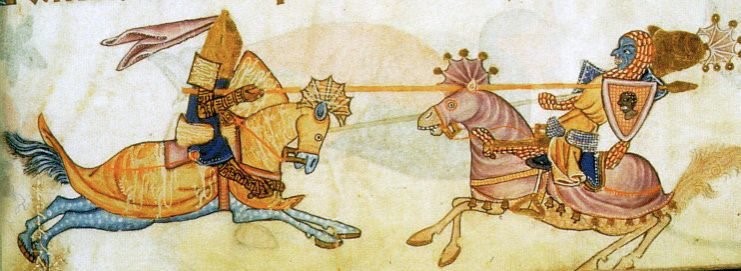
Richard the Lionheart and Saladin. Miniature of the thirteenth century
The king of France, however, prefers to leave Sicily before the arrival of Eleanor, and this is accomplished on March 30, 1191; he sets sail for Acre. Richard, who is getting married, will only be able to join him a month later due to a storm. This storm pushes him to the shores of Cyprus, and the fiery king sees this as a good reason to conquer the island! Since 1184, Cyprus had freed itself from Byzantine rule and become an autonomous state. It is held by Isaac Komnenos, who, jealous of his independence, does not hesitate to form an alliance with Saladin. He even goes as far as to threaten Berengaria of Navarre, whose ship had fallen into the hands of his troops, and Richard, faced with Isaac’s refusal to negotiate, decides to confront him in May 1191.
Richard defeats him easily, further increasing his wealth and fame.
Upon arriving in front of Acre (taken by Saladin in the wake of his previous victories), Philip II of France finds himself in the middle of the rivalry for the succession to the throne of Jerusalem, as the Holy City has been reconquered by the Muslims. The rivalry between Guy of Lusignan and Conrad of Montferrat had been ongoing since the previous year, and the king of France sides with the latter. Richard’s army arrives to finish the siege of the city, which falls into the hands of the Crusaders on July 12, 1191.
Richard the Lionheart and Saladin
Saladin in the Assault on Jaffa. Image: Manuscript of the Arsenal Library
The matter of the succession to the throne of the Kingdom of Jerusalem is first settled, temporarily in favor of Guy, then in favor of Conrad, though not until 1192, and only briefly, as Conrad is assassinated. Guy is ousted in favor of Henry of Champagne but obtains Cyprus from Richard.
Meanwhile, Philip II of France realizes that he has no place in this crusade, where Richard’s overwhelming presence casts too much of a shadow. Rather than continuing to yield, and believing his duty fulfilled, he returns to France in early August! The future will prove him right, both against Richard and against his brother and successor, John Lackland.
Richard, however, continues his crusade, skillfully maintaining his reputation. His rivalry with Saladin begins to be talked about, and it intensifies following his victory against Saladin at Arsuf in September 1191, and then with the reconquest of Jaffa and Ascalon. The end of the year sees the first negotiations between the two men, although they never meet. Hostilities resume in the following weeks, but each time Richard hesitates to attack Jerusalem directly.
In September 1192, Richard learns that Philip II of France and his brother John are plotting behind his back in the West. Facing an aging and sick Saladin, he negotiates a truce of three years and three months, as well as free access to Jerusalem for Christian pilgrims. He leaves the Holy Land at the beginning of October 1192.
The Outcome of the Third Crusade
The outcome is mixed. While the Crusaders have reclaimed a few strongholds and gained access to Jerusalem, the remnants of the Latin states cannot be considered viable. Furthermore, the very image of the Crusade, after the failure of the previous one, is hotly contested in the West.
Politically, even for the Muslims, the result is relative: they have retained the essentials, and the status quo works in their favor, but Saladin faces increasing criticism. Weakened, he empties his empire’s coffers, leaving his successors in great difficulty when he dies in 1193. Rivalries resurface, again benefiting the Crusaders.
For the West, the consequences of this Crusade, even indirect ones, are significant. First, Richard is captured on his return by Leopold V of Austria; the latter had participated in the capture of Acre alongside him but felt humiliated when Richard refused to allow him to raise his flag alongside his and that of the king of France!
Richard is held for two long years and is freed only after a huge ransom is paid. During this time, his brother John plotted against him with Philip II of France. Richard forgives him, however, and resumes his war against his eternal rival; it is during a battle in Limousin that he is struck by a crossbow bolt and dies of his wounds in 1199. Subsequently, Philip II of France gains the upper hand over John, who has succeeded Richard.
The Third Crusade is therefore remembered primarily due to the legendary figures of Richard the Lionheart and Saladin, but also because of the rivalry between the Capetians and the Plantagenets in the West. The status quo achieved with Saladin will certainly prolong the presence of the Latins in the East, but the saga of the Crusades is far from over.
When Pope Urban II launched the First Crusade in 1095, that disorganized expedition of quarrelsome barons without a single crowned king among them had pulled off the military miracle of capturing Jerusalem. Half a century later, when the Second Crusade (1147–1149) was proclaimed, all of Europe expected an even greater triumph: for the very first time in history, the Crusade was led in person by the two most powerful crowned monarchs of Western Christendom—King Louis VII of France and the German monarch Conrad III—preached by the greatest orator of the age, Saint Bernard of Clairvaux, and graced by the legendary Queen Eleanor of Aquitaine riding on horseback. Instead, the main eastern expedition collapsed into one of the most humiliating military disasters of the Middle Ages, shattered in the mountains of Anatolia and outside the orchard walls of Damascus.
The Fall of Edessa on Christmas Eve 1144 and Bernard’s Preaching
For forty-five years after 1099, the four Crusader States in the Levant (the Kingdom of Jerusalem, the Principality of Antioch, the County of Tripoli, and the County of Edessa) had survived only because their neighboring Muslim emirs in Syria and Mesopotamia were bitterly divided against one another. That fragmentation ended with the rise of Imad al-Din Zengi, the ruthless Turkish Atabeg (governor) of Mosul and Aleppo.
In December 1144, while Count Joscelin II of Edessa was away with his army, Zengi laid siege to the vulnerable northeastern Crusader capital of Edessa (modern Şanlıurfa, Türkiye), tunneling beneath its stone towers and storming the city on Christmas Eve, December twenty-fourth, 1144. The fall of the very first Crusader state sent shockwaves of terror across Europe. On December first, 1145, Pope Eugenius III issued the papal bull Quantum praedecessores calling for a Second Crusade, and entrusted the preaching campaign to his former mentor, the charismatic Cistercian abbot Bernard of Clairvaux.
On Easter Sunday, March thirty-first, 1146, on a hillside outside Vézelay in Burgundy, Bernard preached a sermon of such electrifying eloquence before King Louis VII and his fiery twenty-four-year-old wife, Queen Eleanor of Aquitaine, that the crowd ran out of pre-sewn cloth crosses, forcing Bernard to rip his own white monastic habit into strips to hand out! Months later at Speyer Cathedral in Germany, Bernard famously brought the reluctant German King Conrad III of Hohenstaufen to tears, persuading the Germans to march alongside the French.
Anatolian Catastrophes: Dorylaeum and Mount Cadmus (1147–1148)
Because the French and German armies distrusted each other and competed for food along the road through Hungary and the Byzantine Empire (where the nervous Byzantine Emperor Manuel I Komnenos hurried them across the Bosporus as quickly as possible after signing a secret truce with the Seljuk Turks), the two kings made the fatal blunder of marching into Seljuk-controlled Anatolia (Asia Minor) separately:
Conrad III’s Destruction at Second Dorylaeum (October 25, 1147): Ignoring Byzantine advice to stick to the safe coastal road, Conrad III marched his exhausted, thirsty twenty-thousand-man German army straight onto the dry central Anatolian plateau with only eight days’ food rations. At the exact spot near Dorylaeum where the First Crusaders had triumphed fifty years earlier, the Seljuk Sultan Mas’ud I’s horse-archers executed a classic feigned retreat—luring the heavy German knights away from their infantry and then surrounding and slaughtering nearly ninety percent of the German force in a single day, with a wounded Conrad barely escaping back to Nicaea.
Louis VII’s Ambush at Mount Cadmus (January 6, 1148): Marching along the winding southwestern mountain roads of Phrygia with the remnants of the Germans, the French army stretched out into a dangerously long column while crossing the steep defile of Mount Cadmus (modern Honaz Dağı near Denizli). When the French vanguard commander, Geoffrey de Rancogne—accompanied by Queen Eleanor’s contingent—disobeyed orders and marched miles ahead to pitch camp on a plateau, leaving an open gap in the column, Seljuk Turks waiting on the ridges above swooped down into the undefended French baggage train and center. King Louis VII himself was cut off alone from his bodyguards: climbing atop a wet boulder with his back pressed against a tree trunk, the King fought off half a dozen Turkish soldiers single-handedly with his bloodstained sword until dusk saved his life!
The Fatal Blunder: Attacking Friendly Damascus (July 1148)
Having lost most of his infantry and horses, Louis VII abandoned the land march at the southern Turkish port of Adalia (Antalya), sailing with his nobles to Antioch (where bitter rumors erupted over Queen Eleanor’s closeness to her dashing uncle, Prince Raymond of Antioch, who begged Louis to attack Zengi’s son **Nur al-Din** at Aleppo). Refusing to help Raymond, Louis dragged a furious Eleanor south to Jerusalem.
In June 1148, at the grand Council of Acre, King Louis VII, King Conrad III, and the teenaged King Baldwin III of Jerusalem made one of the worst strategic decisions in military history. Instead of marching north to recapture Edessa or attack their real enemy, Nur al-Din in Aleppo, the kings voted to attack the wealthy city of Damascus—the single large Muslim emirate in Syria whose ruler, Mu’in al-Din Unur, had actually signed a peaceful defensive alliance with Christian Jerusalem to resist Zengi and Nur al-Din!
The Siege of Damascus (July 24–28, 1148) lasted a pathetic four days:
Initially fighting their way through the dense fruit orchards and irrigation canals west of Damascus, where the green trees provided water, shade, and food, the Crusaders inexplicably listened to local barons on July twenty-seventh and moved their entire camp to the **arid, treeless eastern plain** outside the strongest section of the city wall—where there wasn’t a single drop of water!
Pinned in the dust without water while Nur al-Din’s relief army raced southward toward them and the kings bickered over which nobleman would get to keep Damascus once it fell, the Crusader army simply packed up and retreated in disgrace on July twenty-eighth without breaching a single gate.
The Only Bright Spot (Lisbon) and Saladin’s Path to Power
Ironically, the only permanent military success of the Second Crusade occurred thousands of miles away on the Atlantic coast of Iberia: in the summer of 1147, a fleet of English, Flemish, and German Crusaders sailing around Europe toward the Holy Land stopped at Porto and agreed to help the first King of Portugal, Afonso Henriques, besiege and capture the Moorish stronghold of Lisbon on October twenty-fourth, 1147—giving birth to modern Portugal’s capital.
In the Middle East, however, the Second Crusade was an unmitigated disaster: it shattered the myth of Western military invincibility, led directly to the 1152 annulment of the marriage between Louis VII and Eleanor of Aquitaine (who eight weeks later married Henry II of England, handing half of France to the English Crown!), and drove the betrayed city of Damascus straight into the arms of Nur al-Din—whose lieutenant’s nephew, a young Kurdish officer named Saladin, soon united Syria and Egypt to recapture Jerusalem in 1187.
In response to Pope Urban II’s call in 1095 to liberate the Holy Land, Christian armies from Flanders, Lorraine, Burgundy, and southern Italy converged on Constantinople during the First Crusade. Led by Godfrey of Bouillon, they joined forces with Alexios I Komnenos to reclaim former Byzantine territories conquered by the Seljuk Turks. The recapture of Nicaea, Antioch, and finally Jerusalem (on July 15, 1099) by the Crusaders allowed for the creation of the Kingdom of Jerusalem, as well as the Principality of Antioch, the County of Edessa, and the County of Tripoli.
East and West in 1095
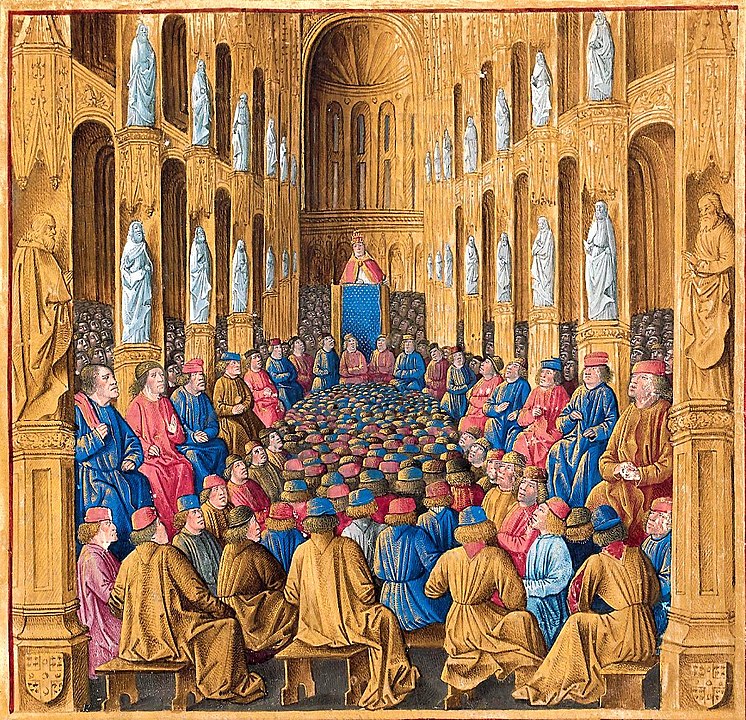
Pope Urban II at the Council of Clermont
While the West was undergoing significant transformations in the 11th century, the East was also in a state of relative instability. The Byzantine Empire, under the Macedonian dynasty, had managed to regain a certain level of peace and even relative splendor until the 10th century.
However, at the start of the next century, the Byzantines found themselves besieged once again (by Normans, Pechenegs, and Bulgarians), and despite relatively good relations with the Fatimids, they had to yield to the advancing Seljuk Turks at the Battle of Manzikert in 1071, opting to abandon part of Anatolia to prevent their core (Constantinople) from being directly threatened. Moreover, their relations with the West had been deteriorating since the Schism of 1054. Fortunately, the rise of Alexios I Komnenos, who defeated the Pechenegs, brought some hope to the Eastern Romans.
In the Muslim world, the caliphate had already fractured (in the second half of the 10th century) into three competing entities: in the West, the Umayyad Caliphate of Córdoba (which will not be directly relevant here), but more importantly the other two rival caliphates, the Shia Fatimids of Cairo and the Sunni Abbasids of Baghdad. The former were on the rise in the 11th century, with their territory extending into Syria-Palestine and the Holy Places in the Arabian Peninsula! The latter, however, had been weakened since the previous century by various dynasties such as the Buyids and by Turkish influence within the army.
It was the Turks themselves, specifically the Seljuks, who gradually took control of the region (Iran, Iraq, Syria-Palestine, and even Anatolia thanks to their victory at Manzikert). While they swore allegiance to the Caliph of Baghdad (who granted them the title of sultan), they held most of the real power. However, they too became divided after Malik Shah’s reign (he died in 1092) due to internal conflicts. Thus, on the eve of the Crusade, the East was deeply divided and weakened.
In the West, as mentioned earlier, this period marked the assertion of the Church’s independence following the Gregorian Reform, despite the ongoing latent conflict with the Holy Roman Empire resulting from the Investiture Controversy (starting in the 1070s). In France, the Capetian monarchy was slowly gaining strength against the great lords, but on the eve of the Crusade, King Philip I had other concerns—he had been excommunicated for remarrying!
In England, the country had been Norman since the conquest by William the Conqueror in 1066. The Normans were expanding rapidly, even into the Mediterranean: just a few years before Urban II’s call, they had conquered southern Italy and Sicily! Italy itself was torn by conflicts between the Pope and the emperor, but different cities were emerging, based on trade: Amalfi at first, then Venice, Pisa, and Genoa. Lastly, Spain had served as a testing ground for the Crusade with the Reconquista, the first victorious step of which led to the capture of Toledo in 1085.
First Crusade of the Barons and the People’s Crusade
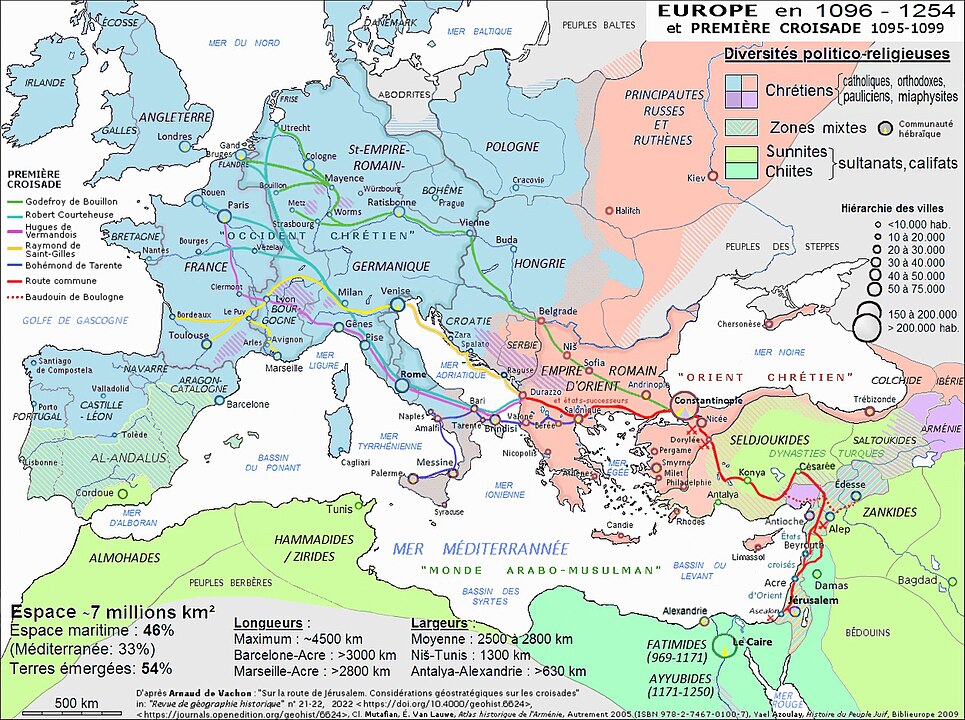
Routes of the “barons” during the 1st Crusade
Urban II’s call met with unexpected success! It did not appeal particularly to temporal rulers, as no major sovereign participated, but it did resonate with the common people. This is what came to be known as the “People’s Crusade” (or the Peasants’ Crusade), which left a lasting impression. Led by Peter the Hermit (a preacher), Walter Sans-Avoir (a knight), and a few other obscure leaders, it was primarily made up of Frenchmen, estimated at several thousand strong (some reports speak of 15,000, an enormous number for the time).
This was a crowd of poor people, driven by a sort of mystical fervor, if not fanaticism, that swept across Central Europe starting in 1096. Their path was quickly marked by pillaging and persecution, especially against Jews, in the Rhineland and as far as Hungary. This “People’s Crusade” (far from peaceful) reached the walls of Constantinople, much to the dismay of the Byzantines, who were shocked by these unorthodox methods.
Meanwhile, the “Barons’ Crusade” was organized more slowly, but unlike the People’s Crusade, it was directly under papal authority through the legate Adhemar of Le Puy. This First Crusade split into four armies: that of Raymond of Toulouse (who had fought in Spain) and the papal legate, the Flemish army of Godfrey of Bouillon, the army of Philip I’s brother Hugh of Vermandois for Île-de-France and Champagne, and the Normans under Bohemond of Taranto.
Baldwin of Boulogne (Godfrey’s brother) and Tancred (Bohemond’s nephew), who would become significant figures in the Latin presence in the East, should also be mentioned. The knights took two different routes—by land and sea—and also headed to Constantinople. For all, the journey was perilous: shipwrecks, attacks by bandits in uncontrolled territories… The beginnings of the First Crusade were far from easy, and God did not seem to have chosen an easy path for his pilgrims!
Negotiations with Alexios I Komnenos and the First Battles
The Byzantine emperor viewed the unruly “People’s Crusade” camped outside his walls with great displeasure. He decided to transfer the pilgrims across the Bosporus. The Seljuks awaited them at Civetot and massacred a large number of them! Peter the Hermit disappeared (his fate remains unknown), and Walter was killed along with 20,000 other peasants.
It was, of course, not as easy for Alexios Komnenos to deal with the powerful barons in the same way. The barons, camping outside the city, grew increasingly insistent and more threatening when they learned from a few survivors that the emperor had delivered the defenseless pilgrims to the Turkish armies. Negotiations lasted several weeks during the spring of 1097, and finally, an agreement was reached (a promise by the crusaders to return Antioch to the Empire, and an oath of allegiance refused only by Raymond of St-Gilles). The barons then crossed the Bosporus as well.
The Turks, still divided, were caught off guard this time. Nicaea was besieged and taken on June 19, 1097, and then returned to the emperor. On July 1, the crusaders defeated the Turks at Dorylaeum, after which the Turks began practicing a scorched-earth policy. This battle highlighted the stark difference between the two combat traditions, a difference that would persist throughout the Crusades: the Franks favored heavy cavalry charges, while the Turks preferred harassment and mounted archers.
The Difficult Journey to the Holy Land
The real difficulties for the crusaders began; though they no longer faced substantial military opposition, they encountered a “new world” they were unaccustomed to. Heat, food and water shortages, and a lack of fodder increasingly took their toll, and the desolate lands of Anatolia weighed heavily on the pilgrims’ morale. Some even resorted to drinking the blood of horses. Tensions grew within the crusader leadership, as the pope’s legate was unable to assert his authority. After two more clashes with the Turks at Iconium and Heraclea, the crusaders decided to split into two groups in September 1097.
The bulk of the army moved toward Caesarea to avoid the Cilician Gates; by the end of October, they were in front of Antioch, which the Turks had taken from Byzantium in 1085. The second army, led by Tancred and Baldwin of Boulogne (brother of Godfrey of Bouillon), passed through Cilicia. Baldwin then responded positively to a call for help from the Armenians of Edessa, enemies of the Turks and rivals of the Byzantines, who opened the city to him. The crusader became the city’s governor, creating the first Latin state: the County of Edessa, in March 1098.
The siege of Antioch began in October 1097. The city was governed by a Seljuk emir, vassal to the emir of Aleppo. The siege was long and difficult, with many problems: Turkish sorties, supply shortages, a lack of siege machines, desertions, and rivalries among the barons. It took the complicity of a Christian convert to Islam, an Armenian, to infiltrate the city: Bohemond entered Antioch on June 2, 1098. Many Turks were massacred, but some remained protected in the citadel. Worse still, the crusaders found themselves besieged within the city they had just captured by Turkish reinforcements led by Kerbogha of Mosul!
The situation grew increasingly dire: famine, disease, and even rumors of cannibalism among the crusaders spread. The liberation of the Holy Sepulcher seemed like a distant memory. Then, opportunely, the Holy Lance was discovered in the cathedral of Antioch, boosting morale. The crusaders launched a sortie and took advantage of dissensions within the Turkish command. On June 28, 1098, they achieved victory. The great victor was the Norman Bohemond of Taranto, who claimed and obtained the governance of the city despite opposition from Raymond of St-Gilles and especially the Byzantines, who had expected the city to be returned as promised. Tensions flared between the emperor and the Frankish barons.
Oh Jerusalem!
The Siege of Jerusalem
The ordeal endured to capture Antioch, along with the troubled journey and the massacre of the People’s Crusade, had nearly made the primary (and perhaps sole) goal of the warrior pilgrimage — Jerusalem — forgotten. The barons continued to quarrel (some even seeking to carve out fiefs in the region), while the Holy City had been taken from the Turks by the Fatimids in 1098. But it was the people who revived the spirit of the Crusade: the “Tafurs,” common folk, many from Peter the Hermit’s crusade, rekindled the pilgrimage spirit and forced the barons to resume their march at the beginning of 1099. In the meantime, the papal legate Adhemar of Le Puy had died on August 1, and the crusade truly fell into the hands of temporal powers, to the detriment of the Church.
Raymond took command of the army, as Bohemond remained in Antioch. He first attacked the ports and established supply lines with the Byzantine and especially the Genoese fleets; however, he avoided the best-defended forts and cities. While Tancred was tasked with liberating Bethlehem (captured on June 6), the bulk of the army reached Jerusalem on June 7, 1099.
The emotion was overwhelming! After so much effort, the pilgrims finally reached their goal: they knelt and prayed at the foot of the city walls, much to the astonishment of its inhabitants. The crusaders even hoped for a miracle to allow them to liberate Jerusalem without a fight. When no miracle occurred, they launched an assault on June 13 but failed due to a lack of equipment (ladders in particular). The Frankish leaders then decided to organize better: Raymond settled in the south; the Lorrainers, Normans, and Flemings divided the west and north without mingling. They began constructing siege machines, likely with advice from the Byzantines, accumulated over previous years, but there was a shortage of wood in the region, and still no miracle.
Fortunately, by June 17, the capture of the ports showed its value: reinforcements arrived via Genoese and English sailors, who brought the necessary equipment despite the threat of the Fatimid fleet. On the defenders’ side, preparations were also underway, including the use of Greek fire, inherited from the Byzantines. The long preparations did not prevent actions, especially those of spies; those captured in the crusader camp were catapulted back to Jerusalem (some smashed against the walls).
The preparations lasted a month, with continued hardship among the besiegers. It was decided to prepare for the final assault by ensuring God’s full support: a public fast of three days was declared, and on July 8, a procession was held. Barefoot but armed, the pilgrims marched around the city. They passed so close to the walls that they were shot at and urinated on, while the Muslims spat on the crosses.
On July 10, a siege tower was positioned at a weakly defended spot, while another advanced slowly due to difficult terrain. The mangonels began bombarding the walls, followed by the battering ram. The general attack began on July 13, but the crusaders only penetrated Jerusalem on July 15, initiating a great massacre.
The First Crusade Ends in a Bloodbath
Christian or Muslim chroniclers all agree that the capture of Jerusalem was carried out in a bloodbath: street fighting lasted two days, with reports of heaps of dismembered bodies and severed heads, and inhabitants massacred in both mosques and synagogues. One chronicler recounts that blood rose to knee level in the fury of purifying the “Solomon’s Temple” (the Al-Aqsa Mosque). For this unleashing of bloodthirsty violence was not “gratuitous”: it was the result of several years of fanatical pilgrimage for the liberation of the Holy Places, of Christ’s tomb, which had to be purified by blood.
Moreover, we must also put into perspective the figures given by chroniclers on both sides, and their descriptions: the city was not emptied of its inhabitants at the end of the fighting, and while the violence was indeed terrible (it would mark generations to come, particularly Saladin), it was not unprecedented for the time…
The goal of the First Crusade was achieved: Christ’s tomb was liberated, and the victors could intone the Te Deum there. But now, what to do? Most of the crusaders would return to the West, but those who remained would have to organize themselves. This would lead to the creation of the Latin States of the East, in which many European sovereigns would invest themselves: the German Emperor Frederick Barbarossa, King Richard the Lionheart of England, or the future Saint Louis.
Marco Polo was born on September 15, 1254, in Venice. At the age of 17, the Venetian merchant embarked on a 24-year journey with his father and uncle across Russia, Asia, and eventually to China. Marco Polo was the first to bring knowledge of the Far East to Europe. His accounts, immortalized in The Book of the Marvels of the World, spread throughout royal courts and influenced great explorers like Christopher Columbus. Marco Polo died on January 8, 1324, also in Venice.
What were Marco Polo’s main achievements?
Exploration: He traveled thousands of miles across Asia, documenting his experiences.
Cultural exchange: His writings introduced Europeans to Asian cultures and technologies.
Diplomacy: He served as an envoy for Kublai Khan, fostering relations between East and West.
Marco Polo and the Passion for Exploration: A Legacy from His Father
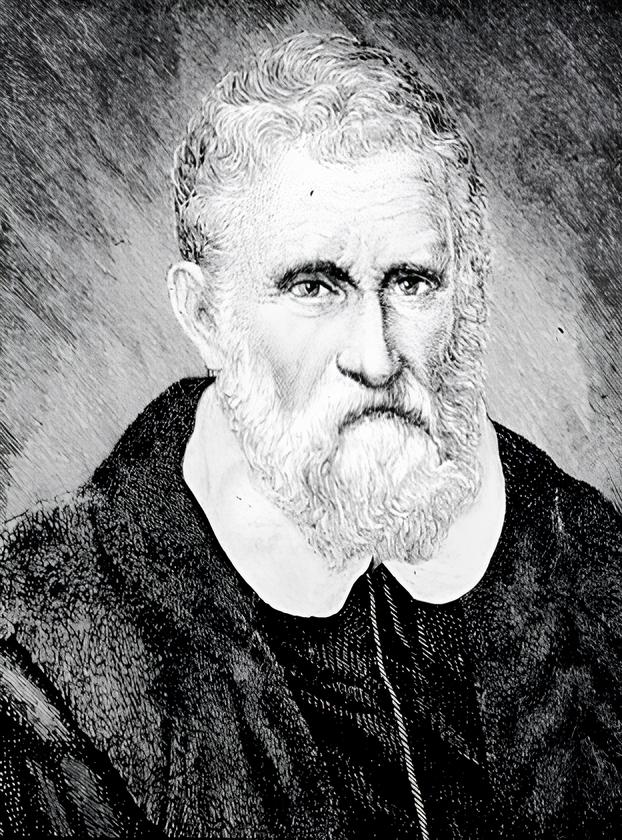
Marco Polo portrait
At a time when Venice was a prosperous city dominating Byzantium, its wealthy merchants took advantage of the opportunity to trade with Muslims who controlled the Silk Road. However, some, like Niccolò Polo, ventured further. Marco’s father continued his journey with his brother Matteo all the way to China. There, he met the Mongol Emperor Kublai Khan, the grandson of Genghis Khan. After a 15-year absence, Niccolò returned to Venice with a prestigious mission: he had been entrusted by Kublai to convey a message of goodwill to the Pope and to request scholars who could share Latin knowledge with the East.
However, upon his return to Venice, Niccolò found not his wife but a son named Marco, around fifteen years old. The noble Venetian woman had passed away prematurely a few years earlier. It is uncertain whether Marco was born shortly before or after his father’s departure. Despite a delay caused by the Pope’s election, Niccolò Polo and Matteo Polo departed again two years later, this time accompanied by young Marco.
Marco Polo’s Journey: A 24-Year Odyssey
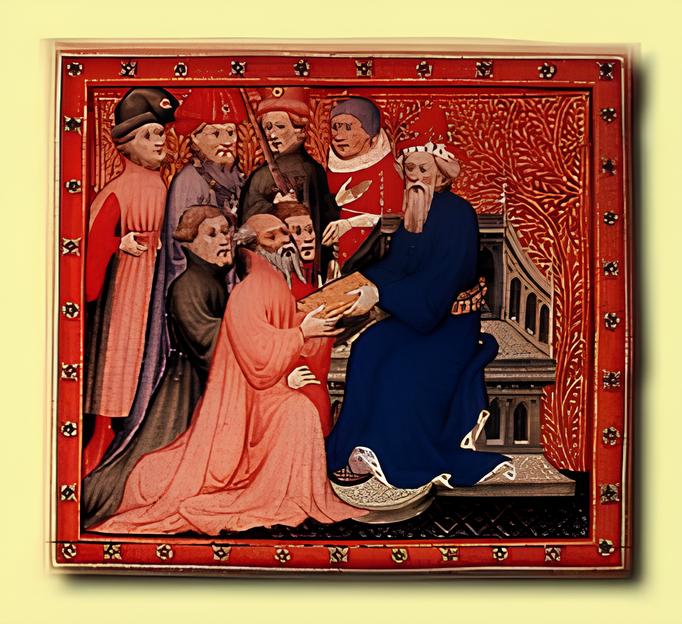
Marco Polo and Kublai Khan, an illustration in an Italian book from the 14th century
At the end of 1271, Marco Polo left Venice with his father and uncle, unaware that he would not return until he was 41 years old. He was 17 at the time. After traveling through Israel and Iran to reach Central Asia, the three men crossed the Gobi Desert and arrived in Cambaluc in 1275. There, they joined the court of Emperor Kublai Khan. For 16 years, they followed the Emperor through the largest cities and the most remote regions. Kublai, a refined ruler who had broken with the systematic massacres of his ancestors, appreciated the cultural contributions of the Venetians. Marco Polo gradually mastered Chinese and became a diplomat.
He was even said to have been the governor of the city of Yangzhou for three years. However, Marco, his father, and his uncle missed Venice and asked the Emperor to let them return.
Kublai finally agreed when he needed someone to escort a Mongolian princess to Iran. The Venetians, experienced travelers, were chosen to accompany her. After crossing Sumatra and India, they delivered the young woman and then continued their journey to Italy.
Upon their return to Venice, the city was at war with Genoa. On September 8, 1298, Marco Polo commanded a galley in a naval battle between the two powers. The Venetian fleet suffered a crushing defeat, and Marco was taken prisoner. While imprisoned, he shared his cell with Rustichello of Pisa, a Genoese writer, to whom he dictated his accounts.
What regions did Marco Polo visit?
Persia (modern-day Iran)
Central Asia (including the Pamir Mountains)
China (Cathay)
Southeast Asia (including India and Sumatra)
Marco Polo and Book of the Marvels of the World: Written in a Cell
A page of The Travels of Marco Polo
Thus, Description of the World, later renamed The Book of Marvels of the World, was born in the French language. After Marco Polo’s release in 1299, the book spread throughout Europe and was translated into multiple languages. Written at a time when Europeans knew little about the Far East, except for a few merchants who rarely ventured beyond the Silk Road, the book provided exceptional knowledge. Many geographical details it contained were later verified.
For example, the introduction of paper money by the Emperor and the use of coal by the Chinese were details that drew attention and made the account credible.
However, some claimed that the story was entirely fabricated. They pointed to the absence of mentions of the Great Wall of China, the importance of pork in Chinese cuisine, or the practice of foot-binding among Chinese women. They argued that the detailed descriptions of landscapes, whose accuracy could not be questioned, had been reported to Marco by Muslims who knew the region far better than Christians.
Nonetheless, it remains plausible that many details were embellished. For instance, the limited size of the Great Wall at that time, the seclusion of women, and other arguments address these accusations. It is important to remember that the text was written by a novelist at a time when epic tales were in vogue, and, especially in the absence of printing, the text was likely altered by scribes over time.
Moreover, the text underwent numerous manipulations, especially in the 16th century, and the original manuscript has been lost. Despite the debates that continue to surround Marco Polo’s account, there is no doubt about his importance in Medieval Europe and later in the Renaissance. His work contributed to the establishment of new routes to the East, reducing reliance on caravanserais. It was under the influence of this work that Christopher Columbus set sail westward to discover a new route to the Indies.
Marco Polo: Key Dates
Christopher Columbus’ handwritten notes on his Latin copy of the Book of Marco Polo
September 15, 1254: Marco Polo is born in Venice
The son of noble Venetian merchants, Marco Polo is born either in Venice or Dalmatia. At the time of his birth, it is unclear whether his father is present or already en route to China. Legend has it that his father left without knowing his wife was pregnant. In any case, Marco Polo will live alone with his mother until adolescence, before she passes away.
1269: Marco Polo’s father returns
After fifteen years of absence, Marco Polo’s father and uncle return to Venice. Emperor Kublai Khan had tasked them with requesting scholars from the Pope. The Pope’s death and the wait for the election of his successor delayed them. More importantly, Niccolo learns that his wife passed away during his journey, leaving behind a son, Marco, whose existence he may not have known about.
1271: Marco Polo departs for China
Two years after their return to Venice, Matteo and Niccolo Polo decide to leave again for the Mongol Empire to avoid Kublai Khan’s impatience. The men, tasked with bringing scholars to teach Latin knowledge to the Mongols, had been delayed by the death of Pope Clement IV in 1269. Gregory X, elected in 1271, sends two monks to China, but they abandon the mission due to turmoil in the countries they must traverse. At only seventeen years old, Marco Polo follows his father Niccolo on a journey that will last 24 years and inspire the “Book of the Marvels of the World.”
1295: Return to Venice
After twenty-four years of traveling throughout the East, including sixteen years with Mongol Emperor Kublai Khan, Marco Polo, his father, and his uncle return to Venice. The Emperor finally allows them to leave when he needs their naval expertise. Until 1298, Marco Polo seems to stay in his hometown, mingling with Venetian nobility.
September 8, 1298: Marco Polo is imprisoned during a naval battle
As Venice and Genoa had been at war for several years, Genoa attacks the enemy fleet. Despite having superior numbers, the Venetian fleet suffers a heavy defeat. Leading a ship, Marco Polo is captured by the Genoese, while the Venetian fleet commander is killed. During his imprisonment, the merchant and explorer dictates his travel accounts to his cellmate, Rustichello of Pisa.
The Book of the Marvels of the World, or Description of the World, written in French, quickly spreads throughout Europe despite the absence of the printing press. It leaves a lasting impression on its readers, notably inspiring future explorers like Christopher Columbus.
January 8, 1324: Death of Marco Polo
The Italian traveler and merchant Marco Polo dies in Venice at the age of 70.
On September twentieth, 1519, five weather-proofed wooden caravels and carracks carrying roughly two hundred and seventy sailors from across Europe weighed anchor at the Spanish port of Sanlúcar de Barrameda and sailed southwest into the unknown. Commanded by a tough, limping thirty-nine-year-old Portuguese nobleman sailing under the flag of Spain—Ferdinand Magellan (Fernão de Magalhães)—this Armada de Molucca set out to accomplish what Christopher Columbus had failed to do twenty-seven years earlier: find a western sea passage around the Americas to the Spice Islands of Indonesia. When a single leaking, worm-eaten ship limped back into Spain three years later with just eighteen skeletal survivors—and without Magellan himself—they had completed the first circumnavigation of the Earth in human history.
Why a Portuguese Veteran Sailed for the King of Spain
Born around 1480 in northern Portugal, Ferdinand Magellan spent nearly a decade fighting and sailing for the Portuguese Crown in India, East Africa, and Malaysia—participating in the 1511 conquest of Malacca alongside his close friend Francisco Serrão, who subsequently sailed further east to settle in the Spice Islands (the Moluccas) and wrote letters back to Magellan describing islands where cloves and nutmeg grew worth more than their weight in gold, while a permanent battle hip wound in Morocco left Magellan with a lifelong limp.
Under the 1494 Treaty of Tordesillas, the Pope had divided the non-European world in half between Spain (everything to the west) and Portugal (everything to the east around Africa). When Portugal’s King Manuel I coldly rejected Magellan’s request for a tiny pension increase and refused to fund his proposal to reach the Spice Islands by sailing *west*, Magellan renounced his Portuguese allegiance, walked across the border into Spain in 1517, and laid a painted globe before the eighteen-year-old Spanish King Charles I (Emperor Charles V). Magellan convinced the young king that if he could find a strait cutting through the bottom of the South American continent, Spain could reach the Moluccas from the west without ever violating Portuguese waters.
Mutiny at Port San Julián and Navigating the Labyrinthine Strait
Sailing across the Atlantic with five ships—the flagship Trinidad, the San Antonio, the Concepción, the Victoria, and the small scouting caravel Santiago—Magellan faced hostility from his three proud Spanish ship captains, who hated taking orders from a grim Portuguese foreigner. After searching the wide estuary of the Río de la Plata in vain for a passage and sailing south into the freezing sub-Antarctic autumn of Patagonia, Magellan anchored for the winter at Port San Julián in March 1520.
On Easter Sunday night, April first, 1520, the Spanish captains seized control of three of the five ships in an armed mutiny, demanding that the fleet turn back to Spain. Magellan crushed the rebellion with ruthless speed: sending a boat party with a hidden dagger to stab the rebel captain Luis de Mendoza aboard the Victoria, blockading the harbor entrance with his remaining two loyal ships, executing Gaspar de Quesada, and marooning the third ring-leader, Juan de Cartagena, on the barren Patagonian shore.
In October 1520, after losing the small Santiago in a scouting shipwreck, Magellan rounded the Cape of the Eleven Thousand Virgins and entered the treacherous, 350-mile-long maze of freezing fjords, blind channels, screaming williwaw winds, and jagged rocks that now bears his name: the Strait of Magellan. Even after the largest ship in the fleet, the San Antonio, deserted in the fog and sailed back to Spain with a huge portion of the fleet’s food supplies, Magellan pressed forward for thirty-eight harrowing days. On November twenty-eighth, 1520, his three remaining ships sailed out of the Western mouth of the strait into a vast, calm, sunlit ocean—which Magellan tearfully christened the Mar Pacífico (the Pacific Ocean) because not a single storm struck them during the crossing.
99 Days of Starvation Across a Giant Pacific and Death at Mactan
Here Magellan’s geographical calculations suffered a near-fatal error: like all European cartographers of 1519, he thought the Earth was much smaller than it actually is, assuming the Spice Islands lay just a few days’ sail west of South America. Instead, the Pacific Ocean covers a third of the planet! For ninety-nine continuous days across twelve thousand miles of empty blue water without sighting a single inhabited island until Guam in March 1521, the crew endured one of the worst starvations in maritime history:
The hardtack biscuit turned into worm-filled powder fouled with rat urine; drinking water turned yellow and putrid.
To keep from starving, sailors soaked the tough ox-hide leather protective wrappings off the mainyard rigging in the sea for four days, roasted the leather over coals, and ate it alongside sawdust and ship rats (which sold among the starving men for half a gold ducat apiece) while twenty men died of scurvy.
Reaching the archipelago of the Philippines in March 1521—where Magellan’s enslaved Malay interpreter, Enrique of Malacca, was stunned to discover he could understand the local Austronesian dialect, arguably making Enrique the very first human being to complete a linguistic circle around the globe—Magellan formed an alliance with Rajah Humabon of Cebu and converted hundreds to Christianity. However, in his zeal to prove the invincible power of Christian armor to his new ally, Magellan foolishly offered to crush a rival chieftain on the neighboring island of Mactan named Lapulapu, who refused to submit to Spanish authority.
At dawn on April twenty-seventh, 1521, wading ashore at low tide over sharp coral reefs that kept his ships’ cannons out of range, Magellan and forty-nine armored Europeans were swarmed by fifteen hundred warriors under Lapulapu. Recognizing the captain, the islanders aimed their fire-hardened bamboo spears and poisoned arrows directly at Magellan’s unarmored legs; struck in the right leg by a poisoned arrow and twice having his helmet knocked off his head, Magellan fought knee-deep in the surf for an hour to cover his men’s retreat to the boats before being overwhelmed and cut down by bamboo lances and kampilan swords on the beach.
Juan Sebastián Elcano and the Return of the Victoria (1522)
Following Magellan’s death and the abandonment of the worm-eaten Concepción, the surviving two ships—the Trinidad and the Victoria—finally reached the Moluccas (Spice Islands) in November 1521, filling their holds to the brim with twenty-six tons of priceless cloves. When the leaking Trinidad proved unable to sail back across the Pacific, Basque navigator Juan Sebastián Elcano—who had ironically been pardoned by Magellan after participating in the 1520 Patagonian mutiny!—took command of the sole remaining eighty-five-foot carrack, the Victoria, and made a desperate dash westward across the Indian Ocean and around Africa’s Cape of Good Hope while hunted by Portuguese warships.
On September sixth, 1522—almost three years to the day after five ships and 270 men had departed—the tattered Victoria limped back into Sanlúcar de Barrameda carrying just eighteen European survivors (including the Italian chronicler Antonio Pigafetta, whose diary preserved the entire story) and three Moluccan islanders. Remarkably, the single cargo of cloves in the hold of the Victoria sold for enough gold to pay for the entire cost of the five-ship expedition with a profit left over—and by sailing continuously westward until they arrived back from the east (losing one full calendar day in their ship’s logbook because they had traveled with the sun around the spinning Earth), Magellan and Elcano proved once and for all the true, breathtaking scale of our planet.
Navigator in the service of the Spanish sovereigns, Christopher Columbus was born on January 1, 1451, in Genoa (Italy). He died on May 20, 1506, in Valladolid. Aboard his three ships, he unknowingly sailed toward the New World.
He is known as “the man who discovered America” in 1492. However, other navigators, such as the Icelandic Leif Erikson (son of Erik the Red), had done so centuries before him. Yet, history remembers the name of the Italian navigator. Columbus had a dream: to find a new route to the Indies. Although he unknowingly failed in this quest, his discovery was no less significant.
Birth (and youth) of Christopher Columbus
Cristoforo Colombo, known as Christopher Columbus, was born in Genoa, Italy, in 1451, although doubts still persist about his birthplace. He was the son of a weaver, Domenico Colombo. Rejecting the life of an artisan, Columbus decided early on to become a sailor. The young man studied navigation and sciences. In 1476, he set sail aboard a ship bound for Lisbon and England. Following an attack by the French, Columbus ended up in Lagos and then joined his brother in Portugal. There, he met Filipa Perestrelo e Moniz, the daughter of one of Madeira’s colonizers. He married her in 1479, and they had a son, Diego.
The Origin of Christopher Columbus’ Voyage
Columbus harbored a dream: to discover a new route to the Indies by crossing the Atlantic. Until then, explorers would go around Africa, which was costly. Columbus studied the writings of various scholars. Adhering to the idea that the Earth was round, he believed he could reach Asia by sailing west across the Atlantic. In his mind, Europe wasn’t far from Asia. While Ptolemy estimated the distance to be 16,090 km, Columbus reduced it to 2,414 km.
The explorer presented his project to a committee of experts appointed by King John II of Portugal. The committee rejected it, and the king refused to finance him. Not giving up, Columbus presented his plan to Isabella of Castile in 1486. She refused in 1490 due to his demands: Columbus wanted to be named Admiral of the Ocean and Viceroy of all discovered lands. The following year, he re-pitched his proposal to the Catholic Monarchs of Spain. King Ferdinand’s advisor convinced Queen Isabella by highlighting the financial benefits of the endeavor. She was also swayed by the evangelical goals tied to the expedition.
Ships
Replicas of Columbus’s three ships (1893)
To chart a new route to the Indies—a quest he would fail but lead to an even more significant discovery—Columbus set sail from Palos, Andalusia, on August 3, 1492. He commanded three ships and a crew of 90 men. These ships are famous: the Santa María, the Pinta, and the Niña. The Santa María was the largest and the ship Columbus sailed on. The Pinta was the fastest, and the Niña was the smallest, as its name suggests. After a stop in the Canary Islands, the expedition embarked on a two-month-long voyage. Worried, the crew almost mutinied.
Columbus and America
On October 10, 1492, land was finally sighted. The ships landed on October 12 on the island of Guanahami, in the present-day Bahamas. Columbus claimed it in the name of the Spanish Catholic Monarchs and named it San Salvador. The navigator believed he had reached the Indies, which is why he called the indigenous people “Indians.” The locals informed him of the presence of gold in Cuba. He arrived on the island on October 28 and declared it Spanish territory.
The captain of the Pinta deserted to search for gold further west. In December, the Santa María wrecked, and Columbus found himself on the island of Hispaniola (now Haiti), where he found gold and left about 40 men in a fort. Columbus returned to Spain aboard the Niña and reunited with the Pinta on the way back. Upon his return to Europe, the success of the expedition increased the Admiral’s ambition, and he was already preparing for another voyage.
As for the name “America,” it comes from the Florentine Amerigo Vespucci. His name was used by a printer from the Vosges in 1507 when he wanted to reprint Ptolemy’s Cosmographia, the geographic reference of that time. The printer wanted to include the newly discovered lands and called upon the geographer Martin Waldseemüller to map them. Waldseemüller recalled Vespucci’s work Mundus Novus from 1503, which mentioned new lands. He named these lands “America” in honor of the navigator. Vespucci had made several voyages to America, though the exact number and dates are uncertain. He did not precede Columbus but played a part in organizing Columbus’s second voyage, and the two became friends. Though he was not the first to land on the continent, Vespucci was the first to recognize that they had discovered a new continent.
Christopher Columbus and 1492
1492… a date that resonates as a major historical event: Christopher Columbus discovers America! Ironically, he was convinced he had reached the Indies and was completely satisfied with having achieved his goal. He would never know that he had discovered a new continent and that his discovery would earn him a place in the annals of geography. To everyone, Christopher Columbus is the one who discovered America. In reality, other navigators, such as the Icelander Leif Eriksson (the son of Erik the Red), had done so several centuries before him. But history has retained the name of the Italian navigator.
Christopher Columbus and His Other Voyages
Columbus’s copy of The Travels of Marco Polo, with his handwritten notes in Latin written in the margins
In September 1493, once again mandated by Queen Isabella I of Spain, Christopher Columbus set sail with a fleet of 17 ships and 1,500 men with the goal of establishing a colony. The Admiral discovered the Lesser Antilles (Guadeloupe and Dominica) and Puerto Rico. He explored the coasts of Cuba and Jamaica. He found the garrison in Hispaniola, which he had established during his first voyage, decimated by syphilis (or by the Indigenous peoples). Columbus settled farther away and founded the colony of Isabela, entrusting its governance to his brother, Bartolomeo Columbus. He discovered that the indigenous people of these islands practiced cannibalism, using this as a pretext to enslave them. He returned to Spain in 1496.
Shortened Third Voyage
Christopher Columbus set sail again for the “Indies” in 1498. Five of the eight ships were redirected to Hispaniola to supply it. The Admiral continued his expedition toward the island of Trinidad. Ferdinand and Isabella of Spain received complaints about the mismanagement of the colony. They sent Francisco de Bobadilla (a Spanish colonial administrator) to arrest Columbus and his brother. Bobadilla brought them back to Spain for trial.
Eventful Fourth Voyage
After the trial, Christopher Columbus was stripped of control over his new lands. However, he was allowed to embark on his fourth voyage in 1502. He reached the coasts of present-day Honduras and discovered an abundance of gold in Panama. However, he had to confront the Indigenous people and lost four of his ships. He took refuge on the island of Jamaica. Eventually, he was rescued and decided to return to Spain in 1504. The great navigator passed away in Valladolid on May 20, 1506, still believing he had reached the Indies but deprived of all his privileges.
Christopher Columbus’ Logbook
The explorer’s voyages are compiled in his logbook titled “Logbook (1492-1493),” in which he described the stages of his journeys. These daily notes were later transcribed and abridged by the Dominican priest and Spanish missionary Bartolomé de las Casas (1485-1566), who was also a writer and historian and a defender of the rights of the Indigenous people against the practices of the Spanish colonists. The original logbook of Christopher Columbus had been given by the navigator himself to the Spanish sovereigns (the Catholic Monarchs) upon his return from the expedition but was later lost.
Christopher Columbus: Key Dates
Presumed portrait of Christopher Columbus, attributed to Ridolfo del Ghirlandaio: blue eyes, elongated face with high forehead, aquiline nose, dimpled chin, hair turned white at the age of 30. Image: Public Domain
January 1, 1451: Birth of Christopher Columbus
Cristoforo Colombo, also known as Christopher Columbus, was born in Genoa, Italy. The son of a weaver, he chose a life at sea early on.
1479: Married
Christopher Columbus married Filipa Perestrelo e Moniz, the daughter of one of the colonizers of Madeira. She bore him a son and died shortly after.
1480: He nurtures great ambition
Columbus studied sciences, navigation, cartography, and cosmography. He began to imagine reaching the Indies by crossing the Atlantic Ocean. His next challenge was convincing the Spanish or Portuguese monarchs to support his project, a task that proved difficult.
1484: Columbus tries to convince the King of Portugal
Christopher Columbus presented his project to a commission of specialists appointed by King John II of Portugal. After the commission’s negative recommendation, the king declined.
1486: Christopher Columbus turns to the Catholic Monarchs of Spain
Columbus met the Catholic Monarchs and presented his project. A scientific commission was assembled to evaluate the expedition. In 1487, following the commission’s recommendation, the Catholic Monarchs gave him a negative response. Columbus did not give up and would try to convince them again a few years later.
April 17, 1492: The Capitulations of Santa Fe
The Catholic Monarchs of Spain, convinced by Columbus’s arguments, agreed to finance his project to cross the Atlantic. They signed the Capitulations of Santa Fe (named after the camp near Granada), which allowed Columbus to outfit ships and gave him the title of Viceroy of the lands to be discovered. The generosity of the monarchs can be attributed to their euphoria following their victory over Granada, ending Muslim presence in the Iberian Peninsula. Columbus would return triumphantly to Seville on March 31, 1493, believing he had discovered the Indies by sailing west.
August 3, 1492: Christopher Columbus leaves Spain
The Genoese navigator Christopher Columbus departed from the port of Palos (Andalusia), hoping to reach the East Indies and their spices by sailing west. Portugal, having discovered the route to the Indies via the Cape of Good Hope, had rejected his plan. But the Catholic Monarchs of Spain, eager to evangelize the world, agreed to finance his voyage.
Three caravels—the Santa María, the Pinta, and the Niña—left Spain, sailing westward. Two months later, they would arrive in the Caribbean, believing they had reached the Indies.
October 28, 1492: Columbus discovers Cuba
A few days after setting foot on the first Caribbean islands (October 12), Christopher Columbus encountered the large island of Cuba. He claimed it for Spain and named it “Juana” in honor of the son of the Catholic Monarchs: Prince Juan.
September 25, 1493: Columbus embarks on his second voyage to the New World
The Genoese navigator began his second voyage to what he still believed were the Indies. Mandated once again by Queen Isabella of Spain, he led a fleet of 17 ships. During this expedition, he discovered the Lesser Antilles (Guadeloupe and Dominica) and Puerto Rico. He explored the coasts of Cuba and Jamaica. In Haiti, he found the garrison he had established during his first visit had been decimated by syphilis. He discovered that the indigenous peoples of these islands were cannibals and enslaved them under this pretext. Columbus did not find the riches and gold he sought and returned to Spain in 1496.
May 3, 1494: Christopher Columbus lands in Jamaica
Columbus’s fleet discovered the island of Jamaica, then called Xaymaca by the indigenous Arawak people, the first inhabitants of the island. The Spanish would establish a colony, massacre the indigenous people, and import African slaves to work on tobacco and sugar plantations. The English seized the island in 1655, and Jamaica gained independence within the Commonwealth in 1962.
1498: A shortened third voyage
The Admiral set sail again with eight ships for a third voyage. On July 31, five ships were redirected to the Hispaniola colony to supply it with basic goods. Columbus himself reached the island of Trinidad. The Catholic Monarchs of Spain, having received complaints about Columbus’s poor governance of the colony, sent Bobadilla to arrest Columbus and his brothers and bring them back to Spain. Following his trial, the great navigator lost all his privileges.
1502: Fourth and final voyage
Columbus was granted permission to depart again in 1502. He landed on the coasts of Honduras, where he found gold but faced hostility from the indigenous people. He lost four ships and requested help from the Hispaniola colony. The colonists eventually intervened, finding Columbus in poor condition. He returned to Spain for good in 1504.
May 20, 1506: Death of Christopher Columbus
The great navigator died in Valladolid, Spain, still believing he had reached the Indies but stripped of all his privileges.
The process by which the famous explorer James Cook (1728–1779)—who, by exploring the Pacific Ocean step by step, led to the discovery of new lands—discovered and named these new territories is quite fascinating. One of the youngest captains in the British Royal Navy, James Cook quickly proved himself to be a skilled sailor. More than a month after leaving Tahiti behind, the Endeavour was plowing its bow through the waves of the Pacific. The world’s greatest wilderness stretched out in every direction.
What the ship was actually searching for was nothing more than a single line drawn on a map over 100 years earlier by a Dutchman named Abel Tasman. By late September 1769, Cook’s crew began to spot encouraging signs. The waters were lighter in color and appeared shallower; seaweed floated on the surface, and there were pieces of driftwood covered in mussels.
James Cook’s Rum Incentive
Official portrait of Captain James Cook.
James Cook promised one gallon of rum to the first man to spot land during the day and two gallons to the one who spotted it at night. On October 6, a faint voice from the top of the mast announced that 12-year-old Nicholas Young had won the prize. He had spotted the southwestern entrance to Poverty Bay in New Zealand, and James Cook named the spot “Young Nick’s Head” in his honor. The 370-ton Endeavour was a coal ship built in Whitby for the east coast of England. Its captain was also born in Yorkshire; he had entered the coal trade on the east coast as an apprentice at a young age.
A natural sailor, James Cook joined the Royal Navy in 1755 at the age of 26. By the time he was 29, he had become captain of the 64-gun HMS Pembroke. Cook distinguished himself during the Seven Years’ War (1756–1763) between England and France, particularly through the maps he prepared and the surveys he conducted on the Saint Lawrence River during General James Wolfe’s Quebec campaign. When his explorations around Newfoundland demonstrated that James Cook was as successful as a researcher as he was a sailor, the Royal Navy began considering him for larger missions.
The mission they had in mind for James Cook was to observe the transit of Venus across the sun in order to determine the distance between Earth and the sun, with the goal of traveling to Tahiti. In addition to an astronomer, Cook’s crew included naturalist Joseph Banks, whose task was to document the plants and animals discovered during the voyage. He was also given a sealed package containing secret orders, which he was told not to open until the first part of his mission was completed.
Terra Australis Incognita
Map of Jan Janssonius’s persuaded location of Terra Australis Incognita (657).
The Endeavour set sail from Plymouth in 1768 with a crew of 94 men. Aware of the illness and death that scurvy could cause on a long voyage, Cook insisted on stocking up on fresh vegetables and meat at every opportunity. No one fell ill during the eight-month journey to Tahiti.
The sailors were weary of the sea, but Tahiti was a paradise. The people were carefree, and most of the women were attractive and eager. However, when gonorrhea began to spread among the crew shortly thereafter, Cook suspected it had been brought to the island by white people who had arrived there earlier. After observing the transit of Venus, James Cook revealed his secret orders. He was instructed to sail south to the 40th parallel, where there were grounds to believe a large landmass or a continent might exist.
The HMS Resolution and Discovery in Tahiti. Source: Bonhams
The information obtained by the Royal Navy was partly based on theories regarding Terra Australis Incognita, or the “unknown southern lands.” Geographers believed that such a landmass must exist in the south to balance the landmasses of the northern hemisphere. If Cook found the continent, he would examine its land, animals, plants, and minerals, as well as the potential for trade. If not, he would turn west and chart other regions.
New Holland and New Guinea
The Earl of Pembroke, then aboard HMS Endeavour, leaving Whitby Harbour in 1768. By Thomas Luny, dated 1790.
James Cook set sail southward with a Tahitian native serving as his interpreter. However, after weeks of sailing without encountering any land, he turned toward New Zealand. Upon circumnavigating the island, it became clear that there were actually two islands, and the region was mapped over the course of six months. Cook was captivated by New Zealand’s snow-capped mountains and the glaciers flowing down into the forests below. Banks discovered some well-preserved human bones. This was definitive proof of the Maori’s cannibalism.
The surveys were completed. James Cook, following his orders, continued westward to find the Great Southern Continent and then return home via the Cape of Good Hope. Three weeks later, he sighted land. This could be no other place than the eastern coast of New Holland. The region would later be called Australia, but at that time—following Captain Jansz’s first sighting in 1606—it was known by this name because the Dutch had made numerous voyages to its western shores.
On April 28, 1770, after sailing north along the coast for a week, they came upon a cove and a plain behind it dotted with eucalyptus trees. Banks found so many plants that Cook named the place Botany Bay. Meticulous measurements were then taken over a distance of nearly 3,200 km. A near-disaster occurred when the Endeavour became stuck and was punctured on the Great Barrier Reef. Thanks to exceptional seamanship, the ship was saved. During the six weeks required for repairs, Banks saw for the first time the animals resembling giant rabbits that the locals called “kangaroos.”
James Cook’s landing at Botany Bay (Kamay), 1770. Source: National Gallery of Victoria
James Cook followed the coastline, rounded the northernmost tip of the island, and named it Cape York. He had proven that New Holland and New Guinea were separate landmasses, and in recognition of this, he claimed the eastern coast of New Holland on behalf of England. The ship returned home in July 1771, after three years at sea. Although no new continent was discovered, surveys had been conducted, and new plants and animals had been discovered. Cook drew the Old World’s attention to the Pacific. How this vast source of abundance was utilized, however, remains an unfinished story.
James Cook’s Other Discoveries
Painted by William Hodges in 1776, this work depicts the fishing boats in Matavai Bay alongside the Resolution and the Adventure, the two ships of Captain James Cook’s second Pacific expedition, as they anchor off Tahiti.
James Cook, immediately upon returning from his first voyage in July 1771, expressed his desire to set out again. The idea that there might be a continent south of “New Holland” greatly interested the Royal Navy. Two ships, Resolution and Adventure, were prepared for a new expedition. On January 17, 1773, Cook crossed the Antarctic Circle and reached latitude 67°16′ south. This was farther south than anyone had ever gone before, yet no land was found. In October 1773, he sailed south again and crossed the Antarctic Circle twice more. Still, there was no land. Beyond the southern horizon lay only Antarctica, but Cook understood that even if a continent existed in those icy latitudes, it would hold little economic value.
Another question concerned whether there was a sea route to China via a Northwest Passage over Canada. Since the 16th century, many explorers had searched for such a route. With this objective, James Cook set out from the Pacific Ocean on July 14, 1776. He was once again aboard the Resolution, this time accompanied by the Discovery.
Cook first traveled to the islands of the South Seas, then headed toward Alaska. Along the way, he discovered the Hawaiian Islands and named them the Sandwich Islands. He then sailed as far as the Arctic ice, but failed to find the passage he sought. Turning south, he prepared to spend the winter in Hawaii, where he was highly respected. However, a dispute arose after a boat was stolen from the Discovery. During the ensuing conflict, Cook was killed. His crew, with great difficulty, recovered what remained of their captain’s body and buried it at sea.
Why Were Convicts Sent to Australia?
The idea of transporting criminals and politically undesirable individuals overseas emerged at the same time Britain acquired territories to which they could be sent. For 200 years, tens of thousands of convicts were effectively sent as forced labor to the American colonies and the West Indies. Prisons were severely overcrowded. Transportation helped alleviate this problem while also supplying cheap labor that contributed to colonial development. As a result, pickpockets, robbers, Jacobite rebels, Irish insurgents, and sheep thieves became some of the first English settlers overseas.
American independence created a crisis. Since the new republic no longer accepted convicts, Cook’s discoveries were seen as a providential solution. Joseph Banks recommended to Parliament that a settlement be established at Botany Bay, pointing out that sending convicts there would also resolve the issue of overcrowded prisons. An additional advantage was that the region’s pine trees and flax could supply masts and sails for ships trading in the Pacific. Thus, in 1786, it was decided that Botany Bay would become the site of Australia’s first penal colony.
How Did Australia Develop?
The First Fleet, consisting of eleven convict ships, arrived at Botany Bay on January 18, 1788. Everyone, including Governor Arthur Phillip, expected—based on Captain Cook’s descriptions—to find a beautiful harbor surrounded by fertile meadows. Instead, they encountered a scrubland stretching to the horizon, covered with eucalyptus trees.
Phillip immediately set out to find a better settlement site. A nearby headland concealed a harbor that Cook had only speculated about: “one of the finest harbors in the world, where a thousand ships could ride in perfect safety.” On January 25, he sailed into Port Jackson, and the following day established the convict colony at Sydney Cove, named after the Secretary of State for the Colonies who had authorized the expedition.
In the early years, crops failed and food shortages were severe. In 1790, new convicts arrived, half of whom were too ill to work. To combat growing disorder, Phillip began rewarding good behavior with land grants. In 1791, one farmer declared himself self-sufficient, and Phillip granted him additional land. By the end of 1792, the population had reached 3,500. That same year, Phillip distributed land to 62 individuals, and 700 hectares were cultivated. The young colony appeared to be taking hold.
When Did People Settle in New Zealand?
As soon as the convict settlers began establishing themselves in Sydney, sealers, whalers, and trading ships started anchoring off the coast of New Zealand. Māori were frequently employed on these vessels, and before long they became familiar figures in Sydney. A chief named Hongi Hika traveled to England, where he was showered with gifts. On his return via Sydney, he exchanged these gifts for muskets. Upon returning home, he used these new weapons to initiate intertribal wars on the North Island.
One of the first Europeans to visit New Zealand was the missionary Samuel Marsden, who arrived in 1814. In the late 1830s, new settlements developed according to the plans of Edward Gibbon Wakefield, who sought to establish self-governing societies that reflected the English class system. To promote his ideas, he founded the New Zealand Company.
In 1839, Wakefield sent his brother William to the Cook Strait region, where he purchased millions of hectares of land from local tribes. In 1840, British Governor William Hobson and 512 northern chiefs signed the Treaty of Waitangi. This agreement granted sovereignty to Britain while recognizing the Māori as British subjects with full rights.
That same year, the first 1,000 settlers who had purchased land from Wakefield arrived in the Wellington region. In a short time, they disrupted Māori life and caused considerable suffering. As these conflicts were gradually resolved over time, a new nation would emerge.
Frequently Asked Questions about James Cook
Who was James Cook?
James Cook was an English explorer and navigator known for his voyages of discovery in the 18th century. He made significant contributions to the exploration and mapping of the Pacific Ocean, discovering many islands and regions, including parts of Australia and New Zealand.
What was the significance of James Cook’s voyages?
James Cook’s voyages were of great importance because they expanded European understanding of the Pacific region. His expeditions helped map previously unexplored areas, discover new lands, and establish a British presence in the Pacific. Cook’s discoveries had a profound impact on scientific knowledge, cartography, and the understanding of different cultures.
What was the Endeavour voyage?
The Endeavour voyage was James Cook’s first major expedition, lasting from 1768 to 1771. Cook commanded HMS Endeavour and sailed into the Pacific primarily to observe the transit of Venus and search for a hypothetical southern continent. This voyage also marked Europe’s first contact with the eastern coastline of Australia.
How did James Cook contribute to the discovery of Australia?
James Cook played a significant role in the discovery of Australia. During his first voyage aboard the Endeavour, he mapped the eastern coastline of Australia and claimed it on behalf of Great Britain. His explorations and scientific observations laid the groundwork for later European settlement in Australia.
What other places did James Cook explore?
In addition to exploring Australia, James Cook explored and mapped other areas in the Pacific. He made numerous voyages to New Zealand, becoming the first European to map the entire coastline of both the North and South Isles. Cook also visited Tahiti, the Hawaiian Islands, the Cook Islands, and other Pacific islands.
Why is James Cook often referred to as Captain Cook?
James Cook is often referred to as Captain Cook because he held the rank of captain in the Royal Navy. His maritime background and expertise in navigation and cartography played a crucial role in his successful voyages of discovery.
What were the main goals of James Cook’s voyages of discovery?
The primary aims of James Cook’s voyages were to explore and map new regions, search for the southern continent (Terra Australis), observe astronomical events, study the flora and fauna of the regions visited, and establish friendly relations with indigenous peoples. These goals aimed to expand knowledge, facilitate trade and scientific research, and advance British exploration and colonization.
What impact did James Cook have on the scientific community?
James Cook’s voyages had a profound impact on the scientific community. His meticulous observations and records of natural phenomena, geography, and indigenous cultures have made significant contributions to various scientific disciplines, including botany, ethnography, geology, and astronomy. Cook’s scientific legacy continues to be recognized and studied today.
Did James Cook circumnavigate the globe?
Yes, James Cook completed a circumnavigation of the globe. During his second voyage, which lasted from 1772 to 1775, Cook circumnavigated the globe, crossing the Antarctic Circle and becoming one of the few explorers to achieve such a feat.
How did James Cook prevent scurvy on his ships?
As a captain, James Cook prevented scurvy on his ships by ensuring cleanliness and ventilation in the crew’s cabins. Cook insisted on a proper diet that included watercress, sauerkraut, and a type of orange extract. His success in keeping his sailors healthy resulted in his name becoming a maritime legend.
For more than fifteen hundred years—from the second century BC until the rise of oceanic maritime empires in the fifteenth and sixteenth centuries AD—the great civilizations of East Asia, South Asia, Persia, the Arabian Peninsula, and the Mediterranean basin were bound together by a sprawling, four-thousand-mile network of overland caravan tracks and sea lanes known to history as the Silk Road. Far from being a single paved highway, this shifting web of desert oases and high mountain passes functioned as the pre-modern world’s internet: moving not only bolts of shimmering Chinese silk, Roman blown glass, and Central Asian warhorses, but also paper, gunpowder, mathematics, world religions, and pandemic diseases across Eurasia.
Definition: Why Baron von Richthofen Named It “Seidenstraße”
Interestingly, no merchant or traveler walking from Chang’an (modern Xi’an) to Antioch in antiquity ever used the term “Silk Road.” The name was coined in 1877 by the pioneering German geographer and traveler Baron Ferdinand von Richthofen, who used the German terms Seidenstraße (singular, “Silk Road”) and Seidenstraßen (plural, “Silk Routes”) to describe the interconnected network of trans-Eurasian trade trails.
Geographically, the overland Silk Road split and reconnected to navigate around some of the most forbidding terrain on planet Earth:
The Hexi Corridor and the Taklamakan Loop: Departing the imperial Chinese capital of Chang’an, caravans threaded the narrow Hexi (“West of the Yellow River”) Corridor beside the Great Wall before reaching Dunhuang, where the trail split into Northern and Southern branches to skirt the lethal, shifting sand dunes of the Taklamakan Desert.
Crossing the Roof of the World: Reconverging at the oasis market city of Kashgar, travelers had to climb fifteen-thousand-foot icy passes over the Pamir, Tian Shan, and Hindu Kush mountains before descending into the legendary merchant cities of Central Asia (Transoxiana): Samarkand, Bukhara, and Merv.
The Western Termini and Maritime Silk Road: From Persia and Mesopotamia, goods traveled onward to Mediterranean ports like Antioch, Tyre, Alexandria, and Constantinople—supplemented to the south by a booming Maritime Silk Road connecting Chinese ports across the South China Sea and Indian Ocean to India, the Persian Gulf, and the Red Sea.
Causes: Why Emperor Wu Sent Zhang Qian West for “Heavenly Horses”
What caused the Silk Road to open officially around 130 BC? Not a desire to sell silk to Rome, but an urgent Chinese military survival crisis! During the early Western Han Dynasty, China’s northern borders were relentlessly raided by the Xiongnu, a powerful confederation of nomadic steppe horse-archers whose tough mounts easily outmaneuvered the smaller, chariot-pulling horses of China.
In 138 BC, the ambitious sixteen-year-old Emperor Wu of Han (Han Wudi) dispatched an imperial envoy named Zhang Qian westward into the unknown territories of Central Asia to forge a military alliance with the Yuezhi nomads against the Xiongnu. Captured and held prisoner by the Xiongnu for ten years before escaping to reach Bactria and the Fergana Valley (modern Uzbekistan, Kyrgyzstan, and Tajikistan) and returning to China after a thirteen-year odyssey in 126 BC, Zhang Qian brought Emperor Wu two revolutionary pieces of intelligence:
Sophisticated Western Kingdoms: Beyond the western deserts lay wealthy, urbanized civilizations (including Hellenistic Bactria, Parthia, and rumors of Rome) that craved Chinese goods.
The “Heavenly Horses” of Fergana: In the Fergana Valley (Dayuan), Zhang Qian had seen tall, muscular, swift horses that “sweated blood” (caused by a skin parasite) and were strong enough to carry heavily armored Chinese cavalrymen into battle against the Xiongnu.
Objectives: Trading Silk for Warhorses, Glass, and Ideas
Driven by the dual objectives of imperial military security and state-controlled diplomatic trade, Emperor Wu launched military campaigns to clear the Hexi Corridor, extended the Great Wall westward to the Jade Gate, and began exporting thousands of bolts of Chinese silk as diplomatic tribute and currency to acquire Fergana breeding stallions, jade from Khotan, alfalfa (to feed the horses), grapes, walnuts, pomegranates, and sesame.
Crucially, almost no individual merchant ever walked the entire four thousand miles from China to Rome. Instead, the Silk Road operated as a relay trade across middlemen—primarily Sogdian, Parthian, Kushan, and Arab traders—who bought goods at one oasis town and sold them at the next for a steep markup:
Going West From China: Mulberry-worm silk (whose manufacturing secret China guarded on pain of death for centuries until Byzantine monks smuggled silkworm eggs out inside hollow bamboo walking sticks in the sixth century AD), porcelain, lacquerware, iron tools, rhubarb, cinnamon, and two inventions that changed European history forever: rag paper (transferred to the Islamic world after the 751 AD Battle of Talas) and gunpowder.
Going East to China: Roman blown glassware (treasured in Chinese aristocratic tombs because China had not yet mastered glassblowing), gold and silver coins, Baltic amber, frankincense, wool tapestries, and cobalt blue pigments.
The Spiritual Highway: Most enduringly of all, marching right alongside the camel caravans were monks, scholars, and missionaries who carried Buddhism from India through the cave temples of Bamiyan and Dunhuang into China, Korea, and Japan, alongside Nestorian Christianity, Manichaeism, Zoroastrianism, and later Islam—proving that the Silk Road’s greatest cargo was human thought itself.
Dagobert I, the most famous Merovingian king after Clovis, reigned from 632 to 639. With the support of brilliant advisors (including Saint Eloi), he restored the unity of the Frankish kingdom during his brief yet prosperous reign and established his capital in Paris. Nicknamed the “good King Dagobert,” he held a court that his contemporaries considered lavish. After his death, the Merovingian monarchy steadily declined. Dagobert I was the first to be buried, according to his wishes, at the Abbey of Saint Denis near Paris. After him, many French kings would be interred there.
Dagobert I, the Last Great Merovingian King
Born around 604, Dagobert was the son of Clotaire II and Bertrude. At the age of ten, his father gave him the kingdom of Austrasia to satisfy the local aristocracy, which was dominated by the mayor of the palace, Pepin of Landen, and the Bishop of Metz, Arnulf. Upon his father Clotaire II’s death in 629, Dagobert was recognized as King of Neustria, although without Aquitaine, which he annexed following the death of his younger brother Caribert in 632.
He subdued the Bretons to the west and the rebellious Gascons in the south who opposed Frankish rule. Beyond the Rhine, he made the Thuringians, Alamanni, and Bavarians tributaries and waged war against the Veneti, who lived in the Danube Valley. In 631, he concluded a peace treaty with the Byzantine Emperor Heraclius.
As the sole ruler of the Regnum Francorum (Kingdom of the Franks), Dagobert defended the kingdom’s threatened borders. He often stayed in the town of Clichy, near Paris, displaying a luxury worthy of a Roman emperor.
He traveled through the provinces, dispensing justice and instilling fear among the leudes (Frankish nobles). Like his predecessors, he had to negotiate with the demands of the Austrasian aristocracy, making his infant son Sigebert king (634).
To prevent Sigebert from one day claiming the entire kingdom, Dagobert assigned Burgundy and Neustria to his third son, Clovis II, during his lifetime.
The “Good King Dagobert”
Contrary to the implication of the song “The Good King Dagobert,” the king was not a fool. During the ten years of his reign, Dagobert wielded absolute power.
He surrounded himself with skilled advisors, including the future Saint Eloi and Saint Ouen, the latter being the Bishop of Rouen and the former a goldsmith.
The bad reputation that the song gave to the king stems from its relatively recent creation, though it predates 1789, and its subsequent adaptations. Revived in 1814, during the restoration of the monarchy, it was interspersed with contemporary satirical verses. Dagobert was part of a new generation of Merovingians more comfortable in councils than on the battlefield.
A Reign Without Lasting Legacy
A great eater, drinker, and lover, Dagobert’s health began to deteriorate in his thirties. In 636, after a near-death experience, he summoned the principal dignitaries of the Regnum and his two sons and gave them a speech: “Thus, examining my conscience and the sins of my heart, meditating on the account I must give to the sovereign King, I feared His judgment…” He increased donations to monasteries, entrusted the education of Clovis to Eloi, and reiterated the division of his kingdom: Austrasia, Aquitaine, and Provence to Sigebert; Neustria, with the Duchy of Dentelin and Burgundy, to Clovis.
Two years later, nearing death, he had himself transported to the Abbey of Saint-Denis, which he had founded, asking to be buried there. He appointed Duke Éga as regent of the kingdom with the agreement of Queen Nanthilde, and died on January 19, 639. After his death, the Merovingian dynasty continued to decline under child kings, known as “lazy kings,” who left power in the hands of factions and the mayors of the palace.