When modern travelers think of ancient Egypt, they naturally picture ancient pharaohs like Tutankhamun and Ramesses II building temples along the Nile, yet the most famous ruler in Egyptian history, Queen Cleopatra VII, was not ethnically Egyptian at all. By birth, language, and royal bloodline, Cleopatra was a Macedonian Greek princess whose ancestors had arrived in the Nile Delta three centuries earlier in the army of Alexander the Great. Spanning nearly three hundred years from 332 BC to 30 BC, the Ptolemaic Period transformed Egypt into a vibrant Hellenistic superpower where Greek philosophy, language, and urban planning merged with three millennia of pharaonic religion.
Alexander the Great’s Liberation and the Oracle of Siwa
By the mid fourth century BC, ancient Egypt had endured generations of humiliating foreign occupation under the Persian Achaemenid Empire, whose kings had looted Egyptian temples and disrespected sacred animal cults. Consequently, when the twenty four year old Macedonian king Alexander the Great marched his army south into Egypt in the autumn of 332 BC after defeating the Persians at Issus, the Egyptian priesthood and populace did not resist him as an invader; they welcomed him with open arms as a liberator.
Demonstrating astute cultural respect, Alexander traveled immediately to the ancient capital of Memphis, where he offered sacrifices to the sacred Apis bull and was crowned with the traditional double crown of Upper and Lower Egypt. In early 331 BC, walking along the Mediterranean coast west of the Nile Delta, Alexander personally sketched the street grid in barley meal for a new port city that would bear his name: Alexandria. Before marching east to conquer Babylon and Persia, Alexander trekked hundreds of miles across the scorching Libyan Desert to the isolated Oasis of Siwa, where the chief priest of the oracle of Amun—whom the Greeks equated with Zeus—greeted the young king as the literal living son of the god, cementing his divine legitimacy in the eyes of every Egyptian subject.
Ptolemy I Soter and the Theft of Alexander’s Body
When Alexander the Great died suddenly of a fever in Babylon in June 323 BC at the age of thirty two without leaving a viable adult heir, his vast empire fractured among his most ambitious Macedonian generals, known to history as the Diadochi, or Successors. Among the shrewdest of these generals was Ptolemy, son of Lagus, one of Alexander’s childhood friends and trusted bodyguards. While rival generals fought suicidal wars trying to control the entirety of Alexander’s empire from Greece to India, Ptolemy immediately claimed the governorship of Egypt—a wealthy, grain rich fortress protected by deserts on both flanks and the sea to the north.
In 321 BC, Ptolemy pulled off the greatest geopolitical heist of antiquity. As the magnificent golden funeral cortege carrying Alexander the Great’s embalmed body in a temple wagon began rolling slowly from Babylon toward Macedon, Ptolemy marched an army into Syria, intercepted the procession, and hijacked the corpse. Bringing Alexander’s body first to Memphis and later entombing it inside a splendid mausoleum called the Soma at the heart of Alexandria, Ptolemy acquired the ultimate talisman of Hellenistic legitimacy. In 305 BC, Ptolemy formally assumed the title of Basileus (King) and Pharaoh, founding the Ptolemaic Dynasty as Ptolemy I Soter (the Savior), a royal line in which every subsequent male monarch was named Ptolemy and every queen was named Cleopatra, Arsinoe, or Berenice.
Alexandria: The Intellectual Capital of the Greek World
Under Ptolemy I and his son Ptolemy II Philadelphus, Egypt did not merely adopt Greek culture; it became the undisputed intellectual and scientific capital of the entire Greek speaking Mediterranean. Designed as a gleaming white marble metropolis separated administratively from the rest of Egypt, Alexandria was anchored by two wonders of the ancient world: the Pharos Lighthouse, rising nearly four hundred feet above the harbor entrance to guide maritime trade, and the Mouseion, the royal research institute housing the Great Library of Alexandria.
Funded generously by taxes collected from the fertile Nile harvest, the Ptolemies invited the brightest Greek minds from Athens, Syracuse, and Asia Minor to live tax free in Alexandria while receiving royal salaries. Within these halls, Euclid wrote the Elements of Geometry, Eratosthenes calculated the circumference of the Earth to within a few percent by measuring shadows between Alexandria and Aswan, Archimedes invented his water screw, Herophilus performed the first systematic dissections of the human nervous and cardiovascular systems, and Jewish scholars translated the Hebrew Torah into Koine Greek to create the Septuagint.
Greek Administration and the Creation of the God Serapis
To govern a country where a few hundred thousand Greek and Macedonian settlers ruled over roughly seven million native Egyptians, the Ptolemies instituted a dual system of administration. Koine Greek replaced Demotic Egyptian as the exclusive language of the royal court, taxation, banking, and high military command. Tens of thousands of veteran Macedonian and Greek soldiers, known as cleruchs, were granted lifelong plots of fertile farmland in the newly drained Fayyum Oasis in exchange for military service, planting Greek gymnasiums, theaters, and bathhouses deep in the Egyptian countryside.
At the same time, the Ptolemies realized they could never hold the country without the support of the wealthy native Egyptian priesthood. Outside of Greek Alexandria, the Ptolemies funded massive reconstructions of traditional Egyptian temples at Edfu, Kom Ombo, Philae, and Dendera, allowing temple sculptors to carve the Macedonian kings wearing traditional pharaonic kilts and crowns offering incense to Isis and Horus. To unite their Greek and Egyptian subjects under a shared state deity, Ptolemy I even introduced a brand new syncretic god named Serapis, combining the theological soul of the Egyptian underworld and bull deity Osiris Apis with the bearded, humanized artistic appearance of Greek gods like Zeus, Hades, and Asclepius.
Dynastic Marriage and Cleopatra’s Linguistic Breakthrough
To keep royal power strictly within the family and mirror the sacred mythological marriage of the Egyptian sibling gods Osiris and Isis—while shocking traditional Greek morality—the Ptolemies adopted the practice of brother sister royal marriage, beginning when Ptolemy II married his full sister Arsinoe II. For nearly three centuries, the rulers of this Macedonian dynasty lived inside the seaside palaces of Alexandria speaking exclusively Greek, viewing the Nile hinterland primarily as an estate to be taxed.
Remarkably, as the Greek biographer Plutarch recorded, not a single Ptolemaic king or queen bothered to learn the native Egyptian language until the very last ruler of the dynasty: Cleopatra VII, who ascended the throne in 51 BC. Fluent in Egyptian alongside Greek, Ethiopian, Troglodyte, Hebrew, Arabic, Syriac, Median, and Parthian, Cleopatra embraced her dual identity as both an educated Hellenistic monarch and the living reincarnation of the goddess Isis, presiding over the final brilliant twilight of Greek Egypt before its annexation by Rome in 30 BC.
In the autumn of 48 BC, two of the most consequential figures in ancient history met inside the royal palace of Alexandria under circumstances that read like high theatrical drama. When the fifty-two-year-old Roman dictator Julius Caesar stepped ashore in Egypt pursuing his defeated rival Pompey the Great, he walked directly into a vicious dynastic civil war between the twenty-one-year-old exiled Queen Cleopatra VII and her thirteen-year-old brother and co-ruler, King Ptolemy XIII. Within six months of brutal urban warfare, burning fleets, and palace intrigue, Caesar crushed the boy-king’s army and restored Cleopatra to the throne of the Pharaohs, forging a political and romantic alliance that reshaped the Mediterranean world.
The Dynastic Feud and the Murder of Pompey the Great
When Pharaoh Ptolemy XII Auletes died in the spring of 51 BC, his royal will left the kingdom of Egypt jointly to his eldest surviving daughter, Cleopatra VII, and her ten-year-old brother, Ptolemy XIII, appointing the Roman Senate as the legal executor of the testament. Brilliant, politically ambitious, and the very first ruler of her three-hundred-year Macedonian dynasty to actually learn to speak the native Egyptian language alongside eight other tongues, Cleopatra quickly sidelined her young brother on official documents and coins. In retaliation, a ruthless cabal of palace regents acting behind the boy-king—led by the eunuch Pothinus, the general Achillas, and the rhetoric tutor Theodotus—staged a coup in 49 BC, driving Cleopatra out of Alexandria into exile in Syria and Palestine, where she raised a mercenary army to fight her way back.
It was at this exact moment of military standoff near the border fortress of Pelusium that Pompey the Great arrived off the Egyptian coast after losing the Battle of Pharsalus to Julius Caesar in Greece. Hoping to win Caesar’s favor and keep Roman troops out of Egypt, Ptolemy XIII’s advisers lured Pompey into a small rowboat and assassinated him on the beach on September twenty-eighth, 48 BC. When Caesar sailed into Alexandria harbor three days later and was presented with Pompey’s pickled head and signet ring, the fatal miscalculation backfired: Caesar turned away in disgust and wept for his former son-in-law, then marched into the royal palace with four thousand Roman legionaries, declaring that as Roman Consul he would personally arbitrate the dispute between the brother and sister.
Smuggled Into the Palace in a Linen Sack
Summoned to Alexandria to state her case before Caesar, Cleopatra faced an immediate problem: her brother’s army under General Achillas controlled every road, harbor entrance, and gate around the royal quarter. If she attempted to enter the city openly, Pothinus’s assassins would kill her on sight before she ever reached Caesar’s chambers. Assessing Caesar’s reputation for boldness and appreciation of wit, the twenty-one-year-old queen devised an audacious plan.
Wait until dusk, Cleopatra boarded a small skiff accompanied only by her trusted Sicilian attendant, Apollodorus. Rowing quietly right beneath the towering walls of the seaside palace, she climbed inside a large hemp or linen sack used for carrying heavy bedding—often mistranslated in later centuries as an Oriental carpet—while Apollodorus tied the bundle shut with a leather strap. Hoisting the queen over his shoulder like a routine delivery of linens, Apollodorus walked straight past the Egyptian palace guards and into Julius Caesar’s private apartments, untying the cord so Cleopatra could step out before the astonished Roman commander. As the biographer Plutarch later wrote, this single clever stratagem was the very first bait that captivated Caesar, convincing him instantly that Cleopatra possessed the intellect to rule Egypt.
The Alexandrian War and the Burning of the Harbor Fleet
The following morning, when Caesar summoned the thirteen-year-old Ptolemy XIII to the throne room to announce a formal reconciliation restoring Cleopatra as co-ruler according to their father’s will, the boy-king spotted his sister already standing beside Caesar. Realizing they had already formed an intimate alliance overnight, Ptolemy ran out into the palace courtyard, tore the royal diadem from his head in tears, and shouted to the crowd that he was being betrayed.
Pothinus immediately ordered General Achillas to march twenty thousand hardened Egyptian soldiers and two thousand cavalry from Pelusium to besiege Caesar’s outnumbered four thousand Romans inside the royal compound. For nearly five months during the winter of 48 to 47 BC, Caesar and Cleopatra were trapped together in the Siege of Alexandria. Fighting for survival block by block, Caesar executed Pothinus after discovering him signaling the enemy, fortified the palace theater, and ordered the Egyptian warships docked in the Great Harbor set ablaze to prevent Achillas from cutting off his sea supply lines—a fierce fire that spread to the docksides warehouses and destroyed thousands of papyrus scrolls belonging to the famous Library of Alexandria.
The Battle of the Nile and the Royal Cruise
In March 47 BC, long-awaited allied reinforcements led by Mithridates of Pergamum and Antipater of Judaea marched into Egypt from the east. Having earlier released Ptolemy XIII in a failed bid to calm the rebels, Caesar sailed out of Alexandria to link up with Mithridates and met the full Egyptian royal army at the Battle of the Nile in the delta. Storming the Egyptian fortified camp from three sides, Caesar’s veterans routed Ptolemy’s forces completely. Attempting to flee the slaughter aboard an overloaded barge, the fifteen-year-old King Ptolemy XIII capsized into the Nile and drowned, weighed down to the riverbed by his solid gold suit of armor.
Returning victorious to Alexandria, Caesar formally placed the crown of Egypt firmly in Cleopatra’s hands, marrying her nominally to her surviving younger twelve-year-old brother, Ptolemy XIV, to satisfy traditional Egyptian custom while leaving three Roman legions stationed in the country to guarantee her authority. Before returning to Rome, Caesar and the pregnant Cleopatra embarked on a magnificent two-month celebratory procession up the Nile River aboard a two-story royal pleasure barge accompanied by four hundred ships, cementing Cleopatra’s status as an unchallenged monarch just months before she gave birth to their son, Ptolemy XV Caesar, known to the world as Caesarion.
125-121 BC: Rome’s legions, led by consul Fluvius Flaccus, intervene in Gaul for the first time in 125 BC, in what is now Provence. They defeat the local Gaulish peoples: the Ligurians, Salyens, and Vocontii. Four years later, consul Fabius Maximus defeats the Allobroges (settled between the Rhône and the Southern Alps). A new Roman province is born: Gallia Transalpina (Transalpine Gaul).
118 BC: Domitius Ahenobarbus establishes the Colonia Narbo Martius (Narbonne). The general and consul turns the city into a commercial crossroads of the western Mediterranean.
102 BC: Fortified in a camp on the Rhône, consul Caius Marius defeats two Germanic-Celtic tribes, the Teutons and Cimbri, at Aquae Sextiae (Aix-en-Provence). These tribes sought to cross the Alps to attack Rome. His triumph halts further foreign invasions on Gaulish soil.
61 BC: Led by their chief Catugnatos, the Allobroges rise again to take control of Transalpine Gaul. The province’s governor, Caius Pomptinus, defeats them at the Battle of Solonion near Valence (Drôme).
58 BC: Wishing to match the military exploits of his rival Pompey (106-48 BC), Julius Caesar (100-44 BC), proconsul of Transalpine Gaul, begins his conquest of “long-haired Gaul” (Gallia Comata), inhabited by powerful tribes like the Arverni (Auvergne), the Aedui (Burgundy), and the Carnutes (Central Loire Valley). Caesar exploits rivalries between these tribes to carry out his Gallic Wars.
52 BC: Upon his return to Rome, crowned with victories, Caesar learns of unrest in Gaul: Roman merchants have been massacred in Cenabum (Orléans) and the Arverni chief Vercingetorix (80-46 BC) has raised an army of 80,000 men. In June, Caesar’s legions lay siege to the oppidum of Gergovia but are defeated by the Gauls. Caesar imposes a two-month siege, from August to September, at Alesia, starving the population. Vercingetorix is forced to surrender. The following year, all of Gaul becomes Roman.
40 BC: After the assassination of Julius Caesar in 44 BC, Rome is divided between his grand-nephew Octavian, generals Lepidus and Mark Antony, who form a triumvirate. They conclude the Pact of Brundisium (Brindisi, Italy), which recognizes Mark Antony as master of the East and Lepidus of Africa. Octavian, the future Emperor Augustus, rules over Gaul.
27 BC: Founded in 43 BC by proconsul Munatius Plancus, Lugdunum (Lyon) is elevated to the rank of capital of Gaul. The city houses the only mint outside Rome authorized to strike gold and silver coins and becomes the empire’s second aqueduct system.
16-13 BC: Emperor Augustus (63 BC-14 AD) gives Gaul a new administrative framework. Transalpine Gaul, governed by a proconsul, becomes Narbonensis, named after its capital Narbo Martius (Narbonne).
Long-haired Gaul is divided into provinces: the Three Gauls: Belgica with its capital Durocortorum (Reims), Lugdunensis with Lugdunum (Lyon), and Aquitania governed from Mediolanum Santonum (Saintes). Gaulish peoples are grouped into civitates (cities), and their governor is the emperor himself.
12 BC: The imperial cult establishes its first sanctuary in Lugdunum (Lyon) and a second in Narbo Martius (Narbonne). Every year on August 1st, the Council of Gaul, bringing together representatives from the sixty cities of the three provinces, elects a high priest to celebrate Rome and the emperor.
9 AD: Three Roman legions led by General Publius Quinctilius Varus are massacred by the Germans in the Teutoburg Forest (modern-day Germany). The province of Germania slips out of Rome’s control. The Romans consolidate the border on the Rhine but no longer seek to control the area between the Rhine and the Danube, which from the third century will become the starting point of the “barbarian invasions.”
The Julio-Claudians, Heirs of Augustus
21 AD: While Julius Caesar had exempted most Gaulish peoples from taxes, Emperor Tiberius (42 BC-37 AD) demands a tribute from all. Julius Florus, leader of the Treveri (inhabitants of modern-day Belgium), and Julius Sacrovir, leader of the Aedui (in Burgundy), launch a revolt. Defeated by legions returning from Germania, the two members of the old Gaulish aristocracy commit suicide.
48 AD: Emperor Claudius (10 BC-54 AD), born in Lugdunum (Lyon), delivers a remarkable speech in the Senate advocating for Gaulish nobles to be considered full Roman citizens. Only the elites of a few tribes allied with Rome, like the Aedui, will gain this status.
68-69 AD After the death of Nero (37-68), the last emperor of the Julio-Claudian dynasty, Rome plunges into political chaos, with four usurpers succeeding each other. The Gauls are drawn into this civil war through the governors of the Three Gauls.
Peaceful Rule of the Flavians
70 AD: Under Emperor Vespasian (9-79), the first emperor of the Flavian dynasty, the Pax Romana (Roman Peace) is solidified during an assembly in Durocortorum (Reims), where, “in the name of Gaul,” the Gallo-Roman elites swear loyalty to Rome.
90 AD: During the reign of Emperor Domitian (51-96), the construction of public buildings multiplies in the major Gallo-Roman cities. Amphitheaters are built in Nîmes, Orange, and Arles. A 275-meter-long and 48-meter-high aqueduct, meant to bring water from the Uzès spring to the city of Nemausus (Nîmes), begins to be erected: this will be the future Pont du Gard.
92 AD: Worried about the increase in Gaul’s wine exports, which threatens small Roman vineyards, Domitian orders, by decree, the uprooting of half of Gaul’s vineyards.
Under the Antonines and Severans
177 AD: As Christianity emerges in Gaul, Emperor Marcus Aurelius (121-180), alarmed by this new religion, demands public executions. Among the most notable are 66 martyrs thrown to the wild beasts in the amphitheater of Lugdunum (Lyon).
197 AD: Emperor Septimius Severus (145-211) sacks Lugdunum (Lyon), the capital of Gaul, which had allied with the usurper Clodius Albinus. Gallo-Roman senators are executed.
212 AD: The Constitutio Antoniniana, also known as the Edict of Caracalla, grants Roman citizenship to all free men in the empire who had not yet acquired it.
Third Century Crisis of the Roman Empire
253-274 AD: Abandoned by the empire, plagued by military anarchy, the Gallo-Romans secede to defend against the first “barbarian invasions” from the east. General Postumus seizes Cologne and declares himself “Emperor of the Gauls” in 260, before being assassinated. In 274, Emperor Aurelian (214-275) restores unity. He is killed by the Praetorian Guard a year later.
284-286 AD: Driven into misery, armed bands of landless peasants, slaves, and deserting soldiers, called the “Bagaudae,” loot and plunder northwest Gaul. Emperor Diocletian (245-313) violently suppresses these outcasts of Roman conquest.
303 AD: To weaken the power of governors, Diocletian divides Gaul into sixteen imperial provinces grouped into two districts: Diocesis Galliarum, north of the Loire and Rhône, with Augusta Treverorum (Trier) as its capital, and Diocesis Viennensis, which extends to the southernmost provinces, with Vienna (Vienne) as its capital.
Rise of Christianity
313-392 AD: Emperor Constantine I (272-337) converts to Christianity in 313. Theodosius I (347-395) continues his work with the Edict of Thessalonica in 380, which declares Christianity the official religion of the Roman Empire. He bans all pagan practices in 392.
406 AD: The “barbarian invasions” sweep across Gaul. Vandals, Suebi, and Alans, Germanic tribes, cross the Rhine and destroy everything in their path. Weakened, Emperor Flavius Honorius (384-423) does not intervene.
410 AD: Rome is sacked by the Visigoths of Alaric I. This Germanic people then seizes Narbonensis and Aquitaine in Gaul.
Collapse of the Roman World
476 AD: On September 4, Odoacer, leader of the Heruli, barbarians allied with the Huns of Attila, confronts Romulus Augustulus (461-507), the last emperor of the Western Roman Empire. He deposes him and becomes the first Germanic king of Italy. The Western Empire collapses.
486 AD: The Roman Empire is replaced in Gaul by a Frankish kingdom ruled by Clovis (465-511). From the Merovingians to the Carolingians, a new Gallo-Frankish identity emerges. Roman civilization begins to merge with the “barbarian” world of the Franks, leading to the birth of the French language.
Under his real name, Gaius Julius Caesar Octavius, Augustus was the first and most famous Roman emperor. When his uncle Julius Caesar died in 44 BCE, Octavius began a long political struggle to gain power. In 31 BCE, he won the naval Battle of Actium against his main rivals, Mark Antony and Cleopatra, Queen of Egypt.
Upon returning to Rome, Octavius laid the foundation for a new regime in 27 BCE: the Principate. Now called Augustus, he gradually accumulated all the powers, thus laying the foundation for the Roman Empire. His reign was marked by peace and prosperity, particularly in the arts, and this period is known as the “Augustan Age,” considered the golden age of Roman classicism.
Octavius: Caesar’s Heir
The future Augustus was born Gaius Octavius on September 23, 63 BCE (the year of Cicero’s consulship), in Rome, on the Palatine Hill. His father served as governor of the province of Macedonia until 59 BCE and died upon his return in 58. Octavius barely knew him, and his mother took on a significant role in his life. Atia Balba Caesonia, his mother, was the niece of Julius Caesar. The young Octavius was then under the tutelage of Gaius Toranius but also under the protection of his maternal grandmother, Julia.
Thanks to her, he was educated until age twelve by some of the greatest masters of rhetoric. It was during this period that he formed important friendships, such as with Agrippa, who would later play a crucial role in his life. While Octavius excelled in politics, he was not particularly skilled in military affairs. Agrippa, a brilliant strategist on both land and sea, would act as his right-hand man in military matters.
Rome’s political situation was becoming increasingly tense, with the rivalry between Caesar and Pompey as the backdrop. Octavius soon aligned himself with his great-uncle and played a political role alongside his sister in the unfolding intrigues. In 48 BCE, Caesar admitted Octavius to the college of pontiffs, and by 45 BCE, he was already on a military campaign in Spain against Pompey’s supporters. During this time, his first health problems emerged, and he especially struggled to present himself as a capable military leader, unlike his friend Agrippa. In the same year, Julius Caesar, who had no sons, named Octavius as his heir in his will, leaving him three-quarters of his wealth.
Upon Caesar’s assassination in March 44 BCE, Octavius was in Apollonia, and his life was at risk. However, against his mother’s wishes, Caesar’s heir decided to return to Rome to assert his rights. He was only nineteen when he arrived in Brindisi and chose to be called Gaius Julius Caesar Octavianus, or Octavian. Determined to play a central role in resolving the ongoing civil wars, he sought to avenge his adoptive father’s death.
The Civil War
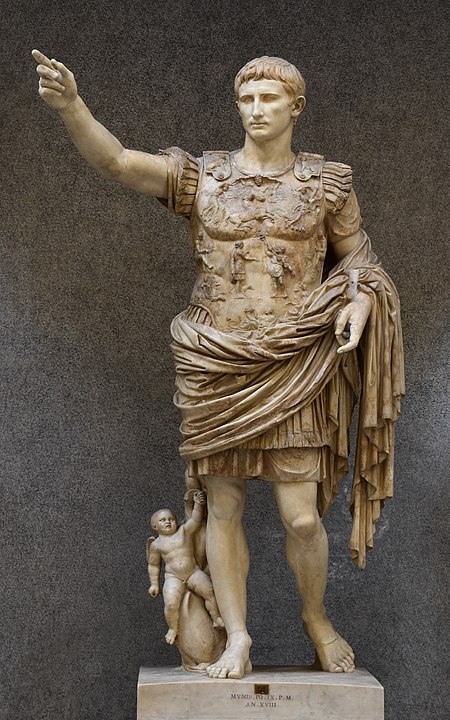
Augustus of Prima Porta, 1st century. Credit: Wikimedia, CC BY-SA 4.0
As Caesar’s legitimate heir, Octavian initially positioned himself as a rival to Mark Antony, who was popular with the Roman people and saw himself as Caesar’s natural successor. However, through his political acumen and with the military support of his allies (particularly Agrippa), the future Augustus gradually marginalized his rival. Octavian benefited from Cicero’s support, which aimed to help him secure the Senate’s decisive backing. Antony was defeated at Modena in 43 BCE, and both sitting consuls were killed. Cicero had planned to share the consulship with the young Octavian, but the Senate refused.
This was a significant moment in the early political career of the future emperor, as he began to see the Senate as his main adversary. The senators did not welcome the rise of a young man who might become another Caesar. However, Octavian eventually secured the consulship and organized the punishment of Caesar’s assassins.
By the end of 43 BCE, Octavian had gained the upper hand over his opponents and, after tough negotiations, secured the alliance of Mark Antony and Lepidus, forming the Second Triumvirate.
The time had come for Caesar’s assassins to pay: they were hunted down the following year and defeated at the Battle of Philippi. The main conspirators, Brutus and Cassius, committed suicide. The triumvirs then divided control of the Roman world, not yet an empire. The last threat, Sextus Pompey, was crushed in 36 BCE.
However, the peace did not last long, as rivalry continued between Antony and Octavian, despite Antony’s marriage to Octavian’s sister. Octavian’s popularity grew, while Antony increasingly came under Cleopatra’s influence. Lepidus was quickly sidelined, and his African provinces fell into Octavian’s hands. War eventually broke out between the two heirs of Caesar, culminating in the naval Battle of Actium in 31 BCE: Antony and Cleopatra were defeated, and Octavian became the sole ruler of Rome.
The Beginnings of Augustus’ Principate
A bust of Augustus as a younger Octavian, dated c. 30 BC. Capitoline Museums, Rome
As early as 38 BC, Octavian obtained the title of Imperator; but his victory over Antony allowed him to accumulate titles, and therefore power: Princeps Senatus in 28 BC (that year, he completed his sixth consulship, with Agrippa as colleague). The Senate gave him the honorary title of Augustus in 27 BC, the tribunician power in 23 BC, and his imperium was renewed for ten years. Although not officially declared, a new regime was established to replace the Republic: the Principate.
Despite his speeches emphasizing the importance of the Senate and the people, Augustus was clearly the sole decision-maker. He then initiated reforms: in the army, administration, organization of the provinces, as well as significant public works in Rome. He shaped what would become the Roman Empire for centuries to come.
A strict observer of Roman virtues, Augustus strove to regulate public morals by enacting sumptuary laws (limiting expenditures) and natalist laws (encouraging marriage). In the economic field, he promoted the development of agriculture in the Italian peninsula. His religious policy had two aspects: on the one hand, Augustus worked to restore and renovate traditional religion, and on the other, he founded the imperial cult.
A protector of the arts, Augustus was a friend of poets such as Ovid, Horace, and Virgil, as well as the historian Livy, to whom he extended his support and generosity. With the help of his friend and advisor, Marcus Vipsanius Agrippa, Augustus sought to embellish Rome by constructing the Forum of Augustus, the Theatre of Marcellus, the Temple of Apollo Palatinus, the Pantheon, and the Baths of Agrippa. According to Suetonius, “he left a Rome of marble where he had found a city of bricks.”
Augustus in Gaul
While Caesar had formed only one province in Transalpine Gaul, Augustus, taking into account the ethnic subdivisions of the region, divided it into four areas. In 22 BC, the former Province, bounded by the Rhône and the Cévennes, was renamed “Narbonensis” and became a senatorial province governed by a proconsul. The rest of Gaul, called Gallia Comata, was divided into three regions, each governed by a legate: Aquitania, between the Loire and the Pyrenees; Lugdunensis, between the Loire, Seine, and Saône; and Belgica, east of the Saône and north of the Seine.
The former Roman colony of Lugdunum, founded in 43 BC, became the capital of the Roman province under Augustus and the starting point of the five major imperial roads leading to Aquitania, Italy, the Rhine, Arles, and the Ocean. The emperor built the Amphitheatre of the Three Gauls there, dedicated to his cult and that of Rome, as well as a mint. Augustus visited the province at least four times, taking particular care to pacify it, while his friend and son-in-law Agrippa personally oversaw the administrative organization of the region by conducting a complete land survey of Gaul and constructing an extensive road network.
Despite the pacification efforts initiated during the last years of Julius Caesar’s dictatorship, some tensions persisted locally, and several outbreaks of violence revealed the last remnants of rebellion by certain Gallic peoples against Roman domination. The Aquitanians (in 39 BC), the Morini (in 30 BC), the Treveri (in 29 BC), and the Aquitanians again (in 28 BC) revolted, prompting the intervention of Roman legions.
In 25 and 14 BC, Augustus subdued the peoples of the upper valleys of the Alps, and in 6 BC, a trophy was erected at La Turbie to commemorate his victory over them.
A Difficult End to His Reign
Internal peace did not necessarily mean peace with Rome’s neighbors. Augustus had to address, and often relied on the talented Agrippa to suppress, various threats around the Empire. The goal was primarily to consolidate the borders rather than expand Rome’s territory: he fixed the limits of the Empire at the Euphrates, facing the Parthians, and pushed the northern borders to the Danube. However, he suffered a traumatic setback in AD 9, when the legate Varus and three legions were massacred by the Germans. Tiberius then took over, but Augustus had to accept that the border would remain on the left bank of the Rhine.
His reign became increasingly painful: his health problems were compounded by conspiracies (such as Cinna’s, from 16-13 BC), and especially by succession issues. Despite several marriages (including his last with Livia), Augustus had no surviving sons.
He adopted Agrippa’s sons, Gaius and Lucius, in 17 BC, but they died before him. He eventually adopted his stepson Tiberius, Livia’s son, in AD 4.
Additionally, Augustus saw his friends and companions, such as Agrippa, Maecenas, and Drusus, die before him. Thus, he passed away almost alone on August 19, AD 14, and was deified the same year, as he had previously deified Caesar. Upon Augustus’ death, Tiberius, who had married his daughter Julia, succeeded him.
Legacy of Emperor Augustus
Historians, both ancient and modern, have expressed varied opinions about Augustus. Some condemned his ruthless quest for power, particularly his role in the proscriptions during the triumvirate era. Others, like Tacitus, who critiqued the imperial regime, acknowledged his achievements as a ruler.
Modern historians sometimes criticize his unscrupulous methods and authoritarian style of governance, but they generally credit him with establishing an efficient administration, a stable government, and bringing security and prosperity to what would become the Roman Empire. His authority over the provinces and military power ensured the Pax Romana, or “Roman Peace,” in an empire spanning the entire Mediterranean, Asia Minor, and almost all of Western Europe.
It was during the “The Age of Augustus” that the historian Livy published his History of Rome from its Foundation.
Emperor Augustus: FAQ
The Education of the Future Emperor Augustus
Augustus received a classical education typical of the Roman elite of his time. He studied literature, rhetoric, philosophy, and the arts. Caesar ensured he received a solid education to prepare him for a political career, along with thorough military training. This education and Julius Caesar’s influence helped prepare Augustus for his future political career.
The Various Names of Octavian
Octavian, or Emperor Augustus, had different names reflecting various stages of his political career and life. These are the names used to refer to Augustus:
Gaius Octavius Thurinus (his birth name)
Gaius Octavius (family name without title)
Gaius Octavius Caesar (after his adoption by Julius Caesar)
Gaius Julius Caesar Octavianus (after his adoption by Caesar)
Octavian (commonly used to distinguish him from his rival Mark Antony during the Second Triumvirate)
Imperator Caesar Divi Filius (official title as the first Roman emperor)
Augustus (honorary title received in 27 BC, meaning “venerable” or “sacred,” which gave him the name Augustus that we know today)
The period of the French Revolution is often primarily seen as a violent confrontation between two orders, the Third Estate and the nobility, with the execution of Louis XVI in 1793 being a focal point. The religious factor is somewhat relegated to the background. However, the clergy is also an order, at least as powerful as the nobility, and, more importantly, religion holds a central place in a deeply religious France and within a monarchy based on divine right. We will thus address the relationship between the French Revolution and religion, beginning with the situation before 1789.
Jansenism and the Revolution
The crisis of Jansenism left its mark on the France of the Ancien Régime, particularly through the papal response with the Unigenitus bull, which reignited Jansenism even within the Parliaments under the reign of Louis XV, where Jansenism and Gallicanism intertwined in opposition to papal influence. For a time, this “parliamentary party” gained momentum, even achieving the expulsion of the Jesuit rivals in 1764. However, Jansenism had to yield to the blows of Maupeou, who quashed the rebellion of the Parliaments in the early 1770s.
These various crises tore the French Church apart, and although Jansenism was ultimately defeated, it had nonetheless spread its ideas widely and was seen as one of the inspirations for the Revolution. As for the clergy, it found itself acting as “agents of the king.”
The French Clergy on the Eve of the Revolution
Officially, the clergy was considered the first estate of the kingdom, but the reality was more complex. By the late 1780s, there were an estimated 130,000 members of the clergy, about 2% of the French population. This included a regular clergy, two-thirds of which was female, and a highly unequal secular clergy, with bishops forming a “general staff” and a large number of parish priests, vicars, and chaplains making up the rest.
The clergy played a central role in society at all levels, starting with parish registers (a goldmine of sources for historians) and much of the education system. They also held a monopoly over charity and assistance. As an estate, the clergy enjoyed numerous privileges, both judicial and fiscal, and was one of the largest landowners in the kingdom.
However, the clergy was deeply divided on the eve of the Revolution, the most significant rift being between the upper and lower clergy, with the former enjoying far more privileges. One could even speak of a crisis within the French clergy, caused by these inequalities and the lingering effects of the Jansenist quarrel. One sign of this crisis was the sharp decline in clerical recruitment, both regular and secular, with monastic orders being the most affected.
In an atmosphere of desacralization of the monarchy, the clergy attempted to oppose all “bad books” by reinforcing censorship through several ordinances in the 1780s. The problem was that the king did not support them in this effort! It seems that, between the Church and the Enlightenment, the king had chosen the latter, even in education, which experienced “secularization” following the expulsion of the Jesuits, much to the dismay of the bishops.
Protestants and Jews
France was predominantly Catholic, but the existence of minorities should not be overlooked.
The situation of the Protestants was mixed, with persecution during the reign of Louis XIV followed by some optimism during the early reign of Louis XV. Ultimately, they continued to live in secrecy until two years before the Revolution, with the Edict of Tolerance in 1787.
Prejudices against Jews remained strong at the end of the Ancien Régime, and the issue of their emancipation was only raised in a few restricted circles. The clergy largely despised them, and mercantile and economic circles were resolutely hostile. Despite the influence of the Enlightenment and some improvements in the second half of the 18th century, Jews were still subject to severe discrimination on the eve of the Revolution.
Religious Practice in France
Religion played a central role in the collective life of Ancien Régime France, even setting the rhythm of life. However, secularization was gaining ground, particularly through the growing prevalence of secular festivals.
The situation seems more complex than has often been portrayed: France was generally thought of as deeply religious and devout, “broken” by the revolutionary rupture. It is difficult to present a unified picture: some regions remained highly devout, others much less so, and still others were influenced by a “poorly rooted” Protestantism. This diversity would later manifest itself in the reactions to the revolutionaries’ religious policies, especially regarding the process of dechristianization.
Thus, the religious situation in France on the eve of the Revolution was complex. The clergy was divided and relatively weakened, religious practice was uneven, the Protestant minority remained solid, and the influence of the Enlightenment was growing. It is, therefore, no surprise that this complexity would resurface when the Revolution broke out.
Cahiers de doléances: The Clergy, and Religion
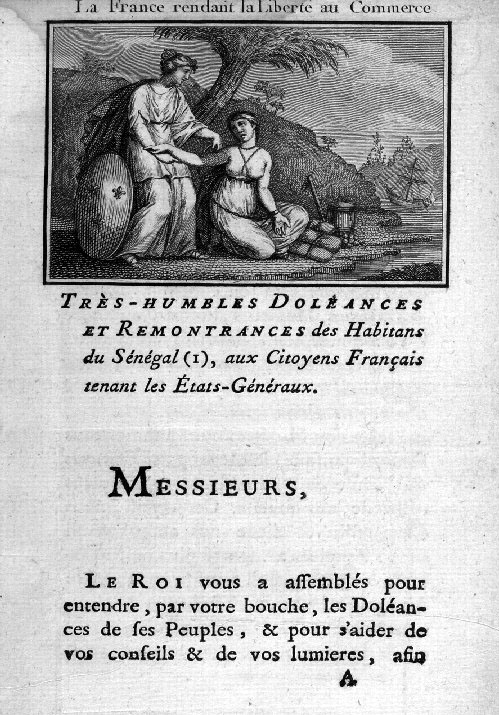
Cahiers de doléances
The Estates-General were convened at the end of 1788 to meet on May 1, 1789. It was during this election campaign for deputies that the cahiers de doléances (grievance lists) were drafted, totaling 60,000, written by rural communities and urban professional groups.
Religion, especially the clergy, is a topic addressed in these cahiers but not among the primary concerns (only a tenth according to Mr. Vovelle). Notables from the West and Franche-Comté regions were highly critical of the clergy, who in these areas exerted strong control over the morals of rural populations. It was also in the West where demands for the abolition of the tithe and regular clergy were most common, despite these not being the regions where the tithe was highest or religious figures most numerous. Conversely, in the Southwest, where the tithe was at its highest, only its reform was requested.
As for the issues that foreshadow the future Outline of the Civil Constitution of the Clergy and the most radical measures of the Constituent Assembly (such as the complete sale of Church property), the demands were concentrated in a continuous zone stretching from the western Paris Basin to Brittany. In these regions, the notables of the Third Estate were the most anti-clerical, and it was also here that counter-revolutionary uprisings would be most significant.
However, the geography of the Cahiers de doléances differs when addressing more strictly religious matters (rather than ecclesiastical ones), such as the reduction of the number of religious holidays. The most vocal regions in this regard were the Mediterranean basin, as well as a Picardy/Lyonnais zone, including the Paris region. These areas would later be among the most affected by de-Christianization.
Regarding the clergy itself, the grievances partly reflect its internal divisions. Most of the clergy’s cahiers defended privileges, the religious monopoly, and condemned the tolerance edicts. However, a few voices from parish priests sought to improve their social status. They were supported in this by some of the village cahiers from the Third Estate.
Nevertheless, none of these Cahiers de doléances questioned religion itself as a whole.
“It was those damn priests who made the Revolution”
This famous quote is attributed to an anonymous aristocrat, and while it shouldn’t be taken literally, it aptly reflects the events of the spring of 1789. First, we must consider the role of the clergy (in its diversity) at the Estates-General, then examine the actions of its members from the opening of the Estates-General until the night of August 4, 1789.
At the Estates-General, the clergy was represented by 291 deputies (out of 1,139), the majority (more than 200) being parish priests. There were only 46 bishops representing the clergy. Most of the lower clergy members supported change (though there would later be opposition between Abbé Grégoire and Abbé Maury).
During the heated debates of the Estates-General starting on May 5, 1789, parish priests played an increasingly important role as the Third Estate resisted the decisions of the king and the pressures from the nobility and high clergy.
Following Mirabeau’s initiative on June 12, three and then sixteen priests left their order to join the Third Estate; among them was Curé Jallet, who, when reproached by the prelates for this defection, replied, “We are your equals, we are citizens like you…”
At the same time, on June 17, 1789, under the influence of Abbé Sieyès, the Estates-General transformed into the National Assembly. Two days later, the clergy, by a majority of its members, decided to join the Third Estate, while the nobility sided with the king. This led to the Tennis Court Oath on June 20, 1789, again with Abbé Sieyès playing a central role, alongside figures like Abbé Grégoire. However, the clergy’s adherence to this movement should be tempered, as it remained divided, especially among prelates, still attached to privileges. And in the rising context of insurrection, particularly in rural areas, members of the high clergy were not spared.
Night of August 4th
Events were accelerating, and the king was overwhelmed. On July 9th, the deputies proclaimed the National Assembly as “constituent.” On July 14th, 1789, the Bastille was stormed. The movement spread to the countryside, resulting in the Great Fear.
It was in this both turbulent and euphoric context that the famous night of the abolition of privileges occurred, although it had been well prepared in advance. During this all-nighter on August 4th, 1789, the clergy members were far from inactive, as they were part of the privileged class. However, there was sometimes an escalation of generosity from certain members of the old order or the nobility, with reciprocal proposals. For instance, the abolition of hunting rights was proposed by the Bishop of Chartres, to which the nobility responded with the idea of abolishing the tithe.
The consequences for the clergy were significant, with decisions affecting them both directly and indirectly. The abolition of feudal dues also impacted chapters and abbeys, and the abolition of privileges as a whole deprived the clergy (which officially ceased to exist as an order) of its fiscal privileges. The clergy was then more directly affected by the elimination of the casuel (payments by the faithful for religious services), proposed by parish priests, and, of course, the abolition of the tithe. The latter, even contested by Sieyès, had the most consequences as it required the state to provide for the clergy, who had lost most of their income necessary for conducting religious activities.
In the weeks and months following, there was still a sense of unity and some euphoria, aided by the context. Religious and revolutionary celebrations took place together, and priests assumed responsibilities, especially in municipal structures. The nobles were viewed with more suspicion than the priests. This “honeymoon” period lasted at least until the spring of 1790, despite some tensions and the emergence of real divergences during the Declaration of the Rights of Man and of the Citizen on August 26, 1789.
It was ultimately the Civil Constitution of the Clergy on August 24, 1790, that would ignite the situation…
Rise of Tensions
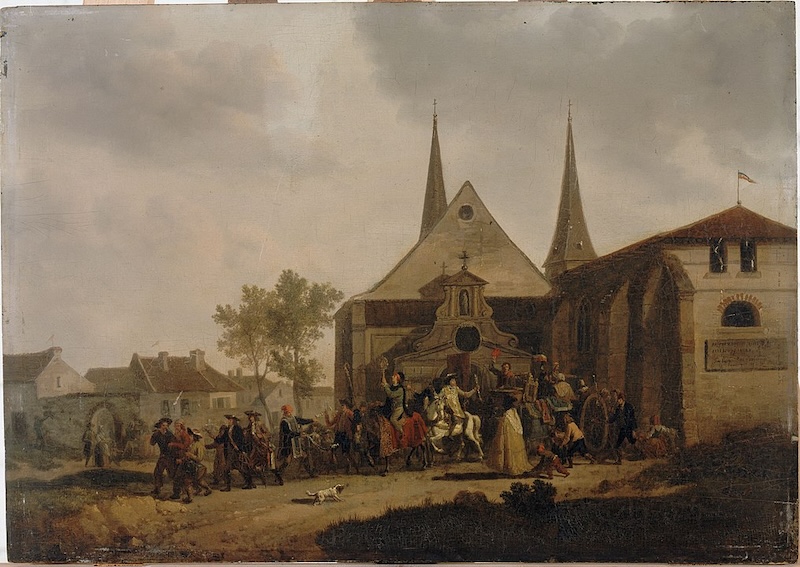
Looting of a church during the Revolution, c. 1793. Credit: Swebach-Desfontaines, Public Domain
Despite the dissolution of the clergy as an order and the participation of many parish priests in the first decisions of the Constituent Assembly, an anti-religious sentiment seemed to be growing in the country by the end of 1789. Indeed, “the happy year” was not as peaceful as it was long thought, and the elements that would constitute the religious crisis were coming into place.
It began with decisions like the temporary suspension of religious vows (October 28, 1789) and the nationalization of church property (November 2), while at the beginning of 1790, the citizenship of non-Catholics, Protestants, or Jews was being debated.
Then came the debate on religious freedom during the drafting of the Declaration of the Rights of Man and of the Citizen in August 1789. The discussions were heated, ultimately resulting in Article 10: “No one shall be disquieted on account of his opinions, including his religious views, provided their manifestation does not disturb the public order established by law.”
As the end of the Constituent Assembly approached, some unsuccessfully tried to impose an article making Catholicism the state religion or the “national religion.” On April 12, 1790, Dom Gerle even requested that Catholicism be the only public religion, sparking an outcry, as the deputies sought instead to place all religions on equal footing.
The suspension of solemn vows aimed to attack the chapters, as the revolutionaries believed that freedom should not stop at the doors of the convents. The Jean-Baptiste Treilhard decree of February 13, 1790, allowed male and female religious members to be released from their vows and to leave their monasteries or convents, granting them a pension. Congregations were spared for the time being, although they were affected by the confiscation of their property, as was the case with all clergy assets. However, teaching orders were dissolved on August 18, 1792.
Civil Constitution of the Clergy
The major decision on the religious question was undoubtedly the passing of the Civil Constitution of the Clergy. This aimed to organize the Catholic Church, and the Ecclesiastical Committee of the Assembly began considering the matter as early as August 1789. This Committee was strengthened in February 1790 by patriotic priests due to rising tensions within its ranks.
From April onwards, discussions centered on a proposal by Martineau, a Gallican Catholic, who sought to clarify the procedures for appointing priests and to eliminate privileges, particularly those stemming from Rome. The nation was to compensate clergy members. This raised the issue of the Pope, who was not consulted, intensifying tensions.
Despite these challenges, the proposal was passed on July 12, 1790, without significant difficulty, and the king accepted it on July 22. However, this did not quell the tensions—quite the opposite. Protests mainly came from bishops, who wanted to appeal to the Pope (who condemned the Constitution in March 1791) and called for a national council, a demand Robespierre rejected. But it was the constitutional oath that truly ignited the situation.
Constitutional Oath and the Explosion
The constitutional oath was a logical follow-up to the Civil Constitution of the Clergy. It responded to the bishops’ refusal to implement the Constitution. On November 27, 1790, it was decided that public clergy officials were required to swear loyalty to the Nation, the Law, the King, and the Constitution. In the Assembly, only seven bishops, following Grégoire’s lead, took the oath. The Assembly members were surprised by the lack of adherence. By 1791, just over 50% of the clergy had taken the oath, with significant regional disparities.
This schism within the Church in France led to clashes and violence at the local level, directed at both constitutional clergy and those who resisted the oath, despite the Assembly’s efforts to enforce religious freedom while imposing the constitutional Church. Punitive expeditions, collective humiliations, and even stoning became common practices, not only among the Sans-Culottes.
On November 29, 1791, the activist refractory clergy were labeled “suspected of sedition”; on May 27, 1792, they became eligible for deportation. The fall of Louis XVI on August 10, 1792, triggered a large emigration of refractory clergy.
Dechristianization
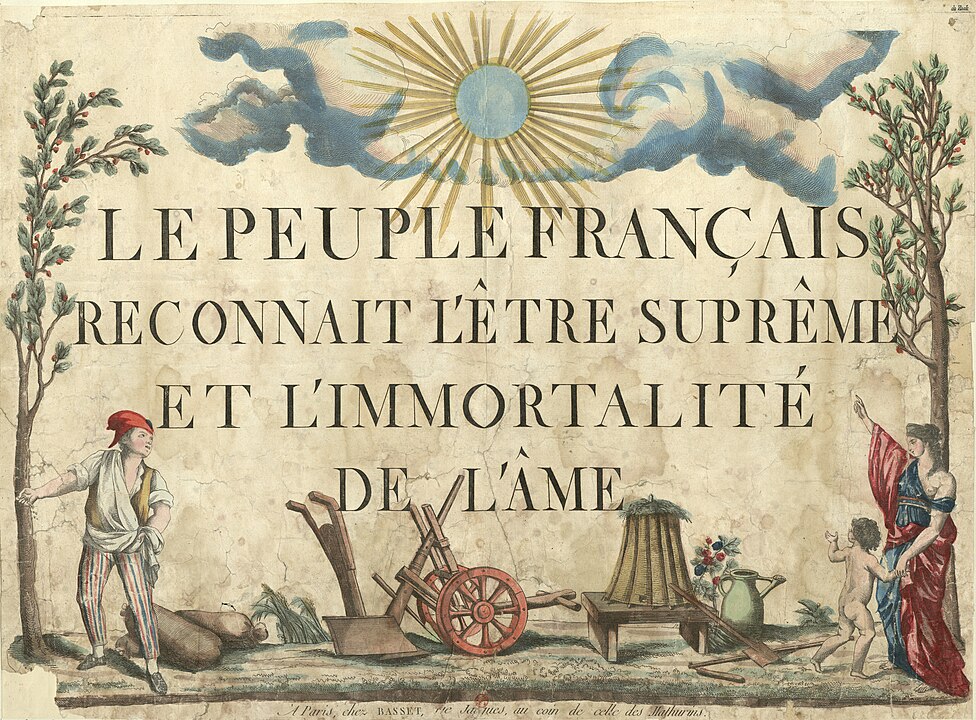
“The French people recognize the Supreme Being and the immortality of the soul” (1794 print). Credit: Wikimedia, Public Domain
Amid the growing tensions surrounding the Church, and localized violence (in the South) involving Protestants, there was a parallel rise in anticlericalism. The year 1793 marked the beginning of a period during which the rejection of Christianity was neither a spontaneous revolt nor a directive of the revolutionary government.
The phenomenon had been present in revolutionary celebrations since the Federation Festival on July 14, 1790. In the same spirit, the Festival of Regeneration, or Unity and Indivisibility of the French, held on August 10, 1793, was a fully secularized ceremony marking a key moment. However, the offensive occurred during the winter of the same year, initiated by politically active circles.
This period saw rural communities renouncing religious worship, or antireligious demonstrations, led by figures such as Fouché in Nièvre. Elsewhere, churches were transformed into Temples of Reason (as happened to Notre-Dame on November 10, 1793), priests were married, and religious books were burned in public displays. The most affected regions were the Paris area, the Center, the North, parts of the Rhône Valley, and Languedoc.
This dechristianization movement shocked even the Committee of Public Safety, and Robespierre, in a speech on November 21, 1793, harshly criticized “aristocratic atheism.” Following his lead, the Convention condemned “all violence and measures against religion.” Nevertheless, dechristianization continued in rural areas until the spring of 1794.
The end of the dechristianization period saw the rise of Robespierre’s deist influence and the emergence of the Cult of the Supreme Being, following other revolutionary cults. The year 1795 also witnessed the first law separating Church and State.
Honoré-Gabriel Riquetti, Count of Mirabeau, was a writer and a political figure at the start of the French Revolution. After a tumultuous youth marked by romantic escapades, he was elected, despite being a noble, as a deputy for the Third Estate in 1789. He quickly made his mark with his eloquence and sought to establish the principle of a constitutional monarchy based on the English model, with power shared between the king and the Assembly. Although distrusted by many deputies, he became president of the Constituent Assembly but was largely ignored by King Louis XVI, who paid handsomely for his advice.
Mirabeau’s Tumultuous Youth
Born in the Gâtinais at the Château de Bignon, the future Count of Mirabeau was the fifth child and second son of Victor Riqueti, Marquis de Mirabeau, and Marie Geneviève de Vassan. Heir to the family name after the death of his elder brother, he was born with a clubfoot and two molar teeth. At the age of three, he contracted confluent smallpox, which left deep scars on his face due to the careless application of an eye ointment, further adding to his natural unattractiveness.
He was a turbulent, undisciplined child but highly intelligent with a prodigious memory. His father recognized his abilities but claimed he had an inclination toward evil. In 1767, he enlisted him in the army but refused to purchase him a commission.
In July 1768, Mirabeau secretly left his garrison and took refuge in Paris.
This escape led to his first imprisonment at the citadel on the Île de Ré. He was released when he requested to join the Corsican expedition, where he distinguished himself. Upon his return, he reconciled with his father (October 1770), and in 1771, he was received at court.
A new dispute arose between him and his father, who wanted to force him to work. At that time, he married a wealthy heiress, Émilie de Marignane (1772), but did not receive any dowry. Harassed by creditors, he was imprisoned in the Château d’If. In May 1775, Honoré was transferred to the Fort de Joux, where the less strict surveillance allowed him to visit the town.
There, he met the Marquis de Monnier, who was married to Marie-Thérèse Richard de Ruffey, the daughter of a president of the Chamber of Accounts of Burgundy. This was the beginning of Mirabeau’s affair with the woman he immortalized as Sophie. Mirabeau fled to Switzerland, then to Holland with Madame de Monnier, who managed to join him. Their respite was brief. They were arrested in Amsterdam in May 1776. Transferred back to France, Mirabeau was imprisoned at the Château de Vincennes in June 1777, where he wrote two famous works: Letters to Sophie and Letters de Cachet.
Mirabeau was released in 1780 after three and a half years in detention. His wife Émilie obtained a legal separation, and in 1786, Mirabeau returned to Berlin on a secret mission.
Mirabeau: Revolutionary Leader
Upon the announcement of the convocation of the Estates-General, Mirabeau launched a fierce campaign in Provence against the aristocracy’s privileges and, despite being a noble, was triumphantly elected as the representative of the Third Estate for the Seneschal of Aix. Linked to the Duke of Orléans, he asserted himself at the Estates-General with his exceptional oratory skills, making people forget his “grand and striking ugliness.
On June 17, 1789, the deputies of the Third Estate declared themselves the National Assembly, gathered in the Tennis Court, and vowed to draft a constitution for the country. On June 23, 1789, he allegedly delivered the famous statement: “We are here by the will of the people, and we shall only leave by force of bayonets,” refusing the king’s order to dissolve the new assembly. He then succeeded in having the principle of inviolability of deputies adopted.
Becoming a popular idol, he fueled unrest with an army of publicists and played a major role in drafting the Declaration of the Rights of Man and of the Citizen. Mirabeau also passed a new tax, the patriotic contribution of a quarter of incomes, and arranged for the nationalization of church property. At this point, Mirabeau appeared to be the man capable of achieving a reconciliation between the king, the aristocracy, and the Revolution, as desired by La Fayette. But while his eloquence captivated the Assembly, his private life scandalized it, and his political ambitions alarmed it.
Mirabeau’s Duplicity and Death
Troubled by the excesses of the Revolution, Mirabeau drew closer to the court and Louis XVI. His first memorandum to the king, dated May 10, 1790, concluded with the words: “I promise the king loyalty, zeal, energy, and courage of which people may have no conception.” Now an advocate of constitutional monarchy, Mirabeau sought to reconcile this idea with revolutionary principles. He defended the king’s right to an absolute veto against the majority of the National Constituent Assembly, which voted for a suspensive veto. Mirabeau hoped to become a minister mediating between the National Assembly and the king. However, in November 1789, the Assembly dashed his ambitions by declaring that no member of the Constituent Assembly could become a minister.
Through the Count of La Marck, Mirabeau sent notes to Louis XVI on organizing the counter-revolution and, with La Fayette—whom he disliked—tried to secure the king’s right to control war and peace in the new constitution. His proposals to maintain the throne and end the Revolution were never fully heeded by the king, who trusted him no more than La Fayette, commander of the National Guard.
His duplicity did not go unnoticed by some revolutionaries, who denounced his corruption.
Despite these complications and some animosities within the Assembly, Mirabeau regained his popularity, became a member of the Paris departmental directorate, and was elected president of the Constituent Assembly on January 30, 1791. Exhausted by a life of excess and work, he died suddenly on April 2, 1791. His body was laid to rest in the Panthéon but was later removed after the discovery of the iron chest, which contained his correspondence with the king. With his death, the Revolution lost one of its key figures and its most powerful orator. His Oratory Works and the Correspondence between the Count of Mirabeau and the Count of La Marck were published posthumously.
Vivandières, cantinières, washerwoman, prostitutes… Women were fully part of the Grande Armée. Incorporated into units or offering their services to passing troops, these women improved the well-being of soldiers who were far away from their families. Some of them even became prominent figures in the Napoleonic epic, known for their heroism, courage, and, in certain cases, for their unique careers as soldiers!
Cantinières: Vivandières, and Laundresses
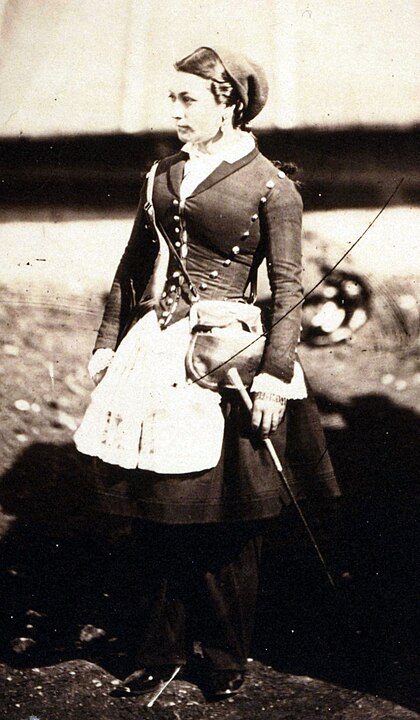
A French cantinière in the Crimea during the Crimean War in 1855, photographed by Roger Fenton
The cantinier was a man, usually a non-commissioned officer, but it was generally accepted that he could have a woman with him to help in the kitchen (one per battalion). These women had the sole mission of preparing meals, although, in practice, they sometimes competed with the vivandières.
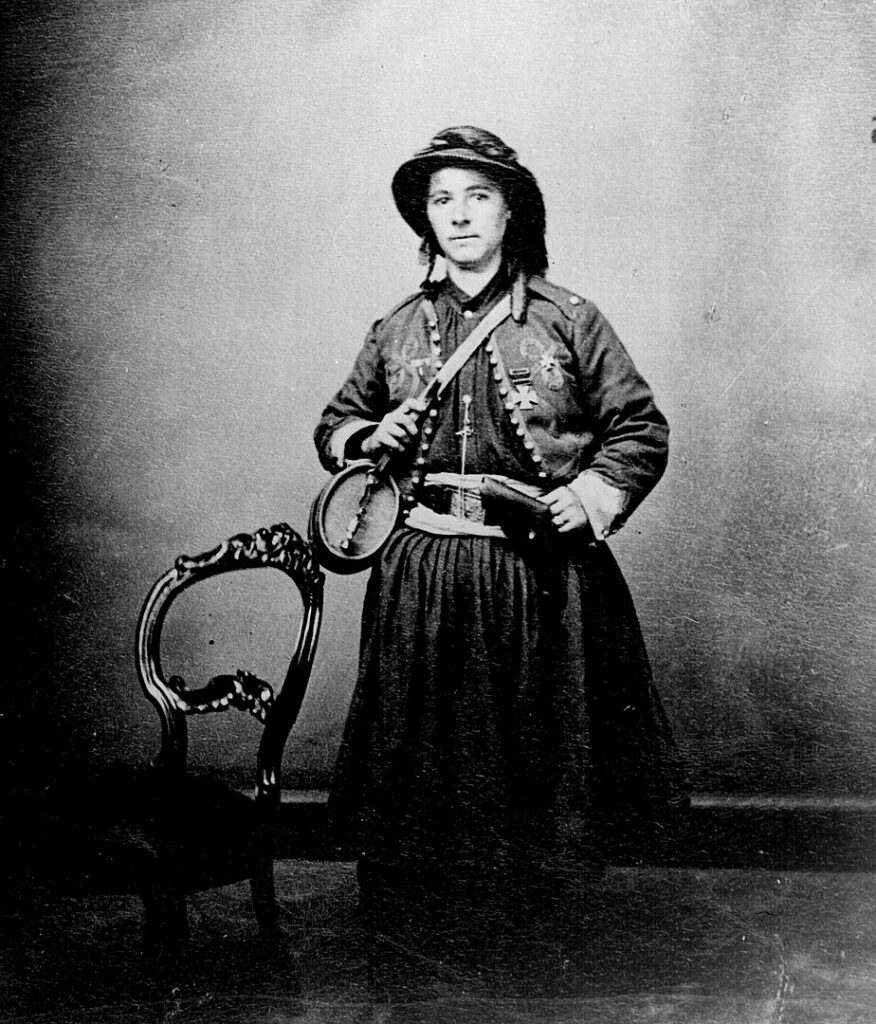
Two types of women were officially allowed to follow the Imperial army: laundresses and vivandières. Their numbers were strictly regulated, with a maximum of four per battalion and two per squadron, army headquarters, or division. Laundresses took care of the soldiers’ laundry, and under the 1809 regulations, they were permitted to have a packhorse to carry their supplies. These were typically soldiers’ wives, and as non-combatant military personnel, they were entitled to a security card (which confirmed their role), lodging, and bread.
Vivandières, on the other hand, sold food, drink, and sometimes small items to the soldiers. They were allowed to have a cart pulled by two horses. Comparable to a modern army’s canteen service, they essentially ran a mobile shop. Their numbers were limited in the same way as the laundresses. They did not receive any salary but were still officially part of the military personnel: they needed a security card issued by military authorities, had the right to use military hospitals during wartime, and had to be present for roll calls conducted by column commanders.
Discipline was strict. Laundresses and vivandières who missed a roll call faced fines for the first offense, imprisonment for the second, and confiscation of their horses and cart for the third. Worse, if one was accused of looting or facilitating looting (vivandières were sometimes involved in hiding stolen goods to sell for themselves), her cart would be burned along with all her belongings, and the woman, dressed in black, would be paraded through the camp and expelled.
French vivandière Marie Tepe of the 114th Pennsylvania Infantry Regiment, a vivandière in the American Civil War. Credit: William H. Tipto, Public Domain
But that was not the most humiliating punishment. During the Spanish campaign, the penalty for a woman following the army without authorization was severe: she would be stripped, shaved all over, covered in shoe polish, forced to march in front of the troops, and sent to the rear.
Nevertheless, vivandières were among the iconic figures of the Grande Armée. During marches, they were relatively protected, with their carts placed at the rear of the convoy between the column and the rear guard. The vivandière became a symbol in the historiography of the Imperial army, improving the soldiers’ daily lives with her goods and small cask of brandy, and sometimes coming to the aid of the wounded on the battlefield. The vivandière is one of the few female figures in a predominantly male institution. In the 19th-century romantic imagination, she also came to represent a kind of substitute mother for younger conscripts.
Among the best-known vivandières was one nicknamed Marie Tête-de-Bois. Marie married a grenadier in 1805, who was killed in Paris in 1814. That same year, their son was killed at the Battle of Montmirail, and Marie herself was wounded while retrieving his body. Having served in seventeen campaigns, Marie Tête-de-Bois was with the Guard during the Hundred Days in 1815. It was in this final campaign of the Empire that she met her death, struck by a bullet that pierced her cask. As she crawled among the dead, a second bullet is said to have hit her face. A dying grenadier reportedly joked that she wasn’t very pretty like that, to which she supposedly replied that she could still boast of having been a daughter, wife, mother, and widow of soldiers.
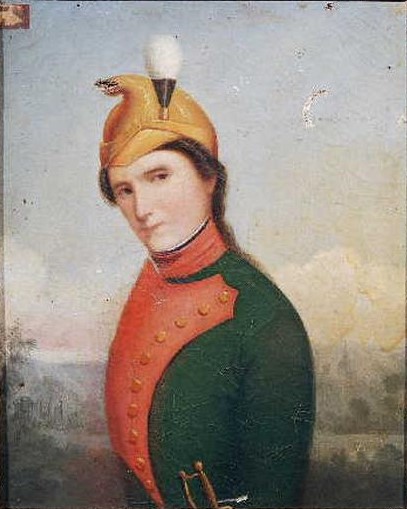
Catherine Balland, from the 95th Line Infantry Regiment, was honored by the painter Lejeune, who depicted her in his painting of the Battle of Chiclana. She was awarded the Legion of Honour in 1813.
Prostitutes and Campaign Loves
The Grande Armée never had an official or semi-official brothel, as was later the case in the French army. Nevertheless, prostitutes (often referred to as “grisettes”) closely followed the troops to offer their services. They inevitably became the main vectors of venereal diseases, which greatly occupied military doctors. Some prostitutes even approached soldiers directly, as evidenced by General Friant’s order on September 18, 1811, instructing to “arrest the runners who sneak into the camps.”
The Grognards also took advantage of the services of local prostitutes in the cities they passed through, both in France and abroad. These women were either professionals or poor souls driven to prostitution by the misery caused by war. In 1806, Berlin women prostituted themselves for a bit of bread, and in 1812, well-off Moscow women, starving, were forced into prostitution, even offering their daughters to the French soldiers.
In addition to professional sex workers, the soldiers of the Grande Armée also engaged in relationships with local women during their campaigns, though these relationships were often fleeting. Upon the imperial army’s departure from Berlin in 1806, it was estimated that 2,000 women were pregnant.
However, some of these campaign relationships did lead to marriages. Starting in 1808, soldiers had to obtain permission from the administrative council of their regiment to marry their chosen partner (officers had to seek authorization from the Minister of War). Despite this new status, it did not change their military situation. In 1810, a decree even provided financial support for soldiers marrying a “respectable girl.
Officially, Napoleon’s Grande Armée was not supposed to have women soldiers. Even during the Revolution, the profession of arms was denied to women, as military service was ideologically linked to citizenship (and, by extension, the right to vote). However, there were a few exceptions that proved the rule, such as Marie-Thérèse Figueur (1774 – 1861).
Her uncle, who commanded a company of gunners, placed her in a counter-revolutionary federalist troop. She was captured along with her uncle by the Legion of Allobroges, and General Carteaux offered them the chance to switch sides, which they accepted. Young Figueur participated in the siege of Toulon in 1793 with the Legion of Allobroges before switching units, first joining the 9th Regiment and later the 15th Regiment of Dragoons. She was nicknamed “Sans-Gêne” (she later inspired the play by Victorien Sardou and Emile Moreau).
With this cavalry regiment, she participated in several campaigns: the Eastern Pyrenees, Germany, the Army of the Rhine, the Swiss campaign, and the Italian campaign.
On November 4, 1799, her horse was killed beneath her, she was wounded, and she was captured at the Battle of Savigliano (Piedmont). She was brought before Prince de Ligne, who allowed her to join his army.
Under the Consulate, in 1800, she was forced into retirement but managed to reintegrate the 9th Dragoons, with whom she participated in the 1805 campaign, including the battles of Ulm and Austerlitz. In 1806, she fought in the Battle of Jena but fell ill and was repatriated to France. Once recovered, she joined the Young Guard and went to fight in Spain, where she was again taken prisoner at Burgos.
Figueur was then transferred to a women’s prison and later to Southampton, where she remained until the end of the Empire. Upon her return to France during the Restoration, Marie-Thérèse opened a guesthouse for officers and married an old comrade, the sergeant Sutter, late in life.
Although rare, we know of other examples of women soldiers, such as Marie Angélique Duchemin, who distinguished herself during the Revolutionary campaigns and for whom Marshal Sérurier tried to obtain the Legion of Honour during the Empire. Other European armies also had such examples, as in the Prussian army. It was only when mortally wounded at Dannenberg (1813) that soldier Renz confessed to being a woman—it was Eleonore Prochaska, who had enlisted during the Prussian War of Liberation as a drummer and later as a line soldier, successfully concealing her true identity.
4,300 to 7,000 wounded in the ranks of the Grande Armée by the evening of Eylau, more than 21,000 wounded by the evening of the Moscow! The dark side of these Napoleonic victories are the mass graves, the field ambulances where amputations are performed in assembly-line fashion, and the makeshift hospitals where the wounded are crowded together. Here, the soldier faces new enemies: gas gangrene, tetanus, dysentery, fevers… To save those who can still be helped, the medical service established an entire support network from the battlefield to rear facilities.
Triage System
Dominique Jean Larrey is often credited with developing one of the first triage systems, where wounded soldiers were treated based on the severity of their injuries rather than rank or nationality. This practical approach prioritized those who needed urgent care, which helped save countless lives on the battlefield.
Napoleon: Medicine, and Surgery
Napoleon Bonaparte was always very skeptical of medicine, ambivalent about its true benefits, and often mocking of those who practiced it. He enjoyed teasing Corvisart and mocking remedies that did more harm to the patient than the illness itself. He still maintained at Saint Helena:
Our body is a machine for living, it is organized for that, it’s its nature; let life run its course, let it defend itself, it will do more than if you paralyze it by burdening it with remedies. Our body is like a perfect watch, which is meant to run for a certain time; the watchmaker does not have the ability to open it, he can only handle it blindly and clumsily. For every one who, by tormenting it with odd instruments, manages to do good, how many ignorant ones destroy it…
Dr. Godlewski acknowledged that Napoleon’s distrust of the medicine of his time was not entirely unfounded. While the early 19th century was the age of great surgeons, it was not yet the age of great physicians, which would only come with the discoveries of Pasteur, radiology, and bacteriology. Indeed, while he despised medicine, Napoleon held surgery in high esteem, particularly the army medical corps surgeons who risked their lives to save others. Napoleon himself was even personally drawn to the field and reportedly attended anatomy courses three times from April to July 1792, before his military career took off.
Treating the Army in Garrison
Each regiment had a few surgeons to care for soldiers in garrison. The most common cases were “fevers,” a generic term that covered various diseases such as influenza, meningitis, and dysentery, often caused by poor water quality and food. If necessary, the patient was sent to a military hospital, or even a civilian hospital in certain special units like the Departmental Reserve Companies. Other treatments were conducted directly at the barracks, particularly for cases of scabies or venereal diseases.
Field Ambulances
Replica of a flying ambulance at the Musée Larrey in Beaudéan. Credit: Wikimedia, CC BY-SA 4.0
The massive use of artillery is the cause of the worst injuries found in 19th-century armies. Surgeon-Major de La Flize reports in his memoirs some colder and darker realities than the epic paintings of the same period might suggest:
I remember some [of the horrific wounds] that particularly struck me. An artilleryman had three-quarters of his face torn off by a cannonball; he had only one eye left but had not lost consciousness and communicated by signs; he was horrible to look at. Another artilleryman had both thighs and one hand blown off and the other arm broken near the shoulder; he could still speak and asked me for brandy; I gave him a drink, and he expired immediately after. […] A young artillery non-commissioned officer, who was on guard near the guns, had his hands resting on the pommel of his saddle when a cannonball crushed both of them. He cried like a child and called for his mother.
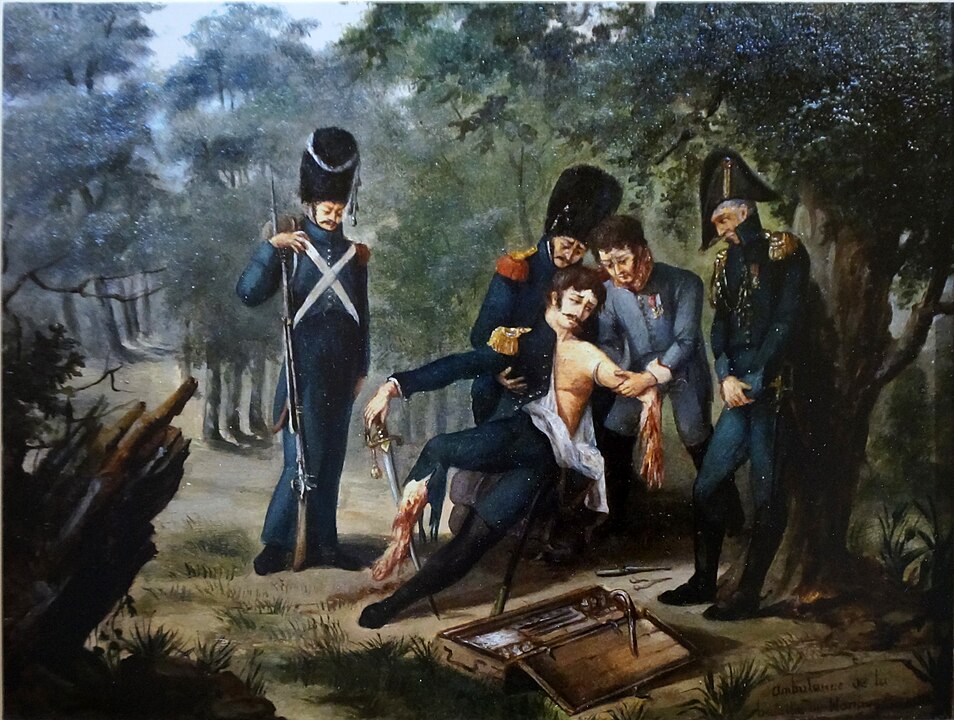
To save those who can be saved, and ensure the morale of all, the Grande Armée quickly equipped itself with an important health service structured by a network of ambulances. In the Grande Armée, an ambulance refers to all centers of varying importance responsible for providing care to those in need, whether at the regimental or army corps level. There are five distinct types of ambulances:
The regimental ambulance, closest to the fighting, where first aid is provided to the wounded, but also all operations requiring urgent intervention: from amputation to trepanation… The infantry division ambulance with its two wagons takes charge of the wounded at the division level, theoretically composed of six surgeons, four pharmacists, and four employees.
The army corps ambulance is a mounted ambulance, called a light ambulance, which can deploy and redeploy as needed. It can form an ambulance depot just behind the front line to quickly evacuate the wounded during battle. It can also form ambulance divisions to reinforce division ambulances or form ambulance sections responsible for supporting small detached units or deployed at outposts. In the case of ambulance sections, the unit carries provisions in addition to its traditional equipment of dressings and medical instruments.
The ambulance reserve, directly attached to the general headquarters, is a strategic reserve composed of about fifty surgeons (under the command of a chief surgeon) on horseback or in carriages to reinforce as quickly as possible any other ambulance that might need it.
Finally, the Emperor’s ambulance is responsible for the sovereign’s health. Napoleon always has a surgeon, a doctor, a pharmacist, and a few nurses ready to intervene in case the Emperor is wounded. They have a wagon with all the necessary equipment. Although often exposed, Napoleon was very lucky on the battlefield. He was nevertheless wounded on April 23, 1809, during the Battle of Ratisbon in Austria. A bullet fired from the city walls wounded him in the right heel, grazing the Achilles tendon. It was surgeon Yvan who cut the Emperor’s boot and dressed the wound before he remounted his horse to keep up appearances for the enemy.
Being Wounded on the Battlefield
Dominique Jean Larrey amputating the arm and leg of colonel Rebsomen at the Battle of Hanau, in 1813
Even though in practice it sometimes happened, soldiers were generally forbidden during battle from going to assist the wounded. Doing so risked weakening the ranks to the enemy’s advantage. While some wounded soldiers managed to reach the ambulance on their own, others were cared for on-site by the medical service. To facilitate this, Larrey set up “flying ambulances (ambulance volante),” two- or four-wheeled carts mounted on springs (to cushion the shocks somewhat), capable of carrying two to four wounded soldiers lying on mobile beds. These flying ambulances allowed for the rapid evacuation of the wounded after they had received first aid from surgeons following the ambulance on horseback.
However, for cost reasons, this system did not last during the Empire, except within the Imperial Guard, where Larrey operated. Along similar lines, Pierre-François Percy introduced the Wurst, long sausage-shaped carts (hence the name, which means “sausage” in German) that surgeons would straddle like a horse to quickly reach those in need. They were used during the Swiss, Danube, and German campaigns. But more commonly, toward the end, the Grande Armée employed stretcher-bearers equipped with pikes that could be transformed into stretchers. Da La Flize recounts:
The stretcher-bearers were then ordered to construct stretchers. These men, two by two, unrolled the straps from their packs, unscrewed the iron head of their pikes, inserted the pole into a slip knot formed with the straps, and fixed their canvas belts in place. The stretcher-bearers then headed towards the battlefield.
The wounded who were not evacuated during the battle usually spent the night without help and had to wait until the next day for the evacuations to resume. Further back, the first-aid posts were improvised, either in pre-existing buildings or under tents on some straw gathered from nearby. The situation was even more critical in winter, as during the Battle of Eylau, since these makeshift shelters offered little protection from the cold. It was at these first-aid posts where the diagnosis was made, and the wounded soldier came into the hands of the surgeons. A former officer of the Grande Armée, Elzéar Blaze, provides a nuanced account of the surgeons, acknowledging their bravery but also the lack of experience among newcomers who learned “on the job”:
The major surgeons were generally good practitioners. Amputating an arm or a leg was as easy for them as drinking a glass of water; I even knew some for whom the latter operation would have made them grimace. These gentlemen had great zeal, and were often seen on the battlefield assisting the wounded, risking their own lives. Many combined science with practice; for others, practice alone sufficed; but by constantly treating all kinds of wounds, with the same cases repeating every day, they knew as much as they needed to know.
But new young men constantly arrived from France, who, through connections or to avoid going into battle with a pack on their back, had somehow gotten a surgeon’s assistant certificate after three months at medical school. They then underwent a practical course in the army at the expense of the first unfortunates who fell into their hands, having escaped the cannon; the scalpel awaited them… and… well… It was, in truth, far worse than Scylla and Charybdis.
The chief surgeon of La Flize recounts in his memoirs the horror of mutilations and operations during the Battle of Borodino in 1812:
On that day of grim memory, how many cruel operations we performed! One cannot imagine the impression a wounded soldier has when the surgeon is forced to tell him that he is doomed unless one or two limbs are amputated. The unfortunate soul is reduced to submitting to his fate and preparing for horrific suffering. It is impossible to express the groans, the teeth grinding, torn from the wounded when a limb is shattered by a cannonball; the painful cries they let out when the surgeon exposes the limb, cuts through the muscles, severs the nerves, saws the bones, and slices the arteries, with blood splattering everywhere. We could say that we were literally drenched in blood, although we were not responsible for its flow, but were instead striving to stop it.
In the French army, amputations were frequent. During the Battle of Borodino, the surgeon Larrey stood for 36 consecutive hours and performed 200 amputations himself! For this experienced surgeon, it took only 4 to 5 minutes to amputate a shoulder. In the absence of anesthetics, the speed of the operation was crucial to minimizing the sufferings of the wounded.
Often, the patient was given just a little alcohol to drink. Sometimes, he clenched his clay pipe to endure the pain: if the wounded died during the operation, his jaw would sometimes loosen, causing the pipe to fall to the ground and break — the origin of the expression ‘to break one’s pipe’ (a French idiom meaning ‘to die’). These rapid and repeated amputations may seem cruel, but they often saved the wounded who would otherwise have died from gangrene.
This extensive resort to amputation was also justified by the very particular context of wartime surgery: if the wounded soldier survived, he would be transported along rough roads and cared for by inexperienced personnel who would be unable to properly manage a serious wound requiring regular dressing — the stump offered a better chance of survival. Aside from a few wealthy exceptions, like generals who could afford luxury prosthetics, most amputated soldiers spent the rest of their lives with a wooden leg (sometimes jointed at the knee), or a simple crutch. Some, unable to afford or bear such prosthetics, were left with crutches or canes.
The soldier’s recovery was not the end of his misfortunes. On the battlefield of Borodino, La Flize reports that there was a lack of food for the wounded. However, the Guard was better fed. As the army resumed its march, the wounded were left in field hospitals, sometimes tens of kilometers from the battlefield, and not all survived the journey. Percy, recounting the arrival of a convoy of wounded during the Peninsular War, wrote:
It had been five days since most of them had left the cart that had served both as their transport and their bed; their straw was rotting; some had a mattress under them, soiled with the pus from their wounds and their excrement. […] The stench was unbearable. The wounds had not been dressed in several days, or had been done so poorly; many were already gangrenous…
Upon their arrival, they were greeted under conditions that varied greatly depending on the location and time. In 1809, a corps of hospital nurses was even created, deployed in Austria, Spain, and Italy. These nurses were unarmed, not even carrying a small sword, with Napoleon hoping this would ensure their neutrality on the battlefield—an initiative later adopted by the Red Cross. This neutrality was reinforced by the fact that French doctors treated all wounded, regardless of nationality. However, no written agreement on the inviolability of military hospitals was reached during the Napoleonic wars, despite an attempt that Austria rejected in 1800.
Regardless, these hospitals are remembered grimly: the wounded often lacked food, heating, especially during the Russian campaign, and typhus outbreaks occurred frequently (such as in Mainz in 1813). There were also personnel shortages (if there were no local staff, particularly nuns, prisoners were requisitioned without hesitation), as well as shortages of medicine and bandages. At the Mojaïsk hospital in 1812, the wounded were bandaged with straw due to the lack of cloth or bandages.
However, these dark descriptions should be tempered by acknowledging that there were well-run field hospitals under the Empire, such as in Burgos in 1810, which had a bathroom, fans for the summer, and stoves for the winter. Despite the difficult conditions and frequent improvisation, it is notable that only 10% of the wounded who reached the hospital died. To understand this figure, it must be considered that hospitals treated not only the war wounded but also the sick in general.
In the end, our view of the healthcare services during campaigns under the First Empire must be nuanced. It was run by dedicated, qualified, and dynamic men who constantly had to make do with limited material and human resources. Napoleon, who always favored short campaigns carried out by fast-moving armies, ultimately invested little in modernizing the healthcare service, which did not allow for maintaining a sufficient and experienced staff. Young surgeons gained experience, and nurses were often neophytes, more or less voluntary depending on the circumstances. Observing the shortage of nurses at Eylau on February 9, 1807, Napoleon exclaimed in frustration: “What an organization! What barbarity!” Surgeon Lombard then dared to explain the lack of enthusiasm for joining the healthcare service:
Sire, when one is sure that in peacetime, no matter how well one performed during the most difficult and perilous war, they will be dismissed, it is hard to be zealous and decide to follow an army as an employee or nurse; this very title upon returning to France will be a terrible recommendation.
One can indeed speak of a lack of recognition for the healthcare service, which, straddling the civilian and military spheres, remained overshadowed by the latter. Napoleon distributed the Legion of Honor to them sparingly (ten surgeons were decorated after Eylau, two of whom died of exhaustion a few days later…) and forbade surgeons from wearing epaulets, which he believed should be reserved for true soldiers (although the surgeons of the Guard granted themselves this right…). Nonetheless, it was these few years of war that allowed surgery to develop at an unprecedented speed.
The German Campaign of 1813 was led by Napoleon Bonaparte from April to October 1813 against the armies of the Sixth Coalition. Like a phoenix rising from its ashes, the Grande Armée, which had disappeared in the snows of Russia in 1812, suddenly seemed to be reborn in the plains of Saxony. The Russians saw their march on Paris abruptly halted by the resurgence of the French Empire: thousands of young conscripts blocked their path, led by the greatest general of the time. However, victories were not enough in the face of shifting alliances, with Prussia, Austria, and numerous German states turning against Napoleon.
Context of the 1813 Campaign
Overview of the battlefield
The elite of the Grande Armée had been lost during the disastrous Russian campaign, falling victim to both the Russian army and, more so, the harsh winter and diseases. In France, the attempted coup by General Malet had forced the Emperor to return hastily by sled. Marshal Joachim Murat, whom Napoleon had entrusted with command of the army, abandoned his post to return to his Kingdom of Naples, leaving Eugène de Beauharnais to take command of the retreating troops.
Upon returning to Paris, Napoleon reasserted his power and made every effort to rebuild an army capable of halting the Russian advance. He organized mass conscriptions in France, enlisting young, inexperienced men aged 17 to 18, who were sent quickly to the Rhine before they could receive proper military training. These 1813 levies gave rise to the image of the ogre associated with Napoleon, which royalist propaganda would continue to propagate.
On the other side, Tsar Alexander was jubilant. His armies continued advancing westward, and he began to imagine himself as the mystical liberator of an enslaved Europe. In February, he entered Warsaw, declaring Poland “liberated”—though it had merely shifted from French to Russian domination, which did not sit well with the Poles. French troops, having been overwhelmed, had to retreat to the Oder, then the Elbe. However, the Russians could not continue their relentless advance.
The Tsar’s army had also suffered heavy losses, both in battle and due to the harsh winter. Strategically, Alexander had to leave troops in garrisons along his route to secure his supply lines. With his forces now far from Russia, he found himself with only 80,000 men at the front. Without a doubt, Alexander risked finding himself in Poland in the same predicament Napoleon had faced in Russia. To change the situation, he urgently needed to shift alliances, particularly with Austria, but first and foremost with Prussia.
Sweden, led by the French Marshal Bernadotte, who had been elected Crown Prince of Sweden, had allied with Russia. In return, Bernadotte hoped to annex Norway to his kingdom. He also harbored ambitions that he might be called upon to restore the monarchy in France.
Prussia, though hostile to Napoleon, hesitated to join the war alongside the Russians. However, General Yorck defected, aligning with Russia through the Tauroggen Convention and taking Königsberg, creating the first de facto starting point for a national war of liberation. He was joined by intellectuals like Baron von Stein, who called for German unity, a national revival, and a general mobilization to drive out the French occupiers.
His call resonated strongly among students and academics. On February 27, the King of Prussia, Frederick William, signed the Treaty of Kalisch in Breslau, sealing his alliance with Russia, and on March 17, he declared war on France.
The Prussian army was hastily rebuilt through the conscription of thousands of Jägers (“Hunters”), light infantry from the rural middle class (who had to pay for their own equipment), but above all through a general mobilization of men aged 17 to 40 to form a militia, the Landwehr.
Though some of these soldiers were also inexperienced, the enthusiasm surrounding the war of liberation made them a formidable force.
The imposition of conscription, the effects of the Continental Blockade, and the demands for soldiers had so aggravated the Germans that some northern regions rose up on their own. The Prussian monarchy could have taken advantage of this anti-French nationalist fervor, but its primary goal was to drive out the occupier and restore a monarchical and aristocratic system (in both Prussia and France). Thus, it was wary of these armed nationalist movements.
This desire to mobilize the entire populace, alongside the fear of losing control over it, was evident in the creation of the Landsturm (“Irregulars”), composed of all men aged 15 to 60 who had not been conscripted into the army and were tasked with harassing the enemy. Though the Landsturm existed on paper, they received neither uniforms nor weapons. In any case, with the Coalition advancing and Germany aflame, Eugène de Beauharnais was forced to abandon Berlin, while the French army retreated from Hamburg and Dresden. Arndt, Körner, and Rückert sang of the “holy war”…
Meanwhile, Austria watched the events of early 1813 with interest but hesitated. Tied to France by marriage, Austria, which Napoleon had defeated and spared twice, knew it stood to lose greatly if it joined the Coalition and lost. Moreover, its interests did not necessarily align with Russia’s. However, Austria also realized that if the Russians and Prussians won, it would have to answer for its loyalty to France. Caught between two fires, Austria took a “neutral” stance, acting as an arbiter while rearming itself, preparing to join the winning side when the time was right.
The United Kingdom, for its part, supported the Coalition and allied itself with Bernadotte’s Sweden, already allied with Russia. The country was still engaged in a conflict with the United States, but this was a distant war in which the Navy had the upper hand, a conflict that did not overly concern the Crown. In Spain, Wellesley’s troops (the future Duke of Wellington) had gained the upper hand, making an invasion of France via the Pyrenees a real possibility.
The Empire Strikes Back
French soldiers sparing the life of Russian soldier Leontiy Korennoy for his bravery
On April 25, after entrusting the regency to Empress Marie-Louise, Napoleon takes command of the army at Erfurt. As he wrote, he intends to “put on the boots of Italy”! He has assembled four army corps and the Guard, totaling about 80,000 men. Young conscripts from 1813 have been joined by some veterans from the armies of Spain and Italy. The French army seems to have quickly healed its wounds, and Napoleon is ready to face his enemies. However, while infantry, artillery, and cavalrymen have been found in France (the imperial army is regaining a very national character that it didn’t particularly have in 1812), there is a critical shortage of horses and thus cavalry.
Napoleon joins forces with the troops of his former stepson, Eugène de Beauharnais, giving him 120,000 men, plus garrison troops. He has managed in a short time to reverse the trend and impose numerical superiority over the coalition, which at that moment has only 100,000 men. The Emperor knows he should rush towards Prussia, take Berlin to force the Prussians out of the coalition, and simultaneously intimidate the Austrian neighbor who might join the Russians at any moment. However, precisely to encourage Austria to join them, the coalition is campaigning near the Austrian border, in Saxony.
Napoleon cannot abandon his Saxon ally, risking seeing his other German allies turn away from him. And, since the enemy is there, he hopes to annihilate them in a decisive battle that he will constantly seek through multiple maneuvers.
On May 2, Napoleon marches on Leipzig and defeats the coalition at Lützen! The Prussians and Russians resist valiantly, losses are very heavy on both sides (the French lose 18,000 men, the coalition 20,000), and due to lack of cavalry to pursue the enemy, Napoleon cannot complete his victory. Paradoxically, as they had already done at Borodino, the Russians, although retreating and abandoning Leipzig to the French, consider the battle a victory…
The Grande Armée continues its counterattack, on May 8 it retakes Dresden, on the 10th it recrosses the Elbe, on the 21st it defeats the coalition again at Bautzen and Wurschen (another 40,000 dead in total, equally distributed between the two camps). Further north, Davout retakes Hamburg and Lübeck! In the southeast, French troops under Lauriston’s command advance to Breslau!
Sudden and brutal, the imperial counterattack is a frank success. Napoleon has recovered the territories he controlled in 1812, except for Poland. But, due to lack of cavalry (Napoleon has only 5,000 mounted cavalrymen), Napoleon is unable to achieve the decisive victory he hoped for. Moreover, the losses have been extremely heavy, a third of the Grande Armée is out of combat (dead and wounded), and, due to lack of cavalry, Napoleon has always been unable to exploit his victories as he would have liked.
On the evening of the Battle of Bautzen, he exasperates: “A butchery, and not a cannon taken, not a flag!” He knows he would need a respite to reform his army once again, so he accepts an armistice on June 4 at Pleiswitz, which is supposed to lead to a congress for peace.
From the Armistice of Pleiswitz to the Congress of Prague
Napoleon’s retreat on 19 October 1813, showing the explosion of the bridge
While officially the Armistice of Pleiswitz aims to facilitate peace negotiations, in reality, no one is fooled; it is mainly a truce allowing each side to regroup its forces. For Austria, it is also an opportunity to officially contact the coalition as part of the talks. Taking advantage of the lull, Russia, Prussia, and the United Kingdom sign a pact on June 14. Victorious in Spain, England senses the moment for the spoils has come and offers two million pounds sterling to finance the war effort of the continental coalition, thus encouraging Austria to join their ranks.
Although officially neutral, Austria seriously considers entering the war on their side if the Prague peace negotiations do not succeed. It must be said that for the coalition, the news is good; on June 21, Wellesley crushed the French in the Iberian Peninsula at the Battle of Vitoria.
During the meeting between Metternich and Napoleon in Dresden on June 26, the Emperor clearly states that he does not intend to cede everything to the coalition. The ambassador reports these words:
“What do they want from me? That I dishonor myself? Never! I will know how to die, but I will not cede an inch of territory. Your sovereigns, born on the throne, can be beaten twenty times and always return to their capitals; I cannot, because I am a soldier who has risen through the ranks. My domination will not survive me; from the day I cease to be strong and therefore feared.”
From then on, all that remains is to make unacceptable proposals to France so that it refuses and the moral responsibility for the war can be placed on him. This is done when the abandonment of Holland and Germany, which France has just reconquered, is demanded. On the French side, no concessions other than Poland and the Illyrian provinces, already lost, can be accepted. Napoleon tries to negotiate, but the coalition has no intention of negotiating piecemeal what they can now take by force: on August 11, the Congress of Prague ends.
Despite letters from his daughter, Empress Marie-Louise, and under pressure from Metternich, Emperor Francis, who had already committed to the coalition on June 27, declares war on France, and thus on his son-in-law, on August 12. From then on, victory seems assured for the coalition; the arrival of reinforcements and Austria’s rallying give them a large numerical superiority over the French Empire. Indeed, Napoleon has managed to raise an army of 200,000 men for the campaign, mainly positioned in Saxony, but facing him, the coalition opposes three large armies:
Bernadotte’s army in the North with 100,000 men, including Swedes, Russians, Prussians…
Blücher’s army in the center, in Silesia, also composed of about 100,000 men.
The Army of Bohemia in the South, commanded by Schwarzenberg, which alone counts 200,000 men.
The coalition also counts on the rallying of the German states.
The Allied Offensive
Alexander I of Russia, Francis I of Austria, and Frederick William III of Prussia meeting after the battle
Napoleon disperses his forces, which may be a mistake. He sends Davout to march on Berlin, Ney against Blücher, and personally launches against the bulk of the allied forces: the Army of Bohemia, which he defeats. On August 27, Napoleon wins an important victory at Dresden, which the allies were trying to retake from Gouvion-Saint-Cyr, but for once, Schwarzenberg’s army manages to withdraw in good order. Although vastly outnumbered, the French lose “only” 8,000 men, while 27,000 allies are out of action and they abandon about forty cannons. During this battle, General Moreau, a Frenchman who had rallied to Russia, is mortally wounded by a cannonball that shatters his right knee.
However, Napoleon’s successes do not erase the setbacks of his marshals: Vandamme is defeated at Kulm, Macdonald is beaten on the Katzbach, Oudinot at Grossbeeren near Berlin, and Ney at Dennewitz. The allies only attack from a position of strength; they fear Napoleon and avoid confronting him personally. Each battle thins the ranks of the Grande Armée while the allied ranks seem to always replenish thanks to the mobilization of the Prussians.
Among the young French conscripts, the setbacks directly impact morale; many decide to desert, or even mutilate themselves to be discharged. Extreme fatigue linked to forced marches, diseases (fevers, typhus…), bivouacs in the open air in increasingly harsh weather, and lack of supplies also contribute to defections.
Napoleon orders deserters to be decimated, meaning that for every ten deserters caught, one is shot. But this does not address the root of the problem; the Grande Armée is forced into rapid and exhausting marches to surprise the enemy, and logistics can’t keep up: while the French lack light cavalry, this is not the case for the allies, who are thus able to constantly threaten and harass supply lines. Russian Cossacks excel in this area, charging at full speed on convoys, attacking isolated groups and lost soldiers… Supply wagons that have time form circles to repel the assaults of those whom Sergeant Faucheur nicknamed “the Mohicans of the North”.
By the end of September, Napoleon finds himself forced to adopt a defensive position, with the bulk of his army in the city of Dresden (130,000 men), and the rest around Leipzig (72,000 men). Davout also has 30,000 men, but far away in Hamburg. In early October, the allies launch a massive offensive on the Elbe.
To try to prevent the reunion of the allied armies, the Emperor directs his forces towards the city of Leipzig.
Leipzig: The “Battle of Nations”
Napoleon and Poniatowski at Leipzig, by January Suchodolski
Napoleon failed to unite all his forces in Leipzig when the fighting began on October 16, finding himself at a significant numerical disadvantage: 250,000 coalition troops against 185,000 French. The battle started around 9 am on October 16, 1813, under a low, gray sky and in the rain. Napoleon positioned himself around the city, with Marmont facing Blücher’s troops in the North, while in the South, Poniatowski, Victor, and Lauriston, supported by Augereau and Macdonald, faced Schwarzenberg’s imposing army. The fighting on the 16th for control of the southern villages was extremely violent, with the village of Wachau, defended by Victor’s men, changing hands several times throughout the day.
However, around 11:30 am, the Grande Armée seemed to have repelled all the coalition attacks, and Napoleon decided to take advantage by launching a counterattack with 12,000 cavalry and two divisions of the Young Guard! But the enemy, in turn, absorbed the blow without breaking its line, the Austrian reserve entered the fray, and the Grande Armée was cut short in its momentum. At the end of this deadly day, neither side had gained the upper hand, with Napoleon losing 20,000 men killed or wounded, and the coalition 30,000. Faucheur, promoted to sergeant-major, offers us a grim snapshot of one of the many tragic scenes of the day:
We were on the march […] when we were very vigorously attacked from the front and flank by an enemy two to three times more numerous than us. We quickly formed into squares by battalion to withstand the charges of cavalry that threatened to assault us vigorously. My captain, behind whom I was standing, had just instructed our men to fire on the cavalry only at his command, when a shell took off the back of his head and covered me in blood. The shell, continuing its path, passing a few centimeters from my face, fell into the square and took off a foot of the drum major. We waited for the charge without flinching and only firing at about twenty-five or thirty paces, we stopped the cavalry’s momentum. During the evening, we endured three or four cavalry charges that were no more successful. Our artillery didn’t let them get as close as the first time and sent them a barrage of grapeshot. The enemy artillery returned the favor; we received our fair share, but nevertheless not as much as a square of a marine regiment that was near us and one of whose faces was somewhat demolished.
In the city of Leipzig, the wounded were pouring in, churches were transformed into makeshift hospitals where amputations were performed constantly. Prisoners were herded into cemeteries, and to shelter them, vaults were even opened, and some cooked their meals among the skeletons. For Napoleon, the situation was becoming complicated, and he knew it: while tactically there was a stalemate, with each side having repelled the other’s assaults, strategically the coalition had the advantage. They would indeed have time to receive reinforcements from Bernadotte and Bennigsen, while Napoleon would only receive Reynier’s corps, partly composed of unreliable German troops.
The troops slept on the battlefield, and the next day, October 17, Napoleon requested an armistice from the coalition with a view to peace. They refused. Napoleon, although decided to withdraw, remained in his positions waiting for Reynier’s arrival. He assumed that the coalition would not be able to attack again before the 19th. On the night of October 17-18, the Grande Armée and its 150,000 men retreated to Leipzig, Napoleon, with his back to the city, tightened the ranks. The French army formed an arc around the city: Ney and Marmont in the North faced the armies of Blücher and Bernadotte, in the East Sébastiani positioned himself against Bennigsen, in the South Poniatowski, Victor, and Lauriston continued to face Schwarzenberg’s army, in the West Bertrand was tasked with guarding the only retreat route.
At dawn, the coalition, with 250,000 to 300,000 men, advanced in a general offensive along the entire French line: the objective was thus to engage the entire Grande Armée in the melee and prevent Napoleon from attempting skillful maneuvers. The same scenes of fierce fighting that had taken place on the 16th were repeated on the 18th around the villages south of Leipzig, still in the South…
But always a little closer to the city… In the North, Ney repelled the enemy’s assaults as best he could. But suddenly, what is considered one of the greatest tragedies of the battle for Napoleon occurred: the Saxons and Württembergers serving in the Grande Armée betrayed and turned their weapons and cannons against their former comrades (only the Saxon Royal Guard, which was alongside Napoleon, remained loyal; the Emperor later sent them back so they could rejoin their sovereign who had remained faithful to Napoleon and would be treated as a prisoner of war by the coalition).
The betrayal opened a real breach in the French lines, the coalition tried to exploit it, General Bülow took the initiative and was only stopped at the last moment by Nansouty’s cavalry, which managed to outflank him. The village of Schönefeld changed hands no less than seven times! In the South, the cannonade was terrible, a witness recounts that in the city itself it would have been impossible to hold a glass full of water, so much did the ground shake. The battle only ceased with nightfall, the soldiers spent the night on the battlefield itself.
The French had lost 50,000 men during the day, the coalition 60,000. Napoleon, having returned to Leipzig, organized the retreat which seemed the last option to save the Grande Armée while there was still a road to the West.
On the night of October 18-19, 1813, the Old Guard crossed the bridges over the Elster to establish themselves west of Lindenau. They were followed by Kellermann’s cavalry, Augereau’s and Victor’s corps, Sébastiani’s cavalry… But an improvised bridge for the retreat collapsed, leaving only one bridge for the entire Grande Armée to cross the Elster! Inevitably, bottlenecks occurred.
Meanwhile, Dombrowski and Reynier protected the North, Marmont the East, and the trio of Macdonald, Lauriston, and Poniatowski the South. Seeing that the Grande Armée might escape them, the coalition rushed towards Leipzig and reached the suburbs, bloody fighting took place at the gates of Leipzig while the Grande Armée slowly retreated across the single bridge. Sergeant-Major Faucheur, defending in the East in Marmont’s sector, reports:
In the morning, we were furiously attacked by Blücher on our front, and on our left by the Swedes […]. Sheltered by the houses, we firmly awaited the enemy’s attacks. Each time they tried to force their way into the village, we covered them with our fire, then we charged at them with bayonets, but when we had the misfortune to leave the village and show ourselves in open country, in pursuit of our assailants, we were immediately riddled with grapeshot and forced to return to the village. Then the enemy would reform its columns and, throwing themselves at us headlong, would push us back sometimes to the middle, sometimes to the last houses of the village. In turn, we would charge back with cries of ‘Long live the Emperor!’ and we would retake the lost ground […]. We lost Scönfeld seven times and […] seven times we retook it.
To prevent the coalition from pursuing him, Napoleon had ordered the bridge to be blown up as soon as his army had crossed. Colonel Montfort, commanding the engineers, entrusted this mission to a corporal, but the latter, deceived by the sight of a few enemy soldiers, blew up the bridge while Poniatowski’s, Macdonald’s, Lauriston’s, and Reynier’s troops had not yet crossed! This is the second great tragedy of the battle for Napoleon, and he has often been reproached, as well as his chief of staff Berthier who did not dare to take initiative, for not having previously built several bridges to ensure the retreat.
Some of the soldiers trapped on the wrong side of the river tried to swim across, including Macdonald and Poniatowski. But the latter, already suffering from several wounds, including one in the back, drowned. Lauriston and Reynier were taken prisoner with a good part of their men (12,000 men). A significant portion of the French artillery park, 150 cannons, as well as the baggage train (500 wagons) fell into enemy hands. The four days of combat had resulted in more than 160,000 dead in total, it would take months for the citizens of Leipzig to bury all the bodies… Numerically, it was the largest battle of the Napoleonic wars, Europe would not see such an engagement again until 1914.
The Retreat and the End of the German Campaign
The French are forced to retreat, the battered regiments withdraw amidst a cloud of isolated men, the exhausted and starving troops resupply themselves from the local population, with the abuses that this entails. Faucheur reports:
On October 19 and 20, all armed men had indeed been brought into the ranks; but there was also a very large number who, lame, sick or wounded, marched without weapons between our columns, presenting a frightening spectacle of demoralization. These men, for the most part not belonging to the regiments with which they marched and unable to be restrained by the bonds of discipline, threw themselves like vultures on the villages in sight and removed all the resources that would have been so precious for the rest of the army. They rarely benefited from their findings for long; almost always they were killed or captured by the Cossacks who never attacked our columns but always prowled in the vicinity.
Nevertheless, despite the disproportion in the balance of power, the French managed to hold their ground against the coalition forces and save the army from destruction. Much weakened, the coalition forces pursue them only very half-heartedly, allowing them to fall back to the Rhine. On the evening of the 19th, the King of Prussia appoints Blücher as Field Marshal of all armies, and Francis I elevates Metternich to the title of Prince. The victory of the coalition forces, sometimes called the “Battle of Nations” (10 different nations participated in it), truly appears as the apotheosis of a German nationalism that had fermented during the French occupation.
One man, however, will genuinely attempt to stop Napoleon in his retreat: the Bavarian General de Wrède, a former ally… He wants to cut off the French route to Mainz with his 50,000 soldiers and sixty cannons. Although weakened, Napoleon still has about a hundred thousand men; he sweeps away de Wrède’s troops at Hanau and can thus cross the Rhine again.
During this last battle, the French lost 2,000 to 3,000 killed or wounded, while the Austro-Bavarians counted 1,700 killed, 3,100 wounded, 4,300 prisoners, and lost several pieces of artillery. Ironizing on the Bavarian’s defeat, Napoleon quips, “Poor de Wrède, I was able to make him a count, but I couldn’t make him a general”…
On November 2, 1813, Napoleon is in Mainz; on the 9th, he is at Saint-Cloud. To try once again to halt the progression of the coalition forces, he orders a new levy of 300,000 soldiers, increasingly young and inexperienced. The first months of 1814 bring sad news: in Alsace, the first elements of the Army of Bohemia have crossed the Rhine, the English have crossed the Pyrenees, in Naples Murat attempts to save his crown and abandons the Emperor to sign a peace treaty with Austria.
Napoleon now intends to cast the shadow of 1793 before the coalition forces. Revealing unparalleled military genius, Napoleon engages in the French campaign, a swan song with the appearance of a fateful apotheosis.
The Battle of Strasbourg in 357 pitted the Roman army, commanded by Emperor Julian the Apostate, against a coalition of Alamanni barbarian tribes attempting to invade Gaul. During the 4th century AD, the Roman Empire enjoyed a period of relative peace along its borders, particularly due to victorious military campaigns that restored the Roman army’s prestige. The Battle of Strasbourg, where Emperor Julian distinguished himself, temporarily halted major barbarian incursions across the Rhine, earning its victor immense prestige.
Context of the Battle of Strasbourg
In 357, the young Julian, appointed Caesar in Gaul by his cousin Constantius II two years earlier, fought against the Alamanni along the Rhine frontier to restore peace to the Empire’s lands. The Alamanni had occupied several towns and fortified positions in Roman territory because Constantius, in his struggle against the usurper Magnentius, had incited barbarian attacks behind enemy lines to weaken his rival. Even after winning the battle (Victory of Mursa in 351), the emperor did not resolve the border situation where the Alamanni remained firmly entrenched. Pressed by movements of the Persian Sassanids, Constantius tasked his cousin Julian with liberating the Rhine from the barbarian threat.
However, being extremely cautious with potential rivals, Constantius surrounded the new Caesar with a crowd of loyal men to keep this possible dissident in check. Despite this, Julian acted with boldness and clear-sightedness, and within a few years managed to improve the situation. Yet, the Alamanni threat was not completely crushed by Julian’s operations.
The army of General Barbatio suffered a crushing defeat, surprised and routed by the barbarians.
Julian the Apostate Facing a Surge of Violence
Upon hearing this, several Alamanni kings gathered their forces to reclaim the territory they had seized from the Empire. Among them were Chnodomar, Vestralp, Urius, Urcisin, Serapion, Suomar, and Hortarius. A particular incident further united the barbarians under a single banner: King Gondomad, a faithful Roman ally who kept his word according to Roman historian Ammianus Marcellinus, had been killed in an ambush, sparking a full rebellion against Rome.
Informed by a deserter from the defeated army of Barbatio that Julian’s forces numbered only around thirteen thousand, the barbarians believed victory would be easy since their own army likely numbered around thirty thousand. Nevertheless, Julian resolved to engage in battle. Leading his army out of camp, he marched toward the barbarian fortifications. Upon reaching the enemy’s position, he gathered his troops and delivered a rousing speech. Energized by his words and proud to have an emperor among them, the soldiers made a tremendous noise, mixing shouts and the clashing of weapons against shields.
This behavior was typical of Roman fighters of the time, who, in a manner similar to the barbarians, expressed their warrior spirit through displays of raw violence. The almost miraculous leadership of a victorious emperor further heightened their combativeness. Given this, the senior officers of the army were also in favor of engagement, as dispersing the enemy into smaller pillaging units would create tactical and logistical nightmares, while also spreading terror among civilian populations.
Roman confidence was further bolstered by operations that Julian had previously conducted on barbarian lands beyond the Rhine, where they encountered no resistance, as the enemy had withdrawn without a fight. From the Romans’ perspective, they were about to face cowards who had refused to defend their own lands.
Setting Up the Armies
The Roman army established itself on a gently sloping hill, a short distance from the Rhine. An Alamannic scout fell into the hands of the soldiers and revealed that the barbarians had crossed the river over the course of three days and nights and were approaching their position. Soon after, the troops saw the barbarian warriors spread out across the plain and form a wedge—a narrow-front attack formation intended to break through the enemy lines in a swift charge. The Roman reaction was swift, and the soldiers formed what was described as an “impregnable wall” (Ammianus Marcellinus, XVI, 12, 20). Roman shields of the time were mostly circular, offering protection often compared to that of Greek shields.
Facing the Roman cavalry on the right flank, the barbarians positioned their own cavalry on the left, mixed with light troops, following an old Germanic tactic. On their right, taking advantage of a nearby forest, they advanced several thousand fighters to ambush the Romans. At the head of their forces, the kings were ready to lead by example.
Chnodomar, the driving force behind this coalition, was described by Ammianus as a formidable warrior with powerful muscles. Serapion commanded the right flank, a name derived from the fact that his father, held hostage in Gaul, had been initiated into the mysteries of Eastern religions.
On the Roman side, the left flank, commanded by Severus, halted on his order, as he sensed the barbarian ambush. Julian, with his 200 elite cavalry, moved through the ranks, encouraging his men while trying, as Ammianus noted, not to appear overly ambitious, as Constantius had placed him under close scrutiny. He organized his men efficiently, issuing loud exhortations to their pride as warriors.
Julian established his battle line in two rows, keeping the Primani legion and Palatine auxiliaries in reserve. These elite troops were heavily equipped, like the units in the front line. The legions of that time were smaller, likely around a thousand men, making them more mobile than the older legions of 5,000. For the “small wars” often waged by barbarians, these units were much more effective. Similarly, Palatine auxiliary units consisted of 500 men but usually operated in pairs, such as the Cornuti and the Bracchiati, positioned on the right of the front line.
These troops were largely recruited from the barbarian world, yet their combativeness and loyalty to the Roman Empire were noteworthy. They were highly reliable units, found in all theaters of operation. Sometimes their ardor was so great that they became difficult to control. It’s also important not to imagine Roman soldiers as always perfectly disciplined; the Romans allowed their men significant freedom for individual feats of arms, as long as it benefited the whole. Honorary rewards were provided for this purpose.
Battle of Strasbourg
As Julian fortified his position, shouts of indignation rose from the barbarian army. The troops feared that their leaders, mounted on horses, might take advantage of this and abandon them if they were defeated. The kings dismounted and stood with their men to boost their morale. The trumpets then signaled the start of combat. The violent clash of the armies took place in a cacophony of noise. The Roman line resisted stubbornly, its cohesion countering the barbarian frenzy. However, on the right, the Roman cavalry broke off from the fight against the barbarian cavalry and skirmishers.
Julian moved forward to stem the retreat, rallying the men who then returned to their positions. The Cornuti and Bracchiati also demonstrated their great valor, impressing the enemy with their courage and indomitable spirit. At the height of the battle, the Alamanni managed to break the Roman line in the center. But the second Roman line intervened; the Primani legion and the Batavians came in support, pushing back the threat.
Ammianus, describing the battle, portrays the Alamanni as equals to the Romans in warfare, perhaps to magnify Julian’s achievement but also likely out of respect for the barbarian combat prowess. It should be noted that a significant portion of the Roman army was composed of barbarians, though it’s incorrect to claim the army was almost entirely barbarized.
The Defeat of the Barbarians
The battle, though violent, continued in a near stalemate where more barbarians were dying. Better protected and more professional, the Romans effectively contained their enemies’ assaults to the point where the barbarians eventually broke and fled, pursued by Roman light units. The carnage was great, and many barbarians, terrified, fled by swimming across the Rhine, where many drowned. At the same time, Chnodomar, fleeing the disaster with a few warriors, hid on a wooded hill but was discovered by a Roman cohort. Surrounded, he surrendered.
The losses were very disproportionate, demonstrating the superior training and protection of the Romans. The Romans lost 243 men and 4 officers, while the Alamanni lost 6,000 on the battlefield, with an unknown number drowning in the Rhine. Ammianus is considered reliable in his accounting, leaving no doubt about the scale of the losses.
These figures closely resemble those from another famous battle: Marathon, where the Athenians also counted the dead, as they intended to offer a sacrifice for every Persian who fell. In that battle, 192 Greeks fell compared to nearly 6,400 Persians.
After the battle, Chnodomar was sent as a hostage to Rome, where he remained until his death. Julian, not wasting his advantage, launched bloody offensives into barbarian territory, stabilizing the frontier. The Battle of Strasbourg is a key moment in showcasing Julian’s tactical brilliance and his ability to inspire his men. His exploits were remarkable, and he was never defeated in a pitched battle. His men would follow him even into the burning sands of Persia, refusing to join Constantius II.
Enveloped in the prestige of victory, Julian became a victorious emperor, favored by Fortune, destined to free himself from oppressive oversight, now that his men were entirely loyal to him.
From 1792 to 1815, France experienced over twenty years of nearly unbroken warfare. The Empire, in this regard, merely continued the French Revolution, though it diverged in other respects. In this context, the daily life of Napoleon’s soldier took on particular importance and significance. More than a million soldiers had to be recruited, clothed, fed, and armed.
How did the Emperor overcome the challenges he faced? What were the reactions of the population and the army? How can we explain that in 1815, despite the sacrifices and hardships endured, so many men once again rallied to the imperial regime? These are some of the questions we will attempt to answer.
What Role Did Conscription Play in Napoleon’s Army?
Conscription, or levée en masse, was crucial for maintaining the Grande Armée. Napoleon implemented a system of mandatory military service, which allowed him to field large numbers of soldiers during campaigns, particularly during the height of the Napoleonic Wars.
Napoleon’s Soldier
From the moment he came to power, Napoleon Bonaparte had considered drawing from the reserves found in orphanages, but the mortality rate there was so high that he had to abandon the idea. The imperial soldier was therefore recruited through conscription; legislation since 1796 mandated that every Frenchman aged 20 to 25 was required to perform military service.
During the relatively peaceful period of the Consulate, the First Consul endeared himself to the wealthier classes by allowing substitution: those called up could avoid their military obligations by purchasing a substitute, provided the replacement did not come from the reserves. This unequal arrangement primarily filled the ranks with men from the lower classes, creating a divide in the burden of service.
The long period of war that began after the break in the Treaty of Amiens created recruitment difficulties, which led Napoleon to bypass the laws. He began calling up classes early and incorporating young men from previous classes who had been exempt from military obligations. An article was introduced into the imperial catechism threatening Christians who refused to serve with damnation. Schoolchildren were placed under military supervision and given uniforms to instill discipline and a military spirit in them.
The conditions for exemptions were tightened so that individuals previously deemed unfit were enlisted, with the weakest assigned to the role of nurses. After the disastrous Russian campaign, the creation of the Guards of Honor forced young men from wealthy classes to serve the Emperor, tying their fate to that of the regime. By 1813, many recruits were barely out of childhood, and they were referred to as “Marie-Louises” in reference to the Empress.
During the Empire’s early campaigns, the issue of military training did not arise, as the army largely consisted of soldiers who had been fighting for over a decade. However, as time passed and battles thinned the ranks of veterans, the training of recruits became increasingly problematic, leading to frequent accidents.
During the German campaign in 1813, for example, Napoleon suspected that many soldiers who had injured their hands while loading their rifles had done so intentionally to avoid service. He considered decimating them but was persuaded otherwise by Larrey, the famous surgeon, who demonstrated that the injuries were accidental and caused solely by the conscripts’ incompetence. The Emperor was grateful for his candor, which had spared innocent men from being condemned to death.
A Recruitment Increasingly Problematic
Marine from the Imperial Guard of the Grande Armée. From book of P.-M. Laurent de L`Ardeche «Histoire de Napoleon», 1843. Credit: Hippolyte Bellangé, Public Domain
Over time, the high proportion of inexperienced soldiers forced the Emperor to adapt his tactics. To reinforce the sense of security and cohesion among the troops, who had become less maneuverable, he increasingly resorted to using massive formations. These compact masses had the advantage of acting like battering rams to break through the enemy’s front lines, but at the same time, they offered the enemy perfect targets, with each cannonball from their artillery wiping out entire rows. This is why the battles of Eylau, Wagram, and the Moskow were much deadlier than that of Austerlitz, without achieving equally decisive results.
From the beginning of the Empire until its fall, no victory was ever capable of leading to peace, as England remained out of reach. Victories never resulted in more than fragile truces. However, the enormous consumption of men that these perpetual conflicts demanded wore down the country. Draft evaders were increasingly numerous. Some young men even went as far as having all their teeth pulled out, making themselves ill, or faking deformities to escape conscription. Prefects received strict orders; the parents of deserters were heavily fined.
These measures had no effect. By 1813, Napoleon himself estimated the number of draft dodgers at 100,000, and this number was likely much higher. The population was turning away from the regime at a time when it was crucial to rekindle the revolutionary fervor of the soldiers of the Year II. The enormous death tolls partly explained this shift: over 450,000 dead in Spain, at least 80% of them French, more than 300,000 in Russia, around 200,000 of whom were French, to mention only those losses. Another cause of the public’s disaffection was the dispute with the Pope, which disoriented a largely Catholic population, and the invasion of Spain, with which regions of France, particularly Auvergne, had close ties due to traditional economic migration.
1.6 Million Draftees Under Napoleon
Fusilier-Grenadiers and Fusilier-Chasseurs of the Middle Guard, 1806–1814. Credit: Public Domain
During his reign, Napoleon called more than 1.6 million Frenchmen to the colors. Clothing, feeding, shoeing, and arming so many men was no small feat. General Bonaparte believed that war should sustain war, with troops supplying themselves from the field. However, this principle could not be applied in all parts of Europe.
The Emperor knew this and was not disinterested in supply issues; quite the opposite. Orders for setting up mills to grind grain, building ovens to bake bread—documents that have come down to us—attest to how carefully he addressed the vital problem of provisioning the Grande Armée (The Great Army). During the invasion of Russia, the army was accompanied by herds of livestock and numerous supply wagons, but unfortunately, they couldn’t keep up!
Logistics failed to obey the master’s will. Suppliers often lacked honesty: the soles of shoes were sometimes little better than cardboard, and those wearing these carnival shoes soon found themselves walking on the balls of their feet! Pay was irregularly distributed, especially in regions like Spain and Portugal, where guerrilla warfare disrupted communications.
Shortages often forced soldiers to resort to looting. In regions they passed through, even those considered friendly, like Poland, residents hid their provisions for fear of being stripped of their last resources. During the 1807 campaign, soldiers demanded bread in Polish from Napoleon (“tata, chleba”), and he responded in the same language that he had none (“chleba, nie ma”).
In Portugal, in 1811, famine forced Masséna to retreat back to Spain in a hurry, with an army severely reduced by malnutrition and desertion. In Spain, soldiers resorted to eating acorns and vetch while Marmont feasted openly from silverware in front of his starving troops! Looting obviously weakened discipline and exposed those engaging in it to guerrilla attacks. During the march through Poland and then Russia in 1812, soldiers were reduced to eating tough, salted meat that had been preserved for several years, nearly spoiled, and drinking from puddles contaminated with horse urine. Requisitions were insufficient, and the army became disorganized, with disorder leading to waste.
Logistics Struggling to Keep Up
The Battle of Borodino was the bloodiest single-day battle of the Napoleonic Wars. Credit: Public Domain
Davout was the only marshal who, by maintaining strict discipline within his corps, managed to supply his troops more or less adequately. Additionally, the privileges enjoyed by the Imperial Guard deprived other units of food and equipment that would have been theirs if the distribution had been fair. The Grande Armée dwindled as it advanced, so that by the eve of the Battle of Borodino, it numbered only 120,000 to 130,000 soldiers, out of the more than 500,000 who had crossed the Niemen. It is true that part of its forces had been left behind to guard the flanks and rear, but the loss was still considerable.
The Napoleonic soldier spent readily without thinking about tomorrow. When he reached a cellar, instead of drawing wine from taps, he would shoot holes in the barrels to sample all the wine. What did it matter what remained for those who followed, as long as he could drink the best! On the eve of a battle, he discarded anything that might hinder him during the fight, so that the morning before an engagement, the bivouac ground was strewn with random objects, as if a tornado had passed through. It was easy to re-equip oneself with the belongings of the dead after victory!
An Army of Marchers
Battle of Waterloo marked the final defeat of Napoleon and the Grande Armée. Credit: William Sadler, Public Domain
During the Italian campaign, it was said that Bonaparte won battles with the legs of his soldiers. Speed continued to play a decisive role in imperial strategy. The goal was to arrive quickly where one was not expected and to gather maximum forces to overwhelm a disoriented enemy. The Battle of Marengo was won through Desaix’s unexpected arrival on the battlefield just when the Austrians thought the day was theirs.
Conversely, the Battle of Waterloo was lost because Grouchy failed to arrive on time. The infantry covered long distances, usually around forty kilometers a day, but sometimes as much as sixty to seventy kilometers, burdened like mules with a heavy rifle and an array of gear (haversack, blanket, cartridge box, ammunition, food, spare shirts, and shoes…).
The march was so grueling that the bones of the weakest soldiers’ feet would break. To move faster without tiring the infantry, carts were sometimes requisitioned from peasants, but this was rarely possible outside of France. In warring countries, peasants would flee with their animals into the forests at the approach of troops. The abandoned houses, left to an unruly soldiery, were then looted and sacked. Conditions were sometimes so dreadful that soldiers murmured in discontent, leading to the nickname “grognards” (grumblers) during the Polish campaign of 1807.
In Spain, during the pursuit of the English army in 1808 through the Sierra de Guadarrama, these grognards, frozen and exhausted, encouraged each other to shoot Napoleon. The Emperor heard the grumbling, but remained impassive; at the next stop, a kind word and improved rations were enough for the cry of “Vive L’Empereur (Long live the Emperor)” to rise once again, as powerful and sincere as ever. Veterans of the Republic’s wars, who had seen much worse, sometimes found their situation so unbearable that they committed suicide, as was notably the case in Spain, in the mud of Valderas.
To be more mobile, the imperial army did not use tents. At bivouacs, soldiers slept on the ground under the stars, or on straw when they found some in a barn. If needed, they protected themselves by building makeshift huts from branches. When their stay was prolonged, the ingenuity of French soldiers took over, and temporary barracks sprang up, lined up as neatly as the houses in a village. The English admired these constructions in 1814 during the fighting in the Pyrenees.
In towns, lodging billets were distributed; the designated host was required to provide food and shelter. The good-natured Germans were the most appreciated of these unwilling hosts (and it was said, Germans, not Prussians). The soldiers’ meals were improved by the presence of “cantinières” and “vivandières” who provided brandy; their presence comforted the warriors if not rested them.
Unenviable Fate of the Wounded and Dead
After battle, the dead were not buried. The wounded were treated only with significant delay, and some were even forgotten where they had fallen. During the retreat from Russia, survivors were found still alive a month and a half later on the battlefield of Borodino! One of them had sought refuge inside the belly of a dead horse; half-mad, he shouted violently at the Emperor. Amputations were frequent, often the only way to save a wounded man’s life. These operations were performed without anesthesia, with the patient given a glass of brandy, if available, and a pipe to smoke. The phrase “to break one’s pipe” originated from these times, referring to the pipe-breaking when a surgery went wrong.
Hospitals were vast death-traps where the sick and wounded were thrown together, often on the ground. Such close quarters facilitated epidemics, and corrupt hospital administrators sometimes deprived the unfortunate patients of food and fuel to sell them for profit. During the winter of 1813-1814, more soldiers of the Grande Armée died from disease than in the battles of 1813. This was not a new phenomenon; the same had happened in Spain!
The fate of those who fell into enemy hands was even worse. In the Iberian Peninsula and Russia, they faced the risk of being executed after enduring horrific torture. In Russia, fanatical peasants would beat them to death with sticks. In Spain, they were tortured to death in grotesque ways: made into sandwiches, roasted like chickens, boiled like lobsters, fried like fish, or smoked like hams. They were poisoned, sawed between planks, castrated, buried alive up to their heads with their hands cut off so they could not free themselves.
Prisoners of the English were crammed into half-rotted ships, the infamous floating prisons known as “hulks,” or were deported to the deserted island of Cabrera in the Balearics, where many died of thirst and hunger. It would take an entire book to describe what these unfortunate souls endured, in conditions that foreshadowed the concentration camps of World War II.
The Emperor and His Soldiers
The Battle of Austerlitz, 2nd December 1805. Credit: François Gérard, Public Domain
In the French army of this era, corporal punishment, still common in other European armies, was forbidden. It was considered degrading. For the most serious offenses, only one punishment was deemed worthy of a soldier: execution by firing squad. This was the punishment demanded by French prisoners in England who had been flogged. Marbot, sent as an emissary to the enemy camp, saved a French prisoner from a beating at the hands of the Prussians during the 1806 campaign.
He warned the Prussian officers that if the Emperor learned that they had inflicted such a punishment on one of his soldiers, all negotiations would cease, and the King of Prussia would no longer reign.
Napoleon demanded such heavy sacrifices from his soldiers that one wonders how they not only endured it but also developed a genuine devotion to him. The answer lies in a few simple words, expressed by one of them: the Emperor brought dignity to these men, most of whom came from the lower classes. While he did not tolerate familiarity from his marshals—except in rare cases, due to court etiquette, with Lannes being almost the only one to address him informally—he tolerated and even encouraged it from his rank-and-file soldiers, whom they called “the little corporal.”
Gifted with an extraordinary memory, he remembered their names and reminded them of the places where they had fought under his command. He affectionately tugged their ears and even once stood guard at the Tuileries Palace in place of a sentry he had sent for a drink to warm up. He laughed at their witty remarks. Shortly before the Battle of Austerlitz, a sentry responded with humor when Napoleon, annoyed by an arrogant Russian envoy, shouted, “Wouldn’t you think these fellows want to devour us!” The sentry retorted, “Oh, but we’ll stick in their throats!” This remark brightened the Emperor’s mood.
The soldiers did not hesitate to analyze and criticize what they believed to be their general’s strategy, even at the risk of reprimands when they overstepped. This happened at Jena, when a young soldier impatiently shouted “Forward” at Napoleon’s passing. The Emperor replied that he should wait until he had fought in a hundred battles and won twenty before offering advice.
The Emperor placed such great trust in his men that, on the eve of the Battle of Austerlitz, he revealed his plan to them—an event unique in the annals of war. After a battle, he sometimes asked the infantry of distinguished units to nominate the bravest among them for a reward, and he once pinned his own Legion of Honor on the jacket of a worthy soldier. In short, Napoleon understood the psychology of his soldiers and mastered the art of inspiring their enthusiasm.
In the gallery of Roman imperial portraits, few faces project the raw, brooding menace of Marcus Aurelius Severus Antoninus, universally known by his military nickname Caracalla. Ruling the Roman Empire from 198 to 217 AD, the elder son of Septimius Severus murdered his own younger brother in their mother’s arms, massacred thousands of civilians in Alexandria over a satirical joke, and bankrupted the treasury to bribe his frontier legions. Yet this ruthless autocrat also enacted the single most transformative civil rights decree in the history of the ancient world: the Constitutio Antoniniana of 212 AD, which granted full Roman citizenship to every free inhabitant of the empire overnight.
The Military Cloak and the Murder of Geta
Born Lucius Septimius Bassianus in Lugdunum (modern Lyon, France) in 188 AD to the North African general Septimius Severus and the Syrian noblewoman Julia Domna, the young prince earned the nickname Caracalla from the hooded Gallic-style military tunic he wore on campaign and popularized across the army. Before Septimius Severus died while campaigning in York, Britain, in February 211 AD, he left his two fiercely rivalrous sons—twenty-two-year-old Caracalla and twenty-one-year-old Geta—with a famous, cynical piece of dying advice: “Be harmonious with each other, enrich the soldiers, and scorn all other men.”
Caracalla ignored the first command immediately. Returning to Rome as co-emperors who despised each other so intensely that they divided the Imperial Palace on the Palatine Hill in half with bricked-up doorways and rival bodyguards, the two brothers lasted barely ten months together. In December 211 AD, Caracalla lured Geta into their mother Julia Domna’s private apartments under the pretext of a peace reconciliation. The moment Geta stepped inside unarmed, Caracalla’s centurions burst in and hacked the younger brother to death as he clung to his mother’s neck, soaking Julia Domna’s robes in blood and even slicing her hand in the struggle.
To erase his crime, Caracalla unleashed the most sweeping damnatio memoriae in Roman history against his dead brother:
Total Erasure: Speaking or writing Geta’s name became a capital crime, every coin bearing Geta’s face was melted down, and his portrait was chiseled off every monument from Britain to Egypt—including the surviving Arch of the Argentarii in Rome.
Purge of Supporters: Over the following weeks, Caracalla executed an estimated twenty thousand of Geta’s friends, guards, palace attendants, and critics, including the Empire’s greatest legal scholar, the Praetorian Prefect Papinian, who refused to write a speech justifying the fratricide by declaring that it was far easier to commit parricide than to excuse it.
The Edict of Caracalla (212 AD): Citizenship and Taxes
Prior to 212 AD, the sixty million inhabitants of the Roman Empire were divided into a strict legal hierarchy: a privileged minority of cives Romani (Roman citizens, living mostly in Italy and provincial colonies) and the vast majority of peregrini (free provincial subjects in Gaul, Spain, Greece, Syria, Egypt, and North Africa who paid direct poll and land taxes without enjoying the legal protections of Roman civil law).
In 212 AD, Caracalla issued the Constitutio Antoniniana (the Edict of Caracalla), preserved partially on the Giessen Papyrus. With a single stroke, Caracalla declared that all free men throughout the Roman world were henceforth Roman citizens, and all free women held the exact legal rights of Roman matrons. Millions of newly enfranchised provincials gratefully adopted the emperor’s family name, Aurelius, transforming the empire from an Italian conquest state into a unified commonwealth.
Why did a brutal military dictator suddenly grant universal citizenship? While Caracalla’s edict boasted that he wanted to thank the gods for saving him from his brother’s “conspiracy” by bringing millions of new worshippers to the state altars as citizens, the cynical contemporary historian Cassius Dio pointed out the cold financial motive behind the generosity:
The Inheritance Tax Loophole: Under Roman law, non-citizens (peregrini) were exempt from paying the five-percent tax on inheritances (vicesima hereditatium) and the five-percent tax on freeing slaves.
Doubling the Rate: At the exact same moment Caracalla turned every provincial millionaire into a Roman citizen, he doubled both tax rates from five percent to ten percent—instantly creating a massive windfall of cash to pay the skyrocketing wages he had promised his soldiers.
The Baths of Caracalla and Death by the Roadside
To win the love of the urban plebs of Rome despite his terror against the Senate, Caracalla constructed the magnificent Baths of Caracalla (Thermae Antoninianae) at the foot of the Aventine Hill. Covering over sixty acres and accommodating sixteen hundred bathers at a time inside vaulted halls lined with granite columns from Egypt, mosaic floors, two public libraries, olympic-sized swimming pools, and underground furnace tunnels operated by hundreds of workers, the complex stood as one of the greatest engineering marvels of antiquity.
Obsessed with believing he was the reincarnation of Alexander the Great, Caracalla marched east in 215 AD to invade the Parthian Empire. After ordering a treacherous massacre of thousands of unarmed youths in Alexandria, Egypt, simply because the locals had mocked his short stature and his murder of Geta, Caracalla marched into Mesopotamia. There, on April eighth, 217 AD, while riding between Edessa and the Moon Temple at Carrhae, the twenty-nine-year-old emperor dismounted from his horse to relieve himself privately by the side of the road. As his guards turned their backs out of respect, a disgruntled soldier named Justin Martialis—secretly recruited by the fearful Praetorian Prefect Macrinus, who had intercepted a prophecy naming him the next emperor—stepped forward and drove a dagger into Caracalla’s collarbone, ending the reign of the tyrant who accidentally united the Roman world.
Claude of France (1499-1524), daughter of a king and first wife of Francis I, was known for her great charity, kindness, and gentleness toward everyone. Her motto, “Candida candidis” (pure among the pure), symbolized her purity and innocence, accompanied by an image of a wounded swan pierced by an arrow. She became Duchess of Brittany in 1514 and Queen of France in 1515, holding the titles of Countess of Soissons, Blois, Coucy, Étampes, Montfort, and Duchess of Milan. Claude died prematurely at the age of 24, after giving birth to seven children, including the future Henry II.
Claude’s Royal Childhood
Claude was born joyfully on October 13, 1499, in Romorantin, the daughter of King Louis XII and Queen Anne of Brittany. Her father, overjoyed, declared her “duchess of the two most beautiful duchies in Christendom, Milan and Brittany.” She was cherished, living alongside her parents and becoming the focus of Easter celebrations in 1505.
From an early age, her parents planned her marriage, which led to one of the greatest conflicts between them. As Brittany was to be her inheritance, it was a significant dowry.
Her mother, Anne, shortlisted only a few suitors, focusing on Charles of Ghent, the future Charles V, who was four months younger than Claude and heir to the Netherlands, Artois, Franche-Comté, Austria, Hungary, Aragon, and Castile. However, there were risks involved. Louis XII then promised Claude’s hand to Francis of Angoulême, the heir presumptive to the French throne, who would defend France’s interests. But Anne detested this lively boy, and she equally despised his mother, Louise of Savoy, who always promoted her son.
Louis XII did not oppose his wife openly, but secretly, in April 1501, he had a declaration drawn up stating that any marriage agreement for Claude other than with Francis of Angoulême would be invalid.
The Treaty of Blois, signed in September 1504, concerning Claude’s engagement to Charles, revealed a dowry that included Milan, Genoa, Asti, Brittany, Blois, Burgundy, Auxerre, Mâcon, and Bar-sur-Seine. Anne did everything to ensure the marriage took place, but the ailing king expressed his desires in letters patent in May 1505. When Anne prepared to leave for Brittany, threatening to take Claude with her, Louis XII spread hostile rumors about Charles of Ghent across the kingdom, causing the people to demand Claude’s marriage to her cousin Francis, “who is wholly French.”
Louis XII had his way. The betrothal took place on May 21, 1506, and Anne of Brittany was forced to attend, despite her displeasure. Claude, barely six years old, dressed in brocade and gold, was carried to the ceremony. She was sweet, pious, and not particularly beautiful; she inherited her father’s nose and her mother’s limp but was even shorter. She also had a slight strabismus and, over time, became overweight, which worsened with her pregnancies.
As time passed, Francis was now 19, and Claude was nearing 15. Although they were still not married, they had known each other for a long time, and Claude had no fears on her wedding night in May 1514. However, the marriage was sad, with everyone in mourning as Anne of Brittany had just died. Three months later, Louis XII followed. Claude was left with no family, only her royal husband.
A Queen on the Sidelines
Portrait of Claude of France painted thirty years after his death in the Book of Hours of Catherine de’ Medici.
Hoping for support from her mother-in-law and sister-in-law, Claude found herself alone in her new family. Louise of Savoy and Marguerite of Navarre formed a tight bond around Francis. Louise had hoped for a more beautiful and intelligent wife for her son, someone worthy of his qualities. Claude, viewed as an outsider, was merely tolerated, and the welcome she received was far from warm. In the end, Louise accepted Claude: she posed no threat, and the union was prestigious, as Claude was the eldest daughter of the King of France. Additionally, her dowry was impressive: she held Brittany and the Duchy of Milan.
Claude remained discreet, always in the background. She accompanied her husband to his coronation in Reims and was seen on a platform during their official entrance into Paris, though she would not be crowned until May 1517. At that time, she was already pregnant, and on August 15, she gave birth to a daughter, Louise. Meanwhile, Francis was waging war in Italy, with Louise of Savoy acting as regent and Marguerite serving as ambassador.
Claude faded into the background. She was not strong, nor did she possess the brilliance or wit of the other two women. She had no court or clientele of her own and was simply “a vessel for securing the dynasty.” Even her children were taken from her care, with Louise of Savoy overseeing everything, including the nursery, the care of the children, their deaths, and future alliances.
At least one positive aspect was that the king did his conjugal duty willingly. He did not reject her and admired their children. While he had mistresses, he treated Claude with kindness and kept his extramarital affairs discreet. No royal mistress was ever officially acknowledged at court.
Claude of France’s Children
During their ten years together, Claude gave birth to seven children. As she endured these successive pregnancies, her health deteriorated. She became weak, gained excessive weight, and eventually became unable to move on her own. Despite her condition, she accompanied the king on his travels, as a queen needed to be seen by the people, as a symbol of peace. Francis I loved to travel and attend festivities. Soon after their first child, Louise, was born in August 1515, Claude joined Francis in the south, where he had just triumphed at Marignano.
In early 1516, they stopped near Marseille at Sainte Baume, and by October 1516, their second child, Charlotte, was born. In the spring of 1517, Francis set out again on a year-and-a-half-long journey. During that time, Claude gave birth to the Dauphin, François, in February 1518 (he would later become Duke of Brittany as François III). They traveled to Brittany and Nantes, where Claude learned of her first daughter’s death, but it was Louise of Savoy who returned to Amboise to organize the funeral.
Continuing their royal tour through Vendôme and Chartres, Henry (the future King of France) was born in March 1519 at Saint-Germain. The court traveled to Châtellerault in the winter of 1519-1520, and then to Cognac for three weeks of festivities in February 1520. The negotiations for the Holy Roman Empire against Charles V began, including the famous Field of the Cloth of Gold in June 1520. Claude, always present, was seven months pregnant at the time (the ambassadors were astonished by her size), and she endured the ceremonies, tournaments, and banquets with great difficulty. Madeleine was born on August 10, 1520 (she would marry James V and become Queen of Scotland in 1537).
Travel ceased due to financial difficulties and the king’s poor health. Once Francis recovered, Claude made a pilgrimage to Notre-Dame de Cléry to thank the Virgin for her husband’s recovery. Although they might have expected the births to stop, another child, Charles, was born in January 1522, followed by Marguerite in June 1523 (who would later become Duchess of Savoy through her marriage in 1559 to Emmanuel Philibert of Savoy).
Tributes to the Queen of France
Exhausted, Claude remained bedridden, her face covered in skin lesions. She was not dying from syphilis, as rumored, but from sheer exhaustion. Francis kissed her one last time on July 12 before departing for a campaign in Provence.
Louise of Savoy and Marguerite, notified of her condition, were still in Bourges when Claude died on July 20, 1524, in Blois. They arrived too late.
The queen was mourned. Louise had come to appreciate her for her discretion and devoted herself to raising Claude’s six children with great tenderness. Marguerite praised her virtues and grace. Francis realized that he had loved her deeply, saying, “I never thought the bond of marriage ordained by God would be so hard and difficult to break.”
Claude was a popular, kind, and simple queen, leaving behind nothing but her children and a sweet, juicy fruit—the “Reine Claude” plum. Numerous eulogies were given, describing her as “one of the most honorable princesses ever to walk the earth and the most beloved by all, both great and small. If she is not in Paradise, then few will ever go there.”
Catherine de’ Medici was born on April 13, 1519, in Florence, Italy. Wife of Henry II and Queen of France from 1547 to 1559, she was also the mother of three kings of France: Francis II, Charles IX, and Henry III; as well as, among others, Elizabeth of France (1546–1568), who became Queen of Spain by marrying Philip II, Marguerite (known as “Queen Margot,” wife of the future Henry IV), and Claude of France (1547–1575), Duchess of Lorraine. After the death of her son Francis II in 1560, she assumed the regency of the kingdom for her second son, Charles IX, who was then 10 years old. From that point on, she played a predominant role in French political affairs, serving as regent of the kingdom of France until 1574.
Starting in 1562, when the Wars of Religion broke out between Catholics and Protestants, she constantly sought to find agreements between the belligerents to bring peace to France. Catherine de’ Medici was thus behind the signing of many peace treaties but was also, paradoxically, the instigator of the St. Bartholomew’s Day Massacre. She died on January 5, 1589, in Blois, France, without having been able to end the French Wars of Religion, which bloodied France from 1562 to 1598.
Genealogy of Catherine de’ Medici
Daughter of Lorenzo II de’ Medici (1492–1519), Duke of Urbino, and Madeleine de la Tour d’Auvergne (1495–1519), Catherine de’ Medici grew up in Italy, her father’s homeland. At the death of her parents, she became Duchess of Urbino, and later Countess of Auvergne after the death of her aunt, Anne of Auvergne, in 1524. She married the future Henry II in 1533 and through this union, became Dauphine and Duchess of Brittany from 1536 to 1547, before her husband’s accession to the throne made her Queen of France from 1547 to 1559.
Margaret (1553–1615), married to King Henry III of Navarre (the future Henry IV of France)
Francis, Duke of Anjou (1554–1584); his death without issue made the Protestant Henry of Navarre the heir to the French throne
Jeanne and Victoire, twins (1556)
Husband of Catherine de’ Medici
Catherine de’ Medici
The marriage between Catherine de’ Medici and Henry II of France (Duke Henry of Orléans) took place in 1533. He was the second son of King Francis I of France and was not expected to reign. However, after the death of his older brother, the Dauphin Francis, in 1536, Henry, Duke of Orléans, became King Henry II in 1547. During her husband’s reign, Catherine de’ Medici had to step aside for Diane de Poitiers, the king’s mistress. King Henry II died in 1559.
Regency of Catherine de’ Medici
Born on April 13, 1519, in Florence as Caterina Maria Romola di Lorenzo de’ Medici, Catherine de’ Medici lost both her parents at a very young age. She spent her early years in Rome and later married Duke Henry of Orléans. This marked her first steps at the French court. However, the young Italian was quickly overshadowed by her husband’s mistress, Diane de Poitiers. Once in the background, Catherine de’ Medici increasingly took on political roles after the deaths of her husband, Henry II, and her son, Francis II. When her other son, Charles IX, ascended the throne, she became regent of the country and quickly had to deal with religious dissensions.
Advocating conciliation and supported by Minister Michel de l’Hospital, she initially favored tolerance and sought to establish peace between Protestants and Catholics (Edict of Amboise, 1563, and Peace of Saint-Germain, 1570). A devout Catholic, Catherine de’ Medici still supported the marriage of her daughter, Marguerite of Valois, to the Protestant Henry of Navarre, the future Henry IV, in 1572. However, she remained distrustful of the Huguenots and Admiral Coligny, which contributed to her involvement in the St. Bartholomew’s Day Massacre in 1572.
Catherine de’ Medici and Nostradamus
Catherine de’ Medici brought Nostradamus to court and appointed him as the king’s physician and advisor in 1564. In the 16th century, astrologers were regarded as highly respected scholars. Since her marriage to Henry, the second son of Francis I, at the age of 14, Catherine de’ Medici had consulted astrologers. Highly superstitious, she also regularly summoned Cosimo Ruggieri, a Florentine astrologer, to France. The famous Nostradamus is said to have predicted for Catherine, among other things, the circumstances of her husband’s death and that her three sons would succeed each other on the French throne before being replaced by Henry of Navarre.
Charles IX: Son of Catherine de’ Medici
Born on June 27, 1550, and died on May 30, 1574, Charles IX was the fifth of Catherine de’ Medici’s ten children. After the death of his brother Louis, who died on October 24, 1550, at the age of 1 year and 8 months, Charles became Duke of Orléans. He ascended to the throne after the death of his older brother Francis II in 1560. In 1570, he married Elizabeth of Austria, with whom he had one daughter. He reigned until his death in 1574 at the age of 24.
Death of Catherine de’ Medici
Still regent at the ascension of her third son, Henry III, in 1574, Catherine de’ Medici’s influence began to wane. She died on January 5, 1589, at the age of 70, a few months before the death of her last son, Henry III. He ultimately ceded the throne to the Bourbons and Henry IV, his brother-in-law. A patron of the arts, Catherine de’ Medici contributed to the construction of parts of the Louvre and the Tuileries Palace.
Catherine de’ Medici: Key Dates
Catherine and Henry’s marriage, painted seventeen years after the event
April 13, 1519: Birth of Catherine de’ Medici in Florence, Italy.
October 28, 1533: Marriage of the Henry II of France (Duke of Orléans) and Catherine de Medici Pope Clement VII officiates the marriage of Henry of Orléans and his niece, Catherine de Medici, in Marseille. When the Duke of Orléans becomes Henry II in 1547, Catherine de Medici will become the Queen of France. Together, they will have ten children.
January 19, 1544: Birth of Francis II After 11 years of marriage to Dauphin Henry II (son of Francis I), Catherine de Medici gives birth to a son, Francis, the future Francis II. Married to Mary Stuart of Scotland, he will become King of France at 15 in 1559. However, his reign, dominated by the Guise family, will last only a year and a half. Francis II dies on December 5, 1560, from an ear infection.
June 27, 1550: Birth of Charles IX Charles IX will succeed his elder brother Francis II at the age of 10.
September 19, 1551: Birth of Henry III The third son of Henry II and Catherine de Medici is baptized Alexander-Edward at birth. He will take the name Henry upon confirmation. His mother will have him elected King of Poland in 1573 at the age of 22. However, he will not have time to exercise this role as he is abruptly called to succeed his brother Charles IX on the French throne. Henry III will often be criticized for his complex personality and fondness for his favorites, the “mignons.”
December 5, 1560: Charles IX succeeds Francis II After the death of Francis II from an ear infection, his brother Charles IX, aged 10, succeeds him but cannot govern alone. Queen mother Catherine de Medici takes over as regent and will rule behind the scenes until her son’s death in 1574.
September 9, 1561: Start of the Colloquy of Poissy, which attempts to reconcile Catholics and Protestants The Colloquy of Poissy takes place from September 9 to October 14, 1561. Convened at the initiative of Catherine de Medici, it aims to achieve reconciliation between Catholics and Protestants. However, the inability to agree on the presence or absence of Christ during the Eucharist leads to a breakdown. Catherine de Medici abandons hopes for religious unity.
January 17, 1562: Signing of the January Edict Pressured by his mother, Catherine de Medici, and Chancellor Michel de l’Hôpital, King Charles IX signs the January Edict in Saint-Germain-en-Laye. It grants Protestants freedom of worship outside city walls, in exchange for their relinquishment of churches they had seized. However, this edict only intensifies Catholic anger, especially from the Duke of Guise, who will soon organize the Massacre of Wassy, sparking the first War of Religion.
September 28, 1567: Attempted abduction of Charles IX Fearing the consequences of Catherine de Medici’ negotiations with Catholic Spain, Prince of Condé organizes the abduction of King Charles IX. The plot fails, leading to the second War of Religion. In November, the Protestants suffer a devastating defeat by the Duke of Montmorency at Saint-Denis, leading them to sign the Peace of Longjumeau.
March 23, 1568: Peace of Longjumeau Signed between Charles IX and Prince of Condé, this peace ends the second War of Religion. The conflict between Protestants and Catholics had resumed in September 1567. Both sides, financially ruined, are forced to negotiate again. The treaty reaffirms the rights granted to Protestants by the Peace of Amboise, signed on March 19, 1563. However, the truce will be short-lived as the third War of Religion begins five months later.
March 13, 1569: Protestants defeated at Jarnac The third War of Religion erupts following King Charles IX’s decision, influenced by Catherine de Medici, to order the arrest of Prince of Condé. Forced to take up arms again, the Protestants face the Catholics once more. The Battle of Jarnac ends with a Protestant defeat and the death of Condé.
August 18, 1572: Marriage of Henry of Navarre and Queen Margot To attempt reconciliation between Protestants and Catholics, Jeanne d’Albret and Catherine de Medici arrange the marriage of their children, Henry of Navarre and Marguerite de Valois. The Catholics take advantage of the gathering of Protestants for the wedding in Paris to order the St. Bartholomew’s Day Massacre (night of August 23-24, 1572). Henry of Navarre, who becomes King of France as Henry IV in 1589, will have the marriage annulled in 1599 and marry Marie de Medici in 1600.
August 22, 1572: Coligny escapes assassination Gaspard de Coligny, increasingly influential with King Charles IX, arouses suspicion in Catherine de Medici and revives Catholic hatred. The Protestant leader tries to convince the king to intervene in the Netherlands against Spain. This likely motivates the Guise family, staunch defenders of Catholicism, to attempt his assassination.
Coligny is one of the first Protestants to be killed.
August 24, 1572: St. Bartholomew’s Day Massacre On the night of August 23-24, 1572, Protestants gathered in Paris for the wedding of their leader Henry of Navarre to Marguerite de Valois are massacred. Two days earlier, the assassination attempt on Coligny, likely orchestrated by the Guise family, had created dangerous tensions. Fearing a coup by the Guise family, Catherine de Medici, wary of Coligny’s influence over her son Charles IX, convinced him to order the massacre of Protestant leaders. When the bells of Saint-Germain-l’Auxerrois ring, Parisians unleash violence on Protestants, men, women, and children.
This is one of the bloodiest episodes of the Wars of Religion that ravaged the kingdom from 1562 to 1598.
February 13, 1575: Coronation of Henry III The fourth son of Henry II and Catherine de Medici is crowned King of France in Reims. Henry III is in Kraków, on the Polish throne, when he learns of the death of his brother King Charles IX (May 30, 1574). His return journey to France takes five months, during which his mother serves as regent. Two days after his coronation, Henry III marries Louise of Lorraine-Vaudémont.
January 5, 1589: Death of Catherine de Medici Queen mother Catherine de Medici dies at the age of 70 at the Château de Blois.
Margaret of Valois (1553-1615), known as Queen Margot, Queen of France and Navarre, was the daughter of King Henry II and Catherine de’ Medici, and the sister of Charles IX and Henry III. On August 18, 1572, she married the leader of the Huguenots, Henry of Navarre (the future Henry IV), symbolizing an attempt at reconciliation between Protestants and Catholics.
Too often used as a “pawn” by her mother during the French Wars of Religion of the 16th century, she received many funeral tributes at her death in 1615: “the Queen of grandeur, the grandeur of spirits, the noble of flowers, the Margaret of Valois.”
The Youth of Margaret of Valois
Margaret of Valois was born in May 1553 at the Château de Saint-Germain, frail and thin. Of her five brothers and two sisters, the future Charles IX nicknamed her Margot. She spoke early and received a princess’s education in Amboise: literature, dance, and music. Raised under the fear of her mother, she was only six years old when her father, Henry II, died. She already showed a strong temperament and refused to change her religion despite pressure from certain members of her entourage.
Talk of alliances soon began… Jeanne d’Albret wanted Margaret for her son, the King of Portugal for his young Sebastian, the King of Spain for Don Carlos, and Philip II of Spain for himself after the death of his third wife, Elisabeth of France… Little Margaret played with Henry of Guise!
Falling in love with him, she was watched and denounced, despite her friendship with her brother, Henry of Anjou, to whom she served as a “spy.” Henry of Guise declared his love for her, but a plot was hatched against him, forcing him to leave the court and marry Catherine de Clèves.
A Marriage for the Sake of the State
Henry of Navarre and Margaret of Valois
Efforts on behalf of the Prince of Navarre resumed in August 1571, but Jeanne d’Albret was hesitant… For her, the French court was nothing but artifice, corruption, and resembled Hell. Eventually, she met Charles IX and Catherine de’ Medici, who won her over (the king sought revenge on his enemies and thus granted his sister’s hand to a Huguenot). The contract was signed on April 11, 1572, despite the absence of papal dispensation and the sudden death of Jeanne d’Albret in June. On July 20, the King of Navarre and future Henry IV arrived in Paris with 800 gentlemen, and the wedding took place in August 1572.
More than 120 ladies displayed their finest velvet attire adorned with gold and silver. The two processions were surprising: on one side, the king, the queen mother, the princes of the blood, the House of Lorraine; on the other, the King of Navarre, the Prince of Condé, Admiral Coligny, and the Count of La Rochefoucauld. While Margaret listened to the mass, the King of Navarre and his followers strolled in the cloister. He was fetched at the end of the mass for the “I do.” Margaret remained silent, not forgetting her love for Guise, and Charles IX, very angry, pushed her head forward: it was her “Yes.” The feast and festivities lasted three days with delicious food and grand spectacles.
Only the common people were displeased; a political marriage with Protestants was an insult. The Protestants preferred to leave, Coligny was attacked, and La Rochefoucauld was killed!
Queen Margot’s Role
François, Duke of Anjou. Portrait by Jean Decourt (1576)
After the St. Bartholomew’s Day Massacre, Margaret pleaded for her husband’s cause with François d’Alençon (Francis, Duke of Anjou). Already abandoned by Navarre, they still lived in perfect harmony. For the reception of the Polish ambassador, she performed her role flawlessly, delivering a speech that was applauded, and “everyone called her a second Minerva or goddess of eloquence,” triumphing in the festivities.
As a dutiful daughter of France, she thwarted her brother d’Alençon’s and her husband’s attempted escape. A year later, she foiled the Politicians’ conspiracy led by Montmorency, Turenne, and Cossé, by becoming the mistress of Joseph de Boniface, Lord of La Mole (who belonged to d’Alençon).
However, after the death of King Charles IX, Margaret’s position became difficult. Without her knowing, her brother had been protecting her. When her husband and d’Alençon were imprisoned in Vincennes, as a devoted wife, she thought of helping them escape… but as they argued over who would escape first, she gave up.
She maintained her role during the festivities in Lyon, despite rumors about her affair with Louis de Clermont, seigneur de Bussy, (Bussy d’Amboise). Navarre expelled her only confidante, Mme de Thorigny, and tension between the spouses reached its peak. D’Alençon left the court in September, and Henry of Navarre slipped away in February 1576… Margaret was placed under house arrest, forbidden from leaving the kingdom. She was shunned, despite protests from d’Alençon, Crillon, and even Navarre, who sent an envoy to the king. Her attempt to go to the spa in Spa was uncovered, and she joined d’Alençon, waiting for peace until September 1577.
Thanks to d’Alençon, who escaped from the Louvre in February 1578 and raised an army to go to Flanders (Flanders was under Spanish control!), the queen mother allowed her daughter to depart but accompanied her, with her Flying Squadron, to inspect the Reformed troops. On August 2, Margaret set out with the household that Henry III had graciously assigned her.
At the Court of Nérac
In Bordeaux, Margaret was warmly welcomed, serving as a reconciliator between her husband and Marshal de Biron. At Nérac, she was happy to reclaim her status, her château, her husband, and life resumed pleasantly. She was courted by Viscount de Turenne, while Henry entertained La Rebours (Margaret’s lady-in-waiting) and decided to manage his mistresses by establishing the theory of Neoplatonic love!
“Flirting and love-talk are permitted, but deflowering is forbidden!”
Everything worked until Navarre learned of Margaret’s relationship with Turenne. Unyielding, the “war of lovers” was declared at the end of 1579: it was a matter of seizing towns belonging to one or the other, unbeknownst to either party—such was the case for Cahors! There was talk of a rupture, though Margaret was present during the king’s 17-day illness and even helped the king’s mistress, Belle Fosseuse, give birth to a stillborn daughter.
Margaret grew bored at this court, which was incomparable to the Louvre, despite the intrigues and rumors, until the arrival of Jacques du Harlay, Lord of Champvallon, a friend of d’Alençon. Handsome and literate, he had all the qualities to win her heart, and he spoke of love. She quickly forgot Bussy, dismissed Pibrac, and loved Champvallon, whom she reunited with in Paris in early 1582 when Henry III summoned her to quell the rebellion. All of the Louvre was aware of Navarre’s child with Belle Fosseuse, who was dismissed. Navarre was furious, and Margaret reproached him, supported, for once, by her mother.
Too beautiful and too intelligent, Henry III could no longer tolerate his sister and expelled her during a ball on August 7, 1583. Without money or support, she headed for Nérac, but Navarre stopped her at Cognac, preoccupied with Corisande until April 1584, when he agreed to take her back. The reception was frosty; she was marginalized and humiliated. As queen, she nonetheless received d’Epernon, who was to convert the king to Catholicism. But Navarre made her life difficult: he had her secretary abducted, threatening him with torture, though he was merely a messenger between Catherine de’ Medici and her daughter.
In March 1585, feeling unsafe, Margaret went to Agen for her devotions, locked herself in the castle, and nearly raised an entire army at her command. Civil war was launched. She sought help from Henry of Guise to repel the heretics. Unfortunately, Marshal de Matignon recaptured Agen, forcing Margaret to flee.
Margaret: Queen of Usson
Having only part of her escort left, Margaret headed towards Carlat, where she was met with hostility. Harassed on all sides, she tried to raise troops in Gascony. Abandoned by both Henry III and Henry of Navarre, she turned to her mother, who offered her shelter at the Château of Ybois, near Issoire, in the autumn of 1586. But it was a trap: Canillac, following the orders of the king, seized Margaret and imprisoned her in the Château of Usson.
Rumors were already circulating: “The Queen of Navarre is very ill. She is suffering from general pains and is in such a state that only a sad outcome is expected.” Margaret realized that the Valois family had effectively cast her out. She wrote to her mother, asking her to take care of her guards and ladies-in-waiting, to pay and relocate them in case of her demise. By the end of the year, her mother and brother had calmed down and forced Navarre to take care of his wife.
Reassured about her life, Margaret began thinking only of revenge. Master of her castle, she organized resistance against the royal power, with Usson becoming the headquarters for the leaders of the League. She began writing her Memoirs, which she dedicated to Brantôme, and met with Saint Vidal (leader of Velay), the Count of Randan (commander of Auvergne), and Urfé (the famous author of L’Astrée).
The shock of her brother’s death brought her closer to her husband. Encouraged by Gabrielle d’Estrées, Navarre asked her for the annulment of their marriage. Margaret agreed, on the condition that she would retain all her acquired privileges and receive money to pay off her debts. The negotiations lasted over five years. In exchange for her assistance in the trial against Henriette d’Entragues, she requested her share of the inheritance and dedicated it to the Dauphin Louis. With Gabrielle’s passing, Margaret reappeared on October 21, 1599, ready to do everything necessary to facilitate and accelerate the dissolution of her marriage, with one goal: to leave Usson.
Everything moved quickly. On November 10, the marriage was declared null. She retained her title as queen and duchess of Valois, her lands, and received 200,000 écus payable over four years. Henry IV and Marie de Medici married in December 1600, and on September 27, 1601, Louis XIII was born.
Return of Queen Margot to Paris
Finally, having received permission to return, on July 18, 1605, she crossed Paris, escorted by the young Duke of Vendôme. On the 26th, Henry IV visited her at the Château de Madrid, and the next day, it was Marie de Medici. Margaret was welcomed at the Louvre and cheered by the people. On August 6, the Dauphin awaited her on the road to Saint Germain. Enamored with the young boy, Margaret bequeathed all her possessions to him and gifted him a Cupid studded with diamonds, seated on a dolphin adorned with an emerald, and a small scimitar encrusted with jewels.
Often afflicted with illness and dysentery, Margaret had lost her beauty, become horrendously overweight, and dressed as an old woman, wearing wigs made from blonde hair borrowed from her servants. In April 1606, she lost her young and beloved squire Dat de Saint Julien, whom she passionately adored, and she moved to Pré aux Clercs as the plague approached Paris. In September, she bought a house in Issy from Jean de la Haye, the king’s goldsmith, and began beautifying it, decorating the park with statues and painting murals on the walls. She regularly hosted the Dauphin, who received a jewel-encrusted cord worth 3,000 écus from her in 1609.
Back in Paris in October, she was overjoyed to reunite with her squire Bajaumont, now a philosopher and valiant soldier, whom she would lose at the end of 1609 when he was attacked in a church. Her salons were filled with diplomats, soldiers, and poets. She hosted receptions attended by the king and queen, where they discussed various topics and indulged in everything. Henry IV himself remarked on returning from her “brothel.” Upon the king’s death, she had a solemn service sung with two funeral orations. Remaining on good terms with the queen, she played a role in the Franco-English alliance for the marriage of Henriette, but she lived apart from the court.
Final Years of Margaret of Valois
Towards the end of 1614, Margaret of Valois fell ill with liver congestion, complicated by kidney stones. Her chaplain, judging her condition serious, warned her. On March 7, 1615, she laid the first stone of her tomb. Queen Margot passed away on March 28, 1615, at the age of 62, leaving 100,000 livres to the poor and 200,000 écus in debts, which were paid by Marie de Medici. A year later, her body was transported from the convent of the Daughters of the Sacred Heart to Saint Denis.
The end of her 1615 funeral oration cannot be forgotten: “Margaret of France is dead! Farewell to the delights of France, the paradise of courtly pleasures! The brilliance of our days, the day of beauties, the beauty of virtues, the elegance of lilies, the lily of princesses, the princess of greatness, the queen of majesty, the grandeur of minds, the spirit of wisdom, the prudence of nobles, the noblest of flowers, the flower of Margaret, Margaret of France.” A far cry from the dark legend of the queen that history would leave to posterity.