Charles II the Bald (823–877) was King of the Franks (843–877) and later Emperor of the West (875–877). He was the son of Louis I the Pious and the grandson of Emperor Charlemagne. With the help of his brother Louis the German, he defeated his older brother Lothair at the Battle of Fontenoy in Puisaye (841) and signed the Treaty of Verdun (843) with them, becoming King of West Francia. The reign of Charles the Bald was marked by Viking invasions, Franco-Germanic wars, and the rise of feudalism. After the death of Emperor Louis II (875), he received the imperial crown and acquired Provence. During the ceremony in 877, he is said to have had his head shaved as a sign of submission to the Church, earning his nickname “the Bald.”
Key Facts about Charles the Bald
Born: 13 June 823
Died: 6 October 877
Title: King of West Francia (843–877), Holy Roman Emperor (875–877)
Dynasty: Carolingian
Parents: Louis the Pious and Judith of Bavaria
Spouse: Ermentrude of Orléans
He was a significant patron of the Carolingian Renaissance, fostering learning, arts, and culture at his court.
Charles the Bald: King of West Francia
Born in Frankfurt am Main in 823, Charles the Bald was the son of Louis I the Pious (himself the son of Charlemagne) and his second wife, Judith of Bavaria. Appointed at a young age as Duke of Alemannia, he became King of Aquitaine and received numerous territories in West Francia from his father.
Upon Louis the Pious’ death in 840, Charles and his brother, Louis II the German, rebelled against their eldest brother Lothair I, the designated heir of the Empire. In 842, they pledged mutual support through the Oaths of Strasbourg. These oaths are likely the first treaties formulated in the “vulgar” language, meaning in both Romance and Germanic tongues.
This fraternal union allowed the succession war to end the following year with a treaty, the Treaty of Verdun, which divided the Empire into three kingdoms. Charles received West Francia, the western part of the Empire, to the west of the Meuse, Saône, and Cévennes. However, in 855, Lothair died, and a new conflict arose between Charles II, his brother Louis, and the sons of the deceased. Louis proclaimed himself King of West Francia and accused his brother Charles of leaving the kingdom in the hands of the Vikings. Charles, exiled in Burgundy, managed to gather an army and expel Louis from his kingdom. He later reconciled with his brother and regained his title as king.
The subsequent territorial division favored Charles, who expanded his kingdom by acquiring Provence and part of Lotharingia, shared with his brother. In 875, after the death of Emperor Louis II, the last son of Lothair, Charles II, supported by Pope John VIII, had himself crowned Emperor of the West in Rome on Christmas Day.
In the following month, January 876, he obtained the title of King of the Lombards.
The division of the empire was not peaceful, and Charles often clashed with his brothers over territory. He formed alliances and waged wars with both Lothair I and Louis the German throughout his reign. His relationship with his nephews, such as Louis II of Italy, was also strained.
buy Revatio online in the best USA pharmacy https://infoblobuy.com/ no prescription with fast delivery drugstore
A Reign Marked by the Beginnings of Feudalism
Charles the Bald as depicted in the Vivian Bible, c. 845
During his reign, Charles II had to deal with the insecurity caused by attacks from the Normans, who landed on the coasts, sailed up the rivers, and pillaged cities (such as Rouen, Bordeaux, Paris, and Tours), as well as attacks from Muslims in the Rhône Valley. These invasions led to the consolidation—foretelling feudalism—of large territorial entities led by hereditary chiefs.
With the support of the Church and his advisor Hincmar, Charles II worked to continue Charlemagne’s efforts to preserve the country’s religious culture. He also sought to organize his kingdom by establishing the heredity of offices (the honores) through the Capitulary of Quierzy (877). This essential text sheds light on the nature of royal power and the evolution of vassalage, as well as comital and episcopal offices.
One of Charles’ most notable acts was the Capitulary of Quierzy, issued in 877, which granted hereditary rights to the nobility in West Francia. This document is seen as a significant step in the development of feudalism, as it allowed nobles to pass their lands and titles to their heirs, reducing the king’s direct control over them.
The Death of Charles the Bald
Illumination representing Charles the Bald before 869
The emperor did not have time to counter the rebels. Charles II died in the Alps on October 6, 877, during a campaign against the son of Louis the German, Carloman. His own son, Louis II the Stammerer, succeeded him as king, but the imperial throne remained vacant until 881, when Charles III the Fat was crowned.
Marcus Tullius Cicero, known as Cicero (106-43 BCE), was a Roman writer, philosopher, lawyer, prodigious orator, and statesman, and one of the greatest figures in the history of ancient Rome. A fervent defender of the values of the Res publica, born four centuries before him, his life took place during the period of crises and civil wars that the Roman Republic was going through, which ended with his assassination. Cicero’s influence on Latin culture was considerable, affecting both the field of oratory, of which he was the first theorist, and political and moral philosophy.
Cicero’s Youth
Born into a plebeian family elevated to the equestrian rank, Marcus Tullius Cicero was born in 106 BCE in Arpinum, a small town located halfway between Rome and Naples. He was sent to Rome for his studies, where he was trained in Greek classics and introduced to public affairs. The Social War (90-88 BCE) erupted during his training, and he joined the army at the age of seventeen. He was placed under the command of Sulla and met Pompey, with whom he would remain closely connected. Military service was essential for a political career in Rome, but Cicero was not particularly drawn to military life. He left the army at the end of the conflict in 88 BCE to return to his studies, while Marius and Sulla fought for power, plunging the Republic into its first civil war.
Cicero completed his education by studying law, history, philosophy, dialectic, and rhetoric. He followed the teachings of Epicureans, Stoics, and Platonists and spent a few years in Athens to perfect his education. He became a master of oratory, both in his diction and the quality of his arguments. Cicero was a Homo novus, a citizen whose ancestors had never held public office, but his marriage to Terentia, a woman from the wealthy and influential Roman family, the Terentii, opened doors to the high aristocracy. This network of alliances was essential for rising through the Cursus honorum, the Roman path to public offices.
An Engaged Roman Citizen
Cicero won his first trial in 81 BCE in a succession case involving parricide. When he was old enough to apply for public offices, he began his ascent through the Cursus honorum. In 75 BCE, he was elected quaestor in Sicily. In 70 BCE, he gained popularity by defending the Sicilians and winning his case against the Roman statesman Gaius Licinius Verres, who was involved in numerous thefts and corruption scandals.
This case truly marked his entry into judicial and political life. Cicero presented himself as a lawyer committed to fighting corruption and published the Verrines, a collection of speeches against Verres.
In 66 BCE, he became praetor, one of the highest Roman magistrates, representing the centrist path of the Viri boni (“men of good”) between the optimates, who were conservative and aligned with the aristocracy, and the populares, who were reformers sensitive to popular and social demands. The first defended class interests, while the latter often succumbed to populism. Today, this could be simplified as a division between the right and the left.
The Conspiracy of Catiline
In 63 BCE, Cicero was elected consul, defeating Senator Lucius Sergius Catilina. Catiline already had a dubious past. In 66 BCE, he had conspired to give the dictatorship to Marcus Licinius Crassus, the general who defeated Spartacus and the wealthiest man in Rome. Furious at his failure to win the consulship, this time Catiline wanted to seize power personally. Presenting himself as a defender of the oppressed, he took advantage of Pompey’s absence, who was campaigning in Asia, and relied on the frustrations of a portion of the Roman nobilitas and provincial notables to organize a coup.
Cicero was informed of this plot and, on November 8, 63 BCE, he addressed the Senate, harshly confronting Catiline: “How long, Catiline, will you abuse our patience?” In this speech, in which he exposed the details of the conspiracy and the threat it posed to the security of the state, he uttered the famous proverbial phrase O tempora! O mores! (“Oh what times, what customs“).
Exposed, Catiline defended himself clumsily and was forced to leave the assembly amid jeers from the senators. That evening, he fled Rome to join a camp in Etruria, where he had begun assembling troops. In the following weeks, the names and plans of the conspirators were quickly revealed through investigations, and they were all arrested, except for Catiline, who organized an uprising in Etruria. Senate sessions followed to decide their fate, and on December 5, after a final debate, they were sentenced to death without trial.
The execution took place immediately after the session, and Cicero sent the army to crush Catiline’s uprising. Unable to gather enough troops, Catiline fled towards Transalpine Gaul. He died on January 5, 62 BCE, during a violent battle in which all the conspirators were killed on the battlefield. Presenting himself as the savior of the homeland, Cicero announced to the people that, thanks to him, the conspiracy had been defeated.
Cicero on the Path to Exile
Hailed as Pater patriae (“Father of the Fatherland”), Cicero gained great popularity from these events, and the publication of the Catilinarians, the speeches he delivered in the Senate during this episode, further enhanced his prestige. Now a member of the Roman Senate, Cicero was also a wealthy man, owning a sumptuous domus (palace) on the Palatine Hill, several villae rusticae (agricultural estates) in the countryside, and comfortable villae urbanae (country residences) in the provinces.
However, his fortune, primarily based on land assets estimated at 13 million sesterces, was far from matching that of Rome’s wealthiest citizens, like Crassus, whose wealth sometimes exceeded 100 million sesterces. Moreover, his senatorial status prevented him from engaging in commercial or financial activities.
Though he had stepped back from political life, Cicero faced increasing criticism. His excessive vanity and self-praise irritated the Romans. When the First Triumvirate was formed—a secret political alliance between Pompey, Caesar, and Crassus—he refused to join. He also had political enemies, particularly the tribune of the plebs Publius Clodius Pulcher, who harbored a deep hatred for him. In 58 BCE, his enemies proposed a law condemning any magistrate who had executed a citizen without a proper trial, explicitly targeting Cicero for the execution of Catiline’s supporters.
Deprived of support, Cicero hastily left Rome the day before the vote on this law and took refuge in Dyrrachium (modern-day Albania). His domus was destroyed, and bloody clashes ensued between his supporters and opponents. Eventually, Pompey secured the passing of a law nullifying Cicero’s exile and restoring his property. After sixteen months of exile, on September 5, 56 BCE, he returned to Rome, where he received a triumphant welcome.
Return to Politics
Cicero attempts to return to politics, and without attacking the triumvirs directly, he targets their protégés. He calls for a Republic united by all the “good citizens,” where they would not necessarily have the leading role. In De Oratore, he emphasizes that a great orator must hold a prominent place in the city, and in De Re Publica, he hints that he sees himself as one of the guardians, if not the guardian, of the Republic. This doesn’t sit well with the triumvirs, who rein him in. Pompey reminds him of the protection he owes him, and Cicero is obliged to support, before the Senate, the extension of Julius Caesar’s proconsular authority over Gaul.
In 51 BC, Cicero is granted a proconsular mandate in Cilicia, a small Roman province in Asia Minor, which he governs, according to Plutarch, with a sense of integrity and justice, even though he takes on this role without much enthusiasm. He applies his philosophy of provincial governance, focused on peace and justice, particularly fiscal justice, eliminating unjust charges. However, he is forced to quell a revolt and raises troops. After two months of siege, the insurgents capitulate, and for this relatively modest achievement, Cicero is proclaimed imperator by his soldiers.
This title, given during the Roman Republic to victorious generals upon their return from military campaigns, inspires Cicero to seek a triumph when he returns to Rome, but that will not happen. He returns to Rome a year later, just as the civil war between Caesar and Pompey is about to break out. Crassus had died fighting the Parthians in 53 BC, and Pompey had taken advantage of Julius Caesar’s absence, who was occupied with his conquest of Gaul, to be named sole consul by the Senate.
Cicero was heavily influenced by Greek philosophy, particularly Stoicism, Platonism, and Epicureanism. He sought to adapt these schools of thought to Roman culture and politics. His philosophical works, such as “De Officiis” (On Duties), “De Re Publica” (On the Republic), and “De Legibus” (On the Laws), explored topics like morality, justice, and the ideal government, emphasizing the importance of virtue and the rule of law.
Civil War
In January 49 BC, declared an outlaw by the Senate, Julius Caesar crosses the Rubicon at the head of his legions and marches on Rome, while Pompey and his supporters flee. Caesar installs a Senate loyal to him, through which he obtains the consulship and then the dictatorship. He offers Cicero, who, like most senators, had fled Rome and taken refuge in one of his country houses, the role of mediator. Distressed by the civil war, which he views as a calamity, Cicero declines but sides with Pompey, whom he joins in Greece without participating in military operations.
After Caesar’s decisive victory over Pompey at Pharsalus in 48 BC, Cicero abandons the Pompeian camp and returns to Rome. Caesar shows kindness toward him, and Cicero praises his clemency. Their relationship remains cordial, but seeing the reality of Caesar’s absolute power and the end of the Republic, Cicero prefers to withdraw from politics.
Nevertheless, he writes the Eulogy of Cato, whom he calls the “last Republican,” to which Caesar responds with his Anti-Cato. Cicero’s personal life is also troubled. In 46 BC, he divorces his wife Terentia and soon after marries Publilia, a very wealthy young woman, whom he also divorces after the death of his daughter Tullia, which causes him profound grief.
Death of Cicero
Cicero then spends most of his time at his villa in Tusculum, dedicating himself to literature, philosophy, and even poetry. The assassination of Caesar on March 15, 44 BC, puts an end to this peaceful retreat. Hating Mark Antony, who positions himself as Caesar’s executor and takes power, Cicero defends the Republican cause and attacks Antony in a series of increasingly violent speeches, the Philippics. He tries to have Antony declared a public enemy by the Senate.
Cicero attempts to influence the young Octavian, but Octavian allies with Mark Antony and Lepidus to form the Second Triumvirate. The three men agree to avenge Caesar’s murderers, but also to eliminate their personal enemies. Mark Antony demands Cicero’s head, and Octavian allows it.
On December 7, 43 BC, Cicero is assassinated in his villa at Formia. His head and hands are cut off and displayed in the Forum in Rome by order of Mark Antony. His brother and nephew are executed shortly afterward, and only his son, who was in Macedonia at the time, escapes Mark Antony’s fury.
Works of Cicero
Due to the breadth, variety, and quality of his literary output, Cicero is considered the greatest classical Latin author. He left us a significant body of work, consisting of his legal pleadings and speeches, treatises on rhetoric, philosophical works, extensive private correspondence, and even poetic compositions. An exceptional orator, his rhetorical art had a significant influence on Western culture from Antiquity through the modern era.
Often considered merely a compiler of Greek philosophers, Cicero had made it his mission to popularize Greek philosophy in Latin for a Roman audience. In the political realm, judgments are more severe, and some historians have seen him as an intellectual lost amidst a den of political intrigue.
A staunch opponent of corrupt politicians and enemies of the state, such as Catiline, Cicero believed in the values of the Roman Republic and sought to preserve it from ambitious individuals and totalitarian tendencies. However, he could only watch helplessly as Pompey and Caesar rose to power.
Cicero: Key Dates
January 3, 106 BC: Birth of Cicero
Marcus Tullius Cicero, known as Cicero, was born on January 3, 106 BC, in Arpinum, Italy. He came from a wealthy and respected family due to their equestrian status. As a child, he studied Greek philosophy and later became a lawyer.
75 BC: Start of his political career
He began his political career by becoming quaestor in 75 BC, gradually climbing the ranks. In 69 BC, he became aedile, in 66 BC praetor, and in 63 BC he was elected consul. His political career was marked by his oratory skills, which earned him his reputation.
63 BC: The Catiline Conspiracy
Cicero had just been elected consul when his opponent, Catiline, decided to seek revenge by attempting to overthrow the government. Cicero managed to thwart his rival’s plans. His writings, the Catilinarians, bear witness to these events. He then had the conspirators executed without a public trial.
August 9, 48 BC: Pompey defeated by Caesar
Julius Caesar pursued and crushed the forces of his rival, Pompey, at Pharsalus in Thessaly. A year earlier, after Caesar had crossed the Rubicon (a river separating Gaul from Italy), Pompey and the senators had abandoned Rome and sailed for Greece. Defeated by Caesar, Pompey sought refuge in Egypt with Ptolemy XIII, but fearing Caesar’s retaliation, Ptolemy had him assassinated.
December 7, 43 BC: Assassination of Cicero
The Roman senator Marcus Tullius Cicero, known as Cicero, was killed near his villa in Formia by men loyal to Marc Antony, the new strongman of the Roman Empire. His head and hands were displayed on the rostrum. Since coming to power with Octavian and Lepidus (the triumvirate of November 11), Marc Antony had been determined to punish those who conspired against Caesar. Around a hundred orators were assassinated, just like Cicero.
Charles V, known as “the Wise,” was King of France from 1364 to 1380 during the dark times of the Hundred Years’ War. The son of John II the Good, he became regent of the kingdom during his father’s captivity in England. He faced peasant revolts (the Jacquerie), a Parisian uprising led by the provost of the merchants, Étienne Marcel, and had to contend with the ambitions of Charles the Bad, King of Navarre.
Amid these multiple dangers, he was forced to negotiate the Treaty of Brétigny (1360) with England, resulting in significant territorial losses. Once he became king, well supported by the constable Du Guesclin, he restored peace, reestablished royal authority, and managed to recapture almost all the English-held territories on the continent. Charles V is considered one of the “great” kings of France.
A Difficult Beginning to Charles V’s Reign
Born in Vincennes on January 21, 1338, the future Charles V was the eldest son of John II the Good and Bonne of Luxembourg. He was the first heir to the French throne to bear the title of “Dauphin” (in 1349). After John II was captured by the English at the Battle of Poitiers (1356), in which Charles participated, he became regent of the kingdom and had to confront the Parisian revolt, led by Étienne Marcel, and the Jacquerie in 1358.
In this disastrous context, he was forced to negotiate the Treaty of Brétigny (1360) with the English.
This treaty stripped the royal domain of the southwest and several northern territories but did not bring peace, as unemployed or unpaid bands of mercenaries ravaged the kingdom.
After his father John II died on April 8, 1364, Charles’s legitimacy was contested by both the English and supporters of his rival, Charles the Bad.
The latter was defeated by Du Guesclin at the Battle of Cocherel, marking the beginning of Charles V’s reign and ensuring the continuity of the Valois dynasty. The new king was then crowned in Reims on May 19, 1364.
Charles V: The First “Most Christian” King
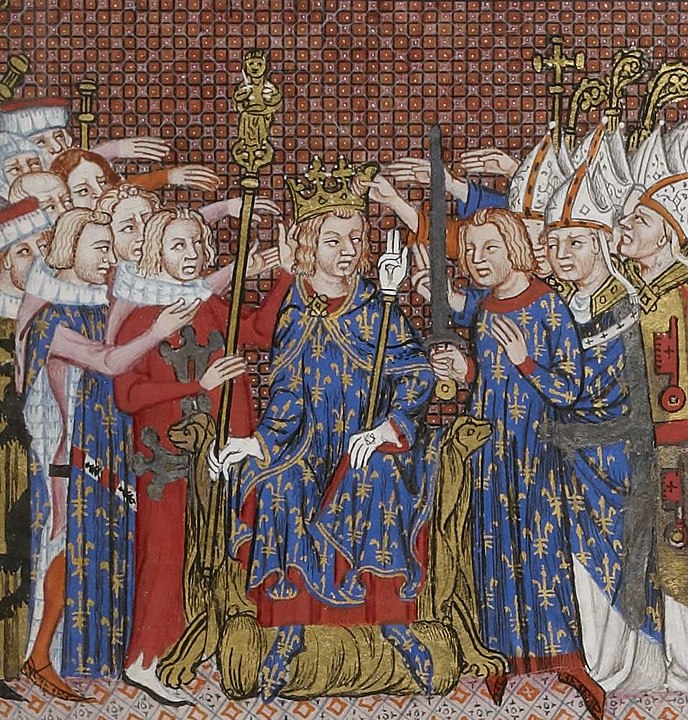
Coronation of Charles V
Despite his frail health and unremarkable appearance, the new king was a wise man. His admirers, starting with Christine de Pisan, praised his moderation, virtues, and love for literature and the arts. He enjoyed discussing political theory with figures such as Nicolas Oresme, Philippe de Mézières, and Raoul de Presles.
At the height of his power in 1376, he asked a jurist, Évrard de Tremaugon, to write Le Songe du verger, a treatise on the theory of the state presented as a dialogue between a cleric and a knight. Initially written in Latin, it was later translated into French. This desire to make knowledge accessible led the king to commission numerous translations of classical authors, including Aristotle’s Politics and St. Augustine’s City of God.
To implement his policies, he adhered to these principles, which required the monarch to govern according to reason for the common good. In addition to these “natural laws” governing the “body politic,” the king was bound by the duties imposed by his coronation oath. More than his predecessors, Charles V was attuned to his religious responsibilities: he was the first king of France to be called “Most Christian.” He even commissioned a Carmelite, Jean Golein, to write a treatise extolling the coronation ceremony and the king’s healing powers.
Charles V’s piety guided all his political actions, yet he remained firm in his dealings with the pope and bishops. Authoritative and methodical, his adversaries dubbed him “the lawyer.” In reality, he skillfully employed propaganda to appeal to the emerging public opinion. He also surrounded himself with capable advisors, mostly from Parliament and trained in canon or civil law.
A Well-Supported Monarch
Men like chancellors Guillaume de Dormans and Pierre d’Orgemont, Hugues Aubriot (provost of Paris), constable Bertrand Du Guesclin, and admiral Jean de Vienne, and later, Bureau de La Rivière, already saw themselves as part of a body serving the state. General advisors on taxation helped manage the collection of taxes, introduced since 1360.
In the royal administrative regions, numerous officials implemented royal orders and dispensed justice, while tax collectors and elected officials gathered revenues, which still constituted extraordinary finances.
By expanding the presence of the king and the state, these officials helped create national unity. Only the principalities, whether ancient like Brittany or the county of Foix, or new like those granted to the king’s brothers as apanages, resisted. These great princes were also appointed lieutenant generals in parts of the kingdom where they exercised all powers. This was less a sign of weakness than a form of power that continued to grant the close royal family a vital role in governance.
Blood ties remained as important in politics as the king’s wisdom and his officials’ loyalty.
Time of Reconquest
Until 1367, although the ransom payments were slow, the Treaty of Calais was generally respected. The two sovereigns tried to deal with the mercenaries and fought through intermediaries. The advantage seemed to be with the English. In Brittany, John IV of Montfort defeated the French-backed candidate, Charles of Blois, at Auray in 1364. In Spain, the Black Prince won at Najera in 1367. In both cases, Du Guesclin was captured. However, the contentious issue of sovereignty stemming from the Treaty of Calais, which involved renunciations that had not yet been exchanged, remained.
Who held sovereignty over Guyenne, governed by the Black Prince? The prince expanded its administration and, to pay his troops, demanded new taxes. The numerous and unruly Gascon nobility invoked their “liberties.” Blood ties between the Albret family and Charles V played a role. Appeals began, addressed simultaneously to the king of England and, secretly, to the king of France. On September 8, 1368, a public appeal was made to Charles V. A year later, when Edward III resumed his title of King of France and Guyenne was “confiscated” from him, the war resumed.
This time, however, the advantage lay with France, which had transformed its army and adopted a new strategy. Du Guesclin, appointed constable in 1370, preferred small, incremental offensives, capturing towns and castles one by one. Meanwhile, the scorched-earth policy cut off enemy supply lines and made large raids pointless.
This strategy paid off. It succeeded not only because of well-paid, motivated troops but also due to the fortifications built by towns and villages. In four years, the English lost everything except Calais, Bayonne, and Bordeaux, while Charles the Bad had to abandon his Norman possessions in 1378. Only Brittany, which rebelled against the French king, remained under John IV’s control.
Time of Revolts
Taxes, renewed year after year, had effectively become permanent. The population, though reduced and “tempered” by hardship, persevered. There was even a recovery in the rural economy, as land previously abandoned returned to cultivation. Those who survived the mid-14th-century crisis lived better. However, this recovery soon led to population growth, which brought renewed pressures. By 1375, southern France faced bad harvests, famine, and epidemics.
In both rural and urban areas, increasing poverty fueled population movements and swelled the labor market. Revolts, like the Tuchins uprising that began in Auvergne in 1363, spread. Between 1378 and 1382, this unrest spread across Europe, seemingly without direct connections between the different centers of rebellion.
The insurgents, largely composed of common people joined by marginalized groups and “vagabonds,” had no clear program. They primarily demanded the abolition of taxes. Charles V’s decision to abolish hearth taxes on September 16, 1380, on his deathbed, only increased the unrest.
Legacy of Charles V
Despite everything, Charles V had overseen the kingdom’s recovery, strengthened royal authority, and stabilized the currency. He implemented financial reforms, extended the privileges of the University of Paris, and built or beautified several palaces (including the Hôtel Saint-Pol and the Louvre). In 1367, Charles V founded the Royal Library (the future National Library of France), which would gather a significant collection of manuscripts. Free of religious fanaticism, he protected the Jews and sought to curb the activities of the Inquisition in Languedoc. Toward the end of his life, he contributed to the start of the Great Schism by recognizing the antipope Clement VII over Urban VI.
Married in 1350 to his cousin Jeanne of Bourbon, Charles V was succeeded by his son, Charles VI. The latter’s reign would undo much of his father’s political achievements, and the kingdom would again be plunged into the turmoil of the Hundred Years’ War.
Founded in 962 by Otto I, the Holy Roman Empire was a political union of states in Western and Central Europe (initially the kingdoms of Germany, Italy, and Burgundy). Built on the ruins of the Carolingian Empire, it emerged from the desire to resurrect the Western Roman Empire, which had fallen in 476. Spanning from the end of the Early Middle Ages to the beginning of the modern era, this complex entity evolved significantly over the centuries. Under the reign of Charles V, the religious unity of the Holy Roman Empire was shattered by Martin Luther’s Protestant Reformation. This led to religious conflict, culminating in the devastating Thirty Years’ War.
After losing much of its influence, the elective monarchy did not survive the Napoleonic Wars. Facing Napoleon Bonaparte, Francis II renounced his title as Emperor of the Romans. On August 6, 1806, after more than 800 years of existence, the Holy Roman Empire disappeared. It left behind a cultural and political legacy shared by many modern countries. This period is also known as the First Reich.
Who Founded the Holy Roman Empire?
When the Western Roman Empire fell in 476, it was replaced by a multitude of barbarian kingdoms. In Gaul, Clovis I founded the Kingdom of the Franks, which quickly expanded toward Central and Southern Europe. The Carolingian dynasty succeeded the Merovingians, with Pepin the Short ascending to the throne in 751. Under his son, Charles I, known as Charlemagne, the Carolingian Empire reached its peak. Determined to revive the ancient Roman Empire, the King of the Franks embarked on a campaign to conquer Europe.
By the end of 800, the monarch was crowned Emperor of the West by Pope Leo III in Rome—a first in three centuries! After the Treaty of Verdun in 843, the Carolingian Empire was divided among three of Charlemagne’s grandsons. Charles the Bald inherited West Francia (the future France), Louis the German received East Francia, and Lothair was given Middle Francia and the imperial title. This marked the end of Charlemagne’s unified empire, which officially ceased to exist in 924 after the assassination of Berengar I. The imperial title remained vacant until the coronation of Otto I, King of Germany, who created the Holy Roman Empire in 962.
What Are the Dates of the Holy Roman Empire?
A political union of states in Western, Central, and Southern Europe, the Holy Roman Empire lasted from 962 to 1806, disappearing at the dawn of the modern era. Initially, the Holy Roman Empire encompassed territories of the former East and South Francia, including the Kingdom of Germany, Bohemia, and Italy. By 1032, the Kingdom of Burgundy had joined the empire. Modeled after Charlemagne’s empire, Otto’s dream was to restore the Roman Empire on the remnants of the Carolingian realm.
At its height, it covered much of Central Europe, including modern-day Germany, the Netherlands, Belgium, Luxembourg, Switzerland, and parts of France and Italy. By the 18th century, however, the regional influence of the Holy Roman Empire had waned in favor of Prussia. It finally collapsed during the Napoleonic Wars. After the signing of the Confederation of the Rhine treaty, Francis II renounced his title as Emperor of the Romans on August 6, 1806, marking the end of the First German Reich.
What Was the Empire Like During the Middle Ages?
The Ottonian dynasty ruled the Holy Roman Empire from 962 until the death of Henry II in 1024. During this period, the empire prospered, developing a thriving merchant economy. Close to the Church, Otto and his descendants dreamed of uniting all of Christian Europe under one empire. To strengthen their authority, they ensured the loyalty of many bishops through the “imperial clientele” system. Christianity played a central role in the Holy Roman Empire during the Middle Ages.
The Church was a privileged partner of the rulers and formed the backbone of the imperial administration, serving as a counterbalance to secular powers. The Ottonians were succeeded by the Salian dynasty, which reigned from 1027 to 1125 and worked to preserve peace. With the decline of the Hohenstaufens in the 13th century, central authority weakened, while the power of the prince-electors grew. By the end of the Middle Ages, the Holy Roman Empire had shrunk to mainly German territories and abandoned its universal ambitions. In 1452, the imperial title passed to the House of Habsburg.
How Was the Empire During the Modern Era?
Under the reign of the Habsburgs, the Holy Roman Empire experienced a revival and regained influence. In 1495, Maximilian I undertook a profound reform of the elective monarchy. Between 1517 and 1570, the empire faced Martin Luther’s Protestant Reformation, which tested its unity. The Peace of Augsburg, signed on September 25, 1555, suspended hostilities between Catholic and Protestant states. At the end of the 16th century, the process of confessionalization began, which solidified the divide between Lutheranism, Calvinism, and Catholicism.
In 1618, tensions between the two camps escalated, marking the start of the Thirty Years’ War. The conflict ended with the signing of the Peace of Westphalia on October 24, 1648. Ratified by the various belligerents, these treaties deeply reshaped the political and religious balance across Europe. From 1740 onward, Prussia and Austria emerged on the European stage, and their rivalry intensified. In the face of these rising powers, the Holy Roman Empire gradually faded, continuing its inexorable decline…
What Was the Constitution Like Under the Holy Roman Empire?
The Holy Roman Empire was governed by a set of laws and customs, many of which were inherited from the Middle Ages. Over the centuries, the elective monarchy established a number of institutions to ensure its functioning. Among them were the Imperial Diet, the Imperial Circles, the Imperial Chamber Court, the Aulic Council, and the Imperial Estates. These entities designated the individuals and corporations eligible to sit in the Imperial Diet.
The constitution of the Holy Roman Empire was largely based on written and unwritten legal foundations, some of which held the status of fundamental laws. This was the case with the Golden Bull of 1356 and the Diet of Worms in 1495. Other examples include the Peace of Augsburg in 1555 and the Peace of Westphalia in 1648. In the modern era, despite his status, the King of the Romans held little actual power. To implement effective policies, he had to collaborate with the seven prince-electors, who had the privilege of electing the emperor. These electors would play a major role in the empire’s politics until the end of the Thirty Years’ War.
What Were the Flags and Symbols Related to the Holy Roman Empire?
Upon his coronation in 962, Otto I adopted the eagle as his emblem, a symbol of imperial power dating back to the Roman Empire. However, it wasn’t until the 12th century that the eagle truly became the figure of the elective monarchy. It was replaced by a double-headed eagle in the 14th century, which soon became the dominant figure in imperial heraldry. The most famous flag of the Holy Roman Empire featured a black eagle on a gold background. During the Crusades, this was often accompanied by a red flag with a white cross.
Many cities adopted the eagle symbol in their coats of arms, signifying the allegiance of their population to the emperor. In addition to these heraldic symbols, the elected sovereign also had a collection of ceremonial regalia: the imperial regalia. Among these consecrated objects, some dating back to Charlemagne, were the imperial crown, the scepter, and the imperial orb. Other notable items included the Holy Lance, the sword, the imperial blade, and the coronation mantle.
What Did Charles V Do During the Holy Roman Empire?
Charles V, often known as Charles Quint, was emperor of the Holy Roman Empire from 1520 to 1556. King of Spain from 1516, he inherited the possessions of the Habsburg family upon his father’s death. He became the most powerful monarch of the first half of the 16th century. His reign was marked by wars against Suleiman the Magnificent’s Ottoman Empire and against France, under Francis I. However, he primarily had to deal with the Protestant Reformation, which threatened to fracture the unity of the Holy Roman Empire.
In the spring of 1521, he condemned Martin Luther at the Diet of Worms. This did not prevent a religious war that lasted until the Peace of Augsburg was signed on September 25, 1555.
This treaty ended hostilities between Lutheran and Catholic states and officially recognized the presence of Protestantism in the empire, signaling the end of religious unity. Faced with this bitter failure and setbacks against both France and the Ottomans, Charles V abdicated in 1556. He handed over his imperial title to his younger brother Ferdinand I and retired to Spain.
What Were the Consequences of the Holy Roman Empire?
The dissolution of the Holy Roman Empire during the Napoleonic Wars reshaped the geopolitical map of Europe. On July 12, 1806, sixteen German states founded the Confederation of the Rhine and seceded. After the Congress of Vienna in 1815, these states regrouped into the German Confederation. Some, primarily those established by Napoleon Bonaparte, were dissolved, allowing Prussia to gain territories. Prussia then emerged as a major power in Central Europe, eventually leading to the formation of the German Empire in 1871.
Before relinquishing his title as Emperor of the Holy Roman Empire, Francis II became Emperor of Austria. This decision led to the creation of the Austro-Hungarian Empire in 1867, which, like the German Empire, disappeared after World War I. Over nearly 1,000 years of history, the Holy Roman Empire left behind a significant political and cultural legacy. This common heritage, shared by many current nations, remains an integral part of the European construction.
Key Dates of the Roman Empire
September 4, 476 – Fall of the Western Roman Empire
Since 455, the Roman Empire has seen a chaotic succession of emperors due to coups. After assassinating Julius Nepos, General Orestes places his son, Romulus Augustulus, on the throne. Less than a year later, the young boy is deposed by the barbarian leader Odoacer. Unlike his father, who is executed, the boy is spared and exiled. Odoacer, then king of the Heruli, becomes the new ruler of Italy. After a slow decline, the fragmented Western Roman Empire, which had been weakening since the 4th century, disappears on September 4, 476.
843 – The Belgian territory divided by the Treaty of Verdun
Following the treaty, the territory is divided between Francia and Lotharingia. Flanders in the north goes to Charles the Bald, while Wallonia is integrated into Lothaire I’s territories. However, these lands will later be part of the Holy Roman Empire a few years later.
February 2, 962 – Otto I crowned emperor
In peril due to the powerful Roman aristocratic families, the Papal States once again require external assistance. Otto I of Germany comes to their aid and is crowned Emperor of the Romans by Pope John XII in exchange for his protection. From that moment, the Papal States fall once again under imperial control. Otto I becomes the first ruler of the Holy Roman Empire, a territory that includes both Germany and Italy.
January 25, 1077 – Henry IV confesses at Canossa
Amidst the Investiture Controversy, Henry IV, King of the Romans, travels to Canossa to kneel before the pope and beg for forgiveness. Having been excommunicated the previous year, his legitimacy as emperor is threatened by rebellious German princes. He waits for three days for the pope’s response, who finally agrees to lift the excommunication.
Humiliated, Henry IV soon embarks on a campaign to conquer Rome and is excommunicated once again.
February 11, 1229 – Frederick II signs the Treaty of Jaffa
To honor his promise to the pope, Frederick II, emperor of the Holy Roman Empire, embarks on the Sixth Crusade in 1228. Very brief, it ends with the signing of the Treaty of Jaffa on February 11, 1229. Sultan Al-Kamil returns Jerusalem, Bethlehem, and Nazareth to the Italian ruler. In return, Frederick agrees not to take control of Islamic holy sites.
On March 18, 1229, Frederick II crowns himself King of Jerusalem before returning to Europe. His methods provoke hostility from parts of Christendom.
July 17, 1245 – Pope Innocent IV deposes Frederick II
While the struggle between the Papacy and the Holy Empire continues, Innocent IV, exiled in Lyon, convenes the 13th Ecumenical Council. In front of the assembly, he deposes the emperor of the Holy Roman Empire, Frederick II of Hohenstaufen. For several years, Frederick had been trying to assert his authority over all of Italy. The conflict grows considerably, especially in the confrontation between temporal power and spiritual authority. Following this event, Frederick II faces several revolts and conspiracies, eventually dying suddenly in 1250. His death brings an end to the struggle between the Papacy and the empire, from which the papacy emerges stronger.
January 21, 1398 – Death of Frederick V of Nuremberg
Born 65 years earlier, Frederick V of Nuremberg dies on January 21, 1398. The son of John II of Nuremberg and Elisabeth of Henneberg, Frederick V succeeded his father as burgrave of Nuremberg, Bayreuth, and Ansbach in 1357. He spent part of his life defending the Nuremberg Castle, a strategic stronghold for the Holy Roman Empire.
January 18, 1701 – Birth of the Kingdom of Prussia
After receiving Emperor Leopold I, Frederick III, then Elector of Prussia, crowns himself in Königsberg and establishes his capital in Berlin. This marks the birth of the Kingdom of Prussia within the Holy Roman Empire. When the empire falls due to Napoleon’s conquests, it is the Kingdom of Prussia that will rise to prominence, reaching its peak at the end of the 19th century and achieving German unification.
August 6, 1806 – End of the Holy Roman Empire
The Holy Roman Empire is dissolved when Francis II of Habsburg renounces the imperial crown. This empire, founded by Otto I in 962, initially encompassed the kingdoms of Germany, Italy, and Burgundy. It lost many of its territories over the centuries and could not withstand Napoleon’s conquests. Francis then takes the title of Emperor of Austria and gives his daughter, Marie-Louise, in marriage to Napoleon.
Spanning from 1792 to 1804, the French First Republic was a regime established in France during the French Revolution, after the end of the monarchy. It ended with the establishment of the First Empire by Napoleon Bonaparte. It all began in 1792, when revolutionary France was in complete chaos. Surrounded by enemies, the constitutional monarchy declared war on Prussia and Austria but soon found itself threatened with invasion. On August 10, the National Assembly declared the removal of Louis XVI.
After the victory at Valmy, the new government abolished the monarchy and established the First Republic. Three political regimes would then succeed one another: the Convention, the Directory, and the Consulate. When the Reign of Terror was declared, France experienced its darkest hours. In 1795, a young army officer appeared and finally brought peace: Napoleon Bonaparte.
Why Was the French First Republic Established?
French Republic in 1801, at the time of the Consulate. Image: Wikimedia
In 1792, the Holy Roman Empire and the Austrian Empire were at war with France. Suffering from significant internal turmoil, the young constitutional monarchy was seeking legitimacy and stability. During the famous Battle of Valmy, the revolutionary army faced the Prussian troops marching toward Paris. France won its first victory against the European monarchies. Emboldened, the Convention abolished the monarchy and, on September 22, 1792, proclaimed the French Republic!
Who Successively Governed During the First Republic?
Following the removal of Louis XVI in August 1792, France desperately needed strong leadership. On September 21, 1792, the National Convention was elected by universal male suffrage. It quickly abolished the monarchy and established the First Republic. On October 26, 1795, after violent internal strife, the Directory replaced it. The Directory governed France until Napoleon Bonaparte’s coup d’état on 18 Brumaire (November 9, 1799). The Consulate was established and lasted until the proclamation of the First Empire on May 18, 1804.
How Did the First Republic Come to an End?
At the beginning of 1804, a royalist conspiracy was uncovered, and its instigators were executed. Napoleon, then First Consul for life, was more powerful than ever. With significant support, he strengthened his control over the various legislative chambers. These bodies granted him the title of Emperor of the French on May 18, 1804, through a Senate decree (the “senatus-consulte”). This marked the end of the First Republic and the birth of the First Empire. France entered an era of grandeur!
When Did the Second Republic Take Place?
After the First Empire, France saw the Restoration from 1815 to 1830 and the July Monarchy from 1830 to 1848. During the latter, Louis-Philippe I was proclaimed King of the French. In the early 1840s, France was severely affected by an economic and social crisis. Significant price increases led to uprisings that drove the monarch from power. The French Second Republic was established on February 24, 1848, and was later abolished on December 2, 1852, when Louis-Napoleon Bonaparte also became Emperor of the French.
French First Republic: Key Dates
August 10, 1792 – Storming of the Tuileries
A decisive day of the French Revolution, August 10, 1792, marks the abolition of the French monarchy. In response to the threat of foreign invasion, insurgents attack the Tuileries Palace. They seize Louis XVI, who had been under house arrest since his flight to Varennes. Shortly after, the National Assembly deposes the king and strips him of his powers. These political upheavals will lead to the “September Massacres” and the beginning of the first Reign of Terror.
September 22, 1792 – Abolition of the Monarchy
At the end of August 1792, the armies of King Frederick William II of Prussia advance into eastern France. European courts aim to overthrow the Revolution and restore Louis XVI to the throne. The victory of General Dumouriez at Valmy provides the revolutionary government with the legitimacy it lacked. The next day, the National Convention definitively abolishes the monarchy in France!
February 23, 1793 – The Convention Orders the Conscription of 300,000 Men
From 1792, France is opposed to the First Coalition, an alliance of several European powers. To confront this, the Convention orders the enlistment of 300,000 men across the entire territory on February 23, 1793. Each French department provides its share of “volunteers,” single men or widowers, for the Republic’s army. This authoritarian mass conscription will lead to the War in the Vendée by March 1793.
March 10, 1793 – Creation of the Revolutionary Tribunal
After the peasant uprising in the Vendée, the National Convention establishes the Revolutionary Tribunal. This body is tasked with “judging conspirators and counter-revolutionaries without appeal or recourse.” The Tribunal becomes the main instrument of the Terror. A famous quote by Danton resonates: “Let us be terrible, so that the people do not have to be.”
October 10, 1793 – Saint-Just Declares the Convention
On August 10, 1793, the Convention, dominated by the Montagnards, suspends the constitution. For Saint-Just, the youngest member of the Assembly, the Republic could not survive otherwise. He declares a true revolutionary dictatorship to restore order, led by the Committee of Public Safety. The decree adopted on October 10, 1793, states: “The government will be revolutionary until peace is achieved.”
November 6, 1793 – Philippe Égalité Dies on the Scaffold
Before the Revolution, Louis-Philippe d’Orléans, a prince of royal blood, was opposed to Louis XVI’s regime. In 1792, he is elected to the National Convention under the name Philippe Égalité, as princely titles are banned. When his son, the future Louis-Philippe I, defects to the enemy in April 1793, Philippe is suspected of complicity and arrested. He is tried by the Revolutionary Tribunal and guillotined on November 6, 1793.
November 24, 1793 – The Revolutionary Calendar is Published
The work of poet François Fabre d’Églantine, the revolutionary calendar breaks from France’s Christian heritage. Established by the Convention on November 24, 1793, it completely reorganizes the lives of citizens. Weeks now have ten days, no longer dedicated to saints but to the land. Months are named after seasons and each lasts thirty days. Sunday rest and religious holidays disappear, replaced by patriotic festivals called “sans-culottides.”
February 3, 1794 – The Convention Abolishes Slavery
Slaves were the great forgotten ones in the 1789 Declaration of the Rights of Man and of the Citizen. Since they were denied liberty and equality, they began revolting in Guadeloupe and Saint-Domingue in 1793. Finally, on February 3, 1794, the National Convention votes to abolish slavery in French colonies. It declares that all men, regardless of color, are French citizens and enjoy the same rights.
May 7, 1794 – The Cult of the Supreme Being
In 1794, Maximilien Robespierre dominates the Committee of Public Safety and the revolutionary assembly. Seeking to end the old regime, he supports the dechristianization of France. However, he knows that the people need religious symbols. On May 7, 1794, the Convention institutes the Cult of the Supreme Being, a nameless, faceless deity. Its festival coincides with Pentecost from the previous calendar.
June 10, 1794 – The Convention Decrees the Terror
On September 5, 1793, as France is besieged on all sides, the revolutionary government institutes the Terror. However, repression and the fear of the guillotine are not enough. On June 10, 1794, pushed by Robespierre, the Convention decrees the Great Terror! Trials are rushed, and the judicial protections of the accused are abolished. Nearly 40,000 people are arbitrarily executed during this period.
July 27, 1794 – End of the Terror
As France seems now secure, many deputies wish to end the Terror. They especially aim to enjoy the power and wealth they acquired during the Revolution. On July 27, 1794, Robespierre, then president of the Committee of Public Safety, and his supporters are arrested. They are guillotined the next day without trial. This marks the end of the Terror!
February 21, 1795 – Restoration of Freedom of Worship in France
After the Terror, the government seeks to reconcile the French with the Revolution. On February 21, 1795, the Convention restores freedom of worship, limited since the Civil Constitution of the Clergy in July 1790. The state thus authorizes the practice of religion, but it must be done without ostentatious signs. Moreover, the state is no longer responsible for managing places of worship.
July 14, 1795 – The Marseillaise Becomes the National Anthem
Written in 1792 during the wars against Austria, the Marseillaise was originally a revolutionary war song. An ode to liberty, it is also a patriotic call for general mobilization and the fight against foreign powers. On July 14, 1795, the Marseillaise becomes the national anthem of France, promoted by the Convention. In 1804, under the First Empire, it is replaced by the Chant du Départ.
October 5, 1795 – Bonaparte’s First Intervention
After Robespierre’s execution, the royalists eventually rebel. In Paris, clashes erupt between the army and rioters planning to attack the Tuileries Palace, the seat of government. On October 5, 1795, the young Republican officer Napoleon Bonaparte is summoned and tasked with quelling the insurrection. He succeeds by bringing in cannons to fire on the angry crowd.
October 26, 1795 – Beginning of the Directory
After three years, the National Convention gives way to the Directory on October 26, 1795. With this new regime, the government seeks to move past the Terror and the Revolution. Elections are held to choose the members of the two legislative chambers: the Council of Elders and the Council of Five Hundred. Thus begin four years during which the Directory works to reform France.
January 2, 1796 – Creation of the Ministry of Police
When the Revolution broke out, the royal police, which had failed to anticipate it, was overwhelmed and disappeared along with the monarchy. On January 2, 1796, the Directory creates the Ministry of General Police. To combat persistent insurgent unrest across France, the government seeks a strong law enforcement force. Unfortunately, crime does not decrease, and conspiracies continue…
September 10, 1796 – The Directory Crushes the “Babouvists”
In 1796, French revolutionary Gracchus Babeuf instigates the “Conspiracy of Equals.” This attempted overthrow arises in a very difficult social context. The goal of “Babouvism” is to achieve the collectivization of land and production means. After a failed military uprising in Grenelle, the Conspiracy is exposed and arrested. Gracchus Babeuf is guillotined on September 10, 1796.
September 4, 1797 – Fructidor Coup
In 1797, new elections are held to renew a third of the two assemblies of the Directory. Citizens vote massively for moderate deputies, favorable to restoring the monarchy. On September 4, 1797, some Directory supporters, backed by Bonaparte, stage the Fructidor coup against the royalist parliamentarians. Many of them are arrested and deported, while the elections are annulled.
May 11, 1798 – The Coup of 22 Floréal Year VI
In April 1798, elections are held again within the Directory. The votes are highly favorable to the Jacobins, a political faction in decline since the fall of Robespierre. Although they hold the majority for a few more days, the current Directors decide to prevent their return. On May 11, 1798, in what amounts to a coup d’état, they pass a law that voids the elections.
November 9, 1799 – Coup of 18 Brumaire
At war and threatened by a royalist resurgence, the Revolution is on its last legs. On November 9, 1799, during the coup of 18 Brumaire, Napoleon Bonaparte ends the Directory. Through clever manipulation, he is appointed First Consul of the Republic and then head of the executive. Although France remains a republic for a few years, Napoleon Bonaparte becomes the sole leader. The Revolution is over.
December 13, 1799 – Birth of the Consulate
Following their coup, Bonaparte, Sieyès, and Ducos establish the Consulate with the constitution of Year VIII, on December 13, 1799. This new political regime is led by three consuls and significantly strengthens the power of the executive. The rights of man and citizen, as well as the defense of liberties, are absent from the text. As First Consul, Bonaparte is more powerful than ever and restores peace in the Republic.
January 18, 1800 – Creation of the Bank of France
Having made a fortune during the Revolution, Swiss financier Jean-Frédéric Perregaux opens the “Caisse des Comptes Courants” in Paris. A few years later, he proposes to Napoleon Bonaparte that his institution be granted the right to print banknotes. This would allow him to collect French savings and increase the amount of money in circulation. Bonaparte agrees and establishes the Bank of France on January 18, 1800.
May 19, 1802 – Creation of the Legion of Honor
To reward civil and military merits, Napoleon Bonaparte creates the National Order of the Legion of Honor on May 19, 1802. This distinction is intended to recognize those who have rendered “eminent services” to the Nation. It initially includes four classes, later expanding to five: Knight, Officer, Commander, Grand Officer, and Grand Cross. This act further enhances the prestige of the First Consul.
August 2, 1802 – Napoleon Becomes Consul for Life
In 1802, Napoleon Bonaparte has significantly strengthened his power over France. For bringing stability to the Republic, the Tribunate, one of the legislative chambers of the Consulate, seeks to grant him national recognition. The people are consulted, and an overwhelming majority votes in favor of this reward. Thus, on August 2, 1802, following political maneuvers, Bonaparte becomes Consul for life.
March 28, 1803 – Creation of the Germinal Franc
During the Ancien Régime, the currency unit was the livre tournois, which was replaced by the franc during the Revolution. On March 28, 1803, Napoleon Bonaparte creates the “germinal franc” and gives it a fixed value and weight. This decision aims to balance the nation’s commercial transactions. Strong and stable, the germinal franc becomes the reference currency in Europe during the Napoleonic wars.
March 21, 1804 – Publication of the Civil Code
Under the monarchy, each French territory had its own laws and local customs. On March 21, 1804, Napoleon Bonaparte promulgates the “Civil Code of the French.” From then on, the law is created by legislators, applied by judges, and governs social relations among all French citizens. The Civil Code is one of Bonaparte’s greatest contributions and has inspired many other countries since.
March 21, 1804 – Assassination of the Duke of Enghien
In early 1804, a royalist plot orchestrated by Georges Cadoudal is uncovered. The investigation, led by Fouché, results in the execution of Cadoudal. The Duke of Enghien, a French prince, is suspected—without solid evidence—of being part of the conspirators. He is kidnapped in the Grand Duchy of Baden, where he had taken refuge, quickly judged, and executed by firing squad in the moat of the Château de Vincennes at night.
May 18, 1804 – Coronation of Napoleon
After the death of the Duke of Enghien and other participants in the royalist plot, Napoleon Bonaparte emerges politically stronger. On May 18, 1804, the Senate approves the Tribunate’s decision to grant Napoleon Bonaparte the title of Emperor of the French. The First Consul thus legally obtains the imperial dignity and its hereditary nature through a symbolic text: senatus-consulte.
December 2, 1804 – Bonaparte Becomes Emperor of the French
On December 2, 1804, Napoleon I is crowned Emperor of the French at Notre-Dame Cathedral in Paris. Pope Pius VII blesses the new imperial emblems: the ring, the sword, and the mantle, and anoints both Josephine and Napoleon. Napoleon then places the crown on his own head. Many French citizens approve of this coronation, seeing it as a way to forever repel the specter of royalty.
It was Jawaharlal Nehru, head of the Indian government, who announced the official birth of India on the night of August 15, 1947. His announcement followed that of Ali Jinnah, who had just proclaimed the creation of Pakistan, split into two regions: West Pakistan and East Pakistan. The latter would later become Bangladesh.
The Turning Point of World War II
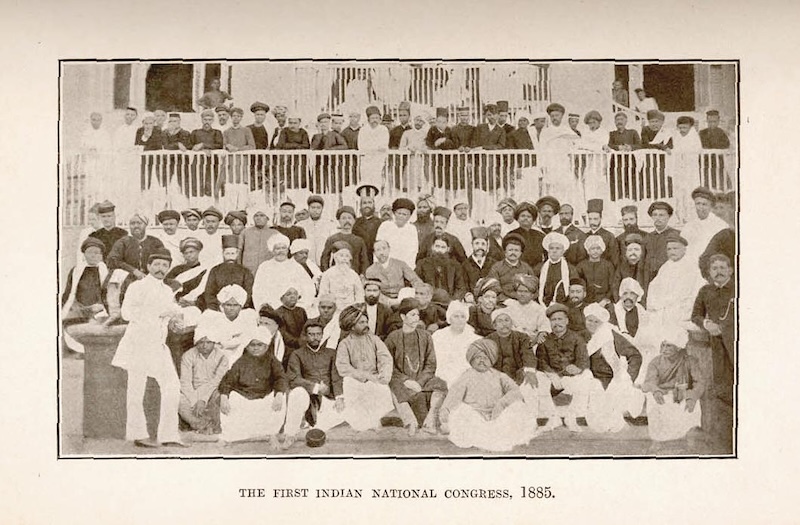
Demands for greater autonomy emerged at the beginning of the 20th century. Initially, these demands reflected a desire for greater Indian participation in the governance of the region. Indians aspired to exercise their own governance and make political decisions without interference from the British Empire. This desire mainly came from the Indian National Congress, founded in 1885 in Bombay, whose more radical wing resorted to terrorism at the dawn of World War I. During the conflict, Indians displayed perfect loyalty to the British.
The interwar period marked the beginning of the first boycott actions and non-cooperation movements. The main figure of this movement was Gandhi. Alongside this non-violent movement, a more radical faction emerged within the Congress, led by Jawaharlal Nehru and Subhash Chandra Bose. By the late 1920s, the demands had shifted towards a desire for complete independence.
After the tensions of the 1930s, the British granted a much more liberal regime, which only served to exacerbate tensions between Hindus and Muslims. However, it was truly World War II that marked a turning point in the progression of independence demands.
Indeed, the Indian Congress demanded a firm commitment from the British towards independence in exchange for Indian troops’ participation in the conflict. But as the situation in Asia became more complicated with Japan’s entry into the war and the invasion of China, Congress leaders launched the Quit India campaign, aimed at preventing Indian participation in the war.
Antagonism Between Hindus and Muslims
The first session of the Indian National Congress in 1885. The Congress was the first modern nationalist movement in the British Empire
The end of the war coincided with the British government’s desire to resolve the issue of Indian independence. However, tensions between Hindus and Muslims were becoming increasingly acute. The Congress wanted to maintain the territorial unity of what had been the Indian Empire, while the Muslims, led by the Muslim League, sought the creation of an independent Muslim state.
Muhammad Ali Jinnah, leader of the Muslim League, forcefully rejected the idea of a confederation between a future Indian state and a future Muslim state. A major issue was the lack of a clear territorial separation between Hindu and Muslim populations.
The creation of two states would thus require massive population displacements.
The Simla Conference on June 25, 1945, marked the first step towards independence. However, during this conference, Lord Wavell, the Viceroy of British India, failed to unite the Hindu and Muslim aspirations. The conference ended in failure on July 14, 1946.
Violent clashes between the two communities followed, and the Muslim League boycotted the Constituent Assembly in December 1946.
The Declaration of Independence
In this context, the British Labour Party accelerated the process of independence and passed the Indian Independence Act on August 15, 1947. Hindu and Muslim leaders, Nehru and Jinnah, immediately proclaimed the independence of India and the creation of Pakistan. Both states were given dominion status and were integrated into the British Commonwealth (Commonwealth of Nations).
Consequences of India’s Declaration of Independence
This partition had significant consequences. Between 1947 and 1950, over 7 million Muslims fled India for Pakistan, while 10 million Hindus and Sikhs made the opposite journey. These massive population transfers were accompanied by great poverty and extremely precarious conditions. Moreover, the division into two states did not ease tensions, and massacres continued. The summer of 1947 alone saw over 400,000 deaths. Finally, Gandhi, who had worked to avoid these extreme acts of violence, was assassinated by a Hindu fanatic on January 30, 1948.
On September 24, 1853, under orders from Napoleon III, Rear Admiral Febvrier-Despointes officially took possession of New Caledonia for France, an island in the Pacific located 18,000 km from mainland France and 2,000 km from Australia. The capital, Port-de-France, now known as Nouméa, was founded in June 1854. This was the era when the French were rediscovering overseas territories and rebuilding a colonial empire to replace the one they had lost a century earlier, during the Treaty of Paris on February 10, 1763, where they gave up Quebec.
1864: The Beginning of Penal Colonization
The settlement of New Caledonia began in 1864 with penal colonization, with more than 20,000 convicts detained there until 1897. Among them were thousands of political prisoners deported after 1871, the year in which the Paris Commune and a Kabyle insurrection in Algeria, another former French colony, were violently suppressed.
1878: The Great Kanak Revolt
“Reserves” were established for the indigenous people, the Kanaks, who were dispossessed of their lands and subjected to forced labor. The exploitation of nickel, the economic lifeblood of the archipelago, now in crisis, triggered several waves of migration, including from Asia, Tahiti, and the Caribbean.
By 1878, a Kanak revolt erupted against the land confiscation.
Some 600 insurgents and 200 Europeans were killed, tribes were wiped out, and 1,500 Kanaks were forced into exile.
1988: The Ouvéa Cave Assault
While New Caledonia became an overseas territory (TOM) in 1946, and the Kanaks gained French citizenship and the right to vote, violence between them and the Caldoches (European settlers) occurred in the 1980s, peaking with the Ouvéa cave hostage-taking and assault in May 1988. About 19 Kanak militants and two French soldiers died. A month later, the Matignon Accords sealed reconciliation through economic rebalancing and shared political power. This was followed in 1998 by the Nouméa Accord, which granted the archipelago a unique status within the French Republic, based on progressive autonomy.
2004: The “Citizenship Day”
Declared a public holiday in 1953 by the French authorities, the date of France’s takeover of New Caledonia was renamed “Citizenship Day” in 2004 to celebrate all communities. However, it remains a day of mourning for part of the Kanak independence movement.
In 2024, a controversial electoral reform reignited the troubled history of this South Pacific archipelago. On May 13, violent riots broke out, unprecedented in scale since the “events” of the 1980s and the 1988 Ouvéa hostage crisis. The riots left 13 dead, including two gendarmes. Four months later, the situation remains unresolved. On this Tuesday, September 24, the people of New Caledonia are more divided than ever as they mark their day of celebration.
The Declaration of the Rights of Man and of the Citizen: An English Localization
The Declaration of the Rights of Man and of the Citizen is a foundational document drafted by the National Constituent Assembly and adopted on August 26, 1789. The storming of the Bastille on July 14 sent shockwaves through every royal court in Europe and marked the beginning of the end for the French monarchy. That same summer, representatives of the people convened to establish a new constitution. Under the leadership of the Marquis de Lafayette, the National Constituent Assembly drafted a text granting all human beings natural, inalienable, and sacred rights. This document, which brought the philosophical ideals of the “Age of Enlightenment” into concrete form, formally abolished the Ancien Régime and left an immense legacy.
What is the Declaration of the Rights of Man and of the Citizen?
Following the storming of the Bastille, the National Assembly gathered in Versailles to draft a new constitution for France. Drawing inspiration from the American Declaration of Independence of 1776, they decided to include a text enumerating fundamental human liberties. The Declaration of the Rights of Man and of the Citizen solemnly defines the natural and sacred rights applicable to all people. It was adopted on August 26, 1789, by the deputies and signed by King Louis XVI on October 5, 1789.
Who drafted the Declaration of the Rights of Man and of the Citizen?
By the end of 1788, France was burdened with crippling debt. Seeking a solution, Louis XVI convened the Estates-General: an assembly bringing together the nobility, the clergy, and the Third Estate. In June 1789, this body transformed itself into the National Constituent Assembly. In August, its 1,154 deputies—including prominent figures such as Mirabeau and Lafayette—drafted the Declaration of the Rights of Man and of the Citizen. Once adopted, the Declaration was incorporated into the text establishing a constitutional monarchy in France.
What does the text of the Declaration say?
Composed of a preamble and seventeen articles, the document establishes the “natural, inalienable, and sacred rights of man.” It recognizes inherent and imprescriptible prerogatives belonging to every human being, stating that “men are born and remain free and equal in rights.” It establishes that sovereignty now resides in the Nation and reaffirms the necessity of the separation of powers. Finally, it introduces the right to property, freedom of opinion and religion, freedom of the press, and the presumption of innocence.
The representatives of the French people, organized as a National Assembly, believing that the ignorance, neglect, or contempt of the rights of man are the sole cause of public calamities and of the corruption of governments, have determined to set forth in a solemn declaration the natural, unalienable, and sacred rights of man, in order that this declaration, being constantly before all the members of the Social body, shall remind them continually of their rights and duties; in order that the acts of the legislative power, as well as those of the executive power, may be compared at any moment with the objects and purposes of all political institutions and may thus be more respected, and, lastly, in order that the grievances of the citizens, based hereafter upon simple and incontestable principles, shall tend to the maintenance of the constitution and redound to the happiness of all. Therefore the National Assembly recognizes and proclaims, in the presence and under the auspices of the Supreme Being, the following rights of man and of the citizen:
Consequently, the National Assembly recognizes and declares, in the presence and under the auspices of the Supreme Being, the following rights of man and of the citizen.
Article 1
Men are born and remain free and equal in rights. Social distinctions may be founded only upon the general good.
Article 2
The aim of all political association is the preservation of the natural and imprescriptible rights of man. These rights are liberty, property, security, and resistance to oppression.
Article 3
The principle of all sovereignty resides essentially in the nation. No body nor individual may exercise any authority which does not proceed directly from the nation.
(The Declaration contains 17 articles in total; the above are the first three as referenced in the source text.)
How can we analyze the Declaration of the Rights of Man and of the Citizen?
As a pivotal event of the French Revolution, the Declaration of the Rights of Man and of the Citizen gave concrete form to the ideals of the Enlightenment. It notably aimed to establish the rule of law, yet it remains imperfect by modern standards for omitting any mention of women or enslaved people in the colonies. Nevertheless, it has inspired numerous countries worldwide in their pursuit of liberty and equality. In 1948, it even served as a foundational reference for the Universal Declaration of Human Rights adopted by the United Nations General Assembly.
What about Article 35?
On June 24, 1793, the First Republic adopted a new Declaration of the Rights of Man and of the Citizen. This text codified certain revolutionary principles and introduced unprecedented rights, such as the right to resist oppression. Article 35 thus affirms that popular revolt against a totalitarian government is not only a right but a civic duty. It states: “When the government violates the rights of the people, insurrection is… the most sacred of rights and the most indispensable of duties.”
What legal value does the 1793 Declaration hold?
Adopted only weeks before the proclamation of the Reign of Terror, the 1793 Declaration proposed a more egalitarian approach than its 1789 predecessor. However, despite its powerful symbolic significance, it never acquired formal legal standing. Indeed, the text was suspended the same year by the revolutionary government and formally repealed in 1795, when a new declaration was drafted. Thereafter, the 1793 document was frequently cited but never officially recognized. To this day, it is the 1789 Declaration that serves as a constitutional foundation for France’s Fifth Republic. The 1795 Declaration, meanwhile, introduced concepts such as the separation of powers and the reserve army—principles that remain in effect today.
How should we interpret Le Barbier’s painting?
In 1789, the artist Jean-Jacques Le Barbier created a painting of the Declaration evoking the Tablets of the Law given to Moses, thereby lending his representation a sacred character. The work is rich in symbolism: it features two women personifying a monarchy freed from absolutism and the spirit of Liberty. Also depicted are the Eye of the Creator God and the pike of the sans-culottes—symbolizing national unity—topped with the Phrygian cap, emblem of freedom. Finally, a laurel wreath expressing glory and an ouroboros (a serpent biting its own tail), symbolizing eternity, complete the composition.
During the Battle of Valmy, the inexperienced but determined French revolutionary troops halted the advance of a coalition army toward Paris. This decisive French victory allowed the French Revolution to continue its course. The Battle of Valmy, which took place on September 20, 1792, is more precisely the first victory of the French army in the revolutionary wars that led to the overthrow of the monarchy, which had until then been held by the Bourbons. It pitted the revolutionary French forces against the Austrians, Prussians, and émigré forces. This victory would be crucial both politically and psychologically, as it would bolster the supporters of the Revolution and the new authorities.
Why Did the Battle of Valmy Take Place?
In 1792, France faced numerous threats. War had been declared against Francis II, Emperor of the Holy Roman Empire, also known as Francis I of Austria, and anti-revolutionary forces had organized. Men from Prussia, Austria, and émigrés advanced into France to liberate Louis XVI. The Battle of Valmy occurred as these troops had been advancing for weeks into French territory and the road to Paris seemed open. The battle would pit revolutionary France against the Kingdom of Prussia, the Holy Roman Empire, and émigrés.
At 3 a.m., the Prussian and Austrian troops advanced toward Hans, between Sainte-Menehould and Valmy in what is now the Marne department. However, it was only around 7 a.m., once the fog had lifted, that the firing began. The French troops, regrouped near the mill of Saint-Saulve on the Valmy plateau, held their ground despite their small numbers and inexperience. The Austro-Prussian forces, expecting an easy victory, had to retreat. The French, aware of their limitations, did not pursue them. Thus, the Battle of Valmy is often referred to as a “simple cannonade.”
Did Dysentery Benefit France?
The invading forces were significantly weakened by dysentery, an infectious disease caused by consuming unripe fruit. However, the disease alone does not account for the French victory.
Meanwhile, the French were galvanized by patriotic songs and cheers. Generals Kellermann and Dumouriez displayed common sense as the enemy troops lacked logistical support.
Why Did the Mill of Valmy Become a Symbol of the Battle?
Commander Dumouriez, camping near Sainte-Menehould on a low plateau where the headquarters was located, asked Kellermann to settle in a basin of meadows with a few mounds, the highest being that of the Valmy mill.
A national subscription was launched to finance new work. Today, the mill is capable of producing flour. Below, the historical center of Valmy 1792 explains the stakes, events, and aftermath of this battle as well as the turmoil associated with the Revolution.
What Are the Consequences of the Battle of Valmy?
The Battle of Valmy is a political and moral victory for the French revolutionaries, who had been struggling until then. Militarily speaking, the supply lines and communications of foreign forces were cut off. The French forces positioned themselves on a plateau favorable to their artillery. Now, the French only needed to hold their ground while the enemy could no longer advance toward Paris. As early as September 21, 1792, after news of the victory reached Paris, the National Convention announced the abolition of the monarchy.
The Brunswick Manifesto is a document written on July 25, 1792, by the Duke of Brunswick, commander of the Prussian armies. Through this text, the duke demands that the Parisian revolutionaries cease their activities and restore Louis XVI to his powers. The manifesto also threatens severe punishments for any attack on the Tuileries Palace or any harm done to the royal family. To understand better, this letter was written three years after the start of the French Revolution.
Following the flight to Varennes, the King of France lost the trust of the French people. He was forced to accept a constitutional monarchy (a monarchy where the powers of the king are limited) and lived under surveillance at the Tuileries. He lost the absolute and divine power of his ancestors. Neighboring kingdoms could not accept that revolutionaries were taking power in France and supported Louis XVI.
War was declared in April 1792. On the advice of counter-revolutionary émigrés, the Duke of Brunswick wrote his manifesto, which was published on August 3, 1792, in the French press. The text angered Parisians, who stormed the Tuileries Palace on August 10, 1792. The monarchy was ultimately abolished, and the royal family was imprisoned before their trial.
Why Was the Brunswick Manifesto Written?
The Brunswick Manifesto was written in July 1792. What should we remember about the context of the time? The French Revolution began three years earlier with a succession of foundational events: the convocation of the Estates-General, the creation of a constituent assembly, and the storming of the Bastille, with the date of July 14, 1789, remaining symbolic. Faced with revolutionary pressure, Louis XVI was powerless. The Assembly proclaimed the end of the feudal system and privileges. The Declaration of the Rights of Man and of the Citizen was also voted on.
In June 1791, Louis XVI felt that his power was slipping away. He refused to abdicate and decided to leave Paris to take refuge in eastern France. His escape was set for June 20 of that same year. The following evening, the king and his family were ultimately arrested at Varennes, in the Meuse.
In September 1791, a constitution limiting the powers of the king was adopted, thus establishing a constitutional monarchy. This marked the end of the absolute divine monarchy of the kings of France.
France declared war on Austria on April 20, 1792. Francis I of Austria, who was none other than Marie Antoinette’s nephew, allied with the Kingdom of Prussia to march on France. Generally, foreign kingdoms feared that the Revolution would spread beyond France. In June 1792, revolutionaries stormed the Tuileries Palace and threatened Louis XVI. They demanded that the king lift his veto on decrees concerning the deportation of refractory priests and the creation of a camp of national guards, but the sovereign refused to yield. The idea of frightening the revolutionaries then took root among royalists.
Who Is the Author of the Brunswick Manifesto?
Although the manifesto has been attributed to the Duke of Brunswick-Lunebourg (Charles-William-Ferdinand), it was actually written by émigrés favorable to the king who had chosen to flee the French Revolution. Between July 14, 1789, and 1815, approximately 140,000 French people went to various emigration zones such as Lower Canada (a British colony), England, Switzerland, Germany, Austria, Spain, Italy, the United States, and Russia.
It was Axel von Fersen, a Swedish count favored by Marie Antoinette, who initiated the Brunswick Manifesto.
He also participated in the flight to Varennes in 1791. In July, Axel von Fersen helped prepare a European coalition against the French Revolution and hoped for a swift victory and a return to absolute monarchy. More concretely, it was Geoffroy de Limon (a French politician) and Jean-Joachim Pellenc (a former secretary to Mirabeau) who wrote the text. Louis XVI, who knew that a manifesto was being drafted, sent Jacques Mallet du Pan to participate in it and avoid threats against the revolutionaries. However, his instructions were not followed, and the manifesto was sent on July 25, 1792. To this day, it is unknown whether the Duke of Brunswick actually signed the text that bears his name.
To Whom Is the Brunswick Manifesto Addressed?
The Brunswick Manifesto was published on August 3, 1792, in Le Moniteur universel, a French newspaper created in 1789 by Charles-Joseph Panckoucke. This media outlet was known for being a propaganda journal and the official organ of the government. The text is addressed to “the city of Paris” and “all its inhabitants without distinction.” More specifically, it targets the French population and the revolutionary forces aiming to depose Louis XVI. Here is an excerpt from the Brunswick Manifesto:
The city of Paris and all its inhabitants without distinction shall be required to submit at once and without delay to the king, to place that prince in full and complete liberty, and to assure to him, as well as to the other royal personages, the inviolability and respect which the law of nature and of nations demands of subjects toward sovereigns […]
What Threat Does the Brunswick Manifesto Pose?
The Brunswick Manifesto is unequivocal: it orders the revolutionaries to “return without delay to the path of reason, justice, order, and peace.” All inhabitants of Paris are “required to immediately and without delay submit to the king.” In addition to urging citizens to halt the revolution immediately, the text threatens the destruction of the capital and severe reprisals.
Their said Majesties declare, on their word of honor as emperor and king, that if the chateau of the Tuileries is entered by force or attacked, if the least violence be offered to their Majesties the king, queen, and royal family (…), they will inflict an ever memorable vengeance by delivering over the city of Paris to military execution and complete destruction, and the rebels guilty of the said outrages to the punishment that they merit.
It is in the second part of the manifesto that threats against the revolutionaries are found. In the first part, the writers explain why Prussia and its allies oppose the new form of governance established in France. Opponents of the Revolution are referred to as the “healthy part of the nation.” This text is a call to “end the anarchy within France.” Read the Brunswick Manifesto.
What Were the Consequences of the Brunswick Manifesto?
The publication of the Brunswick Manifesto did not have the intended effect, which was to frighten the revolutionaries into turning back to their king.
On the contrary, the Revolution immediately became more radicalized. After the manifesto’s publication on August 3, an assault took place on the Tuileries on August 10, 1792.
The revolutionaries seized the palace, which was the seat of executive power, and managed to defeat the 900 Swiss Guards. Louis XVI and the royal family sought refuge in the National Assembly, which chose to suspend the king. He and his family were transferred to the Feuillants Convent, a Parisian monastery, where they lived in deprivation for three days. On August 13, they were taken to the Temple prison.
At the same time, Paris became the epicenter of intense tensions: all enemies of the Republic were hunted down, and the prisons were filled with royalists and dissenters. In early September 1792, the most radical revolutionaries massacred more than 1,300 prisoners in various prisons as an act of revenge. The “September Massacres” took place notably at the Abbaye prison, the Force prison, and the Grand Châtelet prison. These summary executions also occurred in the provinces (Orleans, Reims, Versailles…) and resulted in over 150 deaths. The atmosphere was oppressive as the Austro-Prussian invasion continued.
On September 20, violence continued with the Battle of Valmy: the Prussians, who had crossed the Argonne (a natural region in northeastern France), attempted to march on Paris. Two generals, François Christophe Kellermann and Charles François Dumouriez, managed to stop the Prussian advance in the village of Valmy. This battle was the first victory for the French army in the context of the Revolutionary Wars.
The trial of Louis XVI began on December 11, 1792, and lasted until mid-January 1793. On January 21 of the same year, the king was guillotined at the Place de la Révolution (now Place de la Concorde).
The Battle of Covadonga is the name retrospectively given to a long series of skirmishes and ambushes during the summer of 722 in the Picos de Europa, in Asturias, after which the column sent by the Umayyad Caliphate to subdue Asturias and stop Pelagius’ raids was destroyed and its leader killed.
Despite the small number of forces involved and the absence of a true battle, the strategic, political, and symbolic impact would be immense. Al-Andalus abandoned its efforts to subdue the region, while Pelagius solidified his prestige and was able to establish the Kingdom of Asturias. His successors would turn it into a heroic founding myth embellished with legends. It is from this Asturian victory that the Reconquista is commonly considered to have begun, which would only be completed in 1492, 770 years later.
Note
For decades, historians have debated the details of the battle, with some even questioning the existence of Pelayo (Pelagius of Asturias). While many scholars accept that the confrontation took place, a few doubt it altogether. Interestingly, Muslim chroniclers also reference the event. This uncertainty is common for events in the Early Middle Ages due to the scarcity of reliable sources. A major issue is the lack of independent accounts. Despite these doubts, Covadonga remains significant as a “foundational myth” and has become an important site for religious pilgrimage.
Background
The proclamation of Pelagius of Asturias († 737) as king of Asturias in Covadonga and the beginning of the Reconquista of Spain by the Christians of the north of the Iberian Peninsula.
After the fall of the Visigothic kingdom in 711, those resisting the Umayyad forces took refuge in the northern Iberian Peninsula, particularly in the Cantabrian Mountains. Pelagius, son of Favila, the Duke of Cantabria, initially cooperated with the Muslims in Gijón. However, he later refused to pay tribute to the Umayyads and led a resistance movement. As more fighters joined him in Cantabria, he strengthened his army and launched attacks on small Umayyad garrisons in the region.
At first, the Umayyads, whose main seat of power in the peninsula was Córdoba, did not seem overly concerned by this mountain rebellion. The Cantabrian region was remote, with little strategic or economic value, and the Umayyad resources were focused on campaigns against the Frankish Kingdom beyond the Pyrenees.
However, after their defeat at Toulouse in 721, the governor of Al-Andalus, Ambiza, decided to retaliate. In 722, he launched a punitive expedition against the Cantabrians, who were fortified in the natural stronghold of Liébana. Seeing this as an easy victory to boost troop morale, Ambiza tasked Munuza, his subordinate governor in Gijón, with organizing the campaign. Munuza sent General ʿAlqama, accompanied by Oppas—the brother of former Visigothic King Wittiza and Archbishop of Seville. Oppas was responsible for negotiating the surrender of the Cantabrians and persuading them to submit.
When negotiations failed, the better-organized and numerically superior Umayyads pursued Pelagius and his men. According to the Chronicle of Albelda—the oldest and most reliable source—the first confrontation occurred near Mount Auseva in the Picos de Europa. There, the Christians were forced to hide in the “Cave of Ánseba” due to the overwhelming strength of their enemies. The chronicle does not mention a battle at Covadonga, a site later mythologized by the Asturians, which only appears in chronicles revised much later by Alfonso III for political gain.
The Christians managed to escape, with the Umayyads in pursuit over five mountain passes, each ranging from 1,200 to 1,500 meters in altitude. Through a series of skirmishes, the Christians lured the Umayyads deeper into the Picos de Europa mountains. Eventually, they reached Liébana, the Cantabrian stronghold, where they found refuge in a narrow, easily defensible valley, despite their forces being reduced to just 300 men.
Timeline
Pelagius and his guerrilla fighters harass the enemy by attacking from the heights, firing arrows, and throwing rocks from the mountain slopes. They use the caves, which they know well, to hide. Pelagius personally leads his men down to the valley through the Aliva Pass, the western entry to Liébana. The Umayyads, descending toward the Deva River at the valley’s base, become trapped, unable to maneuver in the narrow space. In their chaotic retreat, Al Qama and many of his men are killed, crushed by a collapsing section of the mountain near Cosgaya in Cantabria, possibly provoked by the attackers. Oppa is captured by Pelagius’s forces.
According to chroniclers like Ahmad al-Maqqari, only ten men from Pelagius’s original group survive. However, many Cantabrian villagers join the fight, attacking the remaining Umayyad reinforcements and inflicting heavy losses. The Umayyad retreat becomes long and difficult as they face constant ambushes over 50 kilometers of mountainous terrain. After two days and nights of fighting, Munuza is killed near the village of Saint Eulalia.
Consequences
Map of the campaigns of the Islamic occupation of the Iberian Peninsula. Image: Wikimedia
After the battle, the Umayyads no longer seriously challenged the independence of Asturias, underestimating the strength of the remaining forces and the significance of the conflict. Nonetheless, this kingdom became the starting point of the Reconquista, with the battle symbolically marking its beginning. According to the Chronicle of Alfonso III, which romanticize the event, the Christians attributed their victory to the divine intervention of Mary. This legend credits Pelagius with erecting a sanctuary in her honor within the caves, originally called Cova Dominica, which later became known as Covadonga. Pelagius chose this symbolic location near the County of Liébana, close to Cangas de Onís, to establish the court of his Kingdom of Asturias, now liberated from the occupiers.
Various authors have downplayed the significance of this victory, emphasizing the persistent “rebellious” nature of Cantabria against domination, whether by Romans, Visigoths, or Muslims. Sánchez Albornoz argues that Pelagius relied more on the indigenous Cantabrian population, of Celtic origin, who were accustomed to resisting authority, rather than on the Goths, who had taken refuge in the Cantabrian mountains after the Battle of Guadalete.
At that time, Cantabria extended far beyond its current boundaries (up to the Sella River) and included parts of western Asturias. Because of this legendary feat, Pelagius is often viewed by historians as a mythical figure and the first King of the Asturians over this Cantabrian territory. His son-in-law, Alfonso I—son of Peter of Cantabria—left a historical legacy through his battles, notably the conquests of Galicia in 740 and León in 754. Alfonso I married Ermesinda, the daughter of Pelagius, and was proclaimed King of Asturias, a region that now encompassed the former Duchy of Cantabria.
Muslim View of the Battle
According to the compilation of the chronicler Al Maqqari (Tremecén, 1578-Cairo, 1632):
ʿĪsā ibn Aḥmad al-Rāzī reports that during the time of Anbasa ibn Suhaym al-Kalbi, a wild donkey named Belay [Pelayo] emerged in the lands of Galicia. From that point onward, the Christians in al-Andalus began to defend the territories still under their control against the Muslims, an achievement they had not anticipated. The Muslims, who had been fighting against the polytheists and forcing them to emigrate, had taken over their lands until Ariyula arrived from the land of the Franks, conquering Pamplona in Galicia. All that remained was a rock where a king named Pelayo sought refuge with three hundred men. The soldiers continued to attack until Pelayo’s men perished from hunger, leaving only thirty men and ten women with him. Their only sustenance came from honey left by bees in the crevices of the rock. The situation became difficult for the Muslims, and eventually, they scorned Pelayo and his followers, saying, “Thirty wild donkeys—what harm can they do to us?” In the year 133, Pelayo died, and his son Fábila succeeded him. The reign of Belay lasted nineteen years, and that of his son, two.
Christian View of the Battle
According to the chronicles of Alfonso III, Chronicle of Albelda, dated 881:
Alkama entered Asturias with 187,000 men. Pelayo and his companions were on Mount Auseva when Alkama’s army arrived, setting up countless tents in front of the entrance to a cave. Bishop Oppas climbed a hill opposite the cave and called out to Pelayo: “Pelayo, Pelayo, where are you?” Pelayo appeared at a window and replied, “Here I am.” The bishop then said: “I believe, brother and son, that you are not unaware of how, not long ago, all of Spain was united under the rule of the Goths and shone brighter than other nations in its knowledge and learning. Yet, even the entire Gothic army could not withstand the might of the Ishmaelites. Can you truly defend yourself from the top of this mountain? It seems unlikely to me. Listen to my advice: return to your senses, and you will enjoy many goods and the friendship of the Chaldeans.”
Pelayo then responded, “Have you not read in the Holy Scriptures that the Church of the Lord will become like the mustard seed and grow again through God’s mercy?” The bishop answered, “Indeed, that is written.” […] “We have as our advocate before the Father, our Lord Jesus Christ, who can deliver us from these pagans.” […]
Alkama then ordered the battle to begin, and the soldiers armed themselves. Catapults were raised, slings prepared, swords gleamed, spears were lifted, and arrows flew without pause. But soon, the magnificence of the Lord was revealed: the stones launched from the catapults, upon reaching the house of the Holy Virgin Mary inside the cave, turned back against those who shot them, killing the Chaldeans. And since God does not need spears but grants victory to whom He wills, the Chaldeans fled…
People usually imagine kamikaze (from the Japanese “divine wind”) as suicide pilots crashing their “disposable” planes into American ships. And in part, they are right.
Special aircraft called Yokosuka MXY7 Ohka were designed for these daredevils—flying bombs that were not built for landing. They were delivered to enemy aircraft carriers attached to Mitsubishi G4M bombers.
But there were other types of kamikaze. For example, the Japanese developed submarine torpedoes called kaiten (from the Japanese “turning the tide of fate”). Yes, the people of Nihon love poetic names. Kaiten pilots would get into their mini-submarines, approach enemy ships, and blow themselves up.
The first modifications of kaiten allowed for ejection. However, no one survived underwater explosions anyway, so the samurai decision was made to abandon this feature.
In addition, there was a ground version of kamikaze—soldiers armed with a handheld anti-tank weapon called Ni05, which was literally a grenade on a stick. The operating principle was simple: shout “Banzai!”, run toward an American tank, hit it, and explode. If lucky, the tank blows up too.
Furthermore, kamikaze were not exclusive to Japan; the Third Reich had its own version. Specifically, the “Leonidas Squadron” of the 200th Bomber Wing in the Luftwaffe. This unit trained suicide pilots to replace the V-2 rocket, which they never had time to complete.
Around 70 people were recruited into the squadron, and from April 17 to 20, 1945, during the Battle of Berlin, these suicide bombers launched attacks on the bridges surrounding the city. However, they did not achieve significant success.
Not All Kamikaze Died
There’s a joke: two kamikaze pilots, one experienced and one new, are waiting for takeoff. The experienced one asks, “First time, huh?” And there’s a grain of truth in this joke: some kamikaze did indeed survive their missions.
There were cases where kamikaze returned to base after failing to find a target or were rescued from the sea following a failed attack.
A petty officer, Takehiko Ena, managed to survive three suicide missions. His first mission to an American aircraft carrier failed when the plane couldn’t take off. On his second attempt, Takehiko’s engine broke down mid-flight, and he made an emergency landing.
During his third flight, the engine malfunctioned again. Ena and two comrades crash-landed into the water, swam to a nearby island called Kuroshima, and stayed there for two and a half months before being rescued by a Japanese submarine. In the end, the unlucky kamikaze survived the war, reevaluated his views, and lived to be 92 years old.
Surviving kamikaze were not well-received by society. You set out to perform a noble act of self-sacrifice but then changed your mind—how could that be acceptable?
Kamikaze Were Not Very Effective
Drawing of a Japanese Yokosuka MXY7 Ohka rocket powered human-guided anti-shipping kamikaze attack plane (Allied code name “Baka”). Image: Wikimedia
The Japanese believed that attacks at the cost of one’s own life should be incredibly destructive. Additionally, they expected that kamikaze would have a profound psychological effect on American troops: the samurai were supposed to create an impression of Japanese invincibility. But these hopes were not fulfilled.
American sailors scornfully referred to kamikaze as “baka bombs.” “Baka” in Japanese means idiot.
During World War II, a total of 1,321 kamikaze gave their lives, resulting in the sinking of 34 American and British ships. However, this did not prevent the Allies from capturing the Philippines, Iwo Jima, and Okinawa.
Kamikaze are usually seen as enthusiastic individuals who eagerly volunteered to sacrifice their lives for the emperor. But in reality, not all of them were so eager to sign up for a suicide mission.
When Vice Admiral Takijiro Onishi of the Japanese Navy came up with the idea to create a squadron of suicide pilots, the high command approved it on one condition: only volunteers could be recruited. Takijiro readily agreed.
To stir up patriotic feelings among young pilots, the experienced samurai commanders employed certain psychological tactics.
They handed out questionnaires to candidates with the question: “Do you want to become a kamikaze?” with three response options: “I passionately wish to join,” ”I wish to join,” and “I don’t wish to join.” However, the pilot was required to write down their name and rank on the form, and if anyone had the audacity to answer negatively, both they and their families could face retaliation from the command.
Moreover, since the testing was conducted in groups, the likelihood of refusal was further reduced—it’s hardest to be seen as a coward in front of your comrades. In fact, those who agreed but without much enthusiasm were brutally beaten with clubs to “instill a fighting spirit.”
As soldier Irokawa Daikichi wrote, “Struck on the face so hard and frequently that [his] face was no longer recognizable.” As you can imagine, this hardly aligns with “voluntary self-sacrifice.”
Kamikaze Departed on Their Mission with Grace
Despite the coercive methods mentioned, being a kamikaze was considered extremely honorable among young Japanese soldiers. They strived to leave for their first and final mission with dignity.
For example, in the winged bombs, that is, the Yokosuka MXY7 Ohka planes, there was a designated place behind the pilot’s head for securing a samurai sword. Additionally, kamikaze would write farewell haiku poems—similar to samurai preparing to perform seppuku.
This is not true. The term “Ancient Greece” or “Hellas” was used to describe a geographical region, not a single state. It consisted of city-states (poleis), mostly located in the southern part of the Balkan Peninsula. The Greeks also spread across almost the entire Mediterranean coast, establishing many colonies. The remains of their cities can be found in modern-day Italy, Spain, Turkey, North Africa, and even Crimea. At different times, there were up to 1,035 poleis.
Over several hundred years (11th–4th centuries BCE), these separate cities never became one unified state. This only happened under external influence when the Macedonian king Philip II united the Greek city-states under the League of Corinth in 338–337 BCE.
Ancient Greece Was the Most Advanced State of Its Time
Surgical tools, 5th century BC, Greece. Reconstruction based on descriptions within the Hippocratic corpus. Image: Thessaloniki Technology Museum
For its time, Hellas was a power with a rich culture and developed science. For instance, Pythagoras had already suggested that the Earth was round. The Greeks used complex mechanisms for astronomical calculations. They made numerous discoveries in classical mechanics and were pioneers in inventing the water mill. Greek cities had water supply systems (aqueducts), warriors used flamethrowers, and medics operated with scalpels, forceps, and even vaginal speculums.
However, more ancient Eastern civilizations had much to say in response. The peoples of Ancient India, China, Egypt, and Mesopotamia built monumental structures, such as the pyramids in Giza, dammed great rivers like the Indus, Ganges, Yellow River, Yangtze, Nile, Tigris, and Euphrates, and created their own writing systems. And all of this happened before the civilizations of Ancient Greece even existed.
Eastern astronomers were just as knowledgeable about the cycles of day and night, the length of the year and the month, as the Greeks. For example, Indians in the 6th century BCE knew that the Earth rotates on its axis, and the Moon reflects sunlight. They used surgical instruments and could perform Caesarean sections. At this time, ancient Greek science was only beginning to emerge.
Both Eastern and ancient Greek researchers were prone to conjectures and superstitions. For instance, Aristotle wrote that some animals spontaneously emerged from water, dust, and dirt.
Ancient Greeks Lived in An Equal Democratic Society
Pericles Gives the Funeral Speech (Perikles hält die Leichenrede), by painter Philipp von Foltz (1852)
Athenian democracy, which existed for about 200 years (approximately 500–321 BCE), is considered the first democratic regime in the world. However, there are many nuances.
First, not all Greek city-states were democratic. In fact, democracy only existed in Athens. In Sparta, an oligarchy (gerontocracy) was mixed with royal power, while in Thessaly, a lifelong elected leader, the tagus, ruled. Power could also be seized by a tyrant.
Second, ancient democracy was not universal. Greek city-states thrived on slave labor. People deprived of personal freedom had no rights.
Women were entirely excluded from the public and political life of “democratic” Athens, as were children, who were considered the property of the head of the family. Lastly, even free individuals from other city-states who moved to Athens had no civic rights and were required to pay special taxes. Native Athenians contemptuously referred to such residents as metics.
Third, Athenian citizens participated directly in the political life of the city-state: they voted on decisions, could make proposals and objections in the Assembly. Modern representative democracy, where we entrust politicians with defending our interests, has its roots in the 18th century.
Spartans Were Invincible Warriors and a Militaristic Society
In popular culture, Spartans are portrayed as brave and invincible soldiers. However, this is just a myth. In reality, before the Battle of Thermopylae, which was lost, by the way, Spartan warriors were not particularly distinguished from soldiers of other city-states. Even after that, the legendary Spartans suffered defeats, such as in the battles of Sphacteria and Leuctra.
Moreover, political structures and educational systems similar to those in Sparta existed in other city-states. The primary occupation of Spartans was managing land and helot slaves, so it cannot be said that Sparta lived solely for and by war.
Athletes in the Ancient Olympic Games Competed Fairly
In modern sports, scandals and manipulations are not uncommon. But the competitions of ancient athletes were supposedly honest and fair!
Unfortunately, not everything was as poetic: cheating, bribery, and dirty tricks accompanied the Olympic Games from the very beginning. There was a strong incentive for this: besides fame and honor, victory in the Olympia often promised significant monetary rewards, lifelong free meals, and the opportunity to compete for money and valuable prizes in smaller competitions.
For a prize-winning position, an ancient athlete received from their city-state 100 to 500 silver coins—drachmas. In that era, 500 drachmas could buy two slaves and a flock of 100 sheep with some money left over.
Despite the fact that those caught cheating faced fines, many still resorted to trickery for the reward. They used herbal infusions, visited sorcerers, and bribed judges. For example, Pausanias, in “Description of Greece,” noted that the Thessalian Eupolos paid other wrestlers, whom he was supposed to compete against, to lose. Eupolos was exposed and had to pay a fine. The money from dishonest athletes was used to build statues of Zeus, which were placed along the path to the Olympic stadium.
These cases were not rare: Pausanias mentioned the names of other dishonest athletes as well.
Amazons – A Myth
In ancient Greek mythology, stories about Amazons were very widespread. The Greeks believed that this was a warlike tribe composed entirely of women. Amazons were said to cut off one breast to make it easier to shoot a bow, meet with men only for conceiving children, and later dispose of the boys. In Greek writings and works of art, Amazons appear alongside centaurs and heroes, and their place of residence is located in various remote regions of the world known to the Greeks. Because of this, historians considered the Amazons to be a fabrication.
However, archaeological excavations of Scythian burial mounds show that there were indeed warrior women among the nomads. They were buried with bows and arrows.
Scythian women were forced to know how to defend themselves, as men often went off to roam, leaving them alone. Of course, they were not a separate people, they did not kill boys, nor did they cut off their breasts. All of this is the product of Greek imagination, for whom the idea of a woman riding a horse and shooting a bow was bizarre.
All Ancient Artworks Were White
Cities and temples of white marble, sculptures perfect in their purity and simplicity—that’s how we know ancient architecture and art. However, in reality, the creators of Ancient Greece were not strangers to bright colors. They enthusiastically added color to their statues and buildings. They used natural pigments such as ochre, cinnabar, and copper blue, which degrade and flake off under the influence of bacteria and sunlight. Additionally, many statues had bronze inlays and black stone pupils.
The issue of natural pigments affects artworks from various eras. For example, they can be seen in the paintings and drawings of Leonardo da Vinci and Raphael, as well as in the frescoes of Michelangelo in the Sistine Chapel. To preserve everything in its original form, museum staff create special conditions for lighting and temperature.
Troy Never Existed
The Burning of Troy (1759–1762), oil painting by Johann Georg Trautmann
The Trojan War is the subject of two of the most famous works of ancient literature: Homer’s “Iliad” and “Odyssey.” His account contains much that is fictional: sirens and sea monsters, gods interfering in human affairs, and beautiful women over whom wars begin. According to legend, Troy was under siege for 10 years, after which the Greeks, with the help of the Trojan Horse, infiltrated the city, killed its defenders, and destroyed it.
For a long time, historians believed that Troy was a myth and that the stories about it were merely legends. For thousands of years, no one knew where it was located, until in the late 19th century, a group of archaeologists led by the eccentric Heinrich Schliemann found Troy in Anatolia (Turkey), at the entrance to the Dardanelles.
However, Schliemann was heavily criticized for not paying attention to the stratigraphy of the site. He dug down to the layer “Troy II,” destroying many historical remains in the process. Moreover, Schliemann became infamously known for his fake discoveries supposedly from Troy.
Today, we know that Troy was destroyed and rebuilt in the same location nine times, and in Homer’s works, the most likely reference is to the layer numbered VI.
Modern Greeks Are Not Descendants of the Hellenes
It is generally accepted in science that Hellenic civilization emerged based on the Minoan and Mycenaean civilizations of the island of Crete. They survived invasions by two Greek tribes: the Achaeans and the Dorians. As a result, the Minoans and Mycenaeans were fully assimilated.
However, despite the subsequent Roman and Turkish conquests, which lasted for centuries, the Greeks managed to preserve their national identity. A 2017 DNA study confirmed that, with minor external contributions, the blood of ancient Mycenaeans still flows in the veins of modern Greeks.
The story takes place in the 1920s on the fictional Irish island of Inisherin. Musician Colm (Brendan Gleeson) suddenly stops being friends with his longtime drinking buddy, Patrick (Colin Farrell). This decision sets off a chain of unfortunate events.
Irish actor Barry Keoghan can rightfully be called the king of supporting roles. Before Martin McDonagh’s film, he had already outshone Colin Farrell in The Killing of a Sacred Deer, Dev Patel in The Green Knight, and Fionn Whitehead in Dunkirk.
In The Banshees of Inisherin, Keoghan plays the funny and annoying village fool, Dominic. The character tries to reconcile the former friends and win the heart of Patrick’s sister, Siobhán. Keoghan masterfully brings to life a naïve and straightforward character hiding an inner fragility. For this role, Keoghan earned an Oscar nomination.
Robert Duvall in Apocalypse Now
USA, 1979
War, Drama, History, Action
Duration: 3 hours 14 minutes
IMDb: 8.4
During the Vietnam War, Captain Benjamin Willard (Martin Sheen) is sent into the heart of the conflict. His mission is to find and neutralize the mysterious Colonel Kurtz (Marlon Brando), who is hiding in the Cambodian jungle. Willard assembles a team and sets off into the hellish chaos of Vietnam.
Robert Duvall plays the film’s most memorable character. His role is Lieutenant Colonel Bill Kilgore, a bloodthirsty, death-insensitive lunatic. He delivers the iconic monologue that begins: “I love the smell of napalm in the morning.” Kilgore is supposed to help Willard’s group move up the river, but the area is dangerous. He agrees only in exchange for a surfing session with one of the crew members—a famous champion.
Orson Welles in The Third Man
UK, 1949
Film Noir, Thriller, Mystery
Duration: 1 hour 44 minutes
IMDb: 8.1
American pulp writer Holly Martins (Joseph Cotten) arrives in post-war Vienna at the invitation of his old friend Harry Lime, only to discover that Lime recently died. At the funeral, a police captain tells Martins that Lime was a gangster who sold diluted penicillin on the black market, causing the deaths of many children. Martins is convinced that his friend couldn’t have been involved in such crimes and decides to investigate the matter and clear his friend’s name.
Without giving away spoilers, let’s just say that Orson Welles’ character is tied to the detective plot and appears in the second half of the film, stealing the spotlight from Joseph Cotten. Welles’ character is cruel, arrogant, yet so charming and charismatic that it’s impossible to resist him, especially for the woman who also appears in the story.
Patricia Arquette in Lost Highway
France, USA, 1996
Thriller, Mystery, Comedy
Duration: 2 hours 14 minutes
IMDb: 7.6
Fred (Bill Pullman) and Renee Madison (Patricia Arquette) live in a two-story house on the outskirts of Los Angeles. One day, an unknown person tells them through their intercom that Dick Laurent is dead. Soon after, disturbing tapes arrive in the mail—someone has been filming the couple while they sleep.
The next morning, Fred discovers a new tape, showing him sitting next to his wife’s bloody corpse. Fred is arrested and, while in police custody, mysteriously transforms into auto mechanic Pete Dayton, who has no connection to the case. Upon being released from jail, Pete tries to unravel what has happened.
In this tangled crime thriller by David Lynch, the main characters are Fred Madison in the first part and Pete Dayton in the second. They represent two parts of the fractured consciousness of a killer. The fragmented film is connected by Patricia Arquette, who plays both the brunette Renee and the blonde Alice. The two characters symbolize different interpretations of the same woman. Renee is the quiet, modest housewife married to Fred, while Alice is the seductive, mysterious lover of Dick Laurent.
Sean Penn in Fast Times at Ridgemont High
USA, 1982
Romantic Comedy
Duration: 1 hour 30 minutes
IMDb: 7.1
The film is based on a book by Cameron Crowe, a journalist who, at the age of 22, decided to spend a year undercover at a high school. He later wrote a novel about the amusing and engaging lives of the students.
At the heart of the story is 16-year-old Stacy (Jennifer Jason Leigh) and her relationships with boys. First, she loses her virginity to an older guy, and then she has a brief fling with ladies’ man Mark. But in truth, she is attracted to a shy ticket seller at the cinema.
All the actors in Fast Times are excellent, but Sean Penn stands out in the role of Spicoli, a secondary character who is a failing student and a surfer, constantly getting into humorous situations. Most of his troubles stem from conflicts with his strict history teacher, Mr. Hand. Spicoli wastes the teacher’s time during class, so by the end of the school year, Mr. Hand decides to get revenge on his worst student.
Jack Nicholson in Easy Rider
USA, 1969
Drama, Adventure
Duration: 1 hour 35 minutes
IMDb: 7.2
In the late 1960s, two biker friends set out on a journey across the southern states to attend the Mardi Gras festival. Along the way, they encounter hippies and face hostility from conservative Southerners. The heroes make it to the festival, but leaving becomes a significant challenge.
Director Dennis Hopper managed to capture the spirit of the times.
The biker road movie told a story about the search for freedom in a country where people are trapped by their prejudices.
During their journey, the two riders meet Jack Nicholson’s character, George Hanson, an alcoholic lawyer. It’s one of the best character introductions in cinematic history. Hanson, despite his better judgment, decides to join the bikers on their trip to the festival.
Tommy Lee Jones in Eyes of Laura Mars
USA, 1978
Thriller, Mystery
Duration: 1 hour 44 minutes
IMDb: 6.2
People around scandalous New York photographer Laura Mars (Faye Dunaway) start dying. At the same time, Laura suffers from vivid visions of these crimes, as if she is watching the murders through the eyes of the killer. Detective John Neville (Tommy Lee Jones) joins the investigation.
Together, they must uncover the identity of the murderer and prevent Laura from becoming the next victim.
Faye Dunaway, a true Hollywood diva of the 1960s, plays the lead role with a monumental, somewhat mannered performance. In contrast, Tommy Lee Jones, still a relative newcomer at the time, stands out with his organic, sometimes chaotic, expressive acting style, which adds complexity to his character.
Jones would later overshadow Harrison Ford in The Fugitive, Val Kilmer in Batman Forever, and Will Smith in Men in Black.
Christoph Waltz in Inglourious Basterds
Germany, USA, 2009
Action, Drama, Comedy, War
Duration: 2 hours 33 minutes
IMDb: 8.4
During World War II in France, SS Colonel Hans Landa (Christoph Waltz), nicknamed “The Jew Hunter,” murders the family of Shosanna Dreyfus (Mélanie Laurent). Years later, Shosanna becomes the owner of a cinema.
A grand premiere of the film Nation’s Pride, glorifying Nazi “heroics,” is planned at her theater, with the Gestapo’s top brass in attendance. Shosanna, bent on revenge, plans to set the cinema on fire with Hitler inside. She is unaware that a ruthless group of Jewish assassins, led by Lieutenant Aldo Raine (Brad Pitt), has similar plans.
Quentin Tarantino is known for creating memorable supporting characters. In his films, actors in minor roles often outshine the leads.
Initially, Tarantino considered Leonardo DiCaprio for the role of the villain in his war-western, but during the scriptwriting process, he realized the character needed to be an older German actor.
After a lengthy casting process, Tarantino was almost in despair, as none of the contenders could bring his vision to life. That was until he came across the relatively unknown 50-year-old Austrian actor Christoph Waltz. Waltz surpassed all his famous co-stars, won an Oscar for his role, and became one of the most sought-after actors in Hollywood.
John Turturro and Steve Buscemi in “The Big Lebowski”
United Kingdom, USA, 1998
Comedy, Crime
Duration: 1 hour 57 minutes
IMDb: 8.1
Jeffrey Lebowski (Jeff Bridges), nicknamed “The Dude” — an overgrown slacker and bowling enthusiast — gets into trouble. One day, gangsters mistakenly show up at his home and ruin his rug. It turns out they confused The Dude with a millionaire of the same name. So the hero decides to contact the other Lebowski and demand compensation for the ruined rug. Instead, he gets dragged into a story involving kidnapping, ransom, and a briefcase with a million dollars.
The Coen brothers, like Tarantino, also pay a lot of attention to the supporting cast. In this comedic neo-noir, two actors could compete for the title of best background actor. John Turturro as Jesus is The Dude’s unforgettable bowling rival. By the way, Turturro improvised a lot on set. For example, he came up with his character’s victory dance and decided to lick the ball before throwing it.
There’s also Steve Buscemi as the frail Donny. Although he doesn’t participate in the main adventures, he’s even more memorable than the main characters.
Jennifer Coolidge in “American Pie”
USA, 1999
Comedy
Duration: 1 hour 36 minutes
IMDb: 7.0
The cult teen comedy from 1999 tells the story of four high school seniors trying to lose their virginity before graduation. The main character Jim, completely clueless in sexual matters, dreams of seducing the most attractive girl in school. Oz, a sensitive lacrosse team star, falls in love for the first time. Kevin still can’t have sex with his longtime girlfriend Vicky. And Paul Finch, the nerdy outsider, suddenly becomes the most popular guy in school.
However, the character that became a household name in the film was “Stifler’s mom,” played by Jennifer Coolidge. She embodies the concept of MILF — a sexy mom — which didn’t exist in ’99. The character appears in only one episode but makes an indelible impression. Such is the Coolidge effect, whose too-obvious sexuality cannot go unnoticed.
Archaeologists in Egypt have discovered 3,200-year-old ruins of military barracks containing numerous artifacts. Among them was a sword inscribed with the name of Pharaoh Ramses II the Great.
The blade, made of bronze, was found in a small armory, indicating its possible use in combat. However, it is not ruled out that it could have been a ceremonial piece, given doubts about whether the ruler himself left it. It is likely that the sword was intended for a high-ranking officer in the Egyptian army.
Scarabs unearthed at the archaeological site.
The ancient Egyptians placed these barracks along a military road in the northwestern Nile Delta, allowing troops to counter enemies arriving from the western desert or across the Mediterranean Sea.
It’s an important discovery for understanding the strategy and especially the logistics of Egypt’s military under Ramesses II. Other military sites built by Ramesses II, such as forts, have been found in northwest Egypt, but they are not as well preserved as this one.
Peter Brand, Professor of History at the University of Memphis (USA)
Archaeologists also uncovered granaries, bread ovens, ceramic remnants of dishes with animal bones, and numerous cow burials. In Ancient Egypt, these animals were revered as celestial deities and symbolized strength, abundance, and prosperity. However, in this case, they were used for food.
Their bones were found near kitchen utensils, confirming butchery and preservation through drying.
Additionally, two limestone blocks with inscriptions were discovered: one with hieroglyphs mentioning Ramses II and the other with the name of an official named Bay.
Archaeologists found two limestone blocks. Image: Courtesy of the Egyptian Ministry of Tourism and Antiquities
Ramses II is considered one of the most outstanding pharaohs of Ancient Egypt, known for his successful military campaigns and numerous construction projects, including the famous temple at Abu Simbel. He reigned for about 66 years, from 1279 to 1213 BCE.