Vitellius Was a Great Gourmet and Loved Peacock Brains and Flamingo Tongues
Reign: April 19 – December 20, 69 CE
Aulus Vitellius began his political career as a governor in the provinces. He served as proconsul in Africa and legate in Germania. The common Romans loved him because he was a good-natured man. He didn’t kill anyone, plotted no intrigues, treated even strangers to meals at his own expense, and had a habit of fraternizing and kissing any random soldier he met – in short, he seemed like a thoroughly decent fellow, despite being a patrician.
After Nero’s death in 68 CE, civil war broke out in Rome. Following a series of mutinies and power struggles, the patrician Servius Galba emerged victorious – though he ruled only briefly before being killed by the Praetorian Guard. The throne became vacant again, and the legionaries decided to place Vitellius on it – simply because he seemed like a pleasant person to them.
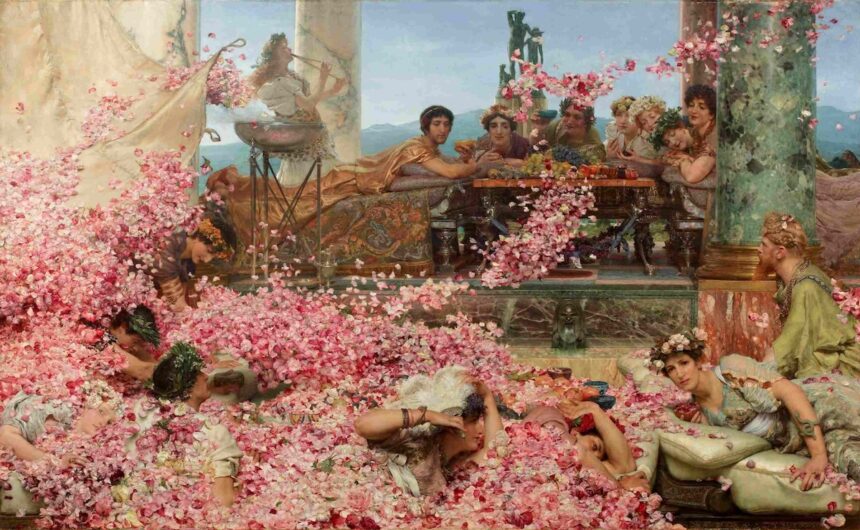
Perhaps in personal life he was such a person, but as an emperor he proved mediocre. He openly neglected the affairs of the empire, preferring instead to throw lavish feasts at the state’s expense.
The fact is that Vitellius was a great glutton and in seven months of rule spent over six million Roman sesterces on gastronomic extravagances.
At Aulus Vitellius’s feasts, they served appetizers made from peacock and pheasant brains, flamingo tongues, pike livers, and lamprey milt brought on military ships from Parthia and Gibraltar. All this culinary outrage, laid out on a huge platter, was called the “Shield of Minerva.” Additionally, at one party that his brother Lucius threw in Aulus’s honor, they served two thousand fish and seven thousand birds. The famous gourmet and culinary expert of that time, Marcus Gavius Apicius, even named a dish of peas and beans pureed with sweet-and-sour spices after Vitellius.
The emperor, however, didn’t disdain simpler food either. He often visited the most plebeian taverns and ate everything he could chew there – and he could chew a lot. Vitellius even snacked on sacrificial animal meat placed on temple altars as offerings to the gods, which was completely unacceptable to the Romans.
In short, Vespasian soon seized power in the empire – quite a decent emperor, by the way – while Vitellius was beaten by a mob, pelted with garbage, and then hacked down by soldiers.
Antoninus Pius Governed the Empire Through Letters and Died from a Cheese Overdose
Reign: July 11, 138 – March 7, 161 CE
The example of Aulus Vitellius shows how dangerous eating disorders can be. And even the best people of the Roman Empire were not immune to them.
For instance, Titus Aelius Hadrian Antoninus Pius became the fourth of the so-called Five Good Emperors of the Nerva-Antonine dynasty. He was a very successful ruler: during his 23 years of rule, there were no crises, wars, or other upheavals. Antoninus successfully annexed southern Scotland to the empire and also suppressed uprisings in lower Dacia and Armenia.
Moreover, he became a unique emperor because he managed to resolve all these crises without ever leaving Italy. Antoninus only wrote letters to the provinces and sent his governors and military commanders there. Some of his messages and edicts were even displayed by the Romans as public property – they were so well composed. Thanks to this management style, completely novel for the empire, Antoninus gained great respect.
Additionally, he built numerous bridges and aqueducts and left behind a treasury with a surplus of 2.7 billion sesterces – before this, no ruler had managed to leave the throne with a positive balance.
In short, he was a decent emperor. He lived to 74 years old and might have lasted longer if not for the sin of gluttony.
One day, according to the Roman historian Aurelius Victor, Antoninus Pius “ate Alpine cheese rather greedily at dinner.” And he consumed so much of this product that he felt ill: he vomited, developed a fever, and took to his bed. At night, a tribune of the night watch came to check on the emperor and, as was customary, asked for the password. Antoninus stoically replied “aequanimitas” (equanimity) and died.
Some scholars suggest the emperor fell victim to food poisoning from staphylococcus or listeria, particularly dangerous for weakened or elderly people. That’s what happens when you forget to invent pasteurization.
Elagabalus Was a Prankster and Invented Whoopee Cushions
Reign: June 8, 218 – March 11, 222 CE
Emperor Elagabalus (also known as Bassianus Varius Avitus) was quite an outrageous personality – perhaps because by fate’s will he ascended to the throne at just 14 years old. Or more precisely, thanks to the intrigues of his grandmother Julia Maesa. Elagabalus didn’t particularly concern himself with state affairs, preferring to spend his days in various sybaritic pleasures.
Thus, he introduced in Rome the cult of Elagabal, the Syrian sun god, after whom he took his name. He built a new temple and made human sacrifices there, selecting exclusively beautiful boys for them. The emperor also dressed as a woman, had affairs with gladiators, held unbridled orgies, rode around Rome in a chariot pulled by lions, deer, and sometimes naked beauties – depending on his mood.
Elagabalus especially loved playing tricks on courtiers. For example, at feasts he would order servants to present guests with food replicas made of wax and marble, to laugh at their faces when they broke all their teeth. If the emperor particularly disliked a subject, they might find a live poisonous snake or scorpion served in a covered dish. And then be told: “It’s a prank!”
Elagabalus also had a collection of trained lions, leopards, bears, and tigers. He loved to release one such pet into a guest’s bedroom at night while they slept in his palace and lock them in. The animals were tamed, but the prank victims were usually not informed of this, so a couple of guests died of fright.
But don’t think Elagabalus was simply a hedonist and pleasure-seeker – this person also had an inventive streak.
Thus, the emperor came up with making a special cushion from leather, filled with air. During feasts, when Elagabalus’s subjects were particularly carefree and absorbed in conversation, slaves would secretly squeeze this cushion on the emperor’s signal, and it would make an indecent sound, causing people to blush and feel embarrassed.
And the Romans so disliked Elagabalus for his extravagance, orgies, and stupid pranks that in 222 CE he was stabbed to death by soldiers of the Praetorian army. The inventor of the whoopee cushion was only eighteen years old at the time.
Valerian Was Killed with Molten Gold
Reign: October 22, 253 – Spring 260 CE
Publius Licinius Valerianus, also known as Valerian I, was a Roman of noble birth, princeps of the senate, and a military commander. During the civil war between Trebonianus Gallus and Marcus Aemilianus in 253 CE, the legions decided not to choose between these two emperors and decisively killed them both, appointing Valerian as the new ruler. Apparently, they hoped that the guy was reliable and wouldn’t pull any tricks – he was 63 years old at the time.
But Valerian did manage to distinguish himself. He became the only Roman emperor in history who was captured by the enemy and killed there.
At that time, the Roman Empire was at war with the Persians, who were ruled by Shahanshah Shapur I. Valerian decided: if you want something done right, do it yourself. And he set out to deal with everything personally. By 257 CE, he had reconquered Antioch and Syria. But an outbreak of plague killed a significant part of his legionaries, and in 260 CE Valerian suffered defeat at the Battle of Edessa and was captured by Shapur I.
Shapur apparently felt not only professional but also personal animosity toward the Roman emperor, and very deep animosity at that. For instance, there are accounts that he humiliated the captive by using his back as a stool when mounting his horse.
Valerian wasn’t accustomed to such treatment, so he immediately declared to the shahanshah that he was, after all, an emperor and could pay a large ransom for his release. Shapur lost his temper and declared: “You think I don’t have enough gold? Watch what I can do.” He melted a ladle of precious metal and poured it straight down Valerian’s throat. And where do you think George Martin drew inspiration for the scene with Viserys and Khal Drogo?
However, the shahanshah didn’t stop there and ordered a stuffed figure made from the emperor’s corpse, stuffing it with straw and manure. Such an inglorious end.
Quintillus Ruled for Only 17 Days
Reign: 270 CE
You might think that the seven months that Vitellius ruled is completely unserious. The nation wouldn’t even have time to get a taste of such a politician. Who knows, maybe in the second year of his emperorship he would have finally eaten his fill, come to his senses, and brought order to the country?
But by Roman standards, Vitellius occupied the throne for quite a sufficient time. If it comes to that, Hostilian stayed on it for only six months, from June to November, and then caught the plague, fell ill, and died. And Marcus Clodius Pupienus lasted only four months before being overthrown and killed by the Praetorians. But the real record belongs to Marcus Aurelius Claudius Quintillus.
He got to the throne thanks to his brother Claudius II Gothicus, who ruled the Roman Empire in 268-270 CE. Under him, Quintillus held the position of procurator of Sardinia. His brother died of plague, and the senators proclaimed him emperor simply as the closest relative.
This didn’t please the legionaries, and they staged a mutiny, placing the much more popular general Aurelian on the throne. So Quintillus’s reign didn’t last long – only 17 days. However, during this time, Rome and some provinces even managed to mint coins with his profile.