44 BC: Assassination of Julius Caesar by Brutus 1/2
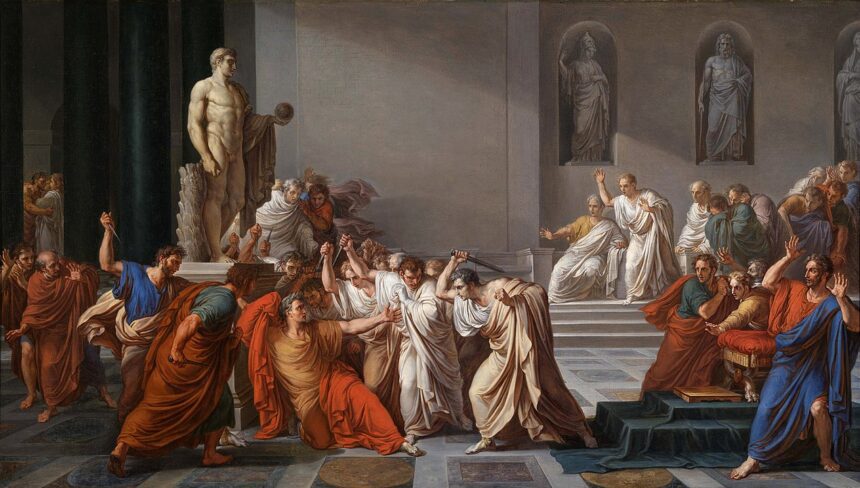
Poor Brutus, remembered throughout history as the paragon of treachery combined with ungrateful patricide! In 44 BC, this fervent republican, son of Caesar’s favorite mistress, feared that his former mentor would have himself granted the title of king. Crowned with his successes, the conqueror of Gaul, aged 55, had already managed to have himself appointed dictator (a magistrate holding full powers) for life, whereas this function was normally limited in time.
- 44 BC: Assassination of Julius Caesar by Brutus 1/2
- 44 BC: Assassination of Julius Caesar by Brutus 2/2
- 1610: Assassination of Henry IV by François Ravaillac
- 1793: Assassination of Jean-Paul Marat by Charlotte Corday
- 1865: Assassination of Abraham Lincoln by John Wilkes Booth
- 1881: Assassination of Tsar Alexander II by the People’s Will Group 1/2
- 1881: The Conspirators Hanged for the Assassination of Tsar Alexander II 2/2
- 1894: Assassination of Sadi Carnot by Sante Geronimo Caserio
- 1901: Assassination of William McKinley by Leon Czolgosz
- 1914: Assassination of Jean Jaurès by Raoul Villain
- 1914: Assassination of Archduke Franz Ferdinand of Austria by Gavrilo Princip 1/2
- 1914: Assassination of Archduke Franz Ferdinand of Austria by Gavrilo Princip 2/2
- 1961: Assassination of Patrice Lumumba 1/2
- 1961: Assassination of Patrice Lumumba 2/2
- 1963: Assassination of John Fitzgerald Kennedy by Lee Harvey Oswald
- 1968: Assassination of Martin Luther King by James Earl Ray
- 1994: Assassination of Juvénal Habyarimana 1/2
- 1994: Assassination of Juvénal Habyarimana 2/2
- 1948: Assassination of Gandhi by Nathuram Godse 1/2
- 1948: Assassination of Gandhi by Nathuram Godse 2/2
- 1984: Assassination of Indira Gandhi by Satwant Singh and Beant Singh
44 BC: Assassination of Julius Caesar by Brutus 2/2
Brutus and about sixty senators were determined to stop his irresistible ascent. They hatched a plot for March 15, 44 BC, during a Senate session. That day, Caesar fell to 23 stab wounds, only one of which was fatal. Alas! Far from strengthening the republic, his disappearance would favor the designs of his designated heir, Octavian, who became Emperor Augustus in 27 BC.
1610: Assassination of Henry IV by François Ravaillac
While the king was traveling by carriage to visit his minister Sully’s bedside, François Ravaillac managed to deliver three fatal stab wounds on Rue de la Ferronnerie.
1793: Assassination of Jean-Paul Marat by Charlotte Corday
Having come to Paris in July 1793, Charlotte Corday (one of the rare women, along with 19th-century Russian activists, to feature in the club of political assassins) was determined to put an end to Marat’s murderous fury. The death of the “Friend of the People” would trigger the Terror and hasten the downfall of the Girondin deputies she had hoped to save.
1865: Assassination of Abraham Lincoln by John Wilkes Booth
On April 14, 1865, Abraham Lincoln, fresh victor of the Civil War, was shot in his box at Ford’s Theatre in Washington by John Wilkes Booth. This actor was outraged that he had granted voting rights to Black people.
1881: Assassination of Tsar Alexander II by the People’s Will Group 1/2
The day before his assassination, Alexander II had finalized the last details for establishing a representative assembly in Russia. An unheard-of advancement for this autocratic country… When he ascended the throne in 1855, the tsar wanted to bring his country out of darkness. He liberalized the economy, moderated his police force, abolished serfdom, etc. Russia was changing. Too quickly for the nobles, not quickly enough for others. Taking advantage of this relaxation, activists multiplied assassination attempts.
1881: The Conspirators Hanged for the Assassination of Tsar Alexander II 2/2
It was the People’s Will group that would claim his life. On March 13, 1881, in Saint Petersburg, a bomb damaged the tsar’s carriage, from which he emerged to check on the victims. It was then that another exploded, mutilating him atrociously. He succumbed shortly after. His son Alexander III would return to aggressive conservatism. Perfect breeding ground for Bolshevism…
1894: Assassination of Sadi Carnot by Sante Geronimo Caserio
On June 24, 1894, Sadi Carnot, then sitting president of the French Republic, was assassinated in Lyon. This event occurred just months before the end of his term and followed the adoption of the first two “scoundrel laws,” repressive legislation targeting the anarchist movement in France. This act marked a major turning point in the history of anarchism in France. In response to this attack, the Chamber of Deputies approved the last and most impactful of the “scoundrel laws,” which aimed to ban all forms of anarchist propaganda on French territory.
1901: Assassination of William McKinley by Leon Czolgosz
On September 6, 1901, William McKinley, 25th president of the United States, was shot in the stomach by an anarchist, Leon Czolgosz, during his visit to an exposition in Buffalo. He died on September 14.
1914: Assassination of Jean Jaurès by Raoul Villain
Jean Jaurès, French deputy from Tarn and socialist politician, was assassinated on Friday, July 31, 1914, while dining at the Café du Croissant on Rue Montmartre. Committed three days before France’s entry into World War I, this murder precipitated Europe into the First World War.
1914: Assassination of Archduke Franz Ferdinand of Austria by Gavrilo Princip 1/2
When the mayor of Sarajevo welcomed Franz Ferdinand on June 28, 1914, Europe had no idea it was just hours from tipping over. How could anyone imagine that this visit by the heir to the Austro-Hungarian Empire, come to ease the separatist tensions agitating its southern borders, would provoke war?
1914: Assassination of Archduke Franz Ferdinand of Austria by Gavrilo Princip 2/2
Seven militants close to the Black Hand, which dreamed of attaching the Serbian part of Bosnia-Herzegovina to the Kingdom of Serbia, had planned to assassinate the archduke. Never mind that he advocated for confederal autonomy of the empire’s peoples! But the attack turned into a fiasco: one of the terrorists chickened out and another’s grenade missed its target. Rerouted, the archduke’s car stalled in front of a café where one of them had taken refuge. Gavrilo Princip fired fatal shots at the princely couple. After their arrest, one of the conspirators claimed the weapons had been supplied by Serbia. Vienna declared war on Belgrade, which called on Russia for help. The fatal domino game had begun.
1961: Assassination of Patrice Lumumba 1/2
When it gained independence in 1960, the young Republic of Congo had found its national hero. Brilliant, charismatic, and self-taught, Patrice Lumumba had founded the Congolese National Movement two years earlier and won the masses’ support. But not that of the Belgian authorities who, worried about his radicalism, imprisoned the leader. This arrest would only accelerate decolonization. Victorious in the legislative elections, Patrice Lumumba was appointed Prime Minister. But his rapprochement with Moscow would cost him dearly.
1961: Assassination of Patrice Lumumba 2/2
In September 1960, a CIA-supported coup brought the army chief of staff, Joseph-Désiré Mobutu, to power. Patrice Lumumba then fled. Arrested a few days later, he was handed over to the Katanga rebels, a region that had seceded with Western support. He was shot on January 17, 1961, then his body was dismembered and dissolved in acid. It would take until 2002 for Belgium to acknowledge its responsibility in these events.
1963: Assassination of John Fitzgerald Kennedy by Lee Harvey Oswald
The assassination of John Fitzgerald Kennedy, 35th president of the United States, is one of the most significant events in 20th-century American history. On November 22, 1963, in Dallas, Texas, Kennedy was mortally wounded by gunfire while parading in a presidential car with his wife Jacqueline. Lee Harvey Oswald was accused of being the assassin, but he was shot before being tried. This event sparked conspiracy theories, investigations, and controversies that have persisted over the years. JFK’s assassination had a profound impact on American society and helped shape the political and cultural climate of the era.
1968: Assassination of Martin Luther King by James Earl Ray
Martin Luther King was shot on April 4, 1968, in Memphis by James Earl Ray, a segregationist. The civil rights leader’s family saw this petty criminal as the instrument of a conspiracy hatched by the CIA with President Lyndon Johnson’s blessing.
1994: Assassination of Juvénal Habyarimana 1/2
On April 6, 1994, around 8:30 PM, the plane carrying Juvénal Habyarimana, president of Rwanda since 1973, was shot down by a missile as it began its descent into Kigali. The head of state was killed along with the president of Burundi, seven members of their entourage, and three French crew members. Habyarimana was returning from a meeting in Tanzania aimed at institutionally implementing the end of ostracism against Rwandans of Tutsi origin. The president belonged to the Hutu ethnic group, but its ultra faction called him a traitor. From there to thinking the crime came from these extremists… Others lean toward the theory of an operation orchestrated by the Rwandan Patriotic Front, a Tutsi rebel group led by Paul Kagame, current leader of Rwanda.
1994: Assassination of Juvénal Habyarimana 2/2
In any case, the attack torpedoed Juvénal Habyarimana’s efforts at appeasement. Civil war resumed with a vengeance. The genocidal impulses of the Hutus would be unleashed, resulting in one of the worst ethnic massacres in history, with nearly one million deaths between April 7 and July 17, 1994.
1948: Assassination of Gandhi by Nathuram Godse 1/2
When India gained its independence in 1947, it housed a religious melting pot comprising Sikhs, Muslims, and Hindus. Gandhi dreamed of a united nation and opposed the country’s partition. But his hand extended toward the Muslim people was experienced as an affront by Hindu nationalists.
1948: Assassination of Gandhi by Nathuram Godse 2/2
In Delhi, on January 30, 1948, one of them, Nathuram Godse, shot him point-blank just as the Mahatma was preparing to celebrate a public prayer.
1984: Assassination of Indira Gandhi by Satwant Singh and Beant Singh
History repeated itself thirty-six years later, in 1984, when Prime Minister Indira Gandhi (unrelated to the previous one) fell victim to fanatics, Sikhs this time, hit by 30 machine gun bullets. Her son Rajiv Gandhi succeeded her until 1989. But two years later, while campaigning for his reelection, he died in a suicide attack carried out by a Sri Lankan Tamil militant.