
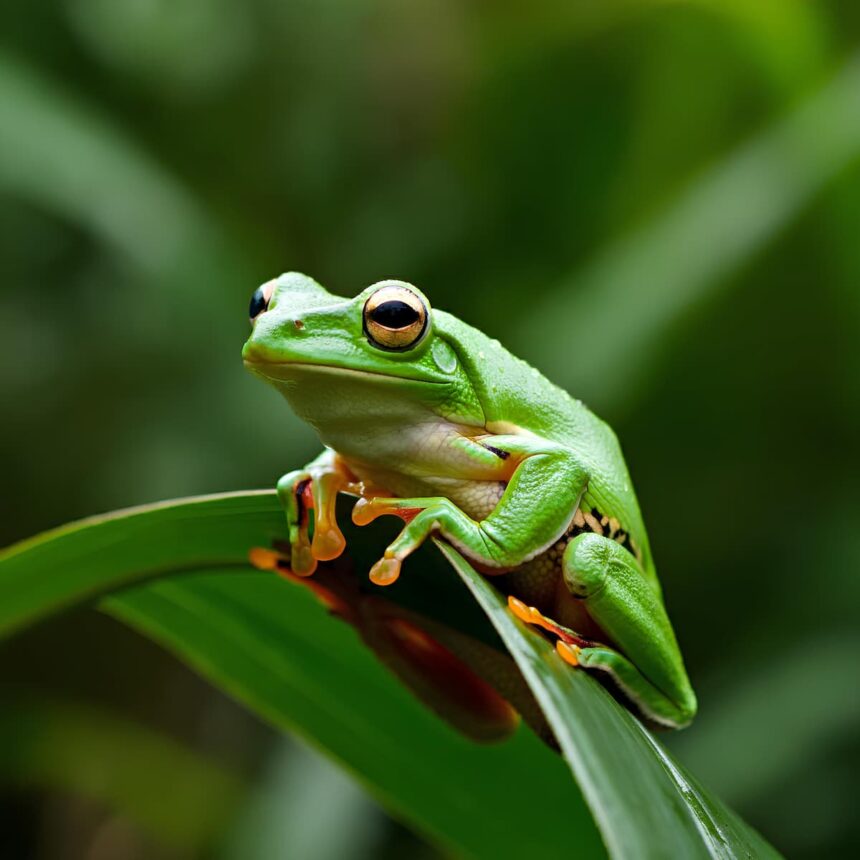
On this spring morning, it’s raining lightly. I really like going down to the water’s edge at this time of year; there’s always something to observe. On the surface of the pond, you can see water striders, those little aquatic insects that glide across the water. There are also tadpoles swimming around, as well as their adult counterparts, the frogs. I spot one with its two large, bulging eyes.
So, let’s take advantage of being by this lovely frog-populated pond to share a few facts about these amphibians, starting with the most straightforward one.
1 The frog is not the female toad
These two animals are completely different and belong to entirely distinct groups of species. The toad—or rather, toads, since there are several kinds—has dull, matte skin covered in warty bumps. Generally, they move around by walking. The various species of frogs have smooth skin and a more triangular head. They get around by jumping.
2 Not all frogs live in water
In France and Switzerland, frogs are divided into two main groups.
On the one hand, there are the so-called brown frogs, like the agile frog and the common frog, which are truly terrestrial. These animals live year-round in forests, along hedgerows, in thickets, and perhaps even in the shady corners of your garden. They only enter the water for a few days each year, just to reproduce in early spring around February or March. Common frogs and agile frogs then gather in large numbers for a frantic breeding frenzy. Males leap onto the females, who then lay clumps of eggs that swell within hours in the water. The egg mass from a single frog can be as large as a big cauliflower. These thousands of eggs will gradually develop into tadpoles, and with a lot of luck, some of them will become frogs.
On the other hand, there is the group of green frogs. These are genuinely aquatic and spend most of the year in the water or on the banks of ponds, where they bask in the sun. Often, they float at the surface with only their eyes poking out above the water. These frogs breed over several months. The males croak using two vocal sacs located on either side of their head. They compete to catch females, who then lay eggs in small packets that sink in the water and are therefore much less conspicuous than the eggs of brown frogs.
3 Tadpoles are highly useful
Tadpoles live in water and go through several stages of metamorphosis to become adult frogs. Because mortality rates are high, it takes many tadpoles—hundreds of thousands—to produce a single adult frog.
For a few weeks, tens of thousands of tadpoles live in ponds. Early in their development, they filter the water, which genuinely cleans the entire aquatic ecosystem. They also serve as prey for many animals, including certain insect larvae, such as the impressive diving beetle larva.
4 You can identify a frog species by its call
Just like with bird songs, each frog has its own vocalization. For example, the common frog produces a characteristic purring sound during the breeding season. You can also distinguish the different species of green frogs by their calls, though it’s not quite as straightforward.
5 Frogs have excellent vision
Their eyes are positioned on top of their head, like periscopes. Green frogs keep their eyes just above the water’s surface. They can monitor their surroundings almost 360 degrees. They even possess stereoscopic vision, allowing them to judge distances with remarkable precision. This is incredibly useful for catching even fast-moving prey like dragonflies.
6 Frogs are protected
In the past, frogs were far more numerous and were actively hunted. Today, however, their populations have declined significantly, and they are fully protected in Switzerland. In France, unfortunately, some regions still permit hunting, catching, and eating them. France even imports 3,000 tonnes of frogs annually for consumption.
7 Frogs are threatened
Unfortunately, all amphibians are on the front lines of the biodiversity crisis. Out of the 7,500 known amphibian species worldwide, a third has already disappeared or is on the verge of extinction. Even close to home, amphibian populations are collapsing. These animals are exceptionally vulnerable, first and foremost because they depend on aquatic ecosystems, which are the most threatened and disrupted habitats. Amphibians are also vulnerable because they require multiple habitats to complete their life cycle, needing both terrestrial and aquatic environments. They must also travel between them. Moreover, they have very limited mobility. A frog or a toad can only cover a few kilometers, making it very difficult for them to find a new habitat. Finally, amphibians breathe through their skin, which is highly permeable. This makes them extremely sensitive to all kinds of pollutants, pesticides, and pathogens, which can kill them very quickly.
8 You can help frogs
If you have a garden, the best thing you can do is create a pond. You can also leave some natural clutter, like woodpiles or stone heaps, and avoid mowing all the grass to leave space for all the small creatures that might live there.
You can also advocate as strongly as possible for the restriction of pesticides—these poisons that kill frogs, toads, newts, and salamanders, and which also poison humans on a large scale.