At the outbreak of the First World War, Germany faced a fundamental strategic dilemma. It was caught between two major powers: France in the west and Russia in the east. Fighting both simultaneously risked a prolonged war that Germany was unlikely to win.
The solution was the Schlieffen Plan, a bold and highly ambitious strategy designed to deliver a rapid victory in the west before turning eastward. In theory, it offered a way to avoid a two-front war. In practice, it demanded a level of precision, speed, and coordination that modern warfare could not sustain.
The Strategic Problem: Time and Geography
German war planning at the turn of the 20th century was shaped by the alliance between France and Russia. A simultaneous war against both was considered inevitable in any major European conflict.
Germany’s only advantage was time. Russian mobilization was expected to be slow due to the empire’s vast size and underdeveloped infrastructure. This delay would give Germany a narrow window to defeat France quickly, redeploy its forces by rail, and then confront Russia.
The entire strategy depended on this assumption.
The Plan: A Massive Turning Movement
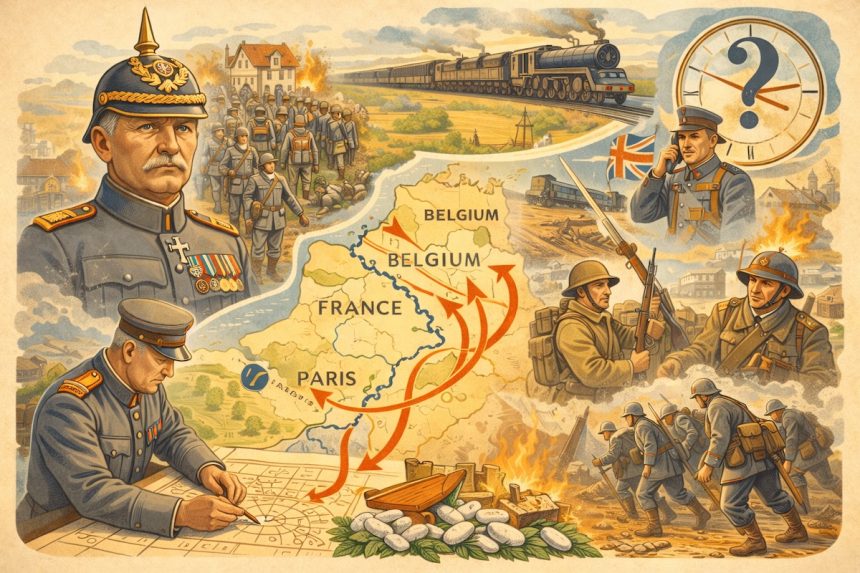
The Schlieffen Plan, developed by Alfred von Schlieffen, was built around a sweeping offensive through Belgium and northern France.
Rather than launching a direct assault against France’s heavily fortified eastern border, German forces would advance through neutral Belgium, bypass French defenses, and swing southward in a wide arc. The right wing of the German army would act as a massive hammer, encircling French forces and driving them back toward their own fortifications.
Meanwhile, the German left wing in the south would remain relatively weak, holding the line and, ideally, drawing French forces forward. Once encircled, the French army would be destroyed in a decisive battle.
Victory, according to the plan, would be achieved in approximately six weeks.
Critical Assumptions
The plan rested on several key assumptions:
- Russia would mobilize slowly.
- France would launch an offensive into Alsace-Lorraine.
- German forces could move rapidly across vast distances.
- Supply systems would keep pace with the advance.
- Troops could sustain extreme physical demands.
Each of these assumptions proved fragile. Together, they created a strategy that left little room for error.
Moltke’s Modifications
After Schlieffen’s retirement, the plan was inherited and modified by Helmuth von Moltke the Younger.
Two changes were particularly significant. First, Moltke abandoned the planned invasion of the Netherlands. This decision reduced the width of the advancing front, limiting maneuverability and increasing congestion in the critical northern sector.
Second, he redistributed forces away from the right wing, reinforcing other areas of the front. The original plan depended on overwhelming strength in the north. By weakening this force, Moltke reduced the likelihood of a decisive encirclement.
These adjustments made the plan more cautious, but also less effective.
Execution in 1914
Germany launched its offensive on August 4, 1914, invading Belgium after its demand for passage was refused. This violation of Belgian neutrality brought Britain into the war.
Despite strong Belgian resistance, German forces advanced rapidly. Infantry marched extraordinary distances, sometimes exceeding 50 kilometers per day. Early progress appeared to validate the plan.
However, problems quickly emerged.
Belgian forces destroyed railways during their retreat, disrupting German supply lines. As the army advanced deeper into enemy territory, logistics became increasingly strained. The strategy of rapid movement began to outpace the ability to sustain it.
In the south, events also diverged from expectations. Rather than being drawn into a prolonged advance, French forces were repelled and regrouped, allowing them to redeploy troops toward the north.
The plan was already beginning to unravel.
The Turning Point: The First Battle of the Marne
As German forces pushed into France, the right wing advanced south of Paris instead of encircling the city from the west as originally intended. This shift created a dangerous gap between two German armies.
Sensing the opportunity, Allied forces acted.
The French commander-in-chief, Joffre, ordered a general counteroffensive. French troops, supported by the British Expeditionary Force, moved into the gap between the German armies. The exposed flank of the German advance was suddenly vulnerable.
By early September 1914, the German First Army began to retreat. Within days, the entire right wing was ordered to withdraw.
The advance halted. The plan had failed.
Why Did the Schlieffen Plan Fail?
The failure can be understood on two levels: operational and structural.
Operational Failures
Several battlefield decisions contributed directly to the collapse:
- Forces were diverted from the critical right wing.
- German commanders hesitated at key moments.
- The gap between advancing armies was not controlled.
- Allied coordination improved rapidly.
The French and British response was decisive. What had appeared to be a retreat turned into a calculated counterattack.
Structural Weaknesses
More fundamentally, the plan itself was flawed.
It required near-perfect execution. Any disruption, delay, or deviation could undermine the entire strategy. There was little flexibility built into the system.
The assumptions at its core proved incorrect:
- Russia mobilized faster than expected, forcing Germany to divert troops eastward.
- Logistics failed to keep pace with rapid advances once rail support ended.
- Troop endurance was overestimated. Continuous marching and fighting led to exhaustion.
Modern industrial warfare introduced complexity and unpredictability that the plan could not accommodate.
The End of the War of Movement
The failure of the Schlieffen Plan had lasting consequences. Germany did not achieve a quick victory in France. Instead, the war in the west settled into a prolonged stalemate.
Trench warfare replaced rapid maneuver. The conflict that Germany had hoped to end in weeks dragged on for years.
The Schlieffen Plan was an ambitious attempt to solve a difficult strategic problem. It reflected the belief that speed, coordination, and decisive action could overcome geographic and numerical disadvantages.
In theory, it was elegant. In practice, it was too rigid.
Its failure illustrates a broader lesson about modern warfare: plans that depend on perfect timing and flawless execution are vulnerable to the realities of uncertainty, resistance, and human limitation.
Germany’s strategy was not undone by a single mistake. It collapsed under the weight of its own assumptions.