Author: Hrothsige Frithowulf

  • 8 Myths About Medieval Hygiene

    8 Myths About Medieval Hygiene

    In the Middle Ages, the Contents of Chamber Pots Were Dumped Out of Windows

    It is believed that this was a very common practice. In 13th century France, there was allegedly even a law requiring residents to shout three times, “Watch out, water!” before emptying a chamber pot.

    However, this is not true. People in the Middle Ages did use chamber pots, as toilets had not yet been invented, but they would empty the contents into cesspits and ditches, not onto the street from a window.

    Of course, there may have been some eccentric individuals who did throw waste out of a window, but they probably did not have an easy time.

    For example, in 14th century English cities, someone could be fined 40 pence for throwing garbage out of a window — an amount that many ordinary workers earned in a month. That could buy several barrels of beer, a couple of sheep, or a grown pig, so one would have to think twice about whether it was worth it.

    It’s also unlikely that the residents of medieval towns would have been thrilled about human waste being dumped on their heads from windows. Records have survived of a man named Thomas Scott who urinated in the street in 1307, which angered two other townspeople. They demanded that the troublemaker go to a public restroom, but when he responded rudely, they beat him and wounded him with a knife.

    Another man who threw a spoiled smoked fish out of his window was beaten so badly by his neighbors that he barely recovered.

    As you can see, people did not go easy on dirty habits back then.

    Wide-Brimmed Hats Were Needed to Protect Against Waste Being Dumped

    This myth is related to the previous one. It is also claimed that such hats were worn by middle-class people attending medieval theaters, forced to crowd in the pit. When lords and ladies lounging on the balconies and upper boxes threw leftovers or sneezed down on the commoners, the brims of these hats would help keep their heads relatively clean.

    In reality, wide-brimmed hats were made for the obvious purpose of protecting against rain and sun. They were common in all cultures, not just European ones.

    In the Middle Ages, they were most often worn by peasants and pilgrims. For the latter, the wide-brimmed hat eventually evolved into the capello romano, or saturno, as well as the galero — hats worn by clergy.

    Additionally, they were favored by soldiers, who often had to wander outside in bad weather or heat. Over time, their hats turned into the famous feathered hats of musketeers, known as cavalier hats. And when firearms became widespread and the wide brims began to interfere with aiming, they started pinning them up with pins, creating the tricorne.

    Nobles also liked such hats, but not because poor people often poured chamber pot contents on their heads. Aristocrats simply considered pale skin a sign of nobility, while a tan was seen as a distinctive feature of commoners who worked in the fields.

    Isabella of Castile Bathed Twice in Her Life
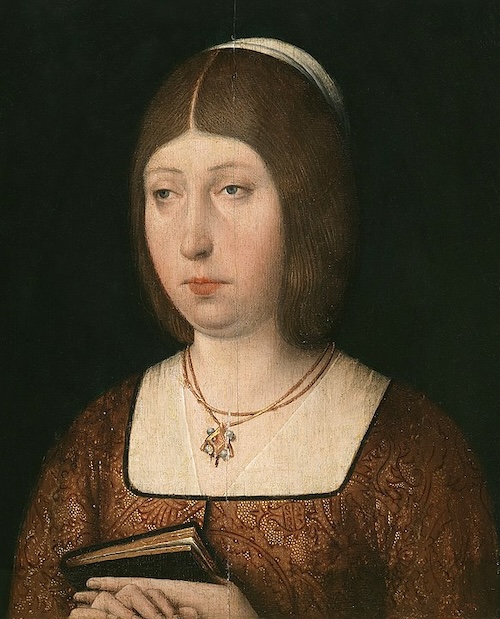
    Isabella I of Castile (1451-1504), queen of Castile and León.
    Isabella I of Castile (1451-1504), queen of Castile and León

    Experts in the unclean and suffering Middle Ages often cite Queen Isabella I of Castile, who ruled Spain in the 15th century. Allegedly, this lady was so devout that she considered bathing a sin and proudly claimed to have bathed only twice in her life — at birth and before her wedding.

    All this to avoid washing away the holy water that touched her skin during baptism.

    However, this is a myth, with no evidence to support it. There is only this legend: in 1491, the queen laid siege to the city of Granada, intending to expel the Muslims from Spain. She vowed not to bathe or change clothes until the city fell.

    Unfortunately for her, the siege dragged on for eight months, during which time Isabella’s clothes took on an unpleasant grayish-yellow tint that artists later named “isabelline.”

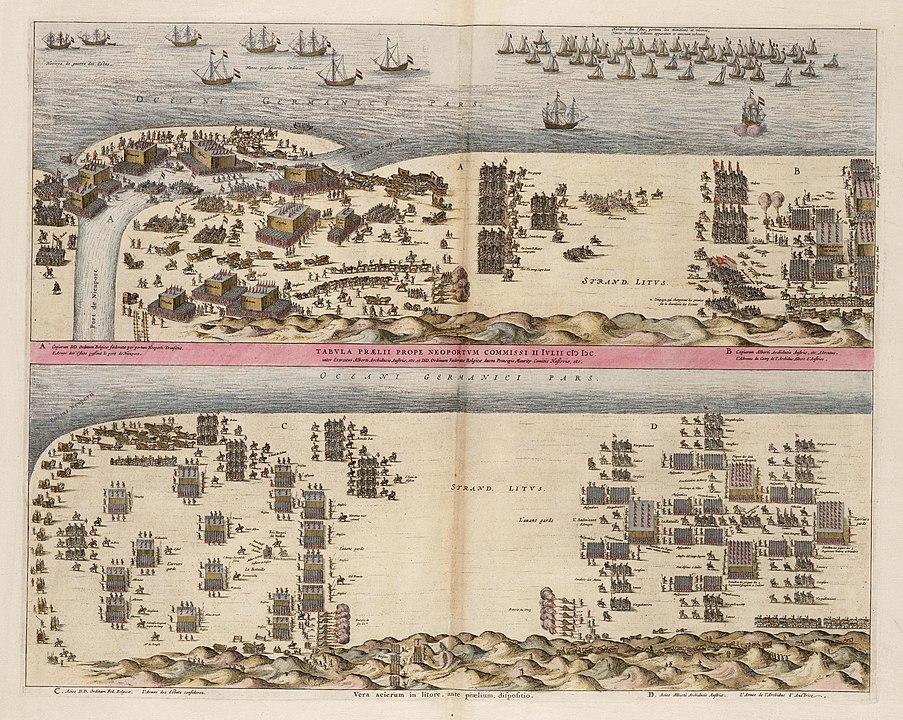
    The legend is quite murky: historians can’t determine whose name the color was originally based on — Queen Isabella I of Castile or Infanta Isabella Clara Eugenia of Spain. There were also rumors that the latter made a similar vow not to bathe when she began the siege of the Dutch city of Ostend in 1601. And the fighting went on for three years.

    As a result, the stories of these two Isabellas often get confused in tales about the unwashed Middle Ages, making it difficult to determine if there is even a grain of truth in the story.

    At that time, people often made strange vows to demonstrate steadfastness and win divine favor in battle through their suffering. For example, some knights vowed not to eat meat or shave during war, covered one eye with a patch, or deliberately refused to use fire to warm themselves.

    But even if we assume that the legend has a basis in reality and the queen did vow not to bathe for several months, this means that such behavior was unusual for her in normal times and was seen as a real ordeal. And after the city was taken, she did bathe again.

    Louis XIV “Stank Like a Beast”
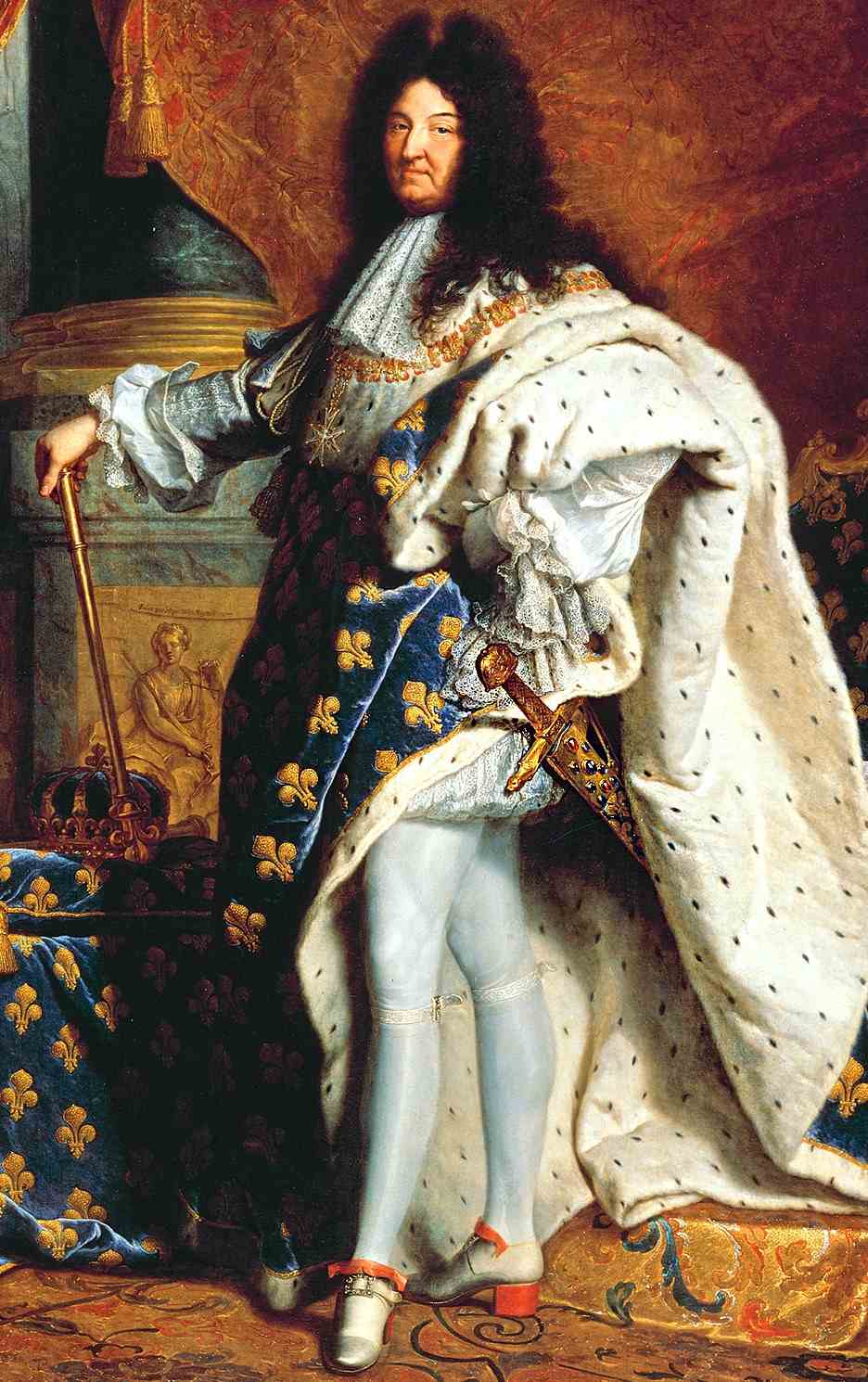
    Louis XIV
    Louis XIV with the Sword of Charlemagne Joyeuse

    Another figure allegedly known for avoiding bathing was Louis XIV de Bourbon, King of France—also known as the “Sun King” or “Louis the Great.” According to an internet myth, this monarch supposedly bathed only two or four times in his entire life and did so only under doctor’s orders. However, the idea of Louis XIV‘s poor hygiene can hardly be explained by medieval customs, given that this was already the Early Modern period.

    According to some “Russian envoys” (or “Cossacks” in another version), “His Majesty stank like a wild beast.” Sometimes, this phrase is even attributed to Peter the Great himself. However, the Tsar could not have said this because, by the time he visited Versailles in 1717, Louis XIV had already been dead for a couple of years.

    There are no historical records of Russian envoys or Cossacks making such a statement.

    Most likely, this anecdote was invented by blogger Denis Absintis, the author of a book about the “dirty and sick” Middle Ages, titled Zlaya Korcha (“Evil Cramp”). While describing the unsanitary conditions of that time, he might have gotten a bit carried away and “slightly” exaggerated.

    Moreover, in his work, he seriously references the writings of Patrick Süskind—a supposed “Swiss chronicler.” In reality, Süskind is a contemporary author known for his novel Perfume.

    In fact, Louis XIV bathed regularly. Otherwise, it would be hard to understand why he spent a fortune on bringing running water to Versailles and building baths and swimming pools there. As contemporaries noted, His Majesty was an excellent swimmer and could swim across the Seine on a dare.

    He built a Turkish-style bath in his palace and regularly took baths there, often in the company of court ladies. And when he could not bathe while traveling, he ordered his valets to wipe his body with grape spirits and sprinkle him with perfume.

    Crusades Brought Soap to Europe
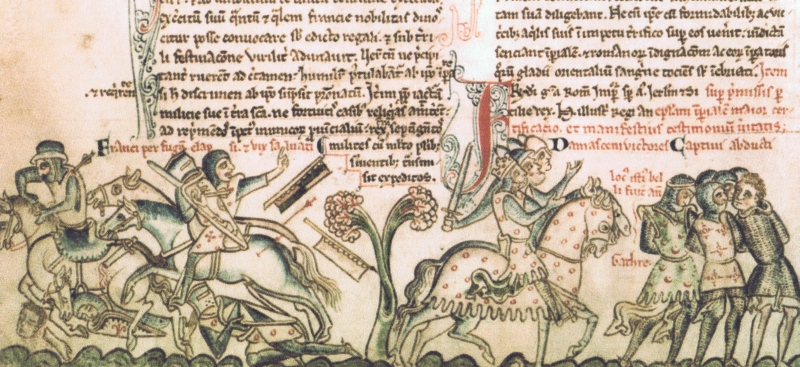
    The defeat of the Crusaders at Gaza
    The dance of the “wild men”. Miniature from “Chronicles” by Jean Froissart. 1470-1472

    There’s a claim that Europeans only started bathing after the dirty Crusades stole the secret of soap-making from the Muslims. Before that, the residents of Europe supposedly didn’t know about it at all.

    In reality, Europe had entire guilds of soap-makers as early as the 6th century. It’s unclear how they managed to produce their products if the First Crusade only took place in the 11th century.

    Crusades did bring back a specific recipe for soap from Palestine—one made with olive oil. When European soap makers started using olive oil instead of animal fat, their products began to smell better. Wealthy people then switched to this new soap. But to say that Europeans didn’t use soap before the wars with the Muslims is inaccurate.

    Europeans Considered Russians Perverts Because They Bathed Once a Month

    This statement also circulated on the internet, thanks to the author of Zlaya Korcha. However, there’s a catch: he provided no sources for this claim.

    Bathhouses were common in Europe at that time, both private ones (for wealthy gentlemen) and public bathhouses. The latter often doubled as bakeries or blacksmith shops to save firewood and not waste the heat from the ovens when there was no need to heat water. Here is a description of such establishments in the city of Erfurt in the 13th century:

    The bathhouses in this city will bring you true pleasure. A beautiful young girl will rub you well with her tender hands. An experienced barber will shave you without a drop of sweat falling on your face. A pretty woman… will skillfully comb your hair. Who wouldn’t steal a kiss from her if they wished?

    Civilization of the Medieval West, Jacques Le Goff

    Yes, bathhouses were often combined with brothels, and it was easy to receive additional services from the bath attendants besides washing. The Church turned a blind eye to these minor sins—in England, for example, bishops taxed bathhouses located within their dioceses.

    In the Middle Ages, People Ate with Their Hands and Had No Manners

    Medieval people, even noble lords, are often depicted as very ill-mannered diners who grabbed food from the table and ate it with their hands. The myth goes that forks were only brought from the East towards the end of the era, and before that, people had to use their dirty fingers.

    However, medieval table etiquette can be judged from a 15th-century manuscript titled “Les Countenance de Table.”

    ……and let your fingers be clean, and your fingernails well-groomed. Once a morsel has been touched, let it not be returned to the plate. Do not touch your ears or nose with your bare hands. Do not clean your teeth with a sharp iron while eating. It is ordered by regulation that you should not put a dish to your mouth. He who wishes to drink must first finish what is in his mouth. And let his lips be wiped first. Once the table is cleared, wash your hands, and have a drink.

    Les Countenance de Table, 15th-Century Manuscript

    As you can see, it doesn’t quite resemble a scene from the comedy Black Knight, where the king served peas with the same hand he had just scratched himself with, and then fed the dog.

    Forks indeed appeared in Europe relatively late, in the 1600s. Before that, people only used spoons and knives, and a noble lord carried his eating knife on his belt—it was considered foolish to show up at a feast without your own cutlery. When medieval aristocrats finally acquired forks, they initially carried them in sheaths, too—a rather amusing custom.

    So Much Filth Flowed Through City Streets that People Walked on Stilts

    Medieval European cities, of course, were not as well-kept as modern ones, but authors of articles and books about the “grim Dark Ages” sometimes exaggerate too much.

    For example, there is a myth that streams of feces, manure, and other filth, poured from the windows and doors of surrounding houses, flowed down the streets of settlements. People were supposedly forced to walk on stilts to navigate the streets.

    It is also said that heels were invented to allow people to move through dung-covered streets without getting dirty.

    Sounds disgusting, doesn’t it? However, images of medieval sufferers on stilts, which are often used to illustrate such statements, are misunderstood by modern people.

    These devices were indeed worn, but not by city dwellers. Rather, they were used by peasants, who used them to move through wet fields and swamps without getting stuck. Additionally, stilts were used to harvest crops from tall trees and for entertainment—there were even amusing battles and tournaments held on them.

    It was not necessary to move around on stilts in cities, as filth did not flow down the streets. There were designated sewage channels for this purpose, and they were covered to prevent odors from spreading. Special responsible individuals made sure these channels did not overflow.

    As for heeled shoes, ladies sometimes wore them to avoid getting their dresses dirty—not in filth, but in rain puddles. Later, men adopted this fashion, using such shoes to emphasize their status and increase their height.

  • How to Have Fun in the Middle Ages

    How to Have Fun in the Middle Ages

    Fifty-two regular Sundays, a week each for celebrating the main Christian holidays—Easter, Christmas, and Pentecost—along with other obligatory holidays like Epiphany, Baptism, Candlemas, Palm Sunday, Ascension, Trinity, the Feast of Corpus Christi, the Sacred Heart, Transfiguration, Exaltation of the Cross, Feast of the Holy Family, Immaculate Conception, Saint Joseph’s Day, Feast of Saints Peter and Paul, Assumption of the Virgin Mary, and All Saints’ Day, plus days dedicated to various saints—patrons of cities, guilds, and so on—along with days for their commemoration and associated events, as well as entries of rulers, bishops, and other important figures. Altogether, about a third of the year was spent by medieval city dwellers in leisure.

    Go to Church and Listen to a Preacher

    Festive church services were performed with great pomp, featuring the best choir singers. From the 9th–10th centuries, festive Mass began to resemble an allegorical play due to performances based on Old Testament, Gospel, or hagiographic stories. These performances lasted until about the 13th century when they were replaced by city theatrical events.

    On holidays, women tried to dress up: they went not only to the service but also “to see people” — to look at others and show themselves. Everyone in the church had their place, determined by their social status. On Sundays and holidays, working was forbidden, and after Mass, parishioners often sought entertainment: dancing and singing often occurred right in the churchyard, although clergy at least formally condemned such behavior.

    Sometimes, a preacher would visit the city, and if he did not perform in the church courtyard, the townspeople would build him a platform where he could pray with the congregation and then deliver a scathing sermon.

    Watch a Performance

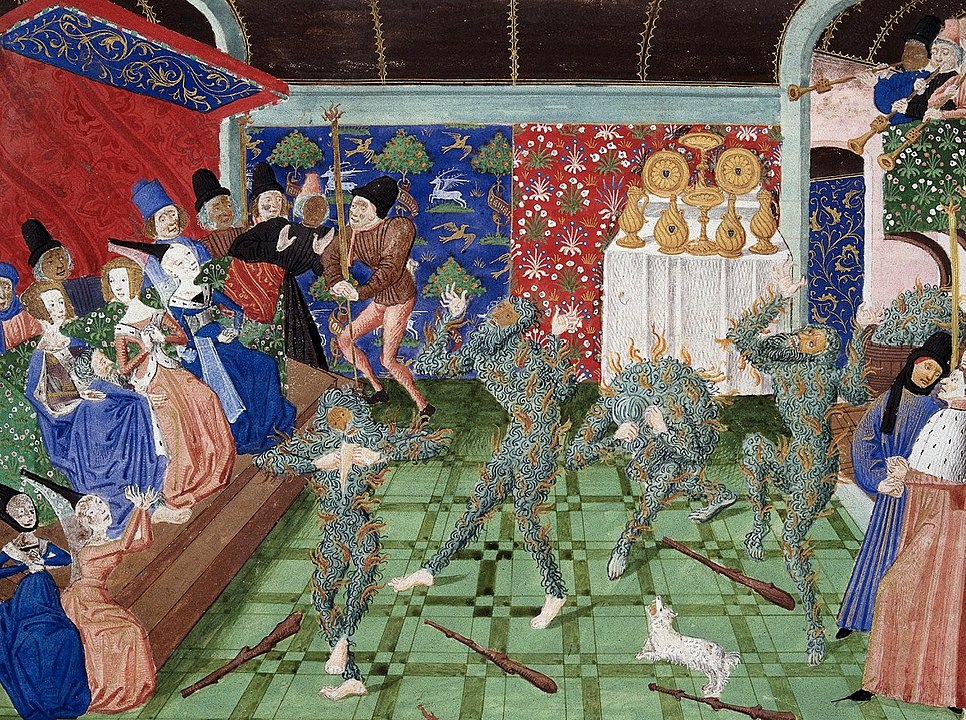
    King Charles VI nearly burned to death in 1393 at the Bal des Ardents at the Hôtel Saint-Pol
    King Charles VI nearly burned to death in 1393 at the Bal des Ardents at the Hôtel Saint-Pol

    Medieval theatrical performances primarily provided spiritual entertainment for the townspeople and explained the Holy Scriptures in the vernacular in various forms. The basis of a miracle play was apocryphal Gospels, hagiographies, and chivalric romances. In England, miracle plays were usually staged by members of craft guilds in honor of their patrons. In France, they were popular among members of puy—urban associations for joint pious activities, music, and poetry competitions.

    The plot of a mystery play was usually the Passion of Christ, the expectation of the Savior, or the lives of saints. Originally, mysteries were part of church services, but they later moved to the churchyard or cemetery, and then to city squares. They were performed not by professional actors, but by clergy and members of the puy.

    Moralities were something between religious and comic theater. In allegorical form, they showed the struggle between good and evil in the world and in the individual. The outcome of this struggle was either the salvation or damnation of the soul.

    Performances were announced in advance; posters were hung on city gates, and during the performance, the city was carefully guarded “so that no unknown people could enter the said city on that day,” as stated in a 1390 document preserved in the city hall archive in Tours.

    Despite the conventionality of the productions, what happened on stage was entirely fused with reality for the audience, and tragic events were mixed with comic scenes. Spectators often became participants in the action.

    Enjoy Wandering Performers

    One could also enjoy entertainment without moral lessons, like watching wandering performers. Around the 14th century in France, troupes of professional actors began to form—such as the “Brotherhood of the Passion” and the “Carefree Lads.” Traveling performers—histriones, spielmänner, and jugglers—used all sorts of tricks to amaze and amuse the public. The “Teaching of Troubadour Giro de Calancon to a Juggler” (he lived in the early 13th century) lists a whole range of skills an actor needed:

    [He] should play different instruments; juggle balls on two knives, tossing them from one blade to another; show puppets; jump through four hoops; don a fake red beard and costume to dress up and scare fools; train a dog to stand on its hind legs; master the art of a monkey handler; amuse the audience with comical depictions of human weaknesses; run and leap on a rope stretched from one tower to another, making sure it doesn’t give way…

    Listen to Music or Poetry

    Instrumental music was mainly the domain of jugglers and minstrels, who sang, danced, and performed to the sound of their instruments. Besides various wind instruments (trumpets, horns, flutes, Pan flutes, bagpipes), harps and types of bowed instruments—the ancestors of the future violin, like the crwth, rebab, and vielle or fiddle—were introduced into musical life over time.

    Moving from place to place, jugglers performed at festivals in courts, castles, and city squares. Despite church persecution, jugglers and minstrels managed to gain the opportunity to participate in religious performances in the 12th–13th centuries.

    In the south of France, lyrical poets were called troubadours, in the north trouvères, and in Germany Minnesingers. The lyric of the Minnesingers belonged to the nobility, heavily influenced by knightly poetry and the love songs of the troubadours. Later, the art of versification in German cities was taken up by the Meistersingers, for whom poetry became a special science.

    Like craftsmen, city poets formed societies similar to guilds. In Ypres, Antwerp, Brussels, Ghent, and Bruges, guilds of so-called “rhetoricians”—craftsmen and merchants who took charge of poetry—held festivals. Each guild had its own coat of arms and motto in the form of a charade, as well as a special hierarchical structure: dean, standard-bearer, jester, and other members of the “elder council.” The city authorities funded competitions in poetry and acting, awarding several prizes: for literary achievements, the best jester’s line, the richest costume, and the most magnificent entry into the city.

    To Dance

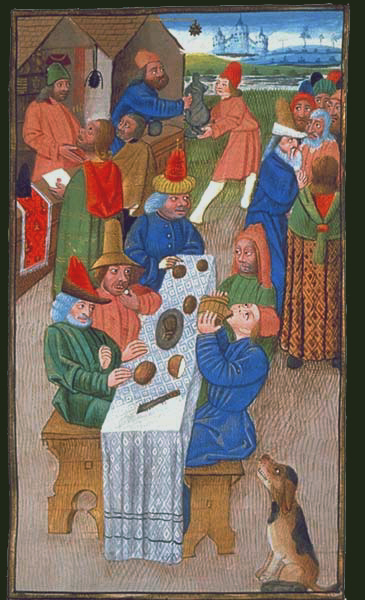
    A medieval peasant meal
    A medieval peasant meal. Image: French National Library

    Dance was a favorite pastime for all social classes in medieval society; no celebration was complete without dancing. Jugglers made the dance more complex by adding acrobatic elements, but townspeople loved to move themselves, not just watch the professionals. The church usually opposed such entertainments, and city governments did not always have a favorable attitude towards dancing. However, later on, authorities began to permit dances in city halls, and by the end of the 14th century, so-called dance houses began to appear. A dance house was usually located near or opposite the town hall and church. The loud music and laughter disturbed the pious atmosphere of the parishioners and church staff, causing their displeasure and endless complaints.

    In Nördlingen, Bavaria, the dance house was located in a three-story building. During fairs, the ground floor was connected by passages to nearby butcher shops and a tavern, allowing visitors to move between establishments. In buildings with multiple floors, the upper-level halls were typically reserved for burghers of noble origin, while the lower levels were at the disposal of ordinary townspeople. In some cities, the dance house also served as an inn, and in Munich and Regensburg, prisoners were even held in the basement of the “Tanzhaus” (dance house).

    Moreover, there were dance houses designed exclusively for commoners: a wooden platform slightly raised above the ground was covered with a roof supported by four columns. Musicians would be positioned on this platform, and men and women would dance in a circle around them. While the nobility preferred measured and ceremonial processional dances and guild festivals featured dances with hoops, swords, and other objects symbolizing artisanal products, the townspeople favored improvisational dances and round dances, which the church considered crude and shameless.

    To Visit a Fair

    Weekly markets served the townspeople regularly, but fairs were held much less frequently—only once or a few times a year: at Christmas, Easter, or on the feast day of a local saint, the city’s patron or the patrons of trade and craft guilds.

    For example, the fair in Saint-Denis, outside the walls of Paris, was held once a year but lasted an entire month. During this time, all trading in Paris ceased and moved to Saint-Denis. Residents flocked there not only to shop but also to marvel at exotic items from distant lands, to watch performances by jugglers, acrobats, and trained bears, and to listen to stories told by merchants who had traveled overseas. The spectacle was so popular that Charlemagne issued a special order to his officials to “ensure that our people perform the work they are required to do by law, rather than waste time wandering through markets and fairs.”

    Fairs attracted all sorts of riff-raff, often leading to fights and disturbances. This is why, for a long time, fairs were only allowed in cities where there was a bishop or ruler who could maintain order and resolve disputes between participants. In medieval England, there were even special courts with simplified procedures to ensure quick resolution of cases. These were called “courts of piepowder”—so named in 1471 by the English Parliament, which decreed that all persons associated with fairs were entitled to demand this type of court.

    To Participate in a Carnival

    Carnival was inseparable from Lent: it was the last multi-day celebration before a long period of abstinence, and it was accompanied by feasts, masquerades, processions, and mock fights with cheeses and sausages. Carnival was a realm of gluttony, chaos, and celebration of all things corporeal. Masks and disguises, half-animal half-human figures, kings of fools, ships of fools, and the election of an “ass pope”—all church and secular rituals were translated into the language of buffoonery, and symbols of authority were publicly mocked. Entire church services and sacred texts were turned upside down. The main events of the carnival took place in churches, although these obscenities had been officially banned with interdicts since the 13th century.

    In a message sent by the theological faculty in Paris to the bishops of France in 1445, the carnival was described vividly:

    One can see priests and clerics wearing masks and monstrous faces during services. They dance in the choir, dressed as women, pimps, and minstrels.

    buy super kamagra online https://infobuyblo.com/buy-super-kamagra.html no prescription pharmacy

    They sing indecent songs. They eat sausages in the corners of the altar while the priest celebrates Mass. There, too, they play dice. They burn foul-smelling smoke from the soles of old shoes. They jump, run around the church without shame. Then they ride through the city in dirty carts and carriages, making obscene gestures and uttering shameful and filthy words to the laughter of their companions.

    During the carnival, anything forbidden on ordinary days was allowed, hierarchies were broken, and established norms were turned upside down—but as soon as the festival ended, life returned to its usual course.

    Greeting a Guest or Ruler

    Ceremonial entries of emperors, kings, princes, legates, and other lords into their subordinate cities were always laden with a multi-layered symbolic meaning: they reminded people of the nature of power, celebrated victories, and affirmed political dominion over distant territories. These events occurred quite often: in the Middle Ages and even in the Early Modern period, royal courts were itinerant — to maintain power, kings had to constantly move from place to place.

    The ceremony consisted of several acts, each strictly regulated. It all began with the greeting of the ruler, often far outside the city; this was followed by the reception of the crowned figure at the city walls, the handing over of the keys, the opening of the city gates, and delegations from the nobility and clergy. From the gates, the procession moved along the main streets of the city, which were strewn with fresh flowers and green branches.

    Finally, in the central city square, oxen and game were roasted, and barrels of wine were rolled out for all the townspeople. In 1490, during the entry of Charles VIII into Vienne, a “Fountain of Good and Evil” was installed, which spouted red wine from one side and white wine from the other. Such feasts were intended to embody the image of a fairytale land of abundance, a vision the ruler was expected to present to his subjects at least once.

    For the guest, elaborate performances were staged. In 1453, a whole play was performed in Reggio: the city’s patron saint, Saint Prospero, hovered in the air with a host of angels who asked him for the keys to the city to hand them over to the duke, while hymns were sung in his honor. When the procession reached the main square, Saint Peter descended from the church and placed a wreath on the duke’s head.

    buy zepbound online https://infobuyblo.com/buy-zepbound.html no prescription pharmacy

    In the German lands, the sovereign often entered the city surrounded by criminals sentenced to exile, and they didn’t just accompany him in the procession but held onto the edge of his garment, the harness, saddle, or stirrup of his horse — thus allowing them to return to the city. For example, in 1442, King Frederick III ordered eleven people to accompany him to Zurich, and in 1473, thirty-seven to Basel. However, city authorities could expel the criminals again as soon as the ruler left the city.

    Watching a Knightly Tournament

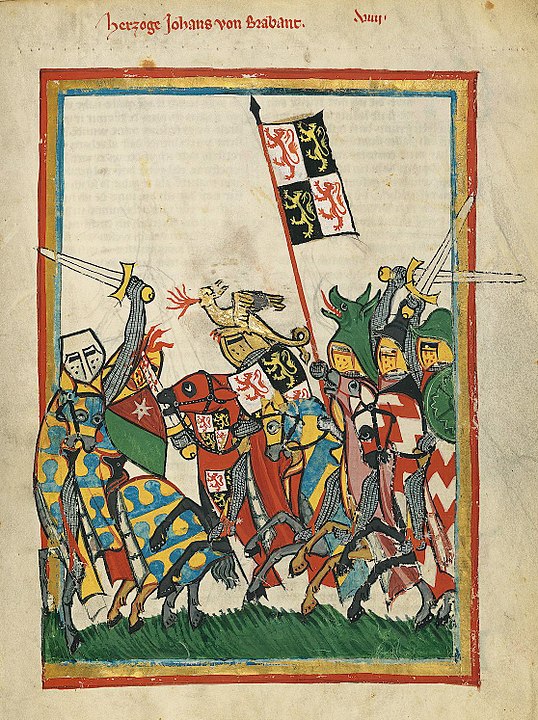
    Duke John I. of Brabant Two knights release doves
    The Codex Manesse (also Große Heidelberger Liederhandschrift or Pariser Handschrift) is a Liederhandschrift (manuscript containing songs), the single most comprehensive source of Middle High German Minnesang poetry, written and illustrated between c. 1304 when the main part was completed, and c. 1340 with the addenda

    The tournament was a true celebration of martial valor and chivalric honor. Everyone wanted, if not to participate, then at least to watch how the noble youth earned glory and spoils. Initially, the event resembled a mix of a fair and a real battle: participants would clash wall to wall, some receiving serious injuries or even dying, and a diverse crowd gathered around, consisting of not only knights, their squires, foot soldiers, and servants, but also blacksmiths, merchants, money-changers, and onlookers.

    Under the influence of chivalric romances, tournaments gradually became more organized, with participants using specialized weapons. Knights would face off in one-on-one duels, and the lists would be fenced off. Stands were built for spectators, each with its own “queen,” and the prize for the best tournament fighter was traditionally awarded by women. In 1364, Francesco Petrarch described the atmosphere of a Venetian joust (from the Italian word giostre — “duel”) as follows:

    “Below, there is not a free spot… the vast square, the very temple [of Saint Mark], the towers, the roofs, the porticoes, the windows are not only full but overfilled and crammed: an incredible multitude of people hides the face of the earth, and the joyful, numerous population of the city, spreading around the streets, only increases the merriment.”

    Eventually, tournaments turned into a costly and sophisticated courtly entertainment, accompanying various celebrations such as the wedding of a ruler, coronation, or the conclusion of peace or an alliance — along with festive masses, processions, banquets, and balls, most of which were not intended for ordinary townspeople.

    The townsfolk responded with a parody “knightly tournament” (often organized during the big carnival at Maslenitsa), where the entire chivalric ritual was turned upside down. A person imitating a knight would ride out for a duel with a basket for a helmet on their head, sitting on an old nag or a barrel, and threaten the opponent with a rake or something from the kitchen instead of a lance. After the event ended, everyone would immediately set off to celebrate with a merry feast.

    Participating in Sporting Competitions

    The burghers had every opportunity to train and compete in the use of real weapons. For practice, archery societies and fencing schools were organized in Flemish, northern Italian, English, French, and German cities, as well as in Krakow, Kyiv, and Novgorod. Associations of archers and fencers had their own charters and resembled guilds.

    buy cialis professional online https://silvermancare.com/wp-content/uploads/2025/03/jpg/cialis-professional.html no prescription pharmacy

    Training was conducted in various disciplines, but each city chose a specific type of combat for its competitions. For example, in Spanish cities, preference was given to duels with cold steel and mounted bullfights, in southern England and Novgorod — fistfights, and in German and Flemish cities — fencing and wrestling.

    In Italy, the games and competitions of city-republic residents resembled drills. In Pavia, for instance, the townspeople were divided into two groups, given wooden weapons, and wore protective helmets. Prizes were awarded to the winners. In river cities, battles could be staged for the symbolic capture of a bridge. Images of a bustling crowd fighting on such a bridge were a favorite subject of engravings from that era: in the foreground, gondoliers are rescuing those who have fallen into the water, while numerous spectators crowd the windows and roofs of nearby houses.

    In England, playing ball was a popular pastime for young men.

    buy neurontin online https://silvermancare.com/wp-content/uploads/2025/03/jpg/neurontin.html no prescription pharmacy

    Everyone who wished could participate, and there were almost no rules. The ball, stuffed with bran or straw, could be kicked, dribbled with feet, rolled, or carried in hands. The goal of the game was to get the ball across a certain line. In cities, such large-scale skirmishes were fraught with great dangers, and it was no coincidence that in London, Nuremberg, Paris, and other places, restrictions were introduced early on to temper the players’ fervor.

    To Play

    For those who didn’t enjoy street fun, there were home entertainments. For example, blind man’s buff and “Frog in the Middle.” The rules of the latter game were as follows: a person sat in the center while others taunted and hit them. The goal was to catch one of the players without leaving the circle, and then that person became the “frog.”

    There were also calm games: some required players to answer questions from the leaders truthfully, while others involved telling a story. In addition, there was a game called “Saint Cosmas”: one participant took on the role of the saint, and the others knelt before them one by one. The leader had to make the kneeling player laugh by any means, and then that person had to perform some task.

    By the Middle Ages, checkers, chess, dice, and even cards had become popular. Chess was a pastime for the nobility, and chessboards made of wood or metal were considered luxury items, often true works of art.

    The rules for playing cards varied. For example, one participant would draw a card from the deck, and everyone present would bet money on it. If three or four cards of the same suit were drawn in a row, the player who drew the first card would win all the money bet on it.

    But the most popular game was dice. This game was enjoyed by all social classes — in huts, castles, taverns, and even monasteries — with people losing money, clothes, horses, and homes. Many complained that they had lost everything they owned in this game. Moreover, there were frequent cases of cheating, especially with fake dice: some had magnetic surfaces, others had the same side reproduced twice, and others had a side weighted with lead. As a result, numerous disputes arose, sometimes even escalating into private wars.

    To Go to the Bathhouse and Have a Good Drink

    In most medieval cities, there were public bathhouses. In Paris at the end of the 13th century, there were 26 bathhouses, half a century later in Nuremberg — 12, in Erfurt — 10, in Vienna — 29, and in Wrocław — 12. Visiting a bathhouse was not limited solely to hygiene; rather, it was a place for entertainment, pleasure, and socializing. After bathing, visitors participated in receptions and dinners, played ball games, chess, dice, drank, and danced.

    In German cities, wine merchants rolled wine barrels to the streets near the bathhouses, set up stools around them, brought out mugs, and offered wine to anyone who wanted to try it. An immediate drinking party would form on the street, so city councils were forced to ban this custom. Exceptions were made only for a few days a year, such as St. Martin’s Day when it was customary to open new wine. But on those days, people stood, sat, and lay in the streets — drinking wine.

    Despite prohibitions from the authorities and the church, some bathhouses and adjacent taverns took on the character of brothels: in addition to food and drink, citizens could also enjoy massages and services from prostitutes, who were often referred to as “bath attendants.”

    In general, although prostitution was condemned by the church, it was considered an inevitable phenomenon. “Women’s houses,” or “reputable houses,” belonged to noble families, merchants, royal officials, and even bishops and abbots, and the most prestigious of them were often located near the magistrate’s or courthouse. In the High Middle Ages, visiting a brothel by unmarried men was not considered shameful — it was seen rather as a sign of health and well-being.

    To Rest by the City Fountain

    Not all townspeople could afford to have a separate garden or water feature built behind their home; many lived in rented rooms, cubicles, and annexes. Water for household use was drawn from a public well or fountain located in the square, usually not far from the church. In the Late Middle Ages, these fountains served not only as decorations and sources of drinking water but also as meeting places and promenades for the townspeople.

    To Watch an Execution

    An execution site could be located outside the city, across the moat, on the square, or even in front of the victim’s house, but the execution was always a public event. The place and time of the execution, as well as the route of the criminal, were known in advance to all townspeople. Heralds summoned the spectators. The optimal time was considered to be noon, and often the authorities held executions on market days to ensure the maximum crowd, although not on religious holidays.

    The crowd gathered around the criminal gradually as the procession moved through the city.

    buy trazodone online https://infobuyblo.com/buy-trazodone.html no prescription pharmacy

    The entire punishment ritual was designed for spectators, a slow theatrical performance meant to involve the surrounding public in the ceremony. In some cases, the criminal was given the right to duel with the executioner, and people could assist in their release. This happened in Saint-Quentin in 1403 when, during the struggle, the executioner fell to the ground, and the townspeople demanded that the royal provost release the victor. Spectators monitored the precise execution of the ritual and could demand a retrial if something went wrong.

    The bodies of criminals were forbidden to be buried in cemeteries, and their corpses remained on the gallows for many years until they completely decomposed, serving as a warning to those wandering around.

  • 16 Most Popular Legends About Peter the Great

    16 Most Popular Legends About Peter the Great

    Without any doubt, Peter I is the most famous Russian monarch and one of the most notable and significant figures in Russian history overall. The first emperor who transformed his country into one of the leading European powers, founder of Saint Petersburg, and author of radical cultural transformations, he became a legend both in Russia and abroad even during his lifetime. Peter’s behavior was also unusual for a monarch: his disregard for ceremonies, his manner of exuberantly entertaining himself and dressing plainly, as well as his colorful personal life. It is not surprising that the most incredible rumors and legends about him arose among his contemporaries.

    Peter I Was Swapped at Birth

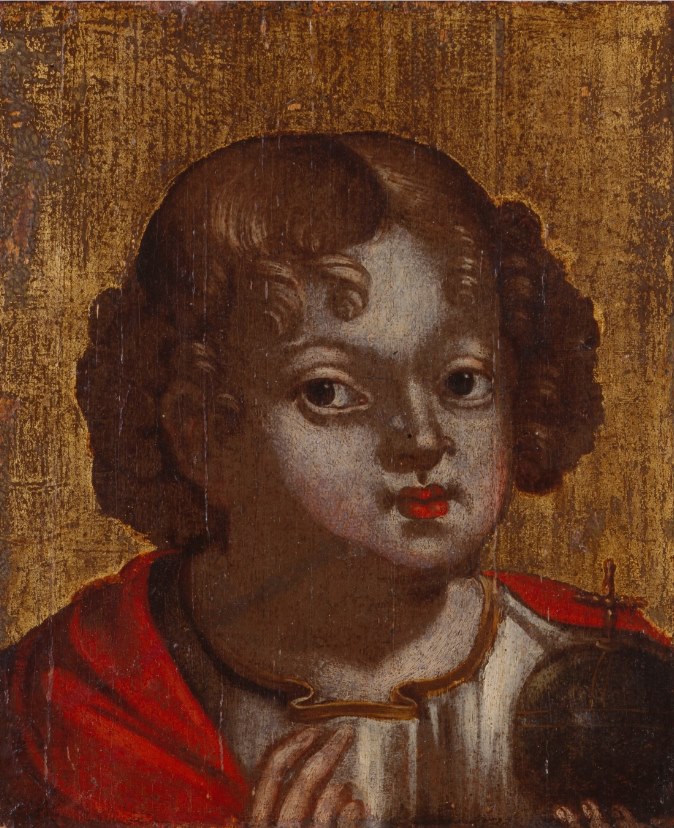
    Portrait of Tsarevich Peter Alekseevich, 1670s
    Portrait of Tsarevich Peter Alekseevich, 1670s

    “The sovereign was swapped” is one of the most common themes in popular mythology about rulers. Essentially, if a divinely appointed ruler does something we strongly dislike, there could be two explanations: either such a ruler was sent to us from above as punishment for our sins, or he is “not real,” meaning he was swapped. From the materials of the Preobrazhensky Prikaz and the Secret Chancellery, we know that both of these scenarios were widely discussed by contemporaries, and the unprecedented fact of the sovereign’s incognito trip abroad only added fuel to the fire.

    However, to discuss this version seriously is not warranted: Peter I was the legitimate son of his father, Tsar Alexei Mikhailovich, from his second wife, Tsarina Natalia Naryshkina.

    Verdict: This is false.

    Peter I Was of Gigantic Stature and Had a Small Head

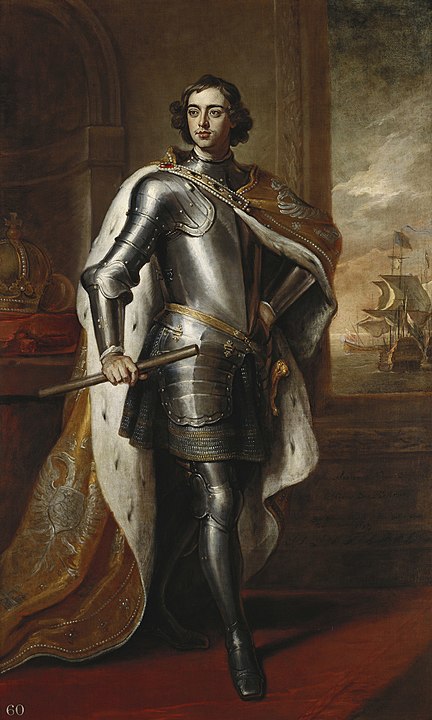
    Peter the Great, Tsar of Russia (1672-1725)
    26-year-old Peter the Great. The portrait by Gottfried Kneller was presented by Peter in 1698 to the English king

    Contemporaries unanimously noted Peter’s tall stature, but how tall he actually was is unknown. Whether the surviving mark in Peter’s Cabin, which suggests his height exceeded two meters, is a reliable source remains questionable. On the other hand, the clothing that has survived and undoubtedly belonged to him does not amaze with its size.

    However, even by our standards, if Peter was a person of average height—over 170 cm—he still would have seemed very tall to his contemporaries, who were significantly shorter. As for the claim that he had an abnormally small head, there is no evidence.

    Verdict: This is partly true.

    Peter I Exchanged Chuvash People, Redheads, or Votyaks for Nails

    The origin of this particular legend is unclear. But it is worth remembering that a significant part of Russia’s population consisted of serfs; the rest could be turned into serfs at any moment by a mere stroke of the sovereign’s pen. Selling, gifting, or exchanging a person or an entire populated estate seemed entirely normal to people of that era. This was especially true for “foreigners” and non-Christians, such as prisoners or those brought from abroad—often young Turks or Kalmyks.

    Equally common was the “collection” of people by monarchs or even wealthy landlords who appeared unusual due to their appearance: “Samoeds,” “Arabs,” “giants,” “freaks,” “dwarfs,” and fools. This, however, was not only practiced in Russia: such live “curiosities” could be exchanged between monarchs. For instance, in 1717, Peter ordered “two Samoed boys, who were uglier and funnier,” to be found and sent as a gift to the Duke of Tuscany; the Duke gladly accepted the gift. However, Peter probably did not exchange people for nails.

    Verdict: This is likely false.

    Peter I Killed His Own Son

    Peter threatened his son with death, after which the court he appointed did indeed sentence the tsarevich to execution. According to the official version, however, he died of a stroke, that is, a heart attack. Similarly, in the 18th century, the deaths of other rulers who died under suspicious circumstances were explained. Whether Tsarevich Alexei was secretly executed or died, for example, from torture to which he was subjected after the sentence, is not so important. His death in captivity in the Peter and Paul Fortress could not have occurred without the knowledge and at least tacit approval of Peter.

    The sovereign was just as ruthless towards his other subjects. According to legend, during the mass execution of the rebellious Streltsy, he personally took up an axe. This legend originates from a report by a foreign diplomat, so there is no absolute certainty of its accuracy. However, it is precisely known that Peter personally attended interrogations in the dungeon for hours when those suspected of treason were tortured. The number of those tortured in dungeons, killed while suppressing revolts, or simply dead from hunger and disease on the battlefields or during the great construction projects of the era cannot be counted. What is clear, in any case, is that the era was bloody.

    Verdict: This is true.

    Peter I Was An Atheist or a Protestant

    Of course, we cannot know for sure whether Peter (or anyone else) believed in God. Many contemporaries already considered Peter a non-believer, a Protestant, or even the Antichrist, and some of them paid for these views with their lives. Such a perception of the monarch is unsurprising, given his radical reform of the Church, his irreverent attitude toward the church hierarchy and rituals, and his personal behavior, which ran counter to church norms. However, the crude entertainments that Peter indulged in during the “All-Joking, All-Drunken Synod” would seem equally shocking to any modern atheist.

    It is also true that Peter, it seems, attached less importance to the theological differences between Orthodoxy and other Christian denominations. And there is no doubt that Feofan Prokopovich, who determined Peter’s church policy starting from the mid-1710s, was under the strong influence of Pietism, the most important Protestant movement of that time. How much Peter delved into the doctrinal essence of the innovations proposed by Prokopovich is unclear, but he was clearly drawn to the model of state subordination of the Church, characteristic of many Protestant countries.

    Nevertheless, it is utterly impossible to imagine that Peter I did not consider himself an Orthodox Christian, and even more so that he was an atheist in the modern sense. There is a wealth of evidence of Peter’s deep piety; while he mocked church rituals in some cases, he devoutly observed them in others. Finally, he naturally regarded God as the source of his own power.

    Verdict: This is false.

    Peter I Opened a Window to Europe

    It is believed that this metaphor was first used by the Italian Francesco Algarotti in his notes after visiting Russia in the late 1730s, more than ten years after Peter’s death. In reality, Algarotti compared St. Petersburg to “a window through which Russia looks into Europe.” His metaphor was later picked up by Pushkin and popularized in “The Bronze Horseman” (where he, by the way, directly refers to Algarotti). In Pushkin’s poem, Peter expresses his intention to “cut a window to Europe,” and, judging by the context, the meaning of this “window” is somewhat different from Algarotti’s: it is more like an opening through which Europe flows into Russia.

    Either way, the metaphor is quite accurate. Naturally, Russia was not isolated from Europe before the founding of the new capital on the Neva River.

    buy levitra soft online http://culia.net/onlinebooking/html/levitra-soft.html no prescription pharmacy

    But it was St. Petersburg that became Russia’s main trading port; many foreigners lived there; and it was through St. Petersburg that various cultural influences, novelties, fashions, new institutions, and behavior models from Europe penetrated Russia.

    Verdict: This is more likely true.

    Peter I Brought Potatoes to Russia and Forced Peasants to Eat Them

    Peter may have indeed brought some potatoes to Russia as a curiosity — he ordered all sorts of oddities, like pickled mangoes, for instance — but no campaign to promote potatoes took place during his reign. Potatoes only started to take root in Russia much later, in the second half of the century.

    Verdict: This is false.

    Peter I Issued a Decree “On the Bold and Foolish Appearance” of Subordinates

    During his reign, Peter personally wrote many decrees, often addressing the most insignificant matters and sounding, by our standards, strange and rather rude. For example, there was the 1707 decree requiring all members of the ministerial “conzilia” to sign meeting protocols, “for by this all foolishness will be revealed.” This meant that ministers who gave bad advice could not later deny it. Many decrees originated from the monarch’s oral orders, which explains the colloquial, even coarse, tone of some of them.

    On the other hand, many of Peter’s sayings are known only through retellings by contemporaries or their descendants. By the end of the 18th century, two important publications had appeared that collected many of these sayings: “Stories of Nartov About Peter the Great” and “Deeds of Peter the Great, the Wise Reformer of Russia.” In both cases, the publishers — the son of Peter’s court turner and mechanic Andrey Nartov, and amateur historian Ivan Ivanovich Golikov, respectively — took considerable liberties with the sources.

    Against this backdrop, it’s easy to attribute all sorts of sayings to Peter — including the decree for subordinates to have a “bold and foolish appearance in front of their superiors so as not to disturb them with their intelligence.” However, historians know nothing about the existence of such a decree. It’s a fake, apparently spread in the internet age. Its content contradicts everything we know about Peter: his genuine decrees, on the contrary, encourage subordinates to “disturb” their superiors and report them to the sovereign.

    Verdict: This is false.

    Peter I Chopped Off Beards with an Axe

    Peter did indeed begin to fight against beard-wearing after his return from the Great Embassy in August 1698. There is evidence that in some cases, he personally cut off the beards of the boyars. The imperial envoy Count Guarient reported that the young tsar personally trimmed the long beards of many boyars, as well as other clergy and laypeople. There are other similar accounts, but an axe is not directly mentioned in any of them.

    Most likely, the cutting of beards got mixed up with another episode involving Peter: during the infamous Streltsy executions, the tsar, according to the testimony of a foreign diplomat, wielded an axe himself. Such a mix-up is not surprising. The beard-cutting episode occurred immediately after the Streltsy uprising, in which Peter suspected many elite members of sympathizing, so beard-cutting apparently also served as a symbolic punishment through humiliation. It is possible, however, that the soldiers sent to enforce the beard-shaving decree in the provinces may indeed have used an axe.

    Verdict: This is almost true.

    Peter I Was an Alcoholic and Forced Others to Drink

    It is impossible to say retrospectively whether Peter was an alcoholic in the strict medical sense, but descriptions by contemporaries and Peter’s own letters leave no doubt: yes, he and his entourage drank excessively, and yes, guests at Peter’s feasts were forced to drink liters of alcohol. One could argue whether there was a political intent — to loosen tongues, to elicit hidden thoughts. Moreover, it was not only at the Russian court but also at many European courts where people regularly drank themselves into a stupor.

    It is also true that Peter’s customs matched the established European stereotype of “Russian drunkenness.” When preparing to become an ambassador to Russia in the late 1720s, the Anglo-Spanish aristocrat Duke de Liria was already convinced that “all matters in those lands are conducted over a bottle.” And yet, the fact remains: many of our contemporaries would have died from alcohol poisoning after just one of Peter’s parties.

    Verdict: This is true.

    Peter I Hated Russia and Moscow

    The origin of this myth is understandable: the tsar eradicated Russian customs, was fascinated with all things foreign, and moved the capital to St. Petersburg. Does this mean he hated Russia and Moscow? Of course, there are no documents where he directly confesses his feelings.

    buy zocor online http://culia.net/onlinebooking/html/zocor.html no prescription pharmacy

    Peter could not have hated Russia; he was deeply convinced that ruling Russia was a task entrusted to him by God, and that he would have to answer for the country’s fate on Judgment Day. Moreover, it was Peter who introduced the idea that the military and officials serve not only the sovereign personally but also the homeland. According to him, even the tsar serves.

    However, Peter certainly hated many of the Russian ways. As for Moscow, it symbolized everything Peter wanted to change in Russia. Moreover, it was associated in the emperor’s mind with his childhood fears, uprisings, and conspiracies. Nevertheless, Peter acknowledged the symbolic significance of Moscow and spent quite a bit of time there even after the founding of St. Petersburg.

    Verdict: This is more likely false.

    Peter I Was Just, Severe, and Quick to Forgive

    In popular mythology, “just, severe, and quick to forgive” are essential attributes of any strong ruler, a true tsar. How much do these attributes reflect reality in the case of Peter?

    buy valtrex online http://culia.net/onlinebooking/html/valtrex.html no prescription pharmacy

    He certainly considered himself just and consistently emphasized his commitment to the law and the principle of fair reward for service. However, he often violated the very laws he had created.

    He was certainly “severe”: being extremely quick-tempered, he could instantly sentence an offender to death or severe punishment. However, the opposite situation was also common: the tsar was aware for years of the crimes and theft of his close associates but did nothing. He could probably be considered quick to forgive, but this tendency was more often associated with the influence of his second wife, Catherine, who repeatedly saved guilty nobles from execution.

    Verdict: In some sense, this is true.

    Peter I Himself Worked on the Construction of St. Petersburg

    Peter took pride in his calloused hands (literally): he enjoyed manual labor and had a deep understanding of the technological details of various crafts—from shipbuilding to metal forging—planting trees in gardens, and so on. In his spare time, he enjoyed working on a lathe, a hobby that was quite popular in Europe at the time. When in St. Petersburg, he regularly inspected construction sites and shipyards. During such visits, he could certainly grab a wheelbarrow or a shovel. However, it is unlikely he had the time or desire to shovel for an extended period.

    Verdict: This is true.

    Peter I Suffered from Syphilis, Epilepsy, and Mental Illness

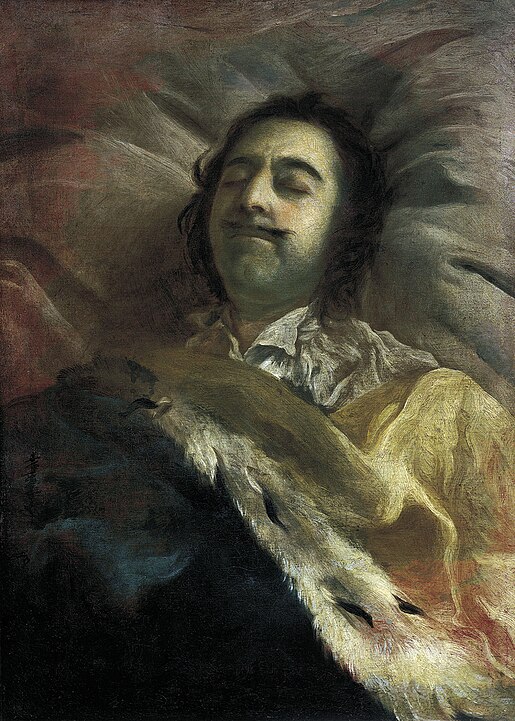
    Peter the Great on his deathbed, by Nikitin
    Peter the Great on his deathbed, by Nikitin

    Retrospectively diagnosing medical conditions is a thankless task. Nonetheless, rumors about Peter having a venereal disease were circulating even during his lifetime. Informed foreign diplomats reported that this very disease led to his death, which aligns well with the known circumstances of his demise: Peter died in excruciating pain caused by a urinary tract obstruction and associated bladder inflammation, which could have been caused or exacerbated by a long-standing venereal disease.

    The version of epilepsy also does not contradict known descriptions of his behavior (contemporaries often mentioned convulsions, fits of rage, tics, and the like). As for mental illness, that, of course, is pure speculation. Did many of his contemporaries consider the tsar’s behavior abnormal? Certainly.

    Verdict: Quite possibly, this is true.

    Peter I Had a German Mistress

    The relationship between Peter and Anna Mons was widely known to contemporaries and is reflected in many sources; even Anna’s letters to the tsar have been preserved. Peter broke off with his mistress after discovering she was cheating on him with a Saxon diplomat. She later even married a Prussian ambassador. However, Anna’s closest relatives continued to serve at court, and her younger brother Willem apparently even became the lover of Peter’s second wife, Catherine, which cost him his life.

    Verdict: This is true.

    Peter I Was the Father of Mikhail Lomonosov

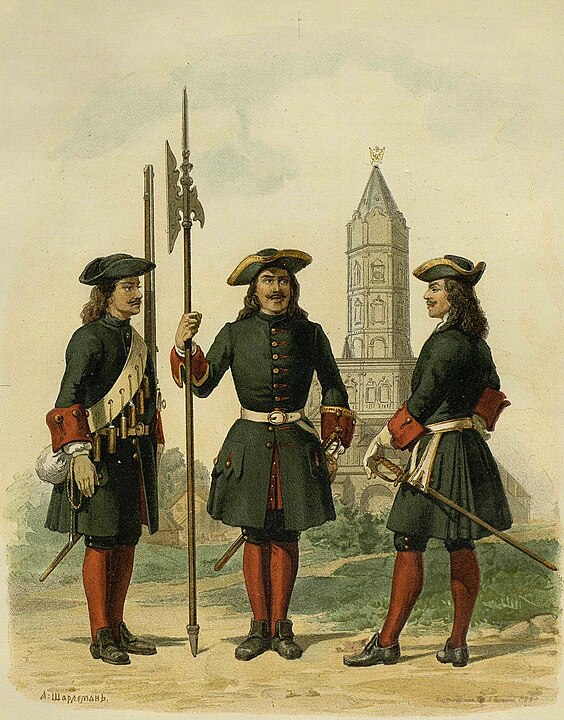
    Preobrazhensky Regiment with the Sukarev tower
    Preobrazhensky Regiment with the Sukarev tower

    Besides Anna Mons, Peter had many other love affairs: with court ladies who became his more or less permanent mistresses, with maidservants, or with random women he encountered during campaigns and travels. As with Peter’s relationship with Anna Mons, these affairs were described in reports by foreign diplomats and widely discussed among the people: we know about this from the investigative files of the Preobrazhensky Prikaz and the Secret Chancellery.

    In court circles, it was whispered that Peter’s illegitimate children included the legendary military leader Peter Rumyantsev-Zadunaisky and Field Marshal Count Zakhar Chernyshev; both their mothers had at one time been the emperor’s mistresses.

    However, substantiating the version that Lomonosov was among Peter’s illegitimate children is difficult. During the scholar’s lifetime, such rumors did not exist. This legend originates from the memoirs of Arkhangelsk sailor Vasily Korelsky, published in our time; in them, the author referred to family legends and a certain manuscript allegedly kept in their family before the war but then lost. These testimonies are highly dubious.

    According to Korelsky, Lomonosov’s mother supposedly met Peter in early January 1711 in Ust-Tosno, but this period of Peter’s life is well-documented, and he was not in the North at that time. The assumption that Lomonosov owed his career and position at court to his status as a bastard is pure speculation and not supported by any evidence.

    Verdict: Most likely, this is not true.

  • 14 of the Most Popular Legends About Beethoven

    14 of the Most Popular Legends About Beethoven

    Beethoven Grew Up in a Poor, Dysfunctional Family

    Verdict: This is partly true.

    Ludwig van Beethoven was indeed born into a poor family. The family lived in Bonn; his father, Johann Beethoven, was a singer in the court chapel of the Elector of Cologne and earned about 315 florins a year, which was barely enough for food and rent. A small additional income came from private lessons: Johann taught piano, violin, and viola. He was a professional musician and was invited to perform in wealthy households.

    Johann Beethoven married Ludwig’s mother, Maria Magdalena, for love, but his own father, the Kapellmeister of the Bonn court chapel, considered this marriage a misalliance and cut off his son’s financial support. He softened only when his grandson was born, who was named Ludwig in honor of his grandfather.

    In 1787, Maria Magdalena died of tuberculosis. The myth of syphilis, which supposedly afflicted both the composer’s mother and father, and even Beethoven himself, emerged later and has no evidence to support it. Allegedly, this was why the composer’s older brothers were born blind, deaf, or with developmental disabilities. In reality, Beethoven was the second child in the family: his older brother died shortly after birth. No records suggest that any children in the Beethoven family were born with congenital defects.

    After his wife and younger daughter died, Beethoven’s father indeed began to have problems with alcohol: seventeen-year-old Ludwig often had to drag him out of the police station.

    Beethoven’s Father Wanted to Make Money by Turning His Son Into a Second Mozart

    Verdict: This is true.

    The phenomenon of Mozart did not leave many parents at peace. When Ludwig was 3–4 years old, his father noticed his musical abilities and decided to use them to improve the family’s financial situation. At the same time, he admired his son’s abilities and said, ““In my son Ludwig I now have my only joy. He’s progressing so well in music and composition that he’ll be regarded by all with amazement. My Ludwig, my Ludwig, I know it! In time he’ll become a great man in the world. Those of us gathered here, and now witnessing it, remember my words!.” However, unlike Leopold Mozart, the composer’s father, Johann did not possess teaching talent and, instead of support and praise, resorted to punishment. Beethoven recalled that he and his younger brothers were raised with beatings, a common practice at the time.

    Starting at around four years old, Ludwig played the piano, violin, and viola for long periods every day. He couldn’t reach the keyboard, so he had to stand on a bench. Playing string instruments never quite worked out for him, although he later tried to learn.

    Beethoven’s first public concert took place on March 26, 1778, in Cologne, where he was presented as a six-year-old virtuoso, even though he was already over seven. However, the concert, like subsequent tours in the Netherlands, did not bring money or fame. The audience might have expected improvisations and musical tricks that amazed them with young Mozart, but Johann did not consider this important: unlike Mozart, Ludwig was forbidden to improvise. Hearing live music, his father would exclaim, “Why are you tinkering again? Get out, or you’ll get a slap!”

    Beethoven Was Poorly Educated Because He Did Not Attend School

    Verdict: This is partly true.

    Beethoven did not receive a systematic school education. He briefly attended a private school and a monastery, but without much success. The teaching methods involved drilling, rote learning of catechism, and Latin, which provoked resistance in the boy. Moreover, his father believed that school was a waste of time.

    As an adult, Beethoven tried to fill the gaps in his education. He studied French and Italian, learned history, astronomy, and philosophy. In 1789, eighteen-year-old Ludwig even became a student at the Faculty of Philosophy at the University of Bonn. He was fascinated by ancient literature, loved Goethe, Schiller, Herder, Shakespeare, and many other authors. However, he never mastered mathematics, only learning addition and subtraction, and wrote with errors.

    His musical education was also unsystematic, but Beethoven was fortunate with his teachers (aside from his father), who also acted as his promoters. One of his first teachers in Bonn was Christian Gottlob Neefe, a renowned German composer and organist. After moving to Vienna, Beethoven studied with other famous musicians.

    Joseph Haydn not only taught him music but also helped him enter Viennese society and lent him money. Antonio Salieri taught him to compose vocal music in the Italian style. Beethoven also highly valued his lessons with the composer Johann Georg Albrechtsberger. According to a contemporary, the Viennese teachers had this to say about their student:

    All three held Beethoven in high esteem but were unanimous in their opinion of his studies. Each said: Beethoven was so willful and stubborn that he had to learn from his own bitter experience what he would never accept as a subject of study.

    Beethoven himself confessed to publisher Gottfried Härtel:

    There is no treatise that is too scholarly for me. Without claiming actual scholarship, from childhood, I have strived to comprehend the best and the wise produced by each era. Shame on an artist who does not consider this mandatory, at least within their power.

    Beethoven Added the Particle “van” to His Surname to Appear Aristocratic

    Verdict: This is not true.

    The particle “van” before Beethoven’s surname (Beethoven literally translates to “beet garden”) actually meant that his family originated from the town of Beto, or Betuwe, in Flanders. Contemporaries from other countries might have mistaken “van” for the equivalent of the German “von,” which indicated noble origin.

    Once, Beethoven tried to use this to his advantage. When a court dispute arose between the composer and his sister-in-law over the guardianship of his nephew Karl, Beethoven argued in favor of his claim to belong to the upper Dutch class using the “van” particle. However, he could not provide documentary proof, so the land court, which handled noble disputes, referred the case to the Vienna Magistrate, which dealt with the affairs of common citizens. Beethoven was outraged: “In the Netherlands, they would have shown better awareness of this insignificant significance.”

    Beethoven Was Deaf

    Verdict: This is almost true.

    Beethoven began to lose his hearing gradually: the first signs of deafness appeared when he was 28 years old. It might have been caused by an illness he had suffered a year earlier. He experienced painful sensations, noises, and ringing in his ears, gradually losing the ability to hear soft, high-pitched sounds.

    In April 1802, he went to the resort of Heiligenstadt, near Vienna, for treatment. There, he fell into a depression and contemplated suicide. In a confession known as the Heiligenstadt Testament, he spoke about the “burning fear” of people, the fear of being exposed for his affliction, and his cruel fate. Fortunately, it did not come to suicide.

    Despite his progressive illness, Beethoven continued to perform as a pianist, and between 1806 and 1814 as a conductor. He sometimes improvised in private salons. Almost complete deafness set in around 1818, nine years before his death. The composer communicated with others by writing down replies in notebooks that he constantly carried with him.

    He Composed Strange Music That Nobody Listened To

    Verdict: This is partly true.

    To Beethoven’s contemporaries, his music seemed complex and incomprehensible, and some even saw it as “aesthetic and artistic terrorism.” He indeed did not write for the general public but for educated people from high society, yet he was not always understood by them. For instance, Emperor Franz, known for his reactionary reforms, disliked his music because he believed it destroyed traditions.

    However, Beethoven had many admirers, such as the Russian Prince Nikolai Borisovich Golitsyn. Golitsyn wrote to Beethoven about the Missa Solemnis, whose world premiere, with his support, took place in St. Petersburg in the spring of 1824:

    …the entire composition is a treasure trove of beauty, and it can be said that your genius has surpassed the ages, and that perhaps there are not yet sufficiently enlightened listeners who can fully appreciate the beauty of your music. However, your descendants will honor and bless your memory far more than your contemporaries are able to do.

    Even during his lifetime, Beethoven was considered one of the three great composers of the era (alongside Haydn and Mozart). At his funeral on March 29, 1827, about 20,000 people attended, an unprecedented number for those times.

    Beethoven Supported Napoleon and Dedicated His Third Symphony to Him

    Verdict: This is only partly true.

    In the 1790s, Beethoven followed Napoleon Bonaparte‘s actions with interest, but it cannot be said that he supported him. Between 1796 and 1798, Beethoven wrote patriotic songs for Viennese militiamen fighting against Napoleon, and in 1802 he dedicated three violin sonatas to Alexander I, one of Bonaparte’s main opponents.

    The famous Third Symphony, which Beethoven began working on in 1803, was initially indeed dedicated to Napoleon, but this was not due to the composer’s political views. At that time, Beethoven was planning a trip to Paris; dedicating the symphony to Napoleon could have served as his entry pass to the local high society salons and attracted public attention. After Bonaparte’s coronation in 1804, the composer abandoned the idea. His student Ferdinand Ries recalled:

    Both I and his other close friends often saw this symphony rewritten in score on his desk; at the top of the title page was the word ‘Buonaparte’, and at the bottom ‘Luigi van Beethoven’ – and no more… I was the first to bring him the news that Bonaparte had declared himself emperor. Beethoven flew into a rage and exclaimed: ‘So, he is just an ordinary man! Now he will trample on all human rights, follow only his ambition, he will place himself above everyone else and become a tyrant!’ Beethoven approached the table, grabbed the title page, tore it from top to bottom, and threw it on the floor.

    Soon, the well-known patron and supporter of Beethoven, Prince Franz Joseph Lobkowitz, paid a generous fee for the right to perform the new work in a private circle, and then another for the dedication of the symphony to himself. The private premiere took place on June 9, 1804, in the prince’s Vienna palace. In the autumn of the same year, the symphony was performed in Roudnice, the Czech castle of Lobkowitz, especially for the Prussian Prince Louis Ferdinand, who financed this concert.

    Both Lobkowitz and Louis were not sympathetic to Bonaparte, and even at the private performances, the initial dedication was not mentioned. The public premiere took place on April 7, 1805, where the composition was called the New Grand Symphony. A year later, the Third Symphony received its final title, Eroica, with the subtitle “Composed to celebrate the memory of a great man, and dedicated to His Most Serene Highness Prince Lobkowitz.” Most likely, the “great man” was Louis Ferdinand, who had recently died in battle against Napoleon.

    Beethoven Was Unhappy in Love

    Verdict: This is true.

    A talented and famous composer, Beethoven was popular among ladies from high society. He often had romantic relationships, but they never led to marriage: Beethoven’s social status and financial situation seemed too unstable to his chosen ones and their families. Up until 1812, the composer had relationships with various women, but then everything changed.

    During this time, Beethoven wrote a letter addressed to an “Immortal Beloved,” which, like the Heiligenstadt Testament, was discovered only after his death. In it, he wrote that after his final separation from this lady, he decided to give up on all romantic relationships. Beethoven never names the “Immortal Beloved,” and her identity remains unknown. It seems that he kept his promise and spent the rest of his life alone.

    Beethoven Did Not Wear a Wig as a Protest Against Social Norms

    Verdict: This is not true.

    By the time Beethoven was active in social life, wigs were already out of fashion—he only wore a wig on very rare occasions. A new hairstyle from France called “à la Titus,” named after the Roman emperor, had become popular: men and women wore short hair with curls. This is precisely the hairstyle we see on Beethoven in the portrait painted by Joseph Mähler.

    Beethoven’s Music Inspired Lenin’s Revolution

    Verdict: This is not true.

    It cannot be said that Lenin’s revolutionary ideas were influenced by his musical tastes. At the very least, there is no documentary evidence that Beethoven’s music inspired his revolution. However, from the recollections of contemporaries, we know that Lenin did enjoy listening to Beethoven. For example, Lenin’s comrade Mikhail Kedrov recalled how he played Beethoven’s music on the piano at Lenin’s request: “He could listen for hours to Beethoven’s sonatas and overtures, the genius who expressed the spirit of the French Revolution in music.”

    Maxim Gorky also told a story about how Lenin listened to Beethoven’s “Appassionata” performed by Isai Dobroven in 1920. Four years later, in an article in the “Izvestia VTsIK,” Gorky quoted Lenin saying: “I know nothing better than the ‘Appassionata’; I am ready to listen to it every day. It is marvelous, inhuman music. I always think with perhaps naive pride: what miracles people can create!”

    Beethoven Constantly Changed Apartments While Living in Vienna: More Than Seventy in Total

    Verdict: This is partly true.

    Vienna was an expensive city. Few could afford to build a mansion for themselves. Even wealthy people usually owned rental properties where they lived while renting out part of the apartments.

    The typical rental term was around seven months—from late September to late April. In spring and summer, the Viennese would move to suburban areas and then return in the autumn to rent another apartment. Beethoven did this as well. During his years in Vienna (1792–1827), he indeed changed his residence frequently; we know of about thirty addresses. But it was certainly not seventy!

    Beethoven Loved Beer

    Verdict: This is not true.

    Unlike his father, Beethoven did not like alcohol, and if he did drink, it was more likely to be wine. The composer confessed: “…alcohol brings me more of a decline than a gain in strength…”

    Beethoven also loved strong coffee, which was in vogue in Vienna. It was consumed at home or in coffeehouses. While walking around Vienna, Beethoven and Haydn would stop by a café: Ludwig would buy two cups of coffee, one for himself and one for his teacher, costing 6 kreuzers each—this was relatively inexpensive at the time. Tea, however, was quite expensive and was only served in aristocratic salons.

    Regarding Beethoven’s gastronomic tastes, he loved pasta with Parmesan and salami, meat (except pork), oysters, and fish—especially carp and pike.

    Beethoven Suffered from Bipolar Disorder

    Verdict: This is not true.

    Firstly, there is no documentary evidence that Beethoven suffered from any mental illness. Secondly, such a diagnosis appeared only two centuries later.

    It is known that Beethoven had a difficult personality. Outbursts of anger alternated with periods of good humor. He himself attributed his bouts of aggression and antisocial behavior to his increasing deafness. In his later years, he was constantly dissatisfied and often lashed out at his servants; he would throw books and furniture at his housekeeper.

    However, these sharp mood swings did not interfere with his work, in which he was very organized and disciplined. Beethoven had a strict daily routine: he would get up early (sometimes at six in the morning), have a light breakfast, start working, and after lunch and a walk, return to composing.

    Beethoven Died in Poverty

    Verdict: This is not true.

    Beethoven was one of the first independent composers in music history. He did not hold a salaried position but earned income from publishing his works and performing. He made quite a lot of money. Moreover, Beethoven received commissions from patrons who could also buy the rights for the first performance of a new composition in a private setting. In 1809, three Austrian patrons—Ferdinand Kinsky, Prince Lobkowitz, and Archduke Rudolph—decided to grant the genius composer a lifetime pension, which had never happened to any musician before.

    Beethoven’s expenses were considerable. He spent a lot on the maintenance and education of his nephew Karl, whom he always referred to as “dear son” in his letters. In his last months, Beethoven was very ill and could no longer compose. A great deal of money went to pay for medical expenses: “However, I submit to the will of fate and pray to God only that by His Divine grace, He may shield me from poverty as long as I am forced to endure the sufferings of this life.”

  • 13 Facts About Tibet

    13 Facts About Tibet

    1. What does Tibet look like? Is it only high mountains?

    Yes and no. Tibet is indeed home to the Himalayas, the highest mountains on the planet. Their peak, Mount Everest, reaches 8,848 meters. At the same time, Tibet is not only mountains but also fertile valleys, deserts, rivers, and lakes. All of this, however, lies at a great altitude: the average elevation of Tibet is about 4,000 meters above sea level. For this reason, geographers and travelers have called Tibet “the swelling of the Asian continent,” a “table-like mass,” or a “giant pedestal.” And for the same reason, many people think Tibet consists only of mountains.

    2. Which is older: Tibet or Rus’?

    It depends on what is meant. If we take as a reference point the adoption of a world religion and the formation of statehood, then Tibet is older: Buddhism was adopted there as early as the 7th century, and the Tibetan Empire emerged at that time. In Rus’, statehood began with the calling of the Varangians in 862, and Christianity was adopted in 988. Chinese written sources mention proto-Tibetan tribes that existed even before our era. In this sense, Rus’ was less fortunate, since its neighbors were not as keen on historical record-keeping as the Chinese.

    3. What is Tibet: a state, a religion, or a place?

    It is primarily a place. Tibet is a geographical region made up of many separate areas. These are inhabited by peoples who speak a common language. They also share a common religion, culture, and history. Today, these areas belong to different administrative regions and even different countries. Central Tibet forms the Tibet Autonomous Region of the People’s Republic of China; the northern region of Amdo is partly within the provinces of Qinghai and Gansu; the eastern region of Kham lies within Sichuan and Yunnan; and the western regions, such as Ladakh, belong to India.

    4. So is Tibet part of China?

    Today, China is often used to refer to the PRC, but historically China was a state primarily inhabited by the Han Chinese. During the Manchu Empire, which established the Qing dynasty and ruled from the 17th to the 20th century, Beijing’s authority expanded over neighboring territories including East Turkestan, Mongolia, and Tibet. After the 1949 revolution, a new state, the PRC, was formed, and parts of these regions were incorporated into it as autonomous areas. In 1951, an agreement was signed in Beijing on Tibet’s incorporation into the PRC, and the People’s Liberation Army entered Lhasa. Thus, the Tibet Autonomous Region became part of the PRC. Other areas inhabited by Tibetan peoples became parts of Chinese provinces such as Qinghai, Gansu, Sichuan, and Yunnan. However, many Tibetans live outside the PRC, in India (notably in Sikkim), Nepal, and Bhutan.

    5. Who governs Tibet?

    The government of the PRC. It administers all aspects of life: governmental, administrative, political, economic, cultural, and others. However, there is also a so-called Tibetan government-in-exile, formed in 1959 after the flight of the Fourteenth Dalai Lama and many Tibetans who followed him. The aim of this government is the liberation of Tibet. At the same time, it deals with issues of education and culture among Tibetans living in exile, numbering around 150,000 people.

    6. Who lives in Tibet: Chinese or Tibetans?

    Tibetans. However, they are not a single homogeneous ethnic group but consist of various local groups: Amdo people, Khampa, Sherpas, Ladakhis, and others. Today, Chinese (primarily officials and military personnel), Uyghurs (traders), and Mongols (Buddhist monks) also live in Tibet. Their interactions are largely functional: the Chinese administer, the Uyghurs trade, and the Mongols pray. Interethnic marriages are relatively rare. Linguistic studies, limited archaeological excavations, and, most importantly, Chinese written sources from the 2nd century BCE indicate that the core of the Tibetan ethnos was formed by the so-called Qiang peoples, who came from the northeast and, mixing with various Indo-Iranian, Turkic-Mongolic, and Austroasiatic groups, formed the Tibetan people.

    7. Is Tibetan spoken in Tibet?

    Yes. The Tibetan language belongs to the Tibeto-Burman subfamily of the Sino-Tibetan language family. A classical written form appeared in the 7th century. At the same time, different ethnic groups in Tibet speak various dialects and do not always understand one another. For example, an Amdo speaker from Qinghai may not understand someone from Central Tibet, and vice versa.

    8. Are all Tibetans Buddhists?

    Not all, but the overwhelming majority are. Buddhism is a true national idea for Tibetans and the foundation of their identity. However, it is not homogeneous and consists of many local traditions. In European literature, these are often called “sects,” but this is not entirely accurate: the term “sect” implies a main branch and offshoots, whereas Tibetan Buddhism itself is made up of local schools such as Nyingma, Kagyu, and Gelug. The Gelug school, which emerged in the 14th century, became extremely influential. It reformed the church structure, religious rituals, canon, and the attire of monks and hierarchs. For example, members of the Gelug school introduced tall yellow hats, leading to its nickname as the “Yellow Hat” school. The Dalai Lama and the second most important hierarch, the Panchen Lama, belong to this school. Some Tibetans practice the ancient pre-Buddhist religion Bon. There is also a small number of Christians in Tibet.

    9. Who is the Dalai Lama?

    The Dalai Lama is the spiritual leader of the Tibetans. The current, Fourteenth Dalai Lama is Tenzin Gyatso. He is Tibetan and was born in the northeast, in the Amdo region, into a simple peasant family. Buddhists believe that people are reborn after death into other humans or animals but do not remember their previous lives. Holy individuals, however, are considered reincarnations of deities and great saints of the past. The Dalai Lamas, for example, are regarded as reincarnations of the bodhisattva Avalokiteshvara. When a “living god” dies, as Buddhist saints are sometimes called in European literature, his followers search for the child into whom he has been reborn. A combination of signs, both mystical and physical, points to a particular infant. In the case of the Fourteenth Dalai Lama, all signs indicated a boy from Amdo.

    10. Are Shaolin monks from Tibet?

    No. The Shaolin Monastery is located in central China and has no connection to Tibet. Shaolin and Tibet share only Buddhism: Shaolin, originally a Taoist monastery, became Buddhist nearly a century before Tibet did.

    11. Why does the phrase “Free Tibet” immediately provoke controversy?

    The issue of political independence for a large ethnic group that once had its own statehood is highly sensitive. After his flight in 1959, the current Dalai Lama gained great popularity and support in Western countries. This is why the northern, Tibetan branch of Buddhism is widespread in the West, rather than the southern traditions such as Thai or Burmese. This also explains why the question of Tibet’s independence is often raised more loudly than that of other groups such as the Kurds or Uyghurs.

    12. Was yoga invented in Tibet?

    No. Yogic practices originated in India. They came to Tibet along with Buddhism, along with many other elements such as major literary works, writing systems, the Hindu pantheon, and myths. Elements of yoga became part of the tantric practices of Tibetan Buddhists, who use physical and mental exercises to achieve higher spiritual states. However, this is not the main direction of Buddhism in Tibet.

    13. Is there civilization in Tibet?

    Tibet is changing rapidly. A few decades ago, it was a country where people truly lived in conditions resembling the Middle Ages. In the northern regions, pastoralists roamed with yaks and sheep much as they had ten centuries earlier. In the Tsangpo River valley, people cultivated millet and vegetables, carrying water in wooden buckets. Wealthy landowners used the labor of hired workers. Goods were transported by caravans. Polygamy and polyandry were common. The dead were dismembered and given to birds of prey. When the British carried out a military invasion of Tibet in 1904, they were opposed by people armed with bows, arrows, slings, pikes, as well as incantations and magical rituals.

    Today, there are five-star hotels in Lhasa. Tibet has excellent roads, and one can reach Lhasa by train. There are power plants, universities, and publishing houses. Of course, in some regions people still live in traditional ways. Moreover, Tibetans continue to believe in magic and remain highly religious. However, this is characteristic of many societies, where faith and superstition coexist with technological progress.

  • What Was the Time of Troubles and How Did It Affect Russia?

    What Was the Time of Troubles and How Did It Affect Russia?

    What Is the Time of Troubles?

    Even contemporaries of the early 17th-century events referred to them as the “Time of Troubles.” The word “troubled” (смутный) in pre-Petrine Russia had, as it does now, negative connotations: anxious, chaotic, full of discord, turbulent, and so on. It very accurately describes this period: a time of deep crisis in both governmental institutions and Russian statehood. Russia experienced a Polish military intervention, and the first civil war began.

    buy zocor online https://thefixaspen.com/wp-content/uploads/2025/03/jpg/zocor.html no prescription pharmacy

    This period can be compared to the beginning of the 20th century: it is no coincidence that General Anton Ivanovich Denikin, a contemporary of the October Revolution and the Civil War of 1917–1922, titled his memoirs written in exile “Essays on the Russian Troubles.”

    Later in Russia, other political upheavals of the “rebellious” 17th century were also called “times of troubles.” Unlike the preceding and following centuries, the 17th century was full of political upheavals—not only the Troubles and the Razin rebellion but also numerous urban uprisings, streltsy (musketeer) revolts, and so on.

    However, in historical memory, the term “Time of Troubles” or simply “Troubles” (with a capital “T”) became associated with the period from 1605 to 1612—from the accession of False Dmitry I to the surrender of the Polish garrison in the Kremlin. Nevertheless, it is difficult to pinpoint the exact beginning and end of the Time of Troubles, so other chronological boundaries are also legitimate.

    Is Ivan the Terrible to Blame for Everything?

    Reducing the causes of the Troubles to the personality of Ivan the Terrible alone is unjust, as various factors provoked it. However, it cannot be denied that many of these factors resulted from his reign.

    buy cipro online https://jayhawkfoot.com/wp-content/uploads/2025/03/jpg/cipro.html no prescription pharmacy

    It is not by chance that Russian writings often begin the narrative of the Time of Troubles with the death of Ivan the Terrible, even though he died much earlier, in 1584.

    Ivan IV spent considerable effort creating Russian autocracy, characterized by the sole and unlimited power of the monarch. The results of his nearly half-century reign included both obviously positive innovations and negative consequences. Notably, there was no clear mechanism for transferring state power if the dynasty ended.

    Ivan died, passing the throne to his son, Fyodor Ivanovich, a man openly incapable; it was already clear during his father’s life that he was unlikely to leave offspring. One of the key causes of the Time of Troubles was the dynastic crisis following the death in 1598 of Tsar Fyodor, the last of the Rurikids, and it was quite predictable. Nevertheless, as far as is known, Ivan left no instructions in case of such a development.

    Furthermore, many of Ivan IV’s domestic and foreign policy decisions severely damaged Russia’s economy. Primarily, this concerns the Oprichnina and the Livonian War, the longest in the country’s history (it lasted 25 years). The consequences of the Oprichnina’s violent land redistribution, accompanied by numerous crimes and bloody excesses, and the exhausting war with significant economic and human losses, which ultimately yielded no positive results, affected Russia for many years after the Tsar’s death.

    Was Tsarevich Dmitry Really Murdered?

    Tsarevich Dmitry by Mikhail Nesterov (1899)
    Tsarevich Dmitry by Mikhail Nesterov (1899)

    It is difficult to give a definitive answer to this question. Tsarevich Dmitry Ivanovich, the youngest son of Ivan the Terrible and the last representative of the male line of the Moscow branch of the Rurik dynasty, died in Uglich on May 15, 1591, at the age of 8. Among the people, the version that he was murdered became immediately popular, and the crime was supposedly organized by the Tsar’s favorite, Boyar Boris Godunov, who was counting on taking the throne after the death of Tsar Fyodor Ivanovich, the elder half-brother of the young prince. At the same time, rumors began to spread that the Tsarevich had actually survived and gone into hiding.

    The Boyar Duma, which included Godunov, ordered an official investigation by sending a commission to Uglich, led by Boyar Vasily Ivanovich Shuisky. After interrogating dozens of witnesses, the commission concluded that Tsarevich Dmitry had died accidentally, having fallen onto a knife during a game with his peers (a game similar to the modern knife game or “swiping,” as described in 19th-century ethnographic literature).

    The commission also determined that rumors of his murder by Godunov’s agents—and the resulting unrest among the townspeople, who tore apart three of Godunov’s associates suspected of the murder—were provoked by the boyar’s ill-wishers. The investigation file from 1591 is kept in the Russian State Archive of Ancient Acts and is the oldest document of its kind in Russia to have survived to this day.

    Nevertheless, the seemingly legally sound conclusions of the investigative commission convinced few. Many continued to consider Boris Godunov a murderer; others believed in the miraculous escape of the Tsarevich. The first circumstance greatly damaged Godunov’s reputation, forever tainting him with suspicion of regicide, while the second led to the appearance of several impostors claiming to be “Tsarevich Dmitry” during the Time of Troubles.

    So, Was Boris Godunov a Villain, or Is He Being Demonized?

    Zemsky Sobor
    The delegation of the Zemsky Sobor marches to the Ipatievsky Monastery to inform Mikhail Fedorovich about its election (17th century). Image: Wikimedia

    If he was a villain, the evidence from his reign does not confirm it. After Tsar Fyodor Ivanovich died in 1598 and the Rurik dynasty ended, Godunov was elected Russian Tsar at the Zemsky Sobor, and he ruled until his death in 1605.

    Compared to the despotic Ivan the Terrible and the helpless reign of his son Fyodor, Godunov seemed to his contemporaries like an effective statesman, successfully handling both foreign and domestic policies. Modern historians also describe him as an extraordinary figure who did much to overcome the consequences of the Oprichnina and Russia’s international isolation under Ivan the Terrible.

    However, in almost all writings from the Time of Troubles, Godunov is evaluated extremely negatively, and this is due to reasons beyond his control.

    The 1598 election was an unprecedented event in Russian history, and the legitimacy of this procedure, about which we know little, was highly questionable to contemporaries: everyone was used to the idea that one could be born a tsar but not elected one. The third tsarist election, in 1613, which made Mikhail Fyodorovich Romanov the tsar, notably did not cause such doubts—the procedure had become accepted. Additionally, Godunov’s reputation was affected by persistent rumors of his involvement in the murder of Tsarevich Dmitry.

    Moreover, during Boris Fyodorovich’s reign, a series of natural disasters caused crop failures in Russia, followed by mass famine, epidemics, increased vagrancy, crime, and other calamities. Contemporaries saw these Troubles as divine punishment for the sins of the Russian people, focusing primarily on the sins of the ruler—seemingly imagined ones. This perception firmly established Boris Godunov’s reputation as a villain.

    Who Were the False Dmitrys, How Many Were There, and Why Did People Believe in Them?

    There were three known individuals who claimed to be the deceased Tsarevich Dmitry Ivanovich: a greater concentration of impostors than in any other period in Russian history. The first was Grigory Otrepyev, a runaway monk from the Chudov Monastery in the Moscow Kremlin (hence, in Russian texts from the Time of Troubles, he was called Rasstriga, meaning “deprived of holy orders”). In 1604, an official investigation initiated by Boris Godunov identified his identity.

    In 1603, he fled to the Polish-Lithuanian Commonwealth, where he presented himself as the miraculously saved Tsarevich Dmitry. A year later, he set out for Moscow with armed supporters to claim the “father’s throne” and unexpectedly received support and recognition from almost all segments of society.

    buy addyi online http://psychrecoveryinc.com/images/newSpace/jpg/addyi.html no prescription pharmacy

    Garrisons in most border fortresses surrendered without a fight, and the army, upon learning of Godunov’s death, swore allegiance to “Tsarevich Dmitry” instead of Boris’s heir, Fyodor Godunov. In 1605, False Dmitry I was crowned in the Dormition Cathedral of the Kremlin, but he died a year later during a city uprising. In May 1606, the townspeople and the army killed part of the Poles who had come to the impostor’s wedding with Marina Mnishek and killed False Dmitry himself. Contemporaries attributed the “people’s wrath” to the inappropriate behavior of the “Poles” who did not respect Russian traditions. A Zemsky Sobor hastily convened in June elected the boyar Vasily Shuisky as the new tsar.

    There is no reliable information about the true identity of the second impostor “Tsarevich” or his real name; we only know that he claimed to be the saved False Dmitry I. Russian contemporaries called False Dmitry II the Tushino thief: in 1608–1609, his supporters’ camp—those who had supported the previous impostor, along with Polish mercenary detachments—was located in the village of Tushino near Moscow. At the end of 1609, losing the trust of most “Tushinites,” he fled to Kaluga, where he was killed in early 1610.

    The last False Dmitry was called either Sidorka or Matyushka. He appeared in 1610 in the Pskov region, hence his nickname Pskov thief, claiming to be the saved False Dmitry II and attracting his supporters to his side. In 1612, he was arrested by the people of Pskov. The further fate of False Dmitry III is unknown: either he was executed in Moscow, or he was killed on the way to the capital.

    The success of these impostors was due to distrust of the central authority and its official information, a result of a deep socio-political crisis in Russian society.

    Who Was Marina Mnishek? Was She Truly a “Gray Cardinal” Behind the False Dmitrys?

    A “gray cardinal” is usually considered a behind-the-scenes yet powerful political player. It is doubtful that Marina Mnishek was such a player, although she certainly played a role in the events of the Time of Troubles. In 1603, Marina Mnishek, the daughter of Polish magnate Yuri (Jerzy) Mnishek, met Grigory Otrepyev at her father’s castle in Sambor, where the impostor was hiding. In 1606, after False Dmitry’s enthronement in Moscow, they married, but a week after the wedding, Grigory was killed.

    The new tsar, Vasily Shuisky, sent Marina back to her homeland, but somehow, finding herself in the camp of the Tushino thief False Dmitry II, Mnishek publicly recognized him as her husband and even bore him a son. When False Dmitry II was killed in 1610 and the Tushino camp disbanded, Mnishek fled to southern Russia with a band of Cossacks, but in the summer of 1614, the army of the newly elected Tsar Mikhail Fyodorovich Romanov captured her near Astrakhan. She died in captivity in Kolomna in 1614.

    When assessing Marina Mnishek’s political influence, it is important to remember that we do not always know how independent her actions were. Her marriage to False Dmitry I could not have been concluded at her will—it required the sanction of her father and the Polish king. It is unclear how Marina Mnishek ended up in the entourage of False Dmitry II: it could have been a voluntary step or a direct abduction by the Tushino thief, who needed to confirm his legitimacy. It is also unknown whether she wanted to flee south or if this was the decision of the Cossacks surrounding her.

    What Was the Involvement of the Poles in the Time of Troubles, and How Did They End Up in Russia?

    Historians of the Early Modern and Modern periods refer to the subjects of King Sigismund III Vasa of the Polish-Lithuanian Commonwealth as “Poles.” Among them were ethnic Polish Catholics, as well as Orthodox Lithuanians (szlachta) and Cherkasy (Cossacks).

    The Polish intervention was preceded by constant conflicts between Russia and its western neighbor, the Polish-Lithuanian Commonwealth, over border territories (particularly Smolensk). While Russia was an absolute monarchy, in the Polish-Lithuanian Commonwealth, royal power was significantly limited by the aristocracy, or magnateria, as it was called in Old Polish, as well as by the Sejm, the representative body of the nobility with broad powers.

    Sigismund III sympathized with False Dmitry I, but the pretender did not actually receive support from him for his campaign against Moscow in 1604–1605, as the Sejm opposed it. False Dmitry I took the throne due to the crisis in Russia, not with the help of the Polish-Lithuanian Commonwealth.

    After the death of the first pretender, a civil war began (1606–1610) with two centers of power: in Moscow, led by Tsar Vasily Shuisky, and in Tushino, where False Dmitry II was located with his supporters. Among them were units of the Polish nobility under the command of hetmans, who came to Tushino as mercenaries. Unable to deal with the “Tushino people” on his own, Tsar Vasily Shuisky entered into an agreement with Sweden, which also had tense relations with the Polish-Lithuanian Commonwealth, and in 1609 invited a detachment of Swedish mercenaries. Sigismund and the Sejm regarded this agreement as anti-Polish, which became the pretext for the Polish-Lithuanian army’s attack on Russia and the siege of Smolensk.

    In the summer of 1610, the Moscow boyars deposed Tsar Vasily Shuisky and sent a delegation to Sigismund near Smolensk to invite his son, Prince Władysław, to the Moscow throne. After two unsuccessful attempts (Godunov and Shuisky), the boyars agreed not to elect a tsar from “among their own.” At this point, the Polish units near Moscow received the status of the army of the future Russian tsar, and one of them ended up in Moscow.

    However, negotiations with Sigismund reached an impasse: the king likely decided to claim the Russian throne himself, and the negotiations were essentially going nowhere. In 1611, a liberation army, known as the Second Militia, was formed in Nizhny Novgorod, led by Prince Dmitry Pozharsky and zemstvo elder Kuzma Minin. The Second Militia marched to liberate Moscow, and on November 2, 1612, the Polish garrison surrendered. However, the intervention did not end there. In 1618, the Poles launched another campaign against Moscow, still hoping to place Prince Władysław on the throne, but they were defeated. The Polish intervention ended with a truce, which was concluded shortly thereafter in the village of Deulino.

    Did Minin and Pozharsky Really Do Something Important?

    The sources leave no doubt that they played a crucial role in liberating Russia from the Polish intervention and ending the Time of Troubles. Of course, the military victories and the restoration of order in the state were not solely their achievements.

    buy prelone online https://thefixaspen.com/wp-content/uploads/2025/03/jpg/prelone.html no prescription pharmacy

    There was no legitimate ruler in the country; it was devastated, and Polish intervention continued on its territory. In these circumstances, the idea of forming an army to end the Time of Troubles, liberate Moscow, and convene a Zemsky Sobor (Assembly of the Land) to elect a new tsar arose in Nizhny Novgorod in 1611. Under the leadership of Kuzma Minin, the zemstvo elder, who, according to some sources, was also a meat merchant, the people of Nizhny Novgorod raised funds to maintain military units and sent letters across the country calling for people to join their cause.

    Prince Dmitry Pozharsky, an aristocrat and courtier who had served in command positions in the army, was recovering from wounds received in battles with the Poles in his village near Nizhny Novgorod at this time. A delegation from Nizhny Novgorod approached him with a request to take command of the militia and lead it to Moscow, and, as is well known, the plan succeeded.

    Who Was Ivan Susanin, and Is It True That He Gave His Life for the Tsar?

    Crowd at the Ipatievsky Monastery in 1613 imploring Mikhail Romanov's mother to let him go to Moscow and become a tsar
    Crowd at the Ipatievsky Monastery in 1613 imploring Mikhail Romanov’s mother to let him go to Moscow and become a tsar (17th century)

    There is little information about the real Ivan Susanin, but it does exist. According to it, Susanin was a serf peasant, possibly the village elder of Domnino, located 60 kilometers from Kostroma, who was widowed by 1613 and had a son-in-law, daughter, and grandchildren (who were the recipients of the first royal charter). Knowing that Tsar Mikhail Romanov was in Kostroma, Susanin, subjected to terrible torture, refused to show the way to the city and was killed for it.

    Ivan Susanin’s feat in the 18th–19th centuries in the Russian Empire was elevated to an official patriotic cult and acquired many unreliable details (which, however, does not negate the fact of his deed). For example, these events are presented quite differently in Mikhail Glinka’s opera “A Life for the Tsar,” renamed “Ivan Susanin” during Soviet times. In it, in the winter of 1613, a Polish detachment heads to Kostroma to kill Mikhail Romanov, elected by the Zemsky Sobor as tsar. The Poles take the local peasant Ivan Susanin as their guide, who leads the “Lyakhs” into the forest thicket and at the cost of his life saves the young tsar from death. No documents confirming this version of events exist.

    How Did the Time of Troubles End?

    It is difficult to pinpoint the end of the Time of Troubles to a single date or year. Several key events marked the end of the Troubles. Perhaps the most important of these was the unanimous election of a new tsar, Mikhail Fyodorovich Romanov, by the Zemsky Sobor in Moscow and his coronation with the Monomakh’s Cap in the summer of 1613 in the Assumption Cathedral of the Kremlin.

    buy vermox online http://psychrecoveryinc.com/images/newSpace/jpg/vermox.html no prescription pharmacy

    This established a new ruling dynasty in Russia, accepted by the vast majority of subjects, and ended the civil war.

    The end of foreign intervention—military actions on Russian territory continued even after the new tsar’s election—came in 1619 with two peace agreements: the aforementioned Deulino Truce with the Polish-Lithuanian Commonwealth and the Treaty of Stolbovo with the Swedish Kingdom.

    However, despite Mikhail Fyodorovich being elected tsar, Sigismund III refused to recognize the decisions of the Zemsky Sobor as legitimate: he held a document from the Boyar Duma, issued three years earlier in 1610, offering the throne to his son, Prince Władysław. The matter was finally settled in 1634 during negotiations in Polyanovka, when Władysław, who by then had become King Władysław IV Vasa, received a compensation of 20,000 rubles in silver from Moscow and officially renounced his claims to the Moscow throne.

  • 15 Most Popular Legends About Ivan the Terrible

    15 Most Popular Legends About Ivan the Terrible

    Ivan the Terrible (1530–1584) is, for most of our contemporaries, a symbol of Russian history in the 16th century—a period when the separate lands and principalities of Northeast Rus were being united into a single Muscovite state, raising questions about how, by what means, and in what form this process would take place. The first crowned Russian tsar did much—both in words and deeds—to establish what he considered the only correct order.

    He ruled for a very long time, and during this period, many important and tragic events occurred. Given that his era was remembered for a long time while authentic evidence about it has remained scarce, it is not surprising that various legends emerged. However, he had many opponents, and the prolonged struggle with neighboring Poland-Lithuania and Sweden led to a real information war.

    In His Childhood, Ivan the Terrible Tortured Animals

    The wild youth of the future Tsar, who allegedly threw animals off roofs and trampled passersby on horseback, was described in the History of the Grand Prince of Moscow by Prince Andrey Kurbsky—a former boyar, military leader, and later a political emigrant. On the one hand, children, even royal ones, can be cruel in their games. On the other hand, Kurbsky’s History aimed to expose the tyrant Tsar, and what better way to do so than with such a vivid illustration?

    Verdict: Unproven

    Ivan the Terrible Suffered From Seizures

    What are seizures? Migraines are one thing, uncontrollable anger is another, and epilepsy is yet another. The Tsar was a superstitious man who frequently sought treatment, but attempting to diagnose him based on stories—especially those from people who never had access to his chambers—450 years later is a difficult and speculative endeavor. A study of his remains conducted in the 1960s revealed that the sovereign suffered from a range of musculoskeletal diseases. However, it is impossible to determine his mental state from his skeletal remains.

    Verdict: Unknown

    Ivan the Terrible Went Mad After the Death of His First Wife

    Regarding the mental disorder aspect, as mentioned previously, the tsar seemed to have genuinely loved his first wife, Anastasia, whom he referred to as a “young maiden” in his second letter to Kurbsky. He continued to remember and speak of her fondly many years later, suggesting a deep and lasting affection. He either believed—or convinced himself—that she had been poisoned by his enemies.

    While it is unlikely that he trusted absolutely no one (otherwise, how could he have managed the state?), it is true that his suspicions eventually led him to exile or execute those he once trusted. This was the case with his early advisors, like Alexei Adashev and the priest Sylvester, as well as the leaders of his oprichnina—Athanasius Vyazemsky, Mikhail Cherkassky, and Alexei Basmanov.

    Verdict: False

    He Constantly Took New Wives and Got Rid of the Old Ones

    The tsar’s personal life was as convoluted as his politics. After the deaths of his first wife, Anastasia Romanovna, and his second, the Kabardian princess Maria Temryukovna, he married Marfa Sobakina, who died just 15 days after their wedding for unknown reasons. In 1572, the tsar forced the clergy to permit him a fourth marriage—despite the Church generally not approving even a third marriage, which it considered “swine-like living.” He then married a fifth time, but both Anna Koltovskaya and Anna Vasilchikova were subsequently sent to monasteries.

    Vasilisa Melentyeva, it seems, was never a legal wife. The last tsarina, Maria Nagaya, married the tsar in 1580 and gave birth to Tsarevich Dmitry, who died in 1591 in Uglich under circumstances that remain unclear. However, shortly before his death, Ivan the Terrible was still making new matrimonial plans; he sent a special envoy, Fyodor Pisemsky, to England to seek the hand of Queen Elizabeth’s relative, Mary Hastings.

    Verdict: He loved marrying, but the accusation is unfounded

    Ivan the Terrible Was Actually Homosexual

    According to foreign writers, Ivan Vasilyevich “began to incline” towards the “Sodomite sin” with his favorite, Fyodor Basmanov. However, no one held a candle to prove it. The tsar certainly did not become an “ideological” homosexual: in his military campaigns, he was usually accompanied by concubines, and near the end of his life, he boasted to the English ambassador Jerome Horsey that he had defiled a thousand girls. It seems Ivan the Terrible believed that no moral restrictions existed for his “absolute royal autocracy,” thus demonstrating his superiority to the court entourage.

    Verdict: This cannot be verified

    He Earned His Nickname “Terrible” for His Cruelty

    16th century portrait of Ivan by Hans Weigel
    16th century portrait of Ivan by Hans Weigel

    The tsar executed people by impalement and other methods more than once. However, it is worth remembering that those were different times, and human life was valued differently than in our politically correct era. Moreover, the term “terrible” has a different connotation than “cruel” or “bloody” — it means “severe,” “dangerous to enemies,” or “strict.”

    In those grim medieval times, executions were common both in the West and the East. Ivan’s atrocities stood out because they were deliberately theatrical. According to a contemporary, Ivan the Terrible summoned Boyar Ivan Fedorov to the palace, made him take his throne, and said, “You have what you sought, what you aspired to, to become the Grand Prince of Moscow and take my place,” after which he personally stabbed the old servant.

    In the summer of 1570, at Chistye Prudy in Moscow, he first spectacularly pardoned more than a hundred “traitors” who had already said goodbye to life — releasing them to their wives and children — and then arranged a showy execution for the remaining 120, including many prominent clerks of Moscow’s administrative orders. And not just executions but with creativity. The “Piskarev Chronicle” reports that the tsar “ordered the execution of clerk Ivan Viskovatov by cutting him limb by limb and another clerk, Nikita Funikov, by boiling him in water.”

    Along with them were executed Vasily Stepanov, who headed the Land Office, Ivan Bulgakov, head of the Grand Revenue, the main financial department of Russia at that time, and Grigory Shapkin, head of the Robbery Order (similar to the Ministry of Internal Affairs). Numerous executions were not seen as excessive cruelty — how could one not rejoice at the punishment of corrupt officials and traitors? Here was a sovereign who knew both how to execute and pardon!

    The life of the oprichnina guard in Aleksandrovskaya Sloboda was filled with a grim solemnity. After punitive expeditions, the tsar and his servants would don monastic robes. Ivan IV himself, acting as “abbot” with Malyuta Skuratov, would ring the bells in the morning, gathering the “brotherhood” for prayer; those who failed to appear were punished. During the long service, the tsar and his sons would pray and sing in the church choir, then proceed to the refectory, after which they would return to regular state affairs.

    Verdict: He earned the nickname, but not for cruelty

    Red Square Is Called So Because Ivan the Terrible Executed People There

    The word “red” in the name “Red Square” means “beautiful,” just like in the phrase “red maiden.” It only began to be called this from the end of the 17th century.

    Verdict: False

    Ivan the Terrible Was Very Religious and Constantly Repented

    From his royal height, Ivan the Terrible disdainfully called the Swedish King John III a “sufferer,” and even in his message to his adversary, King Stephen Báthory of the Polish-Lithuanian Commonwealth, he found it necessary to state that he was the “Tsar of great states by God’s will, not by the rebellious human desire.” But from his immeasurable pride, he would suddenly turn to repentance: “… the body is weary, the spirit is in pain, the sores of the body and soul multiply… <…> … I fell into the robbers, both mental and sensory… For this reason, I am hated by all,” he described his mental state in his will in the summer of 1572 in Novgorod, where the Tsar awaited news of the decisive battle with the Crimean Khan Devlet Giray.

    After the death of his heir, Tsarevich Ivan, the shocked Tsar ordered lists of those executed on his orders to be compiled and sent to monasteries along with large sums of money for monastic prayers for the deceased. According to these lists (“Synodiks of the disgraced”), about 4,000 people were killed.

    Verdict: True

    Ivan the Terrible Was a Strong Ruler and Raised Russia From Its Knees

    The Oprichniki by Nikolai Nevrev (1888).
    The Oprichniki by Nikolai Nevrev (1888). The painting shows the last minutes of boyarin Feodorov, who was arrested for treason

    Russia in the early 16th century was not “on its knees” but was a young, rapidly growing power. Different people have different interpretations of the phrase “strong ruler.” For some, it means cutting off the heads of enemies; for others, it means creating conditions for the country’s successful development. It was precisely during Ivan’s reign in the 1570s that a crisis began in the country. The devastation of the lands due to the hardships of the Livonian War and the introduction of the oprichnina led to frequent departures of peasants from private lands.

    The cadastral books of the early 1580s indicate that in many districts, arable land was significantly reduced, and the population either died out or fled, as evidenced by such entries: “The oprichniks tortured, plundered livestock, burned down the yard.” Zemstvo districts paid two or even three times more taxes in the 1570s than householders. Cities suffered not only from repression but also from the “resettlements” of merchants to Moscow—thus, the layer of wealthy and enterprising people in provincial towns was eliminated.

    The executions of voivodes and the “desolation” of noble estates undermined the army’s combat capability: nobles in the late 1570s were beaten with whips to force them to go to war.

    Verdict: False

    Ivan the Terrible Hated the Boyars

    A boyar in the 16th century was not a special breed of harmful people but the highest rank among the then elite, the Tsar’s court. Members of the Boyar Duma, the Tsar’s voivodes, ambassadors, governors—all came from several dozen noble families whose ancestors had served the Moscow princes for generations. It was impossible to do without them. The descendant of the legitimate rulers, Tsar Ivan Vasilyevich, could execute a particular boyar, but it never occurred to him to appoint the most loyal but common men or even obscure provincial nobles in their place.

    Therefore, in the oprichnina, the Tsar’s new servants were not of low birth. The oprichnaya Duma was headed by Kabardian Prince Mikhail Cherkassky, brother of the new Tsarina Maria; there were representatives of ancient families—boyars Alexei Basmanov and Fyodor Umnov-Kolychev; princes Nikita Odoevsky, Vasily Tyomkin-Rostovsky, Ivan Shuisky. Among other oprichniks were the Rurikids and Gediminids—Princes Rostovsky, Pronsky, Khvorostinin, Volkonsky, Trubetskoy, Khovansky.

    There were also members of other old and honest Moscow families—Godunovs, Saltykovs, Pushkins, Buturlins, Turgenevs, Nashchokins. Even the chief executioner of the oprichnina, Malyuta Skuratov-Belsky, came from a quite respectable serving family.

    Verdict: False

    Ivan the Terrible staged his abdication because he was tired of ruling

    On October 30, 1575, Ivan the Terrible placed the baptized Tatar Tsarevich Simeon Bekbulatovich on the throne. In his petition to Simeon Bekbulatovich, he modestly called himself “little Prince Ivanchik of Moscow” and settled “beyond Neglinnaya… on Arbat opposite the Old Stone Bridge.” However, he did not give up real power to anyone, and after 11 months, he returned to his previous place, appointing Simeon as the Grand Duke of Tver.

    Historians still debate what this spectacle meant. Did the Tsar want to quietly revive the oprichnina? Use others to take away the privileges of the Church? Was he claiming the throne of the neighboring Polish-Lithuanian state?

    Verdict: Unknown

    Ivan the Terrible Killed His Son

    Ivan the Terrible and His Son Ivan
    Ivan the Terrible and His Son Ivan, Ilya Repin,1883–1885

    Most historians mention conflicts between father and son, whether due to the Tsar’s dissatisfaction with his daughter-in-law (he believed she dressed inappropriately) or because of suspicions and jealousy of his son, whom the people wanted to see at the head of the army. We will never know for sure what happened on that November night in 1581, but it can be said that Ilya Repin’s famous painting does not correspond to reality.

    Documents preserved and published in the late 19th century indicate that the Tsarevich “fell ill”; his father summoned doctors from Moscow to his quarters, but the treatment was unsuccessful, and after 11 days, Ivan Ivanovich died. What caused the illness, and whether there was indeed a fatal blow to the head with a staff, we will never know: when the Tsarevich’s grave was opened, it was found that his remains had turned to dust, with only the lower jaw of the skull remaining.

    Verdict: Unknown

    Ivan the Terrible Conquered Siberia

    Firstly, the “conquest,” or rather the annexation, of Siberia was a long process that was only completed in the 18th century; its exploration and exploitation continue to this day. Secondly, there is no reason to believe that Tsar Ivan was the initiator or leader of this enterprise.

    The salt producers, the Stroganovs, invited the daring ataman Yermak Timofeyevich and his detachment to protect their possessions in the Cis-Ural region from raids by the Siberian Khan Kuchum. In the autumn of 1582, Yermak’s detachment of 540 men moved beyond the Urals. A small group of people crossed the mountains and, via the Tobol and Irtysh rivers, penetrated the heart of the Siberian Khanate and captured its capital, Qashliq, from where Yermak sent messengers to Moscow with gifts and news of the victory.

    In 1585, Yermak himself died, but new detachments of Cossacks and Moscow serving men followed in his footsteps. The development of Siberia began, with new towns appearing: Tyumen, Berezov, Tara; Tobolsk was built on the Irtysh as the Siberian capital; and the fortress of Verkhoturye became the gateway to Siberia through which the only overland route passed.

    Verdict: False

    He Was Well-Educated, Knew Many Languages, and Had His Own Library

    Tsar Ivan undoubtedly possessed a literary gift that was, as they say, given by God. He had a rare talent for figurative thinking and a “biting” style, which was unusual for a medieval scholar. The Tsar was always capable of making a joke, a sharp remark, or an unexpected turn of phrase. For example, Prince Kurbsky solemnly declared to Ivan: “… I believe you shall not see my face until the Day of Judgment.” To which the Tsar mockingly replied: “Who indeed wishes to see such an Ethiopian face?”

    The Tsar’s literary interests were not limited to his series of letters and correspondence with Boyar Kurbsky. One of the mysteries of the 16th century is the whereabouts and composition of the Tsar’s library. The chronicle of Riga’s burgomaster Nienstedt contains a story about how the Tsar’s close associates took several books in Greek, Latin, and Ancient Hebrew from a walled-up room and showed them to the Livonian pastor Johann Wetterman.

    In 1819, Christoph Dabelow, a professor at the University of Dorpat, discovered an inventory of the library’s books that included works by Cicero, Tacitus, Polybius, Aristophanes, and other ancient authors. Unfortunately, neither the originals of this inventory nor the library itself have been found to this day, despite numerous attempts to search for them. However, even without these manuscripts, more than 100 books that once belonged to the Tsar are known to exist.

    At the initiative of Ivan IV, the Illustrated Chronicle Codex was compiled—a monumental history of humanity from the creation of the world, including his own reign. Mysterious “additions” by an unknown editor on the margins of the last volumes of this codex contain unique information about events at the court of Ivan the Terrible. Even if these notes were not written by the Tsar himself (in the 16th century, writing was not considered a “royal” occupation), his role as a powerful and biased editor of the history of his reign is unquestionable.

    The Tsar could suddenly start a theological dispute during a reception or, in frustration over a failed political alliance, write to the English Queen Elizabeth I in 1570 in response to her diplomatic explanation that such treaties require discussion in Parliament: “But it appears that other people, not you, rule over you, and not only people but merchants… And you remain in your maidenly status like a common girl.”

    At the end of his life, under the pseudonym Parfeny the Fool, he wrote a canon to the “terrible warrior”—the Archangel Michael. His words express both fear of the appearance of the fearsome angel and hope for the salvation of his sinful soul: “Reveal to me my end, so that I may repent of my evil deeds, so that I may cast off the burden of sin from myself. The journey with you is long. Fearsome and terrible angel, do not frighten me, a feeble man. Grant me, O angel, your humble coming and beautiful walk, and I will greatly rejoice in you. Fill me, O angel, with the cup of salvation.”

    Verdict: True

    Ivan the Terrible Did Not Die a Natural Death: He Was Poisoned

    The Death of Ivan the Terrible after a Game of Chess by Adolf Russ
    The Death of Ivan the Terrible after a Game of Chess, 1844. Image: Adolf Russ (Czech, 1820–1911)

    Dying in the 16th century, even for a Tsar, was not difficult given the state of medicine at that time, and Ivan Vasilyevich’s health had significantly declined by the end of his life. On March 18, 1584, the Tsar passed away; rumors of his violent death spread through Moscow, but it is impossible to prove or disprove them. Historians do not have a unanimous opinion on this matter. An examination of the Tsar’s skeletal remains revealed a high mercury content, but this could have been caused by the common medical ointments of the time, which Ivan used to treat syphilis.

    Verdict: Unknown

  • 11 Most Popular Legends About Alexander Nevsky

    11 Most Popular Legends About Alexander Nevsky

    Nevsky Began to Rule When He Was Very Young

    Verdict: Partly true

    In Rus, the adult life of princes and other noble people began very early. When Alexander was seven years old, he and his older brother, Fyodor, became deputies for their father, Prince Yaroslav Vsevolodovich, in Novgorod. However, at that time, the affairs were actually managed by the boyar Fyodor Danilovich and the steward Yakim, who were left with the children. Alexander truly began to rule at the age of 26, after his father’s death.

    He Was Cruel and Merciless: He Cut Off Noses and Gouged Out Eyes

    Verdict: True

    In the Middle Ages, human rights were perceived very differently than they are today; the lives of commoners were of little value. After liberating the captured fortress of Koporye in 1241, the prince took the knights of the Livonian Order prisoner and brought them to Novgorod. Alexander hanged the local residents who had submitted to the knights as a warning. During his campaign in the territory of the Bishopric of Dorpat in 1242, he allowed his soldiers to “live off the land,” meaning to plunder the farmers and fishermen living in enemy territory.

    His opponents and other princes of that era also fought in this manner.

    buy lopressor online https://rxbuywithoutprescriptiononline.com/buy-lopressor.html no prescription pharmacy

    However, in 1257, when his son Vasily, who was then the prince of Novgorod, refused to pay tribute to the Tatars and fled to Pskov, Alexander indeed dealt harshly with his servants: “Some had their noses cut off, while others had their eyes gouged out.” This was a very severe punishment, but the situation was also dangerous: unrest had begun in Novgorod. The mayor, Mikhalko Stepanovich, was killed, and the Lithuanians launched a successful raid on the city of Torzhok, a major trading hub on the way to Novgorod from the southern regions of Rus.

    He Was Called Nevsky During His Lifetime

    Verdict: False

    Alexander Nevsky
    Alexander Nevsky. Image: malevus.com

    The Battle of the Neva in 1240 between the Swedish and Novgorodian armies was indeed a significant victory for the prince, but the nickname “Nevsky” first appeared in a text titled “And These Are the Russian Princes” from the early 15th century. It began to be widely used even later, after Alexander’s canonization in 1547.

    The nickname was finally established under Peter I, who moved the prince’s relics from Vladimir to Saint Petersburg. This was a symbol of the old victory over Sweden, with which Peter was at war. The emperor also ordered the commemoration day of Alexander Nevsky to be moved from November 23 to August 30, which was the day the victorious Treaty of Nystad was signed, ending the Great Northern War (1700–1721) between the Swedish Empire and a coalition of Northern European states (including Russia) for control over the Baltic lands and dominance in the Baltic Sea.

    He Favored Peace With the Horde

    Verdict: True

    During the campaigns of Khan Batu against Rus in 1237–1238 and 1239–1240, as well as in the initial period after them, the young Alexander did not make any decisions; the senior princes — Mikhail of Chernigov, Daniil of Galicia, and Alexander’s father, Yaroslav Vsevolodovich — were in charge. The first soon died in the Horde, the second unsuccessfully sought help from the West, and the third eventually recognized the Khan’s authority.

    Alexander’s brother, Andrei, tried to resist and had to flee to Sweden from a punitive expedition known as the “Nevryu’s Raid.” Alexander did not enter into conflict with the Horde. He was unlikely to have been pleased by this, but politics is a harsh affair. Moreover, he lacked the strength to oppose the Mongol Empire.

    He Betrayed the Russian Principalities

    Verdict: False

    Alexander could be cruel, but it is unlikely he can be called a traitor who willingly entered the service of the conquerors. The legend that Khan Batu made the prince his “adopted son” and even heir to the Golden Horde is a fiction by Soviet writer Alexei Yugov, author of the novel “The Warriors.” Historian Lev Gumilev also claimed, without evidence, that Alexander even became a blood brother to the Khan’s son Sartaq.

    There is an opinion that in 1252, Alexander went to the Horde with a complaint or denunciation against his brother Andrei — and that Nevryu’s campaign was a result of this. Historian Vasily Tatishchev wrote about this in the 18th century:

    Alexander complained about his brother, the Grand Prince Andrei, saying he had deceived the Khan, took the grand principality under himself as the elder, seized the ancestral cities, and did not pay the Khan taxes and customs in full.

    But it’s hard to trust this account: we do not know on what basis it was written. Moreover, there is nothing about it in other sources.

    Like other princes, Alexander obeyed the Khan’s will, went to the Horde, paid tribute, and received a label to rule. Relying on the Novgorodian nobility, he forced the townspeople to comply with the Tatar census and the need to pay the Khan. Acting otherwise was impossible; otherwise, he would have had to flee, and a more compliant prince would have carried out the census (along with a punitive expedition).

    He Said, “Whoever Comes to Us With a Sword Will Perish by the Sword”

    Verdict: False

    In the few surviving chronicles that recount Alexander’s battles with the Germans, there is no mention of such a speech. This legend most likely arose after the release of Sergei Eisenstein’s famous film “Alexander Nevsky,” in which the main character loosely quotes the Gospel of Matthew: “Then said Jesus unto him, Put up again thy sword into his place: for all they that take the sword shall perish with the sword.”

    Nevsky Never Lost a Battle

    Verdict: True

    Prince Alexander Nevsky was raised from an early age to be a future warrior, accompanying his father on campaigns even as a child. In 1235, fourteen-year-old Alexander participated in the Battle on the Emajõgi River (in present-day Estonia), where the forces of Yaroslav Vsevolodovich defeated the Germans.

    In addition to his well-known victories in the Battle of the Neva and the Battle on the Ice, the prince successfully repelled raids by Lithuanian leaders and in 1256 led a large campaign into Finland: “He came to the land of the Yem, some were killed, others captured; and the Novgorodians returned with Prince Alexander all in good health.”

    He Won the Battle on the Ice Because the Germans Wore Very Heavy Armor

    Verdict: False

    The equipment of a fully armed cavalry warrior of that era (whether a knight of the Livonian Order or a princely retainer) was roughly the same, including in weight. Both sides had heavily and lightly armed warriors.
    In reality, victory was achieved through a well-executed tactical maneuver and the effective distribution of forces.

    buy robaxin online https://rxbuywithoutprescriptiononline.com/buy-robaxin.html no prescription pharmacy

    According to various German sources, several dozen German knights were killed or captured on the battlefield—a significant loss for that time.

    The Battle on the Ice Never Happened

    Verdict: False

    Battle of the Ice anniversary, 750 years. Miniature sheet of Russia, 1992
    Battle of the Ice anniversary, 750 years. Miniature sheet of Russia, 1992.
    buy cefixime online https://rxbuywithoutprescriptiononline.com/buy-cefixime.html no prescription pharmacy

    Image: Public Domain

    The battle is documented in both Russian chronicles and the German “Livonian Rhymed Chronicle” of the 13th century. Although the anonymous German author praised the deeds of the “God’s knights” of the Livonian Order and downplayed their defeat, he did not deny the fact that the battle occurred and that the Russians were victorious. However, it was not an epochal battle that changed the fate of nations, even though more than a thousand and possibly several thousand people participated.

    On the Russian-Livonian border, armed clashes and large-scale campaigns against each other were common. The forces of the Livonian Order often besieged Pskov, while Russian princes, in turn, led troops deep into German territories. For example, Svyatoslav and Mikhail Yaroslavich, together with the Pereyaslavl militia under the command of Dmitry Alexandrovich, the prince’s son, defeated a combined army of Danes and the Livonian Order.

    Alexander Nevsky Corresponded With the Pope

    Verdict: True

    Alexander Nevsky receiving papal legates by Siemiradzki
    Prince Alexander Nevsky receiving Papal legates, 1870s. Image: Henryk Siemiradzki

    The prince did indeed correspond with Pope Innocent IV. For example, in a letter from January 1248, the Pope praised Alexander’s wisdom, his adherence to Christianity, and his refusal to serve “Tatar barbarians.” Interestingly, Alexander was preparing to travel to the Horde at that time.

    In another letter, Innocent IV expressed joy that the prince had agreed to convert to Catholicism and build a “cathedral for the Latins” in Pskov. It seems the Pope misunderstood one of Alexander’s letters, which, unfortunately, has not survived. While in the court of Khan Batu, the prince sent a firm refusal to the Pope: “…we do not accept your teachings.”

    Before His Death, He Took Monastic Vows

    Verdict: True

    The prince took monastic vows under the name Alexius, and in 1547 he was canonized as a saint, revered as a monk, a righteous prince, and the ancestor of Moscow’s rulers. However, starting in the 18th century, the Synod banned depictions of Alexander in monastic attire: Peter I ordered that he be honored specifically as a warrior-ruler.

  • 11 Facts About Islam

    11 Facts About Islam

    In Arabic, Islam means “submission to God,” and a Muslim is a person “devoted to God.” Like Jews and Christians, Muslims are monotheists. They believe there is only one God who created the world and everything in it. In Arabic, God is called Allah, and this is also how Arab Christians refer to God. According to Muslim tradition, God has 99 names—here are just a few: The Merciful, The Compassionate, The King, The Holy, The Peaceful, The Faithful, The Protector, The Great, The Mighty, The Exalted, The Creator, The Maker, The Shaper, The Wise.

    Muslims believe in angels and demons, whom God created before humans, and in prophets, most of whom are identified with biblical figures (Ibrahim is Abraham, Musa is Moses, and even Isa is Jesus Christ). Like Jews and Christians, they also await the coming of the Messiah (Mahdi) at the end of times. Islam is the fastest-growing religion in the world: today, there are more than one and a half billion followers globally.


    What Is the Quran?

    KORAN, MANUSCRIPT, written in Persian and Arabic, c. 1860s.
    Koran, Manuscript, written in Persian and Arabic, c. 1860s. Image: auctionet

    “For Muslims, God became a book”—this statement perfectly captures the status of the Holy Scripture in Islam. In Arabic, al-Quran means “recitation aloud.” This is because this is how the Prophet Muhammad received revelations from God. One day, someone with a scroll appeared to him in a dream and commanded, “Read!” Muhammad, who was illiterate, told the stranger this, but the stranger continued to insist, squeezing the Prophet’s chest.

    Frightened, Muhammad asked what exactly he should read, and then the first words of the Quran were spoken: “Read in the name of your Lord.” The mysterious stranger who appeared to Muhammad is usually identified with the archangel Gabriel. According to Muslim tradition, divine revelation to Muhammad began on the 27th of the month of Ramadan and continued for 22 years, being fully recorded only after the Prophet’s death.

    The Quran states that Muhammad received the revelation in Arabic, hence the belief that only the Arabic original is the Holy Text, and any translations are just interpretations. The Quran is divided into chapters—Surahs, which in turn are divided into verses—Ayahs. The sequence of the Surahs in the Quran, with a few exceptions, is determined by their length—long ones at the beginning and shorter ones at the end. The longer Surahs are considered later and were received by Muhammad after his migration from Mecca to Medina.

    Who Is Muhammad?

    Prophet Muhammad on Mount Hira. Miniature from the manuscript of Sier-i Nebi
    Prophet Muhammad on Mount Hira. Miniature from the manuscript of Sier-i Nebi. Circa 1595. Image: Bilkent University, Public Domain

    Muhammad is a key figure in the history of Islam, the last prophet, or the “seal of the prophets.” When mentioning his name, Muslims always add the phrase “May God bless him and grant him peace.” The main source for reconstructing Muhammad’s biography is the Muslim tradition—Sunnah (from Arabic, meaning “example” or “model”), which is a collection of stories—Hadiths—about the words and deeds of the Prophet. There are several authoritative collections of Hadiths (from the 8th to 11th centuries), whose compilers carefully studied the history of the oral transmission of all Hadiths: the chain of transmitters (from a companion of Muhammad onwards) had to be uninterrupted, and their biographies impeccable.

    What do we know about Muhammad? He was born in 570 in Mecca, a city in the west of the Arabian Peninsula, where the main Arabian shrine, the Kaaba, was located. Apart from the main local shrine—the black stone (possibly of meteoric origin) embedded in the corner of the Kaaba—gods of various tribes were revered there: the Kaaba was an intertribal cult center. Muhammad was orphaned early, and his upbringing was taken over by his uncle, Abu Talib. Muhammad’s first wife was a wealthy widow named Khadijah. She and Muhammad’s cousin Ali were the first to recognize him as a prophet and accept Islam.

    Around 610, Muhammad began his preaching, urging Arabs to reject false gods and worship the one true God. He reminded them that God had sent prophets—Abraham, Moses, Jesus—to other peoples as well, and those who rejected them faced severe punishment. However, his preaching was not successful, and after 12 years, the Prophet, along with his few supporters, had to leave Mecca.

    He then settled in the city of Yathrib, where he already had more followers. This migration (Arabic: Hijra) marks the beginning of the Islamic calendar (thus, the year 2016 is 1437–1438 in the Hijri calendar), and Yathrib was first renamed the City of the Prophet—Madinat an-Nabi, and later simply the City—Medina.

    Muhammad returned to Mecca a few years later, accompanied by a large army as the leader—both religious and political—of a large community. The pagan shrine, the Kaaba, was cleansed of idols and became the main sanctuary of Islam, and it remains so to this day. In 632, having almost unified the entire Arabian Peninsula, Muhammad died without having time to carry out plans for further spreading the new religion. His followers took on this task.

    How Do Shiites Differ From Sunnis?

    Islam is not monolithic; it consists of several branches. The most well-known and numerous branches of Islam are Sunnis (meaning “followers of the Sunnah”—although the Shiites have their own Sunnah) and Shiites (from Arabic, Shia—”followers”).

    The schism that gave rise to Sunnism and Shiism occurred shortly after the death of the Prophet Muhammad and was connected with the issue of succession of power. Future Shiites believed that the successor (called Imam in Shiism) should be Muhammad’s cousin and son-in-law, Ali, and that power should be passed strictly by inheritance from him. However, the majority of Muslims—future Sunnis—decided to elect their leader, the Caliph, independently.

    Nevertheless, after the death of the first three elected caliphs, they chose Ali as the next leader, creating a chance to overcome disagreements. But in 661, Ali was assassinated, and the community split permanently. Ali is the only Muslim leader after Muhammad recognized by both Sunnis and Shiites. The former consider him the fourth caliph (the last of the “righteous”), while the latter consider him the first Imam and a saint. The fifth caliph of the future Sunnis was the governor of Syria, Muawiya ibn Abi Sufyan, while the second Imam of the Shiites was Ali’s son and Muhammad’s grandson, Hasan.


    The majority of Shiites recognize twelve Imams. After the mysterious disappearance of the last of them, Muhammad ibn al-Hasan, in 872, the doctrine of the “Hidden Imam” took shape.

    buy topamax online https://ivfcmg.com/svg/svg/topamax.html no prescription pharmacy

    It states that Muhammad ibn al-Hasan was the Mahdi—the Messiah—and will return at the end of times. Modern spiritual leaders of the Shiites are considered deputies of the Hidden Imam. Shiites make up about 10% of all Muslims worldwide and are predominant in Iran, Iraq, Azerbaijan, and Bahrain.

    Sunnis, who are opponents of the Shiites, make up just under 90% of all Muslims. The last Sunni Caliph was King Hussein ibn Ali al-Hashimi of Hejaz, who took the title in 1923. Almost literally, he became a Caliph for an hour, as he was overthrown in 1924.

    Within both Shiism and Sunnism, there are different schools. Moreover, in Islam, there is a special mystical trend—Sufism. Sufis, who strive to come closer to God through special spiritual practices, can be either Sunnis or Shiites. The name Sufism likely comes from the Arabic word “suf”—wool, from which clothes worn by Muslim mystic ascetics—Sufis—were made. In Sufism, the role of a mentor—Sheikh—is very important, and his students—Murids—follow his example and guidance.

    Sufi orders—Tariqas—developed in the 11th–12th centuries, each with its own practices and distinguishing signs. Around the same time, a unique Sufi philosophy took shape, which found expression, among others, in the poetry of Omar Khayyam, Umar ibn al-Farid, and others. The outstanding Sufi thinker of the 13th century, Ibn Arabi, in his book “The Meccan Revelations,” pondered that all religions contain an element of faith in the One God, but only a Sufi worships God in His entirety.

    What are the Duties of Muslims?

    The five fundamental principles, or pillars, of Islam trace back to the Prophet Muhammad and are known from the Islamic tradition — the Sunnah. They are called pillars because they form the foundation of Islam.

    • The first pillar is Shahada (Arabic: “testimony”). “There is no deity but God, and Muhammad is the messenger of God” (Shia Muslims add “and Ali is the friend of God”). Uttering these words in the presence of two Muslim men is the primary condition for accepting Islam.
    • The second pillar is Salat, the five daily prayers that must be performed facing Mecca. Prayers can be performed individually or collectively. On Fridays, it is customary to perform the afternoon prayer in a mosque.
    • The third pillar is Zakat, almsgiving, which adult Muslims with sufficient means must pay to help the needy.
    • The fourth pillar is Sawm, fasting during the month of Ramadan, during which eating and drinking during daylight hours are prohibited.
    • The fifth pillar is Hajj, the pilgrimage to Mecca and the Kaaba, which every Muslim must undertake at least once in their lifetime if they are physically and financially able.

    Another duty for a Muslim is Jihad (Arabic: “effort”), which does not necessarily mean a holy war for the spread of Islam but can also refer to any struggle for faith, such as against one’s own sins.

    What Are Sharia and Adat?

    Sharia — Islamic law based on the Quran and Sunnah — encompasses all aspects of Muslim life: family and criminal law, doctrine, religious rituals, and ethics. Islam does not distinguish between secular and religious spheres of life, so the legal system of most Muslim countries is based on Sharia.

    In some Muslim communities, there are also pre-Islamic local customs — Adat. Sometimes these customs — such as blood feuds, female circumcision, or bride kidnapping — contradict Sharia norms. Islamic scholars have fought against Adat, but this struggle has often been unsuccessful, and the norms of Adat and Sharia have influenced each other. Some forms of Adat have disappeared over time, but others continue to play a significant role in various Muslim regions, particularly in the Caucasus.

    How Is a Mosque Organized?

    Mosque buildings are architecturally diverse, but there are essential elements: typically, every mosque has one or more minarets — towers from which the call to prayer is announced five times a day. During the Islamic conquests of Christian countries, Christian churches were converted into mosques by adding minarets (consider, for example, the Hagia Sophia, converted into the Aya Sofya Mosque in Istanbul).

    Inside, the prayer hall of a mosque always contains a special niche in the wall — the mihrab — which indicates the direction of Mecca for worshippers. Believers must enter the mosque after performing ablution and removing their shoes. Women and men pray separately. The duties of a religious leader are performed by a mullah (Arabic: “master”).

    Are Images Forbidden in Islam?

    It is a widespread belief that Islam prohibits images of people and animals. However, there is no such prohibition in the Quran itself. In the hadiths, it is said that angels do not enter a house where such images are present, and God considers it a sin for someone to create images, akin to trying to emulate the Almighty: “Indeed, those who create images will suffer torment on the Day of Judgment. They will be told, ‘Bring to life what you have created.’” In one Muslim parable, the sage Ibn Abbas was asked, “Can I draw animals?” He replied, “You can, but remove their heads so that they do not resemble living beings, or try to make them look like flowers.”

    In some Islamic regions, such as Iran and Central Asia, people and animals have traditionally been depicted in book miniatures illustrating famous poetic works or historical texts. A striking example is Persian miniatures, where images of not only ordinary people but even the Prophet Muhammad can be seen. These miniatures were considered sufficiently abstract not to contradict the ban on realistic images.

    In Arab countries, where the prohibition on images was generally interpreted more strictly, calligraphy flourished — calligraphic images adorn mosque walls and book pages. Nonetheless, a few illustrated Arabic manuscripts depicting living beings have survived to this day.

    Regarding photographs, most Muslim theologians permit photography when necessary — for example, for a passport. There is no unified opinion on amateur photography, but even liberal religious authorities recommend keeping family photos in albums rather than displaying them.

    What Is Halal?

    In a broad sense, halal refers to everything permissible for Muslims; its antonym is haram, meaning “forbidden.” However, in everyday speech, “halal” usually refers to permitted food. Prohibited foods include, for example, pork, as well as the meat of permissible animals (such as beef, lamb, etc.) if they were not slaughtered according to the rules (e.g., strangled, beaten to death, or killed without mentioning the name of God) or died of natural causes.

    In Muslim communities belonging to different legal schools, some rules regarding halal food may differ. Additionally, Muslims are forbidden to consume alcohol. In cases of life-threatening hunger, consuming forbidden foods is allowed, but only in the minimal quantity necessary to sustain life.

    How Do Muslim Women Dress?

    It is easy to notice that the degree of coverage in women’s clothing varies significantly in different Muslim regions. Paranja, burqa, and niqab are designed to completely conceal a woman’s body and face from prying eyes, while the hijab leaves the face uncovered. The tradition of wearing a particular type of clothing is more influenced by local customs than by the prescriptions of the Quran, which are quite general.

    For example, in the 24th surah of the Quran (“The Light”), it reads: “Tell believing women to lower their gaze and maintain their modesty. And not to display their beauty; not to dress up or beautify themselves to attract the attention of unrelated men, except for what is obvious. And let them draw their veils over their chests. Let them not display their beauty except to their husbands, relatives, servants, or small children.”

    Burkinis, the swimwear that recently caused an uproar in France, were developed in this century by Australian designer Aheda Zanetti, of Lebanese origin, who started producing sportswear for Muslim women under her brand in 2004. According to Zanetti, burkinis are popular not only among Muslim women but also among followers of Judaism, Hinduism, and even some Christian denominations.

    What Holidays Do Muslims Celebrate?

    Muslims use a lunar calendar, so the dates of holidays shift annually relative to the commonly accepted Gregorian calendar. One of the main holidays is the Feast of Sacrifice, known in Russia by its Turkic name, Kurban Bayramı. On this day, Muslims sacrifice animals in memory of the prophet Ibrahim (Abraham) and his willingness to sacrifice his own son to God.

    The Feast of Breaking the Fast (in Turkic, Ramazan Bayramı or Şeker Bayramı) marks the end of the fasting month of Ramadan. Muslims believe that on the 27th night of Ramadan, known as the Night of Destiny, God decides the fate of every person. It is believed that it was on this night that Muhammad received the first divine revelation. In addition to the general Islamic holidays, Shiites also celebrate the birthday of Imam Ali and some other dates.

    How Do Muslims View Other Religions?

    In the Muslim tradition, all people are divided into the faithful (Muslims), People of the Book, who should not be forcibly converted to Islam, and polytheists, who must be converted to Islam. The People of the Book originally included Jews and Christians because they were also given Revelation (although over time, they distorted it).

    Later, during the Islamic conquests, the status of “dhimmi” (Arabic: “protected people”) was also granted to Mandaeans, Zoroastrians, Hindus, Buddhists, Sikhs, and others. The Muslim government allowed the dhimmi to freely practice their faith on the condition of paying a special tax and maintaining loyalty to Muslims.

    Over time, the list of dhimmi obligations expanded: they were required to wear distinctive clothing, were prohibited from raising pigs, holding noisy religious processions, and so on. Some restrictions could be temporary—introduced and lifted in different regions. Today, in most Muslim-majority countries, people of different religions are equal before the law.

  • A Brief History of Armament

    A Brief History of Armament

    Throughout all ages, war has been a complex and costly endeavor. The outcome and characteristics of confrontations between organized groups of armed people to resolve issues of power, territory, and resources have always depended on the means and skills they possessed. As a result, technology development, social organization, and knowledge of the surrounding world have always gone hand in hand with war and directly influenced its nature.

    18th–15th Centuries BC: Invention of the Chariot

    Tutankhamun on a chariot
    Tutankhamun on a chariot. Image: Museum of Cairo

    Since the beginning of bronze smelting, the production of sturdy chariots made of wood and metal, which could be easily maneuvered in battle, was a significant technical achievement of its time and required large amounts of metal. Additionally, maintaining these combat units, complete with horses and two-person crews, was expensive.

    For this reason, war during the Bronze Age was a luxury affordable only to prosperous centers of civilization, such as Egypt. Chariots played a crucial role in the rise and fall of early state entities in the Middle East; it was difficult to counter rapidly moving, fortified chariots from which streams of arrows rained down on enemies.

    Interestingly, in the “Iliad,” which provides a detailed account of Bronze Age warfare, heroes use chariots not in battle but only to quickly reach the battlefield or return to camp. This is another indicator of the chariot’s significance. Even where, for some reason, chariots were not used to their full potential, they served as a recognized attribute of power and prestige. Kings and heroes went into battle on chariots.

    Armor Production

    In the same “Iliad,” the “helmet-flashing” heroes, clad in armor and armed with heavy spears with bronze tips, are the rulers of individual lands. Armor was so rare that the manufacture of some of them was attributed to the gods, and after killing an opponent, the victor would first try to seize the armor, a rare and unique item.

    Hector, leading the Trojan army, after killing Patroclus, who wore Achilles’ armor, leaves the army in the middle of the battle and returns to Troy to don the unique armor. The rulers of the Mycenaean civilization, during whose era Homer’s events are set, largely ensured their power over their lands through possession of rare and expensive but extremely effective weapons and armor for their time.

    13th Century BC: Mastery of Iron

    The gradual spread of iron ore processing technology across the Near East and Southern Europe starting from around the 13th century BC led to iron competing with bronze as a relatively cheaper and much more abundant metal. It became possible to arm a much larger number of warriors with metal weapons and armor.

    The reduction in the cost of warfare, combined with the use of metal weapons, led to significant changes in the “geopolitics” of the Ancient world: new tribes equipped with iron weapons crushed the aristocratic states of chariot owners and bronze armor wearers. Many states in the Middle East perished this way; Achaean Greece was conquered by Dorian tribes. Thus, the Kingdom of Israel rose to prominence, and simultaneously, the Assyrian Empire became the most powerful entity in the Near East during the early Iron Age.

    10th Century BC: Warriors Ride Horses

    Mongolian horsemen are attacking each other.
    Mongolian horsemen are attacking each other. “Jami at-tavarikh” (“Collection of Chronicles”) by Rashid-ad-din Fazlullah Hamadani. The first quarter of the XIV century. State Library, Berlin

    Before the invention of harnesses and saddles, riding a horse or other hoofed animal was a precarious task requiring constant attention to balance, making the rider practically useless in combat. With the mastery of riding skills using harnesses, cavalry emerged as a type of military unit in Assyria in the 10th century BC and quickly spread thereafter. The primary beneficiaries of this new riding skill were Asian nomads, who previously bred horses for food. With the mastery of horseback riding, which allowed the use of weapons, particularly archery, they gained a new source of military power, enabling them to cover large distances at previously unattainable speeds.

    From around the 8th century AD, a mechanism of confrontation developed between the nomadic “steppe” and sedentary agricultural societies. The successive nomads gained the ability to raid, collect tribute, or serve more advanced and wealthier agricultural communities, equipped with the resource of mounted troops. This mechanism remained virtually unchanged for many centuries—until the collapse of the Mongol Empire.

    7th Century BC: The Art of Battle Formations

    Macedonian phalanx
    Macedonian phalanx, Illustration by Angus McBride

    When it became possible to equip a large number of able-bodied men with armor and heavy weapons, there arose a special need to organize and manage such armed masses. It was during this time that specific types of battle formations, such as the Greek phalanx, emerged. This formation, consisting of dense ranks of heavily armed soldiers arranged in several rows, first appeared in Sparta in the 7th century BC.

    Maintaining such a formation became a key to victory against armies lacking similar organization. Many military metaphors, such as “feeling the elbow,” are believed to originate from the phalanx formation (where a soldier indeed felt the elbows of his neighbors). The victories of Roman legions were also owed to a complex system of formations, allowing for maneuvers and reorganization during battle, and the solid training of fighters who understood the need to maintain formation.

    5th–6th Centuries AD: Invention of the Stirrup

    Battle of Crécy
    The Battle of Crécy in 1346, Jean Froissart’s Chronicles

    By standing in the stirrups, an archer became much more stable and could aim more accurately. Even greater changes were brought to cavalry combat techniques, which required contact with the enemy. The stirrup turned the rider and horse into a single mechanism, allowing the combined mass of the horseman and his mount to be transferred to the opponent along with a lance or sword strike, turning cavalry into the “living combat machines” of their time.

    In Western Europe during the Middle Ages, this advantage was further developed by heavy cavalry, leading to the emergence of heavily armored knights. A knight, armored and sitting in stirrups, attacking with a heavy lance at full gallop, concentrated an unprecedented amount of power at the tip of the lance during the moment of attack. This led to a new aristocratization of war, as the wielders of such effective and expensive weapons were a narrow layer of feudal lords, shaping the nature of warfare in the Middle Ages.

    12th–15th Centuries: Professionalization of Armies

    The effectiveness of the crossbow as a ranged weapon so amazed medieval society that in 1139, the Second Lateran Council deemed it necessary to prohibit crossbows and bows in wars between Christians. This ban had little effect, especially in the case of the bow. The experience of the Hundred Years’ War between England and France—one of the pivotal medieval conflicts marking the crisis of the classical Middle Ages—showed that units of English archers recruited from peasants and armed with longbows could deal devastating blows to the flower of French knighthood in several key battles.

    The confrontation among Italian cities, local feudal lords, and the Holy Roman Empire led to new forms of resistance against knightly forces: pike militias armed with long pikes, which, with organized cohesion and skillful use, could stop cavalry charges. The actions of these armed units (as well as crossbowmen and archers) required increasing coordination and mastery of complex weaponry, leading to the gradual professionalization of warfare—the emergence of mercenary units capable of offering their services, skilled use of weapons, and complex combat techniques. Warfare, especially in Italy, gradually became the domain of professional teams. Fierce competition led to the rise of the arms market: Italian cities offered increasingly advanced models of crossbows, armor, and various types of cold weapons, from which mercenary units could choose.

    14th Century: Use of Gunpowder and Improvement of Cannons

    The Dardanelles Gun, a 1464 Ottoman bombard
    The Dardanelles Gun : is a siege gun dating from soon after the fall of Constantinople in 1453. Image: Gaius Cornelius. Public Domain 

    It is believed that gunpowder was invented in China and used in warfare from the 12th century, but there it was initially used to launch giant arrows, as it was initially in Europe. However, from the 14th century, bronze cannons using gunpowder began launching stone cannonballs. Each of these cannons required tons of metal, and their production could only be afforded by monarchs. Later, with the invention of cast-iron cannonballs, the need for enormous cannons that launched stone projectiles was eliminated, as metal cannonballs had a more destructive effect with a smaller diameter.

    With the invention of the wheeled carriage, allowing cannons to be transported to the required location, artillery became an almost unbeatable force, capable of destroying any stone fortifications within hours. In some sense, it became the “last argument of kings.” Possession of siege cannons was, in most cases, indeed the privilege of centralized monarchies capable of paying for their production and maintenance.

    If the opponent lacked artillery, the outcome of the confrontation was almost predetermined. This factor played a significant role in the expansion of the Muscovite Tsardom to the east and south under Ivan the Terrible; cannons were equally significant during the era of the Great Geographical Discoveries and the establishment of European dominance in various world regions.

    16th Century: Development of Handheld Firearms

    Portable firearms that could be used by infantry revolutionized the combat capabilities of foot soldiers and changed the nature of warfare. However, the firearms of that era were still quite heavy and required time to load and use. Effective use in battle demanded the development of specific methods for coordinating with other units.

    One successful experiment was the formation of the Spanish tercios—a square formation of pikemen that protected musketeers positioned in the center. This tactic turned the Spanish infantry into one of the most formidable forces on the European battlefield for most of the 16th century.

    17th Century: Invention of Drill

    Battle at Nieuwpoort, 1600. Two phases of the battle depicted.
    Battle at Nieuwpoort, 1600. Two phases of the battle depicted

    One of the most significant innovations in army management, shaping it into the form we recognize today, came from Maurice of Orange, the ruler of the Netherlands from 1585 to 1625. He was the first to approach military operations as a series of fundamental maneuvers that soldiers must perform. His innovations resulted in the division of the army into smaller units, such as companies and platoons. Each unit had to precisely execute commands for formation and regularly conduct drills on marching and weapon handling—essentially inventing the military drill.

    Soldiers were required to master the movements involved in maneuvering their units, which could be employed in battle. Similarly, Maurice of Orange meticulously developed and clearly described methods of handling the musket, focusing on practicality and efficiency. These innovations created a unique military mechanism.

    Soldiers integrated into this mechanism performed any command with precision and without error, and their automatic movements allowed them to maintain formations even under enemy fire. Like any automation with a well-developed protocol of actions, this led to a shift in the perception of military service. Essentially, Maurice’s system implied that any “human material” could be transformed into a soldier through rigorous drill.

    In the second half of the 17th century, Maurice’s book reached Russia, where it sparked the formation of regiments organized in the foreign style and later influenced Peter the Great’s military reforms. The ideal of an army where a soldier is primarily an instrument for executing a commander’s precise orders effectively lasted until the end of the 18th century.

    Mid-19th Century: Industrialization of Warfare

    The French Revolution brought forth mass armies recruited through national conscription. However, these armies, despite changes in management methods and tactics, were still equipped with weapons that had remained nearly unchanged since the 17th century (excluding advancements in artillery, whose range and accuracy had significantly improved during the revolutionary and Napoleonic wars). The fact that Napoleon Bonaparte was ultimately defeated by a coalition of conservative European powers temporarily halted major changes in the armed forces.

    A new impetus for progress was the spread of rifled muskets. Their mass use by the French and British forces who landed in Crimea in 1854 against the mostly smoothbore musket-armed Russian army provided the anti-Russian coalition with victories in open battles and forced the Russians to retreat to Sevastopol. The Crimean War, where the slight lag of Russian armed forces in adopting newly emerging inventions—such as steam fleets or rifled muskets—became a critical factor, effectively accelerated the arms race.

    One of the stages of this race was the rearming of armies with new rifled breechloader muskets. It was during this time that firearms were first produced not by hand but on new milling machines invented in the United States, which manufactured identical parts. In essence, only after this did firearms become industrialized; previously, gunsmiths made each musket by hand, fitting each component individually.

    When Colonel Samuel Colt first demonstrated the advantages of machine-manufactured revolvers at the 1851 Great Exhibition in London by disassembling several revolvers, mixing their parts, and then reassembling them, it caused a sensation.

    Artillery advanced similarly. The development of the steel industry allowed the creation of new breech-loading cannons, which demonstrated new destructive capabilities. The fundamental design of artillery pieces, developed in the 1860s–1870s, remains largely unchanged to this day.

    Second Half of the 19th Century: Use of Railways

    Mass armies (often formed by conscription) became a reality of new wars, armed with new types of weapons. The rapid movement and supply of such large forces using traditional horse-drawn transport became an impossible task. Although the first railways began to be built in Europe in the 1830s, their use in war pertains to a later period. One of the first wars where the construction of a railway played a crucial role in its outcome was the Crimean War. The 23-kilometer railway built between the Balaklava base of Anglo-French troops in Crimea and their combat positions in front of besieged Sevastopol solved the problem of supplying the invaders’ positions with ammunition.

    The rapid delivery of supplies and equally swift deployment of large troop contingents transformed perceptions of the speed of army mobilization. Now, within a few weeks, a country with a railway network could switch to a war footing and deploy an army with the necessary resources to the desired front. Europe literally entered World War I on railways that transported troop trains to the borders of the warring states, according to carefully developed mobilization plans.

    Early 20th Century: Invention of World Wars

    The acceleration of technological progress brought new discoveries and inventions into the service of war. Internal combustion engine vehicles, aviation, poisonous gases, and barbed wire—all found military applications during World War I and clearly indicated that future wars would bear little resemblance to the technological understanding of warfare in previous eras.

    During World War II, all these technologies were further developed and refined, becoming even more lethal. The mastery of radar, rocket technology, the first steps in computing, and the advent of nuclear weapons made wars even more complex and brutal. It is still challenging to judge how the latest technological inventions, such as precision weapons, information systems capable of processing vast amounts of data, unmanned aerial vehicles, and other significant technological innovations, will affect warfare.

    It is possible that the changes of recent decades will again turn warfare conducted by technologically advanced nations into the domain of specialists requiring thorough preparation while simultaneously making the weapons used in wars and victories extremely expensive—even for wealthy states.

  • 11 Most Popular Legends of Cardinal Richelieu

    11 Most Popular Legends of Cardinal Richelieu

    Swathed in his flowing scarlet silken robes with his pointed goatee, piercing dark eyes, and a network of spies that seemed to hear every whisper in seventeenth-century Europe, Armand Jean du Plessis, Cardinal-Duke of Richelieu (1585–1642)—Chief Minister to King Louis XIII—stands as the ultimate archetype of Machiavellian statecraft. Because he crushed rebellious French dukes, razed feudal castles, and made Catholic France the dominant power of Europe, his terrified enemies and later Romantic novelists like Alexandre Dumas spun an extraordinary web of legends around the “Red Eminence.” Separating archival fact from literary myth across eleven of the most famous legends of Cardinal Richelieu reveals a statesman who was often even more fascinating than his fictional villainy.

    1. The Secret “Red Cabal” of Fourteen Palace Cats

    While Alexandre Dumas portrayed Richelieu as a cold-blooded monster devoid of human warmth, one legend about the Cardinal’s private life is 100% historically verified: this feared master of Europe was an obsessive, doting cat lover who kept fourteen cats inside his personal study at the Palais-Cardinal. When the Cardinal sat at his desk drafting treaties, kittens slept in the folds of his red silk robes. His favorite cats had colorful names recorded by palace diarists: Lucifer (a jet-black tomcat), Soumise (who slept on his lap), Ludoviska, Mimi-Paillon, Felimare (striped like a tiger), and two kittens named Racan and Perruque because they had literally been born inside the powdered wig of the academician Marquis de Racan! Richelieu even employed two full-time servants to feed his cats chicken paté twice a day and left generous annuities for their care in his final will.

    2. He Invented the Rounded Table Knife to Stop Dinner Guests Picking Their Teeth

    Every time you set a modern dining table with rounded-tip butter and dinner knives instead of sharp pointed daggers, you are touching a real culinary reform instituted by Cardinal Richelieu in the 1630s. Before Richelieu, aristocratic dinner guests brought their own sharp, pointed hunting daggers to the table to spear meat off platters—and to Richelieu’s disgust, guests constantly used the sharp dagger tips to pick meat out of their teeth during conversation (specifically his rough-mannered Chancellor, Pierre Séguier). Disgusted by the bad manners and worried about guests stabbing each other during political arguments, Richelieu ordered his steward to have the kitchen blacksmiths grind down the sharp points of every table knife in his palace into smooth, rounded curves—a design that King Louis XIV later made mandatory across all of France in 1669.

    3. He Built a Mile-Long Stone Dam Across the Sea to Starve La Rochelle

    During the famous 1627–1628 Siege of the Protestant Huguenot stronghold of La Rochelle on the Atlantic coast, critics mocked the churchman for thinking he could capture a port city supplied by sea by the English Royal Navy. Putting on steel body armor over his cassock, Richelieu personally directed thousands of workmen over winter to sink dozens of stone-filled ship hulls and drive massive timber pilings into the ocean floor to construct a 1,400-meter-long fortified sea-dike right across the mouth of the bay—physically locking the English fleet out until the starving city surrendered.

    4. He Was the Evil Villain Who Hunted D’Artagnan and the Three Musketeers

    In Alexandre Dumas’s 1844 masterpiece The Three Musketeers, Richelieu is cast as the scheming arch-nemesis of the King’s Musketeers and the employer of the femme fatale Milady de Winter. In historical reality, while the Cardinal did maintain his own rival guard company (“the Cardinal’s Guards” in red cassocks) that brawled in Parisian alleys with the King’s blue-cloaked Musketeers over honor, the real-life Charles de Batz de Castelmore d’Artagnan wasn’t even born until around 1611 and only became famous years *after* Richelieu died, serving loyally under Richelieu’s handpicked successor, Cardinal Mazarin!

    5. The Legend of the “Day of the Dupes” (November 11, 1630)

    According to palace lore, Richelieu came within five minutes of being fired and executed on November eleventh, 1630, when the King’s powerful mother, Queen Marie de’ Medici, cornered her son Louis XIII inside the Luxembourg Palace screaming in tears that he had to choose between his mother and his minister. When Richelieu tried to enter the locked room by sneaking through a secret chapel passageway only to be banished from the Queen Mother’s sight, the entire court rushed to congratulate the Queen’s allies as the new government—until a loyal courtier whispered to Richelieu not to pack his bags yet. Riding out to the King’s modest hunting lodge at Versailles that evening, Richelieu found Louis XIII waiting to embrace him and banish his own mother instead—prompting a witty observer to dub it the Journée des Dupes (“The Day of the Dupes”).

    6. His Daily Fitness Routine of Jumping Over Palace Furniture

    Despite suffering all his adult life from migraines, malaria fevers, painful abscesses, and intestinal tuberculosis that made him look frail and pale in public, palace servants leaked a hilarious secret about how the fifty-year-old Cardinal relieved stress behind locked doors. According to memoirs of the era, whenever Richelieu was completely alone with one trusted valet inside his private bedchamber, the dignified Prince of the Church hiked up his red cassock and practiced standing high-jumps and long-jumps over his palace chairs, tables, and beds to keep his circulation moving—once being caught mid-leap by an embarrassed courtier named De Gramont, who quickly saved his own skin by taking off his coat and challenging the Cardinal that he could jump even higher!

    7. The Infamous “Six Lines Written by the Most Honest Man” Quote

    Every political thriller quotes Richelieu’s chilling maxim: “If you give me six lines written by the hand of the most honest man, I will find something in them which will hang him.” While Richelieu definitely ran Europe’s first modern domestic postal-interception agency (the Cabinet Noir, or “Black Chamber,” which steamed open wax seals on noblemen’s mail, copied the letters, and resealed them invisibly) and used special judicial commissions to execute rebellious aristocrats like Cinq-Mars and Montmorency, historians later traced that exact six-line quote not to Richelieu’s own pen, but to nineteenth-century plays and novels exaggerating his judicial ruthlessness.

    8. He Secretly Funded Protestant Armies to Fight Catholic Emperors

    To pious Catholics across Europe, it seemed like a dark legend that a Roman Catholic Cardinal—wearing the red hat of the Pope—would ship millions of French gold livres to fund the Lutheran Protestant King of Sweden, Gustavus Adolphus, to invade Catholic Germany during the Thirty Years’ War. Yet this legend was completely true: guided by his cold doctrine of Raison d’État (Reason of State), Richelieu believed that preventing the Catholic Habsburg dynasty of Spain and Austria from encircling France took absolute priority over religious solidarity—while employing a barefoot Capuchin friar named François Leclerc du Tremblay (famous as l’Éminence Grise, “the Grey Eminence”) as his shadowy chief intelligence diplomat.

    9. He Built a Brand-New Ideal City Named “Richelieu” That Nobody Wanted to Live In

    In 1631, elevated to Duke of Richelieu, the Cardinal tore down his modest ancestral manor in Touraine and hired the royal architect Jacques Lemercier to build a breathtaking, symmetrical walled Renaissance utopia from scratch named simply Richelieu—complete with twenty-eight identical limestone aristocratic mansions along a ruler-straight main street. Because rich Parisian nobles hated living far away from Paris in the countryside, the Cardinal had to practically force courtiers to buy the houses; the moment Richelieu died in 1642, the nobles abandoned the town immediately, inadvertently freezing the seventeenth-century streets in time so that the town of Richelieu stands today as an untouched architectural time capsule.

    10. His Deathbed Reply About Forgiving His Enemies

    On December fourth, 1642, as the fifty-seven-year-old Cardinal lay dying in Paris, the parish priest administering the Last Rites asked him the mandatory Christian question: whether he forgave all his enemies. According to the famous anecdote repeated across Europe, Richelieu looked up calmly from his pillow and gave the ultimate statesman’s reply: “I have never had any enemies, other than those of the State.”

    11. His Mummified Head Took a 170-Year Journey After the French Revolution

    The final bizarre legend of Cardinal Richelieu occurred a century and a half after his death. In December 1793, during the Reign of Terror, revolutionary crowds broke into the Chapel of the Sorbonne, smashed open Richelieu’s marble tomb, and sawed the perfectly embalmed, mummified face and front half of the skull off the Cardinal’s corpse—Complete with his reddish-grey goatee and mustache still attached to the parchment-like skin! Stolen by a grocer named Cheval and passed nervously from hand to hand across five generations of French collectors and provincial families for seventy-three years while ghosts and curses were rumored to follow it, the mummified face of Cardinal Richelieu was finally authenticated by historians and reburied with full honors under his marble tomb at the Sorbonne in December 1866.

  • 7 Myths About Antiquity

    7 Myths About Antiquity

    300 Spartans Saved Greece

    Perhaps the most famous battle in ancient Greek history is the Battle of Thermopylae, which took place in 480 BCE. During this battle, Spartan King Leonidas and his 300 warriors heroically resisted the attacks of a vast Persian army led by Xerxes, thereby saving Greece from destruction and enslavement. “300 Spartans” and “Thermopylae” have symbolized heroic resistance against overwhelming enemy forces for several centuries. This narrative was most recently dramatized in the blockbuster film “300” by Zack Snyder (2007).

    However, both Herodotus and another ancient Greek historian, Ephorus of Cyme, whose accounts form the primary sources of information about this battle (Ephorus’s version was preserved in a retelling by Diodorus Siculus), described the event somewhat differently. Firstly, the battle was lost—the Greeks only managed to delay Xerxes briefly. In 480 BCE, the Persian king and his allies conquered most of Hellas, and only a month later, in September 480 BCE, the Greeks defeated them at the Battle of Salamis (at sea) and a year later at the Battle of Plataea (on land).

    Secondly, the defenders were not only Spartans—various Greek city-states, including Mantinea, Arcadia, Corinth, Thespiae, and Phocis, also sent troops to the pass, resulting in an initial force of 5,000 to 7,000 warriors who resisted the enemy’s first assault. Even after Ephialtes, a citizen of the Thessalian city of Trachis, showed the Persians a way to encircle the Greeks, and Leonidas dismissed most of the warriors to spare them from inevitable death, the remaining force still numbered around a thousand.

    Hoplites from the Boeotian city-states of Thebes and Thespiae chose to stay, as the Persian army was bound to pass through Boeotia (the Peloponnesians—Mantineans, Arcadians, and others—hoped that Xerxes would not reach their peninsula). However, it is possible that the Boeotians acted not out of rational considerations but chose to die a heroic death, just like Leonidas’s warriors.

    So why has the legend only remembered the 300 Spartans, even though ancient historians documented all the members of the Greek army? Perhaps it is because people tend to focus on the main characters and forget the secondary ones. However, modern Greeks have decided to rectify this: in 1997, near the monument to the Spartans (a bronze statue of Leonidas), they erected a monument in honor of the 700 Thespians.

    The Library of Alexandria Was Burned by Barbarians

    The Library of Alexandria was one of the largest libraries in human history, housing between 50,000 and 700,000 volumes. It was founded by the rulers of Egypt during the Hellenistic period in the 3rd century BCE. It is often believed that the library—a symbol of ancient scholarship—was completely destroyed by barbarians who hated classical culture. This idea is depicted, for example, in the 2009 film “Agora,” directed by Alejandro Amenábar and dedicated to the fate of the Alexandrian scholar Hypatia.

    In reality, barbarians were not responsible for the library’s demise, nor did it vanish due to a fire. Some sources (such as Plutarch in “Life of Caesar”) do mention that books were damaged by fire during Caesar’s siege of the city in 48 BCE—but modern historians tend to believe that it was not books but papyrus scrolls near the port (containing accounting records of goods) that were burned.

    The library may have also been damaged during Emperor Aurelian’s conflict with Zenobia, the queen of Palmyra, who seized Egypt from 269 to 274 CE. However, there is no direct evidence of any grand fire that completely destroyed the library.

    Most likely, the Library of Alexandria disappeared due to budget cuts that continued over several centuries. Initially, the Ptolemaic dynasty (which ruled Egypt during the Hellenistic period) ensured significant privileges for the library’s staff and provided the necessary funds for acquiring and copying tens of thousands of scrolls. These privileges were maintained even after the Roman conquest.

    However, in the “crisis” of the 3rd century CE, Emperor Caracalla abolished stipends for scholars and forbade foreigners from working in the library—turning many of the books into a dead weight, unreadable, and uninteresting to anyone. Gradually, the library simply ceased to exist—its books were either destroyed or deteriorated naturally.

    Modern Democracy Was Invented in Athens

    The system of governance that existed in Athens from around 500 to 321 BCE is considered the world’s first democratic system and is seen as a precursor to the modern political structures of Western countries. However, Athenian democracy had little in common with modern democracy. It was not representative (where citizens’ political decision-making is carried out through elected representatives) but direct: all citizens were required to regularly participate in the work of the Assembly—the highest governing body.

    Additionally, Athens was far from the ideal of full political participation by the entire “people.” Slaves, metics (foreigners and freed slaves), and women, who made up the majority of the population, had no citizen rights and could not participate in state governance. By some estimates, there were three times as many slaves as free citizens in democratic-era Athens.

    In practice, even poor citizens were often excluded from the political process; they could not afford to spend an entire day at Assembly meetings (though there were periods when Athenian citizens were paid for their attendance).

    The word “democracy” (like many other concepts) acquired a new meaning in the late 18th century when the idea of representative democracy emerged in France (the people exercise their power through elected representatives). At the same time, there was a struggle to expand voting rights, and today, most restrictions on voting rights are considered anti-democratic.

    Amazon Women Did Not Exist

    Amazon with barbarian and Greek, Roman copy of Greek original, detail, c. 160 AD, marble; Galleria Borghese
    Amazon with barbarian and Greek, Roman copy of Greek original, detail, c. 160 AD, marble; Galleria Borghese. Image: Public Domain

    Among the Greeks, there were widespread legends about the Amazons—a warrior people consisting solely of women who wielded bows and even cut off one breast to handle the bow more easily. The Amazons met with men from neighboring tribes only for the purpose of conceiving children; boys were either returned or killed.

    Historically, scholars considered the Amazons to be fictional beings—especially since Greek authors placed them in various distant regions of the inhabited world (Scythia, Anatolia, or Libya). This categorization put them on par with the monsters and exotic creatures of distant lands that, for various reasons, differed from “normal” society.

    However, while excavating Scythian burial mounds in the steppes of the Black Sea region, archaeologists discovered the graves of female warriors, buried with bows and arrows. Most likely, women who shot bows and rode horses alongside men didn’t fit into the Greek worldview, prompting them to categorize these women as separate people.

    Scythian women indeed could defend themselves—it was necessary when men migrated over long distances—and they may have initiated battles by shooting at opponents from a safe distance. However, they were unlikely to kill their sons, avoid men, or cut off their breasts—military historians are confident that this is entirely unnecessary for accurate archery.

    Ancient Art is White Stone

    We imagine the Parthenon and ancient statues as white. This is how they have been preserved to this day because they were made of white marble.

    However, the actual statues and public buildings were originally colored; the paint simply peeled off over time. The pigments used in these paints were mineral-based (vermilion, red ochre, copper azure, copper green, yellow ochre, etc.), while the binder that “glued” the paint to the surface was organic. Organic materials decompose over time due to bacteria, causing the paint to flake off easily.

    The original appearance of ancient statues could be seen at the traveling exhibition “Gods In Color: Painted Sculpture in Classical Antiquity,” organized by American and German scholars in 2007. In addition to revealing that the statues were colorful, it was also found that many of them had bronze inserts and their eyes featured convex pupils made of black stone.

    Spartans Threw Children into a Chasm

    Young Spartans Exercising, also known as Young Spartans
    Young Spartans Exercising, also known as Young Spartans. Painting by Edgar Degas, circa 1860. Image: Wikimedia

    One of the most famous tales about Sparta states that when a boy was born into a Spartan family, he would be taken to the edge of the Apothetai chasm (on the slopes of Mount Taygetus). There, the elders would carefully examine him, and if the boy was sickly or weak, he would be thrown into the chasm. We know this story from Plutarch’s “Life of Lycurgus,” and it remains vivid and popular today, as evidenced in the 2008 parody film “Meet the Spartans.”

    Recently, Greek archaeologists have proven this story to be a myth. They analyzed the bones extracted from the Apothetai gorge and found that the remains belonged only to adults—specifically, forty-six men aged 18 to 55 years. This finding aligns with other ancient sources, which state that the Spartans threw traitors, prisoners, and criminals into the chasm, not children.

    Pandora’s Box

    The myth of Pandora’s box is known to us from Hesiod’s retelling in his poem “Works and Days.” In Greek mythology, Pandora is the first woman on Earth, molded from clay by Hephaestus to bring misfortune to mankind. He did this at Zeus’ request—Zeus wanted to punish humanity through Pandora’s actions for Prometheus stealing fire from the gods for them.

    Pandora became the wife of Prometheus’ younger brother. One day, she discovered something in their house that was forbidden to open. Driven by curiosity, Pandora opened it, releasing numerous misfortunes and calamities into the world. In horror, she tried to close the dangerous container, but it was too late—the evils had already spread across the world; only hope remained at the bottom, thus depriving people of it.

    In Russian, the term “Pandora’s box” has become a common expression referring to someone who has done something irreparable with massive negative consequences: “He opened Pandora’s box.”

    However, in Hesiod’s account, it is not a box or casket but a pithos—a large storage jar that could be as tall as a person. Unlike the “clay” Pandora, the container of evils was made of sturdy metal—Hesiod describes it as indestructible.

    Where, then, did the “box” come from? It is likely due to the humanist Erasmus of Rotterdam, who translated Hesiod into Latin in the 16th century. He mistook “pithos” for “pyxis” (Greek for “box”), perhaps recalling at the wrong time the myth of Psyche, who brought back a box of incense from the underworld. This mistranslation was later solidified by famous 18th–19th century artists (such as Dante Gabriel Rossetti), who depicted Pandora with a box.

  • 10 Facts About Saint Patrick

    10 Facts About Saint Patrick

    Why Does Everyone Drink on Saint Patrick’s Day?

    On the other hand, Saint Patrick’s Day was not originally a religious holiday; it was invented by Irish immigrants in the United States as a way to gather together and not forget their heritage. On the other hand, in Ireland, it has been customary to celebrate holidays extravagantly since ancient times, as evidenced by various sagas.

    For example, the saga “The Intoxication of the Ulstermen” tells of the hero Cú Chulainn, who invited King Conchobar to a feast and stocked up on beer—”150 barrels of each type.” The preparation of food and drink for a royal feast is also described in the saga “The Feast of the Fort of the Geese,” among many others. So, it can be said that Saint Patrick’s Day on March 17th is less about religion per se and more about archaic rituals with a primarily social purpose.

    Who Was Patrick Really?

    This is a complex question with no simple answer. There are various legends about a man named Patrick. One story tells of a young man from a noble Christian Romano-British family born in the late 4th century. He was captured by Irish pirates in his youth and taken into slavery. After six years, he managed to escape from Ireland to Gaul and then to Rome. Another story describes a man who, in 432 AD, began preaching Christianity in Ireland, calling himself a bishop (although it is unclear who consecrated him and where).

    In the 7th century, the first Latin hagiographies of Patrick appeared, merging these two stories into one. However, scholars of the Irish church doubt that these stories refer to the same person. In the 1940s, historian Thomas O’Rahilly hypothesized the existence of two Patricks, proposing to name them Patricius Junior and Patricius Senior (“the younger” and “the elder”). This theory helps reconcile the varying dates of the saint’s death in the Irish annals, which range from 461 to 492 or even later.

    The main source of biographical information about Patrick is the “Confession,” supposedly written by him. Early versions have not survived; only a list from 630 exists, the authenticity of which remains questionable. In 1905, Irish historian John Bury suggested that Patrick never existed at all and that his biography was a creation of monks. In 1962, Daniel Binchy, an expert in Irish law, philology, and linguistics, argued that Patrick did exist and that he himself wrote the “Confession.”

    In short, reconstructing the true biography of the baptizer of the Irish is a highly complex problem with no definitive solution. However, this may not be so important: over the centuries, his legendary biography has been fully developed. The Irish believe that the noble young man did indeed return to lead the people out of the darkness of paganism, that his staff was given to him directly by Christ, and that it was Patrick who drove all the snakes from the island.

    If Patrick Was Not Irish, Why Did He Become a Symbol of Ireland?

    Because he baptized the Irish pagans into Christianity, Saint Patrick is celebrated. According to the “Confession,” the enslaved Patrick was visited by an angel who instructed him to flee Ireland; a ship awaited him on the seashore, ready to sail to Gaul. The angel was sent by God, who wanted the young man to baptize the Irish, and so Patrick later returned to the island.

    There, he preached Christianity, fought against pagan kings and druid priests, and also against the teachings of the British theologian Pelagius, whose doctrine (actually a heresy) had spread widely throughout the country. Pelagianism was condemned at the Council of 418, and in 431, Pope Celestine sent Bishop Palladius to Ireland to bring Irish Christians back into the fold of the Catholic Church. Thus, Thomas O’Rahilly also believed that Patrick and Palladius were one and the same person. In any case, Patrick, an outsider, is given the role of savior of the people, the deliverer from darkness and other woes.

    When Did This Day Become a Popular Holiday?

    This occurred around the mid-18th century, but not in Ireland—in America, where many Irish immigrants began to actively celebrate this day. Before that, St. Patrick’s death date—March 17—was commemorated only in narrow church circles. In 1761-1762, parades were held in several cities, and since then, St. Patrick’s Day has been celebrated by Irish immigrants not only in the U.S. but also in Australia, Canada, New Zealand, and even Argentina.

    In Ireland itself, which was still part of the United Kingdom at the time, St. Patrick’s Day did not become a national holiday and public holiday until 1903. The first parade in honor of St. Patrick’s Day took place in Dublin in 1931, ten years after the country gained independence. In the 1990s, a true advertising campaign began to promote St. Patrick’s Day. The tradition of drinking dark, heavy, strong beer on this day was also imposed from above (in the past, pubs in Ireland were closed on March 17 to reduce drinking). Who exactly came up with all of this is unknown, but the description “talented marketer” fits quite well.

    What Did Patrick Himself Say About Drinking?

    Scenes from the Life of Saint Patrick
    The Miracles of St. Patrick. Scenes from the Life of St. Patrick. Image: Adrian Collart, 1603

    This is unknown. The medieval historian Dorothy Bray, in her “Motif Index of Early Irish Saints’ Lives,” writes that Patrick turned water into wine, referring to the three-part life of St. Patrick—Vita Tripartita. However, the text describes a somewhat different incident: the young Patrick once scooped water from a river with a jug and turned it into honey, which miraculously cured all diseases.

    So, there is no definitive answer to the question of St. Patrick’s attitude toward drinking. On the other hand, St. Brigid not only brewed beer in large quantities and generously shared it with everyone, but she also miraculously accelerated its fermentation, reducing a process that took several days to just one hour.

    Why Is Patrick Associated With Clovers and Leprechauns?

    Almost all Christian holidays are linked to days that were once venerated by pagans. There is an Irish proverb that can be roughly translated as “Like a salmon in the middle of a stream, so is Patrick’s Day in the middle of spring.” Indeed, for the Irish, spring begins on February 1st, on St. Brigid’s Day, when daylight hours noticeably increase. Thus, March 17th falls in the middle of spring, marking the turn toward warmth and light.
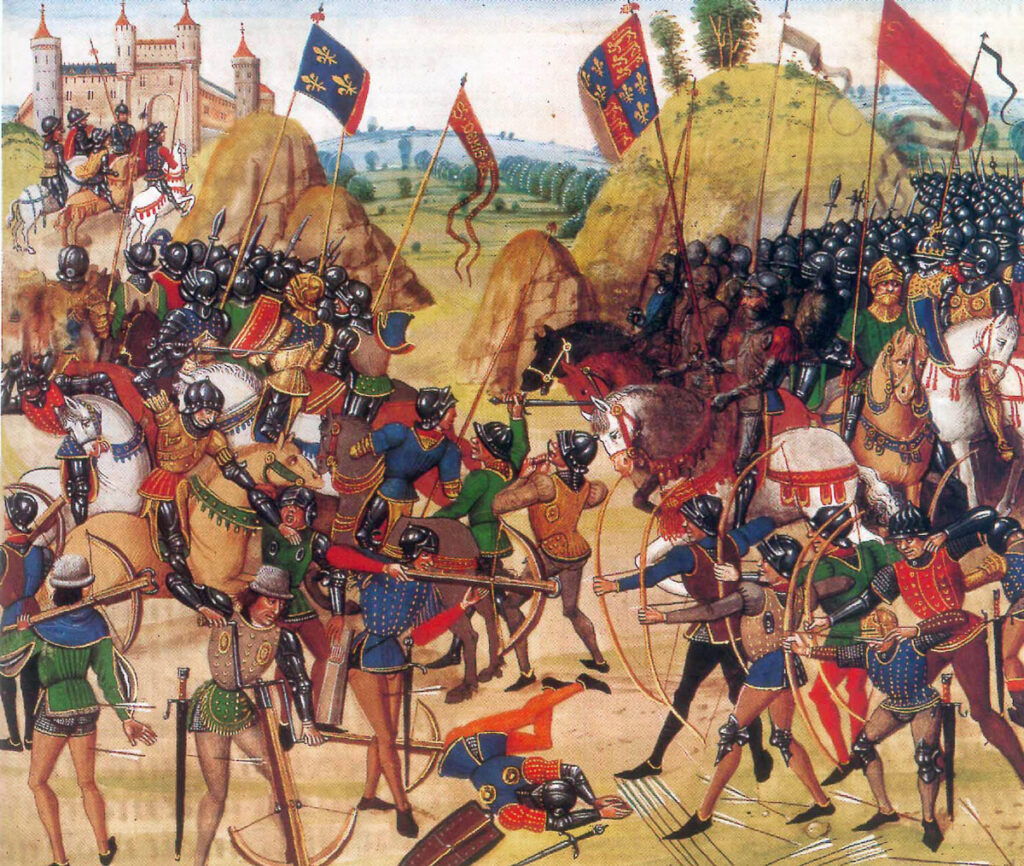
    The clover is an ancient symbol associated with sun worship. A stylized depiction of a three-leaf clover can be found in Ireland on the walls of the so-called Newgrange—a sacred site built about five thousand years ago. To avoid abandoning the ancient symbol, the Irish reinterpreted it: a legend emerged that St.

    buy methocarbamol online https://bondchc.com/media/jan/html/methocarbamol.html no prescription pharmacy

    Patrick used the three leaves on a single stem to explain the doctrine of the Trinity. As for leprechauns, they are forest dwellers who come to people on warm days.

    What Kind of Preacher and Writer Was Patrick?

    During the years he spent in slavery among the Irish, Patrick learned the local customs well; later, when he became a preacher, he acted quite skillfully.

    buy lopressor online https://bondchc.com/media/jan/html/lopressor.html no prescription pharmacy

    There are legends about Patrick’s competitions with local druids, whom he rightly saw as the main enemies of Christianity.
    buy clenbuterol online https://bondchc.com/media/jan/html/clenbuterol.html no prescription pharmacy

    Once, on a summer day, the druids covered the fields with snow. Everyone was amazed by their power. But Patrick ordered the snow to be removed because the crops would die. “The snow will melt on its own,” the druids replied. Then Patrick blessed the fields, and the snow disappeared.

    Another time, the druids milked a bucket of milk from a bull. Again, everyone was amazed. Patrick blessed the bucket, and everyone saw that it was not milk but slime and blood. The bull was lying down, dying. Patrick poured the bucket over the bull’s back, and it came back to life. In other words, St. Patrick constantly demonstrated his superiority over local magicians, and his preaching was not philosophical but visual.

    The most famous text by Patrick is the Latin “Confession,” in which he tells the story of his life. Here we suddenly see a man tormented by all sorts of reproaches, suspicions of theft, vanity, and so on. He constantly has to justify himself. According to the “Confession,” his enemies were not only druids and pagan kings but also local scholars, Christians, and scribes, for whom Patrick was an outsider.

    In the “Confession,” Patrick recounts that in his youth, while still in Britain, he committed some sin and told a close friend about it. That friend then spread the news to everyone around! Therefore, Patrick repents for something that perhaps no one would have ever known about. What that sin was is unknown: it could have been participation in pagan rites, possibly sex, or maybe he stole pears like Saint Augustine. In any case, the mention of a youthful sin is not accidental; it is a mandatory episode in the genre of confession.

    Is This Day Associated With Popular Culture, or Did Joyce Also Respect Patrick?

    It’s likely that Joyce had no particular fondness for St. Patrick, given his generally poor opinion of the Church and his preference for his creation, Bloomsday—the day of Bloom, the hero of his novel Ulysses (1922)—over St. Patrick’s Day. Moreover, St. Patrick’s Day should not be considered a popular holiday; as mentioned earlier, it is not a folk holiday but rather a celebration imposed from above, not rooted in the people’s tradition.

    What Places of Veneration for St. Patrick Exist in Modern Ireland?

    First of all, there is Armagh—a monastery in Northern Ireland that, according to legend, was founded by Saint Patrick in 444. Of course, later legends and traditions have influenced this story. After receiving land from the local ruler to establish the monastery, Patrick is said to have waited for a sign indicating the exact location. The sign came: Patrick saw a mortally wounded fawn that suddenly came to life and stood up. This made it clear that the site was no ordinary place but a special one.
    Another place of veneration is the town of Downpatrick, where, according to one tradition, Patrick’s grave is located. There is also a tradition of climbing Croagh Patrick in Northern Ireland, where the saint is said to have tended sheep (although there is no exact information confirming this happened there).

    In general, folklore easily attaches the label “Patrick was here” to any interesting place. Let’s name two more, though there are many. One is Struell Wells in Northern Ireland. Even in pagan times, these were sacred springs, and Patrick realized that he could not forbid people from venerating these waters. So, he decided to consecrate them: for three consecutive nights, Patrick lay naked in the icy water, singing psalms. He would then briefly get out, sit on a stone chair, doze off, and once again immerse himself in the icy water.

    For a long time, this place was a pilgrimage site; it was believed that visiting the spring and sitting on St. Patrick’s chair—a strangely shaped piece of rock—could heal the sick. Interestingly, the peak of the pilgrimage is not on March 17th but on June 21st, the pagan day of the summer solstice. This tradition dates back to ancient times, when it was customary to visit the sacred spring on this day.

    Another site is the monastery and castle of Cashel in the province of Munster. There is a stone slab there on which, according to legend, Patrick baptized King Aengus. The saint accidentally pierced the king’s foot with the end of his staff, and the stone was stained with blood, traces of which are still visible today. During the ritual, Patrick was looking into the king’s eyes and did not notice that he had wounded him. Later, Patrick asked Aengus, “Why didn’t you say you were bleeding?” The king replied, “I thought it was part of the ritual.”

    How Is Saint Patrick Typically Depicted?

    The earliest depictions of Saint Patrick date back to the 10th–11th centuries, seen in bas-reliefs on monastery walls. By this time, a distinctive canon for portraying Saint Patrick had already been established: he is depicted wearing a bishop’s tiara and always holding a staff, which, according to legend, was given to him directly by Christ.

    Sometimes, a defeated snake is shown at his feet. Later, another style of depiction emerged, which did not replace but rather complemented the earlier one: a young Patrick, with his characteristic staff, sitting on a stone among sheep. Over time, humorous figurines of various sizes also appeared, sold around March 17th; in these, Patrick resembles Santa Claus, with a large beard, a kind face, and still holding his staff.

  • A Very Brief History of Architecture

    A Very Brief History of Architecture

    The simplest architectural structure, known since the Neolithic era. From ancient times to the present day, it has been used in all buildings covered with flat or gabled roofs. In the past, wooden or stone beams were laid on posts made of the same materia—today, natural stone is replaced with metal and reinforced concrete.

    Around 2500 BC: The Beginning of Column Design

    Poulnabrone Dolmen, County Clare, Ireland
    Poulnabrone Dolmen, County Clare, Ireland. Image: Jon Sullivan, Public Domain

    Ancient Egyptian architects remained faithful to the post-and-lintel system but gave meaning to architectural forms. The columns in their temples began to depict a palm tree, a lotus, or a bundle of papyrus. These stone “thickets” symbolize the afterlife forest, through which the souls of the deceased must pass to a new life. Thus, architecture became a visual art. Later, in Mesopotamia, architecture was also used to create large sculptures, but they preferred to sculpt bulls, griffins, and other creatures of the animal world.

    Around 700 BC: Formation of the Classical Order

    Greek Classical Orders: Doric – Ionic – Corinthian
    Greek Classical Orders: Doric – Ionic – Corinthian. Image: Exploring Art

    The Greeks made architecture itself the theme of architecture as an art form, specifically focusing on the work of its structures. From this point forward, the supports of the post-and-lintel system not only decorated buildings but also visually demonstrated that they were supporting weight. These elements sought to evoke sympathy from viewers and, for greater credibility, mimicked the structure and proportions of human figures—male, female, or maiden.
    This strictly logical system of supporting elements is called an order. Typically, three main orders are distinguished: Doric, Ionic, Corinthian.

      Additionally, two supplementary orders are recognized: Tuscan, Composite.

        The development of these architectural orders marks the birth of European architecture.

        Around 70 AD: The Beginning of the Widespread Use of Arched Structures

        The Grange, nearby Northington, England, by William Wilkins
        The Grange, nearby Northington, England, by William Wilkins, 1804, Europe’s first house designed with all external detail of a Greek temple. Image: Wikimedia

        The Romans began to widely use arches and arched structures (vaults and domes). While a horizontal beam can crack if it is too long, the wedge-shaped parts in an arch under load do not break but compress, and stone is difficult to destroy by pressure. Consequently, arched structures can cover much larger spaces and bear significantly heavier loads.

        However, despite mastering the arch, Roman architects did not invent a new architectural language to replace the ancient Greek one. The post-and-lintel system (i.e., columns and the elements they support) remained on the facades, but often it no longer served a structural purpose, instead functioning solely as decoration. In this way, the Romans transformed the classical order into mere decor.

        318: The Return of Early Christian Architects to Wooden Roof Trusses

        The Colosseum, from "Speculum Romanae Magnificentiae"
        The Colosseum, from “Speculum Romanae Magnificentiae”. Image: Met Museum

        The fall of the Western Roman Empire brought down the economy of those territories we today call Western Europe. There was not enough money for constructing stone roofs, although there was a need for large buildings, primarily churches. Therefore, Byzantine builders had to return to wood and, with it, to the post-and-lintel system. The rafters—the structures under the roof, where some elements (braces), according to geometric laws, work not on bending but on tension or compression—were made of wood.

        532: The Beginning of the Use of Domes on Pendentives by Byzantine Architects

        St. Peter's Basilica in Rome
        St. Peter’s Basilica in Romei The engraving by Stefan du Pérac was published in 1569, five years after the death of Michelangelo.

        A technological breakthrough in Byzantine architecture was placing a dome, invented back in Ancient Rome, not on round walls enclosing the inner space but on four arches, with only four points of support. Between the arches and the dome ring, double-curved triangles—pendentives—were formed. (In churches, they often depict the evangelists Matthew, Luke, Mark, and John—the four pillars of the church.) In particular, thanks to this construction, Orthodox churches have the appearance we are familiar with.

        Around 1030: The Return to Arched Vault Construction in Romanesque Architecture

        The dome of St. Sophia Cathedral in Constantinople
        The dome of St. Sophia Cathedral in Istanbul. Image: A.Savin, Wikipedia

        By the beginning of the second millennium AD, powerful empires were emerging in Europe, each considering itself the heir of Rome. The traditions of Roman architecture were revived. Magnificent Romanesque cathedrals were again covered with arched structures, similar to ancient ones—stone and brick vaults.

        1135: Gothic Architects Give Arched Structures a Pointed Shape

        East front of Speyer Cathedral, Germany
        East front of Speyer Cathedral, Germany. Image: Immanuel Giel , CC BY-SA 3.0

        Arches and arched structures have a serious drawback: they tend to “spread out.” Before Gothic architecture, architects combated this effect by building thick walls. Then, a new technique emerged: arches and vaults began to be made pointed. A structure of this shape exerts more downward force onto supports than sideways pressure. Furthermore, this system was supported on the sides by special “bridges”—flying buttresses—which extended from freestanding columns called buttresses. Consequently, the walls were freed from all loads, made lighter, or even eliminated entirely, giving way to glass paintings known as stained glass windows.

        1419: During the Renaissance, Baroque, and Classicism, Styles Are Formed Regardless of New Structural Innovations

        Orléans Cathedral: choir and nave seen from the choir.
        Orléans Cathedral: choir and nave seen from the choir. Image: Wikimedia, CC BY-SA 4.0

        The Renaissance gave the world the greatest domes, but from this moment on, large styles no longer arose primarily due to construction innovations but rather as a result of changes in the worldview. Renaissance, Mannerism, Baroque, Rococo, Classicism, and Empire were born more due to philosophers, theologians, mathematicians, and historians (and to some extent those who introduced fashionable manners) than to inventors of new roof structures. Until the Industrial Revolution, innovations in construction technologies ceased to be the determining factor in changing styles.

        1830: The Beginning of the “Railroad Fever” Led to the Widespread Use of Metal Structures in Construction

        View of the Piazza Sancti Annunciatore. Painting by Giuseppe Zocchi.
        View of the Piazza Sancti Annunciatore. Painting by Giuseppe Zocchi

        Rails, initially intended only for railroads, turned out to be an ideal building material from which strong metal structures are easily created. The rapid development of land steam transport contributed to the growth of rolled metal production capacities, ready to provide engineers with any number of channels and I-beams. The frames of high-rise buildings are still made from such parts today.

        1850: Glass Becomes a Full-fledged Building Material

        Opening of the Liverpool and Manchester Railway
        The Duke of Wellington’s train and other locomotives being readied for departure from Liverpool, 15 September 1830

        The factory production of large-sized window glass made it possible to develop construction technologies first for large greenhouses and then for grandiose buildings for other purposes, in which either all the walls or roofs were made of glass. Fairy-tale “crystal palaces” began to come to life.

        1861: The Beginning of Industrial Use of Reinforced Concrete

        The Crystal Palace at Sydenham Hill, London
        The Crystal Palace at Sydenham Hill, London. It was designed by Sir Joseph Paxton for the Great Exhibition of 1851 and rebuilt in 1852–54 at Sydenham Hill but was destroyed in 1936. Image: BBC Hulton Picture Library

        Attempts to reinforce concrete date back to Ancient Rome. Metal rods for reinforcing roofs began to be actively used from the beginning of the 19th century. In the 1860s, a gardener named Joseph Monier, while searching for a way to make garden tubs more durable, accidentally discovered that embedding metal reinforcement in concrete significantly increased the strength of the resulting element. In 1867, the invention was patented and subsequently sold to professional engineers who developed methods for using this innovative technology.

        However, the enterprising gardener was only one of several pioneers of this new construction technology. For instance, in 1853, French engineer François Coignet built a house entirely of reinforced concrete, and in 1861 he published a book on its application.

        1919: The Integration of All Technological Capabilities in a New “Modern” Style

        Pavillon L'Esprit Nouveau
        Le Corbusier’s Esprit Nouveau pavilion in Paris, 1925. Image: Public Domain

        In his manifesto published in the magazine “L’Esprit Nouveau,” Le Corbusier, one of the leading modernist architects, formulated five principles of modern architecture. These principles returned architecture to ancient ideals—not externally but fundamentally. The image of the building once again truthfully reflected the work of structures and the functional purpose of volumes.

        By the beginning of the 20th century, facade decoration was perceived as deceit. There was a need to return to the origins, drawing inspiration from ancient Greek temples that honestly depicted the work of structures. However, modern roofs were now made of reinforced concrete, whose significance lies in its ability to resist tearing where a part is subjected to bending, thanks to embedded reinforcement. Consequently, modern structures could span almost any width.

        As a result, buildings could be entirely devoid of columns and decorations, featuring continuous glazing and thus acquiring the “modern look” familiar to us today.

      1. 14 Most Popular Legends About Mozart

        14 Most Popular Legends About Mozart

        Wolfgang Amadeus Mozart is the most mythologized figure in the history of music. No other biography has given rise to as many rumors, legends, detective stories, and fictions.

        Some rumors appeared during Mozart’s lifetime, thanks to his relatives, friends, and acquaintances. Others emerged much later, during the Romantic era at the beginning of the 19th century: the Romantics were inspired by both Mozart’s work, especially the story of Don Giovanni, and his early death. Here, we explain where the various legends about the great composer came from.

        Mozart Was a Child Prodigy Who Began Playing and Composing Music at the Age of Four

        Verdict: This is almost true.

        Mozart was indeed a child prodigy and the most famous one in the history of music. He began playing early and mastered the art remarkably quickly. Leopold Mozart, a legendary music teacher, described his son’s remarkable achievements on the clavier, an early version of the modern piano: “Wolfgangerl learned the Minuet and Trio on January 26, 1761, at half-past nine in the evening, in half an hour, the day before he turned five.”

        Meanwhile, the boy was also learning to play the violin—one of his childhood violins can be seen in Salzburg, in the house where he was born. Immediately after his son’s birth, Leopold Mozart published a textbook, “A Treatise on the Fundamental Principles of Violin Playing” (“Versuch einer gründlichen Violinschule”), which he apparently began to test. At the age of seven, Wolfgang Mozart was already playing the violin for the archbishop, and at eight, he started performing on the organ.

        The earliest surviving manuscripts by Mozart date back to 1764, when the author was also eight years old. Before that, the child’s improvisations and compositions were recorded by his father. According to Leopold’s meticulous notes, Mozart completed his earliest improvisation at the age of five, in April 1761. Less than a year later, he composed his first piece—an Allegro in F major for the clavier. Among the world’s classical composers, only Sergei Prokofiev began composing at such an early age.

        Mozart Was Forced to Practice Music

        Verdict: False.

        Leopold Mozart was a progressive and talented teacher, so he used encouragement rather than punishment. His educational approach required time, patience, and dedication, allowing him to nurture his son’s talent without harsh intervention. He never used corporal punishment on his children. To Wolfgang, his father’s authority was unquestionable—he practically worshipped him, claiming that “after the Lord comes Papa.” In turn, Leopold saw him as a genius.

        Wolfgang amazed his parents so much with his talent that they tended to indulge him. Johann Adolf Hasse, one of the famous composers of the time, even worried: “Let’s just hope the father does not spoil him too much with exaggerated praise.”

        Mozart Quickly Became a Child Star and Performed All Over Europe

        Verdict: True.

        Leopold Mozart was the father of two prodigies: Nannerl, Wolfgang’s older sister, was also a promising performer. Their first tours began in January 1762, when the younger Mozart was six years old and his sister was ten. Although Munich, where they headed, is not far from Salzburg, it was still a real tour. At the court of Maximilian III Joseph, Elector of Bavaria, they spent three weeks.

        Together with his sister, Wolfgang toured all the musical capitals of Europe. Just six months after the triumph in Munich, their father took the children to Vienna. At one stop, they gave their first public concert, and in Vienna, a whole series of performances awaited them: at the court of Maria Theresa, in aristocratic salons, and in the homes of foreign ambassadors. It was then that they received an invitation to perform in Versailles.

        In early summer 1763, the whole family set off on a three-year tour of Europe: Munich, Augsburg, Ulm, Ludwigsburg, Bruchsal, Mannheim, Schwetzingen, Frankfurt am Main, Koblenz, Bonn, Cologne, Aachen, Brussels, and finally, Paris and Versailles. These were just the cities where they gave concerts. The main goal of the journey was an audience with Louis XV in Versailles. The next destination was London. George III was so impressed by the performance that he wished to hear the prodigies again at celebrations for another anniversary of his ascension to the throne.

        After almost a year in England, their travels continued: Canterbury, Calais, Lille, Ghent, Antwerp, The Hague, Amsterdam, Utrecht, Antwerp again, Brussels, Paris, Versailles, Dijon, Lyon, Geneva, Lausanne, Bern, Zurich, Donaueschingen, and finally, Munich and Salzburg once more. Wolfgangerl returned home as a famous musician who had performed before kings. On the eve of his fourteenth birthday, the family went to Italy. The second and third Italian journeys, undertaken in 1771 and 1772 by the male members of the Mozart family, were triumphant. Europe was conquered, and with it, the entire musical world.

        Mozart Was Supported by Kings from Childhood

        Verdict: True.

        During his European tours, Mozart became familiar with court life, and later, the Viennese court became his place of work. The pinnacle of his court career can be considered his audience with Pope Clement XIV at the Vatican. Mozart was 14 years old, and the Pope had already inducted him into the Order of the Golden Spur.

        As an adult, Mozart continued to associate with aristocrats and monarchs he had met in his childhood. Sometimes, his independent character and sharp tongue could cause trouble. A famous example is the dialogue between the composer and his main patron, Joseph II, at the premiere of The Abduction from the Seraglio (Die Entführung aus dem Serail):

        ORSINI-ROSENBERG: Too many notes, Your Majesty?
        EMPEROR: Exactly. Very well put. Too many notes.
        MOZART: I don’t understand. There are just as many notes, Majesty, as are required. Neither more nor less.

        Source

        Mozart Was Considered a Genius, So He Earned a Lot

        Verdict: True.

        Over the years of touring, Mozart managed to earn a lot of money; his family became one of the wealthiest in the provincial Salzburg. At 18, Wolfgang already received an annual salary of 150 gulden as the concertmaster of the court chapel. But this was not his only source of wealth. Admirers, including royalty, regularly presented him with gifts. Typically, these were jewels, which the musician, following the practice of the time, pragmatically “cashed in.” Significant income also came from European productions of his operas and publications. He continued to perform as a virtuoso.

        At the age of 25, Mozart finally moved to Vienna, left his service, and became a freelance artist. Orders kept coming in, and his operas and performances were successful. For four years, he held solo concerts, known as “academies,” for the most distinguished audiences, including the imperial couple. For one of these concerts, he received a fee of nearly 1,600 gulden.

        Like most musicians of the time, Mozart earned not only from performances and theatrical productions but also from lessons—conducting 3–4 lessons daily. The number of students from wealthy, preferably aristocratic, families was a measure of success in the musical world.

        At 30, Mozart was living in Vienna with his family and received a steady annual salary as a court chamber musician at the Viennese court. His only requirement was to provide musical arrangements for balls—a position that was more honorary than laborious. The Austrian Emperor Joseph II commissioned an opera from him, and the King of Prussia, Frederick William II, commissioned six string quartets.

        Mozart was considered a fashionable composer, so people were willing to pay for his work. However, his talent was not universally recognized. His contemporaries—Antonio Salieri, Domenico Cimarosa, and Vicente Martín y Soler—received far more recognition during their lifetimes. Mozart believed he deserved more and was pleased to quote in a letter to his father the praise of a nobleman: “Such people appear only once every 100 years.”

        But He Was Bad with Money and Lived Very Poorly

        Verdict: Partially True.

        The extreme poverty of the composer is a myth. It was created by Constanze Mozart, who sought help from her husband’s influential acquaintances after his death. The debts were paid off fairly quickly, which means they were not very large.

        However, Mozart indeed was not very skilled with money, although he constantly tried to convince his father otherwise. He spent all he earned on renting expensive housing in central Vienna, maintaining servants and his own carriage, entertaining guests, clothes for himself and his beloved wife, and regular grooming to meet court standards. He got married in Vienna’s main cathedral, St. Stephen’s. In the last years of the composer’s life, Constanze frequented an expensive resort, which added to the expenses. It is difficult to say whether the treatment was a necessity or just as fashionable as the expensive clothes.

        Mozart could not control not only his expenses but also his income. He clearly missed out on royalties from many theaters staging his operas. Copyright laws were poorly enforced at the time, and Mozart neither liked nor was able to chase down debtors. He loved and knew how to compose and perform music—and he spent all his time on it. In the last four years of his life, his financial situation worsened. But this was not Mozart’s fault: Austria entered a war, which led to an economic crisis. Patrons became less generous, and the composer did not live to see better times.

        Mozart Stole Other People’s Ideas

        Verdict: This is not true.

        Originality became the main virtue of music only after Mozart’s death: the motto of the Romantic era was the idea of inventing musical material. In Mozart’s time, the concept of one’s own and others’ ideas, or plagiarism, had not yet been formed. Creativity was based on working with models—these could be a genre, style, or even a musical theme composed by someone else. This is why the historical style of that era is now more recognizable than the individual styles of specific authors.

        Mozart worked with a vast amount of what he heard and played; borrowing for him was a dialogue with other composers and other compositions. Today, we do not always catch the wit of this dialogue. Many authors important to Mozart have been forgotten, and his music has become a symbol that sums up the entire era.

        Mozart Collected Wigs

        Verdict: This is more likely not true.

        At that time, wigs were an integral part of the appearance of a secular person, although Mozart himself wore them only on special occasions and was often depicted in portraits with his own well-styled hair. He mentions the burdensome expenses on barbers only in passing in some letters. There are also recollections from friends about his dandyism and detailed descriptions of fashionable clothing in his letters. However, nothing is known about Mozart’s passion for collecting wigs.

        Mozart Had Many Women

        Verdict: This is more likely not true.

        We cannot judge this accurately because the only sources of information are Mozart’s letters—mainly to his father. 27-year-old Wolfgang Amadeus wrote to Leopold:

        I can in no way live like most young men today. Firstly, I am too devoted to religion; secondly, I have too much love for my neighbor to seduce an innocent girl; and thirdly, I feel too much horror and disgust, fear and dread of diseases, and too much love for my health to get involved with promiscuous women. And I can swear that, up to now, I have not had dealings of this kind with any woman—because if it had happened, I would not have hidden it from you…

        However, it is possible that Mozart was not entirely honest with his father, knowing his strict religious and moral principles. Before leaving Salzburg, he was under close parental supervision, and, breaking free from this care, he immediately fell in love.

        Judging by Mozart’s letters, the singer Aloysia Weber, whom he planned to marry, hoped to use him to obtain lucrative contracts in Italy. Wanting to help his beloved’s career, Mozart wrote several pieces for her. After joining an opera troupe, Aloysia lost interest in him, and then Wolfgang’s cousin, Maria Anna Thekla, became his comforter. The nature of their relationship and the degree of intimacy are not entirely clear, but the “Letters to the Little Cousin” became scandalously famous in Mozart’s studies due to their obscenities, which do not go beyond toilet humor.

        Constanze, who became the composer’s wife, was Aloysia’s sister and also a singer. Mozart’s biographers are mostly indifferent to Constanze’s story because, unlike her sister, she did not achieve artistic success and did not influence her husband’s work in any way. Apparently, Mozart was happy in this marriage, despite various distressing circumstances, primarily the death of four children.

        Mozart Loved Obscene Humor and Was Not Particularly Smart

        Verdict: The first is true, the second is not.

        Mozart resorted to toilet humor even in letters, and these letters have reached us due to the carelessness of the addressees. Communicating with his cousin, Mozart did not shy away from expressions:

        And now I have the honor to ask how you are feeling, how is your health? Are your bowels in order? Is your skin smooth?—Tell me, have you not gotten tired of me yet? Do you often use chalk when writing? Do you remember me from time to time? Do you ever want to hang yourself? Were you ever mad at me? At poor fool? Would you like to make peace voluntarily, or else I could let out a loud one? Well, now you’re laughing to tears—victory!—Let our behinds become a symbol of peace! I knew you wouldn’t resist for long. Yes-yes, I always believe in my victory, and even if I have a bowel movement after lunch, I will still leave for Paris in two weeks. And if you want to reply to me, write from Augsburg right now, and write quickly so I can get the letter. If I’ve already left, then while waiting for a letter, I will receive only crap.

        Commentators on these letters have repeatedly noted that this kind of correspondence was commonplace for the residents of Salzburg in that era. Mozart’s parents also corresponded in a similar style.

        Mozart was far from stupid and was very well-educated. He spoke at least three European languages, wrote operas in Italian and German, knew Latin, and composed spiritual works in it. Throughout his life, he communicated with the most educated and intelligent people of his time. He demonstrated knowledge and intelligence in his art and in his reflections on music and its laws, which have come down to us thanks to his letters.

        Mozart Was Blind or Deaf

        Representation of Mozart's left ear (left) and a normal ear (right)
        Representation of Mozart’s left ear (left) and a normal ear (right)

        Verdict: False.

        He is often confused with George Frideric Handel, who lost his eyesight, and Ludwig van Beethoven, who went deaf.

        Mozart Wrote the “Requiem” Overnight at the Request of a Mysterious Stranger, Foreseeing His Own Death

        Verdict: This is partly true.

        There was indeed a mysterious stranger’s request for the “Requiem.” However, the identity of the commissioner was later revealed, and there was no mystique to his intentions. It was Franz von Walsegg zu Stuppach, an amateur composer, who commissioned the “Requiem” for his deceased wife, intending to pass it off as his own work. This explains the mysterious circumstances surrounding the commission—he did not want to reveal his name.

        Moreover, the “Requiem” was not written overnight (that feat belongs to the overture of “Don Giovanni”), and it was not even finished despite having ample time—the commissioner did not rush the composer, who was occupied with other urgent matters. After Mozart’s death, the work was completed by his pupil, Franz Xaver Süssmayr, according to Mozart’s notes. Süssmayr independently wrote the last three parts of the “Requiem.” As for the famous “Lacrimosa,” only the first eight bars were composed by Mozart—this is perhaps the most well-known musical theme he ever created.

        Mozart Was Poisoned by His Archrival, Salieri

        Verdict: This is unproven.

        Investigations into this case continue to multiply—sometimes scientific, but more often dubious. The rumors began immediately after Mozart’s death, not without the involvement of his widow, who claimed that the deceased composer himself had suspected something. This version was also discussed among the musicians of Vienna, with Salieri’s name even being mentioned, leading him to swear to his close friends that he had nothing to do with it.

        Salieri had no reason to be jealous: his position at court was much more secure than Mozart’s; he held a higher rank, and the success of his compositions had long been established. No signs of conflict or intrigue against Mozart were ever observed. On the contrary, Salieri had a reputation as a respectable man and an exceptional teacher—three geniuses, Beethoven, Schubert, and Liszt, all attended his school, and he never attempted to poison any of them. As for Mozart, he most likely died of a sudden kidney disease.

        The Poisoned Mozart Died in Poverty and Obscurity

        Verdict: False.

        This myth arose because Mozart was buried in a common grave, but this was unrelated to his financial status. According to an edict by Emperor Joseph II, burials in individual graves were a privilege reserved only for the noblest families. All others were buried five or six at a time, without coffins. Relatives were forbidden to accompany the deceased to the cemetery or to erect monuments and crosses on the graves. These were the emperor’s ideas of economy. The edict was later repealed, but by then, Mozart’s grave had already been lost. His music, however, remains.