Tag: france

  • Was the French Language Born in the Middle Ages?

    Was the French Language Born in the Middle Ages?

    The existence of the Oaths of Strasbourg in 842, which are mutual assistance oaths between Charlemagne‘s grandsons (a bilingual document in the Gallo-Roman language, the “ancestor” of French, and in Old German), is not sufficient to identify the beginnings of the use of French in administrative documents and political acts. The use of the language must correspond to a common practice that can be observed if the state of the archives allows it.

    The Emergence of Vernacular Languages
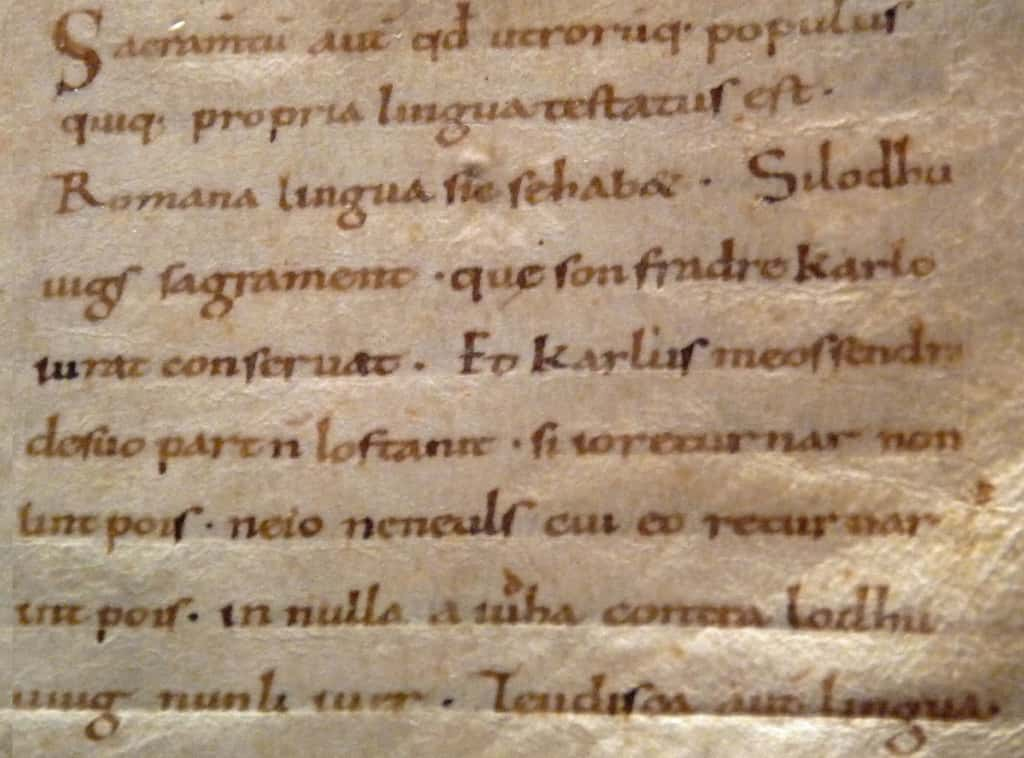
    Extract from the Strasbourg Oaths written in 842, text in Gallo-Romanic (“Romana lingua”)
    Extract from the Strasbourg Oaths written in 842, text in Gallo-Romanic (“Romana lingua”); copy made in Soissons in the 10th century. Exhibition at the Musée Historique de Strasbourg in 2012.
    buy zoloft online https://jayhawkfoot.com/wp-content/uploads/2025/03/jpg/zoloft.html no prescription pharmacy

    Wikimedia Commons, Public Domain

    A distinction must be made within the vernacular languages (local languages spoken by the community) derived from Latin, between Romance languages and those belonging to other linguistic families (Germanic, Celtic, and Slavic). As long as the link between Romance dialects and the Latin mother tongue remains, Latin continues to be used in writing. Non-Romance languages, autonomous from Latin, appear in charters (written administrative and legal acts) earlier, particularly in non-Romanized territories (Scandinavia, Central Europe, etc.).

    Throughout medieval Western Europe, the primary language of charters remained Latin, which accompanied the spread of Christianity. The Latin language, liturgical and scholarly, was essentially used for establishing legal acts involving ecclesiastics. Vernacular languages penetrated charters in two different ways: first, through the clear replacement of Latin by another language, with acts written entirely in the vernacular. This almost immediate transition seems to have been the case for French. Alternatively, a vernacular language could be inserted through words and then sentences in acts written in Latin.

    Langue d’oïl and Langue d’oc
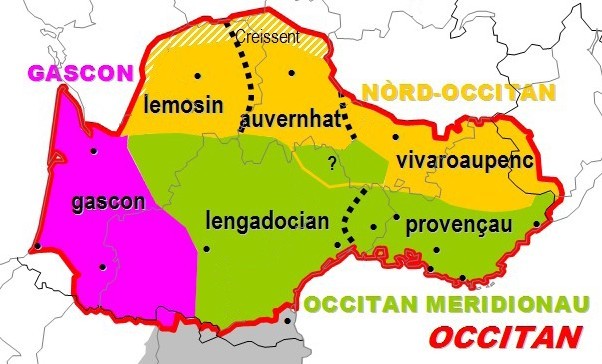
    A map of Occitan dialects according to Pierre Bec
    Geographical area of the main dialects of the langue d’oc. Image: Domergue Sumien, CC BY 3.0

    The linguistic border between langue d’oc and langue d’oïl separates the regions where Occitan languages (or Occitano-Romance languages) are spoken from those where langues d’oïl (Gallo-Romance languages) are used. This transitional space is a contact zone between oc and oïl dialects, embodied in dialects influenced by each linguistic domain. The Occitan language has been spoken since around the 8th century by a population occupying a space delimited by the Atlantic and the Po Valley on one hand and by the north of the Massif Central and the Pyrenees on the other.

    Provinces and later regions share this highly diversified linguistic space, which includes the following variants: Old Occitan, Aranese, Auvergnat, Béarnais, Gascon, Gavot, Limousin, Languedocian Occitan, Provençal, Nissart, and Vivarois. What do Béarn and the Nice region have in common? The only element uniting them in the long term is the language of their inhabitants, which is a local representation of Occitan.

    The langue d’oïl is a Gallo-Romance language that developed in the northern part of France, southern Belgium, and the Channel Islands. It then encompassed different cousin dialects (French, Orléanais, Burgundian-Morvandiau, Champenois, Lorraine Roman, Picard, Walloon, Norman, Gallo, Angevin, Tourangeau, Sarthois, Mayennais, Percheron, Franc-Comtois, Poitevin, Saintongeais, Berrichon, Bourbonnais). This northern linguistic group retained an important Celtic substrate and underwent significant influence from Germanic dialects.

    From one oïl dialect to another, people managed to understand each other, thanks to administrative writing. In Paris (11th-12th centuries), a French “porous” to all these dialects was spoken, which became a linguistic reference in the 14th century as the city became the political and administrative capital of the kingdom.

    The Progression of the French Language in the Kingdom of France

    French is the medieval “vulgar” (living) language that experienced its strongest expansion outside its territory of origin, the oïl domain. The first “export” of French was a consequence of the Norman conquest of England in 1066: a cousin variant of French, Anglo-Norman, was established in the British Isles. At the same time, the clergy of the kingdom perpetuated Latin habits. In the 1230s-1240s, the practice of French spread in legal and administrative acts established by the Dukes of Lorraine and the Counts of Luxembourg.

    In the Kingdom of France, the Dukes of Champagne and Burgundy (great fiefs vassal to the king) began to use it. French penetrated the Duchy of Brittany during the years 1250 to 1280; it spread from the middle of the 13th century in Flanders. On the other hand, the center and west of the oïl domain remained very faithful to Latin throughout the 13th century.

    As French became the language favored by the king, it gradually replaced other vernacular languages of the kingdom. In southern Roman France, the French language penetrated rather slowly: introduced around 1250 in the Dauphiné, it spilled over into the lands of the Germanic Empire from the end of the 13th century (French-speaking Switzerland, Savoy, and the Aosta Valley) and imposed itself in Lyon in the 15th century. In the oc domain, the penetration of legal French did not begin with the Albigensian Crusade.

    It was late and gradual: present after 1350 in Auvergne and Limousin, French imposed itself in Languedoc and Provence after 1450. At the beginning of the 16th century, only the Pyrenees maintained a written production exclusively in the Occitan language; however, in the oc domain, the role of the king’s language was still limited because Latin and local vernacular languages coexisted with written French.

    In the 14th century, French became the language of royal administration at the local level of bailiwicks and seneschalties, then at the central level of the Chancellery and Parliament, until it supplanted Latin after the ordinance of Villers-Cotterêts in 1539.

    buy vermox online https://jayhawkfoot.com/wp-content/uploads/2025/03/jpg/vermox.html no prescription pharmacy

    Forty percent of the words in our dictionaries were forged between the 14th and 16th centuries: this is the period of “Middle French.
    buy symbicort online https://jayhawkfoot.com/wp-content/uploads/2025/03/jpg/symbicort.html no prescription pharmacy

    ” The emergence of a standardized linguistic form, modern French, did not occur before the 17th century, with the creation of the French Academy.

    A Multilingual Metropolitan France

    Today’s France is largely multilingual, thanks to its exceptional linguistic heritage, composed of five Romance languages (oïl domain, Occitan, Catalan, Franco-Provençal, and Corsican), three Germanic languages (Alsatian, Franconian, and Western Flemish), one Celtic language (Breton), and one pre-Indo-European language (Basque). Not to mention the French-based creole languages (America, West Indies, Indian Ocean, Pacific) and all the languages of immigration!

  • Why Did France Take Part in the American Revolutionary War?

    Why Did France Take Part in the American Revolutionary War?

    When American schoolchildren learn the story of the American Revolutionary War (1775–1783), the conflict is naturally framed as a struggle by patriotic colonial militias fighting for democratic liberty and “no taxation without representation” against the British Crown. Yet look at the paradoxical partner who bankrolled, armed, and ultimately won that war alongside George Washington at Yorktown: King Louis XVI of France, the absolute monarch of Europe’s greatest Catholic superpower, a ruler who allowed zero elected parliament or tax voting inside his own kingdom! Why did an absolute French king spend over 1.3 billion livres—driving his own treasury into the bankruptcy that triggered the French Revolution—to help create an English-speaking Protestant republic three thousand miles across the Atlantic? The answer lies in a cold, calculated masterclass of eighteenth-century realpolitik, geopolitical revenge, and the genius of French Foreign Minister Charles Gravier, Comte de Vergennes.

    1. Avenging the Humiliation of 1763 (The Seven Years’ War)

    The single greatest engine driving French intervention in America had nothing to do with Thomas Jefferson’s Declaration of Independence and everything to do with the traumatic memory of February tenth, 1763: the signing of the Treaty of Paris at the end of the Seven Years’ War (known in North America as the French and Indian War). In that global conflict, Great Britain had utterly humiliated the Bourbon monarchy of France—stripping France of all of Canada (New France), the entire Ohio and Mississippi river valleys, key Caribbean islands, and dominance in India.

    For the next twelve years, France’s brilliant war and foreign ministers—first the Duke of Choiseul and then, starting in 1774 under the young King Louis XVI, the calculating diplomat Charles Gravier, Comte de Vergennes—prepared day and night for a war of revenge (revanche):

    • Rebuilding the French Navy: France poured hundreds of millions of livres into constructing eighty modern, copper-bottomed ships-of-the-line (74-gun and 80-gun warships) engineered to challenge the British Royal Navy on equal terms.
    • The Balance-of-Power Calculation: Vergennes was convinced that Great Britain’s arrogant maritime and commercial dominance rested entirely on its monopoly over the trade and resources of its thirteen North American colonies. If France could slice those thirteen colonies away from London, Britain would be permanently reduced to a second-rate island power while France regained its rightful place as the arbiter of Europe!

    2. Secret Gun-Running: Beaumarchais and “Hortalez & Co.” (1776–1777)

    When fighting erupted between American colonists and British troops at Lexington and Concord in April 1775, Louis XVI and Finance Minister Turgot were initially cautious about declaring an open war that might ruin France’s fragile finances unless they were sure the Americans wouldn’t surrender after six months. So in the spring of 1776, Vergennes authorized one of the greatest covert intelligence operations in history, entrusting one million livres of secret French gold (matched by another million from King Charles III of Spain) to a flamboyant French spy, watchmaker, and famous playwright—Pierre-Augustin Caron de Beaumarchais, the author of The Barber of Seville and The Marriage of Figaro!

    Setting up a fake international front company in Paris called Roderigue Hortalez and Company, Beaumarchais secretly shipped whole fleets of military cargo across the Atlantic to George Washington’s starving Continental Army before France ever fired a shot:

    • 90% of America’s Gunpowder: During the critical first two and a half years of the Revolution, fully ninety percent of all the gunpowder fired by American troops—alongside 30,000 Charleville flintlock muskets, 200 bronze Gribeauval field cannons, tents, uniforms, and shoes—came directly from secret French shipments!

    3. Benjamin Franklin’s Fur Hat and the Turning Point of Saratoga

    While Beaumarchais shipped the guns, two events in 1776 and 1777 tipped France from covert aid into full-scale military alliance. First, in December 1776, seventy-year-old Benjamin Franklin landed in France as the American commissioner. Knowing that Parisian Enlightenment salons idolized Jean-Jacques Rousseau’s ideal of the “simple frontier philosopher,” the shrewd Franklin ditched his powdered wig, wore a rustic Canadian marten-fur cap and plain brown coat to court at Versailles, and charmed French aristocrats, ladies, and young idealists like the nineteen-year-old Marquis de Lafayette into treating the American cause as the most fashionable crusade on Earth.

    Still, King Louis XVI waited for proof that the Americans could beat a regular British army in the open field. That proof arrived in Paris in December 1777 with news of the Battle of Saratoga (October 1777)—where American generals Horatio Gates and Benedict Arnold (fighting with French muskets and French gunpowder!) forced an entire British army of six thousand men under General John Burgoyne to surrender in upstate New York. Terrified that Britain might now offer the Americans generous peace concessions to keep them inside the British Empire, Vergennes moved immediately: on February sixth, 1778, France and the United States signed the formal Treaty of Alliance and the Treaty of Amity and Commerce, recognizing the United States as an independent nation and pledging to fight until American independence was won.

    4. How French Ships and Soldiers Won Yorktown (1781)

    Once France entered the war openly in 1778 (soon bringing Spain in 1779 and the Dutch Republic into the war as well), Britain could no longer focus exclusively on George Washington; London had to pull troops and warships out of America to defend the English Channel from invasion, fight the French in the Caribbean sugar islands, defend Gibraltar against Spain, and battle French Admiral Suffren in the Indian Ocean.

    The climax of France’s intervention occurred in October 1781 at Yorktown, Virginia—a battle where there were actually more French soldiers and sailors fighting than Americans!

    1. Admiral de Grasse Seals the Sea (Battle of the Chesapeake): On September fifth, 1781, a French battlefleet of twenty-four ships-of-the-line commanded by Admiral Comte de Grasse defeated the British Royal Navy fleet at the mouth of the Chesapeake Bay—cutting off British General Lord Cornwallis’s army at Yorktown from rescue or resupply by sea.
    2. Rochambeau’s Army and Siege Guns on Land: Marching south from Rhode Island alongside Washington’s Continentals came 5,500 veteran French regular soldiers under General Comte de Rochambeau (funded with gold coins borrowed in Havana), who dug theVauban-style parallel siege trenches and battered Cornwallis’s redoubts into surrender on October nineteenth, 1781.

    Although Britain quickly recovered its global commercial dominance after the 1783 Treaty of Paris (continuing to trade heavily with its former American colonies) while Louis XVI got almost zero new territory to pay back his 1.3-billion-livre war debt—and while French officers like Lafayette returned home carrying contagious ideas about “the Rights of Man” and constitutional liberty—France’s decisive intervention achieved its goal of giving birth to the United States of America.

  • 1962 Assassination Attempt on Charles de Gaulle

    1962 Assassination Attempt on Charles de Gaulle

    On the rainy, dusk-lit evening of August twenty-second, 1962, as French President Charles de Gaulle and his wife Yvonne sped through the southwestern Paris suburb of Petit-Clamart toward Villacoublay military airfield to catch a flight home, their unarmored black Citroen DS 19 sedan drove straight into a military crossfire. Twelve heavily armed gunmen belonging to the Secret Army Organization (OAS) opened fire with submachine guns and light machine guns, riddling the presidential car with fourteen bullet holes at close range, shattering the rear window inches from De Gaulle’s head, and blowing out two tires on the wet cobblestone street. That the sixty-one-year-old hero of Free France walked away without a single scratch was a miracle owed entirely to the nerves of his chauffeur, the obsessive accuracy of a thirty-one-year-old military engineer, and the revolutionary hydro-pneumatic suspension of a French automobile.

    The Algerian War and the Treason of the OAS

    To understand why elite officers of the French military tried to murder their own president on the streets of Paris, one must look at the bitter climax of the Algerian War (1954 to 1962). When Charles de Gaulle returned to power in 1958 during the collapse of the Fourth Republic, French settlers in Algeria—known as the pieds-noirs—and right-wing French army commanders assumed the general would keep Algeria permanently integrated as part of France. Instead, recognizing that colonial rule was no longer sustainable after years of brutal counter-insurgency warfare, De Gaulle opened negotiations with the Algerian National Liberation Front (FLN) and signed the Evian Accords in March 1962, granting Algeria full independence.

    Viewing the abandonment of French Algeria as high treason, a group of rogue French generals, Foreign Legion veterans, and paratroopers formed the Organisation Armee Secrete (OAS). Operating under the motto “Algeria is French and will remain so,” the OAS launched a campaign of bombings and assassinations across both Algeria and mainland France, placing President de Gaulle at the very top of their death list.

    Lieutenant-Colonel Jean-Marie Bastien-Thiry’s Operation Charlotte Corday

    The mastermind behind the August twenty-second ambush—codenamed Operation Charlotte Corday after the young woman who assassinated the French revolutionary Jean-Paul Marat in 1793—was not a hardened street mercenary, but a brilliant, devoutly Catholic thirty-four-year-old French Air Force weapons engineer named Lieutenant-Colonel Jean-Marie Bastien-Thiry. A graduate of the prestigious Ecole Polytechnique and the chief designer of the SS.10 and SS.11 wire-guided anti-tank missiles, Bastien-Thiry convinced himself through medieval theological arguments on tyrannicide that assassinating De Gaulle was a moral duty to save Christian Europe and the French Empire.

    Earlier in September 1961 at Pont-sur-Seine, Bastien-Thiry had orchestrated a roadside bomb attack against De Gaulle’s car that failed when damp explosives only partially detonated. For his second attempt in August 1962, he assembled a twelve-man commando unit positioned along the Avenue de la Liberation in Petit-Clamart. Waiting in two parked ambush vehicles—a yellow Renault Estafette van and a Simca sedan—with lookouts stationed near the Elysee Palace communicating via walkie-talkies and flashed headlights, the squad waited as De Gaulle’s two-car motorcade, escorted by just two motorcycle policemen, approached the intersection at seventy miles per hour around eight-twenty in the evening.

    187 Bullets in the Rain and the Miracle of the Citroen DS

    Because twilight had fallen twenty minutes earlier than in previous weeks, the lookout signaled the ambush team just seconds before De Gaulle’s black Citroen DS 19 reached the kill zone. As the first wave of submachine-gun fire from the yellow van shattered the front left and rear right tires of the presidential car, a lesser automobile would have immediately spun out of control on the wet slick cobblestones and crashed straight into the gunmen’s waiting crossfire.

    Instead, two factors saved the President of the Republic. First, seated in the back seat alongside his wife Yvonne, while his son-in-law Colonel Alain de Boissieu sat in the front passenger seat, De Gaulle bent forward when Boissieu shouted at him to get down just as a second gunner named Lazlo Varga leaned out of a pulling-alongside vehicle and emptied an automatic magazine through the rear window. Second, the 1962 Citroen DS 19 was equipped with a revolutionary self-leveling hydro-pneumatic suspension system—powered by pressurized nitrogen spheres and hydraulic fluid—that automatically compensated for the two blown-out tires, keeping the car’s chassis level and steering straight on three rims while police chauffeur Francis Marroux stomped the accelerator to the floor, fishtailing out of the ambush through a hail of one hundred and eighty-seven bullets.

    “They Shoot Like Pigs” and the Final Firing Squad in France

    Moments later, when the bullet-riddled Citroen screeched to a halt on the tarmac at Villacoublay airfield, Charles de Gaulle stepped calmly out of the car, brushed shards of safety glass from his coat while checking on his unflappable wife Yvonne, and remarked with icy aristocratic disdain that the assassins shot like pigs. Within two weeks, a massive nationwide police dragnet captured nearly every member of the Petit-Clamart commando squad, including Lieutenant-Colonel Bastien-Thiry, who was arrested upon returning from a technical mission to Britain.

    The assassination attempt had two profound consequences for modern France. Politically, public outrage over the near-murder of the president allowed De Gaulle to hold an immediate national referendum in October 1962 amending the constitution so that the President of France would henceforth be elected directly by universal popular vote rather than by an electoral college—creating the powerful modern French presidency. Judicially, following a dramatic military trial at the Fort de Vincennes in early 1963, De Gaulle commuted the death sentences of the trigger men who had obeyed orders, but refused clemency to the organizer who had put his wife Yvonne in the line of fire. At dawn on March eleventh, 1963, at the Fort d’Ivry, Jean-Marie Bastien-Thiry clutched a rosary and became the very last person in French history ever to be executed by a firing squad—an event later immortalized as the opening chapter of Frederick Forsyth’s 1971 thriller novel, The Day of the Jackal.

  • 1982 Chez Jo Goldenberg Restaurant Attack

    1982 Chez Jo Goldenberg Restaurant Attack

    In the tense climate of the Israeli-Palestinian conflicts in Lebanon, this massacre occurred. The terrorists targeted the Jewish quarter of the Marais and, more specifically, a kosher restaurant, the Jo Goldenberg, located on Rue des Rosiers in Paris. They attacked on August 9, 1982, in the early afternoon, armed with grenades and submachine guns. They killed six people and wounded 22 others. Law enforcement failed to intercept the assailants as they fled. This attack fueled tensions and increased French distrust toward President François Mitterrand, who was criticized for a pro-Palestinian policy. He promised to combat terrorism, and an investigation began. As some witnesses contradicted each other and the attack was successively attributed to various groups, the investigation stalled. In 2020, after forty years of judicial wandering, Palestinian Abou Zayed, the main suspect in this case of anti-Semitic attack, was incarcerated pending his trial.

    What Were the Reasons for the Attack on Rue Des Rosiers?

    The Israeli-Palestinian conflict, which has torn the Middle East apart since the 1920s, has repercussions even in Europe. Indeed, tensions run high between the two communities. The Palestinian national sentiment grew even stronger following the crushing defeat of the Six-Day War in 1967; this sense of injustice breeds a desire for revenge and motivates some to commit anti-Semitic attacks. A bomb attack targeted the Copernic Street synagogue in Paris on October 3, 1980, a day of celebration for Jews. The bomb attack left four people dead and 46 injured. This is the first anti-Semitic attack in France since the end of the war. In 1982, the Israeli-Palestinian conflict took a new turn as Israel invaded Lebanon. The goal was to push back the PLO (Palestine Liberation Organization) forces that were bombarding Galilee from the south of the country. Despite the United States securing a ceasefire, tensions intensified, leading to the alleged attack on Rue des Rosiers in August by members of the Fatah-Revolutionary Council.

    How Did the Attack on Rue des Rosiers Unfold?

    On August 9, 1982, a small group of terrorists attacked the kosher restaurant “Jo Goldenberg” at the corner of Rue des Rosiers and Rue Ferdinand Duval. This restaurant, named after its owner, is located in the Jewish quarter of the Marais in Paris. It is the specific target of this anti-Semitic attack without a clear motive. The tragedy occurred at 1:15 PM, with about fifty customers seated. The assailants (either 2 or 5 according to witnesses) burst in, dressed in gray suits and armed with black bags concealing their weapons. They start by throwing a first grenade into the restaurant, opening fire with submachine guns, throwing a second grenade, and then fleeing while continuing to shoot at the crowd somewhat randomly. A plainclothes policeman present in the restaurant tries to retaliate, but Marco Goldenberg, the son of the restaurant owner, thinking he is one of the terrorists, shoots him and seriously wounds him.

    Who Are the Victims of the Attack on Rue des Rosiers?

    Despite the attack lasting only three minutes, it claimed the lives of six people (three men and three women) and injured 22 others. They are the restaurant’s primary customers and employees. The terrorists continued to shoot as they fled, striking a few passersby with machine gun fire. As previously mentioned, Marco Goldenberg also inflicted injuries on a plainclothes policeman. Among the victims are two American citizens.

    How Was the Investigation Into the Attack on Rue des Rosiers Conducted?

    Jean-Louis Bruguière, the anti-terrorism judge, is leading the investigation into this attack. It is particularly laborious. Witnesses diverge, making it impossible to pinpoint the precise number of attackers. Moreover, the attack is initially claimed on behalf of an anarchist-communist organization called Action Directe. They deny it, and suspicions then turn to a dissident Palestinian group led by Abu Nidal: the FCR (Fatah-Revolutionary Council). Since they, contrary to their usual practice, do not claim the attack on Rue des Rosiers and no suspects are arrested, doubt remains. A neo-Nazi lead is even mentioned before being abandoned. In 2007, Judge Marc Trévidic took over the investigation and decided to conduct interrogations anonymously. These incriminate the FCR. In 2015, France issued international arrest warrants against three main suspects: Mouhamad Souhair Al-Abassi, Mahmoud Khader Abed Adra, and Abou Zayed. Only the latter was extradited from Norway in 2020 and placed in detention. As of 2023, he is still awaiting trial.

    What’s the Secret Pact for the Attack on Rue des Rosiers?

    Le Parisien published an article on August 8, 2019, detailing revelations made by Yves Bonnet, the former head of the Directorate of Territorial Surveillance (DST). He confesses before the court the existence of a secret agreement between France and the terrorist group Abu Nidal, potentially linked to the attack on Rue des Rosiers in 1982. This oral pact would have allowed members of Abu Nidal, who were refugees abroad, to come to France without the risk of prosecution in exchange for their commitment not to commit violent actions. The perpetrators of the attack on the Jewish restaurant were potentially associated with the group.

    What Are the Consequences of the Attack On Rue des Rosiers?

    François Mitterrand, heavily criticized for his policy deemed pro-Palestinian, is greeted with cries of “Mitterrand assassin! Mitterrand accomplice!” as he moves to pay tribute to the victims. To appease tensions and demonstrate that he acknowledges the seriousness of the events, he announces his intention to fight terrorism more effectively and create a State Secretariat for Public Security. They classify the facade of the Jo Goldenberg restaurant as a historical monument and affix a commemorative plaque there. The enactment of a law against terrorism and attacks against state security occurred in September 1986. It provides a clear definition of the concept of terrorism and outlines the procedure by which suspects in such cases will be treated (extended detention to 4 days, lawyer intervention delayed to 72 hours after the start of detention, facilitated searches, etc.).

  • The Fronde: From the Parliamentary Revolt to the Revolt of the Princes

    The Fronde: From the Parliamentary Revolt to the Revolt of the Princes

    Revolts undermined the French royal power for four years, from 1648 to 1652. Originating from the Parliament initially, they extended to the princes of the kingdom. Stemming from excessive taxation imposed by Minister Mazarin, this movement known as the Fronde deeply impacted the young Louis XIV. Upon ascending the throne, he spared no effort to ensure that such a crisis would never occur again.

    What Are the Causes of the Fronde?

    The Fronde movement was born in a particular context. Since 1643, the kingdom of France has been governed by Anne of Austria, wife of the late King Louis XIII and mother of Louis XIV. As the latter is still too young, she assumes the regency of the country, accompanied by her principal minister, Jules Mazarin, a trusted man who has already distinguished himself under Richelieu. But the minority of a king always weakens a kingdom, which can see discontented people take advantage of the sovereign’s inexperience to revolt at any moment.

    Despite this situation, Mazarin’s acceptance among the subjects is far from universal. An outsider, as most consider him, pulling the strings of the country alongside the queen mother, is hardly acceptable. And when this same outsider decides to increase taxes to cover the cost of the Thirty Years’ War, it is entirely unacceptable.

    What Is the Parliamentary Fronde?

    To collect the taxes in question, Mazarin resorts to intendants, who wield significant power. Therefore, the Parliament and the nobility fear that this system will further threaten their situation. On May 13, 1648, the Parliament of Paris, the Cour des aides, and the Chambre des comptes issued the Union decree. Defying the royal prohibition, they decided to assemble to consider state reform. The aim of the movement was to reduce the absolute power of the king and to regain certain prerogatives abolished by Richelieu.

    Thus, during the summer, the representatives submit to the queen mother a program of twenty-seven articles, demanding, among other things, the abolition of the intendants and the principle of not levying any new tax without parliamentary consent. Anne of Austria agrees but does not sign the document. Offended by the deputies’ behavior, she waits for the ideal moment to put an end to this charade. In August 1648, she was surprised by the arrest of one of the main counselors of the Parliament, Pierre Broussel. Immediately, the Parisian population revolts (Broussel is a highly esteemed figure), to the point that the Court is forced to flee the Capital. Filled with resentment, the regent has no choice but to confirm the reform program of the parliamentarians.

    The royal family has already lost some of its prestige, and it takes little to arouse the anger of the people and the nobility. The nobles, the princes, and the population all wish for one thing: the departure of Mazarin, which is still far from being considered by the authorities. Therefore, it became imperative to act, especially as the end of the Thirty Years’ War allowed France to recover its troops. The dangerous Capital is once again abandoned by the royal family, which this time goes to Saint-Germain (January 1549).

    Once safe, the regent’s task is now to reaffirm her authority over Paris. To begin with, the regent tries to install parliaments in the provinces to distance them. But to no avail, as they, supported by the bourgeoisie, raised an army led by nobles (Prince Conti, Duke of Longueville, etc.). Meanwhile, Mazarin places the royal troops under the command of the Prince of Condé, who agrees to besiege Paris. Disorganized, the Parisian revolt lost steam, and the Parliament eventually accepted the peace of Rueil in March 1649 before signing the peace of Saint-Germain on April 1, 1649.

    How Was the Fronde Des Princes Organized?

    After the agreements, the kingdom’s elites are rather satisfied, unlike the people, who are still bending under the weight of taxes while Mazarin retains his functions. However, the Prince de Condé, expecting more privileges from the royal family, is very disappointed and makes it known. Mazarin then seeks the help of Prince de Gondi, willing to betray Condé for a few promises. Thus, on January 18, 1650, the Princes de Condé, de Conti, and the Duke of Longueville were arrested and imprisoned at Vincennes. The shadow of a new Fronde becomes increasingly oppressive, especially since Mazarin did not keep his promises to Gondi.

    The latter demands the immediate release of the princes, but Anne of Austria opposes it. The supporters of the princes take up arms throughout France; the country is on the brink of civil war. When the Parisian population discovers, in February 1651, that the royal family is attempting to flee the capital again, it revolts, invades the palace, and blocks the city. Once again, the queen has no choice; she capitulates and releases the princes. Immediately upon his release, Condé begins to plot his revenge. Mazarin, meanwhile, goes into exile in the Rhineland to calm spirits.

    How Did Le Grand Condé Deal with His Own Fronde?

    Soon, Louis XIV reached the age of majority and, distrusting the Grand Condé, raised troops with his mother to quell the insurrection. Condé had indeed joined the rebellion of the Ormée, going as far as to ally with Spain. Cardinal Mazarin emerged from exile to support the young king in Poitiers, even as the despised minister faced a bounty on his head. France became the scene of multiple devastations, with the countryside pillaged and the poorest dying of hunger.

    Under the command of Turenne, who had once again allied with the king, the royal army marched against Condé to put an end to the prolonged horror. Several battles ensued until the fateful day of July 2, 1652, when Condé and Turenne clashed on the outskirts of Paris. However, on the brink of defeat, Condé received assistance from the king’s cousin, known as the Grand Mademoiselle. She ordered the Saint-Antoine gate to be opened, allowing her troops to enter, and directed cannon fire against the royal forces.

    Condé was thus able to seize Paris, a city descending irreversibly into anarchy. Eventually, the Parisians overthrew Condé and initiated negotiations with the royal power. Among the conditions negotiated was the departure of Mazarin from the country, enabling the king to reclaim his authority over Paris. Consequently, the advisor went into exile in Belgium.

    What Were the Consequences of the Fronde?

    On October 21, 1652, Louis XIV made his entrance into the capital. Mazarin was finally recalled in February 1653, and the last insurrection was suppressed in Bordeaux in August 1653. The Prince de Condé was sentenced to death. Nevertheless, he continued his vengeance by fighting against France and Spain. He was pardoned in 1659 by the Treaty of the Pyrenees. After four years of civil unrest organized by parliamentarians, princes, and the population, France regained some stability. However, its sovereign, the young Louis XIV, remained deeply affected by these events, which nearly cost the country dearly.

    Determined to prevent them from happening again, he tirelessly strengthened his absolute power: he had no prime minister, deprived the parliament of power, and surrounded himself at Versailles (far from Paris and its revolts) with the grandees of the kingdom to keep them under surveillance. Thus, these few years of the Fronde were more than enough to dictate the entire policy of a personal reign lasting 54 years.

  • Combat of the Thirty: A Medieval Clash of Honor and Valor

    Combat of the Thirty: A Medieval Clash of Honor and Valor

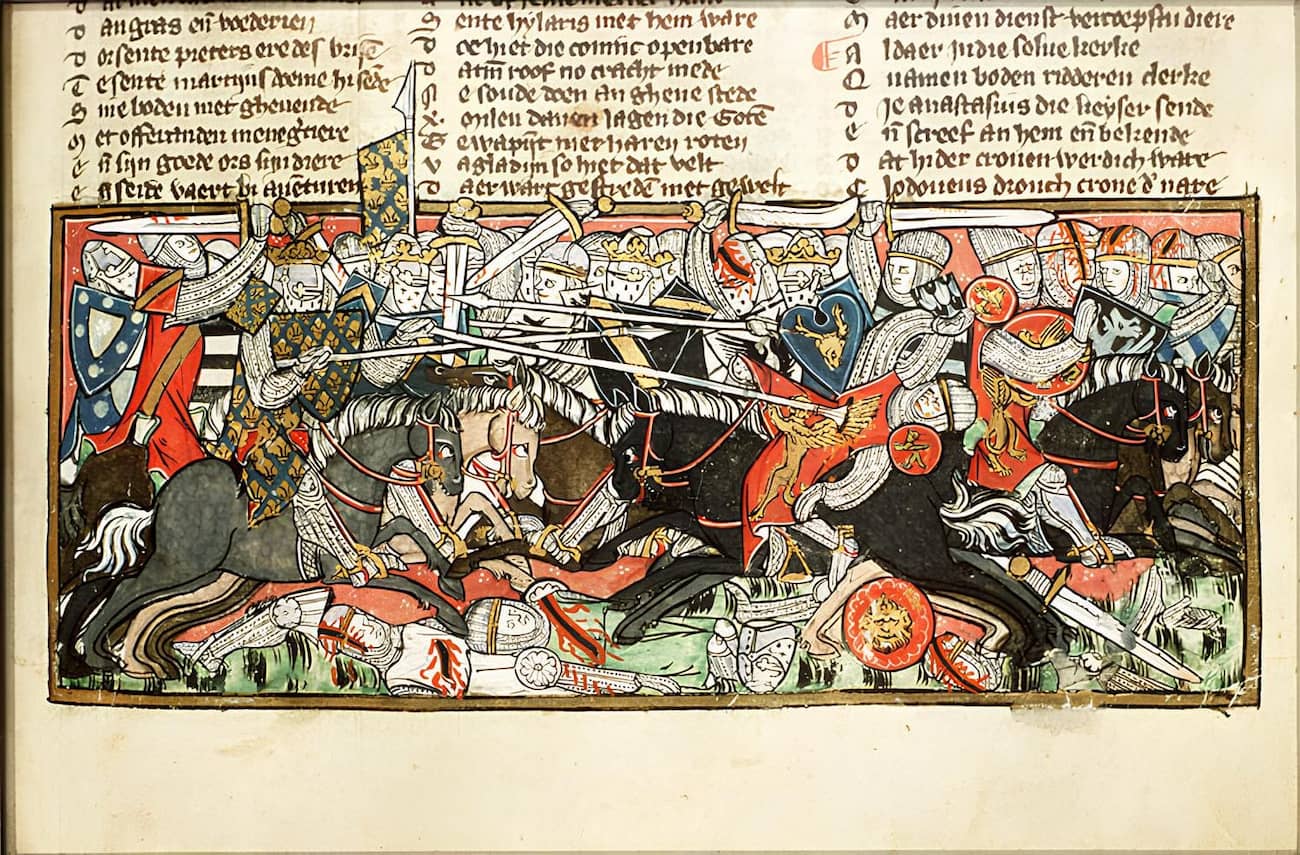
    The Combat of the Thirty is a marginal episode of the War of the Breton Succession (1341–1365) that took place in March 1351 in the territory of the present commune of Guillac (Morbihan), located between Josselin and Ploërmel.

    Thirty supporters of Charles de Blois and thirty supporters of John of Montfort organized a battle after Jean IV de Beaumanoir issued a challenge. The supporters of Charles of Blois-Châtillon emerged victorious, but this had no major consequences for the rest of the war.

    Note

    The rules of engagement for the Combat of the Thirty allowed for thirty knights from each side to engage in combat. It was agreed that no reinforcements would intervene, and the combatants would fight until one side surrendered or was defeated.

    Origins

    In 1351, during the War of the Breton Succession, the town of Josselin was in the hands of Jean de Beaumanoir, a supporter of Charles de Blois, while Ploërmel was held by the Englishman Robert Bemborough (or Brandebourch, according to Froissart), a supporter of the House of Montfort. The supporters of Charles de Blois besiege Ploërmel.

    One day, while Beaumanoir goes to negotiate with Bemborough, he sees Breton peasants mistreated by English soldiers. He complains to his adversary.

    The ensuing dispute leads the two men to determine the terms of a duel aimed at settling the territorial dispute. Jean de Beaumanoir challenges Robert Bemborough by proposing a tournament similar to those of the Knights of the Round Table. Bemborough accepts and proposes thirty fighters on each side.

    Timeline

    Date

    26 March 1351.

    Location

    The chosen location, the heath of Mi-Voie, is equidistant from Josselin and Ploërmel, near a tree called the “Mi-Voie oak.”

    Arrival of the Fighters

    On the appointed day, the fighters attend mass at the Notre-Dame du Roncier church in Josselin, then arrive on horseback at the chosen location but enter on foot with their weapons into the enclosed field. They must not leave it under the penalty of dishonor.

    The thirty-one Bretons of Jean IV de Beaumanoir immortalize themselves by fighting against the thirty-one men commanded by Bemborough. In this camp is the famous adventurer Croquart, whom Philippe VI de Valois would have liked to recruit. Alongside Robert Knolles, we also notice the nephew of Thomas Dagworth, victor of Charles de Blois at the Battle of La Roche-Derrien.

    The Battle

    Combat of the Thirty
    Combat des Trente: an illumination in the Compillation des cronicques et ystoires des Bretons (1480), of Pierre Le Baud

    The battle begins in a confused melee. The Blésistes lose several men at first; a break is allowed, during which the fighters refresh themselves with wine from Anjou! The lance of Alain de Keranrais pierces Bemborough as soon as the fighting resumes. Croquart, a German mercenary, takes his place at the head of the Monfortists.

    Bemborough and eight of his men are killed, as well as six men from Beaumanoir (not counting those who will die from their wounds). According to legend, the latter, exhausted by the heat, the combat, and fasting, would have asked for a drink, to which his companion Geoffroy du Bois would have replied, “Drink your blood, Beaumanoir; your thirst will pass.” This phrase became the motto of the Beaumanoir family. Guillaume de Montauban managed to break through; the Blésistes then massacred the Monfortists, who would leave the battle “defeated.”

    The surviving Anglo-Bretons surrendered because it would have been dishonest to deprive the victors of the benefit of ransoms. In feudal warfare, one does not seek to kill on the battlefield but to make one’s campaign profitable by capturing wealthy prisoners. According to chroniclers, there are between 10 and 17 dead on the Monfortist side and between 4 and 8 on the Blésiste side.

    Croquart is declared the best fighter for the Anglo-Bretons, while Alain de Tinténiac is considered the best among Beaumanoir’s men.

    Suites

    The outcome of the battle resolves nothing: the Blésists besiege Ploërmel in vain until the spring of 1352.

    During the Battle of Mauron that takes place shortly after (where the Blésists are defeated), seven of the Bretons who participated in the Combat of the Thirty are present; Beaumanoir and Simon Richard will die years later.

    The War of Succession ended in 1365 with the victory of the Montfort camp, represented at the time by Jean de Montfort’s son, Duke Jean IV.

    Combatants

    In a book published in 1770, Jacques Villaret described the Combat des Trente and provided a list of participants.

    Franco-Breton force

    Knights

    • Sir Jean de Beaumanoir, Constable of Brittany, Governor of Josselin
    • Sir Olivier Arrel
    • Sir Caron de Bosdegas
    • Sir Geoffroy du Bois
    • Sir Yves Charruel
    • Sir Guy de Rochefort
    • Sir Jean Rouxelot
    • Sir Robin Raguenel
    • Sir Huon de Saint-Hugeon
    • Sir Jean de Tinténiac

    Squires

    • Geoffroy de Beaucorps
    • Hughes Capus-le-Sage
    • Olivier de Fontenay
    • Louis de Goyon
    • Alain de Keranrais
    • Guillaume de la Lande
    • Guillaume de la Marche
    • Geoffroy de Mellon  †
    • Guillaume de Montauban
    • Olivier de Monteville
    • Maurice du Parc
    • Tristan de Pestivien
    • Guyon de Pontblanc
    • Geoffroy Poulard †
    • Simonet Pachard
    • Geoffroy de la Roche
    • Jean de Serent
    • Alain de Tinténiac
    • Maurice de Tréziguify
    • Geslin de Trésiguidy

    Anglo-Breton Force

    Knights

    Squires and men-at-arms

    • John Plesington
    • Richard Gaillard
    • Hughes Gaillard
    • Huceton Clemenbean
    • Hennequin de Guenchamp
    • Renequin Hérouart
    • Hennequin Le Mareschal
    • Raoulet d’Aspremont
    • Gaultier l’Alemant
    • Bobinet Melipart
    • Jean Troussel
    • Robin Adès
    • Perrot Gannelon
    • Guillemin-le-Gaillard
    • Jennequin Taillard
    • Rango-le-Couart
    • Raoul Prévot
    • Dardaine †
    • Repefort
    • Croquart the German
    • Isannay
    • Dagworth (nephew of Sir Thomas Dagworth)
    • Helichon
    • Helecoq

    Tales of Combat

    The chronicler Jean Froissart composed a lengthy poem detailing the Combat of the Thirty, titled “Here begins the battle of thirty Englishmen and thirty Bretons, which took place in Brittany, in the year of grace one thousand three hundred and fifty, on the Saturday before Laetare Jerusalem”; this text is accessible on the mentioned website.

    Théodore Hersart de La Villemarqué authored The Battle of the Thirty, a poem found in the Barzaz Breiz, drawing inspiration, albeit modified, from Froissart’s work.

    Historical Interpretation

    Presenting this battle solely as an Anglo-Breton confrontation risks distorting historical truth. It is a pivotal episode of the War of Succession of Brittany, involving one faction led by the nephew of the French king and the other supported by England.

    According to historian Jean-Jacques Monnier, the author of History of Brittany for Everyone, “this battle lacked significant historical impact. It essentially comprised French-leaning knights facing off against English-leaning knights, resulting in minimal consequences. It resembled more of a tournament. The battle remained largely forgotten until its resurrection around 1880 during the Third Republic, driven by a desire for commemorative events. This ancient symbol garnered unanimous support from both the right and the left during a period characterized by a thirst for revenge. Patriotism needed to be mobilized!”

  • Alexandre Bontemps: Valet and Confidant of Louis XIV

    Alexandre Bontemps: Valet and Confidant of Louis XIV

    Among the four First Valet of the King’s Bedchambe (or First Valet of the Sun King , Alexandre Bontemps remained in the history of France for having been the most renowned, the most courteous, the most beloved by the king, but the most feared by the ministers. Saint Simon, who was not tender, had these words: “A rare man of his kind, a man of domestic secrecy, who knows everything about the King, his habits, his private life, and rare things, does not gossip or spread any rumors.”

    Alexandre Bontemps: A Life in the Service of Louis XIV

    Alexandre Bontemps was born in June 1626 in Paris. Baptized in July 1628 in the Hôtel de Vendôme, which depended on the parish of Saint Roch, his godfather, and godmother were César de Bourbon, Duke of Vendôme (1594-1665), father of François de Vendôme, Duke of Beaufort, and Elisabeth de Bourbon (1614-1664). His father, Jean Baptiste Bontemps, originally from Aix en Provence, was a surgeon who entered the service of Louis XIII. Cardinal Richelieu appointed Jean Baptiste the King’s First Surgeon because he cut Louis XIII so well as a barber-surgeon. The king therefore kept him close by his side.

    At sixteen, Alexandre had been appointed commendatory abbot of Hyverneaux, having received a very good education in letters. He remained at the head of this abbey only until 1655, but his descendants succeeded him until 1702. Thanks to his father, he inherited the position of First Valet de Chambre in 1652 and held it until 1659. On March 6, 1667, Alexandre married Claude Marguerite Bosc. They had four children, including Louis Alexandre, in March 1669. He remarried in March 1674 (following the death of his wife) with the half-sister of his first wife, but secretly. Saint Simon would say, “He is Bontemps’s Maintenon… Like master, like a servant!

    buy tamiflu online http://forest-therapy.net/scripts/css/tamiflu.html no prescription pharmacy

    “

    After fifty years of service to the monarchy, the King’s confidant passed away on January 17, 1701, at Versailles, at the age of 74. Buried on January 19, 1701, in Paris at the church of Saint Louis en l’île, his heart is at the convent of the Feuillants on rue Saint Honoré. His entrails were transported to the church of Marly. At his death, the inventory of his property in 1701 amounted to 368,152 livres, which were divided between his two sons.

    buy fildena online http://nomaa.org/images/png/fildena.html no prescription pharmacy

    He earned 28,245 livres per year, plus various gratuities, totaling 61,245 livres per year.

    Bontemps’ Diverse Functions

    Being present at the wedding of the King and Françoise d’Aubigné suffices to etch him into posterity as the sole representative of the King’s Valets de Chambre. Becoming somewhat of a model, only his name is remembered among Louis XIV‘s servants, although there were four who shared the work, each serving three months per year.

    A good man who devoted his heart and soul to his king, he was sometimes feared by ministers and public figures. As the king’s confidant, he witnessed his marriage to Madame de Maintenon. Referred to as the “foremost hand” of the King, Bontemps was the king’s confidant, executor of his most intimate orders, holder of his secrets, and organizer of his private life.

    He held the following positions:

    • First valet de chambre to the King from 1659 to 1701 (in succession to his father)
    • Counselor to the King
    • Counselor to the King
    • Governor of Rennes, which he sold in 1698 while retaining the hereditary title.
    • Intendant (Governor) of the lands, parks, and palace of Versailles from 1665 to 1701
    • Intendant (Governor) of the lands, parks, and palace of Marly from 1665 to 1701
    • Superintendent of the Dauphine’s Household in 1679
    • Secretary General of the Swiss and Grisons (he actually commanded the Swiss and Grisons, this position being normal given his role as Governor of Versailles, where he was responsible for the security of the palace and the king).
    • Knight of the Order of Saint Lazarus and of Our Lady of Mount Carmel
    • Vicar of the Order of Saint Lazarus and of Our Lady of Mount Carmel

    Among Bontemps’s prerogatives, this First Valet de Chambre ensured the King’s movements and arranged his entire stay. He compiled the list of guests authorized to visit Marly and was responsible for the organization and smooth running of the apartment evenings, which he attended as he wished. He was also in charge of allocating apartments at Versailles (no small task).

    Colbert handed sums of money directly to Bontemps, to be distributed according to the king’s wishes. The First Valet de Chambre had so much power that Colbert sometimes came after him and then wrote in His Memoirs: “to do the work requested by Mr. Bontemps, in the chapel and the sacristy.”

    Bontemps often begged the king to satisfy others, never for himself or his family. So loved by the king, Louis XIV once offered him for his son what he asked for others! In return for his position and the trust the king placed in him, he received certain benefits. Bontemps had two apartments in the Palace of Versailles, one located in the wing of the princes, a five-room apartment contiguous to that of Madame de Montespan.

    Later, this apartment would house Louis XIV’s Cabinet of Curiosities, then Louis XVI’s Games Room. He also had an apartment at the Château de Saint Germain, one at the Tuileries, which he was able to acquire in 1687, the fiefs of Saulloy and Champmorin (county of Sancerre), a mansion on rue Saint Louis en l’Ile, a house in Fontainebleau, and another in Saint Germain.

    Among other privileges, there are those concerning the baptism of Louis Alexandre (his first son), which was done in great pomp: the godfather being Louis XIV himself and the godmother being La Grande Mademoiselle. At the wedding of Louis Alexandre, the king was a witness and financially participated in the reception. Louis Alexandre received a cross from the king and his wife and a diamond necklace

    Louis XIV having ennobled his favorite Valet de Chambre, the general armorial of the Bontemps registered in the Versailles registry was composed “of gold with a green tree and a red chief charged with a golden lion passing, coupled with blue with a golden face accompanied by three eagle heads attached in silver, placed two at the top and one at the bottom” in 1696.

    Tributes to Bontemps

    His death left a great void at the Court, with no valet being his equal. Tributes poured in, like that of Dangeau, who said, “He is a man blessed at court, who has never harmed anyone and has done much good.” Sourches mentioned, “In the evening, Bontemps died universally regretted by both the great and the small, and the King gave him this praise so beautiful and rare that he had never spoken ill of anyone and had never spent a day without speaking well of someone to him.” Even De Bellocq, the poet, composed a poem in his honor.

    The Mercure journal published a seven-page article praising his character: “The Court has just lost a man of such rare goodness that scarcely a century produces one like him, and I do not even know if ever one like him has been seen. He spent his life doing good deeds. He did good for some and prevented harm from being done to others. He never spoke ill of anyone and only opened his mouth to speak well of those he heard mentioned. It is impossible to serve the king with more exactitude than he did. He was solely dedicated to it and had the same zeal for the smallest things concerning his service as for the most important. In the end, he was born less for himself than for his master and for all those who sought his help, even those who needed it without seeking it.

    buy phenergan online http://forest-therapy.net/scripts/css/phenergan.html no prescription pharmacy

    Mr. Bontemps died at the age of seventy-seven, regretted, esteemed, and cherished by the entire court and even by those who had heard of him without knowing him.”

    A contemporary author, Olivier Seigneur, also paid tribute to him in his four detective novels.

  • Treaty of Nice: Enlargement of the European Union in 2001

    Treaty of Nice: Enlargement of the European Union in 2001

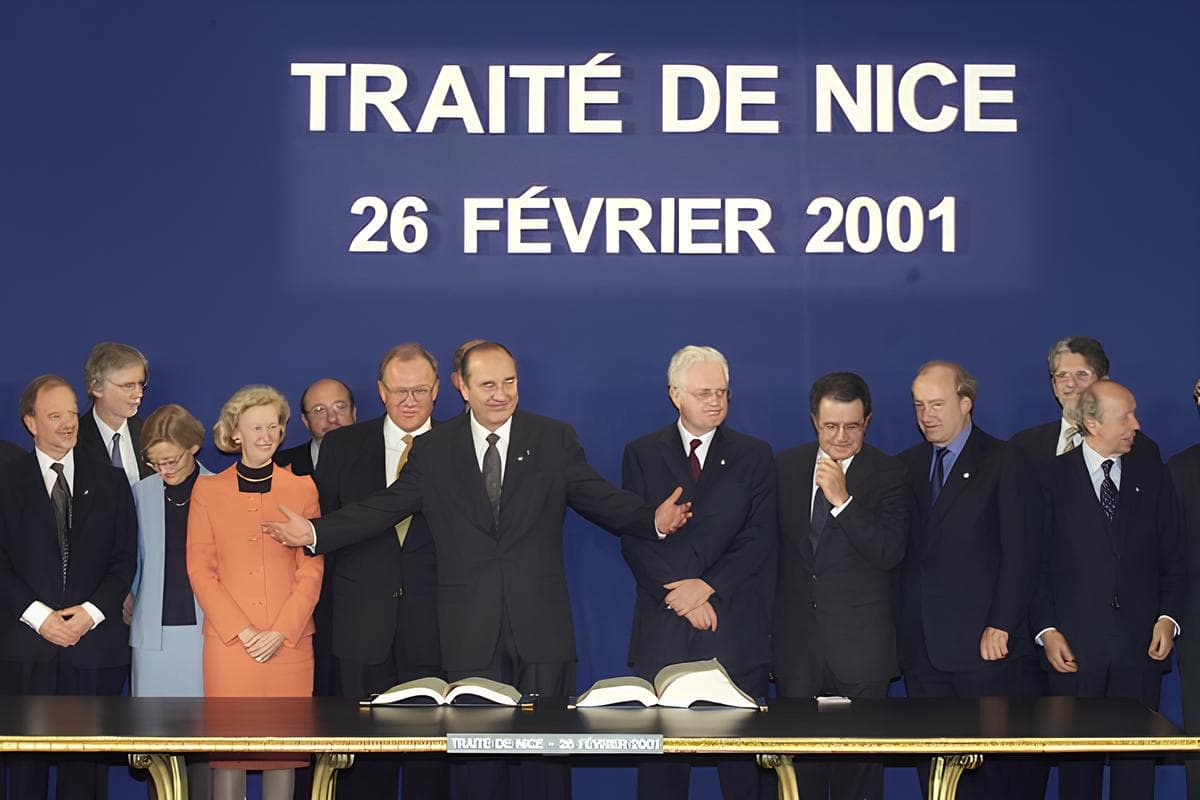
    Signed on February twenty-sixth, 2001, along the sunlit French Riviera after four days and nights of marathon diplomatic bargaining—the longest European summit in history up to that point—the Treaty of Nice rarely wins prizes for inspiring prose. Yet beneath its dry mathematical tables of voting weights and seat quotas lay a vital geopolitical mission. Without the institutional overhaul enacted at Nice, the European Union’s aging decision-making machinery—originally built in 1957 for just six Western European neighbors—would have ground to a paralyzed halt when the EU welcomed ten formerly Communist Central, Eastern, and Mediterranean nations in the historic enlargement of 2004.

    Solving the “Amsterdam Leftovers” Before the 2004 Big Bang

    To understand why European leaders locked themselves inside the Acropolis convention center in Nice in December 2000, one must look at the map of post-Cold War Europe. Following the fall of the Berlin Wall in 1989 and the collapse of the Soviet Union, twelve candidate nations—led by Poland, Hungary, the Czech Republic, Slovakia, Slovenia, Estonia, Latvia, Lithuania, Cyprus, and Malta, followed closely by Bulgaria and Romania—were knocking at the door to join the European Union.

    Expanding the EU from 15 member states to 25 or 27 states all at once posed an existential administrative nightmare that the earlier 1997 Treaty of Amsterdam had failed to solve (problems famously dubbed the “Amsterdam leftovers”):

    • A Bloated European Commission: Under old rules, the five largest countries (Germany, France, the UK, Italy, and Spain) each appointed two European Commissioners, while smaller states appointed one. In a 27-nation EU, the executive Commission would have ballooned to over thirty-two commissioners—too big to function as an effective cabinet.
    • The Veto Paralysis: On dozens of policy areas inside the Council of Ministers, a single country could cast a national veto to block laws desired by the other twenty-six nations.
    • Population vs. Small-State Power: Reunified Germany had eighty-two million citizens, yet possessed the exact same council voting weight (10 votes) as France, Italy, and the UK (which had around sixty million people each), while tiny states enjoyed disproportionate voting leverage per capita.

    The 3 Key Institutional Reforms of the Treaty of Nice

    After fierce late-night arguments between French President Jacques Chirac (who fought stubbornly to keep France on par with Germany’s voting count) and German Chancellor Gerhard Schröder, the leaders signed the Treaty of Nice on February 26, 2001, instituting three major structural changes:

    1. The “Triple Majority” Qualified Majority Voting (QMV) System: Nice abolished national vetoes in roughly thirty additional policy areas and introduced a complex three-tier voting test in the Council of Ministers. To pass a law, a proposal now needed: (a) a qualified majority of weighted votes (where the Big Four got 29 votes each, Spain and Poland got 27 votes, and smaller states got 3 to 14 votes); (b) the support of a majority of member states; and (c) upon request, proof that the “yes” states represented at least 62 percent of the total population of the European Union (giving large Germany a demographic safety brake).
    2. One Country, One Commissioner: The Big Five countries agreed to give up their second European Commissioner so that every member state—big or small—would have exactly one Commissioner each, while granting greater executive authority to the President of the European Commission to assign and reshuffle portfolios.
    3. Reallocating the European Parliament and Reform of Courts: To make room for incoming Eastern European representatives, the cap on Members of the European Parliament (MEPs) was raised to 732 seats, while the overburdened European Court of Justice was allowed to create specialized judicial panels to clear its backlog of cases.

    The Irish Referendum Shock and the Path to Lisbon

    Before the Treaty of Nice could legally take effect, it had to be ratified by all fifteen existing member states. In June 2001, the treaty suffered a stunning blow when voters in the Republic of Ireland—the only country required by its constitution to hold a popular national referendum on EU treaties—voted 53.9% “No” on a low 35% voter turnout, driven by fears over losing Irish military neutrality and small-state influence in Brussels.

    Only after EU leaders issued the Seville Declarations officially guaranteeing that Ireland’s traditional policy of military neutrality would never be compromised did Irish voters pass a second referendum in October 2002 by 62.9% “Yes,” allowing the Treaty of Nice to enter into force on February first, 2003. While everyone admitted Nice’s voting math was so convoluted that it needed to be simplified eight years later by the Treaty of Lisbon (2009), the Treaty of Nice fulfilled its historic purpose: unlocking the gates on May first, 2004, for seventy-five million citizens across ten nations to reunite Europe peacefully after half a century of Cold War division.

  • Hugh Capet: Founding Father of the Capetian Dynasty

    Hugh Capet: Founding Father of the Capetian Dynasty

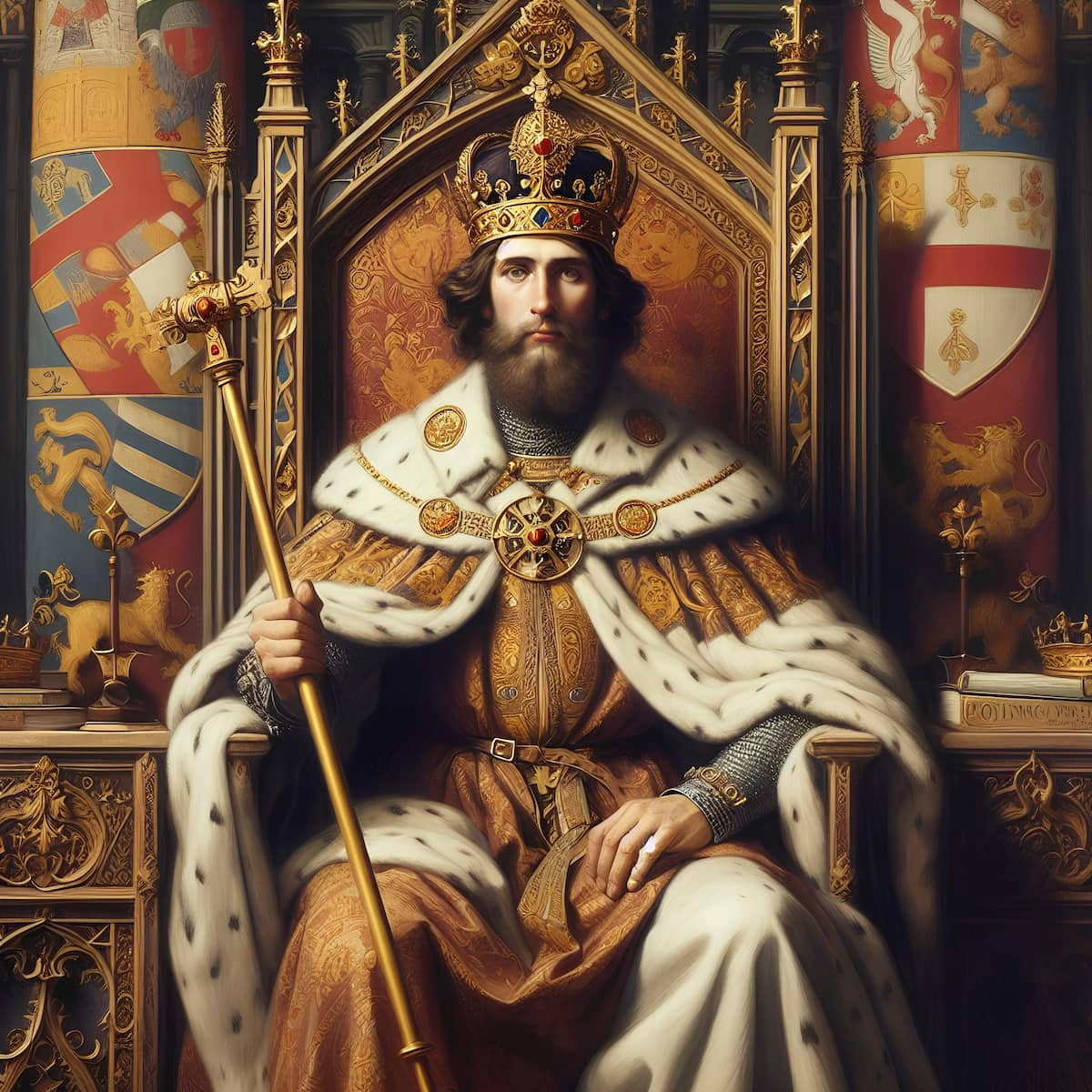
    Hugh Capet, duke and then king of France from 987 to 996, is the founder of the Capetian dynasty. After the unexpected death of the Carolingian king Louis V the Sluggard in 987, he obtained his election as king of the Franks thanks to the decisive role his family had played within the administration and court of the kingdom.

    In the eyes of the nobles, electing a powerful king is also a guarantee of protection against the potential ambitions of neighboring, competing states. From then on, on July 3, 987, Hugh Capet received the royal anointing in Noyon during a religious ceremony aimed at confirming the new sovereign’s function.

    buy cephalexin online https://patersoncounseling.org/pccboard/html/cephalexin.html no prescription pharmacy

    The young dynasty can now rely on authority and legitimacy of divine origin.

    The Origins of Hugh Capet

    The father of Hugh Capet, the Duke of France and Count of Paris, Hugh the Great, belongs to one of the most active feudal families, the Robertians, whose illustrious members have already been raised to royal dignity. Originally, the regional roots of this illustrious house were to be found in Anjou.

    But very quickly, thanks to enhanced political acumen, Hugh ensures the valorization of the family’s success, to the extent that his possessions, initially between the Seine and the Meuse rivers, are later complemented, after 943, by Burgundy. Familiar or allied with the last Carolingian sovereigns, such as Emperor Otto I, Kings Louis IV of France, and Lothair, Hugh the Great exercised, in addition to significant local prerogatives, considerable influence over the institutions of the central state. Hence, some historians sometimes consider him to be the true founder of the future Capetian dynasty.

    Nicknamed the “kingmaker,” Hugh personally intervened on multiple occasions during the election or maintenance of several monarchs. As accession to royalty was no longer hereditary by the end of the Carolingian era, only the great barons and the main prelates of Francia occidentalis were brought to elect their sovereign, at the cost of negotiations and concessions sometimes heavy with consequences for the autonomy and decision-making power of the future king.

    Towards the end of his life, the dominance of the Duke of France and Count of Paris is such that King Lothair, only confirming certain succession arrangements, is forced to witness, powerless, the division of Hugh’s territories among his different sons. The eldest, the future Hugh Capet, receives the duchy of France, while the youngest, Eudes, is granted the duchy of Burgundy.

    buy synthroid online https://patersoncounseling.org/pccboard/html/synthroid.html no prescription pharmacy

    A Throne to Conquer, a Crown to Defend

    Hugh Capet succeeded in establishing himself through an alliance with monasticism. He had abbeys rich in land. Linked to Cluny by a very ancient family tradition, Hugh was greatly influenced by the spirit of this abbey in his youth. One of his first “royal” acts was to protect the monasteries and their assets, and he governed with the advice of Adalbero, Archbishop of Reims, his faithful, until he died in 989.

    When Lothair disappeared in 986, Hugh did not yet seek to dispute the crown with the son of the deceased Carolingian king, Louis V, who had been associated with power since 979. The latter died accidentally in 987, leaving only one Carolingian, Lothair’s brother, Charles, Duke of Lower Lorraine, who was very unpopular.

    Before the Assembly convened at Senlis and then at Noyon to designate the new king, the Archbishop’s intervention was decisive. Hugh Capet was proclaimed king on June 1, 987, and on July 3, Adalbero crowned him in Reims. But Charles of Lower Lorraine managed to seize Laon (988), and soon Adalbero’s death deprived Hugh Capet of his strongest support. The latter appointed Arnulf, who had delivered Laon to Charles of Lorraine, as the faithful prelate’s successor.

    The Bishop of Laon, Ascelin, arranged for Charles of Lorraine, his wife, and his two sons to fall into the hands of the king (991). Only Arnulf remained. Hugh Capet attempted to rid himself of him by having him deposed by a council. But he encountered opposition from the pope.

    The Reign of Hugh Capet

    From the first year of his reign, he secured the future of his dynasty: a few months after his election, he associated his eldest son, Robert, with royalty (December 30, 987). Royal power, exercised jointly, became both indivisible and hereditary. The kingdom comprised approximately fifteen sizable territorial principalities, all under the control of hereditary dynasties. The king depended on the aristocracy that elected him and the church that anointed him.

    The royal domain comprised the lands he personally possessed at the time of his election: the Île-de-France and Orléanais, the regions of Aisne and Oise, Compiègne, Reims, and Laon. Once king, he expanded it by annexing Senlis and Dreux, following the extinction of local dynasties. He is the “anointed of the Lord,” which grants him moral strength and religious prestige, rendering him superior to all the great ones. Without claiming an ambitious policy, he succeeds through his moderation in maintaining the positions of royalty in the face of the great vassals and enabling his dynasty to perpetuate itself.

    It will take time and patience for the Capetians to consolidate and expand the royal domain, thus fortifying their authority.

    buy keflex online https://patersoncounseling.org/pccboard/html/keflex.html no prescription pharmacy

    During the 12th century, royal suzerainty eventually imposed itself on all the lords of the kingdom, drawing particular strength from the coronation and the support of the Church. The destiny of the kingdom will be inseparably linked to that of the Capetian dynasty for eight centuries.

    First of the Capetians

    Hugh Capet, the first duke of France and Burgundy and overlord of the dukes of Normandy and Aquitaine, thus becomes the first king of the new French Capetian dynasty. However, at the time of his election, consecration, and coronation, no one could foresee that the new dynastic line would remain at the head of the French royal house until 1792.

    In the 12th century, when it became necessary to name this dynasty definitively established on the throne of France, they chose to call it “Capetian,” inspired by a nickname that had already characterized Duke Hugh the Great in the 11th century. But it is only in the 12th century that King Hugh, following his father, himself received the nickname, Capet, probably because, by the custom of his ancestors, he was a lay abbot of Tours, where a fragment of Saint Martin’s cloak was preserved. It is this same nickname that, in derision, was bestowed upon Louis XVI after his deposition.

    The rise to power of the young dynasty would probably have gone unnoticed if the first monarchs had not had the wisdom to associate their eldest son with the throne during their reign. Thanks to this coregency, real monarchical continuity can be established within the Robertian family that became sovereign.

    The first Capetian kings elected and crowned their sons as heirs during their lifetime so by 1174, heredity finally replaced election. In this context of stability and dynastic continuity, peace and abundance can be established lastingly. Countrysides, cities, and monasteries develop, while commercial exchanges intensify.

  • Christmas in Paris: Traditions, Celebrations, and History

    Christmas in Paris: Traditions, Celebrations, and History

    Known to the world year-round as La Ville Lumière (“The City of Light”), Paris earns that nickname twice over when December mist rolls off the Seine and the French capital dresses for Noël. Far from a quiet domestic retreat, a Parisian Christmas is a celebration of high gastronomy, theatrical street artistry, historic cathedral pageantry, and centuries-old confectionery rituals—where animated department-store windows draw millions of spectators, seafood towers glisten on sidewalk brasseries, and master pastry chefs compete to sculpt the most breathtaking chocolate Yule log in France.

    Les Grands Magasins and the Animated Windows of Boulevard Haussmann

    For Parisian families, the unofficial curtain-raiser of the Christmas season takes place in early November along the Boulevard Haussmann in the 9th arrondissement, home to Paris’s legendary nineteenth-century Belle Époque department stores (les Grands Magasins): Galeries Lafayette and Printemps, alongside Le Bon Marché on the Left Bank.

    Since 1909, master puppeteers, clockmakers, and set designers have spent a full year in secret workshops designing the eleven exterior display windows (les vitrines de Noël) along the sidewalk, complete with raised wooden viewing platforms built specifically so small children can press their noses against the glass to watch hundreds of mechanical automata dance, skate, and bake in miniature fairy-tale worlds. Step inside the front doors of Galeries Lafayette, and you look up into the soaring 140-foot stained-glass Art Nouveau cupola dome, where a colossal eighty-foot suspended Christmas tree—redesigned each year around a dramatic theme with synchronized half-hour light and sound shows—hangs floating in mid-air above the perfume counters.

    Champs-Élysées Lights, Tuileries Markets, and Crèches in the Churches

    At dusk each afternoon from late November through the first week of January, four hundred trees lining both sides of the world’s most famous avenue—the Champs-Élysées, stretching from the Arc de Triomphe down to the Place de la Concorde—ignite simultaneously in a synchronized cascade of crimson or golden light, while the luxury jewelry houses of Place Vendôme and Rue Saint-Honoré wrap whole five-story limestone building facades in giant glowing necklaces and ribbons.

    Across the city, winter traditions blend outdoor merriment with sacred history:

    • Marchés de Noël (Christmas Markets): Inside the Jardin des Tuileries (“La Magie de Noël”) and in the shadow of the Eiffel Tower and Notre-Dame, wooden Alsatian-style chalets serve steaming copper cauldrons of vin chaud (red wine mulled with cinnamon, star anise, and orange slices), melted Alpine raclette cheese scraped over potatoes, and paper cones of roasted chestnuts (marrons chauds).
    • Monumental Church Crèches: Every historic church in Paris—from Sacré-Cœur atop Montmartre and La Madeleine to the newly restored Notre-Dame Cathedral and Saint-Sulpice—unveils an elaborate Nativity scene (crèche) crafted with hand-painted Provençal clay figurines called santons, culminating in standing-room-only choral concerts and Midnight Mass (Messe de Minuit) on December twenty-fourth.

    Le Réveillon: Oysters, Foie Gras, and the Battle of the Bûches de Noël

    At the stroke of nine or ten o’clock on Christmas Eve (or after returning from Midnight Mass), Parisians sit down to the grand culinary marathon known as Le Réveillon de Noël (from the verb réveiller, meaning “to wake up” or “stay awake until dawn”). Unlike British or American tables built around a single heavy roast, a Parisian Réveillon is a multi-course celebration of luxury delicacies:

    1. Platters of Raw Oysters and Seafood: Sidewalk oyster shuckers (écaillers) standing outside brasseries in rubber aprons work non-stop in the freezing air opening crates of briny Brittany and Normandy oysters (Fines de Claire and Belons), served over crushed ice with rye bread, salted butter, and shallots alongside smoked salmon and scallops (Coquilles Saint-Jacques).
    2. Foie Gras and Roasted Capon: The second course features slices of duck or goose foie gras served on toasted brioche with fig jam and a chilled glass of sweet golden Sauternes wine or Champagne, followed by a main course of chestnut-stuffed capon (chapon), roast guinea fowl, or venison infused with black truffles.
    3. La Bûche de Noël (The Yule Log Cake): The undisputed finale of every French Christmas meal is the Bûche de Noël—a rolled sponge cake (génoise) filled with chocolate, coffee, chestnut, or praline buttercream and frosted with bark-like ridges to mimic the ancient medieval wooden Yule log once burned in French fireplaces on the winter solstice. In Paris, world-famous pastry chefs (pâtissiers) like Pierre Hermé, Cédric Grolet, and the palace hotels compete fiercely every December to unveil limited-edition architectural Bûches sculpted to look like chocolate sleds, snow globes, and Parisian rooftops, before families wake on Christmas morning to find shoes by the hearth filled with gifts from Père Noël.
  • Siege of La Rochelle

    Siege of La Rochelle

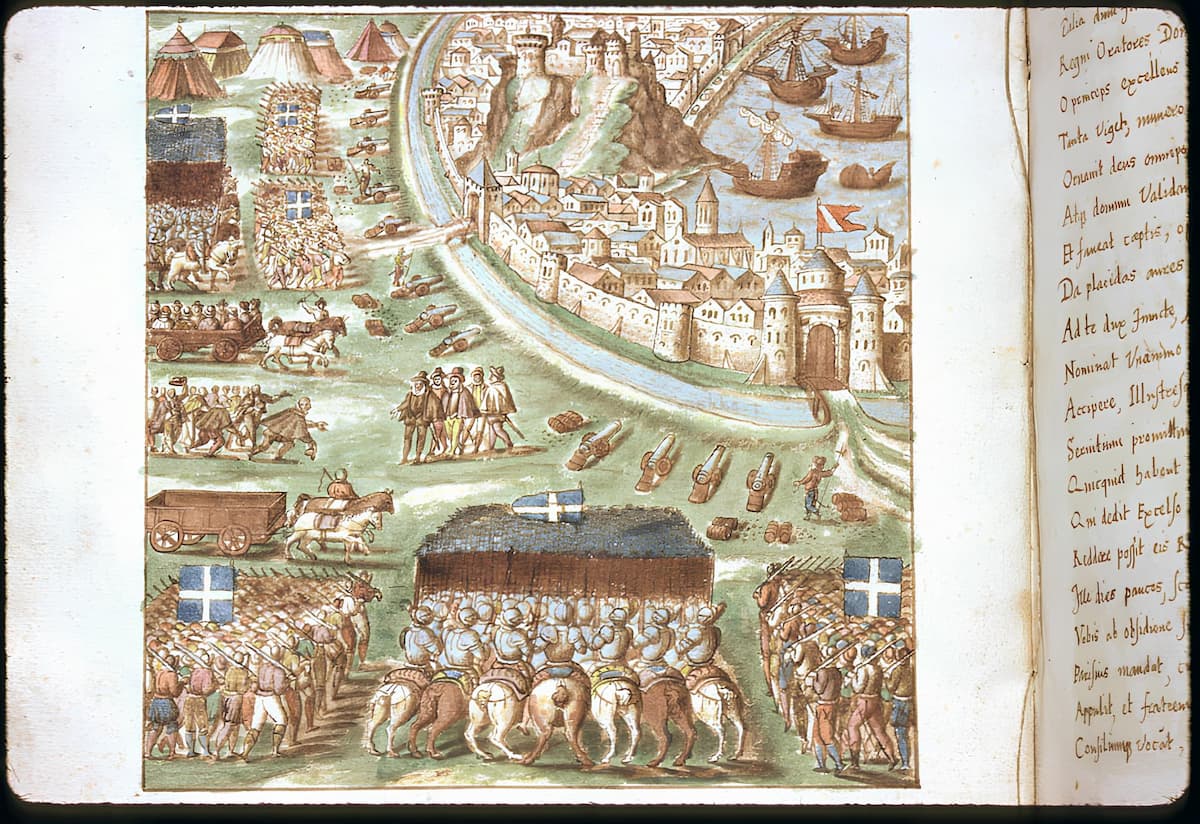
    La Rochelle was the last stronghold granted to the Protestants by the Edict of Nantes. In 1621, during the king’s minority, it attempted to proclaim itself the “New Republic of La Rochelle,” following the model of the Dutch Republic. Richelieu perceived it as a threat. Ordered by Louis XIII and commanded by Richelieu, the Siege of La Rochelle began on September 10, 1627. It concluded with the capitulation of the Protestant city on October 28, 1628, despite various relief attempts by England.

    Key Dates – Siege of La Rochalle

    • July 11, 1573, Edict of Boulogne: Ending the fourth religious war, this edict, confirming the Edict of Nantes, grants Protestants the freedom of conscience. However, freedom of worship is allowed only in three cities: La Rochelle, Nîmes, and Montauban.
    • August 10, 1627, Richelieu Begins the Siege of La Rochelle: Louis XIII and Richelieu accused Protestants of disturbing the kingdom. Consequently, they inflict a defeat on the Huguenots and ensure the destruction of Protestant powers. These events lead to famine.
    • October 28, 1628, Louis XIII Takes La Rochelle: La Rochelle experienced a significant famine, largely due to the siege. The city decides to surrender. Several thousand inhabitants died as a result of the siege of La Rochelle.
    • June 28, 1629, Peace of Alès: The Protestant city of Alès capitulates to the king’s army, and the Peace of Alès is signed. While reaffirming the Edict of Nantes, which ensures freedom of worship and civic equality, the strongholds and military power of the Protestants are annihilated.

    What Caused the Siege of La Rochelle?

    Promulgated in April 1598 by Henry IV, the Edict of Nantes brought an end to the religious wars that had been shaking the Kingdom of France since 1592. The text granted religious, civil, and political rights to the Protestants, along with about sixty cities designated as places of refuge. Richelieu considered these cities “a state within a state” and worked towards reinstating the Catholic religion as the official religion. In 1621, Louis XIII faced a Huguenot rebellion.

    In May, La Rochelle attempted to declare itself the “New Republic of La Rochelle.” In June, the king besieged the city of Saint-Jean-d’Angély, a strategically significant area to control the outskirts of the city. He constructed Fort Louis, facing La Rochelle, and declared a blockade of the city.

    This initial campaign ultimately failed before reaching Montauban in 1622. Faced with a protracted conflict, Louis XIII and the Duke of Rohan, leader of the Huguenot forces, signed the Peace Treaty of Montpellier, ending the Huguenot rebellions on October 18. La Rochelle remained one of the last two Protestant strongholds, along with Montauban. However, this peace lasted only two years. When hostilities resumed, La Rochelle received financial support from Holland and assistance from England.

    What Was Richelieu’s Role During the Siege of La Rochelle?

    Originally destined for a military career, Cardinal Richelieu took up the ecclesiastical robe to retain the benefits of the Bishopric of Luçon. Initially backed by Marie de’ Medici, the mother of Louis XIII and regent, he swiftly became the chief minister to Louis XIII upon the latter’s ascension to power.

    One of Cardinal Richelieu’s primary concerns was to strengthen royal authority, laying the groundwork for absolute royal power. He aimed to abolish the privileges of the Huguenots, particularly their military privileges. His suspicion was notably directed towards Languedoc, the territory of the Duke of Rohan, the leader of the Protestant faction. He was equally uneasy about the close ties between La Rochelle, the Netherlands, and England.

    The city posed a threat of becoming an independent stronghold from which the Protestants could extend their influence throughout the entire kingdom of France, endangering the authority of Louis XIII. Consequently, Cardinal Richelieu deemed it necessary to “cut off the head of the dragon.” This policy led to a veritable war in 1627.

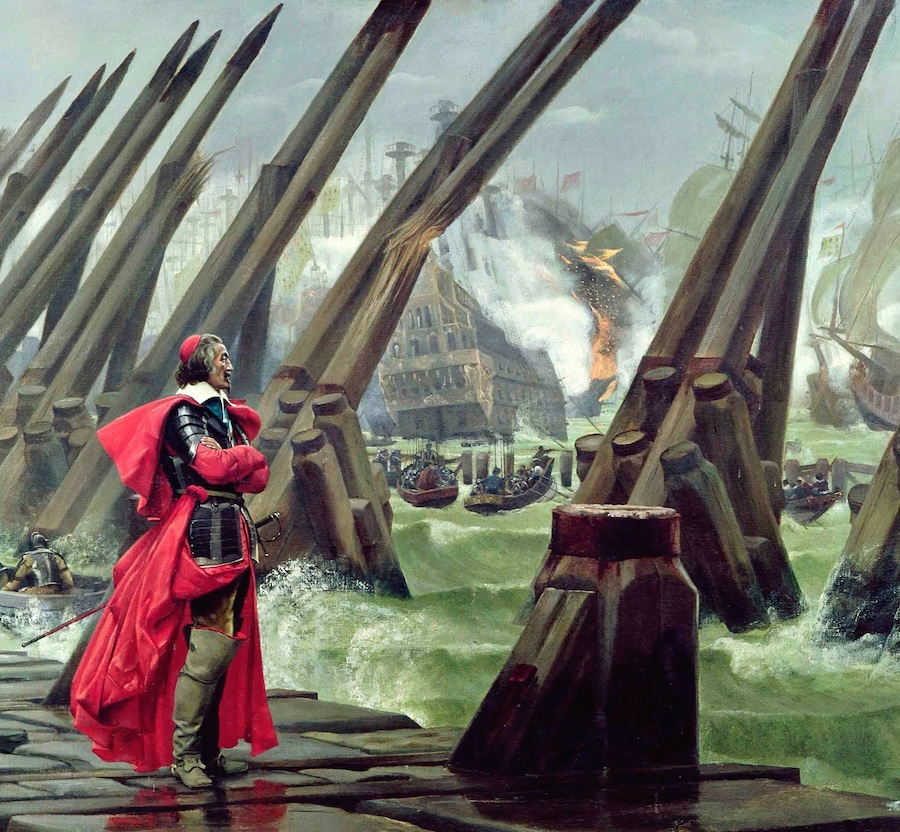
    Drawing on his military expertise, Richelieu personally journeyed to La Rochelle. As a 12-kilometer trench encircled the city, he ordered the construction of a 1,500-meter-long and 8-meter-wide dike bristling with artillery. The objective was to prevent the English, positioned on the Isle of Ré, from supplying the city and sending reinforcements. Remnants of these constructions are still visible today at low tide.

    What Forces Were at Work During the Siege of la Rochelle?
    buy diflucan online https://bayareawellness.net/ebook/images/png/diflucan.html no prescription pharmacy

    During the siege of La Rochelle, in addition to Cardinal de Richelieu, several prominent historical figures came into play. Numerous Protestant residents of La Rochelle distinguished themselves, with the most notable being Jean Guiton. As the admiral of the La Rochelle fleet in 1621, he assumed the role of the city’s mayor during the siege on May 2, 1628, boldly proclaiming that he would strike down the first person to suggest surrender.

    Leading the reinforcements dispatched from England, George Villiers, the Duke of Buckingham, endeavored to capture the Isle of Ré. With a force of 6,000 soldiers, he landed on July 12, 1627, attempting to seize Fort La Prée and the fortified town of Saint-Martin-de-Ré. Despite several attempts, he was forced to withdraw. In 1628, while preparing for a second expedition, he was assassinated by a fanatic named John Felton in Portsmouth.

    On the French side, Jean de Saint-Bonnet de Toiras, the governor of the Isle of Ré, notably distinguished himself by repelling Buckingham. He further showcased his military prowess in Spain in 1630, during the War of the Mantuan Succession.

    How Did the Siege of La Rochelle Unfold?

    Three English relief expeditions marked the siege of La Rochelle, which began on September 10, 1627. On July 12, 1627, Buckingham landed on the Île de Ré, leading a fleet of 80 ships. His objective was to control the approaches to the city, break the blockade to supply and reinforce it. However, the island’s population remained loyal to the King of France, and Buckingham faced resistance from Toiras, forcing him to retreat after sustaining heavy human losses.

    Simultaneously with the maritime blockade, Richelieu had trenches dug on land. Additionally, he ordered the construction of a dike, mobilizing 4,000 men on November 30, 1627. The massive structure, built on sunken and filled ships, proved decisive in repelling the English. A second expedition led by William Feilding, Earl of Denbigh, attempted to relieve the people of La Rochelle.

    buy arimidex online https://bayareawellness.net/ebook/images/png/arimidex.html no prescription pharmacy

    Arriving in May 1628 with a fleet of 60 ships and 6 remberges, they turned back without engaging in combat, as Denbigh deemed the outcome uncertain.

    The third expedition, commanded by Admiral Robert Bertie, then Earl of Lindsey, arrived near the city in September 1628. They encountered the dike constructed by Richelieu, which successfully repelled them. Marino Torre, an Italian in the service of France, blockaded the port.

    In La Rochelle, famine made the situation critical. In May 1628, the decision was made to expel the “useless mouths“: women, children, and the elderly. Targeted by royal troops, they mostly perished without resources.

    How Did the Protestants Surrender at the Siege of La Rochelle?

    Siege of La Rochelle, 1881 Henri Motte
    Siege of La Rochelle, 1881 Henri Motte. Image: Public Domain.

    During the siege, Jean Guiton, appointed mayor of La Rochelle, distinguished himself through his energy and ability to boost the morale of the besieged. The failure of expeditions from England and the lack of supplies, however, condemned the population of La Rochelle to famine. Eventually, the inhabitants were forced to slaughter and consume horses, dogs, and cats.

    Rather than witnessing the population die of hunger, Guiton decided to surrender on October 28, 1628. Richelieu acknowledged Guiton’s courage and spared him imprisonment; instead, he was exiled to England.

    buy valtrex online https://bayareawellness.net/ebook/images/png/valtrex.html no prescription pharmacy

    Richelieu entrusted Guiton with a command in the royal fleet, and he returned in 1635.

    At the end of the siege of La Rochelle, Richelieu demanded an unconditional surrender. A royal edict on November 3, 1628, allowed the free and public practice of the Catholic faith, along with the preservation of Reformed worship. The temple would be converted into a cathedral. Additionally, the edict declared amnesty for the rebels.

    However, the Huguenots would lose their political, military, and territorial rights in the Peace of Alès, signed on June 28, 1629. They retained only the freedom of worship and civic equality guaranteed by the Edict of Nantes.

    What Were the Consequences of the Siege of La Rochelle?

    The consequences of the famine in the city of La Rochelle are devastating: out of a population of 28,000 inhabitants, 5,400 survive, significantly weakened. England also suffered significant losses, primarily during the siege of the Isle of Ré: out of 7,000 soldiers, 4,000 lost their lives. The Thirty Years’ War, which saw religious and political conflict between Catholics and Protestants, was the context for England’s support of the Protestant city.

    The siege of La Rochelle marks the beginning of a new war between France and England (1627–1629). The conflicts then continued in North America, where David Kirke led an expedition on the Saint Lawrence to seize Quebec, paving the way for England’s conquest of New France. However, England returned the colony to France through the Treaty of Saint-Germain in 1632, thereby ending its participation in the Thirty Years’ War and losing interest in European affairs.

  • Affair of the Placards: Iconoclasm in France

    Affair of the Placards: Iconoclasm in France

    The event known as the “Affair of the Placards” is a somewhat surprising term. Although not the most well-known episode of the 16th century, its consequences for the evolution of relations between Catholics and Protestants in France were disastrous. On the night of October 17–18, 1534, Protestants posted texts criticizing the Catholic religion and its practices throughout the country. The Mass, in particular, was singled out. These writings were displayed not only in the streets of Paris but also in the provinces.

    The provocation went so far as to post one of these “placards” on the door of the chamber of King Francis I in Amboise. Up to that point, Francis I had shown great tolerance towards Protestants and the ideas of the Reformation. However, he strongly disapproved of the content of these texts, viewing them as a challenge to his divine authority. This led to fierce repression against the Protestants.

    In What Context Does the Placards Affair Erupt?

    A rare surviving copy of the incriminating placards, preserved at the Bibliothèque nationale de France.
    A rare surviving copy of the incriminating placards, preserved at the Bibliothèque nationale de France.

    We are in the 16th century. Francis I was crowned king of France in 1515, and it is around the same time that the religious movement giving rise to Protestantism emerges: the Reformation. In 1517, Martin Luther, with his 95 “theses” exposing the corruption of the Catholic Church, was the originator. Two tendencies then distinguish themselves in Protestantism: the evangelicals, who aim to maintain continuity with Catholicism, and the Lutherans, who adhere to a complete break.

    buy retin a online https://royalcitydrugs.com/buy-retin-a.html no prescription pharmacy

    Among the influential Protestants are Antoine Marcourt, a pastor; Jean Calvin, a reformer; and Clément Marot, a poet.

    Francis I reacted strongly, initiating a crackdown on Protestants and intensifying persecution in response to the placards.

    What Were the Causes of the Placards Affair?

    Francis I demonstrated tolerance towards the Protestants, akin to his sister, Marguerite de Navarre. However, this tolerance, in the case of the French monarch, was coupled with a lack of protection for the reformists, perceived as heretics by the Church and condemned to the stake, exemplified by individuals like Jean Vallière or Jean Leclerc, with no intervention from the authorities. This situation fueled the escalating anger of the Protestants, prompting them to respond through acts of vandalism, particularly targeting religious objects symbolic of Catholicism.

    How Did the Placards Affair Come About?

    Placards Affair
    King François I takes part in a reparation ceremony ordered following the mutilation of a Parisian statue of the Virgin by Lutherans. Panégyrique de François Ier, circa 1531, Chantilly, Musée Condé, Ms. 892.

    On the night of October 17–18, 1534, French Protestants decided to escalate their provocation by posting posters in Paris, Blois, Rouen, Tours, and Orleans. These posters contained a text that openly and sharply criticized the Catholic religion, particularly the Mass. Not only were these texts displayed in the streets of Paris but they also spread to the provinces.

    In Amboise, Francis I could not ignore the existence of these “Placards,” as one was affixed to the door of his chamber. The king interpreted this as a provocation and an attack on the divine right monarchy, as at that time and for several centuries to come, the king derived his power from God. To curb the enthusiasm of the Protestant instigators of this affront, the king responded by initiating a crackdown. Those who wrote and posted the placards were sought out. Efforts were made to expose and apprehend the protesting individuals, some of whom were ultimately brought to the stake.

    What Does the Text of the Placards Affair Contain?

    The infamous “Placards” could have triggered royal anger. Their title is “True Articles on the Horrible, Grand, and Important Abuses of the Papal Mass, Invented Directly Against the Holy Supper of Jesus Christ.” One must, of course, envision the text in Old French, but the tone is set. The text consists of a brief introduction, followed by four dense paragraphs authored by Pastor Antoine Marcourt. The Catholic mass is at the heart of the criticism, as evident in the opening expressions like “pompous and proud papal mass.” In the final paragraph, it is also stated: “The outcome of the mass is indeed contrary to the outcome of the Holy Supper of Jesus Christ.” There are critiques of all the rituals that take place during the Catholic service, described as “ringings, howlings, chantings, ceremonies, illuminations, incensings, disguises, and such manner of antics.”

    What Were the Consequences of the Placards Affair?

    The royal reaction is swift: the king puts an end to the policy of conciliation, and repression is initiated to avenge the affront to the monarchy. The authors of the Placards and those who posted them are sought after, and Lutherans as a whole are hunted down to be sent to the stake. There is also control over supposedly Protestant writings, with the establishment of a special commission in January 1535. It is also on this date, precisely on January 21, that an expiatory procession takes place during which six Protestants are burned alive, not without being tortured before. Some Protestants manage to escape, and among them, one of the ardent defenders of Reformation ideas leaves France: Jean Calvin. The theologian was known for advocating Protestant ideas and drawing the ire of Catholics.

    The repression appears to subside with the Edict of Coucy (July 16, 1535), which considers sparing Protestants who promise to behave as good Christians. However, all of this is swept aside with the Edict of Fontainebleau in 1540, which rekindles repression and the hunt for Lutherans. One of the symbols of this resurgence is the massacre of Mérindol in April 1545, where nearly 3,000 inhabitants of the Luberon region were murdered, deemed heretics. All of this will be a precursor to the Religious Wars that will erupt in the second half of the 16th century.

    buy lipitor online https://royalcitydrugs.com/buy-lipitor.html no prescription pharmacy

    1. Intensification of Religious Conflict: The Placards Affair exacerbated religious tensions between Catholics and Protestants in France. The inflammatory nature of the posters fueled animosity and deepened the divide between the two religious groups.
      buy topamax online https://royalcitydrugs.com/buy-topamax.html no prescription pharmacy

    2. Persecution of Protestants: In the aftermath of the Placards Affair, King Francis I, who initially showed some tolerance towards Protestantism, took a more hostile stance. He initiated a crackdown on Protestant activities, leading to increased persecution of Protestants in France.
    3. Edict of Fontainebleau (1540): As a response to the growing religious unrest, King Francis I issued the Edict of Fontainebleau in 1540. This edict reaffirmed the royal commitment to Catholicism and sought to suppress the spread of Protestant ideas. It marked a shift towards a more repressive religious policy.
    4. Impact on the Reformation in France: The Placards Affair played a role in shaping the trajectory of the Protestant Reformation in France. The increased persecution contributed to the challenges faced by the emerging Protestant movement, but it also fueled a resilient underground Protestant community.
    5. Long-term Religious Strife: The events surrounding the Placards Affair set the stage for the French Wars of Religion in France, which erupted in the late 16th century. The deep-seated religious tensions culminated in a series of conflicts between Catholics and Huguenots, leading to a protracted period of instability and bloodshed.

    In summary, the Placards Affair had far-reaching consequences, intensifying religious conflict, prompting increased persecution of Protestants, influencing royal policies, and contributing to the complex religious landscape that characterized France in the following decades.

  • Battle of Vouillé: Franks vs. Visigoths in the 6th Century

    Battle of Vouillé: Franks vs. Visigoths in the 6th Century

    In 507, the Visigoths and Auvergnats to the south fought the Franks under the leadership of Clovis to the north of Gaul in the Battle of Vouillé, which took place in the same-named town close to Poitiers. Clovis, the Frankish king, driven by his ambition for conquest, initiated this battle primarily for military, political, and religious reasons. Previously, the Franks had launched two expeditions in 496 and 498 against the Visigothic kingdom of Toulouse. In 507, aided by his eldest son, Thierry, Clovis headed to Poitiers for another confrontation.

    Clovis emerged victorious in this battle, and the Visigoths lost their king, Alaric II, who was killed in combat by Clovis himself, known for his formidable warrior skills. Following this victory, Clovis seized control of the southwestern part of France, extending his rule over most of the Visigothic Kingdom between the Loire and the Pyrenees, which constitutes the southern region of present-day France.

    Clovis’ conversion to Christianity, particularly to Nicene Christianity, had a unifying effect on his Frankish forces. It is believed that his Christian faith played a role in the battle, as he attributed his victory to the Christian God.

    Why Did the Battle of Vouillé Take Place?

    Frankish campaigns in Aquitaine (507-509).
    Frankish campaigns in Aquitaine (507-509).

    Clovis was renowned for his ambitions of conquest and expansion. He had previously attacked the Visigoths in 496 and 498. Clovis succeeded his father, Childéric, as the leader of the Salian Franks at the age of 15. The Franks were of Germanic origin and had settled within the Roman Empire, along the Rhine, and in present-day Belgian territory. Influenced by his devout wife Clotilde, Clovis converted to Catholicism, and this highly symbolic baptism took place on December 25, 496 or 498, depending on the sources.

    This conversion marked a major event in French history, and it was from this event that future kings of France would be known as the “Eldest Son of the Church.” Clovis’s conversion strategically aligned him with the Catholics and the Eastern Roman Emperor to facilitate his conquest of Gaul, in which the Battle of Vouillé in 507 played a pivotal role.

    Which People Were Involved in the Battle of Vouillé?

    The Frankish king Clovis led the Burgundians and the Franks in the Battle of Vouillé, with the Burgundians controlling the northern region of France.

    buy keflex online https://cialisnextdaydeliveryusa.com/buy-keflex.html no prescription pharmacy

    The Burgundians originally came from the Baltic Sea shores and settled between the Jura Mountains and the northern Alps after being displaced by the Huns. They were particularly numerous between the Loire and the Saône. The Burgundian kingdom reached its zenith under the rule of Gondebaud, who happened to be the uncle of Clotilde, Clovis’s wife.

    In this battle, both of these peoples, under the leadership of Clovis, would attack the Visigoths, who had formed an alliance with the Auvergnats (from whom modern-day Auvergne derives its name). The Visigoths were led by King Alaric II, a Germanic people descended from the Goths, who had split into two branches: the Ostrogoths and the Visigoths.

    online pharmacy order lyrica online with best prices today in the USA


    buy erythromycin online https://cialisnextdaydeliveryusa.com/buy-erythromycin.html no prescription pharmacy

    At the time, the Visigoths controlled a vast territory, ranging from Vouillé to the entire southwestern part of France, including Hispania.

    How Did the Battle of Vouillé Unfold?

    In 507, the Franks, led by Clovis and his son Thierry, crossed the Loire in the direction of Poitiers. Their goal was to seize the Visigothic kingdom and conquer Gaul. On the other hand, the Visigoths, with their king Alaric II, moved north to impede the Franks’ advance. Alaric II didn’t have all his forces with him, as part of his troops were already engaged in the southern part of their territory, under attack by the Romans. He also counted on the support of the Ostrogoths, but this hope would go unfulfilled.

    Despite his reservations, Alaric II engaged in combat that began at dawn in the plain of Vouillé. The Visigoths lacked the military strength, and in a final one-on-one duel, Clovis himself killed Alaric II. In disarray, the Visigoths fled to the south with Amalaric, the heir to their kingdom. The Auvergnats, allies of the Visigoths, did not surrender either; they fought until mid-morning and suffered heavy casualties. The Battle of Vouillé finally came to an end.

    Who Won the Battle of Vouillé?

    In the Battle of Vouillé, where Alaric II lost his life, the Franks under Clovis’ leadership prevailed.

    online pharmacy order promethazine online with best prices today in the USA

    Clovis, thanks to his conversion to Catholicism, garnered the support of a significant portion of the Roman Empire, which was led by the Catholic Emperor of Constantinople. In the battle of Vouillé, Clovis positioned himself as a defender of the Christian faith against Arianism, the religion of Alaric II, which was considered heretical.

    During the period of the Battle of Vouillé, the Visigoths were already under attack by the Romans in the southern part of their kingdom. Alaric did not have all his armed forces at his disposal. The Ostrogothic King Theodoric, an ally of the Visigoths, was unable to come to Alaric’s aid because his own territory was also under attack.

    The Battle of Vouillé marked a significant step in the Frankish expansion in Gaul. It contributed to the establishment of the Merovingian Dynasty, which played a pivotal role in the formation of the medieval Frankish state and later the Carolingian Empire.

    What Were the Consequences of the Battle of Vouillé?

    Following Clovis’s victory over the Visigoths and the death of their king, Alaric II, the path to the south opened for the Franks. Faced with this massive breakthrough, the Visigoths retreated to Hispania, except for the region of Narbonne. In 508, Clovis and his army captured Tolosa (Toulouse), the former capital of the Visigoths, and the Narbonnaise. The Ostrogoths, however, later decided to intervene and retook the Narbonnaise. The Franks gained control of numerous territories, including Aquitaine, Gascony, Languedoc, Limousin, and Auvergne. The Burgundians, allies of Clovis, obtained control over Provence, although they failed to conquer Arelate, the predecessor of the city of Arles.

    The Battle of Vouillé resulted in a decisive victory for Clovis I and the Franks.

    buy finasteride online https://cialisnextdaydeliveryusa.com/buy-finasteride.html no prescription pharmacy

    King Alaric II of the Visigoths was killed in the battle, and the Visigothic kingdom in Gaul effectively collapsed, marking the end of their rule in the region.

    The Battle of Vouillé had significant consequences, as it marked the beginning of the shaping of the future boundaries of France, with the Pyrenees line established. Subsequently, Clovis’s successors gained influence over strategic territories, such as the County of Toulouse and the Duchy of Aquitaine. In 508, Clovis established the new capital of his kingdom in Lutèce (Paris) to facilitate governance over the newly acquired territories. In the same year, the Emperor of Constantinople, who led the Eastern Roman Empire, granted Clovis the highly symbolic title of Consul of the Romans.

  • Wars of Devolution: Impact on the Spanish Netherlands

    Wars of Devolution: Impact on the Spanish Netherlands

    In May 1667, the twenty-eight-year-old King Louis XIV of France launched his very first major war of territorial expansion, marching an elite army of fifty thousand soldiers across the northern frontier into the Spanish Netherlands—a prosperous region corresponding roughly to modern-day Belgium, Luxembourg, and northern France. Known to history as the War of Devolution (1667 to 1668), this brief fourteen-month conflict was justified by an obscure medieval inheritance custom from Brabant, yet its geopolitical consequences permanently altered the map of Western Europe, inaugurated half a century of French hegemony, and forced former enemies across the continent to unite in the first modern balance-of-power coalition.

    The Legal Pretext: The Jus Devolutionis and the Unpaid Dowry

    The roots of the conflict lay in the Treaty of the Pyrenees of 1659, which had ended decades of warfare between France and Habsburg Spain. To seal the peace, the young Louis XIV married Maria Theresa of Spain, the eldest daughter of King Philip IV. Seeking to prevent the crowns of France and Spain from ever uniting, the Spanish negotiators inserted a strict clause requiring Maria Theresa to renounce all future claims to the Spanish throne and its territories—specifically on the condition that Spain pay France a massive royal dowry of five hundred thousand gold ecus.

    Because the Spanish treasury was bankrupt from decades of European warfare, those five hundred thousand gold ecus were never paid. When King Philip IV died in September 1665, leaving the vast Spanish Empire to his sickly four-year-old son from his second marriage, Charles II, Louis XIV’s legal counselors uncovered a clever legal loophole. First, they argued that Spain’s failure to pay the dowry rendered Maria Theresa’s renunciation null and void. Second, they cited the Jus Devolutionis—a local private property law practiced in the Duchy of Brabant and Hainaut within the Spanish Netherlands, which stipulated that if a man married twice, the landed property acquired during his first marriage “devolved” exclusively to the children of his first wife, taking precedence even over sons born to his second wife. Although the law was meant only for private citizen estates, Louis XIV audaciously applied it to sovereign provinces, claiming that much of the Spanish Netherlands rightfully belonged to his wife, Queen Maria Theresa.

    The Promenade Militaire of 1667 and Vauban’s Sieges

    On May twenty-fourth, 1667, Marshal Henri de la Tour d’Auvergne, Viscount of Turenne, crossed the border into the Spanish Netherlands accompanied by King Louis XIV himself. The Spanish governor in Brussels, the Marquis of Castel Rodrigo, had fewer than twenty thousand scattered troops to defend dozens of fortified walled cities across Flanders and Hainaut, while Madrid was too preoccupied by war with Portugal to send reinforcements.

    The French campaign was so swift and methodical that courtiers called it a military promenade. Assisting Turenne was the brilliant military engineer Sebastien Le Prestre de Vauban, who revolutionized siege warfare by digging systematic parallel trenches to shelter French infantry and artillery as they crept up to Spanish bastion walls. One by one, the great commercial and strategic hubs of the southern Spanish Netherlands fell with minimal French casualties: Charleroi, Tournai, Douai, Courtrai, and Oudenarde surrendered in rapid succession, culminating in late August 1667 with the nine-day siege and capture of Lille, one of the wealthiest textile cities in Europe. In February 1668, a second French army under the Prince of Conde struck eastward, conquering the entire Spanish province of Franche-Comte in just seventeen days.

    Panic in Amsterdam and the Triple Alliance of 1668

    While the rapid French victories delighted Versailles, they triggered immediate panic in the neighboring Dutch Republic (the United Provinces). For eighty years, the Dutch had fought for their independence against Spain, yet by the 1660s, a weak, declining Spain governing the southern Netherlands served as a comfortable, harmless buffer zone separating Amsterdam from the military might of France. As Dutch Grand Pensionary Johan de Witt watched Turenne’s armies swallow Flemish fortresses one after another, the Dutch coined a famous political proverb: France was a wonderful friend, mind you, but a terrible neighbor.

    Moving with extraordinary diplomatic speed in January 1668, Sir William Temple, the English ambassador in Brussels, and Johan de Witt negotiated a shocking diplomatic reversal. England and the Dutch Republic—who had literally just finished fighting each other at sea in the Second Anglo-Dutch War months earlier—joined forces with Sweden to sign the Triple Alliance of 1668. The three Protestant maritime powers issued a blunt ultimatum: Louis XIV must halt his advance and make peace with Spain on moderate terms, or face a united European military coalition.

    The Treaty of Aix-la-Chapelle and the Transformation of the Frontier

    Unprepared to fight England, the Netherlands, Sweden, and Spain simultaneously at sea and on land, and knowing that he had secretly signed a partition treaty with the Holy Roman Emperor should the sickly child-king Charles II of Spain die soon, Louis XIV agreed to negotiate. Signed on May second, 1668, the Treaty of Aix-la-Chapelle forced France to return the province of Franche-Comte to Spain, yet allowed Louis XIV to retain twelve strategic fortified cities deep inside the Spanish Netherlands, including Lille, Tournai, Douai, Charleroi, Armentieres, Courtrai, and Oudenaarde.

    The impact on the Spanish Netherlands was profound and permanent. Geographically, the treaty left the border between France and the Spanish Netherlands looking like an jagged, indefensible puzzle, with isolated French-held enclaves jutting deep into Spanish Flanders. Economically, the loss of Lille and the upper Lys and Scheldt river valleys stripped Brussels of its richest southern tax base and agricultural hinterland. Militarily, Vauban immediately set to work turning these newly acquired Flemish cities into his famous Pré Carré (“square field”)—a double line of star-shaped fortresses that protected Paris from northern invasion and permanently incorporated French Flanders into the modern state of France, while leaving Louis XIV burning for revenge against the Dutch Republic in the catastrophic war that erupted four years later.

  • Franco-Dutch War: Louis XIV’s Ambition

    Franco-Dutch War: Louis XIV’s Ambition

    Louis XIV pushed France into the Dutch War with the intention of weakening the United Provinces of the Netherlands. After a concerted diplomatic effort to convert Sweden and England to the French cause a few years earlier, he began the attack in 1672. On March 28, 1672, England, an ally of France, was the first country to engage in the war. On April 6, France launched a counterattack against the United Provinces.

    buy finpecia online http://culia.net/onlinebooking/html/finpecia.html no prescription pharmacy

    The Dutch Stadtholder, William III of Orange, put up a strong fight against the French despite their effective progress in the early months.

    He managed to rally his troops and form an alliance against France, which included the Holy Roman Empire, Spain, Brandenburg, and Denmark. Attacked on three fronts, France ultimately forced the coalition to sign the Treaty of Nijmegen in 1678. France relinquished the United Provinces but secured its northern and eastern borders.

    Causes of the Dutch War

    The map shows the military campaign of Louis XIV against Holland in 1672. Vauban, Turenne, Condé.
    The map shows the military campaign of Louis XIV against Holland in 1672. Vauban, Turenne, Condé.

    Louis XIV initiated the Dutch War with the aim of weakening the United Provinces and countering the Triple Alliance (England, Sweden, and the United Provinces). The United Provinces, referring to the seven northern provinces of the Netherlands, had established themselves as a major naval and commercial power in Europe for several decades. Louis XIV was concerned that the United Provinces would thwart his expansionist goals by preventing him from acquiring the Spanish territories that made up the Spanish Netherlands.

    Before the conflict began, France unsuccessfully attempted to impose highly protectionist customs duties to reduce the commercial competition from the United Provinces. Seeing that this strategy had no effect, France chose to pursue an aggressive diplomatic campaign by forming alliances with England and Sweden.

    By doing so, Louis XIV isolated the United Provinces from their Triple Alliance allies. Ultimately, it was England that declared war on the United Provinces on March 28, 1672, followed by France on April 6, 1672.

    The war began due to Louis XIV’s territorial ambitions and his desire to annex portions of the Spanish Netherlands. He claimed that he had the right to these territories through his marriage to the Spanish Infanta Maria Theresa.

    Course of the Dutch War

    The Battle of Solebay (1672), a State burner sets fire to the English admiral's ship.
    The Burning of the ‘Royal James’ at the Battle of Solebay, 28 May 1672.

    The Dutch War involved multiple fronts, including the North Sea, the Spanish Netherlands, Franche-Comté (a Spanish territory at the time), and Alsace. Some battles even took place in the Mediterranean, pitting the French admiral Duquesne against his Dutch counterpart, Ruyter. Less than three months after the war’s outbreak, the United Provinces, though outnumbered, dealt a blow to the Franco-English fleet at the Battle of Solebay on June 7, 1672, off the east coast of England. This naval battle resulted in significant losses on both sides, but the Franco-English blockade plans against Dutch ports failed.

    While the maritime invasion proved disastrous for the French, the land invasion promised a more favorable outcome. Conquests were made at Orsoy, Wesel, and Rheinberg. On June 12, 1672, the Rhine was crossed, and other towns were besieged, thanks in part to the efforts of the Duke of Luxembourg. The Prince-Bishop of Münster, an ally of Louis XIV, began the siege of Groningen on July 9, 1672. However, Dutch forces eventually halted the offensive after a month and a half of fighting. In June 1673, the French captured Maastricht, a particularly significant gain.

    A year later, Turenne, tasked with containing the Imperial forces, crossed the Rhine and achieved victories at Sinsheim and Ladenburg in June and July 1674, respectively. On the northern front, it was Condé who thwarted William of Orange’s troops on August 11, 1674, at the Battle of Seneffe. Fought on three fronts, namely Franche-Comté, the Spanish Netherlands, and Alsace, the war left its mark, compelling the coalition to seek peace.

    Commencing on March 28, 1672, the Dutch War concluded with the Treaty of Nijmegen on August 10, 1678, signed with the United Provinces. Nevertheless, the conflict continued with the other belligerents, each signing separate treaties with France (the Treaty of Nijmegen for the Holy Roman Empire, the Treaty of Fontainebleau for Denmark, and the Treaty of Saint-Germain-en-Laye for Brandenburg).

    Naval warfare played a crucial role in the Franco-Dutch War. King Charles II oversaw the British Royal Navy, which played a complicated role. Although nominally part of the Triple Alliance, Britain protected its own interests and sometimes cooperated with France. Notable naval conflicts included the Battle of Solebay in 1672, where English and French fleets clashed with the Dutch.

    buy buspar online http://culia.net/onlinebooking/html/buspar.html no prescription pharmacy

    These naval conflicts had a lasting impact on the balance of power in Europe.

    Participants in the Dutch War

    Louis XIV at the siege of Maastricht, 1673
    Louis XIV at the siege of Maastricht, 1673.

    From the perspective of states, the Dutch War pitted the Quadruple Alliance against France’s allies. The Quadruple Alliance united the United Provinces, the Archduchy of Austria, the Spanish Catholic Monarchy, and the Duchy of Lorraine. Their common enemy was the Kingdom of France under Louis XIV. To weaken the powerful United Provinces, France allied itself with England, Sweden, Bavaria, Liège, and the Principality of Münster.

    buy female viagra online http://culia.net/onlinebooking/html/female-viagra.html no prescription pharmacy

    Leading figures in Europe were also involved in this war. King Louis XIV could count on the support of Charles II of England and Charles XI of Sweden. On the opposing side, the main leaders of the Quadruple Alliance included William III of Orange, the Stadtholder of the United Provinces, as well as Holy Roman Emperor Leopold I, Frederick William I of Brandenburg, Elector of Brandenburg and Duke of Prussia, and King Christian V of Denmark and Norway.

    William III of Orange, also known as William of Orange, was a prominent Dutch leader who played a crucial role in leading the Dutch Republic’s defense against French forces during the war. He later became King William III of England.

    Outcome of the Dutch War

    Illustration showing all the fortified towns in the Netherlands conquered during the Franco-Dutch war in 1672.
    Illustration showing all the fortified towns in the Netherlands conquered during the Franco-Dutch war in 1672.

    After years of war and despite several remarkable achievements, the Dutch suffered significantly from the conflict, with colossal human and commercial losses. However, in 1677, the marriage of Mary of York, niece of Charles II of England, to William of Orange marked a turning point by cementing an alliance between England and the United Provinces. Fearing the effects of this alliance, Louis XIV intensified his efforts and, at the beginning of 1678, ordered the capture of Ghent, Ypres, and Puycerda.

    During the negotiations in Nijmegen, the negotiators agreed on the main conditions of peace. Louis XIV insisted that Sweden, his devoted ally, reclaim the Swedish territories that Denmark and Brandenburg had taken during the war.

    However, the major winner was France, which saw its northern and eastern borders strengthened at the expense of Spain, which had to cede Franche-Comté. Even before that, England and the United Provinces had settled their differences in the Treaty of Westminster in 1674, resulting in a status quo ante bellum.

    Important Battles and Campaigns

    Battle of Solebay (1672)

    The Battle of Solebay was an important naval engagement that took place on May 28, 1672, during the Franco-Dutch War. It took place off the coast of Suffolk, England, near Solebay (now Sole Bay). The Duke of York (later King James II of England) and Admiral Comte de Tourville, leading the English and French fleets, respectively, engaged the fleet of the Dutch Republic under Admiral Michiel de Ruyter.

    Traditionally wary of the Dutch Republic’s dominance in trade and sea power, the English joined forces with the French to challenge Dutch naval supremacy. Ultimately, it ended inconclusively, with both sides claiming victory. However, the Dutch fleet managed to hold its position, preventing the British and French from achieving their objectives, which included the planned invasion of the Dutch Republic.

    Siege of Utrecht (1673)

    The Siege of Utrecht was a land battle that took place between June 13 and July 30, 1673, during the Franco-Dutch War. The city of Utrecht, in the heart of the Dutch Republic, was a strategic target for French and English forces. The siege marked a critical stage in the conflict, demonstrating the resilience of the Dutch defenses.

    With assistance from British forces, Louis II de Bourbon, Prince of Condé, led the French army as it besieged Utrecht. The Dutch, led by William III of Orange, mounted a determined defense using innovative fortifications and a network of water defenses. The protracted siege and the tenacity of the Dutch led to a stalemate and eventually the siege was lifted. The failure to capture Utrecht was a significant setback for the Franco-British alliance.

    Naval Battles in the Mediterranean

    In addition to major conflicts in the North Sea and the English Channel, the Franco-Dutch War also saw several naval battles in the Mediterranean. These conflicts occurred as part of the wider struggle between France and the Dutch Republic and had far-reaching consequences for trade and colonial interests. The Mediterranean theater was the scene of battles between the French and Dutch fleets, and at times other Mediterranean powers joined in.

    Treaty of Westminster (1674)

    The Treaty of Westminster was signed on February 19, 1674, and determined the outcome of the Franco-Dutch War. The treaty was negotiated between England and the Dutch Republic. The treaty effectively ended England’s participation in the war after it withdrew from its alliance with France.

    The terms of the treaty included provisions on mutual defense, trade agreements, and territorial arrangements. Key agreements included the return of British colonial conquests, such as New Netherland to Dutch control. This treaty significantly changed the balance of power in Europe and paved the way for a more favorable period in Dutch-British relations.

    The Treaty of Westminster had lasting effects not only in the context of the Franco-Dutch War but also in the context of European politics and colonial possessions in the late 17th century. It reshaped alliances and rivalries in the region and contributed to the relative decline of French influence.

    Consequences of the Dutch War

    Peace of Nijmegen - The signing of the Peace between France and Spain.
    Peace of Nijmegen – The signing of the Peace between France and Spain.

    The Dutch War and the Treaty of Nijmegen somewhat altered the landscape of Europe. France emerged as the major winner, with smoother northern borders. With fewer enclaves due to gains in various strongholds such as Ypres, Saint-Omer, Cambrai, and Valenciennes, France became easier to defend and administer. However, this came at the expense of returning several enclaves, like Maastricht and the Principality of Orange, to William III, as well as Charleroi and Courtrai to Spain.

    Louis XIV also acquired Franche-Comté from Spain. Regarding Lorraine, it was returned to its duke by Emperor Leopold I of Habsburg under the Treaty of February 5, 1679. However, as the duke refused to comply with the treaty, Lorraine remained occupied by France.

    The Treaty of Nijmegen was a humiliation for Spain. It was the major loser in the territorial division. Despite some concessions in the Spanish Netherlands by France, such as Charleroi, Binche, and Courtrai, Spain had to part with Franche-Comté and several strongholds like Cambrai, Saint-Omer, Ypres, or Valenciennes. The military defeat also had diplomatic repercussions for Spain.

    Following the Glorious Revolution of 1688 in England, William of Orange, husband of Mary Stuart, daughter of James II, ascended to the English throne alongside Mary. The Glorious Revolution was partly motivated by the fears of the English elite regarding the possible restoration of Catholicism in England under James II’s reign. William of Orange, as a Protestant and Stadtholder of the United Provinces, was seen as a leader capable of ensuring the preservation of Protestant liberties in England.