Today, water is essential to a healthy lifestyle, but this was not the case in the 15th century. Several reasons explain this difference in perception during that era: zero knowledge about waterborne bacteria, no credible products for properly treating water, and a near-total absence of hydraulic science experts. For all these reasons, the 64th King of France chose to wash with fountain water only twice throughout his 72-year reign.
The Sun King, or Louis XIV: Discover Everything You Need to Know About This Famous French Monarch!
Born on September 5, 1638, at the Château Neuf de Saint-Germain-en-Laye, Louis XIV—known as “the Great” or “the Sun King”—was nicknamed “Dieudonné” (“God-given”). He ascended to his father Louis XIII’s throne at just four and a half years old, making him one of the youngest monarchs in French history. Under the guidance of his mother, Anne of Austria, and his godfather, Cardinal Mazarin, he received all the foundational education necessary to later become one of France’s greatest kings. During his reign, he was recognized as the 64th King of France, the 44th King of Navarre, and the third French monarch from the House of Bourbon. Louis XIV is also renowned for installing running water and an abundance of fountains at Versailles—hence the paradox of a king who scarcely ever took a water bath throughout his entire reign.
Louis XIV and His Relationship with Water: What Should We Remember?
Answers come from many directions. According to multiple historical sources, water was considered a vector of disease at that time—to such an extent that even in the Netherlands, light beer was commonly consumed as a substitute for water. In other regions during the same period, wine served this purpose instead. For these sources, this was neither hydrophobia nor aquaphobia in the clinical sense; rather, it was a simple, rational fear of water stemming from insufficient knowledge about waterborne bacteria and viruses. In this regard, several sources even indicate that the discovery of viruses and bacteria occurred between the 17th and 18th centuries.
Additional Sources on the King’s Hygiene Practices
Other historical accounts also emphasize the severe lack of hygiene standards during the 15th through 18th centuries. General sanitation was deplorable, and the air itself was often foul due to poorly managed waste disposal systems. Given all this information, we can better understand King Louis’s motivation to avoid washing with water for fear of infection. Moreover, since medical science at the time was not sufficiently advanced to treat bacterial illnesses, Louis XIV preferred to use alternative, more reassuring methods for his personal grooming.
Can We Accurately State That Louis XIV Bathed Daily?
To this question, the answer is yes! King Louis XIV did engage in regular bathing routines. However, his method involved cloths soaked in alcohol and perfume: the King was cleansed each morning upon waking and each evening before bed. This form of grooming was known as a “dry toilet” (toilette sèche), performed without water. Indeed, perfume was the most frequently used element during each of the King’s cleansing rituals. The objective was to smell fragrant and appear clean, particularly on externally visible parts of the body. Additionally, clothing was changed regularly because Louis XIV was known for excessive perspiration. On an average day, the King changed his garments more than five times. He wore only white shirts to maintain an appearance of impeccable cleanliness. Regarding oral hygiene, Louis XIV brushed his teeth with a mixture of herbs such as anise, cinnamon, and rosemary to ensure fresher breath.
So, How Many Times Did Louis XIV Actually Bathe with Water?
King Louis XIV virtually never took a bath with water. Such baths occurred only under medical prescription. Otherwise, throughout the King’s life, his cleansing routine consisted exclusively of dry baths without water, using alcohol and perfume. Water was introduced into the King’s bathing practice solely following a physician’s recommendation to treat specific ailments. This is why, across his entire reign, the King took only two baths with water.
Sexual obsessives, sometimes paired with wickedness, dominated France for over four centuries. The French monarchy was characterized by continuous coitus from the time of the Valois in the 16th century to the time of Bonaparte, thru the Bourbons. It was a shindig of whores, homosexuals, transvestites, satyrs, rapers, incestuous people, and pedophiles.
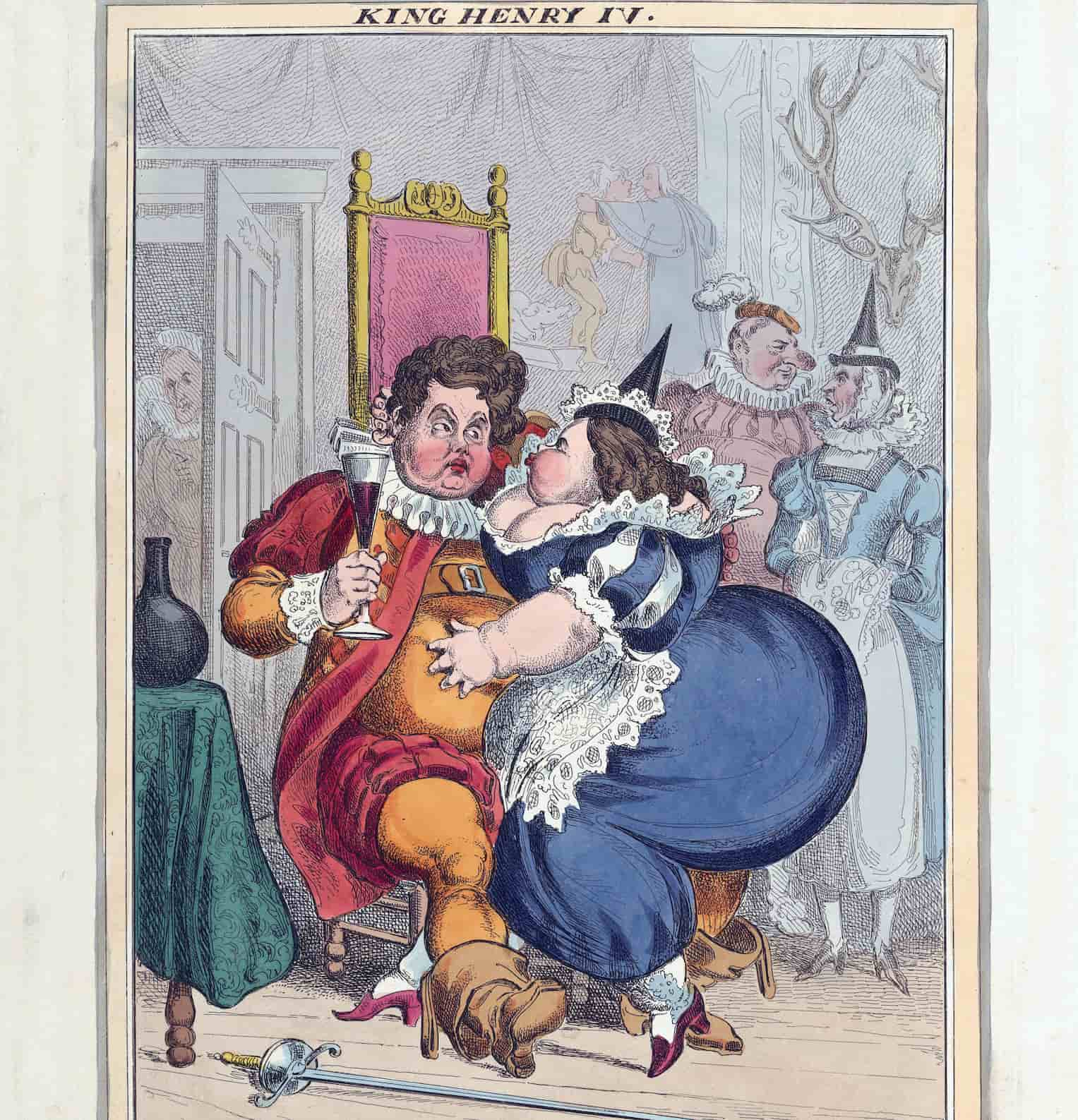
King Henry IV, Who Had 70 Affairs
Henry IV was the most well-known of these serial philanderers. He was called “The Green Gallant” solely for his numerous mistresses. His biographers claim he had relationships with about seventy different women. This is likely an extremely low estimate because of the carnal nature of this man.
The behavior of Henry IV with women left the Italian canon Giovannini utterly shocked, witnessing a level of “chaos” he had never encountered before. Whether they were nuns, prostitutes, country girls, gorgeous or hideous, Henry IV didn’t care. He needed all of them.
When he saw a marquise or prostitute whose features caught his eye, he would immediately dismount and fondle her while she was leaning against a tree or in a barn.
The cheerful and joyous ruler was also extraordinarily generous when it came to rewarding his affairs later.
Louis XIV’s Sexual Appetite Began to Run Wild Early
Louis XIV was tall, muscular, handsome, physically fit, and played the guitar. Women flocked to the most attractive prince in Europe. It’s hard to put a number on the affairs of Louis XIV outside of the official fifteen.
The Sun King’s sexual appetite was reportedly ignited at the tender age of fourteen.
Not even his mom’s closest friends were safe from his lust. Regardless of matters of state, Louis XIV had the capacity to send his advisors away, seized by a sudden urge to indulge in revelry.
When he was almost sixty years old, Louis XIV still “paid respect” to the noblewoman Françoise Maintenon on a daily basis. His alleged extramarital affairs were said to have cost as much as Versailles.
Louis XV Inherited His Father’s Genes for Lust
Louis XV, Louis XIV’s illegitimate son, shared his father’s “fixation”. But until he was 24, ladies actually paid him no attention. Then he met the noblewoman Mailly-Nesle, whose boyfriend, Richelieu, arranged for them to sleep together. That sparked the whole sex addiction of Louis XV.
The monarch went from being a model citizen to opening his own brothel and engaging in pedophilia, and he didn’t stop until he died. According to French historians, Louis XV is without a doubt one of France’s most notorious adulterers, alongside Henry IV.
The isolation of being a monarch, the weight of responsibilities that would crush lesser mortals, and finally the comfort of authority (because nobody can refuse to obey a king) might all contribute to this rage among French monarchs. Sex eventually became a normal pastime for the French royal court around this time.
Considering the staggering number of bastards produced by this massive orgy, it’s possible that millions of French citizens have a trace of kingly blood in their veins today (this was not supposed to sound good).
In the early morning mist of September first, 1870, across a bowl shaped valley loop of the Meuse River near the northern French border with Belgium, the armies of the Second French Empire and the Prussian led German coalition collided in one of the most decisive battles of modern history. In less than fifteen hours of ferocious artillery bombardment and desperate infantry and cavalry clashes, the Battle of Sedan resulted in the capture of Emperor Napoleon III, the destruction of France’s last operational field army, the fall of the Bonapartist dynasty, and the birth of the unified German Empire as continental Europe’s dominant military superpower.
Strategic Blunders and the March Into a Trap
When France declared war on Prussia in July 1870, Emperor Napoleon III and his generals expected a rapid offensive into German territory. Instead, the brilliant Prussian Chief of the General Staff, Helmuth von Moltke the Elder, mobilized over four hundred thousand German troops via coordinated rail networks and seized the initiative immediately. By mid August, following brutal frontier battles at Spicheren, Worth, and Gravelotte Saint Privat, France’s primary fighting force—the Army of the Rhine under Marshal Achille Bazaine—was completely surrounded and besieged inside the fortress of Metz.
With Bazaine trapped, French Marshal Patrice de MacMahon assembled the four corps of the newly formed Army of Chalons, numbering roughly one hundred and twenty thousand men and five hundred and sixty guns, accompanied personally by the ailing, kidney stone afflicted Emperor Napoleon III. Militarily, MacMahon knew the smartest move was to fall back westward to defend Paris. However, Empress Eugenie and the cabinet in Paris telegraphed a stern warning: if the Emperor abandoned Bazaine and retreated to Paris, a revolution would immediately break out in the streets. Against his better judgment, MacMahon marched his slow, supply burdened army northeastward toward Metz, marching parallel to the Belgian border right as Moltke wheeled two massive German armies—the Third Army under Crown Prince Frederick and the Army of the Meuse under Crown Prince Albert of Saxony—northward in a giant right hook to pin the French against the frontier.
Pinned in the Cauldon of Sedan and the Wound of MacMahon
Exhausted after a defeat at Beaumont on August thirtieth, MacMahon pulled his army into the fortified town of Sedan on August thirty first to rest his men and distribute ammunition. Geographically, Sedan was a death trap: the town sat at the bottom of a low basin surrounded on every side by steep wooded ridges and hills that looked straight down into the French positions. Overnight, while the French rested, Moltke’s German corps marched silently around both flanks across the Meuse River to occupy the high ground, closing a complete circle around the French army.
Fighting erupted at four o’clock in the morning on September first in heavy fog around the southeastern village of Bazeilles. There, elite French Marine Infantry fought house to house with extraordinary tenacity against Bavarian troops for six hours until every building was in flames. Around six o’clock that morning, while riding forward to observe the fighting at Bazeilles, Marshal MacMahon was struck in the hip by a fragment from a German artillery shell. His injury triggered a disastrous three way confusion in the French high command: MacMahon handed command to General Auguste Alexandre Ducrot, who immediately ordered a wise retreat westward toward Mezieres before the German ring closed completely; yet barely an hour later, General Emmanuel Felix de Wimpffen—who had arrived from Algeria just two days earlier carrying a secret letter from the War Ministry naming him successor if MacMahon fell—pulled rank on Ducrot and canceled the retreat, ordering the troops to march back into their old positions right as the last gap in the German encirclement slammed shut at noon.
Krupp Steel Artillery and the Brave People of Margueritte’s Cavalry
Once the German infantry linked hands at the village of Illy to the north, Moltke unleashed the full terror of modern industrial artillery. Positioned along the circular rim of hills overlooking the Sedan valley were more than five hundred German breech loading steel Krupp cannons, which outranged, outfired, and exploded on impact with far greater lethality than France’s older bronze muzzle loading cannons. From thirty six0 degrees around the compass, German batteries poured a relentless crossfire of explosive shells down into the crowded two square mile pocket of the Bois de la Garenne, slaughtering whole French battalions that could not even see the guns firing at them.
In the early afternoon, trapped on the western plateau of Floing and facing annihilation, General Ducrot ordered General Jean Auguste Margueritte’s division of Chasseurs d’Afrique—French light cavalry—to charge the Prussian infantry and artillery lines to buy time for a breakout. Just before leading the charge, Margueritte rode forward to reconnoiter and was shot through both cheeks, tearing away his jaw and tongue so he could only wave his arm toward the enemy. Three separate times, the French horsemen galloped across bullet swept slopes straight into the rapid fire of Prussian Dreyse needle guns, being mowed down in heaps just yards from the German muzzles. Watching the suicidal valor through his field glasses from the hillside of Frenois, King Wilhelm I of Prussia was moved to murmur aloud in admiration: “Ah, the brave people!” (Oh! Les braves gens!).
The White Flag and the Surrender of an Emperor
By late afternoon, remnants of the shattered French regiments were pouring back inside the medieval stone walls of Sedan in chaos, while Emperor Napoleon III—who had ridden out under shellfire for four hours hoping a stray bullet would end his suffering—returned to the citadel. When General Wimpffen proposed one more suicidal breakout over the bodies of the wounded, Napoleon III refused to sacrifice another life and ordered the white flag raised over the fortress ramparts.
That evening, the Emperor wrote a two sentence note to King Wilhelm I of Prussia: “Monsieur my brother, having been unable to die in the midst of my troops, nothing remains for me but to place my sword in the hands of Your Majesty.” On the morning of September second, 1870, Napoleon III rode out in a carriage to meet Prussian Chancellor Otto von Bismarck at a weaver’s cottage in Donchery, and subsequently met King Wilhelm at the Chateau de Bellevue. Under the formal capitulation, Napoleon III, thirty nine generals, and over one hundred and four thousand French soldiers became prisoners of war, alongside seventeen thousand dead and wounded. Two days later, Paris overthrew the Empire and proclaimed the Third Republic, while four months later in January 1871, King Wilhelm I stood inside the Hall of Mirrors at the Palace of Versailles to be proclaimed German Emperor—a direct legacy of the afternoon the guns fell silent at Sedan.
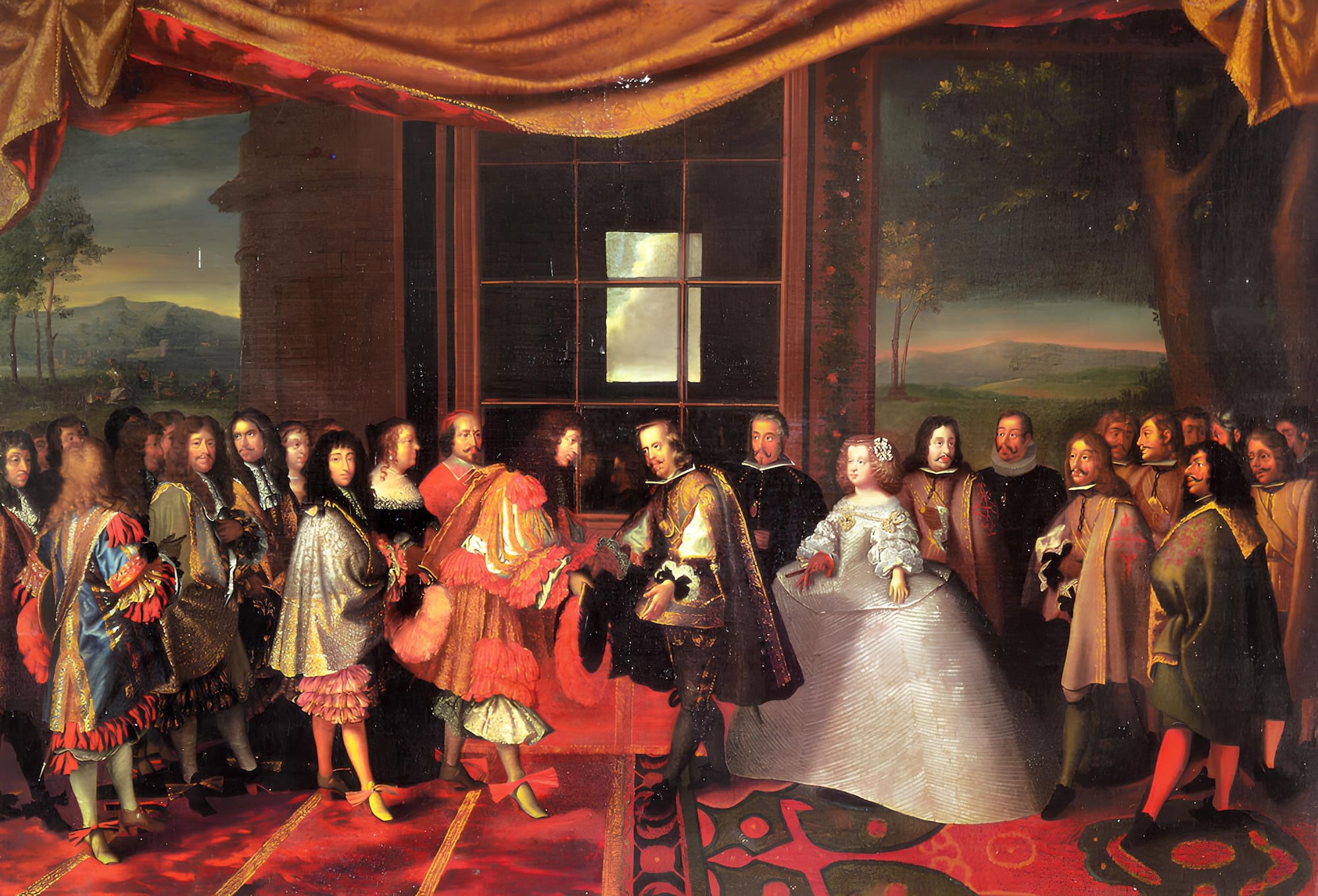
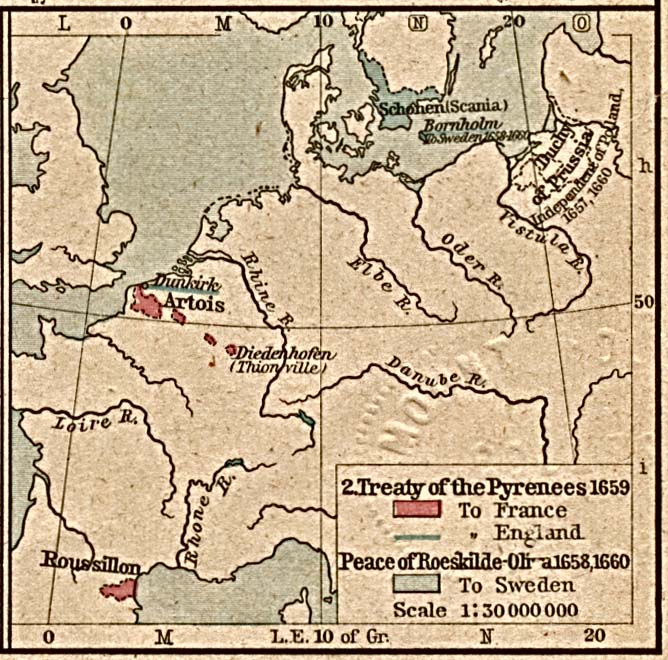
The conflict between France and Spain, which had begun in 1635, ended with the Treaty of the Pyrenees. It pitted two great royal houses against each other: the Bourbons ruling France and the Habsburgs ruling Spain. The Spanish were forced to negotiate an end to the conflict after their defeat at the Battle of the Dunes in 1658. This was finalized on November 7, 1659, when Cardinal Mazarin and Don Luis Méndez de Haro signed the Treaty of the Pyrenees.
As a result of this pact, France was able to regain control of some territories in the north and southwest that had been under Spanish control. The marriage of Infanta Maria Theresa of Austria, daughter of King Philip IV of Spain, to Louis XIV of France was another consequence of this treaty. This marriage greatly strengthened France’s status on the European continent by making the French sovereign the most powerful monarch in Europe and weakening the Spanish monarchy.
What Was the Background to the Signing of the Treaty of the Pyrenees?
The war between France and Spain started in 1635. At the time, both Spain under the House of Habsburg and France under the Bourbons wanted to increase their sway over Europe. The bloody conflict between the two continental powers lasted over 25 years. It wasn’t until the Battle of the Dunes in 1658 that France finally managed to pull ahead. It occurred on territory controlled by the Spanish crown between Nieuport (Flanders) and Dunkirk. The Treaty of the Pyrenees was concluded on November 7, 1659, after extensive negotiations.
What Powers Did the Treaty Bring Into Play?
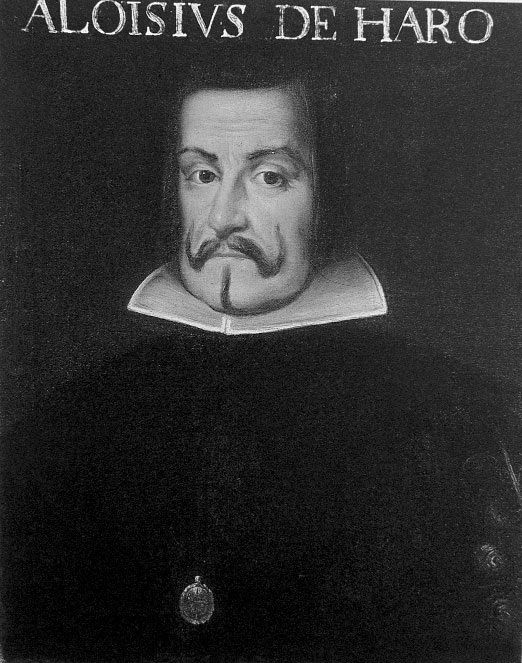
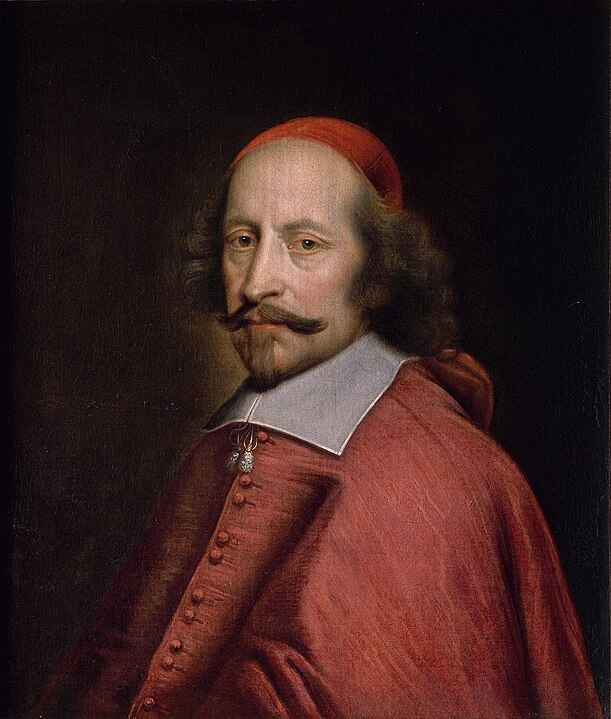
Don Luis de Haro y Guzmán, anonymous painting from the Uffizi Gallery.Portrait of Cardinal Jules Mazarin (1602-1661)
Both Spain and France were major powers in Europe during the 17th century. Several Germanic and Austrian rulers were enthroned by the House of Habsburg in Spain over the ages. On the French side, the Bourbon line wielded power. At the start of the war, Louis XIII was in charge of the French kingdom; Louis XIV took his place in 1643. France triumphed over Spain in their battle, and the Treaty of the Pyrenees was ratified by Cardinal Mazarin. King Philip IV of Spain had his Prime Minister, Don Luis Méndez de Haro, handle this responsibility.
What Did the Treaty of the Pyrenees Establish?
The geopolitical effects of the Treaty of the Pyrenees (1659).
The Treaty of the Pyrenees was an important moment in European history. The House of Bourbons finally triumphed over the House of Habsburg after decades of intermittent conflict that culminated in the Franco-Spanish War. The two reigning dynasties negotiated arrangements that favored France under the Treaty of the Pyrenees. Although talks had begun in 1656, it wasn’t until the French victory at the Battle of the Dunes in 1658 that the Spanish agreed to give as much ground as they did.
There were a total of 124 provisions in the Treaty of the Pyrenees, plus another 8 that were kept secret. There are certain articles that are more vital than others. Article 42, for example, delimits the frontier using the peaks of the Pyrenees as its boundary. Article 61 highlights Philip IV’s rejection of any right to the Alsatian provinces.
What’s in It for the Warring Powers?
French King Louis XIV saw the Treaty of the Pyrenees as a chance to cement his rule over the rest of Europe. The House of Habsburg was severely weakened, as was the Spanish crown. In particular, northern France and the Netherlands were two areas where Spain had to give up control. The Treaty of the Pyrenees, in particular, suggested to Spain that it was compelled to join a forced coalition.
Louis XIV married the daughter of Emperor Philip IV of Austria, Maria Theresa. The infanta and her heirs were legally required to give up their claim to the Spanish throne as part of the marriage contract. The marriage contract was amended by Cardinal Mazarin to include a dowry provision demanding that Spain pay 500,000 gold ecus. The sum was so enormous that it was a factor in Louis XIV’s claim to the Spanish throne and the subsequent War of Devolution.
Cardinal Mazarin adds a clause so that Spain is required to pay a dowry of 500,000 crowns for the marriage. A colossal sum that Spain will be unable to pay, which will later be used by Louis XIV to claim rights over the Spanish crown and will lead to the War of Devolution.
How Did the Treaty of the Pyrenees Redraw the Franco-Spanish Map?
Spain held extensive territory in what is now northern France and the Netherlands prior to the Treaty of the Pyrenees. The “Spanish Netherlands” was the name given to these territories. After defeating Spain in battle, France annexed the territory to its crown. South of it, it absorbed principalities like Catalonia, where modern-day Montpellier is situated.
The treaty resulted in significant changes to the border between France and Spain. France gained control of territories in Catalonia and Roussillon, solidifying its control over these regions.
The delineation of the French-Spanish border, however, was the most consequential event. In a rough sense, the Pyrenees serve as a border here. “The crests of the mountains that form the slopes of the waters” are all that is needed to define the boundary, according to the treaty. It was a complete and utter win for Louis XIV and France. The only concession granted to Spain was the renunciation of support for Portugal, then at war with its Iberian neighbor.
Famous as the “king-knight” who won the Battle of Marignan in 1515, Francis I (or François I) reigned as king of France from 1515 until 1547. His reign profoundly shaped the sixteenth century as the founder of the Valois dynasty, a great lover of ladies and hunting, a great prince of the French Renaissance, and a guardian of the arts and literature. As a result of the ordinance of Villers-Cotterêts in 1539, the language of official actions shifted from Latin to French, and the power of the nobility dwindled to the advantage of the monarchy. His predecessor, Louis XII, did not think much of the young prince who would soon succeed him, though, saying, “This fat boy will spoil everything.” On numerous occasions, Francis I would endanger the country.
François d’Angoulême: Future Francis I
François d’Angoulême was a prince of the blood and a first cousin, once removed, of the French monarch Louis XII. He was born on September 12, 1494, in Cognac. His mother, Louise of Savoy, committed him to the care of the marshal of Gié, where he was nurtured. For a prince of such intelligence and practicality, only military training and rigorous exercise seem to have any interest. His height gave him an advantage in wrestling and running, both of which he excelled at. His mother, who had passed on all her goals to her son, had been quietly preparing him for the responsibilities of leadership. Despite this, Francis was never meant to be king.
But Louis XII had no male heirs in 1506. Hesitant about his own line of succession, the king set about arranging a marriage between his daughter Claude of France and François of Angoulême. The young prince, who had been appointed head of the Guyanese army, had previously been a regular in the king’s council and had been seen accompanying the monarch everywhere he went. Following Louis XII’s death on January 25, 1515, Francis I ascended to the throne and was crowned at Reims. On February 15, he reached Paris with great solemnity at the head of a lavish procession, eager to take part in the festivities that had been planned for him.
Beginning of the reign of Francis I
After ascending the throne on February 4, 1515, he showered his family and friends with gifts. He gave his mother the duchy of Angoulême, to which he later added the counties of Anjou, Maine, and Beaufort; his sister, Margaret, the revenues of the duchy of Berry; his childhood friend Bonnivet; and his teenage friend, Robert La Marck. Then he established his administration and court, naming Louise Madame and appointed her regent as needed due to her frequent moves. She put out a judge from Auvergne called Antoine Duprat as the new regime’s “architect of absolute authority” and “man of confidence.”
The major bodies’ positions were solidified financially, and new taxes were instituted, all in an effort to refill the coffers. The Court, an idea introduced from Italy at the period that was still vague, consisted of powerful lords and their spouses who accompanied the king on his journeys and stood by him at the ceremonial entry into the towns of the realm. Young Claude barely made an appearance since she was pregnant, bashful, and modest. She gave birth to a daughter, Louise, in August of 1515.
The future King Francis I was well-versed in the military sciences and anxious to make a name for himself. What better place to do combat than on ground to which he thought he had rights, and whose excellent culture he was familiar, just as his predecessor had?
The Italian mirage
On the French side, the idealized depiction is of Bayard bestowing a knighthood to King during a fight.
Since the dawn of the Renaissance, the Italian peninsula has been sought by European tyrants—especially French kings—for its wealth and splendor. Furthermore, since Charles VIII’s reign, France has been at open war with the Pope and the Italian principalities, who are joined with European rulers in a Holy League. Louis XII took control of Milan in 1499, but he ended up having to give it back after losing the Battle of Novara (June 6, 1513). Francis I, who had been given his wife Claude’s claim to the duchy, attempted to incorporate it into the royal realm.
Henry VIII of England’s neutrality and the assistance of the Venetians were secured before the young king set off on an expedition in 1515. Marignan’s victory against the Swiss mercenaries supporting the Duke of Milan was guaranteed by the superiority of the French artillery. Due to his military prowess, the lord of Bayard knighted Francis I, a young monarch of just twenty years of age, earning him a reputation for valor and adoration.
Yesterday’s adversaries were forced to bargain with France’s monarch. In Bologna, Francis I and Pope Leo X had their meeting. The Swiss agreed to a permanent ceasefire, allowing France to recruit mercenary soldiers indefinitely. For the sake of maintaining his claim on Naples, Charles I of Spain (the future Charles V) acknowledged Milan to France.
The rivalry with Charles V
Portrait of the young Charles of Habsburg, the future emperor Charles V, around 1515, the eternal rival of Francis I; painted by Bernard van Orley, Paris, Musée du Louvre.
In 1519, Francis I was favored by the Imperial Electors against King Charles of Spain, who, because to the wealth amassed by the Fugger family from the New World’s gold mines, had significantly more influence than his French counterpart. Charles V’s expansionist goals (“Always more”, “always further“) endangered the French throne. Charles, grandson of Charles the Bold, made an attempt to incorporate Burgundy into the Holy Empire and asserted his authority over the regions of Dauphiné and Provence that had previously been under the rule of his great-grandfather.
From that point on, Francis I was constantly forming new alliances with foreign princes while being encircled on all sides by a sovereign who ruled over Spain, Flanders, the Empire, and a large portion of Italy. After an expensive and fruitless conversation with Henry VIII of England at the Field of the Cloth of Gold (June 1520), during which he failed to win the king’s favor, he was forced into war with the Emperor.
The fighting between the two kings officially began in 1521, during the Italian Wars. Very rapidly, operations went from favorable to unfavorable for France; the loss at La Bicoque (1522), where Bayard was murdered, handed Milan up to imperialists. In the year following, the famous royal army leader Constable of Bourbon abandoned his lord, joined Charles V’s service, and led an unsuccessful invasion of Provence.
In 1525, after the tragedy of Pavia, the king himself was kidnapped by the armies of the emperor; he later wrote to his mother, “Of all things, only dignity and life remained to me.” Louise of Savoy secured the regency while he was in jail, and the circumstances were dramatic, calling to mind John II the Good’s incarceration during the Hundred Years’ War.
Francis I was imprisoned in Madrid on January 14, 1526, and forced to sign the Treaty of Madrid, which gave Milan and Burgundy to the Empire in exchange for a promise from his sons, the Dauphin François and Prince Henry, the future Henry II. When he was finally released, however, he wasted no time in abandoning his obligations and restarting the conflict. Francis I, the Pope, Venice, and Duke Sforza of Milan formed an alliance at Cognac in May 1526, but in 1527, imperial armies stormed Rome, forcing Pope Julius II to sign a humiliating peace deal with Emperor Charles V.
For this reason, Louise of Savoy and Margaret of Austria, aunt of Charles V, agreed at the time of the peace of Cambrai, known as the “Paix des Dames,” (1529) to restrict bellicose actions in northern Europe. This was an official acknowledgment of French sovereignty over Burgundy, with Italian claims dropped. This adornment seems to be confirmed by the fact that in 1525, Francis I, a widower since 1524, married the sister of the emperor, Eleanor of Habsburg, who was also the widow of Manuel I, king of Portugal.
New alliances
Kings Francis I and Henry VIII at the Field of the Cloth of Gold. Oil on canvas, 1545, Royal Collection.
Francis I, however, was cognizant of the precarious nature of this accommodation and attempted to create new alliances, offering his support in 1531 to the Schmalkaldic League, formed against Charles V by the German Lutheran princes, much to the shock and dismay of Catholic Europe. However, the battle continued the next year when the emperor invaded Provence after signing a contract with Suleiman the Magnificent in 1535. Both men hoped to reduce the Habsburgs’ influence. At Aigues-Mortes (1538), Charles V was obliged to accept a ten-year ceasefire after being rebuffed by Duke Anne de Montmorency, who had won the position of Constable in 1537.
Francis sacked Montmorency and reignited the struggle in 1542 when his diplomatic efforts to acquire the Duchy of Milan proved futile. In 1543, the French army, aided by the Turks, defeated the Anglo-German alliance and retook Nice. One year later, the monarch won the Battle of Cerisoles.
Amid growing threats to his realm as a result of his collaboration with the “infidels,” he eventually signed the Treaty of Crépy with Charles V (1544) and the Treaty of Ardres with Henry VIII (1546). These treaties legitimize France’s decision to give up Savoy and their defeat in Artois and Flanders, and they put an end to a disastrous war that did little to disrupt the stability of the Habsburg empire.
Francis I: Prince of the Renaissance
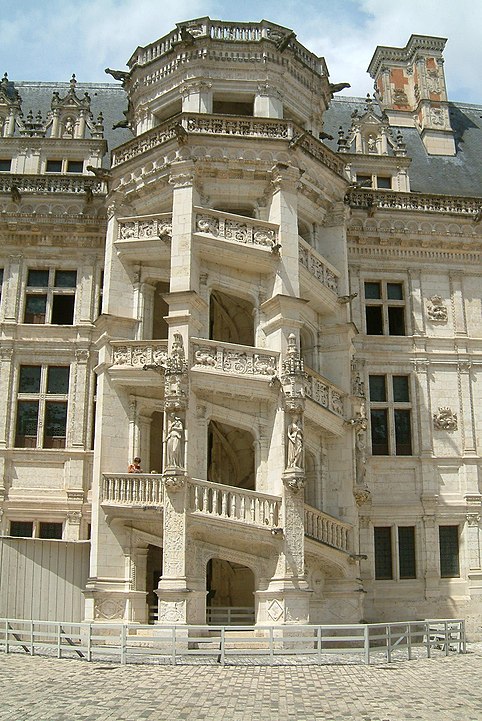
The monumental staircase of the Château de Blois.
Due to his many trips, the French king was soon in touch with the emerging Italian Renaissance. Francis I, whose refined education made him especially sensitive to the need for change in his country, took this task extremely seriously.
He gained the support of Marguerite de Navarre and became known as a protector of humanists at the Meaux apex. The king’s children were taught by the humanist theologian Lefèvre d’Étaples. First, in 1520, the erudite Guillaume Budé was tasked with establishing a royal library in Fontainebleau, the precursor to the National Library; then, in 1530, he was tasked with establishing a trilingual college, the future Collège de France, in which the royal readers taught Greek, Hebrew, and Latin. The king awarded high positions to poets like Mellin de Saint-Gelais and Marot, who were both guests at his court.
The Francis I Gallery at the Château de Fontainebleau.
Like Jean Clouet (the king’s official painter from 1516 until his death), Fiorentino Rosso (who succeeded him from 1530 until his death), Primaticcio (a painter, decorator, and architect who arrived in France in 1531), and Benvenuto Cellini (a guest sculptor from 1540 to 1545), the king attracted great Italian or foreign artists to France. Francis I established the tradition of royal patronage via his invitation strategy, which was continued by his successors, most notably Louis XIV.
Francis was successful in adapting Renaissance art to France in no small part because he welcomed Leonardo da Vinci in 1516. He hired the Florentine artist to live and work in the Château du Clos-Lucé in Touraine and then had him build several palaces for him, notably the Château de Chambord.
The monarch was a skilled constructor, and his palaces at Saint-Germain, Villers-Cotterêts, and Madrid (in Neuilly) were all examples of his work. He also had the castle of Blois (the construction of the staircase) and the castle of Fontainebleau redecorated in the Italian style (Rosso for the royal gallery and Primatice for the ballroom). The Fontainebleau school reached its zenith during his rule.
Francis I greatly expanded the king’s court, inspired in part by Italian aesthetic preferences. It served as the epicenter of the king’s lavish lifestyle, which he transferred between lavish castles whenever his fancy took him. While keeping the medieval (royal entries into cities, tournaments, and hunting) rituals that had been practiced for centuries, the monarch hosted several Italian-inspired feasts, concerts, and theatrical performances.
He was a guy who enjoyed the finer things in life, and he had several affairs, the most noteworthy of which were with the Countess of Chateaubriand and the Duchess of Etampes. The sovereign was able to exert more authority over the normally unruly order by courting the nobles and amassing a larger number of promises and favors.
Money: The sinew of war
Francis I had seized control of his realm after his release from Spanish captivity with an iron fist, and he recognized that having access to sufficient financial resources was crucial to the success of any strategy. All of the Valois were affected by the sudden financial crisis. Ordinary revenues came from the king’s private domain and extraordinary revenues began as exceptional but quickly became ordinary and accounted for nine tenths of the royal treasury’s resources (aids on wine or on cloven-hoofed animals, tolls, gabelle on salt and, finally, the most unbearable of them all, the taille -direct land tax– with its increases, its “floods” levied as and when needed). The taille did not fall uniformly on the king’s subjects; the nobility, the clergy, the vast majority of the king’s officers, and the urban populace were spared.
The tax was not well-grounded and was subject to change depending on the “generalities” by which the treasurers and generals of finance made their decisions. Consequently, the Treasury was always in the dark about its true income. As long as its needs were made clear, the job of communicating with parish taxpayers fell to the treasurers or their receivers and collectors.
The treasurers and “generals” were the financial gurus of the organization. They often came from wealthy banking families and loaned or gave the monarch money when required. Therefore, the Beaunes, Briconnets, and Berthelots had tremendous influence as the king’s creditors, since the Crown was ultimately forced to depend on them despite resorting to various expedients, including the establishment or sale of offices and loans to the cities.
Francis I had appointed a rich businessman called Jacques de Beaune de Semblançay as a “general” and a kind of supervisor of finance, making him the most influential member of this oligarchy. However, beginning in 1521, Semblançay’s ability to meet the expanding needs of the king, who had to pay his men, declined, no matter how intelligent he was. He wired an additional 360,000 livres to the Italian army, but he refused to cover the following gap: He informed the king that “the scholarships are closed.”
Francis, prompted by Louise, became certain that he had been duped, and in 1524 he filed his first lawsuit against his backer, a suit that ultimately went in favor of Semblançay and exonerated him. Nonetheless, the French monarch had no plans to rest on his laurels.
The next year, 1527, he had him jailed once again and formed the “Square Tower” panel, whose members were under his absolute control. The trial lasted many months and ended tragically when Semblancay, having been found guilty of fraud, was hung on August 12, 1527, at the gallows of Montfaucon. In his honor, Marot wrote a renowned epigram. Other people also had to pay the price for Semblancay’s authority. In turn, Bohier, Berthelot, Ruzé, and Poncher were each sentenced to very large penalties but seldom to death. Francis was finally able to break away from the control of the financial aristocracy after escaping the tutelage of parliament. The only thing left to do was implement wide-ranging changes.
The consolidation of the monarchy
Francis I was a tall and elegant monarch who had a lofty conception of his role. He was also bright and cunning, if sometimes impetuous and shallow, and he had a presence that was noted by all the memorialists of his day. Administrative centralization was bolstered, and court life was refined, both of which contributed to the unmistakable advancement of absolute monarchy. The phrase “for such is our pleasure” and the title “His Majesty” both have their origins in Francis I.
A Council (also known as the Privy Council or Council of State) made up of members of the royal family, princes of the blood, powerful commanders, and some elderly servants provided the monarch with advice and counsel as he ran the country. Members of the Privy Council were excluded from government activities until they were invited to join the Council of Affairs, a small, secretive circle in which the monarch and one of his counselors held control.
Francis I’s reign, dominated by military concerns, is remembered for the consolidation of royal power that hints at the eventual rise of absolute monarchy. The expropriation of the Constable of Bourbon’s property in 1523, the formal reunion of Brittany to the kingdom in 1532, and the confirmation of royal justice in the face of seigneurial justice were all examples of events that hinted at the possibility of unification and centralization. Other affirmations included the ban on parliaments exercising their right of remonstrance, leaving them with only the right of registration, the dispatch of intendants to the provinces; and the ordinance of Villers-Cotterêts (1539), which mandated, among other things, the writing of judicial and notarial acts in French rather than Latin. The Duke of Montmorency, Lord of Bonnivet (c. 1488–c. 1525), and Admiral Philippe de Chabot (c. 1480–c. 1543) were the king’s foremost advisors who faithfully interpreted this centralization and unity.
However, the government’s interest in colonial development and the opening of the kingdom may be seen in the founding of the port of Le Havre by Bonnivet (1517) and the support provided to the explorer Jacques Cartier.
Though the government was always scrambling to come up with new ways to pay for the war’s mounting costs, its financial policies seemed disjointed at best. He had a huge need for money (paid to win over the German princes during his campaign for the Empire and for his patronage), but no logical tax structure was put in place, so he pressed his people instead. Taxes rose from 2,400,000 to 4,600,000 livres between 1517 and 1543.
Even though the government was able to increase tax revenue after the Treasury of Savings was established in 1523, the constant strain on state coffers was the result of heavy borrowing, the sale of numerous government positions, the promotion of inflation, and the issuance of numerous titles (such as the annuities on the Hôtel de Ville, established by Chancellor Antoine Duprat in 1522). This practice of imposing interim restrictions that are then made permanent was a mainstay of the French tax system up to the French Revolution.
Francis I: Religious leader
Francis I set out to establish his authority over the aristocracy, the Third Estate, and the clergy from the start of his reign. With the help of Pope Leo X, he signed a concordat in 1516 that gave him the authority to choose bishops throughout his realm. Despite the authority of confirmation being acknowledged for the pope, this concordat of Bologna guarantees him control of the French episcopate. Many members of the clergy and the intellectual community had begun to see the necessity for Church reform at that time.
The clergy frequently exhibited incompetence, confusion, and moral sloppiness, to the point where they forgot the words of the creed. Luther used the business of indulgences as a pretext to set the world on fire and initiate the Reformation as the pope struggled to recover from the moral degradation into which his magisterium had fallen.
At least at first, the monarch was tolerant of Protestant beliefs. When the humanists of Meaux, headed by Bishop Guillaume Briçonnet, Marguerite de Navarre’s spiritual guide, were falsely accused of being Lutherans by the Sorbonne, the monarch intervened on their behalf. In the 1530s, he quelled the many ecclesiastical controversies because he wanted to make peace with the German Lutherans on the political front.
After the incident of the Placards in October 1534, however, King Henry VIII saw the full scope of the movement and gave permission for the Parliament to launch a wave of persecutions, which were diplomatically halted by the Edict of Coucy (July 1535). The persecution, which had been temporarily halted by the 1540 decree of Fontainebleau, resumed in April 1545 with the horrific example of the killing of several hundred Vaudois in Provence. Ultimately, Francis I stayed devoted to Rome throughout his rule, albeit sometimes protecting a few relatives or intellectuals. Protestantism had acquired a solid footing in France, and its position was to be the main dilemma confronting the French monarchy for a hundred years, and this was the revelation of the incident of the Placards.
Francis I passed away on March 31st, 1547, at his Rambouillet fortress due to complications from syphilis. After the dauphin François passed away in 1536, Francis I’s second son, then 28 years old, became King Henry II of France.
FRANCIS I’s CRUCIAL DATES
September 12, 1494: Birth of Francis I
Francis I, born François d’Angoulême, was born in Cognac. The heir apparent to the French throne in 1515, he is the son of Charles of Valois, Count of Angouleme, and Louise of Savoy. On April 7, 1514, he married Claude of France, the daughter of Louis XII. Aside from being the herald of the French Renaissance, the victor of the Battle of Marignan is also a symbol of French independence. Many artists, notably Leonardo da Vinci, were drawn to his court throughout his reign. He initiated the building of Chambord Castle and the establishment of the Collège de France.
April 7, 1514: Francis I marries Claude de France
François d’Angoulême married Claude of France, the daughter of his cousin which was the French king Louis XII. Following this, he was elevated to the position of Duke of Valois. As a result of this marriage, he will be the monarch’s only heir should the king ever die.
January 25, 1515: Coronation of Francis I
Francis I, just 20 years old, became king on January 1 after the death of his cousin and father-in-law, Louis XII. In the city of Reims, he was officially made king of France. His reign would last 32 years.
September 13, 1515: Francis I was victorious at Marignan
Wanting to emulate his ancestors, the young king resolved to lead an invasion of Italy. With his army, he marched across the Alps in August to conquer the Duchy of Milan. When he arrived in September, he found Swiss mercenaries who had been sent as reinforcements by the pope. The conflict didn’t end until the 14th of September, when the French monarch was declared victorious. In response, Lord Bayard knighted Francis I. Along with this victory came the signing of a contract of “perpetual peace” with the Helvetic cantons.
January 1, 1516: Leonardo da Vinci, a hint of an opportunist, enters the service of the King of France
Da Vinci left Italy for France after being there for just two years. He moves to the Clos-Lucé property in Amboise at the invitation of King Francis I of France, who names him “first painter, architect, and engineer of the King” and provides him with a position in the royal court.
August 8, 1516: Francis I signs the Concordat of Bologna
By signing the Concordat of Bologna, the King of France gave himself absolute authority over the French episcopate.
November 29, 1516: Peace of Fribourg
Francis I and the Helvetic Confederation agreed to “perpetual peace” by signing a pact. France paid a hefty sum to ensure Swiss neutrality in any future conflicts and to secure the right to draft Swiss soldiers into French service.
February 7, 1517: Foundation of the Port of Le Havre
King Francis I of France wanted to encourage economic growth in his kingdom, so he granted the charter that would eventually become the port of Le Havre. His vessel, Hermine, arrived in the harbor in October of the following year.
June 7, 1520: The interview at the Field of the Cloth of Gold
There was a summit between France’s King Francis I and England’s King Henry VIII at the city of Calais. The Holy Roman Emperor, King Charles V of Spain, had been elected the previous year, and this meeting’s principal topic was how to react to his accession. Francis I, being encircled by the emperor’s lands, intended to persuade the king of England to join France in an alliance. At the Field of the Cloth of Gold, he gave him the royal treatment with all the pomp and circumstance at his disposal. But whatever advantage Francis planned to gain from this encounter would be nullified by Henry VIII’s reunion with Charles V two weeks later.
April 27, 1522: Defeat of Francis I at Bicoque
Charles V’s armies beat Francis I’s, led by Lautrec, at Bicoque. Finally, France had no choice but to hand over the Duchy of Milan to its most savage opponent.
October 26, 1524: Francis I takes Milan
Led by their king, the French troops captured Charles V’s Milan. The French began a siege of Pavia the next day. The day Francis I was captured was February 24, 1525.
February 24, 1525: Francis I was taken prisoner in Pavia
In his hurry and eagerness for victory, the monarch rushed to assault the opposing forces while the French guns of Genouillac were hitting the Spanish troops in Pavia. French artillery fire instantly ceased out of concern for the safety of the monarch. As a result, the Spanish took advantage of the situation and encircled the king. All of Francis I’s troops were slaughtered, and the king and some of his generals were captured. Francis I was first held captive at a Carthusian abbey in Pavia before being taken to Charles V’s Spain. He was released after renunciating Italy and receiving Burgundy in return for signing the Treaty of Madrid on January 14, 1526.
January 14, 1526: Francis I signs the Treaty of Madrid
Francis I signed the Treaty of Madrid in order to be released from Charles V’s prison in February 1525. He promised to give up Burgundy and any claims to Italian territory. The French monarch disregarded the terms of the contract the day following his release in March 1526, leaving his two sons in Spain as hostages.
March 17, 1526: Release of Francis I
France’s monarch, who had been held captive by Charles V since his loss at Pavia, was liberated from his Madrid cell. As part of the deal that secured his freedom, he had to give up Burgundy and surrender his two sons, Francis and Henry, to the Emperor. In a hurry, Francis I broke this treaty and joined forces with the Italian princes and the Pope in the League of Cognac to fight Charles V. As soon as the Peace of Cambrai is signed in 1529, the war will resume.
August 3, 1529: Signature of the Peace of Cambrai
Louise of Savoy, mother of Francis I, and Margaret of Austria, aunt of Charles V, signed the Peace of Cambrai, often known as the Ladies’ Peace, to bring an end to hostilities between France and the Habsburgs. Francis I, who had been a widower for some time, decided to wed Eleanor of Habsburg, the Emperor’s sister, to finalize the treaty. He also regained Burgundy but sacrificed Italy in exchange. The king’s two sons were finally freed after a massive ransom was paid. However, the anger of the French monarch would spark a new war the next year, in 1536.
January 1, 1530: Foundation of the Collège de France
Francis I was persuaded by Guillaume Budé to establish a royal academy to teach classical languages. The building underwent a transformation during the Restoration and eventually became the prestigious Collège de France.
July 4, 1530: Francis I marries Eleanor of Habsburg
According to one of the treaty’s provisions, Eleanor of Habsburg was to wed Francis I sometime after the Treaty of Cambrai ended hostilities between France and the Habsburgs. July 4, 1530, was the date of the wedding.
August 9, 1534: Jacques Cartier discovers the St. Lawrence
Jacques Cartier, a French explorer, discovered the river’s mouth and gave it the name Saint Lawrence, after the patron saint of navigators at the time. He was successful in getting King Francis I to fund an expedition to the Pacific through the Arctic. Two Indians and a map were among the items he brought back from his journey. The king was suitably pleased, and he was granted permission to proceed with his mission. In the next year, Jacques Cartier would go up the St. Lawrence.
October 18, 1534: Affair of the Placards
Protestant “Placards” were printed in Neuchâtel at Pastor François Antoine Marcourt’s urging. They thought the Mass was a tool of the pope’s to consolidate his authority, so they resisted it. On the night of October 17–18, they were “Placarded” all throughout France, including King Francis I’s quarters in Amboise. “Placards” were “actual articles on the awful, vast, and intolerable excesses of the royal mass,” as the Protestants of the period put it. The French Protestants will be profoundly affected by this incident. The narrative convinced Francis I to go on a quest for the “heretics.” The “placards” scandal has effectively ended decades of religious tolerance in France.
January 13, 1535: Francis I censored books
The French monarch, fearing the spread of Lutheran ideas, bans all book production. A few days later, he changed his mind, but he nevertheless stuck to the notion of censorship and handed it up to a commission of the Paris Parliament.
February 4, 1536: Francis I allies himself with Suleiman the Magnificent
The Treaty of Capitulations was an agreement between France’s monarch and the Ottoman Empire’s Sultan Suleiman the Magnificent. During his conflict with Emperor Charles V over Savoy and Turin, Francis I depended on this alliance, which was unprecedented at the time since it was between a Christian and a Muslim kingdom.
August 10, 1539: Signature of the Ordinance of Villers-Cotterêts
Francis I of France mandated the use of French instead of Latin for all official documents in the fields of government and law with his ordinance of Villers-Cotterêts (Picardy). This was a major choice in achieving the goal of a unified kingdom. The “Langue d’oïl” was the standard language used in official documents across the Paris region and the Loire Valley. Indeed, it will be quite some time before the royal proclamation is implemented everywhere. It wasn’t until the middle of the 20th century that everyone spoke the same language.
March 31, 1547: Death of Francis I
At the age of 53, the king of France died in his castle of Rambouillet. He had been very ill for months, and had previously undergone the utmost unction. It took two months to bury the “Great King François.” On May 24, his coffin would be lowered into the crypt of the royal abbey of Saint-Denis. Francis I, a figurehead of the French Renaissance, was succeeded by his son, Henry II, at the young age of 28.
Bibliography:
Jensen, De Lamar. “The Ottoman Turks in Sixteenth Century French Diplomacy,” Sixteenth Century Journal 16:4 (1985): 451–470. online
Frieda, Leonie. Francis I: The Maker of Modern France. New York: HarperCollins, 2018.
Richardson, Glenn. The Field of the Cloth of Gold (New Haven, Connecticut: Yale University Press, 2014).
Knecht, R.J. Francis I (Cambridge University Press, 1982) online
Jensen, De Lamar, ed. Renaissance Europe: Age of Recovery and Reconciliation. Lexington, Massachusetts: D.C. Heath and Company (2nd ed. 1991).
King Henry II of France’s favorite, Diane de Poitiers (1499–1566), displaced Catherine de’ Medici as queen of France and built an exclusive court around herself. She was a strong, self-reliant lady who understood how to keep herself looking and feeling young. She stuck to her beliefs no matter what: “Be in respectable bearing, in a cool and confident manner, with a modest gaze and quiet tone, consistent and steadfast, always with a purpose, without bending, and with moderation in all things.” As a result of her efforts, Henry developed from an awkward youth into a troubadour, poet, horseman, and king. She went into seclusion in Anet after the shocking death of her husband, King, and passed away there on April 22, 1566.
Diane de Poitiers: A lady of the Renaissance
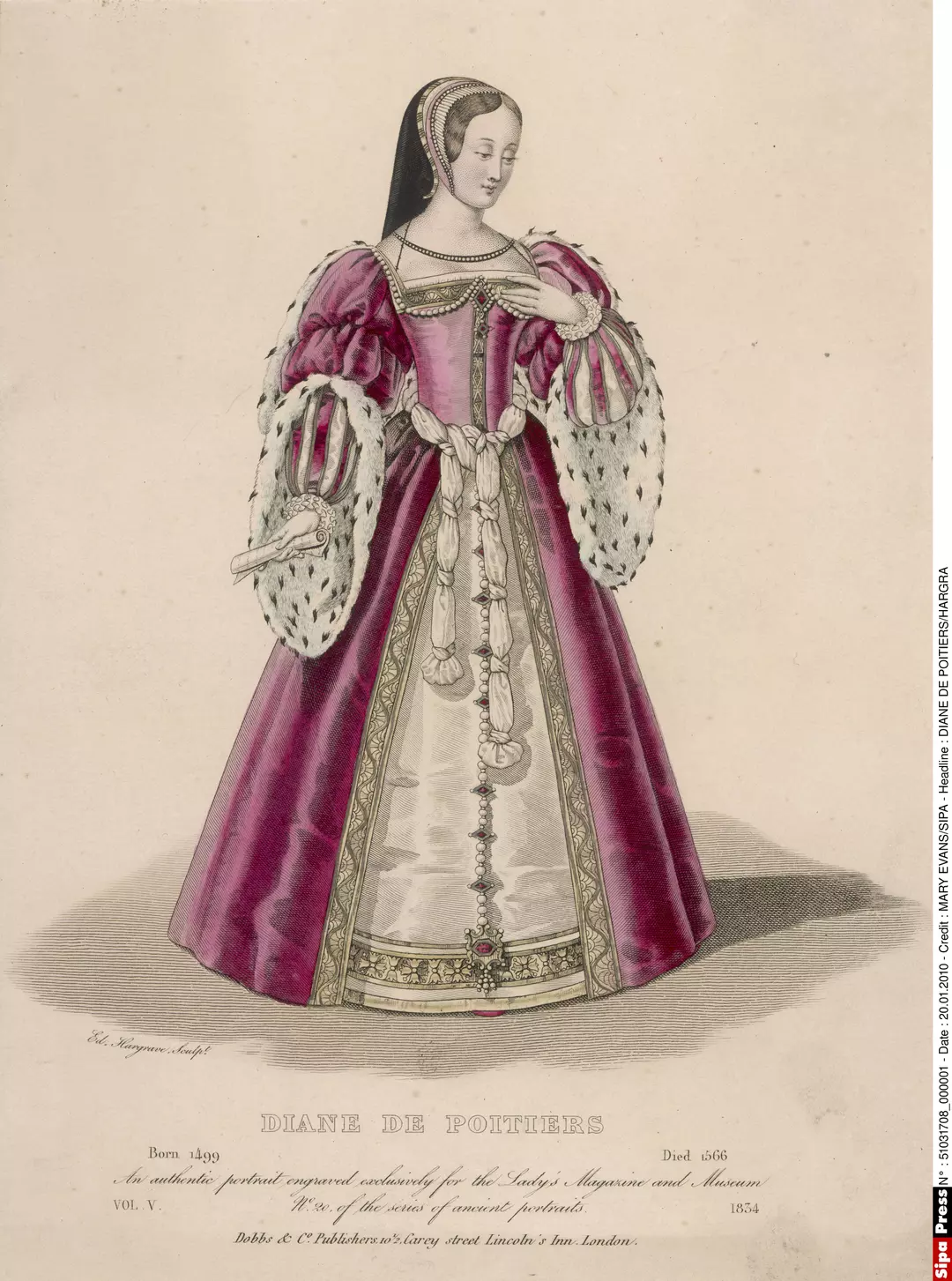
Painting of Diane de Poitiers.
Diane, named after Diana, goddess of the hunt, was born on December 31, 1499, at the family castle in Dauphiné to Jean de Poitiers. Later in life, she inherited the Poitiers lion insignia, the Countess of Valentinois title, and the Château of Saint-Vallier from her grandfather. A wise lady said the newborn’s star would make her more powerful than any queen on the day of her birth.
As early as age six, she accompanied her father on hunting trips, learned to ride, and was given her very own falcon. She attended the court of Anne of France (or Anne de Beaujeu) and Louis XII after her mother’s death, where she was educated in Latin, Greek, theater, dance, philosophy, Plato’s reasoning, and, most importantly, disdain for intrigue, respect for status, a refined palate, and the skill of conversation. She served as Anne’s maid and afterwards as Claude’s upon her coronation as Queen Claude, wife of Francis I of France, in 1515.
As early as age six, she accompanied her father on hunting trips, learned to ride, and was given her very own falcon. She attended the court of Anne of France (or Anne de Beaujeu) and Louis XII after her mother’s death, where she was educated in Latin, Greek, theater, dance, philosophy, Plato’s reasoning, and, most importantly, disdain for intrigue, respect for status, a refined palate, and the skill of conversation. Attended King François I’s coronation in 1515 as a maid of honor for Queen Anne and later for the future Queen Claude, wife of Francis I of France.
She married Louis de Brézé, Grand Seneschal of Normandy and a wealthy, influential, and famous hunter, on March 29, 1515. Diane, with her tall stature, regal appearance, creamy white complexion, gray eyes, straight nose, tiny mouth, and big lips, was elevated to the third position in the kingdom.
Anet, a creepy and abandoned mansion, was where they called home. Louis de Brézé welcomed the king to his mansion and presented him with the city’s keys when he visited Rouen. In 1520, Francis I penned a portrait of Diana that was “beautiful to see, honest to haunt” because the Court had swiftly recognized that the Grand Seneschal of Normandy took her marriage extremely seriously and did not allow herself to be subjugated by the courtiers.
Her mother gave birth to little Francoise in 1518, and her father, Jehan, was arrested in September 1523, taken to Loches, stripped of all his property, sentenced to death, and then narrowly pardoned in February 1524 for life imprisonment for his role in the plot fomented by Charles V and Charles de Bourbon. Diane was said to be the King’s alleged mistress. Not only did the king deny it, but once his wife passed away in July 1524, he entrusted Diane with the guardianship of his children.
Diana comforted the eight-year-old dauphin Francis and the six-year-old Henry during the exchange of Francis I, a hostage of Emperor Charles V, for his children. Back in Rouen, the king took advantage of the Brézé family’s hospitality, and, impressed by Diane’s honesty, wit, and knowledge, he promoted her to lady-in-waiting to his mother, Louise of Savoy.
The meeting with the dauphin Henry
It was early in the summer of 1530 when the young king and queen finally came home. After being let down by his father, the young prince Henry sought comfort from Diane and Anne de Montmorency, the only two individuals who had ever shown him genuine devotion. After spending the fall with Diane and Louis de Brézé in Anet, the kids went back to Saint-Germain. Henry picked out his future wife, Diane, during a tournament held in honor of the new queen, Eleanor of Habsburg, sister of Charles V. Queen Eleanor, the king’s mistress Anne de Pisseleu, and Diane de Poitiers were all candidates for “the lovely among the beautiful” title. After realizing that she and the king’s mistress, Diane, were on equal footing, Anne de Pisseleu became obsessed with destroying her.
Louis de Brézé passed away in July of 1531. Since then, Diane, who had been living happily with her husband for the previous seventeen years, had worn exclusively black, accented with white, clothing. Her motto was “He who sets me on fire has the ability to extinguish me,” and the sign of a widow—a torch pointed downward—was placed on her coat of arms.
Diane moved to Anet to care for her when Louise de Savoie, the regent, passed away. Her daily routine consisted of a thorough cleansing with clean water, an ice water bath regardless of the temperature, a bowl of soup first thing in the morning, three hours of brisk horseback riding, and a light snack at 11 a.m. Diane rules over her territories, entertains guests, and goes to bed at 6 o’clock every night without ever applying makeup or exposing her white skin to the sun. She dresses in silk and wears a black velvet bodice with a deep neckline and long muslin sleeves that culminate in valuable stones at her waist.
Diane de Poitiers: Favorite of Henry II of France
Diane, a close aunt of Catherine de Medici, Henry’s future bride, was brought back to the court that fall of 1533 to serve as her guide and to teach her about French traditions and rites. Diane donned a black and white dress with white feathers for this royal wedding, which included a masked ball and countless dinners. Henry also sports a hat with white and black feathers. As a good husband should, he rushes back to his wife. Henry was dedicated to Diane de Poitiers from the time he was six years old until his death at the age of 42.
In spite of being loved by the king and invited on several hunts, Diane was the target of vicious attacks and accusations of witchcraft from the royal mistress. It’s clear that the mistress of the king and Diane have formed opposing factions. At this point, Henry takes the stand in open court to defend himself and reaffirm his love for Diane. During the “Affaire des Placards (English: Affair of the Placards),” an uprising led by the Reformed against the Catholics, Diane stands behind the king and Henry.
Henry, now the dauphin after Francis’s death, made his sentiments known to his close companions and spoke out for himself. Diane was smart and charming, and she wasn’t naive about using those qualities to get what she wanted. They almost certainly began a passionate affair near the end of 1536 or the beginning of 1537 at Anne de Montmorency’s favorite retreat, the castle of Ecouen. Diane wrote a short poem (of which the following is an excerpt) and sent it to Henry the morning after their first night together.
Here is really that Love, a beautiful morning,
Came to offer me very nice flowers…
Because, you see, such nice flowers
Were boy, fresh, ready and young.
…
Henry’s regular companionship with Diane had left him glowing with joy. Diane shares with him the joy of first love at a young age, and she teaches him all she had learned at Louis de Brézé’s side. Even if she didn’t actively pursue Henry’s affection, once she had it, she did all in her power to keep it, and she did so with the strength of her character and her wits until 1538, when she became the godmother of the little Diane de France (the daughter of Henry and Filippa Duci).
The future queen and the mistress “stick together”: one implores the king, the other takes care of the dauphin. Diane ushered Catherine into a private area, whispered softly, and instructed her on how to make love. On a few occasions, she had Henry spend the night at his wife’s. In January 1544, the long-awaited miracle occurred: Catherine gave birth to a healthy baby boy. Henry, overjoyed, presents Diane a quantity of money as a gesture of gratitude for her assistance with the dauphine.
The mistress had shown her worth once again. However, conspiracies were brewing at the court; the royal mistresses were at odds with one another, and Francis I of France (French: François I) had Diane exiled from the court while Henry was away at war. Upon returning from the war, he wasted little time in getting to Anet.
In February 1545, the king summoned Diana back to court, where she resumed her role with Henry and took responsibility for the upbringing of his two young children. After the death of Francis I of France in March 1547, she became closer to the Guises out of a sense that things were about to shift rapidly. For this position, Anne de Montmorency was chosen. In addition to being given the key to the vault and the authority to withdraw funds at whim, Henry also gave Diane the crown jewels from the royal treasury. In this scene, Henry offers Diane Anne de Pisseleu’s house. The second enjoys the recognition, but she doesn’t let it affect her composure.
Queen or royal mistress?
Diana was very invested in the workings of the government and the kingdom’s finances. She urged Henry to curb the lavishness of the court’s entertainment and pageantry by passing sumptuary laws, and she advocated for the elimination of certain positions within the court and the implementation of progressive social reforms (each district of Paris should constitute a social fund for the poor, and the hospitals should welcome the sick and the infirm). To show his gratitude and devotion, Henry presented her with Chenonceau, the crown jewel of the Loire Valley, which would be even more exquisite when the renovations were completed.
The needlework on Henry II’s robes during his coronation in July 1547 evoked Diana’s qualities (a quiver, bows, arrows, crescent moons, and a double D hanging on the H), yet the letter C of the queen was conspicuously absent. Diana took charge of the children’s upbringing when Catherine gave birth to her third child. Diane’s opinion is final. Everything from soldiers’ attire to the harnessing of horses during the September 1548 festivities in Lyon was black and white.
During these rites, Diane was elevated to the rank of duchess of Valentinois, the highest honor that can be bestowed upon a person who was not born a princess. The Parisian display in May 1549 is considerably worse than the one before it. All the letters were “knotted H and D,” and the color palette is limited to black and white. Only Diane was trusted by Henry; she signed official correspondence as “HenriDiane” and sat on the Privy Council. Despite this, she was still the target of animosity and had to dispel rumors that she was responsible for the persecution of heretics. Henry II expressed his support for her.
Anet: A castle for the king and his favorite
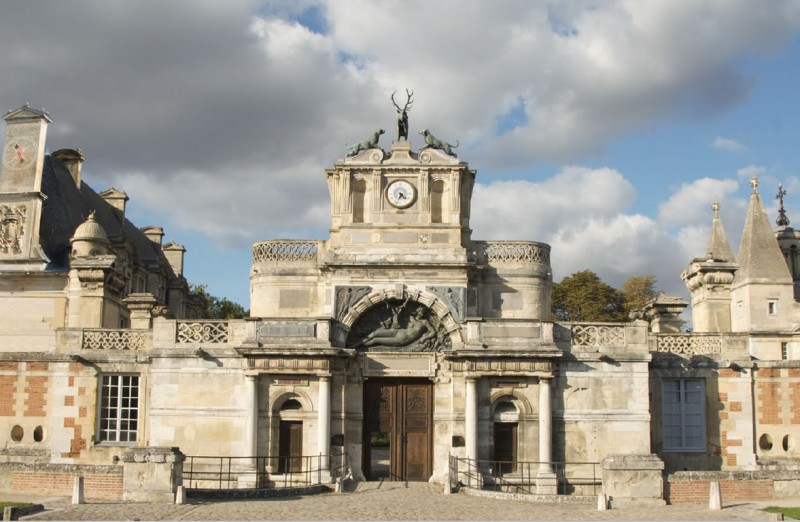
Castle of Anet.
They stayed at Anet for weeks, during which time they went on long horseback rides and hunts in the mornings and had lavish feasts in the evenings. Henry had portraits made of his favorites; the tradition of portraits in the bath dates from this period. Henry’s recovery from his captivity in Spain, the joyous visits of the royal children, and the king’s fondness for quiet library sessions all attest to the fact that Anet was a veritable paradise (all the books were bound in red morocco decorated with the figure of the king and his lady, one of the most prestigious collections of the Renaissance).
Henry made Anet his capital, where he issued orders, wrote letters, and had audience sessions.
The people in Diane’s group thought highly of her. Upon their arrival in France, she was entrusted with the care of the little Mary Stuart. Lady Fleming, her governess and Henry II’s mistress, traveled with the princess in her suitcase. No matter how hard he tries to cover up his affair, the royal mistress had her loyal companions to rely on. A return to Scotland was ordered for Lady Fleming.
When Diane found out that Anne de Montmorency was complicit in the scandal, he became enraged. Now, he plans to have Diane deposed. Their offspring would bring peace between the Constable and the King’s mistress.
Despite their numerous disagreements, the queen and the royal mistress were forced to coexist throughout the war years of 1552–1557. One day, Diane dropped by Catherine’s place, where the latter was sitting and reading. After her curiosity was piqued, Diane inquired as to what she was reading. “I study the chronicles of this country, and I learn that, from time to time, at any period, the prostitutes have handled the affairs of kings.”
An slur that went viral all throughout the kingdom. Diane retaliated by having Montmorency say that, of all the king’s offspring, only Diane of France resembled the monarch, a remark that became widely circulated throughout the country’s courts.
The last years of Diane
Rejoicing, including tournaments and jousting, resumed in 1558 and July 1559, in conjunction with marriages, after the ceasefire with Spain. It was a well-known tragedy when the king was fatally injured in a joust. Diane ran to be by his side, but the queen stopped her. Diane de Poitiers had never before felt so helpless; she was terrified of witnessing the death of France’s monarch and even more so of bearing the brunt of the Queen’s vengeance. They had no power without Henry.
After getting some news, Diane de Poitiers goes home. Even though she had not been invited, she was glad to see the burial from a window. There was no white and black clothing on the effigy of the monarch, no crescent moon, and no HD on the harness of the king’s horse. In April 1560, a document of transfer was completed between her and Queen Catherine de Medici, who had promised her the fortress of Chaumont sur Loire in exchange for Chenonceau.
When Diane visited Catherine’s former estate in Chaumont sur Loire, she was shocked to find numerous artifacts associated with necromancy and alchemy left behind by the queen, including an altar adorned with Greek, Egyptian, and Hebrew characters, powder flasks and jars of brine containing animal limbs, as well as strange works, parchments, and animal remains. She left Chaumont to her daughter Françoise after burning everything in the house.
She moved on to Anet, where she could continue to dwell in Henry’s shadow. Despite a horse accident that shattered her leg, she remained in great shape and looked stunning as she entered her 60s. She had just turned 64.
The death of Diane de Poitiers
Diane de Poitiers, who lived to be 66 years old, passed away at her castle of Anet on April 26, 1566, following a terrible but short illness (perhaps food poisoning). Françoise de Brezé and Louise de Brezé inherited a large portion of their mother’s wealth, and she also left money to many religious institutions. Several hundred impoverished peasants in white followed the casket as they sang, “Pray to God for Diane de Poitiers,” during her burial.
She was laid to rest in the mausoleum she had constructed on the grounds of the castle. In 1795, French rebels uncovered her grave and snipped her hair for souvenir locks. Years later, the castle was auctioned brick by brick.
The Lyon Festival of Lights (Fête des lumières) is held annually on the evening of December 8. Even though this well-attended celebration was first devoted to the Virgin Mary, the custom of the illuminations would provide it with a new identity and permanently inscribe it into Lyon’s history. More than a few million people from all over the globe go to the ancient capital of Gaul for these four days to marvel at the city’s spectacular light display.
Origin of the Festival of Lights
Painting by Rita Greer, depicting the Great Plague of 1665 in London.
When the Great Plague, or Black Death, swept through Europe in 1643, Lyon was one of the cities in its path.
Since 1643, when the plague hit the south of France, the city of Lyon has put the Virgin Mary under its protection and has venerated her. Because half of Lyon’s population vanished as a result of the horrific plague that killed several thousand individuals. Surrounded by the deputy mayors of the period, Provost Alexandre Mascary prayed to the Virgin Mary and pledged to do so annually if the plague would end.
That year, the citizens of Lyon made good on their pledge, and the city’s plague crisis ended. The Vow of the Aldermen is a traditional ritual when city officials honor Mary on the feast of her Nativity, which is celebrated annually on September 8.
At the summit of the Fourvière hill, in a little chapel with a view of the city, the people of Lyon have made it a practice to pray to the Virgin Mary ever since they made their first vow. The Virgin Mary’s first chapel was constructed at Fourvière in 1168. It was repeatedly repaired after being destroyed in 1562 during the religious conflicts.
The subject of whether or not to restore the bell tower was raised as early as 1830. It was completed in 1849, and sculptor Joseph Fabish of Lyon, France, affixed a massive golden virgin to the top of it.
December 8th
(Credit: Joël PHILIPPON)
Originally, the dedication ceremony for the statue of the Virgin atop the new bell tower was set to take place on September 8, 1852, which was the feast of the Nativity and coincided with the celebration of the aldermen’s promise. The statue’s original creator’s workshop was flooded by the Saône River, thus the unveiling had to be postponed.
The Feast of the Immaculate Conception on December 8 was selected as the date. The monument was installed on that day, but the celebrations (procession and fireworks) were canceled due to severe weather and the Saône River’s repeated threats.
After the storm subsided, though, Catholics in Lyon lit candles in the windows of their homes and businesses to see by. This light is the inspiration for Lyon’s annual Festival of Lights, held on the eighth of December. While the custom of placing lights in a window on December 8 began as a religious gesture, it has now become ingrained in Lyon’s secular legacy.
The transition from a religious celebration to a secular one
Lyon during the Festival of Light.
In 1989, the city was clothed for the night by the illumination of historical landmarks, natural landscapes like rivers and hills, and man-made features such as bridges and roadways. Several million people are expected to visit the city during the four-day Festival of Lights, which has been going on since 1999.
Multiple records are consistently broken at the Festival of Lights. Over the course of the 2014 edition’s four days, attendees could expect to see the unveiling of 80 light installations, the sale of 8 million bright lights over Lyon, and a complete hotel park.
Each year, a different charity is chosen to join in the Festival of Lights’ “Les Lumignons du Coeur” (The Lights of the Heart) operation, where visitors may purchase a lumignon candle and contribute to the festival’s gigantic light fresco. All of the money raised is sent to the organization.
In 2013, 310 journalists from across the globe visited Lyon for the Festival of Lights, which is now so well-known that even large cities like Berlin, Dubai, Turin, Montreal, and Rio de Janeiro have their own festivals of lights.
Visiting Lyon during the festival
From December 5 to 8, the city of Lyon is lit from every angle, so be sure to take your time wandering the streets to take in all the sights. Starting at the Parc de la Tête d’Or and ending at the Place Bellecour, this route takes you between the Saône and the Rhône rivers, past the monuments and emblematic squares of the Presqu’île. Along the way, you’ll see the Célestins Theater and the Place de la République square, as well as the Place des Terreaux square and its Bartholdi fountain.
A second path, beginning in the same area, leads to La Confluence and provides an opportunity to explore the urban marvels of Lyon. And the Renaissance District contributes a lot to the city, which would be very different without it.
The historic Lyon landmarks of Saint Jean Cathedral and Saint Paul Train Station, across the Saône, are illuminated remarkably at night during the festival. From the Basilica atop Fourvière Hill, you can take in a breathtaking view of Lyon.
The Merovingians were the line of Frankish rulers that controlled Gaul from 589 to 751. For centuries, this royal family—the ones who laid the groundwork for the French monarchy—suffered at the hands of a “dark mythology” spread first by Gregory of Tours in the sixth century and subsequently by the Carolingians under the pen of Eginhard. Until the twentieth century, students would be shown pictures of the Merovingians and call them the “lazy kings”. The Merovingian era was a mysterious black hole in French history, especially for the time of Clovis and other events connected to Dagobert I. Yet, these monarchs reigned during the transition point between “barbarian” antiquity and the Middle Ages, upon which the foundation of modern France was to be laid.
The mythical origin of the Merovingians
“The lazy kings” (670-752) by E. Crété.
The Salian Franks, a subgroup of the Franks who lived between the Rhine and the Scheldt, are the progenitors of the Merovingian dynasty. The mythical Merovech, a son or nephew of Chlodio (also known as Clodion) ruled over a group of Salian Franks from 448 to 457 and fought with Roman commander Flavius Aetius against the Huns in the Battle of the Catalaunian Fields, from which the city took its name. To begin with, he only had control over the French and Belgian border kingdoms of Cambrai and Tournai. Clovis I, son of Childeric I and king from 481 to 511, became the true founder through his great conquests after four more or less legendary monarchs who were only tribal leaders.
The bishop of Reims, Rémy, gave Clovis and his men baptism in 498 (?), winning them the backing of the Catholic church and the pope of Rome. By 500, he had the Burgundians paying tribute, and in 507, he defeated the Visigoths in the Battle of Vouillé. The Visigoths had been rejected by Spain. Soon after becoming master of much of Gaul, he united the Salian and Ripuarian Franks under his rule. Clovis, the paramount chieftain of the Germanic tribes who had settled in Gaul, was instrumental in the creation of the Salic law of the Frankish monarchs, which included elements of both Frankish tradition and Gallo-Roman law.
The Frankish kingdom, one and divisible
Clovis left his sons a vast realm after his death in 511. The capital was Paris, and the dominant religion was Catholicism. This marked the beginning of a contradiction, particularly when compared to the dynasties that followed the Merovingians: divided between the sons of Clovis, the Frankish kingdom was nonetheless united. Historians have therefore defined a “one and divisible” kingdom. This seeming contradiction was what enabled the Merovingians to become a continental power and extend their territory while avoiding civil strife. Only for a while.
By dividing the year 511 among Theuderic, Chlodomer, Chlothar, and Childebert, the Frankish monarchy was further linked to the imperial legacy of the Roman Empire. Even though the country was spread out geographically and had four capitals (Rheims, Paris, Orleans, and Soissons), there was real political unity because of blood ties.
It would be naive to think that things would remain peaceful after the deaths of Clovis’s first two sons. To begin, there was Chlodomer (524), whose son Clodoald had to leave and become a priest before dying and lending his name to a famous city. The remaining portions of Chlodomer’s realm were split among the three surviving brothers. Upon the passing of the oldest, Thierry, things got more difficult since his son, Theudebert, benefited from his father’s higher status compared to that of his uncles. Using this to his advantage, he struck gold coins bearing his likeness, earning the wrath of Emperor Justinian I and demonstrating his aspirations beyond Gaul’s boundaries. Despite his victories in Alemania and Bavaria, Theudebert died in 548 without realizing his ambitions.
The situation finally settled down with the extinction of the elder branch and the disappearance of Childebert. As a result, Chlothar I was able to rule on his own until 561. A new division occurred at his death, once again between his sons, who were only three in 567 (death of Charibert I). At this time, the Frankish kingdom was split into three sections, each of which would go on to become renowned in its own right: Austrasia (including the Rhine region, Champagne, and Aquitaine), Burgundy (including the ancient Burgundian realm and the kingdom of Orleans), and Neustria (the region of Tournai, “Normandy,” and the region of Paris). In 570, this “watershed moment” coincided with the outbreak of a genuine civil war. At one time, the Frankish monarchy had a strong worldwide presence.
Merovigians: An “international” power
Despite internal strife, the sons of Clovis were united as regnum francorum on foreign policy and had no intention of resting on their father’s laurels. Clovis’s most notable victory, achieved while he was still an ally of the Burgundians, was the conquest of Aquitaine. Of his successors, however, they were the first to fall. In 523, the Merovingians launched their first offensive against the Burgundian kingdom, taking advantage of internal troubles caused by theological disputes between Catholics and Arians. However, they were unsuccessful in this endeavor. A similar event occurred the next year, and the Franks once again lost Chlodomer. Childebert I, Chlothar I, and Theudebert I waited 10 years to attempt again, this time with more caution. As a result of their victory, the Burgundian monarchy was absorbed into the Frankish realm, and its territory was split among the conquerors.
The emperor at Constantinople took notice of the Merovingians’ successes. The dominance of the Ostrogoths in Italy was the fundamental problem. The Ostrogoths, seeing the Franks as a threat who might perhaps become Byzantine allies, granted them Provence in exchange for their neutrality before the emperor. When the Franks invaded Provence in 537, they weren’t trying to improve their looks so that they might reach the Mediterranean. With this conquest, the Franks had practically restored Roman Gaul’s unity; all that was missing was Septimania, which they had not been able to take from the Visigoths.
While Chlothar I and Theuderic I were busy conquering Provence to the south, they were busy annexing the western half of the kingdom of Thuringia via an alliance with the Saxons and a decisive military victory against its monarch. Two years later, Theodosius I invaded Alemannia, Bavaria, and Northern Italy for a brief period. The progress of the Franks was stopped only when the Lombards arrived in the area in the 560s. The conflict in the south also played a role.
The civil war hits the kingdom of the Merovingians
Charibert I, son of Chlothar I, died in 567, and his passing resulted in a fresh partition within the Merovingian realm. This time, however, it sparks a full-fledged civil war between King Sigebert’s three brothers, Chilperic, Gontran, and themselves. The Merovingians’ hazardous tactic of making marriage connections with their opponents, the Visigoths, also contributed to the outbreak of war.
At the conclusion of the sixth century, women were crucial in political fights. Brunehaut, wife of Austrasian King Sigebert I, and Frédégonde, wife of Neustrian King Chilpéric I, were bitter rivals. The first was the daughter of the Visigoth king Athanagild, and she blames the second for the death of her sister Galswinthe, who had been married to Chilperic I before. The death of the Visigoth ruler without a successor stoked jealousy, especially on the part of Chilperic, which only made the situation worse.
Then the hellish whirlwind and faide, rituals unique to the Germanic peoples, were set in motion. Both Sigebert I (575) and Chilperic I (584) were murdered due to the conspiracies of their respective queens. As the 570s progress, the fight becomes more violent, and Gontran does everything he can to stay on the sidelines. Brunehaut has taken control of Austrasia since her husband’s death and has presented his son, Childebert II, to the throne. This one swiftly confronts Frédégonde’s son, Chlothar II, and the battle escalates once again into a more beautiful conflict, despite Gontran’s best efforts to broker a truce (Treaty of Andelot, 587).
After Gontran’s untimely death in 592, his nephew Childebert II inherited the throne and ruled for four years until his own untimely demise. So, Theudebert II and Theuderic II go on with their fight against Chlothar II.
However, when her claim to the throne of Brunehaut was challenged more and more in Austrasia, the queen was forced to seek sanctuary in Burgundy with Theuderic II. However, the fact that she angered the local nobility certainly didn’t help her cause. Also, Childebert II’s offspring joined the fray in due time, much to the delight of Chlothar II, who didn’t have high expectations of them. Theuderic II imprisoned his brother Theudebert II in a convent and passed away in 613. Brunehaut sought to regain control by installing one of its great-grandsons, but he was betrayed by the nobility and eventually executed by his competitor.
The end of Antiquity and the beginning of the Middle Ages
Brunehaut, a Visigothic princess who was “still extremely Roman,” is considered by some modern historians to symbolize the end of Antiquity. Prior to the rise of the Pippinids, the era of Chlothar II and, notably, his son Dagobert confirmed the unity of the Frankish realm (according to the 7th-century Chronicle of Fredegar).
Chlothar II was able to succeed to the throne on his own when the “faide” (the right to take revenge) collapsed. The faide had resisted Brunehaut and Fredegund, and afterwards their sons. The Merovingian dynasty reached its pinnacle under the leadership of the monarch and, much more so, his son Dagobert in the early 7th century. However, the problems rapidly started with Dagobert’s successors and ultimately led to the establishment of the Pippinids, who at the time were not a dynasty. The Pippinids played a crucial part in the Merovingian political system, but Charles Martel eventually succeeded Pepin of Herstal (also known as Pepin II).
Chlothar II and the regna
After his Merovingian competitors and Queen Brunehaut were killed in the early 610s, King Chlothar II, who had been in power since 584, was left to govern alone. Nonetheless, the aristocracy of the Frankish kingdom was on the verge of a revolt due to the kingdom’s continued division into the three regna of Austrasia, Neustria, and Burgundy. Chlothar II needed to “seal the peace” and legitimize his rule.
Inspired by Clovis, in 614 he called meetings in Paris with the nobility, but also the bishops, and nearly simultaneously, in October of that year, he proclaimed the Edict of Paris, which effectively resolved the theological and political challenges facing the realm. In this way, Chlothar II secured the backing of the powerful and the clergy while strengthening his own position. Even if he ruled Neustria himself, he was still the most powerful ruler in the Frankish realm, and he didn’t hesitate to punish the powerful nobles of the other regna who tried to exert their independence by imposing on him, like Godin, who demanded to be made mayor of the Burgundian palace in the year 627.
The monarch was still under pressure to negotiate with the regnum, especially with Austrasia, and the situation had not improved. Because of the regnum’s importance in the war against the Avars and the Wendes, its nobles successfully lobbied King Theodoric to send his young son Dagobert to them. Among these great men was Pepin I, also known as Landen.
The reign of Dagobert I
Chlothar II called a new assembly two years before he died, and the acts that were passed showed the beginnings of the idea of a holy monarch. His son Dagobert took over after his death in 629, and the family relocated from Austrasia to Neustria. Dagobert’s authority seems to have been accepted by all three regna, including his own region of Austrasia. Caribert, his brother, was sent to Aquitaine and died there in 632 after being banished there. After taking the throne, Dagobert I immediately traveled to Burgundy to reassure the nobility. He eventually settled in Paris. His primary advisor was Saint-Éloi, whose father Chlothar II had been the goldsmith and bishop of Saint Ouen.
The Austrasian “problem” remained. When the great ones of the regnum held key posts like mayor of the palace, they were difficult to govern because of the regnum’s might. On the throne of Austrasia in 632, Dagobert placed his son Sigebert. A year after the birth of his son Clovis, he bestowed the thrones of Burgundy and Neustria onto him. His death in 639 caused yet another partition of the Frankish empire.
The time of Dagobert’s rule coincided with the beginning of Islam and, in particular, the first Muslim conquests. The Byzantine emperor approached the Frankish king in a similar fashion to the way he had previously approached previous Frankish monarchs. The lessons of history had been learned, and while diplomatic missions may have been exchanged (as in 629) the conditions were no longer favorable for the formation of an alliance. But Friegarius tells us that the Franks likely knew of Basileus Heraclius’ problems with the Arabs in 637 and 641.
In the early years of the 7th century, the Merovingians pursued an independent foreign policy that had nothing to do with Byzantine interests in the Near East. Dagobert’s primary concern was strengthening the regnum francorum’s frontiers, particularly in Aquitaine (along with Gascony) and Brittany. Around the year 635, he got down to business, but if he subjugated the Basques, he would have to settle for a diplomatic settlement in Brittany rather than really conquering the area.
The Franks installed governors in the eastern regions of Thuringia, Alemania, and Bavaria in exchange for tribute. Dagobert used the danger presented by the Wendes, a group of Slavic people residing in Pannonia, to his advantage, although he was ultimately unsuccessful in conquering them. At long last, the Frankish monarch showed an interest in Friesland, although he was ultimately unsuccessful in establishing his rule there.
The “lazy kings” and the mayors of the palace
After Dagobert’s death in 639, the Merovingian throne was divided between his sons Sigebert III and Clovis II. As predicted, the first ascended to the throne of Austrasia, while the second ruled over Neustria and became more independent with the help of Burgundy. Soon enough, issues started to arise.
It all started in Neustria, where Clovis II was obviously too young to rule. His mother Nanthilde, who was not a queen, but a servant married in 629 by Dagobert since Gomatrude had not given him a boy, had some degree of influence alongside the mayors of the palace, Aega and subsequently Erchinoald. By 648, the young king had been married off to the Anglo-Saxon slave Bathilde. Following the deaths of her husband in 657 and the mayor of the palace the following year, she used the opportunity to assert her authority and try to reunify the regnum francorum. Actually, things were becoming worse with Austrasia.
During Dagobert’s reign, Pepin I established the mayors of the palace as a powerful political institution in the eastern regnum. King Sigebert III made an effort to displace the Pippinids by showing favoritism to a different dynasty. Despite this, Grimoald, son of Pepin, also rose to the position defined by Bishop Didier of Cahors as rector of the whole court, or indeed of the entire realm. Given the Pippinids’ prominence at the period, several historians speculated that Sigebert III’s assassination in 656 could be the catalyst for the first Pippinid “coup.”
In the end, the issue was reduced to a simple matter of succession and competition between the mayor of the palace and the queen, but this highlights the fact that males, and especially Pippinides, had tremendous power in this position. Grimoald and his protégé Childebert, whom he had appointed king at the cost of Dagobert II, son of Sigebert, who had been banished to Ireland, had to be removed from power, and the Neustrians’ and Bathilde’s aid was required to do so. The king of Austrasia in 662, however, was Childeric II, a son of Bathilde.
Rivalries between the Merovingians that benefited the Pippinids
The Pippinids’ challenges were short-lived. In the long term, they would be able to reclaim prominence thanks to the competition between Neustria and Austrasia, as well as the conflicts amongst the great ones inside the regna.
In 665, King Chlothar III of Neustria was in the hands of the new mayor of the palace, Ebroin, who forced out Queen Bathilde. Tensions among the elites reached a boiling point in 673, when Ebroin installed Theuderic III, the son of Clovis II and Bathilde, as Chlothar III’s heir, to the dismay of the favored king of Austrasia, Childeric II. In the years that followed, things only worsened, and civil war broke out in Neustria. One of the victims was named Ebroin, who was murdered in the year 682. However, the basic concept of the Merovingian succession was not questioned at the time, even though the succeeding rulers were weak and challenged.
Dagobert II of Austrasia was killed a few years after his return from exile, when the issue that plagued Neustria spread there. After the death of Wulfoad, a competitor of Ebroin’s, the Pippinids returned to the palace, where they were still strong but closely monitored by the other aristocracy. In the early 680s, Duke Pepin II of Herstal rose to the position of Mayor of the Palace of Austrasia. At the Battle of Tertry in 687, he vanquished his Neustrian enemies who were aligned with the Burgundians, and he also captured the riches of Theuderic III.
The end of the Merovingians
It was with Pepin of Herstal, mayor of the palace, that the Merovingians finally met their demise. But the palace mayor only removed the king’s veneer of authority rather than removing him entirely. Only members of the Pippinid dynasty, the mayors of the palaces in Neustria and Austrasia, held the latter. After Pepin II’s death in 714, his descendants became even more entrenched. This was despite efforts at revolt by the other grandees. However, it was his son Charles who ultimately asserted authority, whether it was against the Neustrians of Rainfroi in the 720s, the Arab-Berbers of Poitiers (the Battle of Tours) in 732, or the Frisians in the following year.
After the death of the last Merovingian, Theuderic IV, in 737, Charles Martel did not establish himself as king by dismissing the heir, Childeric III. Carolingian historiography (heirs to the Pippinids) labeled the last Clovis descendants, beginning with Pepin II, “the indolent kings.” They were installed there by the mayors of the palace, although they had little actual authority and were often deposed by internal strife and external rivals (like Chilperic II during the Rainfroi/Charles battle).
The Merovingian rulers eventually gave way to a new dynasty, the Carolingians, in 751, but not before Charles’ son, Pepin the Short, came to power.
Joachim Murat (1767-1815), one of Napoleon Bonaparte‘s marshals, was known for his bravery and extravagance. He was also king of Naples from 1808 to 1815. After rising to prominence as one of the finest swordsmen and charmers of the Napoleonic period, this innkeeper’s son ascended to the throne and married the emperor’s sister. The Enlightenment ideals he defended made him a hero to Italian nationalists fighting for the peninsula’s union. Novelists would not have dared to create a character like him for a count in the 19th century due to his extraordinary fate, panache, boldness, and terrible conclusion.
Joachim Murat: Son of the Revolution
Fragment of portrait of Joachim Murat, Prince d’Empire, Grand Duke of Clèves and of Berg, King of Naples under the name of Napoleon in 1808 (1767-1815), Marshal of France in 1804.
On March 25, 1767, Joachim Murat entered the world as the son of innkeepers in Labastide-Fortunière (Lot). His father, a tiny bourgeois guy, served on many occasions as consul of his town and oversaw the distribution of church funds and other public assets. Joachim, the youngest of eleven children, was always destined for a career in the church. After studying for a while at the college of Cahors, he enrolled at the seminary of Toulouse, but was dismissed in 1787 due to a dispute with a fellow student.
Joachim joined the 12th Cuirassier Regiment of the Ardennes and was stationed in the city, preferring the military uniform over the collar of a priest. His family opposed his newfound orientation and campaigned vigorously to have him fired. Joachim remained a horseman in the company of the knight Henry de Carrière. In this new universe, Joachim served as the 12th Cuirassier Regiment of Champagne in this regiment. Joachim was a marshal of lodgings when word of the French Revolution of 1789 spread around the area. Departure from his unit and subsequent return home had been mysterious.
In the Lot again, he settled in Saint-Céré as a trader and immediately rose to prominence, joining political organizations and being chosen to represent his canton at the Fête de la Fédération in Paris on July 14, 1791. Along with him, he brought back the Parisian municipal flag after attending the event.
Joachim went back to his old unit as a private despite his newfound status. It wasn’t until February of the following year, 1792, that he and two other department soldiers were officially selected to join Louis XVI’s constitutional guard. But this corps fell well short of his expectations, and in March he publicly complained about the widespread anti-patriotism he had seen there. That guard was disbanded after he wrote to the Legislative Assembly advocating for its elimination.
Rejoining the 12th Regiment of Chasseurs, Joachim quickly rose through the ranks, first to marshal of the logis and then to second lieutenant. Between 1792 and 1793, he was a captain aide-de-camp to General d’Urre and a squadron commander in the armies of Champagne and the North.
Bonaparte’s sword
Murat at the Battle of Abukir, painted by Antoine-Jean Gros (1804).
On October 5, 1795, when royalist groups marched on the Convention in Paris, he was there. At the time, he was serving under the direction of a brigadier general named Bonaparte, who gave him this directive: “Do it swiftly, and with a sabre if you have to!” As the first step in a lengthy partnership, Murat enthusiastically carried out the general’s orders and returned the instruments of his triumph to him. After being promoted to brigade commander in 1796, he served as Bonaparte’s aide-de-camp in Italy.
After making a name for himself at Dego and Mondovi, he and Junot were tasked with transporting captured enemy flags back to Paris. He returned to Italy, where he was discovered in Genoa and Livorno, on the Adige River, in the Tyrol. On September 15, while marching towards Mantoue, he was slightly wounded. General Bonaparte’s reputation as a skilled horseman was already established by the time he ended the Italian war with the Treaty of Compo-Formio. In 1797, he was in Rome while the Roman Republic was being proclaimed.
Faithful to Bonaparte, Murat was part of the Egyptian expedition. In this fantastical country, he cultivated his reputation as a swordsman since he had no interest in scientific advancements. All the major engagements were attended by him, including the landing at Alexandria, the famous battle of the Pyramids (where he did not play a major role), the battle of Gaza, the battle in front of the infamous city of Saint-Jean-d’Acre, and most notably, the Battle of Abukir, where he covered himself in glory as the commander of the army’s vanguard. As a result of his daring attack, the Turks were driven back into the water.
Bonaparte was pleased to be able to replace the memory of the naval failure at Aboukir with that of the land triumph of the same name when the Anglo-Turkish invasion plan failed. Murat was promoted to major general on the battlefield on July 25, 1799, in recognition of his victory.
When he returned to France, he was there at Bonaparte’s side for the 18 Brumaire coup (9 and 10 November 1799). As the situation deteriorated in the Council of Five Hundred, President Lucien Bonaparte called for the delegates’ dismissal. The general marched into the Council chamber with his grenadiers, yelled, “Citizens, you are dissolved!” and then, in response to the deputies’ commotion, commanded his soldiers, “Get all these people out of here!” The deputies’ side saw a mass exodus as people rushed for the doors and windows. Eventually, Lucien would muster enough support to vote for the collapse of the Directory and the beginning of the Consulate, which would result in Bonaparte assuming control of the government.
Caroline Bonaparte and her children.
Murat was at Bonaparte’s side throughout the riots of Vendémiaire, Italy, Egypt, and Brumaire, and he saved the Emperor’s life on more than one occasion. To deny the flamboyant swordsman the hand of his sister, who was obviously head over heels in love with him, was inexcusable. Therefore, on February 20, 1800, Murat (then 33 years old) wed Caroline Bonaparte (then 18 years old) and became the son-in-law of the First Consul Napoleon.
The young spouse remounted his horse and participated in the second Italian war. After Napoleon promoted him to lieutenant general in the head of the reserve army, he also gave him responsibility over the cavalry. Napoleon I believed that Murat’s command of such a large number of mounted troops would be an effective military asset. The commander made his way across the Great St. Bernard Pass and conquered Milan. After that, he went to Marengo to see his brother-in-law and was awarded a sabre for his efforts. After spending some time at Dijon, he headed back to his favorite battlefield—Italy—to seize Tuscany and expel the Neapolitans from the Papal States. After negotiating a peace treaty with the King of Naples, he was appointed to lead the kingdom’s Southern Observation Army. He used this opportunity to grab control of Elba.
Joachim Murat could now return to France and join local politics since that the country was at peace. In 1804 he was elected president of the Lot’s electoral college and a delegate to the Legislative Body, which launched his rise to power. After that, he was named governor of Paris. When the Duke of Enghien scandal arose, he was in charge, yet he was willing to just sign the judgment order.
Murat: Marshal of the Empire
Murat at the Battle of Jena, 14 October 1806.
As the Empire was declared, Murat, who was present at the coronation, was awarded every title possible for his participation, including that of Chief of the 12th Cohort, Grand Eagle of the Legion of Honor, Grand Admiral, and Grand Prince. Important among the new aristocracy, he accumulated a collection of paintings in his private hotel at the Elysée.
At the resumption of hostilities with Austria in 1805, Marshal Murat was promoted to head the equestrian forces. He crossed into Bavaria and then marched straight on to Vienna, where he encountered little opposition. He used deception to convince the Austrians that an armistice had been struck, allowing him to capture control of the Danube’s crossings before they were destroyed. He proceeded to seek his share of glory beneath the sun of Austerlitz after routing a Russian army in Moravia. On March 30, 1806, he was elevated to the position of Grand Duke of Berg and Cleves by imperial edict.
Murat embraced his new position as duke seriously and moved quickly to expand his duchy by annexing places that had been returned to Prussia, most notably the castle of Wessel. Negotiating a new export tariff with Napoleon was another issue on his mind. He personally oversaw the ducal army’s clothes, ordering fabric from Damascus and picking out the colors (crimson dolmans, “doe’s belly” colored pelisses, etc.).
However, for Murat, the war was far from done; he had to charge towards the Prussians and take part in the Battle of Jena, in which the cavalry captured 14,000 prisoners. Next, he pursued the Prince of Hohenlohe until he surrendered, at which point he was able to take Stettin with the whole might of his army (16,000 troops, 60 cannons, and as many flags). However, the destruction of Prussia did not signal the end of the war, since the Russians continued to fight.
The prince traveled through Warsaw, Poland, while dressed in his bright and colorful attire (gold thread embroidery, wide amaranth-colored trousers with gold braid, yellow leather boots, a hat with white feathers, and a plume of four ostrich feathers with a heron egret). This city, where Poniatowski presented him with the sword of Stephen Báthory (the Polish king of the late 16th century), would be his home for the entire month of January. This country wanted nothing more than to be free, and its prince simply wanted to rule.
However, his brother-in-law, Napoleon, had no interest in seeing Poland restored, so he braved the elements to lead his troops in the horrible and brutal Battle of Eylau. Napoleon opted to go into combat with his cavalry and asked Murat, “Will you let us be eaten by these people?” while the outcome of the conflict remained in doubt. The enemy’s center was crushed, and the French army was rescued, all because of Joachim Murat’s decision to lead the largest cavalry charge in the history of the French Empire (which prompted Balzac to write “Le colonel Chabert”). Because of Murat’s eccentric clothing, everyone was shocked when he avoided being killed on every single charge he faced.
Murat led the attack on Eylau while dressed in a fuzzy helmet with feathers, a fur cloak, and a white leotard. Russian troops were stunned when they were defeated at Friedland, but Napoleon met the Russian Czar at Tilsit. As Murat’s extravagant attire drew attention during the celebrations, Napoleon would tell him to “Go put on your general’s uniform; you look like Franconi” (a famous theater actor).
Joachim Murat was promoted to the rank of lieutenant general by the Emperor of Spain upon his return to the Iberian Peninsula in July 1808. He was tasked with protecting strategic Spanish outposts as a safety net for Junot’s Portuguese campaign. His first order of business was to deal with the fallout from Napoleon’s deposing King Charles IV of Spain in favor of his son, Ferdinand VII, by the “guetapens” (ambush) of Bayonne.
The Charge of the Mamelukes, 1808 by Francisco Goya.
The citizens of Madrid revolted and began attacking the French troops. The Mameluke inspired fear among the rebels even as they stoked the flames of their animosity, and the city was soon in flames. Murat’s harsh repression was the only way he could restore order. Francisco Goya painted this scene to commemorate the historic events of “Dos y Tres de Mayo.”
When the Bourbon dynasty in Spain tore itself apart, the throne became available to whomever claimed it, and the Prince may have believed at that point that he had a valid claim to power in the city he had just conquered. However, this did not occur, and Joseph Bonaparte, the former king of Naples, regained control of Spain. When Murat was asked to choose between the crowns of Naples and Portugal, he chose Italy since he had previously served as a commander there.
Murat was relieved to see Savary arrive and assume control of Spain until Joseph Bonaparte could get there. He had now reached his breaking point; he could not bear to order against the national spirit of a people, and, what’s more, he was aware that his authority was being questioned now that another monarch had been installed. As a result of his illness, Murat had been experiencing high fevers, sleeplessness, headaches, nausea, and vomiting. Taking his family to the spa waters of Burgundy in Paris, he met his buddy Lannes before he took control of his realm.
King of Naples, Joachim Murat
Murat as King of Naples, c. 1812.
King Joachim I of Naples and Sicily had widespread popular support throughout his reign. On September 6, 1808, he arrived in Naples and was greeted by the city’s triumphal arches. It’s fair to say that when his people heard that a Frenchman was arriving, they feared the worst. They saw a tall, dark-haired guy with a stellar reputation as a swordsman and ornate costumes that were spot-on for the Italian way of life enter. Whatever title Murat held in the eyes of his people, whether viceroy or grand prefect, Napoleon made it plain that Murat was only a viceroy in the eyes of him.
But Murat misunderstood and used it as inspiration to expand his dominion. He carried on Joseph’s reforms in every area, including the establishment of a national flag and army, the easing of conscription, the founding of a polytechnic university, the introduction of civil status, the publication of a new civil code, the suppression of brigandage, the establishment of new courts of first instance, and much more.
Murat fancied himself an Enlightenment scion. As he realized he’d be helpless against the English without a fleet, he set up a school specifically for the purpose. He also began excavations at Herculaneum, a Roman city that had been obliterated by Mount Vesuvius, and set out to improve the appearance of his capital. Murat decreased ministry subsidies, streamlined tax collection, and negotiated a drop from 5% to 3% interest on the state’s debt as a result of the dire economic circumstances and the state’s mounting debt (to the great displeasure of France).
After the English mocked him in front of his capital, he had no choice but to expel them from Capri in October 1808. It was none other than Hudson Lowe, the future jailer of Napoleon on Saint Helena, who led the English forces.
It was 1810, and from his throne in Naples, King Joachim I observed the Austrian alliance and Napoleon’s marriage to Marie-Louise with skepticism. It was well known that the Austrians had their own opinions on Italy and backed the Bourbons in Naples, despite the latter’s questionable legality. Murat’s association with Italian nationalist groups was a subtle but effective way for him to further his personal objectives. For the sake of his people, on June 14, 1811, he issued an edict mandating the naturalization of all aliens who were receiving financial benefits from civil service jobs. In retaliation, Napoleon declared that all French citizens were also citizens of the Kingdom of the Two Sicilies since it was a member of the Empire, even if this was not to the pleasure of the French.
Joachim Murat took over as commander of the cavalry during the Russian expedition (French invasion of Russia) despite a tense relationship with his predecessor. The enemy withdrew until the Moscow, where a bloody but ultimately fruitless fight took place, in which the king stood out. The Cossacks, in particular, looked up to Murat as a hero because of his courage and flair.
In the heat of combat, Murat raised his whip in a show of respect. Following the victory, the marshal advanced through Russia and took Moscow, but the city’s destruction caused the French army to flee. Returning to France after the uprising over the Malet incident (Malet coup of 1812), Napoleon put his faith in Murat to lead the reorganized armed forces. The latter stayed put and eventually handed over leadership to Eugène de Beauharnais so he could go back to Naples.
After returning to his realm, Murat wasted no time in opening negotiations with Austria and England. Nonetheless, he never fully abandoned Napoleon’s cause and, in 1813, joined up with the French leader to head up the cavalry. Although he saw action at Dresden, the Imperial forces were ultimately routed at Leipzig. His perspective shifted from that of a Prince of the Empire to that of a King, and from that point on, he regarded himself as entirely responsible for the needs of his own country. His wife, Caroline, was also an important motivating factor. He signed the peace treaty with Austria on January 11, 1814, rescuing his kingdom by betraying Napoleon.
However, the calm was only temporary. Upon Napoleon’s defeat and exile to Elba, Talleyrand advocated at the Congress of Vienna for the restoration of the Bourbon dynasty to the Kingdom of Naples. As you may imagine, Murat was anxious. There was danger in his realm. Against the Austrians, who wanted to maintain their zone of influence on the northern part of the peninsula, Murat planned to defend himself in Italy by depending on the nationalist groups, which he would be able to readily unite. Aware of the events unfolding in Elba, he knew that now was the time to win or die by following Napoleon if he returned.
Statue of Joachim Murat on the façade of the Royal Palace of Naples.
Murat saw his chance to fulfill his aim of raising and unifying all of Italy with the backing of the nationalists on March 1, 1815, when Napoleon landed at Golfe-Juan. On March 18, he declared war on Austria, issuing the now-famous statement from Rimini: “A scream is heard from the Alps to the Strait of Scylla, and this cry is: the freedom of Italy!” In Italian history books, Murat was no longer just a French puppet king; instead, he was elevated to the status of national hero and a forerunner of the Risorgimento (Unification of Italy). Because of this, the figure was rehabilitated on the peninsula towards the end of the 19th century, when unification took effect, and his statue still stands in Naples today.
The king’s campaign was successful at the outset, and when the Austrians were driven back to the Po River, the city of Bologna was freed to the cheers of its citizens. However, his counteroffensive backfired, and he was eventually beaten at Tolentino and forced to withdraw and escape. Although he set off for Gaeta, the presence of the English navy prevented him from reaching his destination until he landed in France, where he remained until the Bourbons reestablished their rule over Naples. His wife Caroline, who had sought safety on an English vessel, saw the acclaim bestowed upon the new king.
Murat: The fallen prince
Murat’s death sentence, as shown in the Naples State Archive.
Murat was back in his home country, awaiting a summons from Napoleon. The latter was preparing for battle, and when one thinks of battle, one thinks of an army; when one thinks of an army, one thinks of cavalry, and when one thinks of cavalry, one thinks of Murat. But his wait was in vain since Napoleon never called him, and it was Michel Ney who spearheaded the cavalry attacks at Waterloo (Battle of Waterloo). Many argue that a different result would have been achieved if a cavalryman of his caliber had been in charge in front of the English lines. An unprovable claim that belongs in the domain of uchronia. As the coalition troops closed in on France, Murat fled to Corsica, where he was greeted with open arms and where the soldiers rallied to support him.
After being pursued by General Jean-Antoine Verdier, Murat escaped to Ajaccio, where the National Guards were waiting to salute him. Not being a leader of the Corsican resistance was less important to him than reclaiming his kingdom. A man of great bravado, Murat was much admired. He set out with 250 soldiers on the evening of September 28, 1815, aboard the flotilla of Barbara, a former corsair whom he had elevated to the rank of Neapolitan baron and captain of a frigate. Did he conspire against his previous monarch?
Castello di Pizzo, Murat’s place of imprisonment and execution.
Though Murat preferred to disembark at Trieste, Barbara used their hunger as an excuse to go with him to Pizzo, where he claimed to still have partisans. Unfortunately, the flotilla was scattered by a storm, and only two ships, or roughly thirty men, were able to accompany him. They expected to find partisans in Pizzo, but instead they encountered a community hostile due to the recollection of Joachim Murat’s brutal suppression of brigandage in the area. After an argument on October 8, 1815, he was captured and transported to the fort of Pizzo.
Murat, foreseeing his own death, sent a farewell letter to his wife. He flatly rejected the mock trial that was suggested for him by the Court Martial. When the Court Martial began its trial, the order of execution had already come from Naples; therefore, he was correct on this point. Upon hearing his sentence in the early afternoon of October 13, 1815, Murat had half an hour to pray for mercy before being led to the castle plaza and executed by firing squad.
Joachim Murat asked them, “Where should I sit?” with a stunning lack of complexity. Even though a chair and a ribbon were offered to him, he politely declined. He loosened his shirt to expose his chest and gave the following instructions to his executioners: “Soldiers, respect the face and aim at the heart.” He had just been struck in the chest and hand before he went down. Since he showed signs of life, the police officer gave the order to fire two more bullets. Then his corpse was added to the rest of the graves. The Bourbons may have been able to bury the corpse, but they couldn’t bury the legend of the man formerly known as “the King of the Braves and the Bravest of the Kings.”
On September 13 and 14, 1515, in northern Italy, Francis I famously defeated an army of Swiss mercenaries in the Battle of Marignano. The young king of France, who had been knighted by the lord of Bayard on the battlefield, would gain much favor and a heroic reputation as a result of this military victory. One of the most often mentioned years in French historical discussions was 1515, to which Marignano was occasionally added. However, this conflict ought to be better remembered and placed back into its context, which was also too poorly known: the Italian wars. A monumental work that introduced France to the beauty of the Italian Renaissance.
Battle of Marignano in the context of the Italian Wars
Rich from the beginning of the Renaissance, the Italian peninsula was wanted by the European nations, notably the sovereigns of France. The peninsula was economically powerful and culturally dominant, but its political stability was precarious due to the presence of numerous competing principalities. The most significant of these were the Papal States, the Kingdom of Naples, the Duchy of Milan, and the Republics of Venice and Florence. This meant that the Italian Wars were the focal point of European conflict in the first part of the sixteenth century and the stage upon which territorial aspirations were played out.
Without going back to the Angevin monarchs of Naples, we can claim that Charles VIII, who was only king of Naples for a few months in 1495, was the one who first involved France in the Italian wars. Louis XII was pivotal in the expansion of the French monarchy into Italy. In 1499, the monarch captured Milan; in 1501, he assaulted Genoa and the Regno. However, if he were successful in rapidly removing Ludovico Maria Sforza (Ludovico il Moro), he would need the support of not just the pope and the Aragonese but also powerful peninsular lords like Cesare Borgia. For a while, Louis XII was able to use alliances to his advantage, joining forces with Florence and the Duchy of Milan to take on Venice. But his sway starts to annoy the Italian princes, beginning with Pope Julius II, and this twists the alliances against France.
A solution was made in 1504: France abandoned Naples to the King of Aragon but preserved Milan. This was just a temporary fix since Pope Julius II, in an effort to consolidate his power across Italy, formed a new “Holy League” to fight France, which included Venice, Aragon, Switzerland, and England. After another loss in 1513 at Ravenna, Louis XII finally left Italy and never returned. Although Francis I was just twenty years old at the time of the king’s death in 1515, he was widely recognized as his heir by European courts, especially in Italy. King Francis I, as he was most often known, shared the Italian aspirations of his ancestors. To help him reclaim what he believed was rightfully his, Louis XII had also assembled a brand new army.
Francis I was on his way to Milan
Battle of Marignan, September 14, 1515, Francis I at Marignano.
The newly crowned monarch wasted no time in seeking revenge for France’s recent military setbacks by attempting to retake Milan. The force collected by Francis I was substantial for the time: roughly 10,000 horses, 30,000 infantrymen, and 70 cannons. Bayard, the Charles III, Duke of Bourbon (Also known as the Constable of Bourbon), the Duke of Lorraine, the Count of Guise, and Marshal Trivulce were only some of the numerous knights that participated in the mission. Yes, the nobility’s duty was to “preserve the state via guns” in return for special rights and perks. The Swiss were waiting for the French troops, so the Alps crossing was looking more challenging than expected. Nonetheless, François I showed his first signs of bravery by choosing the pass of Larche, which was far more treacherous than the passes of Montgenèvre or Mont-Cenis. Parallels to Hannibal were being drawn already… The French made camp in Turin after they crossed the Alps.
The French monarch planned to negotiate, using his strike force as leverage. The Swiss promised to return Milan to Maximilian Sforza in exchange for one million crown (ecus – French coins) and the duchy of Nemours. Francis I continued on his voyage after accepting the conditions of the agreement. On September 10, he set up camp at Marignan, a dozen kilometers from Milan; in truth, he had little faith in the Swiss and also understood the woes of the Duke of Milan, who was trying to pay his mercenaries. This told him that his opponents were weaker and more disorganized than they had been.
The king’s fears were realized when the bishop of Sion, Matthäus Schiner, gained control of the Swiss camp. As many as 20,000 Swiss fled Milan on September 13, 1515, bound for Marignano.
Battle of Marignano
The Battle of Marignano, etching by Urs Graf, Swiss mercenary.
Within the French army, the vanguard was committed to the Constable of Bourbon and contained the artillery and its 72-guns. Francis I personally led the main body of the army, while his brother-in-law Charles IV, Duke of Alençon commanded the rearguard, which consisted of the cavalry.
Around 4 p.m., the Swiss mercenaries and the French came into initial contact when the Swiss advanced in three squares of pikemen, totaling 7,000 men. The Charles III, Duke of Bourbon (Also known as the Constable of Bourbon) was having trouble, but the King of France came to his aid by leading a charge, and the two sides fought extremely violently till late that night. French artillery was largely responsible for the enemy’s predicament; the Swiss were forced to relinquish their grip on the situation three times. Francis I was well-known for sleeping with his armor on; his reputation was on the rise. During the night, King of France reorganized his army by arranging his troops in a wider, more lethal line. The King took up residence in the middle, with the Duke of Alençon to his left and the Constable of Bourbon to his right.
The Swiss rallied the following day, September 14, 1515, and made another attack. They opted to assault the middle of the French position, which was commanded by the king, but their 5,000 men were subsequently defeated by the French pikemen and arquebusiers, reinforced by artillery. When the Swiss attempted to flank the French position and infiltrate their way to the guns, they too failed to make it through the center.
By afternoon, another army led by Bartolomeo d’Alviano, captain of Venice, had arrived to reinforce Francis I and had turned the tables on the Swiss. As the Swiss began to escape, the French opened fire with their guns. When the Swiss tried to escape, the cavalry ambushed them and caused great slaughter. In the face of overwhelming odds, the Swiss were able to withdraw permanently. The French, exhausted by the struggle, abandoned their pursuit of the defeated. It was “a fight of giants,” according to the elderly marshal Trivulce, who had fought in 18 major engagements during his life.
The Swiss suffered at least 10,000 casualties, while the French only suffered approximately 5,000, but the victory was decisive. At the tender age of twenty, the young king of France had already achieved a magnificent victory that brought him tremendous renown among his countrymen and foreign sovereigns. Francis I was knighted by Pierre Terrail (seigneur de Bayard) “who was worth an army of his own,” on the evening of the fight.
The results of the Battle of Marignano
There was now access to Milan. Francis I, a virtuous prince, negotiated Maximilian Sforza’s surrender and received a pardon from Pope Leo X. On October 11th, he walked into Milan with solemnity. One year later, on August 18, 1516, King Francis I and Pope Leo X signed the Concordat of Bologna. The latter established clear boundaries for the roles of the king, the clergy, and the people in governing the French Church, allowing the monarch to make key appointments and choose who received the church’s most prestigious honors.
Thus, the young king’s first significant triumph was at Marignano. It was not just a game-changer for the Italian situation but also for his reputation throughout the Italian peninsula and Europe. In the Treaty of Fribourg, Francis I was able to make the Swiss “perpetual allies” of France. The Crown was guaranteed the ability to recruit Swiss mercenary warriors, but the Swiss were forbidden to fight on the side of any nation at war with France as a result of this nonaggression deal. Since 1792, the Swiss cantons have not broken this “perpetual peace.”
But the Battle of Marignano was first and foremost a battle; despite its savagery, it was one of the last to be considered “chivalrous,” and this was especially true according to royal propaganda. The French artillery was the true victor at Marignano, proving itself for the first time in a pitched combat as well as in sieges (like Constantinople or Granada). Despite his victory, the king was unable to celebrate fully. With a certain Leonardo da Vinci in his suitcase, he was forced to go back to France. A decade after Marignano, in 1525, Charles V and his followers began an intense conflict that resulted in the fall of Pavia. Because he was captured, France’s monarch abandoned Italy. Following the signing of the Treaty of Cateau-Cambrésis between Henry II and Charles V in 1559, all French claims to Italy were formally abandoned.
Francesco Guicciardini, Storia d’Italia, Lib. XII, cap. 12
Dean, S. (2012). A blow to Swiss ambitions: The Battle of Marignano, 13-14 September 1515. Medieval Warfare, 2(5), 26-32. Retrieved August 28, 2021, from https://www.jstor.org/stable/48578039, pg. 28
Pepin the Short, son of Charles Martel, was able to depose the last Merovingian monarch and establish a new dynasty at the head of the Frankish realm because of his position as mayor of the palace and the renown of his family. However, this dynasty did not carry his name but that of his son, the legendary Charlemagne, who was anointed Emperor of the West by the Pope in 800 following a series of military victories in the interest of Christianity. The Empire was short-lived, however, collapsing in 843 with the partition of Verdun between Charlemagne’s three grandchildren. The imperial title lasted until 924.
When and how does the Carolingian dynasty begin?
Charles Martel at the Battle of Tours, depicted in the Grandes Chroniques de France.
The Frankish aristocracy of the Merovingian period suffered the same fate as the other barbarian kingdoms established after the fall of the Roman Empire in the seventh century. As time went on, the legitimate Merovingian kings, who were called “lazy kings,” lost power and were replaced by the noble mayors of palaces. Even though they were originally just the kings’ stewards, they eventually grew so powerful that they could actually remove and replace the kings themselves. Childeric III, the last representative of the Merovingians, was deposed in 751 by Pepin the Short, mayor of the palace of Neustria and son of the famous military leader Charles Martel who had stopped the Muslim expansion in Poitiers in 732 (Battle of Tours and Reconquista). Pepin the Short, or Pepin III, established the Carolingian dynasty after he was officially anointed king of the Franks by Pope Zacharias. He left the kingdom to his son Charles I, also known as Charlemagne, who expanded it into an empire after his death in 768. Between 751 and 771, Charles I and his brother Carloman I ruled jointly.
What were the dates of the Carolingian Empire?
Charlemagne at dinner; detail of a miniature from BL Royal MS 15 E vi, f. 155r (the “Talbot Shrewsbury Book”)
During the first three decades of his reign, Charles I expanded the Frankish empire through a series of military victories, mainly against the Saxons and the Lombards, and had the assistance of the pope. In 800, he was anointed emperor in Rome under the name Charlemagne after rescuing Pope Leo III from an assassination attempt. He then set about reconstructing the Western Empire. After the death of Charles I in 840, the so-called Carolingian Empire (a name derived from Charles Martel and Charles I) was split into three parts. Louis I, also known as Louis the Pious, inherited it from his father in 814. The three surviving sons of Louis (Charles II, Lothaire I, and Louis II) negotiated a violent division of the Empire and signed the Treaty of Verdun in 843. The Empire collapsed when it was divided into three separate kingdoms. Nevertheless, the Western Emperor title survived until Berenger I’s death in 924, at which point it was no longer used.
What were the territories conquered by Charlemagne?
When his father, Pepin the Short, passed away in 768, Charlemagne had already completely incorporated the duchies of Aquitaine and Vasconia into the realm. Charlemagne, at the invitation of the pope, launched an offensive against the Lombards in 773 and soon prevailed, eventually annexing the northern part of Italy up to Rome. He used this victory to launch an all-out assault on the Saxons in 776, the last indigenous pagan group in the area. Several military campaigns, including one led by Widukind, were required to finally defeat them in 785. Charlemagne’s 778 campaign against the Saracens resulted in a crushing loss at the hands of the Christians in the Battle of Roncesvalles. Later conquests, however, created what is now known as the “Spanish March,” and efforts against the Frisians, Bretons, Bavarians, and Avars in the years 780–800 pushed the Carolingian Empire even farther west. When Charlemagne passed away in 814, the area of the imperial dominion was about one million square kilometers, having quadrupled in that period.
How was the territory of the Carolingian Empire ruled?
Charlemagne was not only a conqueror and military genius, but also a reformer and highly productive king. Three hundred provinces made up the Imperial Empire. Charlemagne’s religious and secular commands were carried out over his vast realm by “missi dominici,” organizations with two heads (a count and a bishop). Mathematics and grammar were taught in schools set up in each bishopric, and a uniform form of medieval Latin script was introduced. The Carolingian minuscule, a new kind of writing, was developed to make books easier to read. Additionally, a monetary reform was implemented to switch from gold to silver as the metal of choice for coinage. The goal was to make it simpler for business deals to be done, allowing commerce to flourish. Roads were kept in good shape, and farmers’ markets were given the green light, among other things. Libraries, artworks, and monuments flourished under Charlemagne’s reign, ushering in a period known as the “Carolingian renaissance.”
What language is spoken in the Carolingian Empire?
The Salian Frankish nobles, initially from the Rhine valley but later moving southwest, established the Carolingian Empire after establishing a foothold in Gaul after the collapse of the Roman Empire. The Franks, under Clovis’s rule, soon adopted aspects of Gallo-Roman culture and eventually abandoned their pagan religion in favor of Christianity. Even though the Merovingians spoke Old Frankish, the Carolingians under Charlemagne adopted a close dialect called Rhenish Frankish, which became the official language of the capital of the Holy Roman Empire at Aachen.
What was the place of religion in the Carolingian Empire?
The covenant struck between the Carolingian monarchs and the pope to support each other was a defining feature of the Carolingian Empire and its long partnership between politics and religion. Charlemagne ordered the baptism of all infants under the age of one in the bishoprics, instituted the payment of tithes across the kingdom as early as 779, and founded several monasteries. Paganism was outlawed and Christian conversion was mandated in the conquered areas, particularly in Saxony. Charlemagne, against Rome’s opposition, commanded the addition of the Filioque to the Creed during the ensuing dispute between the Roman and Greek churches over the doctrine of the Trinity. Theology develops strongly.
How did the Carolingian Empire end?
When Charlemagne’s heir, Louis the Pious, died, his sons fought over who would succeed him. The sons intended to split up the Empire, while the clergy wanted to keep it as one. The oldest son, Lothaire, believed he would rule on his own. Charles II received Western Francia, Lothaire I received Middle Francia, and Louis II received Eastern Francia according to the Treaty of Verdun signed in 843, which ended years of civil strife. There was a de facto dissolution of the state their grandfather Charlemagne had established. These three realms are not self-sustaining due to external factors like the untimely assaults of the Vikings and the Arabs, the squabbles between brothers and their offspring, and the frequent and unexpected deaths of rulers. The Carolingian dynasty and its royal line perished in the middle of the 10th century.
What do the Byzantine Empire and the Carolingian Empire have in common?
Both the Byzantine and Carolingian empires were Christian and ruled from Aachen and Constantinople, respectively. In both instances, the emperor led the armed forces and ensured the country’s religious harmony by means of military conquest. The governors, sometimes known as missi dominici, were responsible for implementing policies in several regions. The two dynasties had similar priorities when it came to the advancement of culture and learning.
KEY DATES OF THE CAROLINGIAN EMPIRE
October 22, 741 – Death of Charles Martel
Charles Martel was a notable person in the 8th century, serving as mayor of the palaces of Neustria and Austrasia and also as a prominent statesman and military commander. After defeating Umayyad forces attempting to take over Francia at the Battle of Tours (also called the Battle of Poitiers) in 732, he gained international renown and the papacy’s attention. When he passed away, he was given the honor of being buried in the royal church of Saint-Denis.
November 751 – Pepin the Short, King of the Franks
Pepin the Short, Charles Martel’s son, ousted Childeric III, king of the Merovingians, and assumed the throne following his father’s death. This was ten years after Martel’s own death. The pope, Zachariah, supported his claim to the throne, and he became king of the Franks in 751. The Merovingian Dynasty came to an end with this event, ushering in the new Frankish bloodline known as the Carolingians.
July 28, 754 – Pepin the Short is once again crowned
Pepin the Short, at the behest of Pope Stephen II (who succeeded Zacharias in 752), launched a victorious military expedition in Lombardy. Land was donated by Pepin, and the Papal States were officially established when the Treaty of Quierzy was signed in 754. The pope recognized his loyalty by reinstating his position as king of the Franks and bestowing upon him the title of Patrice of the Romans. During this time, the ties between the pope and the new monarchy were tightened even further.
September 25, 768 – Death of Pepin the Short
Pepin the Short, who died at the age of 54 due to sickness, spent the last years of his reign consolidating the kingdom in the South through the conquest of Septimania in 759 and Aquitaine in 768. He was laid to rest at Saint-Denis, much like his father. Carloman and Charlemagne, his sons, argued over how to divide the realm when he died.
December 4, 771 – Charlemagne takes power
Charlemagne took full control of the realm after Carloman’s sudden death in 771, and taking the opportunity to oust his infant nephews, who were eventually imprisoned for life in a monastery. The Archbishop of Sens, Wilcharius, recognized him as the only ruler of the Franks.
774 – Charlemagne confirms the Papal States
Charlemagne formally acknowledged Pepin’s contribution to the Roman Catholic Church before the newly installed Pope Adrian I in Rome. The papacy’s temporal rule over the Papal States was recognized. The latter will continue to grow via further gifts and invasions.
August 15, 778 – Death of Roland at the Pass of Roncesvalles
It was in 778 when the famous warrior Roland, who had been guarding the Frankish border with Brittany, was tasked with leading an expedition against the emirate of Cordoba in Spain. At the Battle of Roncesvalles, this close friend and rumored nephew of Charlemagne was killed by an unexpected assault by the Vascons (Basques).
781 – Alcuin takes charge of Charlemagne’s school
Interior of the Palatine Chapel in Aachen, Germany
In 781, while visiting Rome, the English philosopher and theologian Alcuin met Charlemagne, who asked him to live in Aachen, the imperial capital. He rose rapidly to become the most trusted counselor to the Emperor and the leader of the Palatine School, which Charlemagne had created to educate his top officials. As a result, many episcopal schools and libraries were established across the enormous realm, ushering in the “Carolingian renaissance.”
799 – Charlemagne annexes Dalmatia
Dalmatia was a crucial province of Croatia because of its location between the Byzantine and Carolingian empires. Charlemagne invades in 799 and firmly conquers the region by 803. This invasion by the Franks leads to a naval conflict with Constantinople that is only resolved with the signing of the Pax Nicephori in 812.
December 25, 800 – Coronation of Charlemagne
As a result of Charlemagne’s repeated victories, the Carolingian empire came to cover almost the whole Christian West. Political and religious leaders began to consider the possibility of an empire as a result of the ruler’s absolute authority. Charlemagne was proclaimed Western Emperor in 800 after a failed coup against Pope Leo III in 799. The Byzantine Empire did not acknowledge this coronation because it saw it as illegitimate.
January 28, 814 – Death of Charlemagne
The Western Roman Emperor Charlemagne passed away at the age of 72 in the city of Aachen from what was likely a case of severe pneumonia. His son Louis the Pious took the imperial title after him, but that only sparked a battle of succession for power.
June 22, 841 – The division of Charlemagne’s Empire
The Auxerrois area was the site of the war between Charlemagne’s grandchildren for control of the Empire. The true successor, Lothair, was defeated by his brothers, Louis the German and Charles the Bald. In 843, he was forced to sign the Treaty of Verdun, which gave the French-speaking half to Charles and the German-speaking part to Louis. It was during this war that the seeds for Germany, France, and Italy were planted.
February 14, 842 – Oaths of Strasbourg
Charles the Bald and Louis the German, Charlemagne’s grandsons, exchanged “Oaths of Strasbourg.” They joined forces to take on their elder sibling, Lothair, Emperor of the West, and they did so with this covenant of mutual help. This is the first official document to be written in a vernacular other than Latin. Both Louis the German and Charles the Bald take the oath, but Louis does it in Romance while Charles does it in Tudesque, the ancestor of German. Lothaire was defeated on June 25, 842, by the two allied brothers at Fontenay-en-Puisaye in modern-day Burgundy.
843 – The Belgian territory divided by the Treaty of Verdun
It was officially split between France and Lotharingia the day after the treaty was signed. Northern Flanders fell to Charles the Bald, while southern Wallonia was added to Lothar I’s realm. However, a few years later, the Holy Roman Empire would be given credit for the latter.
November 22, 845 – Independence of Brittany
Near Redon, the Breton Nominoe triumphed in a ball battle against Charles the Bald’s Carolingian army. This loss meant the end of the king’s attempt to conquer Brittany. Brittany broke away from the monarchy and established its own government. It would remain so for nearly 7 centuries.
April 10, 879 – Death of Louis II the Stammerer
After a long illness, the 33-year-old monarch of West Francia passed away at Compiègne. King of France for only 16 short months, Louis II the Stammerer was also known as King Louis II the Lazy. Louis III and Carloman, two of his sons, would go on to rule as monarchs of Neustria and Aquitaine, respectively.
November 28, 885 – Beginning of the siege of Paris by the Normans
Parisians had been fending off the Vikings since the mid-9th century, who were not afraid to ravage the city as they did in 856. The Normans tried something new this time around and laid siege to the city. Because of Eudes, Paris was able to hold out for over two years. It wasn’t until Charles the Fat paid a huge ransom that fighting stopped.
January 13, 888 – Death of King Charles III, the Fat
As a result, Charles the Fat, King of the Franks and Western Emperor, passed away at Neidingen without a direct successor. As a reward for his bravery in repelling the Norman invasion of West Francia, Robert the Strong named his son Eudes as his heir. On February 29, he was anointed king of the West Franks, and he ruled until 898.
July 20, 911 – Treaty of Saint-Clair-sur-Epte
A century after racking up victories and establishing a foothold in Neustria, the Normans were beaten at Chartres by Charles the Simple. The latter was able to exert his authority and initiate talks with the “invaders” as a result of the changing circumstances. The end result was the establishment of the duchy of Normandy. In return for the King of France’s acknowledgment, the Norman Rollon gained control of this area. Additionally, he said that he would become a Catholic. The Normans quickly expanded their area after becoming French, which at the time included roughly what is now Upper Normandy.
October 7, 929 – Death of Charles III, the Simple
The French monarch passed away while in Herbert of Vermandois’s captivity at Peronne. Although he had reigned as king since 893, the Robertians had ousted him and thrown him in jail in 922. Robert I took over after him.
March 2, 986 – Death of Lothar III
Following a fulgurating pandemic, the Frankish king died at the age of 45. The cathedral of Saint-Rémy in Reims served as the site of his burial. Louis V, his son, took over after him. There was just one year under his rule.
Bibliography:
Davis, Jennifer (2015). Charlemagne’s Practice of Empire. Cambridge University Press. p. 25. ISBN 978-1316368596.
Joanna Story, Charlemagne: Empire and Society, Manchester University Press, 2005 ISBN 978-0-7190-7089-1
King, P. D. (1987). Charlemagne Translated Sources. p. 124. ISBN 978-0951150306.
Kramer, Rutger (2019). Rethinking Authority in the Carolingian Empire: Ideals and Expectations During the Reign of Louis the Pious (813-828). pp. 31–34. ISBN 9789048532681.
King Philip Augustus of France (Philip II of France) led his army into combat against a German-Flemish alliance led by Emperor Otto IV on July 27, 1214, in Northern France. Upon the coalition’s surprise loss, the Capetian will be able to expand the royal realm and cement his dominance against his European competitors. This was an early instance, alongside the Battle of Hastings, in which a ruler “tempted God,” or dared to risk being smeared with blood and losing his life on the battlefield. The victory at Bouvines is significant because it would have sparked a newfound “national feeling” throughout France.
On July 27, 1214, in Northern France, King Philip Augustus of France led his army against a German-Flemish alliance led by Emperor Otto IV. This engagement, known as the Battle of Bouvines, is considered to be the first major conflict between the two countries. Capetian will expand the royal territory and strengthen his authority against his European competitors once the alliance is unexpectedly defeated. It was one of the first battles, like the Battle of Hastings, in which a ruler “tempted God,” or took the chance of getting covered in blood and dying in battle Bouvines is particularly significant since a “national sense” in France would have emerged after this triumph.
Background of the Battle of Bouvines
Philip Augustus had continued his war against the Plantagenets (Richard the Lionheart and John Lackland) even after returning from the Crusades, eventually conquering Normandy in 1204. Similarly to the monarch of England, the French king took an interest in the civil wars that were ripping the Empire apart, and he picked sides according to his interests, as he had done from the very beginning of his reign.
The scenario appeared excellent until the issues involving King John of England and Pope Innocent III were added. The pope had outlawed England in 1206 and excommunicated the son of Henry II in 1209. Philip Augustus, saw an opportunity and instructed his son Louis to plan an invasion of England. The attempt failed, and in 1213 John Lackland formed a coalition against his French adversary, gaining the backing of the Count of Boulogne, Ferrand of Portugal (who became Count of Flanders), and most importantly Otto IV, whose rival Frederick Hohenstaufen was backed by the Capetian.
By 1213, Philip Augustus had made up his mind to launch the attack in Flanders. If the English had opted to establish a new front by landing at La Rochelle, his son Louis (the future Louis VIII) would have exacted his vengeance. At La Roche-aux-Moines, the French triumphed (July 2, 1214). For the King of France, the situation in the North was increasingly precarious as the coalition troops were reunified and Otto IV invaded Flanders.
The forces at work
The showdown ended the conflict in more ways than one. Two major monarchs attending at once is a notable anomaly for the time period. The validity of the war is at stake, and that legitimacy is bestowed by the outcome, which is clearly determined by God.
Philip Augustus was not one to make serious promises. Several of his famous knights and vassals were standing around him. These were Duke Eudes of Burgundy, Guillaume des Barres, Gautier de Nemours, and the Count of Sancerre. Brother Guerin, a member of the Hospitaller order, also helped the monarch. About 7,000 men served in the royal army, including 1,300 knights and the same number of mounted sergeants; the infantry was made up of municipal militias with a checkered history. Symbolizing the Holy Trinity, the entire thing is structured around the flag of Saint Denis. The battlefield was meticulously demarcated, and the bridge at Bouvines was shut to prevent the French soldiers from escaping across the marshes.
The alliance lined up 1,500 knights, the same number of mounted sergeants, and somewhat more infantry made up of Flemish militias and English mercenaries to face the royal ost. Attendees included Renaud de Dammartin, Count of Boulogne, Hugues de Boves, the Count of Salisbury, the Duke of Brabant, and the Count of Flanders Ferrand, in addition to Otto IV.
Battle of Bouvines (July 27, 1214)
The conflict was ignited by Brother Guerin and the French right wing. It charged the Flemish knights and their count, breaking through their lines after many charges; it was made up of Burgundians and Champenois. “A capture! It’s Ferrand!” The middle is less resolved; it is there, around Philip Augustus and Otto IV of Brunswick, that the most significant soldiers are at odds. The infantry can’t absorb the cavalry’s shock, and thus the battle devolves into a chaotic maelstrom. The French monarch is disarmed but is rescued by intervening knights, while the emperor is forced to escape.
On the left, Robert de Dreux and Renaud de Dammartin were battling, thus their adversaries were familiar with one another. The latter put up a fierce fight, and it was only until Brother Guerin arrived to provide reinforcements that they finally capitulated. The duke of Brabant and Otton IV himself, among the gathered leaders, escaped as the royal army began its chase. Philip II, now often referred to as “Augustus” because of his unchallenged triumph, declared an end to the battle.
Aftermath and legacy of Bouvines
The English monarchical crisis develops as John Lackland goes missing; Otto IV is significantly weakened in his war against the Hohenstaufen, the future Frederick II; and the major feudal lords (for example, in Flanders) are forced to submit to the Capetian monarchy. The latter declares its status as the world’s preeminent force and validates its territorial gains of recent years.
The domestic ramifications, however, are of far greater significance to the French monarchy. The benefit that Philippe Auguste might get from this triumph was apparent almost immediately; large celebrations were held, and the captives were paraded about. William the Breton, for example, wrote the Philippide, a 10,000-verse ode to Philip Augustus and the Capetian monarchy, between 1214 and 1224. Following this triumph, the latter sought to establish a sense of “national spirit” (an outdated word, but one that conveys the pivotal nature of the war) around himself and the victory.
In spite of the monarch and his propagandists, it is important to place Bouvines in its proper historical context during the reign of Philip Augustus. It seems to have stayed within the Loire region and was mostly unknown across the Empire. Consequently, there was not much “national resonance” at the time.
Bouvines’s legacy was cemented in the 19th century, when historians, inspired to produce a “national romance,” designated the year as a key moment in the establishment of the French state. So, Ernest Lavisse put it in writing: “Thanks to Bouvines, our nation, safe in its birthplace, now presents a stunning image to the rest of the globe. This majesty was the fitting coronation for the genuine France, the one whose tale will unfold unbroken long after we are gone.” Keeping Bouvines in the national consciousness is thus essential.
Bibliography:
Jean-Louis Pelon et Alain Streck, Bouvines 2014 : Une bataille aux portes de Lille, Hazebrouck, La Voix, coll. « Secrets du Nord », 2014, 68 p. (ISBN 978-2-84393170-3), p. 39.
Jean-Jacques Rousseau, as a young man, fled to Switzerland with his French Protestant family to escape religious persecution. He was born in Geneva on June 28, 1712. A few days after he was born, his mother passed away. His father, a watchmaker who was not very wealthy, gave him the best education he could but left the family in 1722. Jean-Jacques Rousseau was placed in the care of his uncle Bernard and sent to a boarding school in Bossey run by pastor Lambercier when he was ten years old. The years that he spent with his relatives in nature were the ones he remembered as most joyful. The next step was an apprenticeship under a very strict master engraver. Rousseau, at the age of 16, escaped from Geneva and began a life on the run.
During the year 1731, Jean-Jacques Rousseau was introduced to Madame de Warens. In order to meet with the catechumen, the baroness sent him to Turin. Even though he had just converted to Catholicism, he still felt out of place in his new environment. The Confessions provided a not-so-pretty picture of the hospice’s environment. So, he ran away and joined Françoise-Louise de Warens at Les Charmettes, a little village close to Chambéry, where he resided until 1742.
Again, the Charmettes was significant because Rousseau recognized nature’s allure and praised it for pages. Louise de Warens assumed responsibility for educating the young man more formally. However, the nature of the connection between the two characters remained unclear. Even though she was 13 years older than Rousseau, the age difference didn’t stop the two from having an affair.
Jean-Jacques Rousseau moved to Paris in 1742 with the goal of becoming famous there as a musical genius. He had a rocky start, but eventually, he befriended Diderot. Both men learned that they were from the tiny bourgeoisie and that their lifestyles were quite modest.
It won’t be long until they are contributing to the Encyclopedia (“Encyclopédie”), with Rousseau heading up the music section. During this time, he also began to develop a friendship with Louise d’Épinay. Moreover, in 1745, he married Thérèse Levasseur, a linen servant. They planned to have five children and then relied on government aid since they wouldn’t afford to raise them. Although this was commonplace at the time, it would come back to haunt Rousseau in the form of vicious criticism.
Discourse on the Arts and Sciences
Diderot was imprisoned in 1749 because his works were considered subversive by the government. But it was while paying a friend a visit that Jean-Jacques Rousseau came upon the topic of the competition of the Academy of Dijon: “If the re-establishment of sciences and arts has aided to cleanse the morality.” For him, it was a true epiphany. After devoting his life to music up until that point, he found this philosophical topic fascinating and entered the contest.
In his reply, he elaborated on a conception of man as being naturally good but tainted by modernity. In July of 1750, Paul found out that his Discourse on the Arts and Sciences had earned him the award. Within that time frame, he gained notoriety among academics and the general public alike.
The “Second Discourse,” or “Discourse on the Origin and Basis of Inequality Among Men,” written by Jean-Jacques Rousseau five years after the first, elaborates on these ideas and provides more evidence for them. Every time something good happens, something bad also happens. His beliefs go counter to the widely held view at the time, which emphasized development at every turn. He bases his argument on a picture of man as he was in the Christian Garden of Eden, which is to say, in a state of nature, prior to the establishment of society and the beginning of history.
However, Rousseau fails to identify a concept analogous to original sin, and instead only suggests that man was compelled to join with his fellow men in order to build society. At that time, he was corrupted by a nefarious group. Contrast this with Hobbes, who believed that “man is a wolf to man,” in his own thesis.
Jean-Jacques Rousseau’s books
Thus, it was not the music in which Jean-Jacques Rousseau put his expectations but rather the revolutionary views that brought him to prominence. His opera, however,Le devin du village, was presented to the king in 1752 and was a smashing success. Rousseau’s participation in the “Querelle des Bouffons” didn’t help his musical career.
Instead, it is the book Julie; or, The New Heloise, in which the protagonists’ trip demonstrates the advantages of living in harmony with the laws of nature, that has been widely read and acclaimed. Clearly, we are not arguing for a return to savagery, but for a life guided by reason and morals.
With the publication of Emile, or On Education and the Social contract the following year, he provided more explanations of his ideas. His ideology rests on the twin pillars of freedom and equality. If Rousseau is to be believed, Rousseau believes that only equality can guarantee safety, and that no fair society can be founded through force. Moreover, in the The Profession of Faith of a Savoyard Vicar which accompanies the Social Contract, he defends a religion based on heart and reason and rejects writings and institutions.
Jean-Jacques Rousseau’s social contract
The political and social philosophy book “The Social Contract, or Principles of Political Law” was published in 1762. Jean-Jacques Rousseau advocates for ideas like popular sovereignty, individual liberties, and social equality. The book was promptly restricted after its publication in both Geneva and France. In this essay, he expands on his previous theses on man’s inherent freedom and social contract, and he seeks to find a middle ground between the two.
In a fair society, everyone has the right to vote and hold public office. Therefore, the contract must be a reflection of the popular will, and Rousseau is really advocating for some kind of participatory democracy. The ideas of Rousseau’s “Social Contract” formed the bedrock of contemporary politics, even if they were never implemented exactly as he described them.
Jean-Jacques Rousseau’s condemnation and wandering
Jean-Jacques Rousseau spent a year composing a scathing critique of the current educational system and the authoritarianism of instructors. Also, he cast doubt on the political system by saying that the cornerstones of a fair and happy society are freedom and equality. Finally, he railed against the Church by declaring that religion need not have it. Such writings, however, cannot be released without consequence. Paris’s parliament slammed them, and afterward, Geneva, the Netherlands, and Bern (the de facto capital of Switzerland) also banned them.
This meant that Rousseau would have to spend the rest of his life on the run from the law. Furthermore, near the end of the 1750s, he clashed with Diderot and Louise d’Épinay over his anti-theatrical ideas. After losing all of his backing, he fled to Switzerland but was met by a mandate instead. At long last, he arrived in Motiers, the capital of Frederick II‘s Prussia.
The ideal society that Rousseau proposed, however, also had its supporters. In fact, he was asked to assist in the constitution-writing processes in both Poland and Corsica. However, the big European powers would make it so that these two weaker governments almost never got a chance to put them into practice.
Jean-Jacques Rousseau facing Voltaire
Voltaire’s anonymous assault against Jean-Jacques Rousseau, titled “Le sentiment des citoyens” (The Sentiment of the Citizens) was published in 1764. The next year, the people of Motiers, influenced by the town pastor, pelted his home with rocks. Later, he ran away to a little island in Lake Bienne. Once again evading, he accepted David Hume, the philosopher, in England. The men quickly disagreed, however, and Rousseau went back to Europe.
Feelings of persecution soon began to consume Rousseau. His detractors did not hold back in their assaults on him, but he still thinks the whole human race is plotting against him. In The Confessions and Rousseau, Judge of Jean-Jacques, he tries to make his case and clear his name. He eventually leaves Paris for the little town of Ermenonville in Picardy, where he lives out the rest of his days in relative poverty and quiet. His primary interests shifted to botany and walking, and he even wrote an incomplete book on them called “Reveries of the Solitary Walker” (Les Rêveries du promeneur solitaire).
Jean-Jacques Rousseau’s death and lasting impact
On July 2, 1778, Jean-Jacques Rousseau passed away at Ermenonville. He died nine years before the Revolution, yet he left behind not just a new political theory but also The Confessions and the Reveries. So influential was The Social Contract to German idealism that Kant dubbed Rousseau the “Newton of the moral world.”
The revolutionary crowd admired his view of universal sovereignty as based on the common good rather than the sum of individual wills. By having his ashes placed in the Pantheon in 1798, Rousseau was elevated to national hero status. Beyond his political legacy, however, Rousseau also left a literary one; the lyricism and emphasis on nature and reflection in his later writings, particularly the Reveries, anticipate romanticism.
Philosopher Jean-Jacques Rousseau
“I would rather be a man of paradoxes than a man of prejudices,” Jean-Jacques Rousseau said in Emile. Many facets of his philosophy and life serve to highlight this principle, whether via his own actions or those of others. The Confessions provide a detailed account of a life lived in isolation and the fear of being persecuted. The work’s paradoxes are reflected in its structure: in his quest to explain “a man in all the reality of his nature,” Rousseau makes some concessions to his own view of man, who is good by nature but corrupted by civil society, religion, authority, and artifice.
However, it was inside this community that Rousseau found fame; he was honored by the Academy, and he made friends among the encyclopedists. But as swiftly as he had risen to prominence, Rousseau plummeted back down to earth when he realized that the Enlightenment’s progressive aspirations were at odds with his own adoration of nature. His detractors were quick to point out the obvious: a man who has abandoned his five children is hardly someone who should write a book on education. The Revolution, however, lionized him, and history would remember him as a major Enlightenment thinker. Even while his criticisms of representative democracy were usually polemical, he still remained an important point of reference for those who did.
TIMELINE OF JEAN-JACQUES ROUSSEAU
Jean-Jacques Rousseau was born in Geneva on June 28th, 1712
Jean-Jacques Rousseau came from a line of watchmakers in Geneva, where he was born. “I cost my mother her life, and my birth was the first of my misfortunes,” Rousseau says in the “Confessions” after his mother does not survive delivery and passes away a few days later.
In 1722, Rousseau’s father abandons the family
After leaving Geneva with Rousseau in the care of his brother-in-law, Rousseau’s father eventually abandons the family. Jean-Jacques stays with his uncle’s pastor, Lambercier, for boarding school. Rousseau remembers those times fondly.
March 1728: Rousseau flees Geneva
After a difficult apprenticeship with the dictatorial engraver Ducommun, Jean-Jacques Rousseau moves on from Geneva. The boy, being 16, goes to live with Madame de Warens in Sardinia. She converted him and sent him to Turin, since she was a contemporary Catholic.
In the year 1732, Staying at Charmettes
Jean-Jacques Rousseau moves in with Madame de Warens at Les Charmettes after spending some time at the seminary in Paris. He makes a living teaching music, a skill he honed in Annecy. After leaving in 1737, he came back in 1742.
Rousseau moves to Paris in 1743
As a result, Jean-Jacques Rousseau made his home there. He rapidly became friends with Diderot and Madame d’Epinay. He corresponded with his future adversary, Voltaire, and contributed to the encyclopedia.
His wedding to Thérèse Levasseur took place in 1745
Jean-Jacques Rousseau married the uneducated Thérèse Levasseur, a linen servant. It was very unusual for people of different social classes to be married without regard to social standing.
July 1752: Rousseau wins the competition at the Academy of Dijon
In his first major public address, “Discourse on the Arts and Sciences,” Jean-Jacques Rousseau explains how social stratification came to be. The prize catapulted him into the Parisian intellectual elite within the next six months.
August 1752: The Querelle des Bouffons breaks out in Paris
The Querelle des Bouffons had been simmering for a while, especially after an essay was written by Jean-Jacques Rousseau, but things really heated up when an Italian touring group showed up. The troupe’s performance of Pergolesi’s “La Serva Padrona,” which looked far from the French reference of the moment, Rameau, was a huge hit.
His scientific understanding of music’s underlying harmony put him at odds with arguments for melody’s greater significance. This dispute is emblematic of the intellectual shifts taking place at the time in France; it lasted for two years and pitted Rameau’s baroque traditionalism against the views of the encyclopedists and, most prominently, against those of Rousseau, the forerunner of Romanticism.
October 18, 1752: Le devin du village is performed before the king
The opera “Le devin du village,” (The Village Soothsayer) written by Jean-Jacques Rousseau, premiered in front of the king at Fontainebleau and was his sole major musical triumph. Rousseau’s beliefs, which confirmed the superiority of melody over harmony, seemed to gain traction in the middle of the Querelle des Bouffons. Though he excelled at philosophy, Rousseau, like Nietzsche a century later, would be remembered mostly as a minor musician.
The “Discourse on the Origin and Basis of Inequality Among Men” was published in March 1755
Jean-Jacques Rousseau writes his first substantial philosophical paper for an Academy of Dijon contest. He derives his new theory of the natural state and the social compact from the question, “What is the genesis of inequality among men, and is it sanctioned by natural law?” Instead of seeing the social compact as a force for peace, as Hobbes did, he sees it as a way to maintain unequal power structures.
Rousseau’s “Social Contract” was published in 1761
In an attempt to have his book “Social Contract” published, Jean-Jacques Rousseau is met with rapid censorship.
The initial release of Julie; or, The New Heloise, 1761
A book titled “Julie, or, the New Heloise,” was written by Jean-Jacques Rousseau and released in 1762. He writes letters to further the romance between Julie and her instructor, Saint-Preux. Beyond the tone and subject matter that fit the criteria of the sensitive book, Rousseau examines the literary medium of his fetish topics: social connections, relationships with nature, morality, virtue, etc.
1765: Victim of persecution in Motiers
Angry locals in Motiers attack the home of philosopher Jean-Jacques Rousseau with rocks. Worried and more paranoid, Rousseau finally fled the country the following year, when he was met with open arms by Hume in England.
At last, in 1766, Rousseau finished his Confessions
After authoring “Confessions,” Jean-Jacques Rousseau finally put pen to paper. Three years before the release of the booklet “Citizens’ Sentiment” (Le sentiment des citoyens) he began writing this autobiography. This anonymously published work by Voltaire was a scathing critique of Rousseau, focusing particularly on his treatment of his children after his desertion.
After being challenged, Rousseau decided to risk it all by engaging in “an endeavor that has never had an example and whose execution would have no imitator.” There would be no reverberation from Rousseau’s readings of the work before it was published after his death, but it would go on to become a classic of French literature.
Jean-Jacques Rousseau, died on July 2, 1778
Jean-Jacques Rousseau passed away alone in the Marquis de Girardin’s house in Ermenonville. From the next day on, though, he was treated with respect, if not outright reverence. While his corpse was being laid to rest on the “Île des Peupliers,” (Poplar Island) a burial monument was being cast in the likeness of his death mask so that it could be constructed two years later.
It was on October 11, 1794, when Rousseau’s remains were brought to the Pantheon
Jean-Jacques Rousseau, who was unfairly used by both revolutionaries and counter-revolutionaries, was given a national monument and could at last rest in peace in the Pantheon. Beyond their obvious political applications, Rousseau’s theses, and especially the “Social Contract,” had a significant impact on contemporary political discourse.
Indeed, Rousseau’s concept of common interest is often at the core of republican concerns. His ideas, like those of any other philosopher, defy neat classification. Even today, Rousseau’s ideas continue to spark heated debate, with some even going so far as to make the (hotly contested) connection between Rousseau and tyranny.
Sources:
Israel, Jonathan I. (2002). Radical Enlightenment: Philosophy and the Making of Modernity. Oxford University Press.
Li, Hansong (2020). “Timing the Laws: Rousseau’s Theory of Development in Corsica”. European Journal of the History of Economic Thought. 29 (4): 648 679. doi:10.1080/09672567.2022.2063357. S2CID 251137139.
Famous for her role in French history, Joan of Arc (1412-1431) was also known as Jeanne d’Arc, Joan the Maid, or the Maid of Orleans. She was a peasant girl from Domremy, Lorraine, who supposedly received divine guidance telling her to save the king from the English and the Burgundians. She convinced King Charles VII to give her an army in 1429 by traveling to Chinon. She helped end the Siege of Orleans with a group of royal warriors and then took Charles VII to be crowned at Reims.
But the Burgundians seized her and sent her over to the English the next year. On May 30th, 1431, she was put on trial for witchcraft and executed by being burned at the stake in Rouen’s central market. The Catholic Church canonized Joan of Arc as a saint in 1920, after reevaluating the 1456 trial that brought her to prominence. She is a legendary character in French history, inspiring many works of literature and art and serving as the focus of various political comeback campaigns.
Who was Joan of Arc?
Since the 1400s, Joan of Arc’s narrative has been the subject of several interpretations and recoveries, resulting in a vast library that dwarfs that of any other renowned figure from the Middle Ages, including Charlemagne and Saint Louis. After a cursory examination of her classical life, the question of how she would be remembered historically appears more intriguing.
Most historians believe that Joan of Arc was born at Domrémy, a village dependent on Vaucouleurs and so near to the French Empire, on January 6, 1412 (though different dates are also put forth). In 1425, Joan, a member of a family of prosperous farmers, had her first voices. She was told by the saints of Bar, Michael, Catherine, and Margaret, the patron saints of the area, that she must visit the dauphin Charles and aid him in “driving” the English out of France.
In the letters, Joan emphasized her virginity by referring to herself as “Jeanne la Pucelle” (Joan the Maiden) or simply as “la Pucelle” (the Maiden), and she signed her name “Jehanne.” She gained fame in the 1600s as the “Maid of Orleans.”
Though there were many prophets and prophetesses active in the time period, Charles VII welcomed her in March 1429. The Duke of Alençon, who had come to believe in Joan’s divine purpose, had the girl undergo both a medical and a theological examination at the suggestion of his advisors. Without a hitch, Joan breezed through both tests. King Louis listened to his court and consented to dispatch the Pucelle (Joan’s other name) to lift the siege of Orleans, even though he did not seem to have fully fallen into the extremely voluntary messianism of Joan.
Joan predicted that Charles would become king and that Paris would be taken back. In spite of certain French captains’ skepticism about Joan’s unorthodox “tactics,” the siege of Orleans was successfully lifted on May 8, 1429. Later triumphs followed, including the one at Patay (18 June 1429), and Joan ultimately succeeded in convincing her king to invade Burgundy in order to be crowned in the cathedral of Reims. On July 17, 1429, this action was taken.
Joan’s situation got increasingly difficult. Charles VII increasingly distanced himself from her under the influence of Georges de la Trémoille when she failed and was wounded in front of Paris, casting doubt on the veracity of her prophecies. Joan and her family were nobly elevated at year’s end in 1429, but she was soon given menial tasks and eventually sent to Compiègne on May 23 of the following year. She was tricked into a trap on the 23rd and sold to the English. After a highly politicized trial presided over by Pierre Cauchon, Joan of Arc was found guilty of heresy, relapse, and idolatry and executed by burning on May 30, 1431. The French monarch made no serious effort to get her back. To prevent a cult from forming, Joan of Arc’s ashes were dumped into the Seine.
Joan of Arc, between history and legend
By the late 15th century, Joan of Arc had already entered the annals of history as a figure of mythology. National heroine, she served under the Third Republic for the revanchist cause of the “blue line of the Vosges.” Since 1920, when she was canonized, she has been revered as a holy figure. When considering the significance of this narrative in French history, it is hard to overstate how vital it is. The first miracle would be that she was able to overcome the reluctance of Charles VII and arm herself against the English army while she was only seventeen years old (she was born in 1412). Her parents are well-to-do peasants.
Only two trials, Joan’s condemnation trial at Rouen in 1431 and her rehabilitation trial, which Charles VII consented to open in 1456 at the request of Joan’s mother Isabelle Romée, exist to provide historical context for the story. With her defenses up, Joan’s word is skewed, and the accounts of her contemporaries are heavily colored by myth. Historians have the responsibility of calculating Joan’s debt to and contribution to her era.
Despite being disproven nearly a century ago, the theory of “bastardy,” which claims she is the illegitimate daughter of Isabeau of Bavaria and Louis of Orleans, persists with remarkable tenacity among sensationalists. While accusations of witchcraft served the English well, evidence reveals that some people, notably Rouen’s judges, theologians, and jurists, really held such beliefs.
It is heresy to cut ties with the militant Church in favor of hearing God’s message via the intercession of Saint Margaret and Saint Michael. For a layman at the turn of the fifteenth century, to partake in frequent communion was to defy the conciliar commands and thereby break with the church.
Domrémy’s proximity to the Empire’s borders heightened the already present sense of nationality. People struggled to protect the fleurs-de-lis from a pretend duke because they only had one king in their hearts. Ideas that speak to the resilience of Mont-Saint-Michel and the power of the coronation that spread among the people there. Joan of Arc then departed to “reveal” her mission to the king, following in the footsteps of earlier female prophets who had done the same for male monarchs. The difference this time was that Joan became a national icon.
The English recognized her symbolic value
Joan of Arc in the protocol of the parliament of Paris (1429). Drawing by Clément de Fauquembergue.
One of Joan of Arc’s distinguishing features is that she stirred up emotions even while she was alive. Indeed, the English (the Duke of Bedford in the lead) and the Burgundians accused her of being a witch, while Jean Gerson and Christine de Pizan praised her. Thus, she earned the moniker “the whore of the Armagnacs” (because Robert de Baudricourt, commander of her local châtellenie, belonged to the Armagnac faction).
The symbolic value of Joan of Arc was immediately recognized by the English, who purchased her from Jean de Luxembourg for 10,000 livres and moved her to Rouen, the capital of seized France, to be tried by an ecclesiastical court. In the same vein as touching on the validity of its ruler, Charles VII, by having the populace believe in a religious trial while, in reality, it is mostly a political one, is the myth of Joan of Arc. Despite the trial and the subsequent dispersal of the ashes, the tale persists.
Since no corpse was ever found after the events of May 30, 1431, proponents of the theory that Joan was still alive and well swear to her being “not dead” at Rouen on the basis of the appearance of three imposter Jains between 1436 and 1460. The king has mastered the art of capitalizing on the legend of the person who approved his coronation and therefore confirmed his right to the throne. After the Armagnacs and Burgundians had made peace at the Treaty of Arras, he had Joan put on trial for rehabilitation and framed her actions in the context of a war against a foreign power (1435).
The death of Charles VII, however, began Joan of Arc’s steady decline into obscurity, even though she was still praised by François Villon or in the Mystères (a dramatic genre) towards the end of the 15th century. And this is hardly the moment in which to honor a medieval prophetess…
“Idiot” and “pious deceit” for Joan of Arc
True, the Ligueurs did a nice job of rehabilitating Joan of Arc for a while in the 16th century, but the Renaissance and the Enlightenment were not sympathetic to anything remotely “Middle Ages,” and so her reputation suffered.
Both Joachim du Bellay and Girard Haillan saw her as little more than a tool of the court, and the latter even cast doubt on her virginity. Voltaire called her an “unfortunate idiot,” a victim of the monarch and the Church, while Montesquieu found only “pious duplicity” in her, but the most violent were the thinkers of the Enlightenment. It wasn’t until the 19th century that Joan reappeared, this time as a cultural figure rather than with an air of holiness.
The romanticism of the 19th century, which was more receptive to medieval and “Gothic” motifs than the enlightened Enlightenment, helped revive the tale of Joan of Arc.
The most iconic example is perhaps Jules Michelet, who in 1856 wrote in his signature manner, “Let us always remember, Frenchmen, that the fatherland among us was born from the heart of a woman, from her compassion and her tears, from the blood she bled for us.” Joan of Arc personifies the common folk: strong and uncomplicated. One of the most potent tools used to build the national republican novel and the myth was Joan of Arc. No one anticipated that the prophetess would one day be revered as a cultural symbol.
The Holy Joan of Arc
The Church’s reacquiescence in Joan’s case was indirectly encouraged by Jules Quicherat, a Michelet student. And he was an anticlerical historian that he uncovered these primary documents in the 1840s, publishing them for the first time. The historian Quicherat “charged” King Charles VII with abandoning Joan of Arc and called the Church an “accomplice” in his prologue. It was the work of German historian Guido Görres (The Maid of Orleans, 1834) that spurred two Catholic historians to attempt a recovery of Joan.
In 1860, Henri Wallon released his biography of Joan of Arc. For him, Joan is a saint and a martyr; he emphasizes her devotion but acknowledges that she was actually abandoned. Wallon reaches out to Monseigneur Dupanloup in an effort to enlist his support in the cause of canonizing Joan of Arc. During a time of dechristianization and crisis of faith, Bishop of Orleans Félix Dupanloup felt it was crucial for the Church to use powerful symbols. Specifically, in 1869, he wrote a panegyric praising Joan of Arc and formally advocated for her canonization.
In addition to her continuing popularity and republican icon status, the political climate of the second half of the nineteenth century played a significant role in the Catholic recovery of Joan of Arc. The first major shift occurred in 1878, on the occasion of Voltaire’s centennial. Anyone who could call Joan an “idiot” and the Church as a whole would understand why Catholics would dislike this guy. As a protest against the philosopher’s glorification, the Duchess of Chevreuse urged all French ladies to bring flowers to the Place des Pyramides and place them at the feet of the monument of Joan of Arc.
The anti-clerical Republicans, who didn’t want to give up on their party’s symbol, organized a counter-protest. Nothing happened because the prefecture forbade both. This, however, marked the beginning of a serious reappropriation of Joan by conservative Catholics. A nationalist right that wanted its own Joan of Arc emerged in the wake of the Dreyfus Affair (1898) and the subsequent Boulangist crises of the 1880s. Last but not least, the response of the Pope was significant; he reopened her trial in 1894, and Joan of Arc was beatified in 1909 and canonized in 1920. The Catholics, and especially the nationalist right and extreme right, reclaimed Joan of Arc.
The nationalist heroin
Statue of Jeanne d’Arc in Paris, Rue de Rivoli. Image: Daniel Stockman
This Joan was progressively forgotten by the Republic over the 20th century and into the 21st, while being glorified by nationalists and the far right. Nationalism, anti-Parliamentarianism, royalism, and Catholic fundamentalism, all tinged with anti-Semitism, overwhelm Joan of Arc.
After the Dreyfus case, the extreme right adopted Joan as their mythological anti-Jewish character. She had to be the one to preserve not just the military’s traditions but also the established order. To commemorate the 500th anniversary of the liberation of Orléans, a postcard was postmarked with the words “Joan of Arc against the Jews” in 1939. The emblem was clearly also adopted by the Vichy dictatorship.
After the war, both De Gaulle and the Communists hailed Joan, and by the end of the 1940s, she seemed to have returned to the Republican fold. But that influence eventually died down, and it wasn’t until Jean-Marie Le Pen revived Marian cults in 1988 that the Virgin Mary was once again used as a symbol of French nationalism. Despite left-wing protests, Joan of Arc eventually became a footnote in French history, with little to no mention in official textbooks, despite scholars still agreeing on her significance.
During her lifetime, Joan of Arc was mostly regarded as a myth, and she was quickly the subject of political and religious recuperation, neither of which helped historians. Because of this, it is difficult to determine who Joan of Arc really was; yet, it seems to have been established that her part in the events of the Hundred Years’ War was incidental. It wasn’t until later that she became really significant. Although she may not generate the same level of excitement as she once did, the constant stream of hypotheses about her, some of which are more plausible than others, demonstrates that she continues to pique the public’s curiosity.
THE TIMELINE OF JOAN OF ARC
Joan of Arc was born on January 6, 1412
Domremy, France, was the birthplace of the French heroine Joan of Arc, sometimes known as “the virgin.”
Beginning on January 1, 1425, at the age of 13, she started to hear voices
She hears voices for the first time. She claims that God and the archangels Saint Michel, Saint Catherine, and Saint Marguerite are behind these sounds.
In 1429, on April 29, Joan of Arc arrived in Orleans
Joan of Arc, a young lady from Lorraine, led an army into Orleans, claiming to have been sent there by God to declare Charles’s royal legitimacy and to expel the English from France. Since October 1428, the city has been under English siege. On May 8, 1429, Charles VII’s last army conquered the city of Orleans, and on July 17, 1429, Charles VII was crowned at Reims under the direction of Joan of Arc. Afterward, he was prepared to retake the country and restructure royal authority.
The coronation of Charles VII took place on July 17, 1429
Charles VII was crowned in Reims Cathedral with Joan of Arc present.
In Compiègne on May 23, 1430, Joan of Arc was taken into custody
Captured by a mercenary serving the Duke of Burgundy, Jean de Luxembourg, Joan of Arc was then sold to the English for 10,000 livres, despite having played a pivotal role in the liberation of Orleans the previous year. In 1431, she was prosecuted for heresy at the Inquisition Court in Rouen and executed by burning at the stake, even though she was not provided any legal representation. In 1456, she was rehabilitated.
The trial of Joan of Arc started on January 9, 1431
Joan of Arc, accused of heresy, was tried by a court at Rouen presided over by Pierre Cauchon, bishop of Beauvais. On February 21, at the royal chapel of Rouen Castle, the first open session began. On May 24, she publicly repented and admitted her faults, but by May 28, she had reversed her decision. On May 30, at Rouen, on the Place du Vieux-Marché, Joan of Arc was burned to death.
It was on May 30, 1431, when Joan of Arc was publicly executed
Rouen’s Place du Vieux-Marché (Haute-Normandie) is where Joan of Arc was burned to death for her “relapse” (return to heresy). The high stake prevented the executioner from suffocating Joan of Arc before the flames reached her. Two years earlier, in 1429, Joan of Arc had successfully freed Orleans from the English siege and had Charles VII crowned at Reims. But the Burgundians captured her at Compiègne and sold her to the English. The monarch made no overt attempt to save her.
Joan of Arc was canonized as a saint on January 1, 1909
After her death, Joan of Arc was elevated to sainthood.
On May 16, 1920, Benedict XV officially declared Joan of Arc a saint
The Catholic Church officially recognized Joan of Arc as a saint.
One of the most significant military achievements of the Hundred Years’ War was the Battle of Agincourt. On October 14, 1415, King Henry V of England’s forces, although being vastly outnumbered, decisively defeated French chivalry. After the devastating loss, the war raged on for another three decades, finally ending in 1453. The already mentally unstable King of France, Charles VI, was severely damaged by the loss, and the whole military strategy of the period was called into question. The Battle of Agincourt effectively put an end to the French tradition of chivalry in a country on the verge of dissolution.
Why did the Battle of Agincourt take place?
In 1337, the first shot was fired in what would become known as the “Hundred Years War,” which would last until 1453. There were temporary ceasefires during this war, which pitted the English crown against the French. Major political turmoil plagued both kingdoms in the years leading up to the Battle of Agincourt. Though he was crowned King of England in 1413, Henry V faced questions about his right to the throne. In order to assert his dominance, he issued an ultimatum to the French, in which he requested the recovery of all English territory that had been lost on French land since Philip Augustus. After being turned down, he decided to take up the arms of over 10,000 troops and go to Normandy in August 1415. Although his force was big enough to capture Harfleur, it was too small to invade. When the French army came across him at Agincourt, he marched to Calais to re-embark.
What is the link between the Hundred Years War and the Battle of Agincourt?
There were numerous pivotal moments throughout the Hundred Years War, and the Battle of Agincourt was certainly one of them. The English had the upper hand in the war’s early stages. They were victorious in two pivotal engagements, at Crécy (1340) and Poitiers (1356). The French monarch, King John the Good, was apprehended towards the close of the latter. The Treaty of Brétigny, signed in 1360 after the invasion’s crushing defeat, ceded a great deal of territory to the invaders. Troops from France, commanded by Bertrand du Guesclin, managed to turn the tide between 1364 and 1370. But in 1415, King Henry V of England arrived and won the Battle of Agincourt by capitalizing on King Charles VI’s illness and the country’s deteriorating political stability.
What role did the King of France play in the battle?
The French King, Charles VI, surprisingly didn’t participate in the Battle of Agincourt. Truth be told, his health prevented him from doing so. The first several months of his rule were successful. When his father, Charles V, passed away, he was only 11 years old when he was crowned king. Charles the Beloved was his affectionate moniker when the populace recognized his efforts to restore peace and safety. However, on August 5, 1392, while on the road with his regiment, he lost his mind and murdered four of his bodyguards. His mental breakdowns would recur often until his death in 1422, even though he was able to pull from the first one after just two days. To the point that others refer to him as “Charles the Mad.” Charles I of Albret, his cousin and the Constable of France, led the French army at Agincourt.
How did the Battle of Agincourt take place?
The French suffered a major strategic defeat in the Battle of Agincourt. However, they have an overwhelming numerical advantage. Against 8,000 English, estimates place the French at between 13,000 and 20,000 strong. The choice of terrain was a mistake. A flat area bounded by two woodlands that the French army couldn’t use for deployment. They had to move in a single file line to make progress. Wet conditions are not ideal for a mounted assault. But the French will do just that, sending their most noble knights into the fray in a last-ditch effort. The English deploy thousands of archers, who slay the French cavalry with a barrage of arrows. Slain steeds and armored knights stand in the way of the oncoming waves. The English flank the enemy from behind and keep the slaughter going.
Who won the battle of Agincourt?
With a military doctrine so at odds with the terrain and, more importantly, the new fighting tactic—the enormous employment of ranged weapons—the French could only lose. Henry V of England lost just a few hundred troops in the battle, while the French lost an estimated 6,000. As Henry V did not want to be saddled with an excessive number of captives, many were killed during the conflict and others were put to death thereafter.
What is the list of notable deaths from this battle?
A few knights fought and died for the English at Agincourt. About a dozen members of the upper class were killed, the most notable being Duke Edward of York, the grandson of King Edward III. The French suffered a greater loss of life. Charles I of Albret, Constable of France and leader of the allied forces, was killed in action. In addition to the dukes of Bar, Alençon, and Brabant and the counts of Vaucourt, Dammartin, and Nevers, other nobility of high rank were slain. Charles of Orleans, the king’s nephew, was taken prisoner and held in England for 25 years.
How did the Dauphin Louis die after the Battle of Agincourt?
The Dauphin is an important figure in the French monarchical system. If the king should pass away, he is the one who would take over. This honor goes to the oldest son of the monarch, although his younger brother would succeed to it in the case of his demise. Charles VI’s son, Dauphin Louis of Guyenne, became King of France in 1415. His older brother, Charles of Guyenne, died on January 13, 1401, and he took over as ruler after his birth in 1397. He was still a child at the time of Agincourt, hence he was not there. The circumstances of his death on December 18, 1415 are unknown, but if he did not perish in the fight, he likely did so shortly afterwards. Jean de Touraine, their brother, took over after him.
What were the results of the Battle of Agincourt?
Many noblemen in France were killed, and that was the first effect. There was a huge loss of bailiffs and seneschals, which hampered the kingdom’s administration. The disastrous loss at Agincourt made the already volatile situation between the Burgundians and the Armagnacs, who had been at each other’s throats for years, much worse, which worked to Charles V of England’s advantage since he had allied with the former. Cavalry assaults and the age of armored knights were put to rest during the Battle of Agincourt, when armies shifted to relying on long-range firearms. A few decades down the road, the introduction of artillery would prove this to be true. Therefore, Agincourt was the last act of the French chivalric era.
How does Shakespeare talk about the Battle of Agincourt?
William Shakespeare, the great English poet and playwright, based one of his most well-known plays, “Henry V”, on the legend of the Battle of Agincourt. As this book was written and released 184 years after the war, the author was free to embellish the historical record as they saw fit. Despite his reputation for being severe and even violent toward his soldiers, King Henry V of England is shown here as a great lord who was close to his warriors. However, for Shakespeare, the most important point was to celebrate the English people coming together as a nation and achieving triumph against a French aristocracy he found to be too haughty.
Bibliography:
Curry, Anne (2006) [2005]. Agincourt: A New History. UK: Tempus. ISBN 978-0-7524-2828-4.
Wason, David (2004). Battlefield Detectives. London: Carlton Books. p. 74. ISBN 978-0-233-05083-6.
Phillpotts, Christopher (1984). “The French plan of battle during the Agincourt campaign”. English Historical Review. 99 (390): 59–66. doi:10.1093/ehr/XCIX.CCCXC.59. JSTOR 567909.
Hibbert, Christopher (1971). Great Battles – Agincourt. London: Weidenfeld & Nicolson. ISBN 978-1-84212-718-6.