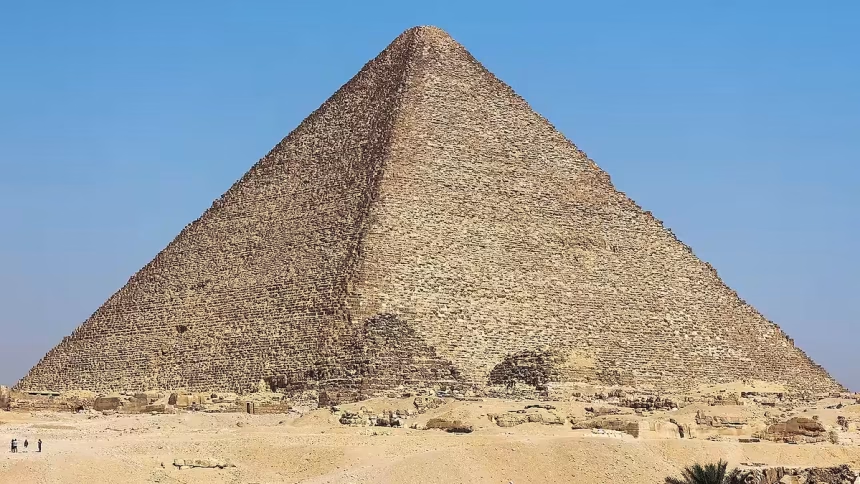
Anyone capable of forming a coherent sentence about the Great Pyramid of Giza would likely agree that it stands as one of the most extraordinary achievements of human engineering and artistic vision. Even without having seen it in person, one can imagine the impact it must have had on ancient observers. Rising from a vast plateau of stone and sand, surrounded by smaller pyramids yet dominating them completely, the structure would have seemed almost unreal. It is hardly surprising that travelers, encountering such a monument in an otherwise stark landscape, returned home with stories in which observation and imagination became inseparable.
In the ancient world, curiosity about distant lands was intense. Greek writers, in particular, responded to this demand by compiling accounts of remarkable places and structures. Over time, these efforts produced lists of the most extraordinary sights known to them. The most famous of these became the Seven Wonders of the Ancient World: the Colossus of Rhodes, the Mausoleum at Halicarnassus, the Temple of Artemis, the Statue of Zeus at Olympia, the Hanging Gardens of Babylon, and in Egypt, both the Lighthouse of Alexandria and the Great Pyramid of Giza. Although different versions of such lists existed, there was broad agreement on one point: the Great Pyramid stood among the most awe-inspiring creations of any civilization.
The Hellenistic World and the Spread of Curiosity
The period following the death of Alexander the Great in 323 BCE, known as the Hellenistic Period, was marked by rapid cultural expansion and exchange. Greek language and ideas spread across vast territories, from the eastern Mediterranean to regions as far as the Indus River. This was not only an age of intellectual achievement in philosophy, science, and mathematics, but also one of intense political fragmentation. After Alexander’s death, his empire was divided among his generals, creating rival kingdoms that frequently clashed with one another.
Egypt became one such kingdom under the rule of Ptolemy I Soter. Under the Ptolemaic dynasty, Egypt experienced both a revival of certain local traditions and a deep integration into the wider Hellenistic world. Trade flourished, and Alexandria emerged as a major intellectual and cultural center.
These developments also made travel easier. Advances in navigation, the spread of a common language, and the relative accessibility of distant regions gave rise to a new kind of traveler. These individuals were not merely merchants or soldiers, but curious observers seeking knowledge, experience, and stories. They traveled through deserts, forests, and unfamiliar cities, documenting what they saw and, just as importantly, how they interpreted it.
Travelers, Writers, and the Construction of Wonder
Among these figures was Philo of Byzantium, known for his work in mechanics and early automata. His travels eventually brought him to Alexandria, where he continued his studies. Accounts like his, along with those of other travelers, contributed to a growing body of descriptions about distant lands and monumental structures.
These reports fascinated writers such as Antipater of Sidon, who composed epigrams celebrating the great monuments of the known world. Whether he personally visited all the sites he described remains uncertain, but his poetic catalog of wonders became highly influential. What mattered was not strict accuracy, but the ability to evoke awe. In this way, the idea of the “Wonders” became as much a literary construct as a geographical one.
Egypt as Idea: Fascination and Projection
The enduring fascination with Egypt has been noted by scholars such as Erik Hornung, who described this phenomenon as “Egyptosophy.” This concept refers to the blend of genuine curiosity and imaginative projection that has shaped how different cultures perceive Egypt. For the Greeks, Egypt represented both ancient wisdom and exotic mystery.
Much of what the Greek world “knew” about Egypt came from texts rather than direct experience. The most influential of these was the work of Herodotus, whose Histories provided detailed, if not always reliable, descriptions of Egyptian customs and monuments. His account of the pyramids, including the portrayal of the pharaoh Khufu as a tyrant, would shape perceptions for centuries, despite later evidence contradicting these claims.
Encountering the Pyramids
Imagine a visitor in the third century BCE standing before the pyramids on the Giza plateau. They would have known, from written accounts, that these structures served as tombs for ancient rulers. Yet the true nature of their construction, their internal layout, and their historical context remained largely unknown. The pyramids presented a paradox: visually simple, yet intellectually impenetrable.
Stories circulated, some claiming that giants had built them, others offering more rational explanations. Even when such myths were dismissed, the sense of mystery remained. The Great Pyramid, in particular, stood as a testament to a civilization whose capabilities seemed almost beyond comprehension.
For centuries, the structure remained sealed. A recorded entry into the pyramid is associated with Al-Ma’mun in the early ninth century CE. By that time, the monument had already accumulated thousands of years of speculation and legend.
Ancient Authors and the Persistence of Error
Later classical writers continued to describe the pyramid. Strabo, writing in the first century BCE, provided one of the earliest detailed and relatively accurate accounts of its physical characteristics. However, even he repeated certain misconceptions, including the belief that the pyramids were built by enslaved labor.
A generation later, Pliny the Elder discussed the Great Pyramid in his Natural History, emphasizing the immense labor and time required for its construction. Although he attempted to quantify these efforts, his conclusions were based on second-hand information rather than direct observation.
Modern research has since demonstrated that the pyramids were constructed by skilled, organized laborers, not slaves. Yet the persistence of earlier narratives illustrates a broader pattern: once established, compelling stories are difficult to replace, even in the face of better evidence.
The Pyramid as a Generator of Meaning
The Great Pyramid of Giza is the only one of the ancient wonders still standing today, but its significance has never been limited to its physical presence. From the earliest Greek travelers to later Roman authors and beyond, it has functioned as a focal point for speculation, admiration, and reinterpretation.
What has endured is not only the structure itself, but the continuous process of storytelling surrounding it. Each generation has projected its own assumptions, fears, and ideals onto the monument. In this sense, the Great Pyramid is not merely a relic of ancient Egypt, but an active participant in the history of human imagination.
Its stones have remained largely unchanged. The meanings attached to them have not.