

Sea Levels Will Rise by 58 Meters
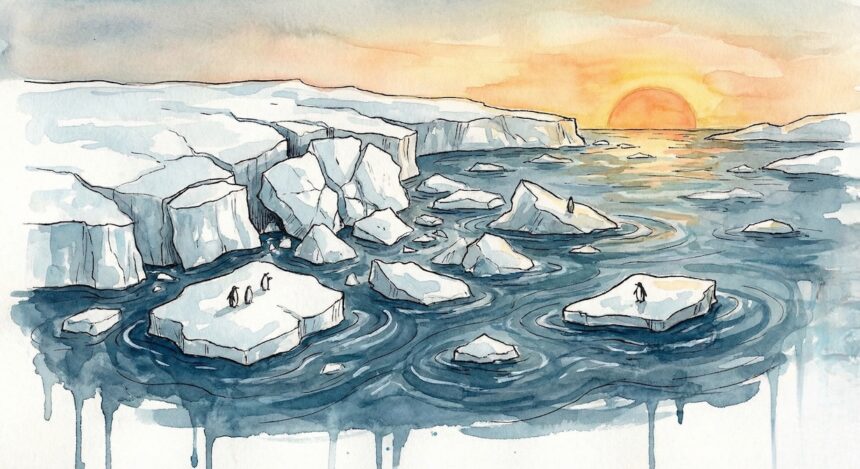
For the Antarctic ice sheet to melt almost completely, a rise in average global temperature of just 10 degrees is sufficient. When this happens, sea levels will rise by 58 meters.
- Sea Levels Will Rise by 58 Meters
- Nearly 40% of the World’s Population Will Lose Their Homes
- Humanity Will Experience Freshwater Shortages
- The Ocean Will Contain Many Potentially Dangerous Microorganisms
- Seismic Activity Will Intensify Across the Planet
- Weather Will Change Unpredictably
- Many Animal Species Will Become Extinct
- Antarctica Will Become Green Again
- And Then a New Ice Age Will Begin

This will lead to the destruction of many coastal cities, including London, New York, New Orleans, Cairo, Bangkok, Venice, Copenhagen, Mumbai, Calcutta, Hong Kong, Shanghai, Buenos Aires, Seattle, San Diego, Saint Petersburg, Riga, and Stockholm.
Not only cities but also individual regions and entire countries could disappear beneath the water. For example, extensive areas of the Netherlands and Denmark, significant territories of Canada and Russia, Bangladesh, almost the entire American state of Florida, Paraguay, and parts of Central America will be flooded. Cambodia will become an island.

China and Australia will also be affected by this disaster. Primarily, the coastal Chinese provinces where approximately 600 million people live, and Australia’s densely populated coastline, where about four-fifths of the continent’s population is concentrated.
Nearly 40% of the World’s Population Will Lose Their Homes
According to a World Bank report, if the average global temperature rises by 2 degrees over the next 30 years, approximately 216 million residents of sub-Saharan Africa, South Asia, and Latin America will be forced to leave their homes. Such people are called climate refugees.

What will happen if temperatures rise by 10 degrees all at once? According to glaciologist Matthew Morlighem from the University of California, nearly 40% of the planet’s population lives in zones that could be flooded if Antarctica melts. This means there would be at least 3.5 billion climate refugees worldwide.
Humanity Will Experience Freshwater Shortages
Those living deep within continents might think that melting Antarctic ice will only affect coastal inhabitants. But that’s not the case.
About 61% of all freshwater on Earth is concentrated in Antarctica—in frozen form, of course. It might seem that if the continent melts, all water problems worldwide would be solved. However, the effect will actually be the opposite.
If sea levels rise by the aforementioned 58 meters, saltwater from the world’s oceans will begin to penetrate groundwater deep within continents. This will not only reduce drinking water supplies but also cause enormous damage to agriculture. Irrigation will become impossible—even at relatively distant locations from the coast, salt will appear in wells and aquifers.
The Ocean Will Contain Many Potentially Dangerous Microorganisms
Have you seen horror movies like John Carpenter’s “The Thing,” where hostile life forms that have been waiting in the ice for millions of years thaw out and cause havoc? Microbiologists from Montana State University believe this is a quite realistic scenario. Of course, you won’t find giant alien spider-mutants in permafrost, but bubonic plague or anthrax? Absolutely.
Scientists call Antarctica a gene repository. Some microorganisms “preserved” there are over 8 million years old and are still viable. The melting of ice will release viruses, bacteria, fungi, and other microbes that have been trapped until now.
Stopping the spread of diseases will be extremely difficult because modern living organisms have no immunity to ancient threats.
There are known cases where thawed pathogens have infected people. For example, in 2016, ancient spores of anthrax stored in Siberian ice led to the death of a child and the hospitalization of 20 more people, while also killing several thousand reindeer.
Scientists from the University of Helsinki modeled the spread of microorganisms from permafrost and concluded that even a single ancient pathogen could cause massive epidemics and deaths worldwide.
In short, if everything dormant in Antarctica’s ice suddenly wakes up and finds itself in ocean water, the coronavirus pandemic will seem like a light seasonal cold to humanity.
Seismic Activity Will Intensify Across the Planet
The melting of Antarctica will lead to far less obvious consequences than rising ocean levels. Harvard University professor Jerry Mitrovica explains that the loss of the Antarctic ice sheet also means a change in Earth’s gravity.
Our planet spins around its axis like a figure skater on ice. If a skater shifts an arm or leg, their center of mass shifts slightly—and the rotation changes. The same is true for the entire planet. All the ice in Antarctica weighs approximately 24 quadrillion 380 trillion tons.
If this mass is distributed across the entire planet, days on Earth will lengthen by 20 seconds.
It might seem—well, days and nights on Earth become longer, there’ll be more time to nap before work. But that’s not the only consequence. The melting of glaciers and changes in gravity will accelerate the movement of tectonic plates and our planet’s mantle, thus creating new seismically dangerous zones and areas of volcanic activity. Ice influences magma movement in the planet’s mantle, and if it melts, even those places deep within continents where earthquakes are rare could become seismically hazardous.
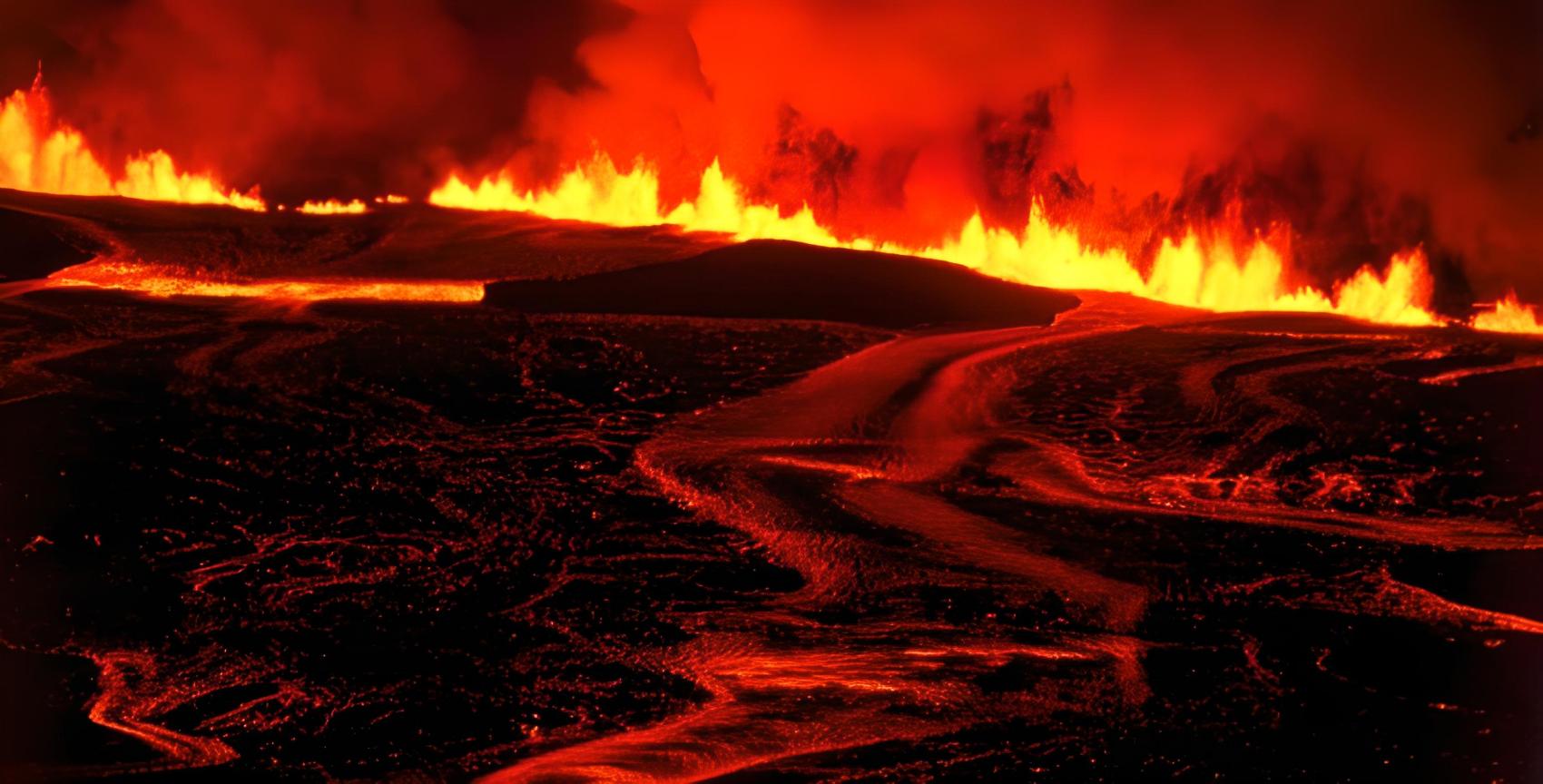
For example: due to glacier melting in Iceland and Greenland, volcanic activity in the adjacent regions has already increased 20–30 times. There are at least 138 volcanoes in Antarctica. The last time they erupted en masse was about 18,000 years ago—and they heated the Earth so much that the Ice Age ended. So the memorable Eyjafjallajökull compared to them would seem like just a mountain of burning tires.
Weather Will Change Unpredictably
The disappearance of Antarctica’s ice will also lead to new weather conditions. As meteorologist Catherine Bradshaw from the University of Exeter in the UK says, the surface of the ice sheet on the continent is very bright and reflects 50–80% of the sunlight falling on it. Where the cover is absent, darker ground is exposed. It reflects light more poorly and therefore absorbs more solar heat.
If Antarctica melts and stops reflecting sunlight, the planet will begin to heat up even more. Rising temperatures will cause wind directions to change and rainfall volumes to increase both on the continent itself and across the entire Earth. Additionally, because a large amount of freshwater will enter the ocean, oceanic currents will reorient—and we can expect new unpredictable droughts and hurricanes.
Many Animal Species Will Become Extinct
Antarctica is often considered a cold and lifeless continent, but it’s actually home to diverse living creatures—penguins, seals, whales, and many marine flying birds. Antarctic animal populations are already declining. Research by Australian scientists from the University of Queensland shows that by the end of the century, if global warming isn’t stopped, at least 65% of species living in Antarctica will simply become extinct.
A similar fate awaits not only cold-loving polar inhabitants but also many marine animals in the world’s oceans, because Antarctica’s melting will disrupt the water-salt balance as well as the circulation of cold and warm currents across the entire planet. Krill and phytoplankton, which are at the very bottom of the food chain, will be affected first, and with the decline of their populations, thousands of species that feed on them will also perish.
Antarctica Will Become Green Again
About 90 million years ago, Antarctica was already green. Swampy tropical forests like those currently growing in New Zealand thrived on the continent, and dinosaurs even roamed through them. For four months, these forests were plunged into the darkness of polar night, and the remaining part of the year they were illuminated by bright sun. The average air temperature reached 19 degrees Celsius.
If the ice melts, this land has every chance of being covered with vegetation again. Research by Italian specialists from the University of Insubria shows that grasses and mosses in Antarctica have been developing at least five times faster due to global warming than they were 50 years ago. Additionally, some algae are already managing to establish themselves right on the snow, using penguin and other bird feces as fertilizer.
It’s unlikely that Antarctica will acquire tropical forests again, even if it completely melts, but tundra and steppes may well appear there. Most likely, its climate will resemble the conditions of modern Alaska or Northern Scandinavia. Perhaps the continent could be colonized by humans.
Of course, farming when you periodically have polar night isn’t very convenient. On the other hand, when more than a third of the planet’s inhabitants lose their homes due to the world’s oceans flooding cities, there won’t be much room for being picky about locations for new colonies.
And Then a New Ice Age Will Begin
This is exactly what scientists suggest, although at first glance, it’s unclear how global warming could cause global freezing.
Research shows that the melting of the Antarctic ice sheet will lead to a disruption in the balance between salt and freshwater. This, in turn, will force the ocean to absorb more carbon dioxide from the atmosphere, reducing the greenhouse effect.
At first, it might seem this is good, since the greenhouse effect causes global warming. But at a certain point, the change in balance during the ocean’s CO2 absorption process could serve as a catalyst for a new ice age. This has happened at least 25 times over the past 1.6 million years. Under the natural course of events, the next ice age would come in many thousands of years, but due to anthropogenic factors, the cycle has accelerated.
So if Antarctica does melt, humanity won’t enjoy warm days for long. The cold will return and become harsher. Across the entire planet.