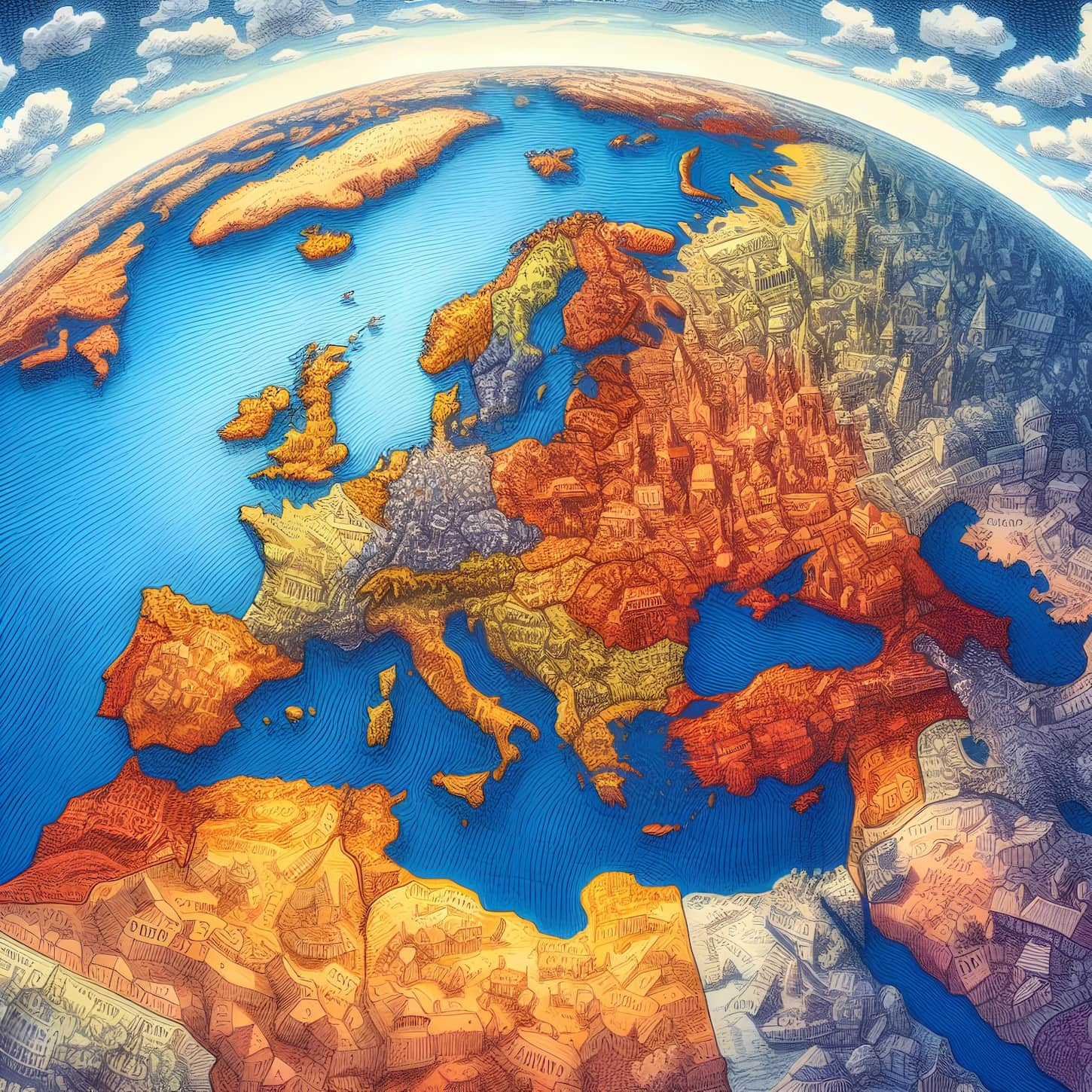
Your uncle, an amateur linguist, tells you that the Old Continent gets its name from Phoenician sailors, who supposedly used the words “ereb” and “assou” to refer to the west and the east, respectively. Indeed, these words, found on an Assyrian stele, were apparently used to distinguish the two opposite shores of the Aegean Sea: Greece on one side, Anatolia on the other. “Ereb” symbolized night, twilight, and the end of the day, while “Assou” referred to the morning light and sunrise.
A keen ear immediately catches what your uncle is getting at: “ereb” and “assu,” pronounced without straining the tongue, would yield “Europe” and “Asia.” Michael Barry, an American specialist in the Near East, suggests that these two words may well be the ancestors of the Greek terms “Eurôpè” and “Asia” in their earliest geographical meanings. But let’s not get too carried away with this sailors’ tale. Other researchers oppose this idea, arguing that this etymology is unlikely.
Princess Europa, Abducted by Zeus
The most widely accepted version points to Greek mythology. The Greek term Eurôpê is said to derive from a mythological heroine, the daughter of the king of Tyre (modern-day Lebanon). As is often the case with ancient Greece, it all begins with a story of gods, passion… and abduction. In mythology, Europa is the princess who was strolling peacefully along a beach in Phoenicia (a coastal region of Asia) when the great Zeus, an inveterate seducer, spotted her. As a pickup technique, Zeus opted for originality—no sweet nothings or flexed biceps. No, he transformed himself into a bull.
“To seduce her, he takes the form of a white bull and lures her onto the shore. To allay Europa’s fears, the white bull becomes ‘gentle as a lamb.’ Once the young girl was clinging to his back, he carried her across the waves on a long journey that ended on the island of Crete, off the coast of Greece,” recounts Louis Mouchotte, history professor and lecturer.
The symbolism of Crete is not insignificant. “It is this abduction of an Asian princess […] that establishes Europe as a distinct space from Asia and Libya. With this version, one might say that we Europeans are thus descended from Asia, forcibly torn from a land we loved,” adds Louis Mouchotte.
Once he arrived in Crete, Zeus—never one to shy away from a dramatic twist—shed his bovine form before taking action—a horned outburst of tenderness might have complicated matters. It was thus under a benevolent plane tree, and in all his divine splendor, that he united with Europa. From this embrace were born three sons, among them the famous Minos, future king and founder of Minoan civilization, marked by the legend of the Minotaur. As for the abducted princess, she was graciously “offered” to the king of the island, who took it upon himself to watch over this half-divine offspring.
Between geographical and historical Europe
Why this myth? “In Greek thought, there is the idea that, to transition from childhood to adulthood, what marks the break is being torn away. With Europa, in the fact that she is abducted from Asia to arrive in Crete, there is an evolution. One might say that we are moving from a sort of childhood of humanity toward adulthood. ”
All the more so because, in this myth, one detail is significant. The night before her abduction, Europa has a dream. For many Greeks, it is prophetic. She dreams that she is in the presence of two women: one is her mother, whom she therefore knows; the other, whom she does not know, nevertheless inexplicably draws her in. Then she wakes up and doesn’t understand why she is drawn to this stranger. “Europe is the choice of adventure. It is voluntary uprooting,” agrees Louis Mouchotte.
While this is the most widespread explanation, it is by no means universally accepted. Herodotus, the father of history, was himself perplexed: “We have no insight into the origin [of the name Europe, Ed.]. But it is certain that this Europe was originally from Asia and that she never came to the land that the Greeks now call Europe.” “
In any case, from a purely geographical standpoint, the earliest recorded use of the term “Europe” is found in a Homeric hymn from the late 6th century B.C., which refers to all the Greeks inhabiting “the rich Peloponnese, and Europe, and the islands surrounded by the waves.” At that time, “Europe” referred to mainland Greece.
In an article on the subject, Pierre Avenas, a French researcher and writer, writes: “There is no certainty regarding the mythological name, the geographical name, or, a fortiori, any connection between the two. But one is entitled to ask a question: could the poet, who named mainland Greece Eurôpê, have been unaware of the heroine’s older name? Probably not. In any case, he did not seek to distinguish between the two names, and de facto, the geographical Europe does indeed bear the name of the heroine Europe.”
The Birth of the Europeans
But Europe as a unified entity, as the home of the “Europeans” who defend it, “dates back only to the 8th century CE, following the Battle of Poitiers, which took place in 732. “The Carolingian Empire marks a high point in the consciousness of a united Europe,” observes Swiss writer Denis de Rougemont, a thinker on European federalism.
Denis de Rougemont explains that the Church and its early saints, at the beginning of the 4th century, began to distinguish the West from Europe. “From then on, the name ‘Europe’ and the concept of Europe would recur with increasing frequency, up to the time of Charlemagne’s empire, in solemn texts addressed to the pope, ecclesiastical panegyrics, chronicles, and the lives of the saints,” he writes in The Origins of Europe: From Hesiod to Charlemagne, or From Myth to History (1959).
The official birth certificate of political and historical Europe can be found in the Chronicle of Isidore of Seville, written in the 7th century. The anonymous author of this chronicle recounts the Battle of Poitiers, where Charles Martel repelled the Arabs. It is in this text that the term “Europenses” appears for the first time, referring to the peoples united under a single banner to defend their lands against a common enemy.
Thus, according to Denis de Rougemont, those who, from that time onward, took up arms to protect this continent were no longer considered mere soldiers of fragmented nations, but rather “members of a single family of peoples .“ The term ‘Europeans’ thus took on its full meaning, long before Europe took the political form we know today—this Europe that is still trying to answer Paul Valéry’s question: ”Will Europe become what it really is, that is, a small cape of the Asian continent? Or will Europe remain what it appears to be, that is to say, the precious part of the earthly universe, the pearl of the sphere, the brain of a vast body?”