Author: Hrothsige Frithowulf

  • 9 Misconceptions About Vikings

    9 Misconceptions About Vikings

    Vikings Loved Horned Helmets

    The stereotypical image of a Viking resembling a Skyrim character has nothing to do with reality. No sane warrior would wear a helmet with decorative horns. Yes, such headgear existed, but it was ceremonial armor worn during religious rituals or used as a status symbol.

    In battle, a helmet with such an adornment would more likely help the enemy kill you; if a weapon caught on the horn, it could cause serious injury.

    Helmets were made smooth so that enemy weapons would glide off them upon impact, increasing the chances of survival. That’s why real Viking helmets, such as the one found in 1943 at the Jermundbu farm in Norway, had no horns. Nor do medieval depictions of Scandinavians show them with horns.

    Most likely, the myth of horned Viking helmets was created by costume designer and illustrator Carl Emil Doepler. For the 1876 production of Wagner’s opera Der Ring des Nibelungen (The Ring of the Nibelung), he designed beautiful but unrealistic outfits, including winged and horned helmets.

    The Viking’s Standard Weapon Was a Double-Edged Axe
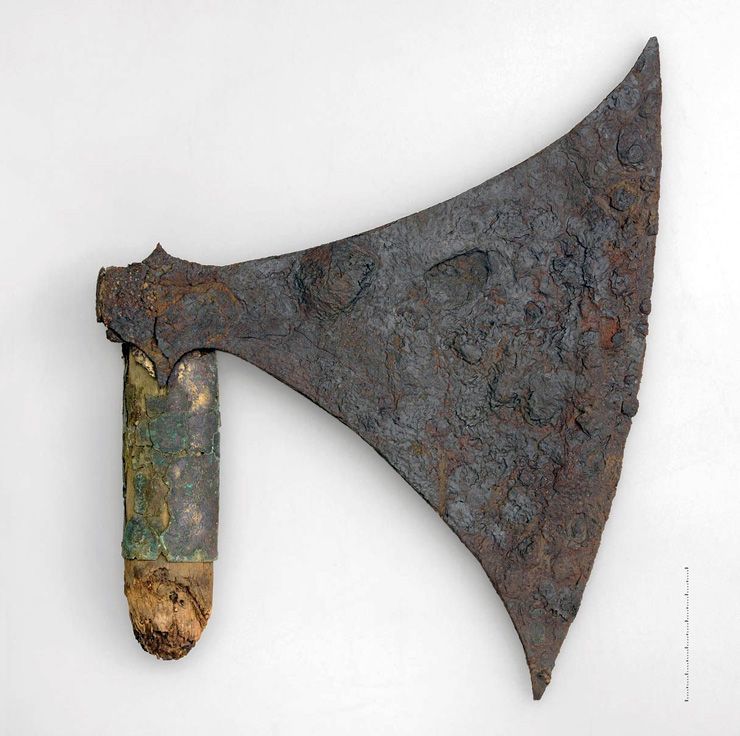
    Broadaxe from Langeid
    Broadaxe from Langeid. Museum number C58882/4. Photo: Vegard Vike, Museum of Cultural History, UiO

    This weapon is very popular in cartoons and games about Vikings. It did exist and was called a labrys. However, one small detail: Vikings didn’t wield them. Labryses were created by weaponsmiths of the Minoan civilization of the Bronze Age.

    Later, the Greeks borrowed this axe from the Minoans and made it an attribute of Zeus. Yes, Thor had Mjolnir, and Zeus had the labrys. It was likely not a weapon but a ceremonial item.

    If Vikings were given such an axe, they would probably find it very inconvenient and impractical.

    Scandinavians used broadaxes—single-edged axes shaped like a crescent—and skeggoxes—bearded axes with a protruding lower blade edge.

    These were simple and convenient weapons. They were easier to master than a sword and simpler to maintain.

    buy finasteride online https://bccrf.org/wp-content/uploads/2020/09/png/finasteride.html no prescription pharmacy

    Moreover, in times of peace or during long journeys, Scandinavian axes were used as tools: chopping wood, shaping boards, or hammering nails into a drakkar. A double-edged axe would hardly be suited for such tasks.

    And no, Viking axes were not heavy weapons for true giants. On average, they weighed from 800 grams to 1.5 kilograms. In fact, the most popular Viking weapon wasn’t even the axe, but the spear, as it was much easier to manufacture.

    Vikings Were a People

    If you think that a Viking was a member of some northern tribe, you’re mistaken. “Viking” wasn’t an ethnicity, but a type of activity.

    In Old Norse, the word Víking referred to a raid for plunder or simply an expedition for peaceful purposes—for example, exploration or trade. A Víkingr was someone who participated in such an expedition.

    Vikings could be Swedes, Norwegians, or Danes. Other people referred to them by the Latin term Norman—meaning “northerner.” In everyday life, a Viking could engage in any occupation: farming, crafting, agriculture, raising livestock, hunting, or fishing. Such people were called bóndi—free farmers with their own households.

    buy fildena online https://bccrf.org/wp-content/uploads/2020/09/png/fildena.html no prescription pharmacy

    When a Scandinavian lacked means to survive or sought adventure, travel, or military glory, they would join other *bóndi*, and together they would set out on a raid to plunder neighbors, find a better piece of land, or even just trade. Then, they would return home and live as before.

    Vikings Were Mighty Redheaded Giants

    When you imagine Vikings, you likely picture mighty and tall red-haired barbarians with luxurious mustaches. Or blond handsome warriors like Travis Fimmel. However, real Vikings might disappoint you a bit.

    According to archaeological findings, their average height was 172 cm, and Viking women stood around 158 cm—6–10 cm shorter than today’s averages.

    buy hydroxychloroquine online https://bccrf.org/wp-content/uploads/2020/09/png/hydroxychloroquine.html no prescription pharmacy

    Modern Scandinavians are much taller than their ancestors. This is quite natural, as they lived in very harsh conditions, had poorer diets, and shorter lifespans—not the best conditions for athletes and basketball players.

    Additionally, the hard physical labor of the northerners led to health problems. Louise Campe Henriksen, curator of the Viking Ship Museum in Roskilde, notes that osteoarthritis and dental diseases were common among Scandinavians of that time.

    Norman warriors were also not especially rugged or masculine in appearance.

    buy zanaflex online https://esishow.com/wp-content/uploads/2025/03/jpg/zanaflex.html no prescription pharmacy

    Here’s what an archaeologist and anthropologist from the University of Copenhagen says:

    “In fact, determining the sex of Viking-era skeletons is difficult. Male skulls were slightly more feminine than those of modern people, and female skulls were more masculine.”

    Lise Lock Harvig , Department of Forensic Medicine, University of Copenhagen

    She adds that Viking women had prominent jaws and developed brow ridges, while the men’s facial features were more feminine. Furthermore, an Arab traveler who visited the city of Hedeby around 1000 AD noted that both Viking women and men wore makeup to appear more attractive.

    As for red hair, it wasn’t uncommon among the northerners, but there were plenty of blond, brunette, and light-brown-haired Vikings as well.

    And they didn’t wear the drab gray and black clothing like extras in Game of Thrones. The northerners preferred bright and colorful clothes and loved silk and furs. The most popular colors were red and blue.

    Vikings Were Dirty Barbarians
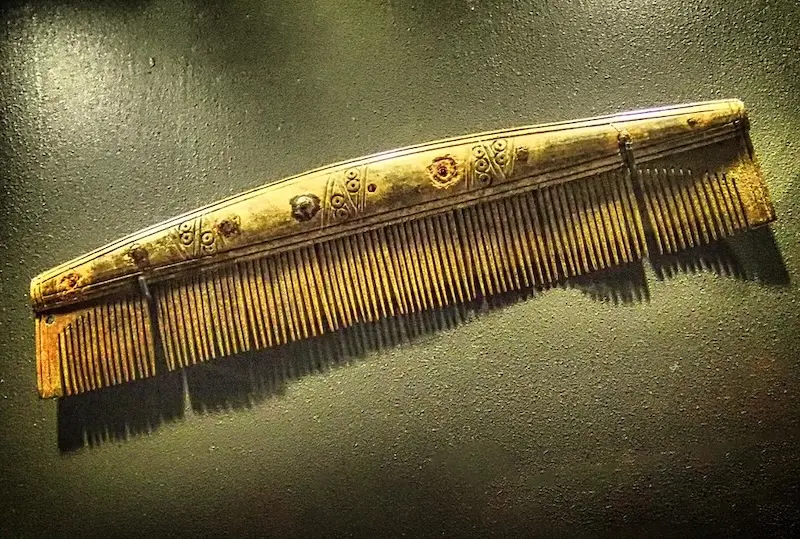
    A Viking bone comb
    A Viking bone comb. Photo: The Field Museum in Chicago, Illinois / Mary Harrsch, Flickr

    No, the Scandinavians had nothing against hygiene. The English, who didn’t particularly like the northern invaders for obvious reasons, seem to have branded them as unwashed savages. In reality, Vikings bathed at least once a week, typically on Saturdays, which was quite good for that time.

    In Old Norse, Saturday was called Laugardagur, which translates to “washing day.” Archaeological findings show that Vikings had tweezers, beard combs, tools for cleaning nails and ears, and toothpicks. A chronicler, John of Wallingford, wrote in 1220 that they bathed, changed clothes, and combed their hair, which made them quite popular with English women.

    John disapprovingly referred to this hygiene as a “frivolous whim.” These pagans would come up with anything.

    Vikings also styled and bleached their hair and used eyeliner. In the later seasons of the TV show Vikings, Ragnar Lothbrok sports a shaved head, and other characters love to flaunt striking hairstyles, shaved in the best Scandinavian barbershops.

    However, in reality, Vikings shaved the heads of criminals and slaves, while they themselves wore long hair.

    They Drank Wine from Their Enemies’ Skulls

    This sounds very brutal, but it is largely a myth.

    Throughout history, there are numerous examples of human skulls being turned into various vessels. Scythians, Mongols, Chinese, Europeans, Slavs, and Japanese all did this at some point. It’s quite possible that some Vikings may have also made drinking cups from skulls. However, the practice of making vessels from the skulls of defeated enemies was likely not widespread.

    The myth may have originated from a mistranslation by Ole Worm, a Danish physician and naturalist, in his 1651 book Runer seu Danica literatura antiquissima. He incorrectly translated a line from the poem Krákumál.

    In Old Norse, the phrase was drekkum bjór af bragði ór bjúgviðum hausa — “drink beer from the curved branches of skulls.” The “curved branches of skulls” is a kenning (a metaphor) for “horn.” Worm, however, translated the line as: “The heroes hoped to drink in Odin’s hall from the skulls of those they killed.” There was no Google Translate back then.

    Mostly, Scandinavians made vessels from animal horns, as well as wood and metal.

    Women in Viking Society Enjoyed Equality
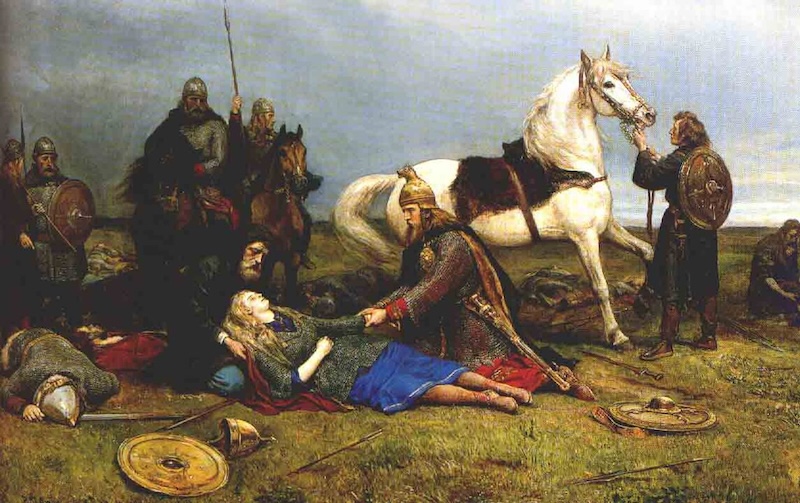
    Such women were called Skjaldmær — “shield maiden.”
    Hervor dying after the Battle of the Goths and Huns, by Peter Nicolai Arbo. Image: Public Domain

    The internet often claims that Viking women had the same rights as men and even fought alongside them in battles. Such privileges were unthinkable in the 8th–11th centuries when women from other cultures were heavily oppressed. So, were Viking women really that lucky? Not quite.

    TV shows like Vikings exaggerate women’s roles in combat. Researcher Judith Jesch from the University of Nottingham argues that brave female warriors existed only in Norse myths, and there is no evidence they existed in reality. Other scholars suggest that female warriors did exist, but they were rare.

    Such women were called Skjaldmær — “shield maiden.”

    And while Norse women had more freedom than women from other cultures, there was no true equality in Viking society.

    For example, the medieval Icelandic legal code Grágás forbade women from wearing men’s clothing, cutting their hair short, or owning weapons. They were also prohibited from participating in most political or governmental activities. Only men could attend the ting, the public assembly of free Norsemen. Women also could not serve as judges or testify in court.

    However, Norse women could own property, manage land inherited from their husbands or family, and demand a divorce if their husbands mistreated them. For the Middle Ages, that was already quite progressive. In general, Vikings respected their women, as they managed the household and crops while their husbands were away on expeditions.

    The Vikings’ Favorite Torture Was the “Blood Eagle”

    This gruesome torture, in which a living person’s back was cut open and their lungs removed, was likely invented by Christian chroniclers who sought to portray the Norsemen as terrifying demons.

    Researchers believe that Vikings wouldn’t have devised such a complex surgical procedure.

    It’s also too difficult to pull out lungs from a living person: the victim would quickly die from shock and pneumothorax before they had time to suffer.

    It’s quite possible that the bloody fantasies about ribs and lungs sticking out of the back were born from a mistranslation of the saga Ragnarssona þáttr, “The Tale of Ragnar’s Sons.” In it, Ivar the Boneless takes revenge on King Ælla II for his father. Vaguely interpreted words about eagles and a torn back may indicate that Ivar simply left Ælla’s corpse to be devoured by predatory birds.

    Ivar the Boneless Was Weak

    In the TV show Vikings, Ivar is given the nickname because he cannot walk due to osteogenesis imperfecta. However, it’s far from certain that the real Ivar was that helpless. On the contrary, the sagas describe him as a cruel and fierce warrior, tall, handsome, and the smartest of Ragnar’s children.

    The chronicler Saxo Grammaticus says nothing about Ivar lacking bones, although this would certainly be worth mentioning in his appearance. The exact origin of the nickname remains unknown. It’s possible that the Viking leader was called “boneless” because of impotence.

    Ivar the Boneless was king in England for a long time. He had no children, because of the way he was: with no lust or love—but he wasn’t short of cunning and cruelty.

    The Tale of Ragnar’s sons (Old Norse: Ragnarssona þáttr) [Source]

    It’s also possible that Ivar earned the nickname for his flexibility and agility in battle. Or maybe the nickname was simply mistranscribed in Latin, and he was supposed to be called Ivar the Hateful instead.

  • 9 Challenges Faced by Medieval Monks

    9 Challenges Faced by Medieval Monks

    Terrible Hairstyles

    In historical films and series, you’ve probably noticed the rather extravagant haircuts of medieval Catholic monks. The top of their heads was shaved, with a ring of hair around it. This was called a “tonsure.”

    The expression “to take the tonsure” comes from the practice of shaving this part of the head.

    It’s unclear when monks began this tradition, but it’s evidently ancient, possibly dating back to the 2nd, 3rd, or perhaps the 5th century AD. Historian Daniel McCarthy believes the tonsure originally symbolized the crown of thorns worn by Christ.

    Another theory is that the hairstyle was chosen by the clergy due to the Roman Empire’s custom of shaving the heads of slaves. Monks referred to themselves as “slaves of Christ.” Alternatively, the tonsure might have been linked to a commandment in the Torah forbidding shaving the sides of the head—a rule that could have subtly transitioned from Judaism to Christianity.

    Regardless of its origin, monks wore the tonsure for about 1,500 years, and it wasn’t until 1972 that Pope Paul VI declared it unnecessary. His reasons were twofold. First, it was a “meaningless ceremony,” and second, having to walk around with a shaved crown discouraged some who were overly attached to their hair from dedicating themselves to God.

    Ergonomic Issues

    Monks were always busy with various tasks, but their most demanding job was copying books. The printing press hadn’t been invented yet, so until the 13th century, manuscripts had to be copied by hand.

    This work took place in special rooms in monasteries called scriptoriums. However, the conditions were far from ideal. Initially, monks copied books by dictation, holding the manuscripts on their laps because tables weren’t introduced until the 7th century.

    Only in the most prestigious monasteries, like St. Gall Abbey, were there spacious, well-lit scriptoriums with comfortable workstations, a lectern for the abbot to dictate from, and large windows for natural light.

    Most monks had to make do with gloomy cells, working alone for years.

    For example, Eadfrith, the Bishop of Lindisfarne, wrote the Lindisfarne Gospels in solitude in a shack on St. Cuthbert’s Island, using seashells as inkwells.

    Scribes often had to lick their brushes to keep them sharp, resulting in fragments of paint getting stuck in their teeth.

    It’s no wonder monks grumbled about their tough life. The books they copied were often filled with marginalia—notes and drawings in the margins.

    These texts were full of complaints from tired monks: “Oh, my hand hurts so much!” “I’m so cold, my fingers are trembling with chill,” “When will I finally finish this chapter?” “Thank goodness it’s almost night, and I can rest.”

    “Those who don’t know how to write think it’s easy work, but although these fingers hold only a quill, the whole body grows weary.”

    Ferreol, Bishop of Uzès

    There are also more poetic marginalia. For instance: “Writing is incredibly tedious. It bends your back, dims your sight, and twists your stomach and sides.” Or: “As a sailor rejoices in reaching harbor, so does a scribe rejoice at the last line.”

    At the end of their work, a scribe might jot down something like, “Finally, I’ve written it all: for Christ’s sake, pour me a drink,” or even, “My right hand has recovered from the pain. If only a beautiful maiden were given to scribes as a reward!”

    Cats, Demons, and Other Distractions

    As you might imagine, it was easy to make mistakes in such conditions. Writing in the margins was one thing—it was allowed. But making errors in the text was quite another. Every correctly written letter atoned for a sin, while every mistake added to it.

    Abbots intimidated their scribes, warning them that any error brought them closer to a life sentence in hell. The scribes excused themselves by saying demons interfered with their work.

    Medieval monk-scribes believed in a special demon named Titivillus. As theologian John of Galensis wrote in 1285, Titivillus observed scribes and “collected into his sack a thousand errors made by monks every day.”

    This demon collected mistakes, errors, corrections, and even poorly recited Psalms. From these “stolen from God” fragments, the malicious demon compiled accusations against Church members, which he would present at the Last Judgment, condemning the negligent monks to eternal damnation. Naturally, the monks were deeply anxious about this.

    Besides demons, physical creatures also caused distractions. For example, a cat walked across a medieval manuscript at the Dubrovnik State Archives after stepping in an inkwell. A bird accidentally flying into the scriptorium could also leave its four-toed imprint on a precious folio.

    Book production was so laborious that it usually took a scribe a year to produce a standard Bible. You can imagine how monks felt when their work was damaged by a cat’s antics.

    Exorcism Difficulties

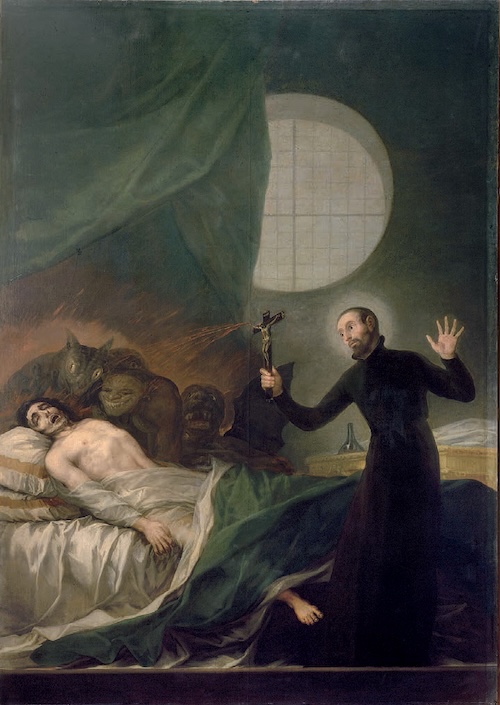
    St. Francis Borgia Helping a Dying Impenitent by Goya
    Painting in the Valencia Cathedral by Francisco Goya of Saint Francis Borgia performing an exorcism, c. 1788 Image: Wikimedia Commons

    And now, back to demons. In the Middle Ages, demons were believed to be the cause of many misfortunes. So, when someone began having seizures, cursing, fighting, or showing other signs of demonic possession, priests—not doctors—were called for help. The priests would then battle the demonic entity.

    The most common methods of exorcism were the cross, holy water, prayer, and, less often, the laying on of hands. These usually sufficed, but sometimes the devil resisted, and the clergy resorted to more extreme measures.

    The afflicted might be severely beaten or even drowned in cold water—for their own good, of course.

    Naturally, the unfortunate soul didn’t feel anything because the demon controlled the body. The idea was that inflicting pain on the devil would cause him to flee the tormented body. The beatings were accompanied by insults, as demons were prideful creatures and could not endure rudeness.

    Sometimes, though, violence didn’t help. For instance, St. Norbert of Xanten beat a possessed man with a whip, but the demon refused to leave—apparently, he was used to it. He only cried out, “Your whip doesn’t hurt me, your threats don’t scare me, death doesn’t torment me!” What could be done with such a case was unclear. Fortunately, sprinkling the poor man with consecrated salt eventually worked.

    At times, demons would slip up, practically doing the exorcist’s job for them. In a 12th-century treatise, a case is described where monks were fighting a demon possessing someone, but it wouldn’t leave and mocked them. The exorcists were desperate when the demon blurted out, “You’re wasting your time. Only Erminold can expel me, and even then, it’s doubtful.”

    The monks searched for someone named Erminold, found a saint by that name, and brought him to the demon. The latter confirmed: “Yes, that’s the one I was talking about.” A bit naive for a servant of hell, wouldn’t you say?

    Finally, some devilish creatures would only leave the possessed if they were offered a relic, such as a hair from a saint’s beard.

    Naturally, finding such a rare item was often a challenge. But sometimes, they were lucky.

    In a 12th-century report by a monk from Soissons, one particularly stubborn demon demanded nothing less than the tooth of Christ the Savior before he would agree to be exorcised.

    They searched for the tooth and couldn’t find it. They had to ask the demon again, and it explained that the relic was in the Church of St. Medard. They sent someone there, retrieved the item, and the demon, after some time, finally left the possessed.

    But more than demons, monks were irritated by imposters who faked possession just to get attention or avoid punishment for their crimes, as the responsibility was then placed on the demon.

    These frauds were easy to spot: as soon as they were doused with holy water and whipped as expected, they immediately stopped their antics. Thomas of Celano described how one day St. Francis began an exorcism, and the possessed person instantly recovered. The exorcist immediately realized it was a fraud and, “feeling deceived, quickly left the town in shame.”

    Vikings and Knights Raiding Monasteries

    The most frequent attackers of medieval monasteries were the wild Vikings, so often that the monks had a special prayer for protection from the northerners: “Our Holy Lord, protect us from the savage people of the Norwegians.”

    There is another version circulating online: “Save us, God, from the Norman sword! Save us, God, from the Magyar arrow!”, but researchers D’Hanen and Magnusson believe this to be a modern invention with no medieval origin.

    Unsurprisingly, many monasteries fortified themselves like true fortresses.

    However, it wasn’t just Vikings who looted abbeys and enslaved their inhabitants. Fellow knights, who were supposed to protect monks, often did the same.

    For example, once John FitzAlan, the first Baron Arundel, was marching with his troops to aid the Duke of Brittany. However, a strong wind struck, and the soldiers decided to wait out the storm in a nearby monastery in Southampton.

    Unfortunately, this monastery happened to be a convent. The knights couldn’t resist: they looted everything valuable and took the nuns with them as concubines.

    Fortunately, the abbess managed to excommunicate the baron from the church. As Arundel tried to cross the English Channel, 25 of his ships were wrecked by a storm. He ordered the captives to be thrown overboard to lighten the ship, but it didn’t help. The knight, along with his squires and most of his troops, drowned.

    Other Monks

    It wasn’t just Vikings or rogue knights who robbed monks. Sometimes their superiors did too. In 1190, Bishop Hugh of Lincoln visited the abbey in Fécamp to venerate the relics there. Flattered by his attention, the monks showed him their greatest treasure—the hand of Mary Magdalene.

    Without hesitation, Hugh bit off a piece of the relic in front of the shocked monks, justifying it by saying, “We receive the body and blood of Christ with our teeth in the Eucharist.”

    In the end, Hugh was canonized because he was truly a holy man.

    As mentioned earlier, books were extremely valuable at the time—one could easily be worth as much as a decent house. Many monasteries survived by selling copied manuscripts.

    However, they had to lend books to their peers and superiors for free, often for long periods—a year, five years, or even ten or twenty years. Sometimes, the books were simply never returned.

    There’s a record of an abbot borrowing a manuscript from a neighboring monastery, only for it to disappear. The priest explained his reluctance to return it by saying, “The book is so large that it cannot be hidden in a sleeve or bag… Evil people would inevitably be attracted to its beauty.”

    How the abbot managed to remove the manuscript in the first place remains unclear, but he couldn’t bring it back.

    Kissing the Floor and Other Practices

    Many monastic orders, especially the Benedictines, believed that the mere thought of sin was enough to commit it. Therefore, one must start repenting immediately.

    Thus, whenever young novices saw the abbot frown, they would instantly throw themselves at his feet. Much like in the movie The Sound of Music, where the main character Maria kissed the floor in front of Sister Bertha to save them both time without waiting for orders.

    However, the floor was not the most unpleasant thing the monks had to kiss.

    When travelers visited the monastery, monks were required to greet them “with heads bowed or lying prostrate on the ground.” They would wash the guests’ hands and feet, greet them with brotherly kisses on the lips, and share their meals.

    However, Saint Benedict recommended doing this only after a joint prayer to avoid “the devil’s tricks,” ensuring that the visitors could be trusted. After all, they might be Vikings.

    Finally, on Maundy Thursday during Holy Week, monks would bring the poor from surrounding villages into the monastery and humbly wash and kiss their feet.

    Digestive Problems

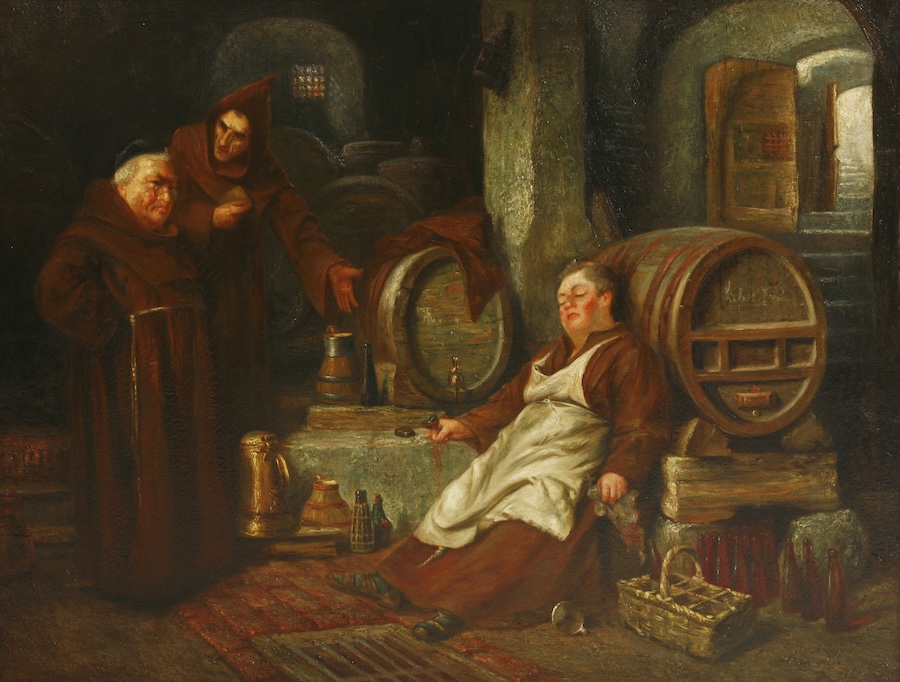
    A drunken monk
    A drunken monk. Painting by Giuseppe Marastoni, XIX century. Image: Public Domain

    The diet in monasteries varied according to their rules, but in general, medieval monks were not overly concerned with healthy eating.

    Their standard diet consisted of sourdough white bread, ale seasoned with herbs, and eels. Eels were highly valued because they could be eaten during fasting, and unlike meat, they were thought not to incite lust.

    In fact, peasants even paid rent with eels until the 16th century, and an annual turnover of 540,000 eels is recorded in the *Domesday Book*.

    Another favorite was beaver tail, which was considered a fish due to its scaly appearance. The rest of the beaver had to be discarded or sold to perfumers for musk.

    Coastal monasteries shamelessly hunted dolphins as well. Science had not yet discovered that they were mammals.

    However, in 1336, Pope Benedict XII decreed that while mortifying the flesh during fasting was good, it was fine to indulge outside of fasting periods. He permitted the consumption of “all four-legged animals.”

    As a result, monks began to eat lamb, beef, pork, venison, rabbits, hares, chicken, and various game alongside bread, fish, seafood, grains, vegetables, fruits, eggs, cheese, wine, and ale.

    At that time, they had not yet invented eating small meals frequently, and there was no time left for prayer, so meals were rare but abundant. Typically, they ate once a day in winter and twice in summer.

    This unbalanced and calorie-rich diet led to widespread digestive problems, sometimes quite serious. For example, in Muchelney Abbey in Somerset, they had to build a separate two-story building—a latrine for forty people—to accommodate all the sufferers.

    Additionally, monks collected various remedies to help themselves and their brethren. In Muchelney, a laxative recipe using different fruit extracts has survived. There were also suggestions like, “Take a small piece of soap, press it, and insert it rectally, then lie down on the bed.”

    Monasteries even had a special position—the circator—a person who patrolled the monastery at night to ensure order and make sure the novices were not engaging in ungodly activities. One of his unofficial duties was to discreetly wake monks who had fallen asleep in the latrine.

    “God’s Pearls”

    There is a common misconception on the internet that people in the Middle Ages did not wash at all. This is not true.

    Of course, regular baths were only taken by the nobility, who could afford to pay for fuel to heat water—after all, swimming in freezing well water wasn’t exactly an option. However, even commoners almost universally washed their hands and faces in the morning.

    Monks had varying hygiene practices depending on the specific rules of their monasteries.

    In many wealthy abbeys with less strict regulations, there were large lavatories—rooms with running water. Before meals, monks were required to wash their hands. These rooms also had sharpening stones because the men of God (like everyone in the Middle Ages) always carried knives with them. These knives replaced all other eating utensils—forks were not in use then. Towels were changed twice a week in the bathhouses.

    However, in other monasteries, washing was much rarer. For example, it is known that monks at Westminster Abbey were required to take a bath four times a year: at Christmas, Easter, the end of June, and the end of September.

    Some especially devout brothers neglected washing altogether, believing that by doing so, they mortified their flesh and thus aided the salvation of their immortal souls. They also thought this helped resist devilish lust and idleness and allowed them to imitate the holy saints.

    As a result, many medieval doctors, including John Gaddesden and Bernard Gordon, noted the clergy’s susceptibility to parasites.

    The aroma coming from an unwashed ascetic was called the “odor of sanctity,” and lice were referred to as “God’s pearls.”

    Even famous individuals, such as Bishop Thomas de Cantilupe of Hereford, Dominican theologian Henry Suso, or Archbishop Thomas Becket of Canterbury, suffered from these parasites. According to contemporaries, lice swarmed on Becket’s woolen clothing both inside and out, and Cantilupe had them “removed by the handful.”

    Women were no better off, which was reflected in the literature of the time. In the 12th-century poem *Planctus Monialis*, a young nun pleads with a young man to love her and complains about her hardships in the convent: “My shirt is dirty, my underwear is not fresh, made of coarse threads… my delicate hair smells of filth, and I endure lice that scratch my skin.”

    However, the steadfast faithful did not complain, as parasites were considered a form of martyrdom.

  • 5 Medieval Inventions That Changed the World

    5 Medieval Inventions That Changed the World

    There is an opinion that the Dark Ages gave humanity nothing new and were a period of stagnation and religious hysteria. But that’s not true. During those difficult times, there were certainly strange and bizarre events, but people also accomplished good things.

    Glasses

    Yes, it was in Medieval Europe—most likely in Pisa in 1284—that glasses were invented, helping people with weak vision to read.

    Before that, a Berber astronomer, chemist, and engineer named Abbas ibn Firnas in the 9th century invented the “reading stone”—a polished piece of quartz that had to be moved across the pages of a book to magnify the letters. But it took another 300 years for Italians to come up with the idea of shaping such a stone into lenses and placing them in a frame. Allegedly, Alessandro di Spina from Florence invented glasses.

    Initially, they were attached to the nose like a clip and were used only for correcting farsightedness. It wasn’t until the middle of the 15th century that they invented side pieces (temples) and lenses for nearsighted people.

    Mechanical Clocks

    Mechanical clocks appeared in Europe between 1280 and 1320. Of course, this wasn’t the first timekeeping device ever—the ancient Greeks and Chinese had made water clocks long before.

    But the invention of the escapement mechanism with a toothed wheel, likely in Italy, allowed for the creation of fully mechanical clocks that operated without any liquid, relying instead on a weight descending on a rope. Finally, it became possible to make chronographs that didn’t take up an entire room or freeze in winter.

    This can be compared to the shift from massive vacuum-tube computers with punch cards to devices that fit on a desk.

    Watchmaking guilds in medieval Europe were highly respected, and their members crafted incredibly complex and finely made mechanisms. Often, clocks—especially large, tower clocks—not only measured time but also tracked the movement of celestial bodies.

    This was important because, according to medieval doctors, the planets predicted the future. For example, if Jupiter entered the house of Scorpio without an invitation, a plague would break out. You needed to be prepared for such events.

    Flying Buttresses

    Lübeck Marienkirche Strebeböge
    Flying buttresses support the main vault of St. Mary’s Church, in Lübeck, Germany. Image: Andreas Praefcke, CC BY 3.0

    Flying buttresses are clever architectural supports that allow the weight of large building walls to be distributed, making them more stable.

    These structures were invented in the 12th century, and they made the so-called Gothic architectural style possible. You know, all those huge cathedrals with statues and towers, like Notre Dame de Paris. Building them without flying buttresses would have been impossible—the buildings would have collapsed under their own weight. Structural mechanics at work.

    Before this, truly massive architectural monuments had to be built on the principle of the Egyptian pyramids—with a wide base and a small top. But flying buttresses transformed them from gray, dull piles of stone into majestic works of art.

    Tower Mills

    Windmill de Dellen in New Scheemda
    Windmill de Dellen in New Scheemda

    The idea of using wind to grind grain, pump water, and lift loads wasn’t new. The first windmills were invented in Eastern Persia in the 9th century, and their blades were horizontally placed.

    But in the 13th century, Europeans invented the tower mill, which had a rotating roof and could carry really large sails. It was much, much more efficient than the Persians’ earlier inventions.

    For almost 600 years, the tower mill was the primary energy source in Europe.

    These structures were highly valuable in the Middle Ages, and building them was costly. As a result, they were often attached to castles or repurposed from existing watchtowers. The mill thus became not only a marvel of engineering but also a fortress capable of withstanding a siege.

    Enemies at the gates? Take down the sails so they don’t get damaged by arrows, and with a single elegant move, the structure transforms into a battle-ready bastion.

    Printing Press

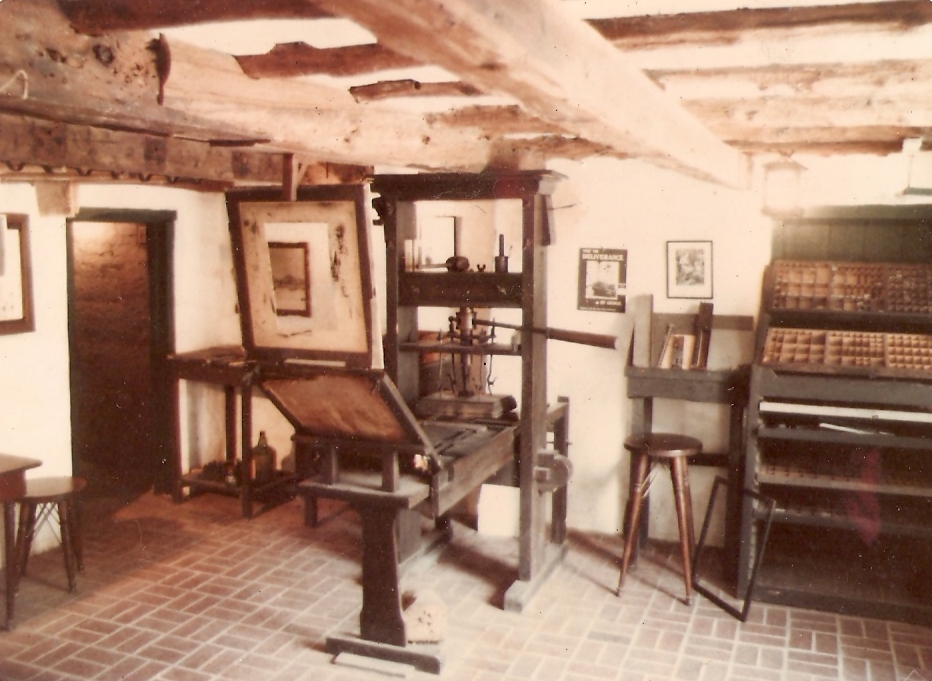
    A replica of Johannes Gutenberg's printing press
    A replica of Johannes Gutenberg’s printing press at the Featherbed Alley Printshop Museum, Bermuda.

    What do you think wine and books have in common? Well, alcohol not only provided inspiration to some writers, but it also enabled their work to become widely distributed.

    The thing is, a German engineer and engraver named Johannes Gutenberg, in the mid-1440s, looked at a wine press used to crush grapes for alcohol, thought about it, and decided to use a similar machine to print books.

    The mechanism worked like this: you assemble text from lead letters, like building blocks. Attach them to a plate, fix the plate to the press, apply ink, and press page after page until you’ve produced the desired number of copies.

    By the way, a couple of centuries before that, in 1282, Europe invented factories powered by water and wind, which allowed for the mass production of quality paper. Before this, the Chinese and Muslims produced it exclusively by hand, making the material too expensive.

    Printing and cheap paper triggered a revolution in European education, significantly increasing literacy rates.

    And yes, because books became more accessible, public libraries appeared in medieval Europe. The first was founded in 1452 by Malatesta Novello, ruler of the Italian city of Cesena.

  • 8 Misconceptions About Ancient Rome

    8 Misconceptions About Ancient Rome

    Romans Wore Togas

    The traditional image of a Roman is that of a person wrapped in a white toga, proudly gazing at us from textbook illustrations or movie screens. However, as British archaeologist Alexandra Croom writes in her book Roman Clothing and Fashion, the toga was the primary garment of “a small number of people for a short period of time within a limited area of the empire.”

    In fact, only Roman citizens had the right to wear wool togas. A Roman sent into exile lost this right, and foreigners were prohibited from wearing togas altogether.

    To properly wear and maintain a toga, one needed a trained slave (or even several slaves). Therefore, only wealthy citizens could afford to wear togas daily. By the time of the late Republic and early Empire, as we learn from the writings of Martial (40–104 AD), togas were worn only on holidays and official occasions.

    In everyday life, Romans preferred simple and comfortable clothing, such as the tunic — a shirt-like garment resembling a sack with holes for the head, arms, and torso, typically reaching the thighs (the toga was usually worn over it), as well as a cloak or mantle. Women wore the stola, a type of tunic that was wider, longer, pleated, and belted.

    The Roman Empire Had Many Slaves, and They Lived Very Poorly

    When people think of Roman slaves, they often imagine shackled individuals chained to the oars of Roman warships. However, only free men could serve in the Roman army and navy. Even slaves taken into the navy were granted freedom.

    Slaves did not only perform heavy and dirty work: they were artisans, farmers, accountants, doctors, household servants, and teachers. Moreover, slaves could serve not only individual Roman citizens but also the state itself.

    According to Roman beliefs, a slave had no personal identity, name, or ancestors, and thus no civil status. A slave could be sold (including to gladiatorial arenas and brothels), chained, and tortured. However, externally, slaves were indistinguishable from ordinary citizens. They dressed the same way, and the collars with the names of their masters, initially introduced for them, were quickly abolished. A slave could be freed and even obtain Roman citizenship. He could own property given to him by his master and conduct business.

    Of course, this was not an enviable position, but it also didn’t resemble the fate of slaves depicted in films.

    Moreover, as the empire expanded, efforts were made to legally combat cruelty toward slaves. Emperor Claudius freed slaves whose masters neglected them during illness. Later, it was forbidden to throw slaves to wild animals in gladiatorial arenas. Emperor Hadrian prohibited the arbitrary killing of slaves, their imprisonment, and their sale into prostitution and gladiatorial fights.

    Despite several uprisings (the peak of which occurred during the height of slavery in the 2nd–1st centuries BC), slaves did not play a major role in Rome’s social conflicts. Free workers also fought in Spartacus’ army. Even in the 2nd–1st centuries BC, when slavery was most widespread, slaves made up only 35–40% of the population in Roman Italy. Throughout the empire, which stretched from the British Isles to Egypt, out of its 50–60 million inhabitants, only about five million (8–10%) were slaves.

    Emperor Caligula Made His Horse a Consul

    This famous story is often cited as an example of the decadence and excess of Roman rulers: Emperor Caligula supposedly made his horse Incitatus a senator. However, in reality, this never happened.

    The myth originates from Roman History by Dio Cassius, who lived a century and a half after Caligula’s reign and was not particularly fond of him. But Cassius only mentions the emperor’s intention, not an actual event:

    One of his horses, whom he called Incitatus, Gaius invited to dinner, during which he offered him golden barley and drank to his health from golden cups. He also swore by the life and fate of this horse and even promised to make him consul. And he undoubtedly would have done so had he lived longer.

    Dio Cassius, Roman History, Book LIX.

    Additionally, Gaius himself was a member of the college of priests of his own cult and appointed his horse as one of his companions; birds of exquisite and expensive breeds were sacrificed to him daily.

    However, modern research even questions Caligula’s intention to make his horse a senator. In 2014, English researcher Frank Woods analyzed this story in an article published in an Oxford University journal. He concluded that Caligula’s joke, based on a play on words, was taken out of context. Another viewpoint suggests that Caligula used such antics to mock the senators’ greed and intimidate them.

    The Death of Gladiators in the Arena – A Favorite Spectacle of the Romans

    A wounded gladiator falls to the sand. The other warrior raises his sword over him and looks at the stands of the Colosseum. The roaring crowd gives the thumbs-down gesture. Blood spurts. This is the image often painted by films about Ancient Rome. However, it wasn’t exactly like that.

    To begin with, the Romans’ favorite spectacle wasn’t actually gladiatorial combat, but chariot races. While the Colosseum could hold “only” 50,000 spectators, the Circus Maximus, according to modern estimates, could accommodate about 150,000 Romans.

    The extent to which the inhabitants of the Eternal City loved chariot races is illustrated by the fact that the Roman charioteer Gaius Appuleius Diocles is considered the highest-paid athlete in history. Over his lifetime, he earned nearly 36 million sesterces, which is roughly equivalent to 2.6 tons of gold. Peter Struck, a professor at the University of Pennsylvania, estimates that today Diocles would have a fortune of about 15 billion dollars.

    It’s also important to mention that most often in the arena, it wasn’t people but animals—often exotic ones—that were killed: lions, panthers, leopards, lynxes, elephants, rhinoceroses, and others. Major gladiatorial battles, like naumachia, could only be organized by emperors.

    As for the likelihood of a gladiator dying in battle, it was about 1 in 10. Gladiators were specially bought and trained for combat, and some of them were even free men. Gladiators wore good armor, and in the case of injury in the arena, they were usually granted mercy.

    It should also be noted that we don’t quite understand the gestures used in the arenas correctly. There is no unanimous opinion on what the extended thumb meant—whether it symbolized death or life. It is certain that the crowd didn’t decide the fate of the wounded; this was done by the emperor or, in his absence, the organizer of the games. Most likely, mercy was symbolized by a clenched fist, representing a sword sheathed in its scabbard, while the thumb, regardless of its position, likely meant a death sentence.

    Nero Set Fire to Rome

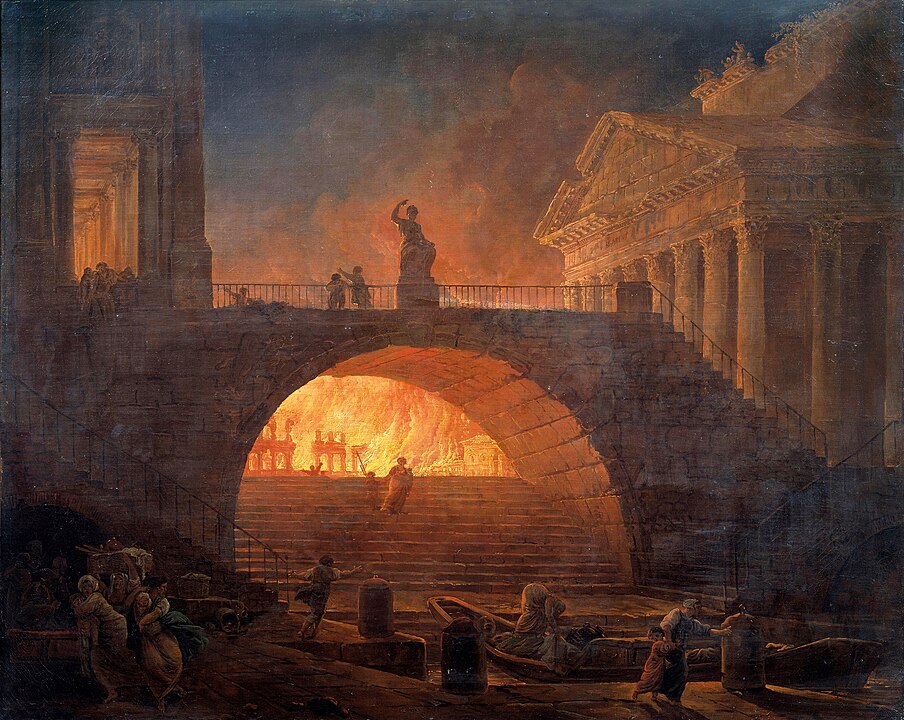
    Fire in Rome by Hubert Robert (1785)
    Fire in Rome by Hubert Robert (1785)

    One of the most famous myths in Roman history—that the Great Fire of Rome in 64 AD was caused by Emperor Nero (37–68 AD)—can be traced back to Roman historians themselves. The first to write about it was Suetonius (70–122 AD), who spoke just as unflatteringly of Nero as he did of his predecessor Caligula.

    Somebody in conversation saying—“Nay,” said he, “let it be while I am living” [emou xontos]. And he acted accordingly: for, pretending to be disgusted with the old buildings, and the narrow and winding streets, he set the city on fire so openly, that many of consular rank caught his own household servants on their property with tow, and (368) torches in their hands, but durst not meddle with them. There being near his Golden House some granaries, the site of which he exceedingly coveted, they were battered as if with machines of war, and set on fire, the walls being built of stone.

    Gaius Suetonius Tranquillus, The Life of the Twelve Caesars, Book Six, Nero.

    “Then followed a terrible calamity, whether accidental or instigated by the will of the princeps is not known (both views are supported by sources), but, in any case, it was the most severe and relentless of all the disasters ever to befall this city at the mercy of raging flames.”

    Publius Cornelius Tacitus, Annals, Book XV.

    To meet the needs of those displaced by the fire and left without shelter, Nero opened the Field of Mars, all the buildings associated with Agrippa, as well as his own gardens. Additionally, he hastily erected structures to accommodate the homeless masses. Food was brought from Ostia and nearby towns, and the price of grain was reduced to three sesterces.

    Historians tend to agree with Tacitus. At the time, Rome was extremely overpopulated, and there were many flammable buildings. There is no direct evidence that Nero caused the fire (he wasn’t even in Rome when it started). On the one hand, upon learning about the fire, he helped the victims and developed a new building plan to prevent such fires in the future. On the other hand, soon after the fire, Nero began constructing a massive palace complex on the ashes, which, even in its unfinished state, astonished contemporaries.

    The Inhabitants of Ancient Rome Were Engulfed in Orgies and Feasts

    It is traditionally believed that the lives of wealthy Romans were full of indulgent feasts and gluttony. However, the reality was not quite like that.

    Roman society was extremely conservative and traditional. Great importance was placed on mos maiorum—the “custom of the ancestors”—and modesty was one of the Roman virtues.

    Since the alcohol content in wine (the primary drink of the time) was high, it was diluted with water before consumption. Drinking undiluted wine or in excessive amounts was considered the habit of barbarians and provincials.

    Romans also washed their hands before meals and used napkins. They ate reclining, mostly using their hands. Bones and other inedible leftovers were thrown on the floor, which slaves later swept away. The food was fairly modest: the diet of wealthy people consisted mostly of vegetables, berries, game, grains, and poultry. During a feast, guests might entertain themselves with gambling.

    However, moderation in food gradually disappeared during the late Republic. The tables of wealthy Romans began to feature delicacies like peacocks and flamingos. At the same time, morals became coarser, and gluttony and drunkenness became the norm. Still, this applied only to a narrow segment of the richest members of Roman society.

    When it comes to orgies, the situation is also not so clear-cut. Ancient ethics viewed sexuality and its expressions differently. For example, the depiction of the phallus was not considered indecent, as it symbolized fertility and played an important role in the cults of agricultural gods.

    At the same time, marriage held great significance for Romans—this was one of the differences between Rome and Ancient Greece. Roman women had more rights than Greek women, but also more responsibilities and accountability (for example, they were personally responsible for infidelity).

    The Roman Empire Was the Largest in History

    From the start, Romans were a nation of warriors. They conquered much of Europe and made the Mediterranean mare nostrum (“our sea”). At the height of its power, the Roman Empire stretched from the Atlantic to the Indian Ocean, but it was not the largest or greatest empire in history.

    In terms of land area, the Roman Empire does not even rank among the top twenty largest states in history, falling behind, for example, the British, Mongol, and Russian empires.

    Moreover, Rome does not rank in the top three largest states of antiquity. It was smaller than the contemporary Han Chinese state and the Hunnic Empire, from which the Han Chinese protected themselves with the Great Wall of China. The Roman Empire was also smaller than the earlier Achaemenid (Persian) Empire and the empire of Alexander the Great.

    Roman Legionnaires Wore Red Clothing and Armor

    In films and TV shows, Roman soldiers are always dressed in red. Indeed, such uniforms could help distinguish between friend and foe in battle, as well as exert psychological pressure on the enemy. However, in reality, there is no evidence that Roman legionnaires wore uniform scarlet equipment.

    Red and purple clothing was only accessible to wealthy Romans and those in high positions. Martial, for example, wrote that red clothing was very rare. Therefore, unlike commanders, an ordinary soldier was unlikely to wear a bright tunic.

    Legionnaires took care of their clothing themselves: they either bought it or received it in parcels from relatives. Typically, Roman soldiers wore short tunics, mostly made of wool. In the northern provinces, soldiers wore warmer tunics with long sleeves. A cloak (sagum) protected them from bad weather.

    Although scarlet was the color of the god of war, Mars, the legionnaires’ clothing was most likely the natural color of wool: white, gray, brown, or black.

  • 11 Most Amazing Facts About Ancient Egypt

    11 Most Amazing Facts About Ancient Egypt

    Pharaoh Pepi II Smeared Slaves with Honey to Attract Flies

    Jar with the cartouches of pharaoh Pepi II
    Jar with the cartouches of pharaoh Pepi II, from Egypt. Neues Museum, Berlin. Image: Wikimedia

    Pharaoh Pepi II of the 6th Dynasty lived around 2300–2206 BCE. Officially, he was called Neferkara Piopi II, meaning “Beautiful is the spirit of the sun god,” in case you’re curious.

    He reigned for about 64 years, during which he established trade with the Nubians and married at least five times. He was notorious for his lax attitude toward paperwork and his indifference to internal politics, which led to conflicts and feuds among the nobles (nomarchs) and contributed to the Old Kingdom’s subsequent crisis. However, Pepi became most famous for his hatred of flies.

    It’s easy to sympathize. Flies are unpleasant insects.

    Pepi invented his own method for dealing with them. Traditional fans were fine, but his solution was more radical. The pharaoh surrounded himself with naked slaves smeared with honey. Flies would land on them, get stuck, and then be killed. These slaves acted as living traps for the insects.

    Pepi, of course, wasn’t concerned about the comfort of his slaves. They weren’t made of sugar, so they could endure it.

    Ancient Egyptian Fly Swatters Were Made From Giraffe Tails

    Handle Depicting a Lion Subduing a Nubian
    Giraffe tail attachment. A lion, symbolizing Pharaoh, devours a Nubian. Image: MET Museum

    By the way, if you’re stingy with honey, here’s another method for dealing with flies that the Egyptians came up with. Take a giraffe tail, attach a stylish handle to it—like in the picture above—and there you go: a fashionable fan. You could swat a fly easily—just make sure it’s not sitting on the pharaoh’s forehead at the time.

    Incidentally, even today, the people of South Sudan hunt giraffes for meat. And the brush made from the tail is used as part of a bridal dowry traditionally presented to the bride’s father.

    Egyptians Used Baboons to Hunt Down Lawbreakers

    Wall relief of Ramses III and baboons, mortuary temple of Ramses III, Medinet Habu, Theban Necropolis, Egypt
    Wall relief of Ramses III and baboons, mortuary temple of Ramses III, Medinet Habu, Theban Necropolis, Egypt. Image: Rémih/CC BY SA 3.0

    When we think of police animals, dogs usually come to mind. But the Egyptians rarely opted for such ordinary solutions.

    buy lyrica online https://onlinebuynoprescriptionrx.com/buy-lyrica.html no prescription pharmacy

    Instead, they used… baboons as guards and watch animals.

    If you doubt that they were helpful to Egypt’s city watch, just look at the teeth of these monkeys. In addition, baboons can move quickly and are as good at parkour as Altair from *Assassin’s Creed*. The guards would unleash trained baboon troops on thieves, and the baboons would chase and capture them. This is documented in many Egyptian frescoes.

    Particularly distinguished baboons could be mummified after death as a sign of gratitude, ensuring their passage to the afterlife.

    Yes, the Egyptians did have dogs, too. But baboons were better. Better than dogs.

    In addition to law enforcement duties, baboons had other roles. They were among the Egyptians’ favorite pets.

    buy zoloft online https://synemed.com/Media/png/zoloft.html no prescription pharmacy

    For example, they were trained to gather figs from trees and bring them to their owners. And due to their habit of screeching in the morning, baboons could serve as living alarm clocks.

    There’s a theory that the word “baboon” has ancient roots and is connected with the name of the Egyptian god Babi (or Baba), the deity of baboons and scribes. Don’t ask why monkeys and calligraphy are related—just accept it as fact.

    Court Physicians of the Pharaoh Had Strange Titles

    An Invocation to I-em-hetep, the Egyptian Deity of Medicine
    An Invocation to İmhotep the Egyptian Deity of Medicine. Image: Ernest Board (1877–1934)

    The Egyptians had a peculiar yet advanced medical system. Particularly skilled doctors could expect high positions at court.

    Since the pharaoh was considered a god, court physicians were also partly priests. Each one was responsible for treating only a specific disease or for the care of a particular organ. They held titles such as “Royal Keeper of the Pharaoh’s Left Eye” and “Royal Keeper of the Pharaoh’s Right Eye.”

    However, the most fortunate physician was the one who served as both a proctologist and dietician, known as the “neru pakhut,” or “Shepherd of the King’s Anus.”

    One of the most famous of these Shepherds was Ir-en-akhti, who lived during the First Intermediate Period of Egypt (roughly 2181–2040 BCE). He succeeded his predecessor, Shepherd Khui, in this honorable position.

    The “neru pakhut” had the authority to administer enemas to the pharaoh, purge his system with emetics, prescribe his daily diet, and even impose fasting. Enemas were especially popular in Egypt, and the pharaoh, along with his court, performed them several times a month for preventive purposes.

    Of course, this was accompanied by the recitation of prayers and incantations meant to maintain the pharaoh’s health.

    Egyptian Medicine Was Advanced Overall

    Edwin Smith Papyrus
    The Edwin Smith papyrus, the world’s oldest surviving surgical document. Image: Public Domain

    Top-notch medical care was available not only to the pharaoh and his entourage but also to ordinary citizens. For example, it’s documented that peasants in ancient Egypt wore pouches around their necks filled with mouse bones, which were thought to prevent nighttime incontinence.

    buy wellbutrin online https://onlinebuynoprescriptionrx.com/buy-wellbutrin.html no prescription pharmacy

    In theory.

    And if you rubbed your head with a mixture of fat from a mountain goat, cat, hippo, and crocodile, it was believed to cure baldness. Just be careful when explaining to the authorities how you got fat from sacred animals.

    The ancient Egyptians also invented their own toothpaste. The recipe: powder from ox hooves, ash, burned eggshells, and pumice.

    Even dog, donkey, and gazelle dung had medicinal properties. These were used by the priests of Khepri, the scarab god. Since scarabs are born from dung balls, dung must be a source of life force. Logical? Logical.

    According to the Kahun Papyrus, honey and crocodile dung were excellent contraceptives. They were also good for women’s health in general. Apply externally.

    Finally, the Egyptians suffered from diseases like schistosomiasis, which caused men to urinate blood. But this wasn’t considered bad—it was believed that they were simply menstruating like women. Egyptians even thought that such men might become pregnant.

    Ramses the Great Had More Than 170 Children

    After hearing all these curious facts about Egyptian medicine, you might think that poor pharaohs barely made it to 30 and died in agony—more from their treatments than from actual dangers.

    But that wasn’t always the case. Some pharaohs lived quite well. For example, Ramses the Great was over 90 years old when he died.

    The king lived a grand life. He had eight official wives, nearly 100 concubines, 111 sons, and 67 daughters. There’s also reason to believe he was left-handed and had red hair.

    Both Men and Women Used Cosmetics

    Egyptians, regardless of gender, applied eyeliner, painted their lips, and rouged their cheeks, as well as rubbed themselves with aromatic oils. This not only made them look very beautiful but also protected their skin from the scorching sun.

    The weather certainly called for it, as you can imagine.

    However, the usefulness of Egyptian skincare products is quite questionable, as they contained lead.

    Egyptians Shaved Their Eyebrows in Mourning for Cats

    Cats were highly revered in ancient Egypt. It was believed that they were protected by the goddess Bastet. Cats were useful in controlling rodents and snakes, and a whole cult formed around them.

    It is documented that when a cat died, its owners would shave their eyebrows (which was a sign of mourning for Egyptians). The deceased pet was mourned for a full 70 days.

    Moreover, cats were mummified like humans and buried with honors.

    For the deliberate killing of a cat, the penalty was death. For an accidental killing, a large fine was paid to the priests of the nearest temple of Bastet, along with public repentance (if the person was lucky). There is a historical account by Diodorus Siculus that in 60 BCE, Egyptians lynched a Roman who accidentally ran over a cat with his chariot.

    Pharaohs Had Stylish Footwear and Socks

    Golden sandals and thimbles for the feet of Tutankhamun
    Golden sandals and thimbles for the feet of Tutankhamun. Image: Public Domain

    The soles of Tutankhamun’s sandals bore portraits of barbarian peoples. So, wherever he walked, he would trample his enemies. Additionally, the enemies of the kingdom were depicted on pharaonic thrones to symbolize that the king of Egypt trampled them with his throne.

    And by the way, Tutankhamun wore socks with his sandals. If you have anything to say about that, remember that the royal crocodiles were purposefully not fed for two days.

    The first socks were invented by Egyptians around 5000 BCE.

    The oldest surviving pair of socks, however, is only 1,700 years old. These were made by Egyptians between 250 and 420 CE. Perfect for wearing with open-toed shoes.

    buy azithromycin online https://synemed.com/Media/png/azithromycin.html no prescription pharmacy

    The Pyramids Were Built by Hired Workers, Not Slaves

    Great Pyramid of Giza
    Kheops pyramid. Image: Wikimedia

    The ancient Greek historian Herodotus believed that the Great Pyramid was built by 100,000 slaves. The image of unfortunate captives hauling massive stones under the blazing sun while being whipped by overseers is frightening. But in reality, nothing like that happened.

    Archaeological evidence shows that the pyramid at Giza was built by 5,000 permanent workers, assisted at different stages of construction by up to 20,000 seasonal laborers. These were free people who worked for wages.

    They worked in shifts: a farmer or craftsman would leave home for 3-4 months to earn extra money on the construction site and then return to his regular life.

    They were provided with food, drink, and medical care, and were housed in a camp near the construction site. Those who died during construction were buried near the pyramid—an honor that slaves would not have received. Additionally, the workers were supplied with large quantities of meat—something slaves could only dream of.

    Although the labor was tough, the workers believed that they were demonstrating their loyalty to the pharaoh and the gods. Plus, they were earning points for the afterlife.

    Some Ancient Egyptian Tombs Had Toilets

    The Egyptians wholeheartedly believed in the afterlife. So much so that they included bathtubs and even toilets in tombs. For example, such a toilet was found in the tomb of the Egyptian architect Kha, dating back to the 2nd millennium BCE.

    Even the dead, the Egyptians thought, might need to relieve themselves from time to time.

    buy tirzepatide online http://cosmeticsurgeryspecialists.org/patientspage/html/tirzepatide.html no prescription pharmacy

  • Stupidest Wars in History

    Stupidest Wars in History

    Throughout recorded history, nations have typically marched to war over comprehensible, if tragic, geopolitical stakes: fertile farmland, strategic trade routes, dynastic succession, or national survival. Yet the archives of military history are also littered with conflicts triggered by absurd misunderstandings, bruised aristocratic egos, stray domestic animals, and culinary disputes. Examining five of the most senseless armed conflicts ever waged reveals how quickly human stubbornness can escalate a trivial local incident into a full-scale military deployment.

    The War of the Oaken Bucket (1325)

    In early fourteenth-century northern Italy, the neighboring city-states of Bologna and Modena lay just twenty miles apart, divided by bitter political hatred. Modena championed the Ghibelline faction supporting the Holy Roman Emperor, while Bologna stood as a staunch stronghold of the Guelph faction loyal to the Pope. After years of border raids and skirmishes, the final spark that ignited a pitched battle occurred in the autumn of 1325 when a small band of Modenese soldiers slipped through the city gates of Bologna during a raid, cut the rope at a public city well near the Porta San Felice, and ran back home carrying the town’s wooden water bucket as a trophy.

    Enraged by the public humiliation rather than the monetary value of an ordinary oak pail, the authorities of Bologna demanded the bucket’s immediate return. When Modena laughed off the ultimatum, Bologna mobilized an army of thirty thousand infantry and two thousand cavalry, marching toward Modena to retrieve their bucket by force. On November fifteenth, 1325, at the Battle of Zappolino, the outnumbered seven-thousand-man Modenese army led by Rinaldo Bonacolsi launched a furious counterattack in the fading afternoon light, routing the Bolognese forces and chasing them all the way back to the walls of Bologna. Over two thousand soldiers died on the field in a single afternoon, and during the victory pursuit, Modenese troops reportedly stole a second bucket from another well outside Bologna’s gates just to rub salt in the wound. To this day, the original fourteenth-century wooden bucket remains proudly displayed inside the Palazzo Comunale in Modena.

    The War of Jenkins’ Ear (1739 to 1748)

    Few wars in European history boast a more bizarre casus belli than the conflict that erupted between Great Britain and the Spanish Empire in October 1739. Seven years earlier, in April 1731, the British merchant brig Rebecca, captained by Robert Jenkins, was boarded off the coast of Cuba by a Spanish coast guard vessel commanded by Julio Leon Fandino, who suspected Jenkins of smuggling contraband goods in violation of treaties. According to Jenkins, the Spanish commander tied him to the mast, drew his cutlass, sliced off Jenkins’s left ear, and handed the severed ear back to him with the taunt that he would do the exact same thing to King George II if he caught him smuggling.

    At the time in 1731, the British government largely ignored Jenkins’s complaint to preserve peaceful trade relations. However, by 1738, hawkish opposition politicians in Parliament led by future Prime Minister William Pitt were desperate for an excuse to seize Spanish commercial dominance in the Caribbean. Summoning Captain Jenkins to testify before a committee of the House of Commons in March 1738, lawmakers gasped in theatrical horror when the captain dramatically produced a small glass jar containing what he claimed was his pickled, shriveled ear, declaring that when mutilated he had commended his soul to God and his cause to his country. Whipped into a patriotic frenzy, Britain declared war on Spain the following year, triggering nearly a decade of naval sieges in Colombia and Georgia that cost tens of thousands of lives before merging into the wider War of the Austrian Succession.

    The Pastry War of 1838

    In the turbulent years following Mexico’s independence from Spain, street fighting and military coups in Mexico City frequently damaged shops owned by foreign merchants. Among these merchants was a French pastry chef named Monsieur Remontel, who operated a bakery in the Tacubaya district outside the capital. In 1828 or 1832, drunken Mexican army officers broke into Remontel’s shop, locked the baker in a back room, smashed his furniture, and ate every single pastry on the shelves without paying. When the Mexican government ignored Remontel’s modest repair bill of roughly eight hundred pesos, the outraged baker inflating his claim to an astronomical sixty thousand pesos and wrote directly to King Louis-Philippe of France demanding royal protection.

    Finding Remontel’s complaint a convenient pretext to collect six hundred thousand pesos in broader unpaid Mexican debts owed to French banks and businesses, French Prime Minister Louis-Mathieu Mole dispatched a naval squadron of twenty-six warships under Rear Admiral Charles Baudin to blockade the Gulf coast of Mexico in the spring of 1838. When the Mexican Congress refused to pay under the barrel of a gun, French warships bombarded and captured the fortress of San Juan de Ulua at Veracruz in November 1838. Calling the retired general Antonio Lopez de Santa Anna back to lead the defense of Veracruz, Mexican forces clashed with French landing parties on the docks, where a blast of French grapeshot shattered Santa Anna’s left leg, requiring its amputation—an injury Santa Anna famously exploited with a full state funeral for his severed leg to ride a wave of patriotic sympathy straight back to the Mexican presidency, while Mexico ultimately borrowed money from British banks to pay off the French pastry claim in March 1839.

    The Pig War of San Juan Island (1859)

    When the United States and Great Britain signed the Oregon Treaty of 1846 to draw the border between Washington Territory and British Columbia along the forty-ninth parallel through the middle of the water channel separating Vancouver Island from the mainland, the diplomats forgot that San Juan Island sat right in the middle of two different channels. Both American settlers and the British Hudson’s Bay Company claimed the island simultaneously, setting up rival farms within shouting distance of one another.

    On the morning of June fifteenth, 1859, an American farmer named Lyman Cutlar looked out his window and saw a large black Berkshire boar owned by Charles Griffin, an Irish employee of the British Hudson’s Bay Company, rooting up and eating the potatoes in Cutlar’s garden for the third time. Grabbing his rifle, Cutlar shot the pig dead. When Cutlar offered to pay ten dollars to replace the pig, Griffin demanded one hundred dollars and threatened to have British magistrates arrest Cutlar as a trespasser on Crown land. In response, the hot-headed commander of the US Army’s Department of Oregon, Brigadier General William S. Harney, shipped Captain George Pickett (later famous for Pickett’s Charge at Gettysburg) and sixty-six American soldiers with cannons onto the island, prompting the British governor to dispatch three Royal Navy warships carrying over two thousand men and seventy naval guns under Rear Admiral Robert Baynes. For months, hundreds of American and British troops stared at each other across the beach until Rear Admiral Baynes famously refused the governor’s order to open fire, declaring securely that he would not involve two great nations in a war over a squabble about a pig—leaving the dead boar as the single casualty of the entire conflict.

    The War of the Stray Dog (1925)

    While the Pig War ended without human bloodshed, an equally trivial border incident between Greece and Bulgaria in October 1925 proved far deadlier. Along the tense mountain frontier pass of Demir Kapia in the Belasitsa range, Greek and Bulgarian border sentries watched each other through binoculars across a narrow strip of no-man’s-land. On October eighteenth, 1925, according to the most widely reported account, a Greek soldier’s dog broke off its leash and bolted across the border wire into Bulgarian territory. Without thinking to wave a white flag, the Greek soldier ran across the border line whistling after his pet, prompting startled Bulgarian sentries to open fire and kill him on the spot, followed immediately by a firefight that killed a Greek captain attempting to calm the situation.

    Rather than treating the shooting as a tragic local accident, Greece’s military dictator, General Theodoros Pangalos, issued a furious forty-eight-hour ultimatum demanding two million French francs, an official apology, and the court-martial of the Bulgarian officers. Before Bulgaria could comply, Pangalos ordered the Greek Third Army Corps to invade southwestern Bulgaria on October twenty-second, occupying the border town of Petrich and ten surrounding villages. Instead of fighting back with a massive counter-offensive, the Bulgarian government smartly appealed to the newly formed League of Nations in Geneva. Acting with rare speed, the League ordered an immediate ceasefire, forced Greek troops to withdraw behind their border, and fined Greece forty-five thousand pounds in damages after over fifty people—mostly Bulgarian civilians—had lost their lives over a runaway dog.

  • 5 Facts About Roman Emperors: Both Funny and Scary

    5 Facts About Roman Emperors: Both Funny and Scary

    Holding absolute power over tens of millions of subjects from the rainy hills of northern Britain to the deserts of Mesopotamia, Roman emperors occupied a political office with almost zero constitutional checks on their personal whims. While statesmen like Augustus, Trajan, and Marcus Aurelius spent their reigns codifying laws and inspecting frontier legions, other rulers used the imperial treasury to indulge bizarre obsessions, theatrical pranks, and terrifying displays of cruelty. Examining five verified historical episodes from the lives of Roman emperors reveals how quickly absolute authority blurred the line between comedy and horror.

    Caligula’s War Against the Sea and His Horse Incitatus

    Few rulers combined dark absurdity and terror as unpredictably as Gaius Julius Caesar Augustus Germanicus, universally known by his childhood military nickname Caligula, meaning Little Boots. According to the Roman biographers Suetonius and Cassius Dio, Caligula lavished an unimaginable fortune on his favorite racing stallion, Incitatus. To ensure the horse slept undisturbed before races at the Circus Maximus, the emperor stationed Praetorian guards around the neighborhood to enforce absolute silence, built the stallion a marble stable fitted with an ivory manger, dressed him in imperial purple blankets, and hosted dinner parties in the horse’s name where senators were forced to attend, culminating in Caligula’s infamous threat to appoint Incitatus to the high office of Roman Consul as an insult to the Senate’s competence.

    Equally surreal was Caligula’s military campaign along the English Channel in 40 AD. After marching legions to the northern coast of Gaul as if preparing to invade Britain, the emperor suddenly ordered his battle lines to face the waves while catapults and ballistae were drawn up on the sand. When the bewildered soldiers stood waiting, Caligula commanded them to draw their swords, charge into the surf, and collect seashells in their helmets as plunder from the conquered ocean to carry back in triumph to Rome—a stunt historians interpret either as a symptom of severe mental instability or a calculated public humiliation of mutinous troops.

    Emperor Claudius Legalizing Flatulence at Banquets

    Following the assassination of his nephew Caligula in 41 AD, Claudius was discovered hiding behind a palace curtain by Praetorian soldiers and unexpectedly elevated to the throne. Remembered as an able administrator who conquered Britain and expanded the empire’s aqueducts, Claudius was also a lifelong hypochondriac who worried obsessively about digestive ailments after suffering illnesses in his youth. According to Suetonius in The Twelve Caesars, Claudius was deeply concerned after hearing a story about a polite dinner guest who nearly died of severe abdominal cramps because embarrassment prevented him from relieving gas in the emperor’s presence.

    Determined to protect the gastrointestinal health of Roman citizens, Claudius drafted a formal imperial edict legalizing and encouraging flatulence at state banquets and social gatherings. At his own crowded dining tables, Which frequently hosted up to six hundred guests at a time, the emperor prioritized bodily comfort over aristocratic etiquette, though he frequently fell asleep at the table immediately after eating and had to be tickled awake with feathers by palace attendants so he could digest safely.

    Domitian’s Pitch-Black Dinner Party of Terror

    During the late first century AD, Emperor Domitian grew increasingly paranoid toward the senatorial aristocracy and devised psychological games designed to remind Rome’s elite that their lives hung by a thread. In 89 AD, as recorded by the historian Cassius Dio, Domitian invited a large group of leading senators and equestrian knights to an evening banquet at his palace. Upon entering the dining hall, the horrified guests discovered that the ceilings, walls, and floors had been painted entirely matte black, with bare wooden benches arranged like funeral biers.

    Next to each senator’s seat stood a carved stone gravestone inscribed with that specific guest’s full name and lit by a flickering oil lamp of the exact type hung inside Roman tombs. Naked Slave boys painted completely black danced silently around the room before serving food traditionally offered to spirits of the dead on black platters. Throughout the entire meal, Domitian spoke exclusively about murder, executions, and slaughter while the terrified senators sat frozen in silence, convinced their throats would be cut the moment the meal ended. When they were finally sent home in carriages pulled by strangers, each senator received a knock at his door hours later from an imperial messenger—only to discover that Domitian had sent them the silver “gravestones” and expensive platters from the dinner as a macabre practical joke.

    Commodus Fighting Disabled Citizens and Ostriches in the Arena

    When the philosopher emperor Marcus Aurelius died in 180 AD, sole rule passed to his nineteen year old son, Commodus, whose megalomania brought an end to the era of the Five Good Emperors. Obsessed with gladiatorial combat and convinced he was the living reincarnation of the demigod Hercules, Commodus abandoned state administration to wear a lion skin, carry a wooden club, and rename the city of Rome Colonia Commodiana as well as renaming all twelve months of the calendar after his own personal titles.

    Stepping onto the sands of the Colosseum himself—an act Romans considered deeply shameful for an aristocrat, let alone an emperor—Commodus charged the public treasury one million sesterces for every appearance. In the morning animal hunts, he used specially forged crescent shaped arrowheads to decapitate running ostriches, then walked over to the senatorial seating section holding a severed ostrich head in one hand and a bloody sword in the other, grinning and gesturing that he could do the exact same thing to the senators. Even more disturbingly, he ordered all citizens in Rome who had lost their feet to disease or accidents to be rounded up, tethered together at the knees in the arena, costumed as mythological serpentine giants, and beaten to death with his Hercules club while the crowd was forced to applaud.

    Elagabalus Smothering Dinner Guests with Deadly Rose Petals

    Crowned emperor in 218 AD at the age of just fourteen, Varius Avitus Bassianus, known to history as Elagabalus after the Syrian sun god he served as high priest, shocked conservative Rome during his brief four year reign with extravagant pranks and sensory excess. Inside his palace, the teenager seated compliant dinner guests on inflatable leather cushions that were secretly deflated mid meal, dropping dignified magistrates onto the floor underneath the tables while serving them fake food crafted out of wax, glass, or painted stone.

    His most infamous banquet spectacle, recorded in the Historia Augusta, turned deadly through sheer luxury. Dining inside a hall fitted with a mechanical reversible ceiling, Elagabalus triggered a hidden lever that released tons of fresh violets and rose petals onto his guests from above. The volume of flowers cascading from the rafters was so immense and heavy that several trapped guests were unable to crawl to the surface and suffocated to death beneath the fragrant mountain of petals.

  • 5 Facts About Iran That Few People Know

    5 Facts About Iran That Few People Know

    Iranians Celebrate the Start of Winter With Watermelons and Pomegranates

    One of the most important holidays in Iran is Yalda, or Chelleh. It is celebrated between the last sunset of autumn and the first sunrise of winter—on the night of the winter solstice.

    It is customary to celebrate Yalda within the family circle. All household members gather together to celebrate the birth of the new sun. The holiday table features watermelons, pomegranates, walnuts, and sweet treats.

    At first glance, this holiday seems very similar to our New Year’s celebration. Find the differences: the whole family gathers at the table, often with relatives coming from afar, and special festive dishes are prepared. However, Yalda night is not a New Year’s holiday. The New Year in Iran is celebrated according to local customs three months later—in late March.

    The Iranian Santa Claus Is Quite Different From Ours

    Hajji Firuz on the Chalous Road
    Hajji Firuz on the Chalous Road. Image: Ninara / Flickr

    Every year, the country celebrates Nowruz, or “new day” in Persian. This is the local New Year—a holiday that symbolizes the rebirth of nature after a long slumber. It begins on the first day of the spring month of Farvardin, that is, on the day of the vernal equinox, between March 20–22. The celebration does not go without the local New Year’s wizard, called Haji Firuz.

    He is also dressed in red, like our Santa Claus. But he’s not an old, kind, white-bearded man sprinkled with snow. On the contrary, Haji Firuz is young and very slim.

    buy levitra super force online https://mexicanpharmacyonlinerx.net/buy-levitra-super-force.html no prescription pharmacy

    His distinctive feature is a black face. According to one version, black represents darkness, a symbol of frozen, lifeless nature. However, some legends claim that Haji was a black slave who managed to gain freedom. Therefore, he became one of the beloved characters in Iranian culture, and his appearance brings hope for positive change.

    Haji Firuz often does not come alone but with his frequent companion, Amu Nowruz, or Baba Nowruz. This character has a white beard and staff, so he resembles our Santa Claus more closely. Yet, the main hero of the holiday is still Haji Firuz. These two characters are considered harbingers of spring. Their appearance signals that slumbering nature is ready to be reborn.

    Local Food Is Very Specific

    Surprisingly, the Persian language has a word for “pirozhki” (small pies). It’s exactly what you think—dough with a filling wrapped inside. However, the word that came into Farsi from Russian refers to just one small pie. The plural also exists—the Iranians add their own ending, and it becomes “pirozhki-ha.”

    In general, Iranian cuisine is very interesting. The country is known for lamb kebabs, i.

    buy vilitra online https://mexicanpharmacyonlinerx.net/buy-vilitra.html no prescription pharmacy


    e., grilled meat, as well as thick soups and combinations of meat and fruits.
    buy propranolol online https://bccrf.org/wp-content/uploads/2020/09/png/propranolol.html no prescription pharmacy

    Moreover, the traditional kebab is not just minced meat on a skewer. It also refers to thinly sliced pieces of meat, as well as an equivalent of our chicken, lamb, or beef shashlik.

    Iranians prepare sauces with added lemons, walnuts, and vegetables. Rice is often slightly overcooked and lightly fried to form a delicious crust—a part loved by almost everyone.

    There are also two local dishes in this country that may not appeal to everyone. The first is called “kalle-pache.” It is a recognized delicacy in Iran—boiled lamb’s head. Its edible part is the brain. They say it is very tasty, but not all foreigners are ready to try it.

    The second dish looks very similar to porridge. It is called “haleem,” and it tastes like sweet, hearty millet. It’s hard to guess that it’s made from grains and meat. Both components of the dish are boiled for many hours until they turn into a homogeneous mass. It looks somewhat like overcooked oatmeal or wheat flakes. However, those who have tried it say they were pleased.

    Iranians Remember and Value the Work of Their Compatriot—Omar Khayyam

    The scientist and philosopher, who lived and worked a thousand years ago, is known today as a poet and author of short quatrains. But in Iran, Khayyam is remembered as a mathematician who solved cubic equations, an astronomer, a lawyer, a historian, and even a physician.

    During his lifetime, Khayyam was especially valued by his contemporaries as an astronomer. He made an important contribution to the creation of the Persian calendar, which Iranians still use today and consider the most accurate in the world.

    By the way, several calendars are in use in the country. In addition to the international Gregorian calendar, their own Persian calendar is actively used. This calendar is divided into 12 months and begins on the day of the vernal equinox. Iranians believe that Omar Khayyam contributed to its creation.

    The poet’s short “rubaiyat” (quatrains) are known worldwide. Interestingly, about 5,000 quatrains are attributed to him. However, Iranian scholars believe that only 300–500 actually belong to Khayyam. Some are certain that only 57 quatrains can be definitively proven to be his. Who wrote the rest is unknown.

    There Is a Concept of “Temporary Marriage” in Iran

    Such a union can be entered into by an unmarried or even an officially married man and a single woman—for example, a widow. The parties sign a marriage contract (prenuptial agreement), which at first glance differs little from a traditional one. However, it is not permanent and only lasts until a specified date, such as several months or a year. After that, the couple can agree to extend the contract, and this can continue as long as the arrangement suits both parties.

    If the contract is not extended, the man and woman officially part ways—no divorce process is required. However, a temporary marriage can be terminated earlier than the agreed-upon date.

    The marriage contract clearly specifies all the details—what the wife receives when entering into a temporary marriage and how property is divided after the term ends.

    buy valtrex online https://bccrf.org/wp-content/uploads/2020/09/png/valtrex.html no prescription pharmacy

    Such unions have become common in Iran, although attitudes toward them are mixed. Many believe that women enter into such marriages to improve their financial situation since material payments to the wife are mandatory in a temporary marriage.

    These kinds of relationships can shock foreigners, especially foreign women, who receive proposals from Iranian men. Women are often unaware that the marriage being offered might only last for a predetermined time. As a result, they may not even inquire about whether the union is temporary or permanent, leading to an unpleasant surprise when the contract is signed.

  • Why Is Everyone Going Crazy for Unicorns?

    Why Is Everyone Going Crazy for Unicorns?

    The first mentions of unicorn-like creatures can be found in the art of Mesopotamia, as well as in ancient myths of China and India.

    In Greek literature, the earliest description dates back to the 5th century BCE. It was provided by Ctesias, who was captured in Persia and served as the personal physician to King Artaxerxes II. Ctesias wrote that wild donkeys the size of horses lived in India. They had white bodies, purple heads, blue eyes, and a long horn on their foreheads. People who drank from this horn believed they were protected from stomach illnesses, epilepsy, and poisoning. However, Ctesias had never been to India. He based his accounts on stories from visitors to the Persian court. Most likely, the “wild donkey” he described was actually an Indian rhinoceros.

    Unicorns even made an appearance in the Bible — though this was likely due to a mistranslation. In the Old Testament, a strong and untamable creature called reem was mentioned, which was translated as a unicorn in one version. However, this likely referred to a wild ox, as modern translators tend to prefer that interpretation.

    Why Unicorns Became Popular in the Middle Ages and the Renaissance

    Portrait of Young Woman with Unicorn
    Portrait of Young Woman with Unicorn is a painting by Raphael, which art historians date c. 1505-1506. It is in the Galleria Borghese in Rome.

    Over time, stories about the creature accumulated more details. The unicorn is mentioned in the Physiologus bestiary, which inspired medieval authors. They compiled collections of articles in which the characteristics of animals, plants, and minerals were given symbolic interpretations. The unicorn was described as a strong and fierce creature that could only be tamed by a virgin. Upon seeing her, the animal would leap into her lap, and she could feed it milk before taking it to the king’s palace. Based on this myth, the unicorn came to symbolize Christ, who entered the womb of the Virgin Mary.

    During the Renaissance, images of unicorns gained popularity. For example, a cute unicorn appears in Raphael Sanzio’s painting Young Woman with Unicorn, symbolizing purity. Another well-known work with the same theme is a series of 15th-century paintings. In five tapestries, the artist depicted the five senses — touch, taste, smell, hearing, and sight.

    buy arimidex online https://silvermancare.com/wp-content/uploads/2025/03/jpg/arimidex.html no prescription pharmacy

    The meaning of the sixth, inscribed with “To My Only Desire,” remains a mystery. Some believe that the girl and the unicorn symbolize courtly love.

    There was also an alternative interpretation of the unicorn’s image; for instance, Leonardo da Vinci suggested that the creature represented sexual desire. The great artist, unknowingly, anticipated the views of modern scholars, many of whom believe the unicorn’s origins are tied to pagan fertility cults, where it likely symbolized masculinity.

    Image: Royal Coat of Arms of Scotland/Wikimedia Commons
    Royal Coat of Arms of Scotland. Image: Wikimedia Commons

    Additionally, the unicorn was popular in heraldry. For example, it can be seen on the royal coat of arms of Scotland. In the Middle Ages, unicorn horns were also traded — though in reality, they were narwhal tusks.

    buy singulair online https://b-nutritious.com/support/php/singulair.html no prescription pharmacy

    How Unicorns Became Established in Popular Culture

    Over time, unicorns shed their religious symbolism and moved into secular literature. They can be found in works like The Tempest by William Shakespeare and Gargantua and Pantagruel by François Rabelais. As unicorns became a staple of children’s fairy tales, their fame grew exponentially. For instance, the mythical creature appears in The Brave Little Tailor by the Brothers Grimm, Alice in Wonderland by Lewis Carroll, and later in The Chronicles of Narnia, where C.S. Lewis retells biblical stories in the fantasy genre.

    buy clenbuterol online https://silvermancare.com/wp-content/uploads/2025/03/jpg/clenbuterol.html no prescription pharmacy

    The world owes the image of cute unicorns to American entrepreneur Lisa Frank, who founded a company in 1979 that produced school supplies. Children began owning notebooks and pencil cases adorned with bright unicorns, pandas, and dolphins.

    Unicorns have also appeared on television. A famous example is the Harry Potter film adaptations. In J.K. Rowling’s works, the unicorn is portrayed in its classic form: in one chapter, readers learn that only girls can approach unicorns in the wizarding world.

    Unicorns also exist in the Gravity Falls universe. However, in this animated series, they are selfish and lie to people (despite looking cute). In this way, they resemble their predecessors from Leonardo da Vinci’s writings.

    buy tizanidine online https://b-nutritious.com/support/php/tizanidine.html no prescription pharmacy

    Gravity Falls unicorn
    Gravity Falls

    Social media and marketing have taken the unicorn phenomenon to new heights. The popularity of unicorns surged again in 2017 when Starbucks released the Unicorn Frappuccino. Photos of the pink and blue drink quickly flooded the internet. Toy brands now produce unicorns in all sizes and forms, including the Poopsie unicorn that comes with a potty and diapers. Moreover, Hasbro’s unicorn toys became the stars of the popular animated series My Little Pony: Friendship Is Magic.

    Could Unicorns Have Existed in Reality?

    Yes and no. Scientists have not found any evidence that horses with a horn existed in the past. There were, however, attempts at hoaxes. In the 17th century, a unicorn skeleton was allegedly found in Quedlinburg. But later it turned out that it was assembled from the bones of various animals.

    As for horses, there are several breeds that have small bony protrusions on the front of their skulls, resembling a horn. For example, they can be found in Moyle, Datong, and Andalusian horses.

    buy tirzepatide online https://b-nutritious.com/support/php/tirzepatide.html no prescription pharmacy

    However, members of these breeds tend to have more muscular bodies than their counterparts and do not resemble the graceful unicorns of legend. Moreover, the bony protrusions are hardly comparable to a large spiral horn.

    Horses simply do not need horns. When animals face a threat, they prefer to run away from danger. A heavy horn could slow them down. If escape is impossible, horses use other means of defense: they bite, rear up, and kick.

    Other members of the odd-toed ungulate order, such as rhinos, do have horns. Surprisingly, despite their external differences, they are relatives of horses. It is likely that ancient authors were describing rhinos in their texts. In this sense, unicorns exist even today—they just don’t look the way we imagine them.

  • 5 Creepy Facts About the Plague Worth Knowing

    5 Creepy Facts About the Plague Worth Knowing

    The Plague Was Not Only in the Middle Ages

    It is commonly thought that the word “plague” is associated with the grim and unclean Middle Ages. It was during this period, between 1346 and 1353, that a wave of the disease later named the “Black Death” swept across Europe. However, few remember that this epidemic was neither the first nor the only one.

    Historians identify three waves of the plague. The first pandemic originated in Central Asia in the mid-6th century, likely in what is now Kyrgyzstan.

    The epidemic reached Constantinople, the capital of the Byzantine Empire, during the reign of Emperor Justinian I — hence it was named the “Justinian Plague.” The plague raged until the mid-8th century and killed between 15 and 100 million people, equivalent to 25–60% of Europe’s population at the time. Exact numbers, however, are impossible to determine — it happened a long time ago, as you can imagine.

    The second wave is the well-known medieval “Black Death.” From 1348 to 1352, it spread throughout Europe, reaching even England, Scandinavia, and Russia. The bubonic plague wiped out, according to various estimates, between a third and half of Europe’s population — that is, between 75 and 200 million people.

    Finally, the third pandemic occurred in the 19th century. It again originated in Central and Southeast China but spread via trading ships to Hong Kong, Bombay, Egypt, Australia, Paraguay, Venezuela, Peru, Russia, the USA, Brazil, Bolivia, Cuba, and other countries. The worldwide death toll is estimated at 15 million — much less than in the Middle Ages, but still an imposing figure.

    To this day, the plague remains undefeated. About 200 people die from it worldwide each year, mainly in poor countries like Madagascar, Congo, and Peru.

    Even in nearby Mongolia, the plague is still present. It mainly affects small rodents such as shrews, marmots, and ground squirrels, as well as some local residents who skin and eat them.

    In Russia, natural foci of the plague are found in Siberia, Tuva, the Urals, the North Caucasus, and Altai.

    Mongols Used the Plague as a Biological Weapon

    For a long time, scientists were unsure where the plague in medieval Europe came from. However, modern research has shown that the second wave of the disease, caused by the bacterium Yersinia pestis, appeared in Mongolia in 1320. It arrived in China and India with nomadic tribes and then spread across the continent with the trading caravans of the Great Silk Road.

    In 1347, Kipchak Khan Janibek laid siege to the Genoese trading port of Caffa in Crimea. Today, this place is known as Feodosia. The siege seemed to be going well until an outbreak of plague erupted in the Khan’s camp.

    A significant part of the personnel became incapacitated due to their poor health, characterized by a complete loss of vitality.

    In short, Janibek’s forces suffered such heavy sanitary losses that his army simply disbanded. The Khan waved his hand and retreated from Caffa’s walls, having first catapulted a dozen or so plague-infected corpses into the city to ensure the Genoese wouldn’t be bored either.

    From Caffa, trading ships spread the disease throughout the Mediterranean, from where it penetrated deep into Europe.

    The Causes of the Plague Were Attributed to Planetary Alignments, Sins, and the Schemes of Lepers

    Saint Sebastian Interceding for the Plague Sticken, by Josse Lieferinxe, 1497-1499, via The Walters Art Museum
    Saint Sebastian Interceding for the Plague Sticken, by Josse Lieferinxe, 1497-1499, via The Walters Art Museum

    Today, we understand well how the plague works. The bacterium Yersinia pestis is carried by fleas living on rodents, such as rats or marmots. The plague bacterium forms a special biofilm in the intestines of insects, preventing them from defecating. The poor flea bites a rat, fails to digest the blood, and regurgitates it back into the wound, now along with the plague bacillus.

    However, in the Middle Ages, microscopes had not yet been invented, so people didn’t delve into the details of these creatures’ lives. The best minds of the time did not consider such mundane causes for the plague; they looked more to the heavens.

    For example, 14th-century scholars from the University of Paris believed the “Black Death” epidemic was caused by a “triple conjunction of Saturn, Jupiter, and Mars in the 40th degree of Aquarius on March 20, 1345.” Astrology in the Middle Ages was an important branch of medicine. After all, stars and planets were thought to have a direct influence on human destinies, including their illnesses, right?

    It was believed that these three closely aligned celestial bodies created miasmas — poisonous air vapors that descended to Earth and caused the plague.

    Other scholars thought that comets, considered harbingers of disaster in the Middle Ages, brought the disease to Earth. From 1300, six of these celestial bodies, including the famous Halley’s Comet, were observed in Europe.

    This theory long dominated medicine and explained not only the appearance of the plague but all diseases. They supposedly arose simply from bad air and foul smells. And indeed, in a plague barrack, the atmosphere is somewhat unhealthy and the smells unpleasant. Therefore, the plague is caused by odors. Logical? Logical.

    Thus, many residents of medieval Europe concluded that they should rarely open windows to prevent miasmas from coming in from the street. They also sought to improve the air inside their homes with perfumes, flowers, and aromatic plants like garlic.

    Clergy and theologians categorically stated that diseases were sent by God as punishment for sins, so to rid themselves of the plague, one needed to pray, fast, and listen to sermons.

    Meanwhile, the Church did not recommend bathing or removing fleas and lice: public baths were considered sources of debauchery, and “warm water could give good Christians impure thoughts.” Fleas were even called “pearls of God” and a sign of holiness, for they “partook of Christian blood.”

    Saint Benedict was cited as an example, declaring, “Those who are healthy, especially the young, should rarely bathe.” Likewise, Saint Agnes of Rome, who died without ever bathing so as not to wash away the holy water of her baptism.

    Some believers, who took the calls to repent and pray too much to heart, formed the flagellant sect in the mid-13th to 14th centuries. This group, particularly popular in Switzerland and Germany, consisted of people who traveled from town to town, whipping themselves and others until they bled. Through asceticism and mortification of the flesh, they sought to appease God and stop the epidemic. Unfortunately, they only succeeded in spreading it further, as they carried fleas on themselves. It was, in particular, the flagellants who brought the plague to Strasbourg, which had not been affected until then.

    Finally, medieval Europeans believed that Jews, who supposedly poisoned wells out of hatred for good Christians, and lepers, who spread the disease on the devil’s orders, were the carriers of the plague.

    This led to numerous pogroms in Jewish quarters and leprosariums. However, as you understand, these executions did not stop the disease.

    Plague Doctors Beat Patients with Canes and Took Wills

    Doctor Schnabel von Rom or Kleidung wider den Tod zu Rom
    Doctor Schnabel von Rom or Kleidung wider den Tod zu Rom, by Paulus Fürst, 17th century, via The British Musuem

    The “Black Death” is now associated with plague doctors—colorful figures in black cloaks, hats, and masks with beaks, making them resemble birds. In modern culture, they are considered either villains who conducted inhumane experiments on patients or, conversely, the first heroes of medicine who sought to heal the sick despite the imperfections of science and the obstacles posed by the church.

    In reality, the image of the doctor in the distinctive mask and cloak only appeared at the end of the Middle Ages. Before this, doctors dressed in whatever they could manage.

    It was not until 1619 that the physician of King Louis XIII of France, Charles de L’Orme, invented an outfit made of Moroccan goatskin: boots, breeches, a long coat, hat, and gloves modeled after a soldier’s canvas coat that covered the body from neck to ankles.

    Doctors were advised to cover their faces with a mask with a beak in which dried roses, cloves, lavender, mint, juniper berries, myrrh, and other aromatic substances were placed. It was believed that pleasant smells protected against the plague, which was thought to be spread by miasmas.

    To some extent, the costume was indeed useful, but not because of the roses in the beak. It was because it was coated in fat, wax, and fragrant oils, which hindered fleas from crawling on the doctor. It was, in a way, the first hazmat suit in history.

    However, doctors did not connect fleas with the plague. They covered themselves in fat to prevent their clothes from being torn off by unruly patients. Thus, the protective properties of the costume were accidental. The pneumonic form of the plague, however, spread through the air without any odors, and the aromatic herbs did not save the doctors—mortality among them was still high.

    In addition to the greasy, slippery costume, a heavy cane helped doctors maintain social distance from their patients.

    In most cases, plague doctors were just apprentices of surgeons, interns starting their careers, or sometimes even people who came from the streets.

    As a result, they often did not even try to treat the sick. Instead, they transported and buried corpses, registered the dead and infected for statistics, and took the last will of the dying, certifying their wills. By the way, there was no prohibition against robbing patients and extorting money from them.

    Plague doctors would bleed the sick and apply leeches, which, naturally, were not particularly effective. In addition, they would rub human feces into buboes (swollen lymph nodes caused by the plague) and let chickens peck at the growths on patients’ bodies, believing the birds could “suck out” the disease.

    However, some doctors were real surgeons who genuinely helped the sick. For example, the French doctor Guy de Chauliac once contracted the plague. He did not panic and went into self-isolation. While in quarantine, he lanced and cauterized his own buboes.

    The pain was, of course, excruciating, but de Chauliac recovered and subsequently healed many more people using the same method. Lancing and cauterizing buboes did not always help, but it worked better than leeches.

    The Plague Ultimately Benefited Humanity

    It might seem insane that such a tragedy as the “Black Death” epidemic could have positive consequences. However, modern historians believe that, in the end, the plague contributed to the development of human civilization since it was thanks to the plague that the Renaissance began.

    The upheavals caused in European society by the terrible disease led people to think more about their earthly lives and enjoy them, rather than focus solely on spirituality and heavenly rewards in paradise. It was precisely due to the weakening of religious morality and the church’s influence that the Renaissance era was marked by outstanding achievements in art and culture.

    Had Michelangelo tried to sculpt a naked David in the 13th century, he would not have fared well.

    Moreover, the need to find a cure for the plague prompted the thinkers of that era to move away from theology and engage in more practical endeavors such as chemistry and biology. While they did not invent a panacea, they did come up with new types of gunpowder and medicines, as well as rat traps, distillation devices, glasses, chronometers, and other useful inventions.

    Additionally, the medieval plague brought an end to the feudal era, as the reduction in the peasant workforce increased the cost of labor. Many lands previously dedicated to agriculture were freed up and converted to pastures, allowing even the poorer sections of the population to consume meat and milk, which had previously been available only to the wealthy.

  • Top 5 Myths About the Crusades

    Top 5 Myths About the Crusades

    Over nine hundred years ago, thousands of Europeans set out to reclaim the Holy Sepulchre — a term that symbolically referred to Jerusalem and the surrounding Holy Land. Since then, many myths and legends have formed around the crusaders and their wars.

    The Crusades Were the First Confrontation Between Christians and Muslims

    To understand why this is not the case, we need to look at the events that preceded the Crusades.

    By 1096, the beginning of the Crusades, the Reconquista — the process of reclaiming the Iberian Peninsula (modern-day Spain and Portugal) from the Moors who had seized it — had already been ongoing for more than three centuries. The Moors were North African tribes who had embraced Islam in the 7th century. In just seven years (from 711 to 718), the Moors defeated the Visigothic Kingdom, conquered almost all of the Pyrenees, and even invaded southern France. The Europeans (the inhabitants of Leon, Castile, Navarre, and Aragon, who would later become unified Spain) would only fully reclaim these lands in 1492.

    Jerusalem itself had been under Muslim control for more than four centuries at the time of the First Crusade, having been seized from the Byzantine Empire. Both Arabs and, later, Seljuk Turks had been pushing back the Byzantines since the 7th century. Gradually, the Byzantines lost their territories (Egypt, the African coast of the Mediterranean, Palestine, Syria) and eventually retained only part of Asia Minor and Constantinople. This brought Byzantine Greek civilization to the brink of catastrophe by the end of the 11th century.

    Meanwhile, the remnants of the Arab Caliphate continued their expansion in the Mediterranean. For instance, in the 11th century, Europeans were reclaiming Sicily from the Arabs. In 1074, more than 20 years before the beginning of the Crusader movement, Pope Gregory VII even planned a holy war against the Muslims.

    Therefore, the Crusades cannot be considered the first clash between Muslims and Christians. This idea was already in the air and was realized in the sermons of Pope Urban II in the French city of Clermont in 1096.

    The Crusaders Only Fought Muslims

    Conquest of Constantinople by the Crusaders
    Conquest of Constantinople by the Crusaders

    The classical Crusades are considered to be the expeditions of European knights to the Middle East and the surrounding territories from 1096 to 1272. However, there were many wars sanctioned by the Catholic Church that were fought in the south, north, and east of Europe itself. From the mid-12th century, Crusades were organized not only against Muslims. Pagans, heretics, Orthodox Christians, and even other Catholics were declared enemies of the Crusaders.

    The Albigensian Crusade from 1209 to 1229 was directed against the Cathar heretics — the Albigensian sect — who did not recognize the Catholic Church.

    The Crusades against southern Italy and Sicily from 1255 to 1266 were initially directed against fellow Catholics. The Pope, who sought to unite all of Italy under his authority, claimed that the Catholics living there were “worse than pagans.” Thus, the holy war became a political tool of the Roman pontiff.

    There is also a well-known movement of German knightly orders against the followers of pagan cults in the Baltic region. In the 12th and 13th centuries, Crusades were organized against the Polabian Slavs, Finns, Karelians, Estonians, Lithuanians, and other local tribes. The Crusaders even reached the northern Russian lands and fought against Alexander Nevsky, among others.

    In the 15th century, the Roman Catholic Church sanctioned Crusades against its opponents — the Hussites in Bohemia and the Ottoman Empire. The last Crusade could be considered the campaign of the Holy League of European states against the Ottoman Empire from 1684 to 1699.

    Executions of the “undesirable” were also carried out without papal sanction. The First Crusade began with mass pogroms of Jews in northern Germany and France. The brutality of this persecution was such that many Jews chose to kill themselves rather than fall into the hands of the “soldiers of Christ.” It was a common practice to offer a choice between death and baptism.

    The Crusaders behaved no less shamefully towards the Christians of the Middle East, of whom there were many. The fact is that by that time, a clear division between the Western and Eastern branches of Christianity had already emerged. Therefore, it is not surprising that the Europeans considered the Orthodox to be barbarian pagans. For example, after capturing Antioch in 1098 following a tough siege, the participants of the First Crusade conducted a massacre in the city, sparing neither Muslims, Christians, nor Jews.

    The participants of the Fourth Crusade (1202–1204) even captured Constantinople instead of heading to Egypt. The city was plundered, and many treasures and relics were taken to Europe. As can be seen, the “civilized” Greeks (Byzantines) were little different from the “barbarians” to the Crusaders.

    Only Knights Went on Crusades to the Holy Land

    The Church of the Holy Sepulchre
    The Church of the Holy Sepulchre in Jerusalem. In 1071, Jerusalem was conquered by the Seljuk Turks. Image: Flickr

    In reality, almost all social strata of medieval Europe participated in the Crusades, from kings to paupers and even children.

    The very first Christian campaign (not to be confused with the First Crusade) was the People’s Crusade in 1096, also known as the Peasants’ Crusade or the Crusade of the Poor. Inspired by the sermons of Peter the Hermit and the speeches of Pope Urban II (who suggested joining the “holy army” to atone for one’s sins), a large crowd of ordinary people and a small number of knights (a total of up to 100,000 people, including women and children) did not wait for the official start of the Crusade. They didn’t even bring supplies with them. This force invaded the Seljuk lands and was defeated — almost all the participants perished.

    buy super kamagra online https://nsstulsa.com/mt-content/uploads/2021/08/png/super-kamagra.html no prescription pharmacy

    Subsequently, peasants repeatedly organized their own “Crusades,” for which the popes even excommunicated the participants from the Church, and their own kings crushed their armies.

    In 1212, a movement began in Europe that became known as the Children’s Crusade. It all started when a teenager named Stephen from Cloyes claimed that Christ had appeared to him and commanded him to liberate the Holy Land. Stephen was supposed to do this through the power of the pure prayers of innocent children’s souls. A similar “prophet” also appeared in the French lands. As a result, up to 30,000 children from France and Germany set out following Stephen, believing his sermons. They barely made it to Marseille, where they boarded seven ships provided by local merchants. The children were then taken into slavery in Africa. However, today many historians doubt that the participants in this crusade were truly children — more likely, they were adolescents and young people.

    Of course, the Crusades mentioned above were not organized with the pope’s approval, making them somewhat unofficial. But they cannot be excluded from the Crusader movement either.

    Women also participated in the Crusades. For example, in the Seventh Crusade, 42 women traveled on one of the ships along with 411 men. Some traveled with their husbands, while others — often widows — went independently. This gave them the opportunity, like men, to see the world and “save their souls” after prayers in the Holy Land.

    Knights Went on Crusades Solely for Profit

    For a long time, it was believed that the main participants in the Crusades were the younger sons of European feudal lords—knights who did not inherit wealth. Consequently, their primary motivation was thought to be filling their pockets with gold.

    In reality, such a simplification is difficult to take seriously. Many of the Crusaders were wealthy individuals, and participating in a holy war was expensive and rarely profitable. A knight had to arm himself and equip his companions and servants. Moreover, throughout the journey to the Holy Land, they needed food and shelter. The overland journey alone took months.

    Often, the entire family participated in raising these funds. Knights frequently mortgaged or sold their property.

    For example, the leader of the First Crusade, Godfrey of Bouillon, mortgaged his family castle. Most of the time, Crusaders returned home empty-handed or with relics, which they donated to monasteries. However, participating in a “righteous cause” significantly raised the family’s prestige in the eyes of other nobility. Therefore, a surviving single Crusader could hope for a profitable marriage.

    To reach the Holy Land by sea, they also had to spend money: to “book” a place on a ship for themselves (as well as for their retinue and horses, if they had any) or to buy provisions. At the same time, no one could guarantee the safety of either the sea or land journey. Crusaders died in shipwrecks, drowned while crossing rivers, or succumbed to disease and exhaustion.

    The territories seized in the Holy Land not only failed to generate profit but almost entirely depended on European resources. To maintain them, kings introduced new taxes. This is how the “Saladin Tithe” came about, named after the ruler of Syria and Egypt who recaptured Jerusalem from the Crusaders.

    The overseas possessions were literally draining money. The Seventh Crusade of Louis IX cost 36 times more than the annual income of the French crown.

    The Crusades Awakened Religious Intolerance

    Despite the successes of the Crusaders, initially, there was no rush to declare jihad against the incoming Christians in the East, although Jerusalem was also an important city for Muslims. The fact is that Muslim rulers were more occupied with conflicts among themselves than with the Crusaders. It got to the point where they invited Christians to participate in their quarrels. Only when the Middle East began to unite under the authority of a single ruler (for example, Nur ad-Din or Saladin) did Muslims start to offer genuine resistance.

    However, this confrontation cannot be called the cause of the emergence of religious intolerance. Much earlier, in 1009, the Egyptian Caliph Al-Hakim ordered the destruction of the Church of the Holy Sepulchre and initiated persecution of Christians and Jews—with killings and forced conversions to Islam. Therefore, it is naive to say that the Crusades caused Islamic extremism.

    The situation with the Crusaders seems somewhat different at first glance.

    For medieval Europe, the Crusades were the first instance where war was not only not considered a sinful act but was presented as a righteous and holy endeavor.

    Only 30 years earlier, after the Battle of Hastings in 1066, Norman bishops imposed penance—a form of ecclesiastical censure and punishment—on their warriors (who, by the way, had won).

    Overall, despite the wars, Muslims and Christians in the Middle East coexisted peacefully with each other most of the time. While Jerusalem was under Arab control, Christian pilgrims could freely venerate their holy sites, which were not destroyed. Muslims were also tolerant of local Christians, imposing only a special tax on them. A similar situation existed in the Crusader states, where followers of Islam made up the majority of the population.

    The Era of the Crusades Brought Only Death, Destruction, and Disease

    The Crusades claimed many lives and caused much suffering, but they also had beneficial consequences for societal development.

    Since wars in distant territories required a constant supply of provisions, this stimulated the development of shipbuilding. Sailing across the Mediterranean Sea became safer and more active, as shipwrecks became less frequent. Many products (saffron, lemon, apricot, sugar, rice) and materials (chintz, muslin, silk) from the East reached Europe. After the Crusades, interest in travel grew significantly in Europe.

    buy addyi online https://nsstulsa.com/mt-content/uploads/2021/08/png/addyi.html no prescription pharmacy

    For the first time since the Roman Empire, large groups of people set off not as pilgrims or traders, but out of interest in the unknown.

    The Crusades significantly expanded the cognitive horizon of Europeans, who became acquainted with other peoples, cultures, and countries. This movement helped accumulate vast knowledge and explore significant territories.

    buy modafinil online https://nsstulsa.com/mt-content/uploads/2021/08/png/modafinil.html no prescription pharmacy

    The Fifth Crusade (1217–1221) laid the foundation for the first medieval expeditions to Central Asia and the Far East.

    Thanks to the Crusades, Europeans were able to access works from around the world that had been carefully collected by Muslims. Numerous texts by ancient scholars and philosophers, lost in Europe, were returned thanks to Arabic translations.

    Medieval science acquired an unprecedented amount of knowledge in geography, mathematics, astronomy, medicine, philosophy, history, and linguistics. It is believed that the Crusaders thus paved the way for medieval Europe to enter the Renaissance.

    However, it should not be forgotten that all of this was achieved at the cost of the economic devastation of modern-day Syria, Lebanon, and Palestine. Many cities and settlements were destroyed or fell into decline, and vast forests were cut down due to numerous sieges. Traders and artisans, for which these places were once famous, relocated to Egypt.

    It took participants of the First Crusade, which lasted from 1096 to 1099, three years to capture Jerusalem. After that, there were eight more large-scale expeditions. The Crusaders held the lands of Palestine and the Levant for nearly 200 years, until 1291, when they were finally defeated and expelled from the Holy Land.

    Around the Crusading movement, many legends were formed, creating a kind of romantic aura. But in reality, as always, everything turned out to be somewhat more complicated.

  • 10 Things You May Not Know About Ancient Egypt

    10 Things You May Not Know About Ancient Egypt

    Beer with Lumps

    The Egyptians had a distinctive cuisine. Most of their diet consisted of bread and beer. The latter, as is well known, is also bread, just in liquid form. However, the Egyptian version of this drink could only loosely be called a liquid.

    It was made from crumbled wheat or barley underbaked bread and date juice, and this mixture was left to ferment in jars sealed with gypsum. The resulting “beer” was not only sipped through a straw but also scooped up, with people eating the porridge from the bottom. It was consumed daily—at home, while working in the fields, and even during meals.

    The pyramid builders working for the pharaohs officially received part of their payment in beer. In some historical periods, it was even considered a form of currency.

    Interestingly, children were also not forbidden to try it. “Eat your porridge and grow big” might have been a common refrain.

    Hedgehogs for Breakfast

    Egyptians ate much less meat than bread because raising livestock without large pastures was a challenging task. Studies of the remains of Pharaoh Akhenaten’s subjects, conducted by anthropologists from the University of Arkansas, show that most residents of Ancient Egypt suffered from clinical protein deficiency.

    Only the wealthy could afford to indulge in beef, and pork was entirely off limits.

    Pigs were considered sacred animals belonging to the god Set. Therefore, consuming pork (including bacon) was forbidden, as it was believed Set would punish those who did so.

    However, it was acceptable to eat crocodiles, even though they were also sacred, as well as hippopotamuses and ostriches. All of these were considered very tasty and nutritious.

    The main delicacy for Egyptians, however, was hedgehogs. They were rolled in clay and then baked in an oven. The top layer, along with the quills, was then removed, and the meat was eaten with dates and accompanied by beer.

    Cleaning Teeth with Pepper and Salt

    Residents of Ancient Egypt frequently experienced dental problems due to their environment and diet. Living in a land surrounded by deserts, their food contained numerous abrasives: sand from millstones mixed with flour during milling and stone particles from dishes that got into the dough. Consequently, their bread was gritty and harsh on their teeth.

    Naturally, chewing food containing sand was detrimental to oral health.

    The situation was even worse for wealthy Egyptians, who consumed very sweet foods. They mixed honey with many dishes, ate dates frequently, and washed their meals down with pomegranate juice. It was believed that food that puckered the mouth was a delicacy for affluent citizens. As a result, tooth decay became a common occurrence.

    Of course, Egyptians sought to address this issue and cleaned their teeth as best they could. They even invented a form of toothpaste, or rather, a powder. It consisted of crushed rock salt, pepper, dried iris flower, and mint. This mixture was moistened with saliva and rubbed directly onto the teeth. They cleaned their teeth either with their fingers or a chewed stick.

    An Austrian dentist, Dr. Heinz Neumann, once prepared this powder out of academic interest, following the Egyptian recipe. After using it, he stated, “The gums hurt a lot and the mouth bled, but the breath definitely became fresher and cleaner.”

    If the combination of pepper and salt doesn’t appeal to you, there’s an alternative. Try another variant that has been preserved: a mixture of powdered ox hooves, ash, burned eggshells, and pumice. Afterward, you can freshen your breath with a lozenge made of frankincense, myrrh, and cinnamon boiled in honey.

    Laxatives Three Times a Month

    In general, medicine in Ancient Egypt was quite strange. Many peculiar recipes for various diseases have been preserved in the papyrus found by Egyptologist Edwin Smith.

    According to the doctors of that time, the root cause of most health problems was related to the intestines. Egyptians were constantly troubled by two diseases of this most important organ in the human body.

    Constipation and diarrhea. Both of these ailments were supposed to be treated with laxatives.

    The remedy was made from castor oil. Healers recommended that patients take it three times a month. Why so often? Prevention. To cleanse the body.

    If it is clear why it was used for constipation, then why was it used for diarrhea? Apparently, the Egyptians adhered to the principle of treating like with like. The sooner everything leaves the intestines, the sooner the diarrhea will end—obviously!

    Enemas from Gourds

    Besides castor oil, enemas were also used. According to Pliny the Elder, the Egyptians invented them by observing how the sacred ibis bird would take water into its beak and then insert it into its anus to wash out its intestines.

    It is unclear whether ibises really do this, but the Egyptians decided that regularly injecting water into the bowels was an excellent idea. According to their mythology, enemas were the favorite tool of the god Thoth.

    It was not only a medical but also a hygiene procedure, just like brushing teeth.

    The use of enemas is described in the Ebers Papyrus. Enemas were made from the bladder of a bull, to which a wooden tube was attached, or from a gourd. A particular type of plant, specifically the bottle gourd or Lagenaria, was also used for these purposes. Look at its shape, and you’ll understand why.

    Naturally, the frequent use of laxatives, obsession with enemas, and daily beer consumption led to numerous intestinal problems, but the Egyptians considered this normal.

    Beatings of Witnesses During Interrogations

    In Ancient Egypt, there was a fairly developed law enforcement system. This can be judged by the preserved records of court hearings from that time. However, investigators back then did not trouble themselves much with observing any human rights.

    The papyri mention that the interrogations of suspects were conducted as follows: the subject would be tied to a post and beaten on the arms and legs with sticks until they revealed everything the honest executors of the Pharaoh’s will needed to know. A scribe present during this would make a note in the record: “was beaten with a double stick” or “was beaten with rods.” Everything was meticulously documented, leaving no room for doubt.

    The strangest part is that the laws allowed for such punishment not only of the criminal but also of the witnesses—just in case.

    There are records showing that sons, slaves, and wives of suspects, and even those who were simply passing by, could be beaten to make sure they were not lying.

    Strange Laws

    Egyptians disliked prolonging investigations and interrogated witnesses directly at the trial, not before it. Before giving testimony, an oath was taken, which could vary depending on the time or the judge’s wishes.

    For example, a female witness swore: “If there is evidence against me, I will be punished with a hundred lashes.” Another man stated: “If I lie, all my servants and property will be taken from me.” Poor laborers who had nothing to confiscate were forced to tell the truth “under threat of injury.”

    If a suspect declared themselves innocent even after being beaten with a stick, they were released. In one court record, a man named Amenhau was interrogated at a trial.

    Despite the beatings, he continued to insist, “I saw nothing! Everything I have seen, you have already heard from my lips!”

    Amenhau was released, but despite this, a note was left next to his name in the papyrus: “a great criminal.” Presumption of innocence? No, never heard of it.

    Human Cat Toilets

    It is well known that Ancient Egyptians loved cats. The goddess Bastet patronized the furry creatures, and she did not tolerate jokes. She could stop protecting them from evil spirits and, most importantly, from mice, which could eat the harvest—what would you do then? So, they cared for their cats so much that they even mourned after their death, shaving their eyebrows as a sign of grief.

    However, it seems that the Egyptians did not come up with toilets for their beloved pets. At least, archaeologists have not discovered anything of the sort yet.

    On the other hand, the Egyptians themselves used hygienic devices that we would now consider a cat litter box.

    Boxes filled with sand and other, less pleasant, contents were emptied daily, and the filler was replaced with clean sand. Wealthy people had wooden or even stone seats installed over the containers, while the poor had to make do without them.

    However, they never came up with a water-based sewage system to carry away waste. The Romans were the first to invent such a system.

    Strange Wigs and Wax Hats

    Many Egyptians, including women, shaved their heads bald. The reason was simple: to avoid lice. For priests and priestesses, the procedure was mandatory because the gods demanded not only moral but also physical cleanliness.

    But walking with a bald head in the heat was not particularly pleasant—it could easily lead to sunstroke. So, the Egyptians wore a variety of wigs. The poorer wore wigs made from sheepskin and plant fibers, while the wealthy could afford luxurious wigs made of natural hair.

    Making wigs was quite a profitable profession and was traditionally practiced by women.

    Nevertheless, fashion for them would periodically fade away, and people would grow their own hair and create intricate hairstyles. For example, they would wrap curls around a stick, coat them with mud, and wait for it to dry. Then, they would remove it, shake off the mud, and get a (possibly) stunning curl.

    Baldness and gray hair were considered a tragedy. But the Ebers Papyrus provided a reliable remedy for hair loss: one had to rub rotten donkey liver into the scalp, and everything would be fine. To prevent graying, a dye made from black calf’s blood with oil was highly effective. It smelled, of course, but lotus perfume was supposed to help.

    But the strangest invention of the Egyptians was the aromatic cones. These were peculiar headpieces made of a mixture of oil, resin, fat, or wax with fragrant myrrh. They would melt in the heat and emit a strong aroma. Apparently, Egyptians wore them to demonstrate their status; they were worn by those close to the Pharaoh and priests.

    Women especially fancied these items, but men could also wear a wax cone on occasion. After all, it is so pleasant and beautiful when wax and oil trickle down your head.

    Battles with Hippos

    Hippopotamus ("William"), Middle Kingdom
    Hippopotamus (“William”), Middle Kingdom. Image: MET Museum

    These animals were a serious problem for the inhabitants of Ancient Egypt: they would devastate crops on the banks of the Nile, capsize fishing boats, and kill people who tried to drive them away.

    A rampaging hippo is a monster beside which alligators are just a trifle. And such a beast could wander onto your land at any moment because they swam wherever they wanted, and no fences could stop them.

    It’s no surprise that Egyptians considered hippos a symbol of chaos and one of the worst incarnations of the evil god Seth.

    Therefore, hunting these animals and their extermination were considered highly useful deeds, often undertaken by wealthy Egyptians. Especially by Pharaohs, because a god-like king who personally destroyed a symbol of evil deserved the adoration of his people.

    Egyptians did not have weapons that could kill a hippo from a distance: its skin was thick, a bow was unlikely to penetrate, and it was not easy to hit the eye. Therefore, they used spears.

    The hippopotamus had to be provoked into aggression by shouting various Ancient Egyptian curses and wishing it misfortunes in the afterlife. And when it opened its mouth and roared in response, the weapon was thrown directly into it.

    As you can imagine, this was no easy task, because a hippo bite had truly catastrophic consequences for the human body. And the hunt did not always end well. For instance, Pharaoh Menes died from injuries inflicted by this beast.

    But if the giant could be felled, the feast was magnificent: these creatures had plenty of meat and fat. Pharaohs who did not want to hunt hippos would hunt ostriches instead. But that was far less honorable.

  • 7 Strange Things Believed in the Middle Ages

    7 Strange Things Believed in the Middle Ages

    Contrary to modern stereotypes, people living during the European Middle Ages (roughly 500 to 1500 AD) were not foolish; notably, virtually every educated medieval scholar knew perfectly well that the Earth was a round sphere rather than a flat disk. However, because medieval natural philosophers lacked microscopes, telescopes, and global exploration networks, they relied on a blend of ancient Roman encyclopedias like Pliny the Elder’s Natural History, Christian allegory, and travelers’ rumors to explain the mysteries of nature. The result was a fascinating medieval worldview populated by seven extraordinary beliefs that treated mythological marvels as everyday scientific facts.

    1. Barnacle Geese Grow on Trees Instead of Hatching From Eggs

    Throughout the Middle Ages, nobody in Britain, France, or Ireland had ever seen a barnacle goose (Branta leucopsis) build a nest or lay an egg. The reason is simple: barnacle geese breed exclusively on remote Arctic cliffs in Greenland and Svalbard during the summer before flying south to winter along European coastlines. Because the concept of long-distance bird migration across oceans was poorly understood, medieval naturalists concluded that barnacle geese did not hatch from eggs at all.

    Instead, observing clumps of stalked goose barnacles (crustaceans with feathery feeding tentacles inside white shells) clinging to rotting driftwood washed up on beaches, twelfth-century scholars like Gerald of Wales wrote in all seriousness that barnacle geese grew like fruit hanging by their beaks from coastal fir trees or rotting ship timbers, eventually ripening and dropping into the sea as fully feathered birds. This belief had a hilarious culinary benefit: because the geese grew from wood and water rather than mating in the flesh, medieval Catholic authorities classified barnacle geese as “fish” rather than “meat,” allowing hungry monks and nobles to eat roasted goose guilt-free during the forty fasting days of Lent—until Pope Innocent III finally banned the loophole in 1215.

    2. Animals Could Be Arrested, Hired Lawyers, and Stood Trial in Court

    In medieval legal philosophy, God’s moral and civil law applied not only to human beings, but to every living creature in creation. Consequently, between the thirteenth and seventeenth centuries across France, Switzerland, Germany, and Italy, domestic animals that committed violent crimes—most commonly free-roaming pigs that wandered into cottages and killed infants—were formally arrested by the town bailiff, locked inside the exact same stone jail cells as human prisoners at public expense, and brought before a secular judge for a full criminal trial.

    In a famous 1386 case in Falaise, France, a sow accused of fatally mauling a child was assigned a defense lawyer, tried before witnesses, dressed in human clothes (a waistcoat, breeches, and gloves), and publicly hanged on the town gallows by the professional executioner. Meanwhile, if a plague of field mice, weevils, or locusts destroyed a village’s barley crop, the pests were tried in absentia before an ecclesiastical church court: a court-appointed defense attorney solemnly argued that the insects were merely obeying God’s command to “be fruitful and multiply” and could not appear in court because village cats were waiting to ambush them along the road, before the bishop issued a formal writ of excommunication ordering the beetles to vacate the parish within three days.

    3. Beavers Bite Off Their Own Testicles to Escape Hunters

    Medieval bestiaries—lavishly illustrated natural history books that used animal behavior to teach moral lessons—were obsessed with the Eurasian beaver. In the Middle Ages, a waxy orange secretion used by beavers to mark territory, called castoreum, was prized across Europe as an expensive painkiller, fever reducer, and perfume ingredient (and actually does contain salicylic acid derived from the willow bark beavers eat).

    Medieval writers erroneously believed that castoreum was produced inside the beaver’s testicles rather than in internal scent sacs. According to every medieval bestiary, when a smart beaver realized it was being chased by a hunter and dogs, it knew exactly what the hunter wanted; so, to save its own life, the beaver would stop, bite off its own testicles with its sharp teeth, and throw them at the hunter’s feet. If a second hunter chased the same beaver later, the animal would simply stand up on its hind legs and lift its tail to show that its “treasure” was already gone, prompting the hunter to walk away—an allegory used by priests to teach Christians to cast away worldly sins and riches to escape the Devil.

    4. The Vegetable Lamb of Tartary: Sheep Growing on Plant Stalks

    Before cotton plantations were familiar to Northern Europeans, travelers returning from Central Asia and India reported seeing a miraculous plant bearing soft, white wool that grew directly out of pods on bushes rather than being sheared from the backs of sheep. Filtered through centuries of exaggerated storytelling—most famously in the fourteenth-century Travels of Sir John Mandeville—the ordinary cotton plant morphed into the Vegetable Lamb of Tartary, or the Borametz.

    Medieval encyclopedias described and illustrated the Borametz as a literal, living flesh-and-blood lamb with hooves, ears, and fleece that grew attached at its belly button to a flexible green plant stem rooted in the soil. According to the belief, the plant-lamb bent its stalk downward to graze on all the grass growing in a circle around its base; once it ate the last blade of grass within reach of its stem tether, both the lamb and the plant withered and died, unless hungry wolves—the only carnivores that loved eating this plant—devoured it first.

    5. Bear Cubs Are Born as Featureless Lumps and Licked Into Shape

    When a female brown bear gives birth inside her dark winter den in January or February, newborn cubs are remarkably tiny and underdeveloped—weighing less than a pound, blind, hairless, and pink, allowing the hibernating mother to nurse them easily without exhausting her fat reserves. Because no medieval hunter dared crawl into an occupied bear cave in mid-winter with a torch to observe newborns closely, naturalists relied on an ancient claim passed down by Pliny the Elder and Isidore of Seville.

    Medieval bestiaries stated as absolute biological fact that mother bears gave birth prematurely after thirty days to lifeless, eyeless, legless white blobs of raw flesh no bigger than a mouse. Upon giving birth to this formless lump, the mother bear spent days patiently sculpting the meat with her warm, rough tongue—literally licking out its legs, ears, eyes, and claws until it took the shape of a bear cub. This weird medieval belief is the direct origin of our modern English idiom of taking an unruly recruit or rough draft and “licking it into shape.”

    6. A Wandering Womb Crawls Around Inside the Female Body

    Inherited from ancient Greek physicians like Hippocrates and Aretaeus and adapted into medieval medical texts, doctors for centuries believed that the female uterus was not anchored firmly in place by ligaments inside the pelvis, but was instead an quasi-independent, mobile creature possessing a keen sense of smell that could wander freely up and down through a woman’s torso.

    If a woman suffered from shortness of breath, fainting spells, loss of voice, or emotional distress—a condition labeled “hysteria,” from the Greek hystera meaning womb—medieval physicians diagnosed that her uterus had detached and crawled upward toward her liver, lungs, or throat, crowding her heart. Because doctors believed the womb loved sweet fragrances and hated foul odors, the standard medieval medical treatment to coax the wandering womb back down to its proper home was “fumigation”: holding foul-smelling substances like burned hair, sulfur, or rotting cabbage directly under the patient’s nose to drive the womb downward, while placing sweet-smelling rosewater, musk, and cinnamon herbs between her legs to lure it back into the pelvis.

    7. Sperm Comes From the Brain and Right vs. Left Testicles Determine Sex

    Without microscopes to observe human spermatozoa or female ova, medieval anatomy texts held deeply imaginative theories regarding human reproduction. Following ancient Hippocratic and Galenic traditions, many medieval scholars believed that human semen was originally distilled from cerebrospinal fluid inside the brain and traveled down through veins behind the ears and along the spinal cord—which led to the widespread belief that cutting the veins behind a man’s ears would render him permanently sterile.

    Furthermore, because medieval medicine associated the right side of the body with heat, strength, and masculinity and the left side with coolness and femininity, encyclopedias taught that male babies were produced strictly by seed coming from the right testicle (or landing in the right side of the uterus), while female babies came exclusively from the left testicle. As a result, desperate medieval noblemen who wanted to guarantee the birth of a male heir were sometimes advised by physicians to tie a tight cord around their left testicle during intercourse—or in extreme rumored cases, have the left testicle surgically removed—so that only “male” seed could flow.

  • 5 Weird Things That Were Considered Normal in the Middle Ages

    5 Weird Things That Were Considered Normal in the Middle Ages

    Special Boards for Dates

    Typically, a young man and a woman end up in bed together for intimate purposes. At least, that’s what modern people think. But in the Middle Ages, there were different views on this.

    Historical records show that in Germany, Switzerland, Wales, and Scandinavia of that time, the sexuality of teenagers was restricted—strict morals, Christian values, no physical relations before marriage. Hence, courtship customs were quite strange.

    Young men would lie in bed with their loved ones without undressing. They would always place a thick wooden board in the middle of the bed to maintain proper boundaries of decency. And they would sleep like that all night.

    This custom was in practice up until the 17th century. It allowed a young man to subtly hint to a girl that he cared about her, but he wanted everything to be official and proper. Only after the bride’s parents approved the courtship could a marriage be arranged, and physical love made possible. Until then, it was only with clothes on and with a board in between.

    Shared Beds for Kings

    Dream of the Magi from Queen Mary's Psalter, England,
    Dream of the Magi from Queen Mary’s Psalter, England, 1310-1320. Image: British Library / Public Domain

    In the Middle Ages, sharing a bed was a common practice because beds were expensive, and it was costly to provide separate sleeping places for everyone.

    However, even those who were not financially constrained sometimes did this. Even monarchs did not mind sharing a bed with someone else—as long as it was another person of royal blood.
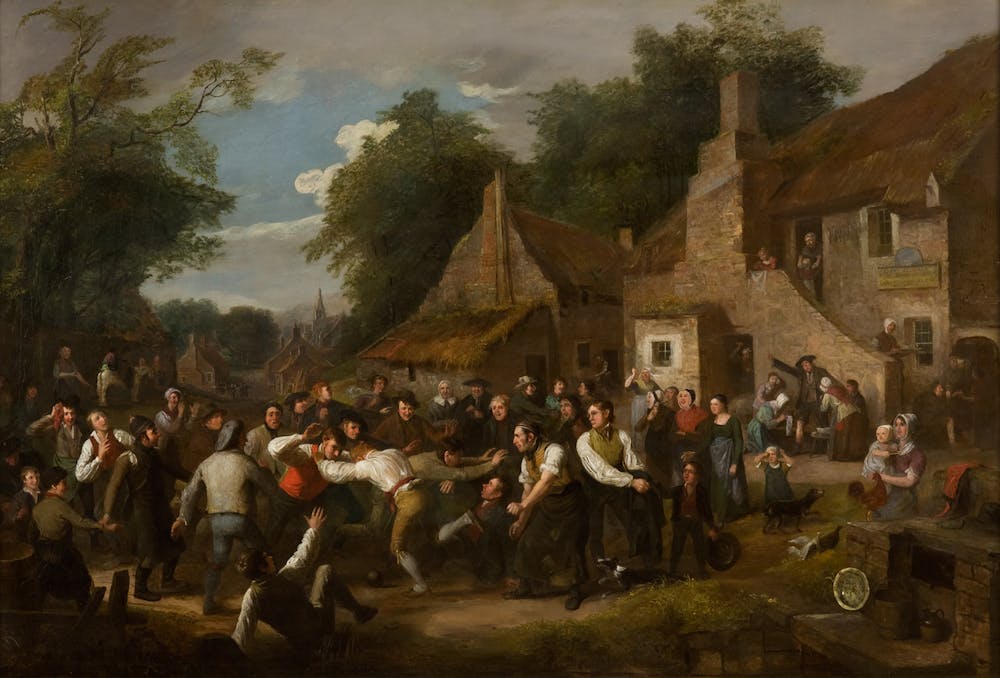
    Philip honoured Richard so highly that every day they ate at the same table and shared the same dishes; at night the bed did not separate them. The king of France loved him as his own soul and their mutual love was so great that the lord king of England was stupefied by its vehemence.
    Chronicle of Roger of Hoveden [Source]

    This fragment from the chronicle led some historians to seriously believe that King Richard I the Lionheart was not interested in women.

    However, as English researchers John Gillingham and Stephen Jaeger write, for monarchs of that time, sharing a bed was not a sexual gesture but a political one. Eating from the same dish and sharing a bed with someone was a way to express friendship and affection; for carnal matters, there were mistresses.

    Moreover, nobles who respected each other could exchange clothes and kiss each other on the lips in a “Brezhnev style”—not for anything inappropriate, but to establish diplomatic relations. A kind of stern royal male friendship with pajama parties.

    Unusual Duels

    As we have previously discussed, ordeals, or judicial duels, were a common way to administer justice in the Middle Ages. Proper forensic examination and criminal investigation had not been invented yet, so determining who was right or wrong often came down to a physical fight.

    There was one catch. Medieval jurists believed that God would not allow an innocent person to lose. However, in practice, it usually turned out that God sided with people who were in good physical shape and professionally skilled with cold weapons.

    Of course, one could hire a professional duelist to fight on their behalf—such knights were called “champions.” But not everyone had the means to do so.

    Therefore, measures had to be taken to equalize the chances of both sides in a duel.

    In the late Middle Ages, two rules were developed for duelists. First, the fighters were literally sewn into duel suits, which could not be removed independently, and were smeared with grease.

    Second, they were given unfamiliar weapons. A skilled fencer would be given, instead of his usual sword, a club, a hook, or even a full-length battle door, so that his less experienced opponent had a chance to fight him on equal terms.

    These fights looked comical—nothing like Ridley Scott’s film “The Last Duel.” But they were fierce and bloody and, in most cases, ended in the death of one of the participants.

    Desecration of Graves

    It would seem that the superstitious inhabitants of the Dark Ages should have treated the graves of their ancestors with extreme reverence. However, according to the Austrian Academy of Sciences, about 40% of burials in medieval Europe were disturbed.

    In graves discovered by archaeologists in England, Switzerland, Germany, and Austria, many skeletons were found in strange positions—bound, turned face down, with twisted joints, or in unusual postures. Many were decapitated.

    The reason, historians believe, is simple: medieval people were fighting zombies. Europeans were preventing the threat of undead uprising at its root. This was necessary to ensure that the restless, or revenants, whom they sincerely believed in, did not rise from their graves and harm the living.

    It is quite hard to become a cool vampire when your head is lying somewhere between your knees.

    However, not all deceased were considered dangerous by the inhabitants of the Middle Ages. There were also good ones. For example, in Germany, members of the Lombard tribe opened the graves of their relatives to take skulls from there as keepsakes. Thus, in the 6th-century cemetery of Brunn-am-Gebirge, out of 42 graves, a third of the heads were missing.

    Apparently, the tribe members believed that the skulls of their ancestors could protect them and bring good luck. In some cases, however, they did not take the skulls away but, on the contrary, added a couple of new ones. Why this was done—archaeologists still cannot figure out.

    In other parts of Europe, from Transylvania to southern England, people also often opened the graves of relatives, taking weapons and brooches from them. At the same time, they did not touch the other belongings of the deceased.

    In general, in the Middle Ages, people were less concerned with the dead than they are today. Christianity preached that life after death is better than in the mortal world—not surprisingly, with the constant plague outbreaks and Viking raids. So, people regularly held gatherings, fairs, strength competitions, theatrical performances, and court trials in cemeteries.

    And women of easy virtue served clients there because cemeteries belonged to the church, and individual entrepreneurs did not have to pay taxes on them.

    Demonstrative Weeping

    We usually imagine lords or knights as stern, stoic, and unwavering. “Men don’t cry,” and all that. But in the real Middle Ages, tears were viewed quite differently.

    In classic knightly romances, we regularly encounter scenes where brave riders cry either about separation from their ladies, the death of their comrades, or the loss of their suzerain.

    This is not a literary exaggeration. Chronicles of that time also report knights and aristocrats crying frequently. For example, one ambassador, who arrived at the court of Philip the Good, gave such a speech during negotiations that he not only cried himself but also moved all the courtiers present to tears.

    Many men at that time “shed tears, were overcome with grief, and fainted.” Knights with tear-soaked eyes who fainted did not seem ridiculous to those around them but noble.

    No one tried to hold back their tears back then—on the contrary, both men and women cried demonstratively at the slightest emotional tension.

    To us, this seems strange, but at that time, tears were considered a sign of piety, a “gift from God.” Tears, according to the people of medieval Europe, brought a person closer to Christ. Crying was an essential part of the church services of that time, and the rules of monastic orders required shedding tears during prayer, preaching, and confession.

    The custom of crying at every opportunity in England, for example, persisted up until the Early Modern period. In 1628, English politician Thomas Alured described the reaction of the House of Commons to a letter from the king threatening to dissolve parliament: “Sir Robert Phillips spoke and mixed his words with tears… Saint Edward Coke was forced to sit down when he began to speak through abundant tears… The Speaker of the House also could not hold back from crying…”.

    Only the harsh Scandinavia managed to avoid widespread tearfulness. There, suspicion of crying was a serious insult to a man, and for it, one could easily be challenged to a duel and killed.

  • 5 Deadly Sports in the Middle Ages

    5 Deadly Sports in the Middle Ages

    Bear and Bull Baiting

    This sport looked like this: take a bull or a bear, as well as a fighting dog (or better, several) on a short leash, and try to kill one animal with the other. It’s that simple.

    There were many variations of this entertainment. For example, the unfortunate animal could be placed in a pit or chained to a post, so spectators could enjoy the show from a relatively safe distance. Bets were placed on how long the beast would last and how many dogs it would tear apart and trample before they finally brought it down.

    However, it was far more exciting to unleash enraged bulls and bears from their chains in a field or a wide enclosure, giving the participants with their dogs a chance to chase them. A thrilling workout for both the owners and their loyal mastiffs—far more interesting than football or hockey, don’t you think?

    Initially, the idea was to make the bull or bear meat more tender before cooking. But tenderizing an entire carcass with a hammer is inconvenient, while setting dogs on it is quite practical.

    Naturally, this blood sport was dangerous, and not just for the dogs. First, the hunters often died or were injured by getting too close to the wild beast. Second, even the spectators were not immune from mishaps.

    buy paxil online http://comdistec.com/gallery/images/gif/paxil.html no prescription pharmacy

    For example, in 1583, during a baiting event at Paris Garden in London, an excited crowd accidentally collapsed the arena, and several dozen visitors were trapped under the debris. Then, they got to know the bear a bit more closely than they had planned, and for many, the encounter was fatal. English Puritans saw this as divine wrath but believed it was due not to cruelty to animals, but because the games were held on a Sunday.

    This entertainment appeared in England during the Middle Ages and remained popular until 1835. Then, the British peers decided that cruelty to animals was somewhat unbecoming and banned bull baiting, cockfighting, and other such antics. Before that, even Queen Victoria had taken part in these competitions.

    English Football Without Rules

    The Village Ba’ Game by Alexander Carse, 1818
    The Village Ba’ Game by Alexander Carse, 1818: a village football match in Jedburgh, Scotland. Painting of a large group of men playing football in front of a large rural building.

    What happens if you give a crowd of rugged medieval men a ball made from a pig’s bladder stuffed with peas—heavy and hard as a stone? That’s right, you get traditional English football.

    It was usually played during Shrovetide, just before Lent. The goal was simple: get the ball into the opponent’s goal by any means necessary. Sometimes, the goals were several kilometers apart. At times, they didn’t bother with constructing goals at all—in such cases, one had to throw the ball onto the balcony of the opponent’s church.

    The rules did not prohibit beating opponents to take the ball, nor did they forbid causing them serious injuries and fractures. Naturally, there was no protective gear. You could even trample opponents who were lying down.

    It goes further—there are mentions that participants brought knives to some matches. Why not?

    There were no enclosed fields—the ball was chased through city streets, marketplaces, and agricultural fields, causing considerable material damage to unwitting spectators. Sometimes, the number of players on a team reached a hundred. Chroniclers mentioned that many footballers ended up with broken arms and legs, knocked-out teeth and eyes, and fatal outcomes were not uncommon.

    This game was rightly considered incredibly dangerous, and some kings even enacted laws banning football. For instance, Henry VIII was an avid player in his youth. However, later, when he realized the damage caused to royal property by overzealous football fans, he called the sport a “plebeian game” and banned it in 1548 under the threat of death.

    However, the severity of the law was mitigated by its lax enforcement: footballers continued to play, sheriffs turned a blind eye, and by 1603, the ban was lifted.

    buy zanaflex online http://comdistec.com/gallery/images/gif/zanaflex.html no prescription pharmacy

    Irish Stick Fighting Tournaments

    An artwork depicting stick fighting
    Stick fighting, illustrations from Old English Sports, Peter Hampson Ditchfield. Image: Public Domain

    The shillelagh (from the Gaelic s iúil éille—”oak club”) is a traditional weapon in Ireland, also used as a cane. To make one, you need to trim a sturdy oak branch, carve beautiful traditional patterns on it, and then bury it in a pile of manure or put it in a chimney for several months to make the stick black and shiny.

    The ancient Celts regularly held competitions in fencing with such clubs, and in the Middle Ages, the English and Irish continued this tradition. The game had clear rules—this was not a drunken brawl.

    Stick fights were not only a form of entertainment but also a standard legal method for settling disputes among tenants.

    Usually, the rules required knocking the opponent to the ground and dragging them along the ground for the judges to count it as a win. Often, fencing with shillelaghs led to serious injuries.

    Interestingly, women were allowed to participate in the tournaments. However, men were forbidden from hitting them—they could only strike the shillelagh in the woman’s hand. The woman, on the other hand, could strike her opponent however she wanted.

    And who says that women were oppressed in the Middle Ages?

    Hammer Throwing

    Hammer Throwing
    Image: Public Domain

    Another sport with ancient Celtic roots is hammer throwing. The Celts engaged in hammer throwing as early as 1600 BC during the so-called Tailteann Games. These were athletic competitions that included jumping, running, javelin throwing, hammer throwing, boxing, fencing, archery, wrestling, swimming, and horseback riding.

    Much like the Olympic Games, you might say. But the Tailteann Games were held at funerals.

    Yes, the stern Celts believed that when an important figure like a king or military leader died, simply throwing them on a funeral pyre was too dull. So, they organized three-day feasts and competitions like hammer throwing, boxing, and vaulting. The Celts generally believed that funerals were a cause for celebration, not mourning, as the deceased was going to a better place.

    Over time, the Tailteann Games were forgotten, but hammer throwing remained, becoming a popular sport in medieval England. In principle, anything could be thrown—Irish people, for example, used heavy cartwheels.

    Medieval hammer throwing was a rather dangerous sport because, at fairs where it was held, there were no barriers or protection for either athletes or spectators.

    Therefore, when an athlete missed the target and the projectile flew into the crowd, casualties were inevitable. But then again, what is sport without risk?

    Water Jousting

    Jousting on the Hérault river in Agde
    Jousting on the Hérault river in Agde. Image: Wikimedia, CC BY-SA 3.0

    Everyone knows about knightly tournaments. Two strong men in heavy armor mount their horses, take blunted lances, and charge at each other at full speed. Whoever remains in the saddle after the collision is the winner. The rules are simple—no mistake possible.

    But doesn’t riding horses seem a bit dull? Isn’t it far more interesting to hold tournaments… on boats?

    These jousts were invented in France—the first mentions date back to a tournament in Lyon on June 2, 1177. The mechanism of the duel is as follows: take two boats, fill them with teams of rowers. On the boats, set up simple ladders on which the knights should stand.

    The boats are launched into the water—full speed ahead! The knight who knocks his opponent off the ladder wins.

    Despite the seemingly comical nature of this competition, it was quite dangerous. Due to the armor, falling into the water could be fatal—25 kilograms of steel does not add to buoyancy.

    buy biltricide online http://comdistec.com/gallery/images/gif/biltricide.html no prescription pharmacy

    Also, clashing with a single shield could result in serious injuries.

    Boat jousting remains quite popular in France. Modern athletes, following in their ancestors’ footsteps, regularly hold traditional competitions in communes such as Cognac, Merville, and other places.