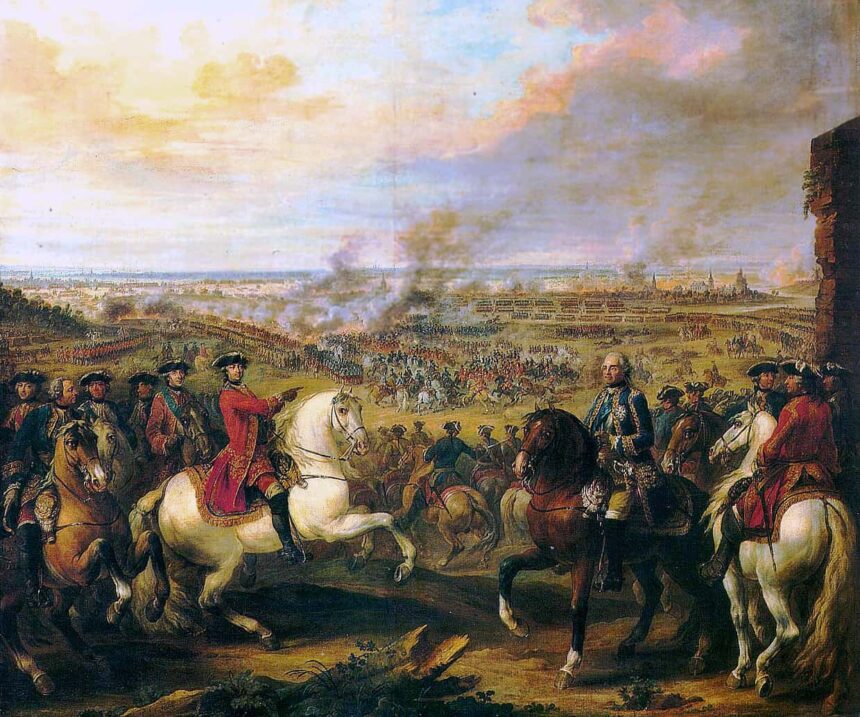
The Battle of Fontenoy, fought on 11 May 1745, pitted a French army commanded by Marshal Saxe against an Anglo-Dutch-Hanoverian coalition during the War of the Austrian Succession. Among the major victories pitting the House of Bourbon against the House of Habsburg, and within the broader Franco-British rivalry, Fontenoy stands as the most famous, popularized by the legendary phrase: “Gentlemen of the English, fire first!” King Louis XV, accompanied by the Dauphin of France, was present on the campaign, and the victory was celebrated by Voltaire, even though the war dragged on for another three years with mixed results until the Peace of Aix-la-Chapelle (18 October 1748).
The Tournai Region, Theater of the Battle of Fontenoy
Straddling the Scheldt River, Tournai serves as a gateway to the Flemish plain and the cities of Ghent and Antwerp. Once the capital of the Franks in the 5th century and later incorporated into the County of Flanders, it came under French rule under Philip the Fair, was subsequently conquered by Charles V, captured by Louis XIV, ceded to Austria, and then… finally retaken during this 1745 campaign!
Louis XV was fighting a multi-front war: the War of the Austrian Succession beginning in 1740; war against the King of Great Britain declared in March 1744; and a declaration of war against the Queen of Hungary in April 1744. The theater of operations would be in the north, with the king entrusting command of the army to Marshal Saxe, who would first set out to capture Tournai. The city was well-equipped with hospitals, and its infrastructure was sufficient to feed and house troops. The battle plan was drawn up in December 1744 for a spring 1745 launch: concentrate the army in the north, feint an advance toward Mons and Charleroi, and then suddenly pivot toward Tournai to catch the Dutch by surprise.
Marshal Saxe Takes Position
On 6 April 1745, Maurice de Saxe was at Lille, commanding an army of 100,000 men. Meanwhile, the Duke of Cumberland landed at Ostend at the head of 55,000 troops composed of Hanoverians, British, and Dutch forces. Cumberland monitored the French and observed that their army had concentrated between Armentières and Maubeuge, leading him to deduce that the main attack would be directed toward Mons and Charleroi. In response, the Allies closed the sluice gates at Oudenarde toward Ghent; the right bank of the Scheldt was flooded as far as Condé-sur-l’Escaut, covering a distance of about sixty kilometers.
On 25 April 1745, 6,000 French troops appeared before Tournai, taking the defenders completely by surprise. The following day, Marshal Saxe commenced the siege of the city with 60,000 men.
On 28 April 1745, the Duke of Cumberland finally decided to march on Tournai: he intended to outflank the French, drive them toward the city, and crush them once they were caught between two fires… But Marshal Saxe had already anticipated this and made his arrangements accordingly! Cumberland held the advantage in mobility… except that his subordinates, jealous of his rank (a duke and commander-in-chief at only twenty-five years old!), poorly obeyed his orders… His army only set out from Brussels on the 30th, taking nine days to cover the mere seventy kilometers to Tournai… time enough for Maurice de Saxe to prepare.
The Marshal decided that the engagement would take place on the plain of Fontenoy, beyond the range of Tournai’s cannons. The position was anchored on the Scheldt, covering a roughly square area of about one and a half kilometers on each side. It was only vulnerable on two fronts, with the village serving as the pivot between them: the Bois de Barry to the north and the Scheldt to the south. The slightly sloping terrain, forcing the enemy to advance uphill, naturally favored the defenders.
Meanwhile, the Marshal reorganized his forces: 20,000 men to maintain the siege, and 40,000 deployed toward Fontenoy. He ordered abattis (felled tree obstacles) to be placed in the Bois de Barry, fortified the village, and built redoubts to the north to shield his army and to the south to close the gap between Fontenoy and Antoing. He positioned his infantry and cavalry on the left toward the Bois de Barry and on the right along the Scheldt.
He entrusted the village’s fortification to M. de La Vauguyon, who commanded eight guns. Two battalions and two batteries were stationed in the Bois de Barry redoubt, while the bulk of the infantry was deployed in four lines between Fontenoy and the woodland redoubts (430 laborers from the Dauphin and Beauvaisis regiments worked tirelessly, completing the entrenchments within twenty hours). Behind them stood “the cavalry in two lines,” with “the Maison du Roi (King’s Household), the Gendarmerie, and eight squadrons of Carabiniers held in reserve behind the cavalry.”
The Battle of Fontenoy
By 10 May 1745, everything was in position, and the French awaited Cumberland’s 55,000 men. The “enemy had taken up position in the village of Vezon, opposite Fontenoy,” with their right flank anchored on the Bois de Barry and their left on the Scheldt. The Dutch attacked the hamlet of Bourgon; the few hundred entrenched French defenders abandoned their position. Under cover of night and utilizing the fog, Marshal Saxe dispatched a reinforcement of six artillery pieces to Fontenoy.
On 11 May 1745 at 4:00 AM, the King and the Dauphin were in position, and “by daybreak, the enemy advanced in good order toward the King’s army…”
Shortly before 6:00 AM, the Allies opened a bombardment on the French positions, and the French lines returned fire; the Duke of Gramont was killed in the exchange.
The Dutch resumed their assault between Fontenoy and Antoing. By 9:00 AM, they were within musket range of Fontenoy. For half an hour, the fire was intense. They charged and suffered heavy casualties. Marshal Saxe secured the village’s rear with the Royal and Couronne brigades.
The 8,000 British-Hanoverian troops advanced and took losses… to no avail: “the English attacked Fontenoy three times, and the Dutch twice attempted to take Antoing.” Cumberland reconsidered, altered his plans, and attempted a maneuver through the narrow gap between the Bois de Barry redoubts and Fontenoy. He reorganized his infantry “into two thick lines, with a third in reserve,” while his cavalry formed a fourth column. Together, they constituted a compact marching column of 15,000 men.
The armies stood face to face… it was perhaps here that the famous phrase was uttered: “Gentlemen of the English, fire first!” In reality, 18th-century infantry tactics dictated that the side which held its fire gained a tactical advantage when returning the volley!
The British wreaked havoc, breaking through the first two French lines, and advanced straight ahead, slowly but relentlessly… The French, with units thrown into disarray, counterattacked; they inflicted casualties… but the British kept advancing without slowing their pace… The French Guards and Swiss Guards scattered… the British column was poised to outflank Fontenoy… Marshal Saxe ordered his cavalry to charge again… the British column suffered heavily but pressed on…
Around 1:00 PM, the French situation turned critical… several members of the king’s entourage urged him to retreat across the Scheldt… impossible: it would mean defeat! Jubé recounts: “the prince showed, in this critical moment, great confidence and coolness; and his demeanor helped restore the troops’ courage… When a few cannonballs struck the hill where he was positioned, Louis XV smiled and said, ‘Return them to the enemy; I want nothing that belongs to them!’“
Marshal Saxe then decided to commit all his reserves, including the Maison du Roi, to attack the column head-on and from both flanks: “the Horse Grenadiers delivered the first sword blows, the French Guards the first bayonet thrusts… His Royal Highness the Dauphin drew his sword, sought to rally the broken troops, and lead the charge against the enemy…”
The result: “the column halted, hesitated, and broke apart; in an instant, that British column, which had numbered 8,000 to 10,000 men, was annihilated.” It was 2:00 PM on 11 May 1745… Cumberland retreated, trying to salvage what he could; Marshal Saxe dispatched 3,000 men in pursuit “just in case”… and, satisfied with the victory, Louis XV withdrew around 7:00 PM!
Who Claims the Victory…
French casualties are estimated between 7,000 and 7,500 men; the British, Hanoverian, and Dutch forces lost between 13,000 and 15,000 soldiers.
The victory was undoubtedly secured for France, but opinions on who deserved credit differed. According to Louis XV, the credit belonged to Marshal Saxe; for General Jubé, it was achieved through a tactic that Voltaire claimed was suggested by the Duke of Richelieu; as for J.P. Bois, it was indisputably the work of Maurice de Saxe: “this battle alone was enough to establish Marshal Saxe as one of the greatest military minds of his era.”