MalevusMalevus
  • HISTORY
  • SCIENCE
  • BIOGRAPHY
  • NEWS
MalevusMalevus
Search

Trending →

Why Did the Second Mexican Empire Collapse?

By Hrothsige Frithowulf
April 14, 2026

Colonialism in Tasmania

By Hrothsige Frithowulf
April 14, 2026

What Was the Schlieffen Plan and Why Did It Fail?

By Hrothsige Frithowulf
April 14, 2026

U.S. States Named After Real People

By Hrothsige Frithowulf
April 13, 2026

How Napoleon Bonaparte Built the Greatest Army of His Era

By Alby Butler
April 13, 2026
© Malevus. All Rights Reserved.
Malevus > Cosmos > The Universe’s Largest Structures: What Are Galaxy Groups, Clusters and Superclusters?
Cosmos

The Universe’s Largest Structures: What Are Galaxy Groups, Clusters and Superclusters?

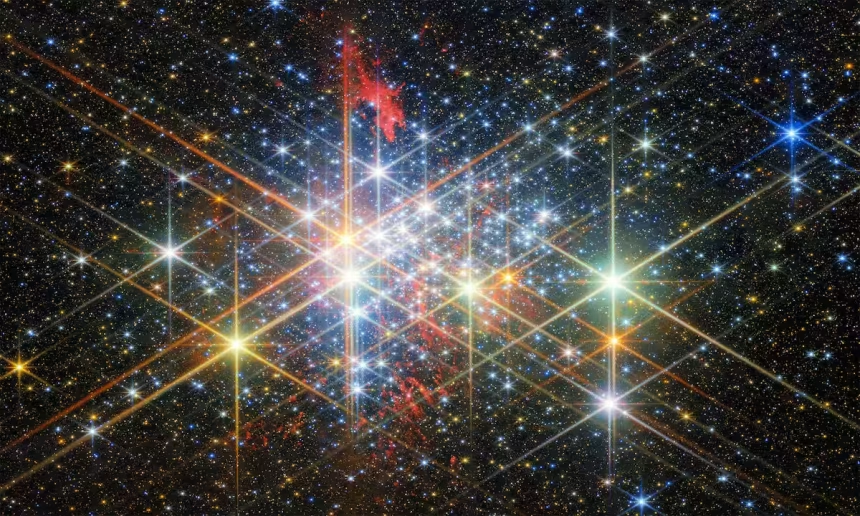
A supercluster is usually composed of hundreds or even thousands of clusters of galaxies, and these clusters are gravitationally bound together.
By Jim Collins
Published: March 15, 2025
Universe's Largest Structures
Previous Article Why Greek Island Houses Are Blue and White Why Greek Island Houses Are Blue and White?
Next Article What Causes Brain Freeze What Causes Brain Freeze?

You Might Also Like

Exomoons

Exomoons: In the search for habitable extrasolar moons

How Long Will It Take to Get to Each of the Planets

How Long Will It Take to Get to Each of the Planets

Perseids

Perseids: The Most Popular Meteor Shower

Moon-landing-conspiracy-theories-Arguments-and-answers

Moon landing conspiracy theories: Arguments and answers

How quasars produce the brightest light in the universe

How quasars produce the brightest light in the universe

Artemis 1

Artemis 1 is launched: Everything you need to about it

exoplanet HIP-65426b james webb

Webb Telescope Pictured The First Exoplanet: HIP 65426 b

Images from the "Hubble" space telescope: View of the globular star cluster Omega Centauri

Med-Sized Black Hole Discovered

higgs boson

The Higgs Boson: Everything About the God Particle

Image of the supermassive black hole at the core of the galaxy Messier 87 / ESO

What if the Sun Became a Black Hole?

820-foot megatsunami on Mars

820-foot megatsunami on Mars

BlueWalker 3 Huge satellite as the second brightest object in the night sky

BlueWalker 3: Huge satellite to be the second brightest object in the sky

MalevusMalevus
Follow US
  • Privacy Policy
  • Contact
  • About us
  • Editorial Standards