
In the aftermath of World War II, Europe sought ways to rebuild an economy that had been completely devastated. In 1951, six Western European nations, including France and the Federal Republic of Germany, signed the Treaty of Paris 1951. This first European treaty established the European Coal and Steel Community. In 1957, they ratified two additional agreements: the Treaty of Rome 1957, which created the European Economic Community, and the Euratom Treaty.
With the end of the Cold War and the collapse of the Soviet Union, it became necessary to rethink European integration. On February 7, 1992, after lengthy negotiations, the member states of the EEC signed the Maastricht Treaty. Entering into force on November 1, 1993, this founding text of the European Union added a political dimension to its original economic objectives. It also initiated the creation of a single currency, the Euro, and the European Central Bank. Revised several times by the Treaty of Amsterdam, the Treaty of Nice, and the Treaty of Lisbon, it laid the foundations of today’s Europe. What follows is a summary.
Why Was the Maastricht Treaty Signed?
After World War II, six Western European countries united to form the European Coal and Steel Community. This supranational organization aimed to support Europe’s economy and prevent further conflict between France and Germany. The ECSC was established in 1951 with the Treaty of Paris, which laid the groundwork for a European democratic framework.
In 1957, the six nations ratified the Treaty of Rome, establishing the European Economic Community. It came into force on January 1, 1958, expanding European cooperation and introducing both the common market and the Common Agricultural Policy, implemented in 1962.
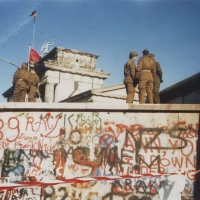
Following German reunification and the collapse of the Soviet bloc, which marked the end of the Cold War, deep reforms became necessary. From July 1990 onward, EEC countries worked toward creating an Economic and Monetary Union. In 1992, they ratified the Maastricht Treaty, which entered into force on November 1, 1993. Also known as the Treaty on European Union, it represents a fundamental step in European integration.
What Were the Objectives of the Maastricht Treaty?
With the ratification of the Single European Act, EEC member states committed to strengthening their common alliance. In 1992, the Maastricht Treaty formally established the European Union by profoundly modifying the Treaty of Rome. The European Economic Community became the European Community, signaling a move beyond purely economic goals.
The treaty expanded its ambitions to include political, financial, and social dimensions, while reinforcing the democratic legitimacy of European institutions. In addition to laying the groundwork for a single currency, it structured the EU around three pillars: the European Communities, the Common Foreign and Security Policy, and cooperation in justice and home affairs. It also established the Economic and Monetary Union, introduced European citizenship, and strengthened the powers of the European Parliament.
What Were the Three Pillars of the Maastricht Treaty?
Until 1992, three regional organizations coexisted: the European Community, the European Coal and Steel Community, and the European Atomic Energy Community. With the Maastricht Treaty, these were reorganized into the three pillars of the European Union.
The first pillar encompassed the European Communities inherited from the ECSC, EEC, and Euratom. This supranational pillar covered integrated policies, where member states transferred a significant portion of their sovereignty to the EU.
The second pillar concerned the Common Foreign and Security Policy, based on intergovernmental cooperation in foreign affairs and security.
The third pillar focused on police and judicial cooperation in criminal matters, addressing issues such as arms trafficking, drug trade, human trafficking, terrorism, organized crime, and corruption.
What Did the Maastricht Referendums Involve?
In most of the 12 member states, the Maastricht Treaty was ratified by national parliaments. However, three countries held referendums: France, Denmark, and Ireland. Despite expectations of smooth approval, the process proved more complex.
On June 2, 1992, the Danish referendum initially rejected the treaty, halting progress. Additional difficulties in Germany and the United Kingdom delayed ratification. The French referendum took place on September 20, 1992. After an intense campaign, the “yes” vote narrowly prevailed with 51.04 percent.
A second referendum was held in Denmark on May 18, 1993, where the “yes” vote succeeded with 56.07 percent. The Treaty on European Union finally entered into force on November 1, 1993.
What Is the Date of the Maastricht Treaty?
The treaty was signed by representatives of the 12 member states on February 7, 1992, in Maastricht. Ratification took place in the presence of Egon Klepsch. After lengthy negotiations, the treaty entered into force on November 1, 1993.
As the founding act of the European Union, the Maastricht Treaty evolved significantly over time. It was first amended by the Treaty of Amsterdam in 1997, then by the Treaty of Nice in 2001, and finally by the Treaty of Lisbon in 2007. Over two decades, the EU expanded from 12 to 28 member states.
How Was the Maastricht Treaty Signed?
After agreement, the Italian government was chosen as the official depositary. The signatories endorsed the creation of European citizenship and an Economic and Monetary Union. They also committed to developing a common foreign and defense policy and set a timetable for introducing a single currency.
However, the United Kingdom and Denmark opposed certain provisions, particularly those related to monetary union. After difficult negotiations, both countries obtained guarantees and accepted the new terms. Denmark then ratified the treaty following its second referendum on May 18, 1993, followed shortly by the British Parliament on May 20. The treaty ultimately entered into force on November 1, 1993.
What Does the Maastricht Treaty Contain?
The Maastricht Treaty structured the European Union around a common framework and three pillars. It consists of seven sections: principles, Union citizenship, Community policies, overseas associations, institutions, and general and final provisions.
Through Article G, which includes 86 paragraphs, the treaty significantly amended the Treaty of Rome. With its entry into force in 1993, the EEC was renamed the European Community. The EU undertook major institutional reforms, building on the Single European Act.
Article D formally established the political role of the European Council, while the legislative and supervisory powers of the European Parliament were strengthened through expanded co-decision procedures. Anticipating future revisions, Article N provided for an intergovernmental conference in 1996, which ultimately led to the Treaty of Amsterdam.