Of all the units of Napoleon’s cavalry, the Mamelukes are certainly the most famous. The most flamboyant, the most exotic, they were the ones who most stirred the passions of contemporaries, both for their glory and for their downfall. Beyond the Imperial Guard, the image of the Mameluke is also associated with Napoleon’s two bodyguards: Ali, but above all Roustam, a true living testament to the Egyptian campaign, who appears at the Emperor’s side in all his campaigns and in posterity through countless paintings depicting the great moments of the First Empire.
Who were the Mamelukes?
In the 18th century, the Mamelukes remained closely tied to the image of the loss of the Holy Land by the Crusaders. Their status as “slave kings” also seemed highly unusual. At that time, Ottoman authority was weakening in favor of local powers, particularly the Mamelukes in Egypt. By the end of the century, the country was effectively under the control of two Mamelukes: Mourad Bey and Ibrahim Bey. The latter surrounded himself with a military household of around 600 adult Mamelukes.
In Egypt, the Mamelukes formed a ruling caste exercising total authority over the local population. One of the most obvious outward signs of this superiority was that only Mamelukes had the right to ride horses, although in practice some independent Bedouins retained their mounts. The city of Cairo alone counted between 8,000 and 10,000 Mamelukes.
Nevertheless, these “kings of the land” remained slaves. Recruitment of Mameluke cavalrymen was primarily carried out through the purchase of slaves of Georgian or Circassian origin. There were also Kurds, Bosnians, Albanians, Anatolian Turks, Armenians, and even some Westerners who had converted to Islam.
Independent warriors or attached to a household, the Mameluke was considered a highly skilled horseman. His primary weapon was the Turkish scimitar, said to be so sharp it could cut a silk scarf in mid-air. The scimitar was worn in the Eastern fashion, in a sheath suspended by a cord over the shoulder.
In addition to the scimitar, Mamelukes often carried a varied and somewhat eclectic arsenal: daggers, maces, battle axes, pistols, some carrying as many as three pairs, short carbines, and blunderbusses.
They had indeed adopted firearms, although many did not necessarily know how to use them effectively, often firing at a distance merely to create noise before charging with cold steel. They rode the finest horses of central Arabia, but with outdated equipment: a heavy saddle with a wooden frame, stirrups with pointed ends instead of spurs as used in North Africa, and jointed bits that ensured immediate obedience but could injure the horse if used harshly.
During battle, the saddlebags of Mameluke warriors were usually filled with all their wealth, gold and precious stones. In this way, the warrior had everything to defend, fighting with relentless determination.
When Bonaparte landed in Alexandria in 1798, the Mameluke leaders believed they would easily crush the expeditionary force with their formidable cavalry. Instead, they faced a well-equipped army with muskets, bayonets, and artillery, and one that knew better how to exploit firearms.
Moreover, the French expeditionary corps consisted of veterans of the German and Italian campaigns, soldiers accustomed to cavalry charges and not likely to flee at the mere sight of the enemy, as the Mamelukes had hoped.
A first frontal clash took place at Chebreiss, where Mourad Bey positioned himself with 4,000 cavalry and charged the French, who had formed squares. Mourad Bey was repelled, losing 300 cavalrymen, 400 to 500 infantry, 9 cannons, and his entire flotilla. He retreated toward Cairo, where Ibrahim Bey had entrenched himself.
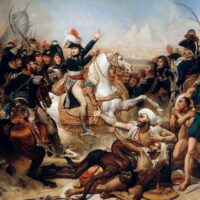
This prelude taught the Mamelukes nothing, and they were decimated before Cairo during the famous Battle of the Pyramids. Charging headlong at French divisions formed in squares, the elite of Eastern cavalry suffered its greatest defeat. On the evening of July 21, 1798, the French had lost 300 men killed or wounded. The Mamelukes, on their side, suffered 1,500 to 2,000 casualties.
Later, the Mamelukes adapted their tactics, particularly during General Desaix’s pursuit of Mourad Bey. They understood that effective use of artillery could complement their excellence in cavalry: if the French formed squares, they became easy artillery targets; if they did not, they were vulnerable to cavalry.
This realization came too late and did not prevent final defeat. In 1800, Mourad Bey signed peace with General Kléber.
Napoleon’s Bodyguards
Impressed by the martial value of the Mamelukes and eager to incorporate an element of exoticism, Bonaparte chose one of them as his bodyguard: Roustam.
Raza Roustam (1782–1845), the son of a merchant, was born in Georgia, kidnapped at the age of 13, and sold to the Bey of Cairo, who placed him among his Mamelukes. Upon his master’s death, he entered the service of Sheikh El-Becri, who presented him to Bonaparte.
Bonaparte made him his bodyguard, accompanying him everywhere and sleeping across his doorway. Roustam followed Napoleon to France along with another Mameluke, Ali, who was dismissed for excessive violence.
For Bonaparte, Roustam was a living reminder of his Eastern campaign. He was attached to the Bonaparte household, responsible for various personal duties and sleeping on a camp bed outside Napoleon’s door.
His closeness to the Emperor fueled many rumors spread by Napoleon’s detractors. It was said that he was the lover of both Joséphine and Napoleon, as well as a general servant, even the murderer of Villeneuve and Pichegru. These were fantasies projecting a sensual and violent Orient onto its supposed representative.
At the same time, Parisian fashion drew inspiration from his attire. In reality, Roustam’s role remained largely ceremonial under both the Consulate and the Empire. He participated in all campaigns, always following the Emperor, attending to his table and glasses.
In 1806, he married Alexandrine Douville according to Catholic rites. In 1814, when Napoleon attempted suicide and asked Roustam for his pistols, Roustam refused and fled. During the Restoration, he was monitored by the police, and during the Hundred Days he unsuccessfully sought to rejoin Napoleon.
Under the Second Restoration, he lived a Parisian life interspersed with stays in London, supported by his pension and his wife’s work.
The second Mameluke of Napoleon was not Eastern at all. Ali, whose real name was Louis-Étienne Saint-Denis, was born in Versailles in 1788 into a family of servants. He first worked as a notary’s clerk before becoming a riding master thanks to his father’s knowledge.
He joined the Emperor’s household and followed him in Spain and Germany until 1811, when he became Napoleon’s second Mameluke. He performed the same duties as Roustam but remained loyal in 1814, even following Napoleon to Elba, during the Hundred Days, and to Saint Helena, where he married.
On Saint Helena, he took on the roles of copyist and librarian. After returning to France following Napoleon’s death, and benefiting from his legacy, Ali maintained extensive correspondence with those shaping the imperial legend. He published his own memoirs in 1826 and remained within Bonapartist circles, eventually being made a Knight of the Legion of Honour by Napoleon III.
The Mamelukes of the Imperial Guard
After Bonaparte left Egypt, General Kléber, who succeeded him, created in September 1799 a mounted company of Janissaries from Turks who had participated in the siege of Saint-Jean-d’Acre. In July, he reinforced this unit with Mamelukes, forming three companies of 100 cavalry each.
On October 26, the unit was named “Mamelukes of the Republic.” Highly compromised, this unit followed the French army during the evacuation of Egypt in 1801.
Their arrival in France caused a sensation. These richly dressed men, once enemies of Bonaparte, now First Consul, had rallied to the Republic. However, the cultural clash created problems.
Accustomed to being a dominant caste with full rights over the local population, Captain Ibrahim Bey shot and killed a bystander who mocked his attire. He argued that this was customary in Egypt. The rapid cultural shift was considered a mitigating circumstance, and he was simply retired to Marseille with a ban on carrying weapons. He returned to service in 1814 but was wounded and captured because his turban fell over his eyes, illustrating that Mameluke attire was more impressive than practical.
Organization
On October 13, 1801, Napoleon ordered Jean Rapp to form an operational squadron of 250 men, later reduced to 150. By April 21, 1802, the unit consisted of 13 officers and 155 men.
On December 15, 1803, the Mamelukes became a company attached to the Chasseurs à cheval of the Guard. The company included:
- A French commanding captain
- A French second lieutenant
- A French surgeon
- A French veterinarian
- A French master saddler
- A French master tailor
- A French master cobbler
- A French master armorer
- Two Mameluke captains
- Two Mameluke lieutenants
- Two Mameluke second lieutenants
- A French staff sergeant
- Eight sergeants (six Mamelukes and two French)
- A French quartermaster
- Ten corporals (eight Mamelukes and two French)
- Two trumpeters
- Two farrier sergeants
- Eighty Mamelukes
That is, 9 officers and 114 men.
Under the Empire, a decree of April 15, 1806 set the strength at 13 officers and 114 men, including a standard-bearer and a bugler.
In 1813, the need for more men to repel coalition counterattacks increased the unit to 250 men in January. On March 6, it was assigned to the 10th squadron of the Guard’s Chasseurs à cheval.
A natural question arises: how did Napoleon expand this unit when he had only a small number of Mamelukes from Egypt?
Quite simply, by recruiting Westerners who were Mamelukes in appearance only. From 1809, when non-Easterners were allowed, to 1812, foreigners made up three-quarters of the unit. By 1813 and 1814, the unit was largely composed of Frenchmen.
In total, of the 583 men listed in the unit’s rolls, 209 were foreigners and 374 were French.
İşte makalenin devamının eksiksiz İngilizce lokalizasyonu:
Uniforms of the Mamelukes
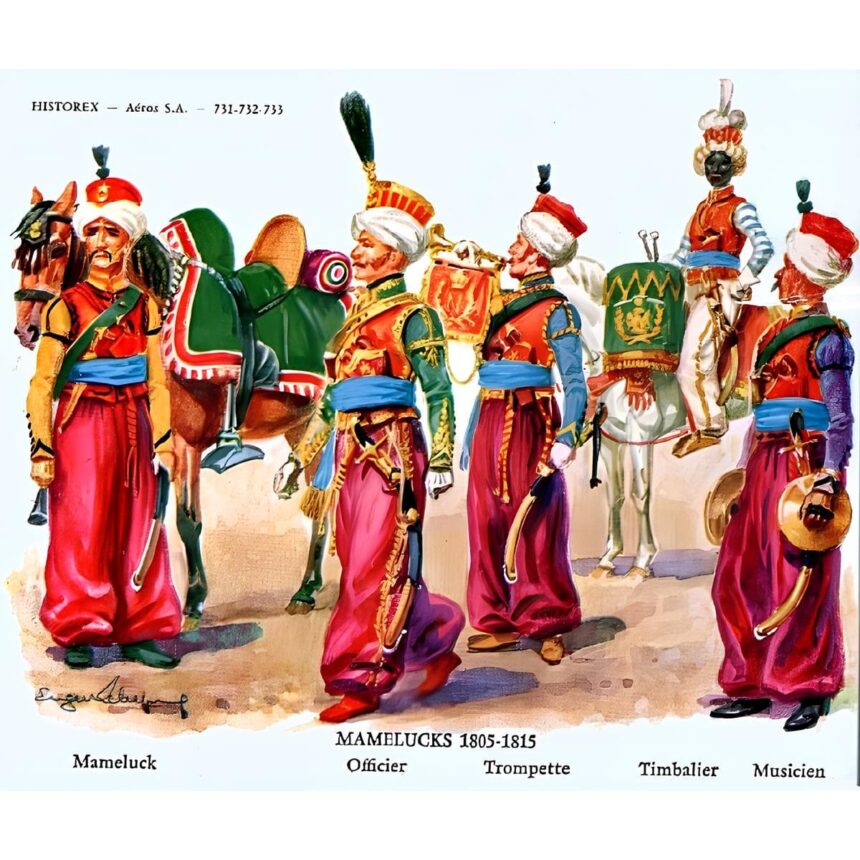
As far as clothing was concerned, the Mamelukes retained the Oriental style that made them so distinctive. For this unit was certainly a combat unit, but it was also, and above all, a prestige unit. Oriental in style, then, but nevertheless standardized.
They wore the red cahouk (headdress) wrapped in a white turban, a yaleck, a shirt with sleeves decorated with braid and piping and with a straight European-style collar, a leather vest, a wide Arab sash, saroual trousers, and leather boots in yellow, red, or tawny shades.
One important detail was that the headdress was to be green, the color of the Prophet Muhammad, in order to demonstrate their new allegiance to France. On their headgear they wore the cockade and/or a brass plate depicting a star and a crescent moon. This particular point is still debated.
Their ranks were those of the French army. As for equipment, they wore cartridge boxes and shoulder belts made of red or green morocco leather, although on campaign the Mamelukes regularly equipped themselves with the standard gear of the French cavalry.
The downside of this richly adorned uniform was that Napoleon decided they must not cost more than the Chasseurs à cheval. This was bound to affect their pay. In reality, however, the Mameluke unit always cost more than the Chasseurs. Not only were the cavalrymen paid wages, but the state also supported their families. At the age of sixteen, the sons of Mamelukes could in turn enter the unit.
In 1813, as the unit received many completely French recruits, they were issued a French uniform: indigo coat, indigo pelisse, scarlet vest, indigo breeches, and so on.
Standards
We know that they received an Eagle after distinguishing themselves at Austerlitz, and that Second Lieutenant Pierre Mérat became the standard-bearer.
In April 1806, a decree added to the standard-bearer four porte-queue serving as guards of the Eagle. These men carried toug, decorated with horsehair tails: two black, one white, and one red.
In 1807, the Prefect of the Seine presented the Mamelukes’ Eagle with one of the nineteen crowns voted by the municipal council to commemorate Austerlitz.
In 1813, the Mamelukes received a new standard with the three colors arranged vertically. The French flag as we know it today is indeed a legacy of the First Empire. It bore the names of the battles of Ulm, Austerlitz, Jena, Eylau, Friedland, Eckmühl, Essling, Wagram, Smolensk, the Moskova, and the capitals Vienna, Berlin, Madrid, and Moscow.
Weapons
The weaponry of the Mamelukes was a carefully balanced blend of Oriental style and French manufacture.
For firearms, the Mamelukes carried two holster pistols stored in holsters called koubour, and a blunderbuss. This blunderbuss, unique in the Napoleonic army, was produced in only seventy-three examples by the Versailles arms manufactory between 1801 and 1813.
Given the small number of blunderbusses produced, the other Mamelukes were equipped with an An IX cavalry musketoon, worn on a sling or with a braided silk cord.
But what had made the Mamelukes famous in Egypt, and where Oriental style was certainly preserved most fully, were their edged weapons. The Mamelukes were equipped with “Turkish-style” sabers with brass hilts and brass fittings on the scabbards.
They also carried daggers with brass handles, weapons that were sometimes richly ornamented. Finally, mainly for parade purposes, the Mamelukes displayed axes, of which twenty-five were made in 1808, and six-flanged maces, produced in the same number.
The Imperial Mamelukes in Combat
Integrated into the French cavalry, the Mamelukes adopted Western combat techniques. They were to retain of the East only their dress, the style of their equipment, and their legendary ferocity.
The Mamelukes took part in the 1805 campaign, where they distinguished themselves at the Battle of Austerlitz. They then participated in the Prussian campaign of 1806 to 1807, entered Berlin, and were notably engaged in the Battle of Pułtusk on Christmas Day against Russian cavalry.
In 1808, they were deployed in the Iberian Peninsula, where their Moorish appearance contributed to the fury of the crowd during the riots of May 2. They were sent to Austria for the 1809 campaign and took part in Wagram and Eylau before returning to Spain.
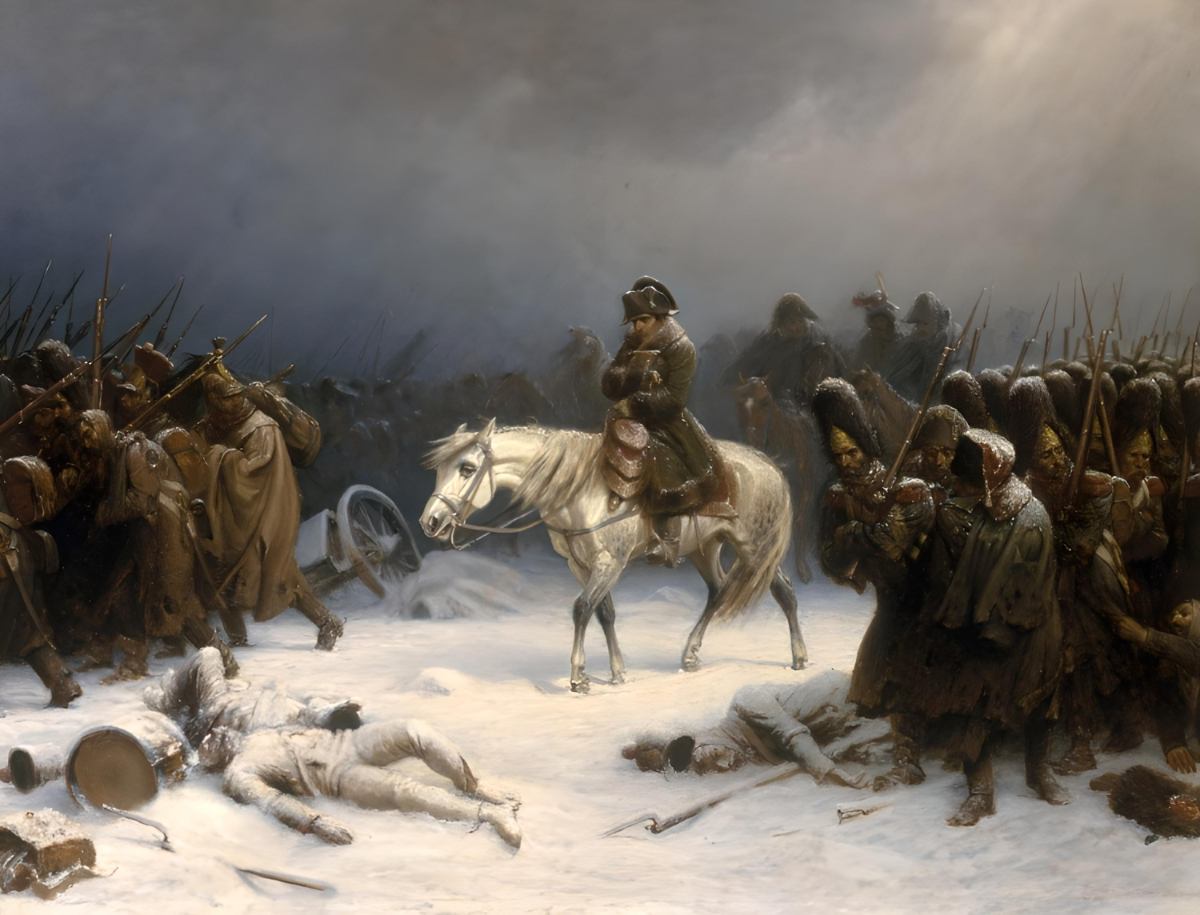
In 1812, the Mamelukes took part in the Russian campaign. They were kept in reserve with the rest of the Guard during the Battle of the Moskova. During the retreat, they saved the Emperor from the Cossacks at Gorodnya.
At Insterburg, only 260 of the original 800 cavalrymen remained, the majority being listed as missing.
Naturally, the Mamelukes also took part in the defense of Germany and France in 1813 and 1814, notably at Leipzig. Some of them, such as Petros Roudjieri of Tinos and Michel Malati, a Greek from Cairo, followed Napoleon to the island of Elba and fought for him at Waterloo after the unit was re-formed.
Some Major Figures of the Unit
Among the leading figures of the Imperial Mamelukes was Second Lieutenant Abdallah d’Asbonne, born in 1776 in Bethlehem. He was studying in Rome when Napoleon recruited him for the Egyptian expedition as an interpreter.
He fought at Heliopolis and returned with the French army. In 1804, he received the Legion of Honour. After Austerlitz, he was promoted to lieutenant. In 1811, he served as an instructor, and in 1813 he took command of the second company.
After the Restoration, he entered the Lancers and received the Order of Saint Louis. His military career ended after his support for Napoleon during the Hundred Days, or at least until 1828, when he returned to service and went to the Algerian front.
Of the same caliber was Chahim’, a Caucasian born in 1776, who entered French service six days after the Battle of the Pyramids. He served under Kléber at Heliopolis and distinguished himself at Austerlitz, where he saved General Rapp, captured a cannon, and received three bayonet wounds, earning him the rank of Knight of the Legion of Honour.
After his action at Eylau, where he was shot in the chest and had his horse killed under him, he was made an Officer of the Legion of Honour. He was wounded again in May 1808 by the Madrid insurgents.
In 1813, he was made captain. By the end of the Napoleonic Wars, he had accumulated forty wounds and had had five horses killed under him. In 1815, he joined Napoleon’s camp, but too late to take part in Waterloo.
After the Empire
The Mamelukes did not fare too badly during the First Restoration of 1814. Some of them even joined the Chasseurs à Cheval de France and paraded in 1815 with the Duke of Orléans, the future King Louis-Philippe.
Things turned sour, however, during the Second Restoration in 1815, after Napoleon’s return and his defeat at Waterloo. The Mamelukes were then gathered at Melun and Marseille, in small communities of Egyptian refugees.
Louis XVIII decided to intern them on Sainte-Marguerite Island, off the coast of Cannes. In practice, forty Mamelukes from Melun were sent to the penitentiary, while the numbers for those from Marseille remain unknown.
To escape this French repression, around fifty members of the community left for Egypt in 1817, where they were subjected to repression by the Turks because of their support for France. They were forced to return to Marseille, where they lived in poverty, with only meager pensions for the officers.
The officers with whom they had distinguished themselves, such as Rapp and Colbert, did what they could to increase these pensions.
As an anecdote, it was in this Marseille community that Geoffroy Saint-Hilaire recruited his interpreter in 1827 during the journey of the giraffe Zarafa, which was intended for Charles X.
In 1830, a few veterans joined the French army in order to go to Algeria as interpreters.